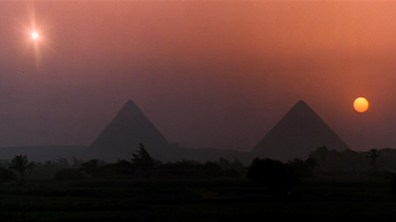
Blade Runner!

Third on the queue, the sci-fi and cult classic Blade Runner! Thank God too, since my first two reviews were both about movies I really didn’t like. While it’s fun to bash bad movies, it can leave a bad taste in your mouth. Good movies are like Listerine that way, they cleanse the critical palette, renew your faith in the visual medium. And as promised when I first decided to do reviews, movies based on books would receive special mention, especially movies that differed greatly from the books that inspired them. Truth be told, I had Blade Runner in mind when I made that statement, and a number of other Philip K Dick stories that went on to become films. In fact, the movies Minority Report, Paycheck, Impostor, The Adjustment Bureau, and Screamers were all movies based on Dick’s stories (which I plan to review soon enough!). And in every case, the films were quite different from the original works. You might even say it’s the Philip K Dick curse: to see your novels and short stories inspire film adaptations, but only after you’ve died and always with big changes! And without a doubt, Blade Runner was the most extreme case of this curse at work. In terms of plot, story, and especially tone and setting, the movie was vastly different from the novel. I’d say shame on the people who made this movie, but the truth is, it kind of worked in their favor…

(Background—>)
A few years back, I finally got around to reading Do Androids Dream of Electric Sheep? which was the original title of the novel that would be the basis for the Blade Runner movie. Having already seen the movie, I found the novel quite surprising, and at times, downright odd. But it’s message and style eventually won me over, as did the comical and satirical aspects that Dick made use of. Whereas the movie was set in a Los Angeles of the future – a noire, dystopian crowded cityscape marked by flying cars and massive video advertisements on the sides of skyscrapers – the novel takes place in a relatively depopulated post-apocalyptic LA where the only people who remain are those who are either too poor or don’t have the requisite IQ levels to get a pass off-world. These colonies get a passing mention in the movie in the form of ads being broadcast from flying zeppelins, but the focus is overwhelmingly on life in the city. Another major difference is the lack of satirical consumer goods that were in the original novel: emotional dialers that people use to set their moods and empathy boxes that are basically TV’s that provide an interactive emotional experience. Both were touches of genius, hilarious but also very interesting in how they help to advance the story.

But by far, the greatest difference between the novel and the movie was in terms of theme. Whereas the novel was very much concerned with the fine line between artifice and authenticity (the robots representing the former), the movie depicted the Replicants (the AI’s) as tragic figures who are given the gift of life, only to have it taken away in the form of slavery, four-year lifespans, and “retirement” (i.e. execution) if they break the rules. So really, the book was a touch more simple in how it perceived machines: as cold and heartless, characterized by false animals, false humans, and nuclear arms. The movie depicted this in more complicated terms, blurring the lines between artificial and authentic, human and machine. Whereas in the book we don’t much care about the Replicants, in the movie, they are about the only characters we sympathize with.

(Content—>)
The movie opens on the city of Los Angeles in the future, circa 2019, where a Blade Runner detective has gone to the Tyrell Corp (the maker of Replicants for off-world use) to issue a Voight-Kampff test to one of the employees. This test, we soon learn, measures emotional responses and is the only way to tell the difference between a Replicant and a human. This is because the latest models (known as Nexus 6’s) have surpassed humans in all aspects, but still have a hard time mimicking human emotions. The Tyrell Corporations motto is “more human than human” for a reason, you see. And for reasons of legality that are mentioned in the movie’s preamble, no Replicants are allowed on Earth, so anyone suspected of being one is required to take the test and then “retired” if they fail. Upon realizing why he’s being tested, the employee shoots the Blade Runner and escapes. Guess he failed!

We then move to the character of Rick Deckard (played by Harrison Ford), who is enjoying a bowl of noodles at a street vendor when a bunch of LA police men approach him and demand he come with them. In this scene, we are given a ground level view of the noire city, as well as a taste of cityspeak. This lingo is the language of the street in the Blade Runner universe, a mishmash of various tongues which is illustrated beautifully by the character of Gaff (played by Edward James Olmos). Deckard goes with them and is told by his old chief that he’s needed again, and despite his reluctance, he takes the job. As his boss says, “you’re not cop, you’re little people!”, meaning he really has no choice in the matter. What follows is an admittedly expository scene, but a totally justified one, where we learn who the “bad guys” are as well as some other pertinent facts. For example, we learn that in addition to their difficulty approximating human emotions, Nexus 6’s also have a four year lifespan that ensures that they will never be able to overcome this flaw. Too much time, too many memories, and they might become totally indistinguishable from the rest of us. Spine tingly!

Afterward, Deckard goes to the Tyrell corp to meet the CEO and learn what he can from them. Sidenote: I could be wrong but I think the set designers got an award for the design of this one building. Part sky scraper, part Ziggurat, totally awesome! Here, we meet not only Tyrell himself, but a Replicant named Rachael (played by Sean Young). She represents a new breed of machine specially created by Tyrell to test out a new idea: giving Replicants memories so they’ll have an easier time dealing with emotions. After running the Voight-Kampff test on her, Deckard is both intrigued and frightened by her, a feeling that haunts him for the rest of the movie, and that I believe is meant to represent the love-hate relationship humanity has with technology. What is also interesting is that she doesn’t yet know that she’s a machine, but once the test is done, she overhears Deckard talking to Tyrell and is shattered by the news.

The movie then splits between the Replicant party, led by a unit named Batty (Rutger Hauer) who is trying to find the men most directly responsible for their creation, and Deckard who is trying to find the Replicants and determine why they came to Earth in the first place. In between, there are the scenes that catalog the budding romance between Deckard and Rachael, who herself seems to be torn between her attraction to Deckard on the one hand, and disgust over what he does. This part of the story, more than anything, helps to illustrate the blurred line that exists between artificial and real. While a relationship between the two of them would certainly be considered taboo, neither of them can resist the allure of the other. Over time, Rachael appears to make peace with the fact that she is a machine, and Deckard seems to get over it as well (wink wink!)

Ultimately, Batty and what is left of his companions (because Deckard keeps killing them), make their way to Tyrell himself. Their whole purpose, we learn, was to find a way to extend their lives. What follows is, in my opinion, one of the best scenes in cinematic history. In the course of a very civilized conversation, Batty is told that there is no way to extend his life, and never was. His hopes, and everything they did in order to get to Earth and find Tyrell, were therefore in vain. Tyrell tries to comfort him by telling him that “the candle that burns half as long burns twice as bright.” He further tells him to let go of whatever guilt he harbors for all the things he did to get to Earth and see him, that he should “revel in his time”. But, overcome by anger and grief, Batty kills Tyrell and escapes from the building. One of the things that makes this scene so good is the fact that you genuinely get the feeling that a sort of father-son dynamic (or that of a man meeting his God) is taking place between them. In addition, you can feel the pain being exuded by Hauer as he kills Tyrell. Obviously it pains him to murder his “father”, but he’s got nothing to lose and just needs someone to blame for the fact that he’s going to die and is helpless to do anything about it.

Shortly thereafter, a confrontation ensues between Deckard and Batty at the Replicant’s hideout. And in spite of the fact that Deckard has now killed all his companions and he is poised to deliver the death blow, Batty chooses instead to save his life. His final scene, as he sits half-naked in the rain holding a dove, are yet another example of cinematic genius. “I’ve seen things you people wouldn’t believe…” he says, the rain dripping from his face. “Attack ships on fire off the shoulder of Orion. I watched C-beams glitter in the dark near the Tannhauser gate. All those moments will be lost in time… like tears in rain… Time to die.” So sad, even Harris Ford shed tears, and he’s fricking Han Solo and Indiana Jones! The police then show up, Gaff let’s him know that his girlfriend’s secret is out, but that he left her alone. As he says, “It’s a shame she won’t live. But then again, who does?” Whether or not he’s referring to the fact that she will eventually be hunted down, or to her four year lifespan, is still a bit of a mystery to me. But in either case, by the end, Deckard is finished with being a Blade Runner and runs off with Rachael, finding a measure of redemption through his relationship with her.

(Synopsis—>)
Blade Runner was panned by some critics who didn’t like the pacing of it, and my own wife remarked the first time she saw it that she felt a little let down. But of course she, and I imagine many of those critics, were expected an action movie and not the cinematic tour de force that it was. With a name like Blade Runner, you kinda sorta think it’s going to be an action flick. But upon seeing it for a second time, her feelings changed and she saw the depth it undeniably has. And despite doing poorly at the box office, time has been very good to this movie, elevating it to the status of a cult classic and an example of cinematic gold. In fact, over the years it has appeared on numerous top 100 lists, not only as one of the best sci-fi movies of all time, but also one of the best movies period. Who am to argue? And hell, why would I even want to? I love this movie!

Blade Runner:
Entertainment value: 7/10 (admittedly, bit slow in places)
Plot: 8/10
Direction: 10/10 baby!
Overall: 8.5/10

Coming reviews!

Not long ago, I plotted a list of movies that I wanted to review in the coming weeks and months. Thus far, I’ve fulfilled on the two of the first three I promised: Terminator: Salvation and Independence Day. However, the third movie I planned to do (Transformers 2) has dropped from the list. Why review a movie so bad that even the director and lead star admitted that they thought it was a mistake? Especially when there are so many superior movies out there that are more deserving of attention? So, to simplify things, and give myself something that I can stick to, I’ve prepared the following list of sci-fi movies that I hope to review:

1. Terminator: Salvation – July 7th
2. Independence Day – July 9th
3. Blade Runner – July 10th
4. Dune (1984, and the 2000 miniseries) – July 14th, 16th, and 18th
5. 2001: A Space Odyssey – July 21st
6. The Terminator franchise (movies 1 through 3) – Aug. 7th, Aug. 13th…
7. Alien franchise (movies 1 through 4) – July 10th, July 11th…
8. A Clockwork Orange
9. Akira – Aug. 2nd
10. Starship Troopers – July 28th
11. Predator franchise (1, 2, and Predators)
12. Screamers (first in the Philip K Dick lineup)
13. Impostor
14. Paycheck
15. Lord of the Rings (like I said, some fantasy will slip in, and allowances must be made for such classics!)
16. A Scanner Darkly
17. Willow (another fantasy honorable mention)
18. Solaris (the original and the Soderberg remake) – thanks to Tom Sharp for the suggestion!
19. The Adjustment Bureau (finishing off the PKD segment)
20. Inception
21. The Star Wars Trilogy
22. The Star Wars prequels – Aug.24th and 25th
23. V for Vendetta
24. Avatar
25. District 9

That’s a tentative list for now. As the weeks go on, I might feel the need to revise or reshuffle the list, depending on new ideas or just my mood! And as I said earlier, suggestions are welcome and I’ll be sure to give a shout out to whoever puts an idea in my head or convinces me to include something I wouldn’t have thought of otherwise. In spite of my enthusiasm for science fiction and movies based on popular novels, there are still many authors and hidden gems I have not yet gotten into. So let me know what you think, and moving on! Next up, Blade Runner!

Independence Day!

Welcome back! For my second review, as promised, I will be covering the enduring (ahem) “classic” of Independence Day. Though it has been repeatedly panned by critics, is an undoubted cheese-fest and full of plot holes and Deus Ex Machina plot twists, I have to admit that I actually liked this movie when it first came out. Years later, it remains a sort of guilty pleasure for me, something I routinely poke fun at, but will still sit and watch. If nothing else, its rah rah tempo, stupid one-liners and over the top action are good for a laugh, and maybe a little excitement. Just be advised, taking this movie seriously is not advisable… But, since I gotta review it, I’m going to have to do just that. Wish me luck!

(Background—>)
Not that long ago, while discussing this movie over dinner, some friends mentioned that they thought this was a Michael Bay movie. They were wrong, of course. In truth, Roland Emmerich directed it, but the mistake was understandable. Much like Bay, Emmerich has a reputation for making movies that are all form and special effects, always lacking in depth, plot and character development. To illustrate, here are some of the movies he made after Independence Day: Godzilla (1998), The Patriot (2000), The Day After Tomorrow (2004) and 2012 (2009). In addition, he’s also been known to rip off other movies from time to time. Consider the Patriot, which was basically Braveheart meets the American Revolution, or Independence Day’s constant borrowing from other sci-fi movies: Star Wars, Close Encounters, War of the Worlds… the list goes on. And in many respects, his later directorial ventures were obvious attempts to recreate the cash cow that Independence Day turned out to be. Still, one can’t deny that things kind of came together for him with this movie. But putting its commercial success aside, let’s get down to dissecting this bad boy!

(Content—>)
The movie opens with a shot of the Apollo landing site, where a shadow slowly covers Old Glory. The shot then pans to Earth where alien ships begin to slowly move into the frame. With this one shot, the audience is exposed to two of Emmerich’s characteristic moves: using landmarks every chance he gets, and ripping off other franchises. Star Wars fans will immediately know what I’m talking about, remember how all the originals began with ships moving into frame from behind the camera? Yeah, well the same thing is happening here. Cut to Earth where dozens of characters, most of whom we’ll never see again, are busy talking about the objects moving into Earth orbit. Will Smith (a marine fighter pilot) the president (a former fighter pilot, played by Bill Pullman), and the crazy alcoholic played by Randy Quaid (another former fighter pilot!), and all his other characters are hurriedly introduced, showing how this event is being perceived by the different people all over the country. Here is yet another characteristic Emmerich move, putting way too many people into a movie, most of whom do nothing except say a line to move the plot along, then either die or are never heard from again.

Moving on, the tension begins to build as everyone begins to ask the obvious: what are they doing here? Naturally, we are shown multiple shots of people all over the world reacting, all of them stupid and cheesy. Some people are thrilled, some think they’ve brought Elvis back, and of course Quaid launches into a drunken rant about how they abducted him way back when (which is apparently why he’s a drunk in the first place). Then, in the movie’s first totally implausible twist, a cable repair man played by Jeff Goldblum discovers that the aliens are using Earth’s satellites to broadcast a countdown signal to all their ships, which are at that moment poised over Earth’s major cities (fans of the V series will recognize this is another case of Emmerich ripping off a respected sci-fi franchise!) Anyhoo, Goldblum discovers this, and brings it to the president, who he just happens to have an in with because he ex-wife works for him. He has to, you see, because somehow the government has missed all this. Yes, that’s right, the US government, in possession of the best scientific minds and cryptologists thanks to NASA, the NSA, the CIA, etc, failed to notice something a cable repair man picked up on. Emmerich himself seemed to recognize the implausibility of this and wrote in an explanation of sorts. Apparently the signal was “subtle”. Yeah, good to know the guy who installs HBO on your home entertainment system is smarter than the guys who send rockets into space and hunt terrorists for a living!

Incidentally, I should take this opportunity to mention all the expository dialogue which takes place within the first thirty minutes. As if it wasn’t clear already, we are made blatantly aware of the fact that Goldblum and his ex-wife still love each other, Will Smith is planning on marrying Vivica A Fox, that he wants to go into space (hint hint!) and that the president is a former soldier who can’t tell a lie! You know, when you have to actually tell the audience what they are supposed to be feeling, it kind of comes off as lazy. But that’s in keeping with Emmerich’s style I guess, pictures instead of words and a few quick and cheesy lines instead of slow, gradual character development. Always taking the short route, eh Emmerich?

In any case, Goldblum warns them, they take him seriously, and the countdown is on! The aliens are clearly going to attack… and then they do! Boom, blam, kapow! The aliens blow up all the landmarks they’ve chosen to hover over and that we are so familiar with. The Chrysler building, the White House, and… I dunno, downtown LA? Yeah, that shot was kind of devoid of landmarks, but I’m guessing blowing up the Hollywood sign just seemed too over the top for this movie. But showing the Statue of Liberty wrecked and toppled over into New York Harbor in the very next shot did not, apparently. What follows is a desperate fight scene where Will Smith’s fighter squadron attacks the LA ship, and in a scene totally ripped off from Star Wars: Return of the Jedi, the entire squadron has to do the whole “pull up, all craft pull up!” thing. Why? The ship has shields, wouldn’t you know? And they are about to fly right into them! Naturally, Smith survives, even if his whole squadron, including his wisecracking friend (played by Henry Connick Jr) gets killed. He even manages to take an alien prisoner, knocking him out between one-liners. “I wrecked your plane!” Whack! “Welcome to Earth!” “Now that’s what I call a close encounter!” One would think he would be a bit sad that all his friends and comrades just got their asses shot to hell, but whatever man, its Will Smith! People expect a certain amount of cool catch-phrases from the man and he has to deliver. It’s in his contract…

Back to Airforce One, where the president, Goldblum, his ex-wife, stereotype dad, and about a half dozen other cardboard stand-ins are talking, we learn that some people knew about these aliens already and kept quiet about it. Even as a teenager when I first saw this, I began thinking to myself “Oh God no, they wouldn’t!” But then, they did! Turns out, and in keeping with Emmerich’s tendency to take the quick and easy road, Area 51 really does exist, and that it really does house the bodies of those aliens who crash-landed at Roswell in 1947, along with their spacecraft. So naturally, that is where they go. Which also happens to be (holy coincidence!) where Will Smith is heading to at that very moment. Why he would be doing that is something not worth considering, that’d just complicate things at this point. I mean, its not like LA and Area 51 are that far apart, right? Actually, there’s about 400 km (or 250 miles) between them. And, as all Marines know, if you get into a dogfight with an alien and happen to take it prisoner, no matter where you are, you should start dragging its carcass to the secret airbase in the middle of the Nevada Desert. Just makes sense! Okay, and in another act of total contrivance, it just so happens that Randy Quaid and a caravan of Winnebagos are heading that way too. So basically, all of the main characters are converging on this one place! How convenient! As if that wasn’t enough, as soon as they all get there, Will Smith steals a helicopter, flies back to LA (what happened to all those alien space craft that were shooting their planes down?) and just happens to find Vivica A Fox and the First Lady, who just happened to find each other after the city got flattened. Just how small is LA anyway?

Then, more expository stuff happens. The prez talks to the weird scientist in charge (played by Brent Spiner, aka. Data from Star Trek TNG) about the aliens and their gear. They then do an alien autopsy on the one Smith captured, which goes horribly wrong when it wakes up and has no restraints to contend with (c’mon people!). And the prez talks to it and finds out they want Earth’s resources because “they’re like locusts”. This is just one of many shallow environmental statements made by this movie, but I digress. This prompts them to try and nuke one of the ships, but wouldn’t you know it, those darn shields are impervious to thermonuclear weapons too! So Goldblum, after yet another expository speech where Judd talks to him about keeping the faith, comes up with an idea. He decides he’s going to infect the alien ship with a computer virus! Not only that, he’s going to fly into the alien mothership, Trojan Horse style, along with Will Smith who just happens to know how to fly the recovered alien spacecraft now (for no other reason than because he saw one in action) and upload the virus there and then set off a nuke to disorient them. Where do I start to explain all the things that are totally weak and crappy about this climax?

Well, for starters, it’s yet another rip-off, this time of HG Wells’ War of the Worlds, where the alien invaders were brought down by actual viruses. But more importantly, there’s the sheer implausibility of the whole idea! For example, are we really to believe that a cable repair man, regardless of how much time he spent at MIT, could design a computer virus that would be capable of disabling alien technology? And are we really to believe that Will Smith can fly an alien spacecraft simply because he saw “how it maneuvers”? And let’s not forget, the ship is 50 years old at this point, you gotta figure the aliens have transponders or some such thing on their ships. How else would they keep track of them? You’d have to think that they’d see it coming and notice it was reported missing 50 years ago and get a little suspicious. But to ask these questions at this point in the movie would be pointless. Hopefully everyone has realized its just easier not to take it seriously. In any case, everything hinges on their ability to get onto the mothership and upload this virus (wait, how did they even know they could get onto it? Never mind!) and on the ability of the US to coordinate a worldwide counter-attack while the shields are down. Again, Emmerich manages to acknowledge the absurdity of all this by having one of his characters (in this case, the jagoff Secretary of Defense) expresses all kinds of doubts. Emmerich promptly shuts those down by having the prez fire the man, mainly because he’s a jagoff! But then again, even Goldblum has his doubts, but Emmerich dismisses them too: “You really think you can fly that thing?” he asks. “You really think you can do all that bullshit you just said?” Nuff said!

In any case, in spite of some predictable road bumps designed to keep the tension up, the plan works. The prez decides to lead the attack… Why? Because he’s a pilot, remember? Not to mention a cardboard cut-out hero. Naturally, he gives a speech that is blatantly American, though it attempts to be international in tone. Yeah, America’s saving the world, so from now on July 4th will be a global holiday. Yay, American culture conquers the world by saving it! Woo… Oh, and Quaid will be flying too, mainly because all the characters have to be swept up in the same plot tsunami again. Everything seems like it might fail when, whattayaknow, Quaid flies his plane into the alien ship’s gun. He gets some personal and comical revenge by killing the bastards that abducted him, and the ship blows up. Now forgetting how stupidly implausible this is (the way to bring down the alien ship is basically the equivalent of plugging the barrel of the gun with your finger???), its also horribly over the top. Of course its the guy who has a family and has been a deadbeat dad up until this point that’s going to redeem himself in a final act of self-sacrifice! But the funniest thing is, how quickly everyone forgets about him. “You should be proud of your father,” says one of the military men. “I am,” says the eldest son, and that’s it. No grief, no anger, no denial. He’s gone, I’m cool!

To make matters even more implausible, Smith and Goldblum somehow manage to survive, despite the fact that they blew up the alien mother ship with a nuke that sent them hurling towards Earth from the resulting shock wave. And then, in the desert, the balance of the main characters watch flaming debris fall through the atmosphere and Will Smith says to his new son: “I promised you some fireworks, boy!” Yeah, nothing like genocide and falling debris, some so big it could take out an entire city, to put you in the festive spirit! I mean c’mon, I know they were trying to exterminate you, but you don’t wipe out an entire race and not feel just the slightest degree of regret or remorse in the process! But again, I’m making the mistake of taking this movie seriously. The big, over the top ending is entertaining, if nothing else, and the big fireworks display only drives the blatant Americanism home. So what the hell! Cue over the top music, and roll credits…

(Synopsis—>)
As I’ve said already in this review, this movie is a guilty pleasure for me. It’s fun, rewatchable, and always good for a laugh. In fact, you might say it was a success for exactly those reasons, and maybe that’s what Emmerich himself was going for. Even if the plot is thin as paper, the characters cardboard cut-outs and the dialogue so cheesy it makes you want to laugh out loud, no one can deny that it was some pretty harmless fun. But if his subsequent movies are taken into account, you begin to see a certain pattern in Emmerich’s movies that are genuinely bothersome. For instance, his constant use and destruction of famous landmarks and his far too many characters – most of whom are, at best, one-dimensional, at worst, total stereotypes.

There’s also the massive plot holes, contrivances, and over the top action sequences. But worst of all, it just seems like all of these are shallow attempts at evoking emotion and the goal is just to get to the next action sequence. Every movie he’s made since has these exact same elements, and it just seems lazy. Everything always feels rushed, minimal time being dedicated to establishing tension, developing characters, or creating back story before something blows up and people start to die. The destroying of landmarks, killing off hundreds of minor characters at once, relying on one-liners and cheesy dialogue to make people care, it just seems like he’s just taking the easy route.

In addition, all his movies have the same central theme to them: the lone hero, the outcast or underestimated soul, who somehow knows more than all the experts and manages to see the threat coming, but is ignored. Ultimately, he saves the day, and course, there’s always the bit about the girl he loved, lost, and will win back once he saves the day. While this is a rather weak basis for a main character, they are typically the only one in his scripts that ever rise above the status of total caricature.

So, go ahead Emmerich. Count your millions and keep making crap fests. You’re hurting no one, so I can bear you no ill will. And besides, you made me laugh and kept me entertained with this first crap fest, so I guess I owe you something. Independence Day: harmless fun, but check your brain at the door.

ID:
Entertainment Value: 8/10!
Plot: 2/10
Direction: 3/10
Total: 6/10

Terminator: Salvation!

Hello and welcome to my first film review! Yes, much like my idea for a beer blog and my desire to write, it seems that a forum and an idea have once again come together to give me a chance to express my inane thoughts. Funny how that works, I guess the universe really does have a sense of humor! And as with all those other things, I value feedback and other opinions highly, so please feel free to drop a line and offer your own thoughts on all the subject matter I choose to review. After all, good films and cult classics need to be praised, or trashed, as the case may be. Furthermore, I would welcome suggestions as to what movies people would like to see reviewed. After all, what constitutes a cult classic is open to interpretation, and I’m currently looking for ideas for what to do down the road. That being said, let’s get to my first review…

As promised, I’ve decided to dedicate my first post to the relatively recent movie Terminator: Salvation, the fourth and most recent installment in the Terminator franchise. I say most recent (as opposed to say, last) because of the rather shameless hints that were dropped at the end of the film, but more on that later… And, just to be a nice guy, I’ve also decided to throw in some headers that looks like this (Background—>), (Content—>), and (Synopsis—>). This way, people can skip whatever sections they don’t want to read, cuts down on reading time. Yes, I am verbose, but at least I admit it! Anyway, it’s time to get down to business! Terminator: Salvation!

(Background —>)
When I first heard the film was coming out, I was hopeful. In fact, I was downright excited, seeing as how the last installment (Terminator 3) was a relative flop-fest that seemed totally unnecessary and was generally panned by critics and fans. And the way I saw it, this movie was supposed to do for Terminator what the Dark Knight (also starring Christian Bale) had done for the Batman franchise. My hopes were high, and I can honestly say I was genuinely impressed with the movie for the first hour or so. As hinted at in the previews, it was action-packed and pretty gritty, presenting the world of Judgement Day and the Resistance. And since that’s what fans came to see, I went in thinking that the movie would make good on these promises.

Then, the climax came… and all those hopes fell to pieces. Yep, the movie had the dubious honor of being pretty good up until the ending, at which point the audience is left with a contrived explanation for everything that’s happened and leaves the viewer thinking: “Really? That’s what they decided to do with this? REALLY?” Yes, the ending left a bad taste in my mouth that only seemed to get worse the further I got away from the movie theater. What should have been a fun movie that ended the franchise on a high-note was instead a contrived, forced story with a heavy-handed message about sacrifice and redemption and an over the top, totally implausible climax that was also meant to be open-ended. This last aspect of the film was especially bothersome, since it felt like this was a rather crass attempt to hedge the movie’s bets, letting the audience know another movie could be coming, if only this one made enough money!

But I digress… To recap, this movie was supposed to explain how John Connor and the resistance took down the machines in the future. This is pivotal to the entire plot of the franchise, the very reason why Skynet began sending Terminators into the past, to kill John Connor, the man who would lead the resistance to victory. Similarly, it is why Connor and the resistance began sending back their own people, to ensure Connor exists so that their victory will be assured. In the course of all this, we are treated to a temporal paradox. By trying to protect the future, they essentially created that future. Kyle Reese becomes Connor’s father and the remains of the destroyed Arny machine are found and become the basis for Skynet’s development; hence Judgement Day and the victory of the resistance over the machines becomes inevitable. Then, in movie two, the characters try to break this paradox by destroying the company that invented Skynet and every trace of its research. And, once they’ve killed the evil T1000, Arny sacrifices himself in order to ensure that no trace of the technology will ever fall into the wrong hands. Cool, smart, and virtually seamless. Since the rise of the machines was not totally ensured until Arny himself was destroyed, no obsessive critic could say “if they blew up Skynet, shouldn’t that be the end of the movie? Would Arny and the T1000 just, like, disappear?”

But of course, the studios decided a third had to be made. I mean, no sense retiring a franchise just because the story ended, right? Not when there’s still millions to be made! Naturally, this would prove difficult since the third movie took place after Judgement Day was supposed to have happened (Aug 29th, 1997). How were they to explain this, you might ask. Well, simple! The main characters didn’t stop Judgement Day in movie two, they only postponed it. It’s inevitable, and everything they do in the third movie only ensures that it happens as foretold. Not so smart and seamless, kind of flaccid really, but what the hell? If nothing else, it opened the franchise up again, which was what many fans wanted. Terminator 1 and 2 were box office smashes and critical delights, cult classics and just downright awesome! The studios couldn’t end it all there, so one crappy movie to get things rolling again could be seen as forgivable, provided the fourth one put things back on track.

Yeah, well… that might have been the case had the movie delivered on what was supposed to be its aims. One, show the world of the future, post-Judgement Day, where the machines and resistance are battling. Two, explain how Connor and the resistance brought them down, bring us to the point where the Terminators were sent back in the first place. That’s all… just work within the framework established by the other movies, and don’t do anything stupid like try to throw in another paradox or up the ante with an even bigger crisis. But of course, that’s what they did…

(Content—>)
At the very beginning, the movie introduces us to Marcus, a convict who gave his body to science via the Skynet corporation. Then, we are quickly brought to the future where Connor is a player in the resistance, but not yet its leader. He stumbles onto a facility in an opening action sequence that is cool, but kinda inexplicable (why, for example, did the machines set off a nuke in the distance?) Then, in the ensuring sequences, we are fed two plot tidbits. One: the raid put the resistance in possession of a master list the machines have been compiling, a list of everyone they wanna kill! The name at the top of the list, followed shortly thereafter by Connor’s and the names of all the resistance leaders… is Kyle Reese! Cue scary music! You see, Reese is still a boy at this point in the story and has not yet joined the resistance. If he were to die, Connor would cease to exist, and the resistance would be screwed. Oh, and the other tidbit, the resistance has figured out a way to shut the machines down using some kind of high-frequency thing, and they are planning their final strike with it on Skynet itself.

Then, out comes Marcus, the confused and obvious man-machine hybrid. The audience has the benefit of knowing this already thanks to all the trailers and spoilers. The only question is, what the heck is his purpose? Why was he created and what is he going to do? Well, after wandering from the facility the resistance just attacked, he runs into (of all people!) Kyle Reese. Through him he learns of the resistance and Connor, and then the boy and his little mute friend are captured. He then runs into a resistance fighter, played by the always smoking Moon Bloodgood! A budding romance forms, even though the two have absolutely no chemistry and the whole thing feels forced (but on behalf of men everywhere I think I can safely say, that shower scene was pretty damn hot!) Oh, and speaking of forced, were also treated to some obvious hints that Marcus is, despite his past, a nice man who’s looking for redemption. Then, of course, the wandering continues and they get back to the resistance base, where Connor just happens to be in charge. Shortly thereafter, Marcus steps on a land mine, and his secret is out. HE’S A MACHINE! (more scary music!)

Now Connor is left to ponder over the mystery of the man. Here we have a Terminator that walked right into his lair, has no idea he’s a Terminator, and is telling him he needs their help to rescue the kid who will grow up to be Connor’s father. The kid is currently in the machines HQ, and an attack on that place is impending. We can smell the tension at this point, as we are all well-aware of the fact that if the attack is carried out and Kyle Reese dies, that Connor will never exist and the machines will win. Things are beginning to make sense. So what does Connor do? Let’s Marcus go because he thinks he has a shot at getting into Skynet’s base, and follows him in himself, but only after he’s given all the resistance cells who listen to his pirate radio broadcasts the message that they are to disobey their orders and hold off on the attack. And with Marcus inside the facility, things finally come together. Some programming things takes over, he wakes up after being repaired by the machines, and the big, mean Skynet computer lets him in on everything.

And, as I said before, the explanation is bunk! The part about the “signal” was kind of neat. It’s a Trojan Horse, you see. Instead of shutting down the machines, its actually a tracking signal which the machines are now using to locate all the resistance’s positions and destroy them. But the rest? Bunk! I know at this point they want to make us think that all hope is lost so we start caring and get all emotionally involved, but man, what a stupid attempt at trying to tie all the loose ends together! In essence, Marcus was designed with the foresight that a man-machine hybrid would somehow manage to wander the desert, find Reese, find Connor, and deliver them both to Skynet so they could be killed. That was his purpose from the beginning, and what seemed like coincidences was in fact Skynet pulling his strings.

Really? I mean, aside from seeming highly contrived and way too convenient, the explanation is devoid of any and all logic! If the machines wanted to do what they’ve done many times over now and send out a machine to get Connor, and by extension Reese, why not just program him to kill them? Hell, Marcus had Reese at gun point twice in the movie, within the first half hour! If he was under Skynet’s control, why not just tell him to pull the trigger? Second, he was well within range of John Connor on multiple occasions too. If his death is what Skynet wants, why not let him kill him? Why the stupid game of cat and mouse, luring him to the base and all that? One shot, bang! and the movie’s over. I know, then the movie would end abruptly. But I mean c’mon! Both these people are supposed to be at the top of the machines hit list for Christ sakes! And as Connor’s father, if Reese were to die wouldn’t that make Connor disappear from the face of the Earth, thus taking out both of their biggest worries and making their victory inevitable?

But even more nonsensical was the fact that Marcus, now supposedly under Skynet’s control at this point, just reaches into his neck and yanks out the chip that’s in there, cutting off Skynet’s control over him, and goes off to save them both. A chip in his neck? That’s how Skynet was controlling him? Why not his brain? Why not somewhere where he wouldn’t be able to get at it? In fact, what the hell was the point in letting him keep his brain and heart but turning them rest of him into hardware? The flesh I can understand, you gotta put a facade on his exterior so he can get past the guards. And even the brain bit I could understand, that could be seen as a way of making sure he retained his humanity, so no one would guess he was an AI by his total lack of feeling… but the rest of him? Hell, the heart was just an obvious Deus ex Machina which comes out at the end. The rest served no purpose! But once again, I’m getting ahead of myself…

The other problem I had with this climax was obvious. How does Skynet know how things are supposed to unfold? I know that at this point in the story, everyone knows about the prophecies and the future, as told by Connor, but he has all this knowledge because he was told about it by those who were actually THERE! Kyle Reese told his mom what was going to happen and she told him, simple! The machines? They got no crystal balls, they got no people from the future telling them how its going to be. So how do they know Reese is Connor’s father? How do they know Connor is the one who will destroy them? How, for that matter, do they know that they’ve repeatedly failed to “get John Connor” as Skynet puts it? It wasn’t until Connor and the resistance had them on the ropes and were delivering the death blow that Skynet even decided to send Terminators back in the first place, as we are told in the first movie. So really, how does Skynet know anything? Some explanations of how they figured this out might have actually helped tie things together more plausibly. Like, “we interrogated people and they told us about Connor and who his father was. We did some calculations using higher-order mathematics and temporal theory and established that they needed to die!” Just a thought. Also, some indication of how the machines were building a time machine in the first place so they could send Terminators back in time to kill Connor and his mother. It’s been established that they were doing this in the earlier movies, so shouldn’t the machines be actively working on that by this movie? Wouldn’t now be the time for them to send Arny back to kill him and his mother? Wouldn’t now be the time for Connor to send Reese back so he can do what he’s supposed to do, i.e. save his mother’s life, knocking her up with him in the process? Temporal paradox people, these things need to happen in the past so things will unfold in the future…

Ah, whatever, there’s enough wrong with this movie without over-thinking things. So, to summarize, Connor rescues Reese, Marcus rescues Connor, and they decide to set some of the machines fuel cells to explode. These just happen to sitting around since the base is also a factory where the Terminators are built. And to top off this unlikely ending, the resistance flies in to their rescue and pulls everyone out before Skynet goes boom! Uh, really? If it was this easy to get into Skynet, why the hell didn’t they do it sooner? Shouldn’t this big, important base have some kind of… oh, I don’t know, defenses??? In fact, we already got to see these big gun towers protecting the place when Marcus walked in. What the hell happened to those? A quick scene or one line of dialogue would have solved that, say you had a hard time punching through and lost a lot of men, or have Marcus and Connor say they managed to disable them from the inside! Show some people dying or some such shit, it’s not that hard!

Then, back at the resistance base, the medics declare that Connor will die. Hold on, I thought, were they really going to kill him off now? Now that they won, were they going to sacrifice their main character? Such a move could only be considered risky and respectable, but of course, they didn’t! Remember Marcus’ real human heart? Yeah, well, he decides to commit the ultimate act of sacrifice by giving it to Connor, thus fulfilling the whole redemption angle of this movie. Personally, I would have thought saving Connor and Reese the first time around and ensuring that the machines lost the war would have done it, but what do I know? Then, in a final scene, Connor has a voiceover explaining that in spite of the fact that the big bad machine is dead, there is still danger because Skynet’s “Global Network” is still out there. What the hell man? Wasn’t the whole idea that taking down the central AI would knock out the machines everywhere, or at least leave them disorganized and easy pickings? Why is there more to do if you just whacked their nerve center? Did you really think the audience would be screaming out for more, or was this just in case the studio decided to squeeze the franchise for more blood down the road?

(Synopsis—>)
Okay, to be fair, there were some things I liked about this movie. The action sequences, for one. We did get to see some pretty cool scenes where Gatling-gun toting Terminators shot up the streets, HK’s were doing aerial combat and big towering tanks blew shit up. And the robot bikes and other assorted killing machines were neat as well. But those strengths were not played upon nearly enough in this movie. Also, the homages that were paid to the originals: Marcus doing the whole “you hit me, I look at you angrily before taking you down” thing that Arny perfected in the second movie, Bale saying “I’ll be back”, the scene with Guns and Roses playing while he hijacked a bike, the cameo by the Arny-bot; those were all pretty cool too. But none of that could save this movie from its forced ending, its heavy-handed theme of redemption, or the fact that the movie should have ended with Skynet being destroyed.

The romance story is also pretty stiff, the actors themselves just don’t have the right kind of chemistry to sell it, and the dialogue between them is pretty damn cheesy. Marcus: “I’m not a good man!” Moon Bloodgood: “You are, you just don’t know it yet.” Yeah… yeah. But what was most disappointing about this film was the fact that instead of redeeming the franchise after Terminator 3, the movie ended up doing the same thing it did: cash in on the franchise with a movie that was all flash and little substance, not to mention full of plot holes so big you could drive a truck through em! I could be wrong, maybe that was their intention from the beginning. But it seemed to me that the whole point of making a fourth movie was to end the series with a bang. Instead, we got a whimper and were openly told we could expect more, should they decide to make another. I don’t know about you, but if they do decide to make T5, I’ll wait to download. That’s right, I won’t even rent it! Take that, money-grubbing studios!

Terminator: Salvation:
Entertainment Value:7/10
Plot:2/10
Direction: 6/10
Total: 5/10

Of Sci-Fi Movie Reviews!

Today, I made an important decision with regards to this blog of mine. After much consideration, I have decided to include science fiction movie reviews to the lineup. Why? Because I love reviewing movies! Because there are countless sci-fi movie classics that rival the written word. And because many books have been adapted to film, with notable differences from the original text that deserve mention. And because I said so, dammit! It’s my blog and I can do what I want! Uh, but feel free to read them and have your say as well. Nothing more fun than comparing opinions on movies I loath and love, especially sci-fi one. Can you say Nerdgasm?

So to get this ball rolling, I’d like to dedicate my first review to a movie that is both relatively recent and relevant… Terminator: Salvation! Yes, the final installment (so far) in the Terminator franchise will be the first ball thrown out in this game! So stay tuned for the full-length review, coming out tomorrow! Followed shortly thereafter by Independence Day and Transformers 2: Revenge of the Fallen. Yep, I plan to eviscerate them, one at a time! Also, if anyone has any requests, send them my way. As long as its science fiction (fantasy welcome too), its fair-game. Nerdgasms for all!

Brave New World Revisited

As a follow-up to my last post, I wanted to delve into the two great satire-epics in more detail. First up, the satire that came true: Brave New World! And as the title says, I would also like to include a little commentary on the thoughtful essay that capped off his thoughts about his magnum opus, its reception, its enduring legacy, and the themes it addressed. There were so many, so where do I begin?

For starters, the central premise in his work: that humanity would be controlled through amusement and pleasure, not fear or brutality. Without a doubt, his commentary was based on the age in which it was written (American society of the 1920’s), an age in which amusement was seen as the cure to all social ills. It might even ventured that if he wrote it a little later, say, during the 30’s and 40’s during the age of totalitarianism and total war, he might have thought differently. One could make this case, but whether by circumstance or design, he ended up being right. In the post-war era, with the death of Soviet Communism, the extension of democracy and the growth of the middle class throughout the industrialized world, it seemed that the forces of repression would need to be more creative if they were going to control the hearts of minds of the people. And, in many respects, they succeeded. With the advent of television, mass advertising, mass consumption, deregulation, globalization, outsourcing, the decline of job security, unions, public broadcasting, and the concentration of industry and information into fewer and fewer hands, personal freedom once again appears to be threatened by the forces of repression and conformity. In fact, in many ways, life today is beginning to resemble life in the 1920’s when Huxley wrote his book. Funky coincidence huh?

But enough background! Let’s get specific. Brave New World opens on the facility where selective breeding takes place under the watchful eye of Mustaffa Mond, one of the ten leaders of the world and the Director of Hatcheries and Conditioning. It is quickly made clear that in Huxley’s world, the World State as its known, all people are predetermined before they are even born. Those who do manual labor are specifically designed for it, their size, physical and intellectual capacities tailored to that purpose. Alphas are the top of the line people, tailored for intellectual work and management, Gammas and Epsilon’s perform the most menial tasks, and Betas and Deltas do all the stuff in between (middle-management and processing, I guess!) In this way, class conflict and expectations are eliminated, no one can feel unhappy with their vocation because they can expect nothing better, and to just to make sure readers are catching on to the subtlety of this assembly-line birthing process, the people in this future revere Henry Ford and cross their chest with a large T when uttering his name. Henry Ford, the man who invented the assembly line and the concept of unskilled labor, who reduced his workers to cogs in the machine, and then bought their loyalty by cutting their hours and increasing their pay. Some saw these as enlightened reforms and Ford as humanitarian; but other, smarter people, saw it for what it was: an attempt at making his workers passive consumers! And what was good for Ford was good for all industrial giants, America soon followed suit and the age of plenty was born! A fitting social commentary, but I’m getting off track here.

Another element that is used to control society are “Feelies”, and like many things in the novel, it took some historical context to teach me the true genius of this concept. You see, at the turn of the century, the relatively new phenomena known as motion pictures were called “movies” (get it?). When sound was incorporated, the term “talkies” came to be used. Sensing the trend, Huxley came up with the idea of “Feelies”, films where the audience were wired into the theater so they could feel everything happening to the actors. Clever! And then there’s the designer drug Soma, a chemically non-addictive substance that people are actually encouraged to use, the process of which is known as “going on holiday”. Whenever people are frustrated, sad, depressed, anxious, restless, or angry, they are encouraged through conditioning and slogans to take their Soma and bliss out. Echoes of antidepressants perhaps? Speaking of conditioning, Huxley sought to portray the forces of commercialism by once again taking things to the next level. In addition to signs, radio jingles, and pervasive ads, people are conditioned from an early age through sleep conditioning to consume, use Soma, and follow the rules of the World State. One such rule is that everyone belongs to everyone else, including in the Biblical sense. Yes, in this world, promiscuity is encouraged and orgies are commonplace, all to keep people satisfied and avoid the pitfalls of monogamous relationships, which include jealousy, infidelity, and crimes of passion.

Thanks to all these measures, society is kept controlled and everyone is happy. Well, almost (here comes the plot!) Enter into this world an Alpha named Bernard Marx (recalling the venerable Karl) who is unhappy with society since he does not fit in. His discontent with all things is often blamed on the fact that he is a bit stunted and maladjusted, the result of a mistake rumored to have happened while he was still in the test tube. His partner Lenina (as far as that is possible in a promiscuous society) is more the traditional sort, and the object of desire for multiple main characters. Together, they visit a Reservation, where the so-called Savages who do not belong to the world state reside. Here, they meet John, the lovechild of a former Alpha who got knocked up and was forced to live out her life on a Reservation in former Mexico. When they find him and speak of their world, which he knows about only through stories his mother told him, he decides to return with them. But, much to his chagrin, he does not fit in in this Brave New World either. Lenina and he are incapable of forging a relationship, despite mutual attraction, because of their different values. In John’s world, his views on love having been shaped largely by Shakespeare and traditional “Savage” values, love is monogamous and righteous. In Lenina’s, love is free and cheap, and to be shared openly.

By the end, all the non-conformists are forced to leave, Bernard and his free-thinking friend are forced to live in exile. Lenina goes back to the world she knows, having been rejected and even beaten by John, and John exiles himself to the countryside to live a simple life. But the forces of civilization won’t leave him alone, they chase him to his new dwelling at an abandoned lighthouse and demand he entertain them. Things get a little violet, the crowd is doused in Soma gas (a standard tactic during a riotous event in the World State), and John and the people engage in a drugged-inspired orgy. When he wakes up, he’s overcome with guilt, realizes he will never be left alone, and hangs himself. A sad and fitting ending, the boy who could not function in either the “civilized” or free world resorting to the only out he can think of. Between barbarism and insanity, death appears to be the only option.

In hindsight, Huxley said that he wished he could go back and revise Brave New World, offer some third options and potential solutions other than suicide. For example, he hoped that the idea of the colony of exiles could have been developed more, where free-thinking people could have come up with some solutions to the problems of insanity and barbarism, civilization and its discontents. But arguably, this way was much more effective. In the end, the point of how a “utopian society” crushes the will of sensitive, thinking individuals, how it does not suffer challengers or people do not see eye to eye with it. And lets not forget that good art needs to frighten and offend sometimes in order to make its point. Letting people down easy just waters down the message. At least I think so. So writers remorse aside, I’d say Huxley’s vision was well-rendered in his book and needs no revisions.

And its ingenious really, regardless of whether or not history has proven his vision to be the more accurate one. Because in truth, the totalitarian age, if it taught us anything, was that human beings cannot be forced into anything for long. In order for people to surrender their freedom, they need to be made to do so willingly, and that takes fear and/or the promise of something better. In addition, it also taught us that totalitarian regimes can only truly thrive in underdeveloped corners of the world where they benefit from ignorance, poverty, and a long history of abuse. And even then, they cannot last indefinitely. Modern, developed countries that boast high rates of literacy and take things like mass media for granted require a more subtle approach when it comes to tyranny and social control. Power can never be exercised by a single man, woman or institution, and it cannot be overt. It must take place behind the scenes, where prying eyes cannot easily go, and excesses and abuses cannot easily be proven. Similarly, punishment must be equally subtle, meted out in ways that are either covert or even appear to be benign or beneficial (aka. therapy, mental hospitals, doping, etc). And above all, measures must be taken to ensure that citizens are kept happy, or at least that the majority are kept happy while the rest are kept marginalized and divided. And last of all, there has to be ways to channel or dissuade discontent. Campaigns and institutions that put a happy face on bad things are a good example, as are offices that give the illusion of making a difference or fighting the system, when in fact they are serving it.

Brave New World, ladies and gentlemen! Not as good a read as 1984, but definitely more accurate and prophetic in terms of its vision. Take that, Henry Ford! You and your little Model T too!

Of Great Sci-Fi (and other non-affliated) Quotes:

alien-worldRecently, I’ve taken to posting quotes by the great science fiction authors on twitter. Most are from the authors I draw the most inspiration from, others are just from people I admire and who offered some wisdom along the way. Like a true nerd, I keep these things in a file on my computer, adding to it every time I find a new one or think up one myself. Might sound odd but I find it useful, it offers fresh inspiration and perspective whenever I’ve hit a wall or am not sure how a piece of writing is turning out. Today, I thought I’d share a few of the gems that have really inspired me over the years. To be fair, some of them are not science-fiction related, or even by authors; they’re just moments of brilliance captured in an utterance. Here are a few:

“We sit atop a sort of anthill of technologies. At the bottom there’s fire, and growing cereal grains, and learning to store cereal – all those things that people have to store edible energy and start building cities. Not that we’re the crown of creation; we are at the crown of technological creation at any given moment.”
-William Gibson during an interview after writing “Pattern Recognition”

“It’s impossible to move, to live, to operate at any level without leaving traces, bits, seemingly meaningless fragments of personal information.”

“The future has already arrived. It’s just not evenly distributed yet.”

“Cyberspace. A consensual hallucination experienced daily by billions of legitimate operators, in every nation, by children being taught mathematical concepts…”

“When I began to write fiction that I knew would be published as science fiction, [and] part of what I brought to it was the critical knowledge that science fiction was always about the period in which it was written.”

“. . . the street finds its own uses for things.”
-Other tidbits from Gibson, who’s nothing if not prolific in his observations!

“The difference between stupid and intelligent people—and this is true whether or not they are well-educated—is that intelligent people can handle subtlety. They are not baffled by ambiguous or even contradictory situations—in fact, they expect them and are apt to become suspicious when things seem overly straightforward.”
-Neal Stephenson, “The Diamond Age”

“Ronald Reagan has a stack of three-by-five cards in his lap. He skids up a new one: “What advice do you, as the youngest American fighting man ever to win both the Navy Cross and the Silver Star, have for any young marines on their way to Guadalcanal?”
Shaftoe doesn’t have to think very long. The memories are still as fresh as last night’s eleventh nightmare: ten plucky Nips in Suicide Charge!
“Just kill the one with the sword first.”
“Ah,” Reagan says, raising his waxed and penciled eyebrows, and cocking his pompadour in Shaftoe’s direction. “Smarrrt–you target them because they’re the officers, right?”
“No, fuckhead!” Shaftoe yells. “You kill ’em because they’ve got fucking swords! You ever had anyone running at you waving a fucking sword?”
-Stephenson, “Cryptonomicon”. One of the funniest written passages I’ve ever read, and fitting because it puts Reagan in his proper, historically accurate place!

“I just think talk of suffering should be left to those who’ve actually suffered.”
-Jack (a First Nations former student I knew. As soon as he said it, I knew that I had just heard one of the smartest things ever said by anybody, anywhere, ever!)

Of Dune and its Alternate Ending

Of Dune and its Alternate Ending

Not long ago, I joined a few Dune fansites and became part of the growing trend of Herbertians who are disillusioned with the path his franchise has taken (see the link below for the specific web sites). All of us were in agreement about how poor a job his son Brian and KJA have done since they stepped into his shoes. Amongst us, there wasn’t a single person who didn’t think they had exploited, abused, misled, and even raped the franchise for all it was worth.

Foremost amongst our complaints was the rather cliched and shallow way they would present characters, construct plots, and just generally fail to meet our expectations. To be fair, Frank set them pretty high, but nevertheless…

Another MAJOR gripe we all had in common was how the Dune franchise ended. None among us could accept that Herbert EVER left notes indicating that his story was to conclude with robots returning to the known universe to wreak havoc and get their revenge. Nor could we believe that it was all meant to climax with a meeting between Duncan Idaho (the ghola-turned Kwitatz Haderach) and Erasmus (or as I call him, Evil the Robot), and working out an agreement whereby humans and robots would learn to live together.

It was a terrible cliche, a ripoff of the Matrix, and totally shallow and bereft of any of the original depth and commentary that Herbert wrote in his originals. But most importantly, it made no sense! The evil robots returning did not fit with Herbert’s original books at all. In Chapterhouse: Dune, it is established that Daniel and Marty were a new breed of free Face Dancers that were capable of independent thought and had their own identities. Early on in the book, when Duncan sees them for the first time, we get the following description:

Reassuring faces. That thought aroused Idaho’s suspicions because now he recognized the familiarity. They looked somewhat like Face Dancers, even to the pug noses … And if they were Face Dancers, they were not Scytale’s Face Dancers. Those two people behind the shimmering net belonged to no one but themselves.

In the final chapter, Frank Herbert spells it out for the reader with a conversation between Daniel and Marty:

“They have such a hard time accepting that Face Dancers can be independent of them.”
“I don’t see why. It’s a natural consequence. They gave us the power to absorb the memories and experiences of other people. Gather enough of those and . . .”
“It’s personas we take, Marty.”
“Whatever. The Masters should’ve known we would gather enough of them one day to make our own decisions about our own future.”

What’s more, in the original novels, the Butlerian Jihad was never anything more than a deep background, and no mention was made of the Thinking Machines when talking of humanity’s future of Leto’s “Golden Path”. Nor was there ever any hint that the robots were evil; that was merely the product of Brian and (much more likely) KJA’s juvenile mind! So really, that ending could only have been the result of them wanting to tie the ending to their own terrible contributions. And the less said about Serena Butler and the “Oracle of Time” (Norma Cenva from the prequels), the better. Not once did they come up in Paul or Leto II’s visions, yet they play a vital role in the ending?

But the question remained, what WOULD have been a good ending by actual, Herbertian standards? How would he have ended the whole thing if, in fact, Dune 7 was really meant to be an ending and not just another installment? For example, who were the old man and woman in the garden that Duncan kept having visions of? What was the true nature of the threat that the Honored Matres were running from? Why was it they needed the Bene Gesserit’s famed defenses against poisons and toxins? How would the Bene Gesserit, Tleilaxu alliance deal with it? In book six of Dune (Chapterhouse), they had already found a way to neutralize the HM’s sexual imprinting by programming it into Duncan.

Odrate and Lucilla managed to bring down the HM and orchestrate a merger by taking over the leadership of their sisterhood. And the remaining Tleilaxu master was in possession of the ghola genes of many of the Old Empire’s most famous people, something which the old man and woman seemed marginally concerned about. And Duncan had plotted their no-ship to fly to another galaxy in the hopes of getting away from the old man and woman and exploring new space with his crew. So the question remained, where was Frank going with all that?

Naturally, it couldn’t have been that the old man and woman WERE Omnius and Erasmus, the evil hive mind and his sidekick! And the purpose of the gholas couldn’t have been to just bring them back for no reason except so that all the original characters could have another run at life and live happily ever after! But strong hints were given that the threat to the HMs, personified by the old man and woman, were in fact, evolved face dancers who had broken free of their masters and were now a threat to the Old Empire itself.

As for their interest in Duncan, they seemed to think he was a threat to them; otherwise, they wouldn’t have bothered trying to catch him in their tachyon net, which itself seemed to have something to do with fold space technology. All the while, there was the fact that the BG was once again producing natural spice, turning Chapterhouse into a new Dune now that the original had been destroyed. In so doing, they were once again breaking the hold of any one group on the production and distribution of the product and were once again breeding Leto’s sandworm.

By this point in the story, Leto’s hold on humanity was broken with the death of the sandworms and destruction of Arrakis, but it had also been revealed (in the storehouse he left for them to find) that he had foreseen this crisis and was still urging them towards a special purpose.

All of that was established. So what was about to happen? Well, whereas many of my counterparts felt that by this point in the books, Leto’s vision (the “Golden Path” as it was called) was at an end, I felt that it was still going. I believed, based on my own reading of the text, that Leto had been preparing humanity without its knowledge for the threats that would be facing it come books 5 and 6 in the original series. The Famine Times and the Scattering were part of his initial plan, the consequences of his 3500 years of rule, and deliberate control over spice production.

These, in turn, served the purpose of breaking humanity’s addiction to spice and forcing them to develop alternatives, ensuring that they were scattered in many directions and not dependent on any centralized authority, institutions, or messianic figures. The purpose of this was so that no fate could claim all of humanity. The development of the HMs and their return to the Old Empire was also a result; therefore, one could argue that it was something Leto had intended. By this logic, I felt that this threat had to be the thing that threatened humanity’s extinction.

In the original works, nothing was ever said about an external threat to the Old Empire. However, ample page time was dedicated to saying that humanity had become complacent, too static, too dependent, and was not prepared to deal with threats to survival. Teaching about survival was the main theme of Leto’s “Golden Path”, preventing humanity’s extinction the overall purpose. While other fans suggested that those threats came and went (i.e., the Ixians losing control of their next-generation hunter-gatherers), I believed they were just on their way.

And my own feelings were that they had something to do with two things: one, a possible alien race, once hinted at when it was said that one of the main reasons humanity kept its nukes was because of the possibility of encountering another “intelligence”. Two, the ongoing hints that the worm and the spice were not indigenous to Arrakis but had come from somewhere else. Leto’s Scattering placed humanity in different galaxies and universes.

Perhaps one of these was the original source of both? And, now that humanity had reached out, perhaps they had found them and were drawing their attention, bringing them back into the Old Empire. An alliance between the HMs, the BGs with the various houses, Ixians, Guild, and the remaining Tleilaxu, was what was needed to defeat them.

Or not… Chances are, I’m wrong on several or all fronts. But that’s because I’m not Frank Herbert and chances are, only he ever knew what Dune 7 and/or the conclusion to the saga would really look like. His death had deprived us of that vision, and his son and KJA are either unaware of it too or are unwilling to share it as originally presented. I HAVE to believe that since there’s no way they could have based their Hunters and Sandworms of Dune on his original notes!

For more on these and other Dune-related topics, check out these sites:
Hairy Ticks of Dune
Jacurutu – The Cast Out

Of Clarke and his Odyssey’s

2001_Space_StationNo doubt about it, 2001: A Space Odyssey was one of the coolest, most memorable, and enduring movies I ever saw. Strange, considering there wasn’t that much dialogue in the film, and some would say that not much happened. But that’s the thing about Kubrick movies, they are very subtextual. And of course, Clarke’s involvement can not be minimized. But I’m here to talk about Clarke specifically, and the many books that came out of this screenplay that he and Kubrick created.

For starters, the books were quite different from the original movie. They contained only trace elements of the fear and intense awe that were there in the original movie. In fact, Clarke can be accused of being quite dry, in my opinion, his books somewhat technocratic and devoid of a lot of the complex emotions human beings are known to have. In fact, I was generally disappointed with the ending he wrote, how astronaut Frank Bowman was perfectly okay being whisked millions of light years away from home and transformed into the “Star Child”.

2001One would think that a person’s psyche would shatter under the strain of knowing that they were being transported across the universe, never to see home again. One would also think that a process of metamorphosis, whereby a human being was being forced to leave behind their corporeal body in favor of some higher form, would be absolutely terrifying. One would think that, but nope!

Still, Odyssey’s main strength lay in its scientific explorations of a future world as well its explorations of extra-terrestrial intelligence. The idea of an alien race that was so advanced and evolved that it had effectively left its bodies behind was groundbreaking, as was the idea of a monolith. The perfectly proportional shape, rectangles laid out in a ratio of 1:2:3; much better than bulky spaceships and little green men I must say!

Also, the story introduced the world to Hal, the AI who, thanks its exposure to human intrigue, becomes homicidal, all the while with that perfect, clinical manner of his! Frightening as he was in the movie, the book contained more depth and drew out the conflict between him and Bowman. In the end, Hal tried to decompress the ship when he realized he had lost control of the mission, which was much more effective than the rather truncated flow of events that happened in the original screenplay.

2010_cover2010: Odyssey Two, was similarly interesting. In this installment, a second mission is mounted to discern what came of the first. They discover the ship, reactive Hal, and learn that the secrecy surrounding contact with the Monolith was what drove him nuts and was the real purpose of the original mission. Ultimately, it is realized that the alien presence around Jupiter has to do with the moon of Europa, which was featured prominently in the original story because of new discoveries being made about the planet at the time.

For those who don’t know, it is widely believed that life exists beneath Europa’s outer crust, composed of ice and rock, since the oceans that lie beneath are warm from Jupiter’s intense radiation and magnetic field. As a case of art imitating life, Clarke decided that in his second book, the reason for the monolith’s presence around Europa – facilitators, if not creators, of life – was to help the natural process of life along.

2010_3By turning Jupiter into a second star – scientists have long known that the gas giant could have become a star if things had happened marginally different in our solar system – Europa’s ice crust melted, atmosphere formed, and life was able to crawl from its oceans. The book also reintroduced Bowman to the story, who is now a living entity inside the monolith around Europa.

After communicating with the crew, letting them know that “something wonderful” is about to happen and they need to leave, he disappears, only to show up near the end and invite HAL (who’s about to die when Jupiter goes Nova) to come with him. By the end of the story, Bowman and HAL, speaking from the Monolith, warn humanity never to go to Europa. The monolith’s experiment in life is to flourish freely there, they advise, without human interference.

2010_4In the movie adaptation, there’s also a saccharine bit about how the Cold War powers should live in peace, but that was thrown in there for the sake of the 80’s audiences who were still dealing with the Cold War. Much like most of the US-Soviet competition that characterized the movie, it never made it into the original book.
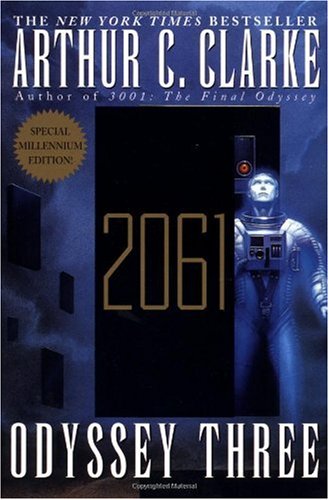
Then, years later, Clarke wrote Odyssey Three, his third installment in the series. Set in 2061, this book was again inspired by real events, the return to the Solar System of Comet Halley. Since it was not scheduled to return until 2061, he set the book in that year and began writing about a mission to go study it up close, during which time they will be doing a flyby of Europa. So Floyd, the main character of book II, a “celebrity guest”, goes on this mission with a new crew.

2061_odyssey3The main purpose is to investigate Halley’s comet, but the main story thread picks up when scientists on Earth and nearby Ganymede notice a new mountain that has formed on Europa (“Mount Zeus) which cannot be a volcano because of its asymmetrical nature. For reasons that are never fully-explained, the mission is hijacked and the crew become stranded on Europa.

During a rescue attempt, Floyd’s son, Bowman’s grandson, and the Afrikaaner character see the monolith on Europa and a wreck of a Chinese ship that tried to investigate earlier, in defiance of the monolith’s warnings. They see the monolith and the mountain confirm that it is, in fact, a giant diamond, a piece of Jupiter that broke off when it went nova and landed on the moon. All of this is consistent with scientific articles of the time that said that Pluto and Neptune had diamond cores, the result of carbon compression, and that the same was probably true of Jupiter.

In the end, the crew is rescued, Bowman makes an appearance in the dreams of a few people, and they come to realize that his consciousness now resides inside the monolith. The mountain also disappears beneath the surface of Europa’s ice. From all this, it is now clear that Europa is evolving, that Bowman and HAL are still alive in some form, and that a monolith is there, acting as guardian and watchman to the whole process.

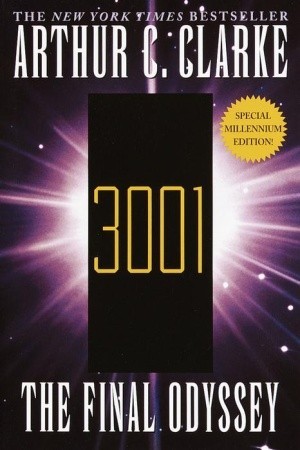
3001Then, to finish things, Clarke wrote 3001: The Final Odyssey. This book I read when I was about twenty, at a time when my literary and critical reading skills were being honed by some seriously awesome teachers and course loads. Perhaps because of this, or because Clarke changed things up drastically in the last book, I was very disappointed.

Quick synopsis, the character of Frank Poole, the astronaut who was killed by HAL in book I, is brought back. His body floats back into the Solar System after having done a circuitous route to the outer rim, and since it’s 3001, they are able to revive him. The first half of the book is then spent showing Poole how different the future is, revising Clarke’s predictions about stuff that happened in the book 2001 but not in real life, deals with all kinds of millennial themes (since the book was written just a few years shy of 2000 and is set just after the third millennium), and asserts the rather weak conclusion that a person from 2001 would have little trouble adapting to life in 3001, as opposed to someone from 1001 adapting to 2001.

Why? Because by 2001, most things that will become a reality by 3001 would be being postulated. Now this I found weak for a few reasons. First, it assumes that what we predict will be taking in 3001 actually will. It assumes that progress is a completely linear thing, that history is devoid of repeats or regression, and is generally an example of Clarke’s technocratic mindset. It also manages to gloss over the fact that Clarke was wrong about most of his predictions for 2001.

For one, the Cold War didn’t continue into the future, commercial space travel was not invented, there were no colonies on the moon, and there were no exploratory missions to the rim of known space. These he attempted to minimize by saying that these things were at least in the planning stages. Yeah! In the same way that a trip to the Moon was in the planning stages during H.G. Wells time, but that didn’t make it close!

space_elevator_liftAnother major disappointment of the first half is the fact that the technological innovations he mentions look like they were ripped directly from Star Trek! For one, they have holodecks (or a close approximation)! They have brain caps they wear that download information directly into your brain. And (this one was my favorite!) genetically engineered dinosaurs that do manual labor! …WHAT??? Are you freaking kidding me?!

To make that worse, he throws in a bit about Poole was surprised to see this, even though he saw all the “Jurassic movies” as a kid. This, along with several other pop-culture references in the first half, made we want to gag! To be fair, its hard to write a book about the near future, especially over and over while the actual future is taking place. But these kind of revisions, penciling in the things that happened in real life, is just annoying! If anything, the real historical record should be minimized in the background.

Much like his talk of all the scientific feats that didn’t happen, it was probably something that should have been tacitly dealt with, but not talked so much about. Oh, and of course, his comments on religion. The way Clarke saw it, humanity had created a universal church in the future after the fall of Christianity. He figured that at some point in the future, the Vatican would open up its archives and it would subsequently fall in the same way the Kremlin did when it did the same. Are you kidding me?

world_religionsSure, its a neat parallel, but everyone already knows the church’s crimes, they’ve been documented endlessly. And the archives aren’t exactly sealed, they’re just not open to the general public. So what would opening them to the public really change? Furthermore, to suggest that humanity could do away with faith because technology meant it no longer needed it is both shallow and naive. It’s the same kind of dogmatic thinking that goes into fundamentalism, that asserts that humanity can’t live without religion because it would be totally lost without all its dogmatic signposts and explanations.
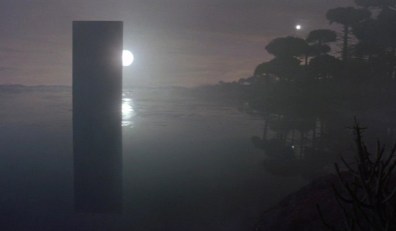
My own theory, humanity’s need for faith, as with everything else, is ambiguous and will not be subject to any one influence. Chances are, we will never outlive our need for spirituality, but that does not mean we can’t live without specific institutions. And we will NEVER be able to invent some bland, universal, all-inclusive faith. Not that we won’t attempt to, but chances are it will fail.

But I digress… the second half of the book deals with Poole deciding that he wants to go to Europa to see what became of HAL and his old colleague. So he goes, and unlike other ships that have tried and failed, he makes it. Then comes more disappointments, Frank and HAL are not transcendent entities as was suggested in previous books. They are merely downloads, digital copies of their original selves preserved inside the monolith – which isn’t a conscious being but is itself a computer. BORING!

2010_jul2012-a4After all that talk about intelligence and reaching the next great leap in cosmic evolution, this is what it all turned out to be? Bits and bytes in some big storage machine? And then there was the status of the Europan’s. Basically, that too, contrary to the hopes inspired by previous books, hasn’t gone so well. The Europan’s chemical and biological makeup, it is revealed, does not inspire confidence. The lifeforms are too basic, too slow and stodgy, to ever evolve into dynamic intelligent beings it seems.
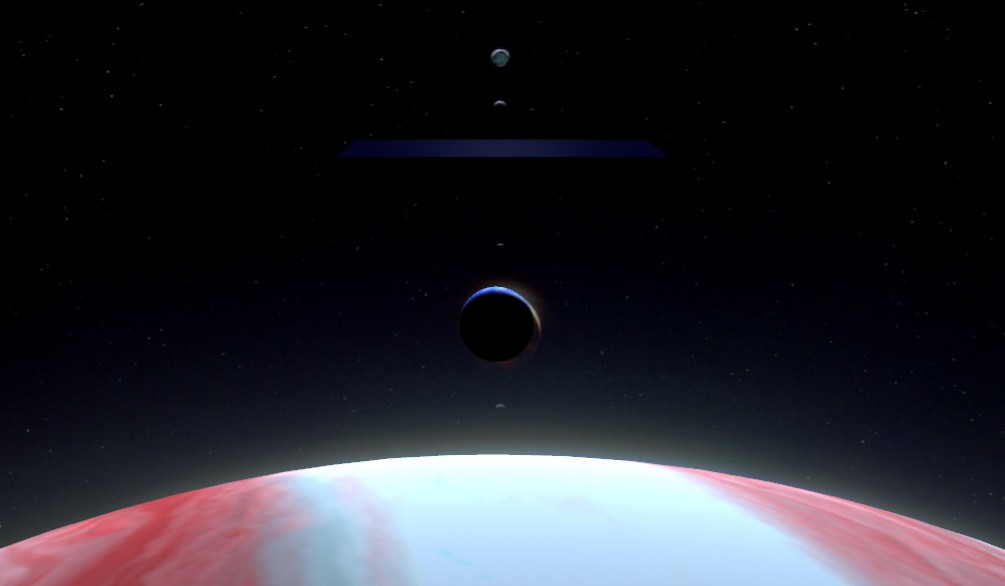
So humanity won’t have counterparts then, children from the “other sun” to deal with in the future? ‘Nuther big letdown man! Well, the book wasn’t over so I went on reading. After all this slow build-up, we finally come to the climax of the story. Turns out, the monoliths are coming back to the Solar System. Why? The last transmissions they sent out were over 900 years ago, back when humanity was contemplating its own nuclear annihilation and breaking the quarantine on Europa.

Jupiter Moons MonolithThis causes the monoliths to conclude that humanity is too aggressive, an experiment gone wrong. So… humanity needs to prepare. They look at all weapons they have in their arsenal, but could possibly stop the monolith’s, a race eon’s older? They opt for a computer virus, another attempt by Clarke to pay homage to the time in which he was writing. They download the virus into the monolith on Europa in the hopes that it will transfer it to the others that are on their way.

Frank and HAL are meanwhile stored in a data crystal to preserve their identities, and before everything hits the fan, it all stops. The monolith’s get the virus, doesn’t really effect them, but they see that humanity has changed since they last saw them and decide to give them more time. Kind of a letdown. The final words, that humanity is still young and their God “still a child”, and they will be granted a reprieve until “The Last Days” were kind of chilling, but it still felt like an abortive climax.

Thus ended the Odyssey series. Some attempts have been made to keep it going by fan-fiction authors, but the less said about them, the better. Nothing worse than fan-fic’s who try to keep a series going after its creator retired it (see Dune and it’s Descendants for more on this point!). And while I was disappointed with the ending, I do think the series was very enjoyable and worthwhile overall.

268170-akira06_superSome of the concepts, transcendence, ancient species, directed cosmic evolution, were all picked up on by some of the best sci-fi minds, not the least of which were J Michael Straczynski (creator of Babylon 5) and Katsuhiro Otomo (creator of the cyberpunk anime Akira). Where he was weak was in his fundamental understanding of human beings and history; how he felt that people are mere subjects to technological evolution and would continue to progress on a linear pattern. Human beings are certainly affected by technological change, but that change is not altogether positive.

In fact, the changes it engenders are often negative and lead to backlash and rejection as a result. Far from replacing religion, technology is often seen as a substitute religion, inspiring the same kind of mindless devotion as fundamentalism, or encouraging people to revert to simple beliefs in the hope of being delivered from its cold rationality. These are the kinds of things I would hope for in any investigation of the future, the social as well as technological upheaval and how they were connected, or at least a balanced look at these kinds of issues.

But Clarke is not that type of guy, he’s a futurist so it’s naive of me to expect it from him. In the end, he got me thinking, both in tune with his thoughts and against them, so I have to be thankful. In the end, that’s what good author does, gets your mind going and your blood pumping. And he left an enduring legacy, many titles to his credit and millions of people inspired by his word, so I say kudos to him! Thanks for all the memories and inspired thoughts, Mr. Clarke. Hope you found a quiet place amongst the stars now that you’ve transcended that final barrier. Rest in peace, Star Child!

Of Dune and its Conclusion

Of Dune and its Conclusion

Since posting my thoughts on Dune and its descendants, I’ve found that there are no shortage of people out there who agree with me. In fact, there are even sites dedicated to expressing the dissatisfaction Herbert fans have with the garbage his son and Kevin J Anderson have been putting out. Not surprising really, but I learned some interesting facts in the course of reading through them. For one, KJA does not run his writing by anyone who was involved in the production of the original Dune novels. His test panel, if that’s what you want to call it, consists mainly of family and friends. Second, I learned that, contrary to my expectations, the latest installments they have made have been doing quite poorly. In fact, let this serve as a correction to my post: the “interquel” novels, known as the “Heroes of Dune” set, are not a trilogy. Sisterhood of Dune is in fact a departure from the interquels, apparently due to sagging sales. Score one for the good guys!

Now some thoughts on these revelations: First of, what kind of serious author tests his work by getting friends and family to read it? And what the hell do his family know about Dune? Seems to me any fool looking to work the Dune franchise would care solely what the people who knew Herbert best would think, not to mention the fans. Screw family! And seriously, what are they going to tell him? That they loved it because they love him? Or are they going to be honest: “Honey, this is shit! This is an absolute insult to the legacy of Herbert, chock full of cliches and sci-fi stereotypes, and every contrivance known to pulp literature! Franks Herbert’s novels were thoughtful works that dealt with timeless themes and deep philosophical issues. Any child could have turned out this fan fiction bullshit with all its wooden dialogue, cardboard characters and ridiculous plot holes. The only thing missing is a whole lot of spelling mistakes! What the hell were you thinking?!!!”

Well, it’s one thing to criticize. Quite another to put your money where your mouth is. This is one thing I wanted to say in my original post but didn’t because it kind of made me feel like a prick. But if I got one piece of advice, it was that I was being too nice. So here’s some unbridled honesty. Do I think I could do better? That’s the question everyone must ask themselves whenever they decide to get critical. If not, they should probably shut up. But I can honestly say that I think I could do better! And I challenge my fellow Dune fans to do the same. While it may never see the light of day, I think that between us we could come up with a far better end to Dune and I invite people to make suggestions, either here or on various fan sites. You know how a groundswell works, and in the information age, its being done all the time. People produce their own works, put out their own news, and basically vote with their feet (more like fingers, hits and comments make the difference here!). But the result is the same, the popular product supersedes the mainstream crap and soon the mainstream crap is sitting up and taking notice. So let me humbly suggest that we make our own Dune 7, at least a mock-up for it. The ending that we, the fans, think that Herbert would have wanted!

Below is a link to a fansite dedicated to honoring the legacy of Herbert and bashing the prequel/sequel/interquel crap that has followed in his wake:

Jacurutu