
I hate it when I’m right.
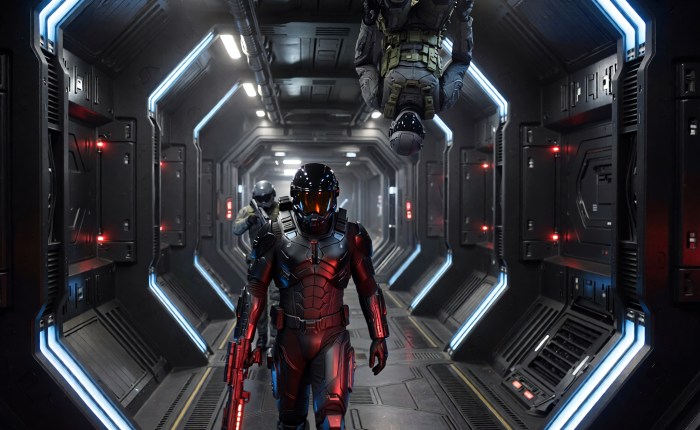
It didn’t take them long to find the right vat. The intruder had entered the Foundries with the same grace and untraceable nature that got them this far. When Dube and Alpha team entered, they were unable to determine the path the intruder had taken. Looking left and right along the sloping corridor, Beta proceeded eastward while Alpha headed west.
When Beta found the vat, they contacted Alpha, who rendezvoused at their position shortly thereafter. It was as bad as Dube suspected. On the console, the intruder had deposited an infiltration node. This allowed them to bypass the biometric locks. The blueprints of what they had assembled were still on the screen.
Broadband Array (port.)
Signal Booster
The vat was still warm, meaning that Alpha and Beta teams had just missed the intruder. Luckily, they now knew exactly what said intruder hoped to accomplish, and it wasn’t sabotage.
[Jonas, are you getting all of this?]
[Confirmed] said Jonas, who proceeded to give a final assessment. [The intruder intends to divert power to a portable array and send a boosted broadband signal. We estimate a 100% probability that the intended recipient is a vessel in deep space. I have multiple probabilistic assessments as to their intentions.]
[No need! Just tell us where they’re headed.]
Jonas uploaded the likeliest route, gossamer threads overlain on top of a map of the ship’s midsection. The probability was indicated by the intensity of the thread. One stood out among the others, but there were two more that were considered a close second and third. Necessity required that they investigate all of them.
[A word of warning] Jonas added. [The fact that the intruder did not attempt to manufacture an explosive device, despite having access to do so, implies that they are equipped with defensive measures. Approach them with extreme caution.]
[Thank you, Jonas]
Dube paused for a second. Everyone in Alpha, Beta, and Charlie team had heard everything he had. He could feel their trepidation, and they his. Some wanted to discuss the possibilities further, he could tell. Unfortunately, there was no time for additional speculation. Not anymore. Their intruder was equipped with the means to broadcast their location. And they would be doing that very soon.
[We have something] said Vorhees. He and team Beta were tracing the intruder’s second most-likely path, as determined by Jonas. The fact that they had something to report so soon suggested Jonas might have gotten things wrong.
[There’s EM traces on the floor that conform to footprints. They’re rapidly fading, but we’re tracking them ahead.]
Dube reached out to Jonas. [Hypothesize]
[Engineer Vorhees is correct. This is consistent with an advanced stealth system. The powerful EM fields involved, upon contact with the interior surface materials, would create a residual electromagnetic field.]
Dube sensed what Jonas might suggest because it was exactly what he was thinking. He quickly leapt at the opportunity to suggest it first.
[Can we track them? Amplify the impressions left to establish a trail?]
[Of course] Jonas replied.
A second later, and the path established by the intruder appeared in Dube’s sensorium. For everyone but Beta team, it was a mark on their maps. For Vorhees and his team, it was a series of footprints that began to recede in front of them.
[Permission to take team Beta ahead. We’re hot on his trail, and I don’t think we want to lose time regrouping.]
Dube could feel the urgency in his thoughts.
[Granted], he replied. There was simply no time to waste. The other teams would simply have to catch up to Beta once they had the intruder cornered, wherever that proved to be.
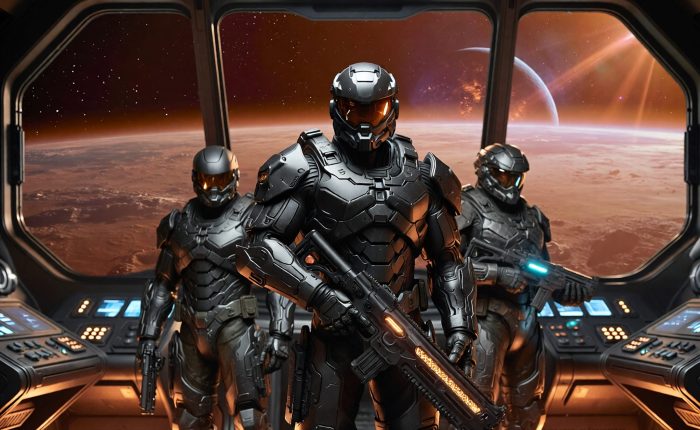
[Alright, let’s move with a purpose!] said Vorhees, prioritizing communication with Baghadur and Kyeong. They obliged and, like him, engaged their exoskins’ overdrive function to enhance their speeds. Rather quickly, their gate overtook the rate at which the intruder’s tracks were fading. A few seconds later, the imprints appeared brighter and more pronounced.
All indications said they were getting closer.
Up ahead, the imprints veered away from the corridor and disappeared behind a bulkhead. As expected, they were taking the shortest route through the Gyro section, which would give them access to the singularity drive, propulsion section in the rear. It was a small mercy that their intruder was not intent on sabotaging either. But that was no reason to slow down or relax!
Vorhees bounded around the bulkhead, followed closely by Baghadur and Kyeong. This led them through an aperture and down another corridor. This one consisted of a series of twisting maintenance passages that interconnected the Foundries and ultimately led to the rear of the ship. A twisted network that would be easy to get lost in. Luckily, between the intruder’s foot imprints and Jonas’ predicted path, they were clearly hot on his trail. Particularly hot, if the brightness of the EM signatures he’d left behind was any indication.
Vorhees stopped. Baghadur and Kyeong came to a stop behind him, just short of bowling him over. They both voked to him.
[What’s wrong? Why have we stopped?]
They saw why a nanosecond later. The path of their intruder ended rather suddenly.
[Fan out] Vorhees ordered. [He’s visible, or at least he temporarily disengaged his stealth field to throw us off. Look for his footprints, quickly.]
Two affirmatives. The three of them each grabbed a passageway and began moving forward to sweep them meticulously. Vorhees was unsurprised when Dube voked to him and asked for a report on their progress. Vorhees kindly updated him with the data he and his team had obtained.
[I see] replied Dube. [Proceed with caution, we are barely a minute behind you.]
[Understood.]
Vorhees looked down the length of the hatchway in front of him and began moving. His exoskin’s overdrive was no longer engaged, and his steps were even and measured. His biomonitors also noted an increase in his adrenal activity and heart rate. He didn’t need to be told that he was feeling more nervous. He had been the second when the footprints he’d been chasing disappeared.
Where are you?
[I have something], Kyeong announced. Vorhees stopped and tapped into his visual field. Looking at the floor, his counterpart spotted a single pair of footprints that were separated by about two meters and rapidly fading.
[He definitely came this way. And you were right, he’s cycling his stealth mode to throw us off.]
[He could be headed anywhere from here], Baghadur offered.
Vorhees looked at the map in his visual field. Baghadur was right. The criss-crossing nature of the maintenance hallways meant that their intruder could be trying to lose them in this network and was headed for an entirely different part of the ship. Then again, it was possible he was just trying to divide them up to even the odds if any ran into him.
The thought made Vorhees’ biomonitors raise their warning about his adrenals. He quickly voked to his companions.
[Kyeong, hold your position. We’ll converge on you.]
Vorhees turned. There was a bright flash, followed by the gradual appearance of a solid form in front of him. He managed to get a look at their intruder, standing not more than a few meters away. His skin was a bronze sheen that reflected Vorhees’ own image back at him. Extending from his right arm was a projectile launcher that was still glowing from the discharge.
Vorhees eyes then fell to his chest, where his exoskin was rapidly disintegrating. The suit’s controls were assaulting his senses to let him know that its structural integrity was failing. Counter-measures were failing, and its attempts to repel the assaulting nanoware were proving futile. Small pieces of the armored skin flaked away like hot embers, rapidly exposing his chest,
A second flash, and the small fire was opening his chest cavity. Vorhees’ biomonitors were blaring now, issuing every kind of warning they could that his body was being invaded by nanobots rapidly boring a hole into his heart and spine.
Vorhees fell. Before the world turned dark on him, he saw their intruder again. His bronze outer shell glistened with the light of the hallway’s status lights. On the wall behind him, there were more shining patches – footprints and handprints that showed where he had anchored himself against the ceiling.
As the light slowly drained from the room, Vorhees realized the full measure of the intruder’s strategy. He had thrown them off in several directions, causing them to split up, thus allowing him to lure the team leader into a trap. With their squad now down a person, he would no doubt do the same to the others – attempt to keep chasing down different paths and picking them off one by one.
Then again, he might opt to use the moment of chaos he’d created to resume his headlong journey towards his objective. Surely, he had bought himself more time now.
What mattered was that he had options and the ball was in his court, something only a professional could pull off.
Clever fellow, thought Vorhees before things went dark.



 Stories by Williams