
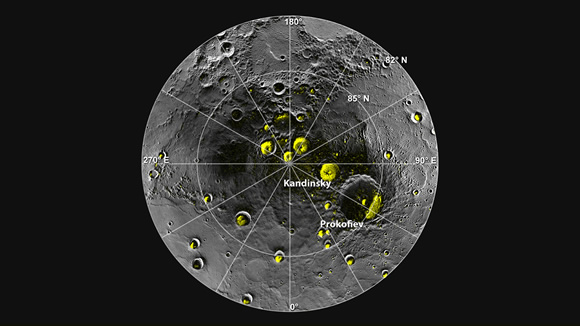
 Yes, the announcement from the Curiosity team yesterday that no organics have been found on Mars (yet) certainly came as a big disappointment. However, people may be interested to hear that organic molecules were discovered on a different planet in our Solar System, along with water and ice. Would you believe it, the planet is Mercury? Yes, the world famous for lakes of molten metal and extreme heat may actually boast the building blocks of life.
This information is the latest to come from NASA’s MESSENGER spacecraft, which is now orbiting the closest planet to our Sun. It confirms what was postulated 20 years ago, after images were taken of the polar region and detected radar-bright materials which were beleived to be water and ice. And where water and ice occur, organic molecules are often sure to follow. Though Mercury boasts the hottest environment of any planet in the Solar System, the area in question lies within a permanent shadowed series of craters on the northern pole.
Scientists today said that Mercury could hold between 100 billion to 1 trillion tons of water ice at both poles, and the ice could be up to 20 meters deep in places. Additionally, intriguing dark material which covers the ice could hold other volatiles such as organics. Unfortunately, all of this water comes in the form of ice, as surface temperatures in the poles are too cold to allow for a thaw. In addition, the total lack of atmosphere on Mercury would mean that any liquid would evaporate and be sucked into space very quickly.
At a briefing which was held yesterday, Sean Solomon – MESSENGER Principal Investigator – has this to say about the news: “These findings reveal a very important chapter of the story of how water ice has been delivered to the inner planets by comets and water rich asteroids over time.” In short, it is believed that these ice deposits and organic molecules were delivered to the planet through a series of meteor impacts, and which have survived thanks to the existence of Mercury’s permanently shadowed polar regions.
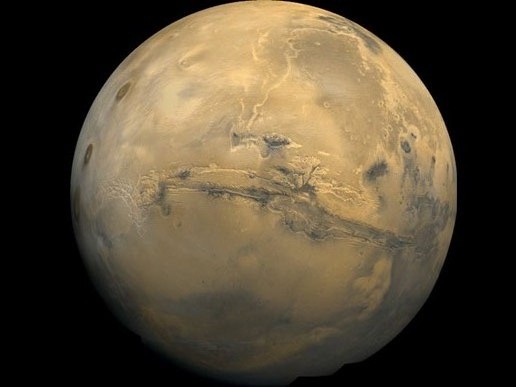
Granted, no settlers are ever likely to be making a home on Mercury – not without some serious technological innovations! – but the discovery is a very interesting find and does help scientists to understand how life may have begun here on Earth. What’s more, this news may help Curiosity and other science teams to determine where and how organic molecules and ice could be found on Mars. The challenges there are similar to those on Mars, since she too is an inner planet that has virtually no atmosphere and a great deal of surface radiation, not to mention that she too would have been the recipient of water ice and organics through meteoric impacts.
So c’mon Mars! Show us what you got. You don’t want to be outdone by your Hermian cousin do ya?

 Stories by Williams