
 Back in January, National Geographic Magazine celebrated its 125th anniversary. In honor of this occasion, they released a special issue which commemorated the past 125 years of human exploration and looked ahead at what the future might hold. As I sat in the doctor’s office, waiting on a prescription for antibiotics to combat my awful cold, I found myself terribly inspired by the article.
So naturally, once I got home, I looked up the article and its source material and got to work. The issue of exploration, especially the future thereof, is not something I can ever pass up! So for the next few minutes (or hours, depending on how much you like to nurse a read), I present you with some possible scenarios about the coming age of deep space exploration.
 Suffice it to say, National Geographic’s appraisal of the future of space travel was informative and hit on all the right subjects for me. When one considers the sheer distances involved, not to mention the amount of time, energy, and resources it would take to allow people to get there, the question of reaching into the next great frontier poses a great deal of questions and challenges.
Already, NASA, Earth’s various space agencies and even private companies have several ideas in the works or returning to the Moon, going to Mars, and to the Asteroid Belt. These include the SLS (Space Launch System), the re-purposed and upgraded version of the Saturn V rocket which took the Apollo astronauts to the Moon. Years from now, it may even be taking crews to Mars, which is slated for 2030.
 And when it comes to settling the Moon, Mars, and turning the Asteroid Belt into our primary source of mineral extraction and manufacturing, these same agencies, and a number of private corporations are all invested in getting it done. SpaceX is busy testing its reusable-launch rocket, known as the Grasshopper, in the hopes of making space flight more affordable. And NASA and the ESA are perfecting a process known as “sintering” to turn Moon regolith into bases and asteroids into manufactured goods.
Meanwhile, Virgin Galactic, Reaction Engines and Golden Spike are planning to make commercial trips into space and to the Moon possible within a few years time. And with companies like Deep Space Industries and Google-backed Planetary Resources prospeting asteroids and planning expeditions, it’s only a matter of time before everything from Earth to the Jovian is being explored and claimed for our human use.
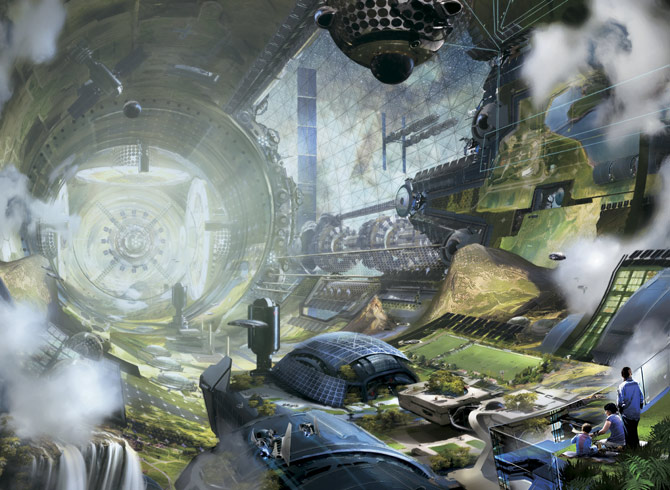
But when it comes to deep-space exploration, the stuff that would take us to the outer reaches of the Solar System and beyond, that’s where things get tricky and pretty speculative. Ideas have been on the table for some time, since the last great Space Race forced scientists to consider the long-term and come up with proposed ways of closing the gap between Earth and the stars. But to this day, they remain a scholarly footnote, conceptual and not yet realizable.
But as we embark of a renewed era of space exploration, where the stuff of science fiction is quickly becoming the stuff of science fact, these old ideas are being dusted off, paired up with newer concepts, and seriously considered. While they might not be feasible at the moment, who know what tomorrow holds? From the issues of propulsion, to housing, to cost and time expenditures, the human race is once again taking a serious look at extra-Solar exploration.
And here are some of the top contenders for the “Final Frontier”:
Nuclear Propulsion:
 The concept of using nuclear bombs (no joke) to propel a spacecraft was first proposed in 1946 by Stanislaw Ulam, a Polish-American mathematician who participated in the Manhattan Project. Preliminary calculations were then made by F. Reines and Ulam in 1947, and the actual project – known as Project Orion was initiated in 1958 and led by Ted Taylor at General Atomics and physicist Freeman Dyson from the Institute for Advanced Study in Princeton.
In short, the Orion design involves a large spacecraft with a high supply of thermonuclear warheads achieving propulsion by releasing a bomb behind it and then riding the detonation wave with the help of a rear-mounted pad called a “pusher”. After each blast, the explosive force is absorbed by this pusher pad, which then translates the thrust into forward momentum.
Though hardly elegant by modern standards, the proposed design offered a way of delivering the explosive (literally!) force necessary to propel a rocket over extreme distances, and solved the issue of how to utilize that force without containing it within the rocket itself. However, the drawbacks of this design are numerous and noticeable.
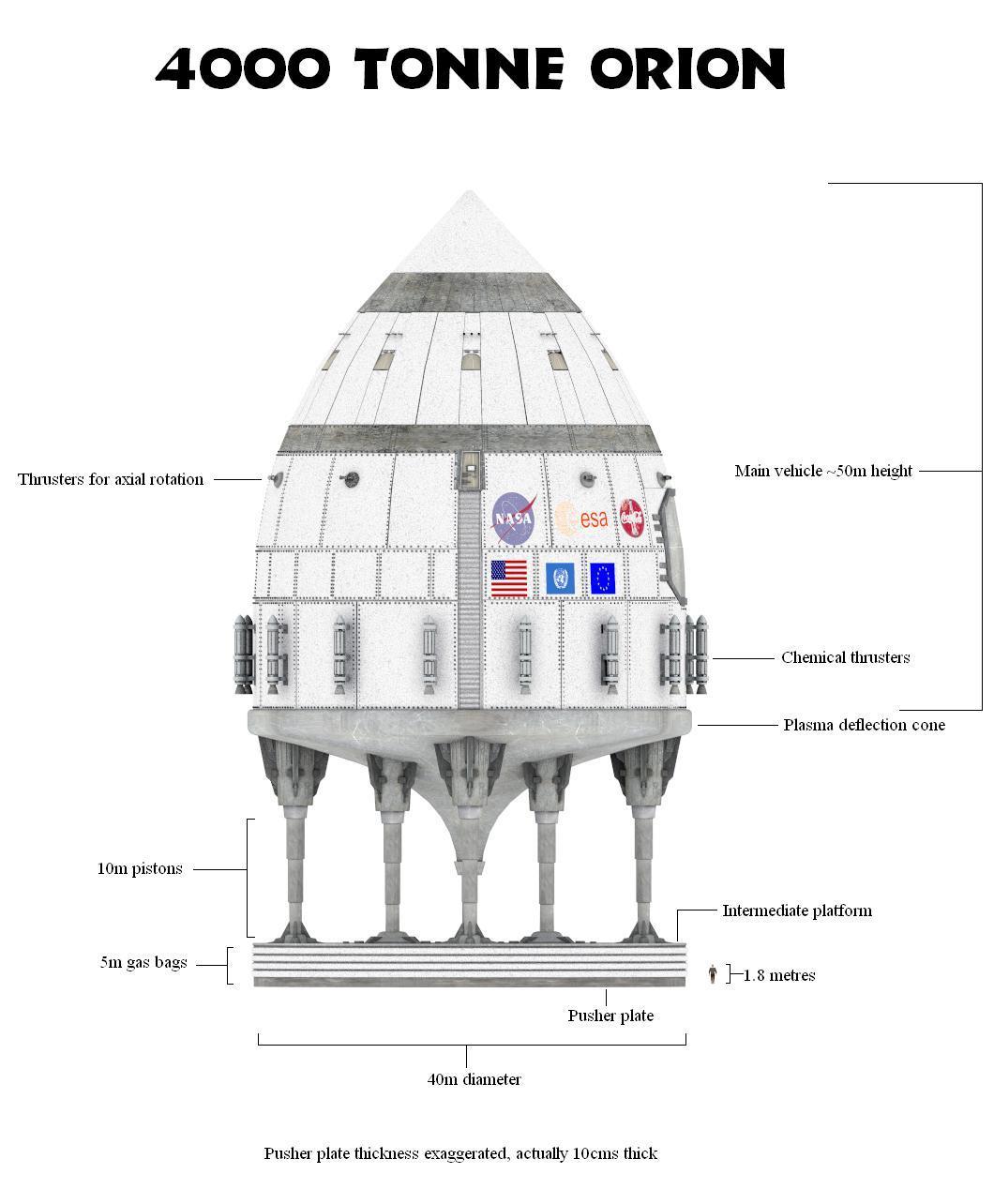 F0r starters, the ship itself is rather staggering in size, weighing in anywhere from 2000 to 8,000,000 tonnes, and the propulsion design releases a dangerous amount of radiation, and not just for the crew! If we are to rely on ships that utilize nuclear bombs to achieve thrust, we better find a course that will take them away from any inhabited or habitable areas. What’s more, the cost of producing a behemoth of this size (even the modest 2000 tonne version) is also staggering.
Antimatter Engine:
 Most science fiction authors who write about deep space exploration (at least those who want to be taken seriously) rely on anti-matter to power ships in their stories. This is no accident, since antimatter is the most potent fuel known to humanity right now. While tons of chemical fuel would be needed to propel a human mission to Mars, just tens of milligrams of antimatter, if properly harnessed, would be able to supply the requisite energy.
Fission and fusion reactions convert just a fraction of 1 percent of their mass into energy. But by combine matter with antimatter, its mirror twin, a reaction of 100 percent efficiency is achieved. For years, physicists at the CERN Laboratory in Geneva have been creating tiny quantities of antimatter by smashing subatomic particles together at near-light speeds. Given time and considerable investment, it is entirely possible this could be turned into a form of advanced propulsion.
In an antimatter rocket, a dose of antihydrogen would be mixed with an equal amount of hydrogen in a combustion chamber. The mutual annihilation of a half pound of each, for instance, would unleash more energy than a 10-megaton hydrogen bomb, along with a shower of subatomic particles called pions and muons. These particles, confined within a magnetic nozzle similar to the type necessary for a fission rocket, would fly out the back at one-third the speed of light.
 However, there are natural drawback to this design as well. While a top speed of 33% the speed of light per rocket is very impressive, there’s the question of how much fuel will be needed. For example, while it would be nice to be able to reach Alpha Centauri – a mere 4.5 light years away – in 13.5 years instead of the 130 it would take using a nuclear rocket, the amount of antimatter needed would be immense.
No means exist to produce antimatter in such quantities right now, and the cost of building the kind of rocket required would be equally immense. Considerable refinements would therefore be needed and a sharp drop in the cost associated with building such a vessel before any of its kind could be deployed.
Laser Sail:
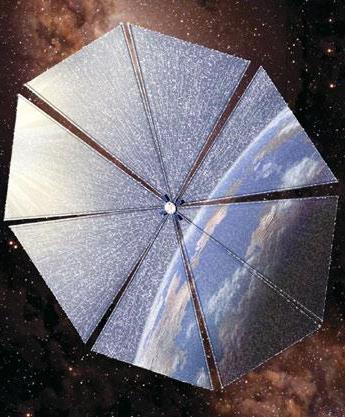 Thinking beyond rockets and engines, there are some concepts which would allow a spaceship to go into deep space without the need for fuel at all. In 1948, Robert Forward put forward a twist on the ancient technique of sailing, capturing wind in a fabric sail, to propose a new form of space travel. Much like how our world is permeated by wind currents, space is filled with cosmic radiation – largely in the form of photons and energy associated with stars – that push a cosmic sail in the same way.
This was followed up again in the 1970’s, when Forward again proposed his beam-powered propulsion schemes using either lasers or masers (micro-wave lasers) to push giant sails to a significant fraction of the speed of light. When photons in the laser beam strike the sail, they would transfer their momentum and push the sail onward. The spaceship would then steadily builds up speed while the laser that propels it stays put in our solar system.
Much the same process would be used to slow the sail down as it neared its destination. This would be done by having the outer portion of the sail detach, which would then refocus and reflect the lasers back onto a smaller, inner sail. This would provide braking thrust to slow the ship down as it reached the target star system, eventually bringing it to a slow enough speed that it could achieve orbit around one of its planets.
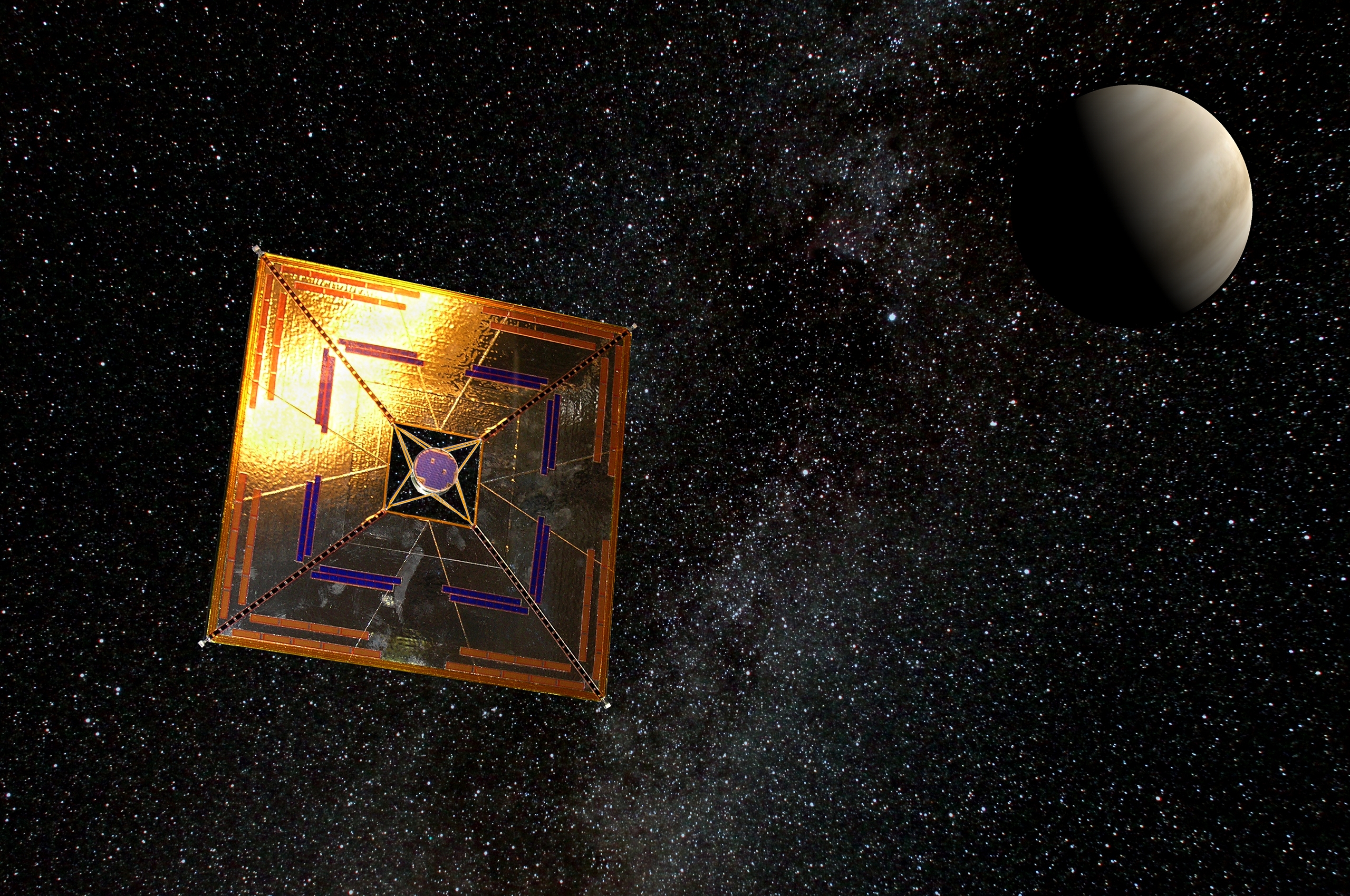 Once more, there are challenges, foremost of which is cost. While the solar sail itself, which could be built around a central, crew-carrying vessel, would be fuel free, there’s the little matter of the lasers needed to propel it. Not only would these need to operate for years continuously at gigawatt strength, the cost of building such a monster would be astronomical, no pun intended!
A solution proposed by Forward was to use a series of enormous solar panel arrays on or near the planet Mercury. However, this just replaced one financial burden with another, as the mirror or fresnel lens would have to be planet-sized in scope in order for the Sun to keep the lasers focused on the sail. What’s more, this would require that a giant braking sail would have to be mounted on the ship as well, and it would have to very precisely focus the deceleration beam.
So while solar sails do present a highly feasible means of sending people to Mars or the Inner Solar System, it is not the best concept for interstellar space travel. While it accomplishes certain cost-saving measures with its ability to reach high speeds without fuel, these are more than recouped thanks to the power demands and apparatus needed to be it moving.
Generation/Cryo-Ship:
 Here we have a concept which has been explored extensively in fiction. Known as an Interstellar Ark, an O’Neill Cylinder, a Bernal Sphere, or a Stanford Torus, the basic philosophy is to create a ship that would be self-contained world, which would travel the cosmos at a slow pace and keep the crew housed, fed, or sustained until they finally reached their destination. And one of the main reasons that this concept appears so much in science fiction literature is that many of the writers who made use of it were themselves scientists.
The first known written examples include Robert H. Goddard “The Last Migration” in 1918, where he describes an “interstellar ark” containing cryogenic ally frozen people that set out for another star system after the sun died. Konstantin E. Tsiolkovsky later wrote of “Noah’s Ark” in his essay “The Future of Earth and Mankind” in 1928. Here, the crews were kept in wakeful conditions until they reached their destination thousands of years later.
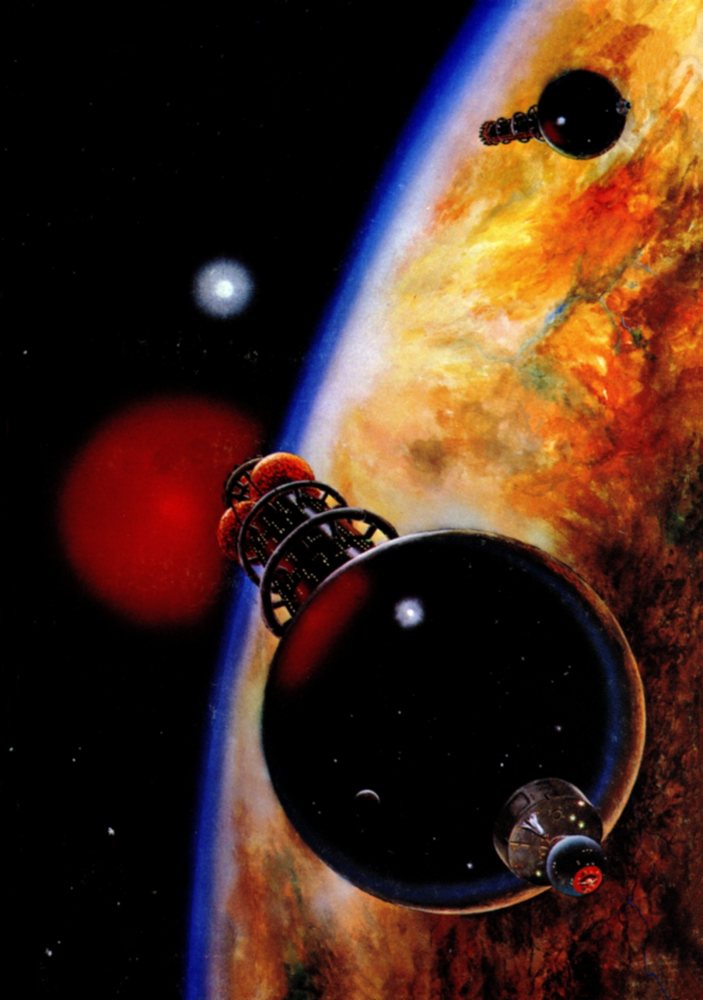 By the latter half of the 20th century, with authors like Robert A. Heinlein’s Orphans of the Sky, Arthur C. Clarke’s Rendezvous with Rama and Ursula K. Le Guin’s Paradises Lost, the concept began to be explored as a distant possibility for interstellar space travel. And in 1964, Dr. Robert Enzmann proposed a concept for an interstellar spacecraft known as the Enzmann Starship that included detailed notes on how it would be constructed.
Enzmann’s concept would be powered by deuterium engines similar to what was called for with the Orion Spacecraft, the ship would measure some 600 meters (2000 feet) long and would support an initial crew of 200 people with room for expansion. An entirely serious proposal, with a detailed assessment of how it would be constructed, the Enzmann concept began appearing in a number of science fiction and fact magazines by the 1970’s.
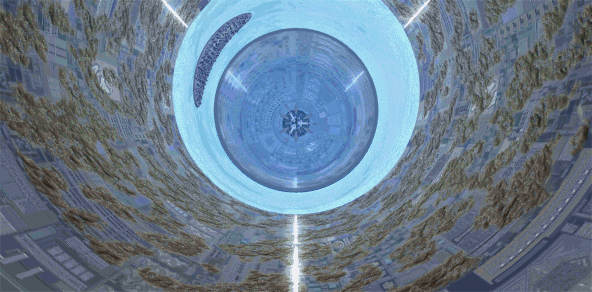 Despite the fact that this sort of ship frees its makers from the burden of coming up with a sufficiently fast or fuel-efficient engine design, it comes with its own share of problems. First and foremost, there’s the cost of building such a behemoth. Slow-boat or no, the financial and resource burden of building a mobile space ship is beyond most countries annual GDP. Only through sheer desperation and global cooperation could anyone conceive of building such a thing.
Second, there’s the issue of the crew’s needs, which would require self-sustaining systems to ensure food, water, energy, and sanitation over a very long haul. This would almost certainly require that the crew remain aware of all its technical needs and continue to maintain it, generation after generation. And given that the people aboard the ship would be stuck in a comparatively confined space for so long, there’s the extreme likelihood of breakdown and degenerating conditions aboard.
Third, there’s the fact that the radiation environment of deep space is very different from that on the Earth’s surface or in low earth orbit. The presence of high-energy cosmic rays would pose all kinds of health risks to a crew traveling through deep space, so the effects and preventative measures would be difficult to anticipate. And last, there’s the possibility that while the slow boat is taking centuries to get through space, another, better means of space travel will be invented.
Faster-Than-Light (FTL) Travel:
 Last, we have the most popular concept to come out of science fiction, but which has received very little support from scientific community. Whether it was the warp drive, the hyperdrive, the jump drive, or the subspace drive, science fiction has sought to exploit the holes in our knowledge of the universe and its physical laws in order to speculate that one day, it might be possible to bridge the vast distances between star systems.
However, there are numerous science based challenges to this notion that make an FTL enthusiast want to give up before they even get started. For one, there’s Einstein’s Theory of General Relativity, which establishes the speed of light (c) as the uppermost speed at which anything can travel. For subatomic particles like photons, which have no mass and do not experience time, the speed of light is a given. But for stable matter, which has mass and is effected by time, the speed of light is a physical impossibility.
 For one, the amount of energy needed to accelerate an object to such speeds is unfathomable, and the effects of time dilation – time slowing down as the speed of light approaches – would be unforeseeable. What’s more, achieving the speed of light would most likely result in our stable matter (i.e. our ships and bodies) to fly apart and become pure energy. In essence, we’d die!
Naturally, there have been those who have tried to use the basis of Special Relativity, which allows for the existence of wormholes, to postulate that it would be possible to instantaneously move from one point in the universe to another. These theories for “folding space”, or “jumping” through space time, suffer from the same problem. Not only are they purely speculative, but they raise all kinds of questions about temporal mechanics and causality. If these wormholes are portals, why just portals in space and not time?
 And then there’s the concept of a quantum singularity, which is often featured in talk of FTL. The belief here is that an artificial singularity could be generated, thus opening a corridor in space-time which could then be traversed. The main problem here is that such an idea is likely suicide. A quantum singularity, aka. a black hole, is a point in space where the laws of nature break down and become indistinguishable from each other – hence the term singularity.
Also, they are created by a gravitational force so strong that it tears a hole in space time, and that resulting hole absorbs all things, including light itself, into its maw. It is therefore impossible to know what resides on the other side of one, and astronomers routinely observe black holes (most notably Sagittarius A at the center of our galaxy) swallow entire planets and belch out X-rays, evidence of their destruction. How anyone could think these were a means of safe space travel is beyond me! But then again, they are a plot device, not a serious idea…
 But before you go thinking that I’m dismissing FTL in it’s entirety, there is one possibility which has the scientific community buzzing and even looking into it. It’s known as the Alcubierre Drive, a concept which was proposed by physicist Miguel Alcubierre in his 1994 paper: “The Warp Drive: Hyper-Fast Travel Within General Relativity.”
The equations and theory behind his concept postulate that since space-time can be contracted and expanded, empty space behind a starship could be made to expand rapidly, pushing the craft in a forward direction. Passengers would perceive it as movement despite the complete lack of acceleration, and vast distances (i.e. light years) could be passed in a matter of days and weeks instead of decades. What’s more, this “warp drive” would allow for FTL while at the same time remaining consistent with Einstein’s theory of Relativity.
In October 2011, physicist Harold White attempted to rework the equations while in Florida where he was helping to kick off NASA and DARPA’s joint 100 Year Starship project. While putting together his presentation on warp, he began toying with Alcubierre’s field equations and came to the conclusion that something truly workable was there. In October of 2012, he announced that he and his NASA team would be working towards its realization.
But while White himself claims its feasible, and has the support of NASA behind him, the mechanics behind it all are still theoretical, and White himself admits that the energy required to pull off this kind of “warping” of space time is beyond our means at the current time. Clearly, more time and development are needed before anything of this nature can be realized. Fingers crossed, the field equations hold, because that will mean it is at least theoretically possible!

Summary:
In case it hasn’t been made manifestly obvious by now, there’s no simple solution. In fact, just about all possibilities currently under scrutiny suffer from the exact same problem: the means just don’t exist yet to make them happen. But even if we can’t reach for the stars, that shouldn’t deter us from reaching for objects that are significantly closer to our reach. In the many decades it will take us to reach the Moon, Mars, the Asteroid Belt, and Jupiter’s Moons, we are likely to revisit this problem many times over.
And I’m sure that in course of creating off-world colonies, reducing the burden on planet Earth, developing solar power and other alternative fuels, and basically working towards this thing known as the Technological Singularity, we’re likely to find that we are capable of far more than we ever thought before. After all, what is money, resources, or energy requirements when you can harness quantum energy, mine asteroids, and turn AIs and augmented minds onto the problems of solving field equations?
Yeah, take it from me, the odds are pretty much even that we will be making it to the stars in the not-too-distant future, one way or another. As far as probabilities go, there’s virtually no chance that we will be confined to this rock forever. Either we will branch out to colonize new planets and new star systems, or go extinct before we ever get the chance. I for one find that encouraging… and deeply disturbing!
Source: ngm.nationalgeographic.com, nasa.gov, discoverymagazine.com, eng.wikipedia.org, 100yss.org

 Stories by Williams