Episode 69 of SfS – Rendezvousing with an Interstellar Object (with Dr. Alan Stern) – is now live!

Episode 69 of SfS – Rendezvousing with an Interstellar Object (with Dr. Alan Stern) – is now live!

Hello all, it’s been a while, I know. Life has been crazy lately. Luckily, I’ve managed to find the time to podcast again. For this latest episode, I had a conversation with Dr. Alan Stern, an astrophysicist from the Southwest Research Institute (SwRI) and the Principal Investigator of NASA’s New Horizons mission. In a recent paper, Stern and his colleagues performed a concept study for an Interstellar Object Explorer (IOE), a mission that could rendezvous with interstellar objects (ISO).

In 2017, the first-ever ISO detected passed through our system – ‘Oumuamua – leaving astronomers intrigued and baffled. Based on the available data, the object defied classification, leading to some rather exotic explanations! Two years later, a second ISO (2I/Borisov) was detected, which was clearly identified as an interstellar comet. In the near future, the Vera C. Rubin Observatory will become operational and will begin detecting dozens of ISOs a year.

Hence the desire for a spacecraft that could rendezvous with the next ISO that graces us. As Stern and I discuss, an IOE mission could have profound implications for astronomy, cosmology, and astrobiology. Studying ISOs would tell us a great deal about other star systems without actually having to go there. And if just a tiny fraction of those happened to be debris from an extraterrestrial civilization, as Prof. Loeb has suggested, the implications would be astronomical (no pun!)

Check out the links below to hear the entire conversation…

Where to Listen:

Episode 68 of SfS – The STASH Experiment and Hibernation Technology for Space, with Dr. Ryan Sprenger – is now Live!

Episode 68 of SfS – The STASH Experiment and Hibernation Technology for Space, with Dr. Ryan Sprenger – is now Live!

This week, I sat down with Dr. Ryan Sprenger, the Senior Research Physiologist at Fauna Bio Inc., a California-based biotech company specializing in genomics research. Sprenger and his colleagues have developed a new concept for testing hibernation in space, the Studying Torpor in Animals for Space-health in Humans (STASH) experiment. Their concept was selected by NASA’s Innovative Advanced Concepts (NIAC) program for Phase I development this year.

With NASA’s support, Sprenger and his team will develop a technology demonstrator that will be sent to the ISS. Their concept has the potential to revolutionize space exploration by allowing astronauts to enter synthetic hibernation during the long voyage to Mars and beyond. In essence, astronauts could sleep for the duration of long-term spaceflights, reducing the physiological impact of exposure to microgravity and radiation and the psychological impacts of months spent in a cramped spacecraft.

It will also reduce the amount of supplies missions need to bring along and the amount of waste produced. It will also have applications here on Earth, helping to mitigate aging, disease, and genetic disorders. Follow the links below to learn more!

Where to Listen:

Episode 66 of SfS – The Cosmic Philosopher: Konstantin Tsiolkovsky – is Now Live!

Episode 66 of SfS – The Cosmic Philosopher: Konstantin Tsiolkovsky – is Now Live!

This week’s episode is dedicated to the life, times, and enduring influence of Russian rocket scientist, philosopher, and cosmologist Konstantin Tsiolkovsky (1857-1935). To many, he’s known as the “father of rocketry and astronautics,” whereas others credit him with being one of the “forefathers,” alongside Hermann Julius Oberth, Robert Esnault-Pelterie, and Robert Goddard (namesake of the NASA Goddard Spaceflight Center).

Regardless of titles, Tsiolkovsky’s influence was immeasurable, and his contributions to science are still felt today. His many treatises on spaceflight, his famous “Rocket Equation,” and his designs for rockets and space stations remain foundational to spaceflight. His speculations about the future of humanity in space inspired generations of futurists, rocket scientists, and science fiction writers – in particular, Sergei Korolev and Werner von Braun, the lead Soviet and German-American rocket engineers during the Space Race.

In addition, Tsiolkovsky’s philosophical ideas were groundbreaking and anticipated future developments, such as the Search for Extraterrestrial Intelligence (SETI) and the Fermi Paradox (“Where are all the aliens?”). For those who believe humanity’s future lies in space, Tsiolkovsky was a pioneer and progenitor who was ahead of his time. As he famously said, “Earth is the cradle of humanity, but one cannot remain in the cradle forever.”

Where to Listen:

Episode 65 of SfS – Mars by 2040? Why Must We Wait? – is Now Live!

Episode 65 of SfS – Mars by 2040? Why Must We Wait? – is Now Live!

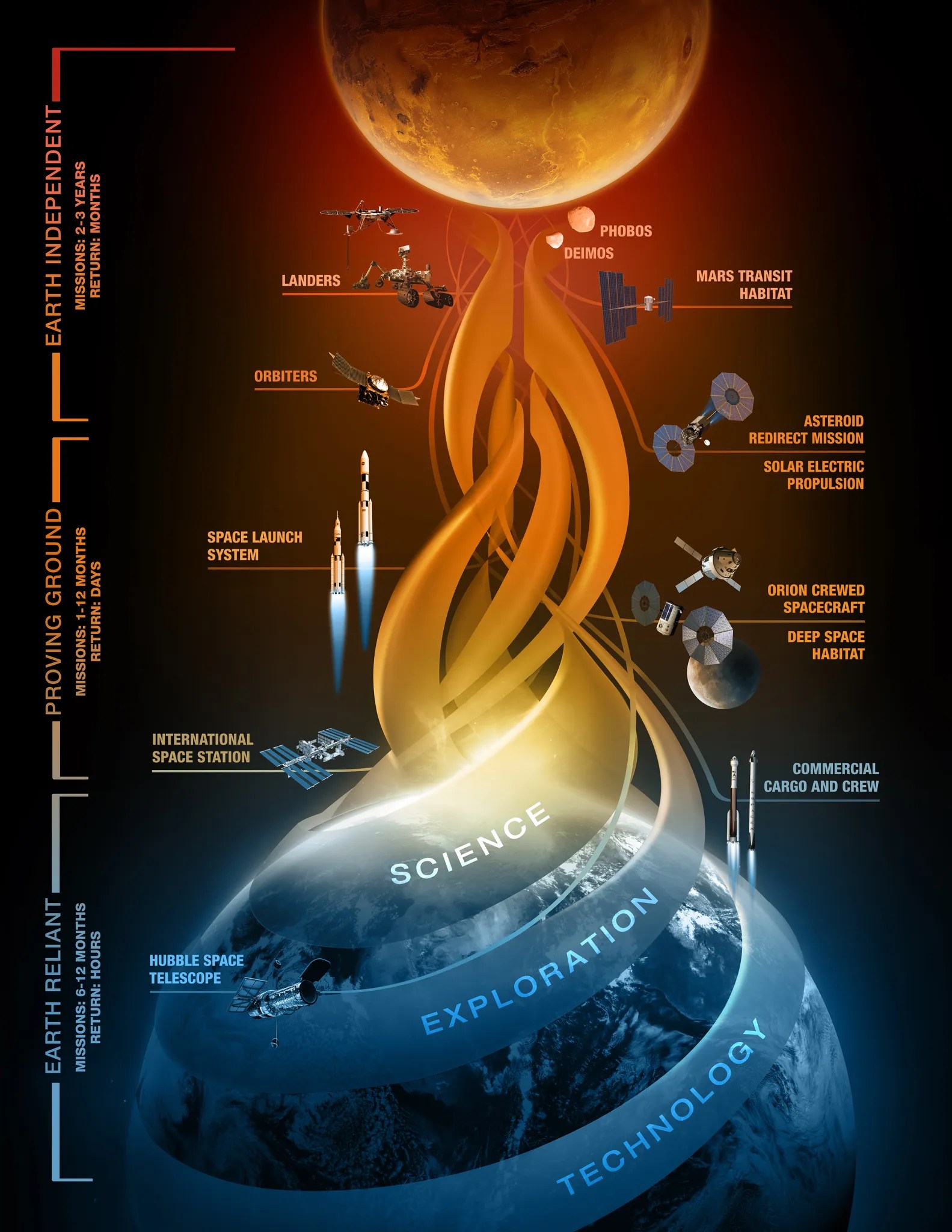
This week was a bit of a treat for me because it allowed me to talk about something that has been unfolding over at NASA for many years. As a science communicator, I have been privileged enough to watch it unfold and have had the opportunity to comment along the way. I am referring to NASA’s long-held plans for sending crewed missions to Mars in the next decade and the many decades’ worth of planning that went into it.

Since 2010, the plan has been to send missions back to the Moon in this decade, build habitats and other infrastructure there, and use it as a testing ground to prepare for Mars. The next step was to send the first crewed mission in 2033, followed by additional missions every 26 months (coinciding with Mars being at its closest to Earth). While there have been doubts for years that NASA could accomplish this goal in that timeline, it was announced this past summer that 2033 won’t happen.

While a flyby mission could occur that year, a crewed mission where astronauts land on the surface is not likely to happen until 2040 – and that would be an ambitious goal. Meanwhile, China is still hoping to make it there by 2033, and SpaceX wants to land there even sooner. But they aren’t in any position to promise that right now since they are dealing with similar challenges and delays. Check out the episode below to learn more about how we got here and what’s likely to follow:

Where to Listen:

Episode 64 of SfS – “The Europa Clipper Mission: A Conversation with Dr. Steve Vance” – is now Live!

Episode 64 of SfS – “The Europa Clipper Mission: A Conversation with Dr. Steve Vance” – is now Live!

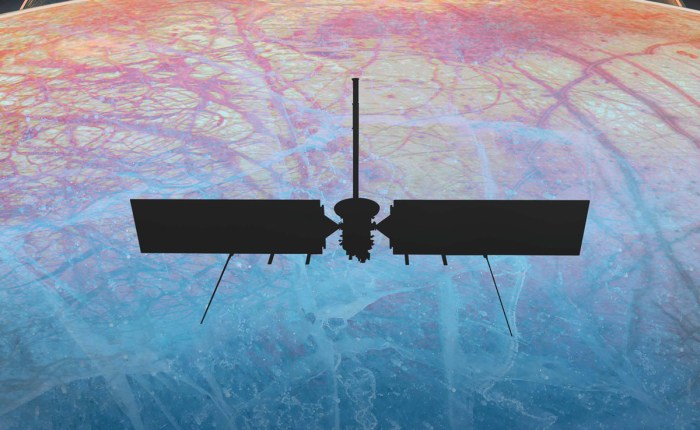
In this week’s episode, I had the good fortune to sit down with NASA scientist and astrobiologist Dr. Steve Vance so we could talk about NASA’s upcoming Europa Clipper mission. This mission, which was decades in the making, will launch this coming October, sending a spacecraft to Jupiter to explore its satellite Europa. Ever since the Voyager probes flew past Jupiter and its moons in 1979, scientists have speculated that there might be an ocean beneath this moon’s icy crust.

The mission will arrive around Jupiter by 2030, where it will begin making flybys of Europa and studying its surface with an advanced suite of instruments. Among its objectives are the characterization of Europa’s surface, investigating surface plume activity, and determining the existence and chemistry of its interior ocean. Another major objective is the search for potential biosignatures, indications that this interior ocean may harbor life!

We got into all of that and a number of other things – including Europa’s depiction in Arthur C. Clarke’s famed Space Odyssey series. As Vance told me during our chat, Clarke played a role in the mission planning, and (contrary to the monoliths told humanity in his stories) we do have permission to “attempt a landing there.”

Where to Listen:

Episode 62 of Stories from Space – Living on Saturn’s Moons – is now Live!

Episode 62 of Stories from Space – Living on Saturn’s Moons – is now Live!

This week, as part of my continuing series, The Great Migration: Settling the Solar System, we took a look at Saturn and its system of moons. With the right technology, know-how, and the right kind of advancements, humanity could someday settle on Saturn’s largest satellites! Much like Jupiter’s icy moons, these satellites are icy bodies, many of which have interior oceans that could harbor life!

Another thing they have in common is their abundant resources, which include water, volatile elements, silicate minerals, metals, hydrogen, and helium-3. But whereas Jupiter has three satellites that could be settled (Europa, Ganymede, and Callisto), Saturn has six – Titan, Rhea, Tethys, Dione, Enceladus, and Mimas. And unlike Jupiter, Saturn has a mild radiation environment that makes harvesting hydrogen and helium-3 from its atmosphere easier and its larger satellites more habitable.

As famed aerospace engineer, science communicator, and space exploration advocate Robert Zubrin has said (many times), Saturn could become the “Persian Gulf of the Solar System,” providing the fuel for nuclear propulsion and fusion reactors across the Solar System. Take a listen to learn more!

Where to Listen:

Episode 61 of Stories from Space – A Mars Sample Return Mission – is Now Live!

Episode 61 of Stories from Space – A Mars Sample Return Mission – is Now Live!

This week’s episode is focused on the upcoming Mars Sample Return (MSR) mission, a joint NASA-ESA venture to send a robotic mission to Mars to collect the Perseverance samples. This will constitute the first sample-return mission from Mars, something that scientists have been planning for decades. In 2028, the mission will launch and is expected to return the samples to Earth no sooner than 2033. Unfortunately, due to recent budget cuts, the mission may be delayed or scaled back significantly.

Meanwhile, China is planning its own sample-return mission as part of the Tianwen-3 mission. This mission will launch in 2028 but is scheduled to return by July 2031. As we enter the new Space Race, it is clear that the brass ring is the Red Planet! But regardless of who secures samples from Mars and returns them to Earth first, the scientific returns will be immeasurable. Much like the Moon rocks returned by the Apollo astronauts, scientists will be able to study these samples for generations using the most cutting-edge instruments available.

These studies could finally answer questions that have remained unresolved since the days of the Viking missions. Was there ever life on Mars? Is there life there today (and where can it be found)? When did it go from being a warmer, wetter environment to the freezing, desiccated world we see today? Check out the episode to learn more:

Where to Listen:

Sharing the gift of astronomy: The Asif Astronomy Club

Sharing the gift of astronomy: The Asif Astronomy Club

The field of astronomy has become increasingly accessible in recent years, thanks to the growth of online astronomical communities, citizen astronomers, and open-access databases. This growth has paralleled the creation of next-generation telescopes, instruments, and data-sharing methods allowing greater collaboration between observatories and the general public. 

Unfortunately, despite these positive developments, there are still millions of people around the world who do not have access to astronomy and would like to. This problem mirrors disparities that exist worldwide, where many communities experience lower education, health, and economic outcomes. These exist not only between nations but between urban and rural communities, where a lack of infrastructure can translate into a lack of access. 

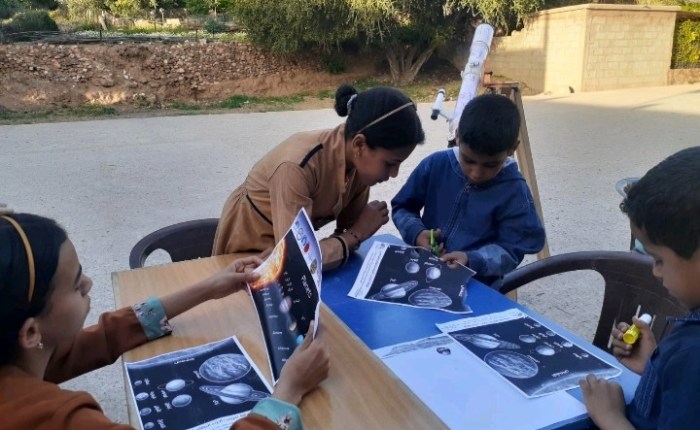
To address this disparity, a growing number of organizations are looking to bring STEM education to traditionally underserved communities. This includes the Asif Astronomy Club, which has engaged with students in remote communities in Morocco’s Atlas Mountains since 2020.

Through its efforts, the club and its leader (El-Mehdi Essaidi) are spreading the culture of astronomy and its central message: “Space is for everyone.” They are also helping to inspire the next generation of scientists and change-makers to reach for the stars (literally and figuratively).

Continue reading “Sharing the gift of astronomy: The Asif Astronomy Club”

Stories from Space is now Live!

Stories from Space is now Live!

It’s officially Launch Day! My podcast series, Stories from Space, just released its first episode. The topic, “We’re Going Back to the Moon!” talks about Artemis and related programs that will send astronauts back to the lunar surface with the long-term goal of establishing a sustained human presence on the Moon. Mostly, the episode addresses the question: why did it take us over fifty years to go back?

Answering a question like that takes about half an hour (or the length of a podcast episode). You can check it out at the Stories from Space homepage (https://www.itspmagazine.com/stories-from-space), or just click on the play button below. The episode is also available for streaming on Spotify and Apple

Good News: Teaching a Summer Course at the Kepler Space Institute!

Good News: Teaching a Summer Course at the Kepler Space Institute!

The course consists of six lessons (2 hours each) that explore humanity’s fascination and understanding of the Red Planet, culminating with two questions: One, how has our knowledge and understanding evolved over time? Two, can human beings thrive (not just survive) there someday? Considering that humans Mars have been exploring Mars for more than sixty years, and been looking up at the Red Planet since time immemorial, there’s a fair bit to unpack there.

https://ksiedu.com/the-exploration-and-potential-settlement-of-mars/#

Continue reading “Good News: Teaching a Summer Course at the Kepler Space Institute!”