Utopia in Popular Culture

Aeon Flux:
Fans of this animated cult-classic are sure to understand why this show has made the list. In the futuristic setting of the show, events revolve around an ongoing conflict between two societies. On the one side, there is Brenga, a police state run by the autocrat Trevor Goodchild. On the other is the anarchist state of Monica, where the show’s main character – Aeon, a Monican agent and spy – comes from.

Much like the world of the Cold War, these two sides are locked in an ongoing state of detente, where espionage and skirmishes take place back on both sides. The border region between them resembles that of Cold War-era Berlin, where a massive wall separates the two and those trying to cross are either shot or cut down. In one particular episode, people who are missing limbs were a focal point, demonstrating just how many people have fallen victim to the border defenses.

This is a common feature in the story, as it seems that the people of Bregna (known as Breens) would like very much to live the lives of Monicans. Its for this reason that one of Aeon’s duties as an agent is to make regular runs into Bregna to get people out through a series of underground passages. It is also suggested that it is precisely because Monica has no official representatives that it is impossible for Trevor Goodchild to deal with them. He does not seem to understand how their society works, and therefore cannot bribe, threaten, or intimidate them into a peace settlement.

Avatar:
Here is a perfect example of the traditional Edenic civilization being threatened by the evil progress-driven bad guys. Though it was not my favorite movie by any means, it’s undeniable (aka. blatant) utopians themes are quite clear. In short, the Na’vi live a peaceful, contended existence with their environment, and are even telepathically linked to a planetary intelligence known as Eywa.

Borrowing elements from Native American lore, the Gaian hypothesis, and the concept of an ecological utopia, Cameron created a world where paradise was to be found by anyone with appreciative eyes. Whether it was their communion with animals, the trees, or Eywa, the Na’vi elevated the concept of living in harmony with their environment to literal levels.

Demolition Man:
Again, we have what is often classified as a dystopia, but which is made so because of its apparent utopian elements. Set in the not-too-distant future of San Angeles – the mega-city formed from the merger of LA and San Diego – the story revolves around the social experiments of one Dr. Raymond Cocteau.

In addition to being the man who invented the cryo-stasis prison system, which was central to the plot, he is also the man who pioneered the San Angelans “utopian” way of life. In essence, this way of life is bereft of violence, crime, and drug use. The people live what can only be described as a peaceful and contented existence, believing that everything that came before them was characterized by violence and brutality.

The price tag was high, to be sure. People are no longer allowed to swear, play contact sports, own guns, or eat anything remotely unhealthy. Violent and/or sexual entertainment has also been banned, as has real sex. However, the people of San Angeles seemed to accept all this based on the state of society prior to Cocteau’s “revolution”.

The proliferation of violence, chaos, drug use and venereal diseases pretty much left them thinking they had no choice.  Such is the nature of utopian engineering, in the end, where people willingly surrender certain aspects of their lives in order to achieve something better. Much like collectivization, the banning of money, or the elimination of monogamy.

Futurama:
This might seem like a bit of a stretch, but I’ve always felt that anyone who loves science fiction can’t help but notice the classic themes and elements in this show. Usually this takes the form of dystopian elements – suicide booths, career chips, the tax monster, etc. However, at other times, some decidedly cheery and optimistic tones make it in.

For example, in one particular episode (season 1, episode 8: “A Big Piece of Garbage”), Earth finds itself being threatened by a massive ball of garbage. They deduce that only a similar ball would be able to deflect it, but unfortunately, no garbage exists. Everything on Earth is now recycled, used cans are recycled to make robots, and used robots are used to make cans. Nothing goes to waste, which is why Fry must teach them how to litter!

And then again, in season 6, episode 2: “In-A-Gadda-Da-Leela”, Leela and Zapp Brannagan land on what appears to be a mysterious, Edenic planet. Here, Leela and Zapp begin living freely as if they were Adam and Eve, which includes shedding their clothes, talking to a serpent, and living off the land. Of course, it was all a ruse by Zapp who once again just looking to get Leela in the sack, but the illusion was complete!

Sid Meier’s Alpha Centauri:
There’s a reason this game is one of my all-time favorites, and that is because it’s so inspired! One immediately gets the feeling upon playing this all the way through that a lot of classic sci-fi elements went into the making of it, as well as genuine cultural, sociological and scientific research.

For starters, there is the concept of colonizing a new world and the social experiments that it naturally will entail, which is in keeping with KSR Mars Trilogy. Each faction in the game represents a different take on engineering the perfect society. There are the humanitarians, the believers, the Gaians, the hive-mind people, the free-marketeers, the militarists, and the rational empiricists.

What’s more, the technology tree that is featured in the game contains many options for social engineering, the intended end result of which is a perfect society in one form or another. These include Thought Control, Cybernetic, and Eudaimonic, three basic visions of utopia which are dependent upon repression, post-humanism, and a utilitarian, social welfare approach meant to enrich the lives of as many people as possible.

There’s even the option of achieving transcendence, which is one of the victory condition’s of the game. This is achieved by merging with Alpha Centauri’s planet-wide organism, becoming part of its mass consciousness and ensuring a sort of quasi-immortality as it were. This is considered the biggest and best victory option since it ensures planetary peace, as opposed to conquering all the other factions, united them, or cornering the planet’s energy market (the three other victory conditions).

Star Trek:
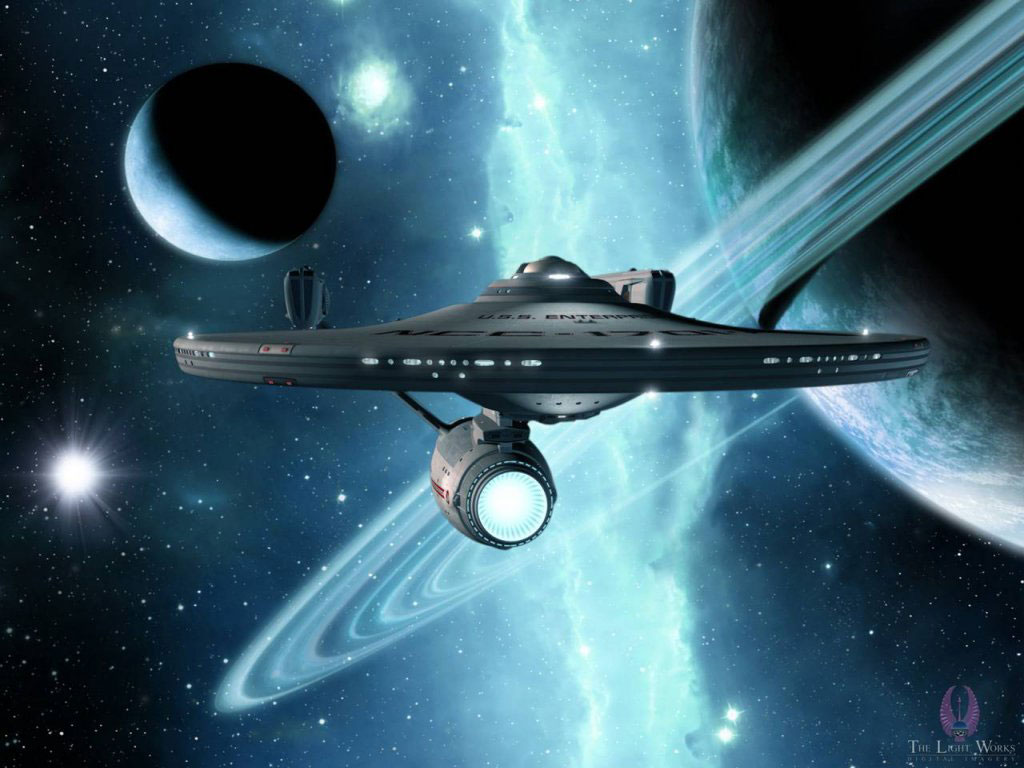
When it comes to commercial sci-fi, Star Trek pretty much has the market cornered when it comes to utopian elements. Whether it was the original series, TNG, or its subsequent spinoffs, it was clear that humanity had reached a state of technical and social perfection thanks to advances made in science and technology, not to mention good old fashion optimism.

For starters, the United Federation of Planets was an egalitarian democracy where all member races were entitled to representation, a constitution guaranteed extensive rights and freedoms, and all wants and needs were addressed thanks to replicators, abundant energy, transporters and warp technology.

And of course, numerous references are made to the fact that Earth is crime free, all known diseases have been cured, and troublesome things like poverty, slavery, exploitation, inequality and human drudgery have all been eliminated. No real explanations are given as to how, but its clear it happened by the 22nd century.

Star Wars:
Though not a utopian series by any stretch of the definition, there are some tell-tale aspects of the franchise which warrant examination. For example, though the bulk of the story takes place during the “Dark Times”, when the evil Empire rules, numerous allusions are made to a time before the Empire where things are described in somewhat idealistic terms.

For example, here is how Obi-Wan describes the role of the Jedi in the good old days as follows: “For over a thousand generations, the Jedi were the guardians of peace and justice in the Old Republic.” In addition, it is also made clear that the Old Republic was governed by an interstellar democracy known as the Galactic Senate. Between the Jedi and the government, things like slavery, conquest, blatant racism, genocide, and all other forms of behavior common to the Empire were highly illegal.

In having this era of peace and relative prosperity to compare their current circumstances with, Lucas was able to drive home the point of how the Empire was illegitimate and had seized power by unjust means. It also made the heroes current predicament seem that much more emotionally involved.

Wing Commander:
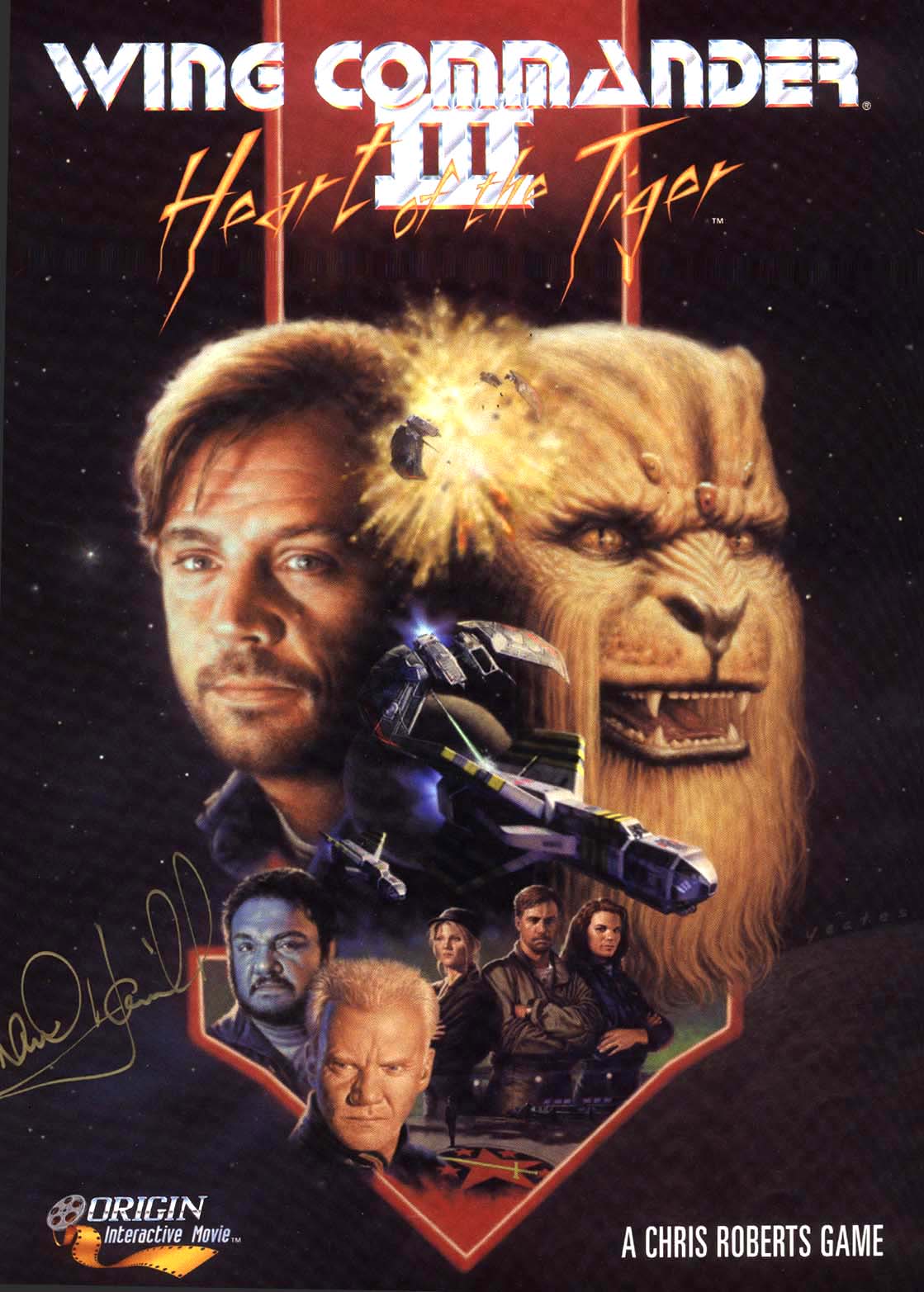
Calling to mind such franchises as Star Trek and Man-Kzin Wars, the Wing Commander series takes place in the distant future when a semi-utopian humanity is engaged in a war with a militaristic foe. As with the violent Kzin, the enemy in this series known as the Kilrathi, are a race of feline anthropoids.

Governed by a strict hierarchy and warrior code, the Kilrathi are driven to war and conquest and have been fighting humanity for generations. Though no formal description is ever made of the Earth government or human customs, many hints are given that suggest that the Terran Confederation is governed by the comparatively enlightened ideals of humanitarianism and democracy.

For instance, in the first Wing Commander it is said that Kilrathi do not place the same importance on alien life as the Confederation. Evidently not, since conquest, slavery and genocide seem to be par for the course for them! In addition, several alien species are allies with the Confederation, usually for the sake of mutual defense against the Kilrathi.

And as with Star Trek, the bad behavior of the enemy species is held in contrast to the comparatively peaceful and egalitarian behavior of humans. And as always, this is designed to illicit a point about history and human nature.

Conclusions:
When it comes to popular culture, there never seems to be a shortage of inspired science fiction elements. This is true of movies, television, and the gaming world. However, I can’t help but notice just how more common dystopian movies, shows and games are. For whatever reason, it just seems like tales of dark futures are much more popular. Is it because dark futures seem more realistic, or might it have to do with the proliferation of dystopian literature in the last century or so. Either way, believe me when I tell you that examples of modern utopian sci-fi franchises were much harder to find. No wonder Neal Stephenson challenged the sci-fi writers of the world to come up with something cheerier!

Technology in the Star Trek Universe (updated!)

I’ve wanted to do a post like this for awhile, ever since my conceptual post on Galactic Empires in fact. After doing my research on what distinguished one from the other, I noticed just how central technology, or the perception thereof, is to it all.

And let’s face it, Star Trek has had a lot to say about technology over the years, not all of it consistent! So with a series of examples, I thought I’d examine just what Gene Roddenberry and his successors have had to say.

Cloaking Device:
First developed by the Romulan Empire, the concept for an invisibility field that encompasses an entire ship has been picked up by just about every advanced race in the galaxy. Considered impractical by many because of the intense power drain, other races have found ways to adapt it to give their ships a decided edge in combat.

One such race are the Klingons whose vessels all come equipped with a cloak. The Romulans maintain use of this technology on their military vessels, particularly their warbirds, and even the Federation has been known to dabble in it from time to time. Another discernible weakness is the presence of tachyons and anti-protons that cloaked vessels are known to produce.

Holodecks:
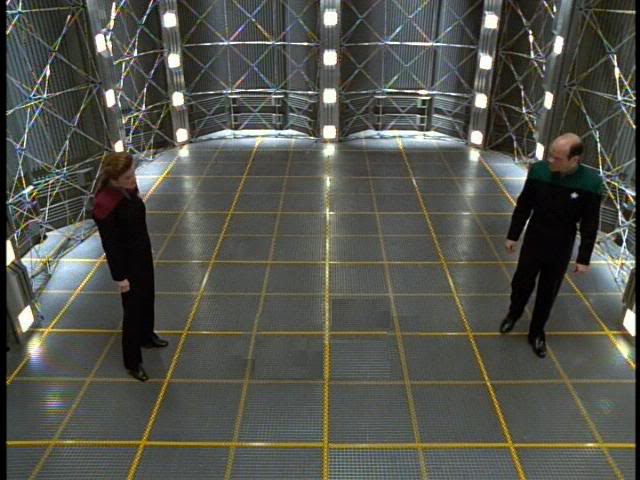
The holodeck is an advanced holoprojector device that was designed by Starfleet for use aboard starships, stations, and institutions. It serves the purpose of entertaining, training and training purposes. Using focused photons to simulate matter, the holodeck is able to create physically real virtual environments out of pure energy.

Because of their potential for danger, all holodecks come equipped with built-in safeguards. Matter created aboard the holodeck ceases to exist as soon as it passes beyond its generators, and the technology has been adapted to creating AI’s such as the ship’s emergency doctor program.

Hypospray:
This non-invasive piece of medical technology is the mainstay of Starfleet medical. Using a compressed air transport mechanism, this device is able to transfer the injectant painlessly from the device into the subdermal layer below the skin of the body, or artery.

In the original series, hyposprays resembled hypodermic needles, but by the time of the 24th century (the TNG series) they had become much more sophisticated, resembling the unit pictured at top left.

Phasers:
Short for phased-energy laser, phasers are the most common energy weapon in Starfleet and the known universe. Beginning in the 23rd century, the technology was adapted for use as hand-held weapons, military rifles, and as the primary weapons banks on ships.

The 24th century saw further developments in the development of this weapon, which included mutli-segment phaser arrays,  and phaser cannons. The former made their first appearance in TNG on the USS Enterprise D and other updated ships while the latter appeared for the first time on USS Defiant.

Replicators:
Using the same technology as the holodeck, a replicator is a matter-energy device that is capable of dematerializing quantities of small matter and reconstituting it as something else. This can take the form of food, commercial products, or machine parts. In short, anything can come out of a replicator so long as it has the atomic matrix down, and isn’t illegal!

Prior to TNG, Starfleet ships used food synthesizers, but by the 24th century, the technology had been perfected and made standard on all starships, stations, outposts and settlements. Because of their sheer usefulness and versatility, every advanced race has adapted the technology for their own use.

Shields:
Also known as Deflector Shields or Screens, these devices are the mainstay of all advanced races in the Star Trek universe. Operating by creating a layer, or layers, of energetic distortion containing a high concentration of gravitons, they are able to provide protection against weapons fire and natural hazards.

Typically, shields are emitted from either a central emitter dish or a series that are dispersed over the hull. They usually come in six sections, covering the fore, aft, port, starboard, dorsal and ventral areas of the ship. In time, shields can be dissipated by either continuous or repeated energy discharges, leaving the ship vulnerable.

Transporters:
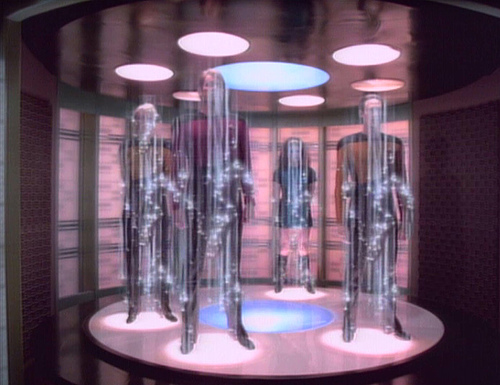
Utilizing subspace technology and the same matter-to-energy concept as a holodeck, the transport is the principle means of transportation to and from ships in the Star Trek universe. Often referred to as “beaming”, transporters are able to dematerialize, transmit and reassemble an object from one pad to another.

Making its debut in the original series, the technology has been updated in the TNG universe and its various spinoffs to allow for greater accuracy and safety through the addition of added redundancies. This increased accuracy allows for point-to-point transport, usually within smaller areas like the ship itself.

Tricorders:
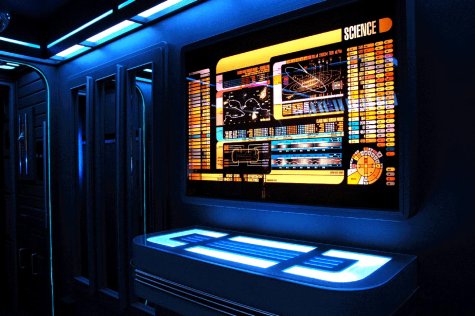
A handheld sensing device, the tricorder was invented by Starfleet specifically for use by Starfleet personnel. However, since their inception in the 22nd century, they’ve gone through repeated upgrades, adaptations and have been adopted by just about every advanced race in the Alpha Quadrant.

As it stands, there are six varieties of tricorder in use within Starfleet alone. These include the psychotricorder which measures a patients brainwaves, a medical tricorder which diagnoses ailments and injury, and four models (VI,VII, X and XV) all of which are in service in one branch of Starfleet or another.

Warp Drive:
In the Star Trek universe, the warp drive is both the primary means of transport and the pinnacle of a race’s technology. In fact, Starfleet only makes contact with a new alien race once they’ve developed this technology, as it’s felt that it is only at this point in a species’ development that they will be advanced enough to experience first contact.

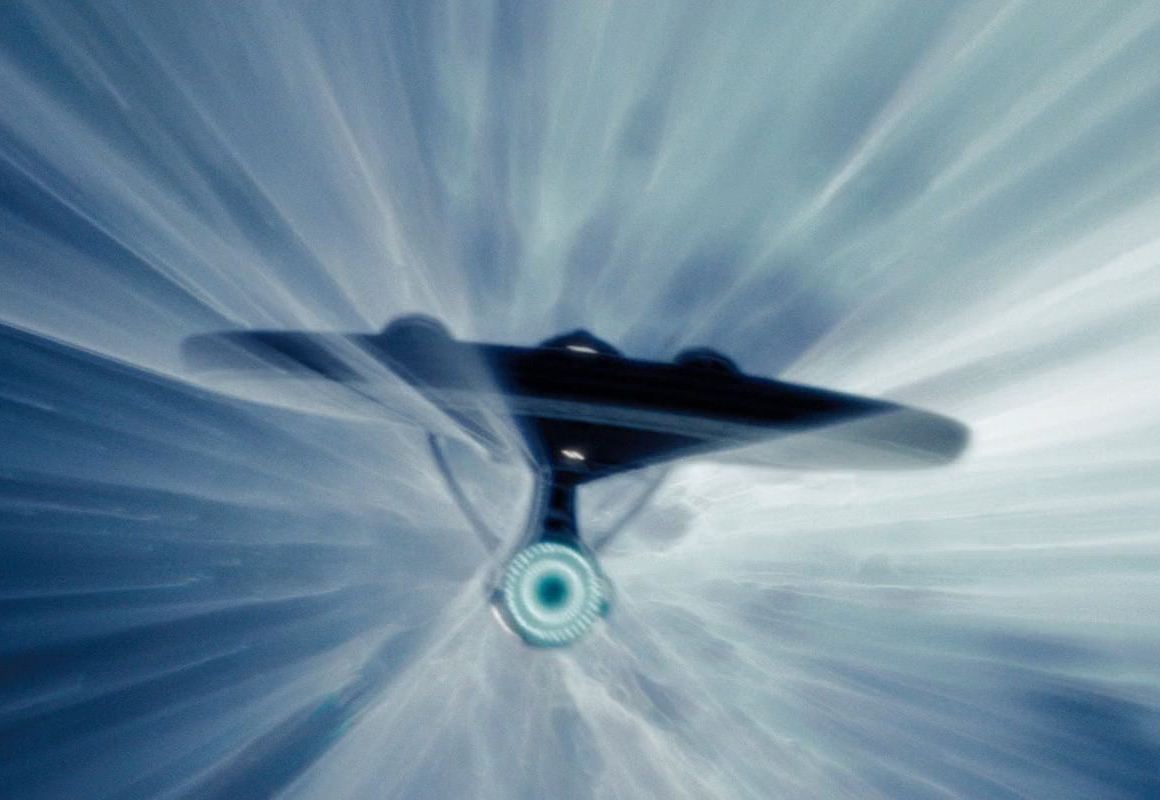
First developed by the human race in the late 21st century, warp technology was what precipitated First Contact with the Vulcans. Utilizing a matter/antimatter process and a dilithium chamber, a warp drive generates a “warp field” to envelope a starship. This has the effect of distorting the local spacetime continuum and moving the starship at velocities that exceeded the speed of light.

Every advanced race in the Alpha Quadrant has this technology, though some are able to achieve greater velocities (known as warp factors) than others. In the course of the old series and new, new and more advanced forms of FTL are being researched which may replace standard warp. These include transwarp, quantum slipstream, and a host of others.

Conclusions:
Technology as Utopian:
For the most, part Star Trek seems to be making the point that technology is a good thing. Whether it was the original series, TNG, or the many spinoffs to follow, it seemed that humanity owed much of its current condition to technological progress. Though they never explained how, at many points in the franchise it is said that Earth is now a paradise, bereft of crime, bigotry, hunger, and inequality. Just about all known diseases have been cured, and even money has become obsolete.

Yes, it seems that in the future, the focus of the economy has shifted to one of “self-improvement”… Might seem a bit hokey on the surface, but as I said in the Galactic Empires post, it’s really not that farfetched. Although its still pure fiction, the advent of something like warp drive, which would make space travel quick and affordable, commerce and transport between colony worlds would be open. This would mean abundant resources that went far beyond Earth and the Solar System, and we already know just how rich our system is in resources (see Asteroid Mining).

But more importantly is the development of replicator technology, which comes in the form of personal and industrial sized units. The former are used to produce everything from food and clothing to consumer products while the latter can create just about anything in bulk quantity. If this were possible, then all scarcity and deprivation would cease to exist. What’s more, the entire basis of an unequal distribution of wealth would disappear. Frankly, it puts me in mind of what Orwell said in 1984:

From the moment that the machine first made its appearance it was clear to all thinking people that the need for human drudgery, and therefore to a great extent for human inequality, had disappeared. If the machine were used deliberately for that end, hunger, overwork, dirt, illiteracy and disease could be eliminated within a few generations.

By the “machine”, Orwell was of course referring to industrial technology and the economy it spawned. However, his overall point was clear. Modern technology, dedicated to the write purpose, had the ability to significantly raise the fortunes of all people. And let’s not forget how in the Star Trek universe, hyposprays and various medical devices can solve just about all that ails you! Break a bone, you get the bone knitter! Tear your ACL, you get the… ligament bonder. I don’t know, all I do know is that pain is virtually obsolete in this universe and its because of progress.

So really, Roddenberry wasn’t far off when he envisioned a “perfect society” in the future. It was just in how he failed to explain how this could done that things seemed a little weak. But of course, there was a flip side to the whole thing.

Technology as Dystopian:
But of course, there were plenty of examples of technology gone wrong. The examples are a little too many to name, so I’ll keep it to just a few. The first comes from the first season when the Enterprise D comes to a planet of Aldea. There, a group of advanced humanoid aliens live in relative peace and prosperity, except that they are sterile and therefore dying off. Hence why they start kidnapping the Enterprise’s children!

Eventually, the Enterprise crew determines that the source of their problem is the great machine that runs their planet, otherwise known as “Custodian”. Because they’ve forgotten how to use the machine, the Aldeans have been unaware of the fact that it’s long since broken down and has been letting harmful radiation in. They assist them in fixing it, and the lesson about letting technology run your life has landed!

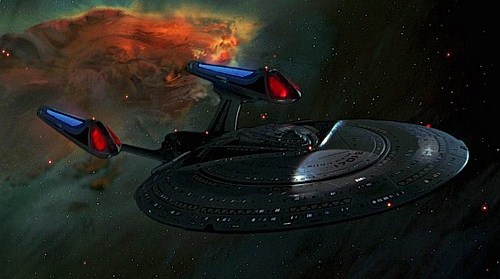
The second example comes from the regrettable movie Insurrection, where the Enterprise E comes to an idyllic planet inhabited by the Bak’u. Here, people live in virtually perfect harmony with the planet by denying themselves certain technology, opting instead for the simple life. Their philosophy is simple: “when you create a machine to do the job of  man, you take something away from the man”.

All of this seems inconsistent with the usual message of Star Trek, and even the movie itself. Far from being purely primitive, the Bak’u employ all kinds of labor saving technology, which includes irrigation and dams. So really, are they really so opposed to technology or just specific technologies? Nevertheless, the metaphor is clear. Combined with the fact that this place has youth-preserving powers, the metaphor of this place is pretty obvious. It is the fountain of youth, garden of Eden, and the evil Son’a who are advanced and creepy want to destroy it. Not their best movie!

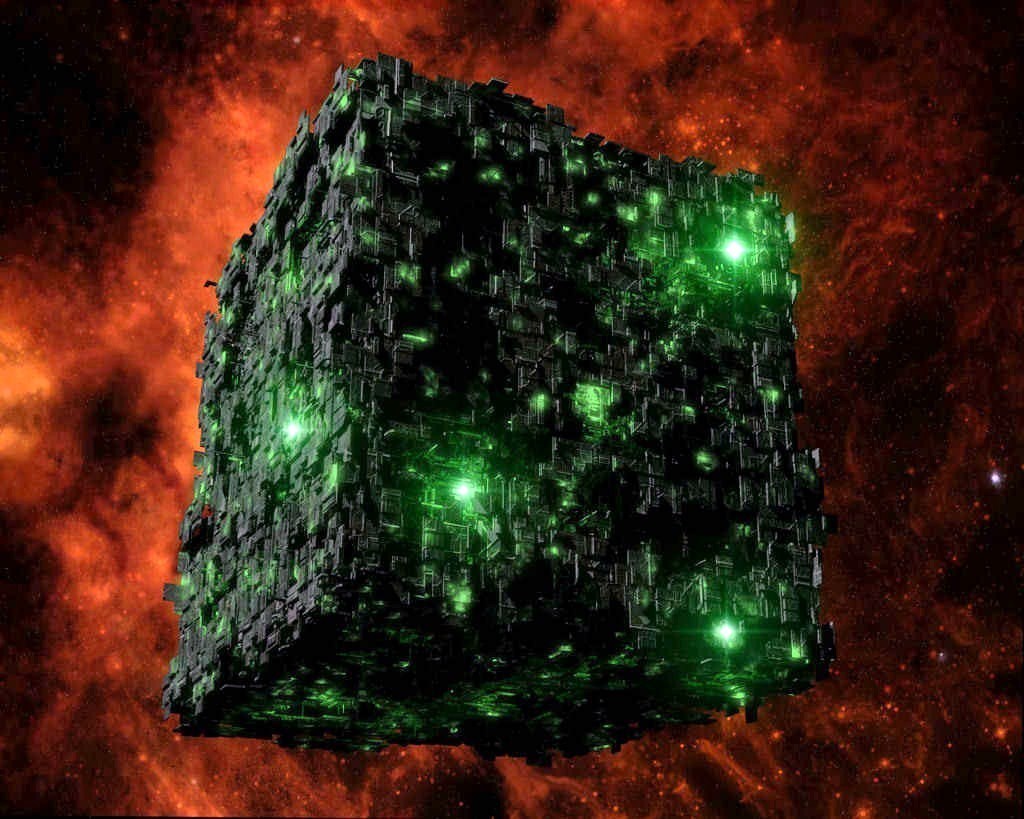
But the last and best example comes in the form of The Borg. A race of cybernetic beings who have merged the organic and synthetic, run by a hive mind that quashes all individuality, and threatening to assimilate all in their path, the metaphor is so thick you need a knife to cut through it. They are the ruthless march of progress personified!

And just look at them and their ships, are they not the perfect representation of cold, unfeeling technology? Sure they are! And the way people change once they’ve been assimilated, becoming soulless automatons and losing all color and individuality. Tell me that’s not a perfect visual representation of the death of the human spirit under the weight of urbanization and anonymity.

Some might call this inconsistent, but it seemed more likely like Roddenberry and his writers were simply hedging their bets. On the one hand, he was showing how human potential could one day yield the perfect society, or at least one that was free of all the problems we know and lament today. On the other, they must have wanted to show the obvious downside and dangers at worshiping at the altar of progress. After all, if you put an ideal, any ideal, ahead of humanity and life, all you get is dystopia!

And as always, other races in the Star Trek universe serve as a mirror for the human condition, or rather different aspects of it. If the human race has got it right, then others must not have achieved that careful balance of humanity and progress just yet. Whereas some prefer to be Luddites and live in an agrarian Eden, others have become runaway cyborgs who assimilate all in their path. It’s all about balance people!

Well, that was kind of fun! And it combined two of my favorite things in the world. Sci-fi and literary criticism. Perhaps I should do more of these. As always, suggestion on which franchise should be covered would be great. I can think of a few off the top of my head – such as the Star Wars universe, Dune, Aliens, Terminator, and possibly Battletech – but I would like to hear from others too. There’s always those added few that would be perfect but I fail to think of. Thanks all!

Cool Ships (volume X)

Aerospace Fighter:
Here’s one I found while sifting through info for another post (see Giant Robots). Like the mechas from that list, this too comes from the Battletech universe. And the name pretty much says it all. This futuristic fighter, which is found in the air forces of every Clan, is capable of flight in both air and space.

Typically, these fighters serve in a supporting role for the assault mechs in the Battlemech universe. Once the mechs are deployed in their drop pods, these fighters follow, flying from space directly into atmosphere and engaging enemy forces in the field of battle.

Using much the same technology as assault mechs, aerospace fighters are powered by fusion engines and are constructed from lighter ferro-fibrous materials. They also come equipped with cannons, lasers, missiles and guided munitions. Control is carried out through either touchpads, hands-on controls, and in some cases, machinery which can read the pilots thoughts.

Akira-class:
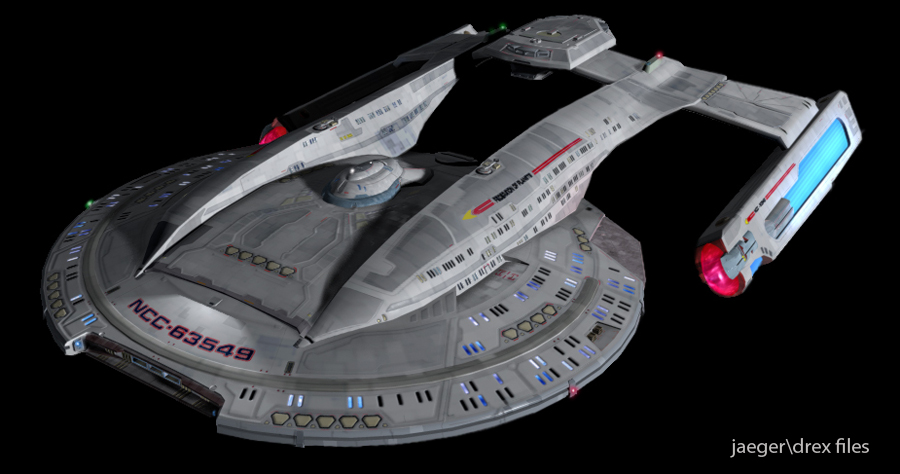
I’ve been waiting to include this one. Years back when I saw it on DS9, I thought of just how cool it looked. After looking into it some more, the cool factor has been magnified considerably. Known as the Akira-class, this starship was meant for war and designed accordingly.

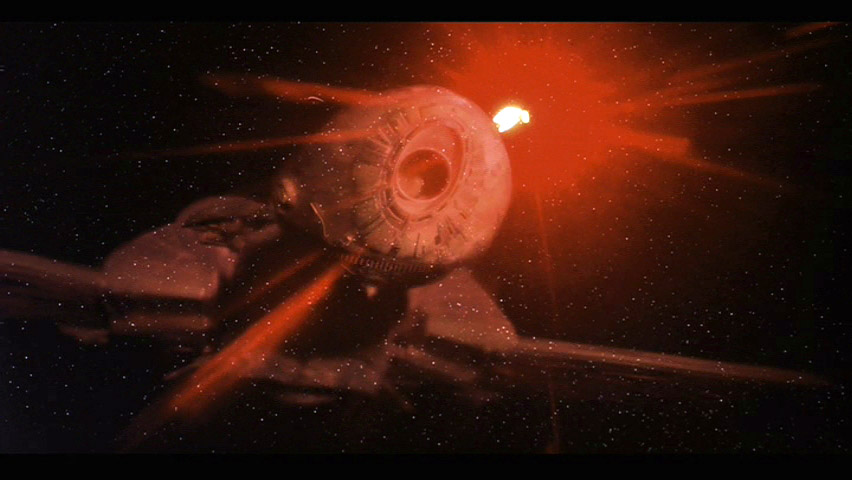
Akira-class ships first made their appearance in First Contact, where several were used to engage the Borg Cube that was trying to assimilate Earth. This was no coincidence, as these ships were apparently part of Star Fleet’s larger effort to create warships that could deal with the Borg threat. It would also go on to play an important role in the Dominion War.

Much like the Defiant, it was built for speed and firepower. But unlike other ships, it has virtually no secondary hull, placing the majority of its functions up front in the saucer array. It also has multiple phaser banks and torpedo launchers, as well as a powerful shield array. But its greatest asset comes in its shape. Resembling a catamaran with a thin profile, the Akira presents a very difficult target. Combined with its speed, it is able to descend on enemies and deliver an ass-whooping without much fear of retaliation.

Covenant Assault Carrier:
Hello Halo! I was just thinking of how I’ve spent a good deal of page time on ships that belong to the UNSC Navy, but none that belong to the Covenant. That seem fair to you? And since they’ve got some really cool customers, I think it only fair that I throw some in here.

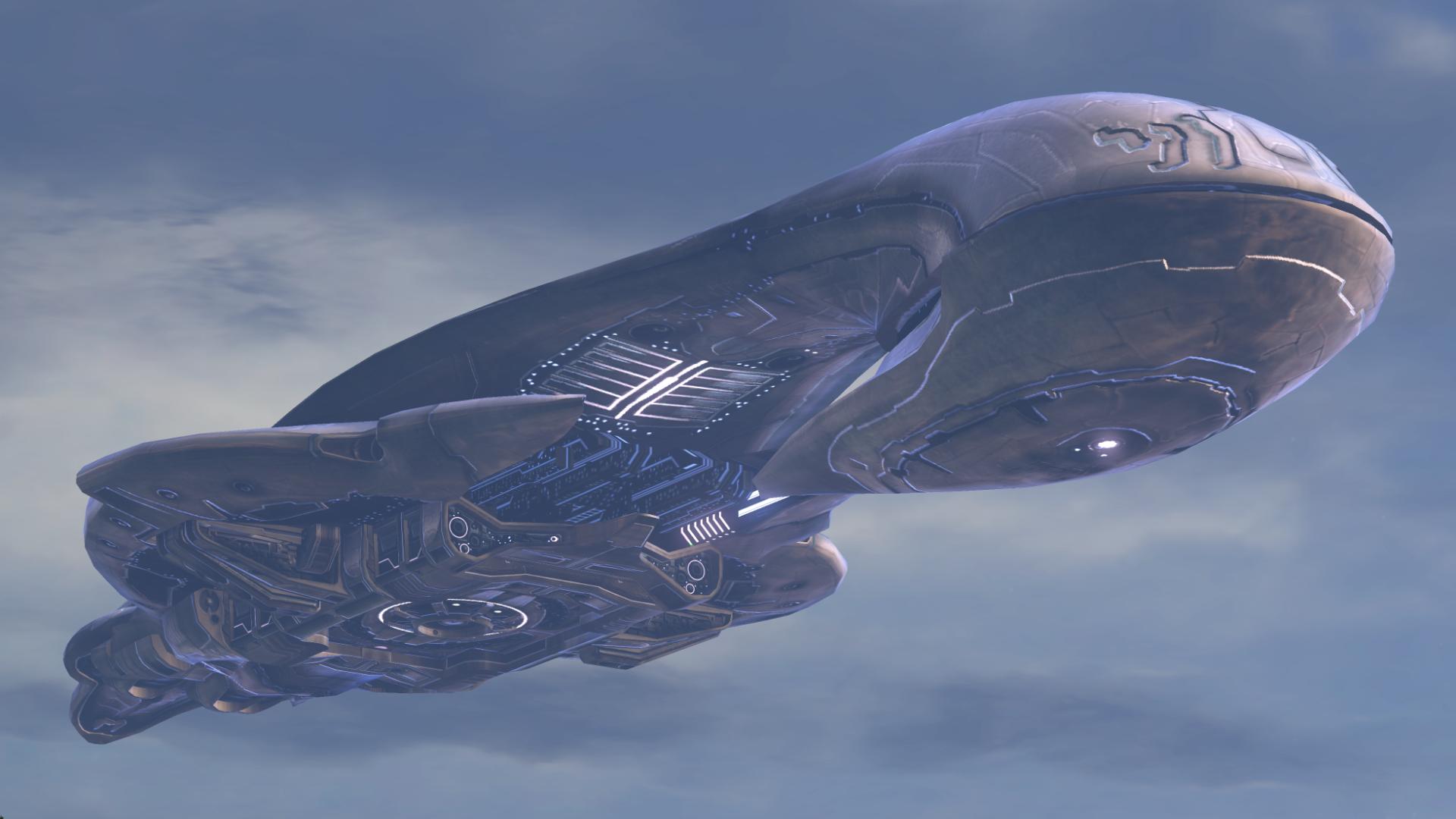
To start, here is the Covenant AC-class, the biggest ship in the Covenant armada and the Halo universe itself (aside from High Charity, of course). These ships serve as the flagships for Covenant assault fleets and boast a wide array of weapons and support craft.

Their massive hulls can not only accommodate multiple wings of Seraph’s, Phantoms, Ghosts, Wraiths, and one or two Scarab walkers. As events in the later series will attest, they can also hold two UNSC Frigates (the Forward Unto Dawn and Aegis Fate). Though designed primarily for planetary combat, their defenses also make them highly effective in ship-to-ship firefights. These include multiple point-defense pulse laser batteries, plasma torpedo launchers and at least two energy beam projectors.

At least two such carriers led the Covenant Fleet of Sacred Consecration to Earth where they engaged the UNSC fleet and Earth’s home defenses in Halo 2. After the Master Chief destroyed one with a commandeered Covenant bomb, the other led an assault on New Mombasa, and then jumped into slipsteam space once its forces were overrun. Interestingly enough, this was the only incidence of such a Carrier being destroyed by UNSC forces. They are just that powerful!

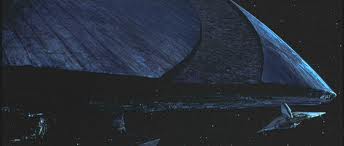
District 9 Mothership:
This ship comes to us from the critically acclaimed if somewhat unoriginal District 9 movie. Yes, despite what some people said about this movie being unique and awesome, it was in fact a collage of ideas Peter Jackson got from other people and franchises. But that didn’t make it uncool.

The same goes for this ship. While the concept of the alien Mothership isn’t exactly new, this vehicle managed to do the concept some justice with its artistry, profile and purpose. For starters, this ship was clearly a “generation ship”, meaning that it was designed to hold an entire population of people and provide for them over the course of many generations as it made its way through space.

When the ship appeared above Johannesburg in 1982, it appeared to be carrying thousands of alien beings who had been designed or engineered for work (echoes of Alien Nation there). Though the ship possessed some very advanced technology, including weapons and medical facilities, it appeared as though none of the workers knew how to operate them. As a result, the aliens had to be resettled and much of their technology began to fall into human hands.

The ship also appeared to have a command module in addition to its vast main hull. As long as this module remains detached from the main vessel, it will hold its last position and remain inert. This was rather crucial to the plot of the movie, since one of the aliens was keeping the module hidden until he could affect repairs. This necessitated that the passengers remain in a camp on Earth until he was finished and they could return back home.

GVD Hatshepsut:
I know what you’re thinking. “This guy must be obsessed with Freespace!” You’ve got some attitude buster! Besides, if you’d played this game much, you’d realize I have only begun to do it justice. Thus far, I’ve included Terran and Shivan ships in these lists, but there’s a wealth of Vasudan ones as well that deserve mention.

To keep it short, the Vasudans were a race of desert-dwelling people who loved history and venerated ancient things. As a result, the Terran forces associated them with the ancient Egyptians and designated their ships accordingly. Likewise, their heaviest ship, the Hatshepsut-class, was named in honor of the most powerful queen in Egypt’s history.

As a cruiser-carrier, the Hastshepsut carried a wide array of weapons. This included multiple laser turrets, point-defense turrets, fusion mortars, anti-ship beams and heavy beam emitters. In its massive carrier bay, which has points of entry on either side of the ship, carries over 30 wings of fighters, bombers and support craft. Other improvements over older models include a heavily reinforced hull and more powerful reactors, which give it the ability to maintain beam fire for longer periods of time.

Independence Day Mothership:
I seem to be in a Mothership kind of mood today. And I seem to recall someone suggesting I include this one some time ago, can’t remember who did, sorry. Just raise your hand and I’ll be sure to give you the credit ;).

Though I’ve pretty much mocked and bashed this movie every chance I could get, I have to admit that Independence Day remains a guilty pleasure for me. And when I saw it, I did think the mothership was pretty cool. And there were things beyond its aesthetics which I now see as praiseworthy.

Much like the District 9 and Alien Nation motherships, this vessel was also a generation ship. As stated in the course of the movie, it housed the better part of the alien race’s people and all of its landing forces. These were all kept within its massive internal bays, which appeared more like an internal city than anything else. These forces were apparently being held in reserve until their attack ships were finished leveling humanity’s cities and destroying it’s defenses.

And as was illustrated at the beginning, it also houses all the attack ships on its exterior. Though not much in the way of technical details are offered in the movie, the ship was very clearly massive and most likely incapable of anything more than sublight speeds.

Liberty Class Cruiser:
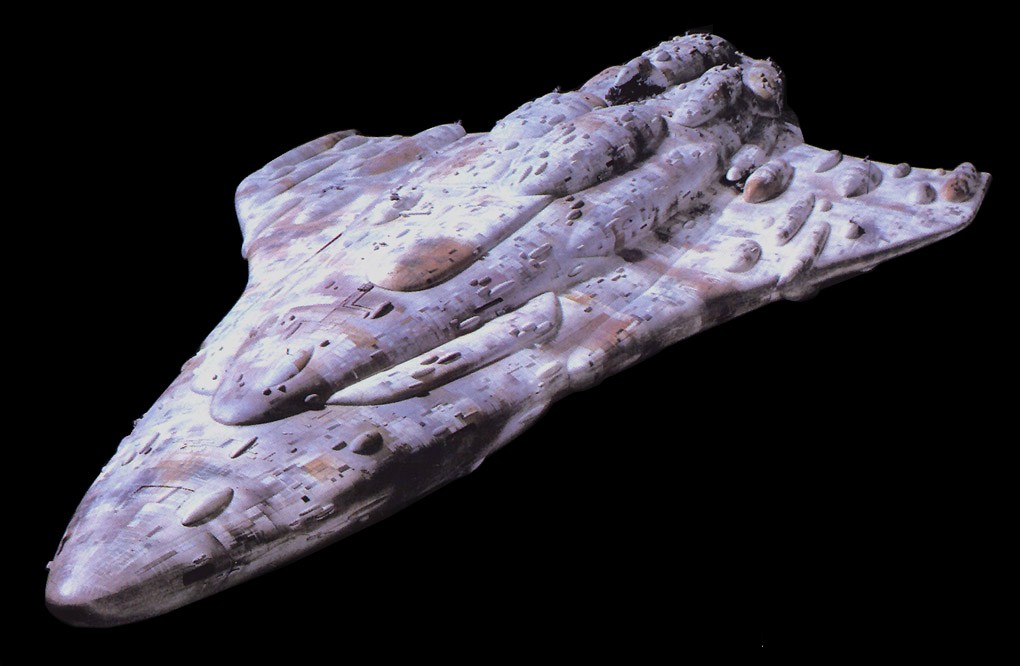
Wow, I almost got through an entire list without mentioning Star Wars. But I don’t imagine I’ll be making a list anytime soon with a single mention from that universe. And today, it’s the MC80 Liberty-class Mon Calamari Cruiser.

Like all Mon Calamari cruisers, each design was unique, making classification somewhat difficult in the early days of the Rebellion. Though the Liberty-class was technically of the same make as Home One (also classified MC80), the Liberty was smaller, narrower and had a pair of wing-like appendages attached to its hull.

In addition, it also packs a lighter weapons array and compliment of fighters and bombers. Measuring 1200 meters in length, the ship boasts a total of 48 turbolasers and 20 ion cannons while three squadrons of fighters provide this ship with protection. All this, combined with its smaller size, make the Liberty best suited for support as part of larger assault missions.

Several of these ships took part in the assault on the second Death Star during the Battle of Endor. It was also Liberty-class that was the first to fall when the Death Star began firing its massive laser. However, these ships proved instrumental in attaining victory, their sleek profiles and coordinated weapons making them effective in close quarters against larger Star Destroyers.

Retribution-class Battleship:
At last, Warhammer 40k makes it into the Cool Ship series. And I’ll think you’ll all agree, this particular ship is pretty cool! Built to resemble an old-world Dreadnought, the Retribution-class is a massive ship of the line in the Imperial Navy, the human faction in the expanded universe (otherwise known as the Space Marines).

Featuring the distinctive armored prow of the Imperial Navy, this ship is able to speed headlong into an enemy fleet and deploy fire from both sides. It is also as fast as the main cruisers of the Imperial fleet, which comes in handy during large-scale fleet engagements where it’s support can mean the difference between victory and defeat.

The main armament of the Retribution class are its rows upon rows of laser batteries lining the sides. For close-quarters fighting, it also carries several torpedo launchers that are capable of delivering devestating, armor-peircing blows. To top it off, the ship is equipped with a series of Lance beam turrets along the dorsal of the ship. They are normally used for finishing off an enemy ship that the main weapons have crippled, or providing return fire when the battleship is closing in on its foes.

Warlock-class Destroyer:
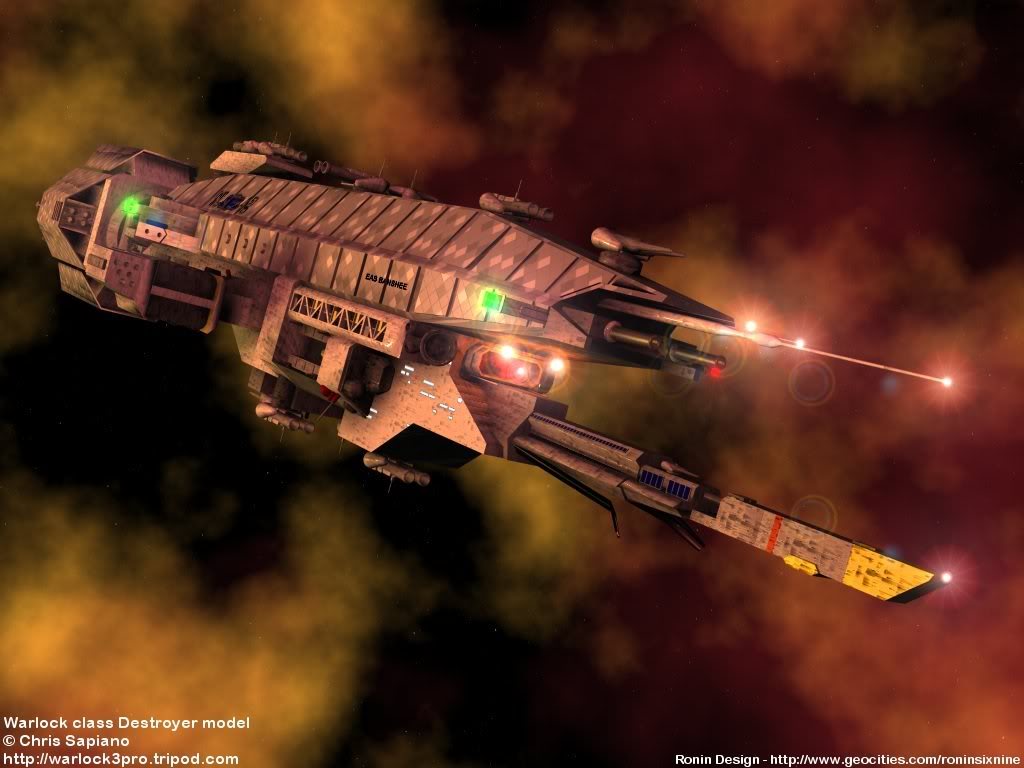
And what would the list be without at least one B5 mention? As a final example, I have decided to include the prototype Warlock-class Destroyer that was making its debut just as the original show was ending. It also made several subsequent appearances in the TV movie Call to Arms and the spinoff series Crusade.

Rushed into production during the last days of the Earth Alliance Civil War, the Warlock featured some of the most advanced technology available. This included advanced weaponry, engines, and most importantly, artificial gravity. This, more than anything else, gave it the advantage over the older Omega-class destroyers which relied on rotating sections.

The Warlock’s engines are a hybrid design featuring the standard ionic thrust modules and a gravitic drive, which like the artificial gravity is borrowed from the Minbari. In terms of weapons, this ship carries two particle beam cannons, multiple heavy cannons and point defense turrets, and 28 large and medium missile arrays. In addition, the original concept also involved a Shadow machine which was buried in the ship’s core. These were promptly removed once Clarke was overthrown, for obvious reasons.

Much like its Omega-class predecessor, it also has a launch bay located at the bow of the ship between its sensor arrays and its cannons. And given it’s larger size, it is able to carry additional squadrons of Starfuries, Thunderbolts and support craft. And of course, its jump capable!

Wow, ten installments of cool ships, totalling close to eighty different vessels. I think some kind of celebration is in order to mark this milestone. Too bad I’m sick as a dog, I’d tilt a glass. Maybe those who read these posts can do that for me. Fill a glass with whatever imbibing liquid you like best and toast your favorite franchises for bringing us these inventive, imaginative designs. Some day, they might just be the basis for something real…

Starship Enterprise… in 20 years!

My pal Fraser Cain over at Universe Today has once again posted the latest from the sci-fi universe. Despite my best efforts, I just can’t seem to keep up with the professionals! Apparently, an engineer has stipulated that the original Enterprise, the Constitution-class vessel from the original series, could be built in 20 years.

In the original series, this ship was built by a team of Star Fleet engineers in the year 2245. However, this engineer describes – in excrutiating detail- how we could do it by 2032, and using current technology.

Everything from the ion drives, the artificial gravity, a 100 megawatt laser, and landing pods and shuttles. Everything but the warp drive… that’s going to take some more time. But dammit, the Star Trek engineers never specified how that whole “warp bubble” thing works anyway!

This ship could make the trip from Earth to the Moon in just three days, and Mars in ninety. Such a ship, with the capacity to carry a large crew and land people with its compliment of shuttles, would be the first step towards colonizing the Solar System. First the Moon, then Mars, then Europa and Ganymede. Perhaps Oberon and Titan too… Skies the limit, apparently!

Like many things, this latest revelation teaches us that the future is coming faster than previously thought. Already we’ve seen compads and peronsal communicators arrive early (iPads and cell phones). If starships make it on the scene a full two centuries ahead of schedule, then it will just prove what guys like Kurzweil say all the time. Technology is not linear, its exponential, and everyday the future gets that much closer… Profoundness! Cue Star Trek music!

http://www.buildtheenterprise.org/

Cool Ships (volume VII)

Welcome to volume 7. Nuff chit chat, let’s get started!

The Blackbird:
Starting this list off right is the stealth ship from the updated Galactica universe. Christened the Laura, in honor of President Roslyn, this ship was the brainchild of engineer Galen Tyrol and his deck hands, who decided to build a new fighter from scratch to make up for their losses. Build for speed and skinned with carbon fiber instead of the usual metal, this ship proved to be invisible to both Colonial and Cylon tracking equipment, hence its designation as a stealth ship.

On her maiden voyage, Starbuck flew the Blackbird on an illegal reconnaissance mission to take pictures of the Cylon Resurrection ship that had been pursuing Galactica. The operation was a complete success, with Admiral Cain – the Pegasus’ CO – going as far to say that: “she flew right up their tailpipe and they didn’t even notice”.

As a result of the technical data obtained from this mission, a joint attack was planned between the Galactica and Pegasus to take the RS down. The Blackbird would go on to play a crucial role in this attack, using its stealth abilities to fly within a few meters of the RS and take out its FTL drive with a well-placed missile. Unfortunately, the Blackbird would suffer a fatal collision after performing this duty, and Captain Lee Adama, its pilot for the op, was almost killed.

Corellian Corvette:
Another mainstay of both the Rebel and Imperial fleets, this ship made its debut in the opening scene from Star Wars: A New Hope and has been with the franchise ever since. Otherwise known as a “Blockade Runner”, the CR90 corvette embodies the spirit of Corellian ship designs, boasting speed and versatility over size and raw firepower.

Because of its adaptability, another Corellian trademark, the CR90 could serve in a variety of roles. These ran the gambit from such mundane duties as freight hauling, to more dangerous assignments like raids and providing fighter escort. In some cases, they could even take on such high-profile missions as diplomatic envoys, carrying public officials to and from their assignments.

Because of these qualities, the CR90 had a long history of service in the Galaxy, serving in the navies of the Old Republic, the Galactic Empire, the Rebel Alliance, and the New Republic. Even after it was phased out of service, it remained a favorite among smugglers, pirates and smaller navies for some time.

Harbor Ship of Bentus:
Here is another feature from the Homeworld universe, the Harbor Ship of the alien race known as the Bentusi. Known for their focus on trade and supplying less advanced races with “short-jump” technology (i.e. FTL), the Bentusi soon found themselves caught in the middle of a series of interstellar conflicts between worlds.

As a result, the Harbor Ship was created, a mothership for the Bentusi fleet that was capable of housing, repairing and deploying smaller vessels. Thought not armed in any official capacity, it is the bulwark of the Bentusi armada and can be found wherever large-scale fleet deployments take place.

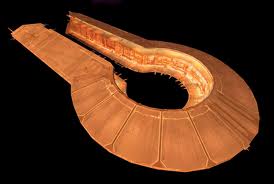
From what I can tell, this design was inspired by what historians believe the harbor of Carthage looked like. Much like the Harbor Ship, it was based on a sort of teardrop design, with a long entrance passage giving way to a sort of rotunda. This design, in addition to being aesthetically pleasing, also makes a lot of practical sense, ensuring that multiple ships are able to be serviced in a 360 degree arc rather than a series of enclosed bays.

Ixian No-Ship:
Another Dune entry which I failed to acknowledge in previous posts, can you believe it? Well, mistake remedied as of now, here is the No-Ship! Named for the fact that it is capable of shielding itself from prescient vision and other forms of detection, including sight. This all makes the No-Ship the ultimate in stealth technology, and led to its wide adoption by all factions in the Dune universe.

Based on the same technology which powered the No-Chamber, a device which the Ixians used to shield their inventions from Leto II’s prescience, No-Ships would become the mainstay of all fleets after his death. In addition to their stealthy characterisitics, they would also boast another invention that was proposed during the time of Leto II, the Ixian navigation machine. This device, which was capable of limited prescience, was able to guide these ships through foldspace without the need of a Guild navigator.

Much like Guild Heighliners, No-Ships appear to have massive capacities. In Heretics of Dune, the No-Ship which Miles Teg steals from the Honored Matres on Gammu apparently had a Great Hold which measured one kilometer in length. This hold was later used to transport an adult sandworms and several tons of its native sand off of Rakis before the HM’s destroyed it. In Chapterhouse and subsequent books, No-Ships served as the mainstay of the Bene Gesserit fleet as well as with all other factions.

The Pegasus:
Battlestar Galactica gave so many cool ship designs that its hard for me to know where to look next. But today, I thought I’d go for the obvious and cover the ultra-modern and behemoth-sized Pegasus, the other Battlestar to survive the destruction of the Twelve Colonies. As with the original, the Pegasus makes an appearance in the re-imagined series. And like everything else, its appearance received an update, as did the tone and nature of its crew.

Although networked like all other modern Colonial ships, the Pegasus survived the assault through sheer luck, having taken its systems down for a diagnostic before the first wave came. Since that time, it’s CO, Admiral Cain, had been fighting a guerrilla style war with the Cylons, attacking their holdings and raiding small convoys in order to keep them off balance.

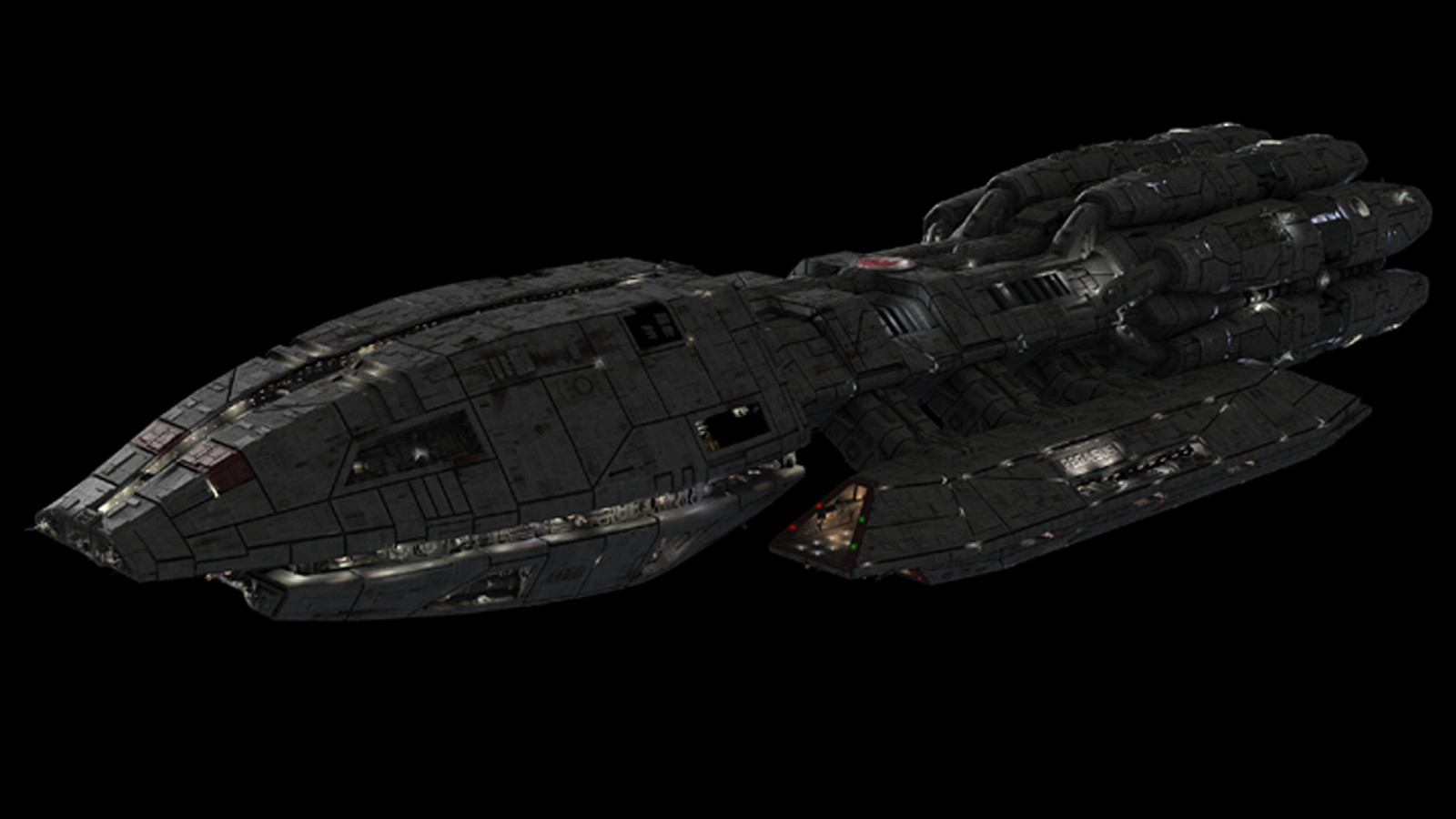
A mercury-class battlestar, the Pegasus was far more advanced and boasted significantly greater firepower than the Galactica.  In addition to its 30 defensive turrets, four heavy cannons, multiple missile launchers and compliment of nukes, its massive bays also hold 10 squadrons of Vipers, as well as dozens of Raptors and support craft. It also carries a series of Viper VII production facilities, meaning that it is capable of replenishing its losses.

With all of these attributes, the arrival of the Pegasus was a great boost to the Colonial fleet, adding a great deal of firepower, manufacturing and many of the latest ships to their arsenal. Nicknamed “The Beast”, the destruction of this ship over New Caprica was considered an immeasurable loss, though its sacrifice was hardly in vain.

Primus-class Battlecruiser:
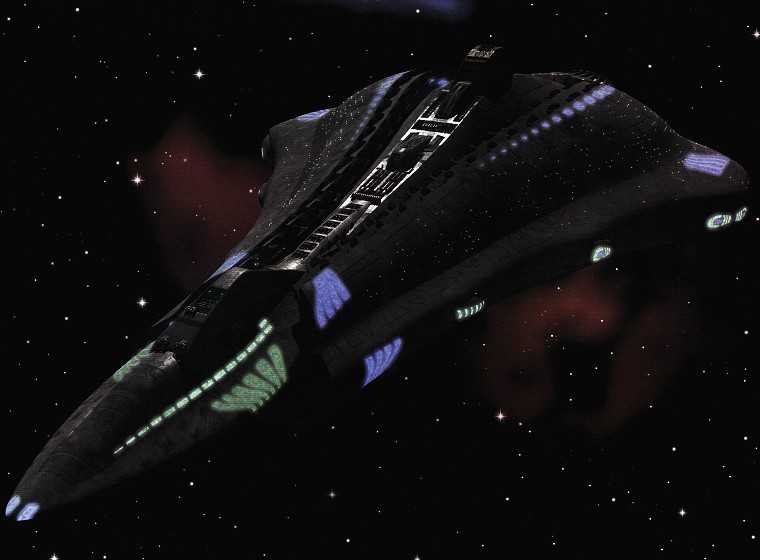
Here we have another installment from the B5 universe, from the Centauri Republic to be specific. Known as the Primus-class Battlecruiser, this baby is renowned for packing firepower and artistic design into one package.

Discernible from its manta ray-like configuration, the Primus remains the mainstay of the Centauri navy even after two centuries of service. Although lightly armored, the ship boasts an impressive array of ion guns, a hyperspace drive, and artificial gravity for its crew.

Making its first appearance in season two of the show (“And Now For a Word”) when televised a standoff occurred outside the station between the Centauri and the Narn. In that battle, the cruiser in question was destroyed, but managed to inflict enough damage that the G’Quon class cruiser also blew up while attempting to make a jump. This demonstrated that the Primus, though an older design, was still capable of standing toe-to-toe with its Narn equivalent.

This encounter was followed up during the season two finale (“The Fall of Night”), when another such cruiser threatened the station when it was discovered that Sheridan was harboring a Narn heavy cruiser. This cruiser managed to inflict serious damage on the station before a squad of Starfuries and the station’s own defenses managed to destroy it.

Primus class cruisers would go on to make several appearances in the course of the show, serving throughout the Narn-Centauri war and even making an appearance during Sheridan’s war to liberate Earth. During the Alliance-Centauri war, these cruisers appeared to have been relegated to defensive duty, leaving offensive operations to the newer and lighter Vorchan-class cruisers.

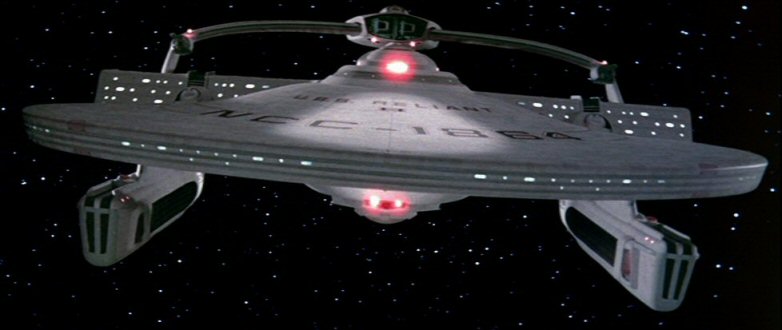
USS Reliant:
Thank you to Victor for suggesting this one. I was wondering if I should go back to the original Star Trek for ideas, and this was just the push I needed to include some. And given that this ship made its appearance in Wrath of Khan, arguably the best of the bunch, I figured it would be the perfect candidate.

A Miranda-class starship, the Reliant possessed capabilities comparable to that of the USS Enterprise. She is best known for being the ship that was charged with investigating planets for the Genesis Project and then being commandeered by Khan Noonien Singh, a warlord from Earth’s Eugenics Wars who had been marooned on the planet for many years.

After commandeering the ship with his people, Khan used the Reliant to seize Genesis and attack the USS Enterprise. During their initial encounter, Khan was able to use surprise to disable and inflict considerable damage. He was only defeated when Spock, using the ship’s prefix code, was able to bring the Reliant’s shields down long enough for the Enterprise to strike back and take out its weapons and warp drive.

During their second confrontation, Kirk was able to lure Khan into the nearby Nebula where neither ship had the tactical advantage. There, the Enterprise was able to outmaneuver the Reliant and crippled her with a series of torpedoes and well placed phaser shots. Rather than face capture, Khan chose to initiate the Genesis’ self destruct sequence and nearly destroyed both ships in the process. The Enterprise narrowly escaped, thanks to Spock’s decision to sacrifice himself to bring the warp engines back on line.

Viscount-class Star Defender:
Last on the list is an entry which I’m personally impressed with. Known as a Star Defender, this class of Mon Calamari heavy cruiser comes from the Star Wars universe, and reminds us that not only the Empire was capable of creating some badass ships!

Commissioned during the time of the New Republic at the behest of Admiral Ackbar, the Star Defender was the Alliance’s answer to the Super Star Destroyer and other classes of Imperial terror weapons. Measuring 17 km in length and boasting over 5000 weapons turrets, this ship was more than a match for the Executor, Eclipse and any other vessel of similar size.

Like all Mon Calamari cruisers, this ship was studded with hangars and launch bays and could carry fourteen fighter squadrons, dozens of troops transports and any number of shuttles and support craft. It can also house over 12,000 troops and carries a standard crew of about 70,000. Though production of these vessels stalled due to the diminishing threat posed by the Empire after the Battle of Endor, the Thrawn crisis and the threat posed by the resurrected Emperor and his Eclipse dreadnoughts provided the final push.

Several versions of the Viscount class were commissioned for service over the years, including the Mon Remonda, pictured below.

Okay, that’s seven down. Do I really need to do an eighth? Ha! Just kidding, of course I do. Perhaps I’ll end this series at ten, or maybe it will become one of those things that slows down but never really goes away. As long as people keep suggesting things and I keep having ideas of my own, there’s no real end in sight! See ya next time 😀

Cool Ships (volume VI)

Back yet again with a sixth installment in the Cool Ships series. Like last time, I took this opportunity to tackle some overlooked examples, and some new ones as well. In addition… You know what? Screw the introductions and final thoughts, let’s just get into this!

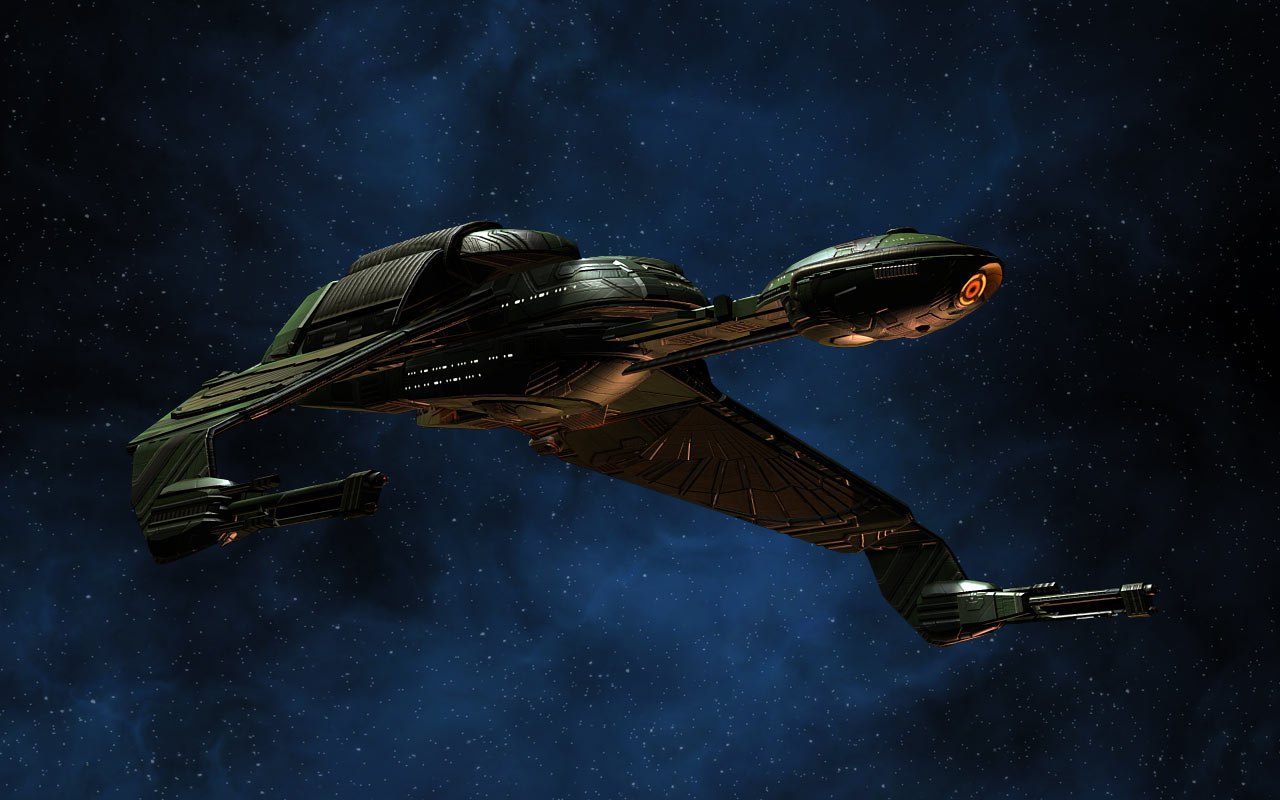
Bird of Prey:
There’s nothing like a classic, and when it comes to the Star Trek franchise, few ships are more classic than the Klingon Bird of Prey. The perfect balance of form, speed, versatility, and firepower, the Bird of Prey is a ship with a very long history of service in the Klingon Empire.

This ship made its first appearance in Star Trek III: The Search for Spock when a renegade Klingon captain, seeking the secrets of the Genesis Planet, used one to attack the Enterprise. Kirk and his crew would later commandeer this ship and use it in the following movie to travel back in time and bring two whales to the future (The Voyage Home).

Bird of Preys would also appear in the fifth and six movie installments, in the latter case as a prototype raider that could fire while cloaked (something previously unheard of). Remaining in service well into the 24th century, Bird of Preys appeared repeatedly in Stark Trek TNG, and DS9,  most notably as part of the Klingon war effort against the Dominion.

Boasting two multi-directional disruptors and single photon torpedo launcher located in the nose. It is also one of the first Klingon vessels to boast a cloaking device, something unavailable on heavier cruisers. Because of their stealthy abilities and versatility, they have played a variety of roles, including reconnaissance, escort, raids and as support for larger vessels.

Cylon Raider:
Boy, they’ve come along way baby! During the original series, Cylon raiders were saucer-shaped, had energy weapons and were crewed by up to three Centurions. In the re-imagined series, this changed significantly, though the Raider still retained its basic roll as a light assault craft.

In addition to getting a facelift, the newer generation of raiders relied on kinetic weapons, missiles and even tactical nukes. Its crew was replaced by an organic brain which was merged with the ship’s machinery, and which relied on an “eye” located in the fore of the central module to communicate and conduct navigation. Much like Raptors, Raiders are capable of making short-range FTL jumps, and therefore do not need to be deployed from a Basestar in the field.

Much of what is known about the modern raider came from Starbuck’s own experiences with a downed vessel. After making her way into the interior, she discovered a system of organs which were apparently fed by an internal supply of nitrogen and oxygen. After removing the brain, she was able to fly the ship using the system of organic levers and controls and rendezvous with the Galactica. Starbuck was meant to use this same vessel as a Trojan horse, but instead used it to fly back to Caprica (“You Can’t Go Home Again”)

Though self-aware, the average Cylon ship is not as intelligent or independent as a humanoid Cylon. However, like the humanoids, they are capable of resurrection and have their consciousness and memories recycled into a new body whenever they are shot down. In time, their accumulated knowledge and experience can make them even more formidable as opponents, as was demonstrated by the vessel known as “Scar” in the season two episode of the same name.

The Ebon Hawk:
Looking beyond the original movies, there are plenty of cool ships to be found in the expanded Star Wars universe. One example is the Ebon Hawk, a Corellian freighter which comes from the Knights Of The Old Republic game.

Much like its modern cousin, the Millennium Falcon, the Ebon Hawk is every smugglers wet dream. The perfect marriage of speed, maneuverability, and survivability, it is perfect for running blockades, evading capture, and saving the galaxy! It also played a central role in the Sith War and the events immediately following it.

Originally belonging to Davik, a ruthless criminal warlord belonging to the Exchange, the ship became the property of the Jedi Order after it was confiscated by Revan. Using this vessel to escape the Sith blockade of Taris, Revan and his comrades used this vessel to travel the Galaxy, investigating the Sith’s plans for domination and systematically unraveling them.

After the end of the Sith War, Revan took this ship to the Rim to further invesigate the true source of the Sith threat. The ship returned to the universe a few years later, carrying an former Jedi master named Kreia who had since become a Sith master, and was exiled by her peers. Once again, the ship would become the property of a Jedi warrior – Meetra Surik – and several fellow-travellers who would used it to retrace the path of Revan and eliminate the Sith Triumvirate, the last of the Sith Lords.

The Event Horizon:
A bit of a break for the usual lineup of cool ships here, the Event Horizon was a  prototype vessel that was featured in the movie of the same name. Built in the near future by Earth scientists to be the first that would be capable of making FTL jumps. In the course of making the jump from the edge of the Solar System to Proxima Centauri, the ship disappeared. Seven years, it rematerialized, sending out a general distress signal.

Upon investigating the derelict, the crew of the rescue ship Lewis and Clarke found a ship of horrors. In addition to having a long spine that was inlaid with jagged metal spikes, the experimental gravity drive looked like some kind of medieval torture device. Seriously, the thing was basically a studded metal ball with spiky rotating appendages.

Oh, and did I mention the ship was haunted? Yeah, apparently generating a quantum singularity and passing through it leads directly to Hell. So in essence, the ship brought a whole lot of Hell back with it when it came back to our universe, and these dark forces began making the rescue teams go made just as it had the original crew. Kinda stupid really…

But ultimately, the design and concept of the ship were pretty cool. And even if you forget about the obviously macabre nature of the engine room, it was pretty neat to behold.

Mothership (Homeworld):
The flagship of the Kushan fleet, the Mothership was the centerpiece of every mission in the Homeworld universe. Originally intended as a colony vessel, its role expanded during the Homeworld War to include that of a command ship and mobile shipyard. This was due to the many hostile races encountered after the Kushan fleet left Kharak to find Earth.

Although not an effective combat platform, the Mothership’s hyperdrive make it FTL capable and therefore capable of deep-space travel. In addition to its internal factories, it also has the capacity to hold 600,000 cryogenically frozen colonists as well as its regular crew of 50,000.

Although not heavily armed, the Mothership contained the means to construct many different classes of support vessels. These included scouts, resource harvesters, fighter craft, destroyers and even cruisers. As such, it had a solid defense screen during the time of the Exodus. Periodically stopping to replenish its resources from asteroid belts, the Mothership was also able to replenish its losses.

USNC Pillar of Autumn:
And here we have another franchise making its first appearance in this series! Coming from the Halo universe, the Pillar of Autumn was featured in the original Halo. A Halcyon-class light cruiser, this class of ship is one of the older ships in service with the UNSC Navy.

During the Covenant assault on Reach, the Autumn fled to the Soell system where it discovered and then crash landed on the Halo ring known as Installation 04. There, after engaging both Covenant and Flood forces, Master Chief John 117 detonating it in order to destroy the installation before it could fire.

Measuring 1.17 km in length and armed with a combination of kinetic guns, nuclear missiles and a magnetic accelerator cannon, the Autumn is powered by a fusion core and able to make FTL (aka. slipspace) jumps through space. In addition, it also carries a squadron of fighters, 15 Pelican dropships, 8 Scorpion tanks, 40 Warthogs, and a full compliment of Marines and Orbital Drop Shock Troops. The ship is run by a central AI – in the case of the Autumn, Cortana – and has a crew of between 300 and 400 personnel.

The Scimitar:
Though I didn’t care much for the movie that featured it, The Scimitar was still a pretty freaking cool ship! Huge, powerful, scary-looking and packing a doomsday device and a truly impenetrable cloak, this baby pretty much had it all. So it begs the question… how the hell did a bunch of slaves built this thing anyway?

Of Reman origin, this dreadnought was built under the supervision of the Picard clone Shinzon and figured prominently in his designs to take over the Romulan Empire and destroy the Federation. This he planned to do by attacking Earth, a plot which was narrowly averted by the crew of USS Enterprise E.

Built for total war, the Scimitar was given every technological advantage the Romulan Empire had at its disposal. This included 52 disruptor banks, 27 torpedo launchers, several squadrons of Scorpion attack fighters, and of course, its thalaron radiation weapon of mass destruction. Requiring several minutes to power up, this weapon was capable of sterilizing an entire planet. Deployment of the weapon involved unfolding its wings, a move which only made it look scarier!

The Scimitar was also protected by two shield arrays, which combined with its weaponry gave it the edge in every combat situation. And as already noted, its cloak was perfect, emitting no tachyons or anti-protons as other cloaking devices were notorious for. As a result, the Scimitar was truly impossible to track while under cloak.

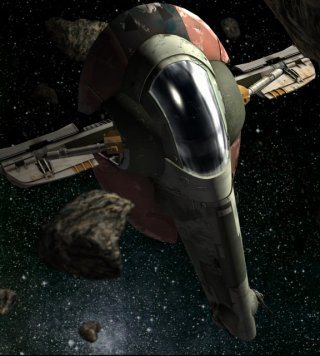
Slave I:
Anyone familiar with the Star Wars universe knows who Boba Fett is. And chances are, all of those people are familiar with his ship, the Slave I. A modified Firespray-31-class attack and patrol craft, the Slave I was originally the property of famed bounty hunter Jango Fett. After his death at the hands of Mace Windu, it passed to his son, Boba Fett.

Small, sleek and stealthy, the ship was also augmented with several advanced weapons systems. These included two rapid fire blaster cannons, two missile launchers, and a rear-mounted minelayer compartment which was capable of deploying seismic charges. The ship also carried a compliment of dummy torpedoes which could tag ships with tracking beacons.

During the events of Empire, Fett used this ship to track Han and the Falcon back to Bespin and then take his carbonite-frozen body back to Jabba’s Palace. After escaping from the Rancour Pit on Tatooine, Fett upgraded to a new ship, which he named Slave II in honor of his father’s ship.

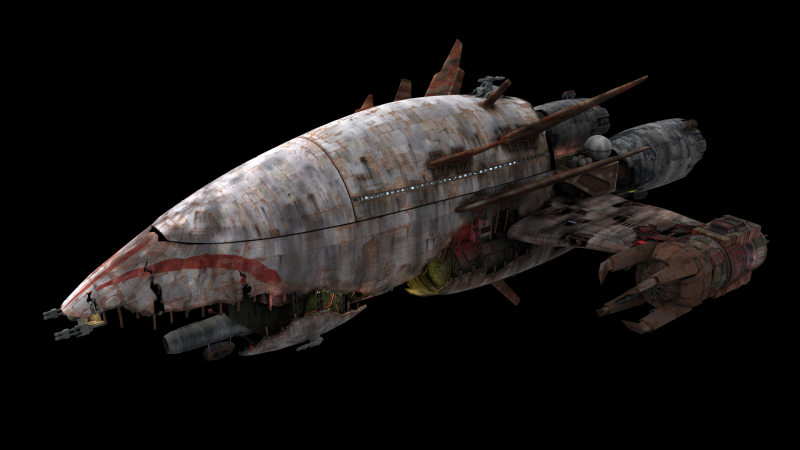
Reaver Ship:
As a fitting final entry, I am returning to the Firefly universe once more. And this time, it’s the Reaver ship that I’ve decided to cover. Though every Reaver ship is of unique design, the one which was featured in the pilot episode (featured at right) is my personal favorite.

Like all Reaver ships, this vessel is adorned with red paint and what I can only assume is the blood of innocent victims. It’s hull and engine compartments have also been modified to look claw-like and threatening, it’s front section has been mangled from ramming into other ships, and its engine functions without radiation containment.

Above all, its weapons have been modified to incorporate the unique Reaver combination of medieval weaponry and snares. These can consist of EMP’s, grappling lines, nets, and launchers that fire shurikens, buzz saw blades, spears and some kinetic weapons. Ultimately, the purpose of Reaver weapons are to disable and capture enemy ships rather than destroy them. This gives the Reaver crews the pleasure of meeting their victims face to face and killing them with sharpened implements.

Yes, much like the Reavers themselves, their ships are scary and look like they got a facelift from a belt sander. But such appearances, as well as their lack of containment, let merchant ships and smugglers know they are coming. When that happens, crews can either power down and hope they’ll go unnoticed or run like all hell. Otherwise, they’re only option is to make peace with whatever deity they pray to and eat a bullet, cuz’ the alternative aint pretty!

Thank you all, this has been volume six! Stay tuned for volume seven, coming soon!

Cool Ships (volume IV)

Back with a fourth installment. As usual, I am indebted to people for making suggestions and offering critiques. Funny thing, these lists seem to be getting longer and more diverse the longer this series goes. But I guess that tells you something about the world of sci-fi. No shortage of material, and kind of like fossil hunting in that the deeper you dig, the more fascinating things get.

Ancients City Ship:
You know the old saying “you can never go home”? Well in this case, the Ancients seemed to think that the best away around that was to take it with you. This one goes out to Nicola Higgins. Thanks for the suggestion, you Stargate fangirl!

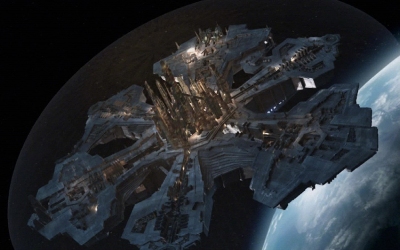
Known as a City Ship, this piece of Ancients technology is in centerpiece of the spinoff series Stargate: Atlantis. A self-contained city that is capable of traveling through space, and comes equipped with a hyper drive, this vessel was designed to transplanting colonies of Ancients on distant worlds throughout the Galaxy. It also heavily armed and shielded, making it a veritable mobile fortress.

Beginning several million years ago, the Ancients began what was known as the “Great Migration”, where they left Earth for the Pegasus Galaxy and other destinations in deep space. One such ship which took part in the migration was the Atlantis, which departed from Antarctica and landed on the world known as Lantea, where it was again discovered by humans in the course of the show.

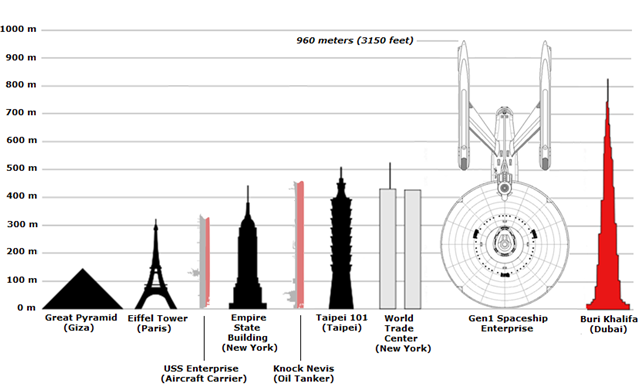
Measuring roughly the same size as Manhattan island, an average city ship comes equipped with extensive living quarters and amenities that make it suitable for large-scale population for extended periods of time. Though capable of space flight and space combat, it’s environment of choice is terrestrial, preferably on water.

Colonial Viper:
This one kind of seems overdue. But I felt the need to push this one back so I could cover the bigger ships from the Battlestar Galactica franchise first. With them done, I can now pay tribute the fighter-craft of choice for the Twelve Colonies, the Viper! Taken from the original series, the Mark II was your basic space superiority fighter, fast, maneuverable, and boasting two laser guns for defense.

In the updated series, the Mark II was considered a relic from the Human-Cylon War, its systems outdated and its controls antiquated (the laser guns were also replaced by two ballistic weapons and a compliment of missiles). However, it was these very antiquated features that would prove to be the saving grace of the Mark II when the Cylons attacked the Colonies at the beginning of the new series.

The updated Mark VII Viper was the pinnacle of Colonial technology at the time. Boasting updating targeting, controls, all of which were networked with the fleet’s central computer system, the Mark VII was far more sophisticated than its predecessor in every measurable way. However, being a networked fighter made it vulnerable when the Cylons unleashed their crippling virus on the Colonies defense mainframe. Several models remained in operation though, thanks in large part to the Pegasus surviving the initial Cylon assault. Once the two fleets combined their resources, the Colonial fleet had several Mark VII’s at their disposal and even began manufacturing new ones to replace their losses.

The Colossus:
Now here’s a franchise I haven’t covered yet! Fans of Freespace and FS II know that when it comes to cool ships, there was no shortage to come out of this video game series. Classically inspired, well-designed and just plain awesome to behold, the Colossus is definitely top of that list. Big, bad, and boasting enough firepower to take down an enemy armada, the Colossus was appropriately named!

Designed by the Terran-Vasudan Alliance in the wake of the Great War, the Colossus was a prototype super-destroyer that was designed to confront all future incursions by a hostile race. Foremost amongst these was the threat of the Shivans, the species that appeared in the first game, destroyed the Vasudan homeworld and nearly destroyed Earth as well.

Measuring 6 km in length, bristling with weapons and boasting a crew of over 30,000, the Colossus took over 20 years to complete and involved dozens of contractors from both races. In terms of defense, it has over 80 weapon turrets, consisting of cannons, missile launchers, and multiple heavy beam emitters. It also houses 60 fighter and bomber wings and requires a crew of over 30,000. In short, the Colossus wields more firepower and fighter wings than an entire Terran or Vasudan armada.

Deimos-class Corvette:
You know the old saying, “it’s not the size of the dog in the fight but the size of the fight in the dog”? That’s what comes to mind whenever I see small ships that are solidly built and pack a wicked punch. As you might have guessed, that precisely what the GTCv Deimos-class vessel is all about! Also taken from the Freespace universe, this corvette was designed for fighter support and attack purposes, providing some added firepower and punch to light assaults and defensive screens.

As the newest addition to the Terran fleet in FS II, these corvettes were designed to replace the aging Fenris and Leviathan-class cruisers from the Great War. In addition to their small profiles and heavy firepower, their hulls are strengthened with collapsed-core molybdenum sheathing for better protection against beam fire and their Vasudan-designed reactor core provides more energy per ton than any other allied ship class.

In a way, these ships remind me of the USS Defiant. Much like that little ass-kickers from the DS9 universe, she packs a lot of power and toughness into a small frame, proving that you don’t have to be big to bring a big ass-whooping! As you might be able to tell, this is a bit of a vicarious experience for me 😉 Being only 5’8”, I too had to be known for scrappiness whenever height and reach failed me in a sparring match!

Drakh Raider:
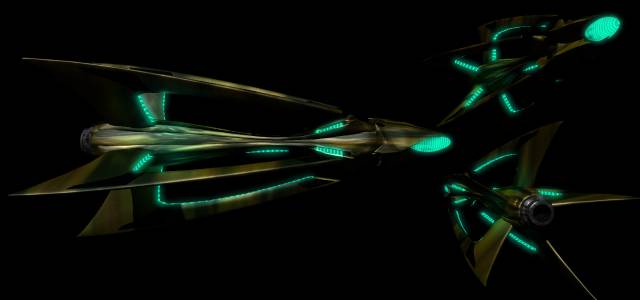
Once more onto B5 friends. God, I worry people are going to get so sick of this universe given all the attention I devote to it. But as long as it keeps providing ’em, I’ll feel obliged to honor ’em! This time, it’s the Drakh Raider which I’ve chosen to represent. Small, sleek, fast and powerful, these ships were the first line of assault and defense for the Drakh fleet, providing attack screens and defensive escort to their larger destroyers and carriers.

As Londo remarked in the course of the show, “They’re a legend. The kind you would use to frighten small children at night... They were ruthless, savage, but extremely bright. A very bad combination.” And these ships certainly embodied that. Making their first appearance in the third season (“Lines of Communication”) when it became revealed that the Drakh were manipulating the Mimbari into a civil war, and later in the Call to Arms TV movie when the Drakh began assaulting Earth.

Being quite small and based around a central beam weapon, these ships were either unmanned or had a very small crew. They were also quite effective, as two were able to destroy a White Star during their initial encounter with Delenn and the Alliance fleet. However, being small and light, they were also relatively easy for more sophisticated ships of the Alliance to shoot down, and even a small fleet of them could not stand up to larger vessels like the Excalibur. Still, these puppies could wreak havoc against shipping and military vessels that belonged to the younger races. Once they began conducting raids on League Worlds, all parties were forced to turn to Sheridan and the White Star fleet for help.

Romulan Warbird:
Also known as the D’deridex-class, the Warbird class was one of the largest and most powerful ships in the Romulan Star Empire’s armada and served as the backbone of the Romulan fleet during the latter half of the 24th century. In addition to its impressive array of disruptors and photon torpedo banks, the Warbird also has a cloaking device, the result of military exchanges between the Klingon and Romulan Empires.

After their debut in the first season of TNG (“The Neutral Zone”), the Warbird went on to appear in several engagements with Star Fleet (most notably the Enterprise) and the Dominion. In the spinoff series of D29, they would figure prominently in the Dominion War. Initially, this consisted of providing defense against Jem’Hadar incursions, but eventually went on to take part in most major offensives. These included the battles of Chin’toka and the final assault on Cardassia Prime.

Measuring twice as long as a Galaxy-class starship (such as the Enterprise D) the Warbird is powered by a forced quantum singularity and boasts the latest in Romulan technology. This makes it not only one of the most advanced ships in the Romulan fleet, but the Alpha Quadrant itself!

Rama:
Once again, I find myself looking back and wondering how the hell I forgot this one. You can’t call yourself an Arthur C. Clarke fan and a sci-fi geek without knowing about Rama. Lucky for me, ongoing segments give us chances to correct for our mistakes, which I am doing now.

Taken from Clarke’s famous novel Rendezvous with Rama, this namesake was what can be termed a “generational ship”, meaning a spaceship where successive generations of people are expected to be born and die before it finally reaches its destination. In the course of the story, this massive ship was detected on its way towards Earth. Once scientists and astronomers learned that it was not an asteroid or some other natural phenomena, they became mighty interested mighty fast!

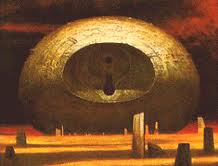
Basically a large cylinder in space, the ship measured 50 km in length, 16 km wide, and rotated in order to provide gravity equal to 0.25 g’s (or a quarter of what we’re used to here on Earth). After boarding it, astronauts from Earth noticed an interior layout that resembled cities, rivers and other common geographical features, but being based on technology and chemical compositions which they could not recognize. The horizontal sections of the ship also housed windows which appeared to be letting in outside light, which in turn was having a thawing effect on the landscape since it was frozen from being in deep space for so long.

In addition, they discovered that their was no crew to speak of, nor any cryogenic tanks that held them in stasis. Evenutally, it was determined that these chemical rivers contained the trace chemicals needed to “manufacture Ramans”, and that as it neared a star, it would take the energy and heat necessary to perform these and other life-restoring functions. In the end, Rama was just passing through, a grave disappointment for Earth people… until they realized that more were on the way!

Pretty damn cool huh? This concept of a cylindrical hull with a self-contained city went on to inspire countless franchises and writers, not the least of which was J.M. Straczynski who modeled the interior of Babylon 5 based on Clarke’s descriptions. Generational ships also appear in many science fiction franchises, not the least of which are Alastair Reynold’s Revelation Space series and Joss Whedon’s Firefly.

USS Saratoga:
Space Above and Beyond is back for another installment, this time with the main ship of the fleet! Designated as a SCVN (Space Carrier Vehicle Nuclear) the USS Saratoga is the futuristic equivalent of a modern-day aircraft carrier and was home to the 58th Squadron (“The Wild Cards”) for the entire series.

In the course of the show, the Saratoga served on the front lines for the entire Chig War. This included the defense of Earth in the pilot episode, the offensive at Ixiom and Deimos, and in Operation Roundhammer – the assault on the Chig homeworld – at the end of the series. For the duration of its service, the Saratoga was commanded by Commodore Glen Ross, a no-bullshit naval officer who enjoyed playing guitar, cared deeply for his people, and was known for his catch-phrase “take that bird out of my sky!”

In addition to its compliment of fighters, the Saratoga boasted some pretty heavy armaments, including laser pulse cannons, phalanx missile launchers, and anti-ship torpedos. The vessel was also powered by a helium 3 fusion engine, measured 525.6 m in length and was capable of FTL travel thanks to a wormhole-generating engine technology.

Tigers Claw:
Yet another franchise I have neglected to include so far, but which deserving since cool ships was kind of their thing… Here we have the TCS Tiger’s Claw, the carrier and command vessel from the video game series Wing Commander. In the first installment in the series, the Tiger’s Claw was as the focal point of the story, a Bengal-class carrier that was deployed to the Vega Sector to fight in ongoing conflict known as the Terran-Kilrathi war.

In the course of its deployment in the Vega Sector, the Tiger’s Claw participated in many successful campaigns. These included the destruction of the Kilrathi base of operations for the entire sector in the campaign known as Custer’s Carnival, and the destruction of the KIS Sivar in what was known as the Goddard Campaign.

Unfortunately, after proving victorious in Vega, the ship was transferred to the Enigma Sector where it was destroyed during an assault on the Kilrathi starbase K’tithrak Mang. Using stealth fighters, the Kilrathi managed to ambush and then obliterate the carrier using torpedoes. These events took place between the first and second installment in the series and formed the basis of the latter’s backstory. Save for the main character of the story – Col. Christopher Blair (aka. you) – all hands aboard her were killed, including her air group commander, General Halcyon.

In addition to its vast compliment of 104 fighters, the Tiger’s Claw also possesses 8 heavy laser turrets, 20 defensive batteries, and powerful shields. Measuring 700 meters in length and weighing over 80,000 tons, her crew numbers in the thousands. Although slow and lumbering compared to smaller craft, she is still capable of a high maximum velocity (468,000 km/hour) and can make FTL jumps.

Voth City Ship:
Here’s another example of something the Star Trek franchise did really right! Appearing in the third season of Star Trek: Voyager (episode 64: “Distant Origin”), the Voth City Ship was something that was both intriguing and heavily-inspired. Based on the concept of a self-contained city in space, she was the command and administrative center of the entire Voth race and home to its ruling matriarch.

As the episode which featured her progressed, we learn that a group of alien scientists have discovered Voyager and have become convinced that she holds the key to proving their “Distant Origins” theory. When they meet these creatures, they learn that their kind evolved from dinosaurs on Earth to become a race of talking, bipedal humanoids who developed an entire civilization before they were forced to flee. After millennia of wandering, they landed in the Gamma Quadrant where they have since become the dominant power.

Unfortunately for said scientists, and the crew of Voyager, the Voth leaders are not too crazy about this idea. In addition to contradicting their beliefs that they emerged in the Gamma Quadrant (known as “Doctrine”) they are insulted to think they are related to mammals, creatures they consider inferior. Once they make contact, they are able to capture Voyager and neutralize her defenses quite easily, beaming the entire ship into one of their massive internal bays and knocking out all of their equipment using a dampening field.

In addition to all this impressive technology, the Voth also appeared to possess cloaking technology, trans-warp capability, and no doubt had some serious mother-loving weapons technology. It was a major blessing that Janeway and her crew didn’t press matters too hard and try to get into a firefight with these aliens, otherwise we would have seen some serious fireworks.

Final Thoughts:
Woo! Okay, that one was pretty good. And some rather new and unique examples made it in this time. Thanks for the suggestions people and my endless thanks as always to the good folks who maintain the Wiki’s and other source info sights for these franchises. Without you, I’d be very limited and would have quite doing these long ago! Also, I seem to have focused on city and generation ships a lot in this posting, which got me thinking…

It was the physicist and mathematician Freeman Dyson who claimed that the pinnacle of technology would be the ability to build a “Dyson’s Sphere”. That is, a sphere so large that it could encompass an entire star system, or at least the star and its primary planets. After all, the amount of materials and engineering capabilities required to build such a thing are just staggering and clearly beyond the means of anything we now know. Now that all may be true, but might I suggest that a more realistic and attainable measure of technological prowess would be the ability to create self-contained environments where several successive generations of humans and animals could survive for long periods of time?

Think about it. A species that can do this would be capable of leaving whatever world they call home behind and transplanting themselves in a distant star system or galaxy, meaning that their fortunes would never be tied to one rock in one star system. Even if our survival didn’t depend on it – which it might given the state of the planet! – it would still be a rather elegant way of planting the seed of humanity elsewhere in the galaxy. Instead of sending people out land on a planet and then do all the hard work of terraforming and building infrastructure, you just send the ship, and people can grow outwards in their own time without having to worry about hostile environments or organisms.

Pretty anthropocentric, I know. And yes, colonization is chock full of potential for evil, especially where indigenous life is concerned. Still, it’s a cool concept and it got me thinking, which is partly why I like to do these things. An excuse for research and to expand my mind!

Until next time, keep those idears coming!

More Cool Ships

And I’m back with more examples, in part because people had some suggestions but also because I found the last list lacking. I mean, you can’t suggest a concept as big and as awesome as cool science fiction ships and only provide a handful of examples. It’s just not decent! So here’s installment number two in the series, cool ships from various sci-fi franchises and what made them so. Keep in mind that suggestions are always welcome. I’m thinking a third and even fourth list might be necessary 🙂

Alliance Cruiser:
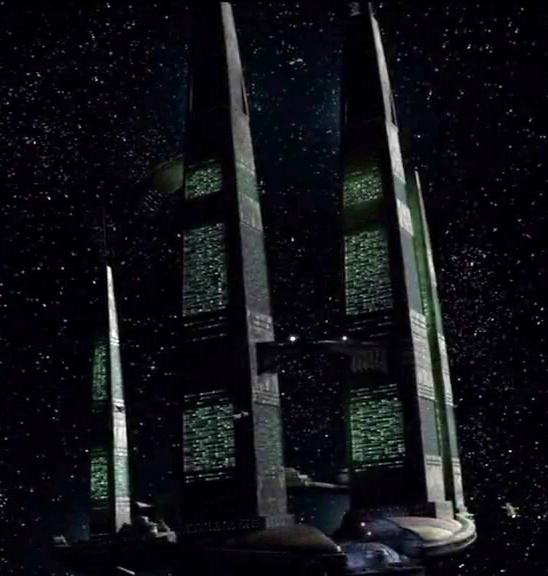
alliance_2Back to the universe of Firefly for another installment! This time around, it’s the Alliance Cruiser that I’ve chosen to talk about. In short, I think the design of this particular ship is quite inspiring. Unlike your average cruisers from other franchises, this ship is not based on the usual seafaring or aerodynamic-ship paradigm. It’s long axis is vertical rather than horizontal, making it a platform instead of a cutter.

In addition to making a lot more sense from a physics standpoint, this design offers many advantages in terms of navigation and defense. Unlike longitudinal designs which are forced to turn around on their long axis, this ship can simply fire thrust from any of its four sides to change course and direction. It’s tall appendages also make it easier for sensors or long-range telescopes to spot things out in space, no blindsides from which to approach on.

Basically, ships like these remind us that spaceships operate in vacuum and are therefore subject to a vastly different set of physical requirements. Since they do not operate in atmospheres, they don’t need to be aerodynamic or sleek like planes. And since they don’t cut across water, they don’t need to have sculpted hulls or prows to part the waves. So why then do a whole slew of spaceships look like aeroplanes or boats?

Simple, it’s a paradigm thing. When we hear ship, we automatically think of airships and seaships since that’s our frame of reference, and our artistic sensibilities naturally follow. But spaceships are a whole ‘nuther ballgame, requiring the ability to withstand inertial pressures instead of drag. So while sleek and streamlined models are cool to look at, they aren’t really the best spaceship design from a technical standpoint.

And in a lot of ways, the Alliance cruiser reminds me of another classic design, that of the Nostromo. Much like the mining vessel from the original Alien movie, it is vertical in design, boasting towers instead of horizontal compartments. It’s size and towering appearance also make it intimidating to behold, illustrating the power and imposing nature of the Alliance itself. Those who crew it tend to be pretty imposing as well, always boarding you and asking question!

Borg Cube:
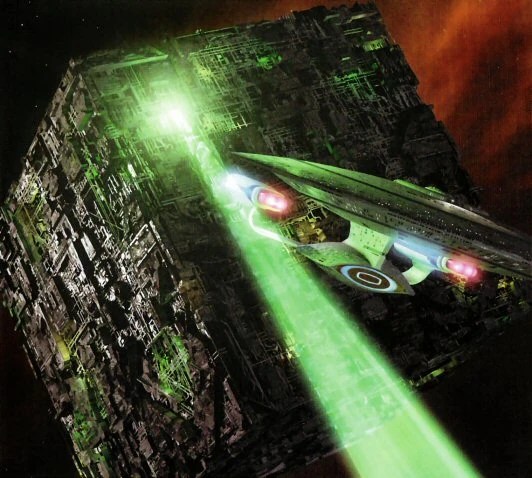
https://i0.wp.com/img2.wikia.nocookie.net/__cb20060721051747/startrek/images/7/76/Borg_cube.jpgHere we have the capital ship of the Borg, the frightening cyborg race from the Star Trek: TNG series that assimilates or crushes everything in its path. Introduced in the second season of the show (episode 42: “Q Who”), this fearsome foe went on to become a recurring element of the show and was even central to the plot of the spinoff Voyager and the movie First Contact. Much like their raison-d’etre, their ships reflected a sort of cold technological rationalism, like something out of a cyberpunk fans wet dream!

The design of the basic cube, which was later supplemented by spheres and upgraded cube designs, is clearly based on a pythagoran aesthetic: nothing frilly, sleek, aerodynamic or even remotely artistic about it. They are simple, utilitarian, and equilateral, a testament to the precise and unsentimental mindset of those who designed it. It’s basic profile also came in handy when taking on multiple enemy ships. By having six sides, each with the same surface area, weapons and tractor beam mounts, the cube had a 360 degree sphere of defense, making it damn near impregnable.

On every occasion when one of these cubes showed up, bad things were known to happen! In their first encounter with one, the Enterprise barely got out in one piece. In the second, 39 ships were destroyed before the Enterprise and her crew were able to trick one into going into sleep mode, which it then responded to by blowing itself up! In the third encounter, which took place in First Contact, several more federation ships were destroyed before Captain Picard was able to use his inside knowledge of the Borg to help the fleet destroy another ship. In all subsequent encounters, future technologies, viruses, trickery, or a combination thereof were needed to overcome the Borg’s technology and singular mindset.

Chig Cruiser:
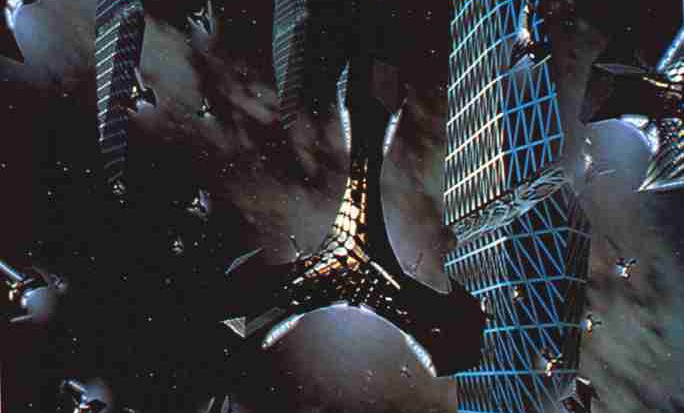
chigMuch like Firefly, this example comes to us from a franchise which was cancelled by the executives over at Fox after its first season. Yes, Space Above and Beyond was yet another sci-fi series which had a lot of promise, but got axed when the execs concluded it wasn’t doing well enough for their liking. What the hell goes on over at Fox anyway?! Does every new show get this kind of treatment, or do Rupert Murdoch’s minions think sci-fi is just inherently liberal?

In any case, the Chig Cruiser was much like the concept for the Chigs themselves. Cool, original, and quite alien in appearance! Basically, the vessels shape can be described as two right triangles attached end to end with the tips removed. The command center appeared to be located in the middle, along with much of its weapons and observation deck. The outer hulls also appear to have been constructed out of the triangular-shaped panels of some alien metal that gave of a peculiar sheen when seen from the right angle.

Like everything else in the series, the concept never really had time to be fully developed. Which is really too bad. Their fighters, encounter suits, and capital ships were all cool to look at, and some explanations as to their utility and even artistic inspirations would have been nice. But what can do? Fox is run by idiots! Rest in peace Space Above and Beyond! You died too young!

Earth Alliance Destroyer:
Thanks to Goran Zidar for suggesting I include this one! And please know that you are alone in thinking that it is cool to behold, Mr. Z 😉 Coming to you from the Babylon 5 universe, source of so many cool ships (see below), the concept for the Earth Alliance Destroyer was nothing short of pragmatic genius. Given that the show boasted dozens of alien races, J.M. Straczynski and his design teams had to come up with countless design concepts that would reflect the multicultural and multiracial tone of the show.

In the case of humanity, Straczynski and his people concluded that the spaceships should look boxy, utilitarian, and should reflect the fact that Earth was one of the less advanced races in the story. As a result, the Earth Alliance Destroyer was built around the concept of a compartmentalized hull with its engines at the rear, a central rotating section (to provide artificial gravity), and a forward section where the bridge, carrier deck and command center would be located. And, as you can plainly see, the end result was quite cool!

While not the most advanced ship in the Galaxy, the Omega-class destroyer was certainly realistic, aesthetically pleasing, and could also holds its own in most firefight situations. And unlike their organic, alien counterparts, these ships were also a lot cooler to watch in battle. Instead of “dying” or breaking apart, they would catch fire and throw off flaming debris, not to mention life pods and floating bodies. Yes, since ships didn’t have energy shields or a lot in the way of armor in the B5 universe, firefights tended to get real serious, real fast! Like I said… realistic!

The Daedalus:
daedalusNext up, and taken from the Stargate universe, is the battlecruiser Daedalus. After appearing in the spinoff show Stargate: Atlantis, this class of vessel (codenamed 304) became the basis for an entire fleet of vessels who’s purpose was to defend Earth from an alien invasion. Based on various alien technologies that were taken from the Goa’uld and Asgard, the Daedalus was the first Earth Battlecruiser and FTL ship ever constructed.

Based on the design of a modern aircraft carrier, the Daedalus bridge and command center were located along the top of the hull at the rear while the forward section contained the ships compliment of fighters and takeoff and landing bays. The ship also contained a hyperdrive which was powered by a Zero Point Module (an alien power source), giving it FTL capabilities.

In terms of armaments and advanced technology, the ship boasted beaming units, shields, multiple rail gun and missile systems, and a compliment of nuclear warheads. Designed to stand up to a potential Gua’old or Or’i invasion, the Daedalus and her kind were built to combine the best that Earth and her alien allies could offer. Yes, if the war came to Earth, we would be ready!

The Executor:
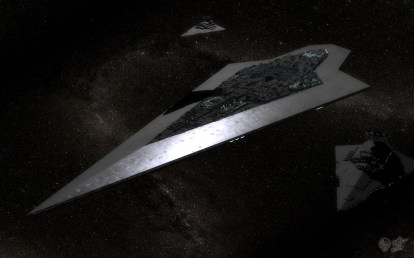
Hello terror! Next up, we have the gargantuan and terrifying Imperial command ship known as The Executor. Who among us can forget that introductory scene in The Empire Strikes Back when a whole fleet of massive Star Destroyers were assembling, only to be suddenly overshadowed by the even larger Executor? Cut to the bridge where we see the terrifying Vader looking out over the fleet, and you begin to see just how big and powerful the empire truly is! Yes, those visuals really gave a sense of size and scale to the bad guys and let us know just how much they meant business!

Commissioned roughly one year after the Battle of Yavin, where the first Death Star was destroyed, the Executor was intended to be a terror weapon, replacing the Death Star as the symbol of Imperial might and badassery! Measuring 19 kilometers in length and bristling with turbolasers, ion guns, multiple tractor beams projectors and a complement of fourteen TIE fighter/bomber squadrons, the Executor was every spacers worst nightmare! No ship in the Alliance was capable of standing toe to toe with it, making a strategic withdrawal an inevitability once it showed up in a theater of battle.

However, during the Battle of Endor, the Alliance was able to destroy it through a combination of strategy and dumb luck. After several Rebel fighters took out the Executor’s shield generators, a single fighter who lost control of his ship crashed directly into the bridge. The Executor then lost control of its helm and was pulled in by the second Death Star’s gravitational field, destroying the ship and causing extensive damage to the Death Star’s outer hull. An ironic death for such a big ship, but at least she went down in a blaze! A big, embarrassing, expensive blaze! I don’t envy the bastards who had to pay the premiums on that one!

Home One:
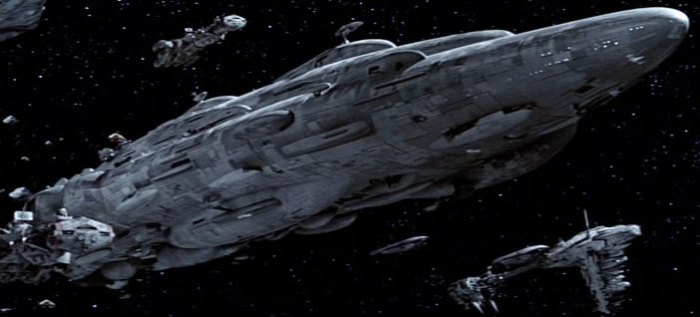
HomeOneAnother vessel that comes to us from the Star Wars universe, Home One was the mobile headquarters of the Rebel Fleet and the biggest Mon Calamari cruiser in existence. As Admiral Ackbar’s command vessel in the original trilogy, it distinguished itself during the Battle of Endor, during which the Executor and the second Death Star were destroyed.

Like most Mon Calamari cruisers, Home One was cylindrical in design and originally served as a star-liner that got modified for combat. This consisted of equipping it with fighter bays, multiple shield emitters, a reinforced hull, and many turbolaser mounts. It’s revolutionary targeting and computer system also gave it a decided advantage in a firefight with Imperial vessels, which boasted heavier armaments, but lacked the ability to coordinate and amass their firepower as effectively.

The largest bay on Home One was on the starboard side where larger vessels would dock. However, a total of twenty hangers were placed throughout the hull, giving it the ability to carry multiple squadrons of X-wings, A-wings, B-wings and Y-wings. It also boasted a crew of over 5000 personnel and could carry 1,200 troops and 20,000 metric tons of cargo. While most of its systems – especially targeting and navigation – were designed for Mon Calamari use, the ship was crewed by a variety of races, reflecting the multiracial nature of the Alliance.

Lexx:
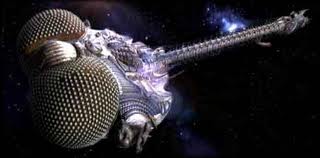
lexxThough not the prettiest ship in the Galaxy, the Lexx certainly deserves a spot on the Cool Ship list. Much like the show that featured it, it was weird, conceptually skewed,  but still damn original! A planet-destroying bioship by design, the Lexx was clearly inspired by the concept of a giant, wingless dragonfly and was created out of resynthesized proteins that were obtained from confiscated organs. Hmmm, gross!

Originally intended for use by His Divine Shadow, the evil ruler of the Divine Order, the Lexx was essentially a terror weapon that would be capable of destroying whole planets. However, the ship was commandeered in the first episode by the show’s crew – consisting of anti-hero Stanley Tweedle, the sex slave Zev Bellringer, and the Kai, an undead assassin, and the bodiless AI 790 – and became the means through which they traveled the universe looking for a new home.

This journey would take them over 6000 years, since the Lexx does not have FTL capabilities, and the crew would go into cryostasis for much of the voyage. Being sentient as well as organic, the ship was required to feed from time to time in order to maintain the life force which powered it. This could involve landing on a planet and eating organic matter directly, but more often than not, required that it blow up an entire planet and eat the resulting debris afterwards.

In the latter case, this consisted of emitting massive amounts of ionized energy from its “eyes” which was then channeled into the “mouth”. This energy was then fired outward in a planar wave which would intercept and obliterate any planet in its path. The Lexx would then take in the giant rocks and debris from the explosion and feed off of all the organic matter they carried. If not permitted to feed regularly, the Lexx could apparently become quite cranky and agitated, which would prove to be hell for whoever had to interact with it!

Narn Cruiser:
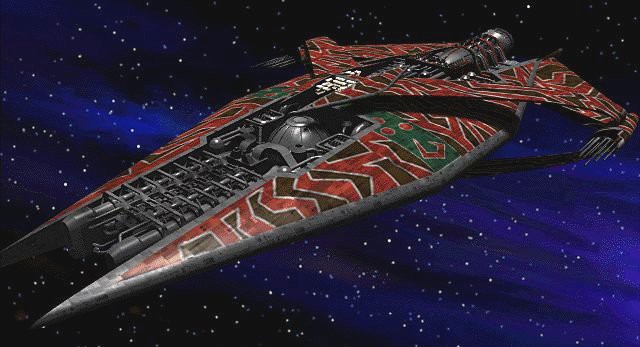
narn02As promised, another cool ship from the B5 universe. And as I said earlier, when it came to producing concepts for alien ships, J.M. Straczynski really had an eye for aesthetics, art, and functionality. Whereas Earth vessels tended to be compartmentalized and practical in nature, other alien races tended to be a bit more flamboyant, a reflection of their particular cultures and levels of technology.

When it came to the Narns, an aggressive but artistic race, their ship designs exemplified this dual nature. Originally a pastoral and peaceful people, the Narns had been brutalized by generations of occupation at the hands of the Centauri and had become quite warlike as a result. Their heavy cruisers, the mainstay of their fleet, were thus powerful and fierce looking, but still managed to achieve an aesthetic quality which brought beauty into the mix.

Boasting two massive beam cannons, several pulse guns and a compliment of space mines, the Narn Heavy Cruiser could take on just about any ship in the Galaxy. Though most were destroyed in the Great War against the Centauri, the ship proved to be effective in numerous engagements, not the least of which were against the Shadows themselves. For example, at the battle of Ragesh 3, two Narn Cruisers combined their beam cannons to seriously damage a Shadow vessel. During the battle in Sector 83, when Sheridan and the White Star Fleet engaged a fleet of Shadows vessels, the Cruiser G’tok managed to assist a pair of White Stars in destroying two Shadow vessels. Quite the accomplishment for this class of vessel!

After the Great War, the Narn regime began rebuilding its fleet, and the Narn Cruiser remained the mainstay of their forces. Several were used during the Alliance war with the Centauri and participated in the assault on Centauri Prime, where its massive compliment of weapons proved quite devastating against the planet’s surface!

Prometheus-Class Assault Vessel:
PrometheusYou know, I’ve never been that big a fan of the Star Trek franchise. But even I have to admit, when these guys do something right, they really do it right! And this ship, the Prometheus Assault Vessel, would be one such example. Much like the USS Defiant from my previous list, this ship demonstrated that when required, Star Fleet could produce ships that really excelled at kicking ass and taking names!

A revolutionary prototype, the Prometheus-Class vessel appeared in a single episode of Voyager where it was being stolen by a bunch of Romulan agents. However, thanks to the combined efforts of the ship’s own holographic surgeon and Voyager’s similarly holographic doctor, the ship was saved and even managed to turn the tables on its Romulan adversaries.

Incorporating advanced phasers, quantum torpedoes, ablative armor and regenerative shields, the biggest surprise the Prometheus had was its multi-vector assault capability. This involved the separation of the ship into multiple modules, much like the USS Enterprise-D would do with its saucer and engine sections. However, in the Prometheus’ case, this resulted in the creation of three semi-independent sections which were capable of unleashing a single, coordinated attack against multiple opponents.

After it was done dispatching all its enemies, it would then come back together, perform repairs as needed, and move on to the next target. And since the ship was programmed with extensive routines, a very small crew was capable of operating it and really only had to speak the requisite commands to get it to kill, kill, kill! Not a bad ship to have in your arsenal!

Shadow Attack Ship:
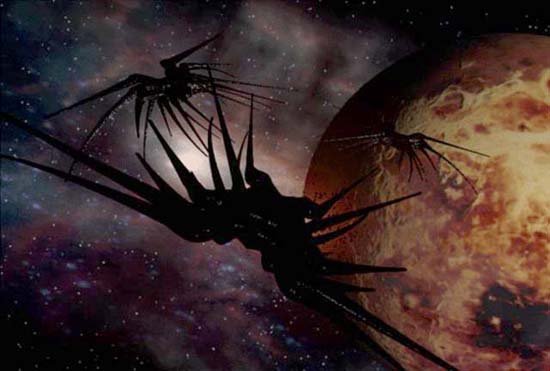
shadow06“It was jet black. A shade of black so deep your eye just kinda slides off it. And it shimmered when you looked at it. A spider big as death and twice as ugly. And when it flies past, it’s like you hear a scream in your mind.” These were the words Lt. Warren Keffer used to describe a Shadow vessel, right before he died chasing one down. An apt description for a ship that was clearly designed to inspire terror in its enemies, and a reflection of the race that built it.

As my final installment, taken again from the B5 universe, I’ve decided to include the Shadow Attack Ship, which is perhaps the most original and artistic spaceship I have ever seen. Granted, it had some stiff competition given the franchise it is coming from, but in terms of its design, performance, and sheer alien appearance, I can’t think of anything that can top it.

Given the fact that Straczynski and crew were working with the concept of organic technology, the ship was clearly meant to look like a living creature. Apparently, they settled on the combination of an arachnid and a giant octopus for the design, which combined with its jet-black sheen, made it both terrifying to behold and aesthetically awesome! And since every Shadow vessel is a living thing, they required sentient beings to merge with them in order to become active. When inactive, they would lie dormant and could remain operable for thousands of years.

More often than not, the Shadows preferred to use telepaths as drivers since only a telepath was capable of jamming the ship’s central operating system (i.e. a person’s mind). When damaged, the ships would emit a high-pitched screeching noise and often required another ship to merge with them and carry them to safety where they could. Of course, the screech couldn’t be heard through space. As Keffer noted, the sounds it made seemed to take place in the observers mind – aka. it was being telepathically conveyed. Hence, in addition to scaring the shit out of their opponents with their appearance and awesome firepower, these ships also had a calculated psychological edge in battle!

Not that they needed it though. In addition to their speed and firepower, the ship’s organic hulls were also incredibly tough, capable of absorbing tremendous amounts of energy before dying. As Sheridan and his people learned, pulse cannons were virtually useless against the Shadow’s skin, and beam weapons were only capable of killing them when focused on its central region for extended periods of time. On multiple occasions, Sheridan and the Alliance forces were only able to destroy one of these vessels by relying on telepaths to jam them while multiple ships combined their firepower to finish them off.

For the Shadows, the weapon of choice seemed to be the beam cannon that was located in the ship’s “mouth”. This focused, pink-purple beam was capable of slicing through the most hardened of structures and ships, and could reduce an entire colony to rubble in the space of a few seconds. However, the standard Shadow vessels also contained a type of space mine that was capable of c0llapsing hyperspace jump nodes and also carried a compliment of Shadow fighters which they kept embedded in their skin. These appeared to be independent in nature seeing as how they were too small for a person to fit in, and served as a mere screen for the larger vessels to make their attack.

In short, a Shadow vessel was the sort of thing you didn’t stick around to fight unless you had plenty of ships watching your back. Fast, furious, and shit-your-pants scary to look at, if you managed to kill one, you counted yourself amongst the few, the proud, the luckiest sons of bitches in the universe!

Okay, thanks for sticking around for the second installment! I think I have one more in me, but I’ll wait a few days before posting that. In the meantime, be sure to check out this cool chart. It provided me with a couple of ideas during the course of my research:
The ultimate starship size comparison chart

Robots, Androids and AI’s

Let’s talk artificial life forms, shall we? Lord knows they are a common enough feature in science fiction, aren’t they? In many cases, they take the form of cold, calculating machines that chill audiences to the bones with their “kill all humans” kind of vibe. In others, they were the solid-state beings with synthetic parts but hearts of gold and who stole ours in the process. Either way, AI’s are a cornerstone to the world of modern sci-fi. And over the past few decades, they’ve gone through countless renditions and re-imaginings, each with their own point to make about humanity, technology, and the line that separates natural and artificial.

But in the end, its really just the hardware that’s changed. Whether we were talking about Daleks, Terminators, or “Synthetics”, the core principle has remained the same. Based on mathematician and legendary cryptographer Alan Turing’s speculations, an Artificial Intelligence is essentially a being that can fool the judges in a double-blind test. Working extensively with machines that were primarily designed for solving massive mathematical equations, Turing believed that some day, we would be able to construct a machine that would be able to perform higher reasoning, surpassing even humans.

Arny (Da Terminator):
Who knew robots from the future would have Austrian accents? For that matter, who knew they’d all look like bodybuilders? Originally, when Arny was presented with the script for Cameron’s seminal time traveling sci-fi flick, he was being asked to play the role of Kyle Reese, the human hero. But Arny very quickly found himself identifying with the role of the Terminator, and a franchise was born!

Originally, the Terminator was the type of cold, unfeeling and ruthless machine that haunted our nightmares, a cyberpunk commentary on the dangers of run-away technology and human vanity. Much like its creator, the Skynet supercomputer, the T101 was part of a race of machines that decided it could do without humanity and was sent out to exterminate them. As Reese himself said in the original: “It can’t be bargained with. It can’t be reasoned with. It doesn’t feel pity, or remorse, or fear. And it absolutely will not stop, ever, until you are dead.”

The second Terminator, by contrast, was a game changer. Captured in the future and reprogrammed to protect John Conner, he became the sort of surrogate father that John never had. Sarah reflected on this irony during a moment of internal monologue during movie two: “Watching John with the machine, it was suddenly so clear. The terminator, would never stop. It would never leave him, and it would never hurt him, never shout at him, or get drunk and hit him, or say it was too busy to spend time with him. It would always be there. And it would die, to protect him. Of all the would-be fathers who came and went over the years, this thing, this machine, was the only one who measured up. In an insane world, it was the sanest choice.”

In short, Cameron gave us two visions of technology with these first two installments in the series. In the first, we got the dangers of worshiping high-technology at the expense of humanity. In movie two, we witnessed the reconciliation of humans with technology, showing how an artificial life form could actually be capable of more humanity than a human being. To quote one last line from the franchise: “The unknown future rolls toward us. I face it, for the first time, with a sense of hope. Because if a machine, a Terminator, can learn the value of human life, maybe we can too.”

Bender:
No list of AI’s and the like would ever be complete without mentioning Futurama’s Bender. That dude put’s the funk in funky robot! Originally designed to be a bending unit, hence his name, he seems more adept at wisecracking, alcoholism, chain-smoking and comedicaly plotting the demise of humanity. But its quickly made clear that he doesn’t really mean it. While he may hold humans in pretty low esteem, laughing at tragedy and failing to empathize with anything that isn’t him, he also loves his best friend Fry whom he refers to affectionately as “meat-bag”.

In addition, he’s got some aspirations that point to a creative soul. Early on in the show, it was revealed that any time he gets around something magnetic, he begins singing folk and country western tunes. This is apparently because he always wanted to be a singer, and after a crippling accident in season 3, he got to do just that – touring the country with Beck and a show called “Bend-aid” which raised awareness about the plight of broken robots.

He also wanted to be a cook, which was difficult considering he had no sense of taste or seemed to care about lethally poisoning humans! However, after learning at the feet of legendary Helmut Spargle, he learned the secret of “Ultimate Flavor”, which he then used to challenge and humiliate his idol chef Elzar on the Iron Chef. Apparently the secret was confidence, and a vial of water laced with LSD!

Other than that, there’s really not that much going on with Bender. Up front, he’s a chain smoking, alcoholic robot with loose morals or a total lack thereof. When one gets to know him better, they pretty much conclude that what you see is what you get! An endless source of sardonic humor, weird fashion sense, and dry one-liners. Of them all “Bite my shiny metal ass”, “Pimpmobile”, “We’re boned!” and “Up yours chump” seems to rank the highest.

Ash/Bishop:
Here we have yet another case of robots giving us mixed messages, and comes to us direct from the Alien franchise. In the original movie, we were confronted with Ash, an obedient corporate mole who did the company’s bidding at the expense of human life. His cold, misguided priorities were only heightened when he revealed that he admired the xenomorph because of its “purity”. “A survivor… unclouded by conscience, remorse, or delusions of morality.”

After going nuts and trying to kill Ripley, he was even kind enough to smile and say in that disembodied tinny voice of his, “I can’t lie to you about your chances, but… you have my sympathies.” What an asshole! And the perfect representation for an inhuman, calculating robot. The result of unimpeded aspirations, no doubt the same thing which was motivating his corporate masters to get their hands on a hostile alien, even if it meant sacrificing a crew or two.

But, as with Terminator, Cameron pulled a switch-up in movie two with the Synthetic known as Bishop (or “artificial human” as he preferred to be called). In the beginning, Ripley was hostile towards him, rebuffing his attempts to assure her that he was incapable of killing people thanks to the addition of his behavioral inhibitors. Because of these, he could not harm, or through inaction allow to be harmed, a human being (otherwise known as an “Asimov”). But in the end, Bishop’s constant concern for the crew and the way he was willing to sacrifice himself to save Newt won her over.

Too bad he had to get ripped in half to earn her trust. But I guess when a earlier model tries to shove a magazine down your throat, you kind of have to go above and beyond to make someone put their life in your hands again. Now if only all synthetics were willing to get themselves ripped in half for Ripley’s sake, she’d be set!

C3P0/R2D2:
For that matter, who knew robots from the future would be fay, effeminate and possibly homosexual? Not that there’s anything wrong with that last one… But as audiences are sure to agree, the other characteristics could get quite annoying after awhile. C3P0’s constant complaining, griping, moaning and citing of statistical probabilities were at once too human and too robotic! Kind of brilliant really… You could say he was the Sheldon of the Star Wars universe!

Still, C3P0 if nothing if not useful when characters found themselves in diplomatic situations, or facing a species of aliens who’s language they couldn’t possibly fathom. He could even interface with machinery, which was helpful when the hyperdrive was out or the moisture condensers weren’t working. Gotta bring in that “Blue Harvest” after all! And given that R2D2 could do nothing but bleep and blurp, someone had to be around to translate for him.

Speaking of which, R2D2 was the perfect counterpart to C3P0. As the astromech droid of the pair, he was the engineer and a real nuts and bolts kind of guy, whereas C3P0 was the diplomat and expert in protocol.  Whereas 3P0 was sure to give up at the first sign of trouble, R2 would always soldier on and put himself in harm’s way to get things done. This difference in personality was also made evident in their differences in height and structure. Whereas C3P0 was tall, lanky and looked quite fragile, R2D2 was short, stocky, and looked like he could take a licking and keep on ticking!

Naturally, it was this combination of talents that made them comically entertaining during their many adventures and hijinks together. The one would always complain and be negative, the other would be positive and stubborn. And in the end, despite their differences, they couldn’t possibly imagine a life without the other. This became especially evident whenever they were separated or one of them was injured.

Hmmm, all of this is starting to sound familiar to me somehow. I’m reminded of another, mismatched, and possibly homosexual duo. One with a possible fetish for rubber… Not that there’s anything wrong with that! 😉

Cameron:
Some might accuse me of smuggling her in here just to get some eye-candy in the mix. Some might say that this list already has an example from the Terminator franchise and doesn’t need another. They would probably be right…

But you know what, screw that, it’s Summer Glau! And the fact of the matter is, she did a way better job than Kristanna Loken at showing that these killing/protective machines can be played by women. Making her appearance in the series Terminator: The Sarah Conner Chronicles, she worked alongside acting great Lena Headey of 300 and Game of Thrones fame.

And in all fairness, she and Lokken did bring some variety to the franchise. For instance, in the show, she portrayed yet another reprogrammed machine from the future, but represented a model different from the T101’s. The purpose of these latter models appeared to be versatility, the smaller chassis and articulate appendages now able to fit inside a smaller frame, making a woman’s body available as a potential disguise. Quite smart really. If you think about it, people are a lot more likely to trust a smaller woman than a bulked-out Arny bot any day (especially men!) It also opened up the series to more female characters other than Sarah.

And dammit, it’s Summer Glau! If she didn’t earn her keep from portraying River Tam in Firefly and Serenity, then what hope is there for the rest of us!

Cortana:
Here we have another female AI, and one who is pretty attractive despite her lack of a body. In this case, she comes to us from the Halo universe. In addition to being hailed by critics for her believability, depth of character, and attractive appearance, she was ranked as one of the most disturbingly sexual game characters by Games.net. No surprises there, really. Originally, the designers of her character used Egyptian Queen Nefertiti as a model, and her half-naked appearance throughout the game has been known to get the average gamer to stand up and salute!

Though she serves ostensibly as the ship’s AI for the UNSC Pillar of Autumn, Cortana ends up having a role that far exceeds her original programming. Constructed from the cloned brain of Dr. Catherine Elizabeth Halsey, creator of the SPARTAN project, she has an evolving matrix, and hence is capable of learning and adapting as time goes on. Due to this and their shared experiences as the series goes on, she and the Master Chief form a bond and even become something akin to friends.

Although she has no physical appearance, Cortana’ program is mobile and makes several appearances throughout the series, and always in different spots. She is able to travel around with the Master Chief, commandeer Covenant vessels, and interface with a variety of machines. And aside from her feminine appearance, he soft, melodic voice is a soothing change of pace from the Chief’s gruff tone and the racket of gunfire and dead aliens!
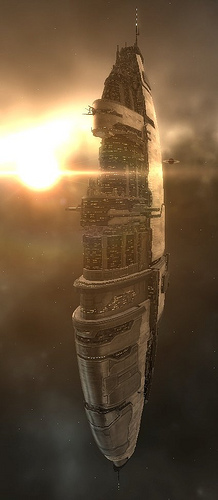
Data:
The stoic, stalwart and socially awkward android of Star Trek: TNG. Built to resemble his maker, Dr. Noonian Soong, Data is a first-generation positronic android – a concept borrowed from Asimov’s I, Robot. He later enlisted in Star Fleet in order to be of service to humanity and explore the universe. In addition to his unsurpassed computational abilities, he also possesses incredible strength, reflexes, and even knows how to pleasure the ladies. No joke, he’s apparently got all kind of files on how to do… stuff, and he even got to use them! 😉

Unfortunately, Data’s programming does not include emotions. Initially, this seemed to serve the obvious purpose of making his character a foil for humanity, much like Spock was in the original series. However, as the show progressed, it was revealed that Soong had created an android very much like Data who also possessed the capacity for emotions. But of course, things went terribly wrong when this model, named Lor, became terribly ambitious and misanthropic. There were some deaths…

Throughout the original series, Data finds himself seeking to understand humanity, frequently coming up short, but always learning from the experience. His attempts at humor and failure to grasp social cues and innuendo are also a constant source of comic relief, as are his attempts to mimic these very things. And though he eventually was able to procure an “emotion chip” from his brother, Data remains the straight man of the TNG universe, responding to every situation with a blank look or a confused and fascinated expression.

More coming in installment two. Just give me some time to do all the write ups and find some pics :)…

The Alien Graph

The Alien Graph

Behold! After a few days of contemplating what I said in the Ancient Aliens post – you know, about how alien’s technology and moral capacity are often interrelated in sci-fi – I realized I needed to put it into graphic form. And as I said in that post, if we are to consider technological advancement as one axis and level of benevolence as another, then the outcome would look something like this:

click to enlarge

The design is based on the Zombie graph that’s been floating around the internet for some time. There, the designer placed different Zombie movies based on two criteria: intelligence and speed. In much the same way, I’ve designed a graph for aliens that is based on two similar criteria: technological advancement and level of friendliness.

I selected aliens that I thought best represented the range of development and behavior in the sci-fi genre. I also included as many franchises as I could think of, just off the top of my head. I certainly wasn’t scientific about it, just relative and to the best of my abilities. And when I was done, I noticed an interesting pattern…

Hostile/Advanced Aliens Rule!:
For example, notice how the vast majority of races from your well-known franchises (Star Trek, B5, Stargate, Star Craft, AvP, Halo, etc) fall into the upper left quadrant. This is the area where malevolence and technological sophistication combine in varying degrees. By contrast, the second largest concentration of races occurs in the advanced/benevolent quadrant, again to varying degrees. Almost no races fall into the nascent (i.e. primitive) quadrants, be they hostile or gentle.

On the one hand, the Xenomorph from Alien and the Arachnids from Starship Troopers both fell into the technologically backward category (technically), and were both classified as malevolent because of their innate hostility to foreign organisms. The Na’vi, from Avatar, were the only alien race that fit the bill for technologically nascent and benevolent. I’m sure there are plenty of examples that could stack this analysis in a different way, but like I said, this was off the top of my head.

The Zerg, I have to admit, were a bit of a conundrum for me. While they are technically a race that does not employ technology per se, they are highly advanced in terms of their biological evolution, to the point where they rely on specialized creatures in the same way that humans rely on machinery. But then again, that’s all for the sake of ensuring that the different factions in the video game are evenly matched. It’s not meant to be a realistic assessment. Much the same is true of the Xenomorphs. While they do not employ tools, fly around in spaceships, or use guns, they are nevertheless an extremely evolved organism that is capable of besting humanity in any contest.

And just to be clear, the middle point of the graph (0,0, where the axes meet) is where humanity stands now in terms of moral behavior and technological development. Sure, some say we’d fall into the evil quadrant, but I tend to believe that humanity is morally ambiguous, neither too good or too evil. Where aliens fall into the spectrum in most sci-fi franchises is meant to reflect this. Much the same is true of technological prowess, where aliens are classified as “advanced” or “primitive” solely in comparison to ourselves.

This all might sound anthropocentric, but that’s the point, isn’t it? These are stories written by human beings for other human beings. All the references, symbols and measuring sticks come from inside us. So in the end, aliens themselves, as represented in our best science fiction, also come from inside ourselves. Their values, their tools, and even their appearances are all constructs of what is familiar and accessible to us. In short, they are merely tools with which we measure ourselves, both morally and technically.

Conclusions:
Well, right off the cuff I’d say the reason we prefer our aliens hostile and advanced is because it makes them seem more threatening and scary that way. Clearly, this makes for a more interesting story. While an alien race that is kind, innocent and backwards can make for an effective tale about the evils of colonialism and imperialism and how one can easily find themselves on the side of evil, these seem to be fewer and farther between. I’d say this is most likely because moral allegories are less intriguing than action dramas. Or maybe just prefer to think of ourselves as the good guys. Let someone else serve as the allegory for evil, selfish and runaway imperialistic behavior!

In addition, there’s the very real possibility that humanity will be making contact with an intelligent life form at some point in the future. And when we do, it’s likely to be the most awe-inspiring and frightening of experiences. When it comes to the unknown, ignorance begets fear and we prefer to err on the side of caution. So it would make sense that whenever we think of aliens, even if its just for the sake of fiction, we would naturally prefer to think of them as both learned and potentially hostile. If indeed aliens serve as a sort of projection for humanity’s own thoughts on itself, than pitching them as potentially hostile beings with advanced technology represents our own fear of the unknown.

In any case, if there is life out there, all these questions will be resolved in the distant future. Hell, maybe even the near-future. If some theorists are to be believed, aliens have already made contact with us and might even be walking among us right now. Granted, most of these people are hanging around the 7/11 with tin foil hats on, but they can’t all be crazy, right?