Top 10 Most Nostalgic SF Games

Hey all. The other day, a revolutionary idea came to me. What with all the other sci-fi stuff I cover, why haven’t I made any mention of sci-fi videogames? Not sure, really, seems kinda obvious now that I think about it. God knows I love talking about the stuff that inspired me, and I’m not ashamed to admit it that sometimes, those things have been games.

Whether they were first-person shooters, space combat simulators, or strategy games, there are some games which have stuck with me over the years. It might have been their cool game-play, inspired backstories, or classic sci-fi elements. Who knows? Point is, I liked them then and, with some exceptions, I like them now.

Anyway, here are the top then that stand out in my mind, in ascending order:

10. Halo 2
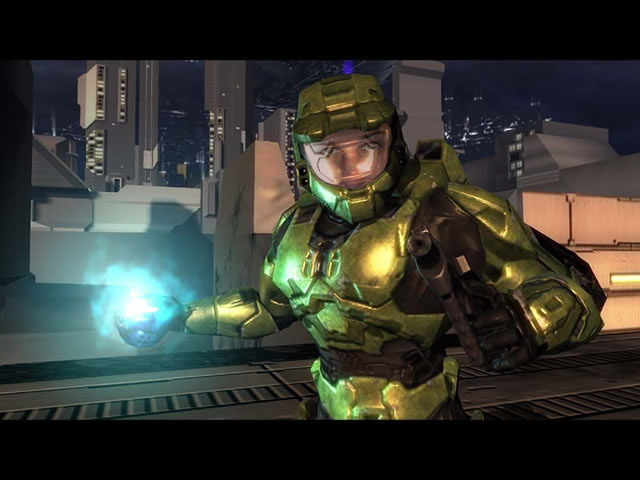
Granted, this game has not been with me too long, as I came to it a bit late in its existence. But I still count it among my top sci-fi nostalgic classics. And in that, I am hardly alone! For gamers, Halo 2 was one of the most anticipated sequels of the last decade. Combing kick-ass gameplay, a cool storyline, and some badass weapons and vehicles, Halo 2 remains a game that I can play over and over.

My favorite missions are the earliest ones when the Covenant are assaulting. Room to room and street to street combat with automatic weapons is much fun! And commandeering a Warthog and joyriding through the transit tunnels of New Mombasa? Pure action gaming art! And while I never really got into the multiplayer thing too much, I have to admit that it’s both extensive and endlessly entertaining.

In addition, I found the storyline highly respectable. In addition to having a classic sci-fi and space opera feel, it contained some genuinely respectable themes and plot devices. The whole backstory about the Forerunners was interesting; but then again, anything involving an ancient and extinct species who’s technology still litters the Galaxy is cool! And the way the Covenant theocracy was following what they believe to be the path to salvation, when in fact they were walking headlong into their graves – tell me that’s not significant!

9. Doom
Granted, it didn’t have the most inspired storyline, but do you think a 16 year old boy gives a damn about stuff like plot and character development? No, he cares about shooting guns and blowing shit up! And that’s precisely what this game was good for when I was a surly teen looking for some fun and adventure on my PC.

And in a lot of ways, this game was a pioneering piece of software. It’s first campaign was made available through shareware, it was one of the first first-person shooters of all time, and it established a new standard when it came to gore and violence.

Thousands of others would follow, each following Doom’s example of a varied arsenal, raw firepower and bloodletting! It was also spawn a slew of sequels, comics, and RPG, and even a horrible, horrible movie. It also provided me with the means to mispend my youth. Good job Doom!

8. Star Wars: Knights of the Old Republic
Speaking of time poorly spent, I can’t tell you how many hours I dedicated to playing this game when I first got it. As I recall, I was in my early 20’s at the time and living in a tiny bachelors apartment in Ottawa. One day this game came in the mail courtesy of one of my best friends (thanks Chi!). I spent the next three days playing it all the way through, pausing only to eat, sleep, and maintain some semblance of a life.

Yes, it was just that addictive. And all because it combined quest-based gameplay with lightsaber duels, a detailed universe, and a genuine Star Wars-esque storyline. Granted, its replay value is a little shaky given that most of the fun comes from completing quests and uncovering the whole mystery plot, but I still found ways to waste time with it!

Another appealing feature about this game was the fact that it took place during the Sith Wars, something that gets mentioned in the expanded universe but never really covered in any detail. So while you’re playing, you get the added benefit of having some important background info filled in for you. If you’re a Star Wars geek, which I admittedly am, this is kind of a big deal…

7. Starcraft
Granted, it took Blizzard FOREVER to make the sequel, but they been busy, what with Diablo, Warcraft, and all their various sequels. And in the meantime, they did give us that fantastic expansion pack to tide us over.

In any case, Starcraft has to be one of the most infinitely replayable games in the history of real-time strategy games. It’s creative, got a good storyline, and some genuinely awesome characters. The Terran Marines are delightful hicks, the Protoss religious zealots, and the Zerg horrifying beasts. What’s not to like? And let’s not forget the multiplayer, which kept gamers entertained for years after the original release date.

And as I said, the expansion pack was really great. As if the original storyline and units weren’t enough, they managed to make some truly worthy add ons with Brood War. I especially loved the Medics and the Dark Templar, the former making Marine shoot em ups more effective, and Dark Templars who’s dark look and hyperblades were just so cool. But the storyline was still what I liked best. Terran exiles, invading aliens, complicated alliances, double-crosses and intrigue. Can’t wait to see how what happens in SC II. Just need me a faster computer before I try to play the damn thing is all!

6. Command and Conquer
Speaking of real-time strategy games, the next up is the classic Command and Conquer! Though I didn’t take to the sequels so much, I thoroughly enjoyed this baby for like a whole summer between grades 11 and 12. And much like Starcraft, the multiplayer was the icing on the proverbial cake, taking all the guerrilla fighting and strategizing to new heights.

And the storyline, once again, is something which I certainly appreciated, being an alternate history and all. To break it down, the story takes place in a world where Hitler never came to power in Germany and Stalin became the big menace of the century in his absence. Once he was defeated, a global coalition known as GDI (Global Defense Initiative) was formed.

And in a way, the game predicted the “war on terror” a bit early, predicting that this coalition would have to fight against a multinational terrorist organization (Brotherhood of Nod) for global supremacy. This war was triggered by the arrival of an alien substance, known as Tiberium, to Earth, an organic-mineral compound that is also radioactive. Pretty cool, real science fictiony when you get right down to it. And the varied units were also neat, each side having their own distinct soldiers, vehicles and special abilities. These made things like rushing virtually impossible, as all units had their own strengths and weaknesses, and could not therefore make offensives unless they had support.

5. X-Wing
Another classic game and one of the most popular flight simulators of all time. Maybe it was because it combined space dogfights with the Star Wars universe. Maybe it was because every kid who grew up with the franchise wanted to fly X-wings and take down the Death Star. Who knows? Point is, it worked, and I for one got a real kick out of it.

Taking place before and during the events of the original movie, X-wing follows the exploits of a Rebel pilot who fights for the Alliance in a series of campaigns. These include raids, escort missions, seizure operations, reconnaissance, and ultimately, large scale assaults. While most missions involve piloting the venerable X-wing, you also get to fly A-wings, Y-wings, and even B-wings (in the expansion pack).

Over time, these campaigns culminate in an attack on the Death Star from the end of the first movie. In the expansion pack, the story continues with the evacuation of Yavin and the search to find a new base of operations, eventually leading to the establishment of a base on Hoth. These events, which took place between movies one and two, are fertile ground and get a good showing here. The same is true with all the early events of the franchise, stuff we hear about in the original movie and expanded source material, but never got to see.

One of the coolest things about this game was the details. When assaulting enemy ships, you could disable them as well as destroy them. This could include disabling subsystems with ion guns or missiles, or targeting things like engines and weapons and destroying them. When assaulting capital ships, you were also able to take out weapons and missile turrets, not to mention shield arrays. This made for a more realistic gameplay, something which other space combat games would emulate in years to come.

4. Wing Commander II
Coming in fourth on this list is the second installment in the Wing Commander series. Another space-combat simulator, this game emerged at about the same time as X-wing and was, at least in my neighborhood, its chief competitor for all the mispent hours we would play games!

In truth, I’m kind of hard pressed to pick one game in the series, since I loved the first three games. But when it comes right down to it, I think I spent the most amount of hours on this one, so WC II for the win! Picking up where the first one left off, this game in the series is set aboard the TCS Concordia and follows the exploits of the series’ protagonist Capt. Christopher Blair.

This is something that set the WC series apart from other space-combat simulators, which is the story-driven and personal nature of the game’s story. Even though the protagonist wasn’t given an official name until the third game (gamers got to use whatever name they wanted), everything centered around the life of this one person, their experiences being yours and helping to shape the course of the game.

In short, after being humiliated and demoted due to the destruction of your former ship, the Tiger’s Claw, you are relegated to a backwater assignment aboard a space station. You remain there, until the TCS Concordia shows up in-system looking for help. After defending her, you are transferred aboard her and become part of its campaign to fight the Kilrathi for control of the Enigma sector (if this is starting to sound familiar, then chances are you read my blurb on the Tiger’s Claw in the Cool Ships series).

In any case, by game’s end, you clear your name, defeat the Kilrathi, and gain control of the sector. Much fun! And because it was personally focused, you find yourself getting emotionally involved and being that much more concerned with winning each mission in your campaign. And of course, as with the first game in the series, this one also had spinoffs which added to the fun as well.

3. Wing Commander Privateer
Though this game bears the WC name, it was more of a spinoff than part of the series. And that’s one of the things I loved about it. Though connected to the main storyline, it was a standalone space combat simulator with a story of its own, and which delved into the world of pirates, smugglers and privateers.

Arriving in my game pile between WC II and just after Doom, I spent the better part of a year playing this game because it was just so replayable! What made it fun was the fact that with this installment in the WC universe, you were a private contractor, you pulled missions for hire, and you used your money to upgrade your ship and buy new ones altogether.

You also got to choose your focus in the game. You could become a merchant, a mercenary, both, and add to that with a little pirating and illegal trading. And of course, there was a larger story set to the backdrop of the Confederation-Kilrathi war and your own drive to get rich. Basically, it involved an ancient ship that was roaming around the quadrant, killing ships on both sides. If you chose to partake of this campaign, you followed clues, pulled jobs, and pieced together the mystery of the ship until it was destroyed.

But above all, the most cool aspect of the game was the richly detailed universe. There were literally dozens of systems and planets for you to venture to, as well as space stations and pirate hideouts. Every place had its own feel and aim, and the jobs you could pull on any given one were suited to match. Years later, I would remind myself of this game when it came time to develop my own sci-fi universe (again, the one I used to write Legacies).

2. Descent: Freespace
One such game was the smash hit and personal favorite of mine, Descent: Freespace. Released in 1999, this game remains one of the best fighter simulators I have ever seen. And I’m hardly alone in thinking that, seeing as how several games (including the online BSG game) have used its engine as a platform. Much like Half Life 2, this game has had many imitators and borrowers due to the sheer wickedness of its design.

But again, one of the things that I loved about this game was its backstory. Set in the 23rd century, the GTA (Galactic Terran Alliance) is at war with an alien race known as the Vasudans. This war has been ongoing and spans several star systems, with losses numbering in the millions. However, all this changes when a new race, known as the Shivans, appears suddenly and begins attacking both sides indiscriminately. After several attacks, the GTA and the Vasudans agree to put aside their differences and focus on this common threat, as the Shivans are clearly not playing favorites.

Also, the Shivans possess vastly superior technology. Their ships are shielded – something neither side has – and are very difficult to track on sensors. Their capital ships are also very tough and hard to disable, and their largest vessel, the Lucifer (expect to see it in the next Cool Ships installment) seems invulnerable to conventional attack. As a result, much of the game is spent conducting intel gathering and raids to procure pieces of the aliens technology. And things really escalate when the Lucifer discovers the location of Vasuda Prime and Earth.

What I loved about this game was how much it reminded me of Babylon 5 and the whole Earth-Minbari war, how Earth Force found itself so outmatched and struggled to try and find a way to beat Minbari technology. I often wondered if the game designers had been inspired by it, given the common elements. On top of that is the fact that you never really get to learn why the Shivans are attacking, or even what they look like. The mystery of who and what they are remains well into the sequel.

But even without all that, the gameplay itself was nothing short of awesome. The missions were realistic, the ships were realistic, and the space combat was realistic (and detailed). I’m not ashamed to admit that this game actually formed part of the basis for my own sci-fi creation, the novel Legacies and the kind of universe it was set in. Being gritty and realistic, I thought I’d found my perfect muse, and did my best to adopt, if not outright copy, a lot of its feel.

Ah yes, and according to an article I read recently, it appears that there might be a third installment at some point in the future. Efforts have kind of stalled, but apparently the developers who worked on the first two games said that they “would kill for a chance to develop Freespace 3.” Given how the sequel ended on a cliffhanger and just how kick-ass this series is, I count myself among them! Tell me who’s gotta go, I’ll take care of ’em!

1. Sid Meier’s Alpha Centauri
Finally, coming in at first place, is Sid Meier’s sci-fi spinoff, Alpha Centauri! Much like the Civilization series which bore his name (and which I adored!), this game was a turn-based strategy engine that focuses on civilization building and conquest, with the player choosing a faction and then ensuring that they become the dominant force in the game.

However, what set this game apart from the Civilization ones was its uniquely speculative and futuristic undertone. Based in part on the Civ games, this story is basically an extension of the original series, where games would end when a player either conquered the world or won the space race by sending a colony ship to Alpha Centauri.

But far from just picking up where these games left off, this game revolves around the idea that Earth was abandoned by the people on the colony ship because of its rampant overpopulation, war, famine, chaos and environmental destruction. This puts the stakes much higher, as the mission is not just to colonize but ensure the survival of the human race.

The story begins with the colonist splitting into five factions before they make “Planetfall”. These include the Morganites (a bunch of monopolistic capitalists), the Gaians (environmentalists), the Hive (totalitarians), the Believers (religious zealots), the Spartans (survivalists), the University (rationalists), and the Peacekeepers (humanitarians). Together, they represent the entirety of the human race, all its particular drives and obsessions. Their struggle clearly mirrors of that of humanity in the present day world.

On top of all that, there’s a planet-wide organisms which is made up of pink fungi and “mind worms”. This organism, as a whole, grows and evolves towards super-sentience every few million years as the planet’ sun reach perihelion. Naturally, this has coincided with the arrival of the colonists, and therefore poses a threat to their survival. So in addition to dealing with the threat of the other factions, there is added threat coming from the planet itself.

In the end, there are any number of ways to win the game. You can conquer the other factions, in which case it is reasoned that you will be able to face the growing threat from “planet” unimpeded. There is a an economic victory, in which a single faction corners the “energy market” (energy being the basis of currency on this world). Then you have diplomatic victory where you basically ally yourself with every faction left in the game, followed by the “transcendental” victory where you become the first faction to achieve union with the planetary organism.

This last option is the biggest and best, being the one that deals with the biggest problem of what to do about the planet and in such a way that ensures humanity’s virtual immortality. By merging humanities consciousness with the planetary organism, you not only achieve a degree of immortality, you also help ensure that the organism won’t regress this time around. And it gives you the highest final score, which is why I always preferred it.

And then there’s all the cool units you get to make. As with the other Civ games, new technologies give you the ability to craft new units. This grows more complex and varied the more technologies you unlock, giving you the means to equip units with new weapons, armor, and special abilities. But the best thing about this game, aside from all the classic sci-fi elements, is the inspired nature of it all. Some serious thought went into the technologies you research, as well as the philosophical models you can adopt.

I’m telling ya, its like some serious sci-fi geeks got together, read all the classics, swallowed the works of Sartre, Plato, Nietzsche, and then waded through the theories of Einstein and Hawkins. This game was a favorite of mine during the early 2000’s, and recently, I managed to get an a copy of it through Amazon.com and have been wasting time on it once more. I’m a happy manchild!

Okay, now I’m feeling kinda weird, geeky, and like I got some serious wasted time to make up for…  But hey, I’m not sorry! Like most people my age, I grew on the dubious combination of television, movies, and video games, with a few genuine experiences thrown in for good measure. If we can’t appreciate the stuff we wasted our youth on, then what good is it? Until next time 😉
Cool Ships (volume VI)

Back yet again with a sixth installment in the Cool Ships series. Like last time, I took this opportunity to tackle some overlooked examples, and some new ones as well. In addition… You know what? Screw the introductions and final thoughts, let’s just get into this!

Bird of Prey:
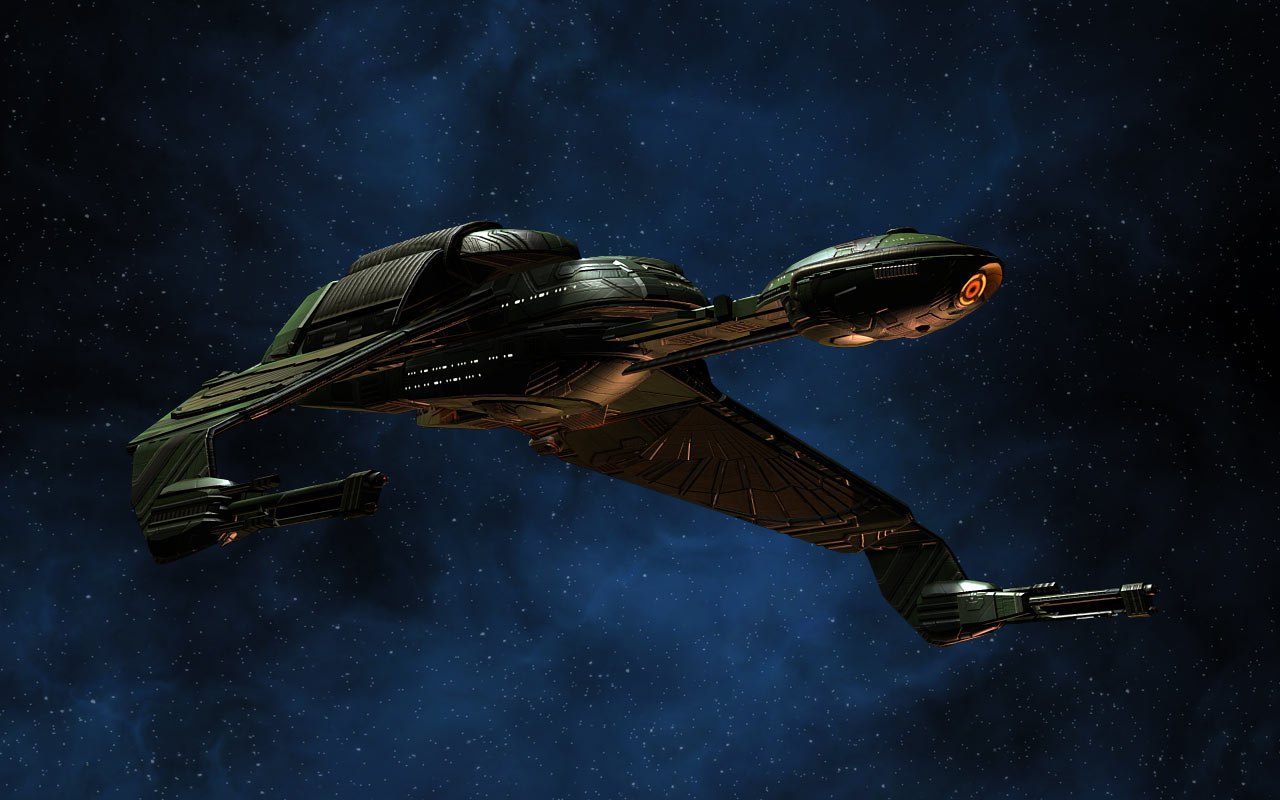
There’s nothing like a classic, and when it comes to the Star Trek franchise, few ships are more classic than the Klingon Bird of Prey. The perfect balance of form, speed, versatility, and firepower, the Bird of Prey is a ship with a very long history of service in the Klingon Empire.

This ship made its first appearance in Star Trek III: The Search for Spock when a renegade Klingon captain, seeking the secrets of the Genesis Planet, used one to attack the Enterprise. Kirk and his crew would later commandeer this ship and use it in the following movie to travel back in time and bring two whales to the future (The Voyage Home).

Bird of Preys would also appear in the fifth and six movie installments, in the latter case as a prototype raider that could fire while cloaked (something previously unheard of). Remaining in service well into the 24th century, Bird of Preys appeared repeatedly in Stark Trek TNG, and DS9,  most notably as part of the Klingon war effort against the Dominion.

Boasting two multi-directional disruptors and single photon torpedo launcher located in the nose. It is also one of the first Klingon vessels to boast a cloaking device, something unavailable on heavier cruisers. Because of their stealthy abilities and versatility, they have played a variety of roles, including reconnaissance, escort, raids and as support for larger vessels.

Cylon Raider:
Boy, they’ve come along way baby! During the original series, Cylon raiders were saucer-shaped, had energy weapons and were crewed by up to three Centurions. In the re-imagined series, this changed significantly, though the Raider still retained its basic roll as a light assault craft.

In addition to getting a facelift, the newer generation of raiders relied on kinetic weapons, missiles and even tactical nukes. Its crew was replaced by an organic brain which was merged with the ship’s machinery, and which relied on an “eye” located in the fore of the central module to communicate and conduct navigation. Much like Raptors, Raiders are capable of making short-range FTL jumps, and therefore do not need to be deployed from a Basestar in the field.

Much of what is known about the modern raider came from Starbuck’s own experiences with a downed vessel. After making her way into the interior, she discovered a system of organs which were apparently fed by an internal supply of nitrogen and oxygen. After removing the brain, she was able to fly the ship using the system of organic levers and controls and rendezvous with the Galactica. Starbuck was meant to use this same vessel as a Trojan horse, but instead used it to fly back to Caprica (“You Can’t Go Home Again”)

Though self-aware, the average Cylon ship is not as intelligent or independent as a humanoid Cylon. However, like the humanoids, they are capable of resurrection and have their consciousness and memories recycled into a new body whenever they are shot down. In time, their accumulated knowledge and experience can make them even more formidable as opponents, as was demonstrated by the vessel known as “Scar” in the season two episode of the same name.

The Ebon Hawk:
Looking beyond the original movies, there are plenty of cool ships to be found in the expanded Star Wars universe. One example is the Ebon Hawk, a Corellian freighter which comes from the Knights Of The Old Republic game.

Much like its modern cousin, the Millennium Falcon, the Ebon Hawk is every smugglers wet dream. The perfect marriage of speed, maneuverability, and survivability, it is perfect for running blockades, evading capture, and saving the galaxy! It also played a central role in the Sith War and the events immediately following it.

Originally belonging to Davik, a ruthless criminal warlord belonging to the Exchange, the ship became the property of the Jedi Order after it was confiscated by Revan. Using this vessel to escape the Sith blockade of Taris, Revan and his comrades used this vessel to travel the Galaxy, investigating the Sith’s plans for domination and systematically unraveling them.

After the end of the Sith War, Revan took this ship to the Rim to further invesigate the true source of the Sith threat. The ship returned to the universe a few years later, carrying an former Jedi master named Kreia who had since become a Sith master, and was exiled by her peers. Once again, the ship would become the property of a Jedi warrior – Meetra Surik – and several fellow-travellers who would used it to retrace the path of Revan and eliminate the Sith Triumvirate, the last of the Sith Lords.

The Event Horizon:
A bit of a break for the usual lineup of cool ships here, the Event Horizon was a  prototype vessel that was featured in the movie of the same name. Built in the near future by Earth scientists to be the first that would be capable of making FTL jumps. In the course of making the jump from the edge of the Solar System to Proxima Centauri, the ship disappeared. Seven years, it rematerialized, sending out a general distress signal.

Upon investigating the derelict, the crew of the rescue ship Lewis and Clarke found a ship of horrors. In addition to having a long spine that was inlaid with jagged metal spikes, the experimental gravity drive looked like some kind of medieval torture device. Seriously, the thing was basically a studded metal ball with spiky rotating appendages.

Oh, and did I mention the ship was haunted? Yeah, apparently generating a quantum singularity and passing through it leads directly to Hell. So in essence, the ship brought a whole lot of Hell back with it when it came back to our universe, and these dark forces began making the rescue teams go made just as it had the original crew. Kinda stupid really…

But ultimately, the design and concept of the ship were pretty cool. And even if you forget about the obviously macabre nature of the engine room, it was pretty neat to behold.

Mothership (Homeworld):
The flagship of the Kushan fleet, the Mothership was the centerpiece of every mission in the Homeworld universe. Originally intended as a colony vessel, its role expanded during the Homeworld War to include that of a command ship and mobile shipyard. This was due to the many hostile races encountered after the Kushan fleet left Kharak to find Earth.

Although not an effective combat platform, the Mothership’s hyperdrive make it FTL capable and therefore capable of deep-space travel. In addition to its internal factories, it also has the capacity to hold 600,000 cryogenically frozen colonists as well as its regular crew of 50,000.

Although not heavily armed, the Mothership contained the means to construct many different classes of support vessels. These included scouts, resource harvesters, fighter craft, destroyers and even cruisers. As such, it had a solid defense screen during the time of the Exodus. Periodically stopping to replenish its resources from asteroid belts, the Mothership was also able to replenish its losses.

USNC Pillar of Autumn:
And here we have another franchise making its first appearance in this series! Coming from the Halo universe, the Pillar of Autumn was featured in the original Halo. A Halcyon-class light cruiser, this class of ship is one of the older ships in service with the UNSC Navy.

During the Covenant assault on Reach, the Autumn fled to the Soell system where it discovered and then crash landed on the Halo ring known as Installation 04. There, after engaging both Covenant and Flood forces, Master Chief John 117 detonating it in order to destroy the installation before it could fire.

Measuring 1.17 km in length and armed with a combination of kinetic guns, nuclear missiles and a magnetic accelerator cannon, the Autumn is powered by a fusion core and able to make FTL (aka. slipspace) jumps through space. In addition, it also carries a squadron of fighters, 15 Pelican dropships, 8 Scorpion tanks, 40 Warthogs, and a full compliment of Marines and Orbital Drop Shock Troops. The ship is run by a central AI – in the case of the Autumn, Cortana – and has a crew of between 300 and 400 personnel.

The Scimitar:
Though I didn’t care much for the movie that featured it, The Scimitar was still a pretty freaking cool ship! Huge, powerful, scary-looking and packing a doomsday device and a truly impenetrable cloak, this baby pretty much had it all. So it begs the question… how the hell did a bunch of slaves built this thing anyway?

Of Reman origin, this dreadnought was built under the supervision of the Picard clone Shinzon and figured prominently in his designs to take over the Romulan Empire and destroy the Federation. This he planned to do by attacking Earth, a plot which was narrowly averted by the crew of USS Enterprise E.

Built for total war, the Scimitar was given every technological advantage the Romulan Empire had at its disposal. This included 52 disruptor banks, 27 torpedo launchers, several squadrons of Scorpion attack fighters, and of course, its thalaron radiation weapon of mass destruction. Requiring several minutes to power up, this weapon was capable of sterilizing an entire planet. Deployment of the weapon involved unfolding its wings, a move which only made it look scarier!

The Scimitar was also protected by two shield arrays, which combined with its weaponry gave it the edge in every combat situation. And as already noted, its cloak was perfect, emitting no tachyons or anti-protons as other cloaking devices were notorious for. As a result, the Scimitar was truly impossible to track while under cloak.

Slave I:
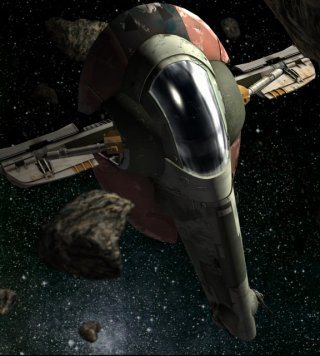
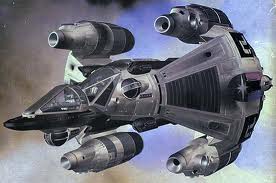
Anyone familiar with the Star Wars universe knows who Boba Fett is. And chances are, all of those people are familiar with his ship, the Slave I. A modified Firespray-31-class attack and patrol craft, the Slave I was originally the property of famed bounty hunter Jango Fett. After his death at the hands of Mace Windu, it passed to his son, Boba Fett.

Small, sleek and stealthy, the ship was also augmented with several advanced weapons systems. These included two rapid fire blaster cannons, two missile launchers, and a rear-mounted minelayer compartment which was capable of deploying seismic charges. The ship also carried a compliment of dummy torpedoes which could tag ships with tracking beacons.

During the events of Empire, Fett used this ship to track Han and the Falcon back to Bespin and then take his carbonite-frozen body back to Jabba’s Palace. After escaping from the Rancour Pit on Tatooine, Fett upgraded to a new ship, which he named Slave II in honor of his father’s ship.

Reaver Ship:
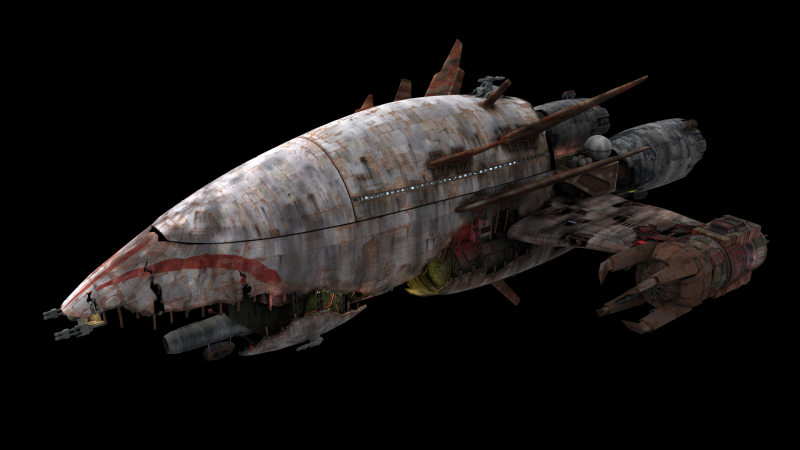
As a fitting final entry, I am returning to the Firefly universe once more. And this time, it’s the Reaver ship that I’ve decided to cover. Though every Reaver ship is of unique design, the one which was featured in the pilot episode (featured at right) is my personal favorite.

Like all Reaver ships, this vessel is adorned with red paint and what I can only assume is the blood of innocent victims. It’s hull and engine compartments have also been modified to look claw-like and threatening, it’s front section has been mangled from ramming into other ships, and its engine functions without radiation containment.

Above all, its weapons have been modified to incorporate the unique Reaver combination of medieval weaponry and snares. These can consist of EMP’s, grappling lines, nets, and launchers that fire shurikens, buzz saw blades, spears and some kinetic weapons. Ultimately, the purpose of Reaver weapons are to disable and capture enemy ships rather than destroy them. This gives the Reaver crews the pleasure of meeting their victims face to face and killing them with sharpened implements.

Yes, much like the Reavers themselves, their ships are scary and look like they got a facelift from a belt sander. But such appearances, as well as their lack of containment, let merchant ships and smugglers know they are coming. When that happens, crews can either power down and hope they’ll go unnoticed or run like all hell. Otherwise, they’re only option is to make peace with whatever deity they pray to and eat a bullet, cuz’ the alternative aint pretty!

Thank you all, this has been volume six! Stay tuned for volume seven, coming soon!

Cool Ships (volume V)

Back again! More ships, more designs, more franchises too. Like I said last time, there’s just no limit when you get right down to it. And in the course of doing my homework on cool sci-fi concepts, I’ve found that there are hundreds of franchises out there that I’ve never even heard of before. Of those I have heard of, I always seem to miss a few obvious candidates. That’s the beauty of ongoing segments though. Here are the latest, with some suggestions thrown in too 😉

Colonial Raptor:
Another late entry from the Battlestar Galactica universe, the updated version. Designed for reconnaissance, transport, atmospheric and space flight, and capable of making short range FTL jumps, the Raptor is the workhorse of the Colonial fleet and one of its most versatile vessels. Ordinarily, the Raptor is operated by a crew of two, one pilot and one Electronic Countermeasures Officer. Given it’s size and shape, it cannot launch from a launch tube and must take off and land from a Battlestar’s forward launch bay.

Having served with the Colonial fleet for over 40 years, making its debut in the first Cylon War, the versatility and reliability of this craft have prevented it from being phased out by newer generations of Colonial ships. During the second Cylon War, Raptors were used regularly in order to dust off survivors from Caprica and other colonies. Relying on a fly-by-wire system, rather than the new defense network systems, it also proved invulnerable to the virus the Cylon’s used to cripple the fleet.

Cygnus:
Now here’s one that people probably won’t remember. In fact, I didn’t recall it either until I did some reading and realized I had seen the movie which featured it – The Black Hole – as a child and quite enjoyed it. Though a little Buck Rogers-y by modern standards, the concept and the movie and this ship still stand the test of time.

Released in 1979 by Walt Disney Pictures, The Black Hole was one of many movies that sought to take advantage of the sci-fi craze that Star Wars had unleashed. The plot centers on a derelict ship, known as the Cygnus, which is run by an android crew and a brilliant (albeit mad) scientist named Doctor Hans Reinhardt.

In addition to looking pretty cool, with its glowing transparent sections and old-school design, the Cygnus is apparently able to withstand the gravitational pull of black hole due to its ability to generate its own gravity well. In addition, its commander, Dr. Reinhardt, theorized that he would be able to fly it through a black hole and see once and for all what lay on the other side… It didn’t take, but still a cool idea!

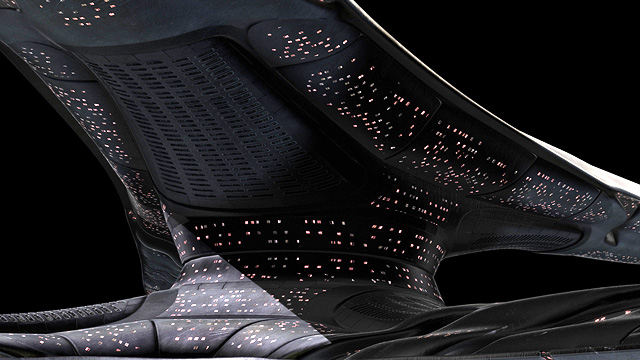
Guild Heighliner:

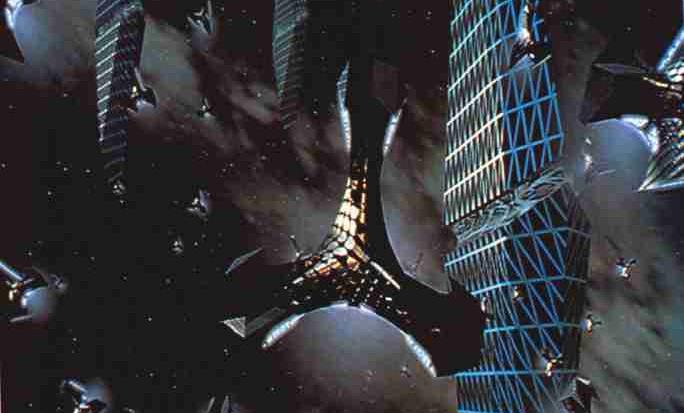
Artist’s concept for a Guild Heighliner

Here’s one I couldn’t believe I had forgotten. In fact, I will accept any and all chastisements for my failure to include Dune craft in this series thus far. This can include physical beatings, just stay away from the nads… not quite done with those yet!

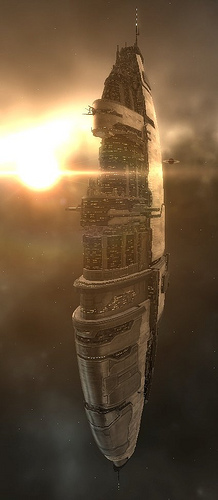
Anyhoo, when it comes to Dune ships, the Heighliner definitely takes the cake! Massive as all hell, this ship was the backbone of all commerce, diplomacy, travel and tourism in the Dune universe. Like all shipping, it was the exclusive property of the Spacing Guild and subject to their many controls, laws and whims.

Boasting Holtzman engines – a FTL drive system that was capable of “folding space” – the ship still required the services of a Guild Navigator. This person, a semi-prescient mutant due to years of living in a spice tank, would see a path through time and space and thus navigate the ship safely to its destination.

According to the original Dune, a single Heighliner was capable of lifting an entire planet’s worth of personnel, goods and supplies from one point in space to the next. As Duke Leto tells Paul in Part I of the story: “A Heighliner is truly big. Its hold will tuck all our frigates and transports into a little corner — we’ll be just a small part of the ship’s manifest.” Later in that same installment, House Harkonnen used a single Heighliner in order to lift an entire army to Arrakis for a surprise assault on the Atreides, and the cost was nothing short of punitive!

Given that the Heighliners are the sole means of commerce in a Empire as massive as that of the Dune universe, its little wonder why Heighliners are so freakishly big. Chartering one aint cheap, and if you do stowe aboard, you are expected to mind your business and wait until you arrive at your destination. Due to their high level of secrecy and sensitivity, no one is even allowed to venture beyond their own boarding craft when on a Heighlinger, and virtually no one outside of the Guild has ever seen a Guild navigator. Considered to be neutral territory by Imperial law, any and all acts of violence aboard Guild Heighliners carry stiff penalties.

Gunstar:
Ah, another childhood classic! Taken from the film The Last Starfighter, the Gunstar was the first line of defense of the Star League against the evil Xur and the Ko-Dan Armada. Sounds pretty cheesy, huh? Well, it was the eighties! And this was yet another Disney franchise that seemed to be riding in the Star Wars wake. Still, this movie was one the first to make extensive use of CGI (Tron being the only other) and had a none-too-bad storyline too boot!

Boasting multiple guns, missiles and a “Death Blossom” trick that is nothing short of devastating, the gun star is a rather unique and innovative design. Apparently, it was meant to be a class of ship that would never go out of style, merging functionality with lethality and being able to take on any class of enemy ship.

Every Gunstar is a two seater, with the starfighter (gunner) in front, and the navigator in the rear. While the navigator flies the ship, the gunner directs fire from a swivel chair, which gives them control over the ships moveable weapons batteries. Although it has no shielding to speak of, the hull is protected by armor plating which can withstand multiple direct hits. When cornered, it is also capable of unleashing the “Death Blossom” where it will begin to rotate at a furious speed and unleash gun and missile fire in all directions. This however, is considered a weapon of last resort, since it will drain the ship’s power supply completely.

Heart of Gold:
Now here’s an interesting, and highly improbably, entry! Coming to us straight out of The Hitchhikers Guide To The Galaxy, the SS Heart of Gold is rather unique in that it merged scientific theory with Douglas Adam’s notoriously quirky sense of humor.

Being a prototype vessel, it was the first ship ever in the universe to boast the “Infinite Probability Drive”. This drive system is essentially a Faster-Than-Light engine which is actually based in quantum theory. Essentially, the theory states that a subatomic particle is most likely to be in a particular place at a particular time, but that there is also a small probability of it being found very far from its point of origin. Thus, a body could travel from place to place without passing through the intervening space as long as it had sufficient control of probability.

Pretty cool huh? In the original radio series, the shape of the vessel was not specified. In the novelization of the series, it was described as a “sleek white running shoe”. For the sake of the movie, artists went with a tea-cup design, and added some brake lights for good measure. Originally built as part of a secret government project on the planet of Damogran, the ship was stolen by President Zaphod Beeblebrox during its launching ceremony and became the means through which the main characters began exploring the universe.

Minbari Cruiser:
Back once more to the B5 universe for another fine example of kick-ass shippery! Known officially as the Sharlin-class Warcruiser, this Minbari vessel is the mainstay of the Minbari fleet in the original series. Big, bold, stealthy, and packing a sh*tload of firepower, this vessel is veritable nightmare for all but the most powerful of races. Even Shadow vessels mind their business when some of these are in the field.

Making its appearance in season one of the show (episode 17: “Legacies”) and went on to become a regular feature. When Sheridan assumed command of the station in season two, the renegade cruiser Trigati was destroyed in the course of a standoff. After B5 broke away from Earth in season 3, a force of Sharlin cruisers arrived just in time to prevent the station from being captured by forces loyal to Clarke. Many went on to serve alongside Sherian and Delenn in the Shadow War and even went on to help liberate Earth from Clarke’s forces.

According to Delenn, Minbari ships do not rely on conventional engines like other ships. Instead, a system of gravitational and electromagnetic fields for propulsion, which have the added benefit of supplying artificial gravity. This frees up their ships from the needs of rotating sections and makes for a more effective combat platform. Sharlin cruisers also boast a significant amount of weaponry, which consists mainly of heavy beam cannons, but also includes missile launchers, neutron guns, and electro-pulse cannons.

During the Earth-Mimbari War, Earth Forces were completely outmatched by this class of Cruiser. In addition to being highly resistant to Earth force weapons, the Sharlin cruiser also boasted a stealth field which prevented Earth ships from being able to lock onto it. In the course of the war, only one human Captain ever survived combat with one, Captain John Sheridan. Relying on a phony distress signal and several well placed tactical nukes, Sheridan was able to lure the Black Star, the Minbari flagship, into a trap and destroy it. Though the Minbari considered it a cheap victory, Sheridan’s fame and renown quickly spread throughout the fleet.

During the battle of Sector 83, the Sharlin-class Cruiser proved an effective weapon against the Shadows. Although somewhat slow and providing a large target for Shadows, their powerful beam weapons were capable of destroying a Shadow ship unassisted. When protected by smaller, faster craft like the White Star, it proves to be a very effective combat platform.

Nebula-B Escort Frigate:
More Star Wars! God, I think I’m OD’ing on this franchise. But the sign says “Cool Ships” and this one is no exception. Known as the Nebula-class frigate, this ship is probably best remembered as the “Medical Frigate” which appeared in Empire and Jedi. 

Measuring some 300 meters long and designed to defend Imperial convoys from Rebel attacks, this ship was more famously used by the Rebellion as a hospital ship. During heavy fighting, Nebula-B’s would be on hand to pick up pilots that had ejected and provide them with life-saving assistance, ensuring that Rebel pilots could live to fight another day.

The most famous appearance of a Medical Frigate was during the Battle of Endor, when several medical frigates were on hand to service Rebel pilots who had been shot down by superior Imperial forces. It was also on board the Medical Frigate Redemption that Luke Skywalker received his prosthetic hand after losing it in a lightsaber duel to Vader.

In addition to providing escort and as a hospital ship, the Nebula-B was proved useful as a deep space scout and reconnaissance ship, due to its sophisticated sensors. During raiding missions or less intense combat operations, many also served as command ships given their speed and defensive capabilities. One weakness of the Nebula-B however was its thin fusilage. Though this made the ship an inexpensive vessel by most standards, it also made it a poor choice for heavy combat. Hence why it was relegated to support, scouting and medical roles.

The Nostromo:
You know, I really thought I covered this one already. I already mentioned how the Alliance Cruisers from Firefly appeared to be inspired by this baby. And it just makes sense that if you’re going to cover ships from the sequel, (the USS Sulaco and the Cheyenne Dropship) that you cover the original first. But alas, the Nostromo was somehow passed over by me, another act of wanton insensitivity! Beating shall continue until my attitude improves!

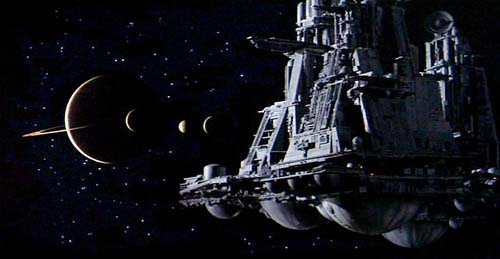
Okay, now that we got my punishment out of the way, allow me to pay this ship it’s due homage. The main set for the movie Alien, the USCSS Nostromo was a deep space commercial vessel which belonged to the Weyland-Yutani corp (much like everything else in this universe!).

Overall, the Nostromo was a curious design which made perfect sense from a space-faring point of view. Doing away with such things as streamlining and aerodynamic sleekness, the ship was well suited to deep-space travel and hailing. In addition, it was also taller than it was long, another common aspect to spaceships which are confined to the whole sea ship/airplane paradigm.

It’s massive refinery, which it towed behind, would process its manifest of mined ore while it made its way back to Earth from wherever it had been deployed. Thus, in addition to providing transport and amenities for a crew of miners and spacers, it was also a mobile refining platform that could deliver processed materials to factories rather than just unrefined ore.

While on return from the distant planet of Thedus, the Nostromo was rerouted to LV-426 where it picked up the alien organism known as a xenomorph. After all but one of the crew were killed the by creature, Ellen Ripley, the ship’s Warrant Officer, set the ship’s to self-destruct and escaped aboard the ship’s life craft with the crew cat, Jones. According to Weyland-Yutani execs, who were some pissed when she returned without her ship, the destruction of this vessel cost them 24 million in adjusted dollars. Damn penny-pinchers!

The Sathanas:
What do you call the most fearsome, intimidating and powerful ship in the universe, without being too obvious, that is? The Sathanas, that’s what! Being the Latin name for Satan, this title is very apt when applied to a massive juggernaut built by a race known as the the Shivans (i.e. Shiva, Hindu god of destruction).

This last entry, much like The Colossus and Deimos from my last list, comes to us from the game Freespace 2. Making its appearance midway through the game, this terrifying vessel was the most powerful space-faring ship ever encountered by the human race or its allies.

Boasting four massive beam cannons which are situated at the end of its claw like appendages, this ship best exemplifies the offensive fighting spirit. Jumping into a field of battle, it is capable of dealing devastating blows on a target head on, keeping its flanks and rear hidden from the enemy.

Above all, it is clear that the Shivan built the Sathanas to act as a terror weapon in addition to a capital ship. One look at its design confirms this, given its clawing appendages and thorny skin. Defeating this ship outright is quite difficult given its reinforced plating and terrible array of weapons. Disabling this ship, through EMP missiles and guns, is not much easier given the incredibly density of its hull and many redundant systems. In the end, the only way to beat it seems to be for lighter craft to take out its “claws” while heavier vessels strike at it from a distance. However, this still proves to be a suicidal mission given the Sathanas’ many missile and defensive batteries.

Ultimately, taking down this ship in the game is much like the real-life campaign to sink the Bismark. This dreadnought, which was the pride and joy of the German navy in WWII, also boasted massive weapons, a heavily armored hull and superior systems. In the end, the Royal Navy brought it down through a combination of luck, persistence, and careful engagements, taking their time to disable it and then closing in to pound it relentlessly! Hmmm. I guess good history makes for good gaming 🙂

Final Thoughts:/strong>
The suggestion box, as always, is still open. Thanks to Goran Zidar for suggesting the Gunstar, I knew I’d have to include it sooner or later and I’m glad someone asked. Anything else? I got another installment on the way, and probably a few more after that. No? Sigh, alright, bring on the beatings! No nads!

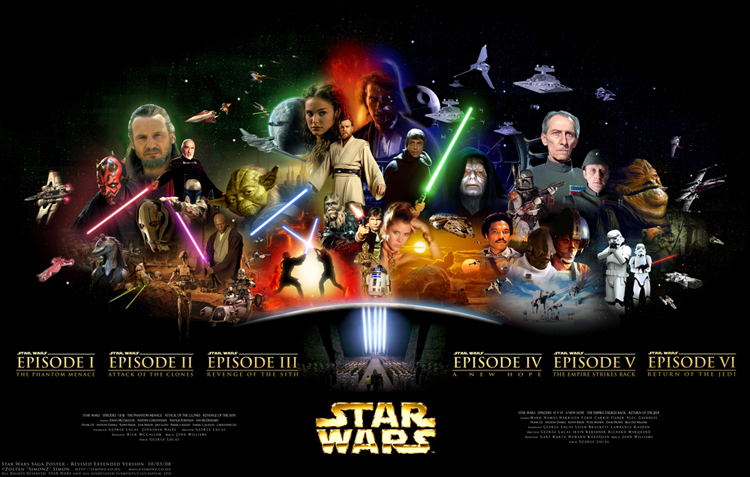
The Star Wars Prequels, Duty Strikes!

Hello, welcome to my last installment on the Star Wars franchise in honor of May the 4th. Only took six days, and I still got the final three movies to cover. Not my best work. But as they say, we all have lives. Well, some of us do. For those who have nothing better to do than read what I write I can only say… you poor things!

In any case, I promised when reviewing the originals that I would dedicate at least one post to the Star Wars the prequel trilogy. But one can scarcely do that without getting into the whole Star Wars legacy and addressing questions about Lucas himself and the directions he’s taken. Love them or hate them, the prequels remain a bone of contention for original fanboys and the new generation of acolytes.

To start, I’d like to give a very quick recap of the three movies before saying what was good and bad about them.

The Phantom Menace:
This movie was without a doubt one of the most anticipated releases in the history of cinema. After years of waiting and hearing that Lucas intended to revisit his universe with some prequel pictures, fans finally got their big break in the summer of 1999. If you’ve seen some of the footage of opening night, where people were lining up around the block, in costume, kissing the floor upon entry, and waving around multicolored lightsabers inside the theater when the movie came on, then you’ve got idea of just how raw and powerful the atmosphere was.

And yet, the Phantom Menace would also go down in history as one of the biggest disappointments of all time. One could easily say that all the build-up made that inevitable. But there were clearly some other factors as well, and people would spend years speculating on them. Of that, more later. First, let’s recap the plot.

The movie opens with the declaration that there is a taxation dispute going on and that the “greedy Trade Federation” has decided to blockade a remote world named Naboo in protest. Sounds a little dry and implausible but okay. We see two Jedis, Obi-Wan and Qui Gonn, being sent to reach a settlement with said Federation.

But once they get aboard, things get hairy. The Feds destroy their ship, on the orders of some “Phantom” dude who’s clearly manipulating things back home. He orders them to begin an invasion of the planet while he covers their asses in the Galactic Senate. Meanwhile, they try to kill them using poisonous gas and some rather inept robots.

Obi-Wan and Qui Gonn manage to escape, relaying on some sweet combat moves and Jedi springing, stow away on one of the troop transports, and are taken down to the surface. Somehow, they are landed on the other side of planet and must find a way to reach the capitol to “warn the Naboo”. Uh, what good does it do to warn people in the midst of an invasion? And why are they on the other side of the planet if the robots are invading the capitol anyway? Bad navigation console?

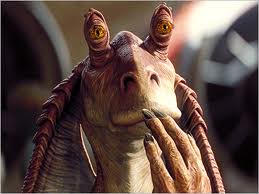
They come across a glaring stereotype named Jar Jar, a bumbling Gungan idiot who tells them his people can help. They swim underwater to the Gungan city where the Boss Nass, through a little force persuation, gives them a pod and lets them take Jar Jar with them, mainly because he owes his life to Qui Gonn (echoes of the Wookie life-debt there). They make it to the capitol and manage to the save the princess, a monotone teenage Geisha named Amidala. Turns out, royalty is elected on this world, and she agrees to go with them to Coruscant to plead their case before the Senate.

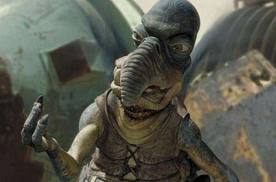
After a daring escape, which is facilitated by R2, they make it to space. However, there hyperdrive is damaged and they must land on nearby Tatooine. Qui Gonn goes off to find a parts dealer and meets another stereotype, an alien named Watto (who might as well be called Shylock given his caricatured appearance and character). He won’t take their credits, and since they don’t have anything to barter with, Qui Gonn concocts a needlessly convoluted scheme.

Yes, instead of simply going to another dealer or hiring a ship (a la Star Wars I), he decides to back Watto’s slave (a boy named Anakin) in a pod race using his ship as collateral. If the boy wins, Watto keeps the money and Qui Gonn gets his parts. But after determining that the boy is force sensitive – via a midichlorian count, one of the biggest let downs ever! – and (according to his mother) the result of immaculate conception, he decides to up the ante. If the boy wins, he gets to take him and the parts with him. For some reason, he seems completely remorseless about seperating the boy from his mother, but whatever.

Oh, and did I mention he built 3P0 – a factory model protocol droid – from spare parts to help his mom around the house? Weird, I thought these things were designed for, you know, protocol, as opposed to doing dishes! But whatever… He meets R2 and the they have immediate chemistry 😉

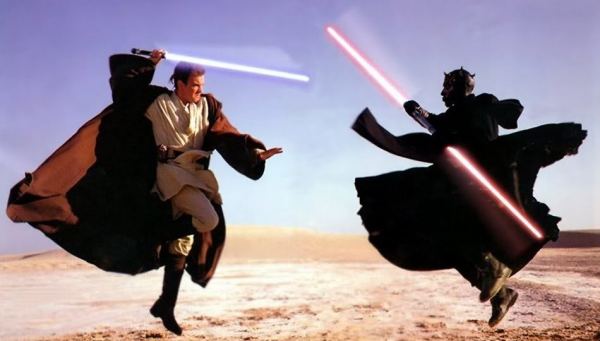
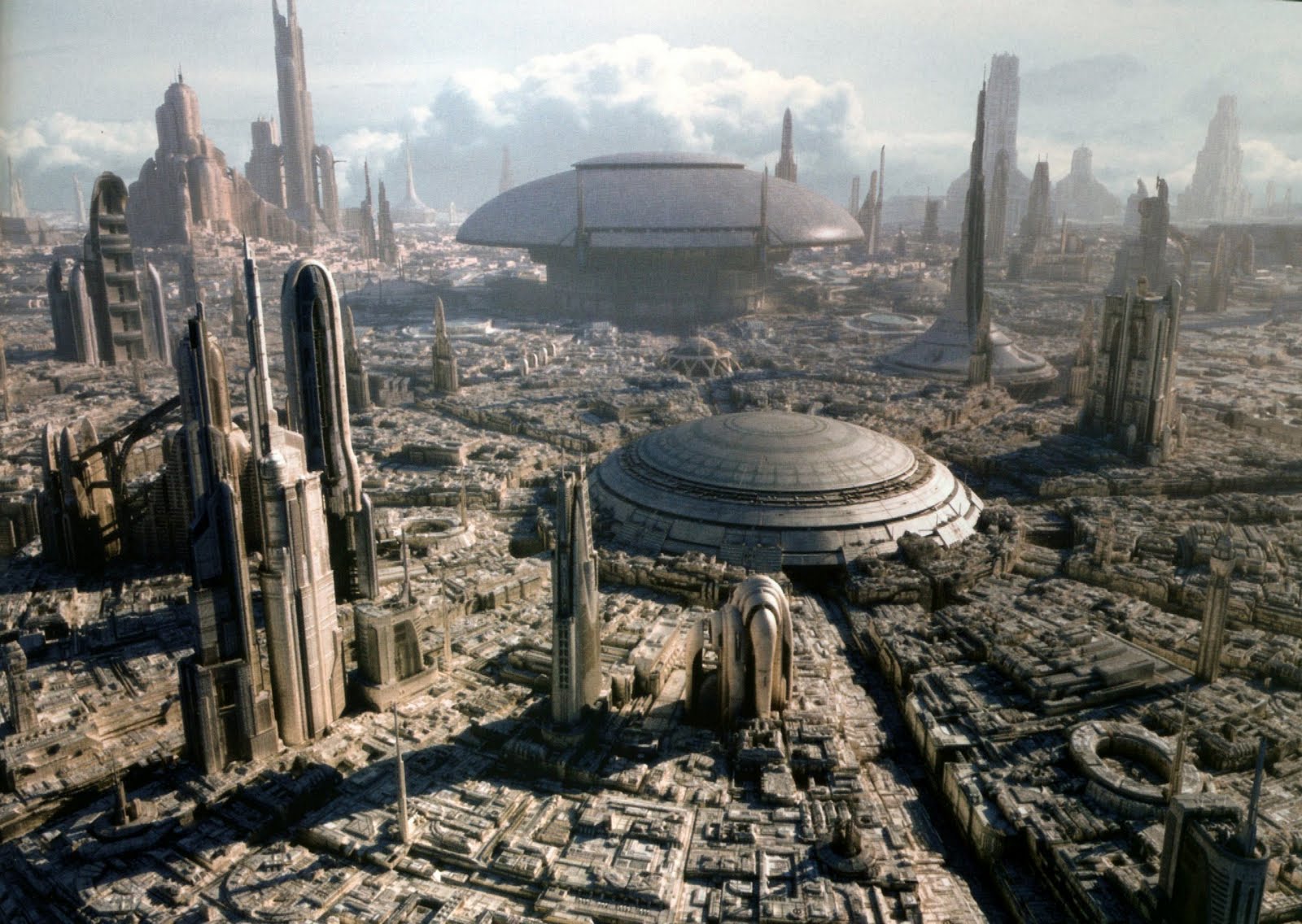
After the big ass pod race, clearly inspired by Ben Hur, Anakin wins using his Force abilities and Qui Gonn has his bounty. Their departure is momentarily interrupted when a Sith named Darth Maul shows up, seeking the princess, and Qui Gonn must fight him. They make it out and head to Coruscant, which is introduced for the first time in the franchise, and begin to attend to all the dry political crap that is waiting for them.

There, Senator Palpatine, representative of Naboo (and the man posing as the “Phantom”) tells them they’re in the thick of it. The Chancellor could force the issue but can’t since he’s been marred by accusations of corruption. Palpatine recommends calling a vote of non-confidence to unseat him so that someone less weak-kneed will take over. After finding nothing but gridlock in the Senate, Amidala concedes and makes the motion. Palpatine is happy, since he (surprise, surprise!) gets nominated!

Meanwhile, the Jedi Council has a look at Anakin, and is worried. It seems his fear of losing his mother is a bad thing, at least according to Yoda. Fear, through commodius viccus, leads to the Dark Side. Seems harsh, but this combined with his age, leads to their decision not to train him. Qui Gonn goes to bat for the little kid, but they are stubborn.

However, things change when Amidala decides she must go back home and the two Jedi are ordered to go with her. For some reason, they take Anakin and his two droids too, and Jar Jar is coming too to provide more slapstick. When they arrive, they begin plotting how their going to overthrow Federation occaption. The Gungans are recruited to help, and agree to lure the droid army into a battle as a feint to leave the capitol open. They decide to make Jar Jar, the idiot they exiled for being clumsy, a General and charge him with leading their attack. …Really?

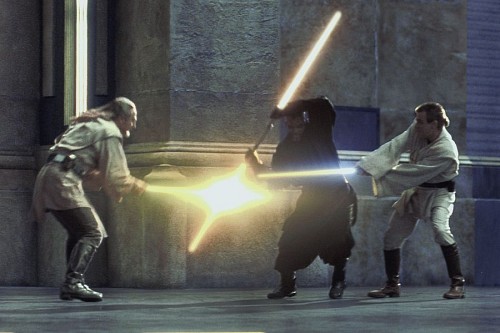
Meanwhile, Amidala, the Jedi and a handful of her security people infiltrate the capitol. After Amidala and her people take the throne room though a little decoy and switch, Qui Gonn and Obi-Wan come face to face with Maul. A brilliant duel ensues, Qui Gonn dies, and Obi-Wan defeats him by pulling a flip and slice routine that frankly, Maul should have been able to prevent. Hell, its the same thing Anakin tries in the third movie and Obi-Wan lopped both legs and one of his arms off! And Maul’s way more badass!

But the really objectionable part comes when Anakin, through sheer dumb luck, ends up commandeering a fighter and flies into orbit with the Naboo fighters to engage the Fed command ship. Those watching couldn’t help but notice that the other ships have all left for some reason, but again, WHATEVER! Anakin, despite the Feds claim that nothing can get through their shields, manages to do just that when he accidentally flies his fighter into their bay and fires some torpedoes into their main reactor. The ship blows up just as Anakin flies out.

Down below, the Gungans are having a hard time tackling the droid army, and Jar Jar’s constant slapstick and bumbling aren’t helping things much. But somehow, he manages to stay alive, and eventually the destruction of the command ship renders all the droids inoperative. The day is won and the capitol celebrates. The Jedi have a memorial and speculate on how Maul must have had an accomplice, since Sith always work in twos. The camera then pans to Palpatine to let us know, as if we hadn’t figured it out already, that he’s baaaad!

And that’s how the movie ends. With lots of fanfare that calls to mind the medal ceremony of the first movie, we see Gungans, the Princess, Obi-Wan and Anakin all standing on ceremony as people cheer and blow horns. The credits rolled, and audiences everywhere were left speechless…

The Reception:
After the movie finished on opening night, it was like the fans everywhere were going “uh, what just happened?” Seriously, if you watch the documentary footage, you can’t help but notice how underwhelming the mood was once the movie was over, nothing close to the electricity that there was going in. It was as if they’d come to witness the second coming and were forced to watch cheep parlor tricks instead. The critics weren’t too kind either, most giving it mixed reviews based on its weak scripting, the inclusion of Jar Jar, the dry political content, and the saccharine character of Anakin.

However, there were good things about this movie too which did not go unnoticed. Just about everyone acknowledged that the pod race and lightsaber duel were worth the price of admission. But overall, this movie fell far short of expectations. And with the benefit of hindsight, the weaknesses became all the more apparent.

  1. The plot stunk of duty: This is something that would become more apparent as the trilogy went on. For all three movies, the entire plot seemed like a set-up for a bunch of explanations. This is a weak basis for a story and makes the audience feel like the movie is plodding along out of a sense of duty rather than a desire to tell a story. In the Phantom Menace, the focus was overwhelmingly on explaining how Palpatine got into power, even if that was only a small part of the story. Aside from that and the introduction of Anakin, there was nothing of importance happening elsewhere. I mean seriously, a taxation dispute? A blockade of a remote world? THESE things put the Galactic Republic in turmoil? I know this was all meant to show how inefficient and corrupt the Republic had become in its dying days, but c’mon! Give us something of consequence!
  2. The plot just plain stunk!: Throughout the first half of the movie, so much happens for which there is no decent explanation. Mainly, audiences just followed it along, waiting to see where it went and only realizing with hindsight that it didn’t make any sense. For starters, why did the Trade Federation agree to this risky scheme when they didn’t even know who they were dealing with? Were they that desperate to getting out of paying their taxes? Second, why was it necessary to fly to the surface to warn the Naboo if they were already being invaded? Third, why did Qui Gonn go through all that trouble just to get some parts? Why not go to another dealer, find a smuggler, agree to pay them ten times what they wanted once they got to Coruscant? Why sponsor a pod race, plot to free a boy, use his force power to manipulate the situation, and ultimately leave the boy’s mother behind in the end? It all seemed so reckless and silly, not what you’d expect from a Jedi Master. What’s more, everybody and their brother was warning him against taking on Anakin, saying they foresaw danger in his training. So why then was he so obsessed with training him, because of that vague prophecy? If this is such an important factor, why weren’t audiences made aware of what that prophecy was? Maybe then we might understand why he was so intent on seeing Anakin become a Jedi and the Council was not. But this was never done, not in this movie or its sequels. And Qui Gonn’s death-bed request that the boy be trained was a pretty weak excuse for the Jedi Council accepting him after all.
  3. One-dimensional characters: There’s this hilarious clip over at Red Letter Media where a guy asks a bunch of people to describe characters from the Star Wars universe. The rules are, say stuff about them without mentioning what they look like or what their job is. In the case of the originals, the people selected could say volumes about Han, Luke, Leia, et al. But with the prequels, they couldn’t say jack! There’s a reason for this. Beyond their basic roles, every character in this movie had no real substance or character. Hell, it wasn’t even clear who the main character was. So many people are the focus of the film and doing things to advance the plot that it doesn’t feel like their is a protagonist at all. Ah, which brings me to point 3!
  4. Who’s the focus here? All good stories have a protagonist. A person’s who’s journey is the focal point of the story and helps the audience to identify with them and become emotionally involved. In the originals, that person was Luke Skywalker. By no means was he the only character, but he was clearly the focus of the story. His own journey of self-discovery was the main driving force of the plot, and his battle with his own demons and his past provided the resolution. In the Phantom Menace, all we get is snap shots of different people doing things to advance the plot towards a resolution, which feels too tidy in the end.
  5. Too much reliance on CGI: It’s an easy thing to criticize a director for relying on CGI, but when you consider the fact that Lucas managed to capture lightning in a bottle using nothing but stop-motion, animatronics and puppets, you have to wonder why he was so obsessed with using the latest technology. Granted, it allowed him to do things he couldn’t before, but it also limited his shoots and made the movie feel incredibly sterile. In just about every shot in this movie, you don’t have real sets and actors on location. You have actors walking in front of a green screen and looking at hanging lights instead of physically real stand-ins. And no matter how advanced the technology, people will always know what they are seeing isn’t real. And when all the backgrounds look so perfectly glossy, clean and packed to the hilt with digital effects, it all just feel fake.

Some Possible Explanations:
As all fans of the Star Wars franchise are aware of by now, Lucas was never that good at scripting or directing. In fact, it was well known that in the first movie, help needed to be brought in to complete the film. In the second movie, that help was on hand from the beginning and it showed. But by the third, Lucas was clearly back at the helm and making the big decisions. With this in mind, it’s little surprise why the Phantom Menace was the way it was. With the success of the original franchise, Lucas had grown richer and more powerful than anyone thought possible, and with companies like Lucas Arts and Industrial Light and Magic behind him, who the hell is going to question him? He’s George freaking Lucas!

Surely, the man must have thought himself immortal by the late nineties when he began writing the script. All those people who used to tell him what to do or challenge him were now gone, replaced by sycophants and suck ups who grew up idolizing him. And can you blame them? It’s George freaking Lucas! How could the creator of Star Wars be wrong?

Sure, there were plenty of cool action scenes and the new technology was pretty damn effective at letting Lucas do all the things he couldn’t do before. But this was Star Wars, dammit! Where were the classic characters, the epic storytelling, the stuff that went beyond special effects and eye-popping visuals? Part of what made the originals so damn good was the depth that went far beyond the ships, guns, and lightsaber duels.

When you look at the originals, at all the things Lucas wanted to do but got called on, you begin to understand. According to rumor, Luke Skywalker was supposed to be a half-cyborg, Han was supposed to be a green alien, and the dialogue was supposed to be a lot more wooden and cheesy than it turned out to be. But thanks to dedicated professionals who knew how to rely on Lucas’ strengths and help him with his weaknesses, something truly awesome and classic was made.

But, as with most things, this success proved to be the downfall. Like Lucas, we all seemed to think he was solely responsible for the creation of Star Wars. Granted he was, in his own words, “the creator as well as the decider” (a cheesy reference to that awful Bushism), but he was never the sole voice of the project. Literally everybody, from the co-directors, co-writers, and even the actors themselves had a role in helping him to make his movies. Without them, we are left with Lucas as he is, warts and all. And after years of success and a growing obsession with the latest special effects, that’s not a very pretty sight!

Well, that’s what I thought of Phantom Menace. Stay tuned for Attack of the Clones… This aint gonna be pretty! But in the meantime, here’s some funny news. It turns out Topher Grace, who played Eric on That 70’s Show, has made an 85 minute editors cut of the three movies. Follow this link to read more on this interesting and funny story:

http://www.bestweekever.tv/2012-03-07/topher-grace-edits-star-wars-prequels

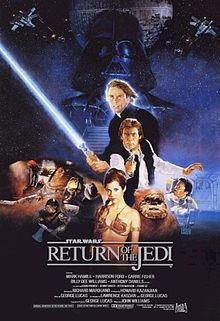
Return of the Jedi

Well, Star Wars weekend is passed, and my final review of the original lineup is long overdue. Been that kind of weekend, unfortunately, a constant flurry of visiting family, friends, and then coming home to be drowned in Spring cleaning. Luckily, I got some time with my keyboard today and decided I’d dedicate some time to the third and final movie in the trilogy.

And much of this is still fresh in my mind, seeing as how my wife and I were driving up island on Star Wars day, and I spent much of the ride recounting the plot to her. She never saw the original trilogy (crazy, I know), so I’ve been trying to fill her in. Appropriate, no?

Return of the Jedi!
Last time, I mentioned that Lucas claimed that he was following the three-act model when he made this trilogy. Thus if Act I could be considered the intro and Act II the dark chapter, then Act III would serve as the culmination to the whole thing. And that’s exactly what happened. In addition, the film had multiple story arcs towards the end the movie, all of which came together in a single, grand conclusion.

In fact, that’s something I forget to mention last time. You may recall that in the first movie, there was a single, all encompassing climax involving all the main characters, and that was the assault on the Death Star. In movie two, there were two strands, Luke’s confrontation with Vader which ran alongside Leia and Chewi’s escape from cloud city. And in this final film, there were three: the battle on Endor, the battle in space, and Luke’s final confrontation with Vader and the Emperor.

An act of symbolism, no doubt, but it’s also what worked best about this last film. With different things happening in different locations, audiences were kept intrigued and on the edge of their seats, watching how one climactic fight interacted with the next. And since we were emotionally involved with all the characters at this point, each one was about as tense as the last.

Alright, let’s get to the plot of this badboy and see why it worked so well!

Plot Synopsis:
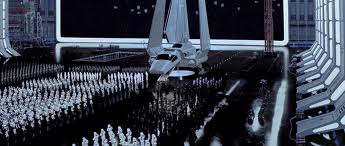
The story opens with the new Death Star being introduced. The new weapon of terror is apparently nearing completion and Vader has flown in to inspect things personally. After letting the station commander know that it must be completed on schedule, he lets him know that the Emperor himself is on the way. He is naturally frighten and rightly so, as we are made aware for the first time that even Vader is a pushover compared to the big man himself!

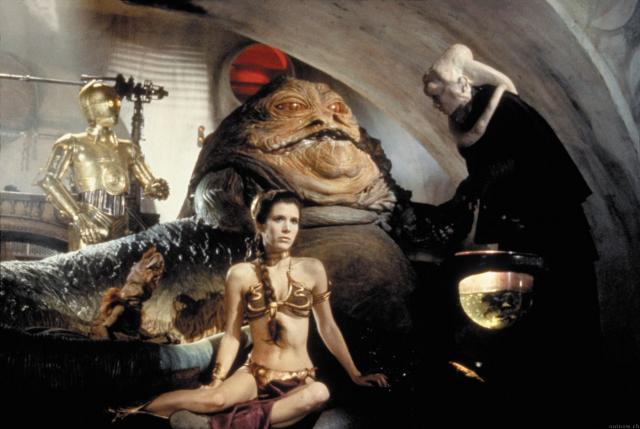
Cut to Tatooine where Jabba’s Palace is located. R2 and 3P0 have entered, apparently to deliver a message to Jabba. Said message consists of Luke Skywalker opening a dialogue, asking to bargain for Han Solo, and concludes with him offering R2 and 3P0 as “a gift”. Jabba’s response is that no deals will take place, as he’s become quite fond of looking at Solo’s carbonite-frozen body. He’s even placed it against the wall like its some kind of artwork. Creepy, though it did bring the room together though 😉

Little by little, the others enter the picture. Leia comes in disguised as a bounty hunter and trade Chewi in for his bounty. As Han’s companion, he too is worth quite a bit of money to Jabba. At the same time, we learn that Lando has already infiltrated the place posing as a mercenary. In the middle of the night, Leia sneaks into Jabba’s palace room and thaws Han, who appears to be blind and sickly from hibernation. They have a passionate reunion, but it’s quickly cut short…

Beginning with a dark, evil laugh, Jabba reveals himself from the corner where they were hiding. Han tries to bargain with him, but Jabba’s pretty intransigent at this point. He has him thrown in the same dungeon as Chewi and Leia is forced to wear a funky-looking bikini (to the delight of nerds everywhere) and become his palace slave. This consists of wearing a choke chain and lying beside him on his floating couch.

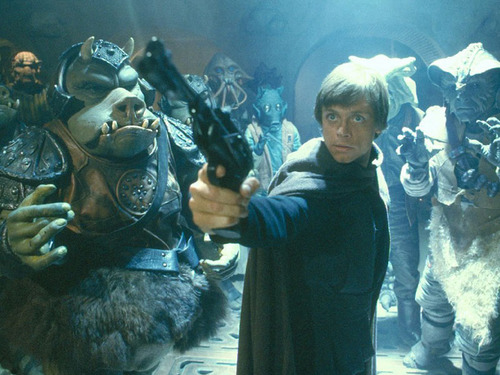
However, Chewi let’s Han know that Luke will be along shortly,  and that he’s a Jedi Knight now. And he does, looking a lot more badass than he did last time! After making his way in with some subtle force tricks, he confronts Jabba and demands Solo’s release. However, things go awry when the minds tricks fail to sway Jabba and he sends Luke and one of his henchmen him into his Rancour pit below.

After a tense few minutes, Luke manages to kill it by dropping the cage door on its head. Jabba is pissed, and orders the whole bunch to be put on his barge and flown out to the desert. Seems they are going to kill them in a big ceremony by being tossed into the Sarlacc pit. No shortage of weird aliens or convoluted death schemes in this one!

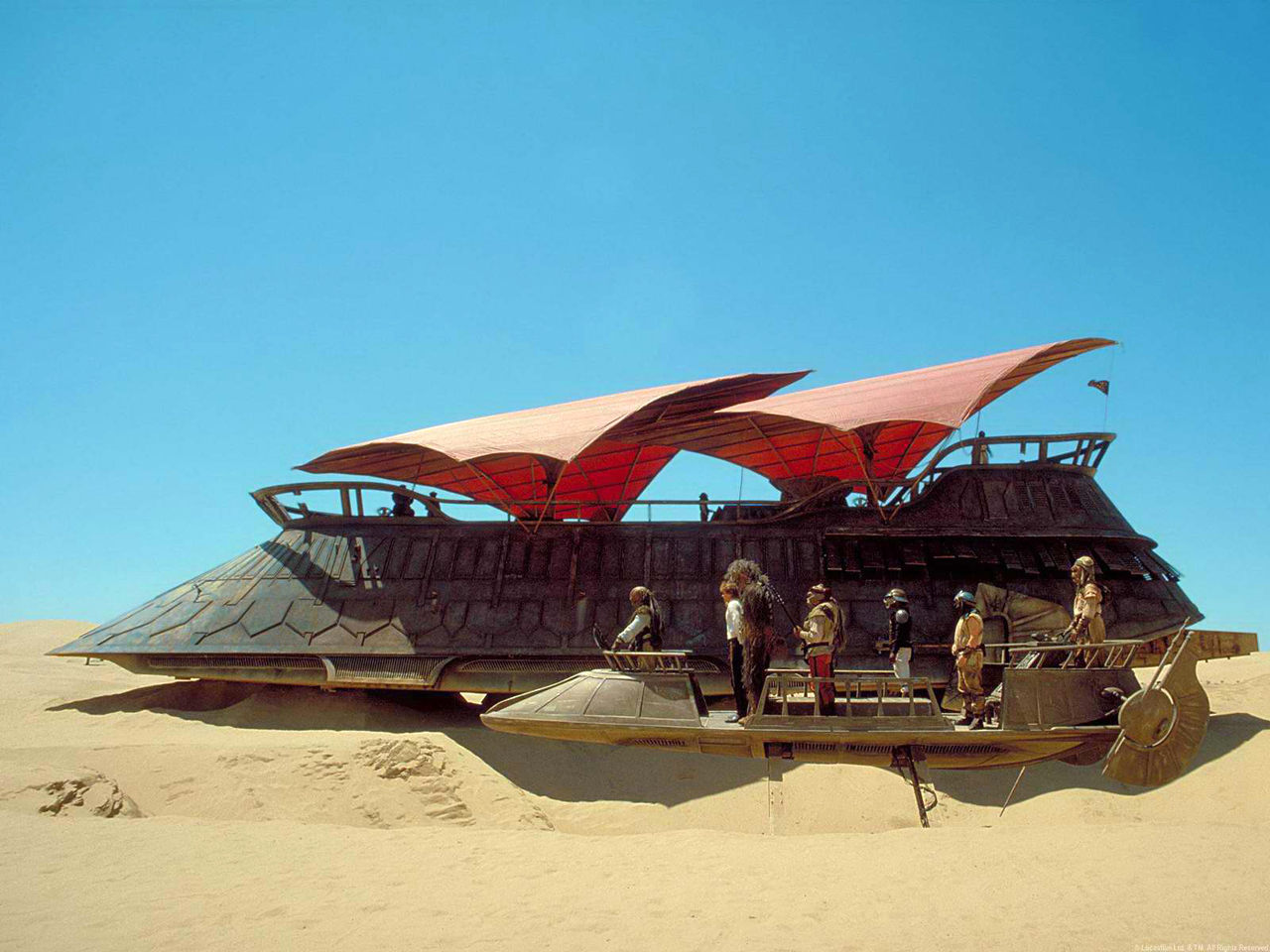
Once arrived, and overlooking the sucking Sarlacc pit (some people have suggested Lucas might have some issues with female genitalia!), Luke and the others stage their counterstroke. This consists of R2 firing Luke his lightsaber, who then starts cutting through henchmen with it. He then works his way to the other escort, eventually reaching Jabba’s own sailbarge. Meanwhile Han, who’s eyesight has been returning, manages to take out Bobba Fett’s jetpack through blind luck. He flies into the side of Jabba’s barge and falls helplessly into the pit. But of course, he will survive!

Leia manages to turn the tables of Jabba by getting a hold of her choke chain and wrapping it around the big slugs neck. R2 breaks her chains and shoves 3P0 and himself off the barge, leaving Luke and Leia to rendezvous on the top deck where they use the barge’s cannon to set the place to blow. They make it back to their barge with Lando, Chewi and Han, swing around to pick up the droids, and get the hell out as Jabba’s barge is blown to hell.

Once they retrieve their ships, Luke and the rest dust-off from the planet. The Millennium Falcon heads off to join the Rebel armada while Luke, in his trusty X-wing, sets course for Dagobah. Seems he has a promise to fulfill, and some questions he needs answered. Arriving to find Yoda sick and weak, Luke manages to get the answers he needs. It seems that he’s finished his training, but that one final test remains: he must confront Vader again. Yoda also confirms that Vader is in fact his father, a fact he and Obi-Wan withheld. Yoda then warns him one last time of the perils of the darkside, but also that there is another Skywalker. He dies uttering these last words, and then fades away…

Back in the swamp by his X-wing, Luke feels incredibly alone. First Obi-Wan, then Yoda; but wouldn’t you know it, Obi-Wans specter appears and tells him Yoda isn’t really gone, kinda like him! Luke demands to know why Obi-Wan lied to him, to which Obi-Wan replies that his version of events – i.e. “Vader betrayed and murdered your father” – was true… in a sense.

Luke expresses his doubts about being able to kill his own father, but Obi-Wan says a confrontation is inevitable. He also confirms what Yoda said before he died, that there is indeed another Skywalker that was kept seperate from Luke to protect her identity. Luke concludes it’s Leia, which isn’t a stretch seeing as how she’s been the only female lead in this entire universe so far!

Back at the fleet, we are treated to a briefing. Seems the Alliance is poised to strike at the second Death Star before it is operational. Since the Emperor is overseeing the final phase, they plan to kill him and destroy his weapon of terror in one fell swoop. The plan involves two phases: in one, a small team or commandos will land on Endor and disable the shield generator that’s protecting the Death Star.

In the second, the fleet will jump in and send their fighter squadrons into the center of the station to take out its main reactor. Lando is set to lead the fleet, and Han is leading the planetary assault. Chewi and Leia volunteer to help, and so does Luke. Han is also sure to lend Lando the Falcon for the attack, which he promises to take good care of. The mission is on!

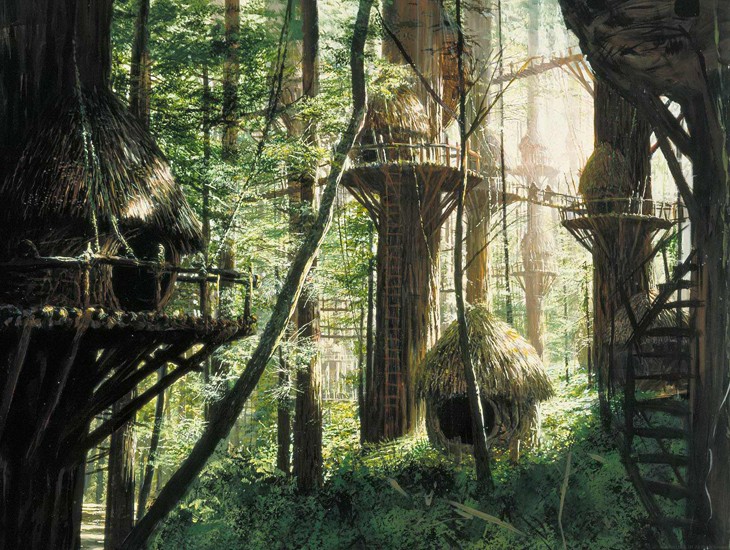
After narrowly making it to Endor aboard a stolen Imperial shuttle, Luke sense his father through the Force. Vader has the same experience, detecting him on the shuttle which, for some reason, is allowed to land. He informs the Emperor and asks for permission to confront him. On the surface, their party’s progress is interrupted when Leia gets lost chasing down some scouts. She is rescued by a strange, furry indigenous creature known as an Ewok. After helping her thwart some more scouts, he takes her back to his village.

Luke, Han and Chewi also come into contact with the locals, but in their case, it involves a trap involving raw meat and a net. Once they spring free, they find themselves surrounded by the furry guys, but they turn up their spears when they see C3P0, whom they believe to be a god. They too are brought to the village, and after enforcing some ground rules (no eating of his friends!), they begin conducting some cultural exchanges.

The Rebel party are welcomed into the tribe and the Ewoks volunteer to help them rid their world of the Empire. Meanwhile, Luke and Leia have a private chat where he reveals to her that she is his sister, and that he must go off to confront Vader. He believes he can turn him back, and as long as he remains with them, they will be in danger. Leia is tearful, but can’t stop him from going.

Luke surrenders to the first patrol he can find, and they take him to Vader. During their little reunion, Luke tells Vader that he intends to turn him back to the good side, but Vader is intransigent. He will take Luke to the Emperor where we will either turn or die. It’s clear he’s torn by this decision, but tells his son it’s too late for him to turn good again.

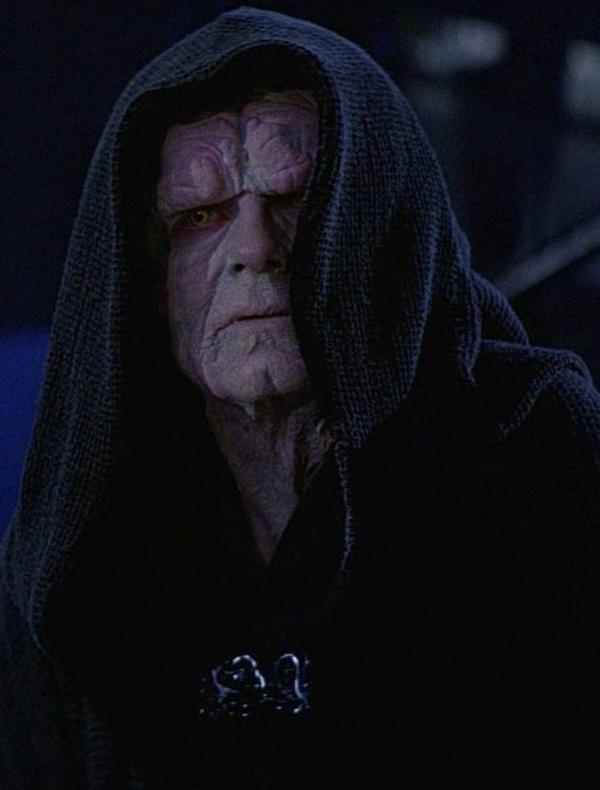
Together, they travel to the Death Star and meet with Palpatine himself. He repeats Vader’s ultimatum, turn or die, to which Luke boasts that soon, they’ll all be dead. The Emperor laughs and reveals that he knows of the attack and that it’s a trap! Cue scary music! It seems the Emperor allowed the location of the Death Star to fall into Rebel hands in the hopes that he could lure them into an attack and crush them all at once. Luke is understandably dismayed…

Han and his party, with the help of the Ewoks, find their way to the back entrance of the shield generator. After making their way inside, they are promptly surrounded and taken prisoner. R2, 3P0 and their Ewok scouts can only watch in dismay, but the Ewoks hatch a plan and run off. They return with the entire Ewok nation, and spring a trap of their own on the Imperial troops. A massive fight ensues, with the Ewoks and Rebels gaining the element of surprise but slowly losing out to the Imperial troops superior weapons.

Meanwhile, the fleet jumps in as planned. On approach, Lando’s helmsman tells him they can’t get any reading on the Death Star to know if it’s shields are still active. His helmsman concludes they are being jammed, but Lando knows this can’t be unless… He orders the fleet to pull up, and they narrowly peel off before slamming nose first into the shields. No sooner do they get their fleet reoriented than the Imperial fleet shows up out of nowhere to seal off their escape. Ackbar yells his iconic catchphrase: “It’s a trap!”

Lando and the fleet begin combing through wave after wave of TIE fighters. Despite their superior numbers, he and the other Rebel squadrons manage to hold their own. However, he grows suspicious when he notices the Star Destroyers are not moving into attack range. However, according to the commander of the Executor, their orders are to hold while the Emperor unveils something “special”.

Cut to the Death Star, where the Emperor lets Luke know, in the latest frightening revelation, that the Death Star is also fully operational. He orders them to fire. The big gun blazes up and destroys the nearest Rebel Mon Calamari cruiser. Lando and Ackbar realize the terrible truth. Ackbar orders a full retreat, but Lando insists they won’t have another chance to assault the Death Star, and simply must give Han more time to bring the shields down.

On the Death Star, Luke is finding it increasingly difficult to resists the Emperor’s taunts. He knows the Emperor wants him to give into his hatred, but he must resist or risk falling prey to the dark side. In time, he gives in and takes his lightsaber and tries to strike the Emperor down. However, Vader interferes and the two begin fighting. Luke turns up his sabre several times, but Vader continues to press him and force him to defend himself.

After they lose a second Mon Calamari cruiser, Lando tells Ackbar to move the fleet into attack range of the Star Destroyers. As long as they are tangled with the Imperial fleet, the Death Star won’t be able to shoot them, and at least they’ll be able to kill a few enemy ships in the process. The two fleets close ranks, and all hell breaks loose! Ships on both sides are destroyed, but at least they are buying time…

Back on the surface, the Ewoks and the Rebels manage to turn the tide. Chewi and some of furry friends commandeer an AT-ST and begin using it against Imperial forces. The Ewoks defenses also prove effective once they put away the rocks and wooden arrows and break out the logs. Once they realize that they’ve won but can’t make it back into the bunker, Han hatches a plan. Using the AT-ST’s communication system, he tells the commander inside that they’ve beat the Rebels and need reinforcements. The Imperial commander orders the doors opened, and Han and the Ewoks take the base and plant their charges.

The place blows up and the shield comes down. Ackbar orders all fighters into the Death Star to take out its reactor. On board, Luke continues to try and elude Vader. However, Vader senses his fear and is able to read his thoughts. He realizes Luke has a sister, and threatens to turn her instead. Luke loses it and attack Vader, pulverizing him with lightsaber blows until he takes off Vader’s hand. The Emperor laughs and tells Luke to take his father’s side, but Luke turns back at the last second. He is now a Jedi, he says, and will never turn to the dark side.

The Emperor is… pretty pissed! He replies that, as promised, Luke will be destroyed if he won’t turn. He begins electrocuting him with lighting from his finger tips, and Luke begins to beg Vader for help. Vader intervenes, grabbing hold of the Emperor and tossing him off a catwalk into the depths of the station below. He explodes in a massive cloud of Force Energy. Unfortunately, Vader’s suit has been irreparably harmed by the Emperor’s electrical storm. Luke comes to his aid, but it seems like ol’ Darth’s ticket has finally been punched!

Inside the Death Star, Lando and the Rebel pilots manages to reach the main reactor and hit it hard. It collapses, triggering a chain reaction which begins to destroy the station from within. Outside, Ackbar and the Rebel fleet manage to bring down the Executor through smart tactics and dumb luck. The Super Star Destroyer loses control and crashes into the Death Star. The whole place begins to fall apart.

Luke manages to reach a shuttle with Vader in tow. However, with his suit irretrievably damaged, Vader tells Luke to take his mask off so he can see him once with his own eyes. Luke obliges, and sees the scarred pale flesh that is Vader’s true face. He then tells Luke to leave him, that he already saved him, and to tell his sister what he did. He then dies, in a scene with is truly tearful… Luke and Lando manage to escape as the station explodes, Lando howling a triumph cheer as the Falcon clears the flaming exit tunnel.

Luke makes it to the surface, where victory celebrations are already underway. Leia tells Han about Luke and her being related, and gives him a big kiss. Their little triangle has become a twosome at last! He arrives in the Ewok village amidst music, dancing, and has a final communion with the specters of Obi-Wan, Yoda, and his father. The final shot shows the entire cast sitting together and smiling broadly as the music reaches a crescendo. The trilogy is done!

What worked and what didn’t about this last installment:
As I said already, this movie packed a triumphant climax that really worked. After two big installments, audiences got to see everything come together with three separate battles, all of which succeeding in capturing a different kind of tension. For example, the battle on the planet was a real heart string puller since we all wanted to see the indigenous furry creatures overcome the imperialistic bad guys. The battle between the two fleets was fast-paced and visually stunning, and the way they were entirely dependent on Han’s ban on the surface made it all the more tense. Finally, the confrontation between Luke and Vader was a whole different kind of action, a battle of wills as much as weapons.

Of course, there were weaknesses. For one, the whole convoluted plot to free Han seemed to contain a few too many twists to be a considered a crafty plan. It was like, why didn’t R2 just give Luke his lightsaber when he fell into the Rancour pit? Why did they need to wait until they were out in the desert? Second, the whole plot involving Ewoks was pretty kid-centric. Originally, Lucas was planning on using Wookies, but decided that something for the kids was in order, reworked the name Wooky into Ewok, and history was made!

And finally, there was some lazy acting this time around that survived the cutting floor. Second, there was the sheer implausibility that a race of small furry creatures armed with sticks and stones could overcome a legion of troops that the Emperor said were his best. And once you took away all the shooting and explosions, this movie really wasn’t as emotionally involved as the other two. Overall, the focus seemed to be on visual effects and action.

Combined with the kid-centric elements, it was clear that by this point in the franchise, Lucas was retaining creative control. So in a way, this movie was a preview of what Lucas would go on to with his prequels. In the end, this movie still kicked ass and was climactic to the point that audiences were blown away and all its weaknesses were overlooked. It was only with hindsight, perhaps with the help of such flops as Phantom Menace, that they became apparent.

But that’s something for the next post. Right now, I must go off on a triumphant note, much like this film! It was a triumphant conclusion, the action rocked, and holy crap that musical score was great! Even now, I find myself humming it as I recount the events of the movie. Epic! So really, this is and shall remain an enduring classic with many memorable scenes. Especially the one near the end where Lando and the Falcon clear the Death Star as its exploding. YEE-HA!

Yaaaay! The good guys one! The Empire has fallen! Bring on the wine and the Ewok music! And until next time… nope, still can’t say it! Good-bye y’all!

The Empire Strikes Back or Happy Star Wars Day weekend!

Well, it’s officially the day after Star Wars Day, so now what? It’s the perfect time to review the sequel to the time-honored classic, that’s what! And I did promise to cover this rare example of a movie that managed to exceed the original, didn’t I? Hell, I would even if I hadn’t, its a freaking cool movie! And the nostalgia appeal alone makes it worth revisiting, time and time again.

And as I might have mentioned last time, The Empire Strikes Back benefited from several advantages which weren’t initially available during the shooting of the first film. This included help with direction, writing, and of course he had the musical score from the get go, which really didn’t suck! But on top of all that was the fact that in the second movie, things had a much darker and more mature feel.

Lucas acknowledged this in a series of interviews and indicated that this was his intention all along. Following the conventional three act formula, Act II is always the darkest of the chapters, where things go bad for the main characters and escalates the dramatic tension. As such, he needed to turns things on their head after the first movie’s happy conclusion, and threw in some big revelations and twists just to make the ride especially fun.

The Empire Strikes Back:
Plot Synopsis:
The opening crawl once again tells us what we need to know, that despite the destruction of the Death Star, its a dark time for the Rebels. The Empire is still a force the dominant power in the universe, after all, and since their loss at Yavin 4, they’ve been pursuing the Rebels without fail. At the same time, Darth Vader has taken an unhealthy interest in finding Luke Skywalker.

Cut to Hoth, where we see an Imperial probe landing on the surface, and Luke and Han who are out on patrol on the back of some weird looking beasts. Luke spots what he assumes is a meteor and tells Han he is going to check it out, but is unfortunately laid out when a big furry Wampa (aka. a Yeti) sets upon him.

Next we see the Rebel base, where Han checks in and let’s Rebel General Rieekan know that he’s got to leave. Essentially, his time with the Rebels have only made things worse with Jabba and his considerable debt. Rieekan is understanding, but his farewell speech to Leia leads to a rather serious argument. Seems she’s unhappy about his decision, and he’s convinced there’s something other than professional admiration motivating her feelings.

Luke wakes up later in the Wampa’s cave, and relies on his newfound knowledge of the Force to free himself and slice off the Wampa’s arm. He escapes into the frozen wastes, but nighttime is descending and the temperature is dropping! Han realizes that Luke hasn’t checked in and decides to head out into the cold to find him. After several hours, the Rebel base is forced to seal its doors and lock them out for the night. Luke and Han are on their own, and odds of their living through the night are slim!

Out on the frozen wastes, Luke is near death and experiences a vision. Obi-Wan comes before him and tells him he must go to Dagobah to learn the ways of the Force from Master Yodah. He passes out just as Han comes over the horizon to find him, but the two are kinda stuck when Han’s Tauntaun dies from exposure. Luckily, Han gets the bright idea to cut his beast open and stick Luke inside, thus keeping him warm and alive until he can build a shelter. Come morning, Rogue squadron finds them and picks them up! The boys are saved!

Back to the base where the Rebels learn that there’s an Imperial probe droid in their midst. Yes, that little spindly thing from the beginning has not only been getting around, it’s been taking footage of their shield generator and broadcasting it to the Imps! Han and Chewi manage to take it down, but it seems that the damage has been done. The evacuation begins…

Then comes another moment in cinematic genius, the scene where the Imperial fleet is shown and the Executor (see More Cool Ships) is introduced. After seeing many massive Star Destroyers pass each other in the starry night, several of them are suddenly overtaken by a huge shadow. Naturally, the audience can’t help but wonder, what the hell is no big that it can cast a shadow capable of blacking out a whole fleet worth of Star Destroyers? A Super Star Destroyer, that’s what! We then cut to the bridge where Vader is watching the fleet, all to the tune of the evil Imperial music!

And of course, it seems the footage has reached them, and upon seeing it, Vader comes to life and orders the fleet there immediately. Admiral Ozzle, the aging stereotype of the arrogant and incompetent British officer, seems pissed at his subordinate for finding this out and gives him a hard stare. Oh we just know that’s going somewhere don’t we? Meanwhile, the Rebels are preparing to leave, and Han and Luke have an awkward moment as they once again say good-bye to each other and wish each other luck. Seems they’re always saying good-bye…

Shortly thereafter, the Imperial fleet arrives but has alerted the Rebels to their presence and have raised their planetary shields. Vader concludes that Ozzle jumped them in too close to the planet, and decides some disciplinary measures are in order. This consists of him choking him to death over a video conversation and promoting his immediate subordinate, Captain Piett, to the rank of Admiral. Here too, the scene was perfect! One man listening in, trying to ignore the fact that his superior is slowly asphyxiating and dropping to the floor, and appearing both flattered and terrified that he’s now in charge.

The first salvos begins as the Rebel ships begin to fly for deep space, X-wings and the planetary Ion cannon providing cover. Meanwhile, General Veers, commander of the Imperial troops, lands beyond the shield and begins sending his walkers into the fray. This is the first appearance of the AT-AT’s, and they were pretty chilling to behold. The Rebel troops meanwhile dig in while Rogue Squadron engages them in their attack speeders.

However, things don’t go so well. The AT-AT’s are too heavily armored to destroy with blasters, and the dug-in defenders weapons are similarly ineffective. Luke comes up with the bright idea to trip up the walkers using their tow cables, but this too begins to falter after the majority of Rogue Squadron gets shot down.

Luke himself is shot down and is forced to bail, taking out a second walker with a grenade from the underside. However, in time, General Veers walker gets in range of the shield generator and delivers the death blow to it. The Imperial forces move in and begin attacking the command center itself.

Back at said center, Vader and an Imperial garrison walk in virtually unopposed, and all forces are ordered to being a full retreat. Han grabs Leia, who is still at her post, and compels her to join him, Chewi and the droids aboard the Millennium Falcon. As the last ship to leave, they are barely out of the bay as Vader walks in. Luke similarly gets to his X-wing out on the wastes and dusts off from the planet. The Imperials have won, but the good guys have once again lived to fight another day.

Luke meanwhile tells R2 that they are not going to rendezvous with the fleet. Seems he’s got another destination in mind, the planet Obi-Wan told him to go to in his vision. Arriving at Dagobah, Luke’s ship is disabled by a storm and he crashes into a fetid swamp. He and R2 are unharmed – well R2 almost gets eaten! – but his ship is marooned and he now seems stuck on this new planet. In the course of setting up camp, he is snuck up on by a tiny little green man, an annoying little creature who seems to know who Yoda is. He promises to take Luke to see him, but only after they’ve had supper!

Meanwhile, it seems that the Imperial fleet has zeroed in on the Millennium Falcon. Han and crew try to escape them, but it seems that ongoing mechanical issues are preventing them from jumping into hyperspace. They pull a trick by pulling into an asteroid field and hiding on one of the larger rocks. Pulling into a cave, they set down to make their repairs.

Back on Dagobah, Luke discovers that the little green man is Yoda, and that his constant pestering was a way of testing his patience, a test he failed. However, Obi-Wan’s disembodied voice insists that he has confidence in the boy, but Yoda is unimpressed by Luke’s insistence that he’s not afraid. He insists, in a very chilling line, “You will be… you will be.” They begin his training, running through the woods as Yoda explains the mysteries of the force and the danger of the dark side.

Luke confronts his first test when he senses a cave filled with dark energy nearby. Yoda tells him he must go inside, and that the only thing in there is “only what you take with you”. After crawling through creepy lizards, snakes and slimy walls, Luke comes face to face with his nemesis – Vader! They exchange blows with their lightsabers and Luke is victorious, cutting off Vader’s head and watching it roll to the ground. However, he is dismayed when the helmet blows open to reveal… Lukes own face! Dun, dun, dunnnnnn! Foreshadowing!

While in hiding, Han and Leia finally come to terms with their feelings for each other. After sensing that there was something going on there, only to see the sparks fly with fight after fight, the two realize that they actually love each other and have themselves a passionate kiss. Unfortunately, the moment is interrupted when a very rude droid announces that he’s found the problem with the hyperdrive and they can get it working again!

Meanwhile, Vader orders the fleet into the asteroids to pursue. Despite taking severe losses, he presses his commanders to keep on them. However, the Executor must pull out of the field when Vader is alerted that the Emperor himself is making contact. In the course of talking with the massive hologram of the Emperor’s hooded face, he learns the Luke Skywalker is officially a threat. The Emperor insists he must be dealt with, but Vader assures him he could be turned. He will do so, or kill him in the process, Vader insists.

Back in the cave, repairs are proceeding, but things get a little odd when they realize that their hiding place doesn’t react too well to blaster fire. They board again and make it out seconds before the “cave”, which appears to have teeth, closes on them. Back on the Executor, Vader has called in some added help, a slew of bounty hunters which includes Boba Fett. The Falcon pops out of the asteroid field and is once more pursued and can’t withdraw, so Han decides to pull a daring maneuver by charging the pursuing Star Destroyer. After slipping over the bridge, the Falcon “disappears”.

The Captain of the pursuing Star Destroyer goes to apologize to Vader, and is killed. Vader orders the fleet to break up and track every possible trajectory. However, seems the Falcon is actually mounted on the back the Star Destroyer’s bridge where its been hiding the whole time. Han plans to float off as soon as their host dumps its garbage before going into hyperspace, which is apparently standard Imperial procedure (not so environmentally conscious that!) They begin to float off with the junk, but it seems they have a tail… Boba Fett in his ship, The Bounty!

They set coarse for Bespin, to a place known as “Cloud City” –  a floating metropolis built around a gas mining platform, where Han has a friend who he thinks will shelter them. This “friend”, who goes by the name of Lando Calrissian (whom he won the Falcon from years back) appears to be running the place now. And despite their bumpy past, Lando seems happy to see him. Leia, however, has a hard time putting her trust in him.

In time, she realizes just how right she was not to! After C3P0 disappears and turns up in pieces, Lando invites them to a dinner banquet, and Vader appears to be the guest of honor! Turns out Boba Fett tracked them there and alerted Vader, who showed up just before they did and threatened to destroy the place unless Lando turned them over. The torturing begins! But it seems that Vader has a larger agenda than extracting information or punishing a few rebels. The real aim of this little “deal” is to prepare a trap for Luke, whom he knows will not be able to resist.

Back on Dagobah, Luke has a vision of the future in which Han, Leia and Chewi are suffering. He is unable to shake the vision and decides to leave. Yoda and Obi-Wan plead with him not to go, telling him he’s not ready and that he cannot hope to defeat Vader. But Luke is intransigent, insists he will come back, and that he won’t fall to the Dark Side. Once Luke leaves, Obi-Wan laments that they might lose their only hope, but Yoda reveals that there is another… hinteddy, hint, hint!

Meanwhile, Han is put into carbon freezing, a way of testing the process Vader intends to use to capture Luke. He is then handed over to Boba Fett to take back to Jabba. Having had all he can take of Vader’s treachery, Lando pulls a double cross and springs Leia and Chewi from capture. Chewi tries to take Lando’s head off, but stops when he tells them they can still save Han. They arrive too late, and Fett gets away… Luke has also arrived and Leia tries to warn him, but they are separated by too much blaster fire.

Luke continues to search the city, and finds his way to Vader. The two draw and begin dueling, and Vader is impressed by Luke’s growing abilities. However, before long, he wears Luke down and eventually takes his hand off. Beaten and helpless, Luke crawls to the end of a catwalk overlooking Bespin’s central mining shaft. Here, after much time and waiting, he learns the truth of what happened to his father and why Vader has been obsessed with finding him…

Vader did not murder his father, you see. Vader IS his father. More than that, he doesn’t want to destroy Luke, but to recruit him. Together, he believes they can destroy the Emperor and “rule the galaxy as father and son.” Luke is overwhelmed and possibly even tempted, but chooses death rather than surrender and capture. Jumping into the shaft, he falls but is pulled into a side passageway which dumps him outside. Hanging on for dear life on the edge of an antenna, Luke begs Obi-Wan for help. However, Obi-Wan already told him he wouldn’t be able to interfere if he confronted Vader. With no one else to call to, he reaches out to Leia, who appears to hear him. She order the Falcon to turn around and picks Luke up. They blast for orbit and prepare to make a daring escape.

However, the Executor is pulling into position and Vader reveals that the Falcon’s hyperdrive was disabled. They need only close in and board them now. However, R2 already found out about the hyperdrive from the station’s computer and zooms in to make a hasty field repair. He managed to put things back in order just in time, and the Falcon blasts off! Admiral Piett watches in horror as he sees them escape, and waits for Vader’s vengeance. But Vader, solemn and saddened, merely wanders back to his quarters…

Back at the fleet, Luke and Leia are tending to his lost hand. Lando and Chewi have meanwhile hopped back onto the Falcon and are going off to find Han. The movie closes with a hopeful scene of Luke, Leia and the droids watching the Falcon leave against a backdrop of the Galactic Core. The shot widens to show the rest of the fleet as it drifts away. Though they’ve suffered a beating and many set backs, the good guys are still alive, and hope remains…

What Made This Movie Even Better!:
As every fan of Star Wars and classic cinema is no doubt aware, this movie is considered one of the few sequels that actually surpassed the original. The reasons for this are pretty plain and I’ve already gone over them, so I think I’ll skip them and get right to the specifics.

For starters, the cinematography was masterful. Again and again in this movie, the music, camera angles and dialogue all coincided to create the perfect atmosphere of tension and impending doom. The opening scene where the Executor is introduced, the build-up to the battle on Hoth, the sense of defeat as the Rebels are forced to retreat, the terror Luke feels as he confronts the Dark Side, the fearful moments as we wait for the trap to close around the main characters on Bespin, and the growing desperation as Luke fights Vader… All of it culminated in the massive revelation that Luke was in fact Vader’s on. It was one of the biggest twists in movie history, and it was absolutely awesome! Years later and I still get the willies just thinking about it.

And in the end, this movie really captured the essence of dark second act. After the introduction and brief victory of good over evil in the first movie, we get a dose of hopelessness and soul-shattering revelation in movie two. Not only did it chill the bones and impress audiences with its mature themes, it also made us wonder just how the good guys were going to turns things around in the end. And it was only because the two movies were so character driven that we cared about what happened so much. Luke’s coming of age, Han and Leia’s budding romance, Chewi’s fierce loyalty, and even the droids quirky antics; we all felt a sense of attachment to these characters and wanted to see them come out okay.

Little wonder then why audiences were on the edge of their seats for the next three years. And granted, the third and final installment had its share of weaknesses, by then the momentum and following had become so strong that it seemed like nothing Lucas did could be perceived as wrong. And honestly, the third and final movie was so climactic and emotionally involved that they really just disappeared didn’t they? But more on that next time.

Happy Star Ways Day Weekend everybody! Enjoy yourselves and… well, you know the rest 😉

May The Fourth Be With You!

Yes, it is now May 4th, making it officially Star Wars Day! And in honor of this momentous occasion, I’ve decided to dedicate the next few days to reviewing the classic movies which started it all. Yes, those movies, the ones that made Lucas filthy freaking rich and perverted his sense of creativity.

But I’ve already ranted enough about those… ahem, other movies. Today is all about honoring the good things about this franchise and pop culture phenomena. And it really was a phenomena wasn’t it? When it comes to setting trends, box office records, and inspiring an entire generation of movie makers and movie-goers, few things can measure up to Star Wars.

In fact, part of the reason the fanboys reacted so badly to the prequels was because they loved the originals so much. Were it not for the intense love inspired by the originals, the new ones would never have been able to inspire such hate. Funny how that works…

First up, and in honor of May the 4th, is the original Star Wars, or as its extended title reads:

Episode IV: A New Hope
Plot Synopsis:
The movie opens with a crawl that divulges the bare bones of the movie’s premise. Basically, there’s  an evil Galactic Empire, a band of Rebels, and things are pretty tense ever since the latter won their first victory against the former. But in truth, the audience got all they needed from the opening visual sequence, a touch of cinematic genius if ever there was one!

For starters, we see a small ship running for its life, being pursued by a very large ship that is chasing it down. This tells us two key things: the Rebels are a small but committed band that are fighting for their existence against a very large, very powerful foe. The massive ship and the way it is making a slow, lengthy crawl over the camera lets us see the power and reach of the Empire, and establishes some dramatic tension which last well past the first few minutes.

Meanwhile, the ship is disabled and boarded. Imperial troopers, decked out in their white suits of armor, very clinical and faceless looking, board and kill all the defenders. Then in walks Darth Vader, who stands a head taller than the rest, is clad all in black, and very clearly means business! Cut to the droids odd-couple, C3P0 and R2D2, who’ve been scurrying around since the action started. Though we don’t know who she is at first, we see Princess Leia giving something to the latter, which under the circumstances, is of obvious importance. Shortly thereafter, they eject in an escape pod to the planet Tatooine, located below.

Leia gets her formal introduction after Vader kills the ship’s Captain and brings her forward to demand answers. She’s a member of the Imperial Senate, and apparently also a member of the Rebel Alliance. The reason their ship was boarded was because a certain set of plans, pertaining to the Death Star, were stolen and traced to their ship. After getting nothing from her, the Imperial officers deduce that the escape pod must have contained them and pursue it to Tatooine’s surface.

In time, C3P0 and R2D2 wind up becoming the property of a moisture farmer named Owen Lars. His nephew, a young man named Luke, quickly establishes himself as the movie’s protagonist. In addition to wanting to get off Tatooine, he also dreams of being a pilot and finding out more about his father, a man whom he knows virtually nothing about. Like all classical heroes, his will be a journey of self-discovery which will take him across the galaxy and fundamentally change him.

Naturally, his surrogate parents are afraid to let him go, alluding to the fact that his father’s legacy is not something they want him to be a part off. But in the meantime, Luke has a more immediate problem on his hands. After seeing a fragment of the recording of Princess Leia and learning that R2 was intended to meet a man named Obi-Wan Kenobi, a man whom Luke suspects is actually Ben Kenobi who lives in the deep desert. After hearing of this, R2 runs off, forcing Luke and C3P0 to run after him…

They find him, and Ben Kenobi, after a near-death encounter with some Sand People. After chasing them off and tending to Luke, Ben reveals that he is in fact Obi Wan, and takes Luke and the droids back to his pad to talk. Luke learns, much to his delight, that Obi-Wan knew his father and that he was in fact a war hero and a Jedi Knight. His lightsaber is still in Obi-Wan’s possession, which he gives to Luke to play with. This was audiences first glimpse of one of the coolest weapons in sci-fi history, and impressively, it was done on a rather meager budget!

In any case, Obi-Wan sees R2’s recording in full. Leia reveals that she has come into possession of the Death Star plans, intended to deliver them to her father on Alderaan, but was intercepted in transit. R2 now holds them, and they still must be delivered. The recording ends with her pleading with Obi-Wan to help the Rebels. He asks Luke to accompany him so he can learn more about The Force and his father, but Luke is naturally reluctant. He can’t leave so long as he has ties and family on Tatooine that need him… Ooh, foreshadowing!

Cut to the Death Star, the infamous Imperial weapon of terror. Its commander, Grand Moff Tarkin, makes his first appearance, as do the other senior commanders. After some exposition on just how freakishly powerful the Death Star is, it is also revealed that until the plans are found, there is a danger. On top of that, there’s also the consensus that the Death Star needs to be tested by blowing up its first planet. Also, with Leia aboard and not talking, Tarkin concludes that they can kill two birds with one stone.

Luke and Ben meanwhile find a wreck in the desert, a Jawa landcrawler which had been destroyed by Imperial troopers. Luke quickly realizes that the Imperial troops were searching for his droids. He rushes home to find his uncle and aunt dead and their home destroyed. He then returns to Obi-Wan to tell him that he will come with him after all. The two then travel to the planet’s spaceport, Mos Eisley, to find a spacer who will take them off planet.

After getting past Imperial guards, they are forced to contend with some tough barfolk. Obi-Wan quickly dispatches them with his own lightsaber, and they meet Han Solo shortly thereafter. After being treated to some not so idle boasts about his ship (the Millennium Falcon), Obi-Wan determines that Han’s the man to take them to Alderaan. We, the audience, also learn that he clearly has some debts, and an angry creditor named Jabba. Before he can leave to check on his ship, he’s forced to gun down one of the men Jabba sent to collect.

Getting into orbit and away from the planet prove a might bit difficult given the presence of Imperial troopers and Star Destroyers. But Han wasn’t bullshitting when he said his ship was fast. They dust off, jump into hyperspace (another cool visual experience) and elude their Imperial chasers.

Meanwhile, Takin has the Death Star parked in front of Alderaan, which he threatens to destroy if Leia won’t divulge the location of the Rebel base. She does, telling him their on Dantooine, but Tarkin orders Alderaan destroyed anyway. Seems Dantooine is too remote to provide an effective “demonstration”. But it’s okay, since she was lying through her teeth. When Tarkin learns of this, he’s naturally pissed and orders that Leia be executed.

However, this order coincides with the arrival of the Millennium Falcon. Since their destination has been blown to pieces, the crew fly into a complete and utter debris field, and soon find themselves face to face with the Death Star itself. After getting nabbed with a tractor beam and brought aboard, they are forced to stow away in the Falcon’s secret compartments, where Han usually puts his “special” cargo. After popping out and sneaking past more Imperial troopers, they learn that Leia is aboard the station. Obi-Wan heads off to disable the tractor beam, while Luke convinces Han to take part in a daring rescue. Hijinx ensue!

First, we have Han, Luke and Chewi’s rather clumsy attempt to get Leia out of her cell block. The first phase, getting in, goes off without much trouble (unless you count all the shooting). Unfortunately, phase two, getting out, proceeds less smoothly. After being cornered my reinforcements, Leia orders them to jump into the trash compactor to escape. Only the timely intervention of R2 and 3P0 prevent them from being mashed.

Second, Obi-Wan succeeds in shutting down the tractor beam, but comes face to face with his old apprentice, Darth Vader. A lightsaber duel ensues, crossed beams providing a metaphor for the internal struggle between the righteous teacher and the student who went bad. As they head for the ship, Luke sees Obi-Wan locked in this duel, and is forced to watch as Obi-Wan puts up his blade and lets Vader kill him. But of course, he warns Vader that this will only make him more powerful… something we will understand very soon.

Ultimately, the good guys get away, short on crew member, but it seems their escape was allowed to happen. Knowing that they will set course of the Rebel Base, Vader has a tracking device placed aboard the ship, and the Death Star follows them to a small moon called Yavin 4.

Once there, Leia meets with the Rebel command staff and shares the plans. Knowing that the Death Star is likely en route, they prepare a desperate plan to destroy the Death Star using the one weakness they can discern. An exhaust vent located along the station’s central axis, at the end of a long, well-defended trench! Some two dozen Rebel pilots suit up for the mission, Luke volunteering to help, and asking Han to do the same. But, having been given his reward and eager to pay off his debts, Han says good luck and leaves with Chewi.

After slipping past the Death Stars shields, the Rebel pilots begin fighting it out with the station’s defenses and defenders. However, the assault on the vent itself does not go well. One wing of pilots is shot down trying to make the run, and the one pilot to get off a shot misses and is killed shortly thereafter. It now falls to Luke and what’s left of the attack wing, which includes his old friend Biggs Darklighter. Biggs is killed covering Luke, and he himself appears about to be gunned down by Vader’s own fighter, until someone new shows up and saves his ass!

Seems Han had a change of heart, and after blowing up Luke’s tails and sending Vader’s ship into a tailspin through space, Luke fires off his ordinance and hits the vent dead on! They break off and get away just in time to avoid the massive shock wave that blowing up such a massive station produces! The Rebel Alliance is saved, and the Empire has been dealt a mighty blow. However, as we see, Vader is still alive and makes it away, letting us know that the war (and movie franchise) will go on…

What Worked So Well About It!:
Where to begin. You know, its always at this point that critics and fanboys say what was so good about the original movies by comparing them to the new ones. To avoid this needless cliche, and perhaps to be a good sport, I’ll keep comparisons to a minimum. Suffice it to say, part of the reason why the first movie was such a smashing hit was because it tapped in to a certain need which was becoming apparent in the movie-going community. In terms of science fiction, audiences were becoming just the slightest bit tired of dystopian stories and dark visions of the future.

After so much technophobia and misanthropy, the stage seemed set for something positive and heroic to come along and renew people’s faith in humanity and the future. So in a way, Lucas’ masterpiece benefited from good timing, arriving exactly when people needed it to. Such timing had not been seen since the arrival of the Beatles to America, an event which came after the assassination of JFK when young people were looking for something happy and joyful to focus them onto new and positive things.

Another thing which worked in its favor was the fact that Lucas had to contend with limited budgets, an largely inexperienced cast and crew, and just about every mishap imaginable. Being in the position of the underdog, having little expected of him, and having to contend with all kinds of difficulties, what came out of it all is best labelled “art from adversity”. There’s just something so purifying about a noble effort which succeeds despite difficulty, isn’t there? It was like Lucas’ movie was living out its own plot, the committed band of Rebels fighting an evil Empire being a metaphor for Lucas’ own fight with the studios and production companies.

The Weak Parts:
But of course, Lucas also benefited from a great deal of help, which came from the highly experienced and talented hands of John Williams, the cinematography of Gilbert Taylor, and a host of editors who helped clean up his movie once the raw footage was slapped together. Arriving just a few months shy of the films theatrical release, these people saved production of the film in many ways, and demonstrated to Lucas that when it came to shooting and dialogue-writing, he needed some help to make it all work (something he forgot in more recent years!)

In fact, it was because these individuals had arrived late to the production that many weaker elements of the movie survived and became part of the original movie. In several scenes, actors and extras made mistakes which Lucas didn’t notice because he was not accustomed to shooting films. Two prime examples are when a Storm Trooper walks head first into a sliding door on the Death Star, and Mark Hamil yells “Carrie!” to actress Carrie Fisher while they were shooting. These were never edited out, as was some of the lazier acting and poor dialogue.

In fact, Lucas gained a reputation for writing wooden dialogue as he was making this movie. During their initial readings, many of the actors complained that it was unrealistic, unnatural, and completely awkward. These sentiments were brilliantly captured by Harrison Ford when he confronted Lucas and told him, “George, you can type this shit, but you sure as hell can’t say it!”.

The Enduring Legacy:
Of course, I could get into all the cultural and cinematic influences that were apparent and helped make the movie such a box office hit. But let’s face it, that’s been done to death! I shall just say that in the end, Lucas knew where to borrow from and could make it all work together. Combining elements like westerns, samurai movies, and allusions to ancient and modern history with an epic story of good versus evil, Lucas’ creation tickled all the right bones and gave audiences what they wanted when they wanted it.

And really, it was one of those rare movies where people felt that there truly was something for everyone. It was not strictly a kids movie (despite what Lucas would later claim) because there was simply so much material and attention to detail which no child would have been able to appreciate. So while the kids (and kids of all ages!) were dazzled with shoot outs, dogfigths and lightsaber duels, the adults were able to appreciate aesthetics borrowed from such classics as The Good, The Bad and The Ugly, Seven Samurai, Metropolis, and costumes and themes alluding to WWII and Nazi Germany.

And of course, with its smashing performance at the box office, Lucas and his crew now had the freedom and the street cred to make some follow up movies and see his vision through to completion. And in no time at all, all the studios and production companies which had doubted him or told him no were lining up to imitate him and finance whatever Star Wars clone they could find. Lucas, I imagine, got a real kick out of that!

Anyhoo, having spilled so much metaphorical ink on this movie, let me just wrap things up by saying Happy Star Wars Day and be sure to check back soon. Next up, I will be covering the even more famous The Empire Strikes Back, one of the few movies in cinematic history to ever be credited as being “better than the first”. In the meantime, check out this shot from the blooper reel. Keep your eye to the right as the Stormtroopers walk in…


Even More Cool Ships!

Dang it, this is fast growing into a theme of its own, outgrowing the whole “conceptual” thing by leaps and bounds! But there are always more contenders, and people have been nice enough to leave suggestions with me. So the list must go on, taking into account more spaceships, aircraft an assorted vehicles that come to us from a variety of franchises. Some are fast, some are scary, some are just really, really neat to look at! But they all have one thing in common, they are all cool!

Here’s the latest, as assembled by me and with the help of some helpful suggestions!

Cylon Base Ship:
cylon_basestarIn my first post, I mentioned the Galactica and how it had evolved from its original self to become the aged but enduring vessel that we saw in the new series. Well, when it came to the Cylons, the artists seemed to go in the opposite direction. Rather than making the Cylon Base Ships less advanced-looking, they opted instead for designs that looked sleeker, updated and more organic.

This was in keeping with the updated concept of the Cylon race. Whereas in the original series, the Cylons were slow, lumbering robots who simply followed orders and sounded very machine-like, the new Cylons were fully organic beings that could easily pass for humans.

The Centurions, much like their predecessors, remained loyal robots, but were also a hell of lot more streamlined and dynamic in appearance. The Base Stars were said to be constructed out of a cartilage-like material that was soft and organic, but became solid and super-tensile once it hardened. And of course, the Cylon Raiders were themselves equipped with organic parts, living brain tissue inside a metal hull.

Of course, the new Base Ships were downgraded in one respect. Much like the Galactica, the new designers decided to forgo the idea of lasers for something a little more realistic. In the case of the Cylons, this meant missiles instead of flak guns and cannons. However, everything else was significantly more advanced than the original, including the appearance and the scientific foundation on which it rested. Basically, the new Base Ships looked organic because they were organic. Instead of being built in a shipyard, they were grown in them. That’s some advanced shit right there!

All of this were quite ingeniously attributed to technological evolution. The old Base Star and Centurion designs were said to have been what the Cylons looked like during the previous war. Toasters was the term used to describe them, given their chrome exteriors and campy-retro look. Their new designs were the result of over twenty years of progress, going from constructions of metal and silicate materials to biometric tissue which was grown in vats. A very cool concept, and in keeping with the latest updates in the fields of science and science fiction 😉

The Discovery:

Discovery, front view

Cue classical music soundtrack! The Discovery is sailing by… in excruciatingly slow motion! Yes, I’m sure I speak for all those who have seen 2001: A Space Odyssey when I say that the story was brilliant, the cinematography superb, but dammit, did they have to do so many long, drawn out space sequences? Well, as someone very wise said, this movie was made back when people still had attention spans!

But on the plus side, the long sequences allowed audiences to truly appreciate the design and concept of this ship, and many others in the film. In what can only be described as a caterpillar (or ball and chain) type design, the Discovery was originally designed for cargo hauling, but was converted to deep-space exploration when Earth scientists needed to mount a manned mission to Jupiter in a hurry.

One can see without much effort how these concepts overlapped in the design. Being made up of many segments, the spine of the ship was clearly designed to hold detachable cargo pods, whereas the crew and navigation team would hold up in the spherical section at the front. Once converted, this frontal section was given pod-bay doors, a compliment of small explorer craft, and a large scanner array mounted along the dorsal section. The engine compartment at the rear was built for heavy thrust, alluding to the fact that this craft was intended for deep-space missions.

rear view

In addition to all that, the ship came equipped with vast stores of food, cryogenic pods, and an onboard AI known as the HAL 9000. During the better part of its deep space missions, the crew would be kept in cryogenic suspension, HAL would pilot the ship, and they would be thawed once it came close to its destination, or in case an emergency situation arose. Also, its contained rotating sections which would become active once the crew was in a waking state, ensuring that they didn’t succumb to muscular atrophy due to weightlesssness.

Simple, straightforward and technically practical, The Discovery was everything one would expect from the future of space travel, at least from a 1960’s standpoint. And granted, we weren’t exactly building ships like this when 2001 rolled around. But we weren’t exactly fighting the Cold War or discovering aliens on the Moon either. In either case, you’d be hard-pressed to find hard sci-fi like this anywhere today. RIP Arthur C. Clarke. You too, Kubrick! You’re genius is sorely missed!

Draconia 1:
Credit for this one goes to Victor of Victor’s Movie Reviews. Initially, I was hesitant when he suggested I post something from the Buck Roger’s universe, but quickly changed my mind when I saw it. Thanks for the suggestion and the links man! Enjoy this one!

Just to be clear, I got nothing against Buck Rogers, I’m just relatively ignorant about the franchise. And after combing through a couple databases, I’m still pretty ignorant. Whereas I thought this was just a popular movie and tv series from the 80’s, I’ve since learned that its roots go way deeper than all that! Originally, Buck Rogers was a novella named Armaggedon 2419, a dystopian story that appeared in an issue of Amazing Stories in 1928. Since that time, the story has been adapted to comic books, radio, television, and with the success of Star Wars and Battlestar Galactica in the late 70’s and early 80’s, a feature film and a TV spinoff.

Known more popularly as “Buck Rogers in the 25th Century”, it is from this point in the series that this megalithic ship known as a Draconian battleship comes to us. Named in honor of the empire that built it, Draconia 1 was the flagship of the Draconian armada and the flagship of the franchise’s chief protagonist, Princess Ardala. , to conquer Earth and make Buck Rogers her consort. And given its size and imposing nature, I’d say the artists captured these intentions quite perfectly. With a name like Draconi 1, you gotta figure the ship is going to look stern, sharp, and geared up for war!

Earth Force Thunderbolt:
ThunderboltAnother happy contribution from the Babylon 5 universe! An upgraded model that was meant to replace the older Starfury-class fighter, Thunderbolts were two-person aerospace fighters that were had boasted extra firepower, better navigation, updated systems, and the ability to navigate inside atmospheres. Yes, unlike the earlier models, these things could operate in space and in the air.

This was made possible by the addition of extendable airfoils which were attached to the ship’s four engine mounts. In addition, the hard mounts on these wings were capable of holding up to ten missiles. These, combined with its four uni-directional pulse cannons, gave it a serious firepower advantage over its predecessor!

Making their debut in the second season of the show,  the Thunderbolt would play a pivotal role in the Earth Alliance civil war, which broke out shortly thereafter. Thanks to a shipment that arrived on the station before B5 declared its independence, and the addition of several squadrons of defectors from the Earth Force destroyers Alexander and Churchill, Sheridan and his forces were not at a disadvantage when President Clarke’s forces came knocking!

According to the B5 Wiki, the Thunderbolt represented the third incarnation in the Starfury series. In terms of design, they were clearly inspired by their namesake, the P-47, and other WWII aircraft like the P-51 Mustang. In addition, inspiration was probably owed to the F4 Phantom of the Vietnam Era, which also boasted a two-seat configuration and also had the same mouth and bared teeth design on the front. A good thing too, for credit should always be given to the classics!

The Eclipse:
What could be more terrifying than a Super Star Destroyer? THIS, that’s what! And like a Super Star Destroyer, it comes to us from the expanded Star Wars universe. Known as the Eclipse, and taken from the Star Wars: Dark Empire comic series, this vessel was the latest incarnation of Imperial terror technology at its best (or worst)! Originally intended as the resurrected Emperor’s new flagship, the Eclipse II quickly became the symbol of resurrected Imperial might in the comic series, dwarfing even the Executor and all other classes of Super Star Destroyer that preceded her.

Little wonder then why they called it the Eclipse. Park it in orbit over a planet, and boom! Lights out! And much like the Death Stars and Executor-class Super Star Destroyers that preceded her, the Eclipse was nothing short of a vanity project by Emperor Palpatine, its size and awesome power reflecting his megalomania and maniacal ambitions. But regardless of how overcompensating it seemed, this ship was still a behemoth and a real slugger when it came to firepower!

Measuring 17.5 km in length, the Eclipse was absolutely fearsome in terms of its overall displacement, tonnage, and raw firepower. In addition to over 1000 turbolasers, laser cannons, and ion cannons, the ship also came equipped with a superlaser that was mounted on its prow. In essence, this ship was like a mobile Death Star, capable of destroying an entire planet as well as an enemy’s armada. On top of all that, it also came equipped with 50 squadrons of TIE fighters and bombers, 100 tractor beams (the better to capture you with!), and its own gravity-well generators.

These last items are devices which appear quite frequently in the expanded SW universe, usually on Interdictor-class Star Destroyers. Basically, they allow a ship to generate a gravitational field which, when activated, prevents an enemy from jumping to hyperspace. So in addition to being impregnable, this ship could also prevent enemies from withdrawing from a battle. Hmmm, can’t beat her, can’t run away. Not exactly built for a fair fight, was she? But much like her terrifying predecessor, she was eventually destroyed in circumstances which couldn’t help but be embarrassing. I guess the old adages are true: the bigger they are…  etc, and pride cometh before a fall! Or in this case, a really big explosion!

The Nebuchadnezzar:

picture by Aquatium at deviantArt

Now here’s a franchise that hasn’t made the list yet. Taken from the Matrix franchise, the Nebuchadnezzar is a hovercraft and, along with others like her, the primary means of transportation and resistance for the people of Zion. Named after the (in)famous Babylonian Emperor who conquered the Levant, this ship made its first appearance towards the end of Act I, right after Neo was unplugged and had to be rescued.

According to Morpheus, her Captain, the ship is their means for reaching “broadcast depth” in the underground tunnels and hack into the Matrix. Beyond this basic role, it is also a primary defender whenever the sentinels begin to venture too close to Zion. In the first movie, its only means of defense was its EMP. However, in the second and third movie, it was upgraded to include defensive gun turrets.

The second and third movie also introduced many other versions of this hovercraft. Apparently, every ship is unique, each one boasting its own structure, profile, and size; variations on a theme rather than based on a standardized model. Clearly, nobody is Zion believes in assembly lines, at least not where their ships are concerned!

SA-43 Hammerhead:
HammerheadTaken from Space: Above and Beyond, the Hammerhead is an aerospace fighter and the mainstay of the future US Navy and Marine Corps. Named because of its configuration, front and back, this ship is not only cool to look at, but is quite practical from a hard science standpoint.

For example, the front and rear wings are not strictly for artistic purposes. In addition to serving as weapon’s mounts, they are the platform for the ship’s many retro-rockets. In the course of the show’s many action sequences, you always see these ships moving about as if they are truly operating in vacuum. In other words, they don’t swoop around like regular jets or have to roll to turn around. In space, all you got to do is fire your lateral rockets and let your axis spin around!

In terms of armaments, the Hammerhead packs a rather impressive array. A forward mounted laser turret is supplemented by a dual one mounted at the rear, giving the ship a near-360 degree range of fire. It also has hard mounts under its wings for missiles, bombs and rockets. These come in handy when facing down multiple squadrons of smaller, faster, but less heavily armed Chig fighters.

The Excalibur:
excalibur_2Back to the B5 universe yet again! Don’t blame me, they make a lot of cool ships. Anyhoo, this time around, the ship in question is the prototype White Star Destroyer The Excalibur. Designed to be a bigger, heavier version of its predecessor, the Excalibur was similarly based on Vorlon and Mimbari technology, incorporating organic hulls and Mimbari energy weapons.

A joint venture between the Earth Alliance and Mimbari governments, the interior of The Excalibur resembles that of most Earth Force ships. It’s controls are human-friendly, making it a quick study for crews who are used to serving on Earth Force vessels. This came in handy on its maiden voyage, when Sheridan and a crew of EF personnel were forced to commandeer it and its sister ship, The Victory.

It’s weapon consisted of multiple turret mounted beam cannons mounted all over the hull, but concentrated near the front and rear. On top of that, it also boasted a massive energy cannon similar to the kinds found on Vorlon warships. Unfortunately, this weapon was such a drain on the ships power that it could only be fire once in any battle, since its use would result in a systems blackout that could last several minutes. In addition, its ample bays could hold multiple squadrons of Starfuries and Thunderbolts, which were deployed by a pylon that extended from the hull.

In addition to playing a key role in defeating the Drakh, The Excalibur and its crew were also tasked with finding a cure for the plague they viciously unleashed on Earth. Though this spinoff series (Crusade) was cancelled partway through its first season, sources from the expanded universe indicate that it was eventually successful. So in addition to being able to kick some serious ass, this ship was also a capable exploration vessel and a mobile research station.

Spaceball One:
spaceballs6ts4uwDespite odd name and it’s whacky nature, Spaceball One is actually a pretty cool ship! In addition to being able to exceed the speed of light and go both “Ridiculous Speed” and “Ludicrous Speed”, the ship is capable of converting into a giant, robotic maid which, when armed with its megavac, is capable of sucking up an entire planet’s atmosphere. Tell me that aint a terror weapon!

A parody on the Star Destroyers from the very movie it was meant to parody, the design elements of this ship also seemed to pay homage to a few other unlikely sources. One suggested influence is The Discovery from 2001: A Space Odyssey, while another is the Nostromo from Alien. Given the comedic references to both these movies – the alien bursting out of a guy’s chest and performing a little ditty over lunch, or the “plaid” scene in space – this shouldn’t come as a surprise.

Thanks to Rami Ungar for (repeatedly) suggesting this one. We consider the matter closed, please stop sending hate mail! I kid of course, keep sending it! We like to hear from you ;)!

UD4L Cheyenne Dropship:
DropShipLast time, it was the USS Sulaco that made the list as a example of a cool ship from the Alien universe. This time around, I thought I’d look a little closer, specifically to its cargo bays. Because it is here that we find those cool Cheyenne-class dropships, the ones that carry Marines, APC’s, and a f***load of munitions to their targets.

Capable of atmospheric and space flight, the dropships are typically deployed from high orbit and extend their wings once they hit the atmosphere in order to maintain lift.The Cheyenne serves primarily as a troop transport, a role it is well suited for since it can take off and land vertically from unprepared areas.

However, it’s nose mounted gatling gun, weapons pods and large compliment of rockets also mean it can attack in a supporting role, namely as a gunship. Once its deployed its compliment of Marines, typically inside of an M579 Armored Personnel Carrier, it will retire to a safe landing zone or offer active support until all enemies in the area have been suppressed.

X-wing:
X-wing_SWGTCG“The Incom T-65 X-wing is the fighter that killed the Death Star. An almost perfect balance of speed, maneuverability, and defensive shielding make it the fighter of choice for Rogue Squadron.” This is how General Carlist Rieekan described the final entry on my list, the venerable X-wing starfighter!

Based on captured designs and built by specialists who defected to the Alliance, the X-wing played a pivotal role in the Galactic Civil War and would form the backbone of the Alliance’s Starfighter Corps. Possessing deflector shields, a hyperdrive, an R2 astromech for repairs and navigation, and a complement of proton torpedoes, the X-wing allowed the Rebellion to launch raids deep into Imperial space and stand toe to toe with its TIE fighter squadrons.

In addition to providing escort to Alliance vessels and conducting raids on Imperial ships and installations, its long list of accomplishments include destroying the first Death Star, proving cover for escaping Alliance ships after the Battle of Yavin and at the Battle of Hoth, and defeating overwhelming Imperial forces at the Battle of Endor. After the formation of the New Republic, the X-wing would go on to play a pivotal role in many subsequent battles and engagements, mainly against the remnants of the Empire.

Featured heavily in the original movies, the X-wing would also go on to become the only Star Wars fighter to get a videogame named after it! Not bad for the little “snub fighter” that could!

Final Thoughts:
And wouldn’t you know it, it seems I have actually have some insight to offer today. Must be on a count of how many ships I’ve reviewed by now. For starters, I think that while aesthetics and artistry count for a lot, some serious props need to be given for a hard sci-fi foundation. Ships that incorporate realistic features, like retro-rocket mounts, wings that only deploy if you’re expecting atmosphere, and practical hull designs, are usually what make the biggest impact. Not that we don’t all love freaky looking spacecraft, it’s just that dropships, hammerheads and starfuries seem somewhat more plausible than saucer sections and mega-dreadnoughts.

At the same time, its fast becoming clear to me that when it comes to designing cool sci-fi ship concepts, the only limits are those imposed by our own imaginations. Really, there are no rules or strictures when your painting with an open canvass, and sci-fi has always been the perfect forum for venturing into the realm of the implausible and impossible. And given the exponential rate at which technology is progressing, dreaming big doesn’t exactly seem unrealistic anymore. If anything, our dreams seem to be coming true faster than we could have imagined. So really, with the possible exception of FTL, nothing we can imagine right now should seem too farfetched. If anything, we should encourage dreamers to dream!

Until next time, and keep those suggestions coming! And maybe come up with some original designs, I’m feeling in the mood for evaluating something new and inspired here 😉
More Cool Ships

And I’m back with more examples, in part because people had some suggestions but also because I found the last list lacking. I mean, you can’t suggest a concept as big and as awesome as cool science fiction ships and only provide a handful of examples. It’s just not decent! So here’s installment number two in the series, cool ships from various sci-fi franchises and what made them so. Keep in mind that suggestions are always welcome. I’m thinking a third and even fourth list might be necessary 🙂

Alliance Cruiser:
alliance_2Back to the universe of Firefly for another installment! This time around, it’s the Alliance Cruiser that I’ve chosen to talk about. In short, I think the design of this particular ship is quite inspiring. Unlike your average cruisers from other franchises, this ship is not based on the usual seafaring or aerodynamic-ship paradigm. It’s long axis is vertical rather than horizontal, making it a platform instead of a cutter.

In addition to making a lot more sense from a physics standpoint, this design offers many advantages in terms of navigation and defense. Unlike longitudinal designs which are forced to turn around on their long axis, this ship can simply fire thrust from any of its four sides to change course and direction. It’s tall appendages also make it easier for sensors or long-range telescopes to spot things out in space, no blindsides from which to approach on.

Basically, ships like these remind us that spaceships operate in vacuum and are therefore subject to a vastly different set of physical requirements. Since they do not operate in atmospheres, they don’t need to be aerodynamic or sleek like planes. And since they don’t cut across water, they don’t need to have sculpted hulls or prows to part the waves. So why then do a whole slew of spaceships look like aeroplanes or boats?

Simple, it’s a paradigm thing. When we hear ship, we automatically think of airships and seaships since that’s our frame of reference, and our artistic sensibilities naturally follow. But spaceships are a whole ‘nuther ballgame, requiring the ability to withstand inertial pressures instead of drag. So while sleek and streamlined models are cool to look at, they aren’t really the best spaceship design from a technical standpoint.

And in a lot of ways, the Alliance cruiser reminds me of another classic design, that of the Nostromo. Much like the mining vessel from the original Alien movie, it is vertical in design, boasting towers instead of horizontal compartments. It’s size and towering appearance also make it intimidating to behold, illustrating the power and imposing nature of the Alliance itself. Those who crew it tend to be pretty imposing as well, always boarding you and asking question!

Borg Cube:
https://i0.wp.com/img2.wikia.nocookie.net/__cb20060721051747/startrek/images/7/76/Borg_cube.jpgHere we have the capital ship of the Borg, the frightening cyborg race from the Star Trek: TNG series that assimilates or crushes everything in its path. Introduced in the second season of the show (episode 42: “Q Who”), this fearsome foe went on to become a recurring element of the show and was even central to the plot of the spinoff Voyager and the movie First Contact. Much like their raison-d’etre, their ships reflected a sort of cold technological rationalism, like something out of a cyberpunk fans wet dream!

The design of the basic cube, which was later supplemented by spheres and upgraded cube designs, is clearly based on a pythagoran aesthetic: nothing frilly, sleek, aerodynamic or even remotely artistic about it. They are simple, utilitarian, and equilateral, a testament to the precise and unsentimental mindset of those who designed it. It’s basic profile also came in handy when taking on multiple enemy ships. By having six sides, each with the same surface area, weapons and tractor beam mounts, the cube had a 360 degree sphere of defense, making it damn near impregnable.

On every occasion when one of these cubes showed up, bad things were known to happen! In their first encounter with one, the Enterprise barely got out in one piece. In the second, 39 ships were destroyed before the Enterprise and her crew were able to trick one into going into sleep mode, which it then responded to by blowing itself up! In the third encounter, which took place in First Contact, several more federation ships were destroyed before Captain Picard was able to use his inside knowledge of the Borg to help the fleet destroy another ship. In all subsequent encounters, future technologies, viruses, trickery, or a combination thereof were needed to overcome the Borg’s technology and singular mindset.

Chig Cruiser:
chigMuch like Firefly, this example comes to us from a franchise which was cancelled by the executives over at Fox after its first season. Yes, Space Above and Beyond was yet another sci-fi series which had a lot of promise, but got axed when the execs concluded it wasn’t doing well enough for their liking. What the hell goes on over at Fox anyway?! Does every new show get this kind of treatment, or do Rupert Murdoch’s minions think sci-fi is just inherently liberal?

In any case, the Chig Cruiser was much like the concept for the Chigs themselves. Cool, original, and quite alien in appearance! Basically, the vessels shape can be described as two right triangles attached end to end with the tips removed. The command center appeared to be located in the middle, along with much of its weapons and observation deck. The outer hulls also appear to have been constructed out of the triangular-shaped panels of some alien metal that gave of a peculiar sheen when seen from the right angle.

Like everything else in the series, the concept never really had time to be fully developed. Which is really too bad. Their fighters, encounter suits, and capital ships were all cool to look at, and some explanations as to their utility and even artistic inspirations would have been nice. But what can do? Fox is run by idiots! Rest in peace Space Above and Beyond! You died too young!

Earth Alliance Destroyer:
Thanks to Goran Zidar for suggesting I include this one! And please know that you are alone in thinking that it is cool to behold, Mr. Z 😉 Coming to you from the Babylon 5 universe, source of so many cool ships (see below), the concept for the Earth Alliance Destroyer was nothing short of pragmatic genius. Given that the show boasted dozens of alien races, J.M. Straczynski and his design teams had to come up with countless design concepts that would reflect the multicultural and multiracial tone of the show.

In the case of humanity, Straczynski and his people concluded that the spaceships should look boxy, utilitarian, and should reflect the fact that Earth was one of the less advanced races in the story. As a result, the Earth Alliance Destroyer was built around the concept of a compartmentalized hull with its engines at the rear, a central rotating section (to provide artificial gravity), and a forward section where the bridge, carrier deck and command center would be located. And, as you can plainly see, the end result was quite cool!

While not the most advanced ship in the Galaxy, the Omega-class destroyer was certainly realistic, aesthetically pleasing, and could also holds its own in most firefight situations. And unlike their organic, alien counterparts, these ships were also a lot cooler to watch in battle. Instead of “dying” or breaking apart, they would catch fire and throw off flaming debris, not to mention life pods and floating bodies. Yes, since ships didn’t have energy shields or a lot in the way of armor in the B5 universe, firefights tended to get real serious, real fast! Like I said… realistic!

The Daedalus:
daedalusNext up, and taken from the Stargate universe, is the battlecruiser Daedalus. After appearing in the spinoff show Stargate: Atlantis, this class of vessel (codenamed 304) became the basis for an entire fleet of vessels who’s purpose was to defend Earth from an alien invasion. Based on various alien technologies that were taken from the Goa’uld and Asgard, the Daedalus was the first Earth Battlecruiser and FTL ship ever constructed.

Based on the design of a modern aircraft carrier, the Daedalus bridge and command center were located along the top of the hull at the rear while the forward section contained the ships compliment of fighters and takeoff and landing bays. The ship also contained a hyperdrive which was powered by a Zero Point Module (an alien power source), giving it FTL capabilities.

In terms of armaments and advanced technology, the ship boasted beaming units, shields, multiple rail gun and missile systems, and a compliment of nuclear warheads. Designed to stand up to a potential Gua’old or Or’i invasion, the Daedalus and her kind were built to combine the best that Earth and her alien allies could offer. Yes, if the war came to Earth, we would be ready!

The Executor:
Hello terror! Next up, we have the gargantuan and terrifying Imperial command ship known as The Executor. Who among us can forget that introductory scene in The Empire Strikes Back when a whole fleet of massive Star Destroyers were assembling, only to be suddenly overshadowed by the even larger Executor? Cut to the bridge where we see the terrifying Vader looking out over the fleet, and you begin to see just how big and powerful the empire truly is! Yes, those visuals really gave a sense of size and scale to the bad guys and let us know just how much they meant business!

Commissioned roughly one year after the Battle of Yavin, where the first Death Star was destroyed, the Executor was intended to be a terror weapon, replacing the Death Star as the symbol of Imperial might and badassery! Measuring 19 kilometers in length and bristling with turbolasers, ion guns, multiple tractor beams projectors and a complement of fourteen TIE fighter/bomber squadrons, the Executor was every spacers worst nightmare! No ship in the Alliance was capable of standing toe to toe with it, making a strategic withdrawal an inevitability once it showed up in a theater of battle.

However, during the Battle of Endor, the Alliance was able to destroy it through a combination of strategy and dumb luck. After several Rebel fighters took out the Executor’s shield generators, a single fighter who lost control of his ship crashed directly into the bridge. The Executor then lost control of its helm and was pulled in by the second Death Star’s gravitational field, destroying the ship and causing extensive damage to the Death Star’s outer hull. An ironic death for such a big ship, but at least she went down in a blaze! A big, embarrassing, expensive blaze! I don’t envy the bastards who had to pay the premiums on that one!

Home One:
HomeOneAnother vessel that comes to us from the Star Wars universe, Home One was the mobile headquarters of the Rebel Fleet and the biggest Mon Calamari cruiser in existence. As Admiral Ackbar’s command vessel in the original trilogy, it distinguished itself during the Battle of Endor, during which the Executor and the second Death Star were destroyed.

Like most Mon Calamari cruisers, Home One was cylindrical in design and originally served as a star-liner that got modified for combat. This consisted of equipping it with fighter bays, multiple shield emitters, a reinforced hull, and many turbolaser mounts. It’s revolutionary targeting and computer system also gave it a decided advantage in a firefight with Imperial vessels, which boasted heavier armaments, but lacked the ability to coordinate and amass their firepower as effectively.

The largest bay on Home One was on the starboard side where larger vessels would dock. However, a total of twenty hangers were placed throughout the hull, giving it the ability to carry multiple squadrons of X-wings, A-wings, B-wings and Y-wings. It also boasted a crew of over 5000 personnel and could carry 1,200 troops and 20,000 metric tons of cargo. While most of its systems – especially targeting and navigation – were designed for Mon Calamari use, the ship was crewed by a variety of races, reflecting the multiracial nature of the Alliance.

Lexx:
lexxThough not the prettiest ship in the Galaxy, the Lexx certainly deserves a spot on the Cool Ship list. Much like the show that featured it, it was weird, conceptually skewed,  but still damn original! A planet-destroying bioship by design, the Lexx was clearly inspired by the concept of a giant, wingless dragonfly and was created out of resynthesized proteins that were obtained from confiscated organs. Hmmm, gross!

Originally intended for use by His Divine Shadow, the evil ruler of the Divine Order, the Lexx was essentially a terror weapon that would be capable of destroying whole planets. However, the ship was commandeered in the first episode by the show’s crew – consisting of anti-hero Stanley Tweedle, the sex slave Zev Bellringer, and the Kai, an undead assassin, and the bodiless AI 790 – and became the means through which they traveled the universe looking for a new home.

This journey would take them over 6000 years, since the Lexx does not have FTL capabilities, and the crew would go into cryostasis for much of the voyage. Being sentient as well as organic, the ship was required to feed from time to time in order to maintain the life force which powered it. This could involve landing on a planet and eating organic matter directly, but more often than not, required that it blow up an entire planet and eat the resulting debris afterwards.

In the latter case, this consisted of emitting massive amounts of ionized energy from its “eyes” which was then channeled into the “mouth”. This energy was then fired outward in a planar wave which would intercept and obliterate any planet in its path. The Lexx would then take in the giant rocks and debris from the explosion and feed off of all the organic matter they carried. If not permitted to feed regularly, the Lexx could apparently become quite cranky and agitated, which would prove to be hell for whoever had to interact with it!

Narn Cruiser:
narn02As promised, another cool ship from the B5 universe. And as I said earlier, when it came to producing concepts for alien ships, J.M. Straczynski really had an eye for aesthetics, art, and functionality. Whereas Earth vessels tended to be compartmentalized and practical in nature, other alien races tended to be a bit more flamboyant, a reflection of their particular cultures and levels of technology.

When it came to the Narns, an aggressive but artistic race, their ship designs exemplified this dual nature. Originally a pastoral and peaceful people, the Narns had been brutalized by generations of occupation at the hands of the Centauri and had become quite warlike as a result. Their heavy cruisers, the mainstay of their fleet, were thus powerful and fierce looking, but still managed to achieve an aesthetic quality which brought beauty into the mix.

Boasting two massive beam cannons, several pulse guns and a compliment of space mines, the Narn Heavy Cruiser could take on just about any ship in the Galaxy. Though most were destroyed in the Great War against the Centauri, the ship proved to be effective in numerous engagements, not the least of which were against the Shadows themselves. For example, at the battle of Ragesh 3, two Narn Cruisers combined their beam cannons to seriously damage a Shadow vessel. During the battle in Sector 83, when Sheridan and the White Star Fleet engaged a fleet of Shadows vessels, the Cruiser G’tok managed to assist a pair of White Stars in destroying two Shadow vessels. Quite the accomplishment for this class of vessel!

After the Great War, the Narn regime began rebuilding its fleet, and the Narn Cruiser remained the mainstay of their forces. Several were used during the Alliance war with the Centauri and participated in the assault on Centauri Prime, where its massive compliment of weapons proved quite devastating against the planet’s surface!

Prometheus-Class Assault Vessel:
PrometheusYou know, I’ve never been that big a fan of the Star Trek franchise. But even I have to admit, when these guys do something right, they really do it right! And this ship, the Prometheus Assault Vessel, would be one such example. Much like the USS Defiant from my previous list, this ship demonstrated that when required, Star Fleet could produce ships that really excelled at kicking ass and taking names!

A revolutionary prototype, the Prometheus-Class vessel appeared in a single episode of Voyager where it was being stolen by a bunch of Romulan agents. However, thanks to the combined efforts of the ship’s own holographic surgeon and Voyager’s similarly holographic doctor, the ship was saved and even managed to turn the tables on its Romulan adversaries.

Incorporating advanced phasers, quantum torpedoes, ablative armor and regenerative shields, the biggest surprise the Prometheus had was its multi-vector assault capability. This involved the separation of the ship into multiple modules, much like the USS Enterprise-D would do with its saucer and engine sections. However, in the Prometheus’ case, this resulted in the creation of three semi-independent sections which were capable of unleashing a single, coordinated attack against multiple opponents.

After it was done dispatching all its enemies, it would then come back together, perform repairs as needed, and move on to the next target. And since the ship was programmed with extensive routines, a very small crew was capable of operating it and really only had to speak the requisite commands to get it to kill, kill, kill! Not a bad ship to have in your arsenal!

Shadow Attack Ship:
shadow06“It was jet black. A shade of black so deep your eye just kinda slides off it. And it shimmered when you looked at it. A spider big as death and twice as ugly. And when it flies past, it’s like you hear a scream in your mind.” These were the words Lt. Warren Keffer used to describe a Shadow vessel, right before he died chasing one down. An apt description for a ship that was clearly designed to inspire terror in its enemies, and a reflection of the race that built it.

As my final installment, taken again from the B5 universe, I’ve decided to include the Shadow Attack Ship, which is perhaps the most original and artistic spaceship I have ever seen. Granted, it had some stiff competition given the franchise it is coming from, but in terms of its design, performance, and sheer alien appearance, I can’t think of anything that can top it.

Given the fact that Straczynski and crew were working with the concept of organic technology, the ship was clearly meant to look like a living creature. Apparently, they settled on the combination of an arachnid and a giant octopus for the design, which combined with its jet-black sheen, made it both terrifying to behold and aesthetically awesome! And since every Shadow vessel is a living thing, they required sentient beings to merge with them in order to become active. When inactive, they would lie dormant and could remain operable for thousands of years.

More often than not, the Shadows preferred to use telepaths as drivers since only a telepath was capable of jamming the ship’s central operating system (i.e. a person’s mind). When damaged, the ships would emit a high-pitched screeching noise and often required another ship to merge with them and carry them to safety where they could. Of course, the screech couldn’t be heard through space. As Keffer noted, the sounds it made seemed to take place in the observers mind – aka. it was being telepathically conveyed. Hence, in addition to scaring the shit out of their opponents with their appearance and awesome firepower, these ships also had a calculated psychological edge in battle!

Not that they needed it though. In addition to their speed and firepower, the ship’s organic hulls were also incredibly tough, capable of absorbing tremendous amounts of energy before dying. As Sheridan and his people learned, pulse cannons were virtually useless against the Shadow’s skin, and beam weapons were only capable of killing them when focused on its central region for extended periods of time. On multiple occasions, Sheridan and the Alliance forces were only able to destroy one of these vessels by relying on telepaths to jam them while multiple ships combined their firepower to finish them off.

For the Shadows, the weapon of choice seemed to be the beam cannon that was located in the ship’s “mouth”. This focused, pink-purple beam was capable of slicing through the most hardened of structures and ships, and could reduce an entire colony to rubble in the space of a few seconds. However, the standard Shadow vessels also contained a type of space mine that was capable of c0llapsing hyperspace jump nodes and also carried a compliment of Shadow fighters which they kept embedded in their skin. These appeared to be independent in nature seeing as how they were too small for a person to fit in, and served as a mere screen for the larger vessels to make their attack.

In short, a Shadow vessel was the sort of thing you didn’t stick around to fight unless you had plenty of ships watching your back. Fast, furious, and shit-your-pants scary to look at, if you managed to kill one, you counted yourself amongst the few, the proud, the luckiest sons of bitches in the universe!

Okay, thanks for sticking around for the second installment! I think I have one more in me, but I’ll wait a few days before posting that. In the meantime, be sure to check out this cool chart. It provided me with a couple of ideas during the course of my research:
The ultimate starship size comparison chart

AI Graph

Inspired by what I learned from my little romp through the world of AI, I’ve come up with a graph that depicts the general rules I observed. Basically, there are two guiding principles to the world of AI’s and science fiction. On the one hand, there’s their capacity for emotion and second, there is their level of benevolence/malevolence towards humanity. As I noted in the last post, the two are very much interlinked and pretty much determine what purpose they serve to the larger story.

So… if one were to plot their regard for humanity as the x axis and their emotions as the y axis, you’d get a matrix that would look pretty much like this:

As usual, not a complete mock-up, just the examples that I could think of. I made sure to include the ones that didn’t make it into my previous posts (like HAL, how could I forget him?!) And even though I had no real respect for them as characters, I also included the evil robots Erasmus and Omnius from the Dune prequels.

P.S. Notice how the examples are pretty much evenly distributed? Unlike the Alien Graph where examples were concentrated in two quadrants (evil and advanced or good and advanced), here we have robots that run the gambit from emotional to stoic and evil to good in a nearly uniform pattern. Interesting…