
 In spite of the challenges posed in studying the planet Venus – see dense clouds of sulfuric acid and surface temperatures in excess of 480 degrees C – scientists have learned quite a bit in recent years from orbiting spacecraft about the planets atmosphere and surface.
For example, the European Space Agency’s Venus Express made an interesting discovery that made the news recently. In short, since its arrivals in 2006, it detected has a sharp decline in atmospheric sulfur dioxide (SO2) concentrations, which followed in the wake of a spike in SO2 concentrations.
The most plausible explanation for this, according to Emmanuel Marcq, is a volcanic eruption, caught in the act. Marcq is the lead author on the report detailing this occurrence, which appeared in a recent issue of Nature Geoscience. A volcano is not the only possibly, he admits. “We know that on Earth there are long-term atmospheric cycles,” he says. “So it could happen on Venus as well. We can’t dismiss this possibility at the moment.”
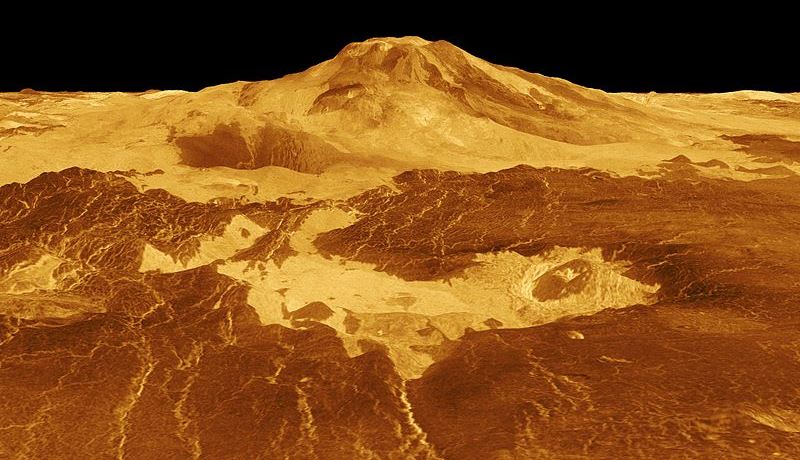 But of course, volcanoes are much more likely. Not only are they the a known source of SO2 (at least on Earth), the surface of Venus is also peppered with volcanoes and its surface is marked by extensive volcanic activity. Most of these are extinct, but evidence obtained over the past few decades have indicated that there may be some that are still active.
For example, back in the early 1980’s Pioneer Venus documented SO2 levels nearly 50 times higher than anyone expected, followed by a steady dramatic decline. Then in the early 1990’s, the Magellan spacecraft detected what appeared to be fresh lava. “It’s very similar to the one we’re observing now,” said Marcq.
Naturally, this sort of activity is one of the things that makes Venus such a rosy place to live! In addition to the runaway Greenhouse Effect that has turned its atmosphere into the carbon choked, acidic stuff of death, its surface is prone to recurring lava flows and hot magma. Naturally, it will be quite the feat to land a satellite on the surface to conduct research in the same way that we currently do Mars. And as for terraforming, which has also been proposed, that too will be quite the challenge!
 Stories by Williams
Why terraform Venus? You need to first get rid of all the excess heat before you get to terraforming it! Who has that money to spend?
Well since its the result of a runaway Greenhouse Effect, it could be undone by simply planting the right kind of carbon metabolizing bacteria in the atmosphere. That’s one idea anyway, and can be done from space.
they better be extemophiles, then.
I loved this. It was so imformative and interesting. Keep up the good work. I always know I can find wonderful things on your blog! Hugs, Barbara
Dang, I can’t stand praise Barbara. But please, don’t ever stop, or coming by to visit 😉