The Internet of Everything

PrintAll of my recent interesting in the concept known as the “internet of things” has been turning up some interesting results. And it’s not hard to see why really, given all the research, innovation and commercial applications dedicated to making it a reality. And yet, a surprising amount of people seem to be in the dark about what this term means.

Again, not surprising, as high-tech trends tend to be somewhat esoteric, understood by only a select few at first and gradually trickling its way into public consciousness. To break it down, the Internet of Things is a concept where the real world will come to resemble the internet, where digital markers and wireless internet will make reality incredibly accessible and connected.

The-Internet-Of-Things-Smart-WorldThink of it this way: you wake up in the morning and receive instant updates from all of your household devices. You’re fridge tells you how close your food is to its expiration dates, and your thermostat sets itself based on the weather, season, and your habits. On your way to work, you are able to access emails and memos from your office server, and when you’re driving home, you are able to tell the house to warm up and turn the lights on.

All day long, you are able to monitor all of your gadgets and devices because they are all “tagged”, feeding you information on their locations and anything else you need to know in real-time. If you lose something, it alerts you to this fact and tells you where to find it. And if you’re out and about without your vehicle, you can summon it and get it to find its way to you.

InternetOfThings_1024x1448That’s the general idea, creating a “smart world” through the use of networking technology. Now here are some videos too that demonstrate the concept in action. All are from Cisco, the networking IT giant located in San Jose (capitol of Silicon Valley) and are promotional videos, basically showing what the company’s vision is and how they intend to bring it about.

“Circle Story”:
This video, perhaps more than anything, demonstrates how the world of the near future will be interconnected. As the name would suggest, it follows a day in the life of regular folks as they start their day, go to their various jobs, do their shopping, and how the entire process is all part of the same dance. And of course, Cisco showcases how its technology is helping to make it happen.

Curiously though, the people do look kind of bored, don’t they? Subtle social commentary, or were they just being realistic? You decide!


Barcelona Embraces IoE to Create a Smart City:
In this promotional video, we see how the city of Barcelona, Spain is using the concept of the Internet of Everything (IoE) to address the ongoing challenge of urbanization and growth. By embracing the latest in smart technology, Barcelona is becoming a shining example of what Cisco refers to as a “smart city”, much to the company’s delight!

What this consists of is Barcelona connecting its citizens, remote sensors, and all devices contained within to a city-wide WiFi. This in turn is offering people new services, facilitating energy-efficient reforms, and establishing new economic opportunities for the city’s companies and partners, not playing to the city’s reputation for social interaction and connectivity. Check out this video for the details:


The Road to the Internet of Everything:
Last, but not least, is Cisco’s promotional video of what the Internet of Everything is really all about. Intrinsic to the IoE is the fact that by 2020, the physical and digital world will be connected by 50 billion devices and 1 trillion sensors. Meanwhile, billions of electronic embedded devices will transmit terabytes of data, communicating everything from health information to updates at the speed of light.

The result of all this, according to the video, will be an “electronic skin” built on the internet, one which will overlay the world’s existing surface and communicate everything across its vast, virtual space. As we know, this skin is already being laid, but what is still to come is going to be pretty impressive and game-changing. The bottom line being that those that are in the know will be able to reap the benefits more quickly.


You may think these videos are little more than corporate promotion of company services. But if the “internet revolution” has taught us anything, it’s that the current range of technological change is here to stay, and is only going to be getting more pronounced as time goes on. And when it comes to predicting how these things will shape the world of tomorrow, those deeply involved in the development process are certainly worth listening to!

After all, they are helping to build that world, and are doing so because we’re letting them. Best to know what’s coming if you want to know how it’s going to effect you, and if you want to have anything to say about it, right?
Powered by the Sun: Efficiency Records and Future Trends

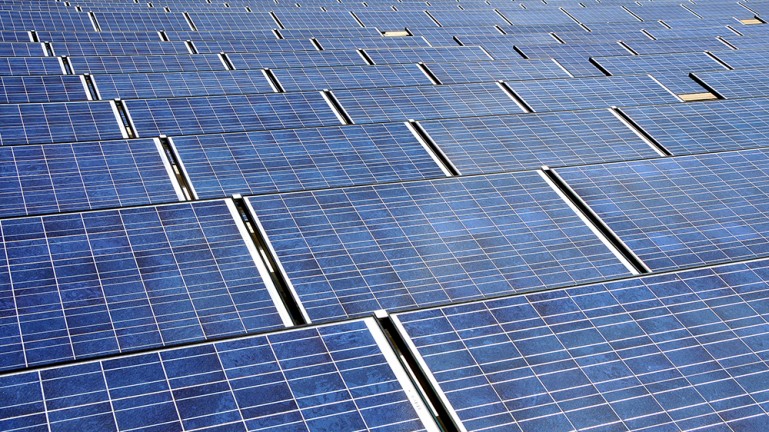
solar_panelThere have been many new developments in the field of solar technology lately, thanks to new waves of innovation and the ongoing drive to make the technology cheaper and more efficient. At the current rate of growth, solar power is predicted to become cheaper than natural gas by 2025. And with that, so many opportunities for clean energy and clean living will become available.

Though there are many contributing factors to this trend, much of the progress made of late is thanks to the discovery of graphene. This miracle material – which is ultra-thin, strong and light – has the ability to act as a super capacitor, battery, and an amazing superconductor. And its use in the manufacture of solar panels is leading to record breaking efficiency.

graphene-solarBack in 2012, researchers from the University of Florida reported a record efficiency of 8.6 percent for a prototype solar cell consisting of a wafer of silicon coated with a layer of graphene doped with trifluoromethanesulfonyl-amide (TFSA). And now, another team is claiming a new record efficiency of 15.6 percent for a graphene-based solar cell by ditching the silicon all together.

And while 15.6 efficiency might still lag behind certain designs of conventional solar cells (for instance, the Boeing Spectrolabs mass-production design of 2010 achieved upwards of 40 percent), this represents a exponential increase for graphene cells. The reason why it is favored in the production of cells is the fact that compared to silicon, it is far cheaper to produce.

solar_power2Despite the improvements made in manufacturing and installation, silicon is still expensive to process into cells. This new prototype, created by researchers from the Group of Photovoltaic and Optoelectronic Devices (DFO) – located at Spain’s Universitat Jaume I Castelló and the University of Oxford – uses a combination of titanium oxide and graphene as a charge collector and perovskite to absorb sunlight.

As well as the impressive solar efficiency, the team says the device is manufactured at low temperatures, with the several layers that go into making it being processed at under 150° C (302° F) using a solution-based deposition technique. This not only means lower potential production costs, but also makes it possible for the technology to be used on flexible plastics.

twin-creeks-hyperion-wafer-ii-flexibleWhat this means is a drop in costs all around, from production to installation, and the means to adapt the panel design to more surfaces. And considering the rate at which efficiency is being increased, it would not be rash to anticipate a range of graphene-based solar panels hitting the market in the near future – ones that can give conventional cells a run for their money!

However, another major stumbling block with solar power is weather, since it requires clear skies to be effective. For some time, the idea of getting the arrays into space has been proposed as a solution, which may finally be possible thanks to recent drops in the associated costs. In most cases, this consists or orbital arrays, but as noted late last year, there are more ambitious plans as well.

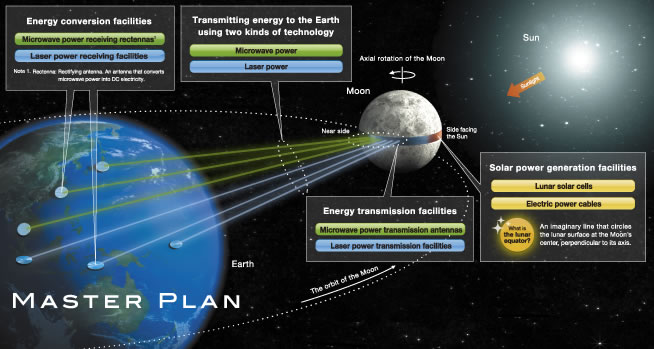
lunaring-3Take the Japanese company Shimizu and it’s proposed “Luna Ring” as an example. As noted earlier this month, Shimizu has proposed creating a solar array some 400 km (250 miles) wide and 11,000 km (6,800 miles) long that would beam solar energy directly to Earth. Being located on the Moon and wrapped around its entirety, this array would be able to take advantage of perennial exposure to sunlight.

Cables underneath the ring would gather power and transfer it to stations that facing Earth, which would then beam the energy our way using microwaves and lasers. Shimizu believes the scheme, which it showed off at a recent exhibition in Japan, would virtually solve our energy crisis, so we never have to think about fossil fuels again.

lunaring-2They predict that the entire array could be built and operational by 2035. Is that too soon to hope for planetary energy independence? And given the progress being made by companies like SpaceX and NASA in bringing the costs of getting into space down, and the way the Moon is factoring into multiple space agencies plans for the coming decades, I would anticipate that such a project is truly feasible, if still speculative.

Combined with increases being made in the fields of wind turbines, tidal harnesses, and other renewable energy sources – i.e. geothermal and piezoelectric – the future of clean energy, clear skies and clean living can’t get here soon enough! And be sure to check out this video of the Luna Ring, courtesy of the Shimizu corporation:


Sources:
gizmodo.com, fastcoexist.com

The Future of Flight: Morphing Wings

morphing-wingsSince the Wright Brothers developed the world’s first airplane, scientists and aerospace engineers have understood how important airflaps and wing design are to ensuring that a plane is able to achieve lift and land safely. During and after World War II, additional lessons were learned, where the sweep of a wing was found to be central to a plane achieving higher service ceilings and air speed velocities.

Since that time, many notable improvements have been made, but some strictures have remained the same. For example, conventional wings suffer from the problem of being fixed in a single position, which makes some aspects of performance possible but other things extremely difficult. In addition, flaps have remained virtually unchanged over the years, relying on hinged joints that are limited and vulnerable.

flexfoilIn both cases, the answer may lie in flexible and seamless materials, leading to wings that can change shape as needed. Such technology could not only enable better performance, but remove the need for hinges and gears. Towards this end, Michigan-based FlexSys has developed a way to optimize wing aerodynamics with FlexFoil, a seamless variable geometry airfoil system.

In development since 2001, FlexFoil is made from what is described only as “aerospace materials,” and is seamlessly integrated into the trailing edge of the wing. Based on a technology known as “distributed compliance,” the morphing structure integrates actuators and sensors that, according to Flexsys, results in “large deformations in shape morphing with very small strains.”

flexfoil1According to a 2006 paper co-written by mechanical engineer Dr. Sridhar Kota (the FlexFoil’s inventor), the foils are:

optimized to resist deflection under significant external aerodynamic loading and are just as stiff and strong as a conventional flap.

What this translates to in real terms is a tolerance of over 4500 kg (10,000 lbs) in air loads and the ability to distribute pressure more evenly throughout the wing, resulting in less strain in any one area. It is also said to reduce wind noise by up to 40 percent on landing, and to lessen build-up of both ice and debris. But the biggest benefit comes in terms of fuel economy.

flexfoil2When retrofitted onto a wing, FlexFoil can reduce fuel consumption by a claimed 4 to 8 percent, with that number climbing to 12 percent for those wings that are built are the system. What’s more, the technology could be applied to anything that moves relative to a fluid medium, including things like helicopter rotor blades, wind turbine blades, boat rudders, or pump impellers.

FlexFoil was officially introduced to the public this week at the AIAA (American Institute of Aeronautics and Astronautics) SciTech exposition in Washington, DC. Plans call for flight tests to be performed this July at NASA’s Dryden Flight Research Center, where the flaps of a Gulfstream business jet will be replaced with the foils.

Check out this video of the airwing design and what it does here:

morphing-wings1To be fair, this is not the only case of flexible, morphing aircraft in development right now. In fact, NASA has been looking to create a morphing aircraft concept ever since 2001. So far, this has included collaborating with Boeing and the U.S. Air Force to create the Active Aeroelastic Wing (AAW) which was fitted to the F/A-18 Hornet, a multirole combat jet in use with the USAF.

But looking long-term, NASA hopes to create a design for a morphing airplane (pictured above). Known as the 21st Century Aerospace Vehicle, and sometimes nicknamed the Morphing Airplane, the concept includes a variety of smart technologies that could enable inflight configuration changes for optimum flight characteristics, and is an example of biomimetic technology.

morphing-wings2In this case, the biological design being mimicked is that of a bird. Through the use of smart materials that are flexible and can change their shape on command, the 21st Century Aerospace Vehicle is able to shape its wings by extending the tips out and slightly upward to give it optimal lift capability. In this configuration, the inspiration for the aircraft’s wings is most clear (pictured above).

But once airborne, the aircraft needs a wing that is capable of producing less wind resistance while still maintaining lift. This is why the wings, upon reaching and service ceilings in excess of 3000 meters (10,000 feet), the wings then contract inward and sweep back to minimize drag and increase airspeed velocity.
Though this program has yet to bear fruit, it is an exciting proposal, and provides a glimpse of the future.

Be sure to check out NASA’s video of the CAV too, and keep your eyes on the skies. Chances are, jets that utilize smart, morphing surfaces are going to be there soon!


Sources:
gizmag.com
, flexsys.com, nasa.gov

The Walking Dead – Season 4.5 Trailer

the-walking-dead-season-4-posterThe Walking Dead returns this February 9th. And of course, after what happened with the mid season finale, fans are eagerly anticipating what’s coming. And so am I, now that things are back on track and the show is closely mirroring what went on in the original comic. In fact, the caption “Don’t Look Back” is a reference to the last line from Volume 8: Made To Suffer, which was also the last line of the last episode.

Of course, this line has a double meaning, referring to how Rick and Carl needed to abandon the prison with all speed. It’s also a reference to how the two will have to put their grief behind them if they are going to survive in the wilderness now. The other survivors – Daryl Dixon, Tyreese, Michonne, Glenn, Maggie, and the rest – were separated from them, and are facing similar challenges.

Rick_Grimes_Carl_Grimes_-_The_Walking_DeadThis is of course how season 4.5 will open, with the two groups looking for food, shelter and safety. And I anticipate they will meet up with a few people from the Governor’s camp, as some attention was dedicated to how his one-time companions made it out in one piece – such as Tara, and perhaps her sister Lilly. We’ll see how that plays out.

And if I were to make some predictions – based on what they’ve done with the show and from the comics – I think they will find their way back to Morgan, and this time around he will join them. It’s also obvious that the two camps will eventually reunite, but I anticipate that will take several episodes. We all know how they just love to drag things out on the show, don’t we?

For the season finale, I anticipate they will find their way back to Hershel’s farm, and that it will end with the addition of some new characters and a new hope which will put them back on the road again. Can’t be more specific, as that would involve major spoilers! In the meantime, enjoy the new trailer. Hopefully, it will tide us over until next week!