Episode 54 – The History of SETI: A Conversation with Dr. Rebecca Charbonneau – is now Live!

Episode 54 – The History of SETI: A Conversation with Dr. Rebecca Charbonneau – is now Live!

This week, I sat down with Dr. Rebecca Charbonneau, a science historian and a Karl Jansky Fellow at the National Radio Astronomy Observatory (NRAO). We talked about the history of the Search for Extraterrestrial Intelligence (SETI), the significance of Project Ozma, the Arecibo Message, and the enduring legacy of the late Dr. Frank Drake – the creator of the Drake Equation and someone Dr. Charbonneau knew personally!

As a historian of science (a rare but awesome thing!), Charbonneau is in a rare position to appreciate how the field of SETI has evolved and how it has impacted (and reflected) our history. Have a listen as we talk about what the history of SETI has meant for our species so far and how the future of this field could revolutionize our existence!

Where to Listen:

Episode 53 – The Drake Equation – is now Live!

Episode 53 – The Drake Equation – is now Live!

For this week’s episode, I addressed one of the most important and well-known theories in the Search for Extraterrestrial Intelligence (SETI). It’s known as the Drake Equation, a thought experiment proposed by famed astronomer and SETI researcher Dr. Frank Drake. Drake presented this equation during the first SETI meeting in 1961, held at the Green Bank Observatory in West Virginia and attended by some of the most influential scientists of the day (including Carl Sagan). As Drake later said about his famous equation:

“As I planned the meeting, I realized a few day[s] ahead of time we needed an agenda. And so I wrote down all the things you needed to know to predict how hard it’s going to be to detect extraterrestrial life. And looking at them it became pretty evident that if you multiplied all these together, you got a number, N, which is the number of detectable civilizations in our galaxy.”

The equation basically states that the number of intelligent species we can communicate within our galaxy (N) can be determined by multiplying the average rate of star formation in our galaxy (R*) by the number of stars that have planetary systems (fp), the number of planets that are habitable (ne), the fraction of habitable planets where life will emerge (fl), the fraction of those where intelligent life will emerge (fi), the fraction of those that will develop transmission technologies that are detectable from space (fc), and the average longevity of civilizations (L).

To this day, the equation remains foundational to SETI and is comparable only to the Fermi Paradox and the Kardashev Scale. Dr. Frank Drake passed away on September 2nd, 2022, at the age of 92. He is one of many luminaries to pass on in recent years, like Stephen Hawking (2018) and Freeman Dyson (2020), and he will be missed!

Where to Listen:

Episode 52 – Going Interstellar: Generation Ships! – is now Live!

Episode 52 – Going Interstellar: Generation Ships! – is now Live!

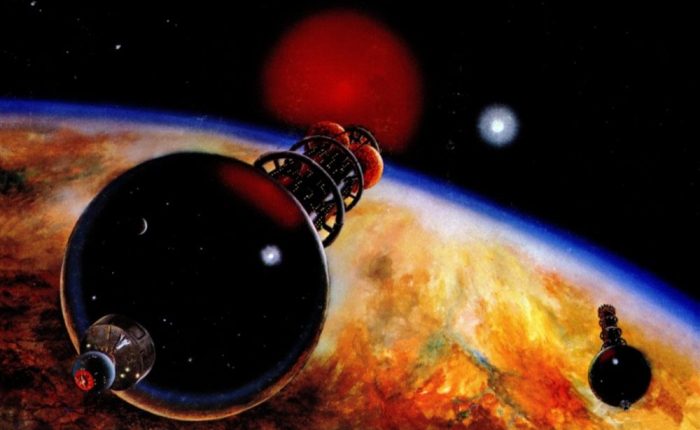
This week’s episode focuses on a time-honored proposal for interstellar travel. Known as a Generation Ship (or Interstellar Ark, Arkship, etc.), the concept envisions a massive starship that can accommodate multiple generations of crews as they travel to nearby stars. The basic philosophy is that if you can’t go fast enough to get there within a single lifetime, then pack for the long haul! But of course, there are lots of considerations that need to be addressed in advance.

A lot can happen on a multi-generational interstellar voyage, which is why Generation Ships are a wonderful setting for science fiction stories! These include Robert A. Heinlein’s Orphans of the Sky, Poul Anderson’s Tau Zero, Arthur C. Clarke’s Rendezvous with Rama, Ursula K. LeGuin’s Paradises Lost, Kim Stanley’s Robinson’s Aurora, and something I’m currently working on (titled Traverse). Check out the episode below…

Where to Listen:

Episode 51 – The Relativity Revolution: The Life and Times of Albert Einstein – Part II – is now live!

Episode 51 – The Relativity Revolution: The Life and Times of Albert Einstein – Part II – is now live!

In Part I, we looked at the early life and education of Einstein and the steps that would eventually lead him to his groundbreaking theory of Relativity. In this second installment, we examine the implications of his theories, his later contributions to the sciences, and the years he spent in exile due to the rise of Nazi Germany. And, of course, there’s his enduring legacy, which includes theories like Dark Matter, Dark Energy, and the most predominantly accepted cosmological model that is still in use to this day.

Here’s where you can check it out…

Where to Listen: