5 – Download

5 – Download

It all came flooding back in an instant. The time it took to assimilate it lasted a little while longer. Once Dube fully returned to his senses, the chronometer in his visual field told him that only a few seconds had passed. But of course, time was consistent that way, always so subjective. The effects of time dilation, which naturally came with travelling at relativistic speeds, were routine compared to the mind’s grasp on reality.

The other Engineers sighed lowly as the memories finished forming the necessary synaptic connections. All the specialized training Jonas kept as part of the C0S Package became memories as real as any other they carried in their minds. Except, of course, for combat training, which the Engineers had elected to hold onto for keeps.

When Dube closed his eyes, he could almost see the training becoming part of him again. The ship’s layout, which had previously been a careful interweaving of smart and dumb matter, suddenly became a strategic grid.

He could see sightlines, angles of approach, and what sections and compartments a stowaway would have from the cargo bay. He was also aware of all possible targets a stowaway might have in mind, the approach vector they would use, and the escape routes available to them. To Dube, it was like having a window into all possible avenues, outcomes, and options the intruder had.

Then again, that was the point. They knew before they set off that they had to be prepared for anything. When it came to the possibility of an unwanted guest on the ship, they were now. There remained only one thing to do…

“Shall we adjourn to the armory?”

“Forthwith.”

The room’s system sensed their approach. The door dissolved into a cascade of nanoparticles that retreated into the surrounding walls. Inside, the room illuminated itself, revealing an austere chamber with only a series of plinths evenly spaced across the walls. Like a coordinated ballet, each of the nine Engineers stepped onto one and stood at attention.

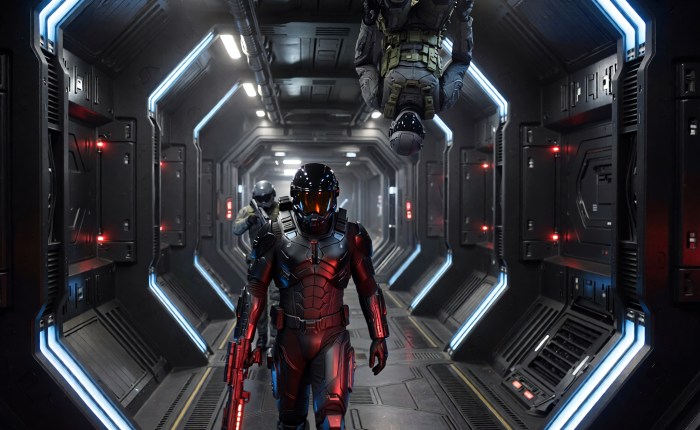
It wasn’t necessary to remain perfectly still; the nanoware would adapt. But every person in the room maintained an erect posture, arms at their sides, fingers spread. Within seconds, they were enveloped by a second skin that forged itself into an integrated suit of armor and weaponry.

Only one part of the transition felt awkward, the part where the nanoware reached up to his neck to cover his face. As always, Dube closed his eyes and held his breath for this part. It was only when he felt the nanoware form a pliable membrane over his entire head that he opened his eyes and resumed normal breathing.

He felt a slight touch of vertigo from all the data that was passing in front of his eyes. There was also a mild euphoria caused by the uploading of data into his neural loom. Both passed quickly once the suit had finished the integration process, shaking hands with his physiology, neurology, and assorted implants.

The sensation of something forming in his arms instinctively caused Due to look down. Where an empty space had previously been, a weapons package had formed that was deemed appropriate for the mission profile. A Cycling Stunner, something that would allow him to strike the target with varying electromagnetic pulses. While the weapon formed, Dube’s suit also linked to the Transverse’s internal systems to ensure that every surface in his vicinity was ready to adjust instantly to changes in the weapons’ EM frequency.

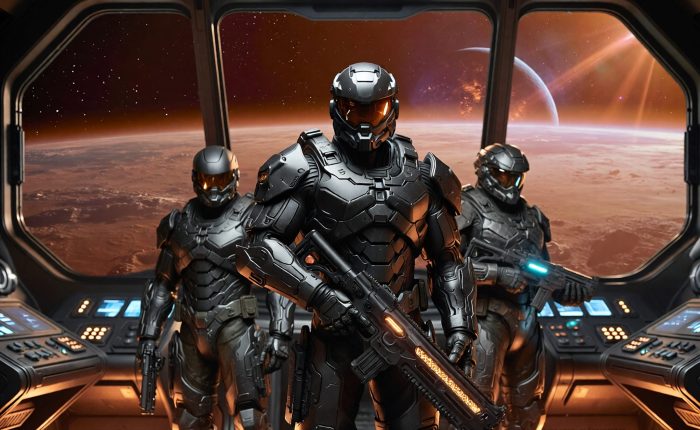
Dube turned to look at his colleagues once the suit and weaponry were fully formed. Every one of them was now covered in a second skin of self-configuring and self-replicating hardware. While each was different in terms of design and appearance, this was largely for aesthetic purposes. For the most part, each of them was as equipped as well as the next.

The armaments they selected were less diverse. Like Dube, some of the other Engineers were carrying sleek and ergonomic stunners. Others were carrying more traditional-looking plasma casters, and the rest had compact ballistic guns. Between these three selections, they had all the necessary weapons to disable their intruder’s defenses, deplete them piecemeal, and inflict significant physical trauma – should the need arise.

The goal was to subdue them, of course. Even though they were all far from the home they had left behind, it was paramount that they question the stowaway. As per the parameters of a C0S, they needed to know who they represented. The Transverse Project had many rivals, but no enemies that they knew of. Clearly, someone back home knew something they didn’t. And of course, they needed to know how the hell they managed to get aboard in the first place.

The dazzling array of weaponry they carried was just in case their intruder refused to come quietly. Dube voked to the other Engineers to check on their status. His suit linked with theirs, and all relevant data was shared between them.

[Everyone independently integrated? Excellent. Synchronize into fire teams, then we go.]

Dube felt the replies of all eight of his fellow Engineers. At the moment, they were following his lead, a privilege reserved for those who were on shift. As per his instructions, their group formed into three fire teams, each one synchronizing closely with its own members. These were connected to the two other groups, with Dube’s designated as fire team Alpha, and Beta and Charlie forming support teams.

The nine of them were now more connected to each other than ever before. That was as deliberate as it was necessary. Until they secured the ship, they needed to be as integrated with each other as they were with their own equipment. But of course, this needed to be tempered by group dynamics, where the whole was broken down into moving parts that could complement and assist one another.

The process was complete.

Everything was in the green.

It was time to go.

[Let’s move!] Dube ordered. His own words echoed in the shared sensorium of their minds. The replies he received echoed louder. Eight voices in his head were more powerful than one, after all.

From their departure point at the end of the habitation section, Dube and Alpha team picked up the path of their intruder – the one Jonas deemed the most probably. Beta and Charlie split off, the former following the next most probable one while the latter secured the location where the intruder had spent the past few years.

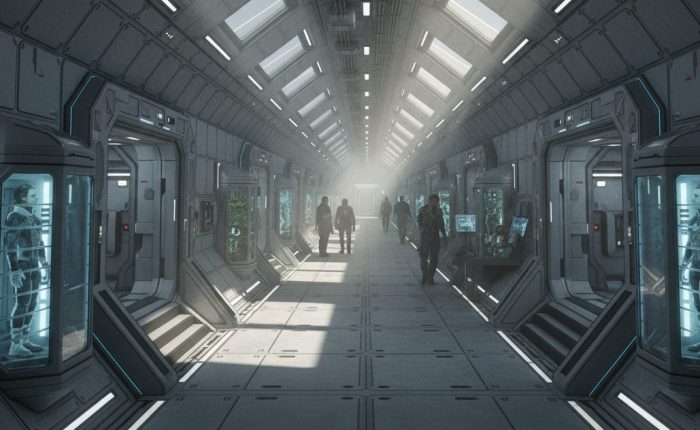
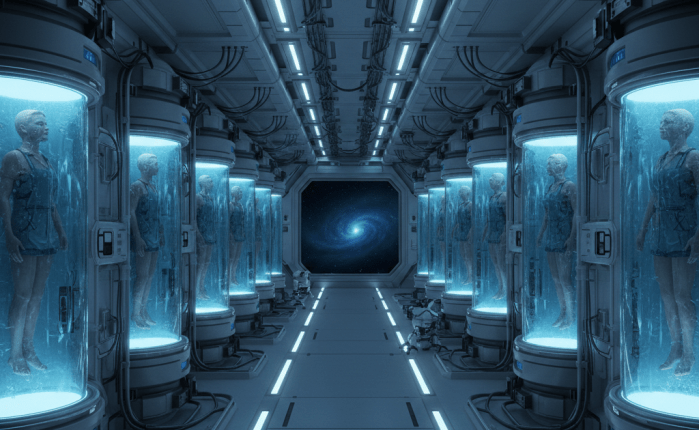
Their movements were fluid and fast, from the cargo bays to the storage bays, to the entrance to the cryobays. Not a moment was spared as they continued along the path of their quarry, even as they communicated with each other and Jonas. When the doors between sections opened, Dube and the other members of Alpha team were hit by a gust of cold air. Their second skins registered the sudden drop in temperature, and they could even see flecks of snow crystals floating on the wind.

[Pressure is equalized between sections, we’d better move,] said Vorhees.

[Confirmed.]

[The intruder has a 45% chance of sabotaging one or more cryogenic units. The purpose of which is to interfere with our settlement efforts.]

[Confirmed.]  Dube impatiently replied. He really didn’t need to be reminded. Thanks to the download, he recalled everything he needed to know about how things could go sideways. Still, he and the team were sure to check all the cryopods they passed. There was no time to waste. A quick scan of their vitals and bio readings, all summarized in a small display window in each pod’s glass cover. Everyone they saw was in the green. As the three of them proceeded, they got word from Charlie team.

[Our guest was definitely in here while the rest of us were sleeping,] said Vorhees. [It looks like they sealed the pod and the wall back up after they got out.]

[How did they do that without setting off any alarms?]

In an instant, Dube was able to see through Vorhees’s eyes and those of his team. All the data they had accumulated from their scans was pressed into his mind. It was all clear. The intruder used a divider to create a seam in the wall from the inside. Once they were out, they simply removed it, and the opening sealed shut behind them.

As far as the ship’s systems were concerned (and by extension, Jonas), a section of the wall had voluntarily receded and returned to its previous configuration. An event like that would barely register if Jonas’ ToC had been set to one.

Worse than that was the timing. The stowaway had extricated themselves from their hiding place just in time to elude capture. This meant they were no longer eluding detection. Jonas’s inspection of the ship’s power systems must have triggered some kind of alarm in their pod, or perhaps the fact that the Engineers had issued an internal alert to the crew. If the stowaway were tapped into the system in ways that went beyond siphoning power, this might have alerted them as well.

Dube reached out to Jonas to share this new information. Jonas came back with updated projections.

[The intruder displays an impressive level of preparedness. We now estimate that he has a sixty-five percent chance of sabotaging one of the ship’s main power relays].

[To what end?] Dube asked.

[Depending on the intruder’s exact location, there are a number of possibilities]

[List them in order of probability, cross-referenced with severity] Dube ordered. Jonas took a second to run the two parameters against each other and began listing his results.

[We estimate that if the intruder is still localized in the Cryogenic Bay area, there is a seventy percent possibility that they intend to interrupt power to multiple cryounits. However, if the intruder is currently moving to the Engine Section, there’s a 100% chance they intend to interrupt power to an engine component. The most likely target would be one of the magnetic stasis chambers on one of the main thrusters.]

Dube didn’t need to know what the outcome of that would be. Each engine was an assemblage of parts that needed to run in perfect synchronicity; otherwise, the engine would cease to function. Jonas would need to shut down the entire engine section to ensure they did not veer dangerously off-course.

However, this seemed like a rather limited strategy. The net result would be that the mission was delayed. No, the plan had to be something bigger, something more ambitious. That’s what Dube’s sense of paranoid self-preservation was telling him, something that Jonas could only appreciate on an abstract level.

[Assume the intruder intends to do more harm. What then?]

Jonas recomputed and almost instantly offered an alternate scenario. [We anticipate another possibility whereby the intruder will attempt to access the Foundries. Based on specified criteria, and assuming they can obtain access to a Foundry unit, we anticipate an eighty-five percent probability that they will attempt to manufacture an explosive device that could cause a breach between the reaction mass and the stasis chambers.]

Dube froze for just a second. If their stowaway managed to get access to the Foundries and could convince the industrial fabricators in that section that he was part of the crew, they could easily assemble an explosive device powerful enough to do serious harm. Assuming such a device were placed in the right way, the stowaway could create a breach between the ship’s supply of matter and antimatter.

[The effect would trigger a cascade reaction large enough to destroy the Transverse.]

[I know!] Dube responded. It was a gamble either way. Assume the intruder meant to destroy the ship, and he would risk crippling a vital system or killing some of the crew. Assume they meant to commit either of these smaller acts of sabotage, and he risked losing the ship. Considering the consequences influenced the odds, but the odds were their best bet at finding their stowaway in time.

[Alpha and Beta teams, converge on the Foundries, immediately,] ordered Dube. [We need to assume their intent is to inflict the maximum amount of harm. Lethal force is authorized.]

4 – Intrusion

4 – Intrusion

Dube looked to those who had joined him on the Bridge. After conferring with Jonas ahead of their arrival, he had several items prepared. As the first Engineer to be apprised of the situation, the responsibility of summoning and briefing the others in his rotation – as well as offering some preliminary recommendations – naturally fell to him.

As for waking up the others, that responsibility fell to the three of them. But only after Dube did his due diligence and convinced them it was necessary.

Between the three of them, the Bridge’s main control podium resided. It was already activated and broadcasting a holographic of the ship’s interior, focused on the subsection of the cargo bay in question. Important features of were labelled, including the rows of cubbyholes, storerooms, nanofabricator units, and other hardware that were visible in the image.

The main attraction was the glowing artery that ran through the area, branching out into many different tendrils that glowed with different intensity. This indicated the local power conduit and all the feed lines extending from it to different ports in the bay. The power drop, and where Jonas had traced it to, was enclosed in box-like brackets and appropriately labelled.

Anomaly.

Since time was a factor, Dube didn’t bother conveying anything verbally.

[Thank you all for coming. It appears that we may have a situation below decks. It concerns the small power anomaly I notified you all about. What I did not mention was the likely possibility that it is not natural in origin. Because of this, I am recommending that we designate this situation as a C0S scenario and take appropriate measures.]

His colleagues reacted predictably. Vorhees thoughts reached him first, followed shortly thereafter by Chen’s.

[You are suggesting that this is power anomaly is being caused by a stowaway?]

[Why didn’t Jonas warn us about an unregistered passenger?]

Dube quickly replied to the former question in the strongly affirmative. Jonas chose to field the latter one.

[There are no indications of any unregistered passengers aboard the Transverse at this time. I have run multiple biometric, thermal, and electromagnetic scans of that area. They have indicated no signs of life in that subsection of the ship.]

[Then why do you suspect that we have a stowaway?]

The question was directed at the ship’s AI, but Dube jumped in, it being his theory and all.

[Jonas ran a probability assessment. At first glance, there was nothing there to report beyond a simple and minor anomaly. However, he confirmed that it was a possibility that someone might have deliberately tampered with the power systems in that subsection for the sake of siphoning power.]

[So there’s no supporting evidence for this theory, then?] asked Chen. Dube looked at him as he voked back.

[Only one thing, and it is admittedly circumstantial.]

Dube gestured at the holographic representation between them, which caused it to zoom in on the room, emphasizing a bulkhead. The illuminated stream that indicated the flow of power now showed small, vein-like channels that extended to a point leading them into the wall.

Vorhees emitted a low whistle of surprise.

[That is odd. The power supply snakes into that wall, but there is nothing inside that would warrant it. And it’s a physical hookup at that.]

[So, something is inside there] added Chen. [Something which is drawing power but not showing up on the ship’s scanners.]

[Correct,] Dube replied. [Coupled with the lack of life signs, I believe this could be a possible indication that our potential stowaway is equipped with advanced masking technology. Which is why I advise we treat this as a C0S scenario and investigate further to confirm or deny my hypothesis.]

The other engineers paused for a second to consider. Chen quickly decided it was not enough and shared this appraisal.

[You’re right, this iscircumstantial. For all we know, this is a manufacturing defect, or an error with the configuration of the nanomaterials in that section. Jonas, when was the last time you ran a check on the structural programming in the bay?]

[Those checks are conducted in accordance with my routine maintenance schedule, Engineer.]

Jonas read of the date of the last time it had checked the ship to make sure every micron of the programmable matter it was made from was functioning properly.

[The results of these and all previous scans indicated no sign of errors. I should also note that since you raised the possibility, I have performed an unscheduled diagnostic check on the ship. In anticipation of your next suggestion, I also ran one of my own programming as well.]

Jonas conveyed all this without the slightest hint of flippancy or condescension, even though Dube (and others, from the looks on their faces) thought Chen deserved it. Jonas was not programmed with a range of emotions. Still, one simply did not suggest to a Level 3 sentience that they had committed a trivial oversight. Not unless they were looking to be embarrassed.

The look on Chen’s face suggested he had absorbed the lesson like a champ. Rather than let him languish in his chagrin, Dube inquired further.

[Jonas, if you’ll indulge me. Is the power drain comparable or close to the power needed to operate a single cryo unit?]

Jonas was quick to reply. [Confirmed. The power level is commensurate with a cryogenic unit in standby mode.] There was a miniscule delay as Jonas investigated Dube’s theory further.

[Ship’s logs indicate that the power consumption was greater during the acceleration phase.]

Once again, Jonas spouted dates at them that indicated the higher power drain was happening the entire time the Engineers and crew were all in cryosleep.

[Let me guess] Chen voked. [At that time, it was enough to power a cryounit running at full capacity?]

[Confirmed] Jonas replied with a detectable trace of finality.

The atmosphere of the room changed sharply. Circumstantial or not, they all understood the Jonas had tacitly confirmed that they had a stowaway, one who was currently awake and moving about the ship. They also knew that they could not track this person.

In the time it had taken to communicate thoughts back and forth, really no more than the space of a few heartbeats, they had gone from theories concerning a power anomaly to knowing lives could be in danger.

[Jonas, prepare all relevant extractions for Contingency C0S] instructed Dube.

[Acknowledged. I will alert you when they are ready for assimilation. I should not be more than one minute.]

The Engineers stood there and waited anxiously. In sixty seconds or less, Jonas would be ready to upload all the training they had undergone back at Sol for this particular situation. Entire petabytes of memories, converted into billions of qbits, would be streaming into their minds again, letting them remember that they had prepared for just this eventuality. But before that could happen, there was the small matter of protocol that needed to be followed.

Dube chose to verbalize this instead of transmitting it directly.

“We’ll need to inform the other Engineers,” he said, his voice a croaky whisper.

“We should probably open the munitions locker,” added Vorhees. “This stowaway sounds like they could be dangerous.”

3 – Vigilance

3 – Vigilance

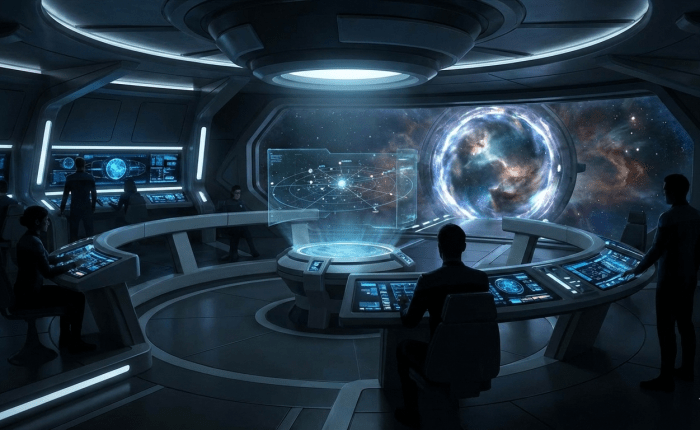
The central dais brightened as soon as Dube stepped into the room. As he approached, it rose slightly to greet him, rising further as his feet were firmly planted in the center. Other terminals and posts were already lit up and their attendants turned to greet Dube. And when he placed his hands out before him, an interface materialized in front of them.

He signalled to the ship’s AI that he was ready to assume his role as the Transverse’s temporary Custodian.

[Alright, Jonas. Show me the stars.]

The bulkhead directly in front of him, a concave feature that occupied much of the Bridge’s front section, went from opaque to transparent. Dube was immediately struck by the intense glow of the starfield, its countless pinpricks of light ranging from soft to piercing. In terms of color, they ranged from yellow and green to various shades of blue. This did not represent their true colors, but the way their light was being blueshifted.

Such was the effect of moving at relativistic speed. Checking their velocity, Dube was informed that they were travelling at 15% the speed of light, a consistent 0.15 c. At this velocity, they were moving faster than any crewed vehicle in human history. As they flew, the light coming from distant stars continued to meet them at a constant rate of c. To accommodate this quirk of nature, the wavelength was shortened, to the point that all light was shifted towards the blue end of the spectrum.

Switching to the rear view, Dube saw the opposite effect with the stars that were receding from them. The light from these reached the ship at the same velocity and time as the oncoming light, but its wavelength was shifted towards the red end of the spectrum. The situation would remain unchanged until the Transverse ceased its acceleration burn and settled into its cruise phase. And in generations, when they commenced their deceleration burn, the situation would be reversed.

Just one of the consequences of living in a relativistic Universe. Another, as indicated by the nature of their vessel, was the immense amount of energy and vast stretches of time it took to travel from one star to the next.

The inspired thought led Dube to call up an overlay and request permission to access the ship’s systems. His Engineer status was immediately accepted, and a range of options appeared before him. He quickly navigated through the menus to select Power and Propulsion, then checked on three interconnected things simultaneously.

Singularity Drive
Reaction Chambers
Main Thrusters

As he hoped, all three systems were in the green. At the ship’s core, a tiny, controlled singularity – no larger than a micron in diameter – caused material periodically injected into its chamber to swirl around it, eventually reaching close to the speed of light. Eventually, the material would fall onto the face of the singularity and be stripped down into its subatomic constituents. Immense energy was released in the process, which the reactor’s receptors happily absorbed.

Meanwhile, the Transverse’ Chambers were cool and calm. The smashing of protons and anti-protons in a carefully controlled process known as matter-antimatter annihilations had ceased with their last acceleration. And the thrusters were quiet, as their were no subatomic particles to accelerate to relativistic speeds.

Dube tried, but a quick check on the other ship systems and subsystems showed no indication of any malfunctions or problems. There were a few issues that were bracketed to one side of the display window. These were those that emerged since last shift and been resolved. Dube noted the work signature of his peers, Engineers Ahika Chen and ShankarVorhees – both of whom had been up for a few minutes longer than he.

At last, he had confirmation. There were absolutely no issues on the ship that required the attention of an Engineer. No distractions and no means for stalling.

Sighing, Dube called out to the ship’s Custodian again.

[Okay, Jonas. I’m here. Let’s have those updates.]

Jonas obliged, sounding almost happy to be summoned.

[Excellent. There are many reports and status updates for your perusal. Shall I share them in chronological order?]

[No. Parse all for anything considered vital, and collate them, starting with the most-recent updates, then provide synthesis from all previous updates.]

Jonas complied. Within seconds, Dube’s mind was filled with new data on the status of the Transverse and all that had happened since he had gone to sleep. As always, Jonas considered some matters to vital that Dube did not, nor any sensible engineer for that matter. For safety’s sake, Jonas’ threshold of concern – ToC, as the Engineers knew it – was deliberately set to high to make sure no small things slipped through the net and became a big thing later. But that meant that seemingly trivial things might slip through in the meantime.

Dube was on the verge of concluding that everything on the list was trivial, until he came to one particular item.

[Stop. What’s this about a power drop in this subsection?]

Jonas summoned a schematic of the ship and enlarged it in his visual field. The image zoomed in on the section in question, highlighted in yellow. The drop was unsubstantial, but not so meagre as to have gone unnoticed.

[Cause?]

[Unknown at this time.]

[Speculate]

Jonas quickly ran through the various possibilities, based on probability and level of concern. It was good that the ship’s Custodian considered a malfunction with its internal sensors (or worse, itself) to be the least likely or worrisome. Dube, personally, would have thought those warranted the most concern.

His attention became fixated on one possibility the moment Jonas mentioned it.

[A siphon? Someone could be siphoning power in that section?]

[Initial assessment indicates a probability of twenty-to-one. Comparatively, the probability of this being the result of a fault in the conduit are one point seven-to-one.]

Dube sighed and felt like chastising Jonas for making him anxious. Jonas wasn’t finished, though. [However, the probability of a power siphon changes considerably when adjusted for axiomatic non-exclusivity.]

Dube huffed. [Meaning?]

[Meaning they may be related. If a structural fault in the conduit was the result of tampering, hypothetically for the sake of syphoning power, then the probability becomes point-zero-six-three to one.]

Dube paused to consider that. A sixty-three percent chance that someone was tampering with the power conduits? Those were hardly comforting odds. The only question was why they were seeing this now.

[What purpose would a siphon in this subsection have?]

[Unknown.]

Dube was on the verge of telling Jonas to speculate once more but stopped himself. Asking for theories at this point was a waste of time, especially when he had his own thoughts on the matter and didn’t want to hear them repeated back to him.

This was something that warranted more eyes and thoughts, he felt.

[Jonas, where are Engineers Chen and Vorhees?]  Jonas replied that both were taking their restoratives in the Arboretum. [Alert them, quietly. Tell them to meet me at Steering. I believe we may have a Sigma-class Contingency on our hands.]

2 – Worldship

2 – Worldship

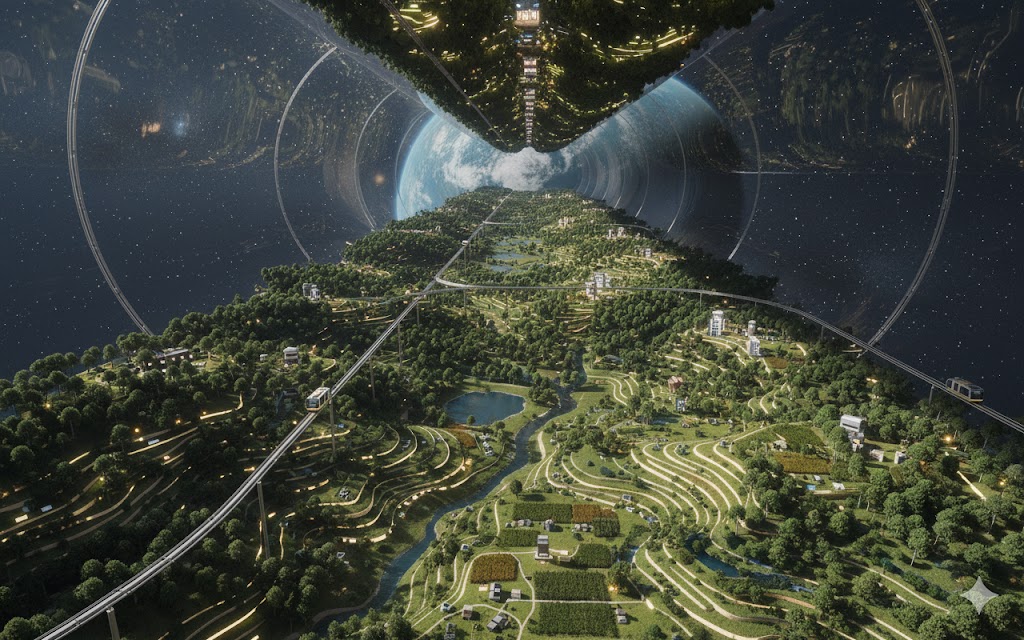
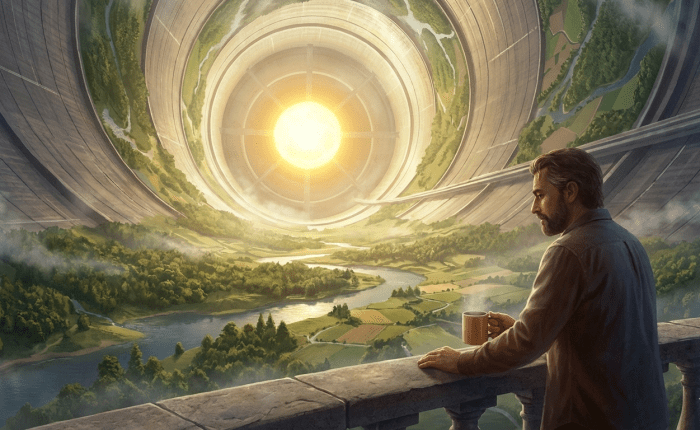
Light poured in through apertures in the hull. The many photons they admitted were focused by the ship’s interior lenses and directed towards the center. Where they met, a bright apparition hovered in midair, visible to everyone on the curved ground below. This “Sun,” which they had brought with them through the miracle of engineering, painted the landscape below in a warm light, drawing attention to every tree, structure, and ripple in the water.

It was appropriate and soothing for someone who had just arisen from cryosleep. Placing his cup down on the parapet, Dube took a deep breath and drew in the morning air. The landscape was quite accommodating, generating dew that formed on the grass and leaves. When the morning light came and turned it into water vapor, the result was fragrant ozone. Were it not for the vertically-sloping skyline, it would have looked, smelled, and felt like home.

Dube got a strange flash of recollection. He remembered standing somewhere, feeling the sights, sounds and smells of home. But he also recalled that there was a voice telling him that it wasn’t home, not anymore. The rest was darkness…

It was like something out of a bad dream that he could only remember in the vaguest sense. Dube knew that such recollections were natural after waking from cryosleep. The dreams one had, especially as they were coming out of dormancy, were known for being vivid. But as time went on, they became foggier and harder to retrieve.

If that were true, the indeterminate recollection was meaningless.

Then again, there was the extraction process that he and the other Engineers had undergone. So many memories from their training sessions had been removed afterward and put in storage, only to be reloaded when a specific Contingency occurred. A common side effect of the process, they had been forewarned, was vague recollections and moments of déjà vu.

If that were true, then Dube was sensing something from a training session, something that he elected to forget. He didn’t see how scenes from home and discussing where home was could possibly be related to contingency-specific training. But until he could retrieve something more of the memory, he had no way of knowing.

Dube huffed. Apparently, another symptom of cryosleep was endlessly poring over trivial matters. Vivid dreams were certainly to be expected during cryosleep, but not any particular obsession with them. Meanwhile, the ship’s artificial dawn was spreading in front of him and he had barely noticed.

There was much to notice too. The last time he had stared out onto the landscape of the ship, it was in the process of being spun up. The grass, trees, and foliage had just taken root, the deserts and transitional zones stood silent, and the waters reflecting the artificial dawn were not yet flowing. But in the years since their departure, the landscape must have blossomed and died many times over.

To look out onto the inner world that was the Transverse today was to look upon an environment that was at once familiar, yet alien. It was exacting in its biomimicry, every patch of the landscape adopted from the original example. But the biosphere had still evolved to become its own unique lifeform, with one generation of life dying and making way for the next. Even though the layout and distribution were as he remembered them, every organism that currently existed inside the ship was different than the ones that came before.

Like the human body, which swapped all its cells every seven to ten years, the landscape Dube beheld was the latest skin covering the same giant organism. That organism would continue to procreate and see its spawn mature and die. It would happen many more times as the ship made its way towards their destination. If necessary, it would continue to do so long after they reached it. The symmetry of that made Dube smile.

It also filled him with feelings of insignificance at the same time. From one end to the other, they had created a closed-loop system that mimicked (as closely as possible) the entire environment of Earth. Within a single structure, the entire biosphere of Earth was recreated.

In the center, there was the massive rainforest belt made up of the Amazon, Congo, and Borneo sections. Capping this section on either side was the patches of savannah and desert, gradually giving way to grasslands and temperature forests.  Stretching perpendicular to these were the three saltwater seas that ran the length of the interior – Atlantic, Pacific, and Indian – eventually emptying into the Arctic and Antarctic oceans.

Further down the ship’s spine, Dube could make out where the verdant hills and lakes of the Precambrian landscape gave way to the next geographical region of the interior. This was the Prairie-Steppe of the northern hemisphere, which distinguished them from the Pampas of the southern. While the view was somewhat hazy, thanks to all the moisture-laden air between Dube and that section, they were distinguishable based on their comparatively flat profile and large tracts of grasslands and shrubbery.

Light from the sunband painted the many structures distributed across this landscape, casting shadows beneath them. Down there, crewmembers were tilling the fields, planting the seeds of the previous harvest to grow the next.

A glance in the opposite direction revealed a different transition. The fields of the Borealis seemed to go on forever, until they thinned to make way for the Tundra. Beyond that, in the barely-perceptible distance, was the northern ice cap – a frozen field that wrapped the front section of the North Habitation module. Dube felt a chill just looking at it.

Picking up his cup, Dube took another sip of his coffee. The dose of restoratives Jonas had added was swarming through his insides now, meeting up with his dormant medimachines and giving them a blast of chemical energy. Once that was complete, they would come together to administer repairs to all of his bodily systems.

He could already feel the cobwebs in his brain being combed away.

Looking to his left, just above his eye level, Dube saw Lake Ontario, the central freshwater lake in the northern section of the vessel. The sunlight reflected from the surface a fine patchwork, indicating where wind and Coriolis forces caused ripples on the water. From his vantage point, the lake looked like something Dube would expect to see from Low Earth Orbit, and perhaps flying over Mars and Venus someday. The experience was known to trigger vertigo to the uninitiated, but Dube had seen it enough times to become comfortable with it.

His eyes came to rest on the small chain of islands that were grouped along Ontario’s narrowest point, the Engineers attempt to reproduce the Thousand Islands and the complex Frontenac Arch biosphere. Already, there were people in small boats out to the open water with their fishing implements. Perhaps they would even catch something. The pike, trout, steelhead, and bass had been awake longer than any of them, after all.

[Engineer Dube. Have you had adequate time to recuperate?]

Dube sighed. [Yes, Jonas. And just to save us both some time, I will be heading for the Bridge right now.]

[Thank you, Engineer Dube. I shall see you there.]

“Of course, you shall,” he sneered.

1 – Awakenings

1 – Awakenings

The light reached him slowly, insinuating itself in the most gradual way. But when his eyes opened, it came too fast. It took several minutes before he could keep them open comfortably; and even then, his eyes couldn’t resolve a single thing. All he could really make out were the smudged lines of color, green, teal and red.

It took several more minutes for his eyes to adjust to the point that he could focus them. At that point, the smudges began to retreat around the edges of discernible lines. Eventually, he could tell what he was looking up at.

Display fields.

The lines and colored markers indicated vital signs. They were his. Eventually, his eyesight improved to the point that he was able to decipher what they meant.

His heart rate was slow.

His breathing was slow and shallow.

His blood pressure was low.

His brainwave activity was rapidly picking up. The mere act of looking at his brainwaves represented as dancing lines appeared to accelerate the pace. His mind was coming to full wakefulness, though the same could not be said of his body. In the race between cognition and body, the latter always seemed to lag behind the former.

Nevertheless, all his vitals were consistent with a person his age awakening from cryosleep after many decades. The process was always long, tedious, and difficult; the greater the duration, the more difficult it generally was. And he knew from experience that a headache and a general sense of malaise were on the way.

[Greetings, Engineer Dube.] said a gentle voice in his mind. He moaned. He had been hoping to have a few minutes of undisturbed dozing before the uplink took effect.

[How are you feeling?]

[Fine, Jonas,] he replied, using the same communication pathway. [How is the ship?]

[The Transverse is functioning well within established parameters. How are you feeling?]

Dube groaned again. The question was pointless. The ships AI had access to every bit of information his biomonitors and the tube’s systems were collecting. But in the interests of crew morale, it was generally agreed that Jonas should show an interest in crew welfare.

[I’m feeling fine, thank you for asking.]

[Very good. Your waking phase will be completed shortly.]

Excellent, Dube thought privately. It was nice to know that at least his thoughts were his alone, when he needed them to be.

He braced himself for the uncomfortable process, one which he knew all too well. Already, the nanites that were being introduced into his blood were increasing his core temperature and oxygenating his blood. In response, his body began shedding any remaining traces of cryo-induced numbness. Within seconds, he could feel some tingling in his extremities. 

This was perhaps the strangest part, where slowly becoming warmer suddenly made the body feel cold. As his body and mind were brought to full wakefulness, his body responded by complaining more loudly. Soon, everything ached, including his head.

“Ah, why must we do this?”

[I trust that is a rhetorical question?]

Dube smiled. The programmers had also insisted that the ship’s custodian be capable of grasping irony. It was felt that the crew would become less annoyed with it over time if that were the case.

Like his eyes and then his nerves, his mind was slowly returning to wakefulness as well. The medimachines had a part to play in that too. Extended cryosleep was known for leaving subjects in a fog when they woke up. The mind as well as the body could be slow to recover. By ensuring proper oxygenation, blood flow, and the production of specific neurotransmitters, the medimachines in his body were bringing Dube to full self-awareness.

Questions began to form in his mind.

[Jonas, what is the current date and time?] The ship’s AI relayed it to him, down to the subjective minute and second. None of the values it gave him mattered nearly so much as the year.

[So, it’s my time at the helm, is it?]

[Correct, Engineer Dube] replied Jonas. [Engineers Chen and Vorhees are also in process. I recommend getting up slowly.]

[Thank you, Jonas. I have done this before.]

[Of course, Engineer. Just a reminder.]

Dube terminated the conversation and waited for the tube’s seals to disengage. A faint hiss signalled a slight change in pressure and the tube’s cover slowly retracted. He felt a slight chill as the ship’s atmosphere touched his skin. It gave him a shiver, another reminder that he returning to full wakefulness. As he pulled himself slowly up from the tube’s interior, he got many sensations at once. Tingling, aching and straining. Several parts of his body, all at once.

Swinging his legs over the side of the tube, Dube managed to right himself eventually. The ship’s gravity made itself felt immediately. Dube had little strength to draw on, at the moment. The fact that he was feeling the stress of an additional point two gees worth of gravity, that only made him feel weaker.

[Do you require assistance, Engineer? I can summon an exoskin or foglets if you like.]

Dube strongly considered the offer. Using the available exoskeletons to get reacquainted with the ship’s gravity was an entirely sensible thing to do. But Dube still had a modicum of pride and preferred that he walk on his own.

[It’s alright, Jonas. I need to get accustomed to it sooner or later. No time like the present.]

[Very well, Engineer.]

It felt like an eternity before his feet finally touched the ground. Once that was done, it was a simple matter of putting one foot in front of the other until he finally reached the lavatories.

[Are you comfortable, Engineer?]

Within the stall, Dube groaned. [This is bordering on harassment, Jonas.]

[Point taken. We shall speak again when you are finished?]

[I’ll let you know when I’m ready.]

Dube was finished with his ablutions and got dressed, throwing on a nanofilament robe that immediately responded to his body heat. His eyes filled with readings from the garment that told him he was in good health, though there was some lingering concern about his core temperature.

Whether it was the ship’s custodian or embedded sensors, the technology had a way of pestering a person to the point where they wanted to shut it all down. If only such a thing were possible, or even the slightest bit practical for people on an interstellar voyage.

A Sneak Preview – Transverse

A Sneak Preview – Transverse

Boy, this has been a long time in the making! Years ago, as I was finishing work on the Formist series, I began working on my next project: Transverse. For years, I worked on it, but found that I was only moving the ball incrementally forward. And then life intervened when my wife had a stroke brought on by kidney disease. As you can imagine, this left little time or energy for creative writing.

However, as things got easier in our lives, I found myself returning to my Work-In-Progress (WIP). And a few months ago, I found the creative energy to finish chapter after chapter! As I write this post, I am nearing the completion of this project. In the spirit of this, I wanted to give you all a preview of my WIP by offering the first few chapters.

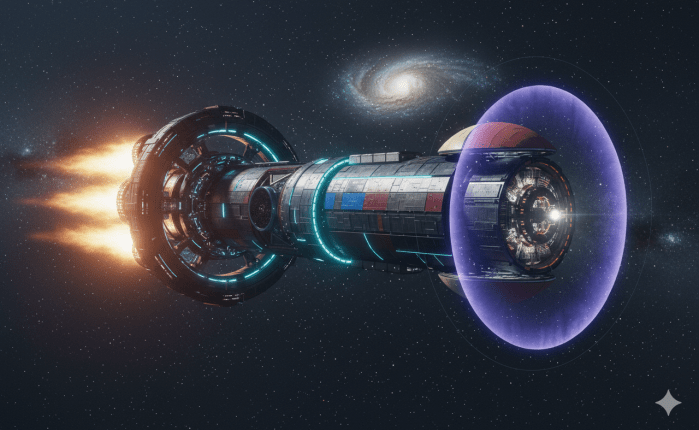
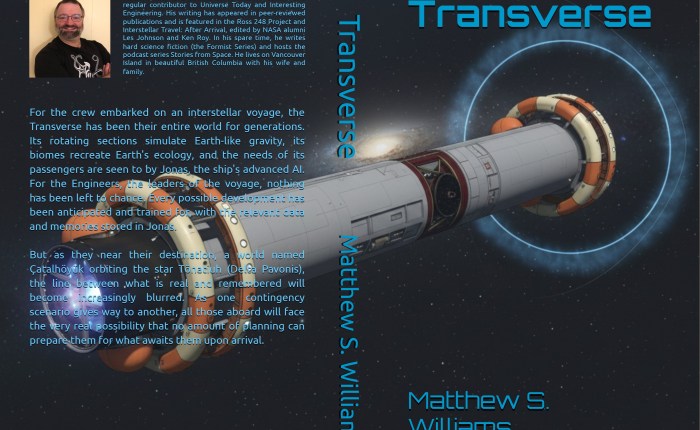
To recap, Transverse takes place aboard a Generation Ship en route to the not-so-distant system of Delta Pavonis. This Sun-like star is roughly 20 light-years from Earth and currently has no confirmed exoplanets, making it perfect for writing fiction. In my story, this star is named Tōnatiuh by the ship’s crew, which is Nahuatl for “Fifth Sun” (since it’s the fifth Sun-like star beyond the Solar System), and also the name of the Aztecs’ Sun god.

The world they are looking to settle is Delta Pavonis d, the third planet from the star, which they’ve named Çatalhöyük after the ancient neolithic settlement, one of the earliest known human settlements (dated to ca. 7500 BCE). The people aboard are highly advanced, led by a team of 9 Engineers and thousands of crew who tend to the ship on a rotational basis. While one-third of the Engineers and crew are awake, the others are kept in cryogenic preservation.

The rest, I hope, will become clear as the chapters go on…


The doors opened onto a vast theatre, dark, but with glowing patches where strategically placed lamps hovered next to the walls. Their light catches small surface spaces across the cavernous room: cream-colored walls, dark wood panels, russet seat cushions. The level of illumination is intentionally kept low; to the point that it makes the space and the few hundred people seated just discernible. On the stage, the focal point of the whole place, the lights are slightly brighter, drawing attention to a backdrop that not currently in operation.

Over ten thousand seats fill the room, arranged in a typical half-moon crescent on the ground floor. Dube knows there are just as many located in the gallery above, along with boxes along the walls that offer an elevated view of the stage. The place is familiar, though he knew somehow that he had never been here before.

Of the handful of patrons who’ve made themselves at home, a few looked at him when he entered. Of these people, Dube could make out some facial features, thanks to the brightened screens of their folios. A handful have no faces, just irises that beam light at him from the active display diodes embedded in them.

Dube felt inexplicably confused. The atmosphere that filled the theatre seemed very much calm. So many people, sprawled out in a room not ordinarily intended for self-directed tasks. No one appeared to be talking or calling in anyone else’s direction. Just the sound of their breathing the circulation of the ship’s air.

And yet, Dube felt that a strange tingle of unease.

He could think of nothing to justify that feeling. He recognized the room, the people were not behaving threateningly in any way, and there was sufficient light to see by.

Walking down the central walkway, he looked left and right for a familiar face. Strangely, everyone looked alien to him. That did not seem right, but he still couldn’t think of anything to contradict what he was seeing.

He smiled when he finally saw someone he recognized.

“Welcome home, Obuya,” she said.

“Home?”

She looked at him queerly.

“Of course. This has always been our home.”

She said the words in such a matter-of-fact way, as if it were somehow academic.

“I’m confused.”

“Can you remember a time before we were here?”

Dube sighed. He seemed to remember images of a distant place. He terrain was alpine, undulating in every direction. Where it ended, a cool valley stretched almost to the horizon, abutted by another mountainous outcropping. The ground before him was covered in shrubs and dotted with all manner of Acacia and Eucalypt trees. The sensations began to pile on: the warm Sun on his face, the cool shadow of the Blue Mountains on his back. And he could feel a gentle breeze coming up from the valley, the smell of wildflowers and eucalyptus oil.

His eyes snapped opened and he beheld the landscape with a new sense of disapproval.

“This is not my home.”

“Not anymore,” said Edennu, sternly. “We brought it all with us.”

These words made Dube feel a strange tingle. How did she know what he was thinking? He had not linked with her, nor had she reached out to him. He tried to do so now but couldn’t get a connection. Reaching out, he found no bandwidth with which to do so either.

He looked around again, harder this time. Somewhere in the sleepy room, there had to be some clue to what was going on. He couldn’t remember what he was looking for when he came in, but suspected it was here somewhere. And then there was the matter of where he had been before. He tried to call up the mental image again; perhaps what he sought was there.

“The trees…” he whispered. “I remember Baobabs, Umkwakwa, and Cinnamonum. Bushwillow blossoms, as many as the stars.”

Edennu quickly retorted, almost chiding him.

“Don’t worry about the trees, Obuya. We brought them all with us.”

He didn’t know why, but her words made perfect sense to him. He inquired further.

“And the oxen? And the aurochs?”

“We brought them too, Obuya.”

“And the Sun,” he said queerly. “What about that?”

She shook her head. “No, Obuya. We didn’t bring that with us. We just have to hope they have enough for all of us.”

“They? Who are you talking about?”

She didn’t reply. Her eyes remained fixed on her book. Dube tried again.

“What did you mean by that? Sandra?”

Edennu went dark. Her physical form was still there. But what was behind it was gone. In the space she occupied, it was as if an absence had formed. Dube looked around the room and noticed that the same thing was happening in other places too. He also noted the way it was spreading. In every seat, in every corner, the people were still there – and yet, not.

The room followed too. The stage, the auditorium, the lights – all of it became bathed in the same interminable darkness. And soon, an ill sound followed. The still quiet gave way to a terrible scurrying, as if something was crawling through the airways.

“What is that?” he asked. Edennu did not answer. She had gone dark and quiet, like everyone else. Nothing around him would answer. The only thing making any noise now was the one thing he couldn’t identify, and that was getting louder the closer the darkness came to envelop him. It was not in the airwaves. It was all around him now.

It only stopped once the darkness completely encompassed him.

He felt surrounded. Enveloped.

Yet strangely, he was unafraid.

He could still breathe, still feel, and was aware of an emptiness that surrounded him. The protective bubble, and his ignorance of what lay beyond it, staved off panic. He was alone, submersed in complete quiet and total darkness.

It felt like an eternity. But then again, it was. For the average mortal, centuries of sleep qualified as an eternity…

Episode 110 of Stories from Space – What’s the Deal with 3I/ATLAS? – is now Live!

Episode 110 of Stories from Space – What’s the Deal with 3I/ATLAS? – is now Live!

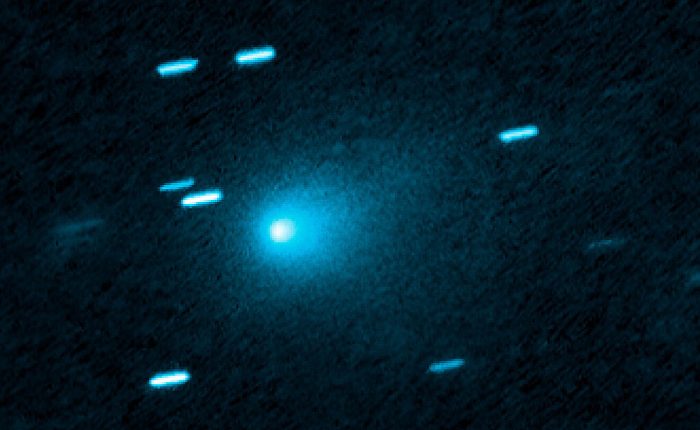
Interstellar Objects (ISO) are back in the news, thanks to the arrival of 3I/ATLAS in our Solar System. As the designation indicates, this is the third ISO we’ve detected since ‘Oumuamua graced our system back in 2017. It is also the second interstellar comet ever observed, something that was confirmed shortly after it was first spotted (thanks to all the outgassing scientists observed). And just like ‘Oumuamua, there was speculation that the object might be something more…

But that speculation was wrong, it’s a comet!

The bottom line is, this latest object taught us more about ISOs and the kinds of conditions that exist in other star systems. This is the appeal of ISOs: they offer opportunities to study other star systems without actually having to go there. But we are currently limited to studying them from afar, hence the efforts to develop spacecraft that could rendezvous with them someday. If we can obtain samples from an ISO, we can learn even more about what is out there, waiting to be found.

And if any of these ISOs happen to be pieces of alien technology, we will have learned the answer to one of the greatest questions of all time: Are we alone in the Universe?

Scientists are continuing to monitor 3I/ATLAS and will continue to do so until it is out of range of our most powerful telescopes (by 2028). The fact that it was detected before making its closest pass to the Sun shows how far we’ve come since ‘Oumuamua flew past Earth and we were only able to get a few days of observations before it left our Solar System. On Dec. 19th, it will make its closest pass to Earth, at a very safe distance!

Where to Listen:

Episode 109 of Stories from Space is Live!

Episode 109 of Stories from Space is Live!

In this latest episode, I discuss the Standard Model of Cosmology, how scientists arrived at it, and how recent discoveries are causing some to question whether or not it is correct. To break it down, it is known as the Lambda Cold Dark Matter (ΛCDM) model, which basically combines the following theories.

  • The Big Bang: The theory that the Universe expanded from an initial state in which all matter was in hot, dense state (c’mon, you know the tune!) Evidence for this theory includes the Cosmic Microwave Background (CMB), the abundance of light elements (hydrogen, helium, etc.), the large-scale structure of the Universe, and cosmic expansion (see below).
  • Special Relativity: Einstein’s famous theory (E=mc2) that asserts that matter and energy are equivalent and how space and time are part of a four-dimensional framework in which the speed of light is constant and cannot be exceeded.
  • General Relativity: The extended generalized version of Einstein’s famous theory, which asserts that mass alters the curvature of spacetime.
  • Dark Matter: The theory that the majority of matter in the Universe is made up of a mysterious mass that doesn’t interact with normal matter in visible light.
  • Cosmological Constant: Also known as the Hubble-Lemaitre Constant (colloquially referred to as “Dark Energy”), wherein 68% of the cosmos is made up of energy that counteracts the force of gravity.

Over the past 120 years, these theories have come together to create the ΛCDM model of the Universe. For decades, scientists have been hoping to get a look at the very early Universe (less than 1 billion years after the Big Bang) to test this theory. When Webb finally provided the first observations of this period in cosmic history, what astronomers saw challenged many of the assumptions inherent in this model. Check out the episode below to learn more…

Where to Listen:

Talking About Grief, Trauma, and Addiction

Talking About Grief, Trauma, and Addiction

Good-day all! I hope everyone had a lovely Summer and is looking forward to Fall. Around here, Carla and I had an eventful time. Things have been going pretty well, but we’re still struggling with a few things. And lately, I’ve fallen into a hole regarding my recovering from Alcohol Use Disorder (AUD), which I was officially diagnosed with about six months ago. This has raised a whole slew of uncomfortable questions, a ton of anxiety, and has made me more prone to drinking than before!

Truly, something must be off here because admitting you have a problem doesn’t generally make it worse, right?! It’s supposed to lead to a sense of resolution, even if it is a scary one. And I’ve accepted the idea of being an addict (hereafter, the Big-A) a couple times already, and it never fit for me. It always just seemed wrong, and since I’m the one most worried about it, I find it hard to believe that I’m in denial.

Continue reading “Talking About Grief, Trauma, and Addiction”

Episode 108 of SfS – A Conversation with Les Johnson – is Now Live!

Episode 108 of SfS – A Conversation with Les Johnson – is Now Live!

This latest episode was particularly special. In addition to having NASA technologist Les Johnson on for the second time (Episode 25 – Going Interstellar!), we got to talk about our latest collaboration and the upcoming release of a major project – the Interstellar Travel Monograph. This series, edited by Les Johnson and fellow NASA alumnus Ken Roy, details interstellar travel’s benefits, possibilities, and challenges. Volume I covered the purpose and motivations, while Volume II addressed the technical and associated requirements of making the journey.

The latest installment, Volume III: After Arrival, addresses how humans will live on a distant planet, exploring questions of governance, economics, adaptation, and (my contribution) terraforming! This work builds on Les Johnson’s previous work, A Traveler’s Guide to the Stars, which lays out the case for interstellar travel for regular, everyday readers. The Monograph series targets scientists, engineers, and technical experts and will be used as textbooks in University-level courses. Everyone who contributed is an expert in their field, and they let me join in! What an honor!

This series also builds on previous work I had the honor of participating in, The Ross 248 Project (also edited by Johnson and Roy), which addressed how humans could live on rocky planets around red dwarf stars (like Proxima b). Check out the episode to hear more about Les Johnson’s work at NASA, the Monogram, and this fascinating subject matter!

Where to Listen: