Classic sci-fi books, reviews, and the best of from a dedicated fan and author!
Author: storiesbywilliams
Matt Williams is a professional writer, science fiction author, and science communicator who currently writes for Universe Today, Interesting Engineering, Stardom Space, and Stellar Amenities. He is also the Director of Media Communications for Mars City Design and a member of Enterprise in Space and Explore Mars. His novels, The Formist Series, are available at Amazon.com and through Castrum Press. He lives with his wife and family on Vancouver Island in beautiful British Columbia.
Judgement Day has come early this year! At least that’s the impression I got when I took a look at this new DARPA prototype for a future robotic infantryman. With its anthropomorphic frame, servomotors and cables, sensor-clustered face, and the shining lights on its chest, this machine just screams Terminator! Yet surprisingly, it is being developed to help humans beings. Yeah, that’s what they said about Skynet, right before it nuked us!
Yes, this 6-foot, 330-pound robot, which was unveiled this past Thursday, was in fact designed as a testbed humanoid for disaster response. Designed to carry tools and tackle rough terrain, this robot – and those like it – are intended to operate in hazardous or disaster-stricken areas, assisting in rescue efforts and performing tasks that would ordinarily endanger the lives of human workers.
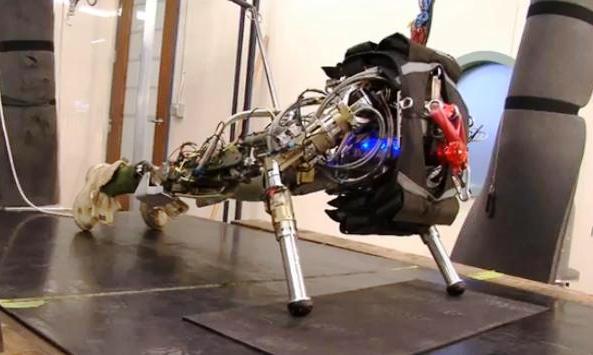
Funded by DARPA as part of their Robotics Challenge, the robot was developed by Boston Dynamics, the same people who brought you the AlphaDog – aka the Legged Squad Support System (LS3, pictured above) – and the Petman soldier robot. The former was developed as an all-terrain quadruped robot that could as an infantry-support vehicle by carrying a squad’s heavy ordinance over rough terrain.
The latter, like Atlas, was developed as testbed to see just how anthropomorphic a robot can be – i.e. whether or not it could move, run and jump with fluidity rather than awkward “robot” movements, and handle different surfaces. Some of you may recall seeing a video or two of it doing pushups and running on a treadmill back in 2011.
Alas, Atlas represents something vastly different and more complex than these other two machines. It was designed to not only walk and carry things, but can travel over rough terrain and climb using its hands and feet. Its head includes stereo cameras and a laser range finder to help it navigate its environment.
And, as Boston Dynamics claimed in a press release, the bot also possesses “sensate hands” that are capable of using human tools, and “28 hydraulically actuated degrees of freedom”. Its only weakness, at present, is the electrical power supply it is tethered to. But other than that, it is the most “human” robot – purely in terms physical capabilities – to date. Not only that, but it also looks pretty badass when seen in this full-profile pic, doesn’t it?
The DARPA Robotics Challenge is designed to help evolve machines that can cope with disasters and hazardous environments like nuclear power plant accidents. The seven teams currently in the challenge will get their own Atlas bot and then program it until December, when trials will be held at the Homestead Miami Speedway in Florida – where they will be presented with a series of challenges.
In the meantime, check out the video below of the Atlas robot as it demonstrates it full range of motion while busting a move! Then tell me if the robot is any less frightening to you. Can’t help but look at the full-length picture and imagine a plasma cannon in its hands, can you?
From the way people have been going on about 3D printing in the past few months, you’d think it was some kind of fad or something! But of course, there’s a reason for that. Far from being a simple prescriptive technology that requires us all to update our software or buy the latest version in order to “stay current”, 3D printing is ushering in a revolution that will literally change the world.
From design models and manufactured products, the range of possibilities is now venturing into printed food and even artificial organs. The potential for growth is undeniable, and the pace at which progress is happening is astounding. And on one of my usual jaunts through the tech journals and video-sharing websites, I found a few more examples of the latest applications.
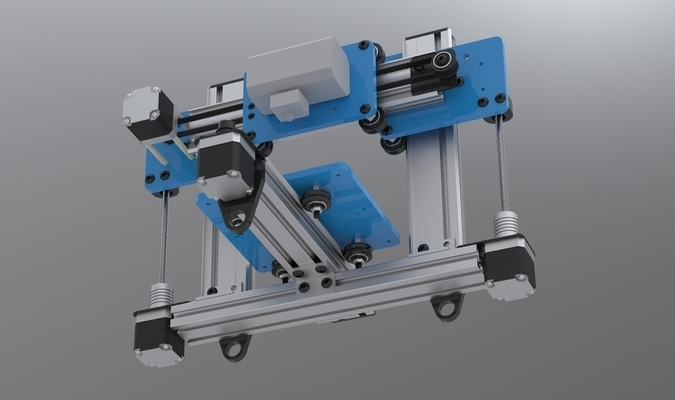
First up is this story from Mashable, a social media news source, that discusses NYU student Marko Manriquez’s new invention: the BurritoBot. Essentially a 3D food printer that uses tortillas, salsa, guacamole and other quintessential ingredients, Manriquez’s built this machine for his master’s thesis using open-source hardware – including the ORD bot, a 3D printing mechanical platform (pictured above).
The result is a food printer that an tailor-make Burritos and other Mexican delights, giving users the ability to specify which ingredients they want, in which proportion, and all through an app on their smartphone. No demos available online as of yet, but Mashable provides a pretty good breakdown on how it works, as well as Manrquez’s inspiration and intent behind its creation:
Next up, there’s Cornell University’s food printer that allows users to created desserts. In this CNN video, Chef David Arnold at the French Culinary Institute shows off the printer by creating a chocolate cake, layer by layer, dough and icing. A grad student from Cornell’s Computational Synthesis Lab was on hand to explain that their design is also open-source, with the blueprints and technical design made available online so anyone can build their own.
As Chef Arnold explained, his kitchen has been using the printer to work with ingredients ranging from cookie dough, to icing to masa – the corn meal tortillas are made from. It also allows for a degree of accuracy that many may not possess, while still offering plenty of opportunities to be creative. “The only real limitation now is that the product has to be able to go through a syringe,” he said. “Other than that, skies the limit.”
But even more exciting for some are the opportunities that are now being explored using metals. Using metal powder and an electron beam to form manufactured components, this type of “additive manufacturing” is capable of turning out parts that are amazingly complex, far more so than anything created through the machining-process.
In this next video, the crew from CNNMoney travel to the Oakridge National Lab in Tenessee to speak to the Automation, Manufacturing and Robotics Group. This government-funded lab specializes in making parts that are basically “structures within structures”, the kind of things that are used in advanced prosthetic limbs, machinery, and robots. As they claim, this sort of manufacturing is made possible thanks to the new generation of 3D ABS and metal printers.
What’s more, this new process is far more efficient. Compared to old fashioned forms of machining, it consumes less energy and generates far less waste in terms of materials used. And the range of applications is extensive, embracing fields as divergent as robotics and construction to biomedical and aerospace. At present, the only real prohibition is the cost of the equipment itself, but that is expected to come down as 3D printing and additive manufacturers receive more market penetration.
But of course, all of this pales in comparison to the prospect of 3D printed buildings. As Behrokh Khoshnevis – a professor of Industrial & Systems Engineering at USC – explains in this last video from TEDxTalks, conventional construction methods are not only inefficient, labor intensive and dangerous, they may very well be hampering development efforts in the poorer parts of the world.
As anyone with a rudimentary knowledge of poverty and underdevelopment knows, slums and shanty-towns suffer disproportionately from the problems of crime, disease, illiteracy, and infant mortality. Unfortunately, government efforts to create housing in regions where these types of communities are common are restrained by budgets and resource shortages. With one billion people living in shanties and slum-like shelters, a new means of creating shelter needs to be found for the 21st century.
The solution, according to Khoshnevis, lies in Contour Crafting and Automated Construction – a process which can create a custom house in just 20 hours! As a proponent of Computer-Assisted Design and Computer-Assisted Manufacturing (CAD/CAM), he sees automated construction as a cost-effective and less labor resource-intensive means of creating homes for these and other people who are likely to live in unsafe, unsanitary conditions.
The technology is already in place, so any claims of that is of a “theoretical nature” are moot. What’s more, such processes are already being designed to construct settlements on the moon, incorporating robotics and 3D printing with advanced computer-assisted simulations. As such, Khoshnevis is hardly alone in advocating similar usages here on planet Earth.
The benefits, as he outlines them, are dignity, safety, and far more sanitary conditions for the inhabitants, as well as the social benefits of breaking the pathological cycle of underdevelopment. Be sure to check out his video below. It’s a bit long, but very enlightening!
Once in awhile, its good to take stock of the future and see that it’s not all creepy robots and questionable inventions. Much of the time, technological progress really does promise to make life better, and not just “more convenient”. It’s also especially good to see how it can be made to improve the lives of all people, rather than perpetuating the gap between the haves and the have nots.
Until next time, keep your heads high and your eyes to the horizon!
It’s a good day when a show like Futurama begins turning out new episodes. This past week’s featured a story where Bender began taking advantage of 3D printing to create a famous folk singer’s one-of-a-kind guitar. Naturally, things got out of control, and the story was chock full of social commentary and the concept that the printing revolution might actually be ushering an age where artificial replicas could infringe on the real thing.
For the life of me, I can’t find clips of this episode anywhere. Guess it’s too soon to expect anyone to upload it to Youtube, lazy piraters! But I found the next best thing: a time-lapse video of a Bender figurine being printed out on a Maker Bot. It’s set to the extended cut of Futurama’s theme, and the result is a pretty cool replica of the jive-talking, amoral alcoholic robot himself!
We all know it’s coming: the day when machines would be indistinguishable from human beings. And with a robot that is capable of imitating human body language and facial expressions, it seems we are that much closer to realizing it. It’s known as the Geminoid HI-2, a robotic clone of its maker, famed Japanese roboticist Hiroshi Ishiguro.
Ishiguro unveiled his latest creation at this year’s Global Future 2045 conference, an annual get-together for all sorts of cybernetics enthusiasts, life extension researchers, and singularity proponents. As one of the world’s top experts on human-mimicking robots, Ishiguro wants his creations to be as close to human as possible.
Alas, this has been difficult, since human beings tend to fidget and experience involuntary tics and movements. But that’s precisely what his latest bot excels at. Though it still requires a remote controller, the Ishiguro clone has all his idiosyncrasies hard-wired into his frame, and can even give you dirty looks.
This is not the first robot Ishiguro has built, as his female androids Repliee Q1Expo and Geminoid F will attest. But above all, Ishiguro loves to make robotic versions of himself, since one of his chief aims with robotics is to make human proxies. As he said during his talk, “Thanks to my android, when I have two meetings I can be in two places simultaneously.” I honestly think he was only half-joking!
During the presentation, Ishiguro’s robotic clone was on stage with him, where it realistically fidgeted as he pontificated and joked with the audience. The Geminoid was controlled from off-stage, where an unseen technician guided it, and fidgeted, yawned, and made annoyed facial expressions. At the end of the talk, Ishiguro’s clone suddenly jumped to life and told a joke that startled the crowd.
In Ishiguro’s eyes, robotic clones can outperform humans at basic human behaviors thanks to modern engineering. And though they are not yet to the point where the term “android” can be applied, he believes it is only a matter of time before they can rival and surpass the real thing. Roboticists and futurists refer to this as the “uncanny valley” – that strange, off-putting feeling people get when robots begin to increasingly resemble humans. If said valley was a physical place, I think we can all agree that Ishiguro would be its damn mayor!
And judging by these latest creations, the time when robots are indistinguishable from humans may be coming sooner than we think. As you can see from the photos, there seems to be very little difference in appearance between his robots and their human counterparts. And those who viewed them live have attested to them being surprisingly life-like. And once they are able to control themselves and have an artificial neural net that can rival a human one in terms of complexity, we can expect them to mimic many of our other idiosyncrasies as well.
As usual, there are those who will respond to this news with anticipation and those who respond with trepidation. Where do you fall? Maybe these videos from the conference of Ishiguro’s inventions in action will help you make up your mind:
Ever since our astronomers have gained the ability to see into deep space and discern what lies in distant solar systems, a total of 910 extra-solar planets have been discovered. Of those, only a handful have been confirmed as potentially habitable by Earth scientists. Despite these discovered, it was not until recently that a “blue planet” outside of the Solar System, thanks to NASAs Hubble telescope.
But here’s the kicker: as it turns out, the planet is not blue due to the presence of liquid water. The blue color likely comes from clouds in the atmosphere made of molten glass. The planet is known as HD 189733 b, located roughly 63 light years away from Earth in the constellation of Vulpecula (aka. the Fox). Initially discovered in 2005 by French astronomers who observed it passing in front of its star, HD 189733 b is one of the best-studied exoplanets.
Prior to this new finding, it was already known that the planet was a hot Jupiter — a massive gas giant that orbits very close to its parent star — and that, using polarimetry, it was most likely blue. Since that time, the blue color has been confirmed by a spectrograph aboard Hubble which scanned the planet during an eclipse. As it passed behind its parent star and out of our vision, Hubble recorded less blue light coming from the star, while the other colors remained the same.
This strongly indicates that the light reflected by HD 189733 b’s atmosphere is blue and thus, if we were close enough to directly observe the planet, it would appear blue. This is an apparent first for astrophysicists and astronomers, who wouldn’t normally be able to observe such a fluctuation from 63 light years away. But the size of the planet, plus the amount of light reflecting off it from its very-close-by star, mean that Hubble can do its thing.
As for the cause of the color itself, the current theory is that the planets atmosphere is full of clouds that contain tiny silicate particles, which absorb some light frequencies but reflect and scatter blue light. In the words of NASA, because the surface of the planet is around 815 Celsius (1,500 Fahrenheit), these particles are likely in a molten, liquid state that periodically turn into rain. Yes, you read that right, the planet experiences periods of molten glass rain!
In addition to that, it is also known that its orbital period (length of a year) is only 2.2 days. The planet is also tidally locked, meaning that one side is always facing towards the sun while the other experiences perpetual night. So basically, outside of its blue color, HD 189733 b is about as uninhabitable as it gets.
Ah well, the search for a truly Earth-like exoplanet continues I guess! And in the meantime, enjoy this short video from Hubble ESA – a computer graphic representation of the universe’s other “blue planet”:
Oh dear. It seems a milestone was passed this week, one which slipped under my nose once again. Ever since I hit 200,000 views, which seemed like forever ago, the milestones have been fewer and further between. You tend to stop keeping track of noticing when they roll around. But when the stock ticker hits a number with five zeroes behind it, you suddenly find yourself taking notice.
And when I did, I noticed some other important milestones had also slipped by unnoticed. For example, back in March Stories by Williams celebrated its second anniversary. That alone was reason to celebrate, but since that time, the site also surpassed 2000 followers, 5000 comments, and 10,000 likes. Oh yes, and I also passed 1000 posts by a significant margin (1148, as of this posting). Awful lot of number here!
Oh yeah, it was also since the second anniversary – roughly one month later in April – that Whiskey Delta was published and sold over 1300 copies. A special shout out to all those who helped make it possible – Rami, Audrey, Carla (my darling wife-editor), and of course, Mr. Max Brooks himself!
Looking ahead, there’s always plenty more to do. First, I want to publish part II of the zombie-fiction series, Papa Zulu! And of course, there’s a few anthologies to take care, such as Yuva and Flash Forward. And then there’s the ongoing Revengers saga that’s been growing some serious legs of late. And I imagine there will be plenty of science, tech, and pop culture news to share in the meantime…
Now appearing at China Daily Mail! The world’s largest structure is more like a self-contained world than a mall, complete with its own beach and even and artificial sun!
Recent revelations provided by Edward Snowden have set many people’s teeth on edge. After years of controversy surrounding the use of domestic, warrantless surveillance, things have only gotten worse with the revelation of PRISM and the NSA’s collection of metadata. But as with all things relating to espionage and government secrets, plumbing the depths only seems to reveal greater depths and bigger secrets.
Case in point: the life and times of General Keith Alexander, the undisputed master of America’s cyberwars and intelligence gathering operations. A four-star Army general with active units under his command, he is also a member of the National Security Agency, chief of the Central Security Service, and commander of the US Cyber Command.
When discussing his reasons for going public, Snowden indicated that he was appalled by:
[The] hypocrisy of the U.S. government when it claims that it does not target civilian infrastructure, unlike its adversaries.
What he was referring to was ongoing accusations by the US government that sources within China – particularly Unit 61398, a hacking force within the PLA that is located in Shanghai – had been stealing terabytes from data from the US since 2006. As it turns out, the US has its own super-secret cyberwarfare division, one which exists as nominally independent from the NSA.
Located inside Fort Meade, Maryland, this top-secret installation is more of a self-contained city. Tens of thousands of people live here, a city of 50 buildings with its own post office, fire department, and police force and is surrounded by electrified fences and heavily armed guards, protected by antitank barriers, monitored by sensitive motion detectors, and watched by rotating cameras.
To block any telltale electromagnetic signals from escaping, the inner walls of the buildings are wrapped in protective copper shielding and the one-way windows are embedded with a fine copper mesh. Keith Alexander is responsible for building this place up for the past eight years, insisting that the US’s inherent vulnerability to digital attacks required that he and those like him assume more authority over the data zipping around the globe.
To hear him tell it, the threat is so paramount that it only makes sense that all power to control the flow of information should be concentrated in as few hands as possible, namely his. In a recent security conference held in Canada, Alexander expressed the threat in the following, cryptic way:
What we see is an increasing level of activity on the networks. I am concerned that this is going to break a threshold where the private sector can no longer handle it and the government is going to have to step in.
If this alone were not reason enough to put people on edge, there are also voices within the NSA who view Alexander as a quintessential larger-than-life personality. One former senior CIA official who agreed to speak on condition of anonymity, claimed:
We jokingly referred to him as Emperor Alexander—with good cause, because whatever Keith wants, Keith gets. We would sit back literally in awe of what he was able to get from Congress, from the White House, and at the expense of everybody else.
In this respect, he is not unlike Herbert Hoover, the overbearing bureaucrat who established the FBI and maintained a stranglehold over the nation’s law enforcement for years, even go so far as to blackmail multiple presidents.
In its tightly-controlled PR, the NSA has focused attention on the threat of cyberattack against the US, particularly against critical infrastructure like power plants and water systems, the susceptibility of the military’s command and control structure, the dependence of the economy on the internet. Defense against these threats is cited as the very reason for the NSA’s ongoing efforts and everything they do towards that end.
But there is a flip side to this equation that is rarely mentioned: which is the offensive capabilities the US military has been developing offensive capabilities. Using so-called cyber-kinetic attacks, Alexander and his forces now have the capability to physically destroy an adversary’s equipment and infrastructure, measures which he claims are crucial to 21st-century warfare as nuclear arms were in the 20th.
Their first attack was launched in the mid-2000s under the name of Stuxnet, a piece of malware that was created by the NSA, CIA and Israeli intelligence. According to Snowden, this virus – the first ever to be designed to destroy physical equipment – was aimed at Iran’s nuclear facility in Natanz. Once unleashed, this worm was able to damage about a thousand centrifuges used to enrich nuclear material.
The success of this sabotage came to light only in June 2010, when the malware spread to outside computers and spotted by independent security researchers. Despite headlines around the globe, officials in Washington have never openly acknowledged that the US was behind the attack. It wasn’t until 2012 that anonymous sources within the Obama administration took credit for it in interviews with The New York Times.
But of course, Stuxnet was only the beginning. Alexander’s agency has recruited thousands of computer experts, hackers, and engineering PhDs to expand US offensive capabilities in the digital realm over the years. And at a time when the CIA and other intelligence agencies are dealing with up to $4.4 billion in budget cuts, the Pentagon has requested $4.7 billion for “cyberspace operations”. In short, more attacks are likely in the works.
As Chris Cooper said in the seminal movie Syriana: “You dig a 6-foot hole, you’ll find three bodies. But you dig 12, and maybe you’ll find 40.” Eventually, you have to wonder if its time to ditch the shovel. The truth is so often an ugly, frightful, shocking and disturbing thing. And personally, I’ve always felt that rather than turn away, we should hold the people who make it so in strong contempt.
AR displays are becoming all the rage, thanks in no small part to Google Glass and other display glasses. And given the demand and appeal of the technology, it seemed like only a matter of time before AR displays began providing real-time navigation for vehicles. For decades, visor-mounted heads-up displays have been available, but fully-integrated displays have yet to have been produced.
Live Helmet is one such concept, a helmet that superimposes information and directions into a bike-helmet visor. Based in Moscow, this startup seeks to combine a head-mounted display, built-in navigation, and Siri-like voice recognition. The helmet will have a translucent, color display that’s projected on the visor in the center of the field of vision, and a custom user interface, English language-only at launch, based on Android.
This augmented reality helmet display includes a light sensor for adjusting image brightness according to external light conditions, as well as an accelerometer, gyroscope, and digital compass for tracking head movements. Naturally, the company anticipated that concerns about driver safety would come up, hence numerous safety features which they’ve included.
For one, the digital helmet is cleverly programmed to display maps only when the rider’s speed is close to zero to avoid distracting them at high speeds. And for the sake of hands-free control, it comes equipped with a series of voice commands for navigation and referencing points of interest. No texting and driving with this thing!
So far, the company has so far built some prototype hardware and software for the helmet with the help of grants from the Russian government, and is also seeking venture capital. However, they have found little within their home country, and have been forced to crowdfund via an Indiegogo campaign. As CEO, Andrew Artishchev, wrote on LiveMap’s Indiegogo page:
Russian venture funds are not disposed to invest into hardware startups. They prefer to back up clones of successful services like Groupon, Airnb, Zappos, Yelp, Booking, etc. They are not interested in producing hardware either.
All told, they are seeking to raise $150,000 to make press molds for the helmet capsule. At present, they have raised $5,989 with 31 days remaining. Naturally, prizes have been offered, ranging from thank yous and a poster (for donations of $1 to $25) to a test drive in a major city (Berlin, Paris, Rome, Moscow, Barcelona) for $100, and a grand prize of a helmet itself for a donation of $1500.
And of course, the company has announced that they have some “Stretched Goals”, just in case people want to help them overshoot their mandate of $150,000. For 300 000$, they will include a Bluetooth with a headset profile to their helmet, and for 500 000$, they will merge a built-in high-resolution 13Mpix photo&video camera. Good to have goals.
Personally, I’d help sponsor this, except for the fact that I don’t have motorbike and wouldn’t know how to use it if I did. But a long drive across the autobahn or the Amber Route would be totally boss! Speaking of which, check out the company’s promotional video:
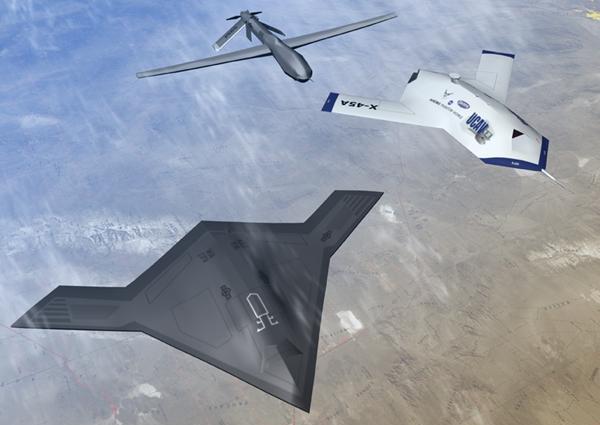
In any developmental milestone, the X-47B made its first arrested landing aboard an aircraft carrier yesterday. This latest test, which comes after a successful arrested landing on an airstrip and a successful deployment from an aircraft carrier, may help signal a new era for the use of unmanned aircraft in military operations.
For months now, the US Navy has been testing the Unmanned Aerial Combat Air System – the first drone aircraft that requires only minimal human intervention – pushing the boundaries in the hopes of determining how far the new autonomous air system can go. And with this latest landing, they just proved that the X-47B is capable of being deployed and landing at sea.
Aircraft landings on a carrier are a tricky endeavor even for experienced pilots, as the ship’s flight deck is hardly spacious, and rises, falls, and sways with the ocean waves. To stop their forward momentum in the shortest distance possible, carrier aircraft have a hook on the underside of the fuselage that latches onto cables stretched across the flight deck. This means that pilots need to land precisely to grab the hook and come to a complete stop in time.
The test flight began when the drone took off from the Naval Air Station at Patuxent River, Md. and then flew to meet the USS George H.W. Bush at sea, a flight which took 35 minutes. Upon reaching the carrier, the same which it took off from this past May, it touched down and caught the 3 wire with its tailhook at a speed of 145 knots, coming to a dead stop in less than 350 feet. After the first landing, it was launched from the Bush’s catapult and then made a second arrested landing.
The Navy tweeted about the success shortly after it happened, and Ray Mabus – Secretary of the Navy – followed that up with a press statement:
The operational unmanned aircraft soon to be developed have the opportunity to radically change the way presence and combat power are delivered from our aircraft carriers.
Naturally, there is still plenty of testing likely to be done before such drones can be considered ready to go into combat zones. For example, perhaps, automated drone-to-drone refueling is scheduled for some time in 2014, another aspect of the UCAS the Navy is determined to try before deploying them in actual operations. Still, for fans and critics alike, this was a major step.
Which brings us to the darker side of this latest news. For many, a fleet of semi or fully-automated drones is a specter that induces serious terror. Earlier this year, the Obama administration sought to allay fears about the development of the X-47 and the ongoing use of UAVs in combat operations by claiming that steps would be taken to ensure that when it came to life and death decisions, a human would always be at the helm.
But of course, promises have been broken when it comes to the use of drones, which doesn’t inspire confidence here. Just eight days after the Obama Administration promised to cease clandestine operations where drones were used by the CIA to conduct operations in Pakistan, Yemen, and Somalia, one such drone was used to kill Wali ur-Rehman – the second in command of the Pakistani Taliban. This was a direct violation of Obama’s promise that UAVs would be used solely against Al-Qaeda and other known anti-US terrorist groups outside of Afghanistan.
What’s more, the development of unmanned drones that are able to function with even less in the way of human oversight has only added to many people’s fear about how, where, and against whom these drones will be used. Much has gone on that the public is now aware of thanks to the fact that only a handful of people are needed to control them from remote locations. If human agency is further removed, what will this mean for oversight, transparency, and ensuring they are not turned on their own citizens?
But of course, it is important to point out that the X-47B is but an experimental precursor to actual production models of a design that’s yet to be determined. At this point, it is not farfetched to assume that preventative measures will be taken to ensure that no autonomous drone will ever be capable of firing its weapons without permission from someone in the chain of command, or that human control will still be needed during combat phases of an operation. Considering the potential for harm and the controversy involved, it simply makes sense.
But of course, when it comes to issues like these the words “trust us” and “don’t worry” are too often applied by those spearheading the development. Much like domestic surveillance and national security matters, concerned citizens are simply unwilling to accept the explanation that “this will never be used for evil” anymore. At this juncture, the public must stay involved and apprised, and measures instituted from the very beginning.
And be sure to check out this video of the X-47B making its first arrested landing. Regardless of the implications of this latest flight, you have to admit that it was pretty impressive:

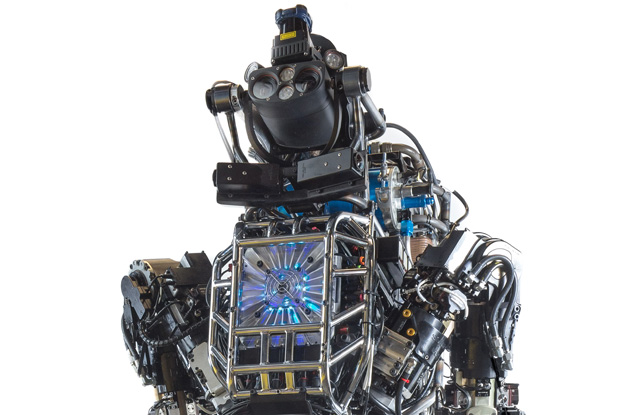 Judgement Day has come early this year! At least that’s the impression I got when I took a look at this new DARPA prototype for a future robotic infantryman. With its anthropomorphic frame, servomotors and cables, sensor-clustered face, and the shining lights on its chest, this machine just screams Terminator! Yet surprisingly, it is being developed to help humans beings. Yeah, that’s what they said about Skynet, right before it nuked us!
 Funded by DARPA as part of their Robotics Challenge, the robot was developed by Boston Dynamics, the same people who brought you the AlphaDog – aka the Legged Squad Support System (LS3, pictured above) – and the Petman soldier robot. The former was developed as an all-terrain quadruped robot that could as an infantry-support vehicle by carrying a squad’s heavy ordinance over rough terrain.
 Alas, Atlas represents something vastly different and more complex than these other two machines. It was designed to not only walk and carry things, but can travel over rough terrain and climb using its hands and feet. Its head includes stereo cameras and a laser range finder to help it navigate its environment.
 The DARPA Robotics Challenge is designed to help evolve machines that can cope with disasters and hazardous environments like nuclear power plant accidents. The seven teams currently in the challenge will get their own Atlas bot and then program it until December, when trials will be held at the Homestead Miami Speedway in Florida – where they will be presented with a series of challenges.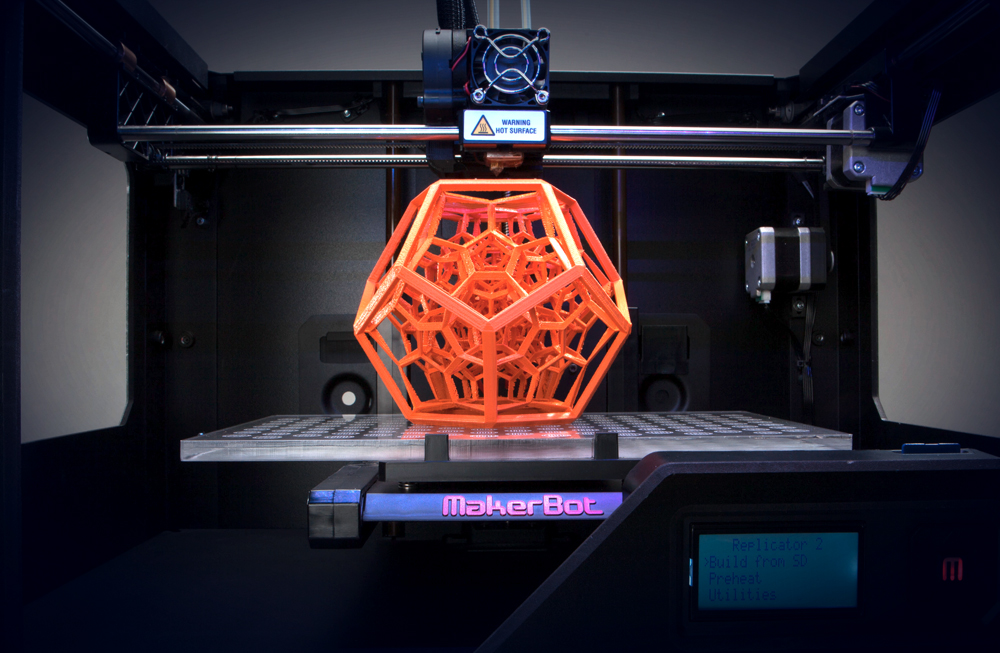





















 Stories by Williams