Powered by the Sun: Solar-Powered Reactors

solar2Welcome back to another installment in PBTS! Today’s news item is a rather interesting one, and it comes to us from the University of Delaware where researcher Erik Koepf has come up with an interest twist on solar power. In most cases, scientists think to use cells that can absorb photons and use them to generate a flow of electrons. But in Koepf’s case, sunlight is used in a different way; namely, as a means of creating alternative fuels.

Basically, the concept for Koepft’s new solar-powered reactor revolves around the idea of getting directly to the hydrogen that is found in conventional fuels, i.e. coal and fossil fuels. While they are decent enough energy sources, they do not burn clean, due to the extensive impurities they carry and by-products they create. If it were possible to remove the essential hydrogen from them, we would have a clean burning and efficient energy supply without the hassle of pollution.

Nuclear MOX plant : recycling nuclear waste : Submerged Spent Fuel Elements with Blue GlowAnd that’s where the solar reactor comes in. As the name suggests, the reactor relies on the Sun’s energy, which it then uses to split water molecules to get at their hydrogen atoms. This is done by exposing a zinc oxide powder on a ceramic surface to massive amounts of focused sunlight. From there, a thermochemical reaction happens that splits water apart into oxygen and hydrogen.

Though it may sound complicated, the sheer beauty of this concept lies in that fact that it uses the Sun’s infinite energy to do the heavy lifting and accomplish atom smashing. No particle accelerators, no nuclear fusion or fission; and best of all, no pollution! Since the process creates no emissions or Greenhouse gases, this is perhaps one of the most environmentally friendly energy concepts to date.

But of course, the project has some additional requirement which fall under the heading, “additional parts sold separately”. For one, the reactor needs to get seriously hot – between 1750° to 1950° Celsius (3182° to 3542° Fahrenheit) – before it can get to the work of splitting water molecules. For this, a focusing mirror that is roughly 13 square meters, flawlessly flat and 98% reflective is needed.

solarpowergeNo much mirror existed when Koepf and Michael Giuliano (his research associate) got started, so they had to develop their own. In addition, that mirror needs to focus the solar energy it collects onto a tiny six centimeter circle that has to be precisely aimed. If the light is just a millimeter or two off to one side, the entire reactor could be damaged. In essence, the system is simple and ingenious, but also temperamental and very fragile.

What’s more, just how efficient it is remains to be seen. While the first tests were successful in creating small amounts of hydrogen, the  the real test will take place next month when the duo present their reactor in Zurich, Switzerland, where it will be running at full power for the very first time. Naturally, expectations are high, but it is too soon to tell if this represents the future or a failed attempt at viable alternative power.

Source: Extremetech.com

Powered by the Sun: Solar Powered Clothing

solar1Imagine threads that would turn the wearer into a walking power source. That’s the concept behind a new type of fiber-optic solar cell developed by John Badding of Penn State University. Announced back in December of 2012, this development could very well lead to the creation of full-body solar cells that you wear, providing you with an ample amount of renewable electricity that you could could carry with you everywhere you go.

Similar in appearance to most fiber-optic cables made from flexible glass fibers, these new solar cells are thinner than the average human hair and could conceivably be woven into clothing. Whereas you conventional solar cell exists only in two-dimensions and can only absorb energy when facing the sun, this 3D cross-section of silicon infused fiber are capable of absorbing light from any direction.

flexible-solar-cell-625x418Already, John Badding and his research team have received interest from the United States military about creating clothing that can act as a wearable power source for soldiers while they’re in the field. In addition, like peel and stick solar panels, we can expect commercial applications for satchels, like the kind used to house laptops. Forget the power cable, now you can charge your battery pack just by setting it in the sun.

And given the upsurge in wearable tattoos and implantable medical devices, these fibers could also prove useful in clothing to ensure a steady supply of power that they could draw from. Hell, I can picture “solar shirts” that have a special recharging pocket where you can place your MP3 player, smartphone, tablet, or any other electronic device once the battery runs down.

Solar-Panels-625x418Naturally, all of this is still in the research and development stage of things. John Badding and his team have yet to aggregate the single strands into a piece of woven material, meaning it is still speculative as to whether or not they will be able to withstand the stress faced by regular clothing without breaking down. Nevertheless, the material is still a significant advancement for solar energy, with the new cells presenting many possibilities for remote energy use and accessibility.

And I for one am still excited about the emergence of fabric that generates electricity. Not only is it a surefire and sophisticated way of reducing our carbon footprint, it’s science fiction gold!

Source: psfk.com

Life-Giving Elements Found on Mars!

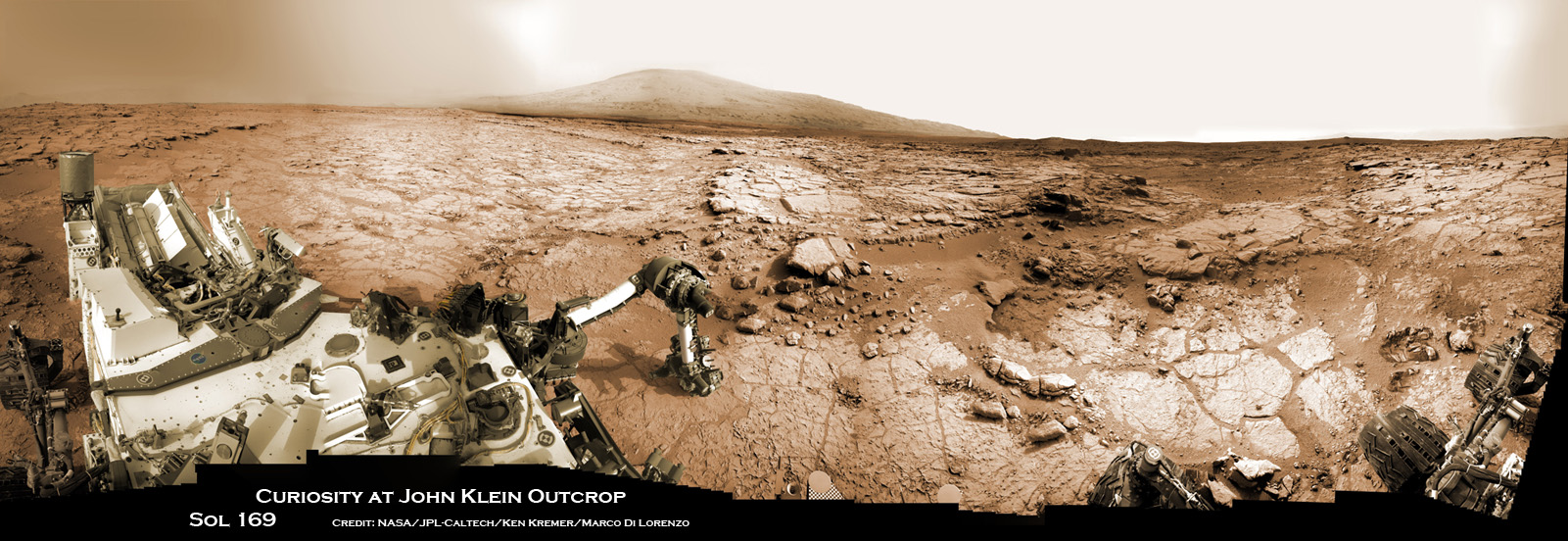
Curiosity_drillingsCuriosity has just finished analyzing the samples collected from its first drilling operation at the John Klein rock formation in Yellowknife Bay. And what it found confirms what scientists have suspected about the Red Planet for some time. Contained within grey the dust collected from the rock’s interior, the rover discovered some of the key chemical ingredients necessary for life to have thrived on early Mars billions of years ago.

After running the two aspirin-sized samples through its two analytical chemistry labs (SAM and CheMin), the Mars Science Laboratory was able to identify the presence of carbon, hydrogen, oxygen, nitrogen, sulfur and phosphorus in the sample – all of which are essential constituents for life as we know it based on organic molecules.

Curiosity_chemWhat’s more, according to David Blake – the principal investigator for the CheMin instrument – a large portion of the sample was made up of clay minerals, which in itself is telling. The combined presence of these basic elements and abundant phyllosilicate clay minerals indicate that the area was once home to a fresh water environment, one where Martian microbes could once have thrived in the distant past.

By confirming this, the Curiosity Rover has officially met one of its most important research goals – proving that all the elements necessary for life to flourish were once present on Mars. And when you consider that the Curiosity team was not expecting to find evidence of phyllosilicate minerals in the Gale Crater, the find was an especial delight. Based on spectral observations conducted from orbit, phyllosilicates were only expected to be found in the lower reaches of Mount Sharp, which is Curiosity’s ultimate destination.

Curiosity-Sol-169_5C1b_Ken-KremerSo what’s next for Curiosity? According to John Grotzinger, the Principal Investigator for the Mars Science Laboratory, Curiosity will remain in the Yellowknife Bay area for several additional weeks or months to fully characterize the area. The rover will also conduct at least one more drilling campaign to try and replicate the results, check for organic molecules and search for new discoveries.

Source: universetoday.com

NASA’s 3D Printed Moon Base

ESA_moonbaseSounds like the title of a funky children’s story, doesn’t it? But in fact, it’s actually part of NASA’s plan for building a Lunar base that could one day support inhabitants and make humanity a truly interplanetary species. My thanks to Raven Lunatick for once again beating me to the punch! While I don’t consider myself the jealous type, knowing that my friends and colleagues are in the know before I am on stuff like this always gets me!

In any case, people may recall that back in January of 2013, the European Space Agency announced that it could be possible to build a Lunar Base using 3D printing technology and moon dust. Teaming up with the architecture firm Foster + Partners, they were able to demonstrate that one could fashion entire structures cheaply and quite easily using only regolith, inflatable frames, and 3D printing technology.

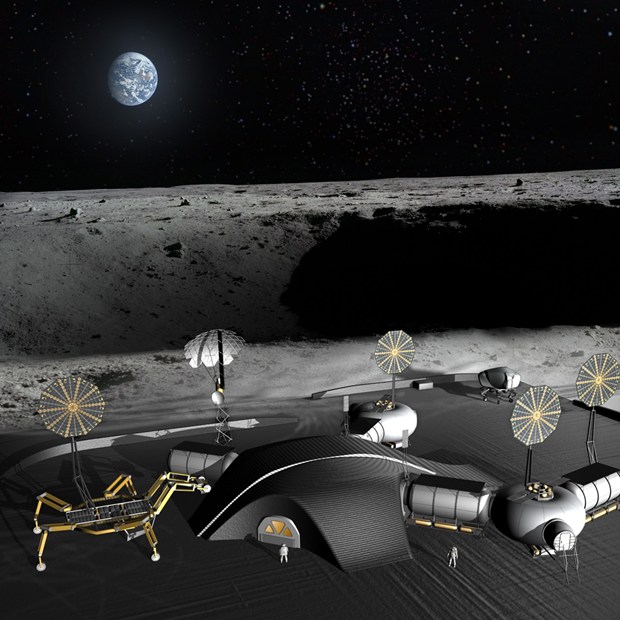
sinterhab2_1And now, it seems that NASA is on board with the idea and is coming up with its own plans for a Lunar base. Much like the ESA’s planned habitat, NASA’s would be located in the Shackleton Crater near the Moon’s south pole, where sunlight (and thus solar energy) is nearly constant due to the Moon’s inclination on the crater’s rim. What’s more, NASA”s plan would also rely on the combination of lunar dust and 3D printing for the sake of construction.

However, the two plans differ in some key respects. For one, NASA’s plan – which goes by the name of SisterHab – is far more ambitious. As a joint research project between space architects Tomas Rousek, Katarina Eriksson and Ondrej Doule and scientists from Nasa’s Jet Propulsion Laboratory (JPL), SinterHab is so-named because it involves sintering lunar dust: heating it up with microwaves to the point where the dust fuses to become a solid, ceramic-like block.

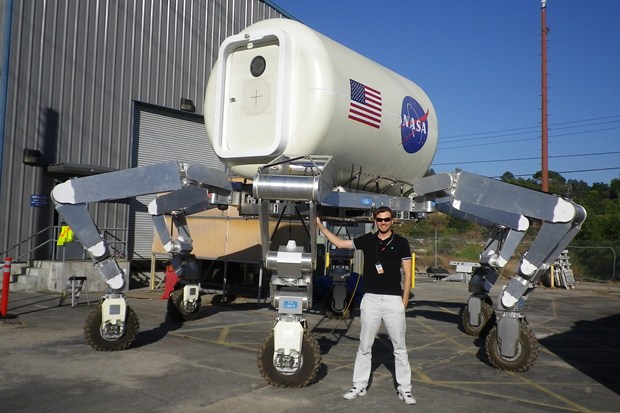
This would mean that bonding agents would not have to be flown to the Moon, which is called for in the ESA’s plan. What’s more, the NASA base would be constructed by a series of giant spider robots designed by JPL Robotics. The prototype version of this mechanical spider is known as the Athlete rover, which despite being a half-size variant of the real thing has already been successfully tested on Earth.

athlete_robotEach one of these robots is human-controlled, has six 8.2m legs with wheels at the end, and comes with a detachable habitable capsule mounted at the top. Each limb has a different function, depending on what the controller is looking to do. For example, it has tools for digging and scooping up soil samples, manipulators for poking around in the soil, and will have a microwave 3D printer mounted on one of the legs for the sake of building the base. It also has 48 3D cameras that stream video to its operator or a remote controlling station.

The immediate advantages to NASA’s plan are pretty clear. Sintering is quite cheap, in terms of power as well as materials, and current estimates claim that an Athlete rover should be able to construct a habitation “bubble” in only two weeks. Another benefit of the process is that astronauts could use it on the surface of the Moon surrounding their base, binding dust and stopping it from clogging their equipment. Moon dust is extremely abrasive, made up of tiny, jagged morcels rather than finely eroded spheres.

sinterhab3Since it was first proposed in 2010 at the International Aeronautical Congress, the concept of SinterHab has been continually refined and updated. In the end, a base built on its specifications will look like a rocky mass of bubbles connected together, with cladding added later. The equilibrium and symmetry afforded in this design not only ensures that grouping will be easy, but will also guarantee the structural integrity and longevity of the structures.

As engineers have known for quite some time, there’s just something about domes and bubble-like structures that were made to last. Ever been to St. Peter’s Basilica in Rome, or the Blue Mosque in Istanbul? Ever looked at a centuries old building with Onion Dome and felt awed by their natural beauty? Well, there’s a  reason they’re still standing! Knowing that we can expect similar beauty and engineering brilliance down the road gives me comfort.

In the meantime, have a gander at the gallery for the proposed SinterHab base, and be sure to check out this video of the Athlete rover in action:

Source: Wired.co.uk, robotics.jpl.nasa.gov

Remembering Douglas Adams

the-hitchhiker-s-guide-to-the-galaxy-original2Yesterday was the birthday of the late, great science fiction writer and luminary known as Douglas Adams. Had he not passed away in 2001, at the age of forty-one, he  would have been celebrating his sixty-first birthday. Best remembered for his series The Hitchhikers Guide to the Galaxy, Adams greatest accomplishment was arguably his ability to weave comedy and science fiction into one!

And that’s not the easiest thing to do in a genre like science fiction, which is noted for being often bleak, dystopian, or highly technical. Sure, there was plenty that was unintentionally funny, especially in Douglas’ time, but Adams demonstrated that science fiction writing could be both high-minded – incorporating real science and galactic exploration – and irreverent.

So I hope people will join me in wishing the man a belated happy birthday! Though I learned about it too late to acknowledge it on time, I’m sure he wouldn’t mind. The man did have a rich sense of humor, after all!

Biography:
Douglas_adams_portrait_croppedBorn in Cambridge, England in 1952, Adams parents moved to London when he was still a toddler. They divorced five years later, and Adams spent his formative years with his mother in Brentwood, east of London. Receiving his education from the privately run Brentwood School, he was noted for being unusually tall, he also stood out because of his exceptional ability at creative writing.

Some of his earliest writing was published at the school, in the town publication The Brentwoodian, or the school magazine Broadsheet. He also designed the cover of one issue of the latter, and had a letter and short story published nationally in The Eagle, the boys’ comic, in 1965. On the strength of a bravura essay on religious poetry that discussed the Beatles and William Blake, he was awarded a place at St John’s College, Cambridge to read English in 1971 and graduated two years later.

While there, he also attempted to ply his comedic skills and applied to join the Footlights, an invitation-only student comedy club. While he waited to join, he began writing and performing in revues with Will Adams (no relation) and Martin Smith, forming a group called “Adams-Smith-Adams”. By 1973, he managed to become a member of the Footlights until he graduated and moved back to London.

At this point of his life, he was determined to break into television and radio as a writer. This resulted in a brief collaboration between him and Monty Python’s Graham Chapman, and a series of appearances by Adam’s on Flying Circus. At the time though, his writing style did not seem suited to radio or TV comedy, and he was forced to work odd jobs to make ends meet. However, Adams never stopped writing and continued to work towards his masterpiece.

The Hitchhikers Guide to the Galaxy:
HitchHikers-Guide-to-the-Galaxy,-The_8Hitchhiker began in 1977 as a pitch to the BBC radio as a concept for a science-fiction comedy radio series. According to Adams, the idea for the title occurred to him while he lay drunk in a field in Innsbruck, Austria, gazing at the stars. He was carrying a copy of The Hitchhiker’s Guide to Europe, and it occurred to him that “somebody ought to write a Hitchhiker’s Guide to the Galaxy“.

At the same time, Douglas worked on novelizations of his concept, which made producing the series all the more difficult. Not a prodigious writer, Adams was apparently the kind of man who had to be forced to meet deadlines and complete what he started. Despite the difficulties he had, Adams wrote five novels in the series, published in 1979, 1980, 1982, 1984, and 1992.

For the rest of his life, Adams made several attempts to get Hitchhiker adapted into a movie. He did not succeed in his lifetime, but in 1981, the radio series became the basis for a BBC television mini-series and Disney bought the rights in 1998. It was not until 2005, four years after his death, that the screenplay finally got a posthumous re-write by Karey Kirkpatrick, and the resulting movie was released.

hitchhikers_movieOther Works:
Despite Hitchhikers immense popularity, it was by no means Adam’s only literary creation. During the 1980’s, Adams and Mark Carwardine, a noted zoologist, collaborated on a series of BBC broadcasts known as Last Chance to See where they would travel to foreign countries and speak of endangered species.

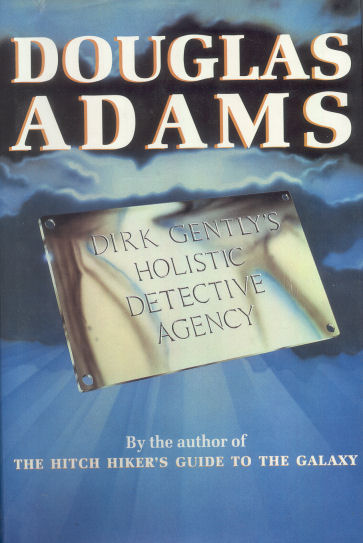
Dirk_Gently_UK_front_coverIn between all this, he wrote the novel Dirk Gently’s Holistic Detective Agency, a humorous detective story which was relesead in 1987. Adams himself described the book as “a kind of ghost-horror-detective-time-travel-romantic-comedy-epic, mainly concerned with mud, music and quantum mechanics.” A sequel, entitled The Long Dark Tea-Time of the Soul, was published a year later. These were entirely original works, Adams’s first since So Long, and Thanks for All the Fish.

In between all of this, Adams also worked with the BBC as a writer on Doctor Who. Altogether, he wrote three Doctor Who serials starring Tom Baker as the Doctor. These included the episodes “The Pirate Planet” (Season 16), “City of Death” (with producer Graham Williams, from an original storyline by writer David Fisher), and Shada (only partially filmed and never filmed).

Legacy:
Adams died in 2001 as a result of a degenerative heart condition and was buried in Highgate Cemetery, North London. After eighteen years of writing, publishing, and broadcasting, he left an indelible mark on science fiction and popular culture. The holiday known as Towel Day – in honor of the sage advice contained in the Guide – takes place every May 25th.

heartofgold_ext2And despite his irreverence and characteristic wit, Adams is also remembered for exploring scientifically plausible ideas. For example, the Heart of Gold – the ship featured in Hitchhiker – is powered by the “Infinite Improbability Drive”. This is an FTL drive system which is based in a particular aspect of quantum theory. Chaos theory also plays an important role in Dirk Gently’s Holistic Detective Agency, where everything, even elements which seem superfluous, turn out to be interconnected with the plot.

towel_dayThe words “Don’t Panic”, also advice contained within the Guide, and the significance thereof are known by any self-respecting geek. Concepts like the “Babel Fish”, the living translation device one inserts in their ear, are also commemorated with programs like Yahoo’s translation program of the same name. Also, in 2011, over 3000 people took part in a public vote to choose the subjects of People’s Plaques in Islington. Adams received 489 votes, and a plaque is due to be erected in his honour.

And just yesterday, to mark his 61st birthday, Google celebrated with an interactive “Google Doodle” which featured a stylized version of the Heart of Gold’s computer console. In addition, the BBC has the text-based Hitchhiker’s Guide to the Galaxy game available to play on their website here. So if you’ve got time and feel like doing something fun to commemorate Adams, just click on the links provided and enjoy!

RIP Douglas Adams. You were a rich soul and a witty, funny, and brilliant man. Like so many before you, you were snatched up too soon and didn’t live long enough to get your proper due!

Powered by the Sun: The Future of Solar Energy

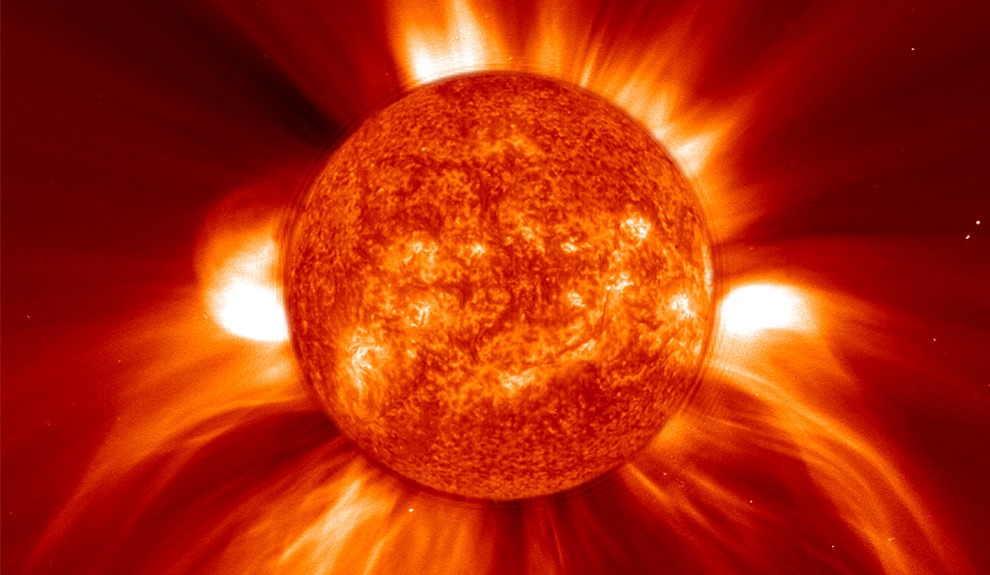
Magnificent CME Erupts on the Sun - August 31Researchers continue to work steadily to make the dream of abundant solar energy a reality. And in recent years, a number of ideas and projects have begun to bear fruit. Earlier this year, their was the announcement of a new kind of “peel and stick” solar panel which was quite impressive. Little did I know, this was just the tip of the iceberg.

Since that time, I have come across four very interesting stories that talk about the future of solar power, and I feel the need to share them all! But, not wanting to fill your page with a massive post, I’ve decided to break them down and do a week long segment dedicated to emerging solar technology and its wicked-cool applications. So welcome to the first installment of Powered By The Sun!

spaceX_solararrayThe first story comes to us by way of SpaceX, Deep Space Industries, and other commercial space agencies that are looking to make space-based solar power (SBSP) a reality. For those not familiar with the concept, this involves placing a solar farm in orbit that would then harvest energy from the sun and then beam the resulting electricity back to Earth using microwave- or laser-based wireless power transmission.

Originally described by Isaac Asimov in his short story “Reason”, the concept of an actual space-based solar array was first adopted by NASA in 1974. Since that time, they have been investigating the concept alongside the US Department of Energy as a solution to the problem of meeting Earth’s energy demands, and the cost of establishing a reliable network of arrays here on Earth.

Constructing large arrays on the surface is a prohibitively expensive and inefficient way of gathering power, due largely to weather patterns, seasons, and the day-night cycle which would interfere with reliable solar collection. What’s more, the sunniest parts of the world are quite far from the major centers of demand – i.e. Western Europe, North America, India and East Asia – and at the present time, transmitting energy over that long a distance is virtually impossible.

NASA "Suntower" concept
NASA “Suntower” concept

Compared to that, an orbiting installation like the SBSP would have numerous advantages. Orbiting outside of the Earth’s atmosphere, it would be able to receive about 30% more power from the Sun, would be operational for almost 24 hours per day, and if placed directly above the equator, it wouldn’t be affected by the seasons either. But the biggest benefit of all would be the ability to beam the power directly to whoever needed it.

But of course, cost remains an issue, which is the only reason why NASA hasn’t undertaken to do this already. Over the years, many concepts have been considered over at NASA and other space agencies. But due to the high cost of putting anything in orbit, moving up all the materials required to build a large scale installation was simply not cost effective.

spacex-dragon-capsule-grabbed-by-iss-canadarm-640x424However, that is all set to change. Companies like SpaceX, who have already taken part in commercial space flight (such as the first commercial resupply to the ISS in May of 2012, picture above) are working on finding ways to lower the cost of putting materials and supplies into orbit. Currently, it costs about $20,000 to place a kilogram (2.2lbs) into geostationary orbit (GSO), and about half that for low-Earth orbit (LEO). But SpaceX’s CEO, Elon Musk, has said that he wants to bring the price down to $500 per pound, at which point, things become much more feasible.

And when that happens, there will be no shortage of clients looking to put an SBSP array into orbit. In the wake of the Fukushima accident, the Japanese government announced plans to launch a two-kilometer-wide 1-gigawatt SBSP plant into space. The Russian Space Agency already has a a working 100-kilowatt SBSP prototype, but has not yet announced a launch date. And China, the Earth’s fastest-growing consumer of electricity, plans to put a 100kW SBSP into Low-Earth Orbit by 2025.

space-based-solarpowerMost notably, however, is John Mankins, the CTO of Deep Space Industries and a 25-year NASA vet, who has produced an updated report on the viability of SBSP. His conclusion, in short, is that it should be possible to build a small-scale, pilot solar farm dubbed SPS-ALPHA for $5 billion and a large-scale, multi-kilometer wide power plant for $20 billion. NASA’s funding for SPS-ALPHA dried up last year, but presumably Mankins’ work continues at Deep Space Industries.

Cost and the long-term hazards of having an array in space remain, but considering its long-term importance and the shot in the arm space exploration has received in recent years – i.e. the Curiosity Rover, the proposed L2 Moon outpost, manned missions to Mars by 2030 – we could be looking at the full-scale construction of orbital power plants sometime early in the next decade.

And it won’t be a moment too soon! Considering Earth’s growing population, its escalating impact on the surface, the limits of many proposed alternative fuels, and the fact that we are nowhere near to resolving the problem of Climate Change, space-based solar power may be just what the doctor ordered!

Thanks for reading and stay tuned for the next installment in the Powered By The Sun series!

Source: Extremetech.com

The Walking Dead – Season Three, Episode 13

the_walking_deadHappy Monday Morning all! Nice weekend? Good, because it’s time to catch up on this weeks episode of The Walking Dead.

Last week, we got something of a “bottle episode” as Rick, Carl and Michonne went back into the Grimes old stomping grounds to pick up supplies and ended up running into an old friend. It seemed that Morgan, the man who saved Rick after he wandered back from the hospital, had fortified himself in the town and was waging a one-man guerrilla war against the Walkers. He had also lost his son Duane since last they met, and had gone a little batty as a result.

And despite his best efforts, Morgan would not come back to the prison with them since he believed that it was only a matter of time before Rick and his people would die, either at the hands of the Walkers or someone else. Letting them go with their share of guns and ammo, he said goodbye to them, and they returned to the prison to deal with their main problem – the Governor and his army operating out of Woodbury.

Which brings us to this week’s episode, where Rick and the Governor are meeting on neutral ground to hash things out.

Arrow on the Doorpost:
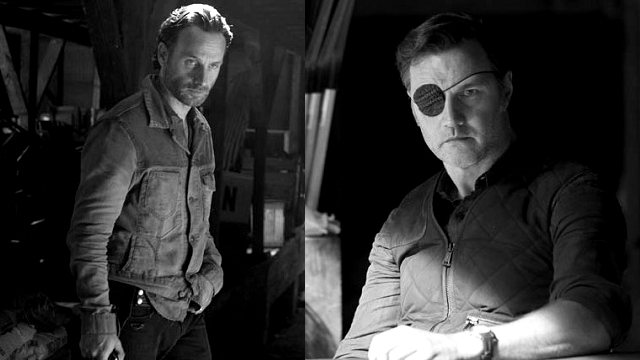
wd3_arrowThe episode opens with Rick, Daryl and Hershel arriving at what appears to be an abandoned silo. After doing a little recon, Rick finds his way into a large warehouse where someone has set up a table on top a raised platform. Making his way to it, the Governor appears and tells Rick they “have a lot to talk about”. After a brief stand-off, they disarm and get down to business (but of course, we see that the Governor has a second gun strapped to the table).

Another car arrives shortly thereafter carrying Caesar, Milton and Andrea. Andrea is surprised to hear that the Governor is already inside and goes in while the others wait out front. Apparently, she arranged the meeting and offered Rick a compromise where they would divide the land between them. However, the Governor rejects it and tells her to leave.wd3_arrow4

Outside, the two camps wait and endure a tense standoff until they are set on by some Walkers and begin taking them out. This gives Daryl and Caesar a chance to do a little “male bonding” as both take out their share with Andreas help. After killing their share, they reflect on how war seems inevitable, and neither one is too crazy about the idea.

Milton and Hershel begin to talk as well, with Milton taking an interest in Hershel’s amputation and how it saved him from being infected. And eventually, Andrea begins to talk to Hershel and asks about Maggie, whether it was true that Governor tried to rape her. Knowing the truth now, she realizes she can’t go back to Woodbury. Hershel invites her to come back to the prison and to her family.
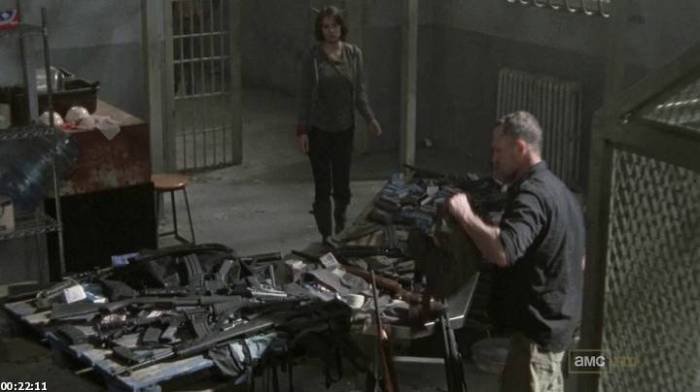
jpegBack at the prison, Glenn and the others are forced to content with Merle, who keeps insisting they go to the talks to kill the Governor. Glenn refuses, which prompts Merle to try and get out on his own. After Glenn, Maggie and Michonne restrain him, he tries to appeal to Michonne’s desire for vengeance. However, she refuses to put Andrea at risk and tells him he’s on his own. Afterwards, Glenn and Maggie finally make up after and decide to blow off holding watch on the field to go have sex.

After talking things over with some whiskey, the Governor finally gives Rick his terms. In exchange for Michonne, he will leave them alone. Rick doesn’t believe it will end there, but the Governor gives him two days to think it over and tells him to return to the silo with his answer. The meeting ends and he leaves with his people, and Andrea goes with him. All parties head back to their respective homes.

wd3_governor1However, upon his return to Woodbury, the Governor reveals his true intentions. He orders Caesar to set up an ambush around the meeting place so they can kill Rick and anyone he can be expected to bring. Milton is surprised and objects, but the Governor insists that its the only way. Sooner or later, they will have to deal with Rick since he doesn’t believe they can ever live side by side.

At the prison, Rick tells his own version of the story: that the Governor wants the prison and all of them dead. The camp is divided, with Merle and Michonne thinking they should strike first while Carol and Hershel think they should take their chances on the road. However, he is willing to trust Rick’s leadership and stay and fight, as long as they are together. Rick tells him what the Governor really wanted, and Hershel agrees its unacceptable.

It’s official. The two camps are going to war!

Summary:
Once again, I have to say I was happy with what was arguably a pacing episode. It managed to build up the suspense, let us know what’s going to come, and provide some breathing room while we build to the big climax. For some time now, its been obvious that an all-out war between the two sides will be happening, but many pieces needed to fall into place before that could happen. This episode was good in that it established much of that and hinted at where others pieces are going to fall.

And like the last episode it was thematically consistent. I liked how the show cut between the Governor and Rick dealing inside and the grunts talking outside. At once we can see two hardened leaders talking about the undesirability of conflict and how far they will go to protect their people, while their soldiers realize how much they have in common and also confess that a fight is not something they would want.

All the while, its clear that said conflict is inevitable. In a world where two sides have the exact same interests – i.e. survival and protecting their own – it would seem that peace and cooperation are the only way. And yet, that is the one thing they cannot hope to achieve, simply because the need to survive dictates that they destroy each other. As always with TWD, the greatest enemy is not the zombies, but your fellow man.

But I think the best aspect of this latest episode is how it is building towards the big finish. We have only three episodes to go this season and some key factors need to be established before it can end. Namely, there’s position of Andrea in all this, the involvement of Tyreese and his gang, and how Rick and his people plan to confront the Governor and his army and win.

At this point, its clear that Rick and the prison camp stand a better chance now of thwarting the Governor and his army than before. With Merle, Michonne, a small stockpile of guns and the prison walls, they have certain advantages, at least if they are attacked. But of course, the Governor has more people, more resources, and the freedom to use them. In any prolonged fight, he is sure to win.

Which brings up Andrea and Tyreese’s group. As a friend of mine suggested (hi Khaalidah!), she believes the Tyreese group is part of a double-cross. After Rick kicked them out, we didn’t see or hear from them at all until they came to Woodbury, hats in hand and looking for refuge. She thought it was possible that Glenn made a deal to have them do a little spying. However, if the previews for next week’s episode are any indication, they were genuine in their desire to become part of Woodbury, but Andrea will set them straight.

So between the Governor’s planned ambush, Milton and Andrea’s desire to stop him, and Tyreese and his gang’s assistance, its entirely possible we’re building towards a big confrontation that will only be won with the help of some last minute help from those people who are closest to the Governor. That’s what I’m predicting at this point. And even though it means violating the comic book material somewhat, it’s what I’d do if I were one of the writers.

It might be premature and hopeful of me to predict a happy ending, but I think if there’s one thing this show can be counted on, its to keep going and not let things get too bloody. Unlike the comic, which really didn’t pull punches and had a bigger death toll, the show has been looking to strike a balance between grimness and hopefulness, where the characters are constantly looking for a normal life and are actually managing to get closer to it. But of course, there’s always a giant cost involved, so expect plenty more death!

Three episodes to go!

Happy 2nd Anniversary, Stories by Williams!

happy-anniversaryI got a friendly little notification this morning. As it turns out, it was two years, twenty four months, and one-hundred and four weeks ago that I started this blog and began sharing my writing and inane thoughts to the general public. My apologies public, but we’ll get to your grievances later. Right now, I want to put those two years into a perspective using a few numbers I gathered.

As the song from Rent says “Five hundred, twenty-five thousand, six hundred minutes… how do you measure, measure a year?” Well, up that to two years and you’ve got one-million, fifty-one thousand, two-hundred minutes, and the following numbers, according to my latest stats check. In the past two years I’ve managed to gather:

  • 238,972 hits
  • 8,778 likes
  • 4,461 comments
  • 977 posts
  • And most importantly of all, 1,945 followers!

I have to say, those are some nice numbers and they make me smile! And so does the prospect of doing this for the foreseeable future. There’s still a moment that I feel I’m building towards, some kind of climax this site and what I want to accomplish with it hasn’t quite met yet. Don’t know what that is yet, but I’ll keep you posted!

In the meantime, I’m pretty happy with how this site has worked out for me. People always start writing with a purpose, and they take all that public once they’ve decided they want to share it. As for me, I guess I just wanted to say something relevant that mattered to people, and to know that the message was received. Thanks for being on the receiving end folks!  And please feel free to keep tuning in! The show’s just getting started…

fireworks2

Movie Trailer Monday: Star Trek Into Darkness!

StartrekintodarknessposterHey guys, thought I’d get into a new habit around here and start posting previews for new movies on a regular basis. Might prove difficult to find a new preview every week, but the way I see it, people like a routine they get in on. And what’s nicer on a Monday than catching a trailer that makes you excited for an upcoming flick. Tell me that doesn’t beat the Monday blahs!

And here is the latest trailer from JJ Abram’s upcoming Star Trek sequel. Unlike the first which was resoundingly dark (had to be with a name like Into Darkness!) and focused on Benedict Cumberbatch – who plays bad guy Khan – this one is more centered on Kirk. And what’s also nice is the mention of a future city other than San Fransisco. And of course, plenty of action too!

Enjoy, and see you next Monday!

Lobby Congress to Illegalize the use of Surveillance Drones

X-47BCall me concerned, but some recent news items have made more than a few people frightened that unmanned drones could be peaking in their windows and watching them as they go to work very soon. The first came back in September when US Congress passed the Modernization and Reform Act of 2012 which, among other things, required the Federal Aviation Administration (FAA) to accelerate drone flights in U.S. airspace.

A number of US law enforcement agencies have also adopted the use of drones for the sake of police work. Amongst them are the Miami-Dade Police Department, the Texas Department of Public Safety, and the Alameda Sheriff’s Department is likely to follow. The Seattle Police Department also maintained a small fleet as well, but grounded them due to public outcry and concerns over privacy.

As it stands, the Obama Administration has already adopted legislation that prevents drones from being armed and would demand that law enforcement agencies register drones, adopt privacy polices, and only use them in criminal matters for which warrants would be required.

https://petitions.whitehouse.gov/petition/make-illegal-use-unmanned-aerial-vehicles-sake-surveillance-within-us/Fqq2C9Wb