Dystopia in Popular Culture

Picking up where I left off last time, I thought I’d get into some examples of how dystopian fiction has influenced popular culture. And given all the feedback I got on my previous post, I also wanted to incorporate some suggested titles as well. But, just to be clear, I still haven’t read Hunger Games, so please don’t ask about it!

Alright, so last time, I mentioned just about every examples of dystopian literature I could find. From the earliest examples of Candide and Gulliver’s Travellers, onto the more modern interpretations of The Time Machine and We, and culminating with classics like BNW and 1984, I essentially ended before I could get into how these novels have had an influence on film and other media. In addition to inspiring the written words, these classics have inspired an entire culture of iconography, symbolism and motifs.

Not surprising, really. Every work of dystopian fiction and satire has sought to create images in the reader’s mind, using highly specific descriptions in order to paint a scene and inspire the right mood. Whenever these novels have been adapted to film, or directors were simply trying to convey similar themes, the task of properly conveying it all visually has always been a hefty one. The same is true for graphic novels and any other visual medium. So today, just for fun, and perhaps to complete my romp through the realm of this inspired genre, here are some examples of dystopia in modern media:

Blade Runner:
Granted, Blade Runner was based on Philip K Dick’s Do Android Dream of Electric Sheep?, a dystopian story in some respects, but not in the same way that the movie was. Whereas the novel took place in a post-apocalyptic Los Angeles (circa 2019) which is sparsely populated and where a living animal is seen as a status symbol. In the movie, the year and location are the same, but the setting is starkly different. Here, it is a stuffy, polluted, mega-city made up of massive skyscrapers and giant animated billboards, where the streets are dirty and packed with people who spoke a strange dialect known as Cityspeak (check out my post on Cityspeak for on that).

And what made it all so awesome, aside from the plot, was the attention to detail. Director Ridley Scott, the same man who brought us Aliens, brought his usual artistic touch and a team of first-grade set designers to the table. Overall, they produced some pretty awesome concepts, ones which are still being praised to this day. Here are just a few:
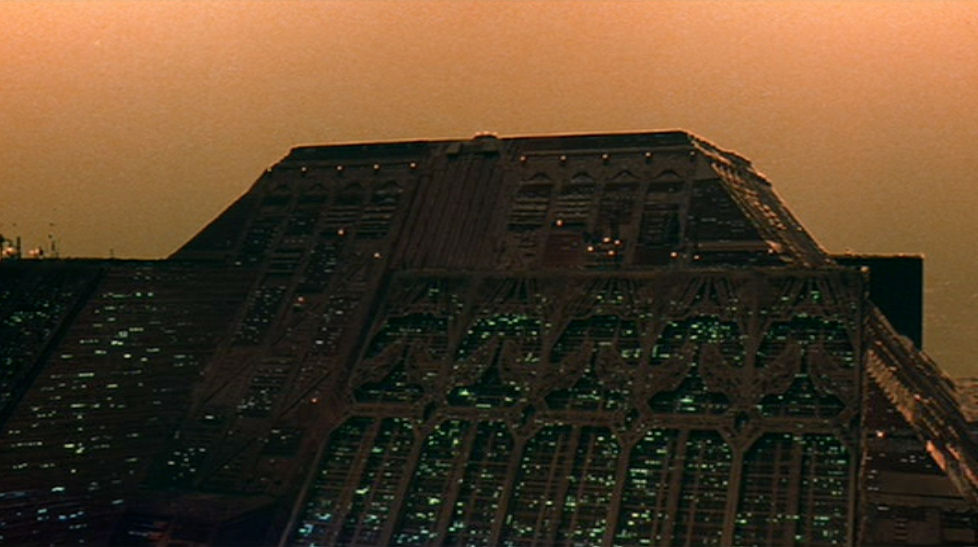
The Tyrell Corp. building, which was kind of the focal point of the movie. Early on, we get a birds-eye view of it as Detective Deckard Cain (Harrison Ford) is being flown there in a Spinner (flying car). Later on, the leader of the Replicant party, Roy Batty, travels there as well seeking answers to some of life’s most basic questions.

For starters, the building is clearly based on a the design of a Ziggurat, the breed of ancient Babylon temple that inspired such legends as the ā€œTower of Babelā€, and which serves as a clear representation for the almost godlike power Tyrell wields. The interior design, with its large columns, soft lighting, candles, an owl (a possible reference to Athena’s owl) and the way Tyrell can block out the sun at will all serve to further illustrate this point. That scene near the end where is dressed in lavish white robes also seemed pretty symbolic, I’d say!

And for those who read 1984, there is a possible encoded reference to the four ministries as well- Truth, Peace, Love, and Plenty – all of which were pyramid-like in design. Coincidence? Who knows? All that matter is when it comes to massive structures that harken back to ancient Egypt and Mesapotamia, the symbolic value is clear. Much like the civilizations that built them, these things stood for power and dominion, both over lesser subjects and the afterlife itself. They were the ruler’s way of achieving immortality by creating something that embodied their power and would stand the test of time. As Shelley said in his poem ā€œOzymandiasā€: ā€œLook on my works, ye mighty, and despair!ā€

And when it comes right down to it, this old-world kind of mentality, updated for the modern age, is indispensable to any dystopian story: Absolute power, wielded by the few over the many and represented in conspicuous and obvious ways! In many cases, it comes in the form of totalitarian governments (a la The Party) who runs things with an iron fist and build massive government buildings to remind everyone of who’s in charge. But in other cases, it takes the form or corporate dominance, where the wealthy rule society like feudal barons while the rest live like serfs. And much like their bureaucratic peers, they choose to lord this by building lavish buildings to themselves and covering themselves with ornate symbols!
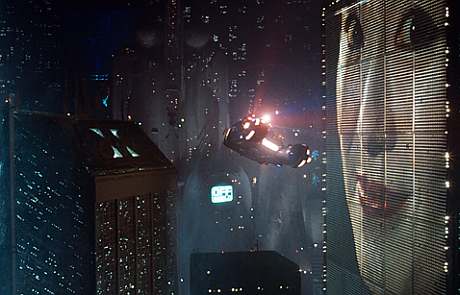
Another trademark bit of dystopian set design were the massive skyscrapers, complete with giant video-billboards. No doubt, these too were designed to give the impression of the control corporations had over the people of LA in the future. As if regular sized billboards ads weren’t enough, (or televised, print, bench, flier, blimp, and radio ads) now it seemed that corporate monopolies were splastering their logo’s on screens the size of buildings!

And just to make it realistic, Ridley Scott and his designers were also sure to use logos that were already big in the early 80′s and seemed destined to get bigger – Atari, Coca Cola, Pan Am Air, Cuisinart, Bell System. But interestingly enough, all of these companies suffered heavy losses after the movie’s release. The phenomena came to be known as the ā€œBlade Runner Curseā€. Strange, one would think audiences began associating them with dark imagery or something ;)

But personally, I think one of the most effective aspects of the movie’s look and feel came through in the construction of the streets. Here, Scott’s design team made sure that every shot was crammed full of people who whore plastic jumpers, dark glasses, cool headgear, and carried what looked like umbrellas with neon handles. Then came the street vendors who peddled food or exotic pets in the same neighborhoods, facades that were ashen grey in color, and all kinds of neon signs written in various languages. It painted quite the scene, one which can only be described by the words ā€œFuture Noireā€.

Brazil:Ā 
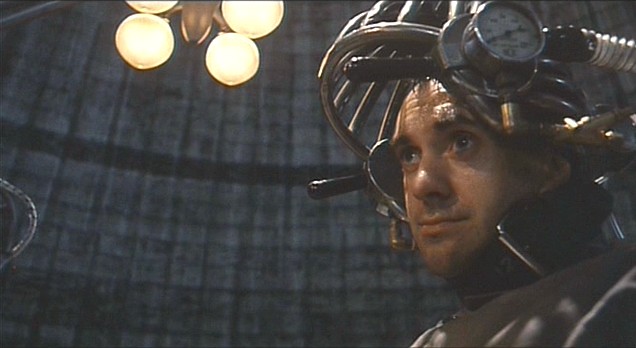
Directed by Terry Gilliam, an old-time member of the comedy troupe Monty Python and director of such movies as The Adventures of Baron Munchausen, The Fisher King and 12 Monkeys, Brazil was a rather humorous take on the classic 1984. In it, we are presented with a dystopian society that is ruled by a totalitarian regime, but which is buffoonish and incompetent rather than exacting and brutal.

In addition, the people in this world are also overly-dependent on machinery which is rather unreliable and poorly maintained. And last of all, there is the main character ofĀ Sam Lowry, a low-level government employee who works in a mind-numbing government job, lives in a small apartment, and is having prescient dreams about a woman and a man in mask who is torturing him.

The movie shared many plot and thematic elements with 1984, but much of its genius comes through in the set design and direction. Given that the aim of the movie was to present a world in which the machinery is as undependable as the bureaucracy, Gilliam decided to go with a look that would call to mind the kind of over-the-top aesthetics of past sci-fi films. While everything was admittedly grey, dark, and shot in wide and tilted angles, there was also a sort of comic, retro feel to the whole thing. This helped to establish the central premise of the movie, in which incompetence and mind-drudging inefficiency were what was destroying humanity, not a specific agenda.

In addition, Gillian had much to say about artifice and vanity in this film. Lowry’s mother, who plays an important role in the plot, is obsessed with plastic surgery which she hopes will make her look younger. Towards the end of the movie, Lowry dreams that his mother is attending the funeral of a friend who died as a result of too many invasive procedures. And in what can only be described as an moment of oedipal confusion, his mother even looks like Jill, the much younger woman he has fallen in love with!

An interesting take on 1984 isn’t it? Rather than following a philosophy like the one espoused by O’Brien, where the Party wields absolute control over reality and people’s minds, want to eliminate all emotion except hatred, and has destroyed any activities that do not serve their interests, the totalitarian regime in Brazil is instead motivated by laziness and a desire to cover its own ass. Not being wrong literally means more to them than the lives of their citizens. What better commentary is there on a bureaucratized society?

Judge Dredd:
Yes, the movie didn’t so well, and the script and plot were so simplistic that Stallone himself called it a ā€œno-brainerā€. But that doesn’t change the fact that the source material is actually one of the better graphic novels in existence, especially when it comes to depth and irony. Set in a post-apocalyptic world of the not-too-distant future, the comics take place for the most part inside ā€œMega City Oneā€, one of several megalopolis’s that have sprung up in the US after a nuclear war which left it and Soviet Union utterly devastated.

Within this city, just about everything is automated and unemployment is almost universal. Every city block contains over fifty-thousand people, amounting to a population of about 400 million people per city. Due to overcrowding, massive unemployment and uncontrollable violence, the leaders of this future society created a quasi-fascist justice system whereby individual ā€œStreet Judgesā€ (policemen) were charged with dispensing judgement and punishment on site. This had a stabilizing effect on society, but the problems remain…
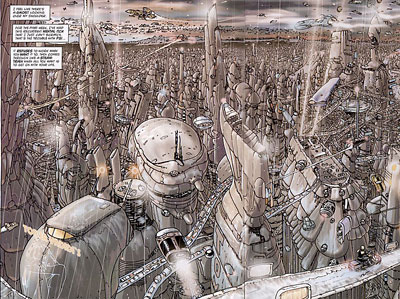
Automatically, one can see a few things at work here. For starters, there’s the Hobbesian idea of man in the state of nature; how because of nuclear war, life became ā€œnasty, brutish and shortā€ and a tyrannical system was needed to put things back in order. In addition, there’s the whole ā€œwho polices the police?ā€ side of things, where audiences naturally fear that the judges will abuse their power or fight to the death to hang onto it.

And last, there is the very real sociological concept of the ā€œmegalopolisā€, the Northeastern mega city running from Virginia to Maine which was originally coined by French geographer Jean Gottmann. In the course of the comic’s history, it is made clear that Mega City One was not actually designed, but grew out of natural urban sprawl that predated the nuclear war. It was only after the war that it became a self-contained place where automation, unemployment and chaos become so rampant.
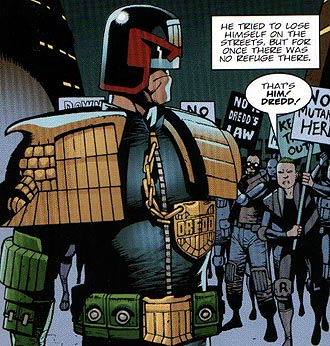
Now one might also get the impression that this was all meant to illustrate some preachy, ā€œwe made a mistakeā€ kind of message (which is in fact what happened in the movie). But in truth, these issues are presented with a fair degree of subtly and irony in the graphic novel.

Knowing full well how his audience would react to fascist symbols and ideology, John Wager (creator) presented readers with a story that is loaded with both. For starters, the Judge’s symbol is an eagle, which bears a striking resemblance to the Nazi black eagle. The Judge’s uniform is also highly ornate and calls to mind the classical imperial motifs of Centurions and Gladiators. And the fact that Dredd’s face is never seen can only be seen as highly indicative. He’s a faceless law-giver, much like Stormtroopers or the SS.

What’s more, the people who sport these symbols and preach these values are presented as heroes. Judge Dredd, for all intents and purposes, is a social fascist who is bereft ofĀ  sentimentality, doubt or remorse over what he does. Unlike the other Judges, there’s no crime he won’t ignore, and he never stops for more than ten minutes at a time to rest in a sleep chamber, then he’s back on the job. He also has little sympathy for people who believe in enlightened reform or who criticize the Street Judges for their abuses of power.

The purpose of this always seemed to be for the sake of ironic social commentary. Rather than condemning the Judges and the system they represent (or endorsing them) we are meant to see how – under the right circumstances – something like this could very well happen!

THX 1138:
You know, its movies like this that remind us all that there was a time that George Lucas had talent, when he cared about thing like plots and inspired story-telling, and not special effects and merchandizing. But I’ll leave my riffs about the Star Wars prequels for another day. Right now, I will admit that there is plenty about this directorial debut worth praising, and not the least of which was the faithful dystopian tone it struck.
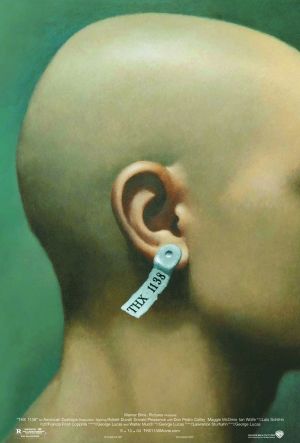
Set in a dystopian future where the human race is required by law to take drugs that suppress emotion and sexual desires, are controlled by android police, and all inhabitants worship a godlike being known as OMM 0910, the story is clearly a commentary on how rationalization and automation threatened to destroy humanity. In addition, there are clear and obvious parallels to novels like We, Brave New World and 1984.

For example, the people in this future are all given designations instead of names, the state sanctioned religion is reminiscent of Big Brother, and the mandatory use of mind altering drugs calls to mind Soma. And of course, the stark, clinical portrayal of society in the future is very similar to descriptions of the One State and Oceania in We and 1984. And let’s not forget the scene were android police torture and abuse the main character? Tell me that didn’t come directly out of the scenes where Winston was languishing in the Ministry of Love!

And of course the overall moral of the story, that love is precious and will fight the odds against the forces of cold rationality, this too was practically lifted from Orwell’s and Zamyatin ā€˜s classics! This is not a criticism, mind you. If anything, Lucas demonstrated a keen ability to adopt freely from novels and franchises in a way that really worked. Much as he would do with Star Wars just a few years later, he seemed to know where to borrow from and how to put it all together!

The Watchmen:
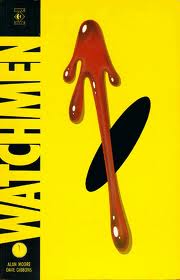
Now this was one of my favorite graphic novels of all time. Lucky for me, it also falls into the realm of dystopian fiction, hence I can talk about it here! In addition to taking place in an alternate universe, the setting is one which is quite dark and gritty. Set in the 1980′s, which is the same period in which it was written, the story is of an alternate reality where the existence of superheroes has caused history to diverge quite a bit from our own. Technically, superheroes have been in existence for many decades, which helps to give the story a real sense of historicity.

However, it was with the service of superheroes in actual wars and government programs that caused history to shift. Beginning with Doctor Manhattan’s intervention in Vietnam and culminating in the development of cheap, renewable energy by Ozymandias (with Manhattan’s help), the Cold War took an unexpected turn. Russia was systematically beaten back to the point where it was becoming desperate and nuclear war seemed inevitable. Meanwhile, society began to decay as war began to occupy more and more of society’s attention and the inner cities were neglected and left to rot.

Told for the point of view of Rorschach, a borderline social fascist with deep-seated issues, the darkness and impending sense of doom really come through! As he investigates the death of the Comedian, a fellow superhero who’s death incites the whole plot, we learn how both he, the Watchmen, and society came to be the way it is. His own tragic story, and that of the Comedians, serves to illustrate how the American Dream failed and cynicism and fear took over.

But of course, the point with dystopian stories is not just to speculate, but to make a point about the time in which it was written. Looked at from this angle, the Watchmen was really telling us about the real world of the 1980′s, a world which had come very far since the post-war era in terms of technological, social and cultural development. And like many other cultural commentaries, a sense of failure and betrayal is at work. What happened to the post-war dream? What happened to the American Dream? How did poverty, crime, licentiousness and cynicism become so rampant? From Rorschach point of view, the Cold War is largely to blame, but so is human nature. And given that he is such a dark and messed up character, I don’t think his opinions were meant to be taken too seriously!

V for Vendetta:
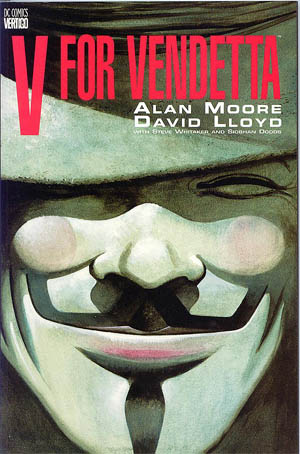
Yet another awesome graphic novel, and one which also inspired a hit movie adaptation. A piece of speculative fiction, this series was produced in the 1980′s and was set in a near-future dystopian England. Over the years, this series’ thematic elements and symbolism have been compared to 1984. However, in truth, the story has much more in common with The Iron Heel and It Can’t Happen Here, by Sinclair Lewis (which should have made my list of dystopian literature, dammit!) In these two novels, especially the latter, a fascist regime takes power by appealing to the people’s sense of moral purity and a desire for order, and in the end the people got more than they bargained for!

But alas, the story in the comic book version involves nuclear war and the transformation of the UK into ā€œlifeboat Britainā€. Given that the movie was made in the early 2000′s, the story had to be updated somewhat. There, the focus shifted to terrorism and the exploitation of fear – echoes of The Handmaids Tale and ā€œLoose Changeā€ there, but I digress. After being passed over by the nuclear holocaust, Britain found itself being flooded with refugees and victims of the war. Bit by bit, authoritarian measures were put into place to deal with the crisis, until eventually, the fascist government of Norsefire took over, and that’s when the real changes happened!

They’re motto: ā€œStrength Through Purity, Purity through Faithā€ pretty much sums it up! In addition to pushing a religious agenda, they were also very much concerned with purging British society or minorities and ā€œundesirablesā€. A police state was put into place where a series of departments – the Eyes, Ears, Mouth, and Hands – were tasked with controlling and monitoring all aspects of society. The Eyes handled surveillance, the Ears listened to people’s by tapping their phones and bugging their homes, the Mouth disseminated propaganda, and the Hands investigated criminal activity. And of course all minorities, be they racial minorities, homosexuals, or just political dissidents, were sent to concentration camps where they were exterminated and experimented on.

Into all this enters the character of V, an anarchist revolutionary who is the product of one camp’s twisted experiments. As a result of their invasive procedures, he became an enigmatic genius/amnesiac with a serious chip on his shoulder who is now on a quest to pay the government back for its crimes. His famous disguise, the Guy Fawkes mask and robes of black and red, are as intrinsic to establishing his character as his monologues and affinity for blowing up government buildings!

Judging by the color scheme alone, one immediately can tell that this man is an anarchist by his use of the color black (or anarcho-syndicalist seeing as how he combines it with red). The mask is a further indication of this, given that Guy Fawkes was a radical who tried to blow up parliament because he believes any vestige of government to be anathema to freedom. So in the end, we can see that this a man who wants to bring down the system and is reaching into Britain’s forgotten past to resurrect the idea of civil liberty.

In contrast, Norsefire’s logo was pretty straightforward too. In the comic, Norsefire represented itself on its ā€œmotivational postersā€ with a set of white wings with a space in the middle that was in the shape of a cross, and behind it lay flames. This is obviously meant to conjure up images of religious propriety, or holy war, and of action, all of which are clear allusions to fascist and religious-right iconography. It was also meant, in my opinion, to call to mind Britain’s Action Party, a fascist political group that played a small but influential role in British political life during the 1970′s.

In any case, one can see several staples of dystopia at work in this series, hence why it earned a loyal following and garnered so much critical acclaim. In addition to the idea of a nuclear war breeding totalitarian regime in Britain (right out of 1984), of ā€œLifeboat Britainā€ giving rise to a fascist regime (which may have helped to inspire the novel Children of Men) and countless allusions to Nazism and how it really could take root in Britain – which calls to mind Orwell’s essay ā€œEngland Your Englandā€ where he basically asserted that it couldn’t.

Final Thoughts:
Wow, this sort of stuff makes me feel head-heavy and tired! It seems that when you get into a subject as rich as dystopian literature and its various offshoots, there’s no shortage of material! But I think I’ve learned something from all of this and it’s important that I get it right. So bear with me…

As I said in my last post, utopian literature predates dystopian by a couple centuries at least. And I also focused on the differences between the two, how utopian lit shows our failures by using a prefect society as a comparison while dystopian societies show the logical outcome of our most worrisome flaws. However, I’ve now come to think that the issue is far more complicated than all that. For starters, one can find elements of the former in the latter and vice-versa. What’s more, utopian novels and treatises were often loaded with irony, at times truncated themselves to make the point that perfect societies were not so perfect, or perhaps unattainable.

On the other hand, all dystopian novels take as their starting point the idea of a failed utopia. Whether it was a willful lie (as O’Brien revealed in 1984) or an attempt at perfection gone wrong, all dystopians arose out of attempt to create a ā€œperfect societyā€. In the case of the classics written after the 18th century, the inspiration for this is clear. Beginning with the French Revolution, then the Russian, and countless other revolutions who’s aim was to radically transform society, it seemed that every attempt to create ā€œreal equalityā€ and an ā€œearthly paradiseā€ was doomed to result in tyranny and abuse. Sometimes horribly so!

But the earlier utopian writers didn’t have these failed social experiments to point to. In their case, saying that utopias were unattainable would have had to have been purely philosophical. And examples abound! The very word Utopia, for example, is Greek for ā€œno-placeā€. And the narrator of this book, the man who is an apparent specialist on this fabled society, is named Raphael Hythloday. This last name has a Greek root which loosely translates to ā€œexpert in nonsenseā€. Samuel Butler, another utopian writer, named his fictional society Erewhon, which is simply ā€œNowhereā€ written backwards. In addition, in his ā€œperfectā€ society, people are punished for being sick and treated for criminal behavior, an inversion of the usual procedure!

I guess its like the dividing line between heaven and hell, or revelation and madness. Somehow, the line is fine, and one misstep can take you from one to the other in the blink of an eye! And, as with everything else, we carry these things with usĀ  and project them wherever we go. Well… that was deep! Stay tuned, I’m sure to have something more cheerful for next time!
Dystopian Science Fiction

Lately, I’ve been feeling kind of dystopian! Perhaps it’s the fact that I’m working on an anthology of dark science fiction with some fellow writer’s over at Goodreads (called Writer’s Worth). Or it might just be that this seemed like the next logical step in the whole “conceptual science fiction” thing. Regardless, when it comes to the future, sci-fi writers love to speculate, and it usually takes one of two forms. Either humanity lives in a utopian society, where technology, time, and evolution have ferreted out our various weaknesses. Or, we live in a dystopian world, where humanity has either brought itself to the brink of annihilation or is living in dark, polluted, and overpopulated environments, the result of excess and environmental degradation.

As with all things science fiction, the aim here is to use speculative worlds of the future to offer commentary on today. As William Gibson, himself a dark future writer, once said: “Science fiction [is] always about the period in which it was written.ā€ So today, I thought I would acknowledge some truly classic examples of dystopian literature and the books that started it all. Here they are:

Earliest Examples

Dystopian literature, contrary to popular conception, did not begin in the 20th century with Brave New World. In fact, one can find examples going as far back as the Enlightenment when philosophers and scholars used fictional contexts to illustrate the weaknesses of society and how they might be reformed. And, in many ways, this form of social critique borrowed from Utopian literature, a genre that takes its name from Thomas More’s seminal book that describes a perfect fictional society.

But where More and earlier writers (such as Plato and St. Augustine) used perfect civilizations to parody contemporary society, this newer breed of authors used dark ones to do the same. In short, Utopian literature showed society how it could be, dystopian literature as it was.

Candide:
A true classic, though it is sometimes difficult to classify this work as a true dystopian work of fiction. For one, it is set in the contemporary world, not in a fictionalized society, and revolves around the life of a fictional character who travels from one region to the next, seeking to answer the fundamental question of whether or not this is “the best of all possible worlds”. However, this book remains one of the principal sources of inspiration for science fiction writers when constructing fictional worlds for the sake of satirizing their own.

Published in 1755 by the critic and philosopher Voltaire, the story was inspired by the 1755 Lisbon Earthquake and the church’s and Leibnizian’s attempts to rationalize it. At the beginning, Candide – the main character whose name means “optimism” – lives a sheltered existence where he is busy studying and living with his friends and companions. However, this existence is quickly interrupted by the arrival of war, and Candide and his companions are forced to travel from place to place, witnessing all the problems of the world.

These include war, slavery, rape, imperialism, abuse of power, and exploitation, which they observe as the story takes them from Europe to the Middle East to the Americas. Eventually, they return home and reflect on all they have seen and whether or not this is “the best of all possible worlds”. They conclude that it is not, but offer a resolution by saying that “we must cultivate our garden”.

Gulliver’s Travels:
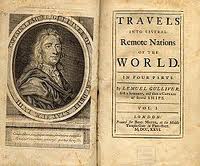
Another classic example that is often considered a combination of utopian and dystopian novels. This is because the plot involves the travels of one man – Gulliver, whose name is a play on the world gullible – whose journey takes him through many fictional worlds where life is either perfect or tragically flawed in various ways. However, since the purpose of these worlds is to parody English society in his day, it is often included as an early example of satiric literature that falls into the utopian, dystopian, and science fiction camps.

The story involves four journeys where Gulliver travels to several fictional societies and records what he sees for posterity. The first voyage takes him to the land of the Lilliputians, a race of tiny people whose morals match their physical size. After some rather brief descriptions of how these people select their leaders (limbo tournaments and other stupid games), we learn that they are a parody of the British system of parliament.

His second voyage takes him to a place that is the polar opposite of the first. Here, in the land of the Brobdingnagians, he is presented with giants whose physical size mirrors their moral outlook. They consider Gulliver to be a curious specimen, whose descriptions of his country disgust them. In the end, they consider him a cute sideshow attraction and refuse his offer of technological advances (like gunpowder). Gulliver then leaves, thinking the people are out of their minds, but ironically states that he withheld the worse about England out of a desire to save face.

His next voyage involves a little “island-hopping”, first to the flying city of Laputa, an island nation where technological pursuits are followed without a single regard for the consequences. He then detours to another island, Glubbdubdrib, where he visits a magician’s dwelling and discusses history with the ghosts of historical figures.

Then onto Luggnagg, where he encounters the struldbrugs – an unfortunate race of people who are immortal but frozen in old age, with all the infirmities that come with it. Gulliver then reaches Japan, which is in the grips of the post-war Shogunate period, where he is narrowly excused from taking part in an anti-Christian display that all foreigners were forced to perform at the time (stepping on the symbol of the Cross).

His final voyage before going home takes him country of the Houyhnhnms, a race of horse-people who see themselves as “the perfection of nature” and who rule over the race of Yahoos – deformed humans who exist in their basest form. Gulliver joins them and comes to adopt their view of humanity – that of base creatures that use reason only to advance their own appetites. However, they soon come to see him as a Yahoo and expel him from their civilization. In the end, Gulliver returns home to regal his family of his adventures but finds that he cannot relate to them anymore. His journeys have filled him with a sense of misanthropy that he cannot ignore.

Throughout the narrative, Swift’s point seems abundantly clear. Each voyage to a fictitious world serves as a means to parody a different element of British society and civilization in general. And ultimately, Gulliver serves as the perfect narrator, in that his ignorance and naivety allow him to absorb the lessons of the journey in a way that is both ironic and sufficiently detached. Can’t just hand the reader the moral, after all! Gotta make them work for it!

The Time Machine:
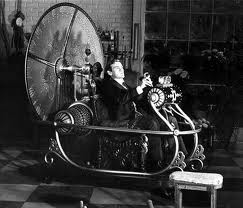
Published in 1895, this science fiction novella inspired countless adaptations and popularized the very idea of time travel. In addition to introducing readers to the concept of time as the fourth dimension and temporal paradoxes, H.G. Wells also had some interesting social commentary to share. In this story, the narrator – known only as The Traveller – recounts to a bunch of dinner guests how he used a time machine to travel to the year 802, 701 A.D. where he witnessed a strange culture made up of two distinct peoples.

On the one hand, there were the Eloi,Ā  a society of elegant, beautiful people who live in futuristic (but deteriorating) buildings and do no work. Attempts to communicate with them prove difficult since they seem to possess no innate curiosity or discipline. He assumes that they are a communistic society who have used technology to conquer nature and evolved (or devolved) to a point where strength and intellect are no longer necessary to survive.

However, this changes when he comes face to face with a separate race of ape-like troglodytes who live in underground enclaves and surface only at night. Within their dwellings, he discovers the machinery and industry that makes the above-ground paradise possible. He then realizes that the human race has evolved into two species: the leisured class of the ineffectual Eloi, and the downtrodden working classes that have devolved into the brutish Morlocks. In the course of searching the Morlock enclave, he learns that they also feed on the Eloi from time to time. His revised analysis is that their relationship is not a benign one, but one characterized by animosity and the occasional act of kidnapping and cannibalism.

Is there not a more perfect vision of industrial society or class conflict? Written within the context of turn of the century England, where discrepancies in wealth, class conflict, and demands for reform were commonplace, this book was clearly intended to explore social models in addition to scientific ideas. And the commentary was quite effective if you ask me…

The Iron Heel:
This dystopian work was written by Jack London, the same man who wrote the classic Call of the Wild, and was released in 1908. A clear expression of London’s own socialist beliefs, the novel is set in the distant future when a socialist utopia – known as the Brotherhood of Man – has finally been created. Overall, the plot revolves around the “Everhard Manuscript”, a testament that details the lives of the story’s two main protagonists and which takes place between 1912 to 1932 in the US. The work is known for its big “spoiler”, letting readers know outright that the protagonists die in the course of their pursuits, but that their efforts are rewarded by providing inspiration to later generations who succeed where they fail.

In the course of this speculative story, we learn that an oligarchy – the Oligarchs or “Iron Heel” – has seized power in the US by bankrupting the middle class and reducing farmers to a state of serfdom. Once in power, they maintained order through a combination of preferential treatment and control over the military. After a failed revolt (the First Revolt) takes place, preparations are underway for a second which is expected to succeed in restoring the Republic. Unfortunately, it too fails and the protagonists are killed. However, centuries later, when their Manuscript is discovered, the Oligarchy has been unseated and a debt is being acknowledged to these characters and their actions.

Thus, London speculates that a socialist society would someday emerge in the US, but only after centuries of dominance by oligarchs who would come to power by decimating the middle class, controlling trade unions, and transforming the military into a mercenary front. His main characters, though condemned to death in the present, will be vindicated in the distant future when humanity will, at last, overcome its greedy tendencies and usher in a state based on equality and fraternity. Apparently, this novel inspired such greats as George Orwell, but not in the way you think. Whereas London chose to offer his readers a sense of consolation by showing them everything turned out okay in the distant future, Orwell chose to take the hopeless route to make his point!

We:
The story takes place in the distant future, roughly one thousand years after the One State conquered the entire world. After years of livingĀ in a perfectly synchronized, rational, and orderly world, the people of the One State are busy constructing a ship (the Integral) that will export their way of life to extra-terrestrial worlds. Published in 1921, and written by Yevgeny Zamyatin, the story was clearly inspired by life in post-revolutionary Russia, with its commitment to “scientific Marxism, but was also a commentary on the deification of reason at the expense of feeling and emotion.

The story is told from the point of view of D-503, chief engineer of the Integral who is keeping a journal which he intends to be taken on the voyage. As we learn in the course of the novel, everyone in the One State lives in glass apartments that are monitored by secret police known as the Bureau of Guardians. All sex is conducted strictly for reproductive purposes and cannot be done without state sanction. However, the main character soon comes into contact with a woman named I-330, a liberated woman who flirts with him, smokes, and drinks alcohol without regard for the law.

In time, he learns that I-330 is a member of a revolutionary order known as MEPHI which is committed to bringing down the One State. While accompanying her to the Ancient House, a building notable for being the only opaque structure in the One State where objects of historic and aesthetic importance are preserved, he is escorted through a series of tunnels to the world outside the Green Wall which surrounds the city-state. There, D-503 meets the inhabitants of the outside world – humans whose bodies are covered with animal fur. The aim of the MEPHI is to destroy the Green Wall and reunite the citizens of the One State with the outside world.

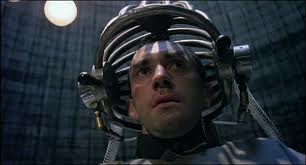
In his last entry, D-503 relates that he has undergone an operation that is mandated for all citizens of the One State. Similar to a lobotomy, this operation involved targeted x-rays that eliminate all emotion and imagination from the human brain. Afterward, D-503 informs on I-330 and MEPHI but is surprised how she refuses to inform on her compatriots once she is captured. People beyond the wall even succeed toward the story’s end in breaching a part of the Green Wall, thus ending the story on an uncertain note.

The Classics

And now we move on to the dystopian classics that are most widely known, that have inspired the most adaptations and sub-genres of noir fiction. Although updated many times over for the 20th century, these dystopian novels share many characteristics with their predecessors. In addition to timeless social commentary, they also asked the difficult question of what it would take to set humanity free.

Whereas some chose to confront this question directly and offer resolutions, other authors chose to leave the question open or chose to offer nothing in the way of consolation. Perhaps they thought their stories more educational this way, or perhaps they could merely think of none. Who’s to say? All I know is their works were inspired!

In addition to parodying the worst aspects of scientific rationalism, imperialism and the notion of progress, the story also went on to inspire some of the greatest satires ever known. In addition, many of its more esoteric elements have appeared in countless novels and films over the years, most notably the concepts of encapsulating walls, secret museums, government-sanctioned breeding, and machine-based programming.

Brave New World:
There’s scarcely a high school student who hasn’t read this famous work of dystopian fiction! And although Aldous Huxley denied ever reading We, his novel nevertheless shared several elements with it. For instance, his story was set in the World State where all reproduction is carried out through a system of eugenics. In addition, several “Savage Reservations” exist beyond the veil of civilization, where people live a dirty, natural existence. But ultimately, Huxley’s aim was to comment on American and Western civilization of the early 20th century, a civilization where leisure and enjoyment were becoming the dominant means of social control.

This last aspect was the overwhelming focus of the novel. In the World State, all people are bred for specific roles. Alphas are the intellectuals and leaders of society, Betas handle high-level bureaucratic tasks, Deltas handle skilled labor, Gammas unskilled labor, and Epsilons menial tasks. Therefore, all vestiges of class conflict and generational conflict have been eliminated from society.

But to further ensure social control, all citizens are sleep-conditioned from a young age to obey the World State and follow its rules. These include the use of Soma, a perfectly legal and safe designer drug that cures all emotional ales, promiscuous sex habits, and “feelies” (movies that simulate sensation).

In the end, the story comes to a climax as two of the main characters, Bernard Marx and Lina Crowe, go to a savage reservation and find a lost child named John. His mother was apparently a citizen of the World State who became lost in the reservation and was forced to stay after she learned she was pregnant. Having experienced nothing but alienation and abuse as a “savage”, John agrees to go with Bernard and Lina back to “civilization.

However, he quickly realizes he doesn’t fit into their world either and expresses disdain for its excesses and controls. Eventually, the people who sympathize with him are sent into exile and he is forced to flee himself. But in the end, he finds that he cannot escape the people of the World State and commits suicide, a tragic act that symbolizes the inability of the individual to find a resolution between insanity and barbarity.

Overall, Huxley’s BNW was a commentary on a number of scientific developments which, under the right circumstances, could be used to deprive humanity of their freedom. In many ways, this was a commentary on how the expanding fields of psychology and the social sciences were being used to find ways to ensure the cooperation of citizens and ensure good work habits.

Nowhere was this more apparent than in factories and in the creation of “assembly-line discipline”, which was exemplified by how the people of the World State revered Henry Ford. In addition to performing eugenics on an assembly-line apparatus, the people worship Ford and cross themselves with a T (a reference to his model T car).

But above all, Huxley seemed to be asking the larger question of what is to be done about the process we know as civilization. If it was inimical to freedom, with all its rational, sterile, and domesticated luggage, and the alternativeĀ  – a dirty, superstitious, and painful existence – was not preferable either, then what was the solution?

In the end, he offered no solution, allowing the reader to ponder this themselves. In his follow-up essay, Brave New World Revisited, he expressed some remorse over this fact and claimed that he wished he had offered a third option in the form of the exile communities – people who had found their own way through enlightened moderation.

1984:
Ah yes, the book that did it all! It warned us of the future, taught us the terminology of tyranny, and educated us on the use of “newspeak”, “doublethink” and “thoughtcrime”. Where would dystopian literature be today were it not for George Orwell and his massively influential satire on totalitarianism? True, Orwell’s work was entirely original; in fact, he thoroughly acknowledged a debt to authors like H.G. Wells and Yevgeny Zamyatin. But it was how he synthesized the various elements of dystopia, combining them with his own original thoughts and observations, and crystallized it all so coherently that led to his popularity.

But I digress. Set in the not-too-distant future of 1984 (Orwell completed the book in 48 and supposedly just flipped the digits), the story takes place from the point of view of an Outer Party member named Winston Smith. Winston lives in London, in a time when England has been renamed Airstrip One and is part of a major state known as Oceania. As the book opens, Oceania finds itself at war with the rival state of Eurasia, though not long ago it was at war with Eastasia and will be so again. As a member of the Ministry of Truth, Winston’s job is that of a censor. Whenever the enemy changes, whenever the Party alters its policies, whenever a person disappears, or the Party just feels the need to rewrite something about the past, men like Winston are charged with destroying and altering documentation to make it fit.

Ultimately, the story involves Winston’s own quest for truth. Living in the constant, shifting lie that is life in the totalitarian state of Oceania, he seeks knowledge of how life was before the revolution; before the Party took control before objective reality become meaningless. He also meets a woman named Julia with whom he begins an affair and rediscovers love.

However, in time the two are captured and taken to the Ministry of Love, where they are tortured, brainwashed, and made to turn on each other. In the end, Winston accepts the Party’s version of reality, simply because he discovers he has no choice. His tragic end is made all the more tragic by the implicit knowledge that he will soon be killed as well.

For discerning fans of science fiction and dystopian literature, the brilliance of 1984 was not so much in how the totalitarian state of the future is run but how it came to be. According to the Goldstein Manifesto, which is the centerpiece of the novel, World War III took place sometime in the 1950s and ended in a stalemate, all sides having become convinced of the futility of nuclear war.

Shortly thereafter, totalitarian revolutionaries with similar ideologies took power all over the planet. In time, they became the three major states of Oceania, Eurasia, and Eastasia, whose boundaries were a natural extension of the post-war spheres of influence.

Also interesting is Orwell’s speculation on how these totalitarian ideologies came to be in the first place. In short, he speculates that dominance by a small group of elites has been an unbroken pattern in human history. In the past, this arrangement seemed natural, even somewhat desirable due to poverty, scarcity, and a general lack of education.

However, it was within the context of the 20th century, at a time when industrial technology and availability of resources had virtually eliminated the need for social distinction, that the most vehement totalitarians had emerged. Unlike the elites of the past, these ones had no illusions about their aims or their methods. As the antagonist, O’Brien, says “The Party seeks power entirely for its own sake… Power is not a means; it is an end. One does not establish a dictatorship in order to safeguard a revolution; one makes the revolution in order to establish the dictatorship.”

This message still resonates with us today. Even though western civilization did technically dodge the bullet of WWIII and does not resemble the world of 1984 in the strictest sense, the cautionary nature of Orwell’s critique remains. Even if the particulars of how 1984 came to be didn’t happen, the message remains the same: human freedom – meaning the freedom to live, love, and think freely – is the most precious thing we have. Beware those who would deprive you of it for your own safety or in exchange for some earthly utopia, for surely they will themselves to be your master! There is also an ongoing debate about which came true, 1984 or BNW, with the consensus being that it was Huxley’s dystopian vision that seemed more accurate. However, the jury is still out, and the debate is ongoing…

Fahrenheit 451:
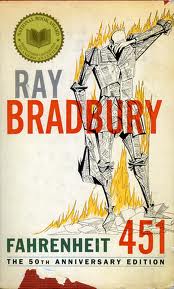
Here is yet another dystopian novel that has become somewhat of a staple in the industry. In Bradbury’s vision of the future, society is permeated by mindless leisure and decadence. Virtually all forms of literature have been banned, and local “firemen” are responsible for enforcing the ban. Wherever illegal literature is found, firemen are responsible for arriving on the scene and putting them to the flame. Yes, in a world where all houses are fireproof, firemen are no longer responsible for putting fires out, but for starting them!

In the course of the story, the main character – a fireman named Guy Montag – begins to become intrigued with literature and discovers a sort of magic within it that is missing from his world. In addition, Guy is told by his boss that society became this way willingly. Perhaps out of fear, perhaps out of sloth, they chose convenience, ease, and gratuity over subtly, thought and reflection. In time, Guy’s choices make him a fugitive and he is forced to flee and seek refuge with other people who insist on keeping and reading books. It is also made clear that nuclear war is looming, which may provide some explanation as to how society came to be the way it is.

In this way, the book has a lot in common with both 1984 and Brave New World. On the one hand, there is active censorship and repression through the destruction of books and the criminalization of reading. On the other hand, it seems as though the people in Bradbury’s world surrendered these freedoms willingly. It is a fitting commentary on American society of the latter half of the 20th century, where entertainment and convenience seemed like the greatest threats to independent thought and learning. This, in turn, could easily form the basis of dictatorship. As we all know, a docile, narcotized society is an easily controlled one!

The Handmaid’s Tale:
Here is another novel that few people get through high school without being forced to read, especially in Canada. But there’s a reason for that. Much like 1984, BNW, and F451, The Handmaid’s Tale is a classical dystopian narrative that has remained relevant despite the passage of time. In this story, the US has been dissolved and replaced by a theocracy known as the Republic of Gilead. In this state, women have been stripped of all rights in accordance with Old Testament and Christian theocracy. The head of this state is known as the Commander, the chief religious-military officer of the state.

The story is told from the point of view of a handmaid, a woman whose sole purpose is to breed with the ruling class. Her name is Offred, which is a patronym of “Of Fred”, in honor of the man she serves. Like all handmaidens, her worth is determined by her ability to procreate. And on this, her third assignment, she must get pregnant if she doesn’t want to be discarded. This time around, her assignment is to the Commander himself, a man who quickly becomes infatuated with her.

Over time, the infatuation leads to sex that is done as much for pleasure as procreation, and he begins to expose her to aspects of culture that have long been outlawed (like fashion magazines, cosmetics, and reading). She even learns of a Mayday resistance that is concerned with overthrowing Gilead, and that the Commander’s driver is apparently a member.

In the end, Offred is denounced by the Commander’s wife when she learns of their “affair”. Nick orders men from “The Eyes” (i.e. secret police) to come and take her away. However, he privately intimates that these are actually men from the resistance who are going to take her to freedom. The story ends with Offred stepping into the van, unsure of what her fate will be. In an epilogue, we learn that the story we have been told is a collection of tapes that were discovered many generations later after Gilead fell and a new, more equal society re-emerged. This collection is being presented by academics at a lecture, and is known as “The Handmaid’s Tale”.

In addition to touching on the key issues of reproductive rights, feminism, and totalitarianism, The Handmaid’s Tale presents readers with the age-old scenario of the rise of a dictatorship in the US. Apparently, the military-theological forces who run Gilead in the future seized power shortly after a staged terrorist attack that was blamed on Islamic terrorists. In the name of restoring order and ending the decline of their country, the “Sons of Jacob” seized power and disbanded the constitution. Under the twin guises of nationalism and religious orthodoxy, the new rulers rebuilt society along the lines of Old Testament-inspired social and religious orthodoxy.

This angle is not only plausible but historically relevant. For as Sinclair Lewis said back in 1936 “When fascism comes to America, it will be wrapped in the flag and carrying a cross.” This is paraphrased from his actual, more lengthy comments. But his essential point is the same. If aĀ  tyranny emerged in the US, he reasoned, it would do so by insisting that it was religiously right and that it was intent on protecting people’s freedoms, not revoking them.

In addition, the angle where an Islamic terrorist attack spawned the takeover? Tell me that’s not relevant to Americans today! Though written in 1985, Margaret Atwood’s dystopian scenario received a shot of credibility thanks to eight years of the Bush administration, a government that claimed religious orthodoxy and used security as justification for questionable wars and many repressive policies.

Final Thoughts:
After years of reading dystopian literature, I have begun to notice certain things. For starters, it is clear why they are grouped with science fiction. In all cases, they are set in alternate universes or distant future scenarios, but the point is to offer commentary on the world of today. And in the end, utopian and dystopian satires are inextricably linked, even if the former predates the latter by several centuries.

Whereas Utopian literature was clearly meant to offer a better world as a foil for the world the writers were living, dystopian literature offers up a dark future as a warning. And in each case, these worlds very much resemble our own, the only real difference being a matter of degree or a catalyzing event. This is why there is a focus in dystopian literature on explanations of how things came to be the way they are. In many cases, this would involve a series of predictable events: WWIII, a terrorist attack, more overpopulation and pollution, an economic crisis, or a natural disaster.

And in the end, the message is clear: whether it is by fear, poverty, or the manipulation of critical circumstances, power is handed over to people who will deliberately abuse it. Their mandate is clear and their outlook is the exact same as any tyrant who has ever existed. But the important thing to note is that it is given. Never in dystopian literature do tyrants simply take power. Much like in real life, true totalitarianism in these novels depends upon the willingness of people to exchange their freedom for food, safety, or stability. And in all cases, they inevitably experience buyer’s remorse!

Quicknote: Since getting “freshly pressed”, a lot of people have written in and asked me about my thoughts on “The Hunger Games”. Sorry to say, haven’t read it so I can’t offer any commentary. I will however be commenting on a number of more modern dystopian franchises, specifically examples found in film and other media, in my next post. Stay tuned, hopefully, something you like will pop there!

A Storm of Swords (Song of Fire and Ice, book III)

Back with the third installment in the Song of Fire and Ice series! By the end of book II, A Clash of Kings, a number of interesting developments took place. Stannis Baratheon’s attack on King’s Landing ended in failure, Robb Stark’s campaign south began to suffer some setbacks, and John Snow had taken up with the Wildlings. In addition, Theon Greyjoy was killed, Winterfell was burned to the ground, Arya escaped and began heading north once again, and young Bran began to head for the Wall with his companions, pursuing a prescient dream.

A Storm of Swords:
The third novel picks up where all these strands left off, with the War of the Five Kings, the war beyond the Wall, and with Daenerys Targaryen’s ongoing efforts to secure an army and return to Westeros. Much like book II, Storm contained a sort of climax where a major battle takes place, this time at the Wall. John’s time spent amongst the Wildlings also gives the reader insight into the lives of the Wildlings and what is driving them south.

At the same time, there is a great deal of detail given to the world of the East, where Daenerys is travelling to the ancient slaver cities of Astapor, Yunkai and Mereen. Much like Qarth in book II, these eastern cities are clearly inspired by the ancient cities of Asia Minor and the Middle East (aka. Babylon, Antioch, Jerusalem, etc). However, there were also some rather dire developments as well. Like I said in my previous post, George RR Martin is never one to shy away from killing off main characters or devastating his readers. Whereas he kind of shied away from that in Clash, this book got right into it! But more on that in a bit. First, I’d like to get into the overall plot of the novel…

Plot Synopsis:
Starting at the Riverlands, where Robb Stark and his armies are gathered, we learn that the Wolf has suffered from some serious errors in judgement. For starters, his uncle, contrary to Robb’s orders, threw off his long-term strategy by engaging Tywin Lannister’s armies at the river crossings. Though they were victorious in thwarting them, this move upset Robb’s plans to lure Tywin closer to his home town of Casterly Rock, where Robb hoped to outflank him and end the Lannister’s involvement in the war.

However, Tywin instead deployed the bulk of his forces to attack Riverrun once Bolton began beating him. Tywin failed to take Riverrun, but deploying his forces here instead of further east meant that he was in a better position to redeploy south once he learned that King’s Landing was threatened. Their victory over Stannis also led to an alliance between House Tyrell and the Lannisters, which meant they would be doubly hard to beat.

In addition, while he was campaigning in Lannister country, Robb fell in love with a young woman from a smaller House and married her. This decision was an insult to the honor of House Frey, the Lord that controls the Twins (the river crossing to the north) and one of Robb’s most powerful allies. Now it was necessary for him to travel to the Twins and make amends, promising his uncle’s hand to one of Frey’s oldest daughters in order to salvage their relationship.

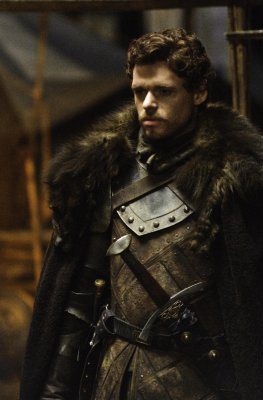
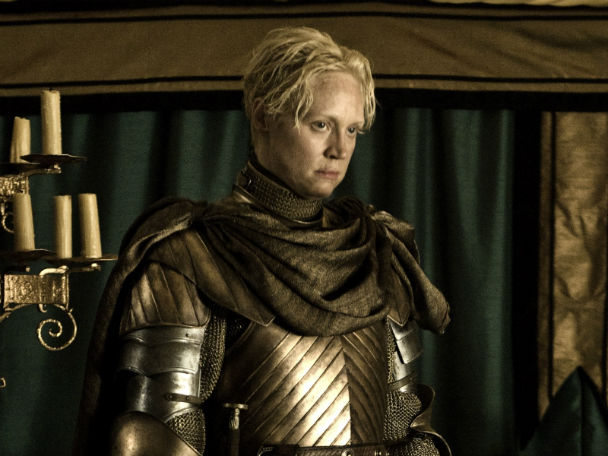
And last, but not least, he also has the defiance of his mother to deal with. It seems that while he was away campaigning, she set Jaime Lannister free and told Brienne to escort him to King’s Landing. On his honor, she made Jaime swear that he would return her daughters to her as soon as he arrived at the capitol. A desperate hope, but given what happened to her boys (she believes them both to have perished at Winterfell at his point) she was both desperate and distraught.

Naturally, Jaime has plans of his own and attempts to escape at the first opportunity. Unfortunately for him and Brienne, his escape attempt alerts some marauders to their presence. As soon as he obtains a sword, he attacks Brienne, the two fight for some time and the noise alerts a band of Bloody Mummers. These men are now in the employ of Lord Roose Bolton of Harrenhal, and they are taken captive. To ensure Jaime’s cooperation, Vargo Hoat, the leader of the pack, slices off Jaime’s hand. Without his sword hand, Jaime becomes a depressed shell of his former self, and begins to contemplate his choices and allegiances.

When Robb and his host arrive at the Twins, they are pleasantly surprised. Despite Lord Walder Frey’s reputation for being a bitter and vengeful man, he seems committed to making this new marriage happen. And his uncle is even pleasantly surprised when he sets eyes on the Frey girl, who doesn’t appear to be as hideous as his other offspring! Everything goes well on the wedding night as well. Though the food is not so good, the wine is plentiful and people begin to get soused. However, once the bride and groom are hauled off, Frey has another surprise in store. Crossbowmen emerge from the gallery and begin firing on them! Robb and his banner men are quickly surrounded, and Robb and his mother are killed!

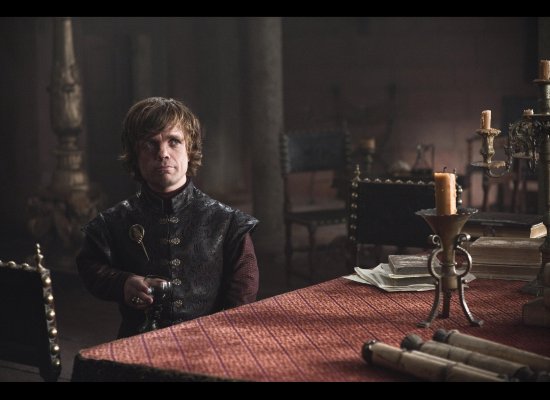
Back at King’s Landing, celebrations are being held! With their victory over Stannis’ forces, the people are jubilant and welcoming House Tyrell as liberators. In addition, Lord Tywin has taken the role as Hand of the King since Tyrion has been bed-ridden with injuries and is suspected of trying to harm Joffrey. Also, it seems that the new hand has made some changes to Joffrey’s wedding arrangements. Instead of marrying Sansa, as was arranged under King Robert, he now wishes to cement the Lannister’s new alliance with the Tyrell’s by marrying Joffrey to Lady Margaery Tyrell. Sansa is relieved, until she is informed that she will be wedding Tyrion instead, who isn’t particularly happy about it either.

Now two weddings must be held. The first, of Sansa and Tyrion, is a sham affair that is rushed through with minimal pomp and ceremony. For the second wedding though, much time and effort are spent and no expense is being spared. In addition, Sansa finds herself being taken into the confidences of the matriarch of House Tyrell. As Joffrey’s previous betrothal, she would like to know just what kind of man her granddaughter is marrying. After learning that the old lady is an honest and gentle person, Sansa tells her the truth: Joffrey is a monster, she says, and her granddaughter should be afraid. The old lady thanks her for her honesty, and begins plotting…

The wedding festivities are lavish and Joffrey appears to be taking well to his new wife, which leaves Sansa fearing for her life. Tyrion is similarly worried, knowing that Joffrey hates him and Cersei and their father both suspect him of treachery. He worries that the boy will try to kill him and his new wife, but they are both saved when something unexpected occurs. In the midst of eating from a massive pigeon pie that was prepared for the event, Joffrey chokes and dies horribly. More to the point, the girl Sansa disappears in the midst of his death. All eyes go to Tyrion, who is promptly arrested for the boy’s death.

After suffering in the dungeons of King’s Landing for a time, Tyrion is brought forth and put on trial. He is forsaken by everyone, including his mistress Shae, who appears to have been threatened into giving him up. All hope appears to be lost for Tyrion, but he then receives an offer from an unlikely source: Lord Oberyn Martell, the Prince of Dorne. It seems that the people of Sunspear still hold the Lannister’s accountable for the deaths of two Martell children who were murdered during Robert’s revolt. The one responsible was Sir Gregor Clegane (“The Mountain”), but they suspect Lord Tywin was the one who gave the order. He agrees to fight for Tyrion if he requests a trial by combat as part of a plot to kill Gregor and eventually put a Martell on the throne.

Without options, Tywin agrees, and as expected, Cersei chooses Gregor as her champion. The fight goes well for Oberyn, who employs cunning and speed to defeat Gregor with a poisoned spear. However, before he can deliver the final blow, Gregor takes Oberyn by the throat and kills him with his bare hands. Tyrion is once again doomed, and Gregor is destined to die a slow and terrible death. However, Tyrion finds help from an unlikely source once again, this time from his brother who has returned.

After hearing of Robb Stark’s death, Harrenhal once again changed hands and Jaime was set free. Having undergone a change of heart, he decided to bring Brienne back with her. Upon his arrival, he and Cersei have a falling out over his brother’s supposed guilt, and he decides to set Tyrion free. This consists of showing him a secret stairway that will take him to the coast, but Tyrion decides to head up instead. Having served as the Hand, he knows the secret stairs lead to the Tower of the Hand, where his father currently resides…

When he enters, he finds Shae warming his bed. She pleads and offers him the usual denials, telling him she was threatened and had no choice. Tyrion, sick of betrayal, decides to strangle her with her own jewelry and then sets out to find his father. After grabbing a crossbow from the bedroom wall, he finds his father in the privy and corners him there. After some harsh words are exchanged, he fires a bolt into Tywin’s stomach and leaves him there for dead.

With both Joffrey and Tywin dead, Cersei takes up the role of Hand and crowns her youngest son, Tommen, as king. In addition, she charges her newly-estranged brother with finding and killing Tyrion. As the new Lord Commander of the Kingsgaurd, it is his duty to track down the assassin, but he is obviously conflicted given the fact that he played a rolein his father’s death. Once the funeral is over, he decides to sets Brienne free and gives her a new sword named Oathkeeper. This was apparently Joffrey’s wedding gift from Tywin, which was reforged from the Valyrian steel of Ned Stark’s old sword. He then tells her to go forth and keep her oath to Catelyn to find Arya and Sansa.

Also, it should be noted, Cersei begins to go nuts as a result of recent events. In addition to losing her son and her father, it is also clear that her incest has become common knowledge. The Tyrells also appear to be positioning themselves to take the throne down the line. It is even intimated that the Tyrell matriarch was the one who poisoned Joffrey because of what Stansa told her about him. Now that Tommen is king, it is he who must marry Lady Margaery Tyrell, but since he’s so young, she believes she must be the power behind the throne.

Sansa is meanwhile ferried away with the help of Lord Donton, a disgraced ex-knight who Joffrey was in the habit of abusing, but whom Sansa was kind to. For some time, they were planning her escape, and when she learned that she would be wed to Tyrion instead of a Tyrell, she agreed to his plans. After helping her escape on the night of the big wedding, she is transferred to a ship waiting for them down by the water. Her rescuer, it seems, is Lord Petyr Baelish, who plans to take her to The Eyrie where he is about to wed her aunt (Catelyn’s sister). After delivering her aboard, Donton is killed to cover their tracks.

She is then brought to the coast of the Vale of Arryn where she meets Petyr and her aunt. While it is clear that Lady Lysa loves Petyr, it is also clear that he doesn’t love her, but instead is carrying a torch for Sansa. After arriving at the Eyrie, he kisses Sansa in the courtyard, sending Lysa into a jealous rage. Later on, she invites Sansa up to the throne room and threatens to throw her out the Moon Door, but Petyr intervenes. After talking Lysa down, he confesses to her that he only ever loved her sister, and then tosses her out the door! He then moves quickly to blame the minstrel and bribes Lysa’s bannermen to ensure their loyalty to his rule.

Meanwhile, Arya’s trip north brings her and her companions into some strange company. Having escaped Harrenhal, she now comes into contact with a group of men known as the Brotherhood without Banners. These were the men whom Ned Stark had sent out to deal with the raids in the Riverlands, but who now are protecting the countryfolk from raiders and Lannisters. Leading them is Lord Beric Dondarrion who has picked up an usual companion, the red priest Thoros of Myr. Here too is another worshiper of R’hllor, who has apparently used his magic to resurrect Beric, a couple of times!

Having been taken in by the company, they soon find Sandore Clegane, who fled King’s Landing during the siege, and put him on trial for his many crimes. Sandore request a trial by combat and narrowly wins when Beric’s sword breaks and he dies. However, Thoros is able to resurrect him yet again, and Sandore is free to go. But before he leaves, he is sure to take a hostage – Arya Stark! The two then travel north together since Sandore is hoping to ransom her to her brother. This journey takes them to the Twins, just in time for Lord Bolton’s supposed wedding. When the pandemonium strikes, Arya is forced to flee and is only saved by the intervention of Sandor himself.

In time, Sandor is critically wounded and Arya leaves him behind. She makes for the Vale of Arryn where she decides to board a ship and head for Braavos. She does this because Jaqen H’ghar, the killer she helped free, gave her a coin before departing which he claimed was from Braavos. The coin contained the inscription “Valar Morghulis”. When she arrives at the port, she speaks these words to a Braavosi Captain, who replies “Valar Dohaeris” and agrees to take her aboard. They set sail for the free city of Braavos and Arya bids farewell to her past life.

To the East, Daenerys and her companions are still busy trying to recruit an army. On the recommendations of Lord Mormont, they set course forĀ Slaver’s Bay believing that they will be able to recruit an army from the Unsullied. These are apparently warrior-slaves who have been raised from birth to fight, feel no pain, and obey any and all orders from their commander. With her new-found friends, Arstan and Strong Belwas, they arrive at Astapor where she agrees to surrender one of her dragons in exchange for a large host. However, she then tricks the slavers by ordering the Unsullied, once they are transferred to her ownership, to kill all the city’s slave masters.

With her new army and a host of freed slaves, Daenerys sets course for the city of Yunkai next. Here, she finds another slave stronghold that is protected by a host of mercenaries. After meeting the enemy’s mercenary brigades, she is aided by the defection of one of their Captains. With his help, they attack the mercenary encampents at night and this city falls shortly thereafter. Finally, she and her host move on to Mereen, the last of the slave cities, but find it walled and heavily defended. They set camp and begin the long process of besieging it.

But first, some revelations are made. On the one hand, she discovers that Arstan is in fact Ser Barristan Selmy, the former Lord Commander of the Kingsguard who Joffrey dismissed. His true purpose, it seems, was to find the heir of the Targaryen line and bring her home. At the same time, she learns that Jorah Mormont was originally sent to spy on her for Robert. However, when the order came that she was to be assassinated, he changed his mind and enlisted with her. Daenerys is outraged. It seems that the prophecy told to her by the Undying of Qarth is coming true. She has been betrayed twice now, which means she will betrayed once more before the end.

To have them make amends, she orders Barristan and Mormont to sneak into the cityĀ  through its sewers with a host of Unsullied at night and open the gates. They succeed, and the city is taken shortly thereafter. She forgives Selmy and makes him the Lord Commander of her Queensguard, but decides to banish Lord Mormont. In the meantime, she decides to set up camp at Mereen and contemplate how she will become the ruler that Westeros needs.

Finally, things to the north are also proceeding apace. Having been captured by the Wildlings, John Snow is brought before Mance Rayder. He is asked to explain why he would defect, and wanting to be convincing, John tells him something approximating the truth. He says he defected because he is sick and tired of being “the bastard son” and wants to be free. Rayder believes him, and John is soon reunited with the young Wildling woman he met earlier and spared.

Her name is Ygritte, and she is clearly taken with John. As time goes on, they become close and claim each other, Wildling-style! As a result of all this, John’s feelings of betrayal deepen, but he made an oath to Qorin to learn all he could, so he continues. In time, this bears fruit when he learns that the Others are what is driving the Wildlings south. Hence why they are determined to take the Wall and claim the northern lands of Westeros for themselves.

He also learns that Rayder had been desperately searching for the Horn of Winter which the Wildlings believe is magic. By sounding this horn, he believes he can melt the Wall and take out the Night’s Watch easily. However, in the meantime, he must commit his forces to attacking the Wall conventionally and sends John and Ygritte with an advance party to scale it and do reconnaissance on the other side. Once over, John escapes from the Wildlings once more and rejoins his brothers at Castle Black.

His loyalties are heavily suspect and few believe his story about Qorin orders, but his loyalty is proven when Ygritte and the advance party attack Castle Black. They manage to defeat the Wildling party, and Ygritte is killed by a stray arrow. John is torn by the loss, but there is little time to mourn. On the other side of the Wall, Rayder has over forty-thousand Wildlings, giants, mammoths and seige engines prepared, and begins his assault. John is given leave to command the defense of the Wall against this first assault, and things go relatively well.

Outnumbered but not outclassed, John and his brothers manage to thwart the first wave. John is then invited to parlay with Rayder, who reveals that he has found the horn after all. He tells John that he cold destroy the Wall with a single blast of the instrument, but he would rather capture it intact since it is the only thing that will keep the Others at bay. John considers his offer of a negotiated truce, but their parlay is cut short when Stannis’ surviving armies take to the field and destroy the Wildling encampment.

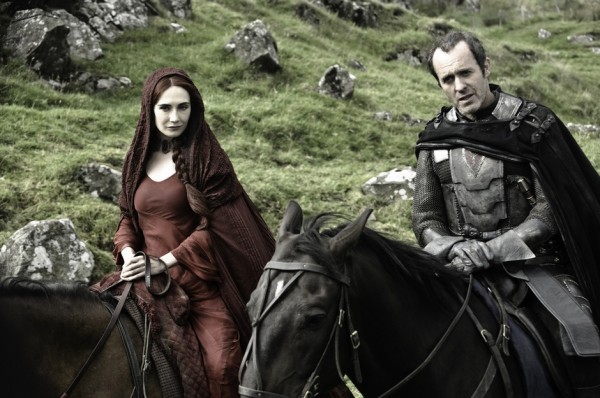
For months, the Night’s Watch had been pleading for aid and soldiers to be sent north to the Wall, and now it seems that only Stannis has chosen to answer. He tells John what the priestess Melissandre believes, how the return of the Others is just a prelude to the return of her god’s sworn enemy – the dark one. Stannis asks for John’s support and promises him Winterfell in exchange, but John is chosen by the Night’s Watch as their new commander and must refuse.

In the epilogue, we see how the Brothers Without Banners have taken one of the Frey men prisoner. After interrogating him about the massacre that happened at the wedding, the reanimated body of Catelyn Stark arrives and orders his death. It seems that the priest Thoros has used his magic to resurrect her as well, and now she is intent on revenge!

Strengths/Weaknesses:
Book III was, in my opinion, a step down from books I and II. On the one hand, there was plenty of action and plot developments to keep the reader interested, and plenty of surprises besides. However, not all of them were welcome to this humble reader. For starters, when Robb Stark is murdered at the court of Walder Frey, I was incensed! I very nearly put the book and the series down for good! Was it not enough that Martin had to kill off Ned Stark? No, he had to kill his son and Catelyn too? The Starks are supposed to be the heroes of this series, dammit! You can’t just keep killing them off! Yes, I was mad…

But it was not just the fact that sympathetic characters kept getting murdered. It was the confusion it caused. Basically, every story has a set of main characters, people that help drive the story forward. When a character dies off, it naturally falls to another to keep the story going. Now we all know that Martin uses many characters and perspectives in his novels, but most of these are secondary and rarely heard from. It’s the main perspectives that tell things of the greatest importance, and usually there are only a few of them. When these people die, it has the effect of making the reader think that they weren’t so important after all. And if it keeps happening, the reader can become cynical and will not form the usual emotional attachments to characters. When that happens, a story dies, at least from the point of view of the person reading it. It’s all about emotional attachments Martin, you can’t keep traumatizing us!

More than that, I was beginning to feel tedious and depressed by the way Arya and Sansa’s sad stories kept going on and on. For two books now, Arya has been trying to get home, only to be waylayed, taken prisoner, get free, taken prisoner again, get free once again, then only to find out that her family is dead. Thus she decides to go to Braavos because she thinks she’s the only Stark left. And she’s just a kid! How depressing! Sansa, on the other hand, has to endure Joffrey’s constant abuse, the prospect of sex with Tyrion, and then is set free only to find herself a prisoner again, just under different circumstances. As if the rapacious and cruel Lannisters weren’t enough, now she has to deal with the murderous and creepy Lord Baelish!

And even before Robb was murdered, the setbacks he was been forced to endure were beginning to get tedious. In spite of all his early successes, its becoming abundantly clear that he’s going to lose the war. First his strategic plans get interrupted, the Lannisters succeed in the south and make a new alliance, Theon stabs him in the back by seizing Winterfell, his attempts to liberate it fail, Winterfell is then burned to the ground and his brothers killed (presumably). Then, on top of all that, he learns that his alliance is likely to fall apart because he chose to follow his heart. And just when it seems like things are going to be okay on that front, he’s and his mother are betrayed and murdered! It’s like, we get it! War is hell, especially this war, and the bad guys are winning! But can’t you give us some happy news for a change?

But like I said, the book had plenty of things to keep the prospective reader interested. After picking it back up (after about a week or so of stewing), I found plenty of good things to keep me interested in the series. For starters, Joffrey finally got what was coming to him, Lord Tywin also bought it while sitting on the privy, and Catelyn was revealed to be alive (albeit in a somewhat hideous form). This was all nice to read, mainly because I was getting so sick of Joffrey that I was just waiting for someone to give him a “golden crown” as well! His and Tywin’s death also brightened Tyrion’s storyline a lot, seeing as how his constant struggle with his cruel family was also beginning to get Kafka-esque. Given that he is one of the few sympathetic characters from that thread, it was nice to see him get a little payback! Now if someone would just whack Cersei we’d be in business!

And of course there were all the plot developments that kept satisfying my curiosity. Much like in book II, there were plenty of things that I was just waiting to hear about that finally got revealed. For instance, I was dying to know what would become of the Others invasion, of the civil war, of Daenerys’ plans to return to Westeros, and of Bran’s visions. After so much build-up, set-backs and plot twists, I was dying for some resolutions! And as usual, George RR Martin gives it out sparingly, providing clues, some answers, and a few interesting tidbits, all the while ensuring that things keeps rolling into the next book.

All in all, I liked this book. It was a very decent follow-up to A Clash of Kings and maintained the commitment to realism, detail and world-building that the series is famous for. My problems really only stem from the fact that at times, the books are too realistic, too detailed, and contain far too many plot twists. However, it would be unfair to say that any one book fails in this regard when its really a cumulative effect. Anything bad that I can say about this particular novel always begins with “at this point in the series…” Mainly, I was just hoping that things would be close to some kind of resolution. That’s another thing that’s important when writing. When audiences wait too long for a resolution, they’ll also lose interest. I hope Mr. Martin is writing this down šŸ˜‰

Speaking of which, I am currently nose-deep in A Feast For Crows. See you soon with the review for that one!

The Alien Graph

The Alien Graph

Behold! After a few days of contemplating what I said in the Ancient Aliens post – you know, about how alien’s technology and moral capacity are often interrelated in sci-fi – I realized I needed to put it into graphic form. And as I said in that post, if we are to consider technological advancement as one axis and level of benevolence as another, then the outcome would look something like this:

click to enlarge

The design is based on the Zombie graph that’s been floating around the internet for some time. There, the designer placed different Zombie movies based on two criteria: intelligence and speed. In much the same way, I’ve designed a graph for aliens that is based on two similar criteria: technological advancement and level of friendliness.

I selected aliens that I thought best represented the range of development and behavior in the sci-fi genre. I also included as many franchises as I could think of, just off the top of my head. I certainly wasn’t scientific about it, just relative and to the best of my abilities. And when I was done, I noticed an interesting pattern…

Hostile/Advanced Aliens Rule!:
For example, notice how the vast majority of races from your well-known franchises (Star Trek, B5, Stargate, Star Craft, AvP, Halo, etc) fall into the upper left quadrant. This is the area where malevolence and technological sophistication combine in varying degrees. By contrast, the second largest concentration of races occurs in the advanced/benevolent quadrant, again to varying degrees. Almost no races fall into the nascent (i.e. primitive) quadrants, be they hostile or gentle.

On the one hand, the Xenomorph from Alien and the Arachnids from Starship Troopers both fell into the technologically backward category (technically), and were both classified as malevolent because of their innate hostility to foreign organisms. The Na’vi, from Avatar, were the only alien race that fit the bill for technologically nascent and benevolent. I’m sure there are plenty of examples that could stack this analysis in a different way, but like I said, this was off the top of my head.

The Zerg, I have to admit, were a bit of a conundrum for me. While they are technically a race that does not employ technology per se, they are highly advanced in terms of their biological evolution, to the point where they rely on specialized creatures in the same way that humans rely on machinery. But then again, that’s all for the sake of ensuring that the different factions in the video game are evenly matched. It’s not meant to be a realistic assessment. Much the same is true of the Xenomorphs. While they do not employ tools, fly around in spaceships, or use guns, they are nevertheless an extremely evolved organism that is capable of besting humanity in any contest.

And just to be clear, the middle point of the graph (0,0, where the axes meet) is where humanity stands now in terms of moral behavior and technological development. Sure, some say we’d fall into the evil quadrant, but I tend to believe that humanity is morally ambiguous, neither too good or too evil. Where aliens fall into the spectrum in most sci-fi franchises is meant to reflect this. Much the same is true of technological prowess, where aliens are classified as “advanced” or “primitive” solely in comparison to ourselves.

This all might sound anthropocentric, but that’s the point, isn’t it? These are stories written by human beings for other human beings. All the references, symbols and measuring sticks come from inside us. So in the end, aliens themselves, as represented in our best science fiction, also come from inside ourselves. Their values, their tools, and even their appearances are all constructs of what is familiar and accessible to us. In short, they are merely tools with which we measure ourselves, both morally and technically.

Conclusions:
Well, right off the cuff I’d say the reason we prefer our aliens hostile and advanced is because it makes them seem more threatening and scary that way. Clearly, this makes for a more interesting story. While an alien race that is kind, innocent and backwards can make for an effective tale about the evils of colonialism and imperialism and how one can easily find themselves on the side of evil, these seem to be fewer and farther between. I’d say this is most likely because moral allegories are less intriguing than action dramas. Or maybe just prefer to think of ourselves as the good guys. Let someone else serve as the allegory for evil, selfish and runaway imperialistic behavior!

In addition, there’s the very real possibility that humanity will be making contact with an intelligent life form at some point in the future. And when we do, it’s likely to be the most awe-inspiring and frightening of experiences. When it comes to the unknown, ignorance begets fear and we prefer to err on the side of caution. So it would make sense that whenever we think of aliens, even if its just for the sake of fiction, we would naturally prefer to think of them as both learned and potentially hostile. If indeed aliens serve as a sort of projection for humanity’s own thoughts on itself, than pitching them as potentially hostile beings with advanced technology represents our own fear of the unknown.

In any case, if there is life out there, all these questions will be resolved in the distant future. Hell, maybe even the near-future. If some theorists are to be believed, aliens have already made contact with us and might even be walking among us right now. Granted, most of these people are hanging around the 7/11 with tin foil hats on, but they can’t all be crazy, right?

Aliens, revisited

After doing my due diligence to learn what I could about the Xenomorph for my post on Ancient Aliens, I found some interesting additional info that kept me reading. For one, I came to learn that there were a lot of details about the Alien universe that were revealed by Ridley Scott and James Cameron in the course of interviews, but never made it into the movies themselves. At the same time, there was plenty of info that made it into comics, novelization and other sources in the expanded franchise which fans of the movies would want to know about. There were a lot of mysteries in the Alien universe that were left deliberately vague, basic questions that never got answered.

For example:

  1. What was that derelict ship from the first movie and where did it come from?
  2. Why were there eggs aboard the ship in the first place?
  3. And of course, where do the Xenomorph’s come from?

Well, here are some of the answers that I found out:

1. Space Jockeys:
This is the name of the race that built the derelict craft that crashed on LV-426 and was investigated by the crew of the Nostromo. Based on the design of the skeleton that was featured in the movie, and additional material from the alien comics, this race was apparently humanoid, very large, and had elephant-like trunks on their faces. According to all sources on the subject, the Space Jockeys are millions of years old and go by many different names.

In fact, “Space Jockeys” was the name the set designers came up with, whereas H.R Giger (the designer of the Alien) called it “The Pilot”. This second name was used in the video game AVG 2, where the aliens are known as Pilots and examples of their technology as “Pilot Technology”. Yet another name comes from the novelization entitled Aliens: Original Sin by Michael Friedman, where they are known as the Mala’kak. Where they come from remains a mystery, but the fact that their ship was carrying Xenomorph eggs would seem suggests that there was some kind of relationship. Which brings us to question two…

2. The Eggs:
One theory has it that the Space Jockeys were the original victims of the Xenomorphs. Another has it that they were in fact their creators. This second theory is far more detailed and shows up in various sources. Apparently, the Space Jockeys (or Mala’kak) bred the Xenomorphs for use a civil war that was raging millions of years ago. This would certainly explain why the Xenomorphs are so hostile, so adaptive, and proliferate so quickly. Ultimately, the Xenomorphs turned on their creators and caused their extinction, and live on as weapons leftover from a forgotten war.

I got to admit, I didn’t like this theory too much. Somehow, it made the Aliens less scary to know that they were cooked up in a lab as opposed to say, borne out of conditions we can hardly imagine on a planet we have yet to discover. However, I also have to admit that it fit with something I notice whenever I watch the original Alien movie. Compare the Space Jockey ship to the architecture of a Xenomorph hive. Do they not look similar? All those curved surfaces and H.P. Lovecraftian sensibilities? Would it be so crazy to conclude that the Xenomorphs inherited their sense of aesthetics from their creators?

However, there remains the question of why a derelict ship was discovered on LV-426 carrying eggs. Could it be that this was a simple transport that was hauling eggs for the sake of the war effort? If so, then the most likely scenario would be that the pilot became infected accidentally and crashed into the planet, programming the ship to send out a distress signal before his untimely demise. However, we won’t know that for sure until the new movie comes out (see below!)

3. Xenomorph Prime:
According to various sources, the Xenomorph homeworld is a hostile planet named Proteus.Ā  Much like LV-426, it boasts a cold and harsh climate that is rife with volcanoes and turbulent wind storms. According to one theory, the planet is not the actual source of the Xenomorph species, but was used as a storage house by the Space Jockeys to contain and breed them.

The exact source of this info is unclear, but in the 2010 AvP video game, things end with Weyland Yutani discovering the location of their homeworld. This would seem to indicate that it will be revealed and/or detailed in the sequel. Also, the info on Proteus (as it stands) is clearly linked to the theory that the Space Jockeys were responsible for the creation of the Xenomorphs, so I can only assume that it came up in one of the AvP comics or novels.

Prometheus:
In the course of learning all this, I also came to learn that Ridley Scott has been dropping some serious hints of late. Apparently, the concept of the Space Jockeys, the Xenomorph homeworld, and the link between the two species will be explored at some length in the upcoming movie, Prometheus. For those who don’t know, this upcoming movie is a prequel to the Alien franchise where the crew of an Earth starship discover the derelict years before the Nostromo. Originally, I was planning on avoiding it. But successive previews and all the promised explanations are starting to get to me. Coming to theaters this summer, people!

Latest Reviews!

Hey all! I am happy to announce that Source has just received another positive review. This one comes from Bibliotasitc.com from a user named george g (I’ll protect your anonymity!) who generously awarded it 4/5 stars!

“A story about water, or the lack thereof. Not exactly the makings of a great story, but the author pulled it off. When I first read this, I thought it was going to be a sermon about the environment, but it wasn’t. These actually a decent story in here. Check it out.”

Thanks man! I’ll have to post more stories to Bibliotastic. As it stands, Source is my only story that made it onto that site.

Meanwhile, over at free-ebooks.net, my latest entry there (Domicile 4.5) picked up the following comment:

“Very interesting! Such good technology–made inert by the greed and slackness of man. We are still not ready, and may never be–for such good things to be reality, since with great wisdom comes great sorrow. Good reading, only a few errors!”

And check out the cover I made for the ebook! Thanks for the feedback, folks! Looking forward to adding new material and seeing what people have to say about it.

Cool Weapons!

Last time, I spoke (at length) about all the awesome firearms that come to us from a variety of science fiction franchises. But let’s face it, there’s a lot more than just guns to speak of! In fact, part of the genius of sci-fi is in how it is constantly inventing entire arsenals of weaponry, tools, and the various nicknacks that make the world go round. Any director or writer who show attention to detail will make sure that their characters come equipped, looked the part, and that their settings have plenty of believable gadgetry taking up space in the background. Here are just some of the cool examples:

Claws:
Predator_clawsAlong with the burner/plasma caster, these weapons are the most basic of Hunter weapons in the Predator universe. According to tradition, every Hunter must distinguish themselves in battle by confronting an enemy in single combat using no other weapon than their claws. Based on the two non-crossover films (Predator and Predator 2), this is apparently done once all lesser prey are eliminated and only the top prey is left. When that occurs, the Hunter will ensure that this finale opponent has been deprived of any additional weaponry, and then will shed every other weapon in their arsenal and engage them in hand to hand combat.

Combi-Stick:
Part of the Hunters arsenal, this weapon comes from the Predator universe and is part of their wider arsenal of cool weaponry. The name refers to the fact that this staff serves multiple functions. Collapses, it serves as a sort of quarter staff. However, the stick has telescoping sections with a blade like end, which when deployed turn it into a spear. In Predator 2, a hunter used his stick on multiple occasions. Against a group of the Jamaican gang members, it was used strictly for impaling, but during a later scene, it was used as a throwing spear against Danny Glover’s character.

Crysknife:
The Fremen weapon of choice, made from the tooth of a Maker (i.e. a Sandworm). The name and design of the weapon are based on the kris, a ceremonial dagger that was traditionally used in Indonesia and is associated with many cultural legends.

A testament to Herbert’s ability to incorporate historic and cultural elements into his stories, the kris is an enduring symbol of the Dune universe and was used by Fremen for warfare, duals, and ceremonial purposes, much like the real thing! In addition, the Fremen had very strict rules about the use and exposure of these knives. According to the Shadout Mapes – the Fremen housekeeper in Dune – who gives one to Jessica: “Who sees that knife must be cleansed or slain!” And as Leto II remarked in Children of Dune: “The crysknife dissolves at the death of its owner.”

Lasgun:
This weapon was the brainchild of Frank Herbert, and is a familiar weapon in the Dune universe. According to Frank’s many novels, the lasgun was a continuous-wave laser projector weapon that when fired emitted a constant, narrow beam of photons. Though it was able to cut through just about anything and was the weapon of choice in the Old Imperium, it had since fallen into disuse by the first Dune novel.

This apparently had to do with the invention of personal shields. Rather than protecting against a lasgun burst, the interaction of the two would cause a reaction that rivaled that of an atomic explosion. Hence, attacker and defender would both be killed instantly if either ever came into contact. Much like the prohibition against the use of nukes in Herbert’s universe, one would get the distinct impression that he was commenting on the futility of nuclear deterrents and arms races.

But that’s another matter. The lasgun, from its first appearance in Dune, has gone on to inspire many a sci-fi franchise. One that immediately comes to mind is Akira. In this movie, riot squads and the military employed large, external cell powered weapons to fire focused beams of light on a large mob, hewing off limbs and burning holes straight through some people! The main character Kaneda also commandeered one and used it to fight his psionic friend, Tetsuo, near the end of the movie.

Lightsaber:
Just what is it about lightsabers that make them so unbelievably cool? Is it that warm glow? The otherworldly feeling one gets from seeing one being activated? Could it be that crack, hiss sound they make when they clash, or that warbling noise when they’re spun around? Or could it just be the fact that they deflect blasters and cut through anything? Well yes! It’s all of the above, clearly! Yet another brainchild of George Lucas, meant to call to mind scenes of swashbuckling and chivalry from old samurai movies, the lightsaber has since gone on to occupy a central spot in the collective unconscious of an entire generation. It is a staple, perhaps THE staple, of pop culture’s take on sci-fi.

Making its debut appearance in the first Star Wars movie, the lightsaber was the established weapon of the Jedi. In addition to being their mainstay, lightsabers were also highly personalized, every Jedi being tasked with building one as part of their training. Originally, the only two designs were that of the blue and red, the former being associated with Obi Wan and Anakin Skywalker (which Luke then inherited), and the latter being associated with Darth Vader. However, Luke went on to create his own and fashioned a green beam. With the expanded universe, significance has been given to different colors, each one associated with a different class of Jedi, and indicating whether they are a member of the Sith or the Jedi Order.

For starters, blue is the color of the Jedi Guardian, the warrior class of the order who focus on combat training and fighting. Green is used by the Jedi Consuls, people who focus more on the force and accumulating wisdom and insight. Yellow represents a sort of middle ground, belonging to those Jedi who focus on a combination of both and are usually called upon to settle disputes and act as arbiters. When it comes to the Sith, only one color appears to be used, and that is red. However, purple, orange, and other closely related colors have popped up from time to time in various places as well. In addition, Mace Windu, the Jedi Master portrayed by Samuel L. Jackson, wielded a purple lightsaber as well. However, this was apparently due to Jackson’s insistence that his character have a purple weapon, as well as the initials BMF etched onto the side!

Ma’Tok Staff:
Coming to us from the Stargate universe, the Ma’Tok is a combination laser gun, club staff that is used by Jaffa warriors (the specially-bred human servants of the Goa’uld). According to the Stargate Wiki, the Ma’Tok relies on a plasma discharge to strike and cauterize the enemy, causing severe damage and intimidating resistance. It takes its power from an internal cell that employs a liquified mineral (Naquadah) to generate plasma energy. This liquid mineral gives the staff a virtually indefinite shelf life, making it the perfect blend of aesthetics and lethality!

Monomolecular Wire:
Here’s an idea that comes in various forms, but for the purposes of this post, I shall stick to the examples that I know best. The first one comes in the form of the Yakuza enforcer from Johnny Mnemonic! Anyone who’s seen this movie (or read the short story it was based on) will remember the main badguy who had an artificial thumb that contained a long filament of glowing wire. When he pulled that thing out and started whipping it around – LOOK OUT! – things began to get lopped off and sliced up! Another example of this being used as a weapon is from the Japanese anime Hellsing. In that show, the butler of the namesake character had monomolecular wires attached to each finger which he would break out whenever there was a crisis. Perhaps they were fashioned from silver, I really can’t recall. Would make them more effective against vampires though!

Plasma Sword:
And we’re back to the Halo universe for another example of cool gear! And today, the item in question is the plasma sword. As gamers are no doubt aware, this weapon is melee weapon of the Elites, but can be employed by humans as well since it’s your basic hand-held weapon. And much like lightsabers and lasguns, it can cut through just about anything and makes short work of any opponent. In many ways, its even more effective than the ballistic and energy weapons in the game. Whereas those can take several shots to take down an enemy (especially someone infected by the flood) one good hit from this baby will turn them into pulp! And if you see an enemy approaching you with one, be sure to hang back and unload your weapon in their direction!

Stone Burner:
Doubling down on the Dune universe, the next example of cool weapons comes in the form of Stone Burner. As a tactical nuke of limited yield, this weapon was the only form of nuclear device that was not prohibited by the Great Convention. This body, in addition to banning all forms of AI’s, also put a stop to the use of nuclear weapons, though it did not forbid the Great Houses from owning any. In any case, Stone Burners, when used strategically, could have a devastating effect on an enemy.

This weapon makes only one appearance in the Dune saga. In Dune Messiah, Paul Atreides is lured into a trap in the old quarter of Arrakeen where a stone burner is set off, which leads to the loss of his eyes.Ā  Though physically blinded, Paul was not deprived of his vision (i.e. his prescience). This all had to do with a larger plot to force Paul to surrender his power as Emperor in order to save his children. And I think we can all agree, any plot that involves a tactical nuke and blinding your enemy Samson-style is pretty badass!

Throwing Disc:
Another Hunter weapon, this particular one made its first appearance in the second Predator movie and then went on to become a regular part of the Hunters’ arsenal. Much like their other weapons, the throwing disc appears to have many variations and may even be personalized to an extent. This may be the result of constant upgrading, or it may be that individual Hunters have a hand in designing their own gear. In either case, many types of throwing discs have appeared. Some employ simple curved blades, blades with spikes, or even shuriken-like appendages (as the picture at right demonstrates). In each and every case, the result generally involves hewed limbs and decapitations!

Thermal Detonator:
“Because he’s holding a thermal detonator!” Yes, whenever a bounty hunter pulls one of these out, you know they mean business! This weapon, which comes to us from the Star Wars universe, made its first appearance in Return of the Jedi. Since that movie came out, the device has been mentioned and referenced countless times in the expanded franchise. Apparently, thermal detonators are the grenades of the future, using plasma charges that when detonated, cause a large explosion that will burn through just about anything. Always be sure to bring one to a negotiation, just be sure to get the ones with the fail-safe triggers!

Vibroblades:
My third and final act of doubling down on a single franchise! Vibroblades are an integral part of the Star Wars universe, but also appear in a number of other franchises. In each case, the weapon revolves around melee weapons that are powered by ultrasonic devices. This increases the weapons cutting effectiveness, and makes them almost as dangerous as a lightsaber. Well, more like a distant second! But non-Jedi’s got to settle for what they can get.

In the video game Knights of the Old Republic, vibroblades and melee weapons are used due to the introduction of personal shields. Some might call this a rip-off of the Dune universe, but in this case, its not so much a matter of necessity as practicality. If an enemy can absorb your blaster fire, then rushing and attacking them with a sword kind of makes sense. And it gives the characters some practice with melee combat before they learn to harness their Jedi abilities.

Last Word:
Okay, I got nothing! Yep, after looking through all the aforementioned examples of cool weaponry, I really couldn’t find any particular patterns that were worthy of comment. Basically, it all comes down to things that augment or go beyond the usual arsenal of guns. It’s only where the swords and knives come into the mix that I see anything beyond simple coolness. And just about all that drinks from the cup of Frank Herbert, a man who merged the ancient and futuristic in order to make a point about technology and how one could find the past in the future and the future in the past. Yeah, that stuff was deep!

As for the rest of it, it’s just plain cool to behold… and fantasize about! Yeah, twenty years later and I still want a lightsaber of my own! šŸ˜‰

Cool Guns!

I’m getting hooked on writing conceptual posts, mainly because it gives me the chance to explore a lot different franchises of sci-fi without being too constrained. Not only that, I really like digging into subject matter of finding the common elements; in this case, the stuff that makes cool stuff cool! So far, I’ve covered the concepts of Galactic Empires, Planetkillers and Ancient Aliens. But today, I thought I’d tackle something a little simpler that’s been known to make sci-fi geeks experience collective nerdgasms! Today the topic is: COOL GUNS!

BFG 9000:
Starting off this review right is the BFG (Big F***ing Gun) that comes to us from the Doom universe. Fans of that old franchise know this one by heart, and I’m sure they remember with some nostalgia what it was like firing this thing. Given that Doom was like most first-person shooters, this weapon would turn up late in the game as a way of dealing with the more tenacious evil critters. And it worked! One shot released a big cloud of green plasma which killed everything in the vicinity. Unless it was a boss, in which case, it might take two or three… Apparently, Quake II and Quake III Arena pay homage by including their own version, known as the BFG10K.

“Blow Dryer”:
Also known as a “burner” or plasma caster, this weapon was the mainstay of the Predator aliens and is featured in the many movies, comics, video games, and novels of the franchise. Mounted on the shoulder, this weapon would discharge a ball of red-hot plasma into objects, causing damage akin to an explosive device, but with none of the messy shrapnel. Though the standard model is shoulder mounted and aimed using a heads-up-display and laser sight, the Predators in later movies were also known to carry wrist-mounted versions of this weapon as well. Like their claws and wrist bombs, they were embedded in the cuffs and served as a backup. One of these makes an appearance in Predator 2 during the meat locker shoot-out.

BR55 Battle Rifle:
This baby is a Halo universe invention, and is the mainstay of the UNSC infantry. Aesthetically, this rifle is based on several bull-pup assault rifles designs from the modern era, a design which is clearly growing in popularity. Some potential sources for inspiration include the Austrian-made Steyr AUG, the French FAMAS, the British L85, the Belgian F2000, and the experimental PAPOP design. Like all bull-pup rifles, this gun loads from the rear and can cut through Covenant opposition with ease! Even when I’m playing as the Covenant, this was my second favorite weapon to be carrying (the first was either two submachine guns or two pistols, or a combinati0n thereof!)

Blade Runner Gun:
In the classic move Blade Runner, Detective Rick Deckard was responsible for locating and “retiring” replicants. And the weapon he used to do just that is featured here. This is the model of a Blade Runner service revolver, for which little information exists, but whose appearance and performance pretty much speaks for itself. Based on a standard service revolver with several extra bits added on for effect, this gun pretty much screams cyberpunk.

In addition, there are several scenes in the movie where Deckard’s gun turned flesh (artificial though it was) into mush! Recall the scene where Deckard uses this gun to punch several holes in Zhora? Or how about the scene immediately thereafter where Leon is beating the crap out of him, and Rachael manages to save him by using his own weapon? Yeah, whenever this gun was brought out of his holster, some big holes resulted!

Blasters:
When asked about his idea for a “Galactic Empire”, George Lucas said that he wanted to create something that was as aesthetically similar to Nazi Germany as possible. This was reflected in the weapons as well. Numerous guns that were modified and used as props in the movie were based on WWII vintage weapons. The first and most recognizable is Han’s blaster, aka. the DL-44. Based on the German C96 Mauser pistol, this weapon was apparently a popular item amongst smugglers and traders, being very powerful and compact. It was also quick on the draw, which comes in handy when in a bar and looking down the barrel of a bounty hunter’s gun (Han shot first!)

The next was the standard issue blaster used by both the Stormtroopers and the heroes, especially in the first movie during their daring breakoutĀ from the Death Star. This blaster, known as the E-11, was based on the Sterling submachine gun of WWII. Simple, consisting of little more than a barel, a handle, and a side-mounted magazine, the gun was easily altered with a few pieces of molded plastic and a scope that made it look suitably futuristic.

The heavier T-21 Blaster Rifle was yet another WWII adaptation. Built around a Lewis machine gun, it was featured in the first movie during the Mos Eisley scene where Stormtroopers were seen walking through the streets searching for Luke and Obi Wan.

Last, there was the DLT-19 Heavy Blaster, the heaviest infantry weapon in the Star Wars franchise. In keeping with his love of WWII kit, Lucas’ set designers used a German MG42 to fashion this one. This blaster appeared aboard the Death Star in the hand of the search party that went over the Millenium Falcon, and again when Chewy commandeered one to take out the remote blasters and cameras in the cell block.

GE M134 Minigun Handheld:
How could I have forgotten this one? I mean really, is there a better visual representation of sheer badassery than the handheld minigun from Predator? Sure, the mere idea of a man carrying a minigun around by hand is so unbelievable its makes me want to laugh out loud. Considering the weight of the weapon, even before you factor in all the ammo, coupled with the killer recoil that no human could withstand – all of this makes the physics totally implausible! But what the heck? It was fun to watch! I can’t imagine anyone not feeling the hair on the back of their neck stand on end as those barrels started whirling and the bullets streamed out, so fast it sounded like a turbine! And I know from talking to actual pilots who’ve seen this baby in action that if you add tracers to the mix, its like watching a laser show. WHURRRRRRRRRRRR! Total carnage!

Grammaton Cleric Pistol:
Though it was not my favorite movie, there were undeniably cool aspects to the movie Equilibrium.Ā One of which was all the cool Gun Kata moves pulled by Christain Bale, Angus Macfadyen, and the other Grammaton Clerics with their special pistols. These guns were clearly souped-up versions of the Beretta 92FS. They clearly fire in both semi-automatic and automatic bursts, and were retrofitted in one scene with impact hammers on the handles.

In addition, some rather curious reloading tricks were devised. One involved arm-rails that would deliver fresh magazines from inside the cleric’s sleeve. Another included magazines that could be balanced upright, which gave the cleric the ability to simply slam his gun down on the fresh magazine once the empty ones had been ejected and go right on shooting. It’s all about rate of fire in this movie, making sure the bullets (and dust) keep flying!

The Lawgiver II:
Also known as the Judge Dredd gun, this pistol is also a modified version of the Beretta 92FS, with molded plastic and LED lights giving it a future-city look. In addition to a rapid-fire setting, the gun also boasts a grenade launcher, signal flare launcher, and a special dual round known as the “double-whammy”. It also has a taser device built into the handle so that only a Judge can operate it, and a DNA tagging system that ensures that every slug fired can be traced back to the person operating it.

M41A Pulse Rifle:

The franchise Alien gave so much to the world of sci-fi geeks, not the least of which came in the form of cool guns. And the Pulse Rifle was arguably the mainstay of that contribution. In fact, it was this gun that inspired entire generations of futuristic weapons, and the name itself has been used many times over to refer to energy and slug-thrower weapons in sci-fi franchises.

This is an important disctintion seeing as how “pulse”, to most sci-fi acolytes, refers to weapons that fire out pulsing beams of energy (most likely plasma). But in this case, it referred to pulses of caseless ammo, big bursts of projectiles that would tear through acid-spewing aliens by the dozen. And let’s no forget the grenade launcher that was attached to the underside, how cool was that? The signature, click-click, BOOM! combination was as pleasing to the ears as it was to the eyes.

But in addition to being just so freaking cool to look at, the amount of creative energy and ingenuity that went into making it was quite impressive. For example, the people in charge of set design wanted a prop that would actually fire, so they built their rifle concept around the M1A1 Thompson submachine gun, a WWII vintage weapon that was small and sturdy enough to get the job done. To simulate the grenade launcher, they attached a cutdown Remington 870 shotgun beneath it and mounted the foregrip of the SPAS 12 shotgun on top of that. Then, they applied pieces of molded plastic and a little LED display to the side to make it look especially badass! Remember that scene where Ripley used it to level that room full of egg’s with the Alien queen inside? Iconic!

M56 Smart Gun:
I know, I’m shoving two examples from a single franchise into one post. But I think it’s worth it. And for fans of Aliens and sci-fi junk, you just can’t make a list of cool guns and not include the Smart Gun! Much like the Pulse Rifle, this weapon was the perfect marriage of aesthetics and ingenuity.

To fashion it, the set designers for Aliens used another vintage WWII weapon (like Lucas, they used the German MG42 machinegun) some motorcycle handles, and the arms from a Steadicam mount. The result, once again, was pure badassery! And the name, according to the expanded Aliens universe, comes from the fact that these weapons could aim themselves. Marines would simply employ their eyepieces and helm cameras, and the guns would pick up movement and target it. Oh, and that scene where Vasquez opens fire in the Alien lair… classic! “Let’s roooooock!”

PPG’s:
The PPG, or Phased Plasma Gun, is the standard weapon of security officers and soldiers in the Babylon 5 universe. According to franchise sources, the PPG fires a small charge of superheated helium which retains its shape and small volume via a residual magnetic field. Upon impact with an object, the magnetic field is dissipated and the heat discharged. PPG bolts also cause visible distortion as they travel through air, hence the blurred effects when people in the show fire off their weapons.

The PPG comes in several standard models. First, there’s the service pistol which every security officer and member of station personnel. The heavier rifles are busted out during riots and times of war, along with the vests and riot helmets. In two episodes (S01E20 Babylon Squared and S05E19 Wheel of Fire ) Garibaldi has scenes where he busts out the BFG version.

Reason:
This weapon is both deadly and cheekily-named, and is taken from Neal Stephenson’s smash-hit novel Snow Crash. This picture doesn’t quite do it justice, but its a close approximation. In the novel, Reason was a gatling gun that was the property of Uncle Enzo’s Mafia, an organization that ran a series of franchulates along the west coast of the former US. But unlike your conventional gatler, it fired caseless depleted-uranium slugs, bullets that are incredibly dense and very heavy. Hence, the weapon packed a massive punch and a mad recoil.

During one of the later chapters, Enzo’s men use the gun to take out a pirate yacht while firing from a life raft. A single burst demolished the pirate ship, but the recoil sent their boat about fifty meters in the opposite direction! This scene also had a hilarious set up when the mafiosos first broke it out, saying that if they ran afoul of any privateers, they were sure they’d “listen to Reason.”

Phaser Rifle:
Over the years, Star Trek has been a source of many weapons designs. However, some were arguably more cool than others, at least in my opinion. These came largely from the later spinoffs and movies, in particular DS9 and Voyager. Prior to this, phaser designs were either too boxy, too bulbous, or just too… Buck Rogers-y! When you’re repelling boarders, or on an away mission, one thing you want is a kick-ass weapon to bolster your confidence and inspire fear in your enemies.

These requirements were met by a new model of weapon, known as the type 3 Phaser Rifle. This weapon went through many variations throughout the course of the show. The first design was very boxy-looking, whereas later models tended to be more sleek and menacing (as shown above). Then came a whole new design, known as the Compression Rifle (seen below), which was apparently an even more powerful model. These weapons were specifically created for use on starships where heavy combat was expected, or in times of war.

Final Thoughts:
Man, that was a long list! But that’s the thing with cool ideas, they tend to get around. And as usual, I noticed some key patterns in the mix which I think should be pointed out. In all of these cases, there were apparently two classesĀ  that each weapon fell into.

  1. Directed-Energy Weapons: Arguably the more science-fictiony of the two. These weapons first made their appearance in Saturday morning serials like Buck Rogers from the 1950’s. They come in many forms – ray guns, death rays, beam guns, blasters, laser guns, and phasers – but the core concept is the same. Phased or directed energy, usually in the form of plasma, that is focused into a tight beam and then emitted. The ironic thing is, since the 1950’s, sci-fi franchises have moved away from these seemingly farfetched devices and come to rely on ballistic weapons designs more and more. Meanwhile, Directed Energy Weapons have become more and more feasible, with several prototypes being explored by military contractors today.
  2. Ballistic Weapons: In the context of sci-fi, these often take the form of weapons that use caseless ammunition, electromagnetically-propelled ammunition, or just standard bullets. But in each case, the weapons that use them are adapted to look more futuristic. Interestingly enough, the future seems to be coming sooner than we thought. In just about every developed nation, firearm technologies are being explored under the banner of the “Future Soldier” program. Having studied many of these, I can tell you that they put much of what was shown in Aliens to shame, especially where Heads-Up-Displays and portable computers are concerned! Again, the future seems to be coming sooner than we thought!

Ancient Aliens (Updated)

And I’m back with another conceptual post, hard at work exploring the ideas that run deep in the grand genre that is sci-fi. And this is one that I find particularly cool, mainly because it’s just so freaking existential! I mean what is there that can possibly throw a wrench into our collective anthropomorphism more than knowing that there is sentient life out there that significantly predates our own, especially if we were to find out that they had something to do with our own evolution…?

In some ways, this is a shout out to the “ancient astronauts” theory, which speculates that extra-terrestrials came to Earth long ago and left some evidence of their visit behind. This can be limited to something as basic as a structure or a relic, or can run as deep as having influenced human cultures, religions and technological development. Regardless of whether or not this theory is to be taken literally, it is well represented in the sci-fi community. Here are some examples that I have assembled:

2001: A Space Odyssey:
A classic example of an ancient species, ancient astronauts, and one of my personal favorites! Originally conceived in the form of a screenplay by Arthur C. Clarke and Stanley Kubrick, the concept of the TMA-1 monolith aliens was a central plot element to one of the most groundbreaking science fiction movies of all time. However, owing to Kubrick’s esoteric style, not much was ever made clear about the species that built the monoliths. Luckily, Clarke went on to develop the idea at length in his novelization of the movie and its many sequels.

According to the novel, and ongoing interviews with Kudrick, the beings that built the monoliths were known as the Firstborn – an extremely ancient race that achieved sentience millions of years ago and were exploring the galaxy long before humanity even existed. The monoliths were their means of traveling from star to star, which they did in order to seek out life and help it along. In the course of their travels, they came upon Earth four million years ago and discovered Simians that were on the verge of starvation. By teaching them to expand their diet through hunting and some basic tricks to cultivate their manual dexterity, they ensured not only the survival of higher order primates, but the eventual emergence of humans as a species.

The story of 2001 thus takes place in the near-future (from when it was originally written) where humanity has developed into a star-faring race and colonized the Moon. Not far from this colony, a monolith is discovered buried under millions of years of moon dust. After examining it, to no avail, they discover that it has sent a signal out to Jupiter. The ship Discovery is then dispatched to investigate, where it finds an even larger monolith in orbit around Europa. The mission ends quite mysteriously as David Bowman, the last surviving member of the crew, flies closer to it in a small pod and disappears. Adding to the mystery were his last words: “My God, it’s full of stars!”

In subsequent books, the mystery of Bowman’s disappearance and the nature of the monoliths is made clear. Essentially, the monoliths are alien machines that contain their consciousness, and some are gateways which allow for FTL space travel. Bowman, when he came into contact with the one around Europa, was transformed or downloaded (depending on how you look at it) and became one with the monolith. The reason they are hanging out around Europa is because they are currently working to transform Jupiter into its own star so that life may blossom on Europa (which scientists speculate is already teaming with life underneath its icey shell).

Cool idea! But you see, there’s a snag… Apparently, the First Ones have also been known to weed wherever they’ve sown. What would happen if they came to the conclusion that humanity was too aggressive for its own good, the result of them teaching us how to harness an appetite for killing other animals and members of our own species? This is the premise that is explored in the finale 3001: Final Odyssey, and which was left on a cliffhanger note. Unfortunately, Clarke died in 2008, leaving fan fiction authors to speculate on how this would all play out…

Alien vs. Predator:
Note: this is not a reference to the terrible movie or its even more terrible sequel! No, in this case, I am referring to the wider franchise, as exemplified by its many video games, comics, novelizations, and even the independent (non-crossover) movies. In these cases, we get a glimpse of two races that predate humanity by hundreds of thousands or even millions of years. Their outward characteristics alone make them cool, and they are both pretty badass in their own special ways. But what is especially cool about them is the fact that very little known about them, other than the fact that they are very, very dangerous!

“I admire its purity. A survivor… unclouded by conscience, remorse, or delusions of morality”. That is how the Alien, or Xenomorph in AVP terminology, was described in the very first movie. Their origin is unknown, as is the timeline of their existence and the circumstances of their evolution. However, one thing is clear: on this last note, it must have been something pretty harsh! I mean really, how difficult must life have been on their homeworld for something like the xenomorph to have emerged. They proliferate at an alarming rate, require living being to gestate, and are designed purely for the hunt!

Overall, their race is divided into two symbiotic and interrelated species. First, there are the “Facehuggers”, the spidery creatures that attach themselves to living creatures and implant them with embryos. This in turn gives rise to the “Chestbusters”, the warrior aliens that seek out, kill and capture creatures for the Facehuggers to use. At the top of the pyramid is the Queen, a Chestbuster who has evolved to become the egg-layer who gives birth to more Facehuggers. An interesting chicken and the egg type arrangement, and something which only adds to their mystery!

The Predators, on the other hand, are relatively straightforward. At their core of their society lies a warrior ethic, where each and every male member of their species is trained to be a hunter. In time, hunters accumulates honor and seniority within their culture by attaining as many kills and trophies (i.e. skulls) as possible, preferably from different species. In fact, it is rumored that a single scene from Predator 2, in which an Alien skull appeared in a hunter’s trophy case was the basis for the whole AVP crossover.

In addition, there are also some clear and apparent rules to the hunt. First, each hunter is drawn to arenas of conflict. In the first movie, one chooses a hunt in Central America where a guerrilla war is taking place. In the sequel, one travels to LA during the height of the drug wars. In both cases, the get a sense of their terrain, taking out the easy prey first, and gradually working their way up to the top carnivore. At first, they rely on their advanced weaponry and stealth. But when at last they face off with the strongest prey, they fight them in the open in hand to hand combat.

God knows how long they’ve been doing this. But given their obvious level of technology, its clear they are not exactly recent additions to space race!

The “Ancient Humanoids”:
Now this was one I didn’t much like, but it’s an example of the concept of ancient astronauts nonetheless. And it comes to us courtesy of Star Trek: TNG. from an episode named “The Chase” (episode 146). In it, Picard’s old friend and mentor turns up dead in the course of an expedition which he claims could be the most profound discovery of their time.

After retracing his footsteps, Picard and the Enterprise are joined by three other search parties – one Klingon, one Romulan and one Cardassian – in orbit around a dead planet. When they reach the surface, they find that all the clues lead to a recording left behind by an ancient species. In the recording, the humanoid alien tells them all that they are the progenitors of every sentient race in the quadrant, that their DNA was planted on countless worlds. This is apparently why so many species are humanoid, and means that humanity shares ancestry with all these would-be enemies.

Heartwarming, and kind of cool if it weren’t such a convenient explanation as to why all aliens in the Star Trek franchise are humanoid. This is something that’s always annoyed me about the franchise. It’s not enough that all the aliens speak English and look like people, minus the occasional molded plastic on their faces. But to make matters worse, they always got to make a point of drawing attention to their humanoid forms. So when it came right down to it, this episode felt more like a contrived explanation than a homage. Personally, I would have thought that limited budgets would be the reason, but what do I know? I’m no xenobiologist!

The First Ones:
Another favorite which comes to us courtesy of the Babylon 5 universe. According to the expanded storyline, the First Ones were the first beings to achieve sentience in the Milky Way Galaxy. By the time of the show, most of them had left our corner of the universe in order to explore other galaxies and what lies between them. Only two remains behind, ostensibly to act as shepherds to the younger races. They were known as the Vorlons and the Shadows. However, in time, the two races turned on each other because of their diametrically opposed ideologies.

The Vorlons believed that development and progress came from order. In the course of their long history, they travelled to many worlds inhabited by sentient races and began tampering with their evolution. In each case, they presented themselves as angels, thus ensuring that sentient beings would see them as creatures of light and truth. In addition, they fostered the development of telepaths for use in the coming wars against the Shadows, whom they knew to vulnerable to psionics.

To illustrate this, the Vorlons are often presented as being aloof and rather stodgy figures. In fact, Lyta Alexander, one of the show’s secondary characters, commented that despite their power, the Vorlons are a highly sensitive people who do not react well to change! In the course of the show, they were initially hesitant to commit their forces to fighting the Shadows, they were extremely irked when Kosh (their ambassador to B5) was killed, and when Sheridan went – and presumably diedĀ  – at Z’ha’dum, they began destroying entire worlds in the hopes of erasing every trace of the Shadow’s influence.

In addition, their esoteric, mysterious nature was summed up with one question that they would ask anyone who was privileged enough to speak to them: “Who are you?” If ever you found yourself being asked that, odds were you were meant for some higher purpose, one which the Vorlons had a hand in arranging!

The Shadows, by comparison, were much more enabling andĀ  intriguing, even if they were a little… oh, I don’t know, shit-your-pants scary!Ā  In the course of their history, they too traveled to many worlds as ambassadors, encouraging different people and races to embrace their ambitious, darker side and go to war with each other. Whereas the Vorlons asked “Who are you?”, the Shadows big question was “What do you want?” Again, if you found yourself being asked this question, it meant that you were on their radar and they had big plans for you. The proper response to this would be feelings of flattery followed by abject terror.

In any case, whereas the Vorlons believed in order and stability, the Shadows believed that evolution came only through conflict and disorder. This, they reasoned, is what lead to the development of stronger, more advanced races. As Morden, their own representative to B5 said, humanity would never have come so far so fast were they not constantly “at each others’ throats”. Sure, some races had to be sacrificed along the way to make this philosophy work, but that was all for the greater good. In the end, what came out of it was a series of species that were stronger and better than they were before.

This philosophy eventually led them into conflict with the Vorlons as well as several other First Ones. Many younger races found themselves taking sides as well or just getting caught in the middle. In fact, wars between the two sides became a recurring thing, happening every few thousand years. In the last, which took place 10,000 years before the main story, the Shadows were defeated by the last great alliance between the First Ones, most of whom then chose to leave the galaxy. Then, just 1000 years before the events in the show take place, the Shadows were once again defeated by the Vorlons and an alliance of younger races and forced out of the galaxy entirely. However, as the show opens, we quickly learn that the Shadows are once again returning to their old stomping grounds, and the first spot on the tour is a planet known as Z’ha’dum.

This world is doubly significant because it is this planet where another First One – THE first one in fact – is thought to reside. His name is Lorien, and he is the last of his kind and the sole First One outside of the Vorlons and Shadows that is left in galaxy. All of the others have long since abandoned it, leaving the Shadows and Vorlons to their war and all the other races that have chosen to enlist in it. In the end, however, Sheridan, Delenn and the younger races form their own alliance which they use to draw a line against both races. With the help of those First Ones that they are able to reach and enlist the help of, they are successful. After a brief but decisive fight, both races agree to leave the galaxy with Lorien, never to return. In the last episode, when Sheridan is on the verge of death , he is found by Lorien who takes him to the great beyond where the other First Ones now reside.

Like I said, its a personal favorite, mainly because I felt it was so richly detailed and in-depth.

The Forerunners:
Now here is an interesting take on the whole ancient astronauts concept. Whereas in most versions of this idea, aliens make contact with a younger race and influence them for their own purposes, in the Halo universe, things happen in a sort of reverse order. It is established as part of the game’s back story that eons after they died out, the Covenant races came upon the remains of an ancient race which are referred to as the Forerunners. After learning how to reverse-engineer their technology, the Covernant began to merge it with their own and was able to jump thousands of years ahead as a result.

At the same time, they began to develop a religion and even a theocracy based on the Forerunners and what they believed their most important relics to be. These would be the Halo devices, for which the game takes its name. Believing that the Halos were the gateway to the afterlife, or the source of deliverance, the Convenant became obsessed with finding a working Halo and activating it. All of their mythology for the past few thousands years was based on this, and they pursued it with absolute single-mindedness.

So in this way, the Forerunners had a profound impact on the development and beliefs of the Covenant, but not intentionally. Rather than coming to the Convenant while it was still in its infancy and manipulating them for their own purposes, the Covenant instead found them, but only after they were long dead. In addition, they were influenced by their own assumptions about the Forerunners, and not anything they chose to tell them. And in the end, this influence had a near disastrous effect, given that the Halo devices were weapons of mass-MASS destruction and not holy relics. By attempting to activate them, the Covenant very nearly brought about their own extinction, and that of every other sentient race in the quadrant. One would think there was a message in all this about the dangers of blind faith and the dangers of deification or something!

The Goa’uld:
Here is a perfect example of the ancient astronauts theory, so bang on that you’d think it was tailor made to fit the premise! In the Stargate universe, which has expanded considerably over the years, an advanced extra-terrestrial species known as the Goa’uld came to Earth during the neolithic period and had a vast influence on our history. In the original movie, this involved a single alien who took on human form and appointed himself God Emperor over his human subjects. This, in turn, gave rise to the Egyptian civilization, with the alien-god Ra at its apex.

In addition to creating ancient Egypt though, Ra was also revealed to have taken human beings through the Stargate, an means of near-instantaneous interstellar transportation, and established similar civilizations on distant planets. On each of these, the Egyptian motifs of pyramids and the cult of Ra persisted, in some cases for thousands of years. Meanwhile, back at Earth, a revolt unseated Ra and he fled into the cosmos, to be found thousands of years later when humans accessed the Star Gate on Earth.

In the expanded universe, we learn that the Goa’uld were merely one of many races that visited Earth and appeared as gods to humanity because of their advanced technology. But whereas most had benign intentions,Ā  the Goa’uld were concerned solely with establishing slave colonies on many worlds throughout the universe. In addition, their interference extended to other less advanced races as well. As a result, humanity is now faced with the task of preparing to face this and other threats, all of which involve highly advanced races that have visited Earth at one time or another and could very well be hostile.

Although it was not too good a movie (in my opinion), the concept is still a very fertile one! It’s little wonder then why it was made into a series, one which has done quite well for itself. Aliens came before, they may come again… Can we stop them this time. Who knows? Spooky stuff!

The Orions:
In the video game series Master of Orion, there is yet another take on the concepts of ancients aliens. In this turn-based strategy game, players select from different alien races that inhabit the galaxy and begin the process of colonization and expansion. In time, the concept of the Orions comes up. It seems that each race, though they are different and possess varying special abilities, have their own legends about this particular race.

One of the aspects of the game is to find the Orions homeworld, a place full of secret and advanced technology, but which is defended by a powerful robotic starship known as the Guardian. Whoever is able to destroy this ship and land on the planet is the most likely to win the game. This is advisable, seeing as the how the purpose of the whole game is to become the undisputed master of the galaxy – the Master of Orion, as it were šŸ˜‰

The Xel’naga:
Another example of this concept which comes to us from the gaming world. of which fans of Starcraft will no doubt be instantly familiar with! Translated literally as “Wanders from Afar”, the Xel’naga were apparently a race from a distant galaxy that was concerned with creating the perfect life form. In the course of their lifetime, they apparent “seeded and cultivated thousands of various species” (from the SC game handbook). This included the Protoss and Zerg, two of the major players in the game, and figures pretty prominently in the game’s backstory.

In the case of the Protoss, the Xel’naga thought that they had found beings that possessed “purity of form” and began manipulating them. However, when they revealed themselves to the Protoss, the latter turned on them and they fled. They discovered the Zerg shortly thereafter, a species which they believed possessed “purity of essence”. They began by enhancing them from the small, parasitic larvae that they were, but found that they were too primitive. They therefore developed the Overmind as well to give them purpose and direction, but this only made matters worse. In time, the Zerg found the Xel’naga, who had chosen to remain hidden this time, and consumed them.

In the course of the game, Xel’naga ruins make only one appearance, in the form of an ancient temple which possesses the ability to sterilize the planet of all other species. However, other ruins are apparently featured in one of the game’s novelizations. Otherwise their is no mention of them, their existence merely constituting part of the story’s deep background.

Final Thoughts:
After looking through these and other examples of ancient astronauts, a few things began to stand out. Like I said before, sooner or later aliens serve an anthropological purpose in science fiction. Or to put it another way, they will always play the role of mirror and meter stick. On the one hand, they are the means by which we project aspects of ourselves onto others so we can study them better. On the other, they are means by which we measure our own flaws and development.

But above all, aliens tend to fall into any one of four categories based on where they fit into the moral and technological spectrum. This spectrum, which I made up myself (!), breaks down as follows:

  1. Benevolent/Malevolent:Ā How aliens behave in our favorite franchises and what purpose they serve often has much to do with their basic motivation. In short, are they kind of benevolent, enlightened overseers as envisioned by Arthur C. Clarke in 2001: A Space Odyssey and Childhood’s End, or are they hostile, conquering species as envisioned in War of the Worlds and Invasion of the Body Snatchers? In either case, the alien serve a basic purpose: as a commentary on humanity. Their murderous ways are our murderous ways, their benevolent, technical perfection what we aspire to be. As Nixon is said to have muttered to JFK’s painting: “Men look at you, they see what they want to be. Men look at me, they see what they are.”
  2. Advanced/Nascent: Another important aspect to the aliens in question is their level of technical development. And, interestingly enough, this can have much to do with their moral character. Oftentimes, the aliens in a franchise are both advanced and malevolent, blowing up the White House Independence Day-style or trying to make us one with the Borg! Other times, they are advanced and enlightened, technology and evolution having erased whatever primitive impulses they might have had, but which humanity still possesses. And in other cases still, their are aliens who are less advanced than humanity and are either ethically challenged because they are behind the times, or noble and “untainted” because they haven’t been perverted by civilization’s greed and avarice. It’s a toss up, really, where the benefits and downfalls of technological progress are seen as having an influence on moral and social development.

Again, these are all mere projections, designed to focus attention on moral and ethical dilemmas that arise out of our collective history. Still, it is fun to take these various examples from popular culture and see where they line up on the moral/technological graph. That way we can see where different franchise place their aliens in terms of the overall spectrum.Ā  And like I said at the beginning, its a cool concept. I mean seriously, wouldn’t it be cool if it were actually true? No one can prove aliens didn’t visit Earth thousands or even millions of years ago and mess with our evolution, right? Yeah, it’s not exactly a sound basis for a scientific theory, but a very fertile source for science fiction!

Of Planetkillers!

What is it about doomsday devices that make them simultaneously scary and freakishly cool? Oh, I don’t know. Maybe it’s the fact that they can turn an entire planet into glass, render it completely uninhabitable, or just plain blow it to smithereens? If none of these things do it for you, I suggest you stop reading now, this is what the whole post is about!

Where these ideas come from is a source of debate, but it goes without saying that apocalypticism is part of our collective unconscious. The very concept of the end of the world has worked its way into every world religion and is as intrinsic to our beliefs as creation. And I suppose that it goes without saying that since humanity began to develop weapons that could actually level entire cities, depopulate entire countrysides, or even raze whole continents, that this obsession with the end of days has expanded beyond the spiritual world and has become an everyday preoccupation.

So it’s little wonder then why science fiction writers have taken it upon themselves to come up with concepts of machines that can destroy and sterilize entire worlds. It just seems like the next logical step after anthrax and thermonuclear weapons doesn’t it? And in the course of this, some pretty cool concepts have been thought up. Here are some examples from various popular sci-fi franchises:

The Death Star:
Without a doubt, this planet killer is the best known in the business. Making its first appearance in A New Hope where it destroyed the planet Alderaan, the Death Star was a massive space station that was created to inspire fear and silence all dissent to the Emperor’s rule. At the center of this force of unrivaled terror was a massive, high-powered laser that resembled a huge eye or a massive crater on the station’s surface. A single beam from this weapon was capable of breaking planets apart and obliterating all life on the surface.

Granted, this same station was then destroyed by a ragtag group of Rebel pilots, guys in tiny fighters who knew about a tiny exhaust vent in the side. But its replacement was even more badass! The second Death Star, which appeared in Return of the Jedi boasted a laser that was capable of recharging more quickly between shots and was accurate enough to take out large vessels as well. Before being destroyed by the Rebels at the Battle of Endor, the new Death Star managed to destroy two Mon Calamari cruisers with ease.

But alas, this weapon’s fatal flaw lay in its design. Being so big, small craft were capable of penetrating its defenses and attacking its vulnerable points. In the case of the first incarnation, this involved firing torpedoes into an exhaust port which would then reach the main reactor. In the second version, there were to be no exhaust ports so the station would have no outward vulnerability. But as long as it was still under construction, the station was vulnerable and hence open to attack. And given it’s sheer size and the time it would take to complete just one, that’s a pretty big window! I guess it’s true what they say: the bigger they are…

The Vorlon/Shadow Planet Killers:
In the B5 universe, a few different types of planet killers existed, both of which were the property of the oldest races. Given the amount of energy that would be required to destroy an entire planet, it was reasoned that only ancient races like the Shadows and Vorlons would be capable of constructing such a thing. However, the younger races had their own means of leveling a planet, if not destroying it completely. This involved mass drivers, which the Centauri used in season two to hurl asteroids into the surface of the Narn homeworld, causing massive destruction and forcing the Narn to surrender. But that’s another matter. Here are what the proper examples of planet killers in the B5 universe looked like:

The Vorlon planetkiller was essentially just a massive gun that was built into a ship. The long, flattened spheroid with plenty of tentacle like things would be escorted through space, fly into position around the enemy planet, and then fire a massive energy discharge that would obliterate the entire thing. By comparison, the Shadow’s planetkiller was much more complex, not to mention insidious!

In what appeared to be a massive, black cloud, a Shadows Shroud held a massive buckminsterfullerene-like assembly that would move into position around a planet and then enclose itself around it. The assembly would then unleash a massive swarm of missiles which would bore into the surface and then detonate, releasing a massive thermonuclear payload near the core of the planet which would trigger tectonic activity that would rip the planet apart.

The former planet killer got its fair share of attention in the series proper, where the combined forces of Sheridan and Delenn’s alliance managed to destroy one only by calling in the help of the First Ones. Between all their races, only they possessed the kind of firepower that was needed in order to destroy a ship of that size. Some attention is also given to the Shadow’s Shrouds, but it wasn’t until the TV movie “A Call to Arms” came out that any in-depth explanations of how they worked or how they could be beat ever came up. In this movie, we see for the first time what the internal structure of the Shroud looks like and how the device could be defeated by attacking its nerve center. This alone would not destroy it, but would prematurely trigger it, causing it to unleash all its missiles, which would then impact and destroy the assembly itself.

The Behemoth:
This planet killer comes to us courtesy of the Wing Commander videogame and made its appearance in the third installment in the series. Much like the Vorlon planet killer, the Behemoth was essentially a big gun that was designed to blow up planets by firing a single, concentrated beam directly into its surface. Simple, and effective, were it not for the fact that the weapon suffered from some congenital defects, which included gaps in the shielding array and the fact that it had no defensive mounts anywhere along the hull.

However, given the fact that the Terran Confederation (the good guys in the story) were losing to the Kilrathi Empire (the bad guys), the weapon had to be pressed into service before it was complete. Its intended purpose was to destroy the Kilrathi homeworld, a move which they believed was the only way to win the war outright at that point. Naturally, the vessel was destroyed due to a combination of its weaknesses and high-level treason. However, the good guys still won in the end due to alternate plans and daring-do, so don’t fret!

Unicron:
The Transformers franchise was something I enjoyed for many years as a kid. And were it not for Michael Bay, I might have enjoyed it again as a result! But whatever… In the course of telling the story of machines that could transform to hide their true identities, one robot in particular truly stands out. Mainly because of his size! His name is Unicron, a massive machine that can transform from a robot to a planet-sized sphere, and which preys on smaller planets. A pretty cool concept, really, especially for a children’s cartoon! Unlike other planet killer devices though, Unicron was unique in that he was a sentient being, and not a simple machine that was under the control of others. His first and only appearance was in Transformers: The Movie, where he was also destroyed. He did not appear again in the course of the original series, but was mentioned several times, particularly in the CGI-animated spinoff, Beast Wars.

The Doomsday Machine:
Gene Roddenberry weighed in on the planet killer thing back in the late 60’s with his own version of a doomsday weapon. It was known simply as the Doomsday Machine, a massive, lamprey-like device that was capable of consuming entire planets into its massive maw. In the course of the episode where it makes its appearance (episode 35, of the same name), the crew of the Enterprise learns that the machine is drawn to populated worlds which it then destroys and converts into fuel so that it can keep going. The process is entirely automated, the ship itself having destroyed its masters and sterilized its own region of the universe a long time ago.

Airing in the late 60’s, the Doomsday Machine was clearly a commentary on the Cold War and the creation on doomsday weapons which were intended for use as a “deterrent”. In fact, at one point Captain Kirk theorizes that the machine was never intended for use, merely to serve as a instrument to inspire fear in an enemy. However, once it was activated, it ran amok and destroyed its enemies and those who created it. In the end, the crew manages to destroy it by (ironically) letting it ingest a ship which they rig to go thermonuclear once its inside.

Halo Array:
Gamers are no doubt familiar with this one! In the Halo universe, much of the focus is on alien artifacts which were built by a race known as the Forerunners. The Covenant, the alien antagonists in the game, believe them to be holy, particularly the Halo devices which are central to the plot. These devices, it turns out, are “weapons of last resort” which the Forerunners built to sterilize all worlds of sentient life that are within range. Their reason for this have to do with a hostile organism known as the Flood, a parasitic life form that infects sentient organisms and turns them into zombie-like creatures.

Unfortunately, the Forerunners died off shortly after concluding their war with the Flood, leaving the Halos and several other artifacts behind. In time, these were stumbled upon by the Covenant who began to reverse-engineer the devices and used them to advance significantly. In time, the Convenant came to believe that the artifacts had been left behind by a holy race and built a religion and even a theocracy around this belief.

The Halo is apparently the crowning piece of the Convent faith. They believe that activating them will lead them on the “Great Journey” (aka. entrance into the hereafter). However, the main characters in the story quickly learn that this would actually cause the destruction of Earth and every inhabited planet in the sector. Inspired by Larry Niven’s Ringworld series, the concept of the Halo devices and the thematic elements which drive the story (i.e. blind faith, theocracy, evolution and ancient alien artifacts) are all prime examples of classic science fiction. Nice to see that they make their way into the gaming world once in awhile!

The Necromongers:
The Chronicles of Riddick is yet another example of theocracy, apocalypticism, and doomsday devices. Within the context of the story, we have a faction of hostile force known as Necromongers, a faction of humanity that worships death and believes that better world (known as Underverse) lies at the edge of the known universe. Leading them is a man known as the High Marshall, a person who apparently traveled to Underverse and returned half-man, half… something else. No kidding, this is how he’s described in the movie, verbatim!

In any case, in their drive to reach the edge of the universe, the Necromongers conquer, pillage and convert every planet in their path. The final step in this process, before moving on, is the use of a planet-killing device of their own, one which leaves the planet itself intact, but destroys all remaining life on the surface. In short, after they replenish their ranks and bring in fresh converts from the conquered populace, they commit whats called the “Final Protocol” before dusting off. Basically, it involves a series of ships standing up on end and releasing payloads into the air which then explode, unleashing a massive shock wave that kills everything in its path. This process gives literal meaning to the words: “Convert, or fall forever!”

The Inhibitors:
As I final example, I have included one of my personal favorites: the hostile alien species known as the Inhibitors, which come to us from Alastair Reynolds’ Revelation Space universe. According to the first novel in the series, the Inhibitors are all that remains of several ancient alien races which went extinct long ago. These machines, which are semi-intelligent and automated, are programmed to seek out and destroy sentient life.

The reason for their existence apparently has to do with a series of terrible events that are collectively known as the Dawn War. This war was apparently fought by all the earliest sentient races in the Milky Way Galaxy which began shortly after they discovered each other, but which lasted for eons. Finally, what was left of the various races decided to merge their consciousness with a series of specialized machines which they then programmed to ensure that no such wars ever happened again. These machines take the form of tiny black boxes which are capable of multiplying, replicating and seem next to impossible to kill.

Ostensibly, these machines were designed to nip the development of sentient life in the bud by sterilizing any planet that supported a potentially star-faring race. In short, they were meant to inhibit the growth of sentient life, hence their name. However, in books II and III, their motivations are explained further. In addition to wanting to prevent another major war from taking place, the Inhibitors were also concerned about the eventual galactic collision which is scheduled to take place between the Andromeda and Milky Way Galaxies several million years from now. When that happens, our two galaxies will merge, but the consequences for any lifeforms living within either of them will be disastrous.

The only way to prevent this, it is said, is to either ensure the development of a single race that has the requisite technological development to resist the destruction brought on by the collision, or to inhibit the growth of any sentient species until after the collision takes place. Once the collision is complete and the galaxy returns to a state of gravitational equilibrium, life can resume, but not before. Sounds crass, but the way they see it, they are doing sentient beings a favor by making sure they don’t get off the ground, rather than letting them die by the billions when the stars all come crashing together!

In the end, these machines destroy planets through various means. In fact, much attention is given to how the Inhibitors employ a great deal of creativity in designing ways to sterilize worlds. Instead of just parking a giant gun in orbit around a planet or covering with a toxic blanket, they will use the system’s natural resources to construct tools and weapons which they will then use to take planet’s or suns apart, bit by bit. The process can take years, even centuries for them. But they plan ahead, and are very patient…

Ultimately, the Inhibitors are not defeated in the Revelation Space universe, but are beaten back, pushed to the fringes of known space where humanity fights an ongoing fight with them that lasts beyond the final novel in the series. They do this by incorporating technology from other extinct races as well as one’s that have developed extremely clever ways to survive. And like with everything else in Reynold’s universe, it all comes down to technology that is both plausible and fascinating to read about!

Well, that’s about all the planet killing I can stand for now. Sure, there are plenty more examples in the realm of sci-fi, but these are the ones that stand out for me. Plus, if I were to take the time to research and list them all, we’d both be stuck on this one post forever. Remember, it takes longer to write than it does to read! So in keeping with the theme of this post, let me leave you with some words of advice:

No matter what you’ve done, its not the end of the world. Unless it is, in which case, it probably didn’t matter anyway šŸ˜‰