1984 vs. Brave New World

Whenever I’m confronted by a virtual bookshelf or asked to list my favorite authors, I always make sure that George Orwell and Aldous Huxley are ranked among the top 10. Both of these men were immensely influential for me, inspiring not only my love of literature but also my desire to write. In that, I am hardly alone. Literally millions of people list these men as major influences, claiming that 1984 and/or Brave New World had a huge impact on their personal and/or intellectual development. It is probably for these reasons that I love teaching them so much, they’re just so chock full of all the elements a literary teacher likes to get into! Picture a quarry full of gold nuggets, one that never runs out and pays out for every new person who’s willing to mine it, and you’ve got a good idea of what these books are like.

Geez, was that sycophantic enough for ya? Okay, both books have their share of weakness too, and while I must admit that 1984 was certainly better structured and more serious than Brave New World, arguably it is the latter which proved to be more accurate. This is another aspect of these two books which has helped to establish their timeless nature: both are distopian visions of the future, both are works of satire that – like all works of satire – were set in the future but were really about the times in which they were written. And, most importantly, both were extremely critical of the day and age they were written in, addressing the many ways in which freedom was being suppressed. But since their approaches and their visions contrasted heavily , future generations were left to debate: which came true?

Huxley sought to answer this question himself in his essay “Brave New World Revisited”. Naturally, he thought that it was his vision that proved more accurate, but of course he’d say that! It was his vision! He also had the advantage in that Orwell had died shortly after writing his magnum opus so he wasn’t exactly around to rebut. But alas, Huxley’s contemporaries and subsequent generations of scholars tend to agree with him. Between a future where humanity is controlled by a series of brutal dictatorships who suppress free thought and control their citizens through the destruction of language, the rewriting of history, and the constant manipulation of emotions, and a future where humanity belongs to a global state where people are made compliant through pleasure and conditioning, it is arguably the latter which came true. The jury is still out, and the trial never ends, but right here, right now, Huxley’s vision is still taking the lead.

Of course, a few years ago, proponents of the 1984 school of thought believed the odds might have been tipped in Orwell’s favor thanks to the rise of the Bush administration, Afghanistan and Iraq, domestic spying and the controlled paranoia of orange alerts and patriotic orthodoxy. However, with the worsening situation in Iraq, Hurricane Katrina, and a series of blatant scandals, each one a “slow-bleed” on Bush’s approval rating, those fears were put to rest. With every passing month after the 2004 election, it seemed that Bush’s “War on Terror”, which many believed to be little more than a justification for waging war on American civil liberties or launching a global neo-con agenda, was doomed to fail. So once again, the pendulum swung back to Huxley. Thank God too! I don’t know about you, but between Feelies and Soma on the one hand and he Thought Police and Room 101, I’ll take being amused to death over being brutalized to death any day!

Naturally, the debate shall continue, most likely well into the “information age”, a time in which new ways and opportunities for encouraging social cohesion or suppressing human freedom will present themselves. But it is such a good debate isn’t it? Not only is it fun, from an intellectual standpoint anyway, but it also forces us to confront the ways in which our personal, intellectual, and creative freedoms are not being addressed, by circumstance or design. It forces us to take stock of our society and think of ways with which we could address the ways in which our governments and even we as a people fall short. It forces us to think for ourselves, which, I don’t know about you, but to me seems to be the point of these novels in the first place. For it is only in individual thought and the freedom to do so that any kind of social control or attempts to make us compliant fail. Well, that and armed rebellion, but this way is much cleaner, I think you’ll agree!

Of Kowloon’s Walled City and “Virtual Light” (by Gibson)

Just finished reading Gibson’s first installment in the “Bridge Trilogy”, and was reasonably impressed with it. In addition to being a good intro to his pre-Bigend series, it also gave me some insight into the writer himself and his inspirations. For starters, and I urge everyone to go look this up, I’d never heard of Kowloon’s Walled City before, nor did I know that was what inspired The Bridge for which the trilogy is named.

In short, this city began as a Chinese fort but became part of Britain’s mandate after they acquired Hong Kong in the lease of 1898. Since that time, it evolved into a massive squatter community, a place for refugees, migrants, drug dealers, thugs, and the poor and downtrodden. Although it had a reputation for being a den of crime, gambling and prostitution, it was also home to over 33,000 people. At least, until the Hong Kong government decided to demolish it in 1993. It took over a year to complete the process, and only after a very intense eviction process.

After reading about all this, I could see where Gibson got the idea for “The Bridge”, which is the center point of Virtual Light and other stories in the trilogy. Set in San Francisco in 2005, the Golden Gate bridge has become a squatter city of its own. This was due mainly to the fact that San Fran was devastated by the “Little Grande” (aka. the Big One), and this and other factors had a dramatic impact on the city. Like many of his other works, the US and North America have become fragmented shadows of their former selves, and private companies enjoy ridiculous amounts of power.

And, as usual, the main characters are freelance people who get caught up in a scheme that is far bigger than themselves. Add to that some cooky religious cult and an interesting side story about Shapely, a man who inadvertently cured AIDS and became a sainted figure, and you’ve got Gibson’s usual take on America of the future, a gritty, dirty place, marked by polarized wealth, private contractors, high-tech assassins, and corporate scheming. It was fun, enjoyable, and the concept of the Bridge was both novel and entertaining.

Now for the weak points. For starters, I really didn’t feel the whole “post-millennium shock” thing. While it was a very interesting idea, it was not as well developed or convincing as I was hoping. In addition, the techno-angle, not as intriguing as I would have hoped. The glasses, which are the MacGuffin of the story, were interesting enough, but really didn’t blow my mind the way some of his other works have. And the story’s setting just doesn’t seem realistic given that it was set only a decade from when he wrote it. It seemed far-fetched that nanotechnology and the disintegration of America could have happened in such a short time.

Perhaps that was why I felt unconvinced throughout, the fact that it was all taking place in 2005. Too soon to seem real! I was also thrown by the rather striking resemblance this book bore to Neal Stephenson’s “Snow Crash”, which had been published a year prior. The stuff about privatized America, cooky religious sects, hacker communities, and corporate plotting, not to mention how the lead female is a messenger; these were all the same! I’m a sucker for all that stuff, but perhaps that added to the whole “unconvinced” thing. I’d seen it done before, and frankly… better. Sorry William! This round goes to Stephenson.

Incidentally, I’m kind of sad that the Kowloon Walled City no longer exists. Rather than demolishing the place, I think the Hong Kong authorities ought to have preserved it as a museum. It was a living piece of history, after all! And let’s not forget that the place was the result of neglect by many generations of civil authorities, so razing it wasn’t exactly a smart (or particularly sensitive) solution! Look it up, the photo galleries are immense and very cool to look at. Here’s a few links I happened to find:

Kowloon Walled City, Cross-Section
“Kowloon Walled City: The Modern Pirate Utopia”, Coilhouse Magazine
Kowloon Walled City Park: Official Webpage

Of Dune and its Alternate Ending

Of Dune and its Alternate Ending

Not long ago, I joined a few Dune fansites and became part of the growing trend of Herbertians who are disillusioned with the path his franchise has taken (see the link below for the specific web sites). All of us were in agreement about how poor a job his son Brian and KJA have done since they stepped into his shoes. Amongst us, there wasn’t a single person who didn’t think they had exploited, abused, misled, and even raped the franchise for all it was worth.

Foremost amongst our complaints was the rather cliched and shallow way they would present characters, construct plots, and just generally fail to meet our expectations. To be fair, Frank set them pretty high, but nevertheless…

Another MAJOR gripe we all had in common was how the Dune franchise ended. None among us could accept that Herbert EVER left notes indicating that his story was to conclude with robots returning to the known universe to wreak havoc and get their revenge. Nor could we believe that it was all meant to climax with a meeting between Duncan Idaho (the ghola-turned Kwitatz Haderach) and Erasmus (or as I call him, Evil the Robot), and working out an agreement whereby humans and robots would learn to live together.

It was a terrible cliche, a ripoff of the Matrix, and totally shallow and bereft of any of the original depth and commentary that Herbert wrote in his originals. But most importantly, it made no sense! The evil robots returning did not fit with Herbert’s original books at all. In Chapterhouse: Dune, it is established that Daniel and Marty were a new breed of free Face Dancers that were capable of independent thought and had their own identities. Early on in the book, when Duncan sees them for the first time, we get the following description:

Reassuring faces. That thought aroused Idaho’s suspicions because now he recognized the familiarity. They looked somewhat like Face Dancers, even to the pug noses … And if they were Face Dancers, they were not Scytale’s Face Dancers. Those two people behind the shimmering net belonged to no one but themselves.

In the final chapter, Frank Herbert spells it out for the reader with a conversation between Daniel and Marty:

“They have such a hard time accepting that Face Dancers can be independent of them.”
“I don’t see why. It’s a natural consequence. They gave us the power to absorb the memories and experiences of other people. Gather enough of those and . . .”
“It’s personas we take, Marty.”
“Whatever. The Masters should’ve known we would gather enough of them one day to make our own decisions about our own future.”

What’s more, in the original novels, the Butlerian Jihad was never anything more than a deep background, and no mention was made of the Thinking Machines when talking of humanity’s future of Leto’s “Golden Path”. Nor was there ever any hint that the robots were evil; that was merely the product of Brian and (much more likely) KJA’s juvenile mind! So really, that ending could only have been the result of them wanting to tie the ending to their own terrible contributions. And the less said about Serena Butler and the “Oracle of Time” (Norma Cenva from the prequels), the better. Not once did they come up in Paul or Leto II’s visions, yet they play a vital role in the ending?

But the question remained, what WOULD have been a good ending by actual, Herbertian standards? How would he have ended the whole thing if, in fact, Dune 7 was really meant to be an ending and not just another installment? For example, who were the old man and woman in the garden that Duncan kept having visions of? What was the true nature of the threat that the Honored Matres were running from? Why was it they needed the Bene Gesserit’s famed defenses against poisons and toxins? How would the Bene Gesserit, Tleilaxu alliance deal with it? In book six of Dune (Chapterhouse), they had already found a way to neutralize the HM’s sexual imprinting by programming it into Duncan.

Odrate and Lucilla managed to bring down the HM and orchestrate a merger by taking over the leadership of their sisterhood. And the remaining Tleilaxu master was in possession of the ghola genes of many of the Old Empire’s most famous people, something which the old man and woman seemed marginally concerned about. And Duncan had plotted their no-ship to fly to another galaxy in the hopes of getting away from the old man and woman and exploring new space with his crew. So the question remained, where was Frank going with all that?

Naturally, it couldn’t have been that the old man and woman WERE Omnius and Erasmus, the evil hive mind and his sidekick! And the purpose of the gholas couldn’t have been to just bring them back for no reason except so that all the original characters could have another run at life and live happily ever after! But strong hints were given that the threat to the HMs, personified by the old man and woman, were in fact, evolved face dancers who had broken free of their masters and were now a threat to the Old Empire itself.

As for their interest in Duncan, they seemed to think he was a threat to them; otherwise, they wouldn’t have bothered trying to catch him in their tachyon net, which itself seemed to have something to do with fold space technology. All the while, there was the fact that the BG was once again producing natural spice, turning Chapterhouse into a new Dune now that the original had been destroyed. In so doing, they were once again breaking the hold of any one group on the production and distribution of the product and were once again breeding Leto’s sandworm.

By this point in the story, Leto’s hold on humanity was broken with the death of the sandworms and destruction of Arrakis, but it had also been revealed (in the storehouse he left for them to find) that he had foreseen this crisis and was still urging them towards a special purpose.

All of that was established. So what was about to happen? Well, whereas many of my counterparts felt that by this point in the books, Leto’s vision (the “Golden Path” as it was called) was at an end, I felt that it was still going. I believed, based on my own reading of the text, that Leto had been preparing humanity without its knowledge for the threats that would be facing it come books 5 and 6 in the original series. The Famine Times and the Scattering were part of his initial plan, the consequences of his 3500 years of rule, and deliberate control over spice production.

These, in turn, served the purpose of breaking humanity’s addiction to spice and forcing them to develop alternatives, ensuring that they were scattered in many directions and not dependent on any centralized authority, institutions, or messianic figures. The purpose of this was so that no fate could claim all of humanity. The development of the HMs and their return to the Old Empire was also a result; therefore, one could argue that it was something Leto had intended. By this logic, I felt that this threat had to be the thing that threatened humanity’s extinction.

In the original works, nothing was ever said about an external threat to the Old Empire. However, ample page time was dedicated to saying that humanity had become complacent, too static, too dependent, and was not prepared to deal with threats to survival. Teaching about survival was the main theme of Leto’s “Golden Path”, preventing humanity’s extinction the overall purpose. While other fans suggested that those threats came and went (i.e., the Ixians losing control of their next-generation hunter-gatherers), I believed they were just on their way.

And my own feelings were that they had something to do with two things: one, a possible alien race, once hinted at when it was said that one of the main reasons humanity kept its nukes was because of the possibility of encountering another “intelligence”. Two, the ongoing hints that the worm and the spice were not indigenous to Arrakis but had come from somewhere else. Leto’s Scattering placed humanity in different galaxies and universes.

Perhaps one of these was the original source of both? And, now that humanity had reached out, perhaps they had found them and were drawing their attention, bringing them back into the Old Empire. An alliance between the HMs, the BGs with the various houses, Ixians, Guild, and the remaining Tleilaxu, was what was needed to defeat them.

Or not… Chances are, I’m wrong on several or all fronts. But that’s because I’m not Frank Herbert and chances are, only he ever knew what Dune 7 and/or the conclusion to the saga would really look like. His death had deprived us of that vision, and his son and KJA are either unaware of it too or are unwilling to share it as originally presented. I HAVE to believe that since there’s no way they could have based their Hunters and Sandworms of Dune on his original notes!

For more on these and other Dune-related topics, check out these sites:
Hairy Ticks of Dune
Jacurutu – The Cast Out

Of Clarke and his Odyssey’s

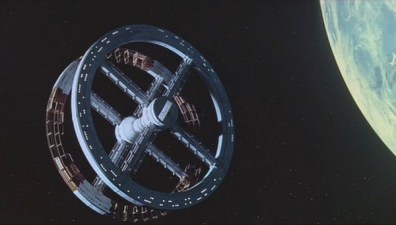
2001_Space_StationNo doubt about it, 2001: A Space Odyssey was one of the coolest, most memorable, and enduring movies I ever saw. Strange, considering there wasn’t that much dialogue in the film, and some would say that not much happened. But that’s the thing about Kubrick movies, they are very subtextual. And of course, Clarke’s involvement can not be minimized. But I’m here to talk about Clarke specifically, and the many books that came out of this screenplay that he and Kubrick created.

For starters, the books were quite different from the original movie. They contained only trace elements of the fear and intense awe that were there in the original movie. In fact, Clarke can be accused of being quite dry, in my opinion, his books somewhat technocratic and devoid of a lot of the complex emotions human beings are known to have. In fact, I was generally disappointed with the ending he wrote, how astronaut Frank Bowman was perfectly okay being whisked millions of light years away from home and transformed into the “Star Child”.
2001One would think that a person’s psyche would shatter under the strain of knowing that they were being transported across the universe, never to see home again. One would also think that a process of metamorphosis, whereby a human being was being forced to leave behind their corporeal body in favor of some higher form, would be absolutely terrifying. One would think that, but nope!

Still, Odyssey’s main strength lay in its scientific explorations of a future world as well its explorations of extra-terrestrial intelligence. The idea of an alien race that was so advanced and evolved that it had effectively left its bodies behind was groundbreaking, as was the idea of a monolith. The perfectly proportional shape, rectangles laid out in a ratio of 1:2:3; much better than bulky spaceships and little green men I must say!

Also, the story introduced the world to Hal, the AI who, thanks its exposure to human intrigue, becomes homicidal, all the while with that perfect, clinical manner of his! Frightening as he was in the movie, the book contained more depth and drew out the conflict between him and Bowman. In the end, Hal tried to decompress the ship when he realized he had lost control of the mission, which was much more effective than the rather truncated flow of events that happened in the original screenplay.
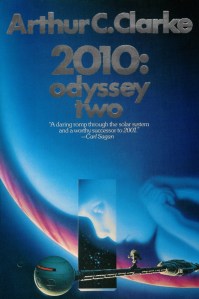
2010_cover2010: Odyssey Two, was similarly interesting. In this installment, a second mission is mounted to discern what came of the first. They discover the ship, reactive Hal, and learn that the secrecy surrounding contact with the Monolith was what drove him nuts and was the real purpose of the original mission. Ultimately, it is realized that the alien presence around Jupiter has to do with the moon of Europa, which was featured prominently in the original story because of new discoveries being made about the planet at the time.

For those who don’t know, it is widely believed that life exists beneath Europa’s outer crust, composed of ice and rock, since the oceans that lie beneath are warm from Jupiter’s intense radiation and magnetic field. As a case of art imitating life, Clarke decided that in his second book, the reason for the monolith’s presence around Europa – facilitators, if not creators, of life – was to help the natural process of life along.
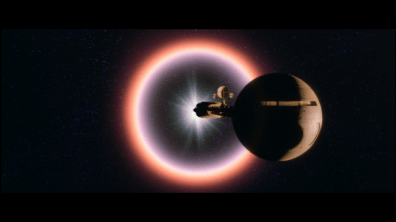
2010_3By turning Jupiter into a second star – scientists have long known that the gas giant could have become a star if things had happened marginally different in our solar system – Europa’s ice crust melted, atmosphere formed, and life was able to crawl from its oceans. The book also reintroduced Bowman to the story, who is now a living entity inside the monolith around Europa.

After communicating with the crew, letting them know that “something wonderful” is about to happen and they need to leave, he disappears, only to show up near the end and invite HAL (who’s about to die when Jupiter goes Nova) to come with him. By the end of the story, Bowman and HAL, speaking from the Monolith, warn humanity never to go to Europa. The monolith’s experiment in life is to flourish freely there, they advise, without human interference.
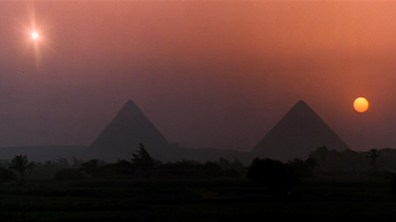
2010_4In the movie adaptation, there’s also a saccharine bit about how the Cold War powers should live in peace, but that was thrown in there for the sake of the 80’s audiences who were still dealing with the Cold War. Much like most of the US-Soviet competition that characterized the movie, it never made it into the original book.

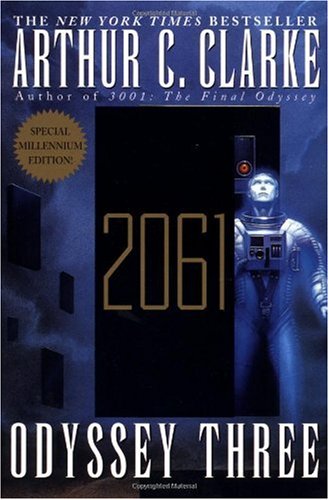
Then, years later, Clarke wrote Odyssey Three, his third installment in the series. Set in 2061, this book was again inspired by real events, the return to the Solar System of Comet Halley. Since it was not scheduled to return until 2061, he set the book in that year and began writing about a mission to go study it up close, during which time they will be doing a flyby of Europa. So Floyd, the main character of book II, a “celebrity guest”, goes on this mission with a new crew.
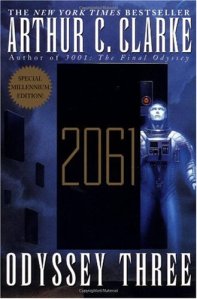
2061_odyssey3The main purpose is to investigate Halley’s comet, but the main story thread picks up when scientists on Earth and nearby Ganymede notice a new mountain that has formed on Europa (“Mount Zeus) which cannot be a volcano because of its asymmetrical nature. For reasons that are never fully-explained, the mission is hijacked and the crew become stranded on Europa.

During a rescue attempt, Floyd’s son, Bowman’s grandson, and the Afrikaaner character see the monolith on Europa and a wreck of a Chinese ship that tried to investigate earlier, in defiance of the monolith’s warnings. They see the monolith and the mountain confirm that it is, in fact, a giant diamond, a piece of Jupiter that broke off when it went nova and landed on the moon. All of this is consistent with scientific articles of the time that said that Pluto and Neptune had diamond cores, the result of carbon compression, and that the same was probably true of Jupiter.

In the end, the crew is rescued, Bowman makes an appearance in the dreams of a few people, and they come to realize that his consciousness now resides inside the monolith. The mountain also disappears beneath the surface of Europa’s ice. From all this, it is now clear that Europa is evolving, that Bowman and HAL are still alive in some form, and that a monolith is there, acting as guardian and watchman to the whole process.
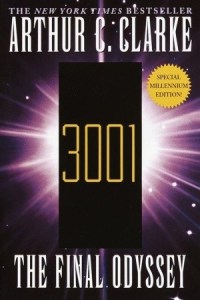
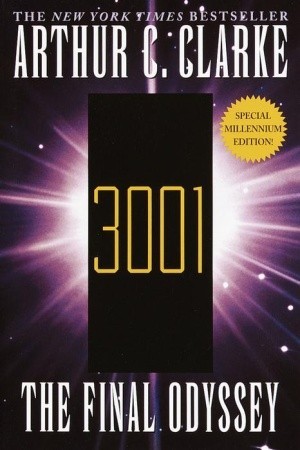
3001Then, to finish things, Clarke wrote 3001: The Final Odyssey. This book I read when I was about twenty, at a time when my literary and critical reading skills were being honed by some seriously awesome teachers and course loads. Perhaps because of this, or because Clarke changed things up drastically in the last book, I was very disappointed.

Quick synopsis, the character of Frank Poole, the astronaut who was killed by HAL in book I, is brought back. His body floats back into the Solar System after having done a circuitous route to the outer rim, and since it’s 3001, they are able to revive him. The first half of the book is then spent showing Poole how different the future is, revising Clarke’s predictions about stuff that happened in the book 2001 but not in real life, deals with all kinds of millennial themes (since the book was written just a few years shy of 2000 and is set just after the third millennium), and asserts the rather weak conclusion that a person from 2001 would have little trouble adapting to life in 3001, as opposed to someone from 1001 adapting to 2001.

Why? Because by 2001, most things that will become a reality by 3001 would be being postulated. Now this I found weak for a few reasons. First, it assumes that what we predict will be taking in 3001 actually will. It assumes that progress is a completely linear thing, that history is devoid of repeats or regression, and is generally an example of Clarke’s technocratic mindset. It also manages to gloss over the fact that Clarke was wrong about most of his predictions for 2001.

For one, the Cold War didn’t continue into the future, commercial space travel was not invented, there were no colonies on the moon, and there were no exploratory missions to the rim of known space. These he attempted to minimize by saying that these things were at least in the planning stages. Yeah! In the same way that a trip to the Moon was in the planning stages during H.G. Wells time, but that didn’t make it close!

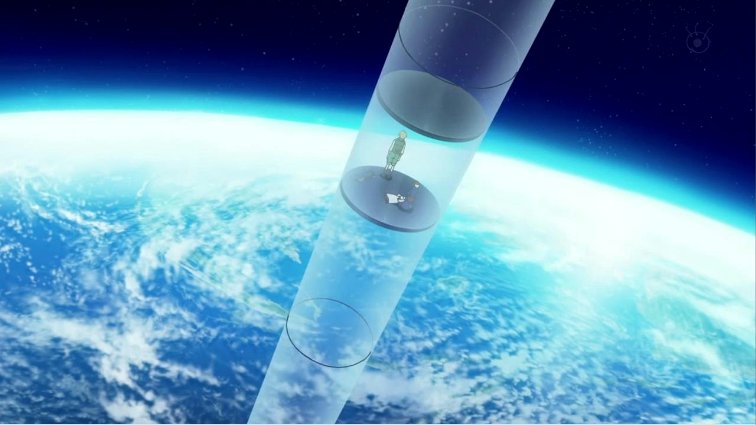
space_elevator_liftAnother major disappointment of the first half is the fact that the technological innovations he mentions look like they were ripped directly from Star Trek! For one, they have holodecks (or a close approximation)! They have brain caps they wear that download information directly into your brain. And (this one was my favorite!) genetically engineered dinosaurs that do manual labor! …WHAT??? Are you freaking kidding me?!

To make that worse, he throws in a bit about Poole was surprised to see this, even though he saw all the “Jurassic movies” as a kid. This, along with several other pop-culture references in the first half, made we want to gag! To be fair, its hard to write a book about the near future, especially over and over while the actual future is taking place. But these kind of revisions, penciling in the things that happened in real life, is just annoying! If anything, the real historical record should be minimized in the background.

Much like his talk of all the scientific feats that didn’t happen, it was probably something that should have been tacitly dealt with, but not talked so much about. Oh, and of course, his comments on religion. The way Clarke saw it, humanity had created a universal church in the future after the fall of Christianity. He figured that at some point in the future, the Vatican would open up its archives and it would subsequently fall in the same way the Kremlin did when it did the same. Are you kidding me?

world_religionsSure, its a neat parallel, but everyone already knows the church’s crimes, they’ve been documented endlessly. And the archives aren’t exactly sealed, they’re just not open to the general public. So what would opening them to the public really change? Furthermore, to suggest that humanity could do away with faith because technology meant it no longer needed it is both shallow and naive. It’s the same kind of dogmatic thinking that goes into fundamentalism, that asserts that humanity can’t live without religion because it would be totally lost without all its dogmatic signposts and explanations.

My own theory, humanity’s need for faith, as with everything else, is ambiguous and will not be subject to any one influence. Chances are, we will never outlive our need for spirituality, but that does not mean we can’t live without specific institutions. And we will NEVER be able to invent some bland, universal, all-inclusive faith. Not that we won’t attempt to, but chances are it will fail.

But I digress… the second half of the book deals with Poole deciding that he wants to go to Europa to see what became of HAL and his old colleague. So he goes, and unlike other ships that have tried and failed, he makes it. Then comes more disappointments, Frank and HAL are not transcendent entities as was suggested in previous books. They are merely downloads, digital copies of their original selves preserved inside the monolith – which isn’t a conscious being but is itself a computer. BORING!
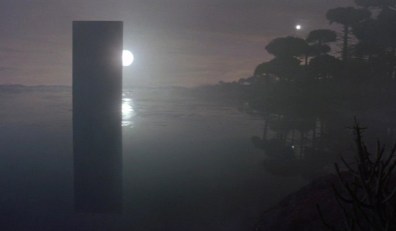
2010_jul2012-a4After all that talk about intelligence and reaching the next great leap in cosmic evolution, this is what it all turned out to be? Bits and bytes in some big storage machine? And then there was the status of the Europan’s. Basically, that too, contrary to the hopes inspired by previous books, hasn’t gone so well. The Europan’s chemical and biological makeup, it is revealed, does not inspire confidence. The lifeforms are too basic, too slow and stodgy, to ever evolve into dynamic intelligent beings it seems.

So humanity won’t have counterparts then, children from the “other sun” to deal with in the future? ‘Nuther big letdown man! Well, the book wasn’t over so I went on reading. After all this slow build-up, we finally come to the climax of the story. Turns out, the monoliths are coming back to the Solar System. Why? The last transmissions they sent out were over 900 years ago, back when humanity was contemplating its own nuclear annihilation and breaking the quarantine on Europa.
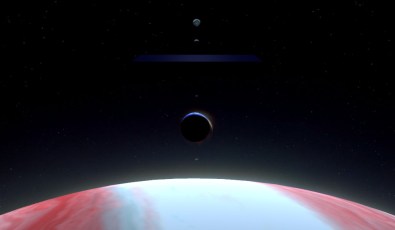
Jupiter Moons MonolithThis causes the monoliths to conclude that humanity is too aggressive, an experiment gone wrong. So… humanity needs to prepare. They look at all weapons they have in their arsenal, but could possibly stop the monolith’s, a race eon’s older? They opt for a computer virus, another attempt by Clarke to pay homage to the time in which he was writing. They download the virus into the monolith on Europa in the hopes that it will transfer it to the others that are on their way.

Frank and HAL are meanwhile stored in a data crystal to preserve their identities, and before everything hits the fan, it all stops. The monolith’s get the virus, doesn’t really effect them, but they see that humanity has changed since they last saw them and decide to give them more time. Kind of a letdown. The final words, that humanity is still young and their God “still a child”, and they will be granted a reprieve until “The Last Days” were kind of chilling, but it still felt like an abortive climax.

Thus ended the Odyssey series. Some attempts have been made to keep it going by fan-fiction authors, but the less said about them, the better. Nothing worse than fan-fic’s who try to keep a series going after its creator retired it (see Dune and it’s Descendants for more on this point!). And while I was disappointed with the ending, I do think the series was very enjoyable and worthwhile overall.
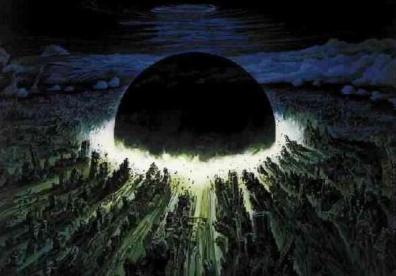
268170-akira06_superSome of the concepts, transcendence, ancient species, directed cosmic evolution, were all picked up on by some of the best sci-fi minds, not the least of which were J Michael Straczynski (creator of Babylon 5) and Katsuhiro Otomo (creator of the cyberpunk anime Akira). Where he was weak was in his fundamental understanding of human beings and history; how he felt that people are mere subjects to technological evolution and would continue to progress on a linear pattern. Human beings are certainly affected by technological change, but that change is not altogether positive.

In fact, the changes it engenders are often negative and lead to backlash and rejection as a result. Far from replacing religion, technology is often seen as a substitute religion, inspiring the same kind of mindless devotion as fundamentalism, or encouraging people to revert to simple beliefs in the hope of being delivered from its cold rationality. These are the kinds of things I would hope for in any investigation of the future, the social as well as technological upheaval and how they were connected, or at least a balanced look at these kinds of issues.

But Clarke is not that type of guy, he’s a futurist so it’s naive of me to expect it from him. In the end, he got me thinking, both in tune with his thoughts and against them, so I have to be thankful. In the end, that’s what good author does, gets your mind going and your blood pumping. And he left an enduring legacy, many titles to his credit and millions of people inspired by his word, so I say kudos to him! Thanks for all the memories and inspired thoughts, Mr. Clarke. Hope you found a quiet place amongst the stars now that you’ve transcended that final barrier. Rest in peace, Star Child!

Of Dune and its Conclusion

Of Dune and its Conclusion

Since posting my thoughts on Dune and its descendants, I’ve found that there are no shortage of people out there who agree with me. In fact, there are even sites dedicated to expressing the dissatisfaction Herbert fans have with the garbage his son and Kevin J Anderson have been putting out. Not surprising really, but I learned some interesting facts in the course of reading through them. For one, KJA does not run his writing by anyone who was involved in the production of the original Dune novels. His test panel, if that’s what you want to call it, consists mainly of family and friends. Second, I learned that, contrary to my expectations, the latest installments they have made have been doing quite poorly. In fact, let this serve as a correction to my post: the “interquel” novels, known as the “Heroes of Dune” set, are not a trilogy. Sisterhood of Dune is in fact a departure from the interquels, apparently due to sagging sales. Score one for the good guys!

Now some thoughts on these revelations: First of, what kind of serious author tests his work by getting friends and family to read it? And what the hell do his family know about Dune? Seems to me any fool looking to work the Dune franchise would care solely what the people who knew Herbert best would think, not to mention the fans. Screw family! And seriously, what are they going to tell him? That they loved it because they love him? Or are they going to be honest: “Honey, this is shit! This is an absolute insult to the legacy of Herbert, chock full of cliches and sci-fi stereotypes, and every contrivance known to pulp literature! Franks Herbert’s novels were thoughtful works that dealt with timeless themes and deep philosophical issues. Any child could have turned out this fan fiction bullshit with all its wooden dialogue, cardboard characters and ridiculous plot holes. The only thing missing is a whole lot of spelling mistakes! What the hell were you thinking?!!!”

Well, it’s one thing to criticize. Quite another to put your money where your mouth is. This is one thing I wanted to say in my original post but didn’t because it kind of made me feel like a prick. But if I got one piece of advice, it was that I was being too nice. So here’s some unbridled honesty. Do I think I could do better? That’s the question everyone must ask themselves whenever they decide to get critical. If not, they should probably shut up. But I can honestly say that I think I could do better! And I challenge my fellow Dune fans to do the same. While it may never see the light of day, I think that between us we could come up with a far better end to Dune and I invite people to make suggestions, either here or on various fan sites. You know how a groundswell works, and in the information age, its being done all the time. People produce their own works, put out their own news, and basically vote with their feet (more like fingers, hits and comments make the difference here!). But the result is the same, the popular product supersedes the mainstream crap and soon the mainstream crap is sitting up and taking notice. So let me humbly suggest that we make our own Dune 7, at least a mock-up for it. The ending that we, the fans, think that Herbert would have wanted!

Below is a link to a fansite dedicated to honoring the legacy of Herbert and bashing the prequel/sequel/interquel crap that has followed in his wake:

Jacurutu

Of William Gibson (The Bigend Trilogy)

Not only is he a famous author, he’s also a fellow BCite and the man who literally wrote the book on cyberpunk. Beyond that, his books have been renowned for capturing the zeitgeist of our times, an age characterized by revolutions in information technology and mass media. And I can honestly say that I’ve tried to emulate him in recent years. His Neuromancer was required reading seeing as how I wanted to get into hard sci-fi and he’s a major name. And his latest works also gave me a push in the direction of modern day fiction, dealing with the cutting edge rather than the future.

But… gotta be honest here, these books have been a bit of a disappointment for me. Pattern Recognition, Spook Country, and Zero History are all mainstream bestsellers that did an awful lot to capture the spirit of our age once more, but they all shared elements which I thought were kind of… well, weak. For example, consider the plot set-ups to all three books. All things in this trilogy by Gibson revolve around the enigmatic (and absurdly named) Hubertus Bigend. He’s an advertising magnate who’s always looking for the angles, the hidden agendas, the thing that’s beyond cutting edge, just five minutes away from becoming real. And to investigate these things, he hires freelance contractors, strange people with strange gifts. And that’s what sets the plots in motion every time.

In Pattern Recognition, he recruits Cayce Pollard (pronounced Cay-See), a freelance “coolhunter” who uses her odd intuition to evaluate logos and brand names for companies. Her father was lost in 9/11 (something that Gibson had to include because it occurred while writing it) and this haunts her. In addition to her weird skills (hypersensitivity to iconography) she follows footage on the internet produced by some cinematic genius. Bigend wants the creator found because… he’s curious, he wants their talent, or something like that. So Cayce sets out to find them relying on Bigend’s network, his dime, and her own personal contacts. Her journey takes her from New York, to London, to Tokyo, and finally to Moscow, all the while she’s pursued by a rival and some shadowy agents who’s agenda is not quite clear. In the end, she finds the geniuses in Moscow, the genius is a brain-damaged girl who’s sister takes care of her and puts out the footage as a way of expressing herself. The dark agents pursuing her turn out to be their protectors who just stalked her because they weren’t sure of her, and Bigend’s slightly richer for having uncovered the truth… I guess. Cool idea, weak climax, weird overall point.

Then there was Spook Country. The name alone was telling, alluding to its focus on the paranoia and intrigue of post-9/11 America. In this one, Bigend is back, employing yet another freelance contractor named Hollis Henry (why they couldn’t just bring Cayce back is beyond me, but whatever). This one has no weird intuition, she’s just a former teen singer who’s gone on to become a writer about the industry. He hires her ostensibly to research locative art for some new magazine, a cutting edge technology that is now referred to as “augmented reality”. In the course of this, she discovers that her real mission is to find out who the artist is working for. You see, he’s been using the GPS technology that powers locative art to track a crate that’s been moving around the world for years, passing that info onto some shadowy figure.

So once again, Bigend is curious… When Hollis looks into it, she finds out that the crate is filled with millions that were embezzled from Iraq’s reconstruction fund and the old man tracking it is a former intelligence operative who has a score to settle. He and his crack team are also being tracked by a current intelligence man who uses an addict named Milgrim to track the old man’s operatives by translating their Russian texts (rendered in a language called Volapuk). By the end, the old man and his crew follow the crate to Vancouver and fill it full of hollow point bullets containing radioactive dust. The money is now useless, Hollis is given an exclusive first hand look at it, and returns to Bigend to report on it. Once again, he’s richer for knowing, but has gained nothing else… And all that spy stuff and paranoia? Didn’t really amount to much. Sure there was spy work going on but it was pretty damn subtle, the marginal stuff that goes on at the fringes of the war on terror, not anything central to it. Not what I would expect at all from a book that was trying to make a point about post-9/11 America, in all its paranoid, angry, confused glory.

In the finale, Zero History, which apparently takes it name from the character Milgrim, a man who has no record of his existence for the last ten years (hence, zero history), things are a bit more clear in terms of Bigend’s motivation. However, the overall story was a bit weak, with a name like Zero History and the fact that its the third installment in the series, I was expecting a big send-off, something that went over and above what the first two did. It didn’t seem too much to expect; after all, the first book was a fitting commentary on cyberspace and the sort of tribalism its engendered. The second book upped the ante with a look at espionage and paranoia in post-9/11 America. So who wouldn’t expect that this one would deal with something incrementally bigger and more important? Alas… not so much. But I digress!

In the final installment of the trilogy, Bigend hires Hollis again, paired up with Milgrim, to investigate the origin of some elusive fashion line known as Gabriel Hounds. The reason he wants to do this is because he wants to break into the military-fashion crossover market. Not as silly as it sounds; according to the book, this has been a huge market trend since the Vietnam War and has received new life thanks to the war in Iraq. The culture of war provides life to the fashion industry, swaths of men who buy outfits to look like soldiers, and fashion designers get accustomed to making army gear and end up contracting to the military itself. In the course of their investigation, they learn that one sample they are looking at is the illusive brand named Hounds. These denim products are sold using direct marketing: the dealers show up at prearranged drop points, sell off their merchandise, and then disappear. However, the other sample they come across is being produced by an arms dealer who has a big racket involving former contacts in the military and consulting worlds, and he now sees Bigend as competition. Since he’s a former military man and is into some shady stuff, things begin to get dangerous!

However, the climax is once again the same, with a build-up and then a letdown. Sure the bad guys get beat, but no one dies and no one even gets hurt beyond a simple tasering. Some arrests are made, people hook up, and the world keeps on spinning! There’s also the point of how Bigend’s company appears to be coming apart towards the climax, but in another abortive twist, nothing happens. Bigend is simply declared as being “too big to fail” by the end, and his machinations about being able to see a few minutes into the future appear to have come true thanks to the work of his people. Cool, as a concept, the idea of limited prescience, but like with the other books, it feels like something taped over the plot itself to give it some credibility. Bigend’s main motivation was his curiosity, a contrivance to get the story moving; everything else just feels like justification. Somehow, Bigend has to benefit from all his maneuvering, and developing some kind of system whereby he can predict trends sounds like a good answer. No explanation is forthcoming as to how this works, its just thrown in at the end. Too bad too, as a premise, it’s pretty cool and even kind of worked with the title. Zero History: there is no future, just a constantly evolving present. He who can see just a few minutes ahead and glimpse it in formation will have unimaginable power!

As a third act twist, Gibson does throw one curve ball. Turns out the elusive Hounds designer, whom Hollis finds, is Cayce Pollard herself! Cool, but again, not much comes of it. Hollis says she won’t reveal her, Pollard says she’s not worried, she knows how to deal with Bigend so she’ll be okay when he finds her, and the thread dies! The story then shifts over to the military man and the threat he poses and no word is given to the Hounds for the rest of the story. Odd seeing as how that was central to the plot, but this kind of truncation is common by this installment in the story so I wasn’t surprised. In the plus column, the story does provide some interesting thoughts on resistance to commodification and how the culture of the armed forces trickles down to the street. But seriously, all the fashion stuff gets really suffocating! After a certain point in my reading of it, I couldn’t help but notice the constant mention of clothing, apparel, jackets, etc. Intrinsic to the themes of the novel yes, but I mean, c’mon! Felt like I was reading Sex and the City fan fiction after awhile! Then there was the rather odd attempts to give Bigend character traits beyond his wealth and eccentricities. Aside from an odd fashion sense he has a lust for the Full English breakfast that is mentioned too often in the story, and serves no real purpose that I can see.

Second, there’s the usual Bigend motivation factor. His interest in the marketability of military apparel is one thing, but why would be pay through the nose to get Milgrim clean in this book? Apparently, Bigend likes him because he “notices things” while at the same time is good at going completely unnoticed. For these reasons, he’s decided to pay for rehab in a Swiss clinic and put him on his payroll. Really? All that money just to hire someone who’s only marketable skill is being inconspicuous and observant? Seems more like he just wanted to bring the character back and came up with a small contrivance to fill the point. And of course, there’s Bigend himself. Unlike the previous books, where he just a shadowy figure in the background, by this book he’s grown to the point where he’s kind of like a Bond villain. Gibson even goes as far to say it by the ending, how his purchase of a Russian low-flying craft, the way he had it decked out, and has all the staff dressed like odd caricatures, is Bondian. Doesn’t make it any less weird. Oh, and the fact that he has acquired half of Iceland through a series of business deals and is flying all his staff there on that Russian craft at the end? Bondian!

Overall, what stands out about these books is their similarity to his earlier works, particularly Neuromancer. In this and other works, the story revolves around contractors who are picked up by mysterious men who work behind the scenes or have hidden agendas. But whereas in Neuromancer and other titles belonging to the “Sprawl” and “Bridge” trilogies where you have corporate magnates or mass media forces with clear (and often morally ambiguous) intentions, this time around the agenda of the shadowy person (i.e. Bigend) seems pretty benign and… well, pointless. I mean, why for example is Bigend so obsessed with uncovering all of these mysteries, what’s his motivation? Where’s the profit incentive, the threat to his bottom line? Surely a filthy-rich advertising magnate would have better things to do than spend all kinds of time and money on pet projects that have no purpose other than satisfying his curiosity. In some cases, marginal attention is given to how these things could be of use to him, but curiosity is always the main driving force. Again and again, Bigend’s actions are justified by saying that this is just the kind of guy he is, an eccentric, controlling man who wants to know whats going on around every corner and just happens to be rich enough to make that happen.

To be fair, I get it. I mean how else are you going to set up plots like this, which delve into the mysteries of the everyday world, not sci-fi worlds where anything’s possible because its total fiction and the limits of your imagination are the only constraints you have to deal with? But I would expect that a story would build to a climax, not truncate itself or end up being a letdown for the heroes, not to mention the audience. But then again, Gibson’s work is in details, the story come through more in the subtext than in the goings on of the text itself. And I still love Gibson’s work and owe a rather large debt to him for the inspiration and example he’s provided over the years. So I won’t be avoiding his books in the future; in fact, I’m anxious to see what he’ll do next. Whatever else can be said about this man, he’s good at what he does and manages to always have a keen eye for the things that are just beyond the fringes of the now, the things that are likely to be the cutting edge stuff of tomorrow. One has to wonder how much influence he himself exercises in this regard… Oh well, something for his next book maybe!

Of Dune and its Descendents

I could never create a blog about science fiction without mentioning the man who is by most standards the greatest sci-fi author of all time. Frank Herbert, author of the Dune sextet, was not only a master at creating detailed universes and realistic characters, he was also the man who literally wrote the book on hard sci-fi. In essence, he was the one who taught people how to take science fiction seriously, something rarely seen before his time. Philip K. Dick, another great of hard sci-fi claimed while writing in the 1950’s that whenever he spoke of his work, he would constantly be asked: “have you ever thought about writing something serious?” I myself have fallen into this trap many times, thinking to myself that anything I write that is set in an alternate universe or the distant future is somehow less real, less meaningful than something written about today or true life events.

It took Herbert’s Dune to snap me out of my complacency. It was after reading the first three of his novels (re-reading actually since I’d already cracked them before) that I realized that a bunch of ideas that I had been keeping bottled up in my head could actually be made into a full-length novel, maybe even a series of them. Up until that time I had been looking for something to write about, but had placed any thoughts of a sci-fi nature into a folder marked “idea for a TV series”. Yep, the best I figured I could do with any science fiction material I thought up was maybe pitch an idea for a TV show someday, you know, in case teaching and writing “serious” stuff never panned out. This was a long-shot in its own right, not to mention something I knew nothing about. Writing for TV? Not my thing, but at the time I figured that was all my ideas would be good for. At no time did I think they could be useful in helping to solve my writing dilemma. But then, after reading Dune, I felt inspired and started putting pen to paper (well, fingers to keys if you want to get technical) and the rest has been history.

But this isn’t about my work, its about Frank’s. And as every fan of Dune knows, Frank’s sextet ended on a somewhat uncertain note. His original six novels did not complete the series; for instance, we were still left with many unresolved threads in the last book, the whole “Golden Path” thing that Paul Atreides and Leto II “The Tyrant” had foreseen had yet to be explained or brought to fruition as well. After years of waiting, wondering and speculating, the Dune fan community finally caught a break when his son Brian Herbert picked up the mantle and revealed that his father had kept notes on a seventh and final Dune book in a safety deposit box that would cap off the series and answer all their unanswered questions. I was lucky enough to have finished the sixth book just in time to get in on this and was relatively excited.

And I’m sorry to say that the only thing greater than the build-up was the letdown! I sound like a prick saying this, but I honestly feel that Herbert’s legacy has fallen on hard times in the hands of his son and coauthor, the soft sci-fi writer Kevin J Anderson. After first announcing their collaboration and plans to complete the series, they started out with a pretty sensible and predictable stunt: they wrote prequels. The first was the trilogy known as the “Prelude to Dune” series. I read two of the books in this trilogy, “House Atreides” and “House Harkonnen” (but not the third and final, “House Corrino”) back in the early 2000’s and was generally unimpressed. In fact, it would be an exaggeration to say I read them, Atreides I put down two-thirds of the way through and Harkonnen I didn’t even get one hundred pages into before I got bored and dropped it.

This I blame in part on the fact that I’ve never really been a fan of prequels. For one, they have to be done right! And if the audience is already familiar with the story, the characters, and where everything is going, it’s not going to make for a very good read. It’s just filler, people reading to see how it happened, not what, where, when, and why. Anyone who sat through the Star Wars prequel trilogy ought to be able to relate. Another reason was the fact that the books seemed relatively uninspired. Not only did they suffer from that prequel sense of duty, having to explain how events the readers were already familiar with came to pass, it was almost always in a way that disappointed. When it comes to background, like most things, less in more. And these two authors really didn’t seem to be bringing anything new and original to the table, just recycling old stuff they knew the fans liked. Just seemed… I don’t know, lazy and kinda crass.

However, this did not stop me from perking up when they announced the second prequel trilogy, the “Legends of Dune” series. It seemed a bit consumerish for them to put out another set of prequels keep us fans waiting for Dune 7 like this, but what the hell right? We all wanted to know what the heck this thing called the “Bulterian Jihad” was all about. In the original Dune series, Frank had indicated that 11,000 years in the future – 10,000 years before the events in the first novel – there was a religious war that was waged by humanity against any and all thinking machines. This war altered the shape of the universe and ushered in the socio-political landscape that characterized the original novels. But beyond that, no one knew what happened. So, the son and the coauthor decided to write about it. What could go wrong?

As it turned out, a lot! Purely my opinion, but these books were an example of what never to do in writing. The first book, “The Butlerian Jihad”, I bought with some interest, and I am sad to say it was one of the worst pieces of writing I have ever seen! It was totally one-dimensional, predictable, and the plot was full of starts and stops and just seemed to fumble its way towards the conclusion. The characters were also completely superficial and really just a bunch of bad stereotypes and cookie cutter heroes and villains. But, I finished it, mainly out of curiosity and even managed to talk myself into buying book two, “The Machine Crusade”. Another suck-fest! The same exact weaknesses as the first! The good guys were too good, the bad guys too bad, and the story was ridiculous and thin as the paper it was written on. I couldn’t believe that Brian Herbert and Anderson could even think about putting the name Dune on it! Surely they had to be sick with guilt over it! But apparently not because they just kept on turning them out. To be fair, I never read book three of the series, for obvious reasons. And based on the synopses I’ve read, I think I made the right choice. While some reviewers hailed the literary duo for their ability to connect past with present, others described it using the same words that I did. Namely, contrived, superficial and not up to the originals.

And yet, I still went out and bought the Dune 7 book when it came out! I might have been a sucker for it, but after years of waiting and many dollars wasted on useless prequels that did nothing to satisfy my curiosity, I had to know how the damn thing ended! I was already writing my own novels at this time, so I felt all the more driven to see how my mentors own vision wrapped up. Sure, this latest book was only book one of two, yet another conspicuous act of opportunism by these two authors, but what did I care? I had to know how things ended and as usual, I felt that the writing style and narrative ability of the duo left something to be desired, but I was still intrigued and held on throughout, waiting for the awesome conclusion to book one of two.

Then I read it… I threw down the book in disgust and never touched another publication by them again.

“Seriously?” I said to myself. The conclusion to the whole story was that the machines were coming back? All that build-up, all that talk of humanity’s extinction and the need to alter the future, it was because those lame-ass, tinker toy, evil the cat, cardboard cutout, villainous robots were coming back to settle an old score? Needless to say, I couldn’t believe it! I couldn’t believe that Herbert’s own son and the hackish Anderson would ever stoop to ending Frank’s masterpiece with a tie-in to their own pitiful work! I refused to believe that the book was even the result of looking over the contents of a safety deposit box that Frank Herbert’s had left behind. In my mind, this ending was merely an attempt to conclude the series in a way that paid homage to their own weak interpretations of the Dune universe. Attempting to rewrite history, as it were, to suit the son and his second, not to complete the vision of the father. (Bit of a Dune-esque theme in there I’m thinking!)

Of course, I could be all wrong. It’s entirely possible the Legends of Dune prequels and Dune 7 (titled “Hunters of Dune”) were the direct result of Herbert’s own notes. But I couldn’t see how. They were nothing like his original books, and all throughout the originals, where hints were dropped as to the possible outcome of the “Golden Path”, not once was machines mentioned or any hint given that the threat to humanity came from the return of some old enemy. If anything, Herbert seemed to be suggesting that it would come from within, from humanity itself, or possibly from an alien intelligence, something humanity had yet to encounter. And while I wanted desperately to know what happened in book II of Dune 7 (“Sandworms of Dune”), I just couldn’t bring myself to waste the money. Luckily, I managed to get a hold of some reviews and synopses which told me all I needed to know. The story ends with more Deus Ex Machina plot twists, contrivances and plot holes big enough to drive a truck through. And the final message, the moral of the whole Dune saga? Humans and machines need to live together in peace! …Really? Where did they get that shit from, the Matrix playbook? Had they just watched that whole trilogy and figured ripping off another franchise was a good way to end Herbert’s legacy?

I mean really, THIS was how six books about human evolution, ecology, science, social and economic models, politics, social control, revolution, upheaval, prescience, survival, genetic engineering, eugenics, holy wars, secret societies, resource control, awareness drugs, chivalry and knife fights was to end? All that history and timeless wisdom that Herbert drew on, and the final message was that humans and machines need to learn how to live together? Dear God, I could imagine Frank Herbert turning over in his grave! But what can you say when its own son who’s putting out these things? You figure he must have the best of intentions.

But good intentions or not, the duo weren’t finished there. Shortly thereafter, they began writing stories that fell (ahem!) between the original books. Yes, as if prequels and sequels weren’t enough, now they were writing… I’m not even sure what to call those! “Paul of Dune”, “Winds of Dune”, and coming soon, “The Sisterhood of Dune”, are all stories that take place between the respective novels in the original series. Again, out of curiosity, I picked up these books to give a gander at their dust jacket and see just what the hell they were about. Again, I felt my IQ drop and promptly put them back down! Even after all the crap I had endured at the hands of these two writers! And yet, I somehow found fresh reasons for being offended by their latest attempts to cash in on Frank’s good name. One, the stories obviously do not cover anything new! Events between the first three novels are all covered in the originals themselves, and at length! Nothing more needs to be said! Second, these guys had already put out six books of pure filler, unoriginal stuff that does nothing but flesh out stuff Frank already wrote about. So it would hardly be unfair to say that the “Heroes of Dune” series, as its called, will be any different. Every time these two publish a book with the Dune name on it, it becomes an instant bestseller, purely for reasons of recognition, never for reasons of quality or originality. Profit incentive is the only reason to keep doing it!

To be fair, its hard for anyone to step into the shoes of a great author, let alone someone like Frank Herbert who left a mountainous legacy. And hey, we all gotta eat right? But in the case of Brian Herbert and Kevin J Anderson, I think it’s safe to say that their work and continued attempts to cash in speak for themselves. When it comes to raping the legacy of Frank Herbert and the Dune series, these two just can’t seem to get enough! Where there’s more money to be made and fans to exploit, these two will pen something else thats equally fluffy and superfluous and just sit back and let the royalties roll in. But how much longer can they keep this up? Who knows, these guys are good like that!

So out of respect for the master and original creator, I implore his son, Brian Herbert, to please stop! Its noble and brave that you’ve decided to step into your father’s shoes to finish off his masterpiece, but the direction you’re taking it in threatens to destroy every last trace of authenticity it once had! And to Kevin J Anderson, let me humbly suggest that you take this opportunity to go back to doing what you do best: writing fan fiction for Star Wars, X-Files and other generic sci-fi franchises. Hell, Star Gate has to be hiring, and Halos pretty damn popular right about now, maybe you could pen something for them. But for the love of God, stay away from Dune, it is clearly out of your league and I don’t think the fans can take much more, let alone the memory of Frank Herbert! I know its kind of late in the game to be asking this, but if there’s anything you two have demonstrated, its the ability to find new ways to squeeze blood from Frank’s corpse. So please, in the name of the master and all that is good and literary, I implore you, STOP!