In the course of the past century, science fiction has provided us with many interesting visions of what the future of transportation will look like. And whereas not long ago, many of these seemed like hopeless fantasy – such as the failure of flying cars or robotic automated vehicles to become a reality by 2000 – recent years and developments have seen reality slowly catching up.
Case in point, last year, the European company named “2GetThere” installed a small fleet of automated podcars (aka. robotaxis) in the eco-friendly community of Masdar City. Similarly, the town of San Jose began work on the Personal Rapid Transit System – a series of on-call, point to point transit cars designed to replace the town’s system of taxis and buses, providing an environmentally friendly alternative to traditional mass transit.
And most recently, the town of Milton Keynes – a sleepy city north of London – that is planning on conducting a podcar system trial run by 2015. Similar to the system at Heathrow Airport, which uses 21 on-call podcars on a 4 km (2.5 mile) stretch of track, the system will consist of a series of pods that will be able to carry two passengers, plus baggage, from the town’s train station to its downtown offices and the shopping district.
Milton Keynes’ plans is much more ambitious, calling for a fleet of 100 vehicles that will travel with far ore independently, albeit in a designated lane with curbs. The trial will assess safety and how people (and animals) react to them. The pods travel at up to 19 km/h (12 mph) and will contain GPS, cameras, and sensors to ensure they don’t crash into anything.
And if all goes well, the system will be adopted by 2017 and residents will pay little more than a bus fare ($3.20) to travel in automated luxury. Purpose-built in the 1960s, Milton Keynes has an unusual grid layout that makes it an ideal testing ground for a plan that other British cities are seriously considering. Given the dual issues of congestion and pollution in British cities, a system of robotaxis seems like the perfect solution.
In fact, such a solution is ideal when it comes to all major cities around the world. The state of robotics, automation, centralized grids, and the reduced impact electrical transit has compared to gasoline-powered cars and buses, we could be looking at a world where every major city has its own system of robotaxis in the near future.
And I imagine a massive grid of Hyperoops lines will be connecting every major city… The future is likely to be mighty cool! In the meantime, enjoy this video of Heathrow’s podcar system in action:
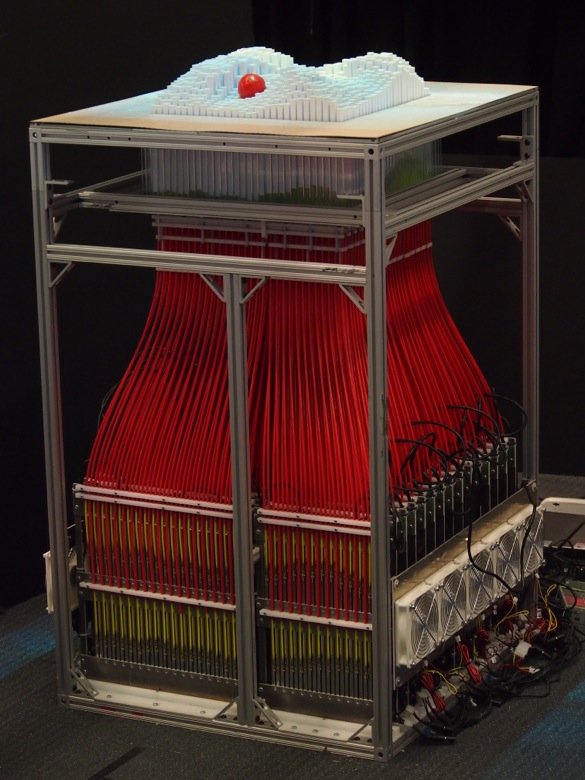
The future of computing is tactile. That’s the reasoning behind the inFORM interface, a revolutionary new interface produced by the MIT Media Lab and the Tangible Media Group. Unveiled earlier this month, the inFORM is basically a surface that changes shapes in three-dimensions, allowing users to not only interact with digital content, but even make simulated physical contact with other people.
Created by Daniel Leithinger and Sean Follmer and overseen by Professor Hiroshi Ishii, the technology behind the inFORM isn’t actually quite simple. Basically, it functions like a fancy Pinscreen, one of those executive desk toys that allows you to create a rough 3-D model of an object by simply pressing it into a bed of flattened pins.
However, with the inFORM, each of those “pins” is connected to a motor controlled by a nearby laptop. This not only moves the pins to render digital content physically, but can also register real-life objects interacting with its surface thanks to the sensors of a hacked Microsoft Kinect. In short, you can touch hands with someone via Skype, or feel a stretch of terrain through Google Maps.
Another possible application comes in the form of video conferencing, where remote participants can be displayed physically, allowing for a strong sense of presence and the ability to interact physically at a distance. However, Tangible Media Group sees the inFORM as merely a step along the long road towards what they refer to “Tangible Bits”, or a Tangible User Interface (TUI).
This concept is what the group sees as the physical embodiment of digital information & computation. This constitutes a move away from the current paradigm of “Painted Bits”, or Graphical User Interfaces (GUI), something that is based on intangible pixels that do not engage users fully. As TMG states on their website:
Humans have evolved a heightened ability to sense and manipulate the physical world, yet the GUI based on intangible pixels takes little advantage of this capacity. The TUI builds upon our dexterity by embodying digital information in physical space. TUIs expand the affordances of physical objects, surfaces, and spaces so they can support direct engagement with the digital world.
It also represents a step on the long road towards what TMG refers to as “Radical Atoms”. One of the main constraints with TUI’s, according to Professor Ishii and his associates, is their limited ability to change the form or properties of physical objects in real time. This constraint can make the physical state of TUIs inconsistent with the underlying digital models.
Radical Atoms, a vision which the group unveiled last year, looks to the far future where materials can change form and appearance dynamically, becoming as reconfigurable as pixels on a screen. By bidirectionally coupling this material with an underlying digital model, dynamic changes in digital states would be reflected in tangible matter in real time, and vice versa.
This futuristic paradigm is something that could be referred to as a “Material User Interface (MUI).” In all likelihood, it would involve polymers or biomaterials that are embedded with nanoscopic wires, that are able to change shape with the application of tiny amounts of current. Or, more boldy, materials that are composed of utility fogs or swarms of coordinated nanorobots that can alter their shape at will.
Certainly the ambitious concept, but as the inFORM demonstrates, its something that is getting closer. And the rate at which it is getting here is growing faster every day. And you have to admit, though the full-scale model does look a little bit like a loom, it does make for a pretty impressive show. And in the meantime, be sure to enjoy this video of the inFORM in action.
This past summer, Elon Musk once again impressed the world with his futuristic design for a high-speed transit tube that could take passengers from Los Angeles and San Francisco in just 30 minutes. It’s known as the Hyperloop, a “fifth form” of transportation that would utilize linear electric motors, solar panels, and air cushions to achieve speeds of up to 1290 kilometers per hour (800 mph).
Unfortunately, Musk also indicated that with his current, busy schedule, it would be many years before a working demonstration could be produced. What’s more, he was unclear on what role, if any, he would play in its creation. The project was unveiled as an open-source venture, and he called upon business investors to take up the role of making it happen.
However, some investors have come forward to do just that. Gathering around the entrepreneurial collaboration platform known as JumpStartFund, these enthusiasts have come together to create a corporation that will see Musk’s concept through to development. This is no small task, seeing as how the price-tag (according to Musk) would be between 6 and 10 billion dollars.
JumpStartFund launched on August 22, and aims to give entrepreneurs a network through which to both seek funding and support as well as crowdsource the idea and collaborate with others to refine it. The Hyperloop concept, put up on the site by the JumpStart team, became the platform’s flagship project within its first week of launch.
Dirk Ahlborn, CEO and co-founder of JumpStartFund, said in an interview back in September:
We want to be the ones that actually make things happen. So of course we need to create a corporation. Whoever decides to dedicate more time to this than just logging onto the platform deserves to be part of this company.
Because Ahlborn and his co-founders have connections with SpaceX, they were able to talk over the idea with the company’s president, Gwynne Shotwell, and get the green light to feature it on the platform. Joining them are engineers Marco Villa and Patricia Galloway, who worked for SpaceX and the US National Science Board respectively and even held directorial and vice chair positions.
JumpStartFund is also accepting applications from members of the site to work full-time on the Hyperloop project in exchange for equity in the company. Ahlborn has also indicated that even naming the company will be a crowdsourced effort:
We want to find a way to give everyone the ability to be a part of this project. The whole concept is always going to be on the platform. Everything is going to be very transparent, and we intend to reserve a percent of future revenues for people that work with us on the platform.
And the Hyperloop is hardly alone when it comes to the future of mass transit. On the opposite side of the US, along the Northeast Corridor, The Northeast Maglev (TNEM) company is looking to create a superconducting magnetic railway that could take passengers from New York to Washington D.C. in 60 minutes, and from Baltimore to D.C. is just 15.
At present, this American company – which is backed by a Japanese government bank – is testing a maglev route in Japan that runs from Nagoya to Tokyo in Japan and is planned to be completed by 2027. In the US, their efforts are aimed at replacing the nation’s aging transit infrastructure, which is unable to cope with modern demand.
As Northeast Maglev CEO and chairman Wayne Rogers said in a recent interview with Co.Exist:
What’s happening is we’re operating on 1940s and 1950s infrastructure and drowning in congestion. This isn’t pie-in-the-sky technology. This is something that you could fly to Tokyo, sit on a train, and actually ride a train that goes 311 miles per hour.
Much like the Hyperloop, the train would run on a bed of air, levitated by a series of electromagnetic coils located on the track. While similar magnetic levitation projects along the corridor have been considered in the past, they repeatedly failed due to curves that would slow down the transit process, and passengers projections were consistently too low.
The current maglev project plans on using tunnels to bypass the curves, and train ridership is at an all-time high. However, the realization of the project will still require significant funds. As Rogers himself projects, the first leg of the route – from D.C. to Baltimore – will cost some $10 billion. As such, the company imagines it will require some additional federal support.
The company does have some high-profile support working in its favor, though. Its advisory board includes two former transportation secretaries, former majority leader Tom Daschle, Under Armour CEO Kevin Plank, former Northwest Airlines CEO Doug Steenland, and George Pataki, Christine Todd Whitman, and Ed Rendell – the former governors of New York, New Jersey, and Pennsylvania.
And ultimately, Rogers and his company are hopeful, citing recent changes and the enthusiasm garnered by the Hyperloop project:
[T]he concept is different, the sponsorship is different, the routing is different, and the technology is different. I think one of the things [the Hyperloop] has done – without commenting on the feasibility of the Hyperloop or not – is it’s brought people’s attention to the problem and brings America back to the things it’s good at, which is thinking big things and implementing cutting-edge technologies on terrific projects.
Who knows? In a few decades times, we could be looking at a world where high-speed maglev trains crisscross every continent, carrying people between all major cities faster than jet planes, and at a fraction of the cost. Meanwhile, intercontinental transit could be taking the form of aerospace travel, jets that fly into the lower atmosphere at hypersonic speeds. It’s important to dream big!
And in the meantime, enjoy this promotional video from The Northeast Maglev company:
No one likes the idea of having to clean their homes or living spaces. Its time consuming, repetitive, and never seems to end. But thanks to some new concepts, which were featured this year at the Electrolux Design Labs competition, a day may be coming when all such maintenance can be handled by machines, and not the large, bulky kinds that are often featured in sci-fi shows and novels.
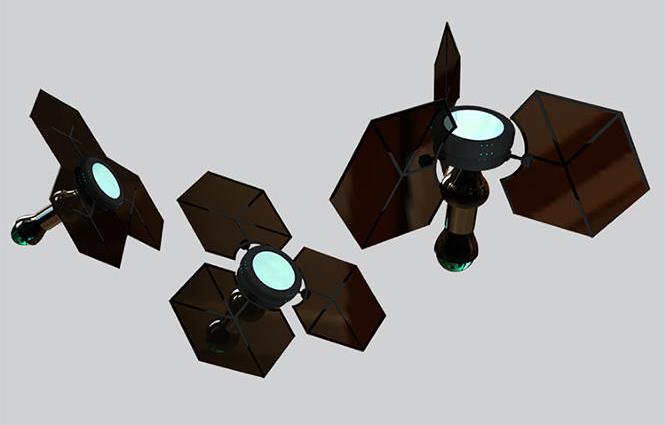
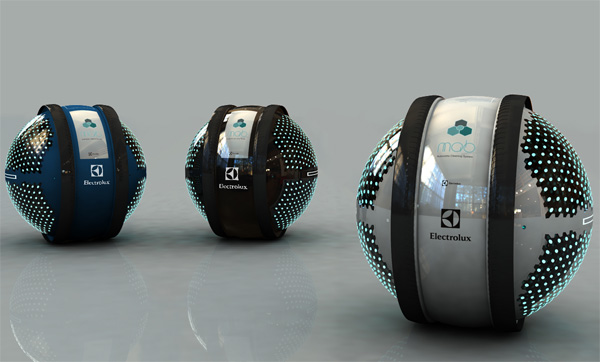
Instead, the new concept for household cleaning robots focuses on the growing field of swarm robotics. That was the concept behind Mab, a series to tiny robots that fly around the house and determine what needs cleaning. Designed by Adrian Perez Zapata, a 23-year old student from Bolivia, the Mab concept utilizes swarm programming to allow all 908 of its insect-like robots to carry out group functions.
Each of the tiny robots lives within a spherical core (picture above), and once they are released, they venture out and depositing tiny amounts of water and cleaning solution onto surfaces that have been identified as dirty. Then, having sucked up the dirty liquid, the swarm returns to their core where they unload and await further instructions or the next schedules cleaning cycle.
The robots fly around by means of several tiny, spinning propellers, and their energy comes from built-in solar panels and a battery unit that is recharged whenever they are in the core unit. Zapata claimed that he derived much of his inspiration for the design from the “robo-bee” research being conducted at Harvard, but initially got the idea from watching actual insects at work one day:
I was in my university gardens when I observed the controlled flight of bees pollinating a flower, and how magical it is to see swarms of bees working together. My concept Mab only requires a short initial configuration to function autonomously, so you could arrive home and see a swarm of mini-robots roaming around cleaning independently. This means you could sit back and relax, as you observe with great astonishment the little Mab fairies working their magic.
Zapata’s design won first place in the 2013 Electrolux Design Labs competition, an annual contest created to encourage designer students from all over the world to come up with ideas and solutions for future living. This year’s theme was Inspired Urban Living, featuring three focus areas to choose from: Social Cooking, Natural Air and Effortless Cleaning, and drew some rather impressive ideas!
For example, second place went to Luiza Silva of Brazil for her design concept known as Atomium, a home 3-D printer for food that uses molecular ingredients to construct food layer by layer. You simply draw the shape of the food you would like to eat and show it to the Atomium, which then scans the image and prints the specified food in the desired shape.
Third place went to Jeabyun Yeon from South Korea for the Breathing Wall, an “air cleaning concept which pulsates and changes shape as it cleans the air.” Inspired by fish gills, It can also be customized to suit individual needs as it scents the air you breathe and changes color according to your choice.
After that, the finalists included: Nutrima, a device for instantly assessing food’s nutritional value and possible toxicity; Kitchen Hub, an app to keep track of food in the fridge, encourage healthy eating, and reduce waste; OZ-1, an air purifier worn as a necklace; 3F, a shape-shifting autonomous vacuum cleaner; and Global Chef, a hologramatic device for bringing virtual guests to the dinner-table.
Taken together, these small bits of innovation are indicative of a much larger trend, where touchscreens, 3-D printing, scanners, swarm robots, and smart environments address our needs in ways that are intuitive, automated, efficient, and very user friendly. The only downside… they are likely to make us ever lazier than we already are!
In the meantime, check out these videos of the Mab, Atomium, Breathing Wall, and other cool inventions that were featured at the 2013 Electrolux Design Labs competition:
For some time now, classroom cameras have been used to see what teachers do in the course of their lessons, and evaluate their overall effectiveness as educators. But thanks to a recent advances in facial recognition software, a system has been devised that will assess teacher effectiveness by turning the cameras around and aiming at them at the class.
It’s what’s known as EngageSense, and was developed by SensorStar Labs in Queens, New York. It begins by filming student’s faces, then applying an algorithm to assess their level of interest. And while it might sound a bit Big Brother-y, the goal is actually quite progressive. Traditional logic has it that by filming the teacher, you will know what they are doing right and wrong.
This system reverses that thinking, measuring reactions to see how the students feel and react, measuring their level of interest over time to see what works for them and what doesn’t. As SensorStar Labs co-founder Sean Montgomery put it:
This idea of adding the cameras and being able to use that information to assist teachers to improve their lessons is already underway. Where this is trying to add a little value on top of that is to make it less work for the teachers.
Montgomery also emphasized that the technology is in the research and development research and development phase. In its current form, it uses webcams to shoot students’ faces and computer vision algorithms to analyze their gaze – measuring eye movement, the direction they are facing, and facial expressions. That, coupled with audio, can be transformed into a rough, automated metric of student engagement throughout the day.
After a lesson, a teacher could boot up EngageSense and see, with a glance at the dashboard, when students were paying rapt attention, and at what points they became confused or distracted. Beyond that, the concept is still being refined as SensorStar Labs looks both for funding and for schools to give EngageSense a real-world trial.
The ultimate goal here is to tailor lessons so that the learning styles of all students can be addressed. And given the importance of classroom accommodation and the amount of time dedicated to ensuring individual student success, a tool like this may prove very useful. Rather than relying on logs and spreadsheets, the EngageSense employs standard computer hardware that simplifies the evaluation process over the course of days, weeks, months, and even years.
At the present time, the biggest obstacle would definitely be privacy concerns. While the software is designed for engaging student interest right now, it would not be difficult at all to imagine the same technology applied to police interrogations, security footage, or public surveillance.
One way to assuage these concerns in the classroomstudents, according to Montgomery, is to make the entire process voluntary. Much in the same way that smartphone apps ask permission to access your GPS or other personal data, parental consent would be needed before a child could be recorded or their data accessed and analyzed.
Yes, you read that right. Whereas the ladies at Thinx invented an underwear that was leak-proof, moisture absorbing and odor-resistant, this latest piece of high-tech underwear actually prevents you from making a stink when you break wind. Sure, they are not exactly tackling Climate Change or curing diseases, but they must just be one of the most practical inventions to date.
They are known as Shreddies, and are the brainchild of British inventor Paul O’Leary. Basically, they use a thin layer of activated carbon, a known odor destroyer, to mask the smell of gaseous secretions. The porous nature of the carbon traps the smell, leaving nothing but the smell of fresh underwear, and all you need to do to reactivate the odor-trapping abilities is to wash them afterwards.
The company calls the fabric “Zorflex” and says that it went through rigorous testing to determine its odor-masking abilities. This included reaching out to a university research department, and presenting the finished product to professional standards scrutiny:
De Montfort University in the U.K. tested our new 100% activated carbon jersey cloth and presented their findings at the 86th Textile Institute World Conference.
Needless to say, when the Textile Institute – the leading international authority of clothing and footwear – backs you up, you know you’re doing something right!
Currently, Shreddies start at $30 for women and $45 for men. And in addition to their standard odor-blocking model, they also produce a line of underwear for people suffering from incontinence. These come with a new waterproof and breathable fabric, which has a high moisture vapour transmission rate.
As to the most important question, the company was sure to address that as well on their website, saying that while their designer underwear does absorb odors, it does not muffle the sound of flatulent outbursts. Luckily, they advise people to just alter the position of their bodies to do that. How thoughtful!
It’s an interesting age we live in, where underwear is capable of doing the same job as a diaper, and with odor-eliminating capabilities to boot! At this rate, we won’t need to mind our manners or toilette train ourselves at all in a few years!
With the help of ballistics computers, integrated devices, and other high-tech advances, the firepower of the individual soldier is growing by leaps and bounds. And now, thanks to weapons like the Tracking Point “smart rifle”, which utilizes computer-assisted aiming, just about anyone will be capable of becoming a sharpshooter.
Tracking Point’s team is located in north Austin, Texas, where they have been working for many years to produce a truly “smart rifle”. After three years, they managed to create a weapon that can hit targets up to 915 meters (1,000 yards) away with near 100 percent accuracy. To put that in perspective, that’s about the length of ten football fields.
Interestingly enough, Tracking Point’s technology was born of frustration. The company’s founder, John McHale, came up with the idea for a smart rifle after returning from a 21-day hunting trip in Tanzania, where he failed to bag the elusive Thompson’s gazelle. Despite repeated attempts that seemed sure to hit the mark, he kept missing, as he lacked the skill to make the necessary corrections for a long-distance shot.
As a Texas native, McHale worked for decades in high-tech. He founded and ran several startups, including NetWorth and NetSpeed, which developed products that brought high-speed Internet to businesses and homes. Using technology to help people deal with the variables of long-range shooting – like shaky hands, wind, and bullet drop – seemed like a good fit with his approach to problem-solving.
Basically, long-range shooting involves a lot of math, incorporating velocity, ballistics, wind speed, and sometimes even Coriolis forces. Basically, as soon as a bullet leaves the gun, it becomes subject to gravity and is fighting to stay on course. The longer the range, the more difficult it is to make an accurate shot. For experienced long-range hunters, these variables are often kept track of using a “dope book” or log.
With a computer-assisted scope, all of this information is gathered in real time by the gun itself and then fed to the shooter via the display in the eyepiece. And while Tracking Point’s rifles are the first type of gun like this on the market, many are sure to follow. Already, a few companies are working on other types of smart firearms, gun-centric apps, and tech-infused scopes.
But of course, this invention goes far beyond the field of sport hunting. The US Army and every other advanced military on the planet is also heavily invested in integrated software and targeting computers to their firearms. And with the development of smart scopes and specialized apps, a new revolution is underway in firearms that has not been seen since the advent of gunpowder.
For those interested in buying one of these rifles, the company has indicated that their is a sixth month back order waiting period. Each one goes for around $25,000 apiece, and the company has already sold out on all the weapons it has slated until the end of the year. Beginning back in may, Tracking Point began shipping their rifles to buyers, and planned to make 400 to 500 by 2014.
Personally, I could do without one. But that’s because In my world, if you’re going to kill an animal, you better make it up close and personal, and be prepared to eat it and not waist a thing! You might say I take the naturalist approach to hunting 😉
Driver inattention, tunnel vision, and distraction are all major causes of road accidents. And while the law has certainly attempted to remedy this situation by imposing penalties against driving while on the phone, or driving and texting, the problem remains a statistically relevant one. Luckily, Emotiv and the Royal Automobile Club of Western Australia have joined forces to come up with a brilliant – albeit slightly unusual – solution.
It’s known as the “Attention Powered Car”, an automobile that features a neuroheadset made by Emotiv, creator of a range of electroencephalography-based monitoring gear. Basically, the driver straps on the headset while driving and then interfaces with custom software to read the driver’s brainwaves. Any lapses in concentration are read by the headset and cause the vehicle to slow down to about 14 km/h (9 mph) as a way of alerting the driver.
In fact, the car – a Hyundai i40 – will only run at full capacity when it senses that drivers are giving their full attention to the task at hand. According to Pat Walker, RAC executive general manager:
The impact of inattention is now comparable to the number of deaths and serious injuries caused by speed and drink driving, which are all contributors to Western Australia consistently having the worst fatality rate of any Australian state. Nationally, it is estimated inattention was a factor in 46 percent of fatal crashes.
The prototype design is largely meant to bring attention to the issue of driver distraction, and also serve as a tool for investigating the problem further. Researchers have been using the car (on a track) to test how various tasks, such as switching radio stations or sending a text message, impact a driver’s attention. Factors measured include blink rate and duration, eye movement, and head tilts.
And while novel and pure science fiction gold, the concept is also quite due. Given the improvements made in EEG headsets in recent years, as well as computerized vehicles, it was really just a matter of time before someone realized the potential for combining the technologies to create a safer drive that still relied on a human operator.
While robot cars may be just around the corner, I imagine most people would prefer to still be in control of their vehicle. Allowing for a neuroband-operated vehicle may be just the thing to marry increased safety while avoiding the specter of a future dystopian cliche where robots handle our every need.
RAC WA has also produced a number of videos about the Attention Powered Car, including the one below. To check out others, simply click on this link and prepare to be impressed.
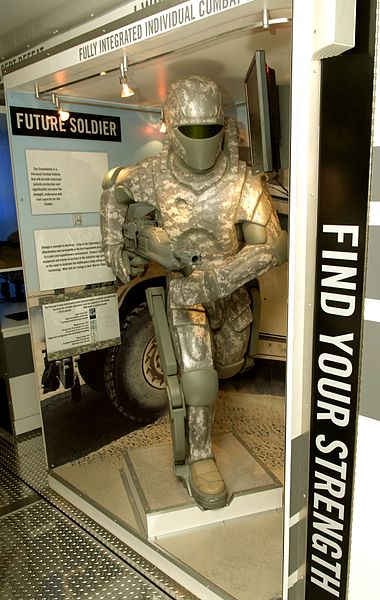
Army researchers have been working for years to incorporate powered armor, exoskeletons, and high-tech weaponry into the arsenal of next-generation soldiers. And this latest development from DARPA – the Defense Advanced Research Projects Agency, the research wing of the US Army – is being hailed as the closest thing there is to a real-life “Iron Man” suit to date.
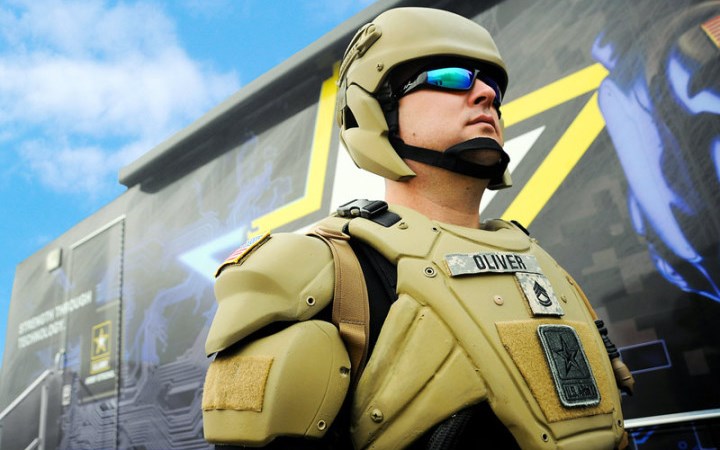
Its known as the Tactical Assault Light Operator Suit (TALOS) and is designed to deliver “superhuman strength with greater ballistic protection”. Named in honor of the Greek automaton made of bronze that Zeus assigned to protect his lover Europa, this suit incorporates a powered exoskeleton, liquid armor, built-in computers and night vision, and the ability to monitor vital signs and apply wound-sealing foam.
Put together, the capabilities would make the already elite Special Operation Forces nearly invincible in the field, according to the Army. As Lt. Col. Karl Borjes, a U.S. Army Research, Development and Engineering Command (RDECOM) science adviser, said in a statement:
[The] requirement is a comprehensive family of systems in a combat armor suit where we bring together an exoskeleton with innovative armor, displays for power monitoring, health monitoring, and integrating a weapon into that — a whole bunch of stuff that RDECOM is playing heavily in.
For the sake of the suit’s design and high-tech features, DARPA reached out to engineers from MIT, who are currently working to produce the liquid body armor that is perhaps the most advanced feature of the suit. Composed of magnetorheological fluids, this armor will “transform from liquid to solid in milliseconds when a magnetic field or electrical current is applied.”
The suit is expected to make a first-generation appearance some time next year. Because of the high number of highly integrated technical challenges with advanced specifications, the Army is also drawing on a broad range of collaborators from multiple fields to complete the design in time. And as Jim Geurts, USSOCOM acquisition executive, in a statement:
USSOCOM is interested in receiving white papers from a wide variety of sources, not just traditional military industry but also from academia, entrepreneurs, and laboratories capable of providing the design, construction, and testing of TALOS related technologies. The intent is to accelerate the delivery of innovative TALOS capabilities to the SOF operator.
For some time now, the concept of advanced powered suits of armor has been a feature of science fiction. Examples abound from literary references, such as E.E. Smith’s Lensman series and Heinlein’s Starship Troopers, to RPGs like BattleTech and Warhammer 40k, and to the gaming world with the HALO and Fallout series’. And much like lightsabers, there has scarcely been a geek alive who didn’t want one!
Now it seems that something very close might be realizable within a year’s time. I don’t know about you, but I feel both inspired and more than a little jealous. Damn SOCOM, always getting the coolest gear first! And of course, there’s a video:
3-D Printing has proven itself quite useful when it comes to creating components, toys, and models. But when it comes to assembling complicated parts, or full-on products, other machines are often necessary. That’s where the Microfactory comes in, a veritable “multi-tool” machine that merges the best of 3-D printing and machining.
Being touted as “a machine shop in a box”, the creators of the device (the Mebotics company) were inspired to create this multi-tool kit after collaborating at the Boston-area Artisans Asylum. Artisans Asylum is a non-profit organization dedicated to promoting hobbyists, artisans, fabricators and entrepreneurs through a series of open maker space presentations.
In addition, the team was also inspired by the fact that most manufacturing systems suffer from two major downfalls: noise and mess. By “closing the system”, as they put it, they eliminated both hassles while still ensuring that their device is capable of both producing tailor-made objects and altering them to order.
The Microfactory dramatically expands the range of products a person with no other equipment could make. It is basically able to 3-D print in four colors, out of multiple materials, and also etch, and mill the final products. This process, which combines machining and printing, is what the makers refer to as “hybrid manufacturing.”
As Co-founder of Mebotics, Jeremy Fryer-Biggs, explains:
I wanted to have a machine that was capable of making parts for all the crazy stuff people people would ask me [to make]. I wanted a tool that would allow me to do a whole wide range of things.
As Fryer-Biggs and the team envision it, the Microfactory could also offer users the ability to create devices and components where they are needed, regardless of the location. With a fully-functional computer incorporated to provide the blueprints, they foresee some extreme scenarios where objects could be created and finished where no stores are available:
You’re at base camp in the Himalayas, you’re in the middle of Afghanistan and you wanna make a part. So you connect this thing to a Wi-Fi hotspot–if you have a Wi-Fi card in the machine that you put in. You can then download from the server whatever the replacement part is you need, and in the middle of nowhere, get your replacement.
This vision is in keeping with what many scientific organizations – such as NASA, the ESA, and other space agencies – are foreseeing. Already, such devices are being considered for use on the International Space Station and on future space missions, where astronauts will always be in need of specialized tools and may not have the ability to have them shipped out to them.
The team currently has several working prototypes but is planning to bring the project to market by raising $1 million through Kickstarter. MicroFactory units are being pre-sold for between $4,000 and $10,000 in several models. Though the team admits that the price is high, the science fiction appeal alone is well worth it! As Marie Staver, a project manager on the team, put it: “The science fiction future is officially here.”
Couldn’t agree more. And in the meantime, check out this video of the Microfactory in action:

 In the course of the past century, science fiction has provided us with many interesting visions of what the future of transportation will look like. And whereas not long ago, many of these seemed like hopeless fantasy – such as the failure of flying cars or robotic automated vehicles to become a reality by 2000 – recent years and developments have seen reality slowly catching up.
 And most recently, the town of Milton Keynes – a sleepy city north of London – that is planning on conducting a podcar system trial run by 2015. Similar to the system at Heathrow Airport, which uses 21 on-call podcars on a 4 km (2.5 mile) stretch of track, the system will consist of a series of pods that will be able to carry two passengers, plus baggage, from the town’s train station to its downtown offices and the shopping district.
 And if all goes well, the system will be adopted by 2017 and residents will pay little more than a bus fare ($3.20) to travel in automated luxury. Purpose-built in the 1960s, Milton Keynes has an unusual grid layout that makes it an ideal testing ground for a plan that other British cities are seriously considering. Given the dual issues of congestion and pollution in British cities, a system of robotaxis seems like the perfect solution.








 For some time now, classroom cameras have been used to see what teachers do in the course of their lessons, and evaluate their overall effectiveness as educators. But thanks to a recent advances in facial recognition software, a system has been devised that will assess teacher effectiveness by turning the cameras around and aiming at them at the class.
 After a lesson, a teacher could boot up EngageSense and see, with a glance at the dashboard, when students were paying rapt attention, and at what points they became confused or distracted. Beyond that, the concept is still being refined as SensorStar Labs looks both for funding and for schools to give EngageSense a real-world trial.
 At the present time, the biggest obstacle would definitely be privacy concerns. While the software is designed for engaging student interest right now, it would not be difficult at all to imagine the same technology applied to police interrogations, security footage, or public surveillance.










 Stories by Williams