Eh Tu, Disney?

Oh dear. It seems that Disney, not content to let other movie magnates have all the fun, will be launching (no pun) a reboot of its own. Yes, The Rocketeer, that kitsch, feel good movie about a guy who finds a rocket pack and becomes a super-hero, is getting remade for a new generation.

Personally, I got nothing against the original. Families had to have some kind of inoffensive option for super-hero movies back when Spiderman didn’t exist and Batman was still a bit Gothic for children to watch. But why does it need to be remade? Wasn’t the last one enough?

But then again, that’s a can of worms which myself and many smarter people besides have already opened. If you pull one thread in this giant tapestry known as reboot/remake/relaunch fever, it all comes tumbling down!

Luckily, some of the folks over at Vimeo made this hilarious video of what The Rocketeer would look like if it had been made into a Pixar movie. I can’t help but wonder if they have the right idea here. Seriously, when was the last time Disney ever did anything great that was live action?

http://vimeo.com/user4835392/rocketeer-pilote

And just to poke fun at Disney, here’s a musical clip from Family Guy where The Rocketeer didn’t do so well (at 1:24), not to mention Michael Jackson. Geez, MacFarlane, talk about kicking a dead horse!

Red Dawn Relaunch

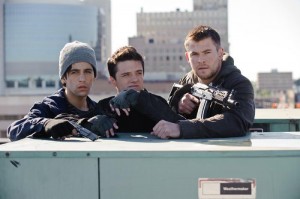
Oh boy, I thought as when I heard about this preview. Another reboot of a cult-classic huh? As I’m sure I’ve said a million times before, why doesn’t Hollywood just admit that they are out of ideas. Sure, this relaunch of the movie about a possible Soviet Invasion will star Thor (Chris Hemsworth), and sure they are taking a slightly more realistic take by making at least one of the “Wolverines” an actual combat veteran (as opposed to say, a bunch of teenagers and Patrick Swayze).

However, beyond that, there doesn’t appear to be anything new or remotely realistic about this movie. For one, the plot has been updated so that small town America is invaded by Cuba and North Korea. Really? Two tottering Soviet-era dictatorships that can’t even feeds their own people and are on the brink of collapse manage to circumvent America’s coastal defenses and occupy the United States? Really? This movie sounds like Cold War propaganda, sans the actual Cold War!

At first, I thought I saw some meager potential here. But that was before I read the actual description of the plot. After that, I felt like grabbing the producers and execs who thought this was a good idea and giving them a good shake. “This is why you can’t reboot Cold War Era ideas in the post-Cold War world!” I’d say. The first movie made sense in that it resonated with Americans who were hearing about Russia’s fortunes in Afghanistan. Red Dawn played to the imagery coming out of that war, where young fighters were running around, their heads wrapped in bandanas, and taking out Russian tanks and helicopters with Stingers and RPGs.

But this? This just seems like another excuse by Hollywood producers to do something that’s been done, throw in some cool new action sequences, and sit back and count their money. If they had any guts, they’d have made it China invading instead of Cuba and North Korea. But then again, you gotta hedge your bets right? Can’t piss off the real threats if you’re currently tied at the hip economically. Better to talk about the marginal countries that are under embargo and no one worries about anymore.

Ah well, at least the trailer looks cool. Might even be a good candidate for download.

Of Remakes and Smart People Making Stupid Arguments

In my position as a social sciences major, I have had many opportunities to witness dumb ideas argued intelligently; cases where the stupidest premises imaginable were made to sound respectable and even plausible by academics who were in the habit of injecting cool rhetoric or intellectual claptrap into weak ideas. If nothing else, it demonstrated to me that there are apologists and defenders who invest way more thought into their arguments than other people do into their work.

One case involved a Humanities Major (I assume) arguing that Brittany Spears song “I’m Not A Girl (Not Yet A Woman)” was a possible indication that the then starlet was a closet post-modernist Hegelian philosopher. Another had to do with the hidden genius behind George W. Bush’s many uses of inventive wordplay. And both were patently brilliant in the way they tried to make the completely mundane and painfully stupid sound smart. I tell ya, you have never heard so many smart argument employed in the defence of such stupid subject matter!

But this article really took the cake for me. Entitled “Why Remakes Are One of Our Greatest Achievements as a Civilization”, this article asserts that there is a connection between the many, many Hollywood relaunches of late and some of our most venerated cultural traditions as a species. And here too, I had to doff my cap the writer. Never have I heard so much thought dedicated to pure thoughtlessness, so much intellectual rhetoric employed in the defence of something so undeserving.

First, the author asserts that remakes are really a sublimated form of folk tales, resembling how cultures in ancient times would tell the same basic stories across vast stretches of space and time. Second, they deconstruct originality by claiming it is a largely 20th century construct that was invented by Modernists hoping to make a break with the past. The conclusion? That originality is a myth and that retelling the same story is a sign of organic creativity… I guess.

Ignoring the fact that we are talking about Hollywood remakes for just a second, I noticed two fatal flaws in this argument. One, Hollywood remakes are deliberate attempts to capitalize on old ideas by simply updating them with the latest in special effects, or by simply redoing an old idea which was shown to have worked in the hopes that it will again. Only in the most farfetched ways does that resemble the organic process of how stories spread across time and space, evolving in terms of detail but remaining similar in theme.

Second, originality may have been a Modernists obsession, but it’s hardly a recent invention. In fact, writers of all ages have lamented the lack of originality in their own  generation and wishing they had lived in earlier times, when writers of great renown established reputations by being the ones who left an indelible mark on their cultures literary traditions. Ancient Greece’s own Aeschylus said his tragedies were “composed of the crumbs from Homer’s table”. Shakespeare’s own works acknowledge a huge debt to Christopher Marlowe, the man who invented blank verse Iambic Pentameter and inspired many of The Bard’s own stories.

Granted, nobody is 100 % original in any time, but to say it’s a myth is both cynical and a rhetorical dead end. And that fact that I’ve even invested this amount of thought into this argument makes me think that the authors of this and other such articles have pulled one over on me. But really, I just have to wonder… are there really people out there, so educated yet so bored, that they have to employ their argumentative and rhetorical skills to subject matter such as this. Have they nothing better to do?

In any case, here is the article. Note the comment, by me (houseofwilliams) in the comment section. I did my best to argue my previous thoughts in as succinct a form as possible. Feel free to leave your own thoughts, or do the mature thing (which I could not), and not not dignify such arguments with a response. And believe me when I say that I will be commenting on the summer or reboots and remakes shortly, and not in a particularly kind way 😉

Why Remakes Are One of Our Greatest Achievements

Scientifically Inaccurate Mars Movies

In honor of the Mars Curiosity Rover’s recent landing, the good folks over at IO9 ask the question: “Why is it we can land a rover on Mars, but Hollywood still can’t make a scientifically accurate movie about Mars?” Yeah, I’d say that ranks right up there with Homer Simpson’s age old question: “How come you guys can put a man on the Moon but you still can’t make my shoes not stink?”

While the hosts go through a list of famous Hollywood movies that feature Mars, they ask guest host Phil Plait, the blogger behind the site Bad Astronomy (a segment at Discovery Magazine online), to debunk the junk science upon which so many of them are based. The list is long, but I’m thinking Mission to Mars for the win! Boy that movie sucked!

In between all that, there’s even some helpful tips for how to go about terraforming a planet like Mars for real. I’m thinking my group and I would do well to listen since our project concerns just that. Also, the image they put up when discussing the lengthy process terraforming would actually involve was taken from the Mars Trilogy by Kim Stanley Robinson! A psychic moment happened for me there because I swear that it was as they were saying “We need a miniseries where that’s done” (i.e. gradual terraforming), I was thinking of that exact series!

So yeah… HBO, Netflix, one you other cable providers, get on that!

LOTR: The Return of The King

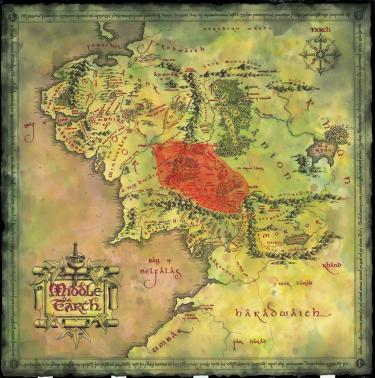
At long last, the third and final installment in the Lord Of The Rings series! It feels like such a long time ago that I read this book, and going over the salient points makes me want to re-read the entire series. By this point in things, I felt myself becoming so immersed in Tolkien’s mythical universe that I felt both saturated yet wanting. There was so much there to absorb, and yet the greater mysteries of his world still seemed unknown. No wonder I picked up the Silmarillion and devoured it shortly thereafter. Man that book was dense!

But of course, that was after the third and final installment. As I said last time, the second book really impressed the hell out of me. But it was tempered by the fact that the greatest battles and climaxes were yet to come. Frodo and Sam had yet to reach Mordor and Mount Doom, Gollum’s true role in the Quest was yet to be revealed, and the battle for Gondor and Middle Earth was yet to truly begin. I awaited on these with eager anticipation…

And then it came! The Battle for Middle Earth was joined! The War of the Ring came to its grand climax and was resolved for all time. And here’s the pertinent stuff and what I thought about it…
Plot Summary:
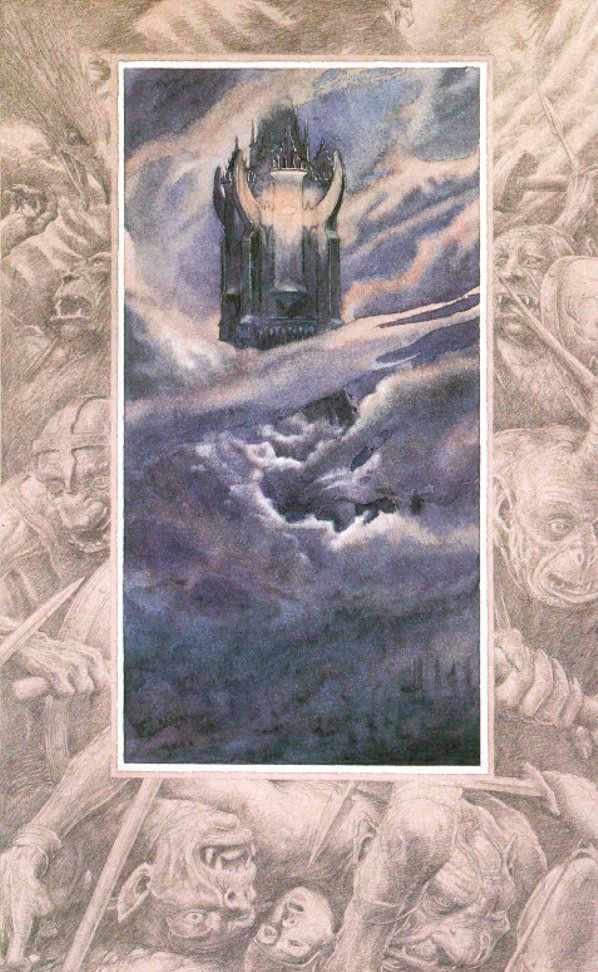
The book opens where the last left off, with Gandalf, Aragorn, Gimli and Legolas returning with Theoden to Edoras to rally their forces and plan for the enxt phase of battle. Though Saruman has been thoroughly defeated, there remains the danger from Mordor, where Sauron is still amassing his armies of Orcs, Southrons and Easterlings and preparing for his assault on Gondor.

At the same time, Sam must find Frodo and rescue him from the grasp of the Orcs. In the wake of Gollum’s betrayal, their Quest has hit a sort of intermission. Until he finds Frodo and returns the Ring to him, it cannot resume, for only Frodo is the true Ringbearer.

Book V: The War of the Ring
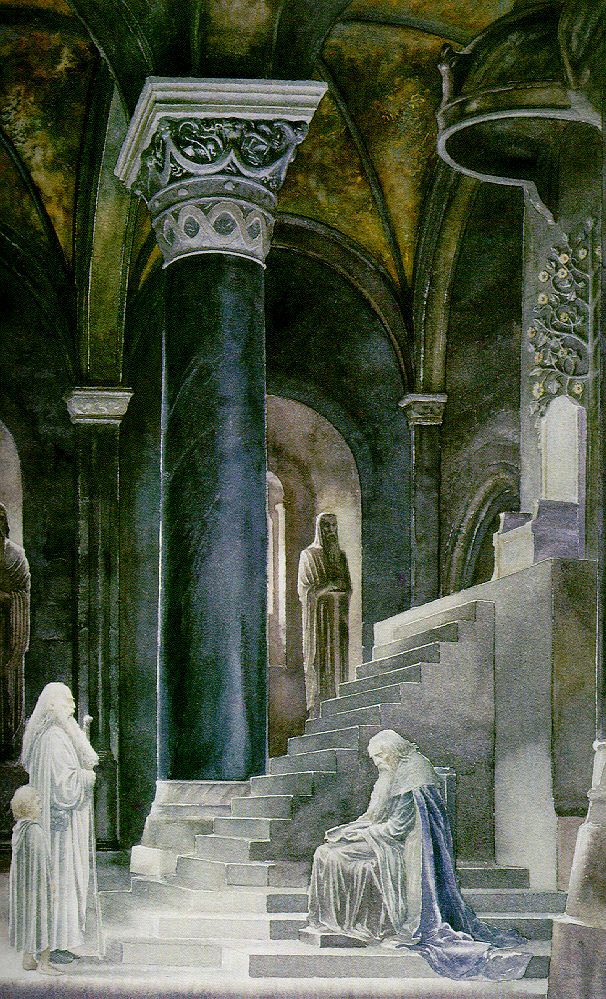
Gandalf and Pippin arrive at Minis Tirith to speak with Denethor, the Steward of Gondor, and warn him that an attack on the city is imminent. Denethor announces that he knows of Boromir’s death, and Pippin enters Denethor’s service as a repayment for the debt he owes to his son for saving his life. Now in the service of the tower guard, he is given a view of the fields of Pelenner and is able to bear witness to the approaching war.

Meanwhile, Osgiliath falls to the advancing Orcs and Denethor begins to fall into a dark mood. He orders Faramir, the lesser of his two heirs in his mind, the task of retaking it with his forces. Unfortunately, he is mortally wounded and his riders return broken. Denethor falls into a deep, dark state and believes his son is dead. He orders a funeral pyre built for the two of them and asks that they be burnt like the Kings of old as the city becomes encircled by a host of 200,000 Orcs.

To the north, Aragorn and his companions have traveled to the White Mountains to find the Paths of the Dead, a mountain hall where the oathbreakers from the War of the Last Alliance still dwell. Helped by his companions, Legolas and Gimli as well as the “Grey Company” – a group of Rangers from Arnor in the north – he sets out to recruit them.

As Aragorn departs on his seemingly impossible task, King Théoden musters the Rohirrim to come to the aid of Gondor. Merry, eager to go to war with his allies, is refused by Théoden several times. Finally Dernhelm, one of the Rohirrim, takes Merry up on his horse, and secretly rides with the rest of the Rohirrim.
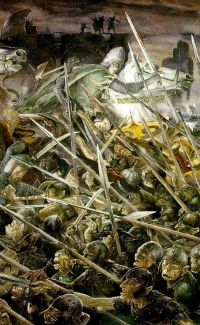
At Minas Tirith, under the leadership of the Witch King of Angmar, the forces of Mordor break through the city’s gates. However, the Rohirrim show up and begin to ride them down. Gandalf arrives in the King’s Hall to confront Denethor and stop him from burning himself and his son.

Denethor cuts the cushion from his thrown and reveals the Palantir inside, and says he has seen visions of the battle which show their ultimate defeat with the arrival of a Corsair fleet from Umbar. Gandalf and Pippin manage to save Faramir from the fires but Denethor is consumed.

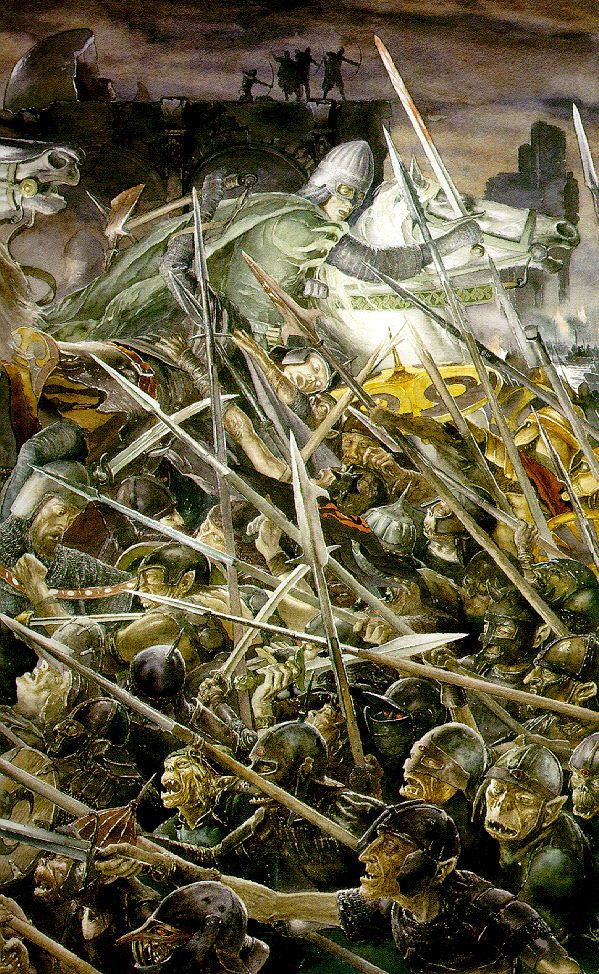
The battle appears is poised as the Riders of Rohan are engaged with Orcs and the Southron war Oliphants when the Corsairs arrive. Sauron’s forces initially rejoice at their appearance, but then realize the ships have been commandeered by Aragorn and the host of the Oathbreakers. With these ships and additional troops added to the fight, the host of Sauron is outflanked and near defeat.

However, the Witch King still manages to wound Theoden mortally before Dernhelm intervenes. Dernhelm is also wounded, and then saved when Pippin sticks his sword in the Ring wraith’s leg. Dernhelm removes her helmet and reveals that she is Eowyn, who then strikes the Witch King dead.

The siege is broken, but at a heavy cost. In addition to the death of many warriors, Theoden is dead, Eowyn and Pippin are both seriously wounded, and Faramir himself is still facing death. On top of all that, they know that Sauron is not yet defeated and they will not be able to thwart another attack.

Aragorn is called upon to heal them as well as Faramir. They recover, and Faramir and Eowyn become acquainted as they both convalesce. In time, she forgets her infatuation with Aragorn and learns to embrace Faramir’s gentle and wise nature.

Knowing that it is only a matter of time before Sauron attacks again, and that they do not have the strength to thwart him a second time, Aragorn and Gandalf propose a bold plan. They will attack the Black Gates in order to draw out the host of Mordor, thus clearing the way for Frodo and Sam to reach Mt. Doom unnoticed.

Upon their arrival, they are approached by the Mouth of Sauron, chief amongst his dark emissaries. He dictates punitive terms to the army of Men, and backs it up by claiming that Frodo is dead and shows them his effects as proof. They begin to despair, but Gandalf refuses to believe it, claiming that his is just another of Sauron’s deceptions. Were he in possession of the Ring, says Gandalf, he himself would be coming forward to meet them.

Having been refused, the Mouth of Sauron returns to the Gate and the host of Mordor falls upon them. They appear to be getting overrun, and Pippin is pinned under the body of a Troll after it is killed. All seems lost, just as the Great Eagles begin to come in and fight off the Ring Wraiths…

Book VI: The Return of the King
Sam finds Frodo’s body in the tower of Cirith Ungol. After fighting off his captors, Frodo awakens and takes the Ring from Sam. They descend the stairs into the land of Mordor and steal some Orcish armor and vestments so they can blend in with the host. However, they find the land largely empty as the armies are being called away to deal with a threat at the Black Gate.

Sam and Frodo are absorbed by the host temporarily, but manage to break away and make for the Mount Doom. With the land all but emptied and the eye fixed on the Black Gate, they make their final approach on the mountain itself. They pause temporarily to look back on all they’ve accomplished and the vast distance they’ve crossed, and realize that their Quest is almost over.
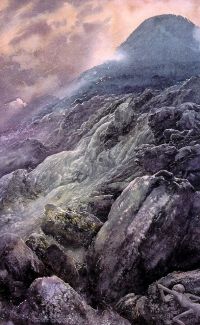
Once inside the mountain, and ready to cast the Ring into the Cracks of Doom, Frodo finally succumbs to the power of the Ring and declares he’s keeping it for himself. However, Gollum appears suddenly and tries to take it from him. He bites off Frodo’s finger and claims it, but loses his footing and falls into the Cracks, which consume him and the Ring together. Sauron and the Ring are at last destroyed!

At the Gates, Sauron appears as a dark shadow who tries to reach out and attack the Army of Men. However, his shadow is blown away by the wind, and his forces flee when they realize their master has been destroyed. The Southrons and Easterlings surrender and are given mercy, and the Great Eagles are flown in by Gandalf to pluck Frodo and Sam from the side of the mountain.

Back at Minas Tirith, Aragorn is crowned King and takes Arwen as his Queen. Faramir takes Eowyn as his wife and is given the title of Prince of Ithilien. The White Tree, which has been dying for some time, blossoms and begins to show signs of life. All of Gondor begins to sprout with trees after Aragorn plants and ancient seed, and Gandalf indicates that the Northern Kingdom, where Aragorn’s ancestors used to rule, will be reclaimed and rebuilt.

Frodo, Sam,  Merry and Pippin and are honored as heroes during the coronation ceremony. After a series of goodbyes, they return to the Shire, only to find it in ruins. They learn that Lotho Sackville-Baggins, one of Frodo’s relatives and usually referred to as “The Chief” or “The Boss”, has been oppressing the locals, but himself is being controlled by someone named Sharky. This man has imposed a program of deforestation and industrialization which has left the Shire scarred and near ruin.

After rallying the locals, they confront Lotho and Sharky’s men at the Battle of Bywater. Victorious, they march on Sharky’s hideout and confront Sharky himself, who turns out to be Saruman, accompanied by Grima. Apparently, the name Sharky is an Orcish word which means “old man”, which his Uruk-hai used to refer to him. Obstinate in defeat, Saruman abuses Grima and turns to leave. However, Grima stabs Saruman in the back and is himself felled by many arrows.

Time passes and everyone appears to have settled down happily. However, Frodo is unable to overcome the injuries he sustained at the hands of the Witch King. Eventually, he departs for the Havens where he meets with Gandalf, Bilbo Baggins, and many Elves, ending the Third Age. They sail into the West, to the lands of Aman, the “Undying Lands”, while Sam returns to the Shire where he is greeted by his wife and daughter, Rosie Cotton and Elanor, and delivers his final spoken words of the book: “Well, I’m back”.

Summary:
Though not as exciting to me as the second book, I nevertheless loved the third and final installment. Naturally, many critics and readers over the years have cited some weaknesses in the book, such as the extended ending where Frodo and his friends return to the Shire to save it from Saruman. This felt like an added climactic moment which occurred after the big one, which can seem a little out of place for a story, even one as epic as this one.

However, it was intrinsic in demonstrating Tolkien’s views on industrialization and labor relations. In short, he was a man who delighted in the natural world, and saw the intrusion of industry and an industrialized workforce as oppressive. And hell, you couldn’t beat the references: “The Boss”, the corrupt workmen, the smokestacks and the ruined countryside. It was like a worker’s pamphlet and a description of 19th century Manchester all rolled into one.

There were several more asides in this book, something Tolkien was famous for. And although they seemed like third act additions, they all seemed to be of particular importance to the author himself. For example, the scene where Theoden and the Aragorn are having an audience with the leader of the Pukel Men in order to find the path through the mountains, this was important in that it showed Tolkien’s views on native peoples, how they have been historically used and abused and were deserving of more respect.

The fact they are asking the help of people that Rohan usually hunts and goes to war with was also an interesting allegory. Much like how the British, French and American colonists called upon their Native neighbours for help in the French and Indian War, the War of Independence, and the War of 1812, Rohan is calling on people it typically considers to be enemies for help against a greater foe. As such, I found the scene quite interesting; and rather than detract from the overall narrative, I felt it added to the richness of Tolkien’s world. An editor would have surely told him to nix it, but that was something else about Tolkien. He refused to let editors tell him what to do, beyond mere spell checks and grammatical corrections.

In terms of the film adaptation, I once again had some issues with how it was done. But to be fair, I was a full-blown Rings geek at this point and saw the book as something akin to canon, so any changes were likely to be seen as just plain sacrilege. Still, it was awesome to witness the battle of Pelennor Fields on the big screen, not to mention seeing Minas Tirith rendered in visual form. These were the big climactic scenes to the story and I approved quite highly with how Jackson rendered it all.

When it came to the battle itself, there was the same conveyance of hopelessness and the feeling that everything was lost, right up until the reinforcements arrive and the day is saved! And personally, I can’t get enough of the scene where the Riders of Rohan start riding down the Orcs! Seeing those ugly bastards get their ranks clobbered was so pleasing after all the people they killed and evil shit they pulled! But of course, the battle got a little hokey after this, as Legolas begins doing his acrobatics and the ghost men show up to the fight.

This latter part wasn’t in the book; the Oathbreakers having done their part to secure the fleet in the first place. Having them also destroy all the Orcs inside the gates of Minis Tirith also made it look like the forces of Gondor did very poorly in the fight, which was really not the case in the book. Granted, they were losing, but their contribution on the fields helped turn the tide of battle and ensured that they still had plenty of foces to send to the Black Gate at the end.

Oh, and that farewell scene between Theoden and Eowyn. All I can say is “Ick!” “I’ve got to save you,” says she, to which he replies “You already have…” Not only was this ripped straight from Return of the Jedi, but it made no sense. How did she save him? Sure, she killed the Witch King, but he’s dying. She didn;’t redeem him the way Luke did his father. So where did the saving come in? What, did she save him from his sexist views? Great, but… you’re still dead, Theoden! Luckily, the fight with the Witch King overshadowed all of that for me. Sure, he too was a bit of a ripoff of Darth Vader, but who cares? He was badass!

Of course, Sam and Frodo’s part in this book was rather truncated. It is for this very reason that Peter Jackson chose to take material from Book IV and place it here, where it could be used to pad their story. However, this worked quite well in the book in that we were brought to a veritable climax when the Book V ended at the Black Gates. With so much hanging in the balance, Book VI manages to carry things on and not keep the reader waiting too long before showing the resolution and tying things up.

That was one thing I didn’t really approve of in the movie, which was the amount of padding they placed in Sam and Frodo’s part. Those who have read the books will know what I mean. The fact that they kept the scenes from Shelob’s Lair for this movie made perfect sense, but the additional parts which didn’t happen in the book – Gollum turning Frodo against Sam, Gollum attacking them twice after betraying them, Frodo falling and getting a vision of Galadriel to help him up – all seemed like needless filler. Oh, and don’t forget the extra added scenes of Arwen looking on and crying, again!

But other than that, zero complaints! Kudos to Peter Jackson for taking on the task of turning one of the best stories of high fantasy and mythos into a full-length movie series, complete with battle scenes that were awesome in their size and scale! And an even bigger kudos to Tolkien, for giving countless generations something which they have been able to enjoy, draw inspiration from, and feel all the richer for having read. Few people have had the same impact as this venerated author, and very few works have ever come to rival its scope and influence.

If you haven’t read it, do it now! Even if you don’t generally approve of fantasy, you’ll find something to love here. I guarantee it!

Kickass Review of Total Recall from Ellipsis Media!

Here is a recent media posting by a friend and colleague of mine, named David Lim. His website, Ellipsis Media, is dedicated to the latest in entertainment and once in a while, I like to hear his opinions on the latest releases. They help me to decide whether or not I’m going to shell out the exorbitant amount of money that it takes to see a movie live these days. Earlier today, he helped me make up my mind on a somewhat contentious issue: whether or not to see the reboot to Total Recall.

Naturally, I had little desire to see this movie since it seemed to me that there was nothing wrong with the first one. And second, there didn’t appear to be much to this one beyond some A-listers who were cast solely for their looks. Third, they did away with the Mars angle which, though they differed drastically from the original PKD story, was still intrinsic to the first adaptation. But to hear that there was absolutely nothing original about it on top of all that, that pretty much clinched it for me.

In short, Total Recall looks like a good candidate for download!

Check out the review below, and if you’re suitably impressed, check out the site and like him on Facebook. It’s free….

How the Dark Knight Should Have Ended

My thanks to Rami for reminded me this site existed! It must have been a year ago that I saw the clip of how the original Superman should have ended, with Superman making down the missiles and not going on a scavenger hunt for the kyrponite. The Prometheus ending was even more apt, pointing out how the Engineer was supposed to die in his chair, not on the floor of an escape pod. But this one was even better!

First Concept Art for the Neuromancer Movie

Some recent news on the Neuromancer front: In addition to Mark Wahlberg and Liam Neeson being confirmed as the leading actors, who will be filling the roles of Case and Armitage, some rather interesting concept art has been revealed. Apparently, the art is the work of Amro Attia, a designer who has worked with director Natali before, contributing to the design of the creatures in Splice.

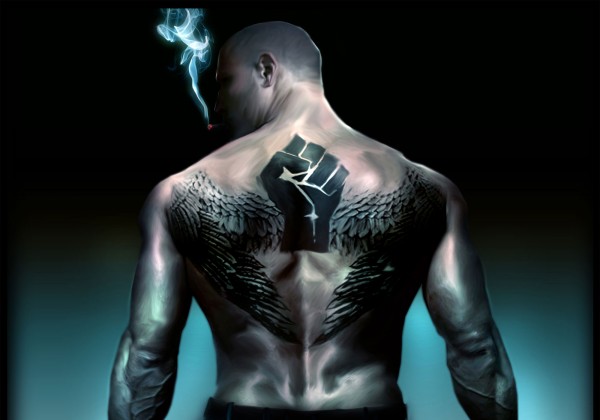
The first is a concept of what Armitage would look like. The tatoo design, for those who have read the book, is a clear reference to Operation Screaming Fist, the mission which nearly cost him his life and left him scarred and traumatized. The perfect candidate to become Wintermute’s plaything.

The second is of Case himself, which appears to be from the opening scenes when he was down and out in Chiba City, looking for whatever work he could ever since his nervous system had been damaged, preventing him from jacking into cyberspace. Note the background, featuring dark, gritty city streets, neon displays, and plenty of Japanese language signs.

Granted, the news on this front is still speculative and no indication has been given that the project is full steam ahead, no turning back. Lord knows I’m pulling for it! Much like Dune and Lord of the Rings, Neuromancer is a classic which seems to have taken an eternity to adapt to the big screen, with several abortive attempts along the way.

Via: Bleeding Cool

Nazis on the Moon?

Well, that seems to be the premise of this new dark sci-fi comedy. Based on the idea that the Nazis have been hiding on the Dark Side of the Moon since shortly before losing the war, the movie opens with their long-awaited offensive to retake Earth. The movie is called Iron Sky, and premiered in Europe back in April. Since then, the movies been making the round, going to cities and theaters wherever fans have requested it be shown.

And judging from the promos and teaser trailer, this movie is a seriously bad film! And I mean the kind of film that’s so bad, it’s awesome! It puts me in mind of more respectable science fiction, such as the alternate history classics of The Man In The High Castle and Fatherland, except those wre actually realistic portrayals of what thw world would be like had the Nazis won. Still, this premise seems much more fun!

The Dark Knight Rises!

Well, I’m back. Some three weeks after it made its big debut, my wife and I finally got around to seeing The Dark Knight Returns. And how to describe the experience? I feel I must come at this chronologically because otherwise, I might blow this review. So please bear with me and be warned that some spoilers follow…

The First Few Scenes:
As the movie began, we got some low-key expository scenes where they recapped all that happened with the last movie. Harvey Dent is dead, his memory is being honored years later, and the big lie that saved Gothamites from the Joker’s madness has been carefully maintained. And despite Commissioner Gordon’s success at nearly eradicating organized crime in Gotham – under the Dent Act – the mayor is quietly entertaining plans to get rid of him.

Meanwhile, we learn that Bruce Wayne has effectively drooped out of the public eye and become a bit of a recluse, a la Howard Hughes. However, this changes when a cat burglar is nearly caught stealing his mother’s pearl necklace while trying to obtain his prints. In addition, her kidnapping of a Senator leads to a manhunt which takes police into the sewers and face to face with a mercenary terrorist by the name of Bane.

This man recently kidnapped a nuclear physicist overseas and made his way to Gotham, apparently at the behest of someone who’s paid for his services. After a brief but nearly fatal encounter between him and Jim Gordon, Wayne is approached by one of his detectives, a young man named John Blake, tells him Batman needs to come back. He resists these demands, but finds he cannot when the nefarious Bane unleashes his plan and the true scope and nature of it become clear.

Suffice it to say, all these things occur within the first 30 minutes and I felt that every scene suffered from the same basic problem. They felt rushed, expository, and kind of like they were just getting the obligatory stuff out of the way. However, as soon as those passed and the plot began to truly unfold, things improved immeasurably. In a way, the action of the movie told its own story and had a degree of depth that these earlier scenes lacked, and they carried on through to the end of movie.

Plot Development:
As I mentioned last time, this movie was connected to the first in terms of plot. I shan’t go into too much detail since many people still need to see it. But suffice it to say, Bane’s motivations go well beyond being a mere mercenary. While his skills in that regard are legendary, his purpose in returning to Gotham go to the very heart of the first movie’s plot, resurrecting the League of Shadows and the aims of Ra’s al Ghul.

But of course there are twists and subplots along the way. For instance, the man who brought Bane to Gotham turns out to be one of Wayne Enterprises own, a man who thinks a little controlled chaos will destabilize the company and ensure his nefarious rise to power. Against that, there is a project to fund the development of clean energy which Wayne invested half his fortune in but then abandoned, mainly because some scientist found a way to weaponize it. Recall the bit about how Bane kidnapped a nuclear scientist? Uh-oh!

On top of all that, the movie makes some pretty strong points about revolutionary justice and the fact that people can so easily be misguided by self-styled “liberators” into becoming their own worst enemies. At many points throughout the movie, allegorical similarities are made to revolutions in France, Russia, and elsewhere where the mob is incited by the bad guys and themselves become a force of malevolence and revolutionary justice that transforms their world into a place of terror and oppression.

And here, quite brilliantly, connections are made to the second movie and the many lies that were told in order to protect the people of Gotham from the terrible truth. Here too we see another fitting theme, which was the flip-side to what was argued in movie two, about how sometimes the truth isn’t enough. Even if a lie may be more convenient, sooner or later, it comes back to haunt you, and those who lied to protect you end up having to answer for a lot. And the worst thing of that is, those who may have been trying to protect you lose your trust at a crucial moment.

The Third Act:
Unlike the The Dark Knight, this movie didn’t suffer from third act problems. This was something I was on the lookout for after last time and I really wanted to see them succeed, which they did in spades! Yes, things were a little slow to get started, but by the time the climax was happening, things blended together quite seamlessly. Like TDK, there were three strands happening at once, but this time around, they worked with each other, not against. It pains me that I can’t give any details to say why they worked so well together. But trust me, this time around, the climax was done right!

And yes, this is definitely the biggest of the three movies in terms of plot and consequences. In movie one, the League of Shadows hoped to tear Gotham apart by driving it mad. In movie two, the Joker hopes to turn it against itself by inducing mass anarchy. But in this one, Bane and his followers want to do annihilate it, body and soul. For them, there are no compromises, no quarter asked and none given.

It pains me even more that I can’t mention the twists that come at the very end. There are two, to be sure, and I really would like to know what others thought of them. once again, can’t mention them by name. But for those who haven’t seen the movie yet, I will say there are some treats which you have to wait til the end to see. For those who have seen it, then you already know what I’m talking about! What did you think of them and do you think they were alluding to another possible sequel?

Inspirations:

“When Gotham is in ashes, then you have my permission to die.”

Overall, this movie boasts a plot that was clearly inspired (at least in part) by The Dark Knight Returns. A number of fans anticipated this and it was good to see that they went with it after all. Not only were the same themes there – Batman coming out of retirement, forced to deal with age and deteriorating health, and going up against a foe in his prime – there was even some subtle shout outs to the comic itself.

The one which really stands out is the scene where two police officers are chasing after some perps, and Batman zooms in on his bike. The older cop says to the rookie, “You’re in for a show!” and spends the next few minutes trying to tell him just stay out of his way. Right out of the comic! And of course, the fact that Batman actually loses in his first confrontation with Bane and has to recoup and recover, forcing himself to overcome his own demons and complacency to defeat him, that too was something from the The Dark Knight Returns.

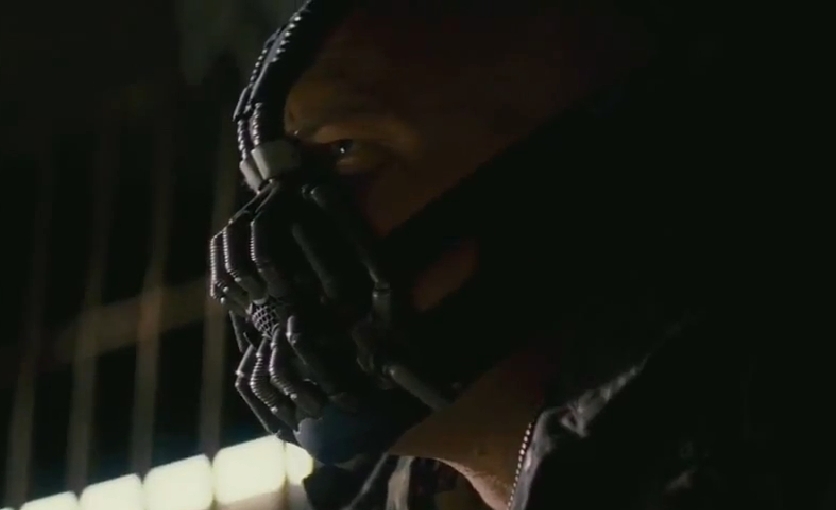
But as I said last time, the character of Bane originally comes from the animated series. Though he was little more than a massive, steroid-juiced freak in that version, here they gave him a much more nuanced and believable persona. While he is a gigantic, muscle bound villain, Bane’s real power comes from the sort of imposing, badass, evil nature that Tom Hardy is famous for.

As Alfred was sure to point out, Bane is a man who was forged in the worst conditions imaginable. Being born into misery and darkness, he has no fear of it, and is prepared to deal it in spades to anyone who gets in his way or incurs his displeasure. Whenever that occurs, everything you need to see comes through in the eyes and the baleful glares he gives, which is what makes the fact that they kept his face hidden all the more poignant.

In this respect, he and Batman are highly similar. Having both grown up with their fair share of pain and anguish, they both enlisted with the League of Shadows hoping to find their way. But whereas Bruce eventually betrayed the League for reasons of conscience, Bane was excommunicated for having none whatsoever. Much like Batman and the Joker, we see a sort of “two sides of the same coin” thing happening.

The Villians:
And while I would never want to get into direct comparisons, Tom Hardy’s portrayal of Bane was fantastic and truly badass! Granted, he didn’t have the same low voice that he did in the commercials, more of a Connery-esque accent minus the slurred S’s. But this only added to his imposing nature. He speaks like a oddly upbeat British person, but his imposing size, scary eyes, and sheer badassery round that out quite nicely. When he speaks, you know to be afraid, even if he’s not using an evil voice.

Overall, I’d say he was no better than Heath, but certainly comparable. Whereas the Joker was a sheer force of crazy malevolence, Bane is an unstoppable juggernaut, forged from suffering to become an instrument of terror. How do you compare two titanic forces like that? It’s like comparing apples to oranges. So no real conclusions there, just equally awesome portrayals!

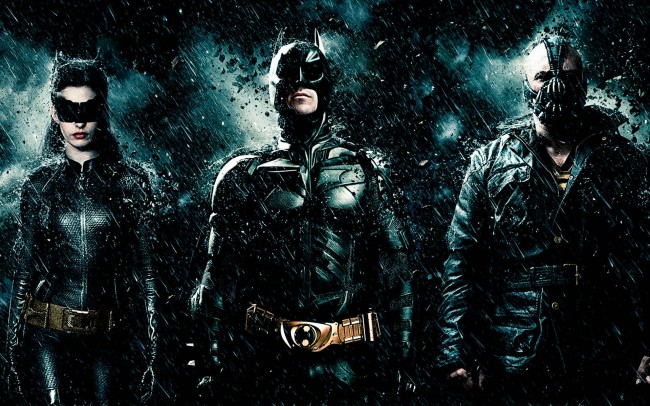
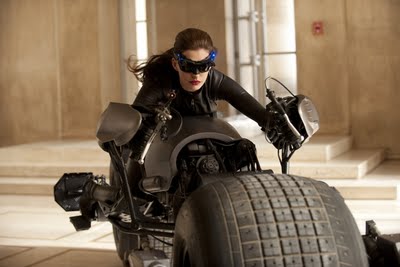
And of course Catwoman was very well played by Anne Hathaway. True to form, she begins as a villain who is working with the forces of evil, but with her own agenda in mind. In time, she comes to see the bad guys for what they are and realizes that she is better served fighting alongside Batman rather than against him. And she did it all believably, faithfully, and managed to pull off some fight choreography that was pretty impressive. In fact, hers was even more impressive than Bales, though he did have to convey an aging Batman and couldn’t exactly steal the show!

Summary:
Alas, the big question… was this movie better than The Dark Knight? Hard to say. On the one hand, it managed to avoid the same problems the last movie had, which was the feeling that things had climaxed before the ending, leading to pacing problems towards the end where there seemed to be a mad rush to wrap things up and the audience was left breathless and kind of confused.

At the same time, they had an awkward opening which the second movie didn’t have. There, Nolan and the writers did a good job weaving action and exposition together to let us know what had happened since the last movie. This time around, they seemed to be rushing through all the introductions in order to get to the action. It’s hard to say which is more important, introduction or conclusion, since both are crucial to how the overall plot is going to be perceived. And ultimately, both movies manage to succeed in spite of these problems.

Second, the villains were well paired. Bane and the Joker were both masterfully portrayed and captured my imagination and literally got me on the edge of my seat. They were the kind of bad guys you didn’t exactly root for, but which made you think being bad could be cool! As for the lesser villains, Dark Knight and Rises differed considerably. Harvey Dent, being a third act introductee, was pretty rushed and never really got to be more than a crazed shadow of his hero self. Catwoman, on the other hand, got a pretty good development through it all, going from being a cynical, “look out for number one” kind of girl to actually caring what happens to Gotham.

So really… I can’t say at this point. Given time, I might be able to say one was better than the other conclusively, but right now, it feels like a neck in neck race. So I think I’ll just call it as dead even. Movies two and three were equally good, and whatever your individual preference, you’re cant go wrong!