Dystopia – Final Word

Well, after many, many suggestions on how my list of dystopian franchises could be augmented – this mainly consisted of poeple asking me “what about (blank)?” – I decided there were a few that I really couldn’t proceed without mentioning. This will be my last tour of the dystopia factory, lord knows that place gets depressing after awhile! But one thing at a time. Here’s my final installment in dystopian science fiction series, a hybrid list of novels, graphic novels, and movies!

A Clockwork Orange:
This dystopian novella was originally written in 1962 and was adapted into film by the great Kubrick almost a decade later. In addition, it was adapted into play after the author realized he didn’t like how the adapted movie ended. Having experienced all three, I can tell you that the movie was probably the best. In addition to the rather ingenious ideas presented by Anthony Burgess, it also benefited from Kubrick’s directorial genius and the superb acting of Malcolm McDowell.

Set in the not-too-distant future, the story revolves around a British youth named Alex who is growing up in a world permeated by youth violence. He is the leader of a group of thugs known as “The Droogs”, young men who go about committing acts of “ultra-violence” which consists of them beating up homeless people, random strangers and other gangs, as well as committing theft and gang rape.

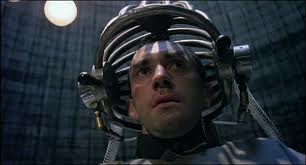
In time, Alex and his friends go to far (even for them!) and an innocent woman is murdered during a break-in. His friends, who are already angry over his bullying and strong arming of them, decide to betray him and leave him to the police. Once in prison, Alex decides to cut his sentence short by undergoing a radical government experiment – an artificially created conscience through Pavlovian conditioning!

The result of this conditioning is that Alex is no longer capable of committing any acts of violence. In fact, even the mere thought of violence produces a reaction so strong that he breaks down and is overwhelmed by nausea. This renders him benign, but also helpless. And in time, all his past crimes begin to catch up with him and he is nearly killed. Once he wakes up in the hospital, he discovers the conditioning has worn off, and he can either resume his old ways, or strike out on a new path…

Another interesting side effect of the conditioning is that he can no longer listen to Beethoven without getting sick either. This has to be one of the most curious and intriguing scenes in the movie, where a restrained and helpless Alex begs the doctors to turn off the symphony because he can’t stand the idea of not being able to listen to it. Much like everything else he does, it speaks volumes of his sociopathic nature.

Ultimately, the movie differed from the novel in that the final chapter was omitted. Immediately before this, we see how Alex is now freed from the conditioning. He also seems intent on blaming the current government, which will oust them from power. But beyond that it not quite clear what’s going to happen. However, the following chapter shows how Alex has realized, independently, that he doesn’t want to live a life of violence anymore. Human freedom, he’s determined, is the ability to make choices for oneself, free of persuasion and operate conditioning.

As I said, I truly think the movie was an improvement on the novel, which is a rare thing with adaptations. Still, it is was in the film that the point of the story really came through, thanks to Kubrick’s usual attention to detail and subtlety. Whether it was through those long, close-up shots of McDowell and his crazy eyes, the combination of wide angle action shots in slow motion, or the way that it played to the tune of Beethoven, you really got a sense of the odd combination of genius and madness that is the anti-hero Alex. The reliance on white, sterile settings also helped to punctuate the sociopathic nature of the story – how underneath the veneer of domesticity, brutality and violence can exist! And last, by leaving the ending a mystery, the moral was more ambiguous, which made for a far more effective dystopian feel!

A Scanner Darkly:
Next up, we have Philip K Dicks seminal novel about drug abuse, self-destruction and the various hypocrisies arising out of America’s war on drugs. In this near-future scenario, which takes place in California in 1994 (seventeen years after it was written), a new drug has hit the streets known as Substance D – or SD, which stands for Slow Death. This powerful hallucinogenic is a great high, is violently addictive, and can render users brain damaged after too much use and abuse. And as a result of its popularity and impact, society is gradually becoming a full-blown police state, where cameras – or “Scanners” – are on every street corner and in the home of every suspected dealer.

Written from the point of view of an undercover narcotics agent, the story follows his descent into addiction and his eventual inability to tell reality from fantasy. Through repeated use of Substance D, he gradually becomes brain damaged himself, is released from the police department, and must go to a privately run recovery-center known as “New-Path”. There, he discovers that these centers, which operate like franchises, are actually growing the plant that Substance D is synthesized from. An interesting twist in which we learn that the people profiting from the side effects are the one’s providing the drugs. A stab at strong-arm governments or the pharmaceuticals industry, perhaps?

For the sake of adapting the movie to film, director Richard Linklater shot the entire thing digitally and then had it animated through the use of interpolated rotoscope. The effect of this was to render every single image in a vivid, almost cartoon-like format, which could only be interpreted as an attempt to mimic the effects of hallucinogens. This animation also came in handy with the rendering of the “scramble suit”, a sort of cloak-like device that PKD invented to ensure that undercover agents in his story could completely disguise their appearance, voice, and any other identifying characteristics.

In addition to being science fiction genius, these cloaks were a clear allegory to the anonymity of undercover agents and a faceless system of justice. While responsible for infiltrating and busting up the narcotics subculture, PKD clearly understood that this sort of profession can lead to an identity crisis, especially if the agents in question find themselves using drugs and becoming over-sympathetic to the people they are spying on. This, of course, is precisely what happens to the main character in the story!

In short, the novel was a commentary on the dangers of recreational drug use, but also on the reasons for why such subcultures come into existence in the first place. In addition to ruining lives and causing crime, repression, domestic surveillance, and other extra-legal practices can become quite commonplace. All of this mirrored PKD’s own experiences with the drug subculture and the law, which is why he dedicated the book to all the friends he had who succumbed to drug abuse and died as a result. Very sad!

And let’s not forget the name, a play on the words from the Biblical passage, 1 Corinthians 13:12 : “Through a mirror darkly.” In this day and age, where “scanners” are the means for monitoring society and police officers spend hours looking at their feeds, the scanner has become a sort of means through which people attempt to gaze into other peoples’ souls. But, as with the Biblical passage, this title is meant to refer to how, when we look at the problems of drug use in our society, we are seeing it all through a haze, the result of our own prejudices and preconceptions.

Akira:
How the hell did I forget this one last time? I mean seriously, this is one of my favorite movies and one of the most inspired Mangas of all time! Not only that, it’s a pretty good example of a dystopian franchise. And yet, I forgot it! WHAT THE HELL WAS I THINKING?! But enough self-flagellation, I came here to talk about Akira! So, here goes…

In 1988, famed Japanese writer, director and comic book creator Katsuhiro Otomo undertook the rather monumental task of adapting his Manga series Akira to the big screen. Though some predicted that a two hour movie could never do justice to the six-volume series he had written, most fans were pretty pleased with the end product. And the critical response was quite favorable as well, with the film being credited for its intense visualizations, cyberpunk theme, its post-apocalyptic feel, and the exploration of some rather heavy existential questions.

To break it down succinctly, Akira takes place in Neo-Tokyo, a massive urban center that was literally build up from the ruins of the original. According to the story’s background, WWIII took place in 1989, and after twenty years of rebuilding, the world once again appears to be one the brink. However, as we come to learn, the destruction of Tokyo was not the result of the nuclear holocaust per se. It’s destruction merely heralded it in after the world witnessed the city’s obliteration, assumed it to have been the result of a nuclear attack, and starting shooting their missiles at each other. The real cause was a phenomena known as “Akira”, an evolutionary leap that scientists had been studying and lost control of…

Quite the story, but what I loved most about the adapted movie and the manga on which it was based was the level of detail. Set in 2019 (the same year as Blade Runner, coincidentally!) this series incorporated a lot of concepts which made for a far more intricate and interesting tale. First off, there’s the concept of a post-apocalyptic generation that is filled with unrest and angst, having grown up in a world permeated by the horrors of nuclear war. Second, there’s the ever-present element of gang warfare that has sprung up amidst the social decay. Third, there’s a government slouching towards dictatorship in response to all the protests, unrest and chaos that is consuming the city.

Into all this, you get a secret military project in which the Akira phenomena is once again being studied. Though motivated by a desire to control it and prevent what happened last time from happening again, it seems that history is destined to repeat itself. Once again, the survivors must crawl from the wreckage and rebuild, their only hope being that somehow, they will get it right next time… A genuine dystopian commentary if ever I heard one!

But what was also so awesome about the series, at least to me, was the underlying sense of realism and tension. You really got the sense that Otomo was tapping into the Zeitgeist with this one, relating how after decades of rebuilding through hard work and conformity, Japan was on the verge of some kind of social transformation. Much like in real life, the characters of the story have been through a nuclear holocaust and have had to crawl their way back from the brink, and a sense of “awakening” is one everybody’s lips and they are just waiting for it to manifest.

A clear allusion to post-war Japan where the country had been bombed to cinders and was left shattered and confused! Not to the mention the post-war sense of uniformity where politicians, corporations and Zaibatsu did their best to repress the youth movements and demands for social reform. Well, that was my impression at any rate, others have their own. But that’s another thing that worked so well about Akira. It is multi- layered and highly abstract, relying on background, visuals and settings to tell the story rather than mere dialogue. In many ways, it calls to mind such classics as 2001, Clockwork Orange, and other Kubrick masterpieces.

Children of Men:
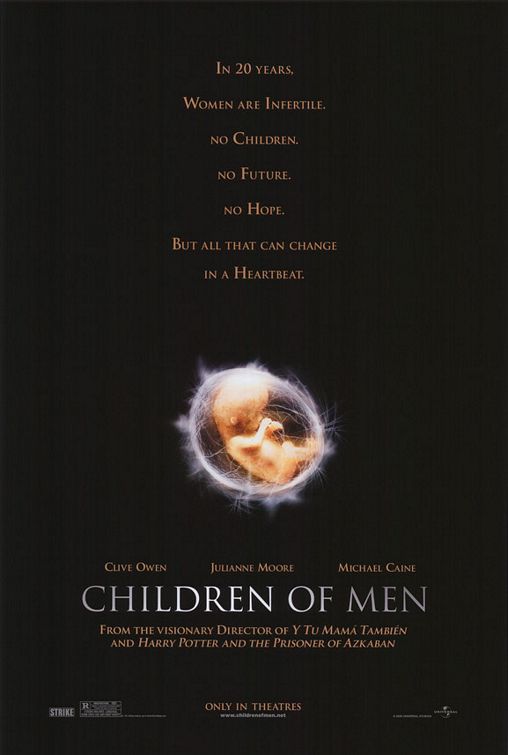
Made famous by the 2006 adaptation starring Clive Owen, this dystopian science fiction story was originally written by author P.D. James in 1992. The movie was only loosely based on the original text, but most of the particulars remained the same. Set in Britain during the early 21st century, the story takes place in a world where several subsequent generations have suffered from infertility and population growth has dropped down to zero. The current generation, the last to be born, are known as “Omegas” and are a lost people.

What’s more, the growing chaos of the outside world has also led to the creation of a dictatorial government at home. This is due largely to the fact that people have lost all interest in politics, but also because the outside world has become chaotic due to the infertility crisis. Much like in V for Vendetta, the concept of “Lifeboat Britain” makes an appearance in this story and acts as one of the main driving forces for the plot.
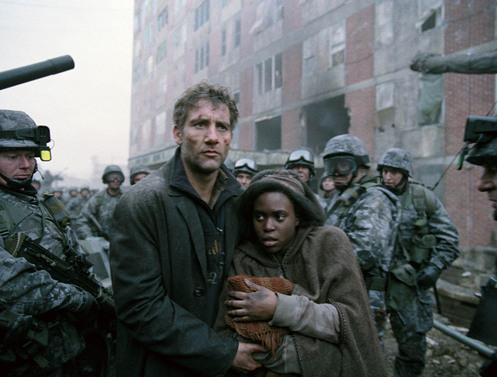
In any case, this also leads to the birth of a resistance which wants to end the governments tyrannical control over society, and which comes to involve the main character and his closest friends. In time, the plot comes to revolve around a single woman who is apparently pregnant. Whereas some of the rebels want to smuggle her out of Britain and hand her over to the international Human Project, others want to use her as a pawn in their war against the government. It thus falls to the main character to smuggle her out, protecting her from resistance fighters and the military alike.

Naturally, the movie drew on all the novels strongest points, showing how society had effectively decayed once childbirth effectively ended. It also portrayed the consequences of impending extinction very well – chaos, withdrawal, tyranny, etc. However, when it came time to adapt it to the screen, Mexican film director Alfonso Cuaron (who brought us such hits as A Little Princess, Y Tu Mama Tambien, and Harry Potter and the Prisoner of Azkaban), also used a variety of visual techniques and sets to convey the right mood.

For example, most of the sets were designed to look like near-future versions of today. In Cuaron’s estimation, all technological progress would have ceased once the implications of the crisis had fully hit, hence all cars, structures, weapons and gadgets were only slightly altered, or used sans modification. So while the billboards, newspapers and signs were all updated and carried messages appropriate for the period, cars, guns and other assorted background pieces looked entirely familiar.

In addition, much of the movie is shot in such a way so that the images are grey and the light effect seems piercing. This conveys a general mood of drab sadness, which is very accurate considering the setting! Last, Cuaron and his camera crews made many continuous action shots using wide angle lenses in order to capture a sense of crisis and how it effected so many people. Never was there a sequence in which you only saw the main actors and their immediate surroundings. The focus, like the scope of the story, was big and far-reaching.

Ghost in the Shell:
Much like Akira, this franchise comes to us by way of Japan and is cyberpunk-themed. In addition, it also came in the form of a manga, then onto a film, but with a television series to follow. And in many respects, it qualifies as dystopian, given that it took place in a dark future where technology has forever blurred the line between what is real and what is artificial. In addition, it also tapped into several cyberpunk trends which would prove to be quite apt (i.e. cyberspace).
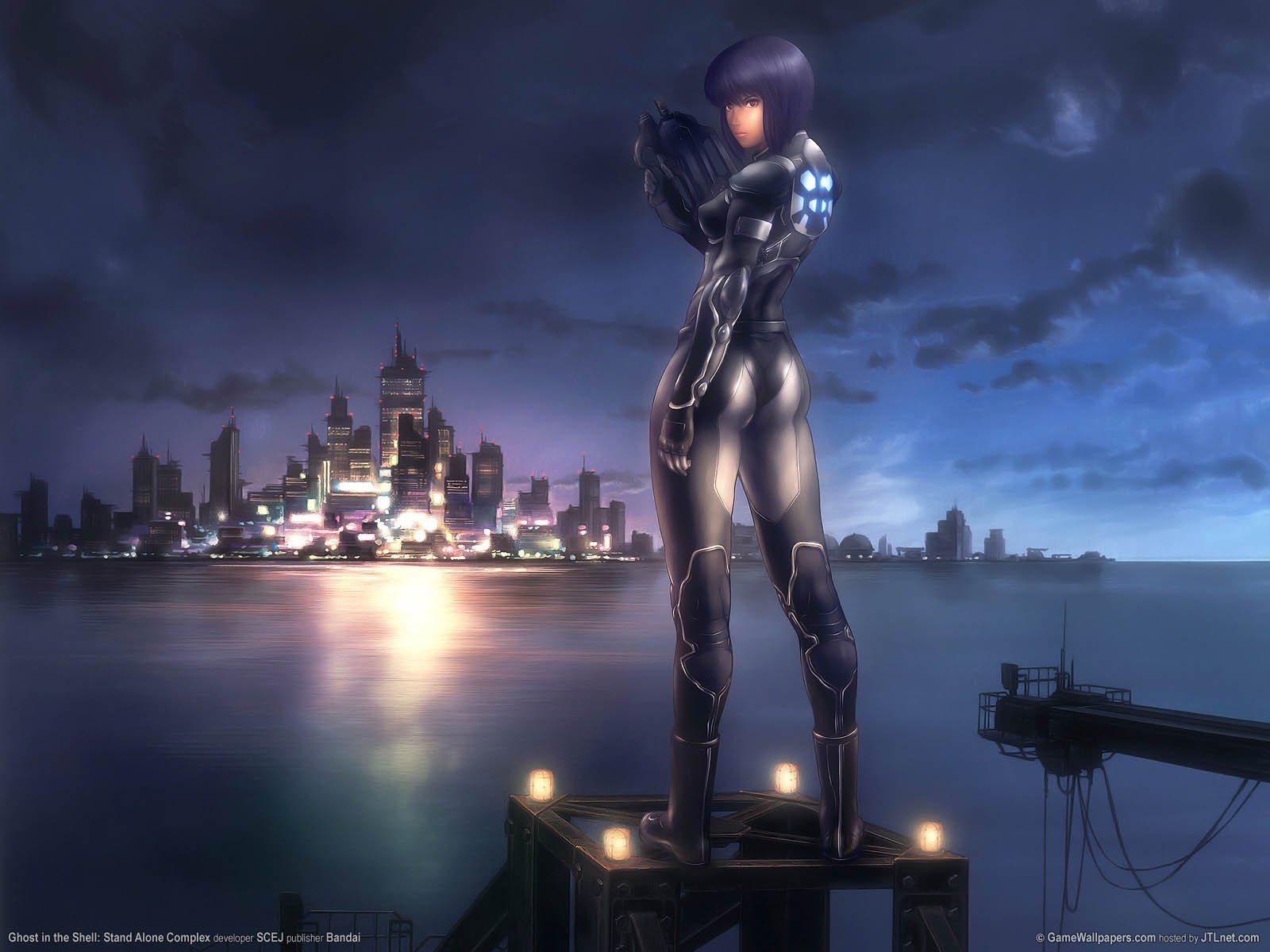
Again, this story takes place in Japan in the early 21st century, a time when cybernetic enhancements and technological progress have seriously altered society. The main character is named Motoko Kusanagi, a member of a covert operations division of the Japanese National Public Safety Commission known as Section 9. She is affectionately known as “Major” given her previous position with the Japanese Self-Defense Forces. And did I mention she’s a cyborg? Yes, aside from her brain and parts of her spinal cord, she is almost entirely machine, and this plays into the story quite often.

In addition to facing external threats, Kusanagi and her companions also face conflicts that arise out of their own nature. These deal largely with issues relating to their own humanity, whether or not a person and their memories can even be considered real anymore if they have been replaced by digital or cybernetic enhancements. These questions were explored in depth in the movie, where events revolve around a sentient program that was developed by the government, but which has since gone rogue and is seeking an independent existence.

However, another thing that makes Ghost in the Shell a possible candidate for the category of dystopia is the setting. Whether it was the manga, the movie, or the television series, the look and feel of the world in which it takes place is quite telling. Always there is a dirty, gritty, and artificial quality to it all, calling to mind The Sprawl, Mega City One, and Neo-Tokyo.

As in these settings, things look futuristic, but also rustic, poor and improvised, hinting at extensive overcrowding and poverty amidst all the advanced technology. This is a central element to cyberpunk, or so I’m told. In addition to being futuristic, it also anticipates dystopia, being of the opinion that this “advancement” has come at quite a cost in human terms.

Logan’s Run:
Considered by many to be a classic dystopian story, Logan’s Run takes place in a 22st century society where age and consumption are strictly curtailed to ensure that a population explosion – like the one experience in the year 2000 – never happens again. In addition, society is controlled by a computer that runs the global infrastructure and makes sure that the all the dictates of population and age control are obeyed.
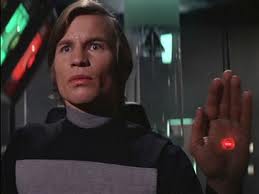
In any case, the story revolves around this concept of an age ceiling, where people are monitored by a “palm flower” that changes color every seven years. When they reach 21 – on a person’s Lastday – the crystal turns black and they are expected to report to a “Sleepshop” where they will be executed. Those who refuse to perform this final duty are known as “Runners”, and it falls to “Deep Sleep Operatives” (aka. Sandmen) to track down and terminate these people.

The main character – Logan 3 – is one such operative. On his own Lastday, he is charged with infiltrated the underground railroad of Runners and finding the place they call “Sanctuary”. This is a place where they are able to live out their lives without having to worry about society’s dictates and controls. However, in time, Logan comes to sympathize with these people, due largely to the influence of a woman named Jessica 6. In the end, the two make plans to escape together for Sanctuary, which turns out to be a colony on Mars.

Right off the bat, some additional elements can be seen here. In addition to the concepts of Malthusian controls and ageism, there is also the timeless commentary on how rationalization and regimentation can lead to inhumanity and repression. Much like in We or Anthem (by Ayn Rand), people do not have names as much as designations. All life is monitored and controlled by a central computer, and it is made clear towards the end that the computer is in fact breaking down. I can remember this last theme appearing in an episode of Star Trek TNG, where a planet of advanced people are beginning to die off because their “Custodian” is malfunctioning and no one knows how to fix it.

Metropolis:
A true classic of both film and expressionist art, this movie also has the added (and perhaps dubious) honor of being a classic of dystopian science fiction! Created in Weimar Germany in 1927 by Fritz Lang, this movie tells the story of a dystopian future where society is ruled by elites who live in vast tower complexes and the workers lives in the recesses of the city far below them where they operate the machinery that powers it all.

This physical divide serves to mirror the main focus of the story, which is on class distinction and the gap between rich and poor. To illustrate this artistic vision, director Fritz Lang relied on a combination of Gothic, classical, modern and even Biblical architecture. In an interview, Fritz claimed that his choices for the set design were based largely on his first trip to New York where he witnessed skyscrapers for the first time. In addition, the central building of the futuristic city was based on Brueghel’s 1563 painting of the Tower of Babel (right>).

The theme of class conflict is further illustrated by the fact that the workers who live in the bowels of the city are also responsible for maintaining the machinery that makes the city run. One is immediately reminded of H.G. Wells’ The Time Machine and the divide between the Morlocks and the Eloi. This comes through even more when the workers decide to revolt and begin ransacking the neighborhoods of the elites. Ultimately, it is only through the love of the two main characters – Freder and Mariah – that the gulf between the two is sealed and order is restored, a fitting commentary on how society must come together in order to survive and achieve social justice.
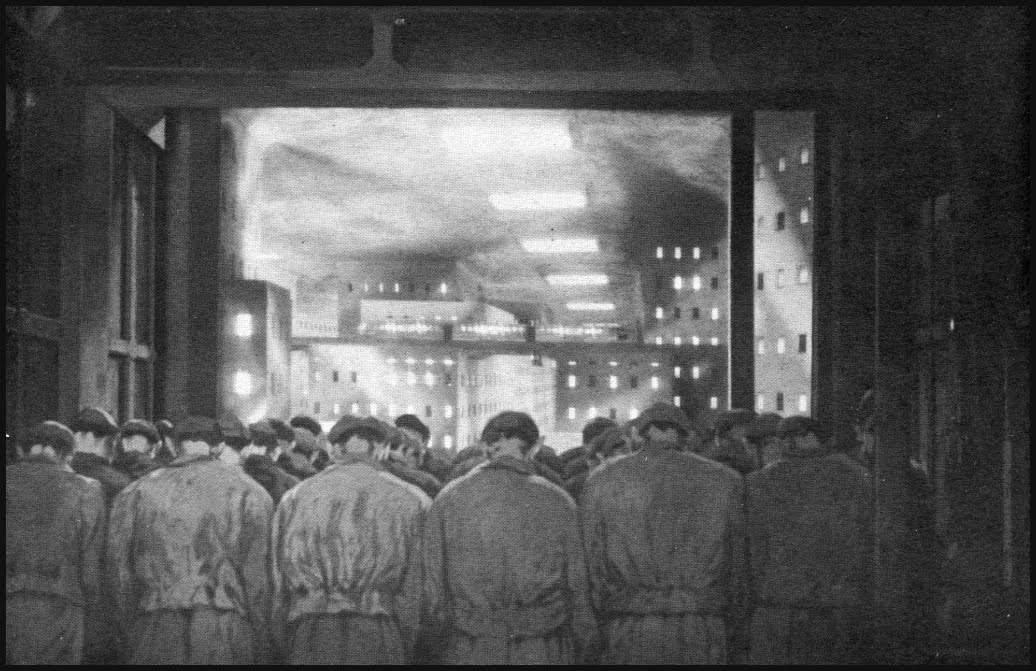
In another act of blatant symbolism, we learn early on in the movie that the workers have taken to congregating in a series of tunnels that run under the city. It is here that they meet with Maria, their inspirational leader, and makes plans to change society. So in addition to tall, Babel-like buildings illustrated the gap between rich and poor, we have workers who are literally meeting underground! Wow…
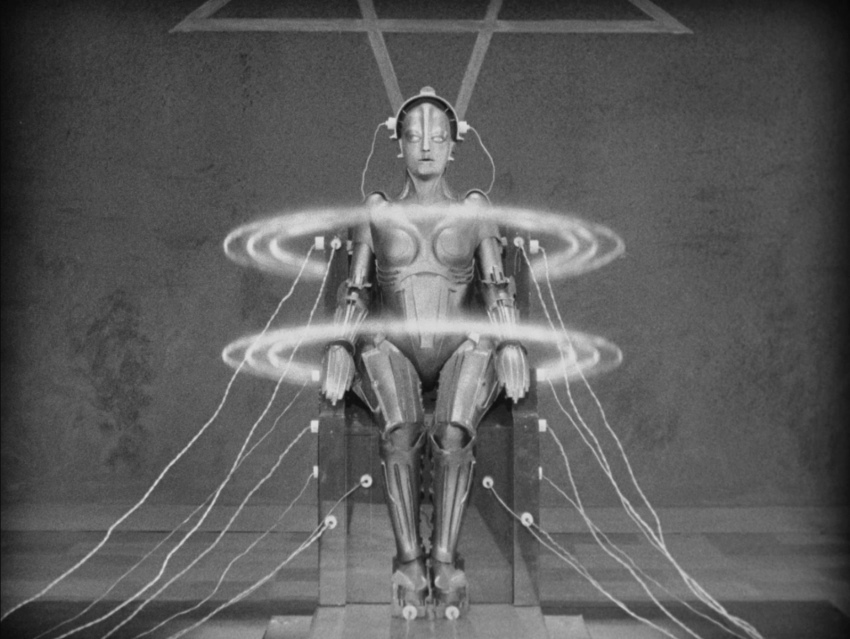
In addition, several other dystopian elements weave their way into the story. The line between artifice and reality also makes an appearance in the form of the robot which the movie is best known for. This robot was created by Rotwang, a scientist who is in the service of the main character’s father – Joh Fredersen, the master of the city. Apparently, this robot is able to take human form and was created to replace his late wife. Once this robot was released into the city, she began sowing chaos amongst men who begin to lust after her, and is the very reason the workers began revolting in the first place. She even causes the character of Rotwang to go insane when he can no longer distinguish between the robot and the woman she’s impersonating.

Neuromancer/Sprawl Trilogy:
Gibson is one of the undisputed master’s of cyberpunk and future noire lit and it was this novel – Neuromancer – that started it all for him. In it, he coined the terms cyberspace, the matrix, and practically invented an entire genre of Gothic, techno-noire terminology which would go on to inspire several generations of writers. His work is often compared to Blade Runner given the similar focus on urban sprawl, cybernetic enhancements, the disparity between rich and poor, and the dark imagery it calls to mind.

The first installment in the “Sprawl Trilogy”, this book takes place in the BAMA – the Boston-Atlanta Metropolitan Axis (aka. The Sprawl). In this world of the 21st century, cyberspace jockeys or cowboys use their “decks” – i.e. consoles – to hack into corporate databases and steal information. The purpose is, as always, to sell off the information to the highest bidder, usually another corporate power. In addition, guerrilla tactics and domestic terrorism are often used to get employees out of their contracts, seeing as how most companies have no intention of ever letting their talent go!

picture by Maxim-Lysak on deviantArt

Also, there is the massive gulf that exists between the rich and the poor in these novels. Whereas the main characters tend to live in overcrowded tenements and dirty neighborhoods, the rich enjoy opulent conditions and control entire parts of the world. In addition, the richest clans, such as the Tessier-Ashpools and Vireks, actively use cloning and clinical immortality to cheat death, and often live in orbital colonies that they have exclusive rights to. Much like in his “Bigend Trilogy”, much attention is dedicated to the transformative power of wealth and how it affords one better access to the latest in technology.

But always, the focus is on the street. Here, jockeys, freelancers and Yakuza agents are at work, pulling jobs so they can buy themselves the latest enhancements and the newest gear. In the case of Molly Millions, a freelance lady-ninja, this includes razor nails that extend from her fingertips. In the case of Yakuza enforcer from the short-story (and movie) Johnny Mnemonic, it consists of a filament of monomolecular razor wire hidden inside his thumb. For others, it might consist of artificial limbs, new organs, implants of some kind. Whatever ya need, they got it in the Sprawl. If not, you go to Chiba City or Singapore, chances are it was made there anyway!

*Interesting  Fact: according to Gibson, Blade Runner came out when he was still tinkering with the manuscript for this novel. After seeing it, he nearly threw the manuscript out because he was afraid Ridley Scott had pre-empted him! Funny how things work out, huh?

Final Thoughts:
Gee, there really isn’t much more to say is there? One thing I have noticed is that much of modern dystopia comes to us in the form of the cyberpunk genre. Though the definition of cyberpunk appears to constantly be evolving, it is generally acknowledged that it is a postmodern form of science fiction that combines “high tech and low life.” Having sorted through several modern examples of dystopian sci-fi, I can say that this is certainly an apt description.

In essence, it assumed that the presence of high tech would entail the emergence of a dystopian society, that the endless march of progress would lead to the destruction of the environment, the devaluing of human life, the elimination of privacy, and the line between real and fake. This last aspect was especially important, embracing cybernetics, virtual reality, and things like cloning and clinical mortality. Since the 1980’s, all of these notions have infiltrated science fiction movies, television, and have even become cliches to some extent.

This genre has given rise to new kinds of science fiction as well. For example, it is generally acknowledged that a sub genre known as post-cyberpunk emerged in the 1990’s which broke away from its predecessor in one key respect. Whereas it too focused on the rise of technology, it did not anticipate dystopia as part of the process. This is best exemplified by books such as Neal Stephenson’s The Diamond Age, a 21st century bildungsroman which predicted vast social and political changes as a result of nanotechnology.

Other sub genres that have emerged in recent years include “Steampunk”, a literary form that combines Victorian era technologies with the punk genres noire sensibilities. Other derivatives include Dieselpunk, Nanopunk, Biopunk, and even fantasy-punk crossovers like Elfpunk. Yes, like most things in the post modern era, it seems that literary genres are becoming fragmented and tribalistic!

But alas, I still feel the need to ask the question, what’s happened to dystopian literature of late? In my initial post, I got a lot of people asking me if I could include some more modern examples. You know, stuff that’s come out since 1984 and The Handmaids Tale. But unfortunately, what I’ve found tends to be more of the same. Just about every example of dystopian fiction appears to draw its inspiration from such handy classics as the one’s I’ve already mentioned, or is in some way traceable to them. Does this mean that we’ve hit bottom on the whole genre, or could it just be we’ve moved away from it for the time being?

Well, I recently learned from an article on IO9 that Neal Stephenson himself stated that science fiction needed to stop being so pessimistic and had to start getting inspirational again. Perhaps he’s onto something… Maybe we’ve gone too far with the whole cautionary tale and need to steer things back towards a brighter future, urging people on with common sense and technological solutions rather than laments. Maybe we need to let them know that such problems as world hunger, overpopulation, pollution, climate change, poverty, war, licentiousness and greed can all be overcome.

Then again, I’m working on a couple dystopian tales right now… Is it too much to ask that this craze last just a few years longer?

Thanks to all who’ve written in and “liked” my dystopian series! Hope to see y’all again soon as I get into ore cheerful things…

Dystopia in Popular Culture

Picking up where I left off last time, I thought I’d get into some examples of how dystopian fiction has influenced popular culture. And given all the feedback I got on my previous post, I also wanted to incorporate some suggested titles as well. But, just to be clear, I still haven’t read Hunger Games, so please don’t ask about it!

Alright, so last time, I mentioned just about every examples of dystopian literature I could find. From the earliest examples of Candide and Gulliver’s Travellers, onto the more modern interpretations of The Time Machine and We, and culminating with classics like BNW and 1984, I essentially ended before I could get into how these novels have had an influence on film and other media. In addition to inspiring the written words, these classics have inspired an entire culture of iconography, symbolism and motifs.

Not surprising, really. Every work of dystopian fiction and satire has sought to create images in the reader’s mind, using highly specific descriptions in order to paint a scene and inspire the right mood. Whenever these novels have been adapted to film, or directors were simply trying to convey similar themes, the task of properly conveying it all visually has always been a hefty one. The same is true for graphic novels and any other visual medium. So today, just for fun, and perhaps to complete my romp through the realm of this inspired genre, here are some examples of dystopia in modern media:

Blade Runner:
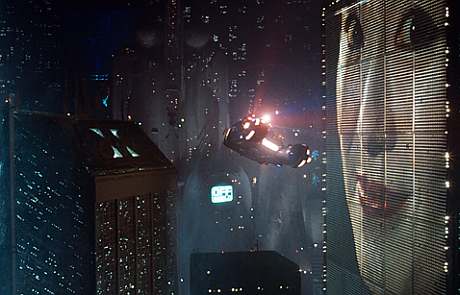
Granted, Blade Runner was based on Philip K Dick’s Do Android Dream of Electric Sheep?, a dystopian story in some respects, but not in the same way that the movie was. Whereas the novel took place in a post-apocalyptic Los Angeles (circa 2019) which is sparsely populated and where a living animal is seen as a status symbol. In the movie, the year and location are the same, but the setting is starkly different. Here, it is a stuffy, polluted, mega-city made up of massive skyscrapers and giant animated billboards, where the streets are dirty and packed with people who spoke a strange dialect known as Cityspeak (check out my post on Cityspeak for on that).

And what made it all so awesome, aside from the plot, was the attention to detail. Director Ridley Scott, the same man who brought us Aliens, brought his usual artistic touch and a team of first-grade set designers to the table. Overall, they produced some pretty awesome concepts, ones which are still being praised to this day. Here are just a few:

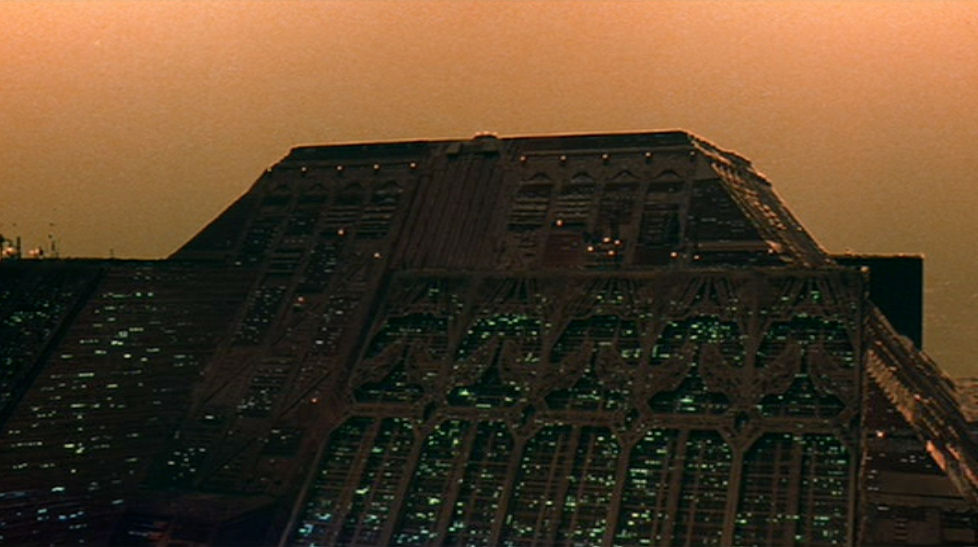
The Tyrell Corp. building, which was kind of the focal point of the movie. Early on, we get a birds-eye view of it as Detective Deckard Cain (Harrison Ford) is being flown there in a Spinner (flying car). Later on, the leader of the Replicant party, Roy Batty, travels there as well seeking answers to some of life’s most basic questions.

For starters, the building is clearly based on a the design of a Ziggurat, the breed of ancient Babylon temple that inspired such legends as the “Tower of Babel”, and which serves as a clear representation for the almost godlike power Tyrell wields. The interior design, with its large columns, soft lighting, candles, an owl (a possible reference to Athena’s owl) and the way Tyrell can block out the sun at will all serve to further illustrate this point. That scene near the end where is dressed in lavish white robes also seemed pretty symbolic, I’d say!

And for those who read 1984, there is a possible encoded reference to the four ministries as well- Truth, Peace, Love, and Plenty – all of which were pyramid-like in design. Coincidence? Who knows? All that matter is when it comes to massive structures that harken back to ancient Egypt and Mesapotamia, the symbolic value is clear. Much like the civilizations that built them, these things stood for power and dominion, both over lesser subjects and the afterlife itself. They were the ruler’s way of achieving immortality by creating something that embodied their power and would stand the test of time. As Shelley said in his poem “Ozymandias”: “Look on my works, ye mighty, and despair!”

And when it comes right down to it, this old-world kind of mentality, updated for the modern age, is indispensable to any dystopian story: Absolute power, wielded by the few over the many and represented in conspicuous and obvious ways! In many cases, it comes in the form of totalitarian governments (a la The Party) who runs things with an iron fist and build massive government buildings to remind everyone of who’s in charge. But in other cases, it takes the form or corporate dominance, where the wealthy rule society like feudal barons while the rest live like serfs. And much like their bureaucratic peers, they choose to lord this by building lavish buildings to themselves and covering themselves with ornate symbols!

Another trademark bit of dystopian set design were the massive skyscrapers, complete with giant video-billboards. No doubt, these too were designed to give the impression of the control corporations had over the people of LA in the future. As if regular sized billboards ads weren’t enough, (or televised, print, bench, flier, blimp, and radio ads) now it seemed that corporate monopolies were splastering their logo’s on screens the size of buildings!

And just to make it realistic, Ridley Scott and his designers were also sure to use logos that were already big in the early 80′s and seemed destined to get bigger – Atari, Coca Cola, Pan Am Air, Cuisinart, Bell System. But interestingly enough, all of these companies suffered heavy losses after the movie’s release. The phenomena came to be known as the “Blade Runner Curse”. Strange, one would think audiences began associating them with dark imagery or something ;)

But personally, I think one of the most effective aspects of the movie’s look and feel came through in the construction of the streets. Here, Scott’s design team made sure that every shot was crammed full of people who whore plastic jumpers, dark glasses, cool headgear, and carried what looked like umbrellas with neon handles. Then came the street vendors who peddled food or exotic pets in the same neighborhoods, facades that were ashen grey in color, and all kinds of neon signs written in various languages. It painted quite the scene, one which can only be described by the words “Future Noire”.

Brazil: 
Directed by Terry Gilliam, an old-time member of the comedy troupe Monty Python and director of such movies as The Adventures of Baron Munchausen, The Fisher King and 12 Monkeys, Brazil was a rather humorous take on the classic 1984. In it, we are presented with a dystopian society that is ruled by a totalitarian regime, but which is buffoonish and incompetent rather than exacting and brutal.

In addition, the people in this world are also overly-dependent on machinery which is rather unreliable and poorly maintained. And last of all, there is the main character of Sam Lowry, a low-level government employee who works in a mind-numbing government job, lives in a small apartment, and is having prescient dreams about a woman and a man in mask who is torturing him.

The movie shared many plot and thematic elements with 1984, but much of its genius comes through in the set design and direction. Given that the aim of the movie was to present a world in which the machinery is as undependable as the bureaucracy, Gilliam decided to go with a look that would call to mind the kind of over-the-top aesthetics of past sci-fi films. While everything was admittedly grey, dark, and shot in wide and tilted angles, there was also a sort of comic, retro feel to the whole thing. This helped to establish the central premise of the movie, in which incompetence and mind-drudging inefficiency were what was destroying humanity, not a specific agenda.

In addition, Gillian had much to say about artifice and vanity in this film. Lowry’s mother, who plays an important role in the plot, is obsessed with plastic surgery which she hopes will make her look younger. Towards the end of the movie, Lowry dreams that his mother is attending the funeral of a friend who died as a result of too many invasive procedures. And in what can only be described as an moment of oedipal confusion, his mother even looks like Jill, the much younger woman he has fallen in love with!

An interesting take on 1984 isn’t it? Rather than following a philosophy like the one espoused by O’Brien, where the Party wields absolute control over reality and people’s minds, want to eliminate all emotion except hatred, and has destroyed any activities that do not serve their interests, the totalitarian regime in Brazil is instead motivated by laziness and a desire to cover its own ass. Not being wrong literally means more to them than the lives of their citizens. What better commentary is there on a bureaucratized society?

Judge Dredd:
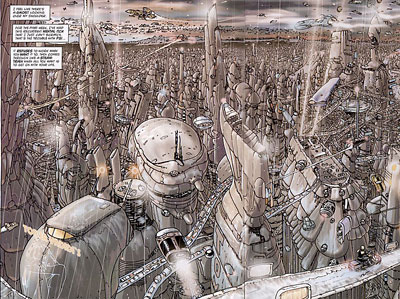
Yes, the movie didn’t so well, and the script and plot were so simplistic that Stallone himself called it a “no-brainer”. But that doesn’t change the fact that the source material is actually one of the better graphic novels in existence, especially when it comes to depth and irony. Set in a post-apocalyptic world of the not-too-distant future, the comics take place for the most part inside “Mega City One”, one of several megalopolis’s that have sprung up in the US after a nuclear war which left it and Soviet Union utterly devastated.

Within this city, just about everything is automated and unemployment is almost universal. Every city block contains over fifty-thousand people, amounting to a population of about 400 million people per city. Due to overcrowding, massive unemployment and uncontrollable violence, the leaders of this future society created a quasi-fascist justice system whereby individual “Street Judges” (policemen) were charged with dispensing judgement and punishment on site. This had a stabilizing effect on society, but the problems remain…

Automatically, one can see a few things at work here. For starters, there’s the Hobbesian idea of man in the state of nature; how because of nuclear war, life became “nasty, brutish and short” and a tyrannical system was needed to put things back in order. In addition, there’s the whole “who polices the police?” side of things, where audiences naturally fear that the judges will abuse their power or fight to the death to hang onto it.

And last, there is the very real sociological concept of the “megalopolis”, the Northeastern mega city running from Virginia to Maine which was originally coined by French geographer Jean Gottmann. In the course of the comic’s history, it is made clear that Mega City One was not actually designed, but grew out of natural urban sprawl that predated the nuclear war. It was only after the war that it became a self-contained place where automation, unemployment and chaos become so rampant.

Now one might also get the impression that this was all meant to illustrate some preachy, “we made a mistake” kind of message (which is in fact what happened in the movie). But in truth, these issues are presented with a fair degree of subtly and irony in the graphic novel.

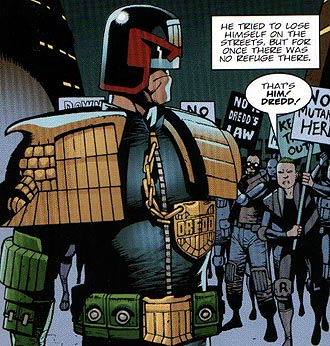
Knowing full well how his audience would react to fascist symbols and ideology, John Wager (creator) presented readers with a story that is loaded with both. For starters, the Judge’s symbol is an eagle, which bears a striking resemblance to the Nazi black eagle. The Judge’s uniform is also highly ornate and calls to mind the classical imperial motifs of Centurions and Gladiators. And the fact that Dredd’s face is never seen can only be seen as highly indicative. He’s a faceless law-giver, much like Stormtroopers or the SS.

What’s more, the people who sport these symbols and preach these values are presented as heroes. Judge Dredd, for all intents and purposes, is a social fascist who is bereft of  sentimentality, doubt or remorse over what he does. Unlike the other Judges, there’s no crime he won’t ignore, and he never stops for more than ten minutes at a time to rest in a sleep chamber, then he’s back on the job. He also has little sympathy for people who believe in enlightened reform or who criticize the Street Judges for their abuses of power.

The purpose of this always seemed to be for the sake of ironic social commentary. Rather than condemning the Judges and the system they represent (or endorsing them) we are meant to see how – under the right circumstances – something like this could very well happen!

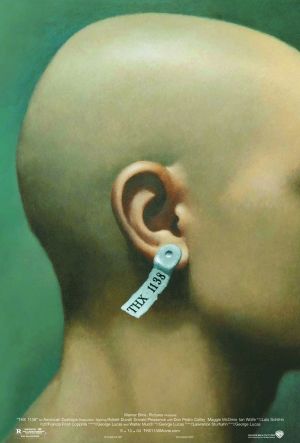
THX 1138:
You know, its movies like this that remind us all that there was a time that George Lucas had talent, when he cared about thing like plots and inspired story-telling, and not special effects and merchandizing. But I’ll leave my riffs about the Star Wars prequels for another day. Right now, I will admit that there is plenty about this directorial debut worth praising, and not the least of which was the faithful dystopian tone it struck.

Set in a dystopian future where the human race is required by law to take drugs that suppress emotion and sexual desires, are controlled by android police, and all inhabitants worship a godlike being known as OMM 0910, the story is clearly a commentary on how rationalization and automation threatened to destroy humanity. In addition, there are clear and obvious parallels to novels like We, Brave New World and 1984.

For example, the people in this future are all given designations instead of names, the state sanctioned religion is reminiscent of Big Brother, and the mandatory use of mind altering drugs calls to mind Soma. And of course, the stark, clinical portrayal of society in the future is very similar to descriptions of the One State and Oceania in We and 1984. And let’s not forget the scene were android police torture and abuse the main character? Tell me that didn’t come directly out of the scenes where Winston was languishing in the Ministry of Love!

And of course the overall moral of the story, that love is precious and will fight the odds against the forces of cold rationality, this too was practically lifted from Orwell’s and Zamyatin ‘s classics! This is not a criticism, mind you. If anything, Lucas demonstrated a keen ability to adopt freely from novels and franchises in a way that really worked. Much as he would do with Star Wars just a few years later, he seemed to know where to borrow from and how to put it all together!

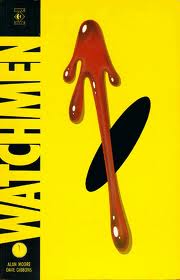
The Watchmen:
Now this was one of my favorite graphic novels of all time. Lucky for me, it also falls into the realm of dystopian fiction, hence I can talk about it here! In addition to taking place in an alternate universe, the setting is one which is quite dark and gritty. Set in the 1980′s, which is the same period in which it was written, the story is of an alternate reality where the existence of superheroes has caused history to diverge quite a bit from our own. Technically, superheroes have been in existence for many decades, which helps to give the story a real sense of historicity.

However, it was with the service of superheroes in actual wars and government programs that caused history to shift. Beginning with Doctor Manhattan’s intervention in Vietnam and culminating in the development of cheap, renewable energy by Ozymandias (with Manhattan’s help), the Cold War took an unexpected turn. Russia was systematically beaten back to the point where it was becoming desperate and nuclear war seemed inevitable. Meanwhile, society began to decay as war began to occupy more and more of society’s attention and the inner cities were neglected and left to rot.

Told for the point of view of Rorschach, a borderline social fascist with deep-seated issues, the darkness and impending sense of doom really come through! As he investigates the death of the Comedian, a fellow superhero who’s death incites the whole plot, we learn how both he, the Watchmen, and society came to be the way it is. His own tragic story, and that of the Comedians, serves to illustrate how the American Dream failed and cynicism and fear took over.

But of course, the point with dystopian stories is not just to speculate, but to make a point about the time in which it was written. Looked at from this angle, the Watchmen was really telling us about the real world of the 1980′s, a world which had come very far since the post-war era in terms of technological, social and cultural development. And like many other cultural commentaries, a sense of failure and betrayal is at work. What happened to the post-war dream? What happened to the American Dream? How did poverty, crime, licentiousness and cynicism become so rampant? From Rorschach point of view, the Cold War is largely to blame, but so is human nature. And given that he is such a dark and messed up character, I don’t think his opinions were meant to be taken too seriously!

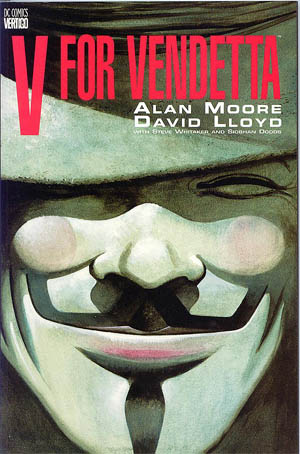
V for Vendetta:
Yet another awesome graphic novel, and one which also inspired a hit movie adaptation. A piece of speculative fiction, this series was produced in the 1980′s and was set in a near-future dystopian England. Over the years, this series’ thematic elements and symbolism have been compared to 1984. However, in truth, the story has much more in common with The Iron Heel and It Can’t Happen Here, by Sinclair Lewis (which should have made my list of dystopian literature, dammit!) In these two novels, especially the latter, a fascist regime takes power by appealing to the people’s sense of moral purity and a desire for order, and in the end the people got more than they bargained for!

But alas, the story in the comic book version involves nuclear war and the transformation of the UK into “lifeboat Britain”. Given that the movie was made in the early 2000′s, the story had to be updated somewhat. There, the focus shifted to terrorism and the exploitation of fear – echoes of The Handmaids Tale and “Loose Change” there, but I digress. After being passed over by the nuclear holocaust, Britain found itself being flooded with refugees and victims of the war. Bit by bit, authoritarian measures were put into place to deal with the crisis, until eventually, the fascist government of Norsefire took over, and that’s when the real changes happened!

They’re motto: “Strength Through Purity, Purity through Faith” pretty much sums it up! In addition to pushing a religious agenda, they were also very much concerned with purging British society or minorities and “undesirables”. A police state was put into place where a series of departments – the Eyes, Ears, Mouth, and Hands – were tasked with controlling and monitoring all aspects of society. The Eyes handled surveillance, the Ears listened to people’s by tapping their phones and bugging their homes, the Mouth disseminated propaganda, and the Hands investigated criminal activity. And of course all minorities, be they racial minorities, homosexuals, or just political dissidents, were sent to concentration camps where they were exterminated and experimented on.

Into all this enters the character of V, an anarchist revolutionary who is the product of one camp’s twisted experiments. As a result of their invasive procedures, he became an enigmatic genius/amnesiac with a serious chip on his shoulder who is now on a quest to pay the government back for its crimes. His famous disguise, the Guy Fawkes mask and robes of black and red, are as intrinsic to establishing his character as his monologues and affinity for blowing up government buildings!

Judging by the color scheme alone, one immediately can tell that this man is an anarchist by his use of the color black (or anarcho-syndicalist seeing as how he combines it with red). The mask is a further indication of this, given that Guy Fawkes was a radical who tried to blow up parliament because he believes any vestige of government to be anathema to freedom. So in the end, we can see that this a man who wants to bring down the system and is reaching into Britain’s forgotten past to resurrect the idea of civil liberty.

In contrast, Norsefire’s logo was pretty straightforward too. In the comic, Norsefire represented itself on its “motivational posters” with a set of white wings with a space in the middle that was in the shape of a cross, and behind it lay flames. This is obviously meant to conjure up images of religious propriety, or holy war, and of action, all of which are clear allusions to fascist and religious-right iconography. It was also meant, in my opinion, to call to mind Britain’s Action Party, a fascist political group that played a small but influential role in British political life during the 1970′s.

In any case, one can see several staples of dystopia at work in this series, hence why it earned a loyal following and garnered so much critical acclaim. In addition to the idea of a nuclear war breeding totalitarian regime in Britain (right out of 1984), of “Lifeboat Britain” giving rise to a fascist regime (which may have helped to inspire the novel Children of Men) and countless allusions to Nazism and how it really could take root in Britain – which calls to mind Orwell’s essay “England Your England” where he basically asserted that it couldn’t.

Final Thoughts:
Wow, this sort of stuff makes me feel head-heavy and tired! It seems that when you get into a subject as rich as dystopian literature and its various offshoots, there’s no shortage of material! But I think I’ve learned something from all of this and it’s important that I get it right. So bear with me…

As I said in my last post, utopian literature predates dystopian by a couple centuries at least. And I also focused on the differences between the two, how utopian lit shows our failures by using a prefect society as a comparison while dystopian societies show the logical outcome of our most worrisome flaws. However, I’ve now come to think that the issue is far more complicated than all that. For starters, one can find elements of the former in the latter and vice-versa. What’s more, utopian novels and treatises were often loaded with irony, at times truncated themselves to make the point that perfect societies were not so perfect, or perhaps unattainable.

On the other hand, all dystopian novels take as their starting point the idea of a failed utopia. Whether it was a willful lie (as O’Brien revealed in 1984) or an attempt at perfection gone wrong, all dystopians arose out of attempt to create a “perfect society”. In the case of the classics written after the 18th century, the inspiration for this is clear. Beginning with the French Revolution, then the Russian, and countless other revolutions who’s aim was to radically transform society, it seemed that every attempt to create “real equality” and an “earthly paradise” was doomed to result in tyranny and abuse. Sometimes horribly so!

But the earlier utopian writers didn’t have these failed social experiments to point to. In their case, saying that utopias were unattainable would have had to have been purely philosophical. And examples abound! The very word Utopia, for example, is Greek for “no-place”. And the narrator of this book, the man who is an apparent specialist on this fabled society, is named Raphael Hythloday. This last name has a Greek root which loosely translates to “expert in nonsense”. Samuel Butler, another utopian writer, named his fictional society Erewhon, which is simply “Nowhere” written backwards. In addition, in his “perfect” society, people are punished for being sick and treated for criminal behavior, an inversion of the usual procedure!

I guess its like the dividing line between heaven and hell, or revelation and madness. Somehow, the line is fine, and one misstep can take you from one to the other in the blink of an eye! And, as with everything else, we carry these things with us  and project them wherever we go. Well… that was deep! Stay tuned, I’m sure to have something more cheerful for next time!

The Alien Graph

The Alien Graph

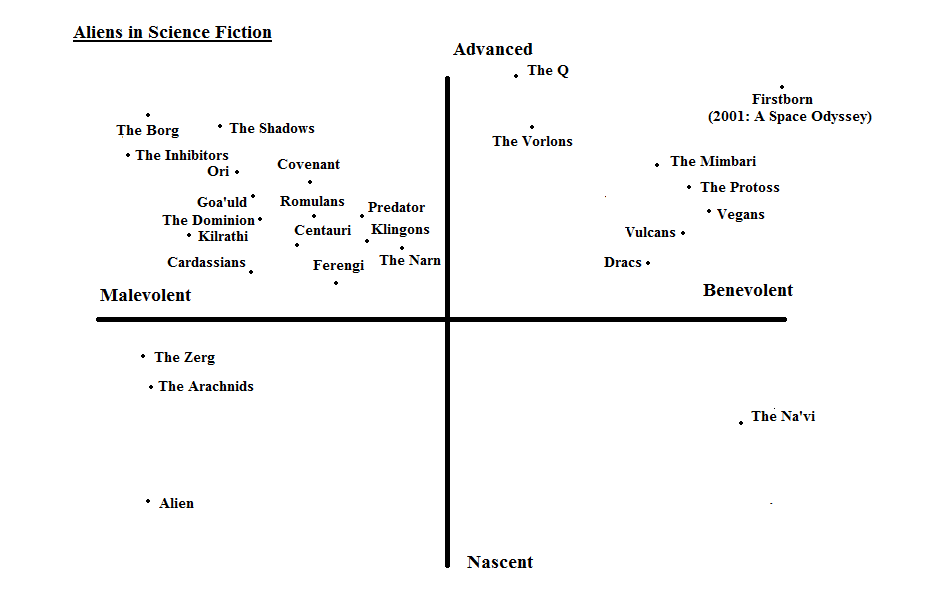
Behold! After a few days of contemplating what I said in the Ancient Aliens post – you know, about how alien’s technology and moral capacity are often interrelated in sci-fi – I realized I needed to put it into graphic form. And as I said in that post, if we are to consider technological advancement as one axis and level of benevolence as another, then the outcome would look something like this:

click to enlarge

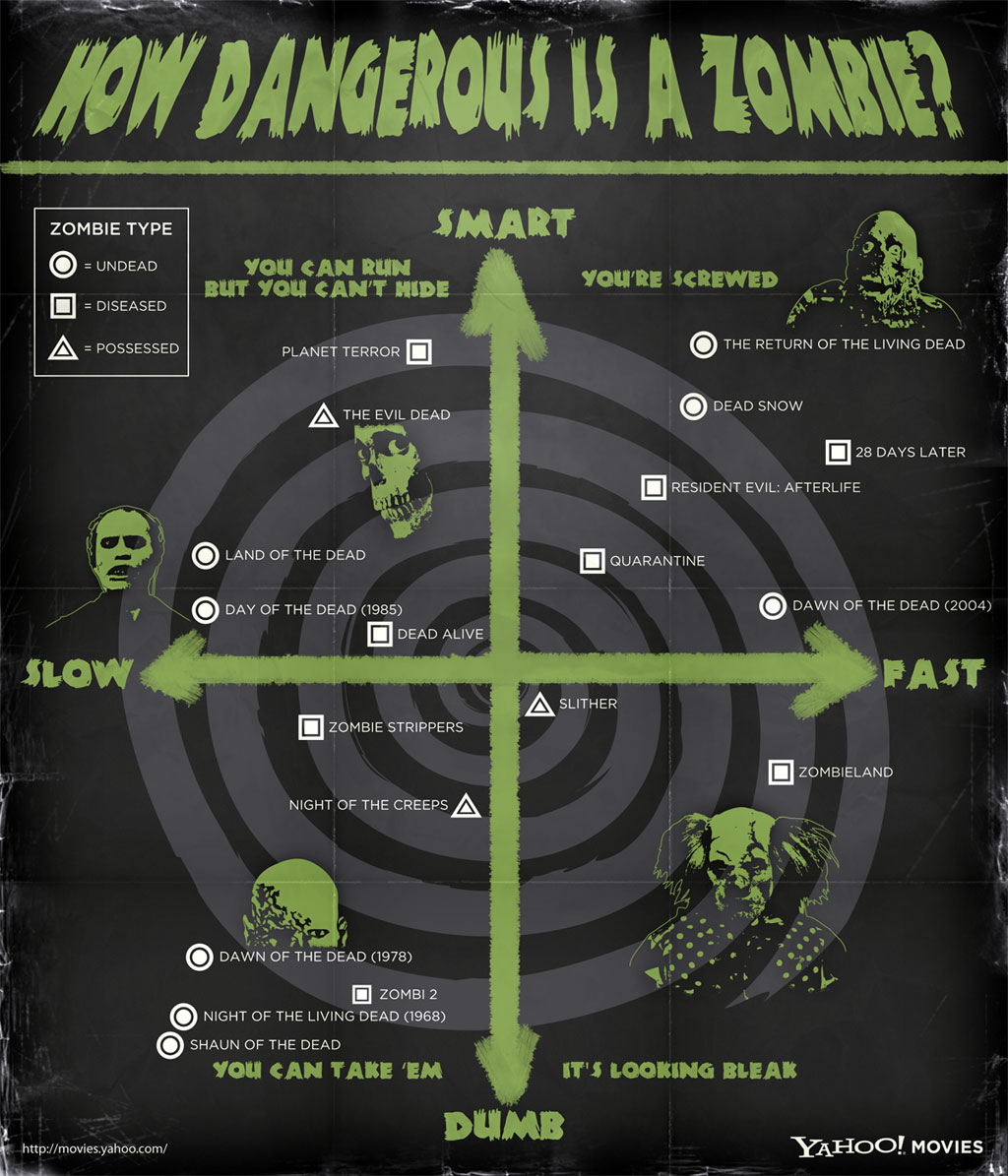
The design is based on the Zombie graph that’s been floating around the internet for some time. There, the designer placed different Zombie movies based on two criteria: intelligence and speed. In much the same way, I’ve designed a graph for aliens that is based on two similar criteria: technological advancement and level of friendliness.

I selected aliens that I thought best represented the range of development and behavior in the sci-fi genre. I also included as many franchises as I could think of, just off the top of my head. I certainly wasn’t scientific about it, just relative and to the best of my abilities. And when I was done, I noticed an interesting pattern…

Hostile/Advanced Aliens Rule!:
For example, notice how the vast majority of races from your well-known franchises (Star Trek, B5, Stargate, Star Craft, AvP, Halo, etc) fall into the upper left quadrant. This is the area where malevolence and technological sophistication combine in varying degrees. By contrast, the second largest concentration of races occurs in the advanced/benevolent quadrant, again to varying degrees. Almost no races fall into the nascent (i.e. primitive) quadrants, be they hostile or gentle.

On the one hand, the Xenomorph from Alien and the Arachnids from Starship Troopers both fell into the technologically backward category (technically), and were both classified as malevolent because of their innate hostility to foreign organisms. The Na’vi, from Avatar, were the only alien race that fit the bill for technologically nascent and benevolent. I’m sure there are plenty of examples that could stack this analysis in a different way, but like I said, this was off the top of my head.

The Zerg, I have to admit, were a bit of a conundrum for me. While they are technically a race that does not employ technology per se, they are highly advanced in terms of their biological evolution, to the point where they rely on specialized creatures in the same way that humans rely on machinery. But then again, that’s all for the sake of ensuring that the different factions in the video game are evenly matched. It’s not meant to be a realistic assessment. Much the same is true of the Xenomorphs. While they do not employ tools, fly around in spaceships, or use guns, they are nevertheless an extremely evolved organism that is capable of besting humanity in any contest.

And just to be clear, the middle point of the graph (0,0, where the axes meet) is where humanity stands now in terms of moral behavior and technological development. Sure, some say we’d fall into the evil quadrant, but I tend to believe that humanity is morally ambiguous, neither too good or too evil. Where aliens fall into the spectrum in most sci-fi franchises is meant to reflect this. Much the same is true of technological prowess, where aliens are classified as “advanced” or “primitive” solely in comparison to ourselves.

This all might sound anthropocentric, but that’s the point, isn’t it? These are stories written by human beings for other human beings. All the references, symbols and measuring sticks come from inside us. So in the end, aliens themselves, as represented in our best science fiction, also come from inside ourselves. Their values, their tools, and even their appearances are all constructs of what is familiar and accessible to us. In short, they are merely tools with which we measure ourselves, both morally and technically.

Conclusions:
Well, right off the cuff I’d say the reason we prefer our aliens hostile and advanced is because it makes them seem more threatening and scary that way. Clearly, this makes for a more interesting story. While an alien race that is kind, innocent and backwards can make for an effective tale about the evils of colonialism and imperialism and how one can easily find themselves on the side of evil, these seem to be fewer and farther between. I’d say this is most likely because moral allegories are less intriguing than action dramas. Or maybe just prefer to think of ourselves as the good guys. Let someone else serve as the allegory for evil, selfish and runaway imperialistic behavior!

In addition, there’s the very real possibility that humanity will be making contact with an intelligent life form at some point in the future. And when we do, it’s likely to be the most awe-inspiring and frightening of experiences. When it comes to the unknown, ignorance begets fear and we prefer to err on the side of caution. So it would make sense that whenever we think of aliens, even if its just for the sake of fiction, we would naturally prefer to think of them as both learned and potentially hostile. If indeed aliens serve as a sort of projection for humanity’s own thoughts on itself, than pitching them as potentially hostile beings with advanced technology represents our own fear of the unknown.

In any case, if there is life out there, all these questions will be resolved in the distant future. Hell, maybe even the near-future. If some theorists are to be believed, aliens have already made contact with us and might even be walking among us right now. Granted, most of these people are hanging around the 7/11 with tin foil hats on, but they can’t all be crazy, right?

Aliens, revisited

After doing my due diligence to learn what I could about the Xenomorph for my post on Ancient Aliens, I found some interesting additional info that kept me reading. For one, I came to learn that there were a lot of details about the Alien universe that were revealed by Ridley Scott and James Cameron in the course of interviews, but never made it into the movies themselves. At the same time, there was plenty of info that made it into comics, novelization and other sources in the expanded franchise which fans of the movies would want to know about. There were a lot of mysteries in the Alien universe that were left deliberately vague, basic questions that never got answered.

For example:

  1. What was that derelict ship from the first movie and where did it come from?
  2. Why were there eggs aboard the ship in the first place?
  3. And of course, where do the Xenomorph’s come from?

Well, here are some of the answers that I found out:

1. Space Jockeys:
This is the name of the race that built the derelict craft that crashed on LV-426 and was investigated by the crew of the Nostromo. Based on the design of the skeleton that was featured in the movie, and additional material from the alien comics, this race was apparently humanoid, very large, and had elephant-like trunks on their faces. According to all sources on the subject, the Space Jockeys are millions of years old and go by many different names.

In fact, “Space Jockeys” was the name the set designers came up with, whereas H.R Giger (the designer of the Alien) called it “The Pilot”. This second name was used in the video game AVG 2, where the aliens are known as Pilots and examples of their technology as “Pilot Technology”. Yet another name comes from the novelization entitled Aliens: Original Sin by Michael Friedman, where they are known as the Mala’kak. Where they come from remains a mystery, but the fact that their ship was carrying Xenomorph eggs would seem suggests that there was some kind of relationship. Which brings us to question two…

2. The Eggs:
One theory has it that the Space Jockeys were the original victims of the Xenomorphs. Another has it that they were in fact their creators. This second theory is far more detailed and shows up in various sources. Apparently, the Space Jockeys (or Mala’kak) bred the Xenomorphs for use a civil war that was raging millions of years ago. This would certainly explain why the Xenomorphs are so hostile, so adaptive, and proliferate so quickly. Ultimately, the Xenomorphs turned on their creators and caused their extinction, and live on as weapons leftover from a forgotten war.

I got to admit, I didn’t like this theory too much. Somehow, it made the Aliens less scary to know that they were cooked up in a lab as opposed to say, borne out of conditions we can hardly imagine on a planet we have yet to discover. However, I also have to admit that it fit with something I notice whenever I watch the original Alien movie. Compare the Space Jockey ship to the architecture of a Xenomorph hive. Do they not look similar? All those curved surfaces and H.P. Lovecraftian sensibilities? Would it be so crazy to conclude that the Xenomorphs inherited their sense of aesthetics from their creators?

However, there remains the question of why a derelict ship was discovered on LV-426 carrying eggs. Could it be that this was a simple transport that was hauling eggs for the sake of the war effort? If so, then the most likely scenario would be that the pilot became infected accidentally and crashed into the planet, programming the ship to send out a distress signal before his untimely demise. However, we won’t know that for sure until the new movie comes out (see below!)

3. Xenomorph Prime:
According to various sources, the Xenomorph homeworld is a hostile planet named Proteus.  Much like LV-426, it boasts a cold and harsh climate that is rife with volcanoes and turbulent wind storms. According to one theory, the planet is not the actual source of the Xenomorph species, but was used as a storage house by the Space Jockeys to contain and breed them.

The exact source of this info is unclear, but in the 2010 AvP video game, things end with Weyland Yutani discovering the location of their homeworld. This would seem to indicate that it will be revealed and/or detailed in the sequel. Also, the info on Proteus (as it stands) is clearly linked to the theory that the Space Jockeys were responsible for the creation of the Xenomorphs, so I can only assume that it came up in one of the AvP comics or novels.

Prometheus:
In the course of learning all this, I also came to learn that Ridley Scott has been dropping some serious hints of late. Apparently, the concept of the Space Jockeys, the Xenomorph homeworld, and the link between the two species will be explored at some length in the upcoming movie, Prometheus. For those who don’t know, this upcoming movie is a prequel to the Alien franchise where the crew of an Earth starship discover the derelict years before the Nostromo. Originally, I was planning on avoiding it. But successive previews and all the promised explanations are starting to get to me. Coming to theaters this summer, people!

Cool Weapons!

Last time, I spoke (at length) about all the awesome firearms that come to us from a variety of science fiction franchises. But let’s face it, there’s a lot more than just guns to speak of! In fact, part of the genius of sci-fi is in how it is constantly inventing entire arsenals of weaponry, tools, and the various nicknacks that make the world go round. Any director or writer who show attention to detail will make sure that their characters come equipped, looked the part, and that their settings have plenty of believable gadgetry taking up space in the background. Here are just some of the cool examples:

Claws:
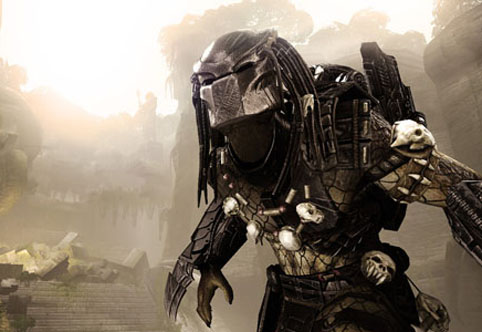
Predator_clawsAlong with the burner/plasma caster, these weapons are the most basic of Hunter weapons in the Predator universe. According to tradition, every Hunter must distinguish themselves in battle by confronting an enemy in single combat using no other weapon than their claws. Based on the two non-crossover films (Predator and Predator 2), this is apparently done once all lesser prey are eliminated and only the top prey is left. When that occurs, the Hunter will ensure that this finale opponent has been deprived of any additional weaponry, and then will shed every other weapon in their arsenal and engage them in hand to hand combat.

Combi-Stick:
Part of the Hunters arsenal, this weapon comes from the Predator universe and is part of their wider arsenal of cool weaponry. The name refers to the fact that this staff serves multiple functions. Collapses, it serves as a sort of quarter staff. However, the stick has telescoping sections with a blade like end, which when deployed turn it into a spear. In Predator 2, a hunter used his stick on multiple occasions. Against a group of the Jamaican gang members, it was used strictly for impaling, but during a later scene, it was used as a throwing spear against Danny Glover’s character.

Crysknife:
The Fremen weapon of choice, made from the tooth of a Maker (i.e. a Sandworm). The name and design of the weapon are based on the kris, a ceremonial dagger that was traditionally used in Indonesia and is associated with many cultural legends.

A testament to Herbert’s ability to incorporate historic and cultural elements into his stories, the kris is an enduring symbol of the Dune universe and was used by Fremen for warfare, duals, and ceremonial purposes, much like the real thing! In addition, the Fremen had very strict rules about the use and exposure of these knives. According to the Shadout Mapes – the Fremen housekeeper in Dune – who gives one to Jessica: “Who sees that knife must be cleansed or slain!” And as Leto II remarked in Children of Dune: “The crysknife dissolves at the death of its owner.”

Lasgun:
This weapon was the brainchild of Frank Herbert, and is a familiar weapon in the Dune universe. According to Frank’s many novels, the lasgun was a continuous-wave laser projector weapon that when fired emitted a constant, narrow beam of photons. Though it was able to cut through just about anything and was the weapon of choice in the Old Imperium, it had since fallen into disuse by the first Dune novel.

This apparently had to do with the invention of personal shields. Rather than protecting against a lasgun burst, the interaction of the two would cause a reaction that rivaled that of an atomic explosion. Hence, attacker and defender would both be killed instantly if either ever came into contact. Much like the prohibition against the use of nukes in Herbert’s universe, one would get the distinct impression that he was commenting on the futility of nuclear deterrents and arms races.

But that’s another matter. The lasgun, from its first appearance in Dune, has gone on to inspire many a sci-fi franchise. One that immediately comes to mind is Akira. In this movie, riot squads and the military employed large, external cell powered weapons to fire focused beams of light on a large mob, hewing off limbs and burning holes straight through some people! The main character Kaneda also commandeered one and used it to fight his psionic friend, Tetsuo, near the end of the movie.

Lightsaber:
Just what is it about lightsabers that make them so unbelievably cool? Is it that warm glow? The otherworldly feeling one gets from seeing one being activated? Could it be that crack, hiss sound they make when they clash, or that warbling noise when they’re spun around? Or could it just be the fact that they deflect blasters and cut through anything? Well yes! It’s all of the above, clearly! Yet another brainchild of George Lucas, meant to call to mind scenes of swashbuckling and chivalry from old samurai movies, the lightsaber has since gone on to occupy a central spot in the collective unconscious of an entire generation. It is a staple, perhaps THE staple, of pop culture’s take on sci-fi.

Making its debut appearance in the first Star Wars movie, the lightsaber was the established weapon of the Jedi. In addition to being their mainstay, lightsabers were also highly personalized, every Jedi being tasked with building one as part of their training. Originally, the only two designs were that of the blue and red, the former being associated with Obi Wan and Anakin Skywalker (which Luke then inherited), and the latter being associated with Darth Vader. However, Luke went on to create his own and fashioned a green beam. With the expanded universe, significance has been given to different colors, each one associated with a different class of Jedi, and indicating whether they are a member of the Sith or the Jedi Order.

For starters, blue is the color of the Jedi Guardian, the warrior class of the order who focus on combat training and fighting. Green is used by the Jedi Consuls, people who focus more on the force and accumulating wisdom and insight. Yellow represents a sort of middle ground, belonging to those Jedi who focus on a combination of both and are usually called upon to settle disputes and act as arbiters. When it comes to the Sith, only one color appears to be used, and that is red. However, purple, orange, and other closely related colors have popped up from time to time in various places as well. In addition, Mace Windu, the Jedi Master portrayed by Samuel L. Jackson, wielded a purple lightsaber as well. However, this was apparently due to Jackson’s insistence that his character have a purple weapon, as well as the initials BMF etched onto the side!

Ma’Tok Staff:
Coming to us from the Stargate universe, the Ma’Tok is a combination laser gun, club staff that is used by Jaffa warriors (the specially-bred human servants of the Goa’uld). According to the Stargate Wiki, the Ma’Tok relies on a plasma discharge to strike and cauterize the enemy, causing severe damage and intimidating resistance. It takes its power from an internal cell that employs a liquified mineral (Naquadah) to generate plasma energy. This liquid mineral gives the staff a virtually indefinite shelf life, making it the perfect blend of aesthetics and lethality!

Monomolecular Wire:
Here’s an idea that comes in various forms, but for the purposes of this post, I shall stick to the examples that I know best. The first one comes in the form of the Yakuza enforcer from Johnny Mnemonic! Anyone who’s seen this movie (or read the short story it was based on) will remember the main badguy who had an artificial thumb that contained a long filament of glowing wire. When he pulled that thing out and started whipping it around – LOOK OUT! – things began to get lopped off and sliced up! Another example of this being used as a weapon is from the Japanese anime Hellsing. In that show, the butler of the namesake character had monomolecular wires attached to each finger which he would break out whenever there was a crisis. Perhaps they were fashioned from silver, I really can’t recall. Would make them more effective against vampires though!

Plasma Sword:
And we’re back to the Halo universe for another example of cool gear! And today, the item in question is the plasma sword. As gamers are no doubt aware, this weapon is melee weapon of the Elites, but can be employed by humans as well since it’s your basic hand-held weapon. And much like lightsabers and lasguns, it can cut through just about anything and makes short work of any opponent. In many ways, its even more effective than the ballistic and energy weapons in the game. Whereas those can take several shots to take down an enemy (especially someone infected by the flood) one good hit from this baby will turn them into pulp! And if you see an enemy approaching you with one, be sure to hang back and unload your weapon in their direction!

Stone Burner:
Doubling down on the Dune universe, the next example of cool weapons comes in the form of Stone Burner. As a tactical nuke of limited yield, this weapon was the only form of nuclear device that was not prohibited by the Great Convention. This body, in addition to banning all forms of AI’s, also put a stop to the use of nuclear weapons, though it did not forbid the Great Houses from owning any. In any case, Stone Burners, when used strategically, could have a devastating effect on an enemy.

This weapon makes only one appearance in the Dune saga. In Dune Messiah, Paul Atreides is lured into a trap in the old quarter of Arrakeen where a stone burner is set off, which leads to the loss of his eyes.  Though physically blinded, Paul was not deprived of his vision (i.e. his prescience). This all had to do with a larger plot to force Paul to surrender his power as Emperor in order to save his children. And I think we can all agree, any plot that involves a tactical nuke and blinding your enemy Samson-style is pretty badass!

Throwing Disc:
Another Hunter weapon, this particular one made its first appearance in the second Predator movie and then went on to become a regular part of the Hunters’ arsenal. Much like their other weapons, the throwing disc appears to have many variations and may even be personalized to an extent. This may be the result of constant upgrading, or it may be that individual Hunters have a hand in designing their own gear. In either case, many types of throwing discs have appeared. Some employ simple curved blades, blades with spikes, or even shuriken-like appendages (as the picture at right demonstrates). In each and every case, the result generally involves hewed limbs and decapitations!

Thermal Detonator:
“Because he’s holding a thermal detonator!” Yes, whenever a bounty hunter pulls one of these out, you know they mean business! This weapon, which comes to us from the Star Wars universe, made its first appearance in Return of the Jedi. Since that movie came out, the device has been mentioned and referenced countless times in the expanded franchise. Apparently, thermal detonators are the grenades of the future, using plasma charges that when detonated, cause a large explosion that will burn through just about anything. Always be sure to bring one to a negotiation, just be sure to get the ones with the fail-safe triggers!

Vibroblades:
My third and final act of doubling down on a single franchise! Vibroblades are an integral part of the Star Wars universe, but also appear in a number of other franchises. In each case, the weapon revolves around melee weapons that are powered by ultrasonic devices. This increases the weapons cutting effectiveness, and makes them almost as dangerous as a lightsaber. Well, more like a distant second! But non-Jedi’s got to settle for what they can get.

In the video game Knights of the Old Republic, vibroblades and melee weapons are used due to the introduction of personal shields. Some might call this a rip-off of the Dune universe, but in this case, its not so much a matter of necessity as practicality. If an enemy can absorb your blaster fire, then rushing and attacking them with a sword kind of makes sense. And it gives the characters some practice with melee combat before they learn to harness their Jedi abilities.

Last Word:
Okay, I got nothing! Yep, after looking through all the aforementioned examples of cool weaponry, I really couldn’t find any particular patterns that were worthy of comment. Basically, it all comes down to things that augment or go beyond the usual arsenal of guns. It’s only where the swords and knives come into the mix that I see anything beyond simple coolness. And just about all that drinks from the cup of Frank Herbert, a man who merged the ancient and futuristic in order to make a point about technology and how one could find the past in the future and the future in the past. Yeah, that stuff was deep!

As for the rest of it, it’s just plain cool to behold… and fantasize about! Yeah, twenty years later and I still want a lightsaber of my own! 😉

Cool Guns!

I’m getting hooked on writing conceptual posts, mainly because it gives me the chance to explore a lot different franchises of sci-fi without being too constrained. Not only that, I really like digging into subject matter of finding the common elements; in this case, the stuff that makes cool stuff cool! So far, I’ve covered the concepts of Galactic Empires, Planetkillers and Ancient Aliens. But today, I thought I’d tackle something a little simpler that’s been known to make sci-fi geeks experience collective nerdgasms! Today the topic is: COOL GUNS!

BFG 9000:
Starting off this review right is the BFG (Big F***ing Gun) that comes to us from the Doom universe. Fans of that old franchise know this one by heart, and I’m sure they remember with some nostalgia what it was like firing this thing. Given that Doom was like most first-person shooters, this weapon would turn up late in the game as a way of dealing with the more tenacious evil critters. And it worked! One shot released a big cloud of green plasma which killed everything in the vicinity. Unless it was a boss, in which case, it might take two or three… Apparently, Quake II and Quake III Arena pay homage by including their own version, known as the BFG10K.

“Blow Dryer”:
Also known as a “burner” or plasma caster, this weapon was the mainstay of the Predator aliens and is featured in the many movies, comics, video games, and novels of the franchise. Mounted on the shoulder, this weapon would discharge a ball of red-hot plasma into objects, causing damage akin to an explosive device, but with none of the messy shrapnel. Though the standard model is shoulder mounted and aimed using a heads-up-display and laser sight, the Predators in later movies were also known to carry wrist-mounted versions of this weapon as well. Like their claws and wrist bombs, they were embedded in the cuffs and served as a backup. One of these makes an appearance in Predator 2 during the meat locker shoot-out.

BR55 Battle Rifle:
This baby is a Halo universe invention, and is the mainstay of the UNSC infantry. Aesthetically, this rifle is based on several bull-pup assault rifles designs from the modern era, a design which is clearly growing in popularity. Some potential sources for inspiration include the Austrian-made Steyr AUG, the French FAMAS, the British L85, the Belgian F2000, and the experimental PAPOP design. Like all bull-pup rifles, this gun loads from the rear and can cut through Covenant opposition with ease! Even when I’m playing as the Covenant, this was my second favorite weapon to be carrying (the first was either two submachine guns or two pistols, or a combinati0n thereof!)

Blade Runner Gun:
In the classic move Blade Runner, Detective Rick Deckard was responsible for locating and “retiring” replicants. And the weapon he used to do just that is featured here. This is the model of a Blade Runner service revolver, for which little information exists, but whose appearance and performance pretty much speaks for itself. Based on a standard service revolver with several extra bits added on for effect, this gun pretty much screams cyberpunk.

In addition, there are several scenes in the movie where Deckard’s gun turned flesh (artificial though it was) into mush! Recall the scene where Deckard uses this gun to punch several holes in Zhora? Or how about the scene immediately thereafter where Leon is beating the crap out of him, and Rachael manages to save him by using his own weapon? Yeah, whenever this gun was brought out of his holster, some big holes resulted!

Blasters:
When asked about his idea for a “Galactic Empire”, George Lucas said that he wanted to create something that was as aesthetically similar to Nazi Germany as possible. This was reflected in the weapons as well. Numerous guns that were modified and used as props in the movie were based on WWII vintage weapons. The first and most recognizable is Han’s blaster, aka. the DL-44. Based on the German C96 Mauser pistol, this weapon was apparently a popular item amongst smugglers and traders, being very powerful and compact. It was also quick on the draw, which comes in handy when in a bar and looking down the barrel of a bounty hunter’s gun (Han shot first!)

The next was the standard issue blaster used by both the Stormtroopers and the heroes, especially in the first movie during their daring breakout from the Death Star. This blaster, known as the E-11, was based on the Sterling submachine gun of WWII. Simple, consisting of little more than a barel, a handle, and a side-mounted magazine, the gun was easily altered with a few pieces of molded plastic and a scope that made it look suitably futuristic.

The heavier T-21 Blaster Rifle was yet another WWII adaptation. Built around a Lewis machine gun, it was featured in the first movie during the Mos Eisley scene where Stormtroopers were seen walking through the streets searching for Luke and Obi Wan.

Last, there was the DLT-19 Heavy Blaster, the heaviest infantry weapon in the Star Wars franchise. In keeping with his love of WWII kit, Lucas’ set designers used a German MG42 to fashion this one. This blaster appeared aboard the Death Star in the hand of the search party that went over the Millenium Falcon, and again when Chewy commandeered one to take out the remote blasters and cameras in the cell block.

GE M134 Minigun Handheld:
How could I have forgotten this one? I mean really, is there a better visual representation of sheer badassery than the handheld minigun from Predator? Sure, the mere idea of a man carrying a minigun around by hand is so unbelievable its makes me want to laugh out loud. Considering the weight of the weapon, even before you factor in all the ammo, coupled with the killer recoil that no human could withstand – all of this makes the physics totally implausible! But what the heck? It was fun to watch! I can’t imagine anyone not feeling the hair on the back of their neck stand on end as those barrels started whirling and the bullets streamed out, so fast it sounded like a turbine! And I know from talking to actual pilots who’ve seen this baby in action that if you add tracers to the mix, its like watching a laser show. WHURRRRRRRRRRRR! Total carnage!

Grammaton Cleric Pistol:
Though it was not my favorite movie, there were undeniably cool aspects to the movie Equilibrium. One of which was all the cool Gun Kata moves pulled by Christain Bale, Angus Macfadyen, and the other Grammaton Clerics with their special pistols. These guns were clearly souped-up versions of the Beretta 92FS. They clearly fire in both semi-automatic and automatic bursts, and were retrofitted in one scene with impact hammers on the handles.

In addition, some rather curious reloading tricks were devised. One involved arm-rails that would deliver fresh magazines from inside the cleric’s sleeve. Another included magazines that could be balanced upright, which gave the cleric the ability to simply slam his gun down on the fresh magazine once the empty ones had been ejected and go right on shooting. It’s all about rate of fire in this movie, making sure the bullets (and dust) keep flying!

The Lawgiver II:
Also known as the Judge Dredd gun, this pistol is also a modified version of the Beretta 92FS, with molded plastic and LED lights giving it a future-city look. In addition to a rapid-fire setting, the gun also boasts a grenade launcher, signal flare launcher, and a special dual round known as the “double-whammy”. It also has a taser device built into the handle so that only a Judge can operate it, and a DNA tagging system that ensures that every slug fired can be traced back to the person operating it.

M41A Pulse Rifle:

The franchise Alien gave so much to the world of sci-fi geeks, not the least of which came in the form of cool guns. And the Pulse Rifle was arguably the mainstay of that contribution. In fact, it was this gun that inspired entire generations of futuristic weapons, and the name itself has been used many times over to refer to energy and slug-thrower weapons in sci-fi franchises.

This is an important disctintion seeing as how “pulse”, to most sci-fi acolytes, refers to weapons that fire out pulsing beams of energy (most likely plasma). But in this case, it referred to pulses of caseless ammo, big bursts of projectiles that would tear through acid-spewing aliens by the dozen. And let’s no forget the grenade launcher that was attached to the underside, how cool was that? The signature, click-click, BOOM! combination was as pleasing to the ears as it was to the eyes.

But in addition to being just so freaking cool to look at, the amount of creative energy and ingenuity that went into making it was quite impressive. For example, the people in charge of set design wanted a prop that would actually fire, so they built their rifle concept around the M1A1 Thompson submachine gun, a WWII vintage weapon that was small and sturdy enough to get the job done. To simulate the grenade launcher, they attached a cutdown Remington 870 shotgun beneath it and mounted the foregrip of the SPAS 12 shotgun on top of that. Then, they applied pieces of molded plastic and a little LED display to the side to make it look especially badass! Remember that scene where Ripley used it to level that room full of egg’s with the Alien queen inside? Iconic!

M56 Smart Gun:
I know, I’m shoving two examples from a single franchise into one post. But I think it’s worth it. And for fans of Aliens and sci-fi junk, you just can’t make a list of cool guns and not include the Smart Gun! Much like the Pulse Rifle, this weapon was the perfect marriage of aesthetics and ingenuity.

To fashion it, the set designers for Aliens used another vintage WWII weapon (like Lucas, they used the German MG42 machinegun) some motorcycle handles, and the arms from a Steadicam mount. The result, once again, was pure badassery! And the name, according to the expanded Aliens universe, comes from the fact that these weapons could aim themselves. Marines would simply employ their eyepieces and helm cameras, and the guns would pick up movement and target it. Oh, and that scene where Vasquez opens fire in the Alien lair… classic! “Let’s roooooock!”

PPG’s:
The PPG, or Phased Plasma Gun, is the standard weapon of security officers and soldiers in the Babylon 5 universe. According to franchise sources, the PPG fires a small charge of superheated helium which retains its shape and small volume via a residual magnetic field. Upon impact with an object, the magnetic field is dissipated and the heat discharged. PPG bolts also cause visible distortion as they travel through air, hence the blurred effects when people in the show fire off their weapons.

The PPG comes in several standard models. First, there’s the service pistol which every security officer and member of station personnel. The heavier rifles are busted out during riots and times of war, along with the vests and riot helmets. In two episodes (S01E20 Babylon Squared and S05E19 Wheel of Fire ) Garibaldi has scenes where he busts out the BFG version.

Reason:
This weapon is both deadly and cheekily-named, and is taken from Neal Stephenson’s smash-hit novel Snow Crash. This picture doesn’t quite do it justice, but its a close approximation. In the novel, Reason was a gatling gun that was the property of Uncle Enzo’s Mafia, an organization that ran a series of franchulates along the west coast of the former US. But unlike your conventional gatler, it fired caseless depleted-uranium slugs, bullets that are incredibly dense and very heavy. Hence, the weapon packed a massive punch and a mad recoil.

During one of the later chapters, Enzo’s men use the gun to take out a pirate yacht while firing from a life raft. A single burst demolished the pirate ship, but the recoil sent their boat about fifty meters in the opposite direction! This scene also had a hilarious set up when the mafiosos first broke it out, saying that if they ran afoul of any privateers, they were sure they’d “listen to Reason.”

Phaser Rifle:
Over the years, Star Trek has been a source of many weapons designs. However, some were arguably more cool than others, at least in my opinion. These came largely from the later spinoffs and movies, in particular DS9 and Voyager. Prior to this, phaser designs were either too boxy, too bulbous, or just too… Buck Rogers-y! When you’re repelling boarders, or on an away mission, one thing you want is a kick-ass weapon to bolster your confidence and inspire fear in your enemies.

These requirements were met by a new model of weapon, known as the type 3 Phaser Rifle. This weapon went through many variations throughout the course of the show. The first design was very boxy-looking, whereas later models tended to be more sleek and menacing (as shown above). Then came a whole new design, known as the Compression Rifle (seen below), which was apparently an even more powerful model. These weapons were specifically created for use on starships where heavy combat was expected, or in times of war.

Final Thoughts:
Man, that was a long list! But that’s the thing with cool ideas, they tend to get around. And as usual, I noticed some key patterns in the mix which I think should be pointed out. In all of these cases, there were apparently two classes  that each weapon fell into.

  1. Directed-Energy Weapons: Arguably the more science-fictiony of the two. These weapons first made their appearance in Saturday morning serials like Buck Rogers from the 1950’s. They come in many forms – ray guns, death rays, beam guns, blasters, laser guns, and phasers – but the core concept is the same. Phased or directed energy, usually in the form of plasma, that is focused into a tight beam and then emitted. The ironic thing is, since the 1950’s, sci-fi franchises have moved away from these seemingly farfetched devices and come to rely on ballistic weapons designs more and more. Meanwhile, Directed Energy Weapons have become more and more feasible, with several prototypes being explored by military contractors today.
  2. Ballistic Weapons: In the context of sci-fi, these often take the form of weapons that use caseless ammunition, electromagnetically-propelled ammunition, or just standard bullets. But in each case, the weapons that use them are adapted to look more futuristic. Interestingly enough, the future seems to be coming sooner than we thought. In just about every developed nation, firearm technologies are being explored under the banner of the “Future Soldier” program. Having studied many of these, I can tell you that they put much of what was shown in Aliens to shame, especially where Heads-Up-Displays and portable computers are concerned! Again, the future seems to be coming sooner than we thought!

Conan (Cont’d)

Conan (Cont’d)

And we’re back! Last time, I got into Conan (ca. 1982), the Milnius/Stone/Laurentiis version that effectively made Arnie’s career. Now, it’s time for the remake, the one directed by Marcus Nispel and starring Jason Momoa. Having just sat through it, I can tell you that the impressions it left are fresh in my mind, as is the bad taste it left in my mouth. I suppose that’s the inevitable result of seeing something that comes with high hopes, only to find out that it really isn’t that good. But I’m getting ahead of myself again, here’s Conan, the remake!

Conan The Barbarian (2011):

For some time now, producers have been trying to do a remake/re-imaging of Conan. Perhaps its the nostalgic appeal of the original or maybe its just a retro thing: sooner or later, fans grow up and pay good money to see something that reminds them of their youth. Just look at American Graffiti. But these attempts can always be messed up when studios spend forever fighting over rights and trying to come up with a plan, and then slap together a product hastily. That’s apparently  what happened here.

After spending  seven years in development with Warner Bros, the rights to shoot this film were shifted to Nu Image/Millennium Films in 2007, with a clause wishing for immediate start on production. It then took another two years before they found a director, eventually settling on Marcus Nispel, a man who’s made his career shooting remakes for guys like Michael Bay, and the critically-panned movie Pathfinder. A big-ass writing team was then assembled to come up with a passable script, and Jason Momoa (hot off playing the role of Khal Drogo in Game of Thrones) was cast as the hero.

Not a very encouraging start, but there were signs of promise. Momoa seemed like a good fit, having already done the badass barbarian thing as Drogo. Stephen Lang also seemed like a good choice to play the villain, having performed the role of the dubious military man in Avatar. And Ron Perlman, hell, he’s always good as a dirty, hairy, hut-dwelling man! One look at Quest for Fire and you can see how he seemed like a sure thing to play Conan’s father. All that was left was the story.

Plot Synopsis:

The story opens with narration by Morgan Freeman. Okay, bit of miscasting right there, but whatever. He explains how its the Hyborian Age, and gives us the bare bones of what’s been going on in this vague, adventurous period of historical fiction. And unlike the first movie, the back story here is kind of extensive. This story, we soon learn, has to do with a magic mask that gave evil witches and wizards the power of Gods. They are known as the Acheronian necromancers, and as the name suggests, they could resurrect the dead and… do other scary things I guess. Okay, seems a little Dungeons and Dragonsesque, but the movie’s just starting…

We also learn that this mask was broken when the evil people were cast down and divided amongst the Cimmerian tribes. And now, predictably, some evil dude is going around and collecting them, hoping to put the mask back together so he can have godlike power. All he needs is one final piece, and guess who’s got it… Conan’s people, naturally! We also get to see how Conan was born, on the battlefield of all places when his pregnant mother was stabbed and his dad had to perform a battlefield C section. Thus, in keeping with his legend, we get a boy who was “borne in battle”. Again, kind of over the top, but things are just getting started.

What follows are many scenes showing Conan as a young boy. After eviscerating a war party of rival tribesmen, we see him helping his father forge a sword, being told all about the Riddle of Steel. And wouldn’t you know it, they even tell us what it is! “What’s more important, Conan, the fire or the ice? Both! It’s the two that make steel hard. That’s the Riddle of Steel.” Really? That’s the riddle, fire and ice make it hard? Gee, I thought it would be something more complicated, not a user’s guide to smithing. If knowing this is all it takes to get into Valhalla then the damn place must be overflowing!

And then, Conan’s people are attacked by some big, bad warlord named Khalar Zym (Stephen Lang). Hmm, Khalar, Khal? Do I detect a slight similarity (aka. ripoff!) there? Anyhoo, he beseiges the village, Conan’s people die, and he tells Corin that he can bend the knee and give up the last remaining fragment, or he’ll burn him alive and take it anyway. He also lets him know its okay to submit to him, since he’ll soon be a living God. But of course, Corin says no, and tells him that God or no, he’ll still fall! Conan of course comes to his aid, but it captured and tied up with him. Zym takes the last fragment, completes the mask (which looks like some kind of dried octopus, all tentacly-like), puts it on and has his evil moment. “Bwoohaahahahaha” and all that.

Conan and his father are left chained to a pot of molten iron which is suspended above them. In short, all they can do is stand there, or risk dumping it on one of their heads. Conan does his best to release his father, but Corin eventually sacrifices himself and causes the pot to dump on his head. Hmm, getting another deja vu moment here. Golden Crown anyone? Conan then goes out into the killing fields that were his home, grabs a sword and does the avenging hero thing. He raises it high and yells!

At this point, we’re about half an hour into the movie and the differences are becoming glaring. For one, in the original movie, Conan was the focus of things. Sure, its about his quest for revenge, but its also a big-time bildungsroman, the telling of how he came to be a powerful warlord who would go on to become a king. There was no magic MacGuffin to incite the plot and keep things going. Second, a great deal of time, far more than was necessary, is dedicated to Conan’s childhood in this movie. Whereas in the original, we get a brief glimpse of a rough, honest and in some ways idyllic existence that was interrupted by tragedy, here we get a full-on preamble that kind of overdeveloped things.

I mean, was it really necessary to show how Conan was a badass even as a child? Wasn’t it supposed to be his hard life that made him so rough and ruthless? Here we see him cutting off the heads of multiple warriors before he’s even hit puberty! And not at the neck, which would have been more civilized; no, he hews their heads off at the jaw! With blunt instruments! Forget Conan the Barbarian, Conan the Psychopath would have been much more appropriate! Don’t get me wrong, I was pulling for him, but it still seemed over-the-top.

What’s more, in spite of that fact Conan brutalized some of his men (he cuts off one of their noses), Zym decides to basically leave Conan alive. Sure, he chained them up to a pot of molten metal, but doesn’t that seem a little super-villainy? Instead of killing the father and selling the child into slavery, I’m going to put them in a situation that at least one of them can escape and pray they never find me. Doom at least had the foresight to sell the boy into slavery, and he seemed relatively helpless by comparison. But with this little psycho, seems to me the sane thing would have been to make sure he died in that village. He chops heads in half at ten, how bad do you think he’s going to be in twenty years?

And of course, the movie then cuts to Conan as a man. He’s part of a group of Aquilonian Mercenaries led by a big burly dude named Artus (Nonso Anozie). He and Conan are close friends and are dedicated to piracy and making trouble, but in truth their ultimate goal is to free slaves and find the man that killed Conan’s people. We get a scene where they are doing just this, killing slavers and setting the captives free because, as Conan says “No man shall live in chains.” After taking the slaves to party in Messantia, Conan is chanced upon by a man named Ela-Shan (Saïd Taghmaoui), a thief who is being pursued by one of Zym’s men: Lucius, the man who lost his nose to Conan as a boy.

Conan recognizes the man and decides to let himself be captured. Once in his prison, he breaks free and begins torturing him for answers. He reveals Zym’s identity to Conan and tells him of his plans. Basically, they involve him capturing a “pure one”, aka. a descendent of the Acheron necromancers, so he can unleash the mask’s power. Taking this information, Conan makes Lucius swallow the prison’s master key and hands the slaves a knife, telling them their freedom lies in Lucius’ belly. I suppose this is meant to be a kind of comic relief, “You swore you’d let me live!” “I swore that I wouldn’t kill you!” Mainly, it just seems cruel. However, Conan is told by Ela-Shan (who is a clear remake of Subotai) that if he ever needs a favor, to come looking for him in the City of Thieves. And of course, he will…

We then cut to Zym and his daughter, the dark sorceress Marique (Rose McGowan), as they cross the land looking for the “pure one”. This journey brings them to a monastery where we see a woman named Tamara (Rachel Nichols), who is being told her future by the head priest. He tells her that she will meet a warrior, a man who will change the course of history. However, the lesson is cut short when Zym’s men attack and seize the place.  A totally overdone scene follows where Marique, after they’ve rounded up all the monasteries ladies, tastes their blood with her claws and then kills them, one after another, once she’s determined that they are not pure.

We also learn that Zym’s ultimate goal is to resurrect his wife, a witch herself who was burned alive by monks, and that he’s quite bitter about it. And of course, there’s also the obligatory scene where Zym smashes the head of the head priest on the stone steps after he tells him his wife was evil and got what she deserved.  Okay, we get it, these guys are really, really bad! Moving on… On the plus side, Tamara got away, and it just so happens that Conan sees her fleeing and recognizes the men that are chasing her. After saving her, Conan pretends that he is going to ransom her to Zym for gold, but his real goal is to lure Zym into a trap.

Conan manages to catch up with Zym as his land-ship (a sea vessel which, for some reason, he’s having pulled across land!) where Zym and his daughter are talking about their plans. Marique tells Zym, in a speech heavily laced with incest, that she could be her mother and he wouldn’t need to bring her back. But naturally, in a response laced with abusiveness, he shoves her away and tells her she will never be her mother. Okay, if the goal here was to make these two seem more evil, then mission accomplished! Otherwise, all I can say is ew! In any case, that’s when Conan delivers his message via a catapult (yep, you read that right!): he hurls Zym’s man at his ship with a note attached. “Meet me at this abandoned trading post at midday”, it says. “Come alone!”

But of course, he doesn’t. He comes to the post with Marique, and Conan confronts them and demands Zym’s head! This is the first fight scene between these two, and naturally it goes against Conan. Using her dark magic, Marique sends a whole bunch of sand people at Conan while he father and him exchange blows with their swords. Conan is forced to flee, taking Tamara with them, by jumping off the edge of the cliff into the water, where Conan’s buddies happen to be waiting. They get on board, sail off, fight off some of Zym’s men, and Tamara and Conan get better acquainted. She learns that he’s incredibly noble, in spite of his rough and tumble exterior. And Conan tells Artus that he’s found the man who murdered father, his family, his people, and of course Artus pledges to help him get his revenge. They’re buddies, remember?

So Conan is dropped up farther along the coast, where he will make his way to Zym’s fortress. However, Tamara decides to tag along for a bit and the two have rough sex in a cave nearby. Yes, the timing of this seems stupid, the dialogue is quite awful, and there’s absolutely no chemistry between them. But what’s even more odd is on the following morning, Tamara wanders out of the cave before Conan awakes (guess she wasn’t too impressed!) somehow finds herself wandering deeper in the wilderness, and is captured by Zym’s daughter. Wait, weren’t they doing it in a cave near the shore? How did she wander into the forest here? Was she totally turned around, or was the sex just that good? In any case, Marique tastes her blood (as usual) and determines she’s the one! Shortly thereafter, Conan wakes up, follows Tamara’s trail to the same wood, and finds one of Marique’s claws which she carelessly left behind. It’s on now!

He then, as previewed, travels to the City of Thieves (guard your pocket book man!), finds Ela-Shan and tells him he needs his help breaking in to Zym’s stronghold. They arrive just Zym is preparing the sacrifice, which consists of making Tamara wear some tight, revealing outfit, cuffing her wrists and ankles, strapping her to a big wheel and… I’m sorry, I got lost there for a second. Were they going for some serious visual innuendo here? Somehow, it seemed like they took a wrong turn on “damsel in distress” road and got lost in S&M junction. But predictably, Conan and El-Shan battle their way in, fight some bad dudes and a big tentacled monster, and Conan is set for his big finale with Zym.

And I can say without reservation that the final fight was totally anti-climactic! For one, they seem to be fighting in front of a poorly animated green screen for all it. It looks like a scene from Mordor, but only if the people from Xena had designed it! And invariably, Tamara must be saved repeatedly (which is annoying), the fight scenes get both ludicrous (they fight on the wheel as its suspended on two rocks over a chasm!) and there’s really no tension to speak of. But alas, Tamara needs to be saved again, as she falls through a plank on a walkway and Zym’s spell is taking effect. Slowly, she’s being invaded by the evil spirit of Zym’s wife. She tells Conan to drop her, but he can’t! Not even with Zym standing before him ready to deliver a death blow.

He and Zym then delivers their final words to each other, which is really just a rehashing of the words he and Conan’s father shared years before. Zym tells Conan that there’s no shame in kneeling to him since he’s a living god. Conan replies, “You forgot what my father told you. God or not, you will FALL! He then knocks the planks out from under Zym’s feet, he falls to his death, and Tamara is saved from being taken over by the spirit of his dead wife. They make it out, he drops her off at a new monastery, then carries on the remains of his old village site. There, he finds the remains of his father’s forge, raises his old sword, and yells!

Strengths/Weaknesses/Impressions:

Okay, I’m going to start with what I didn’t like about this movie, because its a far more important list. Strengths, I got few to mention, and as for impressions, practically none! So here goes… First of all, having Morgan Freeman do the narration was a serious case of miscasting. Yeah, I love Morgan as much as the next person, and he is like THE guy when it comes to voice-over work, but not for this movie. This is a fantasy and historical fiction epic, it requires someone who sounds bad-ass and foreboding. Someone like Mako, Keith David (Spawn), or Tony Todd (The Crow), not the man who narrated Shawshank Redemption, played God in Bruce Almighty, was Driving Miss Daisy, and played Neslon Mandella. It’s just not a good fit!

Second, as mentioned, Conan’s backstory. The original did the best job of this, in my opinion. When it comes right down to it, Conan is characterized by a few simple things: his strength, his cunning, and his feral wits. He’s tough in a way that speaks to hard living and smart in a way that speaks to a life of survival and living on the edge. By taking that away, the remake made his less believable, presenting him as a guy who was just badass from the day he was born. This might have seemed cool to some, but in my opinion it made him way less believable.

Also, in this remake, the character of Conan seemed poorly executed and somewhat confused. With his many overdone antics, we’re made to believe he’s a real bad dude. But then they kind of go out of their way to make him appear good, loyal and loving. And when I say out of their way, I mean they just come out and say it. “I live, I love, I slay, and I am content.” “No man shall live in chains”. “He has the loyalty of a dog”, etc, etc. In the original, Arnie needed barely any words at all to convey this, he just played the part. People could tell from his mere presence he was bad, and by his friendship with Subotai and his romance with Valeria that he was loyal and loving, and by his determination to find Doom and avenge his parents on his own that he was brave. Nobody needed to say anything out loud.

The same is true for the villain, Khalar Zym. I was surprised, to be sure. Ordinarily, Stephen Lang is an effective actor who lends a certain dignity and strength to his characters. This was true even in Avatar, where in spite of a weak plot a cliched characters, he still managed to give strong performance. But here, he is both overdone as the bad guy and really not scary at all! Mainly, he just seems like a creepy old dude who’s looking to get smashed! I’m not sure where all those muscles he built up for Avatar went, but in this movie, he looked pretty damn scrawny and emaciated. Might have been the costume, but gone was the picture of the brusque and burly old dude who can still kick your ass! And that tuft of grey hair on his chin? Didn’t help! Neither did his cheesy lines: “Behold… and despair… your new master!”
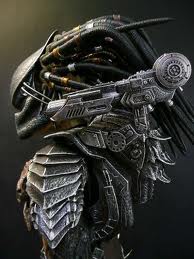
In addition, the supporting cast is pretty weak. Ron Perlman did a good job of portraying Conan’s father, but the role really didn’t seem like a challenge for him. Mainly, he just looked the part and phoned the rest in. Then there was Rachel Nichols, who people might recognize from GI Joe: The Rise of Cobra or as the new blonde lady on Criminal Minds. To call her acting wooden would be too kind! Seriously, I haven’t seen blank stares and cardboard acting like this since… well, GI Joe! The romance between her and Conan was also totally unbelievable. At one point I asked myself, isn’t this woman supposed to be a nun or something? Why then is she shagging the barbarian? And the way he just drops her off at a monastery at the end. Has she not broken her vows at this point? Wouldn’t there be some kind of moral conflict in them having an affair?

Rose McGowan (from Charmed and clealrly one of Tarantino and Rodriguez’s favorite people to work with)  filled the role of the evil daughter quite well, but the character itself was quite weak. Mainly, she’s just creepy and dark for the sake of being creepy and dark, and the incest thing was clearly just thrown in for added vileness. And Ela-Shan, a clear homage to Sobutai’s character, felt like he was just penciled in out of duty. He shows up near the beginning to advance the plot, disappears, reappears as needed, then disappears again. In short, he’s the friend you call when you need a ride but have no intention of hanging out with. That’s mean!

Jason Momoa, who I admire the hell out of for his performance of Khal Drogo in the HBO Game of Thrones miniseries, also had some issues adapting the role of Conan. Sure, he looks the part. A tall, dark, ripped dude with long dark hair? Hell, he IS the part! But he’s a long way from Khal Drogo in this one. Much of the time, he can’t seem to decide if he’s going to go with the deep, raspy voice (a la Christian Bale in Batman), or just use his natural, deep voice. The latter was far better, but he kept doing the raspy thing, sometimes switching in mid-sentence. And when he does the evil stare and threatening words, he just sounded kind of silly! Momoa said he wanted to steer away from Arnie’s version of Conan, which was totally respectable. But at the same time, I think he should have taken a lesson from Arnie’s performance: less is more, especially when you’ve got the kind the commanding presence these two share.

Okay, what was actually good about this movie was the set design. Here was something that also reminded me of Game of Thrones, and it was the picturesque castles and landscapes the movie’s animators came up with. Most of the time, they are pretty cool, and don’t look particularly phoney or out of place. This cannot be said for the final scene where Conan and Zym fight it out in the “Cracks of Doom”, but otherwise the setting looked pretty good. And they did manage to make a lot of the settings look and feel like something out of the original story, giving things a dirty look and feel that calls to mind Biblical allusions, or scenes out of Orientalist art. This was something the original movie did quite well in spite of a limited budget, and this movie did it quite well too.

Reception/Recommendation:

Other than that, sorry to say, but this movie did not live up to the original or the graphic novel which inspired it all. It was a good attempt, but clearly a combination of things were working against it. For one, you can’t take something like an original cult-classic and just redo it! Something like that takes dedication, vision, time, and energy. Throwing writers, a director, some actors (albeit good ones) together and saying “get on it” just isn’t enough. And in the end, the results spoke for themselves. In addition to being almost universally panned by critics, this movie made only 20 million dollars, and that was with a budget over 70! Given time and with DVD sales, I’m sure the studio will recoup its dough, but for the moment, this re-release has done little aside from riding off the coat tails of Game of Thrones.

Speaking of which, it was recently announced that Nonso Anozie will be in season 2 of GOT, playing the role of Xaro Xhoan Daxos. It’s also been said that Momoa’s been talking to the writers about bringing the character of Khal Drogo back. The ties between these two projects continues to astound me! In any case, if you’re looking for some cheesy entertainment, pick this one up and help the studio make its money back! If you’re looking for a faithful adaptation of the original though, something with sword, epic fantasy and a touch of realism, I strongly recommend you rewatch the original, maybe even with the commentary. Or you could just check out Game of Thrones! Whatever floats your boat…

Conan The Barbarian (2011):

Entertainment Value: 7/10

Plot: 4/10

Direction: 6/10

Overall: 5.5/10

Conan, Then and Now

Conan, Then and Now

When I first started doing sci-fi movie reviews, I knew I wanted to tackle Conan sooner or later. It was one of the Fantasy entries I was making room for, and I thought a comparative analysis, old versus new, would be a cool idea. Well, I finally got around to seeing the new one recently, and am all set to pit the original against the remake. I’m not sure if there’s a word for fans of an original beating a remake, but I think the word Fanbashing (which I might have just made up) will suffice! And by that I mean the beating of something BY fans, not the beating OF fans.

Okay, first up, the original version!

Conan The Barbarian(1982):
This movie is a cult favorite for many reasons. On the one hand, it was a pretty good fantasy epic that adapted the long-running comic book series by Robert E. Howard to the big screen. On the other, it was one of Arnold Schwarzenegger’s breakout role. Prior to this, he had spots in B-movies, tv shows, and the cult hit Pumping Iron. After this movie, he would go on to do The Terminator, Predator, Commando, Raw Deal, The Running Man, Twins… in short, every A-movie that he’s known for. But to me, the strength of this movie lies in its direction and storytelling. I tell ya, there are traces of quality and genius that are not commonly acknowledged.

For starters, the casting was superb. Arnie excelled as the brooding, badass known as Conan, James Earl Jones as the hypnotic, charismatic villain Thulsa Doom, Max Von Sydow as the Northman King Osric, and Mako as the narrator/wizard. Hell, even Sandahl Bergman and Gerry Lopez were good as Conan’s love interest and sidekick, Valerie and Subotai. In addition, the story itself was quite creative, weaving epic fantasy and adventure in with real-world history and Nietzschean philosophy.

Despite its small budget and less than pristine production values, you got a real sense that there was a lot of talent and attention to detail went into making this movie. For one, it was directed by John Milius, who’s credits include being the co-writer or director of such movies as Apocalypse Now, Dirty Harry, Red Dawn, Flight of the Intruder, and the HBO series Rome. Oliver Stone (Born of the 4th of July, JFK, Natural Born Killers, Alexander) was also attached as co-writer next to Milnius, and famed producer Raffaella De Laurentiis (DuneDragon: The Bruce Lee Story, Dragonheart, and The Forbidden Kingdom) helped produce it. In short, a lot of talent went into the creation of this film, and I personally felt it showed!

For many, this movie is a guilty pleasure, being one of those B-movies that’s fun in spite of being cheesy. But for me, this movie is also a sleeper hit and a true cult classic, being smart in a way that few people recognize.

Plot Synopsis:
The movie opens with the famous quote by Friedrich Nietzsche: “That which does not kill us, makes us stronger.” Mako, the famous Japanese-American actor, begins narrating and identifies himself as Conan’s chronicler. He sets the scene by telling us that its the “Hyborian Age”, which takes place “Between the time when the oceans drank Atlantis and the rise of the sons of Aryus…”, meaning somewhere between the mythical pre-historic age and the invasion of the Aryan conquerors into the Mediterranean (ca. 40,000-10,000 BCE).

We are then shown an extended scene where a sword is being forged (an apt metaphor) and Conan’s father explaining to him the Riddle of Steel. This “riddle”, which we are never told, runs like a vein through the movie, something which the viewer is no doubt meant to figure out for themselves. After being told of this riddle and of the war-god Crom, both of which are very important to the Cimmerian people (of which Conan is part) we then see his village being set upon by marauders. After killing everyone in the camp, Conan’s mother attempts to shield him when the leader of these attackers shows himself.

We then get to see the villain make his first appearance. Clad all in black, his green eyes beaming, Thulsa Doom (James Earl Jones) manages to hypnotize Conan’s mother and take her sword from her. He then decapitates her in front of the young Conan and sells the poor into slavery. Conan is thus left with only the vague impression of who these men were, which is taken from their black standard of two snakes standing before a black sun. What is most effective about these scenes is how little dialogue takes place. Everything is conveyed through the visuals, the sense of horror and confusion coming through with glances and music instead of lines and declarations.

The next few scenes catalog Conan’s formative years as a slave: pushing a massive wheel in an open field until he is the only slave left (and six feet of pure muscle!), being thrown into the slave pits to fight for the entertainment of others, and then becoming a warrior schooled in the arts of swordplay, hand to hand combat and letters. In keeping with the movie’s Nietzschean theme, we see Conan growing stronger from all this, his hard labor, life of violence and education forging him like his father’s sword.

But the big inciting event happens when one of the slavers, someone he has known since he was a boy, sets him free. Not knowing where to go, Conan runs into the wilderness and chances upon a burial tomb belonging to an old Cimmerian King. In there, he retrieves a sword which he keeps for himself, and sums up the fortuitous experience with one word. “Crom!” That says it all! In this one encounter, Conan is reminded of his people, what his father taught him, and chooses to retrace his origins and find those people that killed his people.

This journey leads him to another chance encounter with an old witch who tells him of a prophecy. In short, the prophecy speaks of a man who would come, who would be king by his own hand, and who would drive the snakes from the land – you know, basic prophecy stuff. But its this last part that intrigues Conan. Remembering the enemy’s standard, he asks the woman what she knows of these snakes. But as always, there’s a price! In exchange for sleeping with her, she tells Conan that he must go to Shadizar in the land of Zamorra – crossroads of the world (a clear reference to Gomorrah and possibly Babylon) where he will find his answers. Having consumated, she then does the black widow thing, turns into a demon and tries to kill him. Conan narrowly manages to toss her into the fire, and which point she becomes a specter and retreats. “Crom…” he says. Yeah, that’s getting to be a real catch-all at this point.

Onto the next scene, where Conan wakes the next day to set out. But before taking to the wilderness again, he finds an archer named Subotai (modelled on Ghengis Khan general and clearly meant to look like a Mongol archer). He claims to be a thief and offers to help Conan, and the two become fast companions and travel buddies. Over a dinner of wild game, Conan tells Subotai of Crom and the Riddle of Steel. Like all Cimmerians, we learn that Conan must tell Crom what the riddle is when he travels to Valhalla, otherwise he will be tossed out. Again, we are given hints but never told of the significance of this. Much like Conan, it seems this riddle is something we are meant to determine for ourselves. This is definitely one of those points of unappreciated quality I mentioned earlier. The genius is there man, it’s there!

When they arrive, they find a city that lives up to its inspirations – big, walled, decadent, and smelly. Replete with whores, drugs, and tons and tons of vendors. And of course, the snakes, which come in the form of snake cult that worship Set – a snake demon-god that was inspired by actual mythology. They decide to break into the temple, and in the process meet Valeria, a beautiful thief who is also determined to steal from the cult’s richess. The scenes that follow are like something out of Caligula or the Old Testament, people in long robes sacrificing a virgin to a giant snake who lives at the heart of the temple. And of course, plenty of rubies, precious stones, and a giant gem (the Eye of the Serpent) that the snake itself protects.

In any case, Conan, Subotai and Valeria manage to kill the giant snake, thwart the sacrifice and steal the prized jewel, narrowly escaping by jumping off the temple’s high tower. Celebrating their new found riches, Conan and Valeria experience a budding romance, and Conan gives her the prized jewel in the form of a necklace. However, the good times are cut short as Shadizar’s ruler – King Osiric, a northman like Conan – has them arrested and brought before him. They suspect their heads are going to roll, until Osiric tells him their audicity in robbing the temple has earned them his respect. Seems the cult of Set had taken his daughter away from him, and he’s prepared to give them enough jewels to buy a small kingdom if they would kind enough to fetch her back.

Subotai and Valeria would rather cash out now, the latter even telling Conan that she would like to settle down with him now. However, Conan still wants his revenge for what Doom did to his people, and sets off alone. In the course of journeying forth, he comes upon a strange hermit who lives next to an ancient burial ground where the bones of dead warrior have been arranged in battle formation next to standing stones. Seems the hermit is none other than Mako, the wizard who is Conan’s chronicler. After getting acquainted and  learning of the location of Set’s followers, Conan is off again, leaving the wizard with the distinct impression that they will meet again, and that he will play an important role in Conan’s sage.

What follows are some rather hilarious scenes as Conan finds his way to the cult and tries to infiltrate them. First, he finds them wandering in the wilderness like a bunch of revellers. One of the priests takes an obvious, and borderline homosexual, interest in him. After asking him to speak in private, Conan then beats the snot out of him and steals his robe. He then travels back to the Temple of Set, dressed in the ridiculous robe, and attempts to pass for a priest. “What do you see in there?” some woman asks as he stares into a pool of water. “Uh… Infinity?” says Conan, which the woman seems to approve of. Then, Doom reveals himself along with his chief followers. Conan recognizes them all from when they murdered his people, and slowly approaches them up the Temple steps. However, during a big speech in which Doom, like a true cult leader, predicts the End Of Days, Conan is attacked, beaten and brought before him. It seems they smelt the intruder…

After getting a lecture on how bad he was for ransacking Doom’s temple in Shadizar, Conan then tells Doom exactly who he is – the boy who survived the massacre of his people, and how has come for revenge. Doom’s response is nothing short of perfect. He admits that he does not remember, that he must have done it in his younger days when he too sought to understand the riddle of steel. However, he explains, he’s found a new power that puts steel to shame: the power of flesh! He demonstrated this by asking an accolade to come to him from the cliffs above, and the accolade jumps to their death! “That is strength, boy! That is power! What is steel compared to the hand that wields it? Look at the strength in your body, the desire in your heart, I gave you this! Such a waste…” He then orders Conan to be crucified, so he can contemplate Doom’s role in making him what he is, and how he squandered it for reasons of revenge.

Conan then dies pinned to a tree, but not before Subotai and Valeria find him and bring him back to the wizard – aka. Mako! He then performs some ritual whereby his spirit is pulled back from the netherworld, and Conan is resurrected. However, they are warned that their will be a price, life for life, etc. But Valeria says she’s willing to risk it because she loves him, which foreshadows what’s to come. The three then set off to invade Doom’s temple and save the princess, but Conan once again has his own plans. In the course of breaking in, they come upon Doom’s men and a big ol’ brawl ensues! Doom is absent from the fight since he morphed into a giant snake and slithered from the room (bit hokey, but okay!). The three then escape with the princess, but Doom makes an appearance on the cliffs above and fires a poisonous arrow/snake into Valeria’s back. She dies, and Conan and Subotai take her body back to the wizard to give it a warriors burial – a big pyre on top of a mound!

Conan, Subotai and the wizard then prepare for an assault, as it is clear that Doom’s men will track them back to the wizard’s home. Turning the standing stones, the warriors remains and every inch of the place into a fortified encampement, Conan then prays to Crom for the first time in years. He asks Crom to grant him revenge, to look upon their valor as they stand against many. He finishes with a line that is both badass and appropriately Conan: “And if you do not listen… then TO HELL WITH YOU!” It takes a special kind of person to tell a god to go to hell, doesn’t it? In any case, battle ensues and its the best part of the movie!

One by one, the bad guys fall as they are either unhorsed by Conan’s sword, shot by Subotai’s arrows, stabbed by the Wizard’s spear, or killed by the booby traps they’ve set up. It all comes down to Conan and Doom’s chief thug, who is wielding Conan’s own father’s sword! Conan is very nearly killed, but is saved at the last second by what appears to be Valeria’s spirit. In keeping with Norse mythology, she appears as a Valkyrie, a warrior spirit since she clearly made it to Valhalla after all! Conan then chops the thug up, breaking his father’s own sword in the process and taking what is left of it back. He then sees Doom ride back to his temple, and decides to use what’s left of his father’s sword for one last duty.

Confronting Doom on the steps of his own temple, Doom tries to pull his hypnotic routine on him. He tells Conan that he is essentially his son, that he made him what he is, and asks him what will he be when Doom is dead. Conan appears to be genuinely falling for it, but then swings his father’s sword around and cuts Doom at the neck! Doom then falls to his knees, where Conan proceeds to hack his head off and toss it down the steps to his followers. He then sets the temple ablaze and marches down the steps and off into the night, Doom’s followers looking on in awe. Conan and Subotai then rides off with the princess, returning to the west to bring her back to her father.

The movie then ends with a picture of an older, bearded Conan sitting on a throne, the epilogue saying that he would go on to become a king himself, as was profesied. But of course, that is another tale 😉

Strengths/Weakness/Impressions:

As I said already, this movie is a personal favorite. One of the best selling points for me was the low-budget, high-quality nature of it. Yes, the production values weren’t the best, and some of the acting was a little B-grade too, but the writing, direction and plot contained unmistakable signs of quality and even touches of genius. Rather than going for a pulp fantasy movie, a la Xena and Hercules, John Milius, Oliver Stone, and Raffaella De Laurentiis seemed committed to creating a story that was grounded in history and realism as well as epic adventure. In this respect, the movie was keeping with Howard’s original vision of the franchise. Howard, like Milnius and Stone, had a passion for history and enjoyed working with settings that were real enough to be credible, but still vague enough to allow him to be inventive while at the same time unconstrained by the pressures of historical accuracy.

But of course, this critique would not be clear without some examples: One, Conan’s people are clearly inspired by Norsemen. They live in wintery forests, wield heavy iron swords and worship the “God in the Mountain” Crom, who is apparently warden of Valhalla and keeper of the Riddle of Steel. Doom’s men, the black riders, were clearly inspired by the Huns – dark riders and conquerors who inspired terror and rode over their enemies. James Earl Jones costumes and appearances were also designed to look as Asiatic as possible, his long hair, green eyes and robes adding to the sense of mystique that surrounded him. It was also a testament to his character that he didn’t speak until well into the movie when he is reintroduced.

Ah yes, and the men that Conan takes up with after becoming a warrior slave were also a clear reference to the Mongols. Their costumes, talk and values are all indicative. Consider the following scene where Conan is in the “Mongol” camp:

Mongol General: “What is best in life?”

Mongol: “The open Steppe, fleet horse, falcons at your wrist, and the wind in your hair.”

General: “Wrong! Conan! What is best in life?”

Conan: “To crush your enemies, see them driven before you, and to hear the lamentation of their women!”

Yep, Mongols clearly! The city of Shadizar in Zamorra was also a brilliant piece of set design, calling to mind all kinds of Orientalist, Arab world and Sodom and Gomorrah type motifs.

But perhaps the biggest strength of the film was the thematic consistency of it. The quote by Nietzsche at the beginning not only previewed the plot, it was present throughout the movie as a constant theme. When Conan confronts Doom near the end, he is confounded by the twist Doom puts on his terrible deeds. Would Conan have really grown up to be the warrior-badass he is were it not for the actions of Doom and his henchmen? Hell, Doom even sounds perfectly sincere when he claims that he MADE Conan what he was, and that Conan would be lost the moment Doom was no more. Rather than being some evil megalomaniac, he seemed to capture the essence of Nietzsche’s amoral philosophy quite perfectly.

And lets not forget the Riddle of Steel, which fits in with this philosophy like one of them round pegs! Though we never are told point blank what it is, enough hints are given as to what it might be all about. For one, steel is strong and formidable, unlike flesh which seems weak by comparison. However, steel is useless without flesh, a mere object that is dependent on the hand that wields it.  On the other hand, it could be said that steel is much like people in that it is forged. When it is first extracted from the Earth, raw ore is much like a raw person; but tempered and shaped through constant exposure to extremes and violence, it becomes a deadly instrument, capable of great and terrible things. I tell ya, the metaphor is thick here!

In the end, the worst that can be said about this movie was that it was a tad cheesy, a tad hokey, and that at times a little wooden in terms of its acting. That and the low budget nature of it all, which was quite apparent throughout. But for anyone who doesn’t mind looking a little deeper, this movie had plenty of respectable stuff just waiting to be noticed. And really, it made Arnie’s carreer and probably didn’t hurt Stone’s, Laurentiis’s or Milnius’ either. Granted, the studio then made the horrible mistake of producing Conan the Destroyer and Red Sonja, two horribly dumbed down sequels that did very poorly, but time has been kind to the original. It has made many a list as one of the top sci-fi fantasy cult classics of all time, and even inspired a re-imagining this past year.

But that, as they say with this franchise, is another tale… 😉

Conan the Barbarian (1982):

Entertainment Value: 8/10

Plot: 8/10

Direction: 9/10

Total: 8.5/10

Of Prequels And Why They Suck…

Of Prequels And Why They Suck…

Looking back, I’ve noticed a sort of thread running through some of the posts I’ve made. And in truth, this thing was quite influential when it came to what inspired me to write science fiction in the first place. It began with the infamous Star Wars prequels, the movies which ruined what used to be a very influential and nostalgic franchise. It was then reinforced by the odious Dune prequels, which tarnished the legacy that inspired me to write science fiction in the first place. Since then, I’ve noticed these same elements at work in any prequel I’ve chanced upon and the lessons only seem to get more concrete.

While I’m no expert on the fine art of writing, be it science fiction or anything other genre, by the time I started doing it I was pretty clear on what I wanted to create. Basically, I wanted to write something I would enjoy, something that emulated the greats I had come to know and admire. But when it came to what I DIDN’T want to do, I found prequels summed up a lot of it succinctly (especially the aforementioned examples). I’m sure I mentioned as much in previous posts, but today, I thought I might speak to these things specifically; outline why prequels can – and often do – suck!

1. No Surprises:
Whether it was the Star Wars prequels, X Men Origins: Wolverine, the Legends of Dune series, or anything else prequel-oriented, there was one undeniable problem they all had in common: we already knew what was going to happen. By stories end, we know that the characters are going to become whatever it is they were in the original story, and we know who’s going to live and who’s going to die. In some cases, we even know how, so there really are no surprises. The only real purpose of a prequel is to fill in the background, explain HOW things happened and how the characters and story we are familiar with came to be.

For example, in Star Wars, we know that Anakin becomes Darth Vader, that Palpatine is the villain and will take over the Republic, and that Amidala will give birth to Luke and Leia before dying. There are a host of other details which the more nerdy among us were familiar with as well, and we were all drawn to theaters back in 1999 hoping to see how they played out. But in the end, when all was said and done, I don’t think any of us came away satisfied. Seeing how things happened when you already know what will happen just seems to make for a disappointing experience.

2. Sense of Duty:
Another thing that brings down a prequel is the fact that things MUST be explained. In short, the writer, director, author, etc. has a list of things which need to be covered before the end. These things have to fall within an established framework – i.e. what has already been established by the original story – and cannot contradict or be inconsistent with them. So really, in addition to having a story where there really are no surprises, you also get a story where things have to proceed in an established fashion and often seem heavily contrived. The end result is not what would feel natural based on the story so far but based on what needs to happen for the sake of the original story.

X-Men Origins will suffice as an example here. In this movie, the story had to show where Wolverine came from, how he and his brother (Sabretooth) had their falling out, and how his memory got erased. The result was actually pretty weak, in my opinion. Basically, Colonel Striker shot him in the head with Adamantium bullets, which he knew wouldn’t kill him but would erase his memory. Now, how did he know ahead of time that that would be the effect it would have? Second, why do that instead of lobbing a rocket-propelled grenade at him? Simple, because the story required it. Wolverine is supposed to be an amnesiac in the first movie, so this movie had to show how.

And while were on the subject, why didn’t Wolverine’s girlfriend kill Striker at the end when she had the chance? The woman had suggestive powers and had the man in her grasp, so why not tell him to march off a cliff? Again, because the story demanded it. Striker needed to live to see movie two, so instead she said some fluff about how she’d be no better than him and just told him to take a walk until his feet bled and he fell from exhaustion. I can’t speak for everyone, but personally, I was disappointed.

3. Less Is More
A lot of people insist that when it comes to back stories and background, the less we know, the better. After all, wasn’t Darth Vader scarier before we knew that he was once portrayed by Hayden Christensen? Wasn’t he a lot more menacing before he cried over the loss of Padme? I know for a fact that I’m not alone when I say that the whole “NOOOOOOO!” scene at the end of Revenge of the Sith brought him down in my eyes. What was once a titanic force of badassery was transformed into a whiney, bitchy child through the simple act of fashioning an origins story.

To use a non-prequel example, consider the Batman franchise. In the Tim Burton version, we got to see the Joker’s origin story, but in the Christopher Nolan version, we got nothing. And frankly, wasn’t Ledger’s updated take on the Joker much more scary than Nicholson’s because of it? Sure, his dialogue and acting were spot on at capturing the insanity and terror of the laughing psychotic killer, but wasn’t part of that assured by the fact that we had NO IDEA who he was or where he came from? The origins stories that he told – “wanna know how I got these scars?” – and how they kept changing was part of what made him so effective. As the audience, we wanted to know, how DID he get those scars? Why IS he so crazy? But by denying us this, I think we were kept wanting and we respected the movie more for it.

The same is true of Batman himself. In Burton’s, we got an exact reversal of what happened with the Joker. Aside from the fact that his parents were murdered, apparently by a young Jack Napier (who would go on to become the Joker), we knew nothing about him. Where he got his skills from, his equipment, and how he got started. This served to make him a much more mysterious character which in turn made him more interesting. In Burton’s Batman, he was the focal point whereas the Joker was his nemesis. But in Nolan’s updated version of The Dark Knight, the Joker was undoubtedly the focus while Batman was just the hero trying to stop him. I’d say what he knew – or in this case, didn’t know – about them was central to that.

4. The Audience’s Imagination Is The Writer’s Greatest Weapon:
I believe it was the famous photographer Duane Michals who said “I believe in the imagination. What I cannot see is infinitely more important than what I can see.” Okay, I Googled that, sue me! But the man had a point, and it applies doubly to movies since they too are a visual medium. What the readers and/or an audience can imagine based on snippets of a story is infinitely more powerful than what they can be shown with a few hundred pages of text or a two hour movie. This is why less is more. By giving the audience less to work with, they have more freedom to imagine and create. If you tell them what happened, detail for detail, then they have nothing except for what you’ve given them.

This, I think, is precisely why prequels are so often a disappointment, at least in my estimation. I’ve always considered myself to be an imaginative person. Given a blank canvas, or one with just a few details, I can create just about anything. And I’m hardly alone in that fact. Imagination is something everyone has – to varying degrees, sure – but it’s part of what makes us human and gives our lives meaning. Being able to express our inner life makes us happy, and there are few things more hurtful and insulting than having someone mock or dismiss that creativity. It’s also one of the cornerstones of a free society, the freedom to create and not be persecuted for it.

So it’s little wonder then why people are drawn to movies where books they’ve read are being adapted to film, or to prequels, where things that have been previously alluded to are acted out. People go to see them because they want to know if it will bear any resemblance to what they themselves imagined. Or, they go because they just want to see what the director’s own vision was. Either way, when you get around to seeing it for yourself, is it not a letdown no matter what? Isn’t that the real reason why people who’ve read the book constantly insist that the movie isn’t as good? That certainly seemed to be the consensus amongst LOTR geeks. And I should know; by The Two Towers, I was one of them! And isn’t that the real reason why the Star Wars prequels sucked as much as they did? We, the fans and audiences are active participants and create out of what we are given. Being told point blank what happened removes half the fun of it!

Some Tips For Writing:
Well, that’s all I got for now. Except to say that if someone is hoping to do a prequel, there are certain tips that I’ve come up with that can help. These are by no means established rules, just the result of my own amateur experience and observations. For one, a writer should take care not to give too much away when writing background. As always, less is more. It’s enough to let the background stay in the background and focus on the story. The more the reader/audience has to work with, the better. That way, when you are writing out the back story, you have much more freedom to work with, and don’t have to worry about staying within boundaries.

Second, a good idea is to write things out ahead of time. When I was thinking up Legacies, I began by writing out an outline for the entire background of the story. I didn’t do this because I was one day planning on writing a whole franchise worth of books, prequels included, but because I just wanted the story to be tight and know where everything fit. But because of that, I was able to pen several short stories that took place before the first novel. Rarely were the main characters and plot lines from that novel the focus of these stories, but they did serve as a solid backdrop which helped to advance things.

But don’t take my word on that, consider Lucas himself. He thought up the entire plot for Star Wars trilogy before making the first movie in the franchise, thus he knew exactly what he wanted to do ahead of time. Sure, he made changes and was forced to adapt along the way, but the end result benefited from this foresight. However, when it came to the prequels, he had only the bare bones to work with, and began writing each movie independently of shooting it. And it certainly showed, didn’t it? Rather than feeling like an ongoing story, each movie was a self-contained tale that was full of duty and contrivances. Nuff said? Plan ahead!

Last, but not least, remember that a story, ANY story, needs to tell its own tale. It cannot be written for the sake of filling in another. Its a bit of a vague point, I know, but a writer’s mentality is important when it comes to the creative process. At no point can you be thinking, “this needs to be explained, that needs to be explained”. It needs to be, “this is a story that needs to be told”. Every character has an interesting back story, and stories are living, organic things. They change over time, grow, and eventually die. Showing how they got to where they were going needs to be interesting and told with sincerity. So forget the duty, focus on the events and what made them interesting. If in the end its not a story that you yourself would enjoy, then don’t tell it! Simple as that…

28 Days Later…

Hello all! In honor of Halloween, I thought I’d jump ahead on my review list again and cover a zombie flick! And not just any zombie flick, a good, scary and even poignant thriller known as 28 Days Later! Not only is this movie a cult favorite, its also a films that got in on the ground floor of this new zombie craze.

Yes, for some reason, zombie movies have been pretty popular in the new millennium. Maybe it’s a retro thing, but it seems that within the last ten years, there have been a plethora of writers/directors who have breathed new life into this old movie genre. After 28 Days was released in 2002, it was followed by the Resident Evil movie, House of the Dead in 2003 (another video game adaptation), the remake of Dawn of the Dead (2004), Shaun of the Dead, Doom (2005), Slither (2006), The Zombie Diaries, I Am Omega (2007), I Am Legend, Day of the Dead (2008, another remake), followed by Quarantine, Zombieland in 2009, and the list goes on. In fact, I’m not even taking the time to mention all the sequels and lesser known titles that came between these ones!

The point is, whereas in previous decades, people could expect a low-budget zombie movie at least once a year, since 2000, there have been multiple entries every year, sometimes as many as a dozen! And with this explosion in titles, there’s been some variety to how zombies were presented as well. Whereas in the old zombie classics, zombies were slow witted and slow moving – literally the walking dead – in new movies and re-imaginings, zombies were fast moving and sometimes highly intelligent. In fact, there’s even a neat table over at Yahoo movies that places zombie films within the context of these two criteria:

How Dangerous Is A Zombie?

If one were to use that table to discuss this movie, the zombies would be placed on the high end of both speed and intelligence, making them VERY dangerous. And, as I will mention soon enough, their take on the creatures was also quite realistic, at least when compared to other franchises. Okay, get comfortable and be ready to get scared, its horror movie time!

(Background—>):
Compared to most horror films, 28 Days had a relatively fair budget of about 5 million pounds or 7 million US$ (based on the 2002 rate of exchange). It’s overall gross, however, was over 82.7 million dollars, and it even spawned a graphic novel and a sequel (haven’t seen or read them yet, but working on it ;)). In addition, the movie was the result of collaboration between writer Alex Garland and esteemed British director Daniel Boyle, whose film credits include Shallow Grave, Trainspotting, Sunshine,Slumdog Millionaire and The Beach (which Garland also wrote).

The film was also well received by audiences and critics, earning itself several awards for direction, cinematography and acting in both Europe and the US in the process. It was even placed on two top 100 and one top 20 list as one of the best horror movies of all time. In addition to its direction and acting, critics praised it for its story, allegory and humanistic elements. In short, the movie went in with a modest budget and limited fanfare, but came out a cult hit and a commercial success. Little wonder why its seen as one of the best movies of the genre, people love underdogs as much as they do hidden gems!

(Content—>):
28 Days Later essentially begins with an act of activism, where some well-meaning animal rights people storm into an animal testing facility and try to free some chimpanzees who are undergoing weird tests. In the course of the break-in, one of the doctors tries to stop them, saying that the chimps are infected with “rage”. This opening kind of seemed hokey to me at first, but afterward I came to see how effective it was. We get a brief prologue that tells us how things began, but which doesn’t weight us down with long-winded or unlikely explanations.

This is always a challenge in zombie movies, explaining how and why the dead are up and walking. In this case, they chose to go with a virus that was like super-rabies, making the infected extremely violent and spreading through the exchange of bodily fluids. Kind of brilliant if you think about it, explains all the zombie-like behavior while still being somewhat plausible. Of course, they are basically saying that animal rights activists will be responsible for the apocalypse, but who cares? It’s fiction!

We then cut to a hospital where the main character – a bike courier named Jim (Cillian Murphy*) – wakes up from a coma and realizes he’s all alone (for some reason, we get a full-frontal shot of his junk here too!) He then gets up and begins to look for answers and food, finding only abandoned buildings and empty streets. After making his way out into central London, he quickly realizes something terrible must have happened. All the missing signs and news pinups about the “End of Days” seem to attest to that. Naturally, he travels to a church where he finds pews filled with corpses, and one survivor, who for some reason seems to want to bite him…

*People may remember Murphy as The Scare Crow in Batman Begins and The Dark Knight.

But of course, he is narrowly saved by two healthy people – a woman named Selena (Naomi Harris) and her friend – who explain to him what’s been going on. Here too, the exposition was kept mercifully brief, the two basically telling him that a virus has devastated the country and that its spread through blood, bites, etc. He agrees to team up with them, but only if they can swing by his house, as he needs to know if his parents are still alive. Naturally, they are not, and infected people soon attack them. Selena’s friend is bitten in the process, and she is forced to kill him. Jim is upset by this, but Selena explains that this is how it is now. Needless sentiment lead to hesitation, which in turn leads to death. Now Selena and Jim are alone to wander the streets looking for other survivors.

Their search brings them to an apartment building where a father and daughter are holed up, and using Christmas lights to attract other survivors. A desperate chase follows as they are forced to run up the stairs as the infected chase them. But eventually they get to the landing where the father, Frank (Brendon Gleeson), is waiting for them in full riot gear! After beating down the infected, he lets them in and they meet his daughter, Hanna (Megan Burns), and begin swapping plans. It seems Frank has a radio and from their high elevation, they’ve been able to picking up a military radio transmission coming from Manchester that tells of a cure, food and shelter. The four of them make plans to go there straightaway.

Getting there is an adventure to be sure, the four having to flee from infected as they get out of the city and there being a few pacing scenes along the way. But eventually, they arrive to find the town of Manchester on fire, and that the transmission is coming from a military base nearby. However, the base appears to be deserted, the only inhabitants being infected crows and bodies. What follows is a heart wrenching scene where Frank gets a drop of blood in his eye and begins to change. He has just enough time to tell his daughter that he loves her before they realize he’s been infected and he goes bat-shit crazy! That’s when the army men reveal themselves and open fire on Frank!

They are then taken to the base’s main compound where the CO, Major Henry West (Christopher Eccleston), welcomes them. Jim and Selena are cautiously optimistic now that they have some protection and a roof over their head, but Hannah is understandably bitter. Her father is dead, after all, and these men were responsible. In the course of the next few days, the Major shows Jim their set up and explains what they’re doing. Seems they’ve been luring the infected to the compound and then killing them with bullets and landmines. They’ve also been keeping a live one for study so they can see how long they survive without the ability to feed. This one they call Mailer, since he was once one of them…

However, things go awry when a few things become clear. For one, the boys seem to like Selena, and are quite pushy on that fact. When Jim tries to intervene to keep them off her, the Major explains that his mens’ sanity has been hanging by a thread and he’s had to make promises to keep their morale from collapsing and them from offing themselves. In short, he promised them women… Suddenly, the signal, the one that lured them in with promises of safety, food and a cure makes perfect sense. The Major and his men, who think the world has gone to hell, are looking to create their own little society here, and need breeding stock! Jim resists, as does one of the soldiers, and the Major orders that they be shot.

While Selena and Hannah are forced to don dresses and prepare for an evening of rape, Jim manages to give the soldiers the slip and runs off. Before the other soldier is shot, he gives Jim some words of encouragement. The Major and the others insist the world is dying, he says, but he’s seen planes going overhead and thinks that’s a pretty strong indication that the carnage must be reserved to Britain. Jim takes some hope from this too, and begins to hatch a plan. He returns to the abandoned outpost where they first met the Major’s men and sets off the siren. This lures the Major and some of his troops, as they know that the siren will draw unwanted attention. When they show up, Jim manages to kill some of them, with the help of some infected, of course.

Back at the base, Selena sets Hanna free and is cornered by one of the soldiers who is about to rape her. However, Jim has returned to the base at this point and unleashes Mailer on them. While he creates all kinds of carnage, Jim manages to break in and kill the soldier who was going to rape Selena with his bare hands. Selena thinks he’s been infected too and is prepared to kill him, but hesitates just long enough to realize he’s clean. We quickly realize that she’s in love with Jim now, as she showed no hesitation when killing her old companion. The two kiss and reunite with Hannah, and all three commandeer a vehicle outside and prepare to drive off.

However, Major West is waiting for them and shoots Jim in the stomach. But Mailer shows up in time to grab West before he can shoot anyone else, and Hannah drives while Selena tends to Jim’s wound. The three then drive to a hospital where Selena tends to his wounds in a frantic montage of quick cut-scenes. Then, after being in a coma for another 28 days, Jim wakes up and finds that he’s recovering in bed, this time in some remote cottage. The three of them are now in the countryside where Hannah and Selena have prepared a massive cloth banner that spells out HELLO. Jim is now awake just in time to help them deploy it and to see a Finnish fighter jet fly overhead. The movie ends with Selena asking sarcastically, “Do you think he saw us this time?”

(Synopsis—>):
Apparently, Boyle and Garland also came up with a number of alternate endings as well, two of which were filmed and a third which never made it past storyboard. In the first, which was meant to be the original ending, Jim dies in the hospital, leaving Selena and Hannah to carry on. However, this ending was rejected after some test screening audiences said it was “too bleak”. Though the scene was meant to convey that the two ladies survived, audiences believed they were marching off to certain death. The second alternate ending included the rescue banner at the very end, but without Jim being present, so as to show that the ladies made it without him.

A third, which never made it past storyboard, was a radical departure. In this one, Jim, Selena, Hannah and Frank converge on a medical facility rather than a military base, the same one where the infected apes escaped from at the beginning. Frank is still infected, but it turns out that there is a cure available here. Unfortunately, the doctor at the base informs them that the cure consists of a full blood transfusion, and only Jim is a blood match. He therefore sacrifices himself to save Frank, and the movie ends. This ending was rejected by Boyle and Garland though, since they realized it was unrealistic. In essence, if an infection can spread through even a drop of blood, no amount of transfusing would work!

While they didn’t go with the ending they wanted, the movie still conveyed the same message all around. In it, we are given a pretty realistic take on zombies, one which ties in with the dangers of epidemics and how modern, industrial societies are vulnerable to infectious diseases. In addition, we get a story that’s chock full of allegory about the human condition. Whereas some people survive by becoming selfish and doing whatever they have to to go on – in Selena’s case, cutting all ties, in the Major’s case, promising his men women – ultimately, people are redeemed through acts of self-sacrifice and empathy.

Frank shows this through his abundant sense of generosity and how he’ll do anything to make sure his daughter survives. Selena demonstrates this by saving Jim and Hannah, allowing herself to care for them even though she’s presumably become hardened and only cares about staying alive. And of course, Jim demonstrates this by putting himself in danger to save Selena and Hannah, even though it nearly costs him his life. And of course, the three make it in the end only by mutual dependency and love. There’s even the bit about the rogue soldier who would rather die than give in to hopelessness and take part in a gang rape.

And that’s the movie. Simple, scary, effective and entertaining! It’s rare that a movie will come along that can cover all these bases, but this one managed to do it quite well. Its also a reminder that within the realm of low-budget cinema, there are some genuine gems waiting to be found. Hell, one could even make the case that low budgets are essential to the success of some movies. It ensures that there aren’t any over-the-top special effects to make it look fake, or a sense of mass appeal to water down the plot. And it just goes to show you what can happen when good acting, writing and direction come together!

28 Days Later
Entertainment Value: 8.5/10
Plot: 9/10
Direction: 9/10
Total: 9/10