In case you were worried that Curiosity had fallen into a ditch, more news has just come from the Red Planet featuring everybody’s favorite rover! It seems the robot has been taking pictures again, and word around the campfire is that it is Curiosity’s best yet! Having taken a break from its usual round of performing scientific research on soil samples and surface terrain, Curiosity took a pause to snap a self-portrait
Well, in truth, it was fifty-five photos, all of which were taken by the Rover’s hi-resolution Mars Hand Lens Imager. These photos were then combined back at Mission Control by NASA personnel to form a panoramic image that shows Curiosity at work digging holes in the sand and with Mount Sharp in the background. The area of the shoot is appropriately known as the “Rocknest” since this is where Curiosity has been for the past few months, gathering scoops of Martian soil for analysis.
In addition to its aesthetic appeal, the images serve an important function. According to NASA’s website, “Self-portraits like this one document the state of the rover and allow mission engineers to track changes over time, such as dust accumulation and wheel wear.” Apparently, they also ensure that Curiosity continues to function within established parameters while personnel are not at the helm.
Check out the full image below. As you can plainly see, it is high-resolution and extremely detailed.
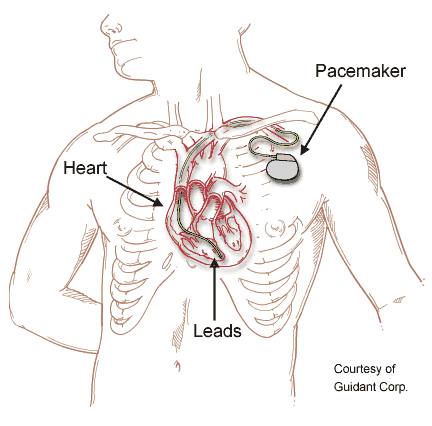
According to the Laws of Thermal Dynamics, there is no such things as perpetual motion. However, engineers at the University of Michigan seemed to have created a device which defies that rule. Not only that, they seem to have overcome one of the pacemakers greatest drawbacks, i.e. the fact that it requires batteries to keep working. Utilizing a process known as piezoelectricity – electricity generated by pressure and/or external force – they have created the world’s first pacemaker which is powered by the beating of one’s heart.
This is an exciting development for obvious reasons: by creating a pacemaker which can utilize the vibrations in the chest cavity to power itself, this device can function indefinitely. As long as the user’s heart keeps beating, the pacemaker will continue to assist the heart in maintaining its rhythm. Hence the concept of perpetual motion, where feedback is used to keep things going for an infinite duration.
Currently, pacemakers are powered by batteries which have a duration of a few years. This requires that patients undergo surgery regularly in order to keep their pacemakers in working order. According to M. Amin Karami, the lead researcher, “Many of the patients are children who live with pacemakers for many years,” he said. “You can imagine how many operations they are spared if this new technology is implemented.”
The piezoelectric pacemaker is about the size of a regular battery, and has been tested extensively. According to Karami, it was able to generate create enough electricity from as few as 20 beats per minute, or as many as 600, to maintain a healthy heartbeat. However, there are still likely to be many years of testing before it is approved for medical use.
But most exciting is the implications this pacemaker has for other biomedical devices such as dispensers and sensors – all of which would live under our skin and be powered by our body heat and movements. Image if everyone was born with a defibrillator/pacemaker implanted in their chest. Surely, death from heart disease would drop substantially, and people would even be able to jack their heart rate up in emergency situations.
Check out this video of the piezoelectric pacemaker in action.
News of Obama’s reelection has certainly been met with some strong emotions. In addition to the extreme laments of certain die-hard conservatives – Trump has called for revolution, Glenn Beck has told conservatives that “Doomsday is here”, and some going as far as to proclaim the death of God – a number of social media records have been broken.
Amongst them was the Facebook photo of Obama embracing his wife, which received the most “Likes” than anything posted on the social media website. As of writing this article, it has reached a total of 4,394,634, beating out Justin Bieber, Gangnam Style, and countless photos of cute kittens.
The same photo was posted on Twitter, where it broke another record for the most retweeted picture ever. Here again, it beat out Bieber for the numer one spot, grossing 814,121 retweets versus Bieber’s compartively modest 223,598. Also of interest is Mitt Romney’s “Thank You” photo, which garnered 910,738 Likes, less than a quarter of Obama’s victory embrace. Once again, this gap would seem to demonstrate the importance of new media in the realm of politics, and how the Obama camp has the edge.
It has been an exciting year for the discovery exoplanets! First, there was the news from Gliese 581 g, then the discovery of an Earth-like planet in Alpha Centauri. And now, scientists working in the European Southern Observatory’s HARPS apparatus have announced the discovery of the latest Super-Earth, which they believe to be the greatest candidate for extra-terrestrial life yet.
The planet is located in the HD 40307 system, an orange dwarf star that is just 42 light years from Earth. Although scientists are still not entirely sure that it’s a rocky planet, there are a number of strong indications that point towards and hospital terrestrial environment. For starters, as the sixth and farthest planet in the system, it lies within the sun’s habitable zone.
Second, the planet has a very reasonable 320 day annual cycle, which means that it receives a similar amount of solar energy compared to Earth – about 62% of what we get year round. This is positive news since most Super-Earths are situated too close to their parent stars to boast life. And last, but not least, the planet is unique amongst its near-Earth exoplanet kin in that it is not tidally locked, meaning it has a night and day cycle. Though this is not absolutely crucial to life, it is a bonus seeing as how it means one side of the planet is not constantly exposed to radiation while the other is constantly in a state of cold, life denying darkness.
Mikko Tuomi of the University of Hertfordshire in the UK, and Guillem Anglada-Escude from Germany’s University of Goettingen are chiefly responsible for this discovery. In the coming weeks, months and years, their team will be doing their best to ascertain the planet’s composition, which they hope to be rocky in nature. If this should prove to be the case, it will move to the top of likely candidates for exoplanet colonization, pushing such planets as Gliese 581 g, the most Earth-like exoplanet discovered to date, out of the top spot.
Okay, good new and bad regarding the NaNoWriMo challenge this year. Good new I got a lot of support from people who told me they wanted to participate but couldn’t. It seems that every year, we find ourselves overloaded with our current responsibilities and unable to take on the task of additional writing. As such, my friends and colleagues who are also indie writers wished me well as I attempted to take on a new novel amidst everything else.
Bad news is, I’m dropping out of the challenge! Yes, I really wanted to take this on and thought it would be just fine to add a daily writing requirement of about 2000 words to my articling, editing and existing writing responsibilities. But unfortunately, it’s not working out. It’s not that I find myself particularly overburdened or stressed out, or the fact that I’ve gotten sick in the last few days – although those were a factor in this decision. No, the real problem is far worse. It seems that I’ve lost interest in my story idea! For a writer, I happen to think that this about the worst thing that can happen.
However, there’s an upside to this, a second bit of good news. Dropping one project allows me to make time for another. And it just happens to be the one I would rather be doing. In order to make time for NaNoWriMo, I decided to put off authoring the sequel to Whiskey Delta – aka. Pappa Zulu. But with Etemenanki sidelined, I’m now able to focus on it again. And I happen to know there are some people who would prefer to be reading it. So look for new entries. If I turn it out at a good enough rate, I might even be able to enter it into NaNo instead 😉
Fans of the zombie-horror genre are no doubt aware of this title, and for some time now, it’s been known that Brad Pitt would be playing the lead role in the film adaptation of Max Brook’s seminal novel. Well it seems that they are all done shooting and preparing for launch! My thanks once again to David Lim at Ellipsis Media for bringing this one to my attention. I have to admit, it made we want to abandon NaNoWriMo and get working on my zombie stories again!
Admittedly, the movie doesn’t look anything like the book, which was a collection of oral accounts that describe the zombie war over the course of many years. But people will certainly forgive that if the movie boasts the same orgiastic zombie apocalypse stuff that’s apparent in this preview! As befitting a would-be blockbuster, the movie is set to be released in June of 2013. Which is good, because I plan to see this movie while sitting in a comfortable, air-conditioned theater eating hot popcorn and laughing at all the people who predicted a zombie apocalypse was coming in 2012.
Bath salts and some isolated incidents of alcohol-induced cannibalism do not a zombie apocalypse make! Anyway, enjoy the clip.
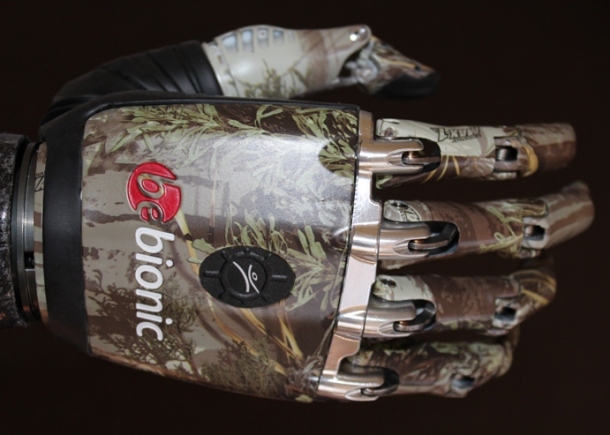
Behold, the latest in bionic technology! The bebionic 3 model prosthetic hand, by the RSL Steeper company! Encased in an aluminum chassis, boasting improved electronics, a redesigned thumb, and new motors that increase the power grip, this hand was first unveiled at the American Orthotic Prosthetic Association (AOPA) Conference in Boston this past September. Since that time, amputees have been obtaining the hand and incorporating it into their daily lives. And the results are quite encouraging!
In addition to being able to do delicate work, like handle eggs and fine china without breaking them, the hand is also capable of performing a power grip that is capable of generating 31.5 pounds of force. That’s quite the Kung Fu grip, just in case you were wondering. And in “hook” mode, the hand is able to bear a load of 99 pounds. So, though it doesn’t have quite the same dexterity or free range of motion as an organic hand, the bebionic is capable of performing all the basic tasks, and is pretty powerful to boot!
Much like the bionic leg which was popularized by Zak Vawter’s historic climb last weekend, the bebionic works by reading the nerve impulses from the wearer’s arm skin. These are amplified by the arm’s electronics and translated into one of 14 possible grip configurations. These different grips are uploaded to the hands internal memory and users are able to cycle through them to determine which grip they want for which purpose. For instance, a mouse-clicking action makes the thumb grip a mouse, while the index finger clicks the left button. The “precision open grip” can be used to grab small objects and the “tripod grip” can be used to write with a pen.
Currently, and depending on its configuration, the hand costs clinical centers between $25,000 and $35,000. In time, and as it becomes available for public purchase, the price is likely to come down somewhat. Still, such a revolutionary device will not come cheap for many years to come. It also comes available in a range of colors and designs, including snow and jungle camouflage and tiger stripes, as well as realistic silicone skin coverings. See the video below for some examples.
Combined with other advances in the field of bionics and prosthetic devices, the bionic hand presents some new and very exciting possibilities. For one, technologies like ReWalk and other exoskeletons are making it possible for paraplegics to walk again, while sophisticated wheelchairs like the wheelchairbot are making stairs and obstacles passable. Coupled with bionic limbs that are giving full ambulatory motion back to amputees, we could be looking at a future where robotic enhancements can restore any and all ability to accident victims, combat veterans and people born with physical deformities.
In addition, the most audacious developments, such as bionic enhancements or robot chairs that read brain waves directly, giving full motion to quadriplegics and the ability to communicate fully to people with degenerative conditions is still yet to come! Once such technologies are readily available and commercially viable, we might even be seeing the emergence of a cybernetics industry, where people can receive enhancements that not only restore abilities, but greatly enhance them. Artificial limbs the enhance strenght and speed, artificial eyes that enhance vision and provide projected images and augmented reality displays, and even silicate implants that enhance brain function and make people smarter.
Homo Superior people… I just got goosebumps!
And while we’re waiting on all that to happen, check out this promo video for the latest bebionic model:
And here’s a video of the bebionic going through a battery grip pattern tests:
As a big fan of the Alien franchise and someone who’s enjoyed just about every AVP game there is, I can honestly say that I am eagerly awaiting the release of this game! For years now, gamers have been getting a taste of combat with xenomorphs and hunters thanks to the AVP franchise, but this promises to be purer in nature.
In short, you’re a human being hunting the most dangerous creature in the universe, no fuss, no muss. And Pulse Guns, Smartguns, Flame Throwers and grenades are your weapons, hopefully with a little assistance from some M577 APC’s, a few UD-4L Cheyenne Dropships and maybe even some of them big power loaders!
Another aspect of the Aliens experience which this game appears to be improving on is the squad combat feature. Whereas in all the previous incarnations of AVP, you were forced to play solo for the vast majority of the game, this time around there appears to be better AIs and group play at work.
This is good seeing as how Colonial Marines are not meant to fight alone, and the explanations for how and why you kept finding yourself fighting solo in the games got pretty tiresome after awhile!
According to Steam, the game is set for release in February of 2013. Just a few months away, and in the meantime, enjoy the preview! I think you’ll agree, it’s pretty cinematic in nature.
It seems IBM is deep at work developing a revolutionary new method for assembling microchips. This process will involve using self-assembled DNA nanostructures to create microchips and chip components. Or, to put it more dramatically, DNA would be used as a sort of “origami”, serving as a sort of scaffolding in the arrangement of nanotubes and allowing the company to develop microchips that are smaller and much less expensive to produce.
But of course, the long-term goal is much more ambitious. According to Greg Wallraff, a scientist working with IBM, the “goal is to use these structures to assemble carbon nanontubes, silicon nanowires, quantum dots. What we are really making are tiny DNA circuit boards that will be used to assemble other components.” In short, this could be not only a step towards bioassembly, nanotechnology, and even quantum computing.
For some time now, scientists have been experimenting with DNA as an assembler for microcircuits. One such individual is Paul W. K. Rothemund, a research associate at the California Institute of Technology, who developed DNA origami back in 2006. This involved taking a long strand of viral DNA, putting into a 2 or 3-D shape, and then holding it together with shorter strands of DNA. In this way, he was able to create shapes such as triangles, stars and smiley faces, according to his Caltech Web site.
Based on this process, complex DNA nanostructures are made in solution and then applied to surfaces which have designated “sticky spots” to ensure that they hold a specific configuration. Once the scaffold is in place, molecules of polymer, metal and other materials can then be guided into place, assembled from the cellular level outward. According to Rothemund, there are still some problems that need to be worked out and it is likely to be another 10 years before the process is entirely viable.
Still, for enthusiasts of bioware, biotech, and nanotechnology, this is exciting news. To know that we could be just ten years away from components assembled by nanostructures composed of living material, a stepping stone towards machinery composed entirely of DNA structures or nanomachines themselves… like I said, exciting!
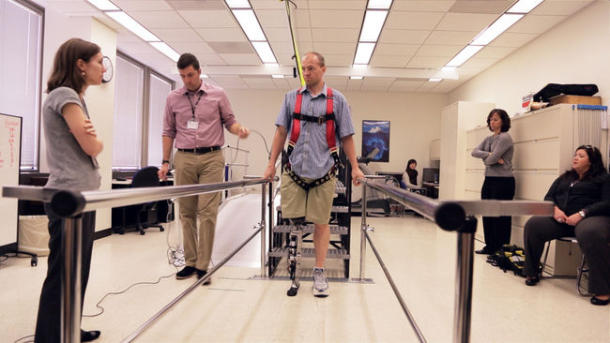
This past weekend, amputee Zak Vawter stood at the foot of Chicago’s Willis Tower with the intention of scaling its 103 flights. The purpose of this historic climb was simple, to test out a new bionic leg which may very be the way of the future. Unlike previous prosthetics, this limb is actually controlled by the user’s mind. Thanks to Vawter’s determination, and a little help from the bionic limb, the climb went off without a hitch!
Vawter, who lost his leg in a motorcycle accident in 2009, performed this climb as part of SkyRise Chicago, an indoor stair-climbing fund-raising event for the Rehabilitation Institute of Chicago (RIC), along with roughly 2700 other climbers. For years now, he has been commuting from Seattle – where he lives with his wife and two children – to Chicago to assist the RIC with the development of the leg.
This consisted of a surgical procedure called “targeted muscle reinnervation”, originally pioneered by the RIC’s Center for Bionic Medicine for upper-arm amputees. The operation reassigns nerves that once controlled a lost limb, allowing amputees to have more natural control of prosthetic devices. In Vawter’s case, this meant rerouting the residual nerves that normally would carry signals to his lower leg by attaching them to his hamstring.
Once that was complete, Vawter was assigned the leg that would turn these nerve impulses into full-range movement. Consisting of a powered knee and ankle that work in unison, the device reads the wearer’s intent. When they push on the device to stand up, for example, it pushes back, propelling them up. When they pull on the device, it retracts, allowing them to take a step forward or vertically, depending on the signals it receives.
“Everything went great,” said Vawter at the event’s end. “The prosthetic leg did its part, and I did my part.” Kudos to you Zak Vawter! Who knows? This could be the end of problems involving accessibility as we know it!

 In case you were worried that Curiosity had fallen into a ditch, more news has just come from the Red Planet featuring everybody’s favorite rover! It seems the robot has been taking pictures again, and word around the campfire is that it is Curiosity’s best yet! Having taken a break from its usual round of performing scientific research on soil samples and surface terrain, Curiosity took a pause to snap a self-portrait