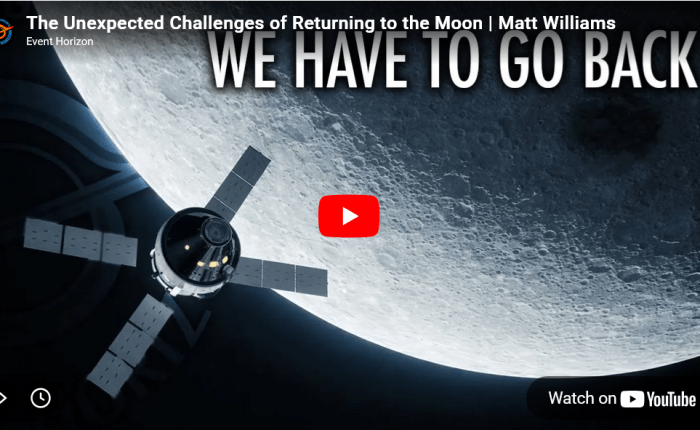
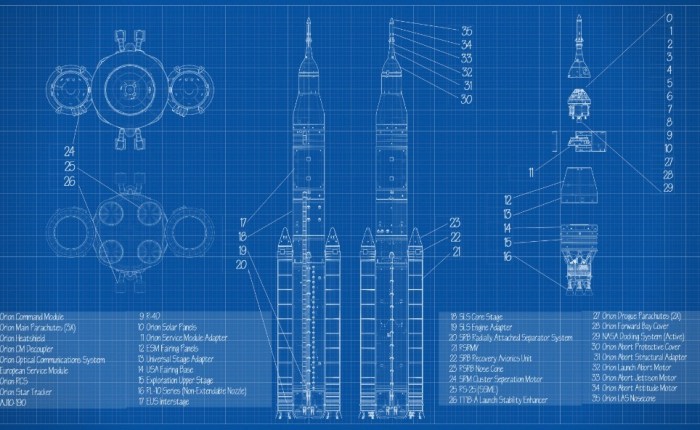
After a bit of a hiatus, John Michael Godier and the fine folks at Event Horizon invited me back on their show to talk about all things space! The topic of this episode was NASA’s Artemis Program, the upcoming Artemis II mission, and other plans to return to the Moon; this time, with the intent to stay!
We also talked about my science fiction writing and what we’ve been up to since we chatted last. Check it out, it was a very fun time!
In this latest episode, I discuss the Standard Model of Cosmology, how scientists arrived at it, and how recent discoveries are causing some to question whether or not it is correct. To break it down, it is known as the Lambda Cold Dark Matter (ΛCDM) model, which basically combines the following theories.
The Big Bang: The theory that the Universe expanded from an initial state in which all matter was in hot, dense state (c’mon, you know the tune!) Evidence for this theory includes the Cosmic Microwave Background (CMB), the abundance of light elements (hydrogen, helium, etc.), the large-scale structure of the Universe, and cosmic expansion (see below).
Special Relativity: Einstein’s famous theory (E=mc2) that asserts that matter and energy are equivalent and how space and time are part of a four-dimensional framework in which the speed of light is constant and cannot be exceeded.
General Relativity: The extended generalized version of Einstein’s famous theory, which asserts that mass alters the curvature of spacetime.
Dark Matter: The theory that the majority of matter in the Universe is made up of a mysterious mass that doesn’t interact with normal matter in visible light.
Cosmological Constant: Also known as the Hubble-Lemaitre Constant (colloquially referred to as “Dark Energy”), wherein 68% of the cosmos is made up of energy that counteracts the force of gravity.
Over the past 120 years, these theories have come together to create the ΛCDM model of the Universe. For decades, scientists have been hoping to get a look at the very early Universe (less than 1 billion years after the Big Bang) to test this theory. When Webb finally provided the first observations of this period in cosmic history, what astronomers saw challenged many of the assumptions inherent in this model. Check out the episode below to learn more…
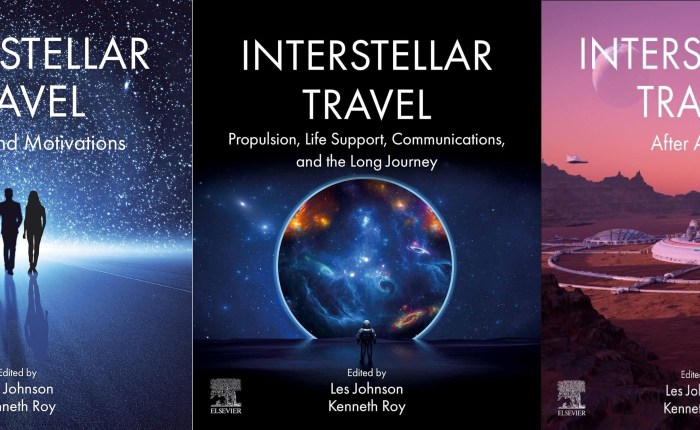
This latest episode was particularly special. In addition to having NASA technologist Les Johnson on for the second time (Episode 25 – Going Interstellar!), we got to talk about our latest collaboration and the upcoming release of a major project – the Interstellar Travel Monograph. This series, edited by Les Johnson and fellow NASA alumnus Ken Roy, details interstellar travel’s benefits, possibilities, and challenges. Volume I covered the purpose and motivations, while Volume II addressed the technical and associated requirements of making the journey.
The latest installment, Volume III: After Arrival, addresses how humans will live on a distant planet, exploring questions of governance, economics, adaptation, and (my contribution) terraforming! This work builds on Les Johnson’s previous work, A Traveler’s Guide to the Stars, which lays out the case for interstellar travel for regular, everyday readers. The Monograph series targets scientists, engineers, and technical experts and will be used as textbooks in University-level courses. Everyone who contributed is an expert in their field, and they let me join in! What an honor!
This series also builds on previous work I had the honor of participating in, The Ross 248 Project (also edited by Johnson and Roy), which addressed how humans could live on rocky planets around red dwarf stars (like Proxima b). Check out the episode to hear more about Les Johnson’s work at NASA, the Monogram, and this fascinating subject matter!
Sixty years ago, famed physicist Freeman Dyson theorized that in their ongoing quest to find more living space and energy, advanced civilizations might choose to convert their solar systems into megastructures enclosing their star. This came to be known as a “Dyson’s Sphere,” a concept that inspired countless variations and similar concepts. A few years later, Nikolai Kardashev mentioned the Dyson Sphere while presenting his scheme for classifying extraterrestrial intelligence (ETI) based on its level of technical development – aka. the Kardashev Scale.
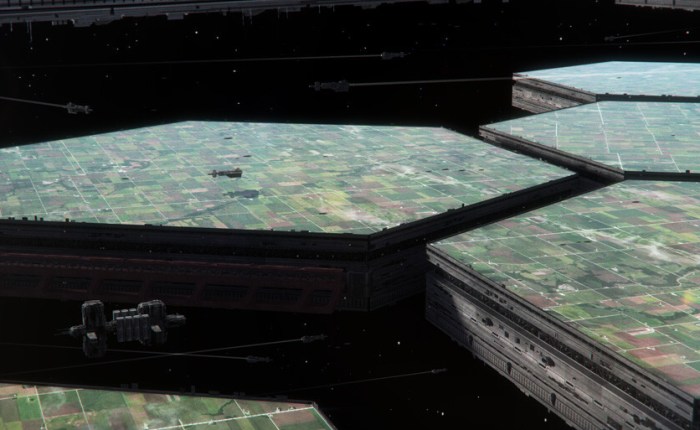
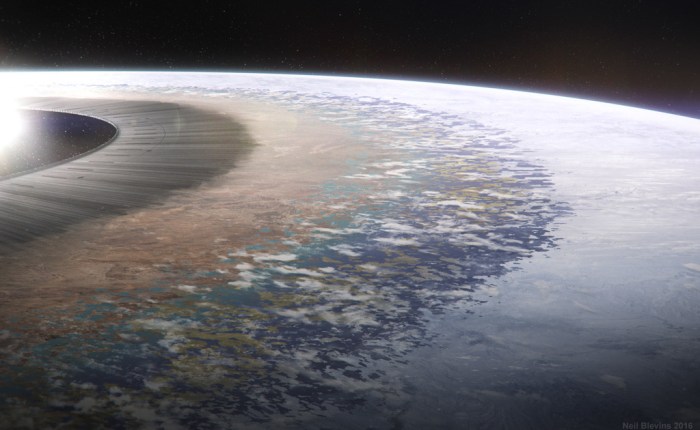
In previous episodes, we examined the kinds of structures that a Type II and III Civilization might create. In this third and final installment, we looked at the types of megastructures a Type I+ Civilization might create (and that could include humanity someday). To break it down, these megastructures would belong to a civilization that had mastered its home planet (i.e., harnessing all of its energy sources) and was beginning to extend its presence across its solar system.
As always, these theoretical structures are a way to make futuristic predictions while also guiding SETI searches for potential technosignatures. Take a listen and be sure to check out the concept art of Neil Blevin at Soulburn Studios.
This past week, I did an episode that is long overdue! In truth, I can’t possibly explain why I’ve neglected it for so long. The subject at hand… MEGASTRUCTURES! Honestly, this is like one of my top five favorite topics and specialties when it comes to space, science fiction, and the Search for Extraterrestrial Intelligence (SETI). Yet here we are, three years (happy third anniversary, Stories from Space!) and more than 100 episodes later, and I find out I haven’t done an episode dedicated to this lovely topic.
The story begins with Freeman Dyson, the famed British-American theoretical physicist and mathematician. In 1960, he wrote a paper outlining how advanced civilizations, in their drive to find more living space and energy, would someday convert their planets into artificial biospheres that would enclose their entire star. This became known as a Dyson Sphere, a concept that spawned an entire field of study. Decades later, there are innumerable proposed concepts, all of which were proposed to help constrain SETI searches.
Similar to Nikolai Kardashev‘s paper (released a few years later), in which he proposed what is now known as the Kardashev Scale, Dyson’s proposed structure was a means of suggesting the kind of technological signatures that SETI researchers should be looking for. Thanks to him, SETI researchers are not only looking for evidence of transmissions in the cosmos, but also evidence of planetary engineering. Given the richness of this topic, this episode is part of a series that may (as I hope) run for three episodes. Check it out!
This week’s episode was an exciting one! I sat down with aerospace engineer, astrophysicist, and analog astronaut Dr. Rodrigo Schmitt. For years, he and other engineers have used the Kerbal Space Program (with the realism mods) to assist with spacecraft design and mission planning. KSP and other “sandbox games” have also been hailed as a vital educational tool for people studying to become aerospace engineers.
During our interview, we chatted about his recent paper, in which he proposes how KSP and other sandbox games could be integrated into the actual spaceship and mission design process. Based on NASA’s Program/Project Life Cycles, he explained how the software could become part of Pre-Phase A: Concept Studies, the initial design phase. Our interview also focused on how he and his team simulated the Artemis V mission and how orbital refueling will play an important role.
It was honestly one of the most fun interviews I’ve done in recent history. Check out the links below to hear more…
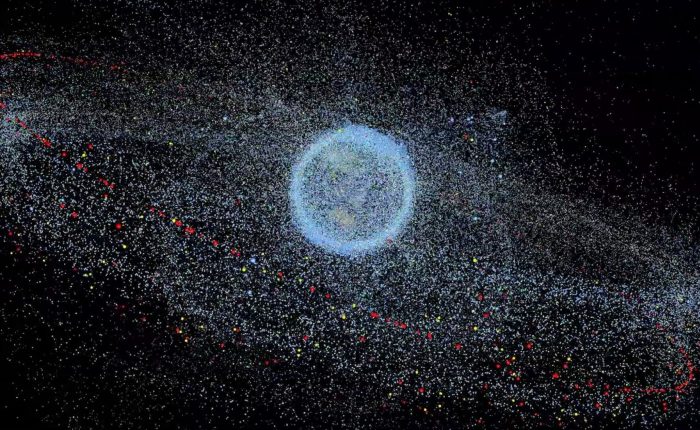
After a wee hiatus, Stories from Space is back! And this week’s episode is dedicated to something that is overdue: Space Junk! Otherwise known as orbital debris, this problem is the result of decades’ worth of launches (roughly 7000) that have placed 21,620 satellites into orbit. About 14,240 of these satellites are still there, and 11,400 are still operational. Similarly, every launch made before the advent of reusable rockets has left thousands of spent first and second stage rockets in orbit.
Over time, collisions between these objects have littered Low Earth Orbit (LEO) with literally millions of objects ranging from the massive to the incredibly small. Regardless, objects in orbit are accelerated to speeds of 7 to 8 km/s (4.35 to 5 mi/s), making them potentially lethal. And the worst part is, it’s only going to get worse. With more and more space companies conducting regular launches to deploy satellite “mega constellations,” CubeSats, and commercial space stations are deployed, the situation in orbit is projected to get worse.
But the greatest threat is what is known as Kessler Syndrome, where the saturation of LEO with debris will create a cascade effect – where more collisions will mean more debris objects, and so on. Hence why this episode also gets into mitigation strategies and proposals for active debris removal (ADR). But of course, the greatest challenge is changing the way we think!
A few months back, I had the honor of appearing on AADYA Geo Talks, the podcast series launched by Bharti Sharma and the organization she founded – AADYA, whose name means “origin” in Hindi. As a geologist and world-traveller, Sharma launched this organization to promote knowledge about planetary and geoscience and create opportunities for collaborative research to address critical global challenges.
During the interview, we talked about how I got into science journalism, my podcast series, and my science fiction writing. The interview lasted for more than an hour because she asked great questions about a range of wonderful topics (and she let me talk for as long as I wanted!) Here’s how she described our conversation:
“In this episode of AADYA Geo Talks, we explore the mind of a space journalist who has spent years unraveling the wonders of the universe. From the allure of dark matter to the search for extraterrestrial life, Matthew takes us on a journey through the most fascinating corners of space science. But here’s where it gets even more intriguing—science fiction has always fueled real-world space missions. “
Check it out, and watch it in segments if you need to! Also, visit the AADYA website to learn more about their education, outreach, and collaborative efforts.
This week’s episode was a special treat! I sat down with former NASA scientist and astrobiologist Keith Cowing, the creator and editor of NASA Watch and Astrobiology.com. Keith’s extensive experience as an industry insider and a scientist has made him a trusted news source for millions of people, including myself. In his time, he witnessed many developments and advancements and played a major part in advancing the fields of astrobiology and space exploration.
He is a trained biologist, a specialist in payloads and biospecimen containment, and was part of the -Space Station Freedom Program. He is also very well-traveled, having been to Nepal and the Arctic Circle and even participated in centrifuge training and zero-g flights. I only got to hear a bit about all those experiences during our chat, but we got deep into discussing the current state of things at NASA. Our talk went so long, I had to break it into two segments to do it justice.
Follow the links below to hear Part I of our interview.
Hello again, folks. It’s been a busy few months, what with the holidays and a few life-related events that have happened since. Unfortunately, I was unable to produce new episodes every week. Fortunately, that is now over, and I have not one but TWO new episodes ready to share! This week’s installment is dedicated to the history, development, and future of Space Stations. Cue the Blue Danube Waltz and the scene from 2001: A Space Odyssey!
As I explain in the episode, the concept of space stations is time-honored and can be traced back to the early 20th century and the work of famed Russian aerospace engineer Konstantin Tsiolkovsky, who is considered the “forefather of rocketry.” Like most ideas pertaining to the future of humanity in space, he made the first recorded mention of a pinwheel station in space that would simulate gravity and have a natural environment that could provide oxygen.
Like rockets that used liquid propellants and other advanced concepts Tsiolkovsky originally proposed, his work went on to inspire the other “forefathers of rocketry”—Hermann Oberth, Robert Goddard, and Robert Esnault-Pelterie—many of whom went on to propose their own concepts. By the latter half of the 20th century, these ideas would bear fruit in the form of the Salyut space stations, Skylab, Mir, and the International Space Station (ISS).
With the decommissioning of the ISS scheduled for 2030, several nations and commercial space interests are working on proposals for successor stations. What will they look like, and how might they enable the migration of human beings throughout the Solar System as Tsiolkovsy predicted? Follow the links below to find out!




 Stories by Williams