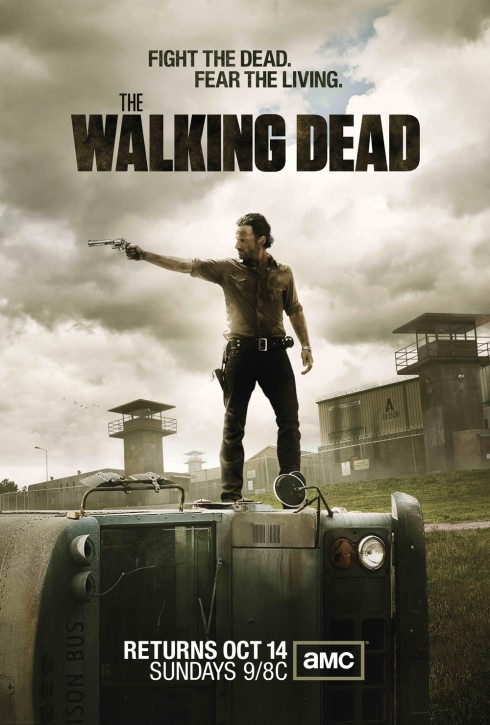
The Walking Dead, Season 3 Episode 5

Hello all and welcome back to my ongoing review of AMC’s The Walking Dead. Season three has now reached the halfway mark, and the two-prongedstory is beginning to really drop some bombs on us, the viewing public! After last weeks’ hefty dose of trauma – i.e. Lori dying and Rick finally snapping – I was curious to see how this week’s episode was going to lighten things up again. What’s more, I had to know if they had really killed Lori off, or that was just a screw to the audience to get them to tune back in for this week’s episode. Needless to say, they were messing around…

In short, the midway mark in this season saw the resolution of the prisoner situation inside the jail. After killing Andre, the escapee who vowed revenge, Axel and Oscar seem to be merging in with the rest. At the same time, the loss of Lori, Carol and T-Dog was mitigated somewhat by the arrival of a new member – Rick and Lori’s baby girl.

Meanwhile, over the in the town of Woodbury, the divide between Andrea and Michonne finally results in a break, with Michonne leaving and Andrea staying behind. However, after witnessing an evening of special festivities put on the Governor, Andrea begins to question her decision to stay. And it’s also abundantly clear from what the Governor has going on behind closed doors that he has not accepted the loss of his family and that that is what drove him to madness in the first place.

Say the Word:
The episode opens on Rick, who is virtually catatonic after receiving the news that Lori is dead. His grief quickly turns to rage and he grabs an axe, proceeding inside to kill whatever remains of the Walkers who entered the prison. Meanwhile, Hershel tells them that the new baby needs formula or she can expect to die within a few days. Maggie and Daryl hop on his motorbike and make for a nursery which they observed in the nearest town. There, they find some diapers, formula, and a possum hiding in one of the closets. Daryl shoots the possum and declares they now have some fresh meat for dinner!

Meanwhile, Rick busies himself with cutting through all the Walkers that are still down below. Glenn tries to talk him down but fails, as Rick seems borderline psychotic and unreachable. After throwing him aside and going off to kill more, he finally finds his way to the room where Lori had her C-section and died. He finds a bullet in the floor and a blood trail leading into a passageway nearby, realizes that Carl couldn’t bring himself to shoot her and that she turned. After putting a bullet through the head of her bloated Walker corpse, he begins stabbing her swollen belly over and over…

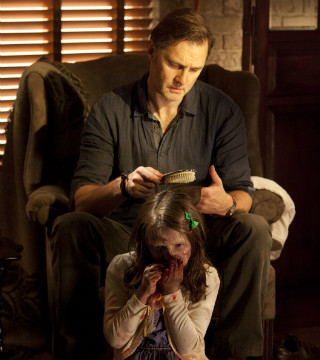
Over in Woodbury, we find the Governor combing the hair of a small Walker, who apparently used to be his daughter. Her name was Penny, and it seems that he is keeping her secured in his office where no one can find her. Meanwhile, Michonne continues to investigate, hoping to find some evidence that the Governor is not who he appears to be. After retrieving her sword and reading some disturbing entries in his diary (which seem to involve the name Penny) she overhears the Governor and his men talking about holding some festivities. His lead researcher seems opposed to the idea, but eventually concedes.

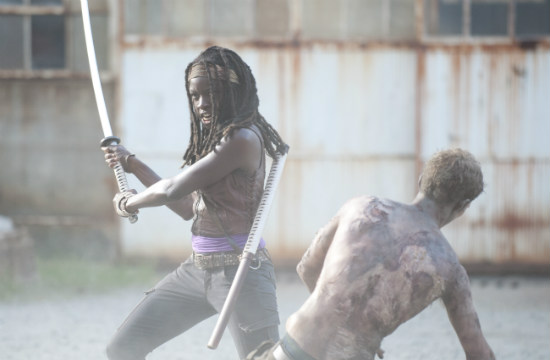
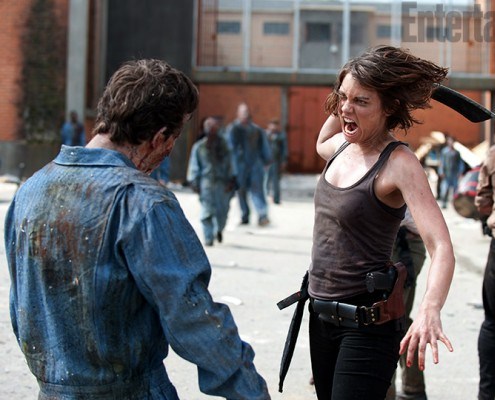
Michonne then finds her way to where some Walkers are being kept in a cage and kills them all. When the Governor’s men catch up to her, he once again extends an offer to join him, but Michonne pointedly refuses (i.e. she points her sword into his chin)! At the mention of the name Penny, the Governor becomes quite concerned, as he thinks Michonne found her in his office, instead of simply reading her name from his diary. She makes one final attempt to convince Andrea to come with her, but fails. To her surprise though, they open the gates and let her go, leaving a saddened Andrea behind.

The Governor tells her to cheer up, as they are going to be having a special event that evening to cap off the celebrations that have been going on for days. However, she is horrified to find that the festivities are a bare knuckle fight between Merle and one of the other sentries, and the fight takes place in a ring surrounded by chained Walkers. The Governor explains its all staged and designed to make the people unafraid of the Walkers, but she is still incensed by it and leaves in a huff.

Glenn digs some graves for the dead, which accounts for one-third of their group. The deaths of Carol, T-Dog, and Lori are felt all around, but Glenn gets some unexpected help from Axel and Oscar who offer to help him dig graves. The baby also appears to be doing well, and Carl suggests naming her after those they’ve lost, eventually settling on his mother’s name. Daryl lays a flower on Carol’s grave, the same one he showed to her when they were looking for Sophie which commemorates the Trail of Tears and all the children that went missing there. And down in his cell, next to Lori’s corps, Rick is surprised to hear (amongst other voices in his head) the phone ringing, and picks it up…

Summary:
This episode excelled for a few reasons. For starters, we finally see the break between Andrea and Michonne occur, the timing of which couldn’t be better (or worse, in Andrea’s case). After finally telling Michonne she thinks her fears are groundless and she intends to stay, she gets a firsthand preview of the Governor’s madness. In time, she’s likely to get more, and her relationship with the Governor is likely to become strained, as Michonne’s was. This in turn is likely to lead to an escape attempt or a rescue attempt by Michonne. Needless to say, it won’t be pretty!

Second, this episode, picking up where the last left off with the prison debacle, showed that no one in the cast is safe. The loss of Carol and T-Dog was not too devastating since neither were main characters, but the death of Lori was nothing if not surprising. Rick is now experiencing a psychotic break, Carl is without a mother, and the group is reeling from the loss of a third of its members. This is in keeping with the spirit, if not the letter, of the graphic novel where no one in the cast is safe!

And I also liked what they did with the gladiator fight. It was an effective way of showing the Governor’s dark side, without being too over the top. Had she found the room full of heads, or simply been thrown into a dank cell full of corpses, that would have been too much. It’s much more entertaining and suspenseful to see the Governor turn bad as a result of an escalating situation between him, Andrea and Michonne. It also fits with his motivation, which is to keep his own safe from any and all threats, as he sees them.

Based on the previews which also came at the tail end, it has been hinted that Michonne will meet up with Maggie and Glenn while they are out searching for supplies, and that Andrea will attempt to flee Woodbury. I’m also looking forward to seeing just what the phone call was about, as it’s not entirely clear if Rick’s being contacted by the other members of the group, or if he’s experiencing a psychotic episode. Could go either way…

Walking Dead, Season 3 Episode 4

Welcome back to the Walking Dead! Today’s review, episode four entitled “Killer Within”, which as you may notice is a double-entendre. After last weeks introduction of the Governor and his walled town, things are once again shifting back towards the main group in the story, focusing on events in the prison and their ongoing struggle to build a safe haven.

Attention is still given the growing mistrust Michonne feels towards the governor, and the conflict between her and Andrea over the issue of trust. But by far, the biggest events took place within the prison complex, and I mean biggest! Some seriously big curveballs were hurled in this episode, which included the birth of Rick and Lori’s child, the death of T-Dog, and the death of Lori herself.

Killer Within:
Things open up on the prison, where we see someone opening the gates and laying bait for the Walkers to come. The identity is left a mystery for the time being, all we know is they are intent on sacrificing everyone within. Shortly thereafter, we see Rick, Glenn, Maggie and Daryl in the yard where they are moving their vehicles and discussing clean-up. They intend to plant crops in the field soon, and don’t want the litters of Walker bodies contaminating the soil.

Hershel comes out to see them on crutches, accompanied by the other members of their group. They are joined by the two prisoners, Axel and Oscar, confront them and ask to be allowed to join them in their side of the prison. They decide to give them supplies and send them on their way, but the send-off is cut short when Walkers show up in the yard and begin attacking them.

A fight ensues, and things are made worse when the prison sirens go off, attracting more Walkers. The group must split up, with Rick, Glenn, and Daryl fighting to clear the yard and get inside to shut off the sirens. Oscar, who used to work in the power room, escorts them to it after Glenn shuts the gate to keep more from coming in. Hershel and Beth manage to get to safety, but T-Dog is bitten while trying to protect Carol and get her inside. Maggie escorts Lori and Carl inside but they find Walkers have infiltrated the prison interior and flee to the basement.

Over in the town, Andrea continues to get to know the Governor while Michonne pursues her suspicion that there’s something “off” about him. Andrea learns that his true name is Philip, and that he had a wife who is now dead. Michonne inspects the army trucks they procured and notices traces of blood and bullet holes and suspects the Governor’s cover story was false.

At the same time, Merle learns of the location of the farmhouse where Andrea was staying, and asks the Governor for permission to go there and begin searching for his brother Daryl. The Governor believes its a wild goose chase, but agrees to go with him if he finds more concrete evidence that his brother could still be alive. Andrea and Michonne are set to leave and Andrea says goodbye, but is told she and Michonne are always welcome back.

Back at the prison, things are going from bad to worse. When they reach the power room, Rick discovers the identity of their betrayer. Turns out it’s Andrew, one of the prisoners who was believed to have died at the hands of the Walkers, is alive. After Rick is knocked down, Oscar grabs his gun and points it at the two of them. He then shoots Andrew and gives the gun back to Rick. Apparently, trust has now been established between their two groups, and the sirens are shut down.

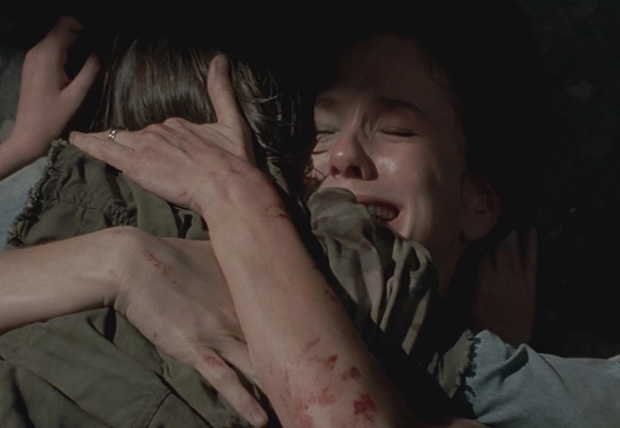
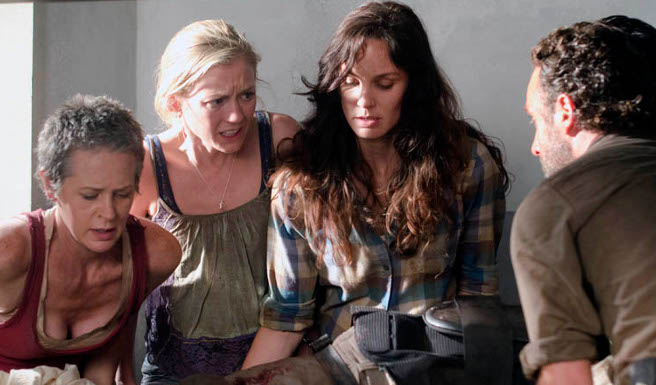
Elsewhere, T-Dog and Carol are rushing through the tunnels and are cut off by a group of Walkers. T-Dog makes his final stand by rushing the group, and dies screaming while Carol makes it back to the yard. In another room, Carol begins to go into labor and experiences serious bleeding. She asks Maggie to perform a C-section and tells Carl she loves him, and does not appear to make it through the process. However, the baby is alive and well, and Carl tells her to leave so he can shoot Lori before she becomes a Walker. A gunshot is heard and he joins Maggie, and the two go back to the yard. There, they meet up with the rest, and Rick is broken when he sees the baby and realizes Lori is dead.

Summary:
Needless to say, this episode was a real nail biter. Granted, it wasn’t too much of a mystery who the saboteur was, though I did suspect it might have been Oscar for a short while. His knowledge of the power room seemed to me to be an indication that he might be the one behind the whole thing. But at the same time, we never really saw Andrew die so… yeah, not a big mystery!

No, the real tension here came in the form of the split which took place inside the prison. Thanks to the arrival of the Walkers, the group was split three ways, with each one facing its own particular crises. For Rick and his group, there was the task of shutting down the sirens and finding out who betrayed them. But Lori, Maggie and Carl, there was the challenge presented by her imminent delivery. For the rest, it was all about staying alive and getting back to the others. Between all of these perspectives, the full range of the show was displayed. You had betrayal and desperation, life in the midst of death, and terrible sacrifice. All of it was poignant and effective.

Also, the slow build-up of tension over in the town thread is something I really approve of. It’s pretty clear at this point that Michonne’s distrust  of the Governor will bear fruit in time, and that the Governor is likely to take her and Andrea prisoner once the cat’s out of the bag. What’s more, they are letting on that Merle’s efforts to find his brother are likely to lead the Governor to the prison. And we all saw what he did with those army men. Clearly, he believes anyone who doesn’t reside within his walls is a threat that must be dealt with. Clearly, these two threads are destined to collide, and sooner other than later.

But above all, the biggest thing in this episode was the deaths of T-Dog and Lori. In the former case, I wasn’t particularly surprised. As a friend of mine recently pointed out (hi Khaalidah!) T-Dog has remained an underdeveloped character in the series. Since we know nothing about his past and he’s got no one he’s particularly attached to in the group, his loss could not be considered a terrible tragedy. Lori, on the other hand is an essential character, the wife and mother of two other main characters.

Personally, I am entertaining the notion that she is not really dead, mainly because her death at this point in the show goes against material from the comics. However, there have been plenty of diversions from that material already, and who’s to say what the writer’s have planned. Perhaps I’m in denial…

Oh yeah, and there is the matter of the title itself, which as I said earlier I believe I to be a double-entrendre. On the one hand, you have Andrew who is busy at work plotting the demise of the group. He is the literal killer within the walls of the prison. However, the other meaning I believe lies within the Governor himself. Whereas he seems like a stable and caring fellow on the outside, the kind of man who projects a positive image to Andrea and the townspeople, we know him to be a cold-blooded murderer and insane man. This side, however, he keeps tucked away from prying eyes. Make sense? Just one man’s interpretation.

More to follow from this series soon enough. Don’t venture too far…

Walking Dead Season 3, Episode 3

My goodness, how I’ve fallen behind with my reviews of the Walking Dead lately! And there’s really no excuse, not with everything that’s been happening in the series lately. With the third episodes in the series, an all-important element has been introduced into the story arc – that being the dubious man known as “The Governor” and his little fortress town.

As anyone familiar with the comic knows, this is an extremely important development to the evolving story. Whereas it represents a separate plot thread in the story, it merges with that of Rick and the others who are trying to make a life inside the prison facility down the road. But I shant spoil any of that, mainly I want to talk about this episode!

Episode 3: Walk With Me
The episode opens with a helicopter crashing in the forest, and with Andrea and Michonne arriving on scene to witness what happened. They are forced to take cover as a series of vehicles pull up and men jump out, dispatching the Walkers who have been attracted to the scene. After killing them all, one man inspects the dead aboard the chopper who have begun to turn and shoots them all in the head.They then take the pilot, who is wounded but alive, into their custody.

Shortly thereafter, the group of armed men begin to inch closer to the forest where Michonne and Andrea are hiding. In order to stay hidden, Michonne kills her captive zombies by slicing their heads off. They think they are in the clear, but the moment they try to leave, a one armed man gets to them from behind and takes them both prisoner. The one armed man is none other than Merle Dixon, the brother of Daryle Dixon who was lost from the group in the first season.

They have a brief reunion as Merle explains to Michonne that he and Andrea are acquainted. Andrea then passes out from her sickness, and wakes up to find that she and Michonne had been taken to a small town nearby. After Merle explains to them how he survived after cutting off his own hand to free himself of Rick’s cuffs, a man referred to as “The Governor” walks in. He explains to them that they are not prisoners and are free to leave.

However, after seeing the town on the following day, Andrea believes they should stay. In addition to its walls, armed guards, and well-disciplined people, the town appears to be well stocked and peaceful. Michonne does not trust the Governor, but Andrea begins to take an obvious shine to him. One day quickly turns into two, and a rift begins to appear between Andrea and Michonne as the one wants to stay and the other wants to leave.

Meanwhile, the Governor speaks to the lone survivor of the chopper crash and learns where his comrades are waiting for them. He then takes an armed group to ambush them and steal their weapons and supplies. Upon his return, he lies to the townspeople and tells them that the chopper pilot died of natural causes and the entire squad of soldiers were killed by Walkers, and begins distributing all their supplies amongst the people.

Andrea then asks the Governor what his real name is, but doesn’t get an answer. Clearly, there is something of a spark between the two of them, and Andrea seems intent on pursuing it. At the same time, Michonne has clearly caught the eye of one of the Governor’s men, and it seems that whether she likes it or not, they will be staying for the time being. While Michonne remains suspicious, Andrea has been taken in by the town’s happy facade and the Governor’s outward charm.

The episode then ends with the Governor in his private apartment, his bed occupied with the town’s woman who was speaking to Andrea and Michonne from earlier. He then returns to a private den with a glass of whiskey where he sits in front of a row of aquariums which contain the heads of several living Walkers. Amongst them is the head of Welles, the helicopter pilot, and the heads of Michonnes own walkers.

Summary:
Personally, I felt that this was the best episode of the show thus far, with the possible exception of the one where the group finds their way to the CDC. In addition to being central to the overall plot of the show, it was also extremely poignant and entertaining. It begins with the reintroduction of Merle, a solid but unsympathetic character from the first season; the introduction of the Governor and his town, and ends with the revelation that he is far from an endearing character himself.

What’s more, Michonne, who has had very little exposure thus far in the series, really killed it in this episode. All throughout, she maintains her tough, frowny exterior, demanding their weapons and insisting to Andrea that they move on. However, she also shows genuine apprehension as its becoming clear that Andrea wants to stay and that there are some who would like her to stick around too. Though it is only conveyed in a few passing glances between her and one of the Governor’s men, it’s apparent that she will find her own reasons for sticking around soon too!

At the same time, the metaphor of the town couldn’t be more clear. At first, it appears like a happy, secure place, the kind of place a person who is used to scrounging and fighting for every inch would see as an instant paradise. But of course, the terrible truth is soon revealed to us, the audience, with the expectation that it will also become clear to Andrea and Michonne before long. As is intimated several times, it seems unlikely that such a place could exist, or that there is another shoe waiting to drop.

And of course, there is! In addition to being a driven by the desire to protect his people from the Walkers, the Governor is also obsessed with eliminating anyone and everyone he sees as a threat to his community and its way of life. And his arrival could not be more timely now that Shane is dead and the series has lost its main blocking character. All throughout the series, the point has been made that in the face of annihilation, mankind’s darker nature is it’s greatest threat to survival. Because in the end, it’s not simply a matter of staying alive but of preserving humanity’s basic dignity and morality.

So far, this paradox of battling death while simultaneously trying to stay sane and decent was personified in the conflict between Shane and Rick. But from this point onward, it will be represented by the contrast between the Governor’s community and Rick’s people. After all, it’s pretty clear point at this point that the Governor will be looking for them now that he knows that Andrea had companions who might still be alive somewhere. And given what he did to the squad of military personnel, he’s not likely to take to their existence too nicely!

Now on to episode four, which is downloading, err, playing right now! I shall return with more on season three just as soon as I’ve watched it!

The Walking Dead, Season 3 Episode 2

Welcome back to The Walking Dead, Season Three! I tell ya, one can wait so long for a show to premier again that by the time it gets going, they find themselves falling behind on their watching and reviewing. Would you believe I didn’t get to watching the latest episode til this morning? Yeah, it’s crazy I know. But I hope this review makes up for that and piques the interest of anyone who has yet to watch it.

Now rumor had it that this episode was the best one yet. That’s a pretty tall order considering that the show has set some pretty high standards thus far for action, suspense, and good old fashion gory kill fests! But I went in with an open mind and tried not to expect too much. Mainly, I just wanted to see what they would choose to reveal and what other cliffhangers we could expect.

Last, I should mention that thanks to a friend (hi, Khaalidah!) I’ve taken it upon myself to learn all I can about the comic books and how this show relates and deviates from them. Thanks to my initial research – still looking to get a comprehensive volume of the first 90 or so issues – I noticed a few things in this episode that were pretty significant as far as the overall storyline goes. But more on that later. Here’s what happened this week on The Walking Dead:

Sick:
The show picks up where the premiere left off, with Hershel bleeding on the floor from an impromptu amputation and Daryl discovering that there are inmates still alive and uninfected inside. After hurrying Hershel back to a cell where they try to stop the bleeding, Daryl, T-Dog and Rick have a strained chat with the inmates. Eventually, they come to an accommodation. In exchange for helping them clear out a new cell block for them to occupy, the inmates agree to share what’s left of the food supply with them.

At first, this doesn’t go so well as it is clear that the inmates are not used to fighting as a single, disciplined force. They make a mess of things as they come upon their first group of Walkers and begin stabbing them in the stomach and rioting on them. However, things improve with subsequent encounters, and slowly the group begins to get the hang of Rick and his group’s tactics. Namely, go for the head, stay together, and don’t let them get around you!

However, the biggest man, ironically named Tiny, disobeys these rules and slips off in the middle of an encounter, causing him to get scratched. The groups begins to debate what to do with him, but that ends when the inmates de facto leader (the only one with a gun) bashes his head in and they move on.

When they reach the cell block, a pitch battle ensues to the take out the last guarding the doors. During this fight, the same prisoner tries to take Rick’s head off, accidentally-on-purpose, and tosses a Walker on him when that doesn’t work. As soon as they kill off the last of them, he pretends it was all an accident. To this, Rick responds, “Yeah, I get it… Shit happens.” And then plunges his machete into the mans’ skull!

Another runs, and ends up getting locked out by Rick, to be eaten shortly thereafter. Of the last two, Rick and the others try to decide what to do with them. The one insists that unlike their companion, he is no killer and just wants to live. The other refuses to plead, and tells Rick to do what he will. Rick decides to spare them, and they enter the new cell block. They find that the former inmates were all shot in the head, execution style.

Meanwhile, Hershel goes from bad to better as Carl manages to slip off and find the infirmary. Coming back with gauze, bandages and peroxide, he even boasts that he killed two walkers. Naturally, his mother is incensed, but he insists he’s just looking out for the group. And the medical supplies help, as Carol gives Hershel’s stump a proper wrapping that will ward off infection. They also cuff him to his bunk, as a precaution…

What follows is on the most touching scenes as Maggie has some time alone with Hershel and tells him its okay for him to let go. Unlike her little sister Beth who hopes her father will recover, Maggie is convinced that they must be prepared for the worst, and tells her unconscious father that she and Beth will carry on as best they can. They have a close call when Hershel stops breathing and becomes suddenly reanimated after Lori gives him CPR, but everyone calms as they realize he’s still alive. He even comes out of his coma shortly thereafter to the relief and delight of everyone.

However, Carol has impending woes as she knows that Lori’s baby is due soon and may have to be removed by C-section. She doesn’t know how to do this, and at the time it seems as though Hershel will not be on hand to do it himself. Hence, she asks Glenn to help her procure a female Walker so she can practice on it. After finding and killing one in the yard, she gets to work on slicing open its stomach. As she does, she is watched from the treeline by someone… or something!

Things come together in the end as Rick and Lori have a private chat. They commend each other for their quick actions and being cool in the crisis. All in all, they agree that it was a good day. However, Rick still can’t talk about all that’s happened between them. The episode ends with him telling her how thankful they all are for saving Hershel’s life, and then leaving her alone.

Summary:
Hm, best episode yet? Not in my humble opinion, but definitely a good one! Personally, I am waiting on next week’s which the previews have indicated is where Michonne and Andrea will meet “The Governor” and be brought to his little town. What’s more, hints are given that Merle Dixon, Daryl’s crazy-ass brother from season one, will be making an appearance. If this episode had some people thinking it was the best yet, I’d tell them to wait on next week’s. Promises to be revelatory!

But of course, this weeks episode still needs a little play by play. For starters, it was damn good because of the way it juxtaposed the group’s fight to save one of his own members alongside the rather ruthless display Rick made with the prisoners. After cutting a deal with them but realizing he couldn’t trust them, he quickly dealt with their ringleader by splitting his head in cold blood! Then he even trapped another one outside where he was eaten by Walkers. As the Joker would say, “See, even to a guy like me, that’s cold!”

What’s more, hints are given that Carl is heading down the dark path as well. After running off to fetch supplies, he had absolutely no patience for his mother telling him that he took an unnecessary risk. In addition, the scene when Hershel is revived and they suspect he might be a Walker ends with Carl holding his pistol whooped out and at the ready. This, along with last weeks episode shows how Carl has progressed from little kid to dedicated killer. And when it comes to his parents, he’s showing some clear signs of identifying with his father at the expense of his mother. You might say he’s picking up on the conflict between them and picking sides.

Also, there was a little revelation that put me in mind of something I read about from the comic books. During this episode, Rick tells the prison inmates that they all have the virus, and that as soon as any of them die, they will be reanimated as Walkers. To my memory, this is the first instance of this being mentioned in the series, though I could be wrong.But if it is, it means they have now tackled an important part of the comic book series, which was the grand revelation that any one of them, including people who die while still human, has a strong chance of coming back as a Walker. Remember Shane? Well, if they choose to follow the comics on this point, Rick will have to travel back to where they buried him, unearth him, and put a bullet between his eyes.

Like I said… cold!

A Feast For Crows!

a_song_of_ice_and_fire_version_2_by_scrollsofaryavart-d4rabm1We come to it at last, the fourth and final book in the Song of Ice and Fire Box Set! Wait, what? There’s a fifth book, and two more on the way? And I just bought the fifth book and promised to review it too??? Son of a bitch! Sigh… Alright, let’s get things moving and review this bastard. Lord knows George RR Martin isn’t done writing books, nor I in reading them, apparently.

Ha! I joke because it’s fun, and true. As I mentioned in a previous post, I had originally planned to quit after book four, but then decided some months back to buy the latest installment in the Song of Ice and Fire series thanks in part to the rave reviews it was getting from friends and critics. But the choice was cinched just the other night when I finally finished Crows and enjoyed how it ended.

To put it simply, A Feast For Crows felt like an afterthought to the series, a depository for the story lines that weren’t particularly important and didn’t make it into the previous volumes in the series. Hence why it took me so long to complete it – coupled with the many other books I started while in the middle of it – it really was a slow read! But upon completing it, I found that there were some rather interesting twists that made the story interesting gain, not to mention worth following!

What’s more, Martin ended the story with the misleading chapter entitled “Meanwhile, Back At the Wall”, which was really a letter to the audience stating that what they had just read was really only half of what he had planned as a fourth installment. At this point in the story, he had so much to say that he felt the only way he could say it all was to either write a massive single-volume or split it in two. And he could either write all the stories half-way, or write half the stories all the way, and leave the others for the next.

And of course, that’s what he did. Whereas the story lines of Cersei, Jaime, Samwell Tarly, Brienne, Arya, Sansa, and a host of other secondary characters get their due in this installment, the equally (if not more important) narratives of Jon Snow, Tyrion, Daenerys, Bran, and others would be reserved for book five. And like I said before, I could see the wisdom and crass commercial value in this! Damn you Martin, making me buy more of your books! Here’s what happens in this book:

Plot Synopsis:
The book opens with the War of Five Kings coming to an end. With most of the major player dead – Robb Stark, Joffrey Baratheon, Tywin Lannister, Renly Baratheon, and Balon Greyjoy – and Stannis defeated at King’s Landing, the war has reached a lull and it seems that House Lannister seems poised to inherit the entire realm. All that remains is for them to seize the last of the Stark’s strongholds (like Riverrun, which is still holding out) and to push the Ironmen back from all the ports they’ve seized.

However, the realm is still beset by intrigue as old scores are being settled and new plots put into action. At the same time, Cersei finds that despite the removal of all her enemies, as well as the death of her eledest son and father, she is unable to wield absolute power, and gradually begins to turn inward and succumb to paranoia and self-destruction. And of course, Sansa is still hiding in the Vale, doing her best to remain hidden and attending to Lord Baelish’s ongoing schemes…

King’s Landing: As is quickly becoming apparent, Cersei is incapable of running the realm on a day to day basis, which is made worse by the fact that her Council, which is staffed by loyalists, is ineffectual. At the same time, there is her growing distrust of the Tyrells and their apparent attempts to position Margaery to inherit the throne. As such. Cersei begins scheming to bring the House down.

At the same time, she has to come to terms with the crowns creditors, which include the Iron Bank of Braavos and the Faith of the Seven. In the former case, she fails and the crowns assets are entirely frozen. In the latter, she agrees to the restoration of the Faith Militant, a military order that is answerable only to the High Septon. However, in so doing, she allows for the accumulation of armed zealots in the capitol, most of whom believe her to be an adulterer. It also means the Faith now has its own army in place and is less compelled to accept her authority.

In her bid to lessen the Tyrell’s influence over the masses, the court and her son, she sends Ser Loras Tyrell to help with the siege of Storm’s End. He is mortally wounded in the assault and may not survive. Cersei then interrogates Grand Maester Pycelle and learns that he has been giving Margaery moon tea, and that she and her cousins have been having elicit sex with multiple suitors.

She turns Margaery and her maids over to the faith and has Ser Osney Kettleback, whom she has been bedding, testify to her falseness. This backfires however when Osney is interrogated by the Septon and reveals how he has been sleeping with Cersei and murdered the previous Septon on her orders. Cersei is jailed in the temple and hopes Jaime will return to fight for her…

The Riverlands: Jaime is sent north to assist in the siege of Riverrun and assist in bringing order to the war torn region. He succeeds in the former endeavor, ending the siege bloodlessly by convincing House Tully to surrender peacefully. The next step in his task is to locate the Brotherhood Without Banners, Lord Beric Dondarion, who is dead at this point, and Stoneheart (Catelyn Stark, who are still active in the Riverlands and hanging Lannisters, Freys everyone who had a hand in betraying House Stark. Afterwards, he gets word that Cersei needs his help, but tosses her letter into the fire.

Brienne is also in the Riverlands now after following the trail of Sansa Stark. Her companions include Ser Podrick Payne (former squire to Jaime) and Ser Hyle, one of Renly’s old knights. In time, they are set upon and captured by the Brotherhood and brought before Stoneheart, where she learns her true identity. Since she is carrying a Lannister sword, Catelyn believes she is in the service of the Lannister’s now, and demands she kill Jaime as a test of faith. Brienne refuses, and is sentenced to hang along with her companions.

Dorne: Picking up where A Storm of Swords left off, there is the growing plot by House Martell to avenge the death of the Elia and make Myrcella the queen of Westeros. They have not been appeased by the death of Ser Gregore Clegane, as they know it was Prince Oberyn who killed him, and that Tywin Lannister was behind the murder. Doran Martell, the ruler of Dorne, must now deal with the plotting of his bastard nieces – known as the Sand Snakes – who want war and to avenge their fathers death. He has them all locked in the tower, but soon finds that the plot is extending to his own daughter, Arianne.

For some time, she has been bedding Ser Arys Oakheart of the Kingsgaurd, and uses him to abduct Myrcella and try and install her as queen. When this fails, she too is placed in the tower and Ser Arys is killed. But before long, her father hauls her before him and tells her of his true plans. He too wants revenge, but has more subtle plans. This involves sending her brother Quentyn to the east to bring back “Fire and Blood” – Daenerys Targaryen – who he believes was prophesied to restore Westeros to its former glory.

Iron Islands: With the death of Balon Greyjoy and the ongoing war against the other Houses of Westeros, there is a question of who will lead the Ironmen. Aeron Damphair, the high priest of the Iron Islands, calls a Kingsmoot, a gathering to determine a successor, which becomes hotly contested by Asha and Victarion, Balon’s daughter and brother. However, Euron Greyjoy – Balon’s oldest brother, known as the exiled “Crow’s Eye”- is chosen as king due to his promise that he can control dragons with a recently acquired horn. He too sends out a party to travel to the east and find Daenerys with the intent of taking her dragons and conquering all of Westeros.

The East: Arya Stark arrives in Braavos and finds her way to the House of Black and White, a temple associated with the assassins known as the Faceless Men (of whom Jaqen H’gar was a member). She begins her training as an initiate and takes on a new identity, a girl who goes by the name of “Cat of the Canals”. However, her former identity continues to assert itself in the form of wolf dreams, and also when she comes across members of the Night’s Watch who are in town. This includes Samwell Tarly, whom she meets without knowing, and when she murders his companion Dareon for abandoning his brothers. The morning after Dareon’s murder, she admits to the Kindly Man that it was “Arya” who committed it, and is given a glass of warm milk as punishment. After drinking, she wakes up blind the following morning.

Meanwhile, Sam, Gilly and Maester Aemon stop on the way to Oldtown, where they hope to uncover the mystery of the one who has been prophesied. Aemon now believes this to be Daenerys as well, and seeks information about the “Lady with Dragons” to the east so he can help restore his niece to the throne. Sam finds a ships of Summer Islanders who claim to have seen the dragons firsthand and agree to take them to Oldtown. Aemon dies in transit, and Gilly and Sam become intimate over their shared sense of grief. When they arrive in Oldtown, Sam sends her to his family’s holdings for her own safety – as the Iron Men have been reeving in the region. He then proceeds to the Citadel, where he is told that Daenerys is the one prophesied to save the realm, and he begins training to go and find her.

Summary:
As I may have said already, this book largely felt like a depository for threads that were not part of the main story. After events in the previous three novels, one would think that the fourth book would have something on the Wall and the growing threat of “The Others.” However, the ongoing story about Arya’s new life in Braavos, the conspiracy in Dorne, Cersei’s own machinations at King’s Landing, and the leadership struggle amongst the Ironmen – all these felt like diversions from the climactic storyline. And after three books, I was beginning to get quite impatient for it. It’s like, C’mon, when are The Others going to attack? When is all this prophecy going to be revealed?

However, by the end, it became abundantly clear where Martin was going with this. At last, we find out that Daenerys is not just a contender for the Iron Throne, but the subject of the very prophecy that was being foretold since the second book, when the Red Comet first appeared. What’s more, by the end, it was abundantly clear that all the threads appearing in this book were closely related. The Iron Islanders, the Nights Watch, and the people of Dorne are all seeking Daenerys, and it’s clear at this point that she will be coming back to Westeros in force, and might even be seen as a force of liberation after all the infighting.

In addition, Cersei’s fate at King’s Landing was a welcome twist. While there are those who see her as a sympathetic character who’s only doing what any man in her position would do, I see that and all the talk of double standards as crap! Crap, crap, crap! She’s a cruel, selfish, and narcissistic woman who only cares about herself and condemns anyone who doesn’t do her bidding. So to see her get hers after all this time made me quite happy. It was also fitting that Jaime, whom she shunned when it became clear he wasn’t sympathizing with her, would spurn her appeals for help.

All of this was just enough to pique my interest in the series again, which was beginning to wane after Robb Stark was killed and it became clear the war was going to drag out and end in the Lannister’s favor. Not only that, but the War in the North, the prophecy involving the coming darkness (i.e. the Others) and Daenery’s own campaign to return in force; all of these seemed to be dragging inexorably on. As I said before, it seemed like the original story, with its three dominant threads, could have been wrapped up nicely in three books. And with book four beginning with all these secondary threads that seemed unrelated to the main plot, I was really beginning to tire.

However, Martin managed to wrap things up nicely. And coupled with all the nice reviews I’ve been hearing about book five, I will continue to read and report on what comes of things. I really, really hope for the sake of the series and his readers that things proceed towards a climax now. Because of this ends up being a “Wheel of Time” scenario after all, where the story just keeps going and going, I will be sorely disappointed and forced to give up. Here I go with A Dance of Dragons, wish me luck!

The Walking Dead, Season Three Premiers!

It’s here at last!This past Sunday, after taking a very long break, the AMC’s Walking Dead finally premiered their third season.I tell ya, I was waiting so long that I almost forogt all about it. And it’s been weeks since there have been any helpful previews to remind me!

But alas, last night I remembered that the 14th was the big day, er, evening, in which the show would be airing. And, since I lack cable TV, I knew I would have to be employing extra-legal means to see it. So, taking to my computer, I found a torrent, uploaded it, and watched it with baited breath! Well, not exactly baited, but definitely lots of anticipation. I mean, it’s not like it was the new season of Game of Thrones, am I right? 😉

But before I tell you about this episode (Spoilers to follow), there’s the matter of how the last season ended. As we all know, all what was left unresolved thanks to the showdown between Shane and Rick, the split up of the original group, the loss of the farm, and Andrea’s rescu eby a mysterious hooded stranger. What was going to come of all this? Who would make it in this next season, and who would die?

Episode One – The Seed:
The party breaks in to a home occupied by Walkers and begins killing them, clearing the way for the rest to come in and settle down. Afterward, they begin to search for food, but find only an owl (which Daryl shoots with his crossbow) and some cans of dog food. However, more Walkers begins descending on the house, and they are forced to throw their bags into the small fleet of vehicles they have and flee.

From this opening scene alone, a few things become clear. For one, it has been several months since the shootout at the barn took place as evidence by Lori’s pregnancy bump. Second, Hershel, Maggie and Beth have joined the party, clearly believing that they would be safer on the road than on their farm. Third, Shane, Andrea and Dale are gone, either dead or having split off and gone their own way.

After leaving the house, the group confers and agrees that they can’t keep moving as they have been. Pursued by different groups of Walkers, their ultimate goal is to find a place to set down until Lori can deliver her baby. At last, they find a place that seems secure – a prison! However, there is still the matter of clearing it of all the Walkers that are currently inside. After making their way through the fence, the group deploys with the discipline of an army unit and takes out over twenty of them. Apparently, they are getting pretty good at killing zombies!

After making camp and having a meal, Rick tells them that they need to push and take the rest of the prison. He thinks that it fell early on, and that it must have supplies, food, medicine, and an armory. However, since they are low on ammo, they will need to go in in and fight it out hand to hand. This they begin to do,but quickly realize the interior of the prison is not as secure as hoped.

Luckily, a cell block which they come upon does appear to be impenetrable and they decide to spend the night there. And just to be on the safe side, Rick finds the keys to the cells and every locks themselves in for the night. Ironically, the prison’s purpose is reversed now, locking people in instead of trying to keep them from getting out.

In between all this, we cut to a small town, where we meet Michonne for the first time and watch her ass-kicking skills at work! This consists of her decapitating zombies with her samurai sword, and without the slightest bit of trouble I might add! After making the rounds, she returns to a “Deer Cooler” (a meat locker) where we find Andrea, who appears to be sick and in her care.

They decide to set out again, as Andrea doesn’t think she’ll survive if they stay. Packing up her two captive Walkers, the two set out… Yes, apparently Michonne is n the habit of keeping two Walkers with her in chains while traveling. Neither have jaws, which is clearly a defensive measure to make sure they can’t bite her. And I’m guessing having them around keeps other Walkers off their backs. Clever!

Lastly, we cut back to Rick and his usual party of hunters are exploring the basement of the prison. Unfortunately, this area is filled with Walkers, the party gets broken up as they begin running from two separate parties. In the process, Hershel is bitten on the leg and they are forced to scramble to the nearest secure room. Once there, Rick amputates Hershel’s leg with an axe to prevent the spread of the infection. Hershel is still in danger of bleeding out on the floor, and Daryl turns around to see several uninfected prisoners hiding in the next room…

Summary:
What can I say about this opening episode except WOW! Some seriously and truly badass stuff happened here, not to mention plenty of more cliffhanger notes. For starters,the opening scene was very effective and quite intelligently done. Not a word of dialogue passes between anyone in those first few minutes, and yet, we are made to everything of importance. The group has changed, they’ve become more seasoned and experienced, but everyone has the same look of fatigue and wear on their faces. The moment when Carl opens a can of dog food and Rick throws it in the fire place, that too was classic. It’s like he’s saying,”we may be hungry but we’re not animals!” And it was done without a single word.

Then there are the scenes where they fight their way onto the prison grounds, then into the prison proper were both very cool! In the first, special attention is given to the fact that the company has become a highly disciplined and able force, which is demonstrated in how hey manage to quickly envelop the zombies and pick them off from all sides. The moment at the end where Rick shoots the last of them and then laughs to himself is especially good here. It’s like a moment of pride where he’s realizing how effective they’ve become at the whole business of staying alive and killing zombies!

Then comes the fight next day where they begin clearing out the prison grounds using only handheld weapons. Each and every one of them is particularly badass here, stabbing and slicing their way in. But the best part is when the former guards, decked out in full riot gear come to fight them and they have to get creative. After all, you can’t simply smash in their skulls when they are protected by a helmet, and Daryl’s arrows prove useless against the helmets face shields. Here, T-Dog grabs a riot shield and begins bashing into some, while Maggie realizes that the best way to kill them is to stab under the helmets, and then feels very proud of herself when she kills one this way.

And of course, the irony of the prison. What better demonstration is there of how in an apocalyptic world, everything is turned upside down? In this kind of environment, a facility that was once built to incarcerate men is now turned into a fortress, with the express purpose of protecting those withing from those without. And the ending, where they must both cut off Hershel’s leg and find prisoners who are still alive? Whoa, you talk about a climax! A sure fire guarantee that people will be tuning in next week! I know I will…

However, there were also some kinder, gentler elements that were also well suited to the story. In this episode, Lori is desperate to talk to Rick about everything they’ve gone, specifically the triangle that existed between her, Shane and Rick. The matter of the baby’s true father is intrinsic to this, and while Lori wants to talk it out, Rick sure as hell doesn’t! She lets on towards the end that she thinks that Rick hates her, and intimates that Rick killed Shane, which is something she blames herself for. Her words “I put that knife in his hands” silences any doubt as to the whereabouts of Shane, and whether or not she or being literal or metaphorical remains to be seen.

Also, there is the issue of budding and developing romance that is factored in here. In the last season, Maggie and Glen began to have a relationship, and its clear from this episode that it is still happening. At the same time, Carol is beginning to make some overtures towards Daryl, who as we may recall was a great comfort to her last season while they were still looking for her daughter Sophia. However, Daryl seems a bit unenthused and is keeping her at a distance for the time being.

At the same time, little Carl also seems to be taking an interest in Beth, much to the chagrin of her father Hershel. Between these two seasos, he’s obviously grown considerably and is trying to emulate his father, wearing his old hat, shooting a gun, and trying to be a protector. It’s cute, it’s endearing, and in a way all of these relationships are indicative of something very important in the story. In the midst of all that death, people want to cling to life and take what joy they still can. But naturally, there’s a great deal of misgiving and hesitancy since there’s a chance it will end in pain.

Michonne was also very cool, and for what’s it worth, it’s good that they introduced here. Obviously they haven’t developed the thread involving her and Andrea very much in this episode, but we can assume their will be more to  come on that front later. At this point, we can only assume of what happened to separate her from the rest. But if I were a betting man, I’d say Shane killed Dale to protect his secret, Rick killed Shane out of necessity (he did kinda go batshit crazy there!), and Andrea took off because her and Shane had a thing. Somewhere along the way, she got sick and fell in with Michonne, who pulled her out of harm’s way.

The only complaint I might make, more of an observation really, was that as usual, they did up the disgusting factor! The worst part, for me, was when Rick ripped the helmet off one of the prison guard Walkers and his entire face came with it! Oh, and did I mention the skull kept screaming at him? And then Rick cut his head in half with the machete. I know it’s all animatrons and models, but holy shit yuck!

Looking forward to episode two and more revelations, not to mention zombie smashing!

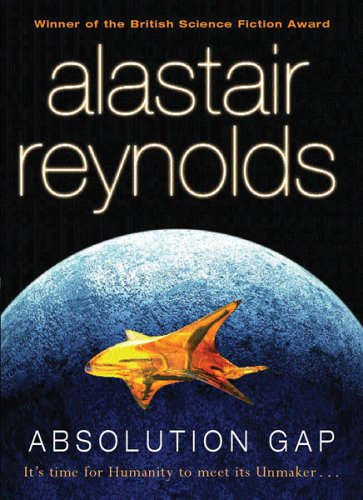
Absolution Gap

Good afternoon all – or morning or evening, as the case may be – and welcome to the final installment in my Revelation Space review. Today, I shall be covering the third and final installment in the trilogy, otherwise known as Absolution Gap. As the conclusion to the series, it brought together the apocalyptic trends established by the first two and wrapped them up pretty nicely, while also introducing some ideas and threads of its own.

These included the threat of the Inhibitors, the attempts by Neville Clavain and his rogue group of Conjoiners, Hyperpigs and refugees to stop them, and the growing awareness of those within the universe at large of their approaching doom. And, true to form, Reynold’s also tells the story through multiple threads which seem unrelated at the beginning, but ultimately come together to reveal a single plot arc that brings everyone and everything together.

And last, but not least, this book also brought the series full circle in terms of the quasi-religious motifs that play an important role in the story. As I mentioned in a previous post, concerning sci-fi and religion, Alastair Reynolds was not one to shy away from the subject of spirituality and religion. One look at the titles in this series (Revelation Space, Redemption Ark, Absolution Gap) are proof enough of that. However, Reynolds went a step beyond, weaving a narrative which begins with knowledge, proceeds to contrition, and then culminates in a sort of forgiveness for all humanity. In the end, the acts of the few who would risk all to save others provides the whole with a sort of reprieve, a second chance for them to contemplate their ambiguous future.

I also should mention that, much like in Redemption Ark, Reynolds chose to include characters and/or elements from his short stories and prequels into this book. In Redemption‘s case, this involved bringing Sky Haussmann back in the form of H, the man who helped Clavain and his friends find their way to Resurgam in time to witness the Inhibitors at work and help save the population. Here, we see hints of how the Revelation Space universe will end, which comes to us from the short story “Galactic North” which is to be found in the collection of the same name. But more on that later! In the meantime, let’s get into this book from the beginning…

Plot Synopsis:
The story opens in 2615, with aboard a lighthugger known as the Gnostic Ascension, a freelance treasure-hunter which is run by a sado-masochist named Jasmina. After waking her crewman Quaiche from reefersleep, she informs him that his attempts to lead them to valuable artifacts have failed for the last time. In order to ensure his success during their next stop, a planet in orbit of 107 Piscium, she places his lover Morwenna (an Ultra and fellow crewmember) in a scrimshaw suit on the outside of his exploratory ship until he returns with some goods.

While surveying a moon in orbit of the gas giant Haldora, he discovers what appears to be an alien bridge in a chasm, but is then attacked by automated defense systems. He then crashes on the planet and sends out a distress signal, knowing that since his ship is on the other side of Haldora, it will not be notified in time to save him. He begins to succumb to an indoctrination virus which he has been carrying for some time, and then notices a miracle has occurred. His shuttle has arrived in time to save him, tough the acceleration has killed Morwenna. During recovery, he realizes it was because Haldora disappeared for a fraction of a second, allowing his radio signal to reach his ship directly…

In the second thread, events take place on Ararat in 2675, twenty three since the crew of the Nostalgia for Infinity landed on the planet. After receiving a capsule from space, Scorpio seeks out Clavain, who has withdrawn from society and left him in charge. This was apparently due to the death of his daughter Felka, who wandered into the sea to contact the Pattern Jugglers and never returned. They discover that the capsule is from Ana Khouri, whom they have not seen since events around Resurgam took place.

Ana informs them that they are fighting the Inhibitors using advanced tech that they have retrieved with the help of Ana’s daughter, Aura. Having come into contact with the Hades Matrix, the alien moon which was an actual data storage device, she now has visions and is able to convey alien technology to their forces which they have begun to incorporate. Unfortunately, Skade has returned from where they had left her last time and kidnapped Auna from Ana’s womb, and is now holding her hostage. After being attacked by Inhibitors, her ship crashed on Ararat.

Making their way to the ship, Skade demands that they kill Clavain in exchange for Auna. Clavain agrees and asks Scorpio to do it for him, since he trusts him as a comrade as arms. He also asks that his body be thrown into the ocean so it might join with Felka and Galiana, his daughter and wife. After killing Clavain and rescuing Auna, the ship is attacked by Inhibitors, but they are saved by the Conjoiner Remontoire who defends them from orbit.

Back at the colony, the leaders decide that its time to load up the Nostalgia and leave the planet and confer with Captain Brannigan (now part of his ship) who reveals that he has been preparing to do so for some time. Apparently, he has been aware of what’s been going on in space, the mounting fight between Inhibitors and their allies, and knew the day would come when he had to lift them off Ararat. Bringing what colonists they can with them, they break for orbit and are met by Remontoire who helps outfit them with their new weapons.

After debating their ultimate destination, they decide to go to Yellowstone to help evacuate the people there before the Inhibitors lay it to waste. Aura tells them to go to a moon called Hela, though they don’t understand why and choose to ignore her advice. When they arrive at Yellowstone, they find the planet overrun and few, if any, ship attempting to depart the system are uninfested by Inhibitor machinery. As a result, Scorpio’s leadership is challenged and a new council is formed, which elects to go to Hela as Aura suggested.

In the third and final thread, the place is Hela and the year is 2727. On this world, a young 17 year old named Rahsmika Els runs away from home to find her long lost brother Harbin, who joined the “Cathedrals” long ago. This is basically a mobile city made up of religious institutions that travel the planet, keeping its eyes on the sky so they may witness what their leader – Quaiche – witnessed many years ago. The disappearance of Haldora, which is the basis of their faith, is something they are waiting on, and all initiates are injected with Quaichist blood to receive the same virus that converted him.

When Quaiche becomes aware of her, he becomes very interested. Els apparently has the ability to discern lies from truth. What’s more, her principle interest lies in xenoarchaelogy, and her theories on the extinct insectoids which were indigenous to the planet (the Scuttlers) are quite fascinating. Apparently, this race was also wiped out by the Inhibitors, and their whereabouts are another subject of fascination for the cult that has grown up around Quaiche. Because of all this, he lures her to his Cathedral and takes her on as an apprentice, never revealing that her brother is in fact dead.

Meanwhile, Els becomes plagued by nightmares about a race known as the “Shadows”, a people that live in a brane (dimension or universe) parallel to our own. In the course of speaking to them through her dreams, she learns that their universe was consumed by a rogue terraforming agent and they are trying to pass through into our own. Eons back, they had showed the Scuttlers how to build a machine that could bring them across, which was apparently hidden inside Haldora. Hence, the gas giant is not a natural planet, but a giant cloaking field which sometimes malfunctions. Hence its disappearance from time to time.

Shortly thereafter, the Nostalgia shows up and begins entering into negotiations with Quaiche to protect the planet. While this is happening, he attempts to seize the ship, but Scorpio and his people defeat them. He then takes Khouri and Els hostage, who we now learn is actually Aura (now 17 years old). Her identity was a cover to infiltrate the planet and learn all she could about their society, and her gifts the result of her enhanced mind. Quaiche then reveals that he wants the Nostalgia to anchor itself to Hela and stop it from rotating, so that he may watch Haldora permanently. Brannigan agrees and lands the ship, but also deploys a Cache Weapon which fires on Haldora, destroying its cloaking field and revealing the machine within.

A fight ensues, in which Quaiche is killed and Nostalgia/Brannigan is destroyed. Aura and Khouri are rescued and reunited with the crew. However, the question remains of what to do about the Shadows. When a digital envoy enters into a scrimshaw suit and begins to speak to them, it claims the offer to destroy the Inhibitors is still open. However, Scorpio claims that their is a better way. He claims that materials found on Ararat match ones found on Hela, which they originally took to be massive seashell deposits, but which turned out to be advanced building materials.

He now knows that these were left behind by a race known as the Nestbuilders, an ancient species which move unseen throughout our galaxy to elude the Inhibitors. He suggests appealing to them for help against the Inhibitors, rather than trusting in these Shadows. He advised Remontoire to tell Aura and Khouri of this, and they escape the Cathedrals before it is destroyed. Scorpio, injured and having gone through cryogenics too many times, dies out on the planet surface…

In the epilogue, the year is 3125 and the place is a Pattern Juggler planet. This brings the story full circle, back to the beginning where this same woman was standing on the world right before it was to be evacuated. She reflect on everything that has happened and realizes Scorpio was right. After finding the Nestbuilders, which had been hiding between stars, they used their weaponry and eventually pushed the Inhibitor menace back. The war is still not over, but victory seems assured. However, in doing so, they created a greater problem: the so called “Greenfly” machines. These are a self-replicating race of terraformers that programmed to destroy every object in a solar system and reorganize them into trillions of vegetation-filled habitats.

Apparently, the Inhibitors had kept them in check, but without the Inhibitors, the Greenfly are now out of control. This is very similar to what the Shadows described as having destroyed their own universe, which leads Aura to conclude that they were not from a parallel brane, but from the future. As such, humanity is evacuating towards the Pleiades, but before they leave, Aura decides that she will swim with the Pattern Jugglers one last time. In so doing, she hopes to warn and warn the people they have assimilated about what is coming, and enters the water just as the story ends…

Summary:
I should start this last section by stating that this was my least favorite book of the three. This does not mean I didn’t enjoy it, but as usual, there were the elements I had come to know and expect from Reynolds which detracted from the overall story. These include his use of convoluted plots, multiple twists, and some rather weird and out there concepts.

For starters, Clavain and Skade are both killed off pretty quickly in the beginning in a way that suggests that they were simply being done away with. In reality, Skade’s involvement in the story pretty much ended in book II when her ship blew up. Bringing her back and having her take Clavain with her just seemed like a way to write Clavain out, which I really didn’t see the need for (aside from making him a Jesus-like figure). Also, the concept of Ana’s daughter, which is the source of their ideas for fighting the Inhibitors, also seemed a bit weird. I mean a psychic, talking baby?

The Hades Matrix being a source of valuable information I could see, but why not just have it that they went back there to get as much information as they could in the intervening 23 years? And if they were going for a messiah-type figure in her daughter, why not let her grow up before she becomes this impressive psychic figure. It would go a long way to furthering the Judea-Christian elements that are prevalent in the story.

Which brings me to the next issue, that of the many plot twists. For starters, why was it necessary to blank out Aura’s mind so she could pretend to be a 17 year old native to Hela? Why not just send her in as is, posing as a religious convert who had come from off world? All kinds of people came to Hela everyday for this exact reason, so why not simply slip her in with them? Or, why didn’t they simply contact Quaiche directly when they got there instead of going through all this cloak and dagger? Things really didn’t materialize until they did anyway, so why go through all that? Granted, it tied the threads together quite succinctly, but by the time it is revealed, I began to feel that the story was trying to do too much.

And finally, there is the matter of the twist ending. At the time of reading, I felt like it came out of nowhere. Who were these Nestbuilders? Why hadn’t we heard of them until now? And why the last minute introduction of them? Naturally, I would later learn that the Nestbuilders did not so much come out of nowhere, but were instead an adaptation of something from an earlier work. Essentially, they are a species who make an appearance in “Galactic North” and who are related to the “Slugs” from Chasm City – i.e. the species that had taken to hiding between star systems to avoid the Inhibitors. This made sense and wrapped things up nicely by tying it back to his previous work. But much like with the character of H in the Redemption, I felt that things had not been explained fully.

What’s more, this does not explain how Scorpio was able to discern their existence and learn all he needed to know – like the fact that they could trust them or they would be able to help them beat the Inhibitors – from one tiny shard of shell they left behind. Perhaps if he revealed that Felka told them as much after meeting with the Pattern Jugglers one last time, or that Galiana had conveyed some hints in one of her visions before dying. But as I recall, no explanations were made and we’re simply handed this solution shortly before the book ends. Again, not well explained, and kind of comes off as a third act twist that feels contrived.

And now for the things I liked! As usual, Reynold’s characteristic knack for combining cool technology, hard science, a gritty take on the universe, and some interesting conceptualizations of alien civilizations proved very interesting. On top of all that, there was a rather intriguing commentary on organized religion and apocalypticism which ran through the entire story, which achieved a truly artistic climax in the way he envisioned the “Cathedrals”. I am forced to wonder if he adapted that from somewhere, or it was a Reynold’s original. Either way, very cool!

And in hindsight, I actually appreciate the way he managed to weave elements from Chasm City and Galactic North into this story. The way it ended on a note of uncertainty, due to the fact that their universe was beginning to resemble the very one the Shadows had told them about, really brought the story home and gave the impression of a tightly knit universe. Lastly, the way Reynolds took this opportunity (again) to get into some hard scientific concepts, most notably membrane theory (aka. M-theory), was quite welcome. Much like how he incorporating Galactic Collisions in volume two, it was not only educational but enjoyable to see real scientific theories being adapted into fiction.

All in all, I consider the Revelation Space trilogy to be one of the most influential and poignant series I have ever read. While it might not rank up there with Dune or LOTR, it remains a source of inspiration and ideas for me. Hell, Reynolds practically taught me all I know about nanotechnology, not to mention time dilation and relativistic space travel. Without his hard scientific  influence, I would still be believing in a universe where FTL had to happen in order for good sci-fi to occur!

Note: Alas, I have yet to read the Prefect, the fifth and final novel in the Revelation Space universe. And in point of fact, several short stories make up the universe as well, some of which I believe I have yet to read. So really, I cannot say in all honesty that I’ve read the entire series or have commented on it fully. However, the novels of Revelation Space, Redemption Ark, and Absolution Gap are the only ones in the series that have a common plot and characters, hence why I refer to them as a “trilogy” and treat them as a contained set. And in that respect, I have finished with the Revelation Space Universe and my review thereof. Anything else at this point would just be gravy… 😉

Total Recall: The Original

Wow, it seems that I have Mars on the brain today! How else am I to explain the constant deluge of Mars-related news and my insistence on publishing Mars-related posts? Not to mention the fact that a few nights back, my wife and I finally sat down and watched Total Recall together. the original, not the remake. And interestingly enough, the whole reason we watched it, aside from my insistence that it was a classic, was the fact that she expressed some desire to see the new one.

As for myself, I had little interest paying theater prices to  see the remake. But I figure I’ll have to catch on DVD (or download) sooner or later, if only so that I can provide a comparative review. My compromise with on this with el wifey was that she watch the original first, just so she’d know what she was missing when we finally did get around to seeing it 😉

Word around the camp fire is that the remake has made its share of money (it’s purpose from the get-go) but that the critical response has been pretty iffy. In fact, it received a 29% “rotten” rating on Rotten Tomatoes.com and was generally panned for lacking all the elements that made the original a hit. Of my friends and fellow armchair critics, the consensus seemed to be that it boasted cool action sequences, but lacked originality and depth.

So to be fair, and in preparation for my eventual exposure to the remake, I thought I’d give the original movie an official review. I mean, you have to know what makes an original movie awesome before you say that a remake fails to deliver right? Of course you do! And I apologize in advance for all the terrible puns, but this is an Anry movie dammit! They are to be expected. Okay, here goes. Cue the Arny noises:

“HLALALALALAL!”

Total Recall (1990):
Loosely based on Philip K. Dick’s short story “We Can Remember It For You Wholesale”, the story deals with the subject of false memories, identity, and free will. Although Dick’s original story did not take place on Mars, much of the plot had to do with Mars, Martians, and the fact that the main character was a hero who was in possession of secrets even he didn’t… (ahem) recall. In the end, the movie adaptation was faithful to the spirit of the story, if not the letter, and managed to expand on it greatly.

The film was a box office success, grossing over 250 million dollars and receiving largely positive reviews. In addition to its classic sci-fi themes and motifs, it boasted some very cool and cunning set designs, special effects, and action sequences. Plus, it possessed that rare and awesome Anry quality, where everything had a certain comical, cheesy element to it, even the somewhat gratuitous violence.  but of course, much of this was due to the directorial style of Paul Verhoeven, director of such gory over-the-top cinematic splatter fests as Robocop, Starship Troopers, and Showgirls!

Plot Synopsis:
The story opens on the apartment of a blue collar worker named Douglas Quaid (Arny) who is unhappy with his workaday life. At night, he dreams of being on Mars with a strange woman he doesn’t recognize, and interprets this as a latent desire to move there and become something more than he is.He asks his wife about moving to Mars, which she promptly shoots down given the violence between a mutant resistance faction and the Mars government, which is led by a man named Cohaagen (Ronny Cox).

Eventually, his desire to experience a trip to Mars leads him to seek out a company called Rekal, an organization that specializes in false memories. After hearing the sales pitch, he decides he wants to live out a fantasy where he is a secret agent who is sent to Mars, a scenario which resonates with him for some reason. Unfortunately, things go awry when Quaid begins his “implant procedure”, as it seems that he begins acting out his fantasy even before its been implanted in his mind. Naturally, the company is frightened and decides to dump Quaid in a cab and erase all traces of his visit from their computers.

When he returns home, a work friend finds him and asks about his visit, which he does not (ugh!) recall. The conversation then turns ugly as thugs grab him and his friend pulls a gun, telling him he must die because he “blabbed about Mars”. Quaid has no idea what he’s talking about, but quickly kills him and all the thugs with ease. Running back to his apartment, he tells his wife Lori (Sharon Stone) about what happened, insisting that it’s not a delusion. After washing the blood from his hands, he is shocked to find that another gunman is trying to kill him. This time it’s his wife!

After disarming Lori, he learns the truth. His name is not Douglas Quaid, and he and Lori were never married. His true identity was erased for reasons she does not know and she was to keep an eye on him, posing as his wife. When he realizes she is stalling and men are on the way to get him, he knocks her out and runs. He is pursued by an agent named Richter (Michael Ironside) who is apparently Lori’s boyfriend and works for Cohaagan. He is determined to kill Quaid, something which Cohaagan doesn’t want. He reveals that he is the one who erased Quaid’s memory and dumped him on Earth, and asks that he be returned to him alive.

After escaping, Quaid ends up in a dingy hotel and is contact by a man claiming to be his contact from Mars. He warns him that he has a trace bug in his skull, and tells him how he can muffle the signal. He then leaves Quaid a case with various items, such as money, ID cards, a device for removing the bug in his nose, and holographic device which projects a mirror image of himself. On top of all that, there is a laptop-like device that contains a recording which he made for himself, which begins to explain the situation…

Turns out his real name is Hauser, and that he was working for Cohaagen up until a few months ago. Then, he defected and joined the resistance, a move which prompted Cohaagen to erase his mind and dump him on Earth. The recording tells him to go to Mars and find the resistance, and that his mind contains enough info to ruin Cohaagen forever. Quaid escapes mere seconds before Richter and his men show up, and does as the recording tells him and gets his ass to Mars!

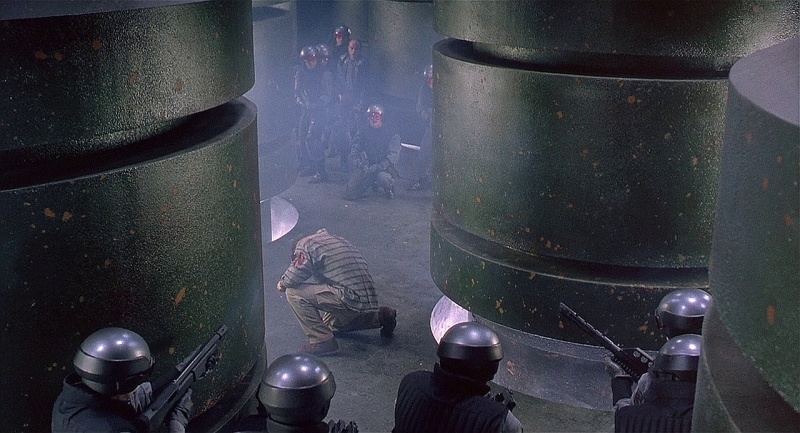
Once there, he has a bit trouble getting through security, as the disguise he brought begins to malfunction. Richter is in the vicinity and realizes it is Quaid, and a firefight begins. Quaid narrowly escapes thanks to a stray shot which shatters the dome, causing decompression. When the emergency doors begins to close, he manages to slide underneath one and make it away.

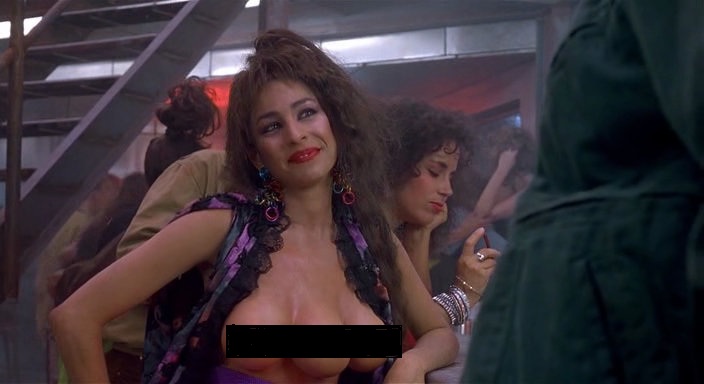
He then travels to the Hilton Hauser told him to seek out, where he finds a message in a safety deposit box written in his own hand. It tells him to go to a club called “The Last Resort” in the red light district (“Venusville”) and ask for a woman named Melina. A newfound friend named Benny, a cab driver with “five kids to feed”, picks him up in the midst of a resistance attack and explains that this is commonplace. Once in the “Last Resort”, which appears to be a front for the resistance, Quaid meets Melina; who as it turns out, is the woman from his dreams. They have a brief reunion, in which she slaps him and tells him they thought Cohaagen killed him. He replies that he doesn’t remember who he is, to which she replies that he was only ever using her to “get inside” and kicks him out.

Back at his hotel, Quaid receives some strange visitors: Rekall’s President, Dr. Edgemar, and his wife, Lori. He explains to Quaid that he is dreaming his experiences and never left Rekal, which makes some sense since everything that has happened to him is what he specified in his travel package. He offers him a way out by presenting a pill, which he claims is a symbol that will allow him to wake up from his self-sustaining dream. Quaid is about to comply, but notices that Edgemar is sweating and shoots him. Lori then attacks him with the help of some more thugs, and Quaid is beaten to near-unconsciousness.

However, Melina shows up to rescue him, and the two kill the thugs, shoot Lori, and then make a getaway. Once again, Richter shows up and is unable to capture them before they slip away. They run to the Last Resort and escape through a series of underground tunnels which lead to the resistance headquarters. Meanwhile, Richter and his men attack the club, but are told to pull back by Cohaagen. He then shuts down the ventilation shafts, slowly depriving Venusville and the mutant population of air.

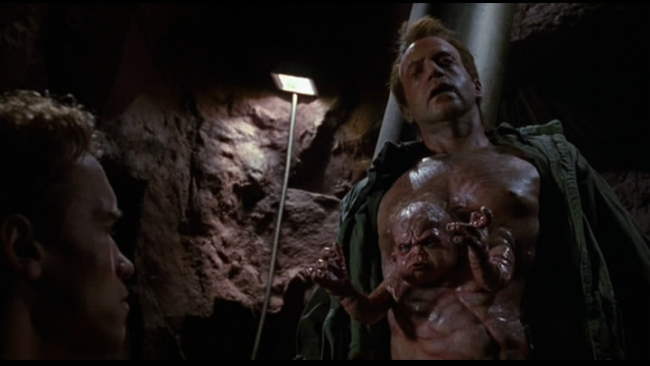
In the resistance HQ, Quaid is taken before Kuato, leader of the resistance, who apparently lives within the stomach of one of his lieutenants. He helps Quaid to remember what he saw that made Cohaagen erase him memory, which turns out to be an underground reactor built by aliens millions of years before. He wakes up to discover that Cohaagen’s forces have found them and are coming through the walls. They escape into a airlock, but Benny betrays them and shoots Kuato’s host dead. With his final words, Kuato tells Quaid to start the reactor.

Captured, Quaid and Melina are brought to Cohaagen’s facility where he tells them the last of the story. It turns out Hauser was not a double agent at all, but a loyal member of Cohaagen’s inner circle who volunteered for the memory implant procedure so he could get close to Kuato and lead their forces to his lair. They knew that Hauser would not be able to fool Kuato unless he sincerely believed himself to be a double-agent, hence the implanted memories and feigned cover up. Quaid does not believe it, until Cohaagen shows him another recording where Hauser tells him himself that he’s been played.

Cohaagen orders them both placed in memory-implant chairs where Hauser will be restored and Melina will be turned into a willing supplicant of his. He then leaves with Richter, and Quaid manages to break his bonds and kill the scientists before the procedure can take effect. He pulls Melina out, who also appears unaffected, and they begin to fight their way to the reactor. Benny tries to take them out using a drilling machine, but Quaid manages to disable the machine and kill him with a drill!

Once they reach the reactor assembly, Richter attempts to stop them with a small army. But relying on the holographic device and some kick-ass shooting, Quaid and Melina manage to take them out. Richter tries to escape using the underground lift, but Quaid jumps aboard the and the two fight it out. Quaid manages to overpower Richter and tosses him over the edge. Richter grabs hold of Quaids arms and threatens to take him with him, but he loses his arms when they are crushed against the shaft, and he falls to his death.

Quaid reaches the reactor room where Cohaagen tries to stop him, telling him that the reactor will detonate the planet’s precious minerals. However, Quaid doesn’t believe him, and Melina arrives shortly thereafter to shoot Cohaagen. However, Cohaagen indicates that he has planeted a bomb on the device, which Quaid narrowly manages to toss down a shaft before it goes off. Once it explodes, it breaches the room’s seals, causing decompression and sucking Cohaagen out onto the surface where he dies of asphyxiation. Quaid manages to activate it mere seconds before he and Melina are sucked out as well and begin to suffocate.

The reactor fires up and begins to plunge a series of red hot rods into Mars’ core. This causes the ice core at the heart of the planet to melt and explode in plumes of air to the surface. This air leads to the creation of an atmosphere and a blue sky within seconds, saving Melina and Quaid from asphyxiation and destroying all pressure domes on the surface. The Red Planet has now become a habitable world, which is apparently what the Martian aliens had intended all along.

Quaid and Melina walk up to the nearest hilltop and look out at the sky. Quaid wonders aloud if he is in fact dreaming, to which Melina replies that he had better kiss her before he wakes up. The movie ends with the sunshine becoming a blinding flash of light, leaving viewers to wonder if it was all a dream, or actually happened.

Summary:
To cut straight to the chase, I really liked this movie. I saw it back when I was a surly teen, and appreciated it for what it offered – action, guns, and plenty of creative nudity! Remember that scene in the Last Resort with the three-breasted hooker? Scarcely a boy who grew up in the 80’s doesn’t know about her! But as I got older, I came to see the plot as something rather creative and complicated, which inevitably drew me back to the story again and again over the years.

Of course, the number of twists and explanations might seem a bit contrived, and even I thought so for awhile. But that was before I saw it again recently and actually thought them through. Basically, Hauser was himself when he found the resistance and posed as a defector. But Melina didn’t let him in, thinking his intentions weren’t pure. It was Cohaagen’s attempt to remedy this by staging his capture, circulating rumors of his torture and death, and then planting false memories and dumping him on Earth and setting him up to find his way to Mars and the resistance. It was only in this way that his sincerity could be seen as genuine, and the psychic Kuato wouldn’t be able to detect his true intentions. For all intents and purposes, he was Quaid when he met him, and his desire to learn the truth and help the resistance was genuine.

Sure, the overall twists, turns, and explanations for them all still present some degree of confusion, but that’s part of what’s good about this movie. Even after multiple viewings, audiences still debate whether or not everything was just a dream or real. They cite various tidbits of evidence, like the fact that Dr. Edgemar was sweating, that the story was exactly what Quaid asked for, that this coincidence was due to the fact that Quaid was looking to reclaim the life he lost, or that he had dreams of Melina before he went to Rekal. It all makes for a cool debate.

The plot also managed to make some rather cool commentary on the nature of identity, memory, false consciousness and free will. If it were possible to implant memories in a human being, then would they really cease to be who they were and become someone else? Would this be a possible remedy to the problems of criminal behavior and psychosis? Kuato offers a resolution to all this when he says to Quaid, “a man is defined by his actions, not his memories.” This is then thrown for a loop when Quaid discovers that his true and original self was an agent of Cohaagen’s, but he responds to this by embracing his new identity and fighting to free Mars.

And of course, the special effects and sets were all very well done. Sure, there are plenty of people who would say that they looked cheesy, especially the animatronic heads that were used for the asphyxiation, robotic head, and bug-removing scenes, but they were pretty state of the art for the time. The mutants were also very well done, molded plastic imitating the effects of radiation quite well. And the animatronic limb that Benny showed and Kuato’s body-within-a-body was also pretty convincing! And this was done without the benefit of any CGI.

What’s more, it was original, which is a claim the remake can’t possibly make. though I have yet to see the movie, one thing that I hear from just about everyone is how the sets and effects seemed very much borrowed. The robot forces look like Storm Troopers and droids, the flying cars look like something out of Minority Report, and the cityscape seemed ripped from Blade Runner. In the case of the original, there was a latent cyberpunk 80’s feel to much of it, but nothing had been copied or borrowed, much as I can tell.

It was also well cast and ably acted. Cox and Ironside brought their usual awesomeness to their villain characters, Stone was convincing as the assassin/seductress, and the supporting cast was pretty solid. And let’s not forget, it was an Arny movie, which meant that it was automatically fun, cheesy, and full of hilarious one liners and his signatures “Hlalalalalalal!” And seriously, some of the lines he said: “Consider that a divorce”, “You blew my covah!”, and “See ya at the party, Richter!”. They rank right up there with “Get to tha choppa!”

The only real weaknesses were the many cheesy scientific implausibilities. For one, the scene where he removes the bug from his nose was impossible, as it would have broken his nose. Second, there’s no way anyone could create an atmosphere on Mars by simply evaporating water. Sure, it might be a good step in the right direction, but there’s no guarantee it would work, and it would take centuries, not mere seconds. Last, if you were already asphyxiating due to exposure to near-vacuum, you wouldn’t be instantly saved once breathable oxygen started pouring out. But of course, all of this could be dismissed by saying that it was all a dream. Or it can be simply written off as part of the cheese factor.

Overall, I’d say this movie deserves to be placed in the sci-fi classics section, between guilty pleasure movies and the films that actually have something to say and will make you think a little. If you haven’t seen it, then do so! And if you’re planning on seeing the remake, or already have, then get your ass to the video store and ask for Total Recall! And until next time, here’s a three-breasted hooker to keep you company! See ya at the party! Halalalalalalal!

Time Travel In Pop Culture

Hey all. Continuing in my series on time travel in science fiction, I am addressing some of the most poignant and memorable examples of the concept in film. Working in chronological order, and avoiding any examples of movies based directly on books (and their sequels), I have compiled a list of what I consider the top 12. Hope you enjoy, and remember that suggestions are welcome. No sense in limiting myself to one list, after all!

Time Bandits:
A cult-hit which is also a fond memory from my childhood! The story tells the tale of an imaginative child (Kevin) who loves history but lives a boring, materialistic life, who one night is whisked away by time travelers and taken on an incredible journey. All the while, we, the audience are left wondering if this just another flight of fancy, or if his reality is beginning to mirror his imagination.

The adventure begins when a group of dwarves pour out of Kevin’s wall and reveal that it is a time portal, and that the dwarves have stolen a precious map. They escape through the portal when an evil visage – the Supreme Being – appears behind them demanding the return of the map. After landing in the era of the Napoleonic Wars, Kevin learns that Randall and his friends were once employed by the Supreme Being to repair holes in the spacetime fabric, but instead realized the potential to use the map to steal valuable riches.

With the map and Kevin’s help, they visit several locations in spacetime, meeting historical figures and stealing valuable objects while Kevin documents their adventures with his Polaroid camera. Meanwhile, an sorceress named Evil is monitoring them and hopes to steal the map for himself. After several time jumps, Evil manipulates the group by luring them to his realm and the Fortress of Ultimate Darkness, where they are led to believe that “The Most Fabulous Object in the World” awaits them.

Evil takes the map and locks the group into a cage over an apparent bottomless pit while the group plans their escape. Evil quickly thwarts them, but then turns into stone and explodes. From the remains, an elderly man emerges, revealed as the true form of the Supreme Being. He orders the dwarfs to collect Evil’s remains, recovers the map, and allows the dwarves to rejoin him. The Supreme Being disappears with the dwarfs, leaving Kevin stranded behind with one last smoking piece of Evil’s remains.

Kevin then awakens in his bedroom and finds that it’s filled with smoke. Firefighters break down the door and rescue him, claiming that his parents’ new microwave caused the fire. As Kevin recovers, he discovers that he still has the photos from his adventure. As his parents look at a strange piece of rock in the microwave, Kevin tries to warn them off that it is a piece of concentrated evil and they should not touch it; nevertheless, both do, and suddenly explode and disappear…

The Terminator:
Here we have a classic example of science fiction and time travel, where parties from the future travel back in time with the intent of altering the future, only to beget it. Naturally, the two parties involved are warring factions, humans on the one hand and intelligent machines on the other. For both sides, victory in the past means victory in the future, and its a zero sum game!

Arnold Schwarzenegger plays the leading role as the Terminator, a race of cyborg that is specifically designed to hunt and kill humans. His target in the past is the woman (Sarah Conner) who will give birth to the man that will lead humanity to victory over the Terminators and their AI (Skynet) in the future. Naturally, the resistance sends back their own guardian, a soldier named Kyle Reese, to protect her.

In the course of fighting each other, they end up creating the very future that sent them back. Kyle Reese and Sarah Conner make love, which leads to Sarah becoming pregnant with John. The destruction of the Terminator machine produces the wreckage which, when recovered, becomes the basis for Skynet’s eventual creation. A temporal paradox is thus created, and Sarah is left with a heavy burden! On the one hand, she must raise the future leader of humanity, all the while being the one person who knows the future and all the horrors it will hold.

Back to the Future:
The classic comedy about the accidental time traveler, altering the past – and thereby the future – and all the hijinks that ensue. In this story, we get a teen-age apprentice (Marty) and his genius friend (Doc), who one night creates history when he invents the world’s first time machine. Shortly thereafter, said genius is killed by a group of terrorists, and the teen-ager accidentally escapes into the past and must get home.

Michael J Fox plays the role of Marty McFly, who by sheer happenstance is transported back to 1955, on the very date that the Doc first conceived of the device that makes time travel possible – the Flux Capacitor. Once in the past, he seeks out the Doc and the two begin to plot how to send him home.

However, there’s a snag. Due to Marty’s inadvertent tampering with the past, he has altered the flow of future events. By saving his father from a car accident, he ends up preventing him and his mother from meeting. What’s worse, by taking his place, he becomes the object of her affection.

Marty knows that if his parents do not meet and fall in love, he will never exist. So in addition to getting”Back to the Future”, he must ensure that that future – and he himself – still exists. Some close shaves result, but in the end, he is able to get his future father to step up, to take on the bully and win his mother’s love. He in turn is able to get the time machine into the right place at the right time to intercept a bolt of lighting which triggers the Flux Capacitor. Back in the future, he sees that things have changed, but in good ways. All seems well, until the Doc tells him they’ve got more time traveling to do!

Star Trek IV: The Voyage Home:
Though time travel is a familiar theme in the Star Trek universe, Star Trek IV was the first example of it occurring in film. And for many fans of the franchise, the aspect of traveling back in time to the 20th century is what makes this movie the best in the series. For others, not so much… But regardless of individual opinions, the message of this movie was clear. Time travel is ultimately necessitated, not to alter the past, but to save the future

At the beginning of the film, an alien probe reaches Federation space, leaving a trail of neutralized ships in its wake. When it reaches Earth, it has a similarly damaging effect, neutralizing all power sources and vaporizing the oceans. The probe is in search of something, but all attempts to communicate fail. On their way back from Vulcan, the crew of the Enterprise are told to avoid Earth at all costs.

After some research, they realize that the probe is specifically looking to communicate with Humpback whales, a species which has been extinct since the 21st century. Kirk orders the crew to prepare for time warp, which involves sling-shotting around a star at maximum warp, thus picking up a boost of speed which will break the time barrier. They succeed, and find themselves in orbit of an Earth that doesn’t look that different.

Once in the 20th century, they begin searching for Humpback whales while doing their best not to alter the past. These attempts are somewhat frustrated when they are forced to look for a contemporary source of fuel for their depleted engines, and Chekhov is mortally injured while attempting to evade capture. In the end, they make a daring rescue and make it back to the present and the whales are able to save Earth, bringing with them a 20th century whale biologist who will oversee the repopulation of the species.

Flight of the Navigator:
I remember this one fondly from my youth. Released in 1986, the story revolves around an average 12 year old who finds himself “chosen” by powers far greater than himself to play a role far beyond his maturity level. A typical coming-of-age story, as provided by Disney, but involving space aliens and the laws of Relativity. Funky!

The story opens in 1978 when a boy named David (Joey Cramer), while camping, falls into a ravine and loses consciousness. When he awakens, he wanders home and finds that the year is now 1986. Shortly thereafter, an alien spacecraft crashes into some power lines and is taken into custody by NASA, but is impenetrable to their investigations. Meanwhile, David is examined by doctors who discover that he has accurate star charts in his mind, a detail which comes to the attention of lead researcher. Dr. Faraday (Howard Hesseman) at NASA.

After convincing him to come to NASA to let them research him, they discover that the star charts he holds lead to an alien planet called Phaelon. Time dilation also accounts for the fact that he has not aged, and they decide to keep him on lockdown. David then begins to hear a telepathic voice coming from the ship. With the help of an intern named Carolyn (played by a young Sarah Jessica Parker), he escapes from his room and enters the ship.

Once inside, he is told by the AI – whom he names Max (voiced by Paul Reubens) – that it’s mission is to travel to alien worlds, pick up organisms for study, then return them to their homeworld. In the course of studying David, he experimented by storing star charts in his mind since the average human only uses 10 percent of their brain capacity. Unfortunately, after dropping David off, he crashed the ship into some power lines before attempting to leave and lost all his navigation info.

He now needs to retrieve the info from David’s brain so he can return all the alien specimens to their own worlds. Together, they escape from the facility and begin flying around the world and into high orbit. Meanwhile, the NASA men put his family under house arrest. Upon seeing all this, David concludes that he doesn’t belong in 1986 and asks Max to return him to his own time, regardless of the risks. He does, and David returns to his family, happy to be home.

One of the main reasons this movie sticks out in my mind was because of the way it merged family-friendly material with genuine scientific ideas. All in all, it was impressive for a Disney flick, and even provided some hard sci-fi elements, such as time-dilation, artificial intelligence, and polymorphic materials. Seriously, a seamless ship that can morph its shape and is impenetrable, pretty advanced for ol’ Walt!

Army of Darkness:
Here is the cult hit that exemplified low-budget ham comedy! In this film, we have an unwitting time-traveler who is transported back in time to the Dark Ages where he is called upon to play the role of a hero. Initially resistant, he eventually takes to the role and ends up saving the day, and finding his way home.

The story picks up from its predecessor, Evil Dead 2, where a man named Ash (Bruce Campbell) is transported back in time through a wormhole after battling living dead forces in his own time. Equipped with a shotgun, a chainsaw, and some badass one-liners, he finds himself in deep past where warring kingdoms are threatened by the forces of the undead.

He is quickly informed that the Book of the Death (the Necronomicon) is responsible for all of their fates. His initial attempts to help them are frustrated when he botches the ritual for sending the book back into the abyss, and his newfound love interest is captured by the enemy.

However, in the end, he and his newfound allies come together to defeat the Army of Darkness in a pitch battle, and he conducts the ritual one last time to send the book into hell, and bring him back to his own time. Of course, one of the demons follows him, and he’s forced to get into it in the present! A gunfight ensues, the demon dies, and the women swoon. Ash is the king, man!

Freejack:
An early nineties take on the concept of time travel and a semi-dystopian future where clinical immortality is possible through the concept of “bonejacking”. Though negatively reviewed, the movie did capture a lot of Gibsonian, cyberpunk themes and had a more than a few braincells dedicated to it. In short, the time travel in this film involves capturing people from the past seconds before they die and bringing them into the future. Once there, they become vessels for the consciousness of those who pay to bring them forward. Those who escape are known as “freejacks”, property of the wealthy who must be retrieved.

Enter into this Alex Furlong (Emilio Estevez) who is brought forward by a wealthy industrialist Ian McCandless (played by Anthony Hopkins). He was supposed to have died in 1991 during a race-car driving stint, but now finds himself in 2009. The US of the future has become the picture of cyberpunk dystopia, where the rich rule and the poor are numerous and live by whatever means they can.Much of this is due to the “trade wars” which the US apparently lost to emergent Asian interests, who now run much of America’s economy.

He escapes to find his wife, Julie (Rene Russo), who is apparently in the employ of the man who paid to bring him back. He is eventually captured, but is saved thanks to the intervention of one of the chief execs who wants the boss to die. Essentially, if the boss doesn’t transfer his consciousness within a specific window, it will be lost for all time. However, a double-cross ensues, the boss’ chief enforcer Victor (played by Mick Jagger) shoots the chief exec, as it appears the transfer is complete and his boss is still alive and in control of the company.

It is revealed afterwards that the process failed, that Alex is still himself, and that Victor knew. He would rather work for Alex, a man he has come to respect, than the asshole who planned to usurp his old boss. He lets Alex and Julie go, who now have control of the company and continue to maintain the pretense that Alex is now McCandless. All in all, not a bad movie, though it was perhaps miscast and kind of cheesy!

Timecop:
In the near future, the Time Enforcement Commission is created once it is realized that time travel is possible. Known as Timecops, they are responsible for policing the past and ensuring the protection of the space-time continuum. One of their chief cops, Max Walker (Van Damme), is a man with a haunted past, as his wife was murdered years before by unknown assailants.

After conducting an arrest, he is made aware of a conspiracy to alter the future. At the head of it is Senator Aaron McComb (Ron Silver), head of the TEC, who is looking to change the past so that he will be president in the present. It is he who sent thugs back in time to kill Walker, due to the fact that he is getting wise to his schemes in the present. Apparently, he was the target, the fact that he survived and his wife was killed was entirely incidental.

Having learned all this, Walker makes an unauthorized jump into the past and meets his wife. After explaining to her what is going on, he urges her to keep his past self with her on the night of the attack while he deals with the thugs sent to kill them. A confrontation ensues in which Walker confronts McComb and kills him by merging his past self with his future self. This violates the law of the same matter of occupying the same space, and both die. He returns to a future (his present) in which his wife is alive and things are starkly different due to the death of McComb and all his schemes.

In essence, the story is all about the dangers of human avarice and the desire to control the future. On the one hand, it had its own a share of grey matter, but suffers from inconsistencies in that it tries to be an action flick and a respectable sci-fi piece at the same time. The brains comes from the fact that it actually incorporates ideas such as the “Ripple Effect” – i.e. unintended results of tampering – but this is watered down for the sake of getting to the action. Too bad too, because it remains a good and time-honored premise.

12 Monkeys:
Post-apocalyptic sci-fi meets psychological thriller, with plenty of bat-shit crazy material thrown in for good measure! Based on a classic premise of time travel being used to prevent a cataclysmic event, the story is a satire on the dangers of human avarice, control, and how easily chaos can result. And of course, there is a temporal paradox angle, where the actions of the time traveler end up fulfilling the very future they were trying to prevent.

The main character is a convicted felon named James Cole (Bruce Willis) who lives in a grim desolate future where human beings live underground. This is due to a virus released in 1996-97, apparently by a terrorist group known as the Army of the 12 Monkeys. To earn a pardon, Cole agrees to go into the past to collect information on the virus that caused the pandemic. His ultimate goal is to procure a sample and bring it to the future so a cure can be made. Unfortunately, the technology is imprecise, and Cole is sent off course many times.

In his first trip, he lands in 1990 and is committed by Dr. Kathryn Railly (Madeleine Stowe). While in the institution, he meets another mental patient named Jeffrey Goines (Brad Pitt) a fanatical animal activist. He tries in vain to contact the future by calling a number the scientists are monitoring, but can’t get through. He then is transported to the future where he hears the garbled message, and is told that Goines is a suspected member of the the Army of the 12 Monkeys. Goines Labs, which his father owns, is apparently the producer of the virus, and Jeffrey is believed to be the one who spread it.

His next trip sends him to 1996, as planned. Once there, he kidnaps Dr. Railly and goes off in search of Goines. Throughout all this, Cole is troubled with recurring dreams involving a chase and a shooting in an airport. When he finds Goines, he learns that he is the founder of 12 Monkeys but denies any knowledge of the virus. Cole vanishes again and Railly begins to wonder if Cole is telling the truth when she finds a photograph from World War I in which Cole appears. Cole, on the other hand, begins to doubt his own sanity, but both he and Railly settle the question when she leaves a voice mail on the number he provided, creating the message the scientists played for him prior to his second mission.

They both now realize that the coming plague is real and that the Army of the Twelve Monkeys is a red herring. Believing they can’t stop it, they plan to fly off together to enjoy what time they have left. At the airport, Cole leaves a last message telling the scientists they are on the wrong track and that he will not return. He is soon confronted an acquaintance from his own time who gives him a gun and instructs him to complete his mission. At the same time, Railly spots the true culprit behind the virus: an assistant at the Goines virology lab named Dr. Peters who is about to embark on a tour of several cities around the world, which matches the sequence of viral outbreaks.

Cole attempts to shoot the man but is fatally shot himself while trying to get through security. As Cole dies in Railly’s arms, she makes eye contact with a small boy – the young James Cole witnessing his own death, which is what he keeps reliving in his dreams. Dr. Peters, aboard the plane with the plague, sits down next to one of the lead scientists in the future and comments about how the world is coming to an end.

Ultimately, this movie was effective because it combined aspects of a post-apocalyptic sci-fi movie with a psychological thriller. By employing an anti-hero like Cole, a convicted criminal as an anti-hero who’s sanity is in doubt, the audience is presented with the same kind of mind-bending questions the main characters are. At every turn, the reality of their situation remains in doubt, and given the situation, they would prefer insanity to the notion that the apocalypse they are trying to prevent is real. Naturally, this fatalistic story ends on a note of self-fulfillment, where prophecy comes true and the everything they’ve done to fight it proves fruitless.

The Primer:
This low budget 2004 film by master-writer Shane Carruth is perhaps one of the smartest explorations of sci-fi to ever be presented in film. In addition to its experimental structure and deep, philosophical nature, it employs an unapologetic, complex technical dialogue. After collecting the Grand Jury Prize at the 2004 Sundance Film Festival, it has gone on to earn a cult following.

The story opens when a team of engineers create a machine that reduces the weight of objects, but has the unexpected side effect of causing time travel. After building a man-sized prototype, Abe and Aaron decide to cut their two other friends out of the discovery and begin using the device to make trades on the market. However, when a potential financial backer finds and uses the box, which leaves him comatose, Abe concludes that its too dangerous.

He uses a “failsafe box” – his own machine which he built in secret – to travel back in time and warn his past self not to make the box. However, he soon finds out that Aaron has already beaten him to the punch and used his own machine to go back in time and ensure that the time machine will be built. What’s more, he ensures that his past self will be able to build the machine all by himself, thus cutting Abe out of involvement down the line.

Abe eventually convinces Aaron to leave and not attempt to tamper with their past selves again. However, the movie ends with Aaron speaking on the phone to an unspecified person, relaying the information about the box to them. We then see a past version of Aaron working on a building-sized version of the box, indicating that he has ensured his past self will have control over time travel and continue to tamper with it.

The movie is considered inaccessible for obvious reasons. For one, its technical lingo is deliberately complicated and esoteric, and the confusing portrayal of time travel and multiple selves that comes from repeated iterations can make a person go cross-eyed! But just about everyone agrees, its smart, inspired, and was made on a shoestring budget by a very committed soul.

Mr. Nobody:
Here we have a very interesting story that addresses the concepts of time travel, post-mortality, and the theory of multiple universes. It also embraces the familiar themes of choice and free will, exploring the different consequences that come of them, and tops it all off with a pseudo-spiritual psychological twist. Like many other films listed here, audiences are left in a state of wonder about what they are seeing and whether or not it is real or imagined.

The story opens in 2092 with the introduction of Nemo Nobody (Jared Let0), a 118 year old man who is the last mortal on Earth. Nearing death, people want to hear about his life and experiences, which he begins to relate with the help of a psychiatrist and journalist. However, when the prodded, he begins to spit out contradictory stories that occur in a non-linear narrative which revolve around three points in his life – age nine, when his parents get divorced; at age fifteen, when he fell in love; and at age thirty-four, living his adulthood.

At nine, his parents get divorced, prompting to choose whom he’s going to live with. As a result of this, different scenarios happen which affect his future. With his mother, he finds that there are two choices involving a young love of his named Anna, but neither work out in the long run. In one, he misses his chance while young and reconnects with her later, only to find her unavailable. In the second, they fall in love and enjoy many years together but are sadly separated. They make plans to meet up when older, but he her loses her number and subsequently any chance at finding her again.

With his father, who becomes an invalid that he must care for, all the while writing a fantasy novel about life on Mars, things take a similar course. Here, events revolve around another series of love interests, and he is called upon to make decisions which will effect the outcome of his life. In one, he is rejected by the woman he loves and is rendered paralyzed after he drives off in frustration and crashes. In another, they get married and she dies in an accident, and Nemo dies in space after spreading her ashes on Mars. In yet another, their marriage is destroyed due to his love’s affliction with borderline personality disorder. In the next, he takes random chances and ends up getting murdered as a result of mistaken identity. And in the final one, he wakes up in a strange world where he finds a tape of himself, as an old man, telling him that he does not exist.

After all this, Mr. Nobody tells the journalist and shrink that they both don’t exist, that they are in the mind of Nemo as a boy when he is being forced to choose between two futures. Back at the railway station as a nine year old, Nemo creates a third and totally unexpected choice for himself by abandoning both parents and running away from the tracks, escaping his dilemma and moving towards an unknown future. He then finds himself as the adult Nemo sleeping on a bench by the lighthouse and waiting for Anna to return. When she arrives, the two embrace and are ecstatic over their reunion.

The movie then cuts to the precise moment where Mr. Nobody dies of old age and the expansion of the universe comes to a halt and time reverses itself. The imaginary 118 year-old man then cackles triumphantly as he springs back into awareness with the realization that his younger self has finally found his one true love and life and conquered causality.

Like I said, can’t tell if it’s real or fake, for in the end, any or all of the timelines being mentioned here could be in the mind of one of Nemo’s selves. However, in presenting this non-linear and highly subjective narrative, the movie provides a fitting commentary on the nature of time and choice. With every decision we make, a million potential outcomes are brought to life and die out in the blink of an eye. If one were to truly examine the course of their life’s events and seek to understand the outcomes, they surely would go mad! But ultimately, the movie ends on a very happy note, showing that free will is what is important and the means out of an endless stream of fatalism and predestination.

Safety Not Guaranteed:
Here is a movie that is not only unique, it’s also based on a true story. In addition, it was just released this past June and earned the Waldo Salt Screenwriting Award at the 2012 Sundance Film Festival. Inspired by an actual classified ad that appeared in a 1997 issue of Backwoods Home Magazine, the movie tells the story of a man who is seeking a companion for time travel, saying that he has done it only once before and, naturally, “safety not guaranteed”.

The story opens with a disillusioned college graduate named Darius Britt (Aubrey Plaza) who takes a job at a Seattle magazine where her father works. After finding the article, he asks Darius to help track down the man and earn his trust. She eventually locates the man, Kenneth Calloway (Mark Duplass), and tells him she wants to be his time traveling companion. Kenneth, despite being paranoid that he is being watched by secret agents, puts his trust in Darius and the two begin to conduct training exercises for the mission.

Eventually, Kenneth tells her that his mission is to go back to 2001 and prevent the death of his old girlfriend who was killed when someone drove a car into her house. In time, Darius begins to develop feelings for him and tells him that her motives involve saving her mother who died when she was young. However, she soon finds that his ex-girlfriend is still alive and that it was Kenneth who drove into her house with her in the car. Having begun to suspect that Kenneth may not be insane, this revelation leads her to question his sanity once again.

Afterwards, Darius is questioned by two government agents who have been following Kenneth since they think he might be spy, apparently due to his communications with government scientists. This throws her into further disarray, and she returns to Kenneth’s house to confront him about Belinda. However, Kenneth claims that if she is alive then his time traveling must have worked. Her father then arrives to warns Kenneth that the government agents are on his property. Kenneth panics and runs, Darius follows him, and finds him on a boat with his time machine.

After telling him that she’s sorry but what she shared was real, Kenneth tells Darius that the mission has changed. He now intends to go back with the intention of saving her mother. As her father and the government agents close in, Kenneth activates his time machine and the boat disappears. In the end, things end on a happy note, with every indication being given that the time machine works and Kenneth was telling the truth all along.

Naturally, this movie has earned a great deal of accolades and rave reviews, and for obvious reasons. In the end, it presents viewers with a scenario where a person may very well be insane, but clearly has a good heart and understandable intentions. Throughout the movie, we are thrown curve balls that make us question whether or not this is real or the product of a delusional mind, made all the more poignant because Plaza’s character seems to be genuinely falling for him. In the end, we are thrown a bone with the happy resolution, with everything leading up to that point making it all the more suspenseful and engrossing.

Summary:
And that’s time travel in film! Hope you all enjoyed it, because I sure as hell enjoyed taking the trip down memory lane. Now if you’ll excuse me, I’m feeling nostalgic and want to catch up on some old hits. I imagine some of you have some movie watching you want to do now too 😉

Modern Warfare 3

Hey gamers! Today, I will be wrapping things up in my Modern Warfare commentary with my review of the third and final game in the MW series. Having just purchased it a few weeks ago, and played it through for the second time, I can honestly say that I was pretty pleased with it.

As the climax to the series, it was chock full of action and expanded on many of the strengths from the first and second games. And of course, it took things a step further from the last, developing the multiplayer and special ops features even more. This consisted of larger, more detailed environments, more immersive game features, and plenty of new weapons and added features. But of course, all of that takes a bit of a backseat, at least in this reviewers mind, to the plot.

Naturally, it had its share of drawbacks too, most which were similarly consistent with the previous installments. There were plot holes, some over-the-top elements, and an unnecessary scene (which, like last time, pushed the boundaries of good taste). But overall, I’d say it was a fitting and very fun final installment. But like I said, the plot first…
Plot Synopsis:
The story picks up where MW2 left off, with a grand introduction that lets the player know that they are now in the midst of World War 3. In fact, that’s probably one of the coolest aspects of the intro, where after a montage of chaotic scenes from the first two games, we see WW3, and then the first letter flips to reveal the title MW3. Effective, and accurate since the actions of Makarov and Shepherd in the last game led to an open state of war between the Russian bloc and the US.

The intro then extends to a movie/flash-back scene where what is left of Task Force 141 is heading to a field hospital run by Russian Loyalists in northern India. Things in this scene take place from Soap’s POV as Nikolai and Price are hauling him off the chopper and rushing to get him inside. All the while, Soap experiences flash-backs of everything that brought them to this point, including Zakhaev’s death, Makarov’s terrorist acts, and Soap killing General Shepherd. Price’s voice provides narration, saying how the actions of one man can change the world, even bring it all to the precipice.

Once inside, they begin fighting to save Soap’s life. However, matters are complicated when Makarov’s forces arrive on the scene hoping to take out Soap and Price and anyone helping them. Here, you play as Yuri, one of Nikolai’s men, and are tasked with defeating the assault with the help of a remote-controlled drone. Together, the four of you (Soap, Price, Nikolai and Yuri) escape together, as the last of the now-disavowed Task Force 141.

Cut to New York City, where the Russian offensive against the Eastern Seaboard continues. Here, you change POV’s to a member of Delta Force Team Metal named Frost, which is being sent in to Manhattan to take out a Russian jamming device which is preventing US forces from achieving air superiority.

The fight takes you through the streets of downtown Manhattan and into the NYSE, which is itself being occupied by Russian troops. Once you reach the roof and destroy the device, US air forces move in and take out the remaining Russian choppers and Migs, and you get to fly around in a Blackbird and gun some down yourself!

Next, your team joins a bunch of SEALS as you head underwater to take on the Russian fleet that is still occupying the East River. This journey involves traveling through the Lincoln Tunnel, now underwater, and then into the river itself, avoiding Russian mines along the way. Once you reach the sub and force it surface with some charges, board the sub and take out its crew, you set the sub’s ordinance to target all remaining Russian ships in the harbor and make a daring escape on zodiacs.

With this latest victory, the Russian assault on the US which began in MW2 is now defeated. Afterward, Russian President Boris Vorshevsky announces plans to make peace with the United States at a summit in Hamburg. However, Makarov’s men hijack the president’s airfcraft, causing it to crash land while you (playing from the POV of one of his protective detail).

Once on the ground, you and the other survivors rush to find him and his daughter, but Makarov arrives, taking the President hostage and shooting you. In your last seconds, you hear Makarov demanding the launch codes to Russia’s nuclear stockpile, saying he will see Russia standing over Europe, even if it’s a pile of ash.

After recovering from his wounds, Soap and Task Force 141 proceed to Sierra Leone where they are told Makarov’s bomb maker is hiding. After fighting your way through the local villages, which are in the midst of being raided by local warlords, you find your way to the pick up point. Unfortunately, the shipment of chemical weapons is shipped out via helicopter seconds before you arrive. Price then calls up his contacts in the SAS, warning them that the targets are London, Paris and Berlin.

The POV once again shifts to an SAS unit in London which is tasked with raiding one of Makarov’s store houses along the Thames. After an intense chase, which takes you through the London Undergound and back up to Big Ben, the main attack (against Parliament) is thwarted. However, you soon learn that one of the other trucks made it to its destination nearby and is detonated, killing hundreds of people in the immediate vicinity. Similar detonations happen in Berlin and Paris, paving the way for a Russian invasion and World War III.

Team Metal is then sent to Hamburg to rescue the US Vice-President who is still there. The invasion scene calls to mind COD’s many awesome recreations of historic WWII battles, in particular D-Day. After landing on the riverfront and fighting your way up into the streets, you are to provide cover for the tanks as they make their ways down the boulevards to where the VP’s convoy got stranded. Also, you get to be a tank gunner in this mission (finally!), and take out enemy infantry while the M1A1 drives around and blasts the crap out of enemy vehicles.

Meanwhile, Task 141 heads to Somalia to track down a local warlord who was also involved in the shipment of the chemical weapons. After taking him prisoner, Price learns the name and location of Makarov’s bomb maker – a man named Volk who is currently in Paris.

Task Force 141 heads there and teams up with the French GIGN to capture Volk, which involves making your way through some chemical-infested areas. After taking him prisoner, you are then required to get out of Paris before Russian troops can overtake you. Ultimately, this ends in a desperate airlift off of a bridge as the Eiffel Tower is bombed and falls in the distance.

Volk gives up Makarov’s location, who he says will in Prague for a high-level meeting . The next mission involves infiltrating the occupied city with the help of an old friend – the Loyalist commander Kamarov (not to be confused with Makarov, damn anagrams!) As Yuri, you and Soap take up a sniping position in a church overlooking the hotel where the meeting is going down.

However, the op goes awry when Price gets inside and sees that Makorov has taken Kamarov (again, anagrams!) hostage and is onto them. He then sets off a series of bombs which kill Kamarov and blow up the bell tower, sending Soap and Yuri out the window and down onto a scaffolding.

Before the explosion, Makarov reveals that he knows Yuri, information which Soap gives to Price once the three make it to cover. Soap dies on a table from wounds sustained in the fall, and Price puts a gun to Yuri’s head and demands explanations.

Yuri then tells him that he used to be a soldier in Zakhaev’s army, whereupon he met Makarov. Through a series of flashbacks that show events from MW1 and 2, we see that Yuri was there with Makarov when Price shot his arm off outside of Pripyat in the early 90’s.

He was also there when Zakhaev detonated the nuke he gave to Al-Asad, destroying the capitol and killing thousands of American Marines and millions of civilians. Finally, he was there when Makarov and his men murdered hundreds of civilians in the Moscow International Airport. Yuri attempted to prevent the massacre, but was shot by Makarov beforehand, leaving him to die amongst his many other victims.

Having heard all this, Price decides to let Yuri live and begins planning an assault on Makarov’s fortress in the Czech Republic. As Yuri, you storm the old castle and learn that Makarov is holding Russian President Vorshevsky captive and is seeking to capture his daughter who is in Berlin. Rescuing her becomes a priority now, as the President continues to refuse to hand over the launch codes, but wis likely to reconsider if Makarov threatens to kill his daughter. Yuri and Price destroy the base and relay the information to Team Metal.

Switching back to Frost’s POV, you and your team are now responsible for fighting your way through Berlin, which is still contested, and finding the President’s daughter before Makarov’s men do. In the course of this mission, things go sideways, Frost is killed, and the President’s daughter is taken.

However, they are tracked to a Siberian diamond mine where Makarov’s men are also holding the President. A joint strike is planned to rescue both from the mine, which succeeds, even though Metal’s team leader (Sandman) is forced to stay behind and sacrifice himself.

With the Russian President and his daughter alive and well, he travels to D.C. where a truce is declared and all forces with withdrawn. WWIII is over, but PRice is still determined to find Makarov and make him pay for his crimes. In a final mission, he and Yuri travel to hotel in Dubai where they learn Makarov is staying. Now, as Price, you and Yuri break into the buidling wearing Juggernaut suits and fight your way to Makarov on the top floor.

In the ensuing chase, Yuri is impaled and he and Price lose your armor. Price then corners Makarov on the roof as he attempts to board a chopper and the two fight. Makarov gets the upper hand and nearly shoots Price, but Yuri manages to intervene and is shot dead by Makarov. Enraged at the loss of another comrade, Price grabs a hold of Makarov and beats the holy hell out of him.

Realizing that they are also lying on a glass roof that is about to break, he ties the chopper’s metal line around his neck and falls through the roof with him. Makarov is hung while Price falls to a landing below. With Makarov dead and his work done, he pulls himself up and lights a cigar. Mission accomplished!

Summary:
First off, let me just say that this game is stupid-fun! I mean, holy shit, the action and intensity! Boom! Boom! Explosions! Russians! Thugs and militiamen! Urban warfare and infiltration, predators and submarines! Yeah, it was pretty damn bad-ass. They essentially took what they started in MW2, which was to push the boundaries by putting war directly on American soil, and pushed it that extra mile. That was the aim of course, picking up where the last left off with World War III in the wings.

And they expanded on the warfare by adding new environments, most of which involved destroying landmarks and historic places! And there new twists on the available missions, involving underwater infiltration, working with local resistance, tank gunning and wearing a Juggernaut suit. And like last time, they threw in the AC-130 gunships and predators, giving you the ability to deal death from above. Always nice! On top of that, they really went the extra mile to mix up the action. Fighting aboard a jet airliner while it’s in a nose dive, effectively leading to a zero-g gunfight.

As for the multiplayer and special ops, things are similarity awesome. The multiplayer feature has been upgraded with new weapons, new game profiles, and more options, all taken to the extreme! Endless hours of entertainment are available here for those who have a fast machine and internet connection. As for the special ops, things are much the same, but with some noteworthy additions. For example, in the special ops section, there’s the added Survival option alongside the usual Mission feature. In the former, you fight in different environments against increasingly difficult enemies, each win allowing you to upgrade your weapons and options. In the latter, you’re doing much the same as in game two, fighting in different scenarios with different goals, unlocking new missions as you go

I also enjoyed the flashbacks, where material from the first and second installment was included. It was pretty seamless they way they did that. It even added some explanations and background which added a moment or two of plausibility to the plot. Providing Makarov with a dossier was something they neglected to do in the second game, which left a lot of questions of where he came from and why he was conducting terrorism against his own people, especially since the Ultranationalist are supposed to be in charge at that point.

But of course, there was some problems in and around all that. For one, the game shifts locations so often that you really begin to question how the main characters are able to move so much. Especially Task Force 141; how do they get from India to Sierra Leone to Somalia to Europe to Siberia with such ease? All this feels highly unrealistic, especially since this Task Force has been disavowed and don’t have access to government resources anymore. Is Nikolai flying them everywhere? How is he able to do this? What kinds of resources does this guy have?

And for that matter, there’s the issue of Makarov. In this game, his abilities and resources are even more staggering than in the last one. Isn’t this guy supposed to be a freelance terrorist? How then is he able to find an endless supply of men, guns, choppers and chemical weapons to fund his crusade against the west? In Zakhaev’s case, it was understandable. He was leader of a Russian Ultranationist faction in the middle of a civil war. He had almost half the resources of the Russian military at his disposal, including a nuke or two.

But as I recall, his movement went on to win power after he was killed. After that, Makarov took his place and continues the campaign, clearly not happy with the extent to which the Russian government has gone and wanting it to go further. Makes sense, and since General Shepherd was helping to create WWIII, some of what he pulled of in MW2 made sense. But this time around? The way he is able to always get away, take the Russian President hostage, allude the SAS and Task Force 141, and start WWIII is all kind of ridiculous. It’s like the Joker in The Dark Knight, where the villain has some massive master plan and is somehow prepared for everything.

And there was a small trace of the same controversial aspect that made MW2 a bit iffy. This time around, they avoided the scenes of big shoot ups in crowded airports. Most importantly, you aren’t the one doing it! I still don’t get that, that was messed up! However, there is the one scene where you watch one of the chemical bombs going off in the middle of a London street. It all takes place from the POV of a father who’s recording a video of his wife and little daughter as they walk along the sidewalk and point to Big Ben. Then boom! The truck blows up, and the little girl and mother are the first to die. It’s not gruesome or graphic, but what the hell? Was it really necessary to illustrate how bad the bad guys are? We already know they’re setting off bombs in civilian centers and shot up an airport. What else needs to be said?

In the end, the weaknesses smack of a plot where the creators are trying too hard. More action, more locations, more twists, more adventure. It all makes for a pretty skookum gaming experience, but it’s not what you’d call in-depth, and it’s definitely not what you call realistic. But of course, all that can be overlooked the moment you remember that it’s a first-person shooter! Be thankful you get a plot at all, fool! Now get back to shooting stuff and blowing shit up!

Happy Hunting!