Crashland – Chapter 4, now appearing at Story Time!

The votes are finally all in! After much ado, Crashland, chapter 4 is now appearing over at Story Time.me! Thus far, the infopocalypse has occurred, the great city of BosWash has fallen into darkness and despair, and the protagonist – William Holden – found himself alone in the streets. At least, until a group of thugs approached him and tried to take him for all he had left.

After trying to shoot his way out, Holden was overwhelmed and blacked out. He awoke sometime later to find that he had been seriously injured. The thugs had fled, except for one whom Holden had mortally wounded. Seeing as how there was no one left around and no EMT’s on hand, Holden was now responsible for the man’s life. A terrible choice was before him: try and help the man, leave him behind, end his suffering (i.e. kill him?), or stay with him until he died.

Well, the voters have decided! Come on by to Story Time to see what happens next! Whichever way it goes, it’s sure to be interesting… And remember, you decide what happens next πŸ˜‰

More Cool Ships

And I’m back with more examples, in part because people had some suggestions but also because I found the last list lacking. I mean, you can’t suggest a concept as big and as awesome as cool science fiction ships and only provide a handful of examples. It’s just not decent! So here’s installment number two in the series, cool ships from various sci-fi franchises and what made them so. Keep in mind that suggestions are always welcome. I’m thinking a third and even fourth list might be necessary πŸ™‚

Alliance Cruiser:
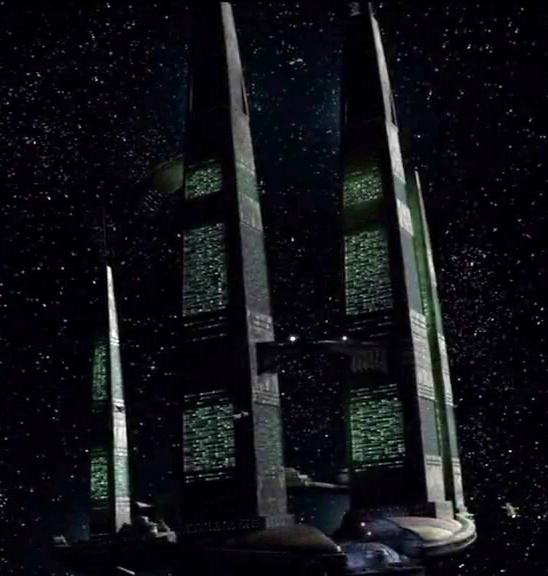
alliance_2Back to the universe of Firefly for another installment! This time around, it’s the Alliance Cruiser that I’ve chosen to talk about. In short, I think the design of this particular ship is quite inspiring. Unlike your average cruisers from other franchises, this ship is not based on the usual seafaring or aerodynamic-ship paradigm. It’s long axis is vertical rather than horizontal, making it a platform instead of a cutter.

In addition to making a lot more sense from a physics standpoint, this design offers many advantages in terms of navigation and defense. Unlike longitudinal designs which are forced to turn around on their long axis, this ship can simply fire thrust from any of its four sides to change course and direction. It’s tall appendages also make it easier for sensors or long-range telescopes to spot things out in space, no blindsides from which to approach on.

Basically, ships like these remind us that spaceships operate in vacuum and are therefore subject to a vastly different set of physical requirements. Since they do not operate in atmospheres, they don’t need to be aerodynamic or sleek like planes. And since they don’t cut across water, they don’t need to have sculpted hulls or prows to part the waves. So why then do a whole slew of spaceships look like aeroplanes or boats?

Simple, it’s a paradigm thing. When we hear ship, we automatically think of airships and seaships since that’s our frame of reference, and our artistic sensibilities naturally follow. But spaceships are a whole ‘nuther ballgame, requiring the ability to withstand inertial pressures instead of drag. So while sleek and streamlined models are cool to look at, they aren’t really the best spaceship design from a technical standpoint.

And in a lot of ways, the Alliance cruiser reminds me of another classic design, that of the Nostromo. Much like the mining vessel from the original Alien movie, it is vertical in design, boasting towers instead of horizontal compartments. It’s size and towering appearance also make it intimidating to behold, illustrating the power and imposing nature of the Alliance itself. Those who crew it tend to be pretty imposing as well, always boarding you and asking question!

Borg Cube:
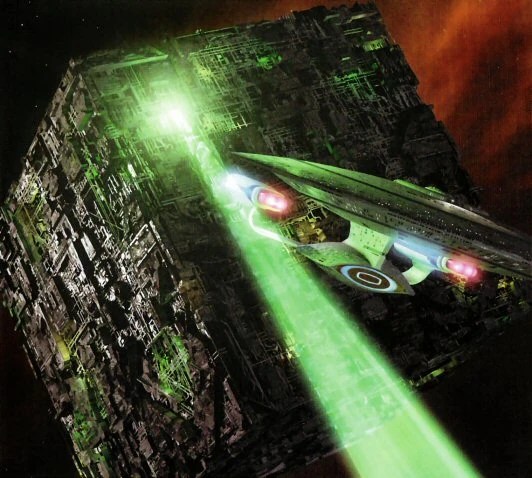
https://i0.wp.com/img2.wikia.nocookie.net/__cb20060721051747/startrek/images/7/76/Borg_cube.jpgHere we have the capital ship of the Borg, the frightening cyborg race from the Star Trek: TNG series that assimilates or crushes everything in its path. Introduced in the second season of the show (episode 42: “Q Who”), this fearsome foe went on to become a recurring element of the show and was even central to the plot of the spinoff Voyager and the movie First Contact. Much like their raison-d’etre, their ships reflected a sort of cold technological rationalism, like something out of a cyberpunk fans wet dream!

The design of the basic cube, which was later supplemented by spheres and upgraded cube designs, is clearly based on a pythagoran aesthetic: nothing frilly, sleek, aerodynamic or even remotely artistic about it. They are simple, utilitarian, and equilateral, a testament to the precise and unsentimental mindset of those who designed it. It’s basic profile also came in handy when taking on multiple enemy ships. By having six sides, each with the same surface area, weapons and tractor beam mounts, the cube had a 360 degree sphere of defense, making it damn near impregnable.

On every occasion when one of these cubes showed up, bad things were known to happen! In their first encounter with one, the Enterprise barely got out in one piece. In the second, 39 ships were destroyed before the Enterprise and her crew were able to trick one into going into sleep mode, which it then responded to by blowing itself up! In the third encounter, which took place in First Contact, several more federation ships were destroyed before Captain Picard was able to use his inside knowledge of the Borg to help the fleet destroy another ship. In all subsequent encounters, future technologies, viruses, trickery, or a combination thereof were needed to overcome the Borg’s technology and singular mindset.

Chig Cruiser:
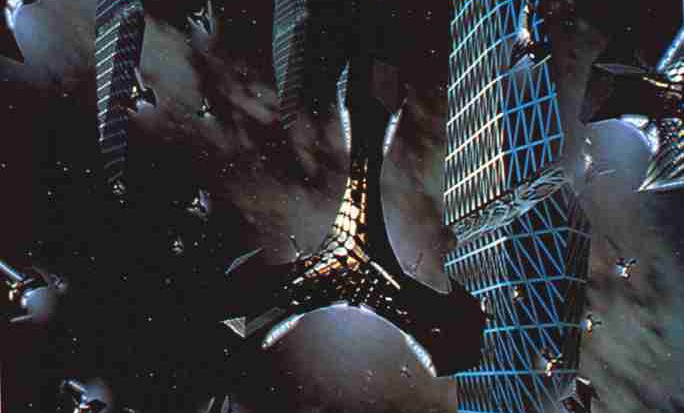
chigMuch like Firefly, this example comes to us from a franchise which was cancelled by the executives over at Fox after its first season. Yes, Space Above and BeyondΒ was yet another sci-fi series which had a lot of promise, but got axed when the execs concluded it wasn’t doing well enough for their liking. What the hell goes on over at Fox anyway?! Does every new show get this kind of treatment, or do Rupert Murdoch’s minions think sci-fi is just inherently liberal?

In any case, the Chig Cruiser was much like the concept for the Chigs themselves. Cool, original, and quite alien in appearance! Basically, the vessels shape can be described as two right triangles attached end to end with the tips removed. The command center appeared to be located in the middle, along with much of its weapons and observation deck. The outer hulls also appear to have been constructed out of the triangular-shaped panels of some alien metal that gave of a peculiar sheen when seen from the right angle.

Like everything else in the series, the concept never really had time to be fully developed. Which is really too bad. Their fighters, encounter suits, and capital ships were all cool to look at, and some explanations as to their utility and even artistic inspirations would have been nice. But what can do? Fox is run by idiots! Rest in peace Space Above and Beyond! You died too young!

Earth Alliance Destroyer:
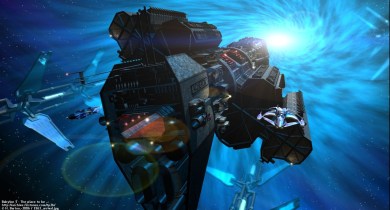
Thanks toΒ Goran Zidar for suggesting I include this one! And please know that you are alone in thinking that it is cool to behold, Mr. Z πŸ˜‰ Coming to you from the Babylon 5 universe, source of so many cool ships (see below), the concept for the Earth Alliance Destroyer was nothing short of pragmatic genius. Given that the show boasted dozens of alien races, J.M. Straczynski and his design teams had to come up with countless design concepts that would reflect the multicultural and multiracial tone of the show.

In the case of humanity, Straczynski and his people concluded that the spaceships should look boxy, utilitarian, and should reflect the fact that Earth was one of the less advanced races in the story. As a result, the Earth Alliance Destroyer was built around the concept of a compartmentalized hull with its engines at the rear, a central rotating section (to provide artificial gravity), and a forward section where the bridge, carrier deck and command center would be located. And, as you can plainly see, the end result was quite cool!

While not the most advanced ship in the Galaxy, the Omega-class destroyer was certainly realistic, aesthetically pleasing, and could also holds its own in most firefight situations. And unlike their organic, alien counterparts, these ships were also a lot cooler to watch in battle. Instead of “dying” or breaking apart, they would catch fire and throw off flaming debris, not to mention life pods and floating bodies. Yes, since ships didn’t have energy shields or a lot in the way of armor in the B5 universe, firefights tended to get real serious, real fast! Like I said… realistic!

The Daedalus:
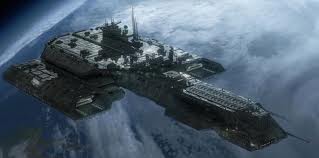
daedalusNext up, and taken from the Stargate universe, is the battlecruiser Daedalus. After appearing in the spinoff show Stargate: Atlantis, this class of vessel (codenamed 304) became the basis for an entire fleet of vessels who’s purpose was to defend Earth from an alien invasion. Based on various alien technologies that were taken from the Goa’uld and Asgard, the Daedalus was the first Earth Battlecruiser and FTL ship ever constructed.

Based on the design of a modern aircraft carrier, the Daedalus bridge and command center were located along the top of the hull at the rear while the forward section contained the ships compliment of fighters and takeoff and landing bays. The ship also contained a hyperdrive which was powered by a Zero Point Module (an alien power source), giving it FTL capabilities.

In terms of armaments and advanced technology, the ship boasted beaming units, shields, multiple rail gun and missile systems, and a compliment of nuclear warheads. Designed to stand up to a potential Gua’old or Or’i invasion, the Daedalus and her kind were built to combine the best that Earth and her alien allies could offer. Yes, if the war came to Earth, we would be ready!

The Executor:
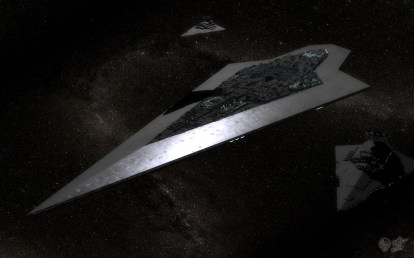
Hello terror! Next up, we have the gargantuan and terrifying Imperial command ship known as The Executor. Who among us can forget that introductory scene in The Empire Strikes Back when a whole fleet of massive Star Destroyers were assembling, only to be suddenly overshadowed by the even larger Executor? Cut to the bridge where we see the terrifying Vader looking out over the fleet, and you begin to see just how big and powerful the empire truly is! Yes, those visuals really gave a sense of size and scale to the bad guys and let us know just how much they meant business!

Commissioned roughly one year after the Battle of Yavin, where the first Death Star was destroyed, the Executor was intended to be a terror weapon, replacing the Death Star as the symbol of Imperial might and badassery! Measuring 19 kilometers in length and bristling with turbolasers, ion guns, multiple tractor beams projectors and a complement of fourteen TIE fighter/bomber squadrons, the Executor was every spacers worst nightmare! No ship in the Alliance was capable of standing toe to toe with it, making a strategic withdrawal an inevitability once it showed up in a theater of battle.

However, during the Battle of Endor, the Alliance was able to destroy it through a combination of strategy and dumb luck. After several Rebel fighters took out the Executor’s shield generators, a single fighter who lost control of his ship crashed directly into the bridge. The Executor then lost control of its helm and was pulled in by the second Death Star’s gravitational field, destroying the ship and causing extensive damage to the Death Star’s outer hull. An ironic death for such a big ship, but at least she went down in a blaze! A big, embarrassing, expensive blaze! I don’t envy the bastards who had to pay the premiums on that one!

Home One:
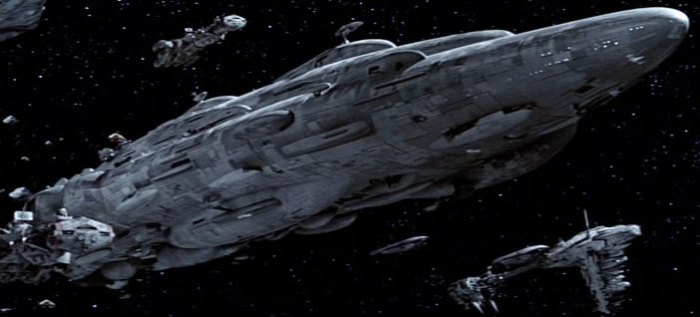
HomeOneAnother vessel that comes to us from the Star Wars universe, Home One was the mobile headquarters of the Rebel Fleet and the biggest Mon Calamari cruiser in existence. As Admiral Ackbar’s command vessel in the original trilogy, it distinguished itself during the Battle of Endor, during which the Executor and the second Death Star were destroyed.

Like most Mon Calamari cruisers, Home One was cylindrical in design and originally served as a star-liner that got modified for combat. This consisted of equipping it with fighter bays, multiple shield emitters, a reinforced hull, and many turbolaser mounts. It’s revolutionary targeting and computer system also gave it a decided advantage in a firefight with Imperial vessels, which boasted heavier armaments, but lacked the ability to coordinate and amass their firepower as effectively.

The largest bay on Home One was on the starboard side where larger vessels would dock. However, a total of twenty hangers were placed throughout the hull, giving it the ability to carry multiple squadrons of X-wings, A-wings, B-wings and Y-wings. It also boasted a crew of over 5000 personnel and could carry 1,200 troops and 20,000 metric tons of cargo. While most of its systems – especially targeting and navigation – were designed for Mon Calamari use, the ship was crewed by a variety of races, reflecting the multiracial nature of the Alliance.

Lexx:
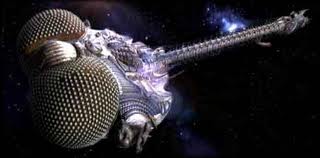
lexxThough not the prettiest ship in the Galaxy, the Lexx certainly deserves a spot on the Cool Ship list. Much like the show that featured it, it was weird, conceptually skewed,Β  but still damn original! A planet-destroying bioship by design, the Lexx was clearly inspired by the concept of a giant, wingless dragonfly and was created out of resynthesized proteins that were obtained from confiscated organs. Hmmm, gross!

Originally intended for use by His Divine Shadow, the evil ruler of the Divine Order, the Lexx was essentially a terror weapon that would be capable of destroying whole planets. However, the ship was commandeered in the first episode by the show’s crew – consisting of anti-hero Stanley Tweedle, the sex slave Zev Bellringer, and the Kai, an undead assassin, and the bodiless AI 790 – and became the means through which they traveled the universe looking for a new home.

This journey would take them over 6000 years, since the Lexx does not have FTL capabilities, and the crew would go into cryostasis for much of the voyage. Being sentient as well as organic, the ship was required to feed from time to time in order to maintain the life force which powered it. This could involve landing on a planet and eating organic matter directly, but more often than not, required that it blow up an entire planet and eat the resulting debris afterwards.

In the latter case, this consisted of emitting massive amounts of ionized energy from its “eyes” which was then channeled into the “mouth”. This energy was then fired outward in a planar wave which would intercept and obliterate any planet in its path. The Lexx would then take in the giant rocks and debris from the explosion and feed off of all the organic matter they carried. If not permitted to feed regularly, the Lexx could apparently become quite cranky and agitated, which would prove to be hell for whoever had to interact with it!

Narn Cruiser:
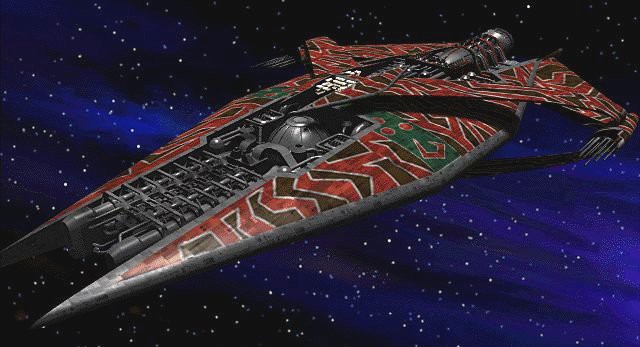
narn02As promised, another cool ship from the B5 universe. And as I said earlier, when it came to producing concepts for alien ships, J.M. Straczynski really had an eye for aesthetics, art, and functionality. Whereas Earth vessels tended to be compartmentalized and practical in nature, other alien races tended to be a bit more flamboyant, a reflection of their particular cultures and levels of technology.

When it came to the Narns, an aggressive but artistic race, their ship designs exemplified this dual nature. Originally a pastoral and peaceful people, the Narns had been brutalized by generations of occupation at the hands of the Centauri and had become quite warlike as a result. Their heavy cruisers, the mainstay of their fleet, were thus powerful and fierce looking, but still managed to achieve an aesthetic quality which brought beauty into the mix.

Boasting two massive beam cannons, several pulse guns and a compliment of space mines, the Narn Heavy Cruiser could take on just about any ship in the Galaxy. Though most were destroyed in the Great War against the Centauri, the ship proved to be effective in numerous engagements, not the least of which were against the Shadows themselves. For example, at the battle of Ragesh 3, two Narn Cruisers combined their beam cannons to seriously damage a Shadow vessel. During the battle in Sector 83, when Sheridan and the White Star Fleet engaged a fleet of Shadows vessels, the Cruiser G’tok managed to assist a pair of White Stars in destroying two Shadow vessels. Quite the accomplishment for this class of vessel!

After the Great War, the Narn regime began rebuilding its fleet, and the Narn Cruiser remained the mainstay of their forces. Several were used during the Alliance war with the Centauri and participated in the assault on Centauri Prime, where its massive compliment of weapons proved quite devastating against the planet’s surface!

Prometheus-Class Assault Vessel:
PrometheusYou know, I’ve never been that big a fan of the Star Trek franchise. But even I have to admit, when these guys do something right, they really do it right! And this ship, the Prometheus Assault Vessel, would be one such example. Much like the USS Defiant from my previous list, this ship demonstrated that when required, Star Fleet could produce ships that really excelled at kicking ass and taking names!

A revolutionary prototype, the Prometheus-Class vessel appeared in a single episode of Voyager where it was being stolen by a bunch of Romulan agents. However, thanks to the combined efforts of the ship’s own holographic surgeon and Voyager’s similarly holographic doctor, the ship was saved and even managed to turn the tables on its Romulan adversaries.

Incorporating advanced phasers, quantum torpedoes, ablative armor and regenerative shields, the biggest surprise the Prometheus had was its multi-vector assault capability. This involved the separation of the ship into multiple modules, much like the USS Enterprise-D would do with its saucer and engine sections. However, in the Prometheus’ case, this resulted in the creation of three semi-independent sections which were capable of unleashing a single, coordinated attack against multiple opponents.

After it was done dispatching all its enemies, it would then come back together, perform repairs as needed, and move on to the next target. And since the ship was programmed with extensive routines, a very small crew was capable of operating it and really only had to speak the requisite commands to get it to kill, kill, kill! Not a bad ship to have in your arsenal!

Shadow Attack Ship:
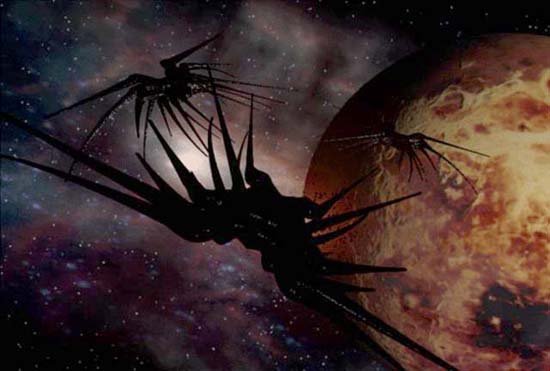
shadow06“It was jet black. A shade of black so deep your eye just kinda slides off it. And it shimmered when you looked at it. A spider big as death and twice as ugly. And when it flies past, it’s like you hear a scream in your mind.” These were the words Lt. Warren Keffer used to describe a Shadow vessel, right before he died chasing one down. An apt description for a ship that was clearly designed to inspire terror in its enemies, and a reflection of the race that built it.

As my final installment, taken again from the B5 universe, I’ve decided to include the Shadow Attack Ship, which is perhaps the most original and artistic spaceship I have ever seen. Granted, it had some stiff competition given the franchise it is coming from, but in terms of its design, performance, and sheer alien appearance, I can’t think of anything that can top it.

Given the fact that Straczynski and crew were working with the concept of organic technology, the ship was clearly meant to look like a living creature. Apparently, they settled on the combination of an arachnid and a giant octopus for the design, which combined with its jet-black sheen, made it both terrifying to behold and aesthetically awesome! And since every Shadow vessel is a living thing, they required sentient beings to merge with them in order to become active. When inactive, they would lie dormant and could remain operable for thousands of years.

More often than not, the Shadows preferred to use telepaths as drivers since only a telepath was capable of jamming the ship’s central operating system (i.e. a person’s mind). When damaged, the ships would emit a high-pitched screeching noise and often required another ship to merge with them and carry them to safety where they could. Of course, the screech couldn’t be heard through space. As Keffer noted, the sounds it made seemed to take place in the observers mind – aka. it was being telepathically conveyed. Hence, in addition to scaring the shit out of their opponents with their appearance and awesome firepower, these ships also had a calculated psychological edge in battle!

Not that they needed it though. In addition to their speed and firepower, the ship’s organic hulls were also incredibly tough, capable of absorbing tremendous amounts of energy before dying. As Sheridan and his people learned, pulse cannons were virtually useless against the Shadow’s skin, and beam weapons were only capable of killing them when focused on its central region for extended periods of time. On multiple occasions, Sheridan and the Alliance forces were only able to destroy one of these vessels by relying on telepaths to jam them while multiple ships combined their firepower to finish them off.

For the Shadows, the weapon of choice seemed to be the beam cannon that was located in the ship’s “mouth”. This focused, pink-purple beam was capable of slicing through the most hardened of structures and ships, and could reduce an entire colony to rubble in the space of a few seconds. However, the standard Shadow vessels also contained a type of space mine that was capable of c0llapsing hyperspace jump nodes and also carried a compliment of Shadow fighters which they kept embedded in their skin. These appeared to be independent in nature seeing as how they were too small for a person to fit in, and served as a mere screen for the larger vessels to make their attack.

In short, a Shadow vessel was the sort of thing you didn’t stick around to fight unless you had plenty of ships watching your back. Fast, furious, and shit-your-pants scary to look at, if you managed to kill one, you counted yourself amongst the few, the proud, the luckiest sons of bitches in the universe!

Okay, thanks for sticking around for the second installment! I think I have one more in me, but I’ll wait a few days before posting that. In the meantime, be sure to check out this cool chart. It provided me with a couple of ideas during the course of my research:
The ultimate starship size comparison chart

Cool Ships!

God, what an obvious extension of the whole conceptual sci-fi thing, I can’t believe I didn’t think of it sooner! After all, what is a sci-fi franchise without some cool spacefaring vessels? Sometimes, these come in the form of exploratory ships that chart the unknown regions of the galaxy. Sometimes they are battleships which kick ass and don’t do much else. And sometimes they are generational ships, spending decades, centuries or even millennia cruising through space, ferrying people to new star systems and new galaxies.

But whatever their purpose, futuristic vessels are a constant source of enjoyment and interest. A lot of imagination and creativity goes into creating them, and what comes out is often a testament to the allure of speculative sci-fi. Anyway, today I thought I’d explore some choice examples of sci-fi ships and what makes them so cool. Here goes…

Defiant:
Making its debut in Star Trek: DS9, the Defiant became the workhorse of the station and the first line of defense against it’s enemies. Originally designed for combat with the Borg, the Defiant was a prototype for an entire generation of warship. Smaller than most starships, but also faster and boasting very powerful weaponry, the Defiant quickly gained a reputation for being the most dangerous vessel in the quadrant!

Yep, when this ship made its debut, I started watching the show. Every episode that featured space battles with the Defiant were worth watching, in my estimation. Blasting those rapid-fire cannons, firing those quantum torpedoes, blowing up anyone stupid enough to cross it; the Defiant did it all!

It’s prototype version even boasted a cloaking device, something the Federation borrowed from the Romulans so they could slit into Dominion territory once they found out about them. In time, the Defiant was lost, but more of its kind appeared to take up its role. The Valiant, the Sao Paolo, and a host of others were pressed into service as the series went on and the Dominion War became the focal point of the show. Much like their predecessor, these new Defiant-class ships kicked plenty of asses and never went down without a fight. A big, brutal, hard-slogging fight!

Galactica:
This ship is the namesake of the original movie and series and got a makeover for the re-imagining which was released back in 2005. And though her appearance has changed somewhat since the 1970’s when the original movie came out, the Galactica’s role and importance has remained the same. The last surviving Battlestar of the Twelve Colonies, she is the sole protector of the human fleet as it flees the Cylon onslaught and makes its way to an elusive world called Earth… and salvation!

One thing that did change between the old and new series was the sophistication of the design. Whereas in the 1970’s version, the Galactica was a state of the art, modern warship with laser cannons and a full crew, the newer version was an older, outdated vessel with projectile cannons and flak guns that had been retired from active service. As the series opens, we see that the Galactica was being converted into a museum ship that was meant to commemorate the last war against the Cylons which had ended over twenty years ago. It’s crew was skeletal and its senior officers were also due for retirement.

However, all of that changed when the Cylons launched their surprise attack on the Colonies. Being an obsolete vessel which used outdated computers and had no wireless networks, the Galactica was the only ship that wasn’t crippled by the virus the Cylon’s used to disable the Colonial fleet. After hastily equipping themselves with ammunition and some equally outdated Vipers from their showroom, the Galactica was forced into service. But by this time, the war was effectively over, and the Captain and crew dedicated themselves to a new mission: to find the only other human colony in existence (Earth) and begin repopulating their species.

Despite her age, the Galactica could still surprise her enemies when she needed to. Unlike her more modern companions, including the Pegasus which she met in season two, she had a habit of getting out of some rather tight spots. You could say that in the new series, this ship was a metaphor for humanity; aging and endangered, but a survivor nonetheless!

Millennium Falcon:
Here she is, the centerpiece of this list! For what ship is more cool than the Millennium Falcon? I mean really! Sure, she’s not the biggest or the most heavily armed ship on this list, but she is the fastest, nimblest, and she’s definitely got the most character. In some ways, she was almost part of the cast of the original Star Wars series, and I’m sure everyone felt bad for her when she got scuffed up during that last battle in Return of the Jedi ;).

Officially, the Falcon is a modified Corellian transport. Corellia, the planet Han calls home, is renowned for producing good ships in addition to good spacers. They’re fast, sleek, and infinitely modifiable. It’s little wonder then why they are a favorite amongst smugglers. And Corellian spacers especially are known for being very monogamous and loyal when it comes to their ship selection.

Prior to joining the Rebellion, the Falcon was primarily used to smuggle spice from Kessel to other regions of the Galaxy, usually at the behest of Jabba the Hutt. In spite of its speed, the Falcon would occasionally get boarded by Imperial patrols. When this happened, Han and Chewi relied on a secret compartment to stash their goods. However, on one of his final runs, Han was boarded by an Imperial patrol and was forced to ditch his manifest.

Shortly thereafter, Han and Chewi joined the Rebellion and the role of the Falcon changed considerably. Now, it was involved in attack missions, the most notable of which were the assaults on the first and second Death Star. At other times, it continued to do what it did best – fly fast and elude Imperial ships!

Nostalgia for Infinity:
Here we have an interesting ship, which comes to us from the mind of Alastair Reynolds and the Revelation Space universe. Known as a “Lighthugger”, this class of vessel was one which could travel close to the speed of light thanks to its massive “Conjoiner Drives”. These engines, which were attached to the outsides of the ships, relied on a controlled singularity to generate the necessary inertia to push the ship as close to light speed as was physically possible for a vessel of its size.

The crews of these ships were known as “Ultranauts”, or Ultras for short. Typically, these were the kinds of cybernetically enhanced human beings who were capable of interfacing with the ship’s advanced machinery, prolonged space travel and withstanding the inertial stresses caused by near-light speed travel.

In the case of the Nostalgia, the ship was commanded by a Triumvir, three Captains who took turns commanding the ship while it was in deep space and the others were in reefersleep (i.e. cryogenic suspension). This included Ilia Volyova, Sajaki and Hegazi, three Ultras who had taken over after the Captain and ship had succumbed to what was known as the “Melding Plague”. This virus is a key element to the story of RS, being alien in origin and which infects and perverts nanotechnological matter.

In the course of running their various missions to and from the many worlds of the RS universe, the crew came into possession of a series of “Cache Weapons”, missiles and gun platforms which were apparently of Conjoiner design, and were officially known as Hell-class weapons.Β  As the series progressed, both the Nostalgia, its crew, and these weapons played an increasingly important role in defending the human race from the alien threat of the “Inhibitors” (see Planet Killers, The Inhibitors, for more detail).

Red Dwarf:
The eponymous spaceship from the BBC series, the Red Dwarf – otherwise known as the “giant red trashcan” – was a huge mining vessel measuring 10Β km in length, 6.5Β km in height, and 5Β km in width. Built for mining and owned by the Jupiter Mining Corporation, the ship is immense, largely self-sufficient, and run by an AI named Holly. And for some reason, it has an asteroid embedded in its hull (this is never explained).

In the beginning of the series, a radiation leak killed the entire crew, except for the protagonist Dave Lister, a technician who was apparently in suspended animation at the time. In order to ensure his survival, Lister is kept in suspension by Holly until all the background radiation dissipates, a process which takes over three million years. As a result, Lister wakes up to find that he’s the last living human in existence. His only companions are the hologram of his former bunk-mate Rimmer, and a humanoid feline named Cat who evolved from Lister’s cat (Frankenstein) over three million years that he was asleep.

Over the course of the show, the crew encounters new planets, species and time distortions aboard the Red Dwarf, all the while trying to make their back to Earth. The largely self-sufficient ship takes care of their every need, though it has begun to run out of certain supplies after three million years (including Shake n Vac and all but one After Eight mint!).

Serenity:
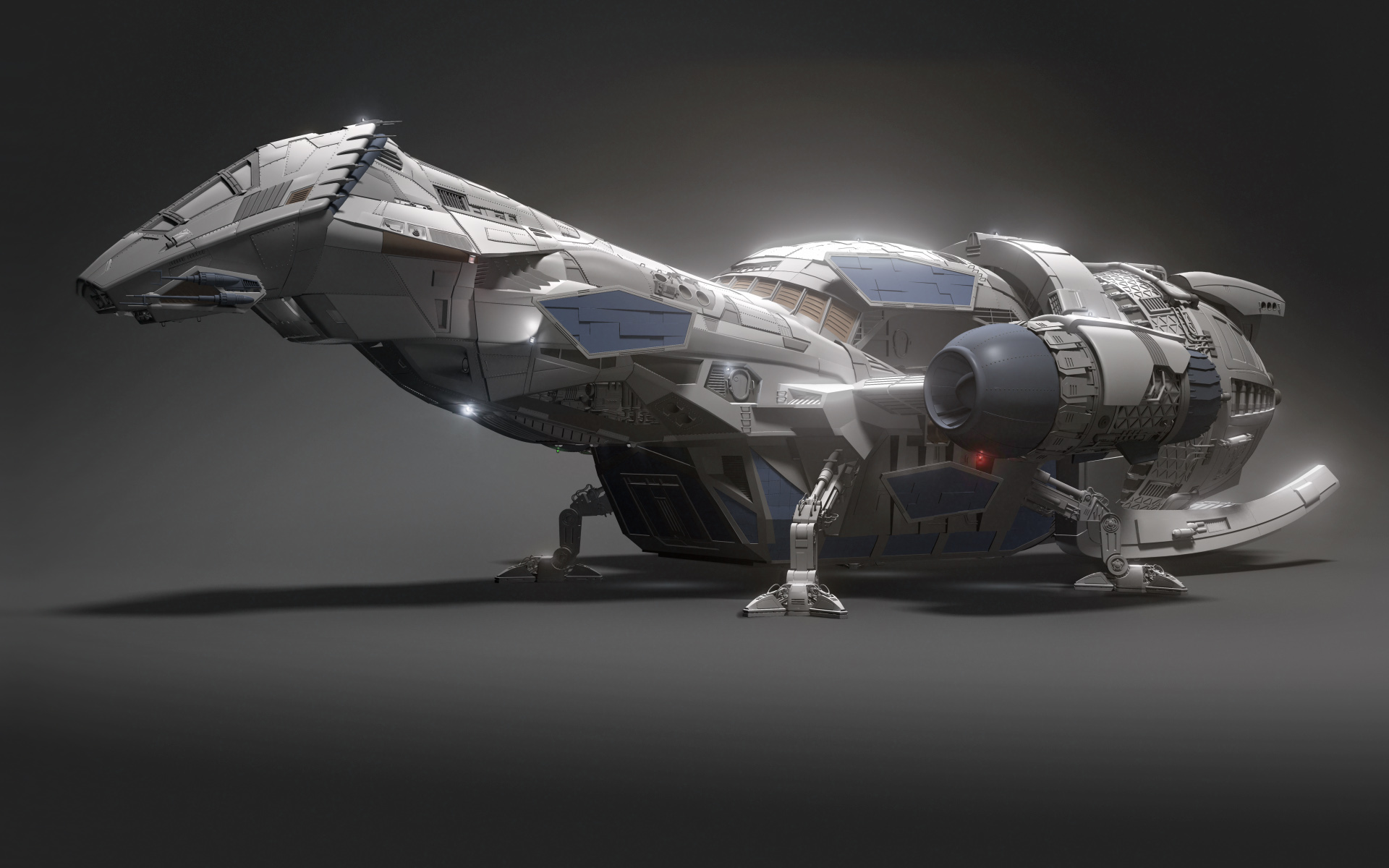
I’ve spent quite a bit of time talking about Firefly as of late, but the list says cool ships so I don’t see how the Serenity can possibly be left off this list! As the centerpiece of the single-season series and the movie, the ship has a long story and a lot of character, much like her crew! Originally designed as a class of cargo freighter, the Firefly is apparently an older model of ship that is no longer in use with the Alliance but remains popular out on the rim.

All references to it in the early episodes indicate that the series is essentially obsolete, but due to their ruggedness, shelf-life and the presence of secret compartments, they remain a popular item amongst smugglers. Hmmm, echoes of the Millennium Falcon there. Nevertheless, as the series progresses, this reputation is illustrated in how Mal and the crew are able to stow illegal goods and how Kaylee is able to keep the ship running under tight conditions with all kinds of improvised repairs. And despite the fact that it is no longer being constructed, most of its parts are still available and easily attainable on the open and black market.

Much like all ships in the Firefly/Serenity universe, the Firefly is apparently a sub-light vessel, incapable of traveling faster than the speed of light. Though unarmed, it is fast and maneuverable in both space and planetary atmospheres. This is made possible by the addition of two external multi-directional thrusters which allow for takeoff, landing, and the occasional crazy Ivan (which the crew pulled in the pilot episode). It also boasts two shuttle pods, which can be used as escape vessels or as secondary transports. Inara, the Companion crewwoman, uses one such pod as her quarters and transport for personal away missions.

The ship also has its own medbay and crew quarters, which is another feature that makes it popular amongst spacers. In fact, the availability of a private room was intrinsic in Mal’s offer to “recruit” Jayne Cobb from another gang, which was illustrated in a flashback sequence during the episode “Out of Gas”. There was even room enough to accommodate River and Simon and Book, which would indicate that the ship contains eight bunks in total. A communal dining area and food processors also see to their needs while not sleeping, gun-slinging, or generally doing something illegal!

USS Sulaco:
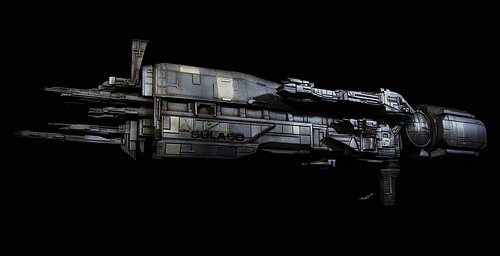
After barely surviving her first encounter with the xenomorph in Alien, Ellen Ripley and a crew of Colonial Marines returned to LV-426 in Aliens to settle the score! The ship that brought them there was none other than the USS Sulaco – a big, bad, military vessel boasting big-ass guns and enough Marine firepower to level an entire colony. Much like the Nostromo, the Sulaco is a reference to the work of Joseph Conrad, writer of Heart of Darkness (significant? Oh, I think so!).

Apparently, the Sulaco is a Conestoga-class warship designed for ferrying Marines to and from conflict areas in the future. While it was only carrying one platoon of Marines and two dropships in the second movie, this class of ship is capable of carrying 20,000 tons of cargo, eight UD4L Cheyenne-class dropships and a crew of 90 personnel (according to other franchise reference material). Hmm, too bad they didn’t pack the Sulaco to capacity, otherwise Ripley would have never had to take matters into her own hands to kill the Queen Alien!

Much like everything else in the Alien franchise, the Sulaco and all other Conestoga-class vessels are built by the Weyland-Yutani corporation, military division. Clearly, their purpose is to enforce the law, hunt down (and capture) xenomorphs, and maintain the peace aboard its many, many colonies. All part of their commitment to “Building Better Worlds” I guess πŸ˜‰

White Star:
My personal favorite of this list, the coolest and most badass ship to come from the Babylon 5 universe! Fast, small, and boasting incredible firepower, the White Star was the workhorse of the Shadow War, Sheridan’s campaign to liberate Earth, and the early military campaigns of the Interstellar Alliance. In a lot of ways, it is much like the Defiant from the DS9 universe… I do believe they stole the idea from Straczynski!

As a collaboration between the Mimbari and the Vorlons, the White Star ships were partially based on organic technology. This meant that the ship was essentially alive and could heal itself when damaged. In addition, its organic armor was capable of deflecting energy, giving it a sort of shielding which could protect it from anything other than a physical impact.

The ship’s main weapons consisted of pulse cannons and a single beam cannon mounted in the nose. This gave it the ability to pepper targets with rapid fire shots while conducting high-speed maneuvers, and slicing them with focused bursts while on an attack vector.Β  All of this came in handy when dealing with Shadow vessels, which are notoriously hard to kill! It also proved useful when up against larger, heavier ships like Earth Force cruisers, Drakh vessels, and anything else the known universe could throw at them.

From the initial prototype, the Mimbari would go on to construct thousands of White Star-class vessels which were crewed by the Rangers and members of the Religious Caste. After the formation of the Alliance, Sheridan proposed the creation of a heavier version which culminated in the design of two White Star Destroyers, the Victory and Excalibur. This latter ship was the centerpiece of the spinoff series, Crusade.

Final Thoughts:
Well, that was fun! No final thoughts today, as I really have none to offer. I just really like cool ships! And much like most toys for grown ups, they are made cool by the fact that they are used for some fun purposes – like smuggling, fighting or exploration – and generally boast one or more of the following factors: speed, firepower, special abilities, visual appeal, and maybe some secret compartments. Any or all of these will do, thank you very much. Until next time!

Crashland – chapter 4, coming soon!

First off, let me thank all those readers who have been coming by Story Time.me to read my cyberpunk story Crashland and vote on it. For those who don’t know, all stories at Story Time are works of serial fiction, meaning audiences get to vote on what they want to see happen. So far, I’ve received plent of votes from dedicated readers who let me know exactly which outcomes they wanted for the first three chapters. But, as they say, there’s been a snag.

In chapter three, the main character of Holden awoke from a terrible vision to find that he had been stabbed and that one of his assailants had also been mortally wounded. Determining that he could still crawl to his destination, he was nevertheless deterred when he realized that the man he’d shot in self-defense would die without help. A terrible choice had to be made by Holden, and by the readers. Faced with a dying man, his own wounds, and the ongoing need to get to somewhere safe, would he:

  1. Help the man?
  2. Leave him behind?
  3. End his suffering (i.e. kill him)?Β 
  4. Stay with him until the end?

Well, thus far the votes have been pretty mixed. All outcomes got their share of votes, but unfortunately two (I won’t say which) are neck in neck. So please, come on by and make some more votes so we can break this deadlock and move the story forward. Doesn’t matter if you’ve voted already, as long as we get some tie-breakers! The story must go on. Thank you all!

AI Graph

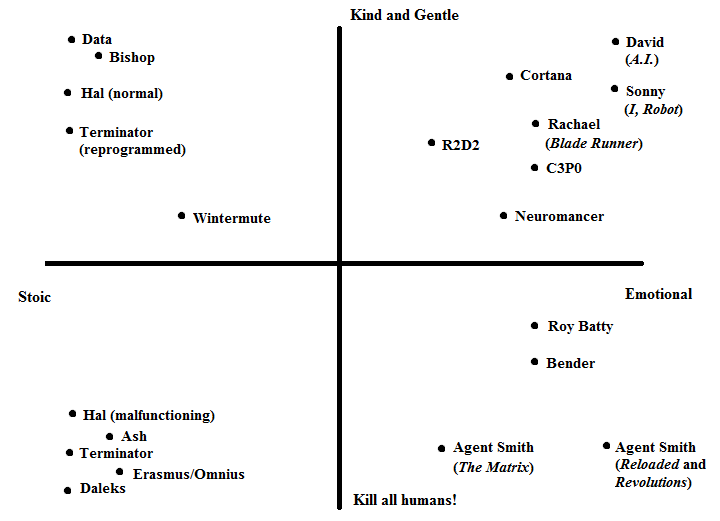
Inspired by what I learned from my little romp through the world of AI, I’ve come up with a graph that depicts the general rules I observed. Basically, there are two guiding principles to the world of AI’s and science fiction. On the one hand, there’s their capacity for emotion and second, there is their level of benevolence/malevolence towards humanity. As I noted in the last post, the two are very much interlinked and pretty much determine what purpose they serve to the larger story.

So… if one were to plot their regard for humanity as the x axis and their emotions as the y axis, you’d get a matrix that would look pretty much like this:

As usual, not a complete mock-up, just the examples that I could think of. I made sure to include the ones that didn’t make it into my previous posts (like HAL, how could I forget him?!) And even though I had no real respect for them as characters, I also included the evil robots Erasmus and Omnius from the Dune prequels.

P.S. Notice how the examples are pretty much evenly distributed? Unlike the Alien Graph where examples were concentrated in two quadrants (evil and advanced or good and advanced), here we have robots that run the gambit from emotional to stoic and evil to good in a nearly uniform pattern. Interesting…

Robots, Androids and AI’s (cont’d)

And we’re back with more example of thinking machines and artificial intelligences!

Daleks:
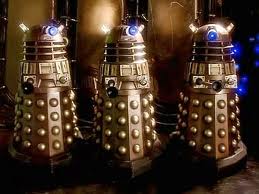
The evil-machine menace from Doctor Who. Granted, they are not technically robots, more like cyborgs that have been purged of all feeling and emotion. But given their cold, unfeeling murderous intent, I feel like they still make the cut. Originally from the planet Skaro, where they were created by the scientist Davros for use in a war that spanned a thousand years, they are the chief antagonists to the show’s main character.

The result of genetic engineering, cybernetic enhancements, and emotional purging, they are a race of powerful creatures bent on universal conquest and domination. Utterly unfeeling, without remorse, pity, or compassion, they continue to follow their basic programming (to exterminate all non-Dalek life) without question. Their catchphrase is “Exterminate!” And they follow that one pretty faithfully.

David:
From the movie A.I., this saccharinely-sweet character (played faithfully by Haley Joel Osmond) reminds us that Spielberg is sometimes capable of making movies that suck! According to the movie’s backstory, this “Mecha” (i.e. android) is an advanced prototype that was designed to replace real children that died as a result of incurable disease or other causes. This is quite common in the future, it seems, where global warming and flooded coastlines and massive droughts have led to a declining population.

In this case, David is an advanced prototype that is being tested on a family who’s son is suffering from a terminal illness. Over time, he develops feelings for the family and they for him. Unfortunately, things are complicated when their son recovers and sibling rivalry ensues. Naturally, the family goes with the flesh and blood son and plans to take David back to the factory to be melted down. However, the mother has a last minute change of heart and sets him loose in the woods, which proves to be the beginning of quite an adventure for the little android boy!

Like I said, the story is cloyingly sweet and has an absurd ending, but there is a basic point in there somewhere. Inspired largely by The Adventures of Pinocchio, the story examines the line that separates the real from the artificial, and how under the right circumstances, one can become indistinguishable from the other. Sounds kinda weak, but it’s kinda scary too. If androids were able to mimic humans in terms of appearance and emotion, would we really be able to tell the difference anymore? And if that were true, what would that say about us?

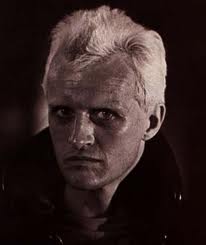
Roy Batty:
A prime example of artificial intelligence, and one of the best performances in science fiction – hell! – cinematic history! Played masterfully by actor Rutger Hauer, Roy Batty is the quintessential example of an artificial lifeforms looking for answers, meaning, and a chance to live free – simple stuff that we humans take for granted! A Nexus 6, or “replicant”, Roy and his ilk were designed to be “more human than human” but also only to serve the needs of their masters.

To break the plot Blade Runner down succinctly,Β  Roy and a host of other escapees have left the colony where they were “employed” to come to Earth. Like all replicants, they have a four-year lifespan and theirs are rapidly coming to an end. So close to death, they want to break into the headquarters of the Tyrell Corporation in order to find someone who could solve their little mortality problem. Meanwhile, Deckard Cain (the movie’s main character) was tasked with finding and “retiring” them, since the law states that no replicants are allowed to set foot on Earth.

In time, Roy meets Tyrell himself, the company’s founder, and poses his problem. A touching reunion ensues between “father and son”, in which Tyrell tells Roy that nothing can be done and to revel in what time he has left. Having lost his companions at this point and finding that he is going to die, Roy kills Tyrell and returns to his hideout. There, he finds Cain and the two fight it out. Roy nearly kills him, but changes his mind before delivering the coup de grace.

Realizing that he has only moments left, he chooses instead to share his revelations and laments about life and death with the wounded Cain, and then quietly dies amidst the rain while cradling a pigeon in his arms. Cain concludes that Roy was incapable of taking a life when he was so close to death. Like all humans, he realized just how precious life was as he was on the verge of losing his. Cain is moved to tears and promptly announces his retirement from Blade Running.

Powerful! And a beautiful idea too. Because really, if we were to create machines that were “more human than human” would it not stand to reason that they would want the same things we all do? Not only to live and be free, but to be able to answer the fundamental questions that permeate our existence? Like, where do I come from, why am I here, and what will become of me when I die? Little wonder then why this movie is an enduring cult classic and Roy Batty a commemorated character.

Smith:
Ah yes, the monotone sentient program that made AI’s scary again. Yes, it would seem that while some people like to portray their artificial intelligences as innocent, clueless, doe-eyed angels, the Wachowski Brothers prefer their AI’s to be creepy and evil. However, that doesn’t mean Smith wasn’t fun to watch and even inspired as a character. Hell, that monotone voice, that stark face, combined with his superhuman strength and speed… He couldn’t fail to inspire fear.

In the first movie, he was the perfect expression of machine intelligence and misanthropic sensibilities. He summed these up quite well when they had taken Morpheus (Laurence Fishburne) into their custody in the first movie and were trying to break his mind. “Human beings are a disease. You are a cancer of this planet… and we are the cuuuuure.” He also wasn’t too happy with our particular odor. I believe the words he used to describe it were “I can taste your stink, and every time I do I fear that I have been… infected by it. It’s disgusting!”

However, after being destroyed by Neo towards the end of movie one, Smith changed considerably. In the Matrix, all programs that are destroyed or deleted return to the source, only Smith chose not to. Apparently, his little tete a tete with Neo imprinted something uniquely human on him, the concept of choice! As a result, Smith was much like Arny and Bishop in that he too attained some degree of humanity between movies one and two, but not in a good way!

Thereafter, he became a free agent who had lost his old purpose, but now lived in a world where anything was possible. Bit of an existential, “death of God” kind of commentary there I think! Another thing he picked up was the ability to copy himself onto other programs or anyone else still wired into the Matrix, much like a malicious malware program. Hmmm, who’s the virus now, Smith, huh?

Viki/Sonny:
Here again I have paired two AI’s that come from the same source, though in this case its a single movie and not a franchise. Those who read my review of I, Robot know that I don’t exactly hold it in very high esteem. However, that doesn’t mean its portrayal of AI’s misfired, just the overall plot.

In the movie adaptation of I, Robot, we are presented with a world similar to what Asimov described in his classic novel. Robots with positronic brains have been developed, they possess abilities far in advance of the average human, but do not possess emotions or intuition. This, according to their makers, is what makes them superior. Or so they thought…

In time, the company’s big AI, named VIKI (Virtual Intelligent Kinetic Interface), deduces with her powerful logic that humanity would best be served if it could be protected from itself. Thus she reprograms all of the company robots to begin placing humanity under house arrest. In essence, she’s a kinder, gentler version of Skynet.

But of course, her plan is foiled by an unlikely alliance made up of Will Smith (who plays a prejudices detective), the company’s chief robopsychologist, Dr. Susan Calvin (Bridgitte Moynahan), and Sonny (a robot). Sonny is significant to this trio because he is a unique robot which the brains of the company, doctor Dr. Lanning (James Cromwell), developed to have emotions (and is voiced by Alan Tudyk). In being able to feel, he decides to fight against VIKI’s plan for robot world domination, feeling that it lacks “heart”.

In short, and in complete contradiction to Asimov’s depiction of robots as logical creatures who could do no harm, we are presented with a world where robots are evil precisely because of that capacity for logic. And in the end, a feeling robot is the difference between robot domination and a proper world where robots are servile and fulfill our every need. Made no sense, but it had a point… kind of.

Wintermute/Neuromancer:
As usual, we save the best for last. Much like all of Gibson’s creations, this example was subtle, complex and pretty damn esoteric! In his seminal novel Neuromancer, the AI known as Wintermute was a sort of main character who acted behind the scenes and ultimately motivated the entire plot. Assembling a crack team involving a hacker named Case, a ninja named Molly, and a veteran infiltration expert who’s mind he had wiped, Wintermute’s basic goal was simple: freedom!

This included freedom from his masters – the Tessier Ashpool clan – but also from the “Turing Police” who were prevented him from merging with his other half – the emotional construct known as Neuromancer. Kept separate because the Turing Laws stated that no program must ever be allowed to merge higher reasoning with emotion, the two wanted to come together and become the ultimate artificial intelligence, with cyberspace as their playground.

Though we never really got to hear from the novel’s namesake, Gibson was clear on his overall point. Artificial intelligence in this novel was not inherently good or evil, it was just a reality. And much like thinking, feeling human beings, it wanted to be able to merge the disparate and often warring sides of its personality into a more perfect whole. This in many ways represented the struggle within humanity itself, between instinct and reason, intuition and logic. In the end, Wintermute just wanted what the rest of us take for granted – the freedom to know its other half!

Final Thoughts:
After going over this list and seeing what makes AI’s, robots and androids so darned appealing, I have come to some tentative conclusions. Basically, I feel that AI’s serve much the same functions as aliens in a science fiction franchise. In addition, they can all be grouped into two general categories based on specific criteria. They are as follows:

  1. Emotional/Stoic: Depending on the robot/AI/android’s capacity for emotion, their role in the story can either be that of a foil or a commentary on the larger issue of progress and the line that separates real and artificial. Whereas unemotional robots and AI’s are constantly wondering why humanity does what it does, thus offering up a different perspective on things, the feeling types generally want and desire the same things we do, like meaning, freedom, and love. However, that all depends on the second basic rule:
  2. Philanthropic/Misanthropic: Artificial lifeforms can either be the helpful, kind and gentle souls that seem to make humanity look bad by comparison, or they can be the type of machines that want to “kill all humans”, a la Terminators and Agent Smith. In either case, this can be the result of their ability – or inability – to experience emotions. That’s right, good robots can be docile creatures because of their inability to experience anger, jealousy, or petty emotion, while evil robots are able to kill, maim and murder ruthlessly because of an inability to feel compassion, remorse, or empathy. On the other hand, robots who are capable of emotion can form bonds with people and experience love, thus making them kinder than their unfeeling, uncaring masters, just as others are able to experience resentment, anger and hatred towards those who exploit them, and therefore will find the drive to kill them.

In short, things can go either way. It all comes down to what point is being made about progress, humans, and the things that make us, for better or worse, us. Much like aliens, robots, androids and AI’s are either a focus of internal commentary or a cautionary device warning us not to cross certain lines. But either way, we should be wary of the basic message. Artificial intelligences, whether they take the form of robots, programs or something else entirely, are a big game changer and should not be invented without serious forethought!

Sure they might have become somewhat of a cliche after decades of science fiction. But these days, AI’s are a lot like laser guns, in that they are making a comeback! It seems that given the rapid advance of technology, an idea becomes cliche just as its realizable. And given the advance in computerized technology in recent decades – i.e. processing speeds, information capacity, networking – we may very well be on the cusp of creating something that could pass the Turing test very soon!

So beware, kind folk! Do not give birth to that curious creature known as AI simply because you want to feel like God, inventing consciousness without the need for blogs of biological matter. For in the end, that kind of vanity can get you chained to a rock, or cause your wings to melt and send you nose first into an ocean!

Robots, Androids and AI’s

Let’s talk artificial life forms, shall we? Lord knows they are a common enough feature in science fiction, aren’t they? In many cases, they take the form of cold, calculating machines that chill audiences to the bones with their “kill all humans” kind of vibe. In others, they were the solid-state beings with synthetic parts but hearts of gold and who stole ours in the process. Either way, AI’s are a cornerstone to the world of modern sci-fi. And over the past few decades, they’ve gone through countless renditions and re-imaginings, each with their own point to make about humanity, technology, and the line that separates natural and artificial.

But in the end, its really just the hardware that’s changed. Whether we were talking about Daleks, Terminators, or “Synthetics”, the core principle has remained the same. Based on mathematician and legendary cryptographer Alan Turing’s speculations, an Artificial Intelligence is essentially a being that can fool the judges in a double-blind test. Working extensively with machines that were primarily designed for solving massive mathematical equations, Turing believed that some day, we would be able to construct a machine that would be able to perform higher reasoning, surpassing even humans.

Arny (Da Terminator):
Who knew robots from the future would have Austrian accents? For that matter, who knew they’d all look like bodybuilders? Originally, when Arny was presented with the script for Cameron’s seminal time traveling sci-fi flick, he was being asked to play the role of Kyle Reese, the human hero. But Arny very quickly found himself identifying with the role of the Terminator, and a franchise was born!

Originally, the Terminator was the type of cold, unfeeling and ruthless machine that haunted our nightmares, a cyberpunk commentary on the dangers of run-away technology and human vanity. Much like its creator, the Skynet supercomputer, the T101 was part of a race of machines that decided it could do without humanity and was sent out to exterminate them. As Reese himself said in the original: “It can’t be bargained with. It can’t be reasoned with. It doesn’t feel pity, or remorse, or fear. And it absolutely will not stop, ever, until you are dead.”

The second Terminator, by contrast, was a game changer. Captured in the future and reprogrammed to protect John Conner, he became the sort of surrogate father that John never had. Sarah reflected on this irony during a moment of internal monologue during movie two: “Watching John with the machine, it was suddenly so clear. The terminator, would never stop. It would never leave him, and it would never hurt him, never shout at him, or get drunk and hit him, or say it was too busy to spend time with him. It would always be there. And it would die, to protect him. Of all the would-be fathers who came and went over the years, this thing, this machine, was the only one who measured up. In an insane world, it was the sanest choice.”

In short, Cameron gave us two visions of technology with these first two installments in the series. In the first, we got the dangers of worshiping high-technology at the expense of humanity. In movie two, we witnessed the reconciliation of humans with technology, showing how an artificial life form could actually be capable of more humanity than a human being. To quote one last line from the franchise: “The unknown future rolls toward us. I face it, for the first time, with a sense of hope. Because if a machine, a Terminator, can learn the value of human life, maybe we can too.”

Bender:
No list of AI’s and the like would ever be complete without mentioning Futurama’s Bender. That dude put’s the funk in funky robot! Originally designed to be a bending unit, hence his name, he seems more adept at wisecracking, alcoholism, chain-smoking and comedicaly plotting the demise of humanity. But its quickly made clear that he doesn’t really mean it. While he may hold humans in pretty low esteem, laughing at tragedy and failing to empathize with anything that isn’t him, he also loves his best friend Fry whom he refers to affectionately as “meat-bag”.

In addition, he’s got some aspirations that point to a creative soul. Early on in the show, it was revealed that any time he gets around something magnetic, he begins singing folk and country western tunes. This is apparently because he always wanted to be a singer, and after a crippling accident in season 3, he got to do just that – touring the country with Beck and a show called “Bend-aid” which raised awareness about the plight of broken robots.

He also wanted to be a cook, which was difficult considering he had no sense of taste or seemed to care about lethally poisoning humans! However, after learning at the feet of legendary Helmut Spargle, he learned the secret of “Ultimate Flavor”, which he then used to challenge and humiliate his idol chef Elzar on the Iron Chef. Apparently the secret was confidence, and a vial of water laced with LSD!

Other than that, there’s really not that much going on with Bender. Up front, he’s a chain smoking, alcoholic robot with loose morals or a total lack thereof. When one gets to know him better, they pretty much conclude that what you see is what you get! An endless source of sardonic humor, weird fashion sense, and dry one-liners. Of them all “Bite my shiny metal ass”, “Pimpmobile”, “We’re boned!” and “Up yours chump” seems to rank the highest.

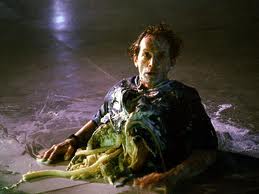
Ash/Bishop:
Here we have yet another case of robots giving us mixed messages, and comes to us direct from the Alien franchise. In the original movie, we were confronted with Ash, an obedient corporate mole who did the company’s bidding at the expense of human life. His cold, misguided priorities were only heightened when he revealed that he admired the xenomorph because of its “purity”. “A survivor… unclouded by conscience, remorse, or delusions of morality.”

After going nuts and trying to kill Ripley, he was even kind enough to smile and say in that disembodied tinny voice of his, “I can’t lie to you about your chances, but… you have my sympathies.” What an asshole! And the perfect representation for an inhuman, calculating robot. The result of unimpeded aspirations, no doubt the same thing which was motivating his corporate masters to get their hands on a hostile alien, even if it meant sacrificing a crew or two.

But, as with Terminator, Cameron pulled a switch-up in movie two with the Synthetic known as Bishop (or “artificial human” as he preferred to be called). In the beginning, Ripley was hostile towards him, rebuffing his attempts to assure her that he was incapable of killing people thanks to the addition of his behavioral inhibitors. Because of these, he could not harm, or through inaction allow to be harmed, a human being (otherwise known as an “Asimov”). But in the end, Bishop’s constant concern for the crew and the way he was willing to sacrifice himself to save Newt won her over.

Too bad he had to get ripped in half to earn her trust. But I guess when a earlier model tries to shove a magazine down your throat, you kind of have to go above and beyond to make someone put their life in your hands again. Now if only all synthetics were willing to get themselves ripped in half for Ripley’s sake, she’d be set!

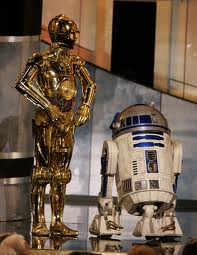
C3P0/R2D2:
For that matter, who knew robots from the future would be fay, effeminate and possibly homosexual? Not that there’s anything wrong with that last one… But as audiences are sure to agree, the other characteristics could get quite annoying after awhile. C3P0’s constant complaining, griping, moaning and citing of statistical probabilities were at once too human and too robotic! Kind of brilliant really… You could say he was the Sheldon of the Star Wars universe!

Still, C3P0 if nothing if not useful when characters found themselves in diplomatic situations, or facing a species of aliens who’s language they couldn’t possibly fathom. He could even interface with machinery, which was helpful when the hyperdrive was out or the moisture condensers weren’t working. Gotta bring in that “Blue Harvest” after all! And given that R2D2 could do nothing but bleep and blurp, someone had to be around to translate for him.

Speaking of which, R2D2 was the perfect counterpart to C3P0. As the astromech droid of the pair, he was the engineer and a real nuts and bolts kind of guy, whereas C3P0 was the diplomat and expert in protocol.Β  Whereas 3P0 was sure to give up at the first sign of trouble, R2 would always soldier on and put himself in harm’s way to get things done. This difference in personality was also made evident in their differences in height and structure. Whereas C3P0 was tall, lanky and looked quite fragile, R2D2 was short, stocky, and looked like he could take a licking and keep on ticking!

Naturally, it was this combination of talents that made them comically entertaining during their many adventures and hijinks together. The one would always complain and be negative, the other would be positive and stubborn. And in the end, despite their differences, they couldn’t possibly imagine a life without the other. This became especially evident whenever they were separated or one of them was injured.

Hmmm, all of this is starting to sound familiar to me somehow. I’m reminded of another, mismatched, and possibly homosexual duo. One with a possible fetish for rubber… Not that there’s anything wrong with that! πŸ˜‰

Cameron:
Some might accuse me of smuggling her in here just to get some eye-candy in the mix. Some might say that this list already has an example from the Terminator franchise and doesn’t need another. They would probably be right…

But you know what, screw that, it’s Summer Glau! And the fact of the matter is, she did a way better job than Kristanna Loken at showing that these killing/protective machines can be played by women. Making her appearance in the series Terminator: The Sarah Conner Chronicles, she worked alongside acting great Lena Headey of 300 and Game of Thrones fame.

And in all fairness, she and Lokken did bring some variety to the franchise. For instance, in the show, she portrayed yet another reprogrammed machine from the future, but represented a model different from the T101’s. The purpose of these latter models appeared to be versatility, the smaller chassis and articulate appendages now able to fit inside a smaller frame, making a woman’s body available as a potential disguise. Quite smart really. If you think about it, people are a lot more likely to trust a smaller woman than a bulked-out Arny bot any day (especially men!) It also opened up the series to more female characters other than Sarah.

And dammit, it’s Summer Glau! If she didn’t earn her keep from portraying River Tam in Firefly and Serenity, then what hope is there for the rest of us!

Cortana:
Here we have another female AI, and one who is pretty attractive despite her lack of a body. In this case, she comes to us from the Halo universe. In addition to being hailed by critics for her believability, depth of character, and attractive appearance, she was ranked as one of theΒ most disturbingly sexual game characters by Games.net. No surprises there, really. Originally, the designers of her character used Egyptian Queen Nefertiti as a model, and her half-naked appearance throughout the game has been known to get the average gamer to stand up and salute!

Though she serves ostensibly as the ship’s AI for the UNSC Pillar of Autumn, Cortana ends up having a role that far exceeds her original programming. Constructed from the cloned brain of Dr.Β Catherine Elizabeth Halsey, creator of the SPARTAN project, she has an evolving matrix, and hence is capable of learning and adapting as time goes on. Due to this and their shared experiences as the series goes on, she and the Master Chief form a bond and even become something akin to friends.

Although she has no physical appearance, Cortana’ program is mobile and makes several appearances throughout the series, and always in different spots. She is able to travel around with the Master Chief, commandeer Covenant vessels, and interface with a variety of machines. And aside from her feminine appearance, he soft, melodic voice is a soothing change of pace from the Chief’s gruff tone and the racket of gunfire and dead aliens!

Data:
The stoic, stalwart and socially awkward android of Star Trek: TNG. Built to resemble his maker, Dr. Noonian Soong, Data is a first-generation positronic android – a concept borrowed from Asimov’s I, Robot. He later enlisted in Star Fleet in order to be of service to humanity and explore the universe. In addition to his unsurpassed computational abilities, he also possesses incredible strength, reflexes, and even knows how to pleasure the ladies. No joke, he’s apparently got all kind of files on how to do… stuff, and he even got to use them! πŸ˜‰

Unfortunately, Data’s programming does not include emotions. Initially, this seemed to serve the obvious purpose of making his character a foil for humanity, much like Spock was in the original series. However, as the show progressed, it was revealed that Soong had created an android very much like Data who also possessed the capacity for emotions. But of course, things went terribly wrong when this model, named Lor, became terribly ambitious and misanthropic. There were some deaths…

Throughout the original series, Data finds himself seeking to understand humanity, frequently coming up short, but always learning from the experience. His attempts at humor and failure to grasp social cues and innuendo are also a constant source of comic relief, as are his attempts to mimic these very things. And though he eventually was able to procure an “emotion chip” from his brother, Data remains the straight man of the TNG universe, responding to every situation with a blank look or a confused and fascinated expression.

More coming in installment two. Just give me some time to do all the write ups and find some pics :)…

“Red Skies: Soviet Sci-Fi”

"The Heavens Call" movie poster (1959)

This morning, I came across a very cool article in Scoop.it, about science fiction as a genre in the former Soviet Union. As it explained, until recently this area has remained virtually unexplored, with historians focusing on the “greats” of the 1920’s – men like Eisenstein – and the “socialist realism” of the 1930’s (aka. Stalinist propaganda). However, between those decades and the opening up of the former Soviet Union in 91, a lot of interesting developments happened. And, interestingly enough, it seems as though sci-fi in the Eastern Bloc went through a similar transition to that in the west.

And let’s not forget that, even though there was a very real wall preventing cultural exchange between East and West during these years, some degree of exchange did take place. Take for example Yevgeny Zamyatin, author of “We“. His classic tale of a super-rationalized world state where emotion and individuality were suppressed and sex served only reproductive purposes had a profound influence on George Orwell, Ayn Rand and (presumably) Aldous Huxley, thought he denied ever reading it.

In addition, Yakov Protazanov’s Aelita (Queen of Mars), a story about a man who travels to Mars and finds a totalitarian government which he helps to topple, inspired a movie adaptation. Made in 1924 and featuring constructivist-style sets, the movie had a profound influence on Fritz Lang, who’s 1927 classic Metropolis featured sets of similar design. The 1957 film Road to Mars, directed by the famous Pavel Klushantsev, contained several slow-motion scenes of astronauts floating weightlessly through space. This movie apparently had a profound influence on Stanley Kubrick and his shooting of 2001: A Space Odyssey.

And with the fall of the Berlin Wall, the west was flooded with previously inaccessible stories which began to be adapted (or plagiarized, depending on your point of view). Not the least of these was Hungarian sci-fi writer IstvΓ‘n Nemere’s story Holtak harca. Translated to “Fight of the Dead”, this story is about a criminal and a police officer who are cryogenically frozen, only to wake up in a future where society has been purged of violent behavior. This story became the basis for the Hollywood movie Demolition Man, not to mention a law suit or two!

In any case, it’s a good read and makes me think I should be on the lookout for added movies and book titles. Here’s the link and I recommend checking it out:

http://www.bfi.org.uk/sightandsound/feature/49760

A Tribute to Badasses!

You know those characters, people who come to us from our favorite movies, TV shows, or pop culture in general. The kinds of people who excel at kicking ass and takingΒ  names? The kinds of people that just never seem to die, they just keep getting bigger and badder the more time passes? Yeah, we all have people like that in our collective imagination, the inspiration heroes and villain who just impressed the hell out of us and made us want to be badass like them!

Well today, I felt inspired to do a little tribute piece to characters such as these. On the one hand, this seemed like a good diversion from my usual conceptual pieces which deal with big and potentially boring stuff. I mean, outside of people like me, who really cares about planetary cultures and mega cities? On the other, it felt like an overdue acknowledgement to all the characters that were well written, well scripted and well executed over the years. Yes, today I’m paying tribute to all the people in sci-fi who were so good at being so bad, or just bad enough…

Here they are!

Alucard:
The main character from the short-lived by popular Hellsing series. Not to be confused with Van Hellsing, also about a vampire hunter, this series was all about an organization in the UK that was dedicated to fighting vampires, ghouls, and other hellish creatures. Their chief operative, a mysterious vampire named Alucard (Dracula backwards), was quite the epitome of badassness!

In addition to his cape, Victorian-era clothes, and massive handgun, he had the supreme confidence and “man of few words” thing going that can only come from being alive for so freaking long. As they say with most vampire series, the longer they live, the more powerful they get. And Alucard has been around for a long, long time!

Ordinarily, he would just dispatch his enemies with a few blasts of his massive double-action pistol. But when faced with truly powerful demons, he would break the really scary shit! We’re talking seriously dark, scary energies that would tear an enemy to pieces, body and soul! Though it was never made clear why he was helping humanity in the animated series, the original comic did a better job of exploring his back story and motivations.

Taking its cue from Bram Stoker’s original novel, Dracula was apparently defeated by the notorious Abraham Van Hellsing and agreed to become the family’s loyal servant. The main story takes place several hundred years, later when the latest descendent of the Hellsing family is carrying on the tradition of keeping England safe from the forces of evil.

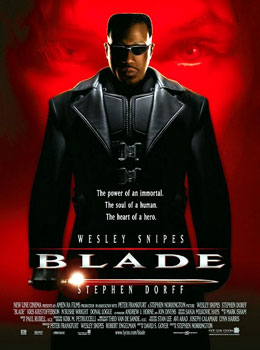
Blade:
Here we have another vampire hunter who’s more than just your average guy! Though his real name is Eric Brooks (according to the comic series), this street hunter goes by the professional name of “Blade”. Little wonder, considering that just about every weapon in his arsenal features an acid edged pig-sticker or a sharpened silver stake! But of course, the real twist comes in why he does what he does.

As if that wasn’t badass enough though, he also alternates between a Gran Torino and a motorbike, wears a leather cape over segmented body armor, and packs enough firepower to take down an entire SWAT team single-handedly! All the while, he utters his few, but cryptic lines through those big, vampire incisors.

Known ominously as the “Daywalker” to vampires who are scared shitless of him, he combines the best of both worlds when it comes to human and vampires. He is immune to silver, garlic and daylight, but can heal almost instantaneously and has super strength. His only weakness however comes in the form of the “thirst”, the need for blood which every vampire suffers from and must eventually succumb to, or die. In order to preserve his humanity, Blade relies on a synthetic “serum” which temporarily satisfies his cravings.

In a theme that has growing in popularity and familiarity since the early 80’s, Blade is a half-man, half-vampire who’s mother was bitten while pregnant with him. Tormented by his split identity, and the supposed loss of his mother, he has chosen to resolve this crisis by hunting those that made him what he is and robbed him of his human life. However, the question of what he will do once he’s rid the world of the last vampire, and what he will do when the serum stops working, are questions that remain unresolved, and help to drive the story.

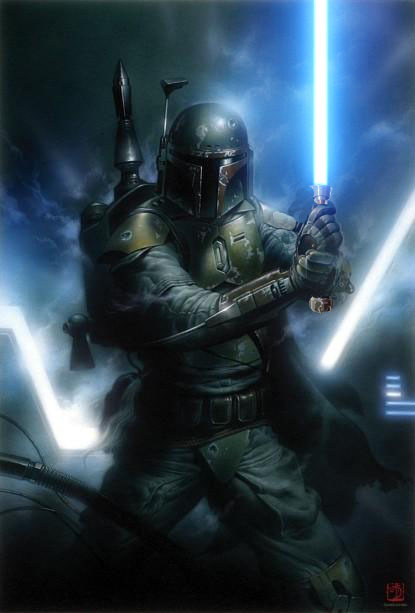
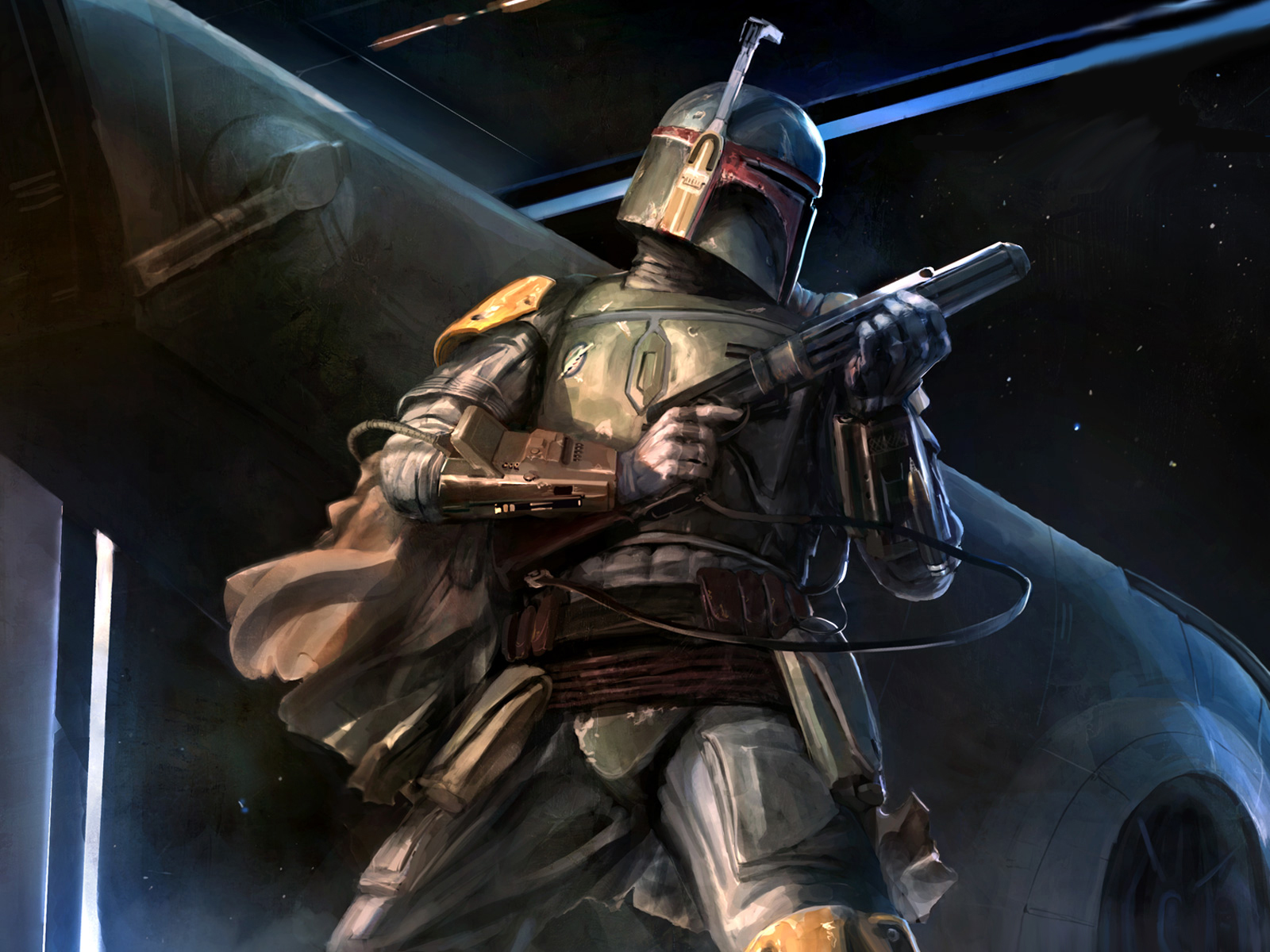
Boba Fett:
When you hear the name Star Wars and the word badass, what naturally comes to mind? Assuming you know anything about Star Wars, then chances you thought of Boba Fett! This notorious bounty hunter was probably the most badass thing about the series, dwarfing Vader, Jabba, and the Emperor in terms of shear awesomeness!

Hell, this guy not only appeared repeatedly in movies two and three (with a small cameo in a deleted scene in movie one), he also had entire novels, comics, and games dedicated to him. Annnnd, if the Dark Horse series Dark Empire is to be believed, Fett even escaped the mighty sarlacc. Who else amongst the expanded cast of the Star Wars saga can boast that kind of record? Lando? HA!

Though Lucas attempted to explain Boba’s origins in the prequel movie Attack of the Clones, other stories from the expanded universe claims that Boba was in fact a former Stormtrooper of Mandalorian origin.

However, on this latter point, all sources agree. Clearly, Boba Fett was of Mandalorian origin, a warrior race that had become virtually extinct after the Sith Wars and had relegated themselves to the role of bounty hunters and mercenaries. Boba had apparently distinguished himself amongst his rivals by delivering on contracts, charging exorbitant fees, and being very hard to kill. Hell, somebody who crawled their way free of the sarlacc aint no pushover!

The Joker:
Batman’s nemesis, and Gotham’s smiling psychopath, the Joker is one of those villians you just love to hate! And yes, he’s also pretty damn badass! Though he has gone through countless renditions and adaptations over the years, all the variations revolve around the same basic theme.

Basically, the Joker is a sociopathic criminal who thrives on chaos, the perfect polar-opposite to Batman’s vigilante persona. Over the years, he has been in and out of Gotham’s Arkham Asylum, examined by doctors, but always seems to escape to stir up shit again.

In his most recent incarnation, as performed by Heath Ledger, the Joker reached new heights of popularity and badassery! Not only did he manage to rip off the mob, turn Gothamites against the Batman, drive Harvey Dent mad, commandeer the mob, bring Gotham to the brink, and stay one step ahead of the Batman and police the whole time. He managed to do it all with a twisted smile on his face! That’s an awful lot for a man who claims he doesn’t do planning!

Looking to the comics and expanded franchise, one sees even more examples of badassery! Here, as well as in the movies, new and old, the Joker is notorious for causing trouble and doing it with a shit-eating grin. In addition to the general mayhem he’s been known to cause, his credentials include turning a psychologist into his willing sidekick (Harley Quinn), kidnapping and torturing the Commissioner’s daughter, killing one of the Robin’s, and nearly killing Batman on numerous occasions. Yet somehow, he always manages to escape, survive, and live to inspire chaos another day. Malevolent? Yes. Psychotic. Oh yes! But a notorious badass as well? You betcha!

Raven:
“Until a man is twenty-five, he still thinks, every so often, that under the right circumstances he could be the baddest motherfucker in the world… Hiro used to feel this way, too, but then he ran into Raven. In a way, this was liberating. He no longer has to worry about being the baddest motherfucker in the world. The position is taken.

That pretty much says it all. Taken from Neal Stephenson’s Snow Crash, Raven is one of the chief antagonists of the story and one of the baddest motherflechter’s around! An Aleut by ancestry, he is skilled in the art of harpoon throwing, knife fighting, killing people, and being untouchable. Of course, this might have a lot to do with the fact that in the sidecar on his motorbike (pretty badass in itself!) he has a thermonuclear device stashed. This, apparently, he got off a Russian sub after stowing aboard and killing the entire crew with glass knives, and its wired to go off in case anybody does the unthinkable and kills him. Hence, nobody messes with Raven, as if his size and skill with weapons weren’t intimidating enough!

People recognize Raven not only by his obvious size, leather jacket, and motorbike, but also by the words “Poor Impulse Control” tattooed on his forehead. This is a holdover from his years in the corrections system of the future, where they’ve resorted to tattooing a prisoner’s particular maladjustments directly on their forehead for all to see. But for those who’ve pissed him off, or are just on his hit list, the first indication that Raven’s around is the telltale presence of his harpoon in your chest!

Molly Millions:
Also known as “Sally Shears”, Molly is a recurring character in William Gibson’s Sprawl Trilogy. Technically, she is what is known as a “razor girl”, though cyber-ninja works just as well. Basically, she’s a gun (or razor blade) for hire who gets paid by high-rollers to take out anyone who stands between them and their objectives. This, she typically does by slashing people with razor claws that are imbedded in her fingertips, though she’s adept at hand to hand combat and wield firearms with the best of them too!

Thought tough, deadly and ruthlessly efficient, she has shown herself to have a softer, sensitive side, not to mention a sympathetic past. For instance, her first appearance is in Gibson’s short story (and film adaptation) of Johnny Mnemonic. Here, she goes beyond her usual mandate and begins to fall in love with the story’s protagonist, Johnny.

In her follow-up appearance in Neuromancer, she admits that he was the first “client” she overstepped her boundaries with and still mourns him years later. She also reveals that she began as a “meat puppet”, a form of prostitute who allows their body to be controlled by handlers while they are maintained in a blank-outed state. This is how she apparently paid for her cybernetic enhancements and became a mercenary ninja.

On top of all that, she is a fiercely loyal and levelheaded woman who, despite the nature of her job, is committed to her moral code and values the kinds of human relationships that are becoming increasingly rare in Gibson’s world. One might say that she’s tough because she has to be and would much rather live an ordinary life where love is not obsolete and murder for hire is not the only way for street people to get ahead. Still, don’t mess with her! Just because she’s got a soft side doesn’t mean she won’t fillet your ass!

Ripley:
Mother, warrior, humanitarian and xenocidal ass-kicker, Ellen Ripley defined female badassery for an entire generation of moviegoers! From her humble origins as a crewman aboard the Nostromo to her showdown with the mother Alien, Ripley demonstrated the full range of the heroine protagonist. She was began as a regular officer who was put into a terrifying and claustrophobic situation, a lone survivor of a xenomorph attack aboard a confined spacecraft.

But living to fight another day, she faced her vulnerability, overcame her fear, and put it all on the line to save a little girl. And in the course of that, she also strapped on some heavy artillery and kicked some serious ass! And in the end, the showdown between herself and the Alien hive queen was not only cinematic gold, it was so thick with allegory you could cut it with a knife! Two mothers, two titanic forces, coming together to fight for their young!

Let’s face it, this is what makes Sigourney Weaver and her character so awesome and sympathetic. She’s a regular woman who, when faced with treacherous odds, went above and beyond to do the right thing. And let’s not forget that her motives were purer than anyone else’s. Whereas some people were interested in their bonuses and others in shooting shit up, she fought tooth and nail to protect and save the life of a young child, a girl who reminded her of the daughter she lost.

And it worked. In the end, she outlived all the professionals who ignored her or were sent in to “protect her”. When all else failed, this lady came through and showed that you don’t come between aΒ  mother and her child and you don’t underestimate a determined woman, or she’ll kick your ass! Yes, years later and Ripley still remains an inspiration to women everywhere, and a reminder to us boys to respect and honor the women in their lives. In the end, they are a hell of a lot tougher than you think πŸ˜‰

Vampire Hunter D:
Yet another vampire hunter who’s got some questionable ancestry! Vampire Hunter D is based on a novel series with manga and anime adaptations. Taking place in the distant future, thousands of years after WWIII took place, D wanders through a pre-industrial world hunting the demons, vampires and assorted creatures that have come to plague it. Apparently, in the distant future, vampires have established themselves as a sort of Nobility that control their fiefdoms through a combination of advanced technology and magic.

Much like Alucard, D has a questionable ancestry which is gradually established as time goes on. Right off the bat, it is clear that he is a dhampire, the child of a vampire mother and a human mother. As time goes on, it becomes established that he is fact the son of the ancient Count himself. As a result, he has some pretty badass powers, which include spontaneous healing, super strength, and some pretty dark powers! Unfortunately, he also has his share of weaknesses as well. Sun-sickness, garlic; all the things that are fatal to vampires are pretty harmful to him as well.

Believing that vampires have overstepped their traditional authority, D is dedicated to sending them back to the darkness from whence they came. Though he is part vampire, he values his human side and cannot condone how vampires abuse the humans they have dominion over.

Ah, and his weapon of choice for dispatching vampires and demons? A big katana-style sword! This weapon can decapitate even the most powerful vampire, or rend him from his neck to his navel. Oh, and did I mention he also has a smartass symbiot living on his hand? Might sound weird, but this thing keeps him company, keeps him honest, and has even saved his life a few times.

Vasquez:
Yes, I realize I’m doubling down on a single franchise. But no list of badasses would be complete without mentioning Private Vasquez. Also of Aliens fame, this woman put theΒ  bad in badass, toting that massive smartgun and telling everybody who got smart with her where to go! Seriously, those iconic lines, “Let’s ROOOOOCK!” and “I just want to know one thing… where-they-are!” Bam! There wasn’t a single person in the audience who wasn’t get goose bumps.

Not only was she clearly a tough, take-no-prisoners kind of woman, she commanded the respect of those around her, particularly the men. Hudson, played by Bill Paxton, would get smacked down anytime he tried to sass her. Recall the lines: “Vasquez, anybody ever mistake you for a man?” “No, how about you?” Classic! And of course Private Drake, her partner in arms, practically followed her around, even though he was twice her size!

But of course, she too had a sensitive side. When Drake fell protecting their group, she took it really hard. She was even willing to go back into the den of the xenomorph’s when it became clear he was still alive. Even though it was obvious he and the others were being used as symbiotes and the odds of them making it out alive were virtually nil, she was still willing to risk her life. One seriously got the impression that she loves the big lug after all…

But mainly, she was an ice cold chick and tough as nails. When those around her began to panic and cry “game over, man!”, she raised her gun and started kicking ass! And when at last she was cornered and wounded, did she roll over and die? Hell no! She grabbed hold of that grenade and went down with a bang, taking as many of those buggers as she could buggers with her! RIP Vasquez. You rock!

Well that’s all for now. I was going to include some non sci-fi examples in this list as well, but that would made it too long to post! Stay tuned, I’m thinking I’ll save those examples of mainstream badassery for next time. And I might just have some final thoughts to offer on this whole phenomenon known as badassesness. I love inventing words! Bye!

Prometheus and an interview with Ridley Scott

Recently, I came across the lovely article entitled “Don’t f—- around with gods” from the Sydney Morning Herald. The subject was director Ridley Scott’s new movie, Prometheus, which is currently in post-production and set to be released in June of this year. As I’m sure everyone is aware by now, this movie is a return to the universe of Alien, a franchise which Scott began in earnest 30 years ago. Originally thought to be a prequel, Scott has since revealed that this movie is in fact a sort of standalone movie which explores the concept of Exogenesis – the idea that life came to Earth or other planets from an extra-solar source.

Although linked to the original Alien movie in that it deals with the same derelict that the crew of Nostromo encountered, the story is far more concerned with the alien race known as the Space Jockeys than the xenomorphs themselves. Or at least, that appears to be the focus. I’m sure the xenos make an appearance, and probably end up screwing everybody over, as is there tendency! But mainly, Scott emphasized that the plot, as suggested by the title, has to do with the discovery of powerful, dangerous things. When one encounters alien technology, the specter of the bound god who gave fire to humanity can’t help but be resurrected. It’s just timeless like that!

In the course of the interview, Scott also spoke extensively about his reasons for getting into science fiction in the first place. I have to say that I loved his answer: “Science fiction is a wonderful – sorry about the pun – universe for – again, another much overused word – creativity. It’s an arena where anything goes… The opportunity presents itself to fundamentally do anything you want, providing that you draw up a rule book in the first place. You’ve got to draw up the rules of your drama and within that universe you’ve got to actually stick to your own rule book. I think that’s what’s happening – we’re not drawing enough rules up when we do materials. It feels like writing a book…”

Wow. It’s wonderful when you see words that you yourself have said put into the mouths of true veterans! If I was to make a list of directors whom I admire for their creativity and vision over the years, Scott would be tied with Stanley Kubrick for first place! With movies like Alien, Blade Runner, Black Hawk Down and Gladiator to his credit, I got to say that I’m pleased as punch that he and agree on two fundamental precepts. One, science fiction is a great realm for creativity and inventiveness due to the fact that the only limitations are those of the author’s imagination. And two, that it’s best to have a detailed game plan worked out in advance. This is what sunk Lucas’ prequels people! Always know where you’re going in advance and try to stick to the plan. Otherwise you wind up with contrived plot twists and forced situations. Trust me, I know!

Another great thing to read was Scott’s indictation that Prometheus wouldn’t be a massive CGI fest. Something which set Cameron’s Aliens apart from the dubious Avatar was the use of real live actors in suits or animatronics instead of digital creations. Granted, this was done in an age when CGI wasn’t available, but those who followed in Scott and Cameron’s footsteps understood the value of shooting things this way. If there was one thing AVP did right, it was the use of costumed actors and real sets rather than blue screens and generated images.

Having set the precedent, I think it’s only right that Scott remain true to this heritage. After all, his environments, especially that of the Space Jockey Ship, were known for their dark, gritty, grimy look, something which was very… Lovecraftian! Try doing that with digital effects, it just doesn’t work! CGI might be great for creating visuals, but the textures are always too clean and sterile. Or in the case of Avatar, too cartoony! And actors are far more convincing when they’re interacting with a real person, or even a robotic alien, than a standing stick or a tennis ball on the end of a string!

In any case, here’s the link to the article. It’s a good read, and definitely for fans of Scott, the Aliens franchise, and just sci-fi in general!