3 – Vigilance

3 – Vigilance

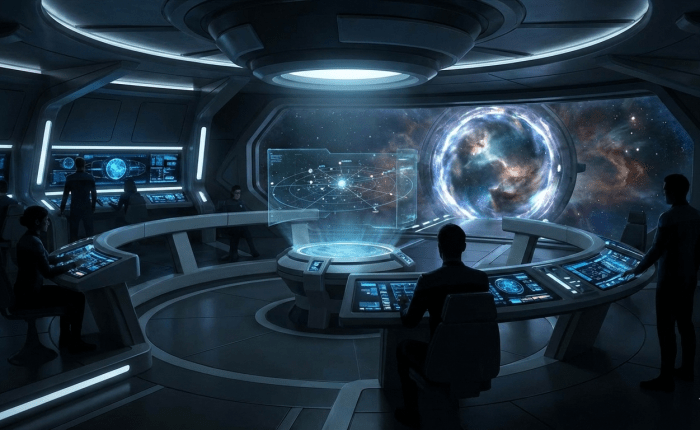
The central dais brightened as soon as Dube stepped into the room. As he approached, it rose slightly to greet him, rising further as his feet were firmly planted in the center. Other terminals and posts were already lit up and their attendants turned to greet Dube. And when he placed his hands out before him, an interface materialized in front of them.

He signalled to the ship’s AI that he was ready to assume his role as the Transverse’s temporary Custodian.

[Alright, Jonas. Show me the stars.]

The bulkhead directly in front of him, a concave feature that occupied much of the Bridge’s front section, went from opaque to transparent. Dube was immediately struck by the intense glow of the starfield, its countless pinpricks of light ranging from soft to piercing. In terms of color, they ranged from yellow and green to various shades of blue. This did not represent their true colors, but the way their light was being blueshifted.

Such was the effect of moving at relativistic speed. Checking their velocity, Dube was informed that they were travelling at 15% the speed of light, a consistent 0.15 c. At this velocity, they were moving faster than any crewed vehicle in human history. As they flew, the light coming from distant stars continued to meet them at a constant rate of c. To accommodate this quirk of nature, the wavelength was shortened, to the point that all light was shifted towards the blue end of the spectrum.

Switching to the rear view, Dube saw the opposite effect with the stars that were receding from them. The light from these reached the ship at the same velocity and time as the oncoming light, but its wavelength was shifted towards the red end of the spectrum. The situation would remain unchanged until the Transverse ceased its acceleration burn and settled into its cruise phase. And in generations, when they commenced their deceleration burn, the situation would be reversed.

Just one of the consequences of living in a relativistic Universe. Another, as indicated by the nature of their vessel, was the immense amount of energy and vast stretches of time it took to travel from one star to the next.

The inspired thought led Dube to call up an overlay and request permission to access the ship’s systems. His Engineer status was immediately accepted, and a range of options appeared before him. He quickly navigated through the menus to select Power and Propulsion, then checked on three interconnected things simultaneously.

Singularity Drive
Reaction Chambers
Main Thrusters

As he hoped, all three systems were in the green. At the ship’s core, a tiny, controlled singularity – no larger than a micron in diameter – caused material periodically injected into its chamber to swirl around it, eventually reaching close to the speed of light. Eventually, the material would fall onto the face of the singularity and be stripped down into its subatomic constituents. Immense energy was released in the process, which the reactor’s receptors happily absorbed.

Meanwhile, the Transverse’ Chambers were cool and calm. The smashing of protons and anti-protons in a carefully controlled process known as matter-antimatter annihilations had ceased with their last acceleration. And the thrusters were quiet, as their were no subatomic particles to accelerate to relativistic speeds.

Dube tried, but a quick check on the other ship systems and subsystems showed no indication of any malfunctions or problems. There were a few issues that were bracketed to one side of the display window. These were those that emerged since last shift and been resolved. Dube noted the work signature of his peers, Engineers Ahika Chen and ShankarVorhees – both of whom had been up for a few minutes longer than he.

At last, he had confirmation. There were absolutely no issues on the ship that required the attention of an Engineer. No distractions and no means for stalling.

Sighing, Dube called out to the ship’s Custodian again.

[Okay, Jonas. I’m here. Let’s have those updates.]

Jonas obliged, sounding almost happy to be summoned.

[Excellent. There are many reports and status updates for your perusal. Shall I share them in chronological order?]

[No. Parse all for anything considered vital, and collate them, starting with the most-recent updates, then provide synthesis from all previous updates.]

Jonas complied. Within seconds, Dube’s mind was filled with new data on the status of the Transverse and all that had happened since he had gone to sleep. As always, Jonas considered some matters to vital that Dube did not, nor any sensible engineer for that matter. For safety’s sake, Jonas’ threshold of concern – ToC, as the Engineers knew it – was deliberately set to high to make sure no small things slipped through the net and became a big thing later. But that meant that seemingly trivial things might slip through in the meantime.

Dube was on the verge of concluding that everything on the list was trivial, until he came to one particular item.

[Stop. What’s this about a power drop in this subsection?]

Jonas summoned a schematic of the ship and enlarged it in his visual field. The image zoomed in on the section in question, highlighted in yellow. The drop was unsubstantial, but not so meagre as to have gone unnoticed.

[Cause?]

[Unknown at this time.]

[Speculate]

Jonas quickly ran through the various possibilities, based on probability and level of concern. It was good that the ship’s Custodian considered a malfunction with its internal sensors (or worse, itself) to be the least likely or worrisome. Dube, personally, would have thought those warranted the most concern.

His attention became fixated on one possibility the moment Jonas mentioned it.

[A siphon? Someone could be siphoning power in that section?]

[Initial assessment indicates a probability of twenty-to-one. Comparatively, the probability of this being the result of a fault in the conduit are one point seven-to-one.]

Dube sighed and felt like chastising Jonas for making him anxious. Jonas wasn’t finished, though. [However, the probability of a power siphon changes considerably when adjusted for axiomatic non-exclusivity.]

Dube huffed. [Meaning?]

[Meaning they may be related. If a structural fault in the conduit was the result of tampering, hypothetically for the sake of syphoning power, then the probability becomes point-zero-six-three to one.]

Dube paused to consider that. A sixty-three percent chance that someone was tampering with the power conduits? Those were hardly comforting odds. The only question was why they were seeing this now.

[What purpose would a siphon in this subsection have?]

[Unknown.]

Dube was on the verge of telling Jonas to speculate once more but stopped himself. Asking for theories at this point was a waste of time, especially when he had his own thoughts on the matter and didn’t want to hear them repeated back to him.

This was something that warranted more eyes and thoughts, he felt.

[Jonas, where are Engineers Chen and Vorhees?]  Jonas replied that both were taking their restoratives in the Arboretum. [Alert them, quietly. Tell them to meet me at Steering. I believe we may have a Sigma-class Contingency on our hands.]

A Humble Attempt at Predicting Future History

A Humble Attempt at Predicting Future History

There’s an old saying by Kierkegaard, “Life can only be understood backward; but it must be lived forwards.” I’ve heard this adage many times, except that the word “history” was always substituted for “life.” This is certainly true, to a point. After all, history is subject to prejudices, bias, and the good old human tendency to look for patterns. In my experience, how we remember history is no less about “the winners write the books” as “the writers impose their organization principle.”

That’s what I love about science fiction’s future histories. The sub-genre owes its existence to Olaf Stapledon’s Last and First Men, a science fiction novel released in 1930. In this “future history,” Stapledon presented an imaginative romp through several futures where the descendants of humanity rise and fall many times, creating advanced civilizations and periodically slipping back into barbarism.

Continue reading “A Humble Attempt at Predicting Future History”

Behold! The Venus Calendar!

Behold! The Venus Calendar!

Recently, I learned that there’s an actual Martian calendar, known as the Darian Calendar. It was crafted by aerospace engineer Thomas Gangale in 1985, who named it after his son Darius. It was also adopted by the Mars Society in 1998 and will be the official calendar of Martian settlers (if and when permanent settlements are built on Mars someday).

Continue reading “Behold! The Venus Calendar!”

Revitalizing an Old Idea: Thirteenth

Revitalizing an Old Idea: Thirteenth

It came to me when I was in University and eventually grew to become the seed of my very first written work. It was intended to become part of a series called Legacies, and I had big plans for it. I even wrote a few short stories over the years that were part of this fictional universe. However, as years passed and I became more committed to hard science fiction, I fell out of love with the series. Since it was my first effort, I also felt that the writing was amateurish and needed serious polishing.

But the other day, I found myself musing about the seed. It wasn’t a bad idea, and I could still recall the sense of inspiration I felt when plotting it all out. And over the years, the basic concept was still there, always trying to find expression in new form or variation on the old. I can’t help it. There’s just something about ancient migrations, long-lost tribes, and forgotten histories that is so damn intriguing!

And since I’m at a transitional point in my writing – my first trilogy down and an open field in front of me – I’m once again contemplating if this idea has a future. While it’s not exactly hard science-fiction (more space opera), I still think it has the potential to be fun and intriguing.

Continue reading “Revitalizing an Old Idea: Thirteenth”

Talking About “the Process” – Part the First

Talking About “the Process” – Part the First

Recently, a friend of mine raised the subject of my writing process, how I go from receiving an assignment and/or getting ideas to researching the topic, deciding on an approach, and so forth. In short, he said that if I were ever to write an article where I share my personal experiences and preferences, he would happily read it. While I was understandably flattered, my first instinct was to groan at the mere mention of those two words:

“The Process”

I don’t why, but for about as long as I’ve been writing at a professional level, I’ve found this kind of talk both painful and tedious. Maybe it’s the way I’ve grown tired of introspection over the years, or maybe the way I prefer that discourse be focused on material rather than method. It’s like that witty line David Hyde Pierce once uttered on Frasier: “This is boring, yet difficult.”

Still, it’s an important subject and a crucial part in how things get created. For the sci-comm (science communicator), it’s all about taking raw information that is often inaccessible and translating it into an accessible narrative. It’s also about taking discoveries and developments that might otherwise appear to be happening in a vacuum and relating the context in which it happened, and the implications going forward.

So I decided to suck it up and relate what I could about this topic. For convenience sake, I have decided to address it in a Q&A format:

Continue reading “Talking About “the Process” – Part the First”

My First (Real) Five Year Plan

My First (Real) Five Year Plan

The Five Year Plan… chances are, we’ve all heard someone talk about how they have one and hoped that they would be able to achieve all their listed goals by the end of it. While I’m sure most people can’t be bothered to listen to anyone lay out their life plans with anything other than the barest of feigned interest, it does feel like this is something we should all consider.

Somehow, having a plan in place that includes an ultimate goal, concrete steps on how to get there, and a timeline for each step – that just seems like the kind of thing serious people and high-end achievers do, doesn’t it? So I got to thinking a while back that I should start setting goals and a schedule for making them happen, though this would be subject to adjustment along the way.

Continue reading “My First (Real) Five Year Plan”

The Formist Series is Almost Complete!

The Formist Series is Almost Complete!

Hey folks! As always, I feel like I’m overdue in posting an update and letting you know what’s going on. I guess it’s just the nature of my work, but at the end of the day, I just seem to have very little energy left to write anything. But that’s no excuse. So as always, allow me to apologize for not posting this sooner!

As the headline says, my first series of novels – which includes The Cronian Incident and The Jovian Manifestois nearing completion. It’s been quite the long road and there’s been plenty of peaks and troughs. But now that the finish line is finally in sight, I’m feeling excited! So let’s do this right and start by talking about this final installment in the series…

Continue reading “The Formist Series is Almost Complete!”

Ten Day Book Challenge: Day Four

Ten Day Book Challenge: Day Four

And I’m back with another entry in the Ten Day Book Challenge. I’ve been very bad at keeping up with these, but I am determined to share my choices for the top ten most influential books I’ve ever read. So what I lack in punctuality, I hope to make up in sincerity and selection :).

Okay, so as usual, here are the rules of this challenge:

  • Thank whoever nominated you with big, bold print. If they have a blog, link to the post where you got tagged there.
  • Explain the rules.
  • Post the cover of a book that was influential on you or that you love dearly.
  • Explain why it was so influential to you.
  • Tag someone else to do the challenge, and let them know they’ve been tagged.

Thanks once again to RAMI UNGAR for the nomination, and you can find him at ramiungarthewriter.com. And here’s my third selection for the challenge, the post-cyberpunk classic The Diamond Age!

This book takes place in the 21st century after the world has been fundamentally changed by the introduction of nanotechnology. If Eric K. Drexler’s book The Engine of Creation was the authoritative treatise on how nanotechnology would change our lives, The Diamond Age was definitely the fictional counterpart. In this novel, Stephenson treated fans to his usual mix of weirdness, genius, historical and social commentary, education and growth.

For me, this book remains immensely influential, not because it introduced me to the concept of nanotechnology, but because it did so in a way that had such depth. Anyone who reads this is sure to feel that this book came along at exactly the right time to offer commentary on a concept that was slowly moving from the realm of science-fiction to science fact. And as this concept becomes more and more realized, I feel that this book will become required reading for people looking to understand the evolution of nanotechnology.

But, as I said, this book went beyond mere technological commentary, and contained some very interesting thoughts on social change, historical patterns, and the role of culture in development. While I didn’t agree with everything he asserted, it was interesting to see Stephenson detail how specific cultures may go about embracing technology differently, and how the pendulum of history can swing back and forth depending on the time and place and what means are available to people.

If nothing else, it got me thinking in a very serious way, like most of his works. And it was also delightfully fun to read and inspired me as a science fiction writer to take more risks and tackle issues I felt were previously inaccessible to me. Again, I highly recommend this book.

Okay, now for my nomination. This time around, I nominate the Tousled Apostle herself and a long-time friend and colleague of mine, Jamie A. Hughes!


Cover Art Reveal for the Future Days Anthology!

Behold! When the anthology drops, this will be the beautiful artwork that adorns the cover! This anthology is a collection of short stories by Castrum authors and is being released in advance of a number of new books by said authors (one of which is the second installment in my Formist Series – The Jovian Manifesto). My wife thinks there’s a strong resemblance between the child wearing the jet pack and yours truly. Yeah, I suppose I can see it too! 🙂

For those interested, my own contribution is the story Jericho, a story that takes a look at a generation ship that arrives at its destination many centuries from now. The colonists are what are known as Seedlings, people who use advanced nanotechnology to seed and terraform other worlds in advance of colonists. When they arrive, their homes, cities, streets, industries, and all the basic amenities are already built. All they need to do is take their places among the colony and get things working.

This story takes place in the same universe as The Cronian Incident, thought not the same time frame. Speaking of which, stay tuned for cover art for the second installment in that series, The Jovian Manifesto!

The Jovian Manifesto, More Good News!

The Jovian Manifesto, More Good News!

Some good news on the publishing front. My latest novel, the Jovian Manifesto (the second installment in the Formist Series), is back from the editor and I’m now making corrections. Once that’s done, it’s back to the publisher for another run-through, and then it will be ready for publication. While I can’t give a precise date, a realistic estimate at this point places the release date early this summer. And I’ve already seen some sample artwork, and it looks awesome!

And while I don’t want to spoil anything, I can say that the second book has plenty of action scenes! One thing I worried about in book one was that it had a rather slow buildup. Of course, that’s a consequence of having a story with multiple settings and an intricate plot. Nevertheless, I wanted there to be more action scenes in the second and third books, and ensure that they occurred throughout.

Credit: NASA

Suffice it to say, there are a few combat scenes that involve powered exosuits, some exotic locations, and the aforementioned space combat. Writing these scenes was admittedly a bit of a challenge, since its kind of hard to predict what combat would look like where super-advanced technology is involved. In a society where anything can be synthesized and manufactured at the atomic level, what kinds of weapons, armor and ships would be possible?

In other news, The Cronian Incident is still getting reviews. At this moment, it has accrued 12 reviews on Amazon (with an average rating of 4.7 out of 5 stars) and 16 on Goodreads – with an average rating of 4.0 out of 5 stars. Hopefully, the second book will do just as well.