News From Space: Canada’s Plans for 2014

canadarm2_chrishadfieldEarlier this month, Industry Minister James Moore announced that Canada’s new space plan will be made public in early in the new year. The announcement came on Monday Dec. 2nd at an aerospace forum in Montreal which also brought together leaders of Canada’s space industry. Emphasizing the achievements of Canada’s space industry, he also went on to claim that next year’s goals would reach beyond these traditional areas:

Our companies are leaders in optics, in robotics, radar imagery and satellite communications, but we will not stop at this success… The industry has spoken up, has worked collaboratively, has given the government advice on how to proceed (and) we’ve taken the advice and we’re putting it into action.

A background paper provided by Moore outlined the government’s strategic goals for its space activities, which include jobs and growth, sovereignty, security and the advancement of knowledge. Moore also told the space industry executives assembled that the government will examine all opportunities to work with the private sector and Canada’s international partners to encourage innovation in the country’s space activities.
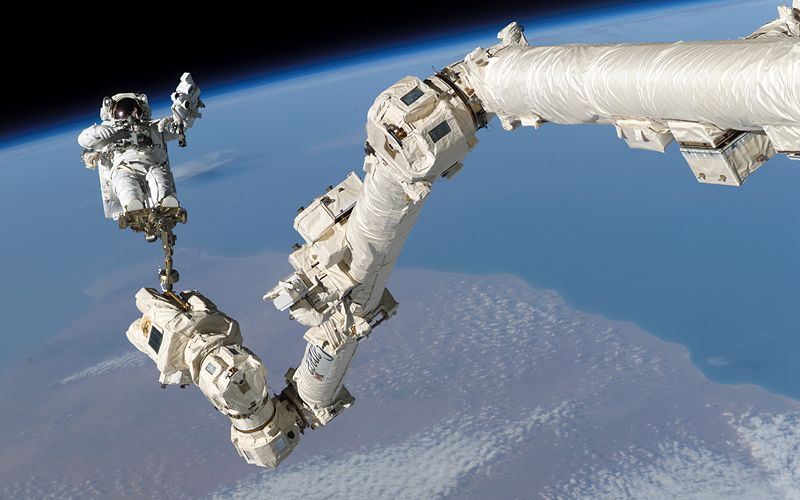
Canadarm2_Steve_RobinsonFollowing up on the Emerson report’s recommendations, Moore announced various actions, including the establishment of a space advisory board composed of industry leaders and chaired by Walt Natynczyk, head of the Canadian Space Agency.

This framework will provide the foundation for the next phase of our government’s space program. It will be based on the principles of partnership with other countries and the private sector, catering to our strengths and inspiring Canadians.

The industry minister also said the government will double current support for its space technologies development program to $20 million annually by 2015-2016:

This will bring the kind of predictability and stability of funding that you asked for. And (it) will help develop more groundbreaking space technologies that Canadian space companies are so recognized for.

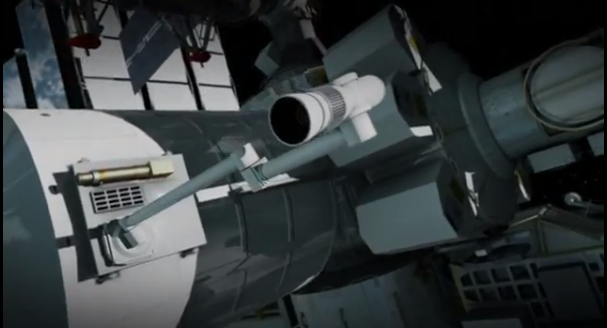
spacex-dragon-capsule-grabbed-by-iss-canadarm-640x424Beyond these stated objectives, its not quite clear what in store’s for the Canadian Space Agency (CSA). After Hadfield’s high-profile tour as the mission commander aboard the ISS, it is safe to say that interest in this field is growing. And with our nation’s ongoing commitment to providing new robotic arms (aka. Canadarm’s) for the ISS, parts and technical workers and astronauts for manned missions, any increase in public interest is likely to have positive results.

What’s more, with the Obama government dedicated to pursuing some extremely ambitious objectives – towing an asteroid to Near-Earth Orbit, a manned mission to Mars, establishing an outpost on the Moon – it would seem obvious that one of their greatest colleagues in space exploration and research would want to get on board.

Source: cbc.ca

Evidence for the Big Bang

planck-attnotated-580x372The Big Bang Theory has been the dominant cosmological model for over half a century. According to the theory, the universe was created approximately 14 billion years ago from an extremely hot, dense state and then began expanding rapidly. After the initial expansion, the Universe cooled and began to form various subatomic particles and basic elements. Giant clouds of these primordial elements later coalesced through gravity to form stars, galaxies, and eventually planets.
And while it has its detractors, most of whom subscribe to the alternate Steady State Theory – which claims that new matter is continuously created as the universe expands – it has come to represent the scientific consensus as to how the universe came to be. And as usual, my ol’ pal and mentor in all things digital, Fraser Cain, recently released a video with the help of Universe Today discussing the particulars of it.

big_bangAddressing the particulars of the Big Bang Theory, Cain lists the many contributions made over the past century that has led this so-called theory to become the scientific consensus has come to exist. They are, in a nutshell:

  1. Cosmic Expanion: In 1912, astronomer Vesto Slipher calculated the speed and distance of “spiral nebulae” (galaxies) by measuring the light coming from them. He determined most were moving away. In 1924, Edwin Hubble determined that these galaxies were outside the Milky Way. He postulates that the motion of galaxies away from our own indicates a common point of origin.
  2. Abundance of Elements: Immediately after the big bang, only hydrogen existed and compressed into a tiny area of space under incredible heat and pressure. Like a star, this turned hydrogen into helium and other basic elements. Looking out into the universe (and hence back in time) scientists have found that great distances, the ratios of hydrogen to basic elements is consistent with what is found in star’s interiors.
  3. Cosmic Microwave Background (CMB) Radiation: In the 1960’s, using a radiotelescope, Arno Penzias and Robert Wilson discovered a background radio emission coming from every direction in the sky, day or night. This was consistent with the Big Bang Theory, which predicted that after the Big Bang, there would have been a release of radiation which then expanded billions of light years in all directions and cooled to the point that it shifted to invisible, microwave radiation.
  4. Large Scale Structure: The formation of galaxies and the large-scale structure of the cosmos are very similar. This is consistent with belief that after the initial Big Bang, the matter created would have cooled and began to coalesce into large collections, which is what galaxies, local galactic groups, and super-clusters are.

These are the four pillars of the Big Bang Theory, but they are no means the only points in its favor. In addition, there are numerous observational clues, such as how we have yet to observe a stars in the universe older than 13 billion years old, and fluctuations in the CMB that indicate a lack of uniformity. On top of that, there is the ongoing research into the existence of Dark Matter and Dark Energy, which are sure to bear fruit in the near future if all goes well.

big_bang1In short, scientists have a pretty good idea of how the universe came to be and the evidence all seems to confirm it. And some mysteries remain, we can be relatively confident that ongoing experimentation and research will come up with new and creative ways to shed light on the final unknowns. Little reason then why the Big Bang Theory enjoys such widespread support, much like Evolution, Gravity, and General Relativity.

Be sure to check out the full video, and subscribe to Universe Today for additional informative videos, podcasts, and articles. As someone who used to write for them, I can tell you that it’s a pretty good time, and very enlightening!

News from Space: The Search for Life on Europa

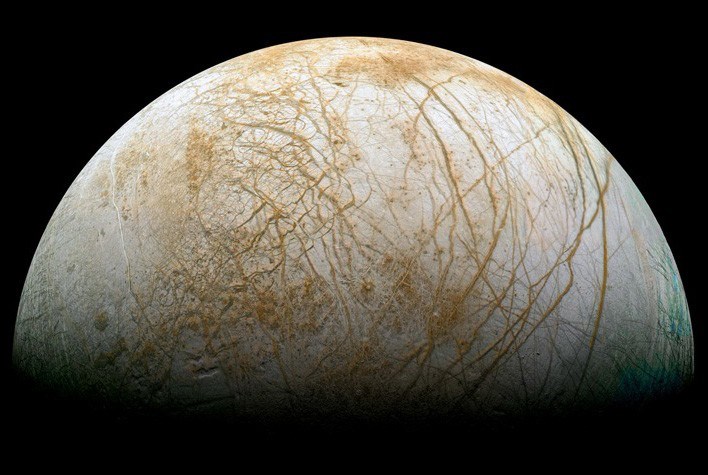
europa-landerJupiter’s moon of Europa is one of the best and most intriguing candidates for extra-terrestrial life in our Solar System. For many decades, scientists have known that beneath its icy outer-shell, a warm, liquid ocean resides. Due largely to interaction with Jupiter’s strong magnetic field – which causes heat-generating tidal forces in Europa’s interior – these warm waters may host life.

And now, new models suggest that its ice-covered waters are turbulent near the lower latitudes. This is what gives rise to its chaotic equatorial landscapes, but intriguingly, may also make it easier for life to make it to the surface. This contradicts previously held beliefs that Europa’s life was contained beneath it’s outer shell, and will mean that any missions mounted to Europa may have an easier time spotting it.

europa_chaosterrainThanks to ongoing observation of the planet’s surface – especially the Galileo and New Horizons space probes which provided comprehensive and detailed images – it has been known that Europa’s surface features are not consistent. The landscape is marked by features of disrupted ice known as chaos terrains, geological features that are characterized by huge chunks of ice that have broken away and then re-froze into chaotic patterns.

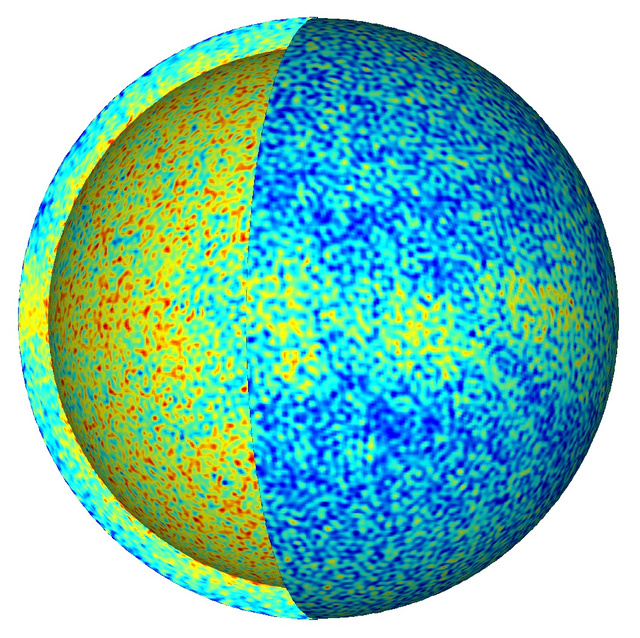
These models were produced by University of Texas geophysicist Krista Soderlund and her colleagues. Based on computer simulations, Soderlund and her colleagues have theorized that turbulent global ocean currents move Europa’s internal heat to the surface most efficiently in regions closest to the moon’s equator. This is likely causing the melting and upwelling at the surface, and why regions further north and south appear to be smoother.

europa_modelIn addition, the models indicate that given Europa’s spin, heat flow, and other factors, it likely percolates upward at about 1m per second or so — which is remarkably fast. This would explain why the equatorial regions appear to be so fragmented. But it also means that these areas are also likely yo be relatively fragile and soft, which means that upward currents could bring nutrients and even living organisms to the surface.

Hence why any potential search for signs of life on this moon would now appear to be considerably easier. If missions are indeed mounted to Europa in the not-too-distant future, either involving probes or manned missions (most likely in that order), their best bet for finding life would be to land at the equator. Then, with some drilling, they could obtain core samples that would determine whether or not life-sustaining nutrients and organic particles exist beneath the ice.

Hopefully, these missions won’t run afoul of any life that doesn’t take too well to their presence. We don’t want a re-enactment of Europa Report on our hands now do we?

Source: IO9.com

News From Space: China’s Jade Rabbit Moon Rover

change'e3Earlier this week, China took another step towards becoming a major power in space with the launch of the Chang’e-3 lunar probe. On board this vehicle is the Yu Tu (Jade Rabbit) lunar rover, a vehicle that is designed to deploy from the vehicle once it reaches lunar orbit and explore the surface independently. If all continues to go to plan, the Chang’e-3 will reach the Moon by December 14th, and its arrival will certainly be historic.

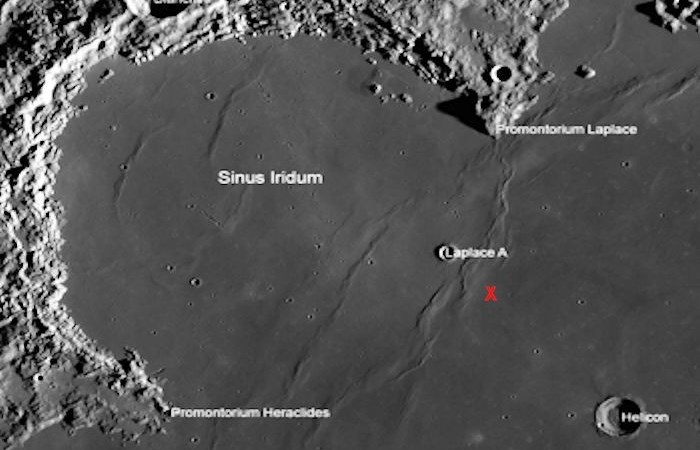
For starters, the probe’s landing in Sinus Iridum, a basaltic lava plane in the Moon’s northern hemisphere, will be the first spacecraft to make a soft landing on the Moon in 37 years. In addition, it will the be the first time China has landed a spacecraft and a rover on the Moon. This is the latest in the Chang’e program, a series of robotic and human missions that ultimately seeks to put Chinese cosmonauts on the Moon.

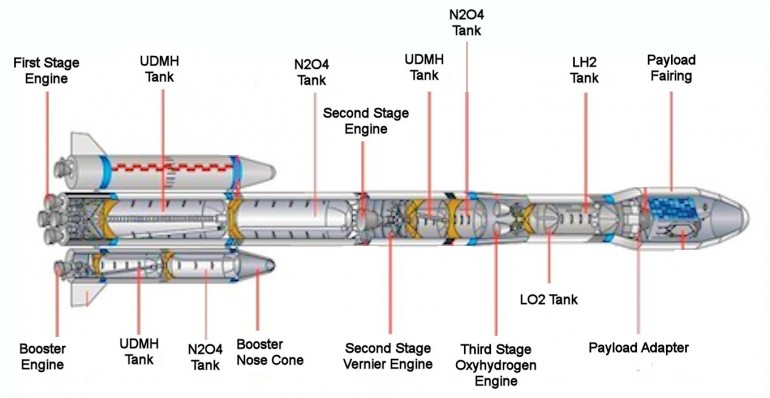
change'e3_2The Chang’e-3 mission incorporates two major components – the Lander and the Jade Rabbit rover, which is named after the companion of the Moon goddess Chang’e in Chinese mythology. The three-stage Chang Zheng 3B (Long March 3B) launch vehicle that is being used to send the Chang’e-3 probe to the Moon is roughly a functional equivalent of SpaceX’s Falcon 9 rocket, the heaviest rocket in their fleet.

After launching on Monday from the Xichang Satellite Launch Centre, the rocket was placed into an Earth-Moon transfer orbit and conducted its first separation. Shortly thereafter, its second stage engines were engaged to effect course corrections and bring the lander and rover into lunar orbit. Then came two crucial burns from the third stage engines, which put the Chang’e-3 probe into a parking and then highly elliptical translunar orbit.

change'e3_3Throughout all this, the probe slept, and will continue to do so until it burns its own engines to enter lunar orbit tomorrow.Then will come the tricky bit, landing safely without any input from controllers on Earth. This requires a combination of inertial guidance, extremely precise range and velocity measurements, image recognition, and a pretty fast computer – not to mention a certain amount of luck.

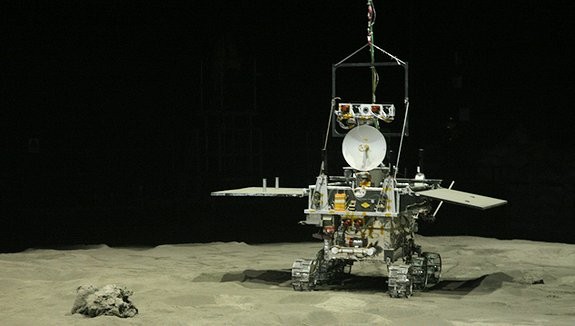
Once landed, the six-wheeled rover will begin exploring the surface and collecting soil samples for analysis. As with other rovers, energy will be provided by a series of solar panels and information obtained during its mission will be sent back to Earth for further analysis. In addition, real-time video and pictures will be captured by the rover’s arsenal of cameras, all of which will be sent back to Earth and shared via Chinese media outlets.

change'e3_1In addition to being a first for China’s space program, the Jade Rabbit also has the added distinction of being outfitted with what is arguably the most sophisticated scientific equipment of any previous rover. Most notable is a powerful ground-penetrating radar capable of penetrating up to 30 meters (100 ft) of lunar soil or about 100 m (330 ft) of lunar crustal material, and analyzing the underlying structure.

The rover is also equipped with an Alpha Particle X-ray Spectrometer (APXS) that uses particle-induced X-ray emission and X-ray fluorescence to determine the abundance of elements within rock and soil samples. The instrument can also find hidden materials, such as water of crystallization, which is otherwise difficult to detect remotely. Finding water on the Moon is an ongoing objective for space agencies, and crucial to plans for future settlement.

change'e3_4Then there is the Lunar Ultraviolet Telescope (LUT), which is designed to act as the first long-term astronomical observatory to ever be placed on the Moon’s surface. The vacuum environment and slow rotation of the lunar environment make an ideal location for near-UV observations that cannot be carried out from beneath the Earth’s obscuring atmosphere.

Another optical instrument is the Extreme Ultraviolet Camera intended to monitor the Earth’s plasmasphere, which is a magnetically active region within the magnetosphere but above the ionosphere. It works by viewing light with a wavelength of 30.5 nm which is scattered from helium ions in the plasmasphere. The lander is also hosting several other cameras and a lunar soil probe.

china-lunar-lander-rover-launch-jade-rabbit-13As already stated, the landing site for Chang’e-3 is in the general area of Sinus Iridum, a northwestern extension to the Mare Imbrium basaltic plane which is surrounded from the northeast to the southwest by the Montes Jura mountain range. A precise location has not yet been announced by Chinese authorities, but it has been widely speculated that it will take place within the vicinity of crater Laplace A – a crater that is about 9 km in diameter.

This is certainly an exciting time, as we are likely to learn plenty of new things about the Moon in the next few weeks! And in the meantime, be sure to check out this animation of the Change’e-3 entire mission- from launch to touchdown and deployment on the Moon, courtesy of RyukyuSARs:


Sources: gizmag.com, nasaspaceflight.com

Cassini, MESSENGER, and MOM: A Space Probe Odyssey

Cassini_Saturn_Orbit_InsertionIt had has been a big month in the field of space probes and satellites. Whether they are in orbit around Mercury, on their way to Mars, or floating in the outer Solar System, there’s been no shortage of news and inspirational footage to be had. And it is a testament to the age we live in, where space news is accessible and can instantly be shared with millions of people around the world.

First up, there’s the recent release of Cassini’s magnificent image of Saturn’s rings shining in all their glory. Back in July, Cassini got a good look back at Earth from about 1.5 billion kilometers (932 million miles) away. Known as
“The Day The Earth Smiled”, NASA has spent the past few months cobbling together this picture from numerous shots taken during Cassini’s circuitous orbit around Saturn.

cassini-jupiter-annotatedCassini has always been able to take impressive pictures in Earth’s general direction, but this picture was special since it used the enormous bulk of Saturn to block the usually confounding brightness of the Sun. Cassini, which was launched to survey the outer planets in 1997, captured an absolutely incredible image of both the Earth as a pale blue dot, and of Saturn as a striking, luminous apparition.

As part of NASA’s latest awareness campaign, which tried to get everyday citizens to smile at the sky for the first posed interplanetary photo most of us have ever experienced, the photo captured the halo effect that makes our sixth planet look truly breathtaking. In the annotated version (pictured above), you can also see Venus, Mars, and some of Saturn’s moons.


Next up, there’s the MESSENGER probe, which managed to capture these impressive new videos of Mercury’s surface. As part of the NASA Advisory Council (NAC) ride-along imaging campaign, these videos were captured using the Mercury Dual Imaging System (MDIS). Even though the original high-res images were captured four seconds apart, these videos have been sped up to a rate of 15 images per second.


The views in each video are around 144-178 km (90-110 miles) across. The large crater visible in the beginning of the second video is the 191-km (118-mile) wide Schubert basin. In related news, there are new maps of Mercury available on the US Geological Survey website! Thanks to MESSENGER we now have the entirety of the first planet from the Sun imaged and mapped.

MESSENGER launched from Cape Canaveral Air Force Station back in August of 2004 and established orbit around Mercury on March 18th, 2011. It was the first man-made spacecraft ever to do so, and has provided the most comprehensive mapping of Mercury to date, not to mention evidence of ice, organic molecules, and detailed conditions on the surface.

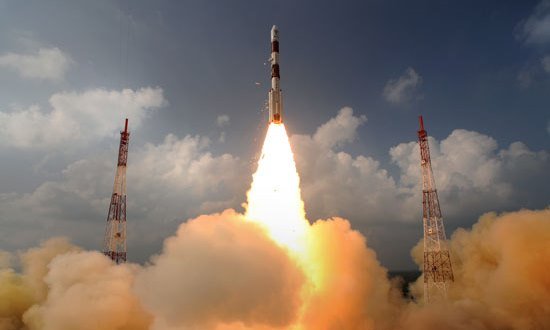
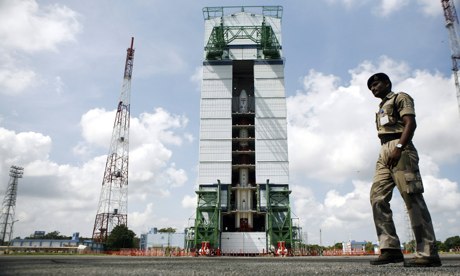
India_Mars_Orbiter1And last, but not least, there was the recent launch of the Indian Space Research Organization’s (ISRO) new Mars Orbiter Mission (aka. MOM). The launch took place on Tuesday, November 5th from the Indian space port located on a small island in the Bay of Bengal. As the nation’s first attempt to reach the Red Planet, the aim of the $70 million mission goes beyond mere research.

In addition to gathering information that might indicate if life has ever existed or could exist on Mars, the mission is also meant to showcase India’s growing prowess in the field of space and to jump ahead of its regional rival (China) in the big interplanetary march. As Pallava Bagla, one of India’s best known science commentators, put it:

In the last century the space race meant the US against the Soviets. In the 21st century it means India against China. There is a lot of national pride involved in this.

India Mars probeIn addition, there has been quite a bit of speculation that the missionw as designed to stimulate national pride in the midst of an ongoing economic crisis. In recent years, a plunging currency, ailing economy and the state’s seeming inability to deliver basic services have led many Indians to question whether their nation is quite as close to becoming a global superpower as it seemed in the last decade.

MOM is expected to arrive in the vicinity of Mars on September 24th, 2014 where it will assume an elliptical orbit around the planet and begin conducting atmospheric surveys. If all continues to goes well, India will the elite club of only four nations that have launched probes which successfully investigated the Red Planet from orbit or the surface – following the Soviet Union, the United States and the European Space Agency (ESA).

India_Mars_Orbiter2MOM was also the first of two new Mars orbiter science probes that left Earth and began heading for Mars this November. The second was NASA’s $671 million MAVEN orbiter, which launched on November 18th atop an Atlas V rocket from Cape Canaveral in Florida. MAVEN is slated to arrive just two days before MOM, and research efforts will be coordinated between the two agencies.

Much like MAVEN, MOM’s goal is to study the Martian atmosphere , unlock the mysteries of its current state and determine how, why and when the atmosphere and liquid water were lost – and how this transformed Mars climate into its cold, desiccated state it is in today. In addition to aiding our scientific understanding of the world, it may help us to transform the planet into a liveable environment once again.

For many people, these developments are an indication of things to come. If humanity ever intends to become an interplanetary species, an expanding knowledge of our Solar System is an absolute prerequisite. And in many respects, making other planets our home may be the only way we can survive as a species, given our current rate of population growth and consumption.

Sources: extremetech.com, nasa.gov, universetoday.com, planetarynames.wr.usgs.gov, theguardian.com, www.isro.org

3-D Printing Martian and Lunar Housing

3dprinted_moon_base1For enthusiasts of 3-D printing and its many possibilities, a man like Berokh Khoshnevis needs no introduction. As for the rest of us, he is the USC’s Director of Manufacturing Engineering, and has spent the last decade working on a new direction for this emerging technology. Back in 2012, he gave a lecture at TEDxTalks where he proposed that automated printing and custom software could revolutionize construction as we know it.

Intrinsic to this vision are a number of technologies that have emerged in recent years. These include Computer-Assisted Design/Computer-Assisted Manufacturing (CAD/CAM), robotics, and “contour crafting” (i.e. automated construction). By combining design software with a large, crane-sized 3-D printing machine, Khoshnevis proposes a process where homes can be built in just 20 hours.

contour-craftingKhoshnevis started working on the idea when he realized the gigantic opportunity in introducing more speed and affordability into construction. All of the technology was already in place, all that was required was to custom make the hardware and software to carry it all out. Since that time, he and his staff have worked tirelessly to perfect the process and vary up the materials used.

Working through USC’s Center for Rapid Automated Fabrication Technologies, Khoshnevis and his students have made major progress with their designs and prototypes. His robotic construction system has now printed entire six-foot tall sections of homes in his lab, using concrete, gypsum, wood chips, and epoxy, to create layered walls sections of floor.

3dprinted_moon_base3The system uses robotic arms and extrusion nozzles that are controlled by a computerized gantry system which moves a nozzle back and forth. Cement, or other desired materials, are placed down layer by layer to form different sections of the structure. Though the range of applications are currently limited to things like emergency and temporary shelters, Khoshnevis thinks it will someday be able to build a 2,500-square-foot home in 20 hours.

As he describes the process:

It’s the last frontier of automation. Everything else is made by machines except buildings. Your shoes, your car, your appliances. You don’t have to buy anything that is made by hand.

contour-crafting2As Khoshnevis explained during his 2012 lecture at TEDx, the greatest intended market for this technology is housing construction in the developing world. In such places of the world, this low-cost method of creating housing could lead to the elimination of slums as well as all the unhealthy conditions and socioeconomic baggage that comes with them.

But in the developed world, he also envisions how contour crafting machines could allow homes to be built more cheaply by reducing labor and material costs. As he pointed out in his lecture, construction is one of the most inefficient, dirty and dangerous industries there is, more so than even mining and oil drilling. Given a method that wastes far less material and uses less energy, this would reduce our impact on the natural environment.

3dprinted_moon_base2But of course, what would this all be without some serious, science fiction-like applications? For some time now, NASA and the ESA has been looking at additive manufacturing and robotics to create extra-terrestrial settlement. Looking farther afield, NASA has given Khoshnevis a grant to work on building lunar structures on the moon or other planets that humans could one day colonize.

According to NASA’s website, the construction project would involve:

Elements suggested to be built and tested include landing pads and aprons, roads, blast walls and shade walls, thermal and micrometeorite protection shields and dust-free platforms as well as other structures and objects utilizing the well known in-situ-resource utilization (ISRU) strategy.

3dprinted_moon_baseMany existing technologies would also be employed, such as the Lunar Electric Rover, the unpressurized Chariot rover, the versatile light-weight crane and Tri-Athlete cargo transporter as well some new concepts that are currently in testing. These include some habitat mockups and new generations of spacesuits that are currently undergoing tests at NASA’s Desert Research And Technological Studies (D-RATS).

Many of the details of this arrangement are shrouded in secrecy, but I think I can imagine what would be involved. Basically, the current research and development paradigm is focusing on combining additive manufacturing and sintering technology, using microwaves to turn powder into molten material, which then hardens as it is printed out.

sinterhab3To give you an idea of what they would look like, picture a crane-like robot taking in Moon regolith or Martian dust, bombarding it with microwaves to create a hot glue-like material, and then printing it out, layer by layer, to create contoured modules as hard as ceramic. These modules, once complete, would be pressurized and have multiple sections – for research, storage, recreation, and whatever else the colonists plan on getting up to.

Pretty cool huh? Extra-terrestrial colonies, and a cheaper, safer, and more environmentally friendly construction industry here on Earth. Not a bad way to step into the future! And in the meantime, be sure to enjoy this video of contour crafting at work, courtesy of USC’s Center for Rapid Automated Fabrication Technologies:


Sources:
fastcoexist.com, nasa.gov

News From Space: UrtheCast Cameras Blast Off!

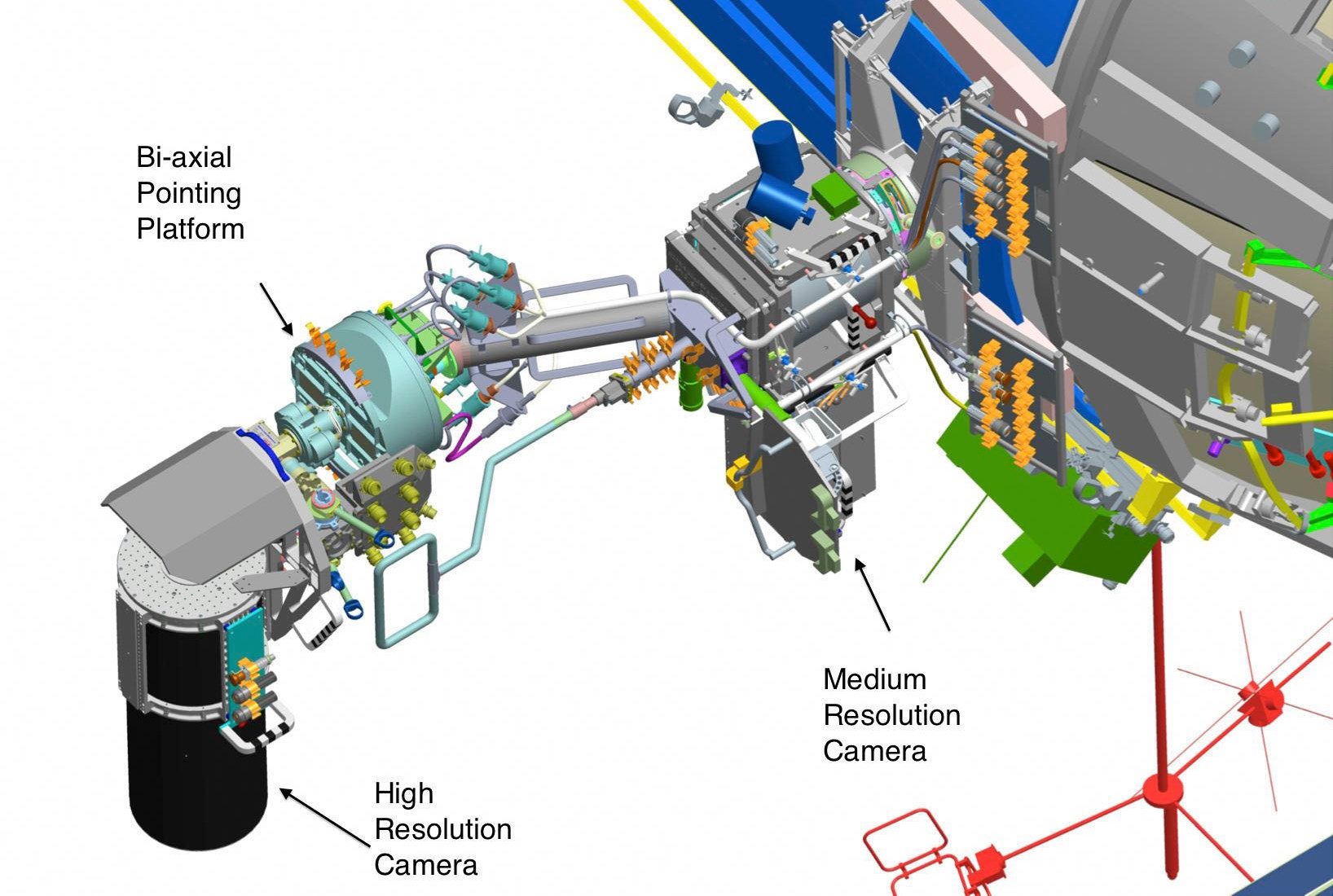
space_cameraTwo High-Definition cameras designed to stream detailed views of Earth from the International Space Station blasted off into space yesterday. The cameras are the work of UrtheCast, a Vancouver-based company that distributes operational software for publicly accessibly HD cameras and broadcasts. Once installed, they will provide a view of Earth that is usually reserved for astronauts.

The cameras – one still and one video camera – launched at 3:52 p.m. ET from the Baikonur Cosmodrome in Kazahkstan on an unmanned Russian Progress spacecraft aboard a Soyuz rocket. The two cameras will be attached to a platform on the underside of the space station that was brought up by a previous Progress flight in July and installed by Russian cosmonauts during a spacewalk.

Urthecastcam_UCThe cameras will be able to view a large band of the Earth between the latitudes of 51 degrees north and 51 degrees south, covering everything from the Canadian Prairies and the southern tip of Chile and Argentina. What’s more, their resolution will be high enough that people will be able to see things as small as cars, boats, their own homes, and even small groups of people.

The company stressed though that individual people would not be discernible as the resolution is simply not high enough to make out facial features. The fixed, still camera will take a continuous video panorama of Earth 50 kilometres wide as the space station orbits Earth 16 times each day. Meanwhile, the other camera will be pointable and able to be directed at specific points on the globe.

????????????????????????????????????????????????????????????And while many of the images they take will be available free online just a few hours after they were captured, customers will also have access to specific footage captured by the second, pointed camera. So for a small fee, people will be able to take part in what the company likes to call the “world’s first near-live HD video feed of Earth.”

The company expects customers to include governments, non-governmental organizations and corporations that would like particular types of live and archival images for purposes such as monitoring the environment. As Chris Carter, director of wealth management for ScotiaMcLeod and CBC Radio’s Vancouver business columnist, claims that this expectation is valid since UrtheCast’s business model allows it avoid a major hurdle.

urthecaste.gifBasically, the greatest impediment to providing space-based footage of the Earth is the astronomical (no pun!) cost of getting cameras into space. UrtheCast has gotten around this hurdle by partnering with Roscosmos, the Russian Space Agency, who transported their cameras in exchange for free access to images that it might otherwise have to pay for.

According to a statement made by the company earlier this month, as of Sept. 30, the company – which trades on the Toronto Stock Exchange – had annual purchase commitments worth $21 million:

Although these purchase commitments cannot be considered binding prior to the cameras being installed on the ISS, UrtheCast has already begun the process of converting these purchase commitments into binding commercial agreements.

The democratic space age is looming, people. Between regular updates on social media and webcasts from NASA rovers and space satellites, to live feeds from publicly-accessible cameras, we are entering an age where exploration and research are accessible like never before. Add to this the dream of telexploration, and we could be looking at a future where astronauts do NOT get to have all the fun!

Sources: cbc.ca, urthecast.com

The Future of Space Travel: Stamp-Sized Thrusters

MIT_microthrustersReducing the cost of space missions is one of the greatest challenges facing engineers and technicians today. With a myriad of planned missions, ranging from everything to a settlement on the Moon, sending satellites to Near-Earth asteroids, and manned missions to Mars, the goal of making space travel more affordable is a persistent and important one.

As it stands, most efforts are directed towards created craft that are either reusable, repurposed, or simply don’t rely on big, expensive and disposable rockets to get them into orbit. But another angle at bringing the cost of missions down is focusing on the size of the space craft themselves. If they could be shrunk down to the point where they are no larger than a paperweight, sending them into space could be done on the cheap.

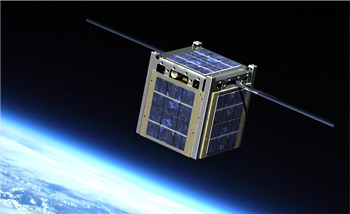
cubesatAlready we are seeing this idea at work with CubeSats, a new breed of satellites that are roughly the size of a Rubik’s cube. Over the past decade, dozens of these satellites have been sent into space, often as part of University projects. Since most sensor and survey equipment is now small enough that it can fit into a shoebox, the CubeSat design is ideal for departments that cannot afford to mount multimillion dollar space missions.

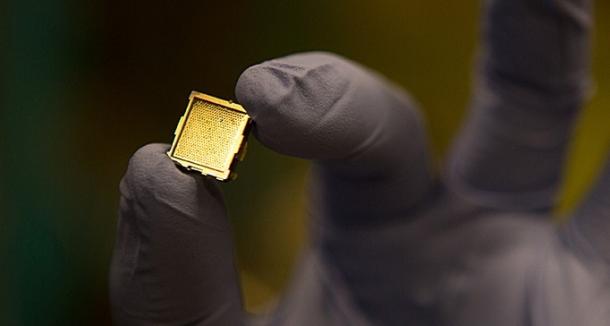
Expanding on this concept, MIT’s Poalo Lozano, a professor and the director of the Institute’s Space Propulsion Laboratory, has unveiled a new type of “microthruster” which, when added to the scaled-down satellites, could radically reduce the cost of space missions even further.  Roughly the size of a stamp, these tiny ion-engines would prolong the use of satellites by ensuring they could maneuver in space.

CubeSatsUp until now, CubeSat’s have had a limited life expectancy as their orbits inevitably decay and they burn up in the Earth’s atmosphere. But by equipping them with an Electrospray Propulsion System (iEPS), these pint-sized satellites would be able to conduct life-saving maneuvers that would extend their period of service and give them new functionality.

The thrusters are basically a liquid-fuel system that, when a voltage is applied, emit a stream of ions through tiny nozzles that propel the satellite forward. According to Lozano, four of these thrusters could provide attitude control and main propulsion for standard solar-powered “1U” CubeSat, which measures about 10 centimeters (4 inches) on a side and weighs 1 kilogram (2.2 pounds).

europa-lander-2But more exciting are the long-term prospects created by the addition of these tiny thrusters. For the price of sending a large spacecraft, a fleet of CubeSats could be dispatched to explore the moons of Jupiter. Other possible missions include clearing the massive pile of orbital debris floating around the Earth, de-orbiting satellites at the end of their service lives, and correcting atmospheric drag in low Earth orbit.

Part of what makes plans like these so feasible is the fuel-to-weight ratio it allows for spacecraft, something which astronauts and space agencies always have to take into account. As the Space Propulsion Laboratory claims on their website:

Less than 150 g of propellant would be required by a 1U CubeSat to reach Earth’s escape velocity from [low Earth orbit] and explore interplanetary space.

cubesats2Other possibilities arise from the fact that iEPS units require very little in the way of fuel, so even scaled-up versions can be fitted to small satellites to provide cost-effective and fuel-efficient thrust. Scientists in Switzerland, for instance, say they can send a shoebox-size satellite to the moon in six months with only a few drops of fuel.

As Professor Lozano said, in regards to the long term plans for the iEPS concept:

The goal is to make [CubeSats] do most of the things we already do with big satellites, except in a less expensive way. People have very big plans for these very small spacecraft.

cubesats1But in reality, even the outer Solar System is not limit when it comes to this scaled-down satellite technology. Looking even further abroad, tiny satellites could be sent into deep space to map out what lies between our Solar System and other stars, or investigate the mysteries of the Milky Way. Asteroid prospecting could also benefit from small, cost-effective probes that are capable of navigating between rocks.

And when the technology is scaled down even further, perhaps even to the nano level, millions of tiny probes could be sent out into space to study dark matter, high-energy particles, and seek out new life. Combined with new technologies like space penetrators, entire solar systems and even galaxies could be seeded with tiny space sats. Exciting possibilities indeed!

And in the meantime, be sure to check out this video on CubeSat’s, courtesy of Singularity HUB:


Sources:
news.cnet.com, web.mit.edu, singularityhub.com

Alien Spotting by 2020?

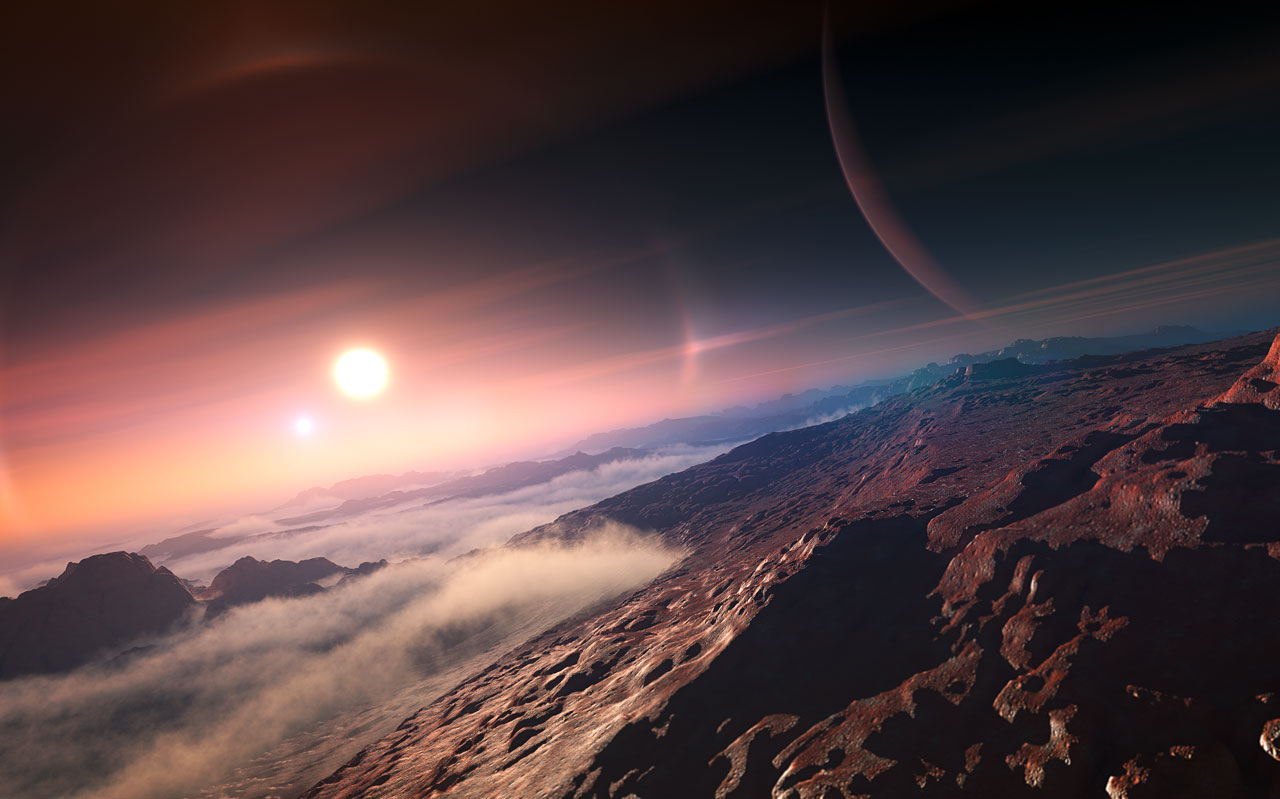
alien-worldWith recent observations made possible by the Kepler space telescope, numerous planets have been discovered orbiting distant stars. Whereas previous observations and techniques could detect exoplanets, scientists are now able to observe and classify them, with the ultimate aim of determining how Earth-like they are and whether or not they can support life.

Combined with advanced astronomical techniques, the latest estimates claim that there may be are up to 50 sextillion potentially habitable planets in the universe. With their eyes on the next step, the scientific community is now preparing to launch a bevy of new space telescopes that can peer across the universe and tell us how many of those planets actually harbor life.

TESSOne such telescope is NASA’s Transiting Exoplanet Survey Satellite (TESS), which will launch in 2017. While Kepler was focused on a single patch of sky with around 145,000 stars, TESS will be equipped with four telescopes that keep track of around 500,000 stars, including the 1,000 nearest red dwarfs. TESS is expected to find thousands of orbiting, Earth-sized-or-larger planets around these stars.

But to find out whether or not any of those planets actually house life, another sophisticated telescope needs to be employed – the James Webb Space Telescope.Whereas TESS is Kepler’s successor, the James Webb Space Telescope – a joint NASA/ESA/CSA venture – is the planned successor for the Hubble Telescope and is due to launch in 2018.

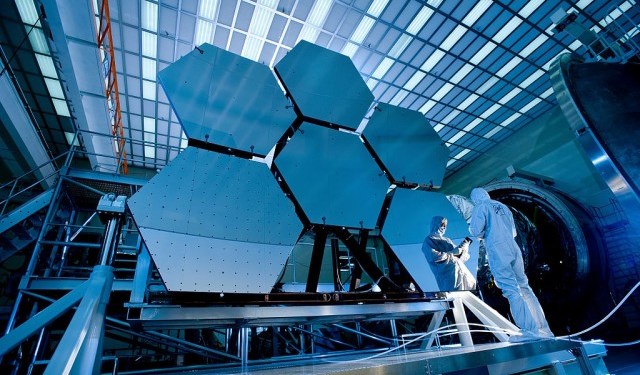
TESS_Space_Telescope_Mirror37-640x425The JWST has a primary mirror that’s about five times larger than Hubble’s (pictured above), which means it can resolve much fainter signals, locating stars and other objects that have never been seen before. Because it primarily operates in the infrared band (whereas Hubble was tuned towards visible light), the JWST will also be able to see through dust clouds into hidden areas of space.

The JWST’s scientific payload includes a spectrometer that’s sensitive enough to analyze the atmosphere of distant planets. By measuring light from the parent stars, and how its reflected in the planets atmospheres, it will be able to determine if there are life-supporting elements and evidence of biological life – such as oxygen and methane.

TESS_comparisonBecause these planets are light years away, and because the reflected light is incredibly dim, the James Webb Space Telescope will only be able to do this for large planets that orbit red and white dwarfs. Still, that leaves thousands or even millions of candidates that it will be able to observe, and determine whether or not they are already inhabited by extra-terrestrial life.

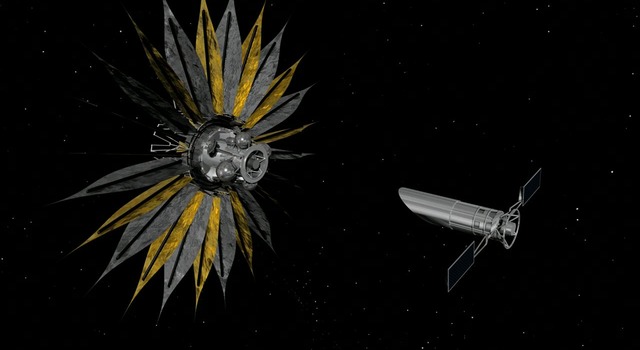
And last, but not least, there’s the New Worlds Mission, which aims to put a Starshade – which is essentially a big flying space umbrella – into space. This disc would then fly between the James Webb Space Telescope and the star its observing, blocking out large amounts of light and the result “noise pollution” from nearby bright stars that the JWST isn’t observing.

Starshade_1280x720_H264With the Starshade in place, the JWST would be able to probe thousands of nearby planets for signs of life and return data to Earth that is of far greater accuracy. The New Worlds Mission is currently in the prototyping stage, but NASA hopes to procure the necessary funding by 2015 and and launch it within the JWST’s own lifetime.

Because of all this, it is now believed that by 2020 (give or take a few years) we will have the ability to directly image a distant planet and analyze its atmosphere. And if we find methane or another biological marker on just one planet, it will completely redefine our understanding of the universe and the lifeforms that inhabit it.

The answer to the question – “are we alone in the universe?” – may finally be answered, and within our own lifetime. And in the meantime, be sure to enjoy this video of the Starshade space umbrella, courtesy of New Scientist.


Sources: extremetech.com, wired.co.uk, newscientist.com