News From Space: MAVEN Launched

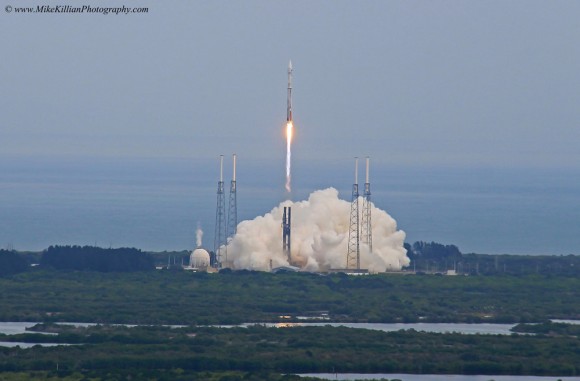
maven_launchYesterday, NASA’s Mars Atmosphere and Volatile Evolution (MAVEN) space probe was finally launched into space. The flawless launch took place from Cape Canaveral Air Force Station’s Space Launch Complex 41 at 1:28 p.m. EST atop a powerful Atlas V rocket. This historic event, which was the culmination of years worth of research, was made all the more significant due to the fact that it was nearly scrapped.

Back in late September, during the government shutdown, NASA saw its funding curtailed and put on hold. As a result, there were fears that MAVEN would miss its crucial launch window this November. Luckily, after two days of complete work stoppage, technicians working on the orbiter were granted an exemption and went back to prepping the probe for launch.

NASA_mavenThanks to their efforts, the launch went off without a hitch. 52 minutes later, the $671 Million MAVEN probe separated from the Atlas Centaur upper stage module, unfurled its wing-like solar panels, and began making its 10 month interplanetary voyage that will take it to Mars. Once it arrives, it will begin conducting atmospheric tests that will answer key questions about the evolution of Mars and its potential for supporting life.

Originally described as a “time-machine for Mars”, MAVEN was designed to orbit Mars and examine whether the atmosphere could also have provided life support, what the atmosphere was like, and what led to its destruction. This mission was largely inspired by recent discoveries made by the Opportunity and Curiosity rovers, whose surface studies revealed that Mars boasted an atmosphere some billions of years ago.

maven_atmo1During a post launch briefing for reporters, Bruce Jakosky – MAVEN’s Principal Investigator – described MAVEN’s mission as follows:

We want to determine what were the drivers of that change? What is the history of Martian habitability, climate change and the potential for life?

Once the probe arrives in orbit around Mars, scheduled for September 22nd, 2014, MAVEN will study Mars’ upper atmosphere to explore how the Red Planet may have lost its atmosphere over the course of billions of years. This will be done by measuring the current rates of atmospheric loss to determine how and when Mars lost its atmosphere and water.

maven_atmosphereFor the sake of this research, MAVEN was equipped with nine sensors the come in three instrument suites. The first is the Particles and Fields Package – which contains six instruments to characterize the solar wind and the ionosphere of Mars – that was provided by the University of California at Berkeley with support from CU/LASP and NASA’s Goddard Space Flight Center.

The second suite is the Remote Sensing Package, which ill determine global characteristics of the upper atmosphere and ionosphere and was built by CU/LASP. And last, but not least, is the Neutral Gas and Ion Mass Spectrometer, built by Goddard, which will measure the composition of Mars’ upper atmosphere.

As for the long term benefits of the mission and what it could mean for humanity, I’d say that Dr. Jim Green – NASA’s Director of Planetary Science at NASA HQ in Washington, DC – said it best:

We need to know everything we can before we can send people to Mars. MAVEN is a key step along the way. And the team did it under budget! It is so exciting!

Source: universetoday.com

Virgin’s Galactic’s Coming Space Flight

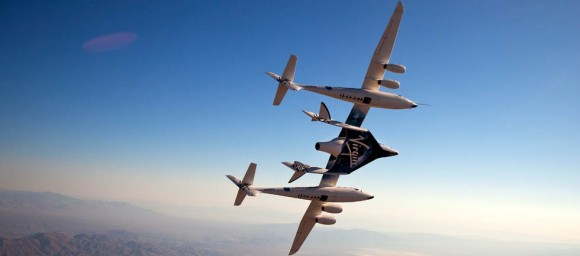
spaceshiptwo_flightNext year, Virgin Galactic is planning on mounting its first tourist spaceflight. This will involve SpaceShipTwo, the flagship of the fleet, taking six civilian passengers – including founder Richard Branson and his two adult children, Holly and Sam – into Near-Earth Orbit for the first time. And in true Bransonian fashion, he has arranged a major multimedia campaign in preparation for the event.

This consisted of signing a “multi-platform partnership” with the network NBCUniversal for it’s affiliates to transmit the flight all over the world. So far, the platforms for coverage include CNBC, MSNBC, NBCNews.com, Syfy and The Weather Channel. They also plan a “primetime special” on NBC on the launch’s eve, and to host a live event for three hours on NBC’s Today show.

Spaceshiptwo-580x256This past September, SpaceShipTwo conducted its second powered test flight, which consisted of a full-technical run through. This concluded with the deployment of its feathered wings, which allowed the ship to slow down and make a controlled descent. These were the latest in a long series of flights designed to test the ship’s engine, wings, landing mechanisms, and ability to glide.

Said Branson of the newly-announced partnership:

Virgin Galactic is thrilled that NBCUniversal will join us on our exciting first journey to space. In this first chapter of commercial space travel, we will help make space accessible and inspire countless more people to join us in the pursuit of space exploration and science innovation.

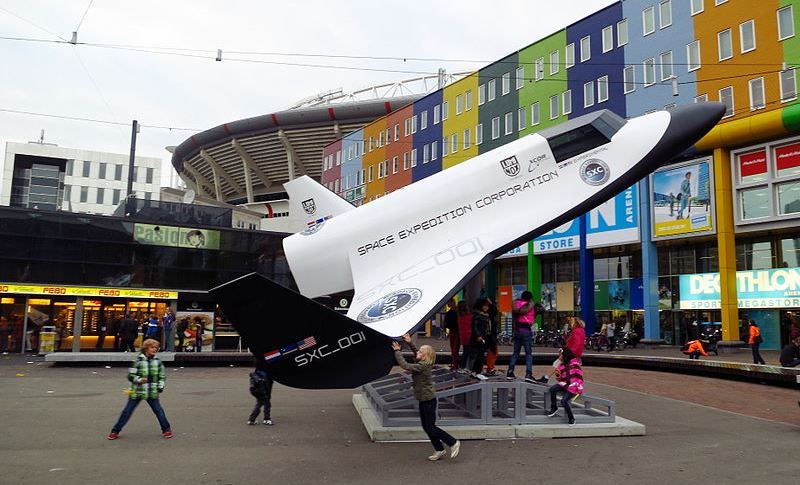
Lynx_spaceplane_mockupAlready, some 600 people have signed up for a ride aboard SpaceShipTwo once it’s making regular runs into orbit. What’s more, competitors have emerged to get a piece of the market, the most notable of which are XCOR Aerospace (run by Jeff Greason, a former member of the Rotary Rocket company) and Amazon founder Jeff Bezos’ Blue Origin.

Another curious media partnership is also being contemplated in anticipation of the maiden flight. This one comes from One Three Media, the company behind the Survivor series. Apparently, CEO Mark Burnett is looking to create a reality TV show where contenders will compete for a chance to win tickets aboard the space carrier.

spaceshiptwo-2nd-flight-2No indication has been given yet as to what sort of things contestants will do in order to win, or whether they have to go through something similar to astronaut training. But a recent press release from the studio stated the show would be a “groundbreaking, elimination competition series where everyday people compete for the ultimate prize”.

And according to Mark Burnett, it represents the culmination of a decade’s long dream:

For the past 10 years I have relentlessly pursued my dream of using a TV show to give an everyday person the chance to experience the black sky of space and look down upon mother Earth. Last year, I spent time in New Mexico at the state-of-the-art facility and last week [I] spent time in the Mojave desert with Sir Richard and his impressive team. We got to see the spaceship up close and hear of Sir Richard’s incredible vision of how Virgin Galactic is the future of private space travel. I am thrilled to be part of a series that will give the everyday person a chance to see space, and that NBC has come on board too so that viewers at home will have a first-class seat.

virgin_galactic_bransonNo telling on when this show might premiere, but it is the latest in a long series of attempts by Burnett to put a person into space. Back in 2000, he announced a deal with NBC to host a space reality show (Destination Mir) where the winner would visit the Russian space station. Burnett subsequently proposed another show that would have brought ‘N Sync guitarist Lance Bass to the International Space Station.

Due to various factors, such as lack of funding and the Russian Federal Space Agency choosing to deorbit their aging space station in 2001. But with Branson ready to send people into space, and with a transport mechanism that is far more affordable and accessible than space rockets, this latest reality space venture might just come to fruition.

The age of private space travel is dawning, friends. I sincerely hope I can afford a trip into space before I’m too old to go. It’s too soon for me to make a bucket list, but I know for a fact that I would like to know the feeling of weightlessness at least once before I die!

Source: universetoday.com, (2)

Space Tourism: The World View Balloon

near-space_balloonWhen the Space Age began, some five decades ago, there were many who predicted that commercial space flight would follow shortly thereafter. This included everything from passenger flights into space, orbital space stations, and even space tourism. Naturally, these hopes seem quite naive in hindsight, but recent events are making them seem feasible once more.

Consider Virgin Galactic, a commercial aerospace carrier that will begin taking passengers into Low-Earth Orbit (LEO) beginning next year. And there’s Inspiration Mars, a private company that wants to send a couple on a round trip to visit the Red Planet. And now, there’s World View Enterprises, a company that plans to send to start sending passengers on a near-space balloon ride beginning in 2016.

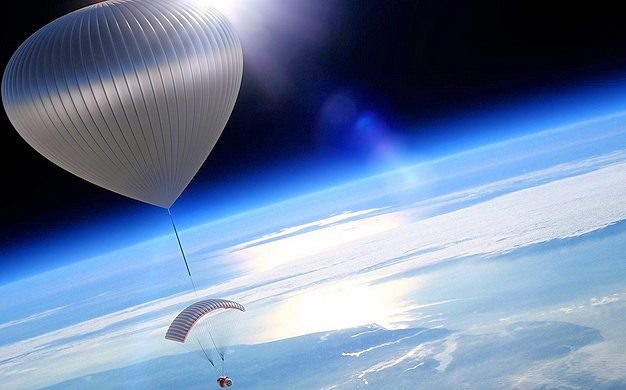
near-space_balloon1Based in Tucson, Arizona, World View is a start-up that is looking to entice people into the budding field of space tourism by offering people a chance to get a taste of space without actually going there. Going into space is defined as traveling 100 km (62 miles) from the Earth’s surface, whereas their balloon ride will take passengers to a height of 30 km (18.6 miles), where they will be treated to a spectacular view of the Earth

World View Enterprises recently obtained approval from the US Federal Aviation Administration for its proposed balloon experiences, which will cost US $75,000 a ride, and are projected to begin in 2016. Each flight will consist of two balloon pilots and up to six passengers, which will be contained within a cylindrical capsule that comes equipped with heating and its own air-supply.

near-space_balloon2According to the company’s plan, the capsule – which measures 6 meters in length and 3 in width (approx. 20 x 10 feet) – will be deployed below a parasail (used for recovery) and tethered to a 400,000 cubic meter (14 million cubic ft) helium balloon, which will provide the lift needed to bring the capsule and its occupants to 30 km in altitude or Low-Earth Orbit.

Might sound a little dangerous to some, but the FAA has determined that World View’s design meets the engineering and environmental challenges posed by Low-Earth Orbit. They stressed that the capsule be designed and tested as if it were going to have long-term exposure in space, even though it will not exceed altitudes much above 30 km, and assigned it a safety factor of 1.4 – the same as that required of manned space systems.

near-space_balloon5The flight itself is projected to last about four hours, with the ascent taking 1.5-2 hours. The capsule will then remain at an altitude of 30 km for about two hours, during which time the semi-space tourists will be free to move about the cabin and take in the view. Unfortunately, they will not experience weightlessness during this period.

That’s comes after, when the capsule is cut off from the balloon and begins to fall towards Earth. Once it gains enough speed, the parafoil will provide sufficient lift to slow the descent and bring the passengers in for a safe, controlled landing. Before touching down, the capsule will deploy a set of skids and lands much the same way a paraglider does.

near-space_balloon4All in all, the balloon ride being suggested by World View does appear to hit many of the key points on the space tourism agenda. These include seeing black sky and the curvature of the Earth, and having a view of the planet that only astronauts are ever treated to. That may very well add up to an experience that is as good as being in space without technically getting there.

The only question is, will enough passengers line up for an amazing day’s flight that costs a startling $75K? Only time will tell. One thing is fore sure though. The dream of space tourism appears to finally be upon us, though it is a few decades late in coming. Today’s dreams do tend to become tomorrow’s reality, though they sometimes take longer than expected.

And be sure to enjoy this promotional video from World View Enterprises showing their concept in action:


Sources: gizmag.com, fastcodesign.com,

News From Space: Olympic Torch gets a Spacewalk

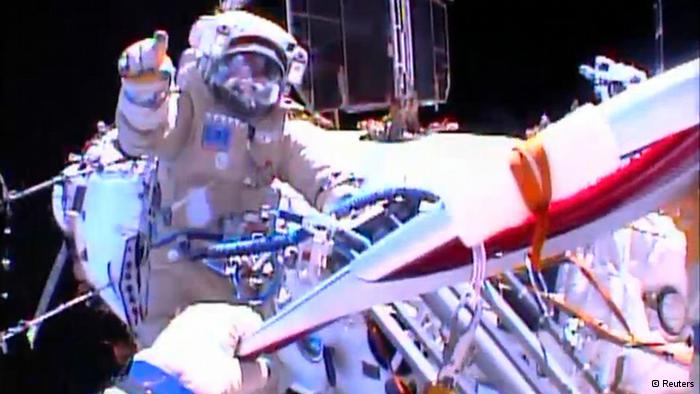
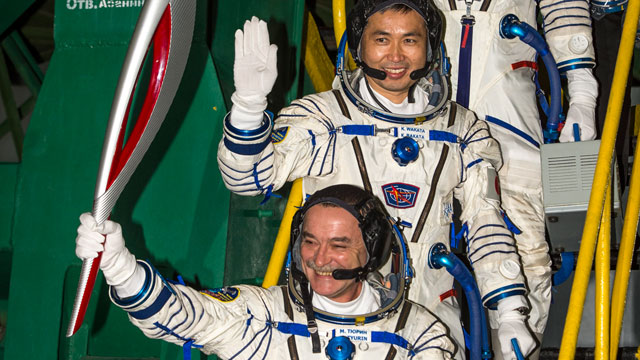
sochi_torch_ISS1Yesterday, for the first time ever, the Olympic torch was taken into space as two Russian cosmonauts took it on a spacewalk outside of  the International Space Station. NASA streamed video of the event as two cosmonauts, Oleg Kotov and Sergei Ryazanskiy, conducted their walk while the torch bobbed weightlessly from the end of a tether.

The two cosmonauts took several photos with the torch hovering with planet Earth in the background, the orb’s edge capturing the sunrise and emitting a bright glow. After two hours, they returned it to the space station and got to other tasks on their itinerary, which included attaching a footrest and a camera platform to the exterior of the orbiting laboratory.

The Soyuz TMA-11M spacecraft rests on its launch pad at the Baikonur cosmodromeThe walk was just latest leg in the torch’s journey, which began on October 7th when the torch was delivered from Greece to Moscow. After touring the country, a journey which took it from Moscow, to St. Petersburg, and even to the North Pole (another first) aboard an atomic-powered icebreaker, the torch was launched last Thursday aboard a Soyuz rocket from the Baikonur Cosmodrome.

Inspired by the Firebird of Russian folklore, a magical glowing birdt hat can be both a blessing and a curse to its owner, the metre-long torch – which weighs roughly 2 kg (4.4 lbs) on Earth – accompanied a three-man crew into space. This consisted of a Russian cosmonaut and an American and Japanese astronaut, bringing the total number of crew aboard the station to nine.

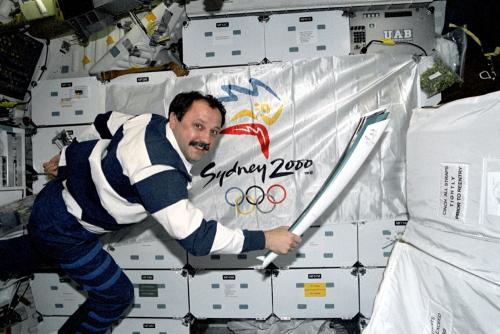
Space-Shuttle-Atlantis-STS-101-031.previewGranted, this is not the first time an Olympic torch has been taken into space. In 1996 and again in 2000, the Atlanta and Sydney Olympic torches were flown into space aboard the U.S. Space Shuttle Atlantis, in preparation for the Atlanta Summer Olympics. However, in that case, the torch was not taken outside of the spacecraft, which makes this a true first.

Much like on that occasion, the torch remained unlit while it was in space, as lighting it would have consumed precious oxygen. Still, the ISS crew managed to carry the unlit torch with them on a tour through several of the station’s modules and snapped pictures of it all. This took place over the course of several days before it stepped into space on Saturday.

sochi_torch_ISS4The torch is set to return to Earth tomorrow along with Russian cosmonaut Fyodor Yurchikhin, U.S. astronaut Karen Nyberg and Italian Luca Parmitano of the European Space Agency. Once home, it will be handed off to Sochi 2014 officials and continue on its 65,000 kilometer (44,000 mile) journey, which just happens to be the longest Olympic torch relay in history.

The torch is also planned to reach such destinations as Mount Elbrus (Europe’s highest peak) in the Caucasus mountain range before arriving in Sochi on February 7th, where it will kick of the 22nd Winter Games. In another interesting first, this will be the first time that an Olympic Games has been held by the Russian Federation, whereas the 1980 Summer Olympics that were held in Moscow took place during the era of the Soviet Union.

Olympic torch launched into spaceAccording to Deputy Prime Minister Dmitry Kozak, who has been in charge of planning the Olympics, transporting the Olympic torch to the ISS and bringing it into space is seen as “[A] way to show the world what Russia is made of.” He said it would display Russia’s “might” and its economic achievements, not unlike China did with the Tiangong space station.

Though the upcoming games are still a source of controversy to many – due to the recent passage of several laws that criminalize what officials call “gay propaganda” – this latest part of the Sochi Olympic torch relay showcases what is truly great about the Olympics. Not only was it an historic first, it also reminds us what the Olympics are all about.

sochi_torch_ISS5Originally conceived as a way of fostering goodwill between Greece’s city-states, and resurrected in 1894 to foster goodwill between nation-states, bringing the torch on board the ISS amidst a crew of international scientists helps to celebrate the spirit of diversity and tolerance which can and must define our modern world.

One can only hope that the symbolic value of this has not been lost on Russian lawmakers. Take it from us, Putin and the State Duma of Russia. It’s not too late to rethink your country’s political stances. If you really want to show how far your country has come, why not do some incredibly rational, like back away from an incredibly antiquated legal stance? I know for a fact it would make the Olympics go more smoothly this coming February…

And of course, be sure enjoy this video that NASA captured during the spacewalk:


Sources:
cbc.ca, (2), ctvnews.ca, abcnews.go.com, in.reuters.com

News From Space: More Happening on Mars!

marsIt seems like weeks since the Red Planet has been featured in the news. But that’s to be expected when the two biggest news makers – the Opportunity and Curiosity rovers – are either performing a long drive or climbing a tall mountain. Not much in the way of updates are expected, unless something goes wrong. Luckily, these rovers always find ways to surprise us.

After over a year on Mars, Curiosity has accomplished a long list of firsts. This latest occurred last week, when NASA announced that Curiosity picked up the pace of its long trek to Mount Sharp by completing its first two-day autonomous drive, in which the rover did one leg of an autonomous drive on Sunday, then completed it on Monday.

mars_scapePreviously, Curiosity’s autonomous drives were only executed after finishing a drive planned by mission control on Earth using images supplied by Curiosity. These images would then be uploaded its on board computer, and the rover would compare them with images taken by its navigation camera to plot a safe path. The drive completed Monday is the first where the rover ended an autonomous drive on one day, then continued it the next day by itself.

This is all thanks to the incorporation of the new autonomous navigation (or autonav) software, which NASA finished incorporating and debuted at the end of August. According to NASA, this new system not only allows the rover to drive itself for longer stretches of time, it also allows mission control to plan activities for several days, which could be implemented on Fridays and before holidays so the rover can continue to work while the staff are away.

curiosity_hirise_tracksAccording to NASA, on Sunday, the new software allowed Curiosity to drive about 55 m (180 ft) along a path planned by mission control, then switched to autonomous mode and traveled another 38m (125 ft) with the rover selecting waypoints and the safest path. It then stored navigation variables in its non-volatile memory, then reloaded them on Monday to drive another 32 m (105 ft).

In all, Curiosity covered about 125 meters (410 ft) in total. This brought it within about 80 m (262 ft) from “Cooperstown,” a rocky outcrop where the rover will be conducting another series of scientific examinations. These will be the first time that Curiosity has had the opportunity to use its arm-mounted instruments since September 22.

mountsharp_galecraterAccording to Kevin Lewis of Princeton University, who spoke about the upcoming studies in “Cooperstown”:

What interests us about this site is an intriguing outcrop of layered material visible in the orbital images. We want to see how the local layered outcrop at Cooperstown may help us relate the geology of Yellowknife Bay [on Mars] to the geology of Mount Sharp.

This stop will be only brief, as the rover team are anxious to get Curiosity back on its way to Mount Sharp. Once there, it will begin digging, drilling and generally seeking out the vast caches of minerals that the mountain is expected to have, ones which could potentially support a habitable environment. Exciting times ahead!

Sources: gizmag.com, jpl.nasa.gov

News from Space: First Earth-Sized Exoplanet Found!

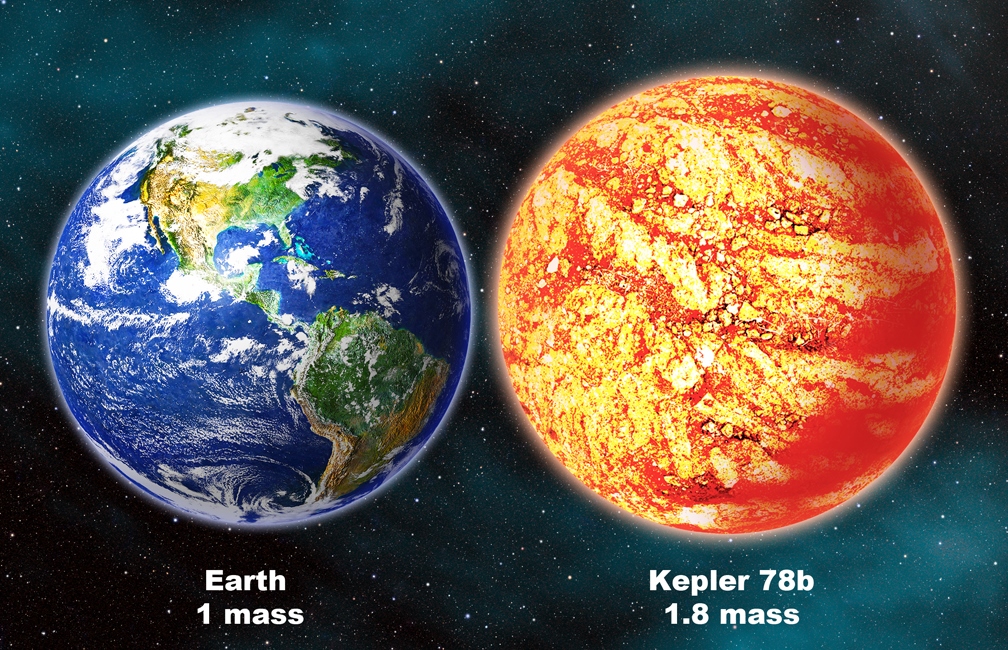
kepler78bFor the past three and a half years, the Kepler space telescope has been hurtling through space and searching the Milky Way for signs of of other planets orbiting distant stars. In that time, Kepler has identified many Earth-like exoplanets, many of which reside within our own stellar neighborhood. However, it has found only one planet in recent months that is Earth-sized.

That planet is known as Kepler-78b, the existence of of which was recently verified by NASA scientists at Cape Canaveral. Of all the planets discovered beyond our Solar System, this one is both rocky in composition and weighs in at roughly 1.2 times Earth’s mass. Beyond that, however, the similarities between this planet and our own end.

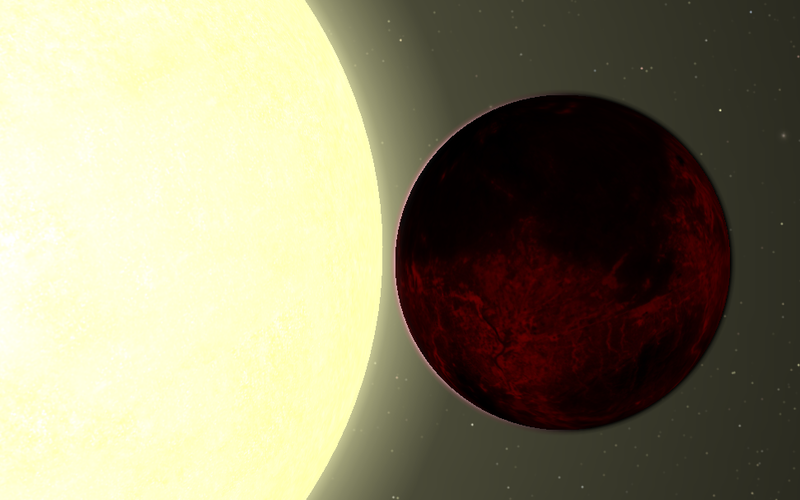
kepler78b2In addition to having an orbital period of 8.5 hours, the planet also rotates around its parent star at a distance of about 1.5 million kilometers (approx. 93205 miles). Basically, this means that Kepler-78b is thirty to forty-five times closer to its Sun than Mercury is to ours, and experiences a full year in under nine days. This makes Kepler 78b an extremely hostile environment, unsuitable for life as we know it.

Andrew Howard, of the University of Hawaii at Manoa’s Institute for Astronomy and the lead author on one of two papers published in Nature magazine about the discovery of the new planet, said in recent webcast:

We’ve been hearing about the sungrazing Comet ISON that will go very close to the Sun next month. Comet ISON will approach the Sun about the same distance that Kepler-78b orbits its star, so this planet spends its entire life as a sungrazer.

Kepler78b1A handful of planets the size or mass of Earth have been discovered, but Kepler-78b is the first to have both a measured mass and size. At 1.2 times the size of Earth with a diameter of 14,800 km (9,200 miles), astronomers say it has a density similar to Earth’s, which suggests an Earth-like composition of iron and rock. Its star is slightly smaller and less massive than the sun and is located about 400 light-years from Earth in the constellation Cygnus.

Verification of the planet’s existence and characteristics was made by two independent research teams that used ground-based telescopes for follow-up observations. The team led by Howard used the W. M. Keck Observatory atop Mauna Kea in Hawaii. The other team led by Francesco Pepe from the University of Geneva, Switzerland, did their ground-based work at the Roque de los Muchachos Observatory on La Palma in the Canary Islands.

exoplanet_hotAnd while the discovery is exciting, the close proximity of Kepler-78b to its star poses a challenge to theorists. According to current theories of planet formation, it couldn’t have formed so close to its star, nor could it have moved there. Given that its star would have surely been larger when the system was in formation, Kepler-78b’s orbit would have put in inside the swollen star. Hence, the planet’s existence is an enigma.

To make matters worse, Kepler-78b is a doomed world. Gravitational tides will continue to pull Kepler-78b even closer to its star, and eventually it will move so close that the star’s gravity will rip the world apart. Theorists predict that the planet will vanish within three billion years. And while this may sounds like an eternity to us, in astronomical terms it represents a life cut short.

Source: universetoday.com, nature.com

Creating Dark Matter: The DarkLight Project

https://i0.wp.com/scienceblogs.com/startswithabang/files/2011/08/dark_matter_millenium_simulation.jpegFor several decades now, the widely accepted theory is that almost 27% of the universe is fashioned out of an invisible, mysterious mass known as “dark matter”. Originally theorized by Fritz Zwicky in 1933, the concept was meant to account for the “missing mass” apparent in galaxies in clusters. Since that time, many observations have suggested its existence, but definitive proof has remained elusive.

Despite our best efforts, no one has ever observed dark matter directly (nor dark energy, which is theorized to make up the remaining 68% of the universe). It’s acceptance as a theory has been mainly due to the fact that it makes the most sense, beating out theories like Modified Newtonian Dynamics (MOND), which seek to redefine the laws of gravity as to why the universe behaves the way it does.

https://i0.wp.com/www.extremetech.com/wp-content/uploads/2013/04/cdms.jpgLuckily, MIT recently green-lighted the DarkLight project – a program aimed at creating tiny tiny amounts of dark matter using a particle accelerator. In addition to proving that dark matter exists, the project team has a more ambitious goal of figuring out dark matter behaves – i.e. how it exerts gravitational attraction on the ordinary matter that makes up the visible universe.

The leading theory for dark matter used to be known as WIMPs (weakly interacting massive particles). This theory stated that dark matter only interacted with normal matter via gravity and the weak nuclear force, making them very hard to detect. However, a recent research initiative challenged this view and postulates that dark matter may actually consist of massive photons that couple to electrons and positrons.

https://i0.wp.com/www.extremetech.com/wp-content/uploads/2013/10/prototype-a-prime-dark-matter-detector.jpgTo do this, DarkLight will use the particle accelerator at the JeffersonJefferson Lab’s Labs Free-Electron Laser Free Electron Lase in Virginia to bombard an oxygen target with a stream of electrons with one megawatt of power. This will be able to test for these massive photons and, it is hoped, create this theorized form of dark matter particles. The dark matter, if it’s created, will then immediately decay into two other particles that can be (relatively) easily detected.

At this point, MIT estimates that it will take a couple of years to build and test the DarkLight experiment, followed by another two years of smashing electrons into the target and gathering data. By then, it should be clear whether dark matter consists of A prime particles, or whether scientists and astronomers have barking up the wrong tree these many years.

https://i0.wp.com/scienceblogs.com/startswithabang/files/2012/12/sim3dnew.pngBut if we can pinpoint the basis of dark matter, it would be a monumental finding that would greatly our enhance our understanding of the universe, and dwarf even the discovery of the Higgs Boson. After that, the only remaining challenge will be to find a way to observe and understand the other 68% of the universe!

Source: extremetech.com

Halloween Comets!

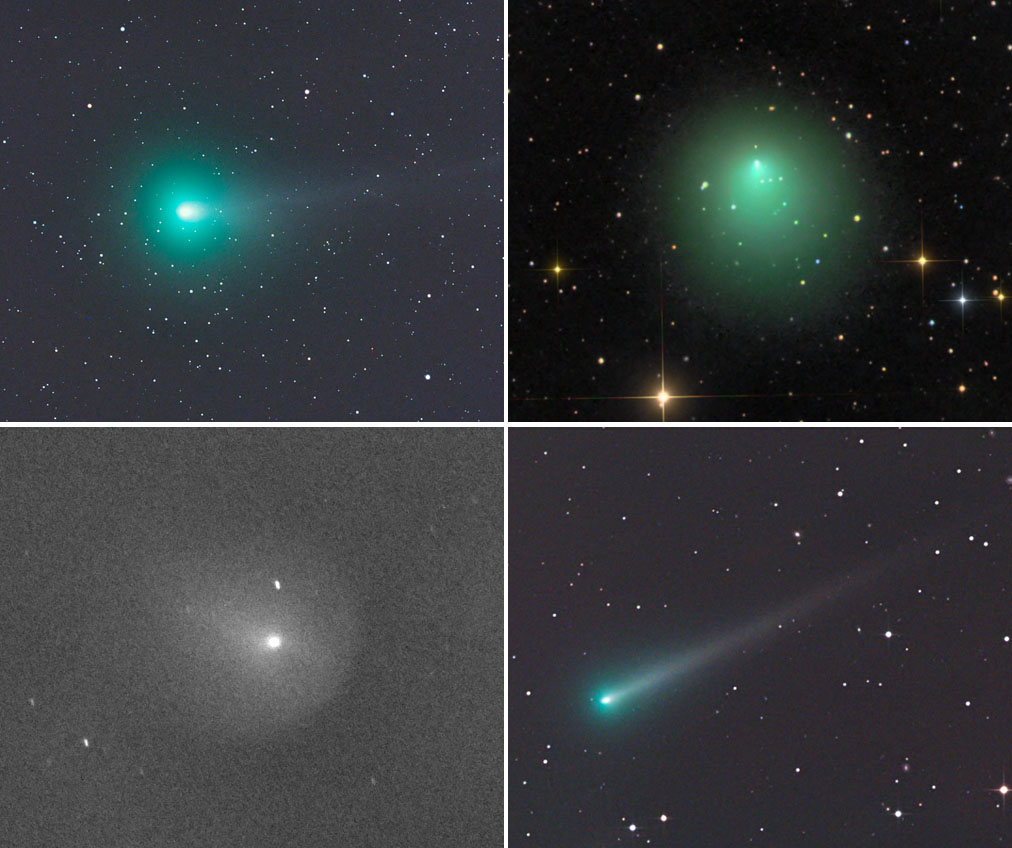
No fewer than four bright-ish comets greet skywatchers an hour before the start of dawn. From upper left counterclockwise: C/2013 R1 Lovejoy, 2P/Encke, C/2012 X1 and ISON. Credits: Gerald Rhemann, Damian Peach, Gianluca Masi and Gerald RhemannToday, the early morning was greeted by the arrival of not one, not two, not three, but four comets! And interestingly enough, even astronomers were surprised. For months now, they have known that the comets ISON and 2P/Encke would be gracing the morning sky on October 31st, but no one predicted that they’d be joined by C/2013 R1 (Lovejoy), and C/2012 X1 (LINEAR) as well.

These two comets – the former being discovered by  Australian amateur astronomer Terry Lovejoy back in September and the latter being a somewhat obscure character, presented a rare opportunity to stargazers everywhere. The appearance of four comets at the same time in the night sky is a rare phenomenon indeed. The fact that it coincides with Halloween? Well, the word spooky comes to mind…

https://i0.wp.com/d1jqu7g1y74ds1.cloudfront.net/wp-content/uploads/2013/10/Halloween-comets-4_edited-11.jpgThe appearance of C/2012 X1 (LINEAR) was especially surprising given how sudden it was. In the past few days, the otherwise obscure comet has brightened by a factor of more than 200. Almost overnight, a comet found on precious few observing lists became bright enough to see in binoculars. Hence, comet trackers all over the world were sure to get up extra early to see it. But brightest of all was Comet Lovejoy, which reached magnitude 8.

As for Encke and C/2012 X1, astronomers were well prepared for their arrival. Encke’s appearance is predictable, since it treks around the sun every 3.3 years like clockwork and is often well placed for viewing. Because of its short period, dedicated comet watchers meet up with it a half dozen or more times during their lives. And due to its brightness, which tends to fall into the magnitude 7.5-8 range, binoculars are often all one needs to see it.

https://i0.wp.com/d1jqu7g1y74ds1.cloudfront.net/wp-content/uploads/2013/10/ISON-Damian-Oct.-27-580x403.jpgComet C/2012 X1 is not usually visible in the night sky. But thanks to an eruption of fresh, dust-laden ices from its surface that blasted into space to form a gigantic glowing sphere that vaulted the comet’s magnitude 250 times to a voluminous 7.5, astronomers were expecting it to make an appearance alongside Encke this Autumn.

For those still interested in spotting these shooting stars, Comet Lovejoy will continue to brighten throughout November to the point where it can be seen by the naked eye. Small telescope users will continue to be able to see the comet with ease, as well as the gas tail that it is developing. Encke will also reach its peak magnitude for viewing by Nov. 21st as it chases the into the glare of morning twilight.

All you need is a telescope, a good set of binoculars, or a keen pair of eyes. And while we’re at it, I’d just like to remind people that this sort of conjunction does NOT portend doom! If anything, its a rare privilege, and should be considered a tiding of joy. The fact that it happens to fall on the spookiest of annual events, well that’s just pure coincidence!

Source: universetoday.com
November 2013 Eclipse

Bloomberg Photos Best Of The Year 2012On this coming November 3rd, the people of the Africa will be treated once again (if that’s the right word) to a solar eclipse. And the good folks at Astronomers Without Borders – an independent outreach program with global reach – will be doing all they can to make sure that students and sky watchers can safety watch it take place. And they are looking for help…

Basically, they are looking for donations so they can send tens of thousands of eclipse glasses to schools in Africa just in time for the eclipse. In addition to allowing for students to safely observe a major astronomical event, it is also a rare opportunity to expose students to science in a region where science resources are often non-existent.

SOLAR-ECLIPSE-2013-pathAs Mike Simmons, who leads AWB, told Universe Today in an email interview:

We’re working with the IAU’s Office of Astronomy for Development who has contacts working with schools and able to distribute the glasses to them. The opportunity for this came up late so we’re working very hard to make it happen in the short time we have left.

According to the AWB website, schools have been identified and vetted by partner organizations in each country in Africa, and distribution networks have been verified. Every donated pair of eclipse glasses WILL reach a student for use for the eclipse, and will be given by the AWB free of charge.

SOLAR-ECLIPSE-2013-kidsThe International Astronomical Union’s Office of Astronomy for Development, which is based in Cape Town, South Africa, is providing invaluable support and assistance through their many contacts across Africa. But alas, the program depends entirely on private donations.  However, as Simmons explained, they are confident they can raise the money in time:

There’s no question we can get all the donations that are needed as long as we get the word out in time. We do probably a half-million dollars in programs each year based on the hard work of passionate amateur astronomers and educators around the world,” Simmons said, “all on way less than $25,000 a year.

If you’re interested in pledging a donation, simply go to AWB’s website by clicking here. Each pair goes for $1 to $4, depending on how many you want to buy. As for those of us who don’t live in Africa, I guess we’ll just to wait until Monday, August 21, 2017, when the next Solar Eclipse that will be visible from North America will take place.

Source: universetoday.com, astronomerswithoutborders.com

Dead in Space: Government Shutdown, NASA and Mars

marsAs the government shutdown goes into its second week, there is growing concern over how it is affecting crucial programs and services. And its certainly no secret that a number of federally-funded organizations are worried about how it will affect their long term goals. One such organization is NASA, who has seen much of its operations frozen while the US government attempts to work out its differences.

In addition to 97% of NASA’s 18,000 employees being off the job, its social media accounts and website going dark, and its television channel being shut down, activities ranging from commercial crew payouts, conferences, and awards and scholarship approvals are all being delayed as well. Luckily, certain exemptions are being made when it comes to crucial work on Mars.

NASA_mavenThese include the Mars Atmosphere and Volatile EvolutioN (MAVEN) orbiter. Following two days of complete work stoppage, technicians working on the orbiter were granted an exemption and permitted to continue prepping it for launch. And not a moment too soon, seeing as how a continued shutdown would have caused the orbiter to miss its crucial launch window.

Designed to survey the Martian atmosphere while orbiting the planet, NASA hopes that MAVEN will provide some clues as to what became of the planet’s onetime atmosphere. MAVEN was been scheduled to blast off for the Red Planet on Nov.18 atop an Atlas V rocket from the Florida Space Coast until those plans were derailed by the start of the government shutdown that began at midnight, Oct. 1.

But as Prof. Bruce Jakosky, MAVEN’s chief scientist, stated in an interview just two days later:

We have already restarted spacecraft processing at the Kennedy Space Center (KSC) today. [Today, we] determined that MAVEN meets the requirements allowing an emergency exception relative to the Anti-Deficiency Act.

Curiosity-roverAnother merciful exception to the shutdown has been the Curiosity Rover. Since contract workers at NASA’s Jet Propulsion Laboratory (JPL) oversee the rover’s mission, the Curiosity team is not subject to the same furloughs as other NASA employees. At JPL, the technicians and workers at the lab are employed by the California Institute of Technology, and are therefore able to keep the mission going.

However, the management at JPL and Cal Tech will continue to assess the situation on a weekly basis, and it’s possible the team may not remain completely intact in the event of a prolonged shutdown. This would be particularly detrimental for Curiosity since the Mars rover requires daily maintenance by scientists, engineers and programmers and cannot run on autopilot.

curiosity_sol-177-1As Veronica McGregor, a media relations manager at JPL, said in a recent interview:

Right now, things continue on as normal. Curiosity is one where they literally look at the data each day, sit down, create a plan, decide what science instrument is going to be used tomorrow, they write software for it and upload it. [It’s] is kind of a unique mission in that way.

Other programs running out JPL will also continue. These include the Opportunity and Odyssey rovers, the Mars Reconnaissance Orbiter, the HiRISE camera, Dawn, Juno, and Spitzer space probes, and the Voyager satellites, APL, MESSENGER, and New Horizons.  In addition, operations aboard the International Space Station will continue, but with the bare minimum of ground crew support.

cassini_spaceprobeRobotic missions that are already in operation – such as the Cassini spacecraft circling Saturn, or the Lunar Atmosphere and Dust Environment Explorer (LADEE) winging its way to the moon – will have small crews making sure that they are functioning properly. However, no scientific analysis will be conducted during the shutdown period.

As the shutdown continues, updates on which programs are still in operation, which ones will need to be discontinued, and how they will be affected will continue to be made available. One can only hope the politically-inspired deadlock will not become a prolonged affair. It’s not just current programs that are being affected after all.

Consider the proposed 2030 manned mission to Mars, or the plans to tow an asteroid closer to Earth. I can’t imagine how awful it would be if they were delayed or mothballed due to budget constraints. Politics… bah!

Sources: universetoday.com, (2), mashable.com