For almost a year now, NASA has been discussing plans which will eventually culminate in a return to the Moon. Initially, such plans were kept under wraps just in case NASA found itself in a budget environment that did not favor renewed space exploration. But since the 2012 election, and the re-election of President Obama, NASA publicly announced its plans, confident that the budget voted on in 2010 (which included lucrative funding for them) would continue.
And now, NASA has been unveiling the tools that will take us there and beyond in the coming years. Far from simply shooting for the Moon for the first time in decades, NASA’s plans also include manned missions to Mars, and exploratory missions which will take it out to Jupiter and the outer Solar System. And since they are thinking big, its clear some budget-friendly and powerful tools will be needed for the job.
Above, we have the latest. It’s called the JX-2, a liquid-fuel cryogenic rocket engine is the modernized version of the J-2, the engine that NASA used in the late-’60s and early-’70s to thrust humans beyond low Earth orbit. With the conclusion of the Apollo program, these babies fell into disuse. But with the upgrades made to these new versions, NASA hopes to send people back to the Moon, and a few places beyond.
Of course, there are other noted improvements in NASA’s arsenal that will also come into play. For starters, the J-2 was part of the general assembly of the Saturn V rocket, the mainstay of the space agency’s fleet at the time. In the years to come, NASA will be deploying its new Space Launch System (SLS) and the Orion Multi-Purpose Crew Vehicle (MPCV).
The SLS is NASA’s next-generation rocket, a larger, souped-up version of the Saturn V’s that took the Apollo teams into space and men like Neil Armstrong to the Moon. According to NASA spokesmen, the SLS rocket will “incorporate technological investments” and “proven hardware” from previous space exploration programs.” Essentially, this means that projects which have been shelved and retired have been updated and incorporated to create a rocket that can do the job of sending men into deep space again.
The Orion MPCV, on the other hand, is the module that will sit atop the SLS, carrying its crew compliment and delivering them to their destination once the rocket has put them into space and disassembled itself. Announced back in September of 2011, the SLS and MPCV constitute the largest and most powerful space rocket system ever built by a space agency.
No date has been given as to when the SLS and MPCV will be sent into space, courtesy of the new JX-2 rocket engine. But NASA claims there will be a launch sometime next year. As for the Moon, well, we’re waiting on that too, but it’s clear that with Mars slated for 2030, a manned mission to the Moon is sure to happen before this decade is out.
In the meantime, check out the infographic on the new rocket system below, and keep your eyes on the skies! We’re going back, and this time, we mean to stay!
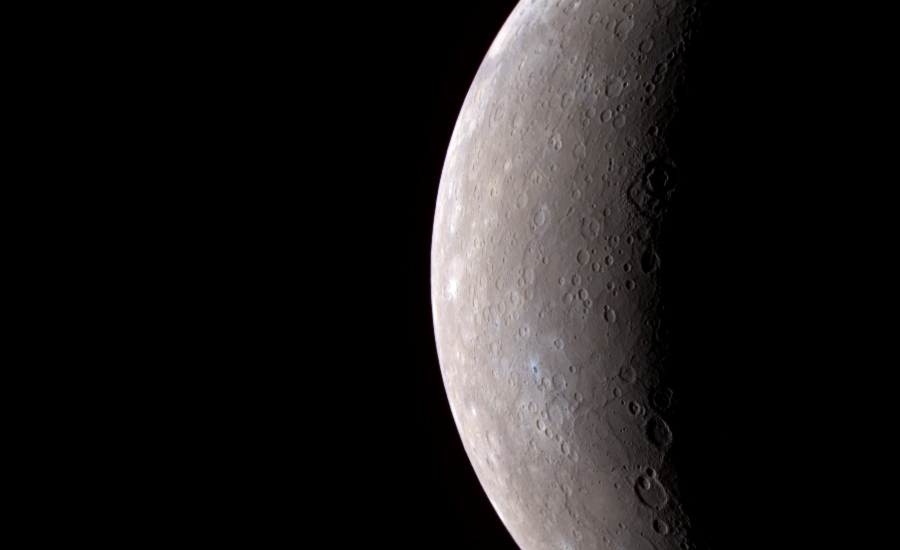
Mercury is the smallest planet in the Solar System and has the closest proximity to our sun. As a result, it’s one of the most neglected when it comes to scientific study. While Mars, Venus, Jupiter and Saturn have been probed and photographed in exquisite detail during the space age, the closest planet to the Sun has had to make do with a few flybys from the Mariner 10 spacecraft in the early 1970s.
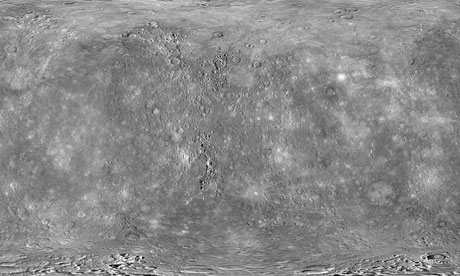
However, that is now changing thanks to NASA’s Messenger spacecraft. In addition to confirming the existence of ice and organic molecules back in November, the probe has also transmitted thousands of images of the planet over the past year. These have allowed NASA personnel to construct the first high-resolution maps of the planet, its own high-resolution maps, down to the scale of kilometers.
According to David Blewett, a scientist at the Applied Physics Laboratory at Johns Hopkins University and part of the Messenger team, part of the reason it has taken more than 30 years to revisit the planet since the Mariner 10 flybys was because a lack of public interest. Messenger, he claims, has changed all that. Speaking ahead of a briefing on Friday at the annual meeting of the American Association for the Advancement of Science in Boston, Blewett had this say:
“Messenger has revealed Mercury to be a fascinating, dynamic and complex world. We know now that it is an oddball planet. It’s the smallest of the eight planets but has the highest density. The interior structure is different than the other planets. The geologic surface is different to the moon and Mars. The surface composition is enigmatic because … it consists of rock types that we don’t have much experience with. It has a global, Earth-like magnetic field, Venus and Mars do not.”
The new global map is an enhanced image that shows the different compositions of rocks on the surface of Mercury by color-coding them. The more orange areas are volcanic plains while the make-up of the rocks in the deep blue areas is unknown. Though Messenger was able to detect an abundance of individual elements on Mercury’s surface – including iron, titanium, sulphur and potassium – without rock samples to study, scientists cannot determine the exact compounds or minerals in which those elements are arranged.
But the biggest surprise came on the surface, where there was an abundance of relatively volatile elements such as potassium and sulphur was seen to be very high. Most of the models for the formation of Mercury predict that these elements should have evaporated away during the planet’s formation. So in addition to learning more about its surface features, scientists are now presented with the opportunity to study and learn more about the planet’s early history as well.
But of course, much of that information and research are going to have to wait for future generations of Rovers. These are likely to be similar in nature to Curiosity, in that they are remote controlled, networked robots with internal labs. But unlike those currently combing the Red Planet, these ones will have to be able to withstand surface temperatures in excess of 400 C and some dangerous surface activity. Hard to know exactly when NASA will be rolling any of those out, but the simplest answer is, not too bloody soon!
Check out the video of Mercury’s new color map as it rotates to show its fully-detailed surface. And FYI, this bit of breaking news has become my 900th post! Woohoo!
Well it seems that Earth has survived yet another close shave with an asteroid. This time around, the object in question was a celestial body known as DA14, a rock measuring 45 meters (150 feet) in diameter and weighing in at 130,000 metric tons in mass. Discovered last year by astronomers working out of the La Sagra Sky Survey at the Astronomical Observatory of Mallorca, this asteroid performed the closest fly-by of Earth ever observed by astronomers.
Basically, the asteroids passage took it within Earth’s geosynchronous satellite ring, at a paltry distance of 27,000 kilometers (17,000 miles). That may sound like its still pretty far away, but to give you a sense of scale, consider that Earth’s geosynchronous satellite ring, which the asteroid passed within, is located about 35,800 km above the equator. So basically, this asteroid was closer to you than the satellite that feeds your TV set. Scared yet?
Naturally, NASA was quick to let people know that DA14’s trajectory and orbit about the Sun would bring it no closer to the Earth’s surface than 3.2 Earth radii on February 15, 2013. In a statement released in advance of the asteroid’s passage, they claimed:
“There is very little chance that asteroid 2012 DA14 will impact a satellite or spacecraft. Because the asteroid is approaching from below Earth, it will pass between the outer constellation of satellites located in geosynchronous orbit (22,245 miles/35,800 kilometers) and the large concentration of satellites orbiting much closer to Earth. (The International Space Station, for example, orbits at the close-in altitude of 240 miles/386 kilometers.). There are almost no satellites orbiting at the distance at which the asteroid will pass.”
However, they were sure to warn satellite operators about the passing, providing them with detailed information about the flyby so they could perform whatever corrections they needed to to protect their orbital property. All in all, we should be counting our lucky stars, given the asteroid’s mass and size. Were it to have landed on Earth, it would have been an extinction-level-event the likes of which has not been seen since the age of the dinosaurs.
In related news, NASA was quick to dispel notions that this asteroid was in any way related the recent arrival of the meteor above the Urals in Russia. In a statement issued earlier today, they said the following:
“According to NASA scientists, the trajectory of the Russia meteor was significantly different than the trajectory of the asteroid 2012 DA14, making it a completely unrelated object. Information is still being collected about the Russia meteor and analysis is preliminary at this point. In videos of the meteor, it is seen to pass from left to right in front of the rising sun, which means it was traveling from north to south. Asteroid DA14’s trajectory is in the opposite direction, from south to north.”
Good news! We’re not witnessing the End of Days just yet. Take that Apocalyptics! Don’t you people get tired of being wrong? (fingers crossed!)
This morning, many Russians caught an astonishing site as a meteor passed over the town of Chelyabinsk just east of the Ural mountains. The resulting sonic boom shattered thousands of windows, left an estimated 500 people injured and thousands more shaken. What’s more, many people caught the entire thing on tape, watching in awe as the meteor graces the atmosphere during daylight hours, setting the sky on fire and then letting loose a massive thunderclap.
Although there were no confirmed deaths, the full extent of the damage has yet to be fully assessed. And while some believed that the lights were caused by a meteor shower, others believe that it was a single meteor that cut across the sky and exploded in the atmosphere. The explosive force shook the town’s buildings, and it seems as though the 6000-square-foot roof of a Zinc Plant collapsed. Some residents are even saying that fragments of the meteor rained down on the town.
And though there is no definite connection between this meteor strike and asteroid DA14, which passed Earth by today, it is notable that they happened within a day of each other. But just in case people are worried, now might be a good time to remind them that by all reliable accounts, DA14 is expected to miss Earth entirely. Good news for those of us planning on getting up tomorrow morning, alive and uncharred!
Check out this compilation video of the meteor appearing in the sky and the explosive lights show which followed:
And just in case you need a sense of how loud it was, check out this video of the sonic boom:
If you were to get into a discussion with a true Star Wars fan, it would only be a matter of time before the subject of the Kessel run came up. Long considered one of the biggest enigmas to come out of the franchise, Han’s boast in A New Hope about his ship’s capabilities – with the Kessel Run as a reference – still has some people scratching their noggins and scrambling for explanations today.
To refresh people’s memory, this is how the boast went down in the course of Han’s introduction to Luke and Obi-Wan at the Mos Eisley Cantina:
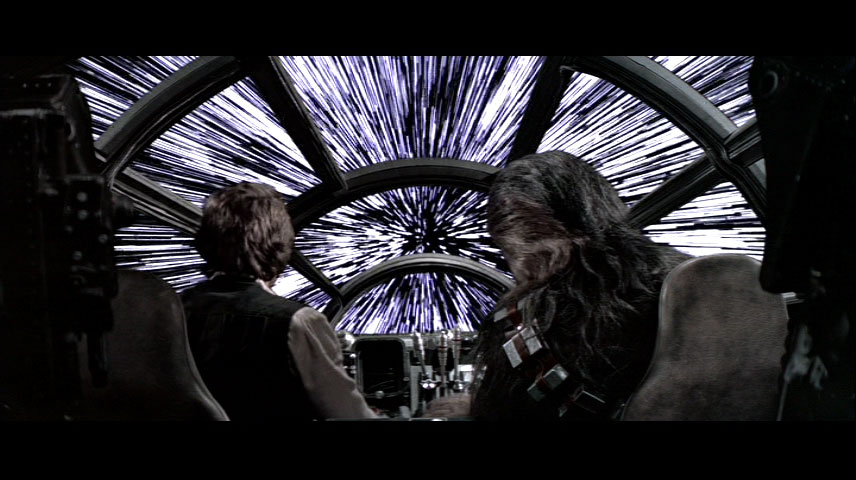
Han: “Fast ship? You’ve never heard of the Millennium Falcon?” Obi-Wan: “Should I have?” Han: “It’s the ship that made the Kessel Run in less than twelve parsecs!”
See what I mean? A parsec is a unit of distance, not time, so from an astronomical perspective, it made no sense. How could Han have used it to explain how quickly his ship could travel? Well, as it happens, there are some possible and even oddball explanations that have been drafted as the franchise has expanded over the years.
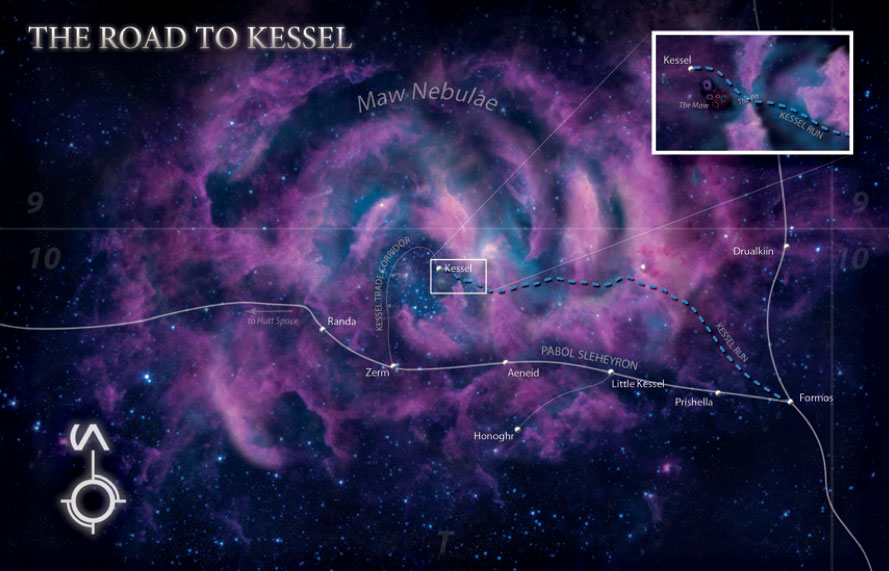
Another important point to make here is about the Kessel Run itself. As a smuggler, Han was deeply involved in running “glimmerstim spice” during his pre-Rebel days (a clear rip off from Dune, but whatever). This took him to and from Kessel, a remote planet located in the Outer Rim that is surrounded by a black hole cluster known as the Maw. As an unnavigable mess, it provided a measure of protection for smugglers running the Imperial blockade that guarded the space lanes near the planet.
All of this comes up in the Jedi Academy Trilogy, a series of novels written by Kevin J. Anderson that are part of the expanded Star Wars universe, and is the first case of the Run being detailed. From these an other sources, we are told that the Run is an 18-parsec route that led away from Kessel, around the Maw, and into the far more navigable area of space known as The Pit. Here, smugglers had to contend with asteroids, but any smuggler worth his salt could find their way through without too much difficulty, and didn’t have to worry about Imperial patrols from this point onward.
To cut down on the distance traveled, pilots could dangerously skirt the edges of the black holes, a maneuver dangerous because it involves getting pulled in by their gravitational forces. If a ship were fast enough, it could risk cutting it closer than most, thus shaving more distance of the route while still being able to break free after it all to complete the run.
Hence we have the first possible explanation to Han’s ambiguous statement. Han’s boast was not about the time taken for him to complete the Run, but the fact that Millennium Falcon was so fast that he was able to cut a full third of the Run off and still make it out. The Falcon would have to be a pretty sweet ship to do that! And it would also fit in with all his other boasts, about how the ship could “make 0.5 past light speed”, and was the “fastest ship in the fleet”.
However, there are other explanations as well. For starters, this expanded universe explanation does not jive with what Lucas himself said, what was presented in the novelization of the original movie, and of course what astronomers and megafans have to say. In the first instance, Lucas claimed in the commentary of the Star Wars: Episode IV A New Hope DVD that the “parsecs” are due to the Millennium Falcon’s advanced navigational computer rather than its engines, so the navicomputer would calculate much faster routes than other ships could.
In the A New Hope novelization, Han says “standard time units” in the course of his conversation with Luke and Ben, rather than “parsecs.” And in the revised fourth draft of A New Hope that was released in 1976, the description for “Kessel Run” is described as a bit of hapless misinformation that Obi-Wan doesn’t believe for a second. In short, Han erred when he said it and didn’t realize it.
And then there is the far more farfetched and mind-bending explanation as made by Kyle Hill in a recent article by Wired magazine. Here, he argues that the true intent of Han’s statement was that he was, in fact, a time traveler. By combining some basic laws of physics – namely that the speed of light (c) is unbreakable and 0.99 ad infinitum is as fast as anything can go – and the details of Han’s boast, a more clear picture of how this works emerges.
First, because the shortened Kessel Run spans 12 parsecs (39.6 light-years), a ship traveling nearly light-speed would take a little more than 39.6 years to get there. Factoring in time dilation, anyone watching the Kessel Run would see Solo speeding along for almost 40 years, but Solo himself would experience only a little more than half a day. So basically, in the time it takes Han to complete just one Kessel Run, the rest of the galaxy continues on its usual path for 40 years, which pushed the date of Han’s birth 40 years into the past.
Confused yet? Well, the idea is that Han would have been born long before events in A New Hope, and even The Phantom Menace took place. After completing his run, no doubt trying to avoid Republic authorities or some such equivalent, he came upon a universe that had gone through the ringer with a Sith coup d’etat, Imperial oppression, and a looming Civil War. What could he do but stick to smuggling and hope to make a living?
REALLY doesn’t make sense in terms of the storyline, does it? Ah, but what can you do? People like to find quirky explanations for things that don’t make sense. It can be fun! But of course, there’s a final and much, much simpler explanation that I haven’t even mentioned yet, and it’s one that’s far more believable given the so-called evidence.
Put simply, Lucas made a mistake. The parsecs line was a misfire, an oversight, and/or brain fart on his part. Nothing more, and all these attempts at explanation are just an obvious attempt to make something that doesn’t fit fit. It makes perfect sense when you think about it: since A New Hope was the first Star Wars movie, that meant Lucas was directing it all by himself. The assistance he sorely needed in terms of directing, writing, editing, etc. didn’t come until the movie was almost complete and he was looking bankruptcy and a nervous breakdown in the eye.
And remember, this is the same movie where a Storm Trooper walked head first into a door aboard the Death Star, Luke yells “Carrie” to Carrie Fisher while they are shooting, the cast and camera can be seen in numerous widescreen shots, and just about every technical problem that could go wrong did go wrong, some of which even made it into the final cut. As far as bloopers, outtakes and errors are concerned, the first Star Wars movie was a mess!
See? So really, is it hard to imagine a simple oversight like a typo could have made it on screen and no one caught it? Hell no! And frankly, I think fandom would be a lot happier if Lucas had remembered these early days of his career and not decided to make the prequels all by himself. Sure, there were plenty of people to catch these kinds of simple errors the second time around, but his many flaws as a movie maker found other ways to shine through – i.e. Jar Jar, lazy directing, too much special effects, wooden dialogue, confused storyline, continuity errors and plot holes galore!
Ah, but that’s another topic entirely. Point is, Star Wars had simple beginnings and plenty of mistakes were made along the way. One can’t expect something so grand and significant in terms of popular culture to be consistent or error free. And Lucas was never really good at producing a seamless product. In the end, it was a fun ride until the new ones came out, and even then he was still making money hand over fist.
And with Disney at the helm now, chances are we’re in for a real treat with some high-budgets and high-production values. And I’m sure there will be plenty of things for the meganerds and uberfans to poke fun at and make compilation videos of. And I of course will be writing about all of it 😉
In what is a first amongst cosmic first, the Curiosity Rover drilled into Martian rock and collected fresh samples from the resulting dust. The precision drilling took place this past Friday, Feb. 8, 2013 – during the 182nd day of the mission – after numerous tests and procedures were conducted. The images were beamed back to Earth on the following day (Saturday, Feb 9) amidst a great deal of fanfare and celebration.
Given the fact that it took them nearly a decade of painstaking work and effort to design, assemble, launch and land the Curiosity Mars Science Laboratory (MSL) rover, it’s obvious while the rover team is overjoyed with this latest development. What’s more, this was more than just a first in the history of space exploration, it also marked Curiosity’s 6 month anniversary on the Red Planet since touching down on Aug. 6, 2012 inside Gale Crater.
John Grunsfeld, NASA’s associate administrator for the agency’s Science Mission Directorate, had this to say about the drilling:
“The most advanced planetary robot ever designed now is a fully operating analytical laboratory on Mars. This is the biggest milestone accomplishment for the Curiosity team since the sky-crane landing last August, another proud day for America.”
Curiosity drilled a circular hole about 16 mm (0.63 inch) wide and 64mm (2.5 inches) deep into the red slab at the “John Klein” rock site. The fine-grained sedimentary rock, which is rich with hydrated mineral veins of calcium sulfate, parted to produce a slurry of grey trailings surrounding the hole. These dust samples were then collected for examination using the rover’s on board laboratory.
The team believes the area known as Yellowknife Bay, where the drilling took place, repeatedly experienced percolation of flowing liquid water eons ago when Mars was warmer and wetter, and potentially more hospitable to the possible evolution of life. These latest samples, they hope, will offer additional compelling evidence to this effect, and also some traces of organic molecules.
While this may sound like an ordinary day around NASA, it represents a quantum leap in terms of what remote landed craft are capable of doing. At no time in the past have astronauts been able to place mobile research platforms on a distant planet, collect samples of said planet, and conduct research on them, all the while beaming the results and images back to labs at Earth for analysis.
What’s next for the rover? Well, once the analysis is complete, the 1 ton robot will continue to investigate Yellowknife Bay and the Glenelg area. After that, it will set off on a nearly year long trek to her main destination – the sedimentary layers of the lower reaches of the 5 km (3 mile) high mountain named Mount Sharp – some 10 km (6 miles) away from its current position.
In a move that was sure to give Trekies a collective fangasm, William Shatner made contact with the International Space Station this week. This past Thursday, thanks to the marvels of 21st century communications technology, the man who portrayed Captain Kirk was able to speak to Chris Hadfield, an astronaut on board the International Space Station.
The conversation began when Shatner – ahem! – opened hailing frequencies and contacted the ISS. Hadfield replied and, using some Star Trek sound effects as background, the two had a live, streaming video conversation. The entire conversation was recorded and uploaded to Youtube for the benefit of fans and amateur astronomers everywhere.
Needless to say, when science fiction and reality collide like this, it is an epic day in nerdom! Check out the video below…
This weekend, amateur astronomers and stargazers will be treated to a rare sight: the conjunction of Mercury and Mars in the sky. This has proven to be quite the confusing spectacle in the past, as people have often misinterpreted the conjunction of the two planets as the appearance of Mercury’s moon. Much like the appearance of other “pseudo-moons”, it is a mistake that litters the history of astronomy.
The conjunction will appear tonight, on February 8th, during the closest conjunction of two naked eye planets in 2013. This month offers a chance to see the fleeting Mercury in the sky, and the conjunction with Mars will provide the opportunity to see how Mercury would look in the night sky if it did indeed have a moon.
To see the conjunction, be sure to find a site with a clear view of the western horizon, grab some binoculars, and begin watching the skies at about 15 minutes after local sunset. According to astronomers, this should coincide with February 8th at 17:00 Universal Time! Look for a reddish dot just above that bright star that hangs low in the sky, and you’ll have your two planets looking very much like they’re in orbit of each other.
But be quick about it, since you’ll only have a 15-30 minute window (depending on latitude) to snare the pairing before they follow the setting Sun below the horizon. Photographing the pair will be tricky, though not impossible, since they present a very low contrast against the bright background twilight sky. And just in case you’re not impressed with the sight itself, consider that with Curiosity and other rovers operating on Mars and the Messenger satellite orbiting Mercury, permanent robotic “eyes” are monitoring both!
Good luck and good gazing! And if you happen to snap a picture of the conjunction, don’t hesitate to send it my way. I’ll be sure to post it with the deets of the amateur professional who made it happen!
It’s no secret that in recent years, the technology behind 3D printing has been growing by leaps and bounds, and igniting a lot of imaginations in the process. And it seems that with every passing day, new possibilities are emerging, both real and speculative. Some are interesting, some are frightening, and some are just downright mind-blowing. Consider this small sampling of what’s emerged most recently and decide for yourself…
First off, it now seems that there is a design for an android that you can download, print and assemble in the comfort of your home – assuming you have access to a 3D printer. Designer Gael Langevin, who calls his project InMoov, has spent the last year perfecting the concept for a voice-controlled android that can be constructed from parts generated by a 3D printer. And not only that, he has made the entire project freely available via open source so that any DIY’er can print it on their own.
Starting with the android’s right hand, Langevin’s idea quickly took off and morphed into a the full-body concept that is now available. Designing the bot with Blender software and printing it on a 3D Touch using ABS plastic as the material, the end product is a fully animated machine that responds to voice control and can “see” and hold objects. And as you can see from the video below, it looks quite anthropomorphic:
Then came the announcement of something even more radical which also sounds like it might be ripped from the pages of a science fiction novel. Just yesterday, a team of researchers at Heriot-Watt University in Scotland announced that they used a new printing technique to deposit live stem cells onto a surface in a specific pattern. This is a step in the direction of using stem cells as an “ink” to fashion artificial organs from a 3D printer, which is their ultimate goal.
The process involves suspending the cells in a “bio-ink,” which they were then able to squeeze out as tiny droplets in a variety of shapes and sizes. To produce clumps of cells, they printed out the cells first and then overlaid those with cell-free bio-ink, forming spheroids, which the cells began grouping together inside. Using this process, they were able to create entire cultures of tissue which – depending on the size of the spheroids – could be morphed into specific types of tissue.
In short, this technique could one day be used to print out artificial tissues, such as skin, muscles and organs, that behave like the real thing. It could even serve to limit animal testing for new drug compounds, allowing them to be tested on artificially-generated human tissue. According to Jason King, business development manager at Roslin Cellab and one of the research partners: “In the longer term, [it could] provide organs for transplant on demand, without the need for donation and without the problems of immune suppression and potential organ rejection.”
And last in the lineup is perhaps the most profound use proposed for 3D printing yet. According to the European Space Agency, this relatively new technology could turn moon dust into moon housing. You read that right! It seems that a London-based design firm named Foster+Partners is planning to collaborate with the European Space Agency to build structures on the Moon using the regolith from the surface.
The process is twofold: in the first step, the inflatable scaffolding would be manufactured on Earth and then transported to the Moon. Once there, a durable shell composed of regolith and constructed by robotically-driven 3D printers would be laid overtop to complete the structures. The scheme would not only take advantage of raw materials already being present on the lunar surface, but offers a highly scalable and efficient model for construction.
Should the plan be put into action, a research expedition or colony would first be established in the southern polar regions of the Moon where sunlight is constant. From there, the scaffolding and components of the printing “foundry” would be shuttled to the moon where they would then be assembled and put to work. Each house, once complete, would be capable of accommodating four people, with the possibility of expansion should the need arise. For now, the plan is still in the R&D phase, with the company looking to create a smaller version using artificial regolith in a vacuum chamber.
Impressed yet? I know I am! And it seems like only yesterday I was feeling disillusioned with the technology thanks to the people at an organization – that shall remain nameless – who wanted to print out “Wiki-weapon” versions of the AR-15, despite the fact that it was this very weapon that was used by the gunman who murdered several small children in the town of Newton, Connecticut before turning the weapon on himself.
Yes, knowing that this technology could be creating life-saving organs, helpful androids and Lunar housing goes a long way to restoring my faith in humanity and its commitment to technological progress. I guess that’s how technology works isn’t it, especially in this day and age. You don’t like what it’s being used for, wait five minutes!
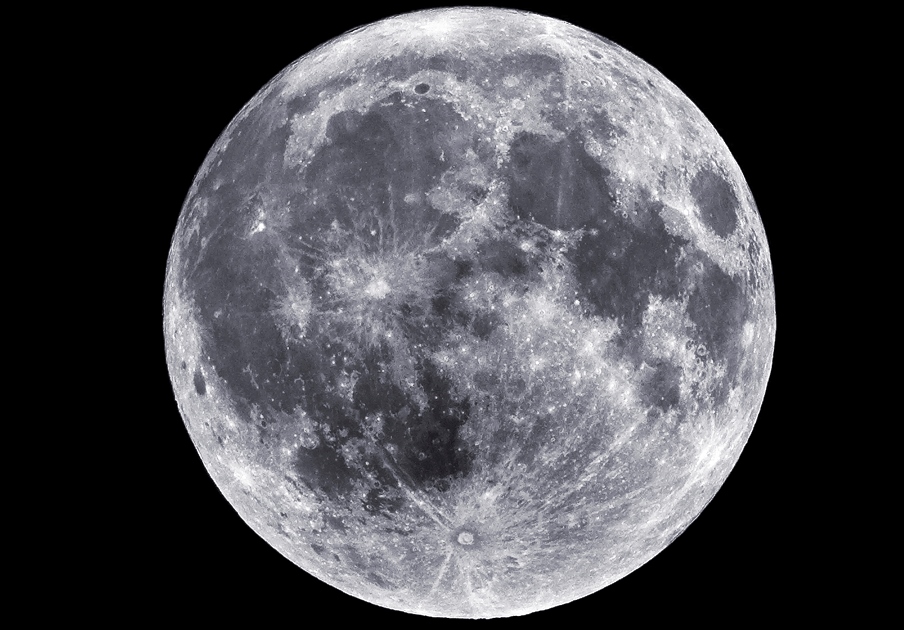
In an effort to demonstrate how laser communications work, and perhaps just to show off a little, a team of NASA engineers shot an image of the Mona Lisa to the moon by piggybacking it on laser pulses. The transmission occurred back in mid-January, and took place between NASA’s Goddard Space Flight Center here on Earth and the Lunar Reconnaissance Orbiter (LRO) some 386,000 km (240,000 miles) away. In addition to showcases how NASA regularly communicated with the orbiter, it also presented a possible means of communicating with a future moon colony.
On any given day, scientists at the Goddard Space Flight Center use what is known as the Next Generation Satellite Laser Ranging Station to track the LRO’s position. Expanding on this, the staff reprogrammed the laser to send the massive work of art in the form of as massive JPEG file. This involved chopping the picture into a 152×200 pixel array, with each pixel assigned a gray-scale value and beamed up one at a time. All told, the process took some time, with image transmission speed clocked at about 300 bits per second.
It then fell to LOLO, the LRO’s Lunar Orbiter Laser Altimeter, to put the Mona Lisa back together based on the arrival times of the pixel data. All the while, LOLA continued to pursue its primary mission of mapping out the lunar terrain. The image was then beamed back to Earth via the LRO’s radio telemetry system, with only minor errors caused by turbulence in the atmosphere.
MIT’s David Smith, head of LOLA, had this to say about the event in a release:
“This is the first time anyone has achieved one-way laser communication at planetary distances. In the near future, this type of simple laser communication might serve as a backup for the radio communication that satellites use. In the more distant future, it may allow communication at higher data rates than present radio links can provide.”
According to NASA, the success of the demonstration could pave the way for lasers to be used for satellite communication, particularly with its Lunar Atmosphere and Dust Environment Explorer (LADEE) mission, which is set to launch this year.
No telling how DaVinci might react to the news of his classic portrait breaching the heavens and being beamed into space. However, given the man’s obvious love of his work and fascination with all things metaphysical and scientific, I think he would have been very happy. Perhaps if his enigmatic masterpiece were to be send into the cosmos as part of the search for extra-terrestrial life too. But that’s another day and another mission!
And be sure to check out the video below from the Goddard SFC explaining the process, courtesy of NASA:

 For almost a year now, NASA has been discussing plans which will eventually culminate in a return to the Moon. Initially, such plans were kept under wraps just in case NASA found itself in a budget environment that did not favor renewed space exploration. But since the 2012 election, and the re-election of President Obama, NASA publicly announced its plans, confident that the budget voted on in 2010 (which included lucrative funding for them) would continue.
 Above, we have the latest. It’s called the JX-2, a liquid-fuel cryogenic rocket engine is the modernized version of the J-2, the engine that NASA used in the late-’60s and early-’70s to thrust humans beyond low Earth orbit. With the conclusion of the Apollo program, these babies fell into disuse. But with the upgrades made to these new versions, NASA hopes to send people back to the Moon, and a few places beyond.
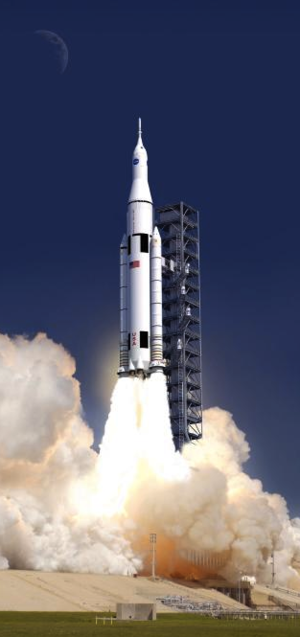 The SLS is NASA’s next-generation rocket, a larger, souped-up version of the Saturn V’s that took the Apollo teams into space and men like Neil Armstrong to the Moon. According to NASA spokesmen, the SLS rocket will “incorporate technological investments” and “proven hardware” from previous space exploration programs.” Essentially, this means that projects which have been shelved and retired have been updated and incorporated to create a rocket that can do the job of sending men into deep space again.












 Stories by Williams