Curiosity Rover’s First X-Ray Analysis of Martian Soil

Curiosity_cheminanalysisA bit of retro news from the Curiosity front here. Roughly one month ago, before the big announcement about “earthshaking news” was made, there was some other news regarding Curiosity’s ongoing soil analyses. And given all the attention that was dedicated to the possibility of organic molecules, this is one news story that might have been overlooked.

Put simply, Curiosity performed tests that were previously impossible on Mars, using an x-ray scanner that was roughly the size of shoebox in order to conduct detailed analyses of Martian soil. The purpose, of course, was to determine what kinds of minerals it contains and how its soils first came into being.

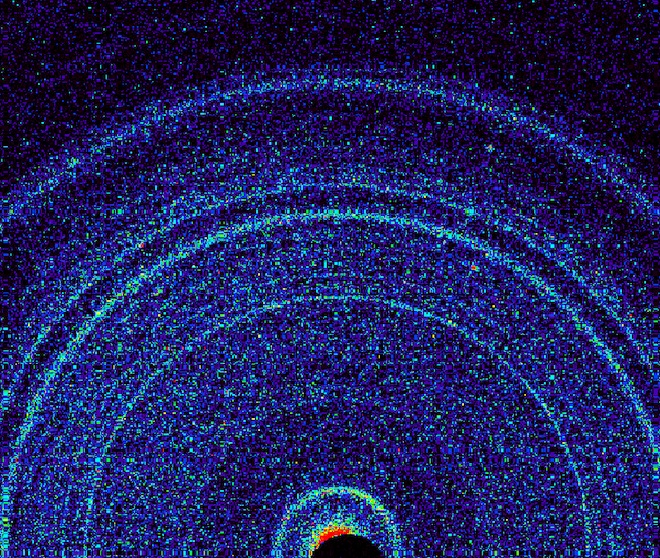
The device in question, called CheMin, takes a sample of sand – just a thimbleful – and shakes it 2,000 times a second, all the while bombarding it with x-rays. The rays then penetrate the grains, and the way in which they diffract can tell scientists about their constituent atoms. The results are then scanned to see just what kind of mineral composition it has (take a look up top to see the results rendered in stunning technicolor!)

Up until now, this technique has been impossible simply because the equipment needed to carry out such operations were far too large and clunky to fit on a rover. But thanks to NASA engineers, the device in question was shrunk down exponentially in size and even boasts improved electronics, ensuring it is both portable and energy-efficient.

As a result, the Curiosity rover has made some very interesting discoveries. For starters, Curiosity has determined that the soils in the area are extremely similar to those found around the Mauna Kea shield volcano in Hawaii. In fact, it’s identified crystalline feldspar, pyroxenes, and olivine – all of which are common to the soil here on Earth.

Yes, not exactly earthshaking news is it? But it’s interesting nonetheless, and let’s us know once again that Mars and Earth have plenty in common.

Source: Wired.com
Ice and Organics Found on Another Planet!

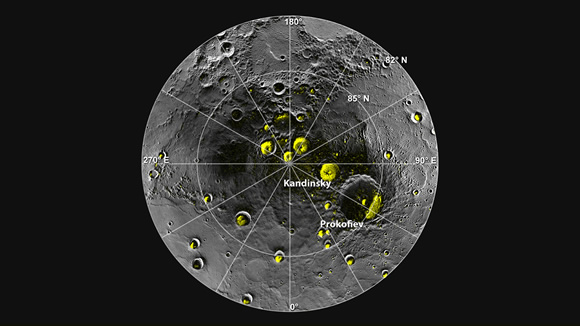
mercury_messengerYes, the announcement from the Curiosity team yesterday that no organics have been found on Mars (yet) certainly came as a big disappointment. However, people may be interested to hear that organic molecules were discovered on a different planet in our Solar System, along with water and ice. Would you believe it, the planet is Mercury? Yes, the world famous for lakes of molten metal and extreme heat may actually boast the building blocks of life.

This information is the latest to come from NASA’s MESSENGER spacecraft, which is now orbiting the closest planet to our Sun. It confirms what was postulated 20 years ago, after images were taken of the polar region and detected radar-bright materials which were beleived to be water and ice. And where water and ice occur, organic molecules are often sure to follow. Though Mercury boasts the hottest environment of any planet in the Solar System, the area in question lies within a permanent shadowed series of craters on the northern pole.

Scientists today said that Mercury could hold between 100 billion to 1 trillion tons of water ice at both poles, and the ice could be up to 20 meters deep in places. Additionally, intriguing dark material which covers the ice could hold other volatiles such as organics. Unfortunately, all of this water comes in the form of ice, as surface temperatures in the poles are too cold to allow for a thaw. In addition, the total lack of atmosphere on Mercury would mean that any liquid would evaporate and be sucked into space very quickly.

At a briefing which was held yesterday, Sean Solomon – MESSENGER Principal Investigator – has this to say about the news: “These findings reveal a very important chapter of the story of how water ice has been delivered to the inner planets by comets and water rich asteroids over time.” In short, it is believed that these ice deposits and organic molecules were delivered to the planet through a series of meteor impacts, and which have survived thanks to the existence of Mercury’s permanently shadowed polar regions.

Granted, no settlers are ever likely to be making a home on Mercury – not without some serious technological innovations! – but the discovery is a very interesting find and does help scientists to understand how life may have begun here on Earth. What’s more, this news may help Curiosity and other science teams to determine where and how organic molecules and ice could be found on Mars. The challenges there are similar to those on Mars, since she too is an inner planet that has virtually no atmosphere and a great deal of surface radiation, not to mention that she too would have been the recipient of water ice and organics through meteoric impacts.

So c’mon Mars! Show us what you got. You don’t want to be outdone by your Hermian cousin do ya?

“Earthshaking” News From Mars!

Curiosity-RocknestCancel the champagne! Turns out what we have here is a tentative conclusion made by some overzealous scientists. According to an update made earlier today, scientists working for NASA indicated that no organic molecules were found in the sample of Martian soil taken by Curiosity nine days ago. The news first appeared on NASA’s Twitter feed as follows:

“Everybody, chill. After careful analysis, there are no Martian organics in recent samples.”

This was followed shortly thereafter with:

“Why the wait? We’re moving at the speed of science. My team needed time to analyze the data.”

Uh, yeah. Because that’s what we were concerned with; the wait, not the getting of our hopes up! But last but not least, there some words of reassurance:

“Turn that frown upside down: We’re fewer than four months into a multi-year mission. We’ve only just begun!”

To be fair, this announcement doesn’t rule out the possibility of organic molecules on the Martian surface. It’s just that no organic molecules have been found yet. Unfortunately, having thought that they had detected some traces in their samples, Grotzinger conveyed the team’s excitement about the possibility of a discovery and triggered a bit of a media frenzy. Understandable, but frankly, I have a bit of a bone to pick with Grotzinger himself.

Dude, you had to know we’d all get excited and start hanging on your every update with baited breath. But in the end, we were like a bunch children on Christmas morning, desperately waiting to rip into our presents, only to find that Santa had stuck us with an IOU! Or worse, a note saying: “There are plenty more Christmas’s coming! Be happy!” Turn my frown upside down, Grotzinger? You owe me restitution!

Okay, now that I’m ranted out, I sincerely hope the mission meets with the results they are looking for soon. Granted, Curiosity still has many more years before her mission is complete, but I don’t think I can stand this kind of suspense! And frankly, I’d like to hear about some definitive proof that terraforming is possible on a planetary scale. Get on it, NASA! You got a planet to prep for colonization!

Animation of Curiosity’s 1st “Touch and Go” Maneuver

In the days leading up to Thanksgiving in the US, Curiosity performed her first “touch and do” maneuver. This was the process whereby the rover drove up to and inspected an interesting looking rock using the Alpha Particle X-Ray Spectrometer (APXS) on its arm, then moved onto the next point of interest on the same day.

This latest maneuver now puts Curiosity inside the ‘Glenelg’ geologic formation. The NASA science team selected this as the first major science destination because it lies at the intersection of three diverse types of geological areas that will help unlock the secrets of Mars’ ancient watery history and evolution to modern times.

What makes this historic is that it is the first time the rover has conduct a touch and go maneuver on the same day. Ordinarily, the rover performs these duties separately. According to Curiosity Mission Manager Michael Watkins (of NASA’s Jet Propulsion Laboratory in Pasadena, Calif), “[this] is a good sign that the rover team is getting comfortable with more complex operational planning, which will serve us well in the weeks ahead.”

In honor of this event, NASA scientists created a animation of the maneuver using the same software they do to plan the rover’s movements. Beginning with the examination it made using its arm sensor, the animation then shows (with painful accuracy) the rover making the 25.3 meter (83 foot) transit to its next location.

News From Mars!

An interesting slew of news has been coming from NASA recently, courtesy of the Curiosity Rover and its mission to Mars. First, there was the announcement by John Grotzinger on NPR radio that Curiosity’s science team had discovered something potentially “earth-shattering” on the Red Planet, which came just two days ago. Since then, researchers over at NASA have been keeping a tight lip on what that might be, though it seems to be taking an extraodinary effort to do so. One can only imagine what they’re dying to tell us…

But it seems more stories are coming in the wake of this. First, there was the revelation by the Curiosity Rover that Mars radiation levels, once thought to be problematic for life, are actually safe for humans. According to Don Hassler, the principal investigator on Curiosity’s Radiation Assessment Detector instrument (RAD), Curiosity determined that “the Mars atmosphere is acting as a shield for the radiation on the surface and as the atmosphere gets thicker, that provides more of a shield and therefore we see a dip in our radiation dose.”

Apparently, the levels are equal to what astronauts deal with on the International Space Station, which means people in suits will be able to walk on the Red Planet safely once a manned mission is mounted. Knowing that they can conduct surveys on the surface without additional radiation shields should prove to be a boon for colonization as well. More settlers will certainly be drawn to Mars now that they know they can settle in without having to worry about little things like radiation sickness or mutations!

Third, there was the news that in the wake of making its “one for the history books” discovery, that Curiosity has finished collecting and analyzing soil samples and is preparing to move on. The final checks and preps were made amidst ethereal whirlwinds and twisters, which are characteristic of the region known as the “Gale Crater”, where it has been conducting its research for the past month. The rover is now being prepared to move on in search of suitable targets for a compact rock drill, the final major sample acquisition system to be tested.

Ashwin Vasavada, the deputy project scientist for the Mars Science Laboratory rover at the Jet Propulsion Laboratory in Pasadena, Calif, had this to say on the next phase of the mission: “We still would like to get a little further into this Glenelg region where we see this diversity of rocks and layered rocks and other really interesting terrain. And then we still have a goal in the next month or two of doing the big U-turn and heading up to Mount Sharp.”

Mount Sharp is a 3-mile-high mound of layered terrain that sits in the center of the Gale Crater, where Curiosity is expected to spend the bulk of its planned two-year mission. In the meantime, the research team needs to go over all the information Curiosity has sent back, including an ongoing analysis of the martian weather.

On top of all that, there’s still the matter of that “earth shaking news”. How about it NASA? You too, Grotzinger? We’re ready and waiting… how much more time do your researchers need before they’re sure and are free to break the news they are so clearly dying to share? I still say its organic molecules, but what do I know?

Source: news.cnet.com

“Earthshaking” News From the Red Planet?

In an interview with NPR earlier today, John Grotzinger – the Principal Investigator for NASA’s Mars Science Labs – said a recent soil sample test with the SAM instrument (Sample Analysis at Mars) shows something”‘earthshaking.” Like any good scientist (or a terrible tease), Grotzinger and his team are awaiting confirmation before announcing just what it is they’ve found. Nevertheless, the announcement of a potential discovery which could be “one for the history books” has fueled speculation and put many on the edge of their seats.

Thus far, the smart money has been on the discovery of organic molecules in the Martian soil, which is precisely what Curiosity has been up to for the past few months. This is because the very purpose of the SAM instrument to examine the chemical and isotopic composition of the Martian atmosphere and soil, specifically to determine if anything organic is capable of living there. If so, it will end the age-old argument of whether or not life can exist on the surface Mars, even if it doesn’t currently.

It will also prove to be a boon for those who are seriously looking ahead, and plotting manned missions to the Red Planet with the intent of making it habitable for humans. As I’m sure all people are aware of by now, there are plenty of people who are monitoring Curiosity’s findings and hoping they will help determine whether or not terraforming can be carried on the the planet, with the long-term goal of creating a “Green Mars” where terrestrial species can live and thrive, crops can grow, and oceans and rivers can once again exist.

I think I speak for them and myself when I say, “Grotzinger, best of luck to you, and this better not be some kind of media stunt!” Oh, I can’t wait to hear what they find!

Source: Universe Today

Curiosity’s Best Image Yet!

In case you were worried that Curiosity had fallen into a ditch, more news has just come from the Red Planet featuring everybody’s favorite rover! It seems the robot has been taking pictures again, and word around the campfire is that it is Curiosity’s best yet! Having taken a break from its usual round of performing scientific research on soil samples and surface terrain, Curiosity took a pause to snap a self-portrait

Well, in truth, it was fifty-five photos, all of which were taken by the Rover’s hi-resolution Mars Hand Lens Imager. These photos were then combined back at Mission Control by NASA personnel to form a panoramic image that shows Curiosity at work digging holes in the sand and with Mount Sharp in the background. The area of the shoot is appropriately known as the “Rocknest” since this is where Curiosity has been for the past few months, gathering scoops of Martian soil for analysis.

In addition to its aesthetic appeal, the images serve an important function. According to NASA’s website, “Self-portraits like this one document the state of the rover and allow mission engineers to track changes over time, such as dust accumulation and wheel wear.” Apparently, they also ensure that Curiosity continues to function within established parameters while personnel are not at the helm.

Check out the full image below. As you can plainly see, it is high-resolution and extremely detailed.

New Super-Earth Discovered

It has been an exciting year for the discovery exoplanets! First, there was the news from Gliese 581 g, then the discovery of an Earth-like planet in Alpha Centauri. And now, scientists working in the European Southern Observatory’s HARPS apparatus have announced the discovery of the latest Super-Earth, which they believe to be the greatest candidate for extra-terrestrial life yet.

The planet is located in the HD 40307 system, an orange dwarf star that is just 42 light years from Earth. Although scientists are still not entirely sure that it’s a rocky planet, there are a number of strong indications that point towards and hospital terrestrial environment. For starters, as the sixth and farthest planet in the system, it lies within the sun’s habitable zone.

Second, the planet has a very reasonable 320 day annual cycle, which means that it receives a similar amount of solar energy compared to Earth – about 62% of what we get year round. This is positive news since most Super-Earths are situated too close to their parent stars to boast life. And last, but not least, the planet is unique amongst its near-Earth exoplanet kin in that it is not tidally locked, meaning it has a night and day cycle. Though this is not absolutely crucial to life, it is a bonus seeing as how it means one side of the planet is  not constantly exposed to radiation while the other is constantly in a state of cold, life denying darkness.

Mikko Tuomi of the University of Hertfordshire in the UK, and Guillem Anglada-Escude from Germany’s University of Goettingen are chiefly responsible for this discovery. In the coming weeks, months and years, their team will be doing their best to ascertain the planet’s composition, which they hope to be rocky in nature. If this should prove to be the case, it will move to the top of likely candidates for exoplanet colonization, pushing such planets as Gliese 581 g, the most Earth-like exoplanet discovered to date, out of the top spot.

Source: Discovery News

NASA’s X1 Robotic Exoskeleton

It may not be Iron Man, but it’s certainly a step in that direction. It’s known as the X1 Robotic Skeleton, a spinoff of their earlier Robonaut 2 project. Designed specifically to assists astronauts with either exercising in space, performing difficult tasks, or restoring movement to astronauts who have suffered from paralysis, the X1 is a big leap forward in terms of ergonomics and man-machine interface.

The exoskeleton is powered by four motorized joints and six passive joints, all of which give the 57 pound suit a good range of motion. When set to exercise mode, it provides resistance to the astronauts movement, ensuring that their muscles get the exercise they need while in zero-g environments. The rest of the time, the motors provide enough force to allow an astronaut to get a full range of motion and maintain full ambulatory capabilities.

A joint effort between NASA, The Florida Institute for Human and Machine Cognition, and the awesomely named Oceaneering Space Systems, the X1 is still deep in the research and development phase. Still, the suit could some day be used both in space and on Earth. In that respect, it is not unlike ReWalk and other robotic systems that are currently employed by the military which are used to help restore motion to the paralyzed and assist people in power lifting. Soon, the word “disability” will be entirely without meaning and “power lifters” will have to be redefined!

Check out this video of the X1 in action and/or click on the link below for more on this story.


Source: news.cnet.com

Endeavour’s Final Mission Caught on Video

Several weeks ago, the shuttle Endeavour returned to Earth after performing its 25th and final mission. It was then treated a hero’s tour as it was driven about LA before being brought to its final resting place in the California Science Center. However, before any of that happened, Endeavour got a hero’s send off as it was flown all over California on the back of a 747 with two Air Force F/A-18’s flying escort.

And wouldn’t you know it, one of those pilots took some grand aerial footage of the whole event. The 15-minute segment is about as close as anyone can get to actually being there, complete with radio communications going back and forth. And in what many people are sure to appreciate, there is no soundtrack or narration to take away from the authenticity. Word of warning though, the video is long, so be sure your schedule is clear for the next 15-20 minutes before hitting play. Enjoy!