The Future is Here: The VR Cave!

Cave2It’s called the CAVE2, a next-generation virtual reality platform that is currently the most advanced visualization environment on Earth. Whereas other VR platforms are either in 2D or limited in terms of interactive capability, the CAVE2 is about the closest thing there is to a real-life holodeck. This is accomplished through a series of panoramic, floor-to-ceiling LCD displays and an optical tracking interface that is capable of rendering remarkably realistic 3D environments.

Developed by the Electronic Visualization Laboratory (EVL) at the University of Illinois at Chicago, CAVE2 is a direct follow up to the VR platform the university created back in 1992. Like the original, the name stands for “Cave Automatic Virtual Environment”; but whereas its predecessor was set in a cube-shaped room, the new environment is set within a cylindrical, 320 degree immersive space. In addition, the screens, sounds, and resolution have all been vastly upgraded.
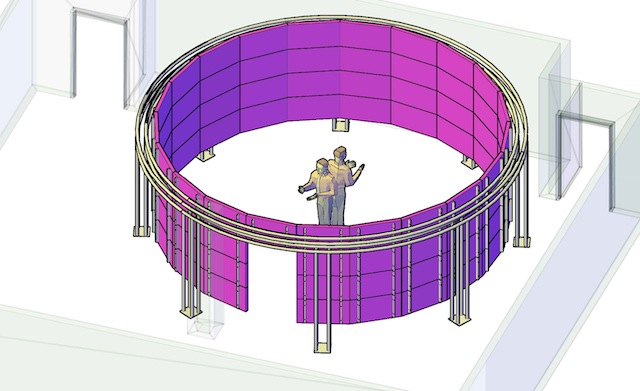
ModelFor example, the 7.5 by 2.5 meter space (24 feet x 8 feet) is covered floor-to-ceiling with 72 3D LCD screens, each of which outputs images at 37-megapixels (that’s 7,360 x 4,912 pixels, twice that of 2D). This allows for a pixel density that is on par with the human eye’s own angular resolution at 20/20 vision. Headgear is needed to get the full 3D effect, and the entire apparatus is controlled by a hand-held wand.

Yes, in addition to the holodeck, some other science fiction parallels are coming to mind right now. For example, there’s the gloved-controlled holographic interface from Minority Report, the high-tech nursery in Ray Bradbury’s short story The Veldt, and the parlor walls he envisioned in Fahrenheit 451. And apparently, this is no accident, since director Jason Leigh, the head of the project, is a major sci-fi geek!

mars_lifeBut of course, all this technology was designed with some real-life, practical applications in mind. These range from the exploration of outer space to the exploration of inner space, particularly the human body. As Ali Alaraj, a noted neuroscientist who used the CAVE2 put it:

“You can walk between the blood vessels. You can look at the arteries from below. You can look at the arteries from the side. …That was science fiction for me. It’s fantastic to come to work. Every day is like getting to live a science fiction dream. To do science in this kind of environment is absolutely amazing.”

All of this bodes well for NASA’s plans for space exploration that would involve space probes, holographics, and avatars. It would also be incredibly awesome as far as individual hospitals were concerned. Henceforth, they could perform diagnostic surgery using nanoprobes which could detail a patients body, inch for inch, from the inside out.

And of course, the EVL has provided a cool video of the CAVE2 platform in action. Check them out:

Source: IO9, evl.uic.edu
Biotech News: Artificial Ears and Bionic Eyes!

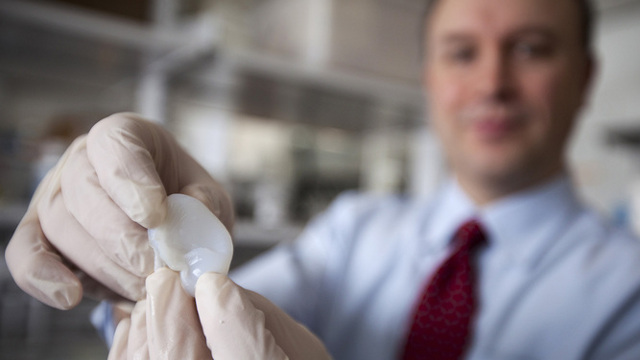
3d_earLast week was quite the exciting time for the field of biotechnology! Thanks to improvements in 3D printing and cybernetics – the one seeking to use living cells to print organic tissues and the other seeking to merge the synthetic with the organic – the line between artificial and real is becoming blurrier all the time. And as it turns out, two more major developments were announced just last week which have blurred it even further.

The first came from Cornell University, where a team of biotech researchers demonstrated that it was possible to print a replacement ear ear using a 3D printer and an injection of living cells. Using a process the team refers to as “high-fidelity tissue engineering”,  they used the cartilage from a cow for the ears interior and overlaid it with artificially generated skin cells to produce a fully-organic replacement.

3dstemcellsThis process builds on a number of breakthroughs in recent years involving 3D printers, stem cells, and the ability to create living tissue by arranging these cells in prearranged fashions. Naturally, the process is still in its infancy; but once refined, it will allow biomedical engineers to print customized ears for children born with malformed ones, or people who have lost theirs to accident or disease.

What’s more, the Cornell research team also envision a day in the near future when it’ll be possible to cultivate enough of a person’s own tissue so that the growth and implantation can happen all within the lab. And given recent the breakthrough at Wake Forest Institute of Regenerative Medicine- where researchers were able to create printed cartilage – it won’t be long before all the bio-materials can be created on-site as well.

Eye-cameraThe second breakthrough, which also occurred during this past week, took place in Germany, where researchers unveiled the world’s first high-resolution, user-configurable bionic eye. Known officially as the “Alpha IMS retinal prosthesis”, the device comes to us from the University of of Tübingen, where scientists have been working for some time to build and improve upon existing retinal prosthetics, such as Argus II – a retinal prosthesis developed by California-based company Second Sight.

Much like its predecessor, the Alpha IMS helps to restore vision by imitating the functions of a normal eye, where light is converted into electrical signals your retina and then transmitted to the brain via the optic nerve. In an eye that’s been afflicted by macular generation or diabetic retinophathy, these signals aren’t generated. Thus, the prosthetic works by essentially replacing the damaged piece of your retina with a computer chip that generates electrical signals that can be understood by your brain.

biotech_retinal-implantBut of course, the Alpha IMS improves upon previous prosthetics in a number of ways. First, it is connected to your brain via 1,500 electrodes (as opposed to the Argus II’s 60 electrodes) providing unparalleled visual acuity and resolution. Second, whereas the Argus II relies on an external camera to relay data to the implant embedded in your retina, the Alpha IMS is completely self-contained. This allows users to swivel the eye around as they would a normal eye, whereas the Argus II and others like it require the user to turn their head to change their angle of sight.

Here too the technology is still in its infancy and has a long way to go before it can outdo the real thing. For the most part, bionic eyes are still rely heavily on the user’s brain to make sense of the alien signals being pumped into it. However, thanks to the addition of configurable settings, patients have a degree of control over their perceived environment that most cannot begin to enjoy. So really, its not likely to be too long before these bionic implants improve upon the fleshy ones we come equipped with.

biotech_dnaWow, what a week! It seems that these days, one has barely has to wait at all to find that the next big thing is happening right under their very nose. I can foresee a future where people no longer fear getting into accidents, suffering burns, or losing their right eye (or left, I don’t discriminate). With the ability to regrow flesh and cartilage, and replace organic tissues with bionic ones, there may yet come a time when a human can have a close-shave with death and be entirely rebuilt.

I foresee death sports becoming a hell of a lot more popular in this future… Well, crap on me! And while we’re waiting for this future to occur, feel free to check out this animated video of the Alpha IMS being installed and how it works:


Sources:
IO9.com, Extremetech.com

The Future is Here: Peel and Stick Solar Panels!

solar_arrayEver since Albert Einstein first proposed the concept in 1921, photovoltaic cells – solar cells – have been at the forefront of alternative fuel and energy research. And while progress has been made, two key factors have remained as stumbling blocks to their widespread adoption: One, the cost of making solar cells; and two, the cost of installing them.

In order for this to change, analysts have predicted for some time that solar panels would need to be printed on cheap, durable materials that could be installed anywhere. Until such time, they would continue to lose out against the gas and coal equivalents, which would continue to generate as much energy as a single solar cell while remaining comparatively cheaper.

solar_powerAnd as it turns out, the wait may be coming to an end. According to Silvija Gradecak, a materials science and engineering professor at MIT, new research from around the world is driving us ever closer to that goal. And it is her lab, among others, that is making a major contribution, through the release of a new breed of bendy, peel-and-stick solar panels.

The focus of Gradecak’s team has been on the production of a organic, thin-film cells that are made from abundant materials which could be manufactured on the cheap. And in December of last year, they made a breakthrough with the production of a transparent photovoltaic cell by using flexible graphene and a nanowire coating. This thin, flexible and transparent photo cell, they claimed, could be mounted anywhere and is comparatively cheaper than current silicon based varieties.

solar_cellNaturally, Gradecak was sure to point out that this development did not take place in a vacuum. Nor was it the only one of its kind:

“”There was a significant effort to develop these type of devices and the slope of this improvement is very high… I personally believe this is not just theoretical. In a couple of years you will see these types of devices commercially.”

And in that respect, she is right. At Stanford, researchers presented their own concept for a next generation solar cell this past December: a flexible, peel-off panel that can stick to almost any surface. Composed of nickel, silicon and silicon dioxide and a protective polymer layer, the cell consists of multiple layers that can be peeled away and applied as needed.

Exciting times, these are, especially when long-awaited environmental solutions are finally becoming feasible. It also inspires hope that we might be able to tackle a little problem known as emissions before it is too late. Of course, that would require making this technology available worldwide, especially in developing economies where coal and gas power are especially lucrative. But anything is doable, especially if the price is right!

Source: Co.Exist.com

The Hacking Continues…

hackers-1Cyberwarfare has been making it into the news quite a bit of late. From the international cyber-spying virus known as “Red October”, to China’s hacking of the New York Times and Bloomberg L.P., to intrusions into major software companies and social utilities, it seems no one is immune or unassailable in the digital age. What’s more, there are indications that it is nation states that may be leading the charge.

The latest victim in the ongoing war was Microsoft, which recently admitted that it too has been targeted by hackers. The announcement came in the midst of such tech giants as Apple, Facebook, and Twitter reporting security breaches linked to a software developer’s website, which would apparently infect programmers’ computers after they visited the site.

hacker_@In a statement posted by general manager Matt Thomlinson, Microsoft experienced intrusions of a similar nature. Though they did not specify who these hackers were, Mike Isaac at AllThingsD recently identified the website in question as iPhoneDevSDK, a site popular with mobile-app developers. In response, iPhoneDevSDK recently told users that it discovered that an administrative account on its site had been hacked, which allowed hackers to inject infectious code into its Web pages.

Once again, there are many who suspect that these attacks are linked to sources in China. In recent years, the Chinese government has been indicted in several attacks on American media chains as well major companies, as part of a wider campaign to steal trade secrets and monitor and manipulate how China is portrayed in the news.

As it stands, it is not yet clear whether this represents a part of that campaign, or if private hackers are simply using extra-covert means to conduct a little anti-corporate mischief on the side. Personally, I hope it’s the latter, as the idea of nations inciting cyberwarfare against each other is not exactly the most comforting notion! But then again, knowing that they are spying on each other kind of gives those of us who are afraid of “Big Brother” a bit of a reprieve doesn’t it?

Source: businessinsider.com

The Future is Here: The Apple iWatch!

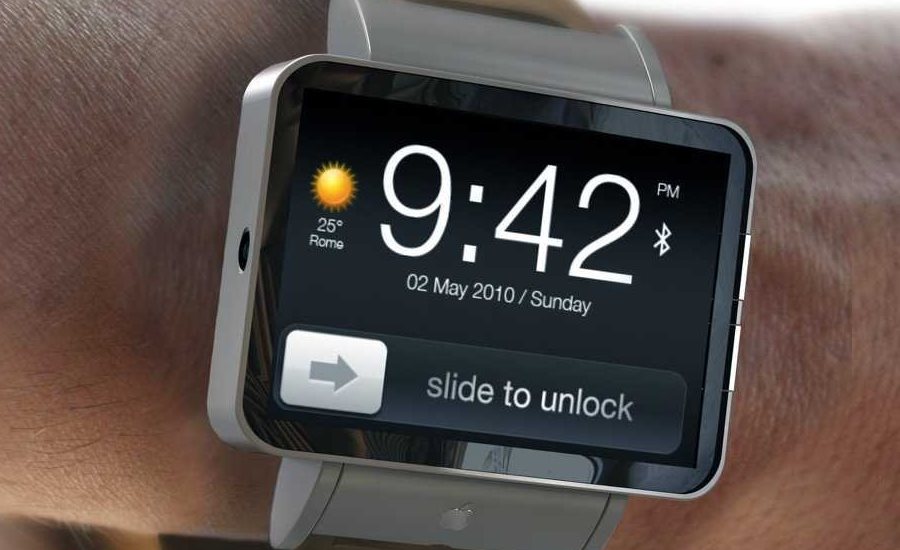
iWatchLeave it to Apple to once again define the curve of technological innovation. Known as the iWatch, this new design for a smartwatch is expected to make some serious waves and spawn all kinds of imitations. In addition to keeping time, it will boast a number of new and existing abilities that will essentially make it a wrist-mounted computer. As a result, there are many who claim this device is a response to Google’s Project Glass, since it signals that Apple is also looking to stake a big claim to the portable computing revolution.

According to Bruce Tognazzini, a principal with the Nielsen Norman Group and former Apple employee who specializes in human-computer interaction, an Apple iWatch is likely to have a serious impact on our lives. In addition to some familiar old features that were created for the iPhone, Apple has filed numerous patents and made plans to incorporate several new options for this one device. For example:

  • The iWatch will apparently make use of wireless charging, something Apple holds the patent for
  • Voice interaction through Siri, removing the need for a complicated control interface
  • Networking with your iPhone, iPod and other devices
  • Health monitor, including pedometer, bp monitor, calorie tracker, sleep tracker, etc.
  • NFC chip for personal, mobile banking
  • The phone acts as an ID chip, eliminating the need for passwords and security questions

Wearable ComputerSo in essence, the phone combines all kinds of features and apps that have been making the rounds in recent years. From mobile phones to PDAs, tablets and even fitness bands, this watch will combine them into one package while still giving the user the ability to network with them. This ensures that a person has a full range of control and can keep track of their other devices when they’re not on their person.

Apple also indicated that with this portable computer watch, people could take part in helping to correct faulty maps and other programs that require on the spot information, allowing for a degree of crowd-sourcing which has previously been difficult or impossible to provide. And since it’s all done through a device you strap on your wrist, it will be more ergonomic and portable than a PDA or smartphone.

Paper-Thin-Pamphlet-Smartphone-Concept-2And with other companies working on their own smartwatches, namely Cookoo, Pebble, and even Google, this could be the end of the smartphone as we know it! But in the course of making technological progress, some inventions become evolutionary dead ends, much like over-specialized creatures. I’m sure Steve Jobs would approve, even if the iPhone was one of his many, many babies!

Envisioning The Future of Finance

BrightFutureA few times now, the website known as Envisioning Technology has snared me with their predictive posters. First there was their “Emerging Technologies” infographic for the year of 2012. That was followed shortly thereafter by “The future of health” and “The future of education“. They even took a look at popular dystopian and apocalyptic scenarios and asked the question “Should I be afraid“?

And now, in their latest infographic, they’ve tackled the future of finance. Looking at the financial industry as a whole, they attempt to gauge its readiness to technological change. While looking at trends that are likely to influence the very notion of value in the coming decades, they ask the question “are [organizations] paying enough attention to the imminent changes that will define the future of society or if they are running the risk of letting accelerating change vanquish existing business models?”

And as usual, the information is presented in an interconnected, multi-layered fashion. Dividing all aspects of the financial sector into the categories of Data, Automation, Security, Disintermediation (i.e. removing the “middle men”), Crowds (crowd-sourcing, crowd-funding), Mobile technology, Currencies, and Reputation, potential technologies are then listed based on whether or not they are under development, likely to be in development in the near future, or are currently being overlooked.

Take a gander and see what you think. As usual, its packed full of interesting concepts, speculative reasoning, and a ton of statistical data. And be sure to check out the website in case you have yet to see their other infographics.

Source: Envisioning Technology

The Water Discus: Dubai’s Submersible Hotel

underwater-hotelLeave it to Dubai to come up with something even more weird and adventurous in terms of architecture. Were it not enough that they already boast the tallest skyscraper (the Burj Khalifa) and the tallest, most-luxurious hotel (the Burj Arab) in the world, now they are attempting to build the world’s largest underwater hotel. Appropriately named the Water Discus, this new hotel promises “submersible luxury” to its clientele, just as soon as its completed.

The plan for the hotel – which was designed by Polish firm Deep Ocean Technology – involved two tiers of accommodations. The first consists of a series of futuristic looking discs suspended above the water, while the second involves a submersible section that is capable of submerging to a depth of 10 meters (33 feet) below sea level.

This lower section will contain the most expensive rooms in the hotel, as well as a diving area and a bar. It’s also intended to give those staying there an extended gander of what aquatic life looks like on the sea floor. Further to that, guests will be able to rent underwater vehicles that they can operate remotely, giving them a chance to explore and get a close up look at aquatic life, while still being able to luxuriate in the comfort of their rooms.

What’s more, the Swiss firm that owns the patents for Deep Ocean Technology also indicated that the hotel will also serve as an environmentally conscious research center as well as a tourism hub. As Bogan Gutkowski, the president of said Swiss firm, told World Architecture News:

“We would like to create here in the UAE the International Environmental Program and Center of the Underwater World Protection — with Water Discus Hotel as a laboratory tool for ocean and sea environment protection and research.”

And here we see another trend at work in the UAE, which is the blending of modern architecture with ecological and environmental research. This is perhaps best exemplified by Masdar City, the world’s first zero-emission planned urban environment. Who knows? With the construction of this hotel, they may just start working towards an eco-friendly underwater community. These days, just about anything seems possible in Dubai!

And just in case you’re curious, click here to check out the website for Deep Ocean Technology (aka. DOT) which discusses the proposed hotel. Don’t expect to be able to afford tickets, but I’m sure there’s plenty of interesting info to be had.

Source: Wired.com

The Birth of an Idea: The Computer Coat!

optical_computer1I’ve been thinking… which is not something novel for me, it just so happens that my thoughts have been a bit more focused lately. Specifically, I have an idea for an invention: something futuristic, practical, that could very well be part of our collective, computing future. With all the developments in the field of personal computing lately, and I my ongoing efforts to keep track of them, I hoped I might eventually come up with an idea of my own.

Consider, the growth in smartphones and personal digital assistants. In the last few years, we’ve seen companies produce working prototypes for paper-thin, flexible, and durable electronics. Then consider the growth in projection touchscreens, portable computing, and augmented reality. Could it be that there’s some middle ground here for something that incorporates all of the above?

Pranav Mistry 5Ever since I saw Pranav Mistry’s demonstration of a wearable computer that could interface with others, project its screen onto any surface, and be operated through simple gestures from the user, I’ve been looking for a way to work this into fiction. But in the years since Mistry talked to TED.com and showed off his “Sixth Sense Technology”, the possibilities have grown and been refined.

papertab-touchAnd then something happened. While at school, I noticed one of the kids wearing a jacket that had a hole near the lapel with a headphones icon above it. The little tunnel worked into the coat was designed to keep the chord to your iPod or phone safe and tucked away, and it got me thinking! Wires running through a coat, inset electrical gear, all the advancements made in the last few years. Who thinks about this kind of stuff, anyway? Who cares, it was the birth of an idea!

headphonesFor example, its no longer necessary to carry computer components that are big and bulky on your person. With thin, flexible electronics, much like the new Papertab, all the components one would need could be thin enough and flexible enough to be worked into the inlay of a coat. These could include the CPU, a wireless router, and a hard drive.

Paper-thin zinc batteries, also under development, could be worked into the coast as well, with a power cord connected to them so they could be jacked into a socket and recharged. And since they too are paper-thin, they could be expected to move and shift with the coat, along with all the other electronics, without fear of breakage or malfunction.

flexbatteryAnd of course, there would be the screen itself, via a small camera and projector in the collar, which could be placed and interfaced with on any flat surface. Or, forget the projector entirely and just connect the whole thing to a set of glasses. Google’s doing a good job on those, as is DARPA with their development of AR contact lenses. Either one will do in a pinch, and could be wirelessly or wired to the coat itself.

google_glass1Addendum: Shortly after publishing this, I realized that a power cord is totally unnecessary! Thanks to two key technologies, it could be possible to recharge the batteries using a combination of flexible graphene solar panels and some M13 peizoelectric virus packs. The former could be attached to the back, where they would be wired to the coats power system, and the M13 packs could be placed in the arms, where the user’s movement would be harnessed to generate electricity. Total self-sufficiency, baby!

powerbuttonAnd then how about a wrist segment where some basic controls, such as the power switch and a little screen are? This little screen could act as a prompt, telling you you have emails, texts, tweets, and updates available for download. Oh, and lets not forget a USB port, where you can plug in an external hard drive, flash drive, or just hook up to another computer.

So that’s my idea, in a nutshell. I plan to work it into my fiction at the first available opportunity, as I consider it an idea that hasn’t been proposed yet, not without freaky nanotech being involved! Look for it, and in the meantime, check out the video of Pranav Mistry on TED talks back in 2010 when he first proposed 6th Sense Tech. Oh, and just in case, you heard about the Computer Coat here first, patent pending!

New Video Shows Google Glasses in Action

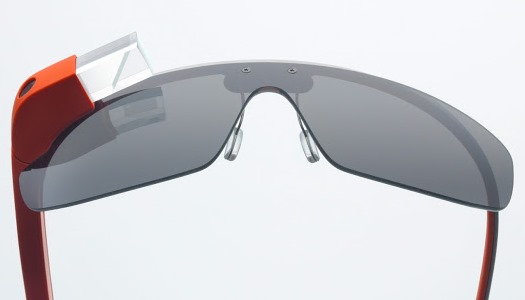
GOOGLE-GLASS-LOGO1In a recently released teaser video, designed to expand Google Glass’ potential consumer base from the tech-savvy to what it refers to as “bold, creative individuals”. While the first video of their futuristic AR specs followed a New Yorker as they conducted mundane tasks through the city, this new clip hosts a dizzying array of activities designed to show just how versatile the product can be.

This includes people engaged in skydiving, horseback riding, catwalking at a fashion show, and performing ballet. Quite the mixed bag! All the while, we are shown what it would look like to do these activities while wearing a set of Google glasses. The purpose here is not only to show their functionality, but to give people a taste of what it an augmented world looks like.google_glass

And based on product information, videos and stillpics from the Google Glass homepage, it also appears that these new AR glasses will take advantage of the latest in flexible technology. Much like the new breeds of smartphones and PDAs which will be making the rounds later this year, these glasses are bendable, flexible, and therefore much more survivable than conventional glasses, which probably cost just as much!

Apparently, this is all in keeping with CEO and co-founder Larry Page’s vision of a world where Google products make their users smarter. In a 2004 interview, Page shared that vision with people, saying: “Imagine your brain is being augmented by Google.” These futurist sentiments may be a step closer now, thanks to a device that can provide on-the-spot information about whatever situation or environment we find ourselves in.

google_glass1One thing is for sure though. With the help of some AR specs, the middle man is effectively cut out. No longer are we required to aim our smartphones, perform image searches, or type things into a search engine (like Google!). Now we can just point, look, and wait for the glasses to identify what we are looking at and provide the requisite information.

Check out the video below:

Exploring the Universe with Robotic Avatars and Holodecks

holodeck_nasaSpace exploration is littered with all kinds of hazards. In addition to the danger of dying from decompression, mechanical failures, micro-meteoroids or just crashing into a big ball of rock, there are also the lesser-known problems created by low-gravity, time dilation, and prolonged isolation. Given all that, wouldn’t it just be easier to send probes out to do the legwork, and use virtual technology to experience it back home?

That’s the idea being presented by Dr. Jeff Norris, one of the scientists who works for NASA’s Jet Propulsion Laboratory in Pasadena, California. In a recent presentation that took place at Pax Prime last year – entitled “NASA’s Got Game” – he spoke of the agency’s plans for telexploration – the process of exploring the universe using robotic avatars and holodecks, rather than sending manned flights into deep space.

avatar_imageIn the course of making this presentation, Norris noted several key advantages to this kind of exploration. In addition to being safer and cheaper, its also more readily available. Whereas deep space exploration involving space ships with FTL engines – the Alcubierre Drive they are currently working on – will eventually be available, robot space probes and advanced telecommunications technology are available right now.

At the same time, telexploration is also more democratic. Whereas conventional space travel involves a select few of highly-trained, eminently qualified people witnessing the wonders of the universe, robotic avatars and holographic representations bring the experience home, where millions of people can experience the awe and wonder for themselves. And when you think about it, it’s something we’re already doing, thanks to the current generation of space probes, satellites and – of course! – the Curiosity Rover.

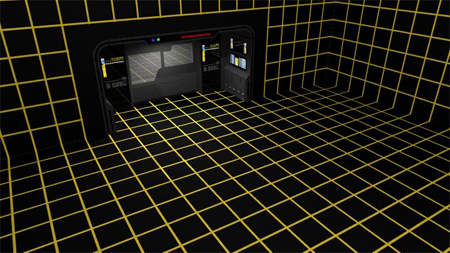
Curiosity_selfportraitBasically, rather than waiting for the warp drive, Norris believes another Star Trek technology – the holodeck – will be the more immediate future of space exploration, one that we won’t have to wait for. Yes, there are more than a few Star Trek motifs going on in this presentation, and a little Avatar too, but that’s to be expected. And as we all know, life can imitate art, and the truth is always stranger than fiction!

Check out the video of the presentation below:


And remember…

holodeck_vegasad