Apollo Rocket Engines Recovered from Seafloor

apollo_rocketThis past week, history was made when Jeff Bezos (founder of Amazon.com) and his privately funded company, Bezos Expeditions, announced that they had successfully retrieved pieces of the very engines that had once launched Apollo astronauts to the moon. Using remotely operated vehicles and a series of slings, the crew members recovered enough parts to reconstruct the majority of two F-1 rocket boosters.

Bezos Expeditions announced last year that using state-of-the-art deep sea sonar, that they had discovered the remains off the coast of Cape Canaveral off the coast of Florida. And this past Thursday, and with NASA’s help, Bezos located the fragments at a depth of almost 4.8 kilometers (3 miles) and began hauling them to the surface. Bezos claims they belonged to the historic Apollo 11 spaceflight, but further study and restoration will be needed before their identity can be confirmed.
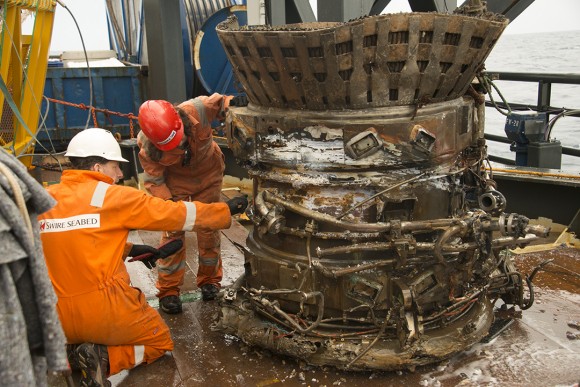
apollo_rocket1Regardless, this is an exciting find, and the nature of the rocket boosters confirms that they were at least part of the Apollo program. Between 1968 and 1972, ten missions were conducted that flew out of the Kennedy Space Center, each one using the Saturn V rocket, that used five F-1 engines to boost them into orbit. Once the rockets had spent their fuel, they were detached and fell into the sea.

That means that approximately sixty five F-1 engines reside in the ocean off the coast of Florida. No telling which of those these ones could be, but it is hoped that serial numbers will be retrieved from the engines that can connect them to a specific Apollo mission. But regardless, this is an exciting find, and could not have come at a better time since NASA is looking to embark on a renewed era of exploration.

saturn-v-rocket-engines-recovered-ocean-installed_65442_600x450All told, Bezos and his team spent three weeks at sea, working almost 5 kilometers below the surface. During this time, Bezos claims that his team found so much:

We’ve seen an underwater wonderland – an incredible sculpture garden of twisted F-1 engines that tells the story of a fiery and violent end, one that serves testament to the Apollo program. We photographed many beautiful objects in situ and have now recovered many prime pieces. Each piece we bring on deck conjures for me the thousands of engineers who worked together back then to do what for all time had been thought surely impossible.

Naturally, NASA was pretty impressed with the find as well. After the find was announced, NASA Administrator Charlie Bolden made the following statement on behalf of the Agency:

This is a historic find and I congratulate the team for its determination and perseverance in the recovery of these important artifacts of our first efforts to send humans beyond Earth orbit. We look forward to the restoration of these engines by the Bezos team and applaud Jeff’s desire to make these historic artifacts available for public display.

Apollo_11Needless to say, this is an exciting find, regardless of whether or not these rockets were the same ones that sent Neil Armstrong, Buzz Aldrin and Michael Collins to the Moon. Naturally, I hope it is. I can think of no greater tribute to Armstrong’s memory so soon after his passing. I can imagine him looking down on this from the stars, where he now resides, with a big old smile!

And be sure to check out this video taken by the Bezos Expedition of the undersea find:

Source: nationalgeographic.com, universetoday.com

The Future is Here: Batteries for Stretchable Implants

Stretchable-battery1One of the newest and greatest developments in medical technology of late has been the creation of electronics that can stretch and flex. Increasingly, scientists are developing flexible electronics like video displays and solar panels that could make their way into clothing or even bodies. But of course, some challenges remain, specifically in how to power these devices.

Thus far, researchers have been able to develop batteries that are thin and bendable, flexibility has proven more of a challenge. In addition, no stretchable batteries have thus far offered rechargeability with high the kind of storage capacity that one might expect from the lithium-ion technology now powering many smartphones, tablets, laptops and other mobile devices.

flexbatteryHowever, that may be changing thanks to two research scientists – Yonggang Huang from Northwestern University and John A. Rogers University of Illinois. Together, they have unveiled a rechargeable lithium-ion battery that can be stretched, twisted and bended, and is still capable of powering electronics. What’s more, the power and voltage of this battery are similar to a conventional lithium-ion battery and can be used anywhere, including the inside of the human body.

Whereas previous batteries of its type had a hard time stretching up to 100 percent of their original size, this new design is capable of stretching up to 300 percent. Huang and Rogers have indicated that this will make it ideal for powering implantable electronics that are designed for monitoring brain waves or heart activity. What’s more, it can be recharged wirelessly and has been tested up to 20 cycles of recharging with little loss in capacity.

Stretchable-batteryFor their stretchable electronic circuits, the two developed an array of tiny circuit elements connected by metal wire “pop-up bridges.” Typically, this approach works for circuits but not for a stretchable battery, where components must be packed tightly to produce a powerful enough current. Huang’s design solution is to use metal wire interconnects that are long, wavy lines, filling the small space between battery components.

In a paper published on Feb. 26, 2013 in the online journal Nature Communications, Huang described the process of creating their new design:

“We start with a lot of battery components side by side in a very small space, and we connect them with tightly packed, long wavy lines. These wires provide the flexibility. When we stretch the battery, the wavy interconnecting lines unfurl, much like yarn unspooling. And we can stretch the device a great deal and still have a working battery.”

No telling when the first stretchable electronic implant will be available for commercial use, but now that we have the battery issue worked out, its only a matter of time before hospitals and patient care services are placing them in patients to monitor their health and vitals. Combined with the latest in personal computing and wireless technology, I also imagine everyone will be able to keep a database of their health which they will share with their doctor’s office.

And be sure to check out the video of the new battery in action:

Source: neurogadget.com

Movie Trailer Monday: Star Wars VII

Morning folks, and welcome to my second installment for Movie Trailer Monday. Today, it’s not so much a trailer as it is a fan-made teaser for the upcoming Star Wars VII. Given that Disney is still in contract talks with cast members and they haven’t even begun to shoot, no trailer could be feasible at this point. But that won’t stop fandom from making special videos presentations of what they hope to see.

And this one contains quite the eclectic bit of source material, splicing video game scenes from Knights of the Republic and Force Unleashed II, with some footage from Serenity and other movies. And in what I can only assume was a nod to Abram’s other works, there were also some scenes from Star Trek and the voice-over from the upcoming sequel, Into Darkness.

It seems that fan-made videos are begging better all the time, which just goes to show you how far software and computing have come. Soon, we may not even need Disney, Lucasarts, or any of the major studios at all! But until such time, I guess we’ll have to be content to rely on them to shoot all the cool footage so we can steal it and make our own shorts. Enjoy the show!

NASA’s 3D Printed Moon Base

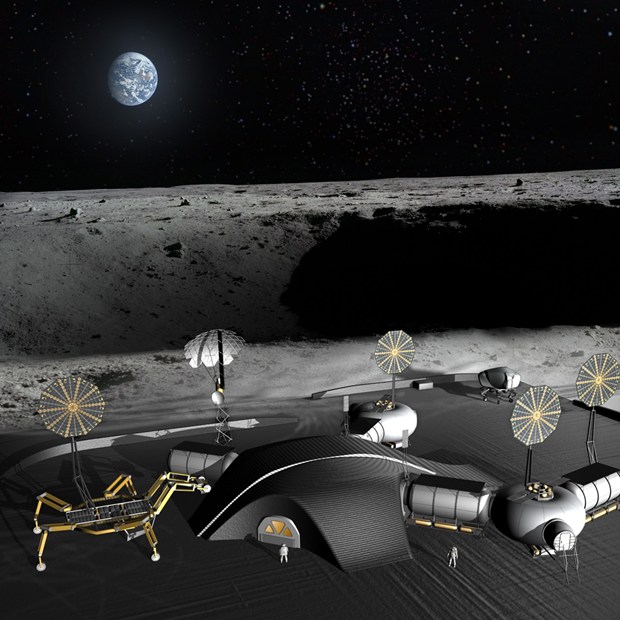
ESA_moonbaseSounds like the title of a funky children’s story, doesn’t it? But in fact, it’s actually part of NASA’s plan for building a Lunar base that could one day support inhabitants and make humanity a truly interplanetary species. My thanks to Raven Lunatick for once again beating me to the punch! While I don’t consider myself the jealous type, knowing that my friends and colleagues are in the know before I am on stuff like this always gets me!

In any case, people may recall that back in January of 2013, the European Space Agency announced that it could be possible to build a Lunar Base using 3D printing technology and moon dust. Teaming up with the architecture firm Foster + Partners, they were able to demonstrate that one could fashion entire structures cheaply and quite easily using only regolith, inflatable frames, and 3D printing technology.

sinterhab2_1And now, it seems that NASA is on board with the idea and is coming up with its own plans for a Lunar base. Much like the ESA’s planned habitat, NASA’s would be located in the Shackleton Crater near the Moon’s south pole, where sunlight (and thus solar energy) is nearly constant due to the Moon’s inclination on the crater’s rim. What’s more, NASA”s plan would also rely on the combination of lunar dust and 3D printing for the sake of construction.

However, the two plans differ in some key respects. For one, NASA’s plan – which goes by the name of SisterHab – is far more ambitious. As a joint research project between space architects Tomas Rousek, Katarina Eriksson and Ondrej Doule and scientists from Nasa’s Jet Propulsion Laboratory (JPL), SinterHab is so-named because it involves sintering lunar dust: heating it up with microwaves to the point where the dust fuses to become a solid, ceramic-like block.

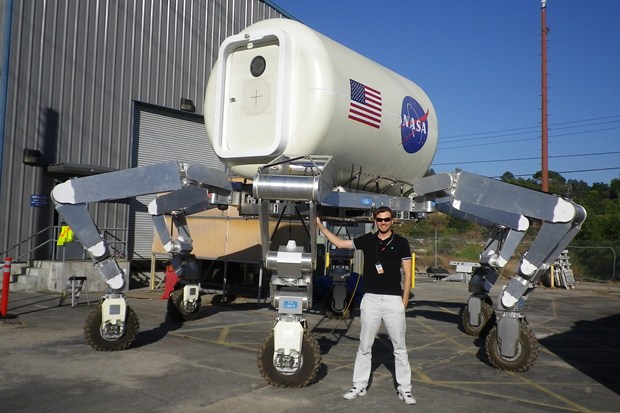
This would mean that bonding agents would not have to be flown to the Moon, which is called for in the ESA’s plan. What’s more, the NASA base would be constructed by a series of giant spider robots designed by JPL Robotics. The prototype version of this mechanical spider is known as the Athlete rover, which despite being a half-size variant of the real thing has already been successfully tested on Earth.

athlete_robotEach one of these robots is human-controlled, has six 8.2m legs with wheels at the end, and comes with a detachable habitable capsule mounted at the top. Each limb has a different function, depending on what the controller is looking to do. For example, it has tools for digging and scooping up soil samples, manipulators for poking around in the soil, and will have a microwave 3D printer mounted on one of the legs for the sake of building the base. It also has 48 3D cameras that stream video to its operator or a remote controlling station.

The immediate advantages to NASA’s plan are pretty clear. Sintering is quite cheap, in terms of power as well as materials, and current estimates claim that an Athlete rover should be able to construct a habitation “bubble” in only two weeks. Another benefit of the process is that astronauts could use it on the surface of the Moon surrounding their base, binding dust and stopping it from clogging their equipment. Moon dust is extremely abrasive, made up of tiny, jagged morcels rather than finely eroded spheres.

sinterhab3Since it was first proposed in 2010 at the International Aeronautical Congress, the concept of SinterHab has been continually refined and updated. In the end, a base built on its specifications will look like a rocky mass of bubbles connected together, with cladding added later. The equilibrium and symmetry afforded in this design not only ensures that grouping will be easy, but will also guarantee the structural integrity and longevity of the structures.

As engineers have known for quite some time, there’s just something about domes and bubble-like structures that were made to last. Ever been to St. Peter’s Basilica in Rome, or the Blue Mosque in Istanbul? Ever looked at a centuries old building with Onion Dome and felt awed by their natural beauty? Well, there’s a  reason they’re still standing! Knowing that we can expect similar beauty and engineering brilliance down the road gives me comfort.

In the meantime, have a gander at the gallery for the proposed SinterHab base, and be sure to check out this video of the Athlete rover in action:

Source: Wired.co.uk, robotics.jpl.nasa.gov

Movie Trailer Monday: Star Trek Into Darkness!

StartrekintodarknessposterHey guys, thought I’d get into a new habit around here and start posting previews for new movies on a regular basis. Might prove difficult to find a new preview every week, but the way I see it, people like a routine they get in on. And what’s nicer on a Monday than catching a trailer that makes you excited for an upcoming flick. Tell me that doesn’t beat the Monday blahs!

And here is the latest trailer from JJ Abram’s upcoming Star Trek sequel. Unlike the first which was resoundingly dark (had to be with a name like Into Darkness!) and focused on Benedict Cumberbatch – who plays bad guy Khan – this one is more centered on Kirk. And what’s also nice is the mention of a future city other than San Fransisco. And of course, plenty of action too!

Enjoy, and see you next Monday!

ISS Astronaut Chris Hadfield sings with the Barenaked Ladies!

ISS_Hadfield_BNLFans of The Big Bang Theory, or anyone who has lived in Canada for the last 20 years, ought to be instantly familiar with the Barenaked Ladies. However, what is not common knowledge is that Chris Hadfield, an astronaut aboard the International Space Station, is himself Canadian and apparently, quite the musician! Not only can he sing, he can play the guitar in zero-gravity and even execute some sweet moves. Quite the ensemble!

And in this rare treat, which took place back in February, Hadfield, the Barenaked Ladies, and the Wexford Gleeks children’s choir all collaborated to create the world’s first space-to-earth musical collaboration. The song they sang was an original creation, entitled “I.S.S. (Is Somebody Singing)”, which was commissioned by CBCMusic.ca and The Coalition for Music Education with the Canadian Space Agency to celebrate music education in schools across Canada.

So if you have a few minutes, I recommend you cue up this video, turn the volume up, and enjoy a truly heartwarming and breathtaking song that celebrates Canada, music, planet Earth, and the wonder of looking down at it all from space. It’ll give you goose bumps, I swear!

New Iron Man 3 Trailer!

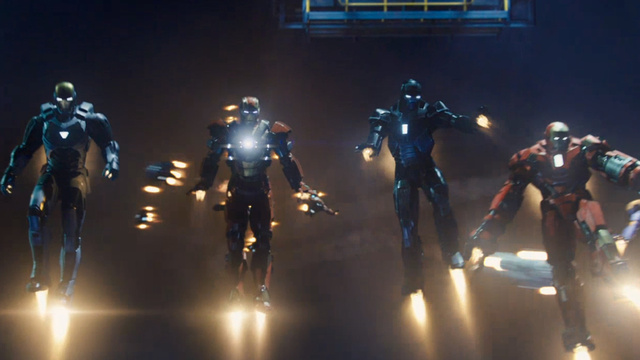
ironman3A new theatrical trailer has been released in honor of the third and final installment in the Iron Man franchise! Suffice it to say, it looks pretty awesome, and seems to be promising a finale that is nothing short of bad-ass. Pay special attention to the final few seconds of it, where Stark and Rhodes get “backup” in the form of a whole bunch of guys in Iron Man suits.

Like I said, promises to be bad-ass! Take a gander:

Darth Vader POV Video

RS_darthEver wonder what it would be like to be Darth Vader while he was kicking some Jedi ass? Well, the stunt people over at Geeks of Doom decided to put together a lovely first-person video that gets you about as close as you can to the real experience. The entire thing was caught on a GoPro camera, was choreographed using those kick-ass lightsaber replicas that light up and add sound, and took only about half an hour to film. Impressive!

Watch and experience the Dark Side for yourself!

Game of Thrones – Season 3 Trailer!

GOT_Season3_teaserIt’s here at last, a GOT Season 3 trailer that isn’t just a despicable tease with no real footage to offer! But that’s to be expected, studios always love to treat their fans like a bunch of crack addicts. Get them hooked on a season, then tell them it’s going to be a year or more until the next one comes along. Feed them tiny crumbs along the way, and just before the next batch is ready, give them a taste!

Now that March has rolled around, we are just slightly less than a month away from the premiere. And from this trailer, some hints are given as to what’s in store for the characters of Robb, Daenerys, Tyrion, John Snow, Jaime, Cersei, and all those that fall somewhere in between this season. Naturally, fans of Martin would advise you not to get too attached! People have a way of dying off in his universe…

Enjoy!

The Future is Here: The VR Cave!

Cave2It’s called the CAVE2, a next-generation virtual reality platform that is currently the most advanced visualization environment on Earth. Whereas other VR platforms are either in 2D or limited in terms of interactive capability, the CAVE2 is about the closest thing there is to a real-life holodeck. This is accomplished through a series of panoramic, floor-to-ceiling LCD displays and an optical tracking interface that is capable of rendering remarkably realistic 3D environments.

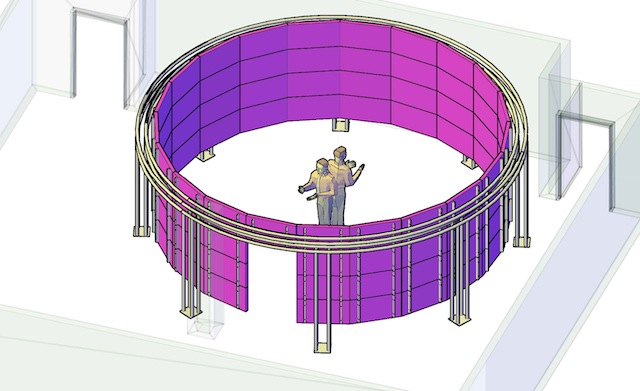
Developed by the Electronic Visualization Laboratory (EVL) at the University of Illinois at Chicago, CAVE2 is a direct follow up to the VR platform the university created back in 1992. Like the original, the name stands for “Cave Automatic Virtual Environment”; but whereas its predecessor was set in a cube-shaped room, the new environment is set within a cylindrical, 320 degree immersive space. In addition, the screens, sounds, and resolution have all been vastly upgraded.

ModelFor example, the 7.5 by 2.5 meter space (24 feet x 8 feet) is covered floor-to-ceiling with 72 3D LCD screens, each of which outputs images at 37-megapixels (that’s 7,360 x 4,912 pixels, twice that of 2D). This allows for a pixel density that is on par with the human eye’s own angular resolution at 20/20 vision. Headgear is needed to get the full 3D effect, and the entire apparatus is controlled by a hand-held wand.

Yes, in addition to the holodeck, some other science fiction parallels are coming to mind right now. For example, there’s the gloved-controlled holographic interface from Minority Report, the high-tech nursery in Ray Bradbury’s short story The Veldt, and the parlor walls he envisioned in Fahrenheit 451. And apparently, this is no accident, since director Jason Leigh, the head of the project, is a major sci-fi geek!

mars_lifeBut of course, all this technology was designed with some real-life, practical applications in mind. These range from the exploration of outer space to the exploration of inner space, particularly the human body. As Ali Alaraj, a noted neuroscientist who used the CAVE2 put it:

“You can walk between the blood vessels. You can look at the arteries from below. You can look at the arteries from the side. …That was science fiction for me. It’s fantastic to come to work. Every day is like getting to live a science fiction dream. To do science in this kind of environment is absolutely amazing.”

All of this bodes well for NASA’s plans for space exploration that would involve space probes, holographics, and avatars. It would also be incredibly awesome as far as individual hospitals were concerned. Henceforth, they could perform diagnostic surgery using nanoprobes which could detail a patients body, inch for inch, from the inside out.

And of course, the EVL has provided a cool video of the CAVE2 platform in action. Check them out:

Source: IO9, evl.uic.edu