For over two years now, Elon Musk and his private space company (SpaceX) have been working towards the creation of a reusable rocket system. Known as the Falcon 9 Reusable Development Vehicle (F9R Dev) – or “Grasshopper” – this system may prove to be the greatest development in space travel since the invention of the multistage rocket. After multiple tests that reached greater and greater altitudes, the latest attempt at a takeoff and soft landing took place this past month.
Timed to coincide with SpaceX’s launch to the International Space Station (which took place on Friday April, 18th) the landing was apparently a success. Several days after the launch, Elon Musk tweeted that the “[d]ata upload from tracking plane shows landing in Atlantic was good!” This update came on April 22nd, and as of yet, no definitive data of whether the first stage landed correctly, or whether it was still in one piece by the time the recovery boats got to it.
Presumably SpaceX will provide another update in due course. In the meantime, they took the opportunity to release a rather awesome video of what the Falcon 9 Reusable should look like when successfully performing a vertical takeoff and vertical landing (VTVL). The video has accumulated an astonishing 3,598,143 views in the last two weeks, which is indicative of the level of interest this project and its impications have garnered over the past few years.
Meanwhile, the resupply mission went off without a hitch. Officially designated as CRS-3, this mission was even more significant due to the fact that its Falcon 9 launch vehicle featured the same retractable landing legs and the ability to soft land as the Grasshopper test rocket. However, in the case of the ISS mission, it was the first time where a Falcon 9 was tested in a real-world scenario where the rocket would return to Earth after reaching Low Earth Orbit (LEO).
Though the rocket was successfully picked up by the ISS, the jury is still out on whether or not the soft landing was a success or not. To minimize any risk, the first stage of the Falcon 9 attempted to “soft land” in the Atlantic. Unfortunately, according to Elon Musk, due to “13- to 20-foot waves… It’s unlikely that the rocket was able to splash down successfully.” Using telemetry data gathered from a SpaceX spotter plane, it appears that everything else went to plan, though.
Because of the rough seas, though, the retrieval boats couldn’t make it to the landing site, and thus the rocket is unlikely to be recovered. In the meantime, SpaceX will spend the following days and weeks analyzing more detailed data from the launch, and then update the Falcon 9 design and launch protocol accordingly. However, it is clear at this point that these latest tests are not being considered a failure, or reason to cease in their efforts.
As Musk himself explained in a series of public statements and interviews after the launch:
I would consider it a success in the sense that we were able to control the boost stage to a zero roll rate, which is previously what has destroyed the stage — an uncontrolled roll…I think we’re really starting to connect the dots of what’s needed [to bring the rocket back to the launch site]. I think that we’ve got a decent chance of bringing a stage back this year, which would be wonderful.
Considering the benefits of cheap, reusable rockets, and all the things they will make possible – space-based solar power, the construction of a Moon settlement, missions to Mars, the construction of a Space Elevator – there’s simply no way that a single unsuccessful rocket recovery will deter them. In the meantime, be sure to check out this video of what a successful Falcon 9 VTVL test looks like. Hopefully, we’ll be seeing a real-world example of this happening soon:
Hello again! In another attempt to cover events that built up while I was away, here are some stories that took place back in March and early April of this year, and which may prove to be some of the greatest scientific finds of the year. In fact, they may prove to be some of the greatest scientific finds in recent history, as they may help to answer the most fundamental questions of all – namely, what is the universe made of, and how did it come to exist?
First up, in a development that can only be described as cosmic in nature (pun intended), back in March, astrophysicists at the Harvard-Smithsonian Center announced the first-ever observation of gravitational waves. This discovery, which is the first direct evidence of the Big Bang, is comparable to significance to CERN’s confirmation of the Higgs boson in 2012. And there is already talk about a Nobel Prize for the Harvard crew because of their discovery.
This theory, which states that the entire universe sprung into existence from a tiny spot in the universe some 13.8 billion years ago, has remained the scientific consensus for almost a century. But until now, scientists have had little beyond theory and observations to back it up. As the name would suggest, gravitational waves are basically ripples in spacetime that have been propagating outward from the center of the universe ever since the Big Bang took place.
Originally predicted as part of Einstein’s General Theory of Relativity in 1916, these waves are believed to have existed since a trillionth of a trillionth of a trillionth of a second after the Big Bang took place, and have been propagating outward for roughly 14 billion years. The theory also predicts that, if we can detect some gravitational waves, it’s proof of the initial expansion during the Big Bang and the continued inflation that has been taking place ever since.
Between 2010 and 2012, the BICEP2 – a radio telescope situated at the Amundsen–Scott South Pole Station (pictured above) – the research team listened to the Cosmic Microwave Background (CMB). They were looking for hints of B-mode polarization, a twist in the CMB that could only have been caused by the ripples of gravitational waves. Following a lot of data analysis, the leaders announced that they found that B-mode polarization.
The work will now be scrutinized by the rest of the scientific community, of course, but the general consensus seems confident that it will stand up. In terms of scientific significance, the confirmation of gravitational waves would be the first direct evidence that the universe started out as nothing, erupted into existence 13.8 billion years ago, and has continued to expand ever since. This would confirm that cosmic inflation really exists and that the entire structure of the universe was decided in the beginning by the tiniest flux of gravitational waves.
And that’s not only discovery of cosmic significance that was made in recent months. In this case, the news comes from NASA’s Fermi Gamma-ray Space Telescope, which has been analyzing high-energy gamma rays emanating from the galaxy’s center since 2008. After pouring over the results, an independent group of scientists claimed that they had found an unexplained source of emissions that they say is “consistent with some forms of dark matter.”
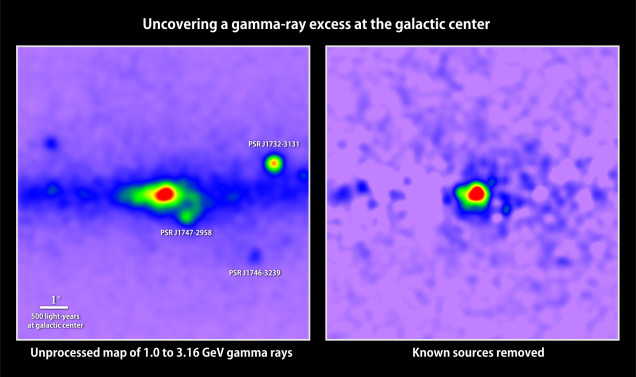
These scientists found that by removing all known sources of gamma rays, they were left with gamma-ray emissions that so far they cannot explain. And while they were cautious that more observations will be needed to characterize these emissions, this is the first time that potential evidence has been found that may confirm that this mysterious, invisible mass that accounts for roughly 26.8% of the universe actually exists.
To be fair, scientists aren’t even sure what dark matter is made of. In fact, it’s very existence is inferred from gravitational effects on visible matter and gravitational lensing of background radiation. Originally, it was hypothesized to account for the discrepancies that were observed between the calculations of the mass of galaxies, clusters and entire universe made through dynamical and general relativistic means, and the mass of the visible “luminous” matter.
The most widely accepted explanation for these phenomena is that dark matter exists and that it is most probably composed of Weakly Interacting Massive Particles (WIMPs) that interact only through gravity and the weak force. If this is true, then dark matter could produce gamma rays in ranges that Fermi could detect. Also, the location of the radiation at the galaxy’s center is an interesting spot, since scientists believe that’s where dark matter would lurk since the insofar invisible substance would be the base of normal structures like galaxies.
The galactic center teems with gamma-ray sources, from interacting binary systems and isolated pulsars to supernova remnants and particles colliding with interstellar gas. It’s also where astronomers expect to find the galaxy’s highest density of dark matter, which only affects normal matter and radiation through its gravity. Large amounts of dark matter attract normal matter, forming a foundation upon which visible structures, like galaxies, are built.
Dan Hooper, an astrophysicist at Fermilab and lead author of the study, had this to say on the subject:
The new maps allow us to analyze the excess and test whether more conventional explanations, such as the presence of undiscovered pulsars or cosmic-ray collisions on gas clouds, can account for it.The signal we find cannot be explained by currently proposed alternatives and is in close agreement with the predictions of very simple dark matter models.
Hooper and his colleagues suggest that if WIMPs were destroying each other, this would be “a remarkable fit” for a dark matter signal. They again caution, though, that there could be other explanations for the phenomenon. Writing in a paper submitted to the journal Physical Review D, the researchers say that these features are difficult to reconcile with other explanations proposed so far, although they note that plausible alternatives not requiring dark matter may yet materialize.
And while a great deal more work is required before Dark Matter can be safely said to exist, much of that work can be done right here on Earth using CERN’s own equipment. Tracy Slatyer, a theoretical physicist at the Massachusetts Institute of Technology and co-author of the report, explains:
Dark matter in this mass range can be probed by direct detection and by the Large Hadron Collider (LHC), so if this is dark matter, we’re already learning about its interactions from the lack of detection so far.This is a very exciting signal, and while the case is not yet closed, in the future we might well look back and say this was where we saw dark matter annihilation for the first time.
Still, they caution that it will take multiple sightings – in other astronomical objects, the LHC, or direct-detection experiments being conducted around the world – to validate their dark matter interpretation. Even so, this is the first time that scientists have had anything, even tentative, to base the existence of Dark Matter’s on. Much like until very recently with the Big Bang Theory, it has remained a process of elimination – getting rid of explanations that do not work rather than proving one that does.
So for those hoping that 2014 will be the year that the existence of Dark Matter is finally proven – similar to how 2012 was the year the Higgs Boson was discovered or 2013 was the year the Amplituhedron was found – there are plenty of reasons to hope. And in the meantime, check out this video of a gamma-ray map of the galactic center, courtesy of NASA’s Goddard Space Center.
It’s no secret that the human race is poised on a new generation of space exploration and travel. With future missions based on towing asteroids to Earth, building settlements on the Moon, and walking on Mars, NASA and other space agencies are eying their aging hardware and looking for design modifications. From shuttles, to rockets, to capsules, everything is getting an overhaul. And now, NASA is looking to create the next generation of space suits, and is looking to the public’s for help.
They are called the Z-series, a revolutionary new suit that is designed for walking on Mars as well as floating around in space and performing spacewalks. This new series is expected to replace the current aging design, which has been in continuous use on both space flights and aboard the International Space Station since 1982. In addition to updated technology and functionality, the new spacesuit also has an updated look.
The first design was unveiled back in December of 2012 with the Z-1, which bore a striking resemblance to Buzz Lightyear’s own spacesuit. The new version (the Z-2 series), which has different joint designs and a more durable torso, also comes with a trio of “flashy” cover designs that were made in collaboration with fashion students at Philadelphia University, and were inspired by biomimicry, the evolution of technology, and even – supposedly – street fashion.
And unlike the current microgravity suits, the Z-series is designed for walking in extra-terrestrial environments where gravity is the norm (i.e. the Moon and Mars). Intrinsic to the new design is flexibility: it makes it much easier to walk, bend, and pick things up off the surface of a planet or moon. It also goes on quite differently. Whereas the old suit is pulled on like a pair of pants and a shirt, the new version has a handy door built into the back so someone can climb inside.
As Bobby Jones, an engineer for ILC, the company that worked on the new design explained:
There are a lot of fundamental design differences between developing a microgravity suit versus a planetary walking suit. A lot of that has to do with how much mobility is built into the lower torso. With microgravity you’re using your arms to move around and your feet just hang out there. You can dock the suit up to your habitat or vehicle and leave it outside, so you don’t drag dust and other things into your cabin,” Jones explains.
As previously noted, anyone can help decide among the three cover designs by casting a vote on NASA’s website. One option, inspired by underwater creatures (and known as the “Biomimicry” suit), employs glowing wires to help the suit stay visible at night. A second version – known as the “Technology” suit – pays homage to past spacesuits and uses light-emitting patches along with wire. The third option, inspired by “Trends in Society”, uses electroluminescent wire and a bright color scheme to mimic the appearance of sportswear and the emerging world of wearable technologies.
NASA says the final design is “reflective of what everyday clothes may look like in the not too distant future,” pulling in elements of sportswear and wearable tech. NASA will move forward with the most popular cover in the public vote, and plans to have the suit ready for testing by the end of the year. And they are hardly alone in looking to create suits that can handle the challenges of future exploration. For example, it’s also worth checking out this MIT professor Dava Newman sleek Mars spacesuit, aka. the “Spiderman Spacesuit”, that is currently in development.
In the meantime, check out this video from Ted Talks where Newman showcases her Spiderman suit. And be sure to head over to the Johnson Space Center’s website and cast your vote for what NASA’s next-generation spacesuit will look like.
This morning, at exactly 8:00 am Pacific Standard Time, the Kindle Countdown Deal for Papa Zulu – the second novel in the Whiskey Delta zombie series – officially kicked off! Copies are available from now until Tuesday for just $0.99, at which point they will be on sale for $1.99 until the promotion ends (on Thursday). Get em while they’re cheap! As per the rules of a Kindle Countdown Deal, these promotions don’t last long, and are only allowed so often…
Click on this link to get your copy, or on the image located in the right hand column to go to the book’s Amazon page. And if you haven’t already, be sure to check out this video trailer I made for Papa Zulu‘s release (and don’t forget to comment and subscribe):
The news has been percolating through the internets about this MMORPG for some time. And it seems I’ve finally gotten in the know. While I’ve never considered myself to be much of a gamer, I loved The Elders Scrolls IV: Oblivion and the latest installment Skyrim with abandon. And I never got in on World of Warcraft, EVE Online, Battlestar Galactica or any other of the many online RPGs that have come out over the years, and kind of regretted that.
And the way I figure it, a massive-online gaming universe where you get to play against real people, and which is set in a fantasy realm that’s one part mythos, one part LOTR, two parts medieval warfare, and all parts kick-ass, is sure to be way fun! And given the fact that its parameters are way larger than a conventional installment in the game, I’m guessing that you get to play in the franchise’s expanded universe, rather than in any one setting.
And I’m growing rather tired of playing COD: Modern Warfare 3 online. Two many idiots, homophobes and members of the Aryan nation for me. And waaaaay too many pros who’s favorite saying in the world is “You Mad Bro?” Anyway, check out the trailer for the game below. I’m off to set up an account!
Fleeing a horde of flesh-eating zombies? There’s an app for that. Seriously though, it seems that some cheeky IT developer recently created a fitness app for Google Glass that motivated runners by letting them know if they pace they are setting would be enough to flee from a pursuing zombie. But of course, that’s just one option that comes with this Glass application – known as Race Yourself – which first previewed this past January.
Mainly, the app seeks to take advantage of Google Glass display technology, which allows runners to see their progress in real-time without having to check their watch, device, or a series of chimes. Using the Glass’ heads-up display, it allows users to keep track of time, distance, and calories by simply taking a quick glance at the screen. And it comes complete with some games, including running from zombies or fleeing a giant boulder (a la Raiders of the Lost Ark).
While it is still in development, early reviews state that the app would be of use to both casual runners and those training for a big race. In addition to keeping track of your time and distance, runners are able to see how many calories they’ve burned and the pace they are setting. In the end, these useful stats, which can be consulted at a glance, are the real point of the app. The games (which require far more concentration) are just a fun bonus.
In addition to the zombie chase and the fleeing of the boulder, they include running against an Olympic athlete (100 metes in 9 seconds), racing against a train to save a woman lying on the tracks, or against your own speed during the last 50 meters of your run, where the name Race Yourself comes from. Runners using the app can expect two hours of battery life, which is more than enough for a good workout.
Richard Goodrum, COO of Race Yourself, says that the app will be launching later this year, at about the same time that Glass opens up to the general public. It will be joined by apps like Strava Cycling app, which offers similar stats to cyclists. And while you’re waiting, be sure to check out this video of the app in action:
As a kid, I was a big fan of the Eastman and Laird TMNT comics. As a youngster who grew up in the Star Wars and Karate Kid era, and who loved science fiction and RPGs, my love of this franchise was pretty much a given from the get go. And over the years, I and many other adolescents were excited to see these characters adapted to television and the big screen, with mixed results. And now, true to form, Michael Bay has chosen to tap into this latest reservoir of nostalgic energy for the sake of profit.
And after a few years of development and lots or preliminary hype (mainly that the script sucked and Bay claiming it wasn’t his fault), Paramount Pictures has announced the movie’s release. It will be premiering on August 8th, 2014 (just in time for the summer blockbuster season) and will star Alan Ritchson, Jeremy Howard, Pete Ploszek, Noel Fisher, Will Arnett, Danny Woodburn, William Fichtner, and Megan Fox in the role of investigative reporter April O’Neil.
Rather than direct, Bay has chosen to produce this baby and the leave the behind-the-camera work to Jonathan Liebesman, who brought us such action porn movies as Battle: Los Angeles, Clash of the Titans, and Bay’s reboot of The Texas Chainsaw Massacre. And between Fox, the eye-candy cinematography, and the slow-motion/fast-motion action shots, it looks to me like this is yet another campy action flick on par with Bay’s Transformer series.
And I’m just assuming (based on past experience with Bay movies) that the turtles themselves will all be terribly cheesy and borderline racist caricatures, with at least one sounding very much like a punchy, sass-talking black dude. Also, is anyone surprised to see Fox here? Didn’t she burn all her bridges with Bay after she compared him to a Nazi? Just saying… Enjoy the trailer:
Facebook, that massive social utility company that is complicit in just about everything internet-related, recently announced that it is seeking to acquire Titan Aerospace. This company is famous for the development of UAVs, the most recent of which is their solar powered Solara 50. In what they describe as “bringing internet access to the underconnected,” their aim is to use an army of Solara’s to bring wireless internet access to the roughly 5 billion people who live without it worldwide.
Titan Aerospace has two products – the Solara 50 and Solara 60 – which the company refers to as “atmospheric satellites.” Both aircraft are powered by a large number of solar cells, have a service ceiling of up to 20,000 meters (65,000 feet) and then circle over a specific region for up to five years. This of length of service is based on the estimated lifespan of the on-board lithium-ion batteries that are required for night-time operation.
The high altitude is important, as the FAA only regulates airspace up to 18,000 meters (60,000 feet). Above that, pretty much anything goes, which is intrinsic if you’re a company that is looking to do something incredibly audacious and soaked in self-interest. As an internet company and social utility, Facebook’s entire business model is based on continued expansion. Aiming to blanket the world in wireless access would certainly ensure that much, so philanthropy isn’t exactly the real aim here!
nNevertheless, once these atmospheric satellites are deployed, there is a wide range of possible applications to be had. Facebook is obviously interested in internet connectivity, but mapping, meteorology, global positioning, rapid response to disasters and wildfires, and a whole slew of other scientific and military applications would also be possible. As for what level of connectivity Facebook hopes to provide with these drones, it’s too early to say.
However, TechCrunch reports that Facebook would launch 11,000 Solara 60 drones. Their coverage would begin with Africa, and then spread out from there. There’s no word on how fast these connections might be, nor how much such a connection would cost per user. Perhaps more importantly, there’s also no word on how Facebook intends to connect these 11,000 satellites to the internet, though it is obvious that Facebook would need to build a series of ground stations.
Many of these might have to be built in very remote and very hard to administer areas, which would also require fiber optic cables running from them to hook them up to the internet. In addition, Titan hasn’t produced a commercial UAV yet and have confined themselves to technology demonstrations. What they refer to as “initial commercial operations” will start sometime in 2015, which is perhaps this is why Facebook is only paying $60 million for Titan, rather than the $19 billion it paid for WhatsApp.
As already noted, this move is hardly purely altruistic. In many ways, Facebook is a victim of its own success, as its rapid, early growth quickly became impossible to maintain. Acquiring Instagram and WhatsApp were a savvy moves to bring in a few hundred million more users, but ultimately they were nothing more than stopgap measures. Bringing the next billion users online and into Facebook’s monopolistic grasp will be a very hard task, but one which it must figure out if it wants its stock not to plummet.
To be fair, this idea is very similar to Google’s Project Loon, a plan that involves a series of high-altitude, solar-powered hot air balloons that would provide wireless to roughly two-thirds of the worlds population. The idea was unveiled back in June of 2013 and has since begun testing in New Zealand. And given their hold on the market in the developed world, bringing broadband access to the developing world is seen like the next logical step for companies like Verizon, Time Warner, Comcast, and every other internet and telecom provider.
One can only imagine the kind of world our children and grandchildren will be living in, when virtually everyone on the planet (and keeping in mind that there will be between 9 and 11 billion of them by that time) will be able to communicate instantaneously with each other. The sheer amount of opinions exchanged, information shared, and background noise produced is likely to make today’s world seem quiet, slow and civilized by comparison!
Incidentally, I may need to call a lawyer as it seems that someone has been ripping off my ideas… again! Before reading up on this story, the only time I ever heard the name Titan Aerospace was in a story… MY STORY! Yes, in the Legacies universe, the principal developer of space ships and aerospace fighters carried this very name. They say its a guilty pleasure when stuff you predict comes true when you are writing about it. But really, if you can’t cash in on it, what’s the point?
Consider yourself warned, Titan! J.J. Abrams may have gotten off the hook with that whole Revolution show of his, but you are not nearly as rich and powerful… yet! 😉 And the meantime, be sure to check out these videos of Titan’s Solar 50 and Google’s Project Loon below:
I came across this trailer recently for the latest installment in the Star Wars: The Old Republic MMORPG. It’s called Galactic Strongholds, an expansion that gives players the ability to create their own bastions and fortresses as they take part in the ongoing war between the Sith Empire and the Republic. In addition to waging large-scale battles in space, you get to create custom bases (complete with decorations, trophies and furniture) and live on multiple worlds in the Star Wars universe.
Here is the latest trailer from 20th Century Fox for the fifth and latest installment in the X-Men franchise. Set in the future, this movie is essentially a sequel that bridges with the prequel First Class, with the X-Men’s future selves teaming up with their past selves in order to prevent an all-out war between mutants and humanity that will lead to a big ol’ apocalyptic clusterf#$@! It’s a novel idea, and one which allows the cast to incorporate both the old cast with the new.
This includes Hugh Jackman, Patrick Stewart, and Sir Ian McKellen reprising their roles as Wolverine, Professor Xavier and Magneto in the future; and James McAvoy, Jennifer Lawrence, and Michael Fassbender playing Xavier, Mystique and Magneto in the past. New to the cast is Peter Dinklage (of Game of Thrones fame), who plays the character of Bolivar Task, the new villain for this movie. But as usual, the top billing appears to be going to Jackman and Wolverine… again!
Even though I don’t much care for prequels, one of the things that was nice about X-Men First Class was the fact that it wasn’t all about that guy, as opposed to the other five movies in the franchise. I mean, there are other characters in this series, right? And as expected, the movie is set to be released just in time for the summer blockbuster season – on May 23rd, 2014. Enjoy the trailer, it’s really quite action-packed:

 For over two years now, Elon Musk and his private space company (SpaceX) have been working towards the creation of a reusable rocket system. Known as the Falcon 9 Reusable Development Vehicle (F9R Dev) – or “Grasshopper” – this system may prove to be the greatest development in space travel since the invention of the multistage rocket. After multiple tests that reached greater and greater altitudes, the latest attempt at a takeoff and soft landing took place this past month.
 Presumably SpaceX will provide another update in due course. In the meantime, they took the opportunity to release a rather awesome video of what the Falcon 9 Reusable should look like when successfully performing a vertical takeoff and vertical landing (VTVL). The video has accumulated an astonishing 3,598,143 views in the last two weeks, which is indicative of the level of interest this project and its impications have garnered over the past few years.
 As Musk himself explained in a series of public statements and interviews after the launch:


 And that’s not only discovery of cosmic significance that was made in recent months. In this case, the news comes from NASA’s Fermi Gamma-ray Space Telescope, which has been analyzing high-energy gamma rays emanating from the galaxy’s center since 2008. After pouring over the results, an independent group of scientists claimed that they had found an unexplained source of emissions that they say is “consistent with some forms of dark matter.”
 The galactic center teems with gamma-ray sources, from interacting binary systems and isolated pulsars to supernova remnants and particles colliding with interstellar gas. It’s also where astronomers expect to find the galaxy’s highest density of dark matter, which only affects normal matter and radiation through its gravity. Large amounts of dark matter attract normal matter, forming a foundation upon which visible structures, like galaxies, are built.


 And unlike the current microgravity suits, the Z-series is designed for walking in extra-terrestrial environments where gravity is the norm (i.e. the Moon and Mars). Intrinsic to the new design is flexibility: it makes it much easier to walk, bend, and pick things up off the surface of a planet or moon. It also goes on quite differently. Whereas the old suit is pulled on like a pair of pants and a shirt, the new version has a handy door built into the back so someone can climb inside.





 However, TechCrunch reports that Facebook would launch 11,000 Solara 60 drones. Their coverage would begin with Africa, and then spread out from there. There’s no word on how fast these connections might be, nor how much such a connection would cost per user. Perhaps more importantly, there’s also no word on how Facebook intends to connect these 11,000 satellites to the internet, though it is obvious that Facebook would need to build a series of ground stations.



 Stories by Williams