The O’Neill Cylinder

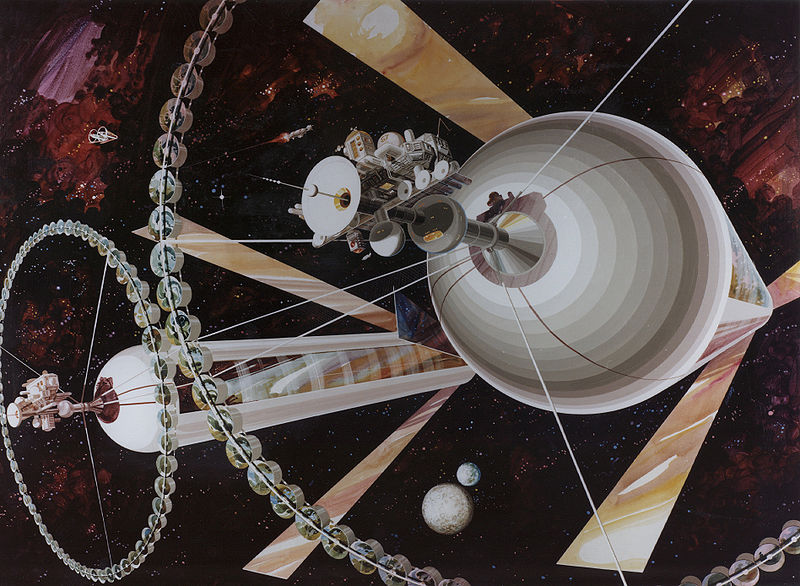
Welcome all to another post that explores the world of conceptual sci-fi! In keeping with the trend of explaining concepts which helped inspire my group’s most recent project, the space colonization story Yuva, I’ve decided to talk about what is known as an O’Neill Cylinder.

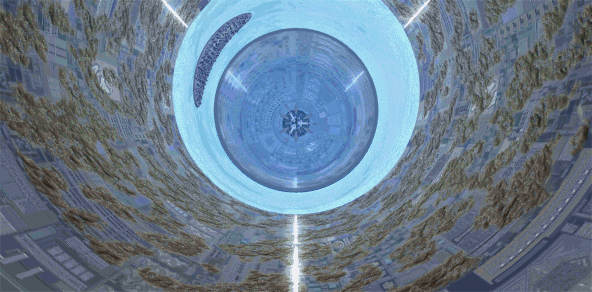
Named in honor of Gerard K. O’Neill in his 1976 book The High Frontier: Human Colonies in Space, the concept deals with the idea of placing a large cylinder in space that would rotate to provide gravity. Habitats within the cylinder would be built along the walls to ensure uniform gravity.

Some of the more interesting features of this design, aside from the curious layout, is the fact that in such a setting, windows placed in the hull can provide natural illumination, thus cutting down on the electricity bill. If the cylinder is particularly large, in which case one side is invisible to the other, then the rotation can provide periodic light, simulating day and night. And being a single volume of space, it can be pressurized, the gravity increasing pressure near the surface.

Fans of Rendezvous with Rama will recognize this concept right off the bat. The alien vessel in the story, dubbed Rama, was one big O’Neill Cylinder that floated through space, with a city built directly into the interior. A circular lake was also placed at the midway point, known as the Cylindrical Sea. At the far ends of the ship, an entrance and a gravitational drive were placed.

Another example is to be found in the Gibson novel Neuromancer, where a space station known as “Freeside” became the focal point in part III of the story. According to Gibson’s own descriptions, the station was a large cylinder in space owned by the Tessier-Ashpool clan. Their own villa was located at the very tip, a place known as “Straylight”, with luxury apartments, hotels, and vacation spots lining the interior. Artificial illumination was provided by a long band that ran down the middle and obscured a clear view of the other side.

And last, and my personal favorite, is the eponymously named space station of Babylon 5. Built along the same lines as Rama and Freeside, this space station was one giant rotating cylinder which housed over a quarter million humans and aliens. The interior surface was divided between several sectors, each one coded by color.

B5_interiorBrown Sector was designated for trade facilities, Blue Sector for personnel facilities, Green for diplomats, Gray for manufacturing, Red for resident habitation, and Yellow for environmental control. Transport along the length of the station was handled by a long rail that was frequented by a transport shuttle. At this point in the station, the gravity was virtually nil and atmospheric pressure was also substantially less.

All of this was consistent with an O’Neill Cylinder and applied to far more than just the station itself. Just about all Earth ships and installations in the B5 universe contained rotating sections to provide gravity since humanity had not yet stumbled onto the secret of artificial gravity.

When it comes right down to it, the concept of a rotating space cylinder is a very eloquent idea for simulating gravity, consistent with hard science and realism. Artificial gravity is often used in science fiction as a sort of given, mainly because its convenient and simpler from a design standpoint. Ships that have cylinders and rotation sections are bulky compared to sleek, unrealistic space concepts – space barges compared to flying works of art.

But that’s really not realistic, especially where near-future science fiction is concerned. Like it or not, artificial gravity just isn’t a plausible concept yet, not unless we find that troublesome graviton particle and learn how to harness it in a stable way. Which is why you can tell that a franchise is particularly inspired when you see ships and stations relying on rotation sections to simulate gravity. Not only is it more realistic, its shows that the conceptual artists and writers are doing their homework.

And that’s precisely why the Yuva ships feature them! And I hope people will find that it is indicative of the kind of mindset me and my group have. We like sci-fi, we like realism, and its especially good when hard science and hard fiction come together. Can’t wait until the book is done, all these teasers are driving me nuts!

My Personal Writing Tips, or “How to Avoid Rookie Mistakes”

Proofreading and editing can be such a chore, I tell ya! Thought I’ve never been very good at proofreading and criticizing other peoples work, I find that it is when I am called upon to edit and evaluate their work that I most want to retreat into my shell. I feel selfish when this happens, mainly because of all the people I have asked to review my own work and give me their opinions. You’d think I’d be better at this aspect of it!

But of course, I know that part of the reason I hate editing the work of others is because I hate editing my own. I’ve noticed this about most people who enjoy writing, composing, and anything else that requires active revision and corrections. By the time the work is done, they want to put it down and forget about it, to let others handle the business of finding the flaws and pointing out the necessary corrections.

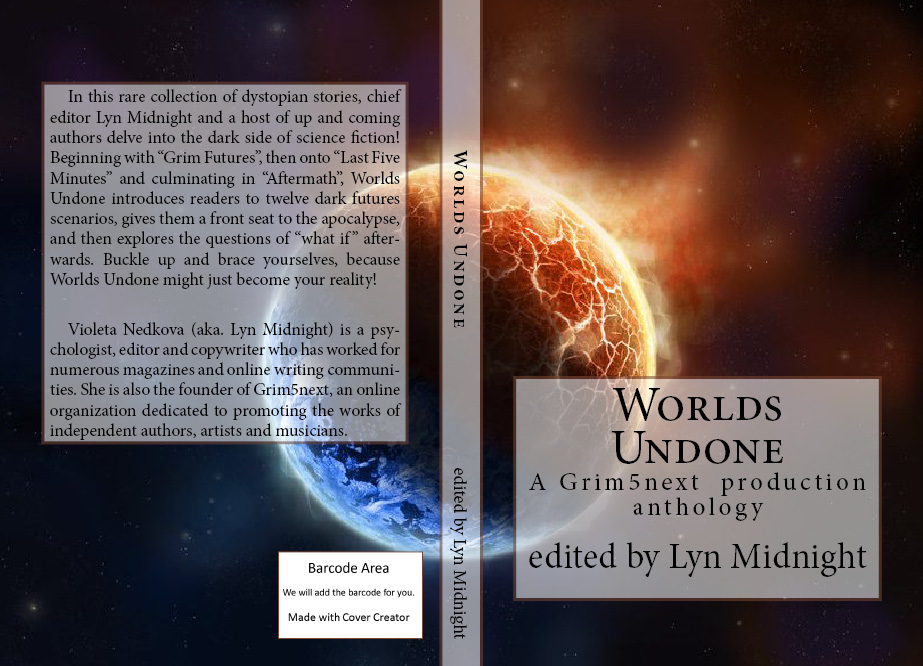
Alas, I’ve had to check most of that baggage ever since I started to become a member of several writing communities. In fact, I’ve even volunteered to act as a contributing editor for two major projects, one of which is the “Yuva Anthology” (begun by Khaalidah and myself), the other being the “Worlds Undone” Anthology. The latter one people might remember from a few months ago, when I was doing mock ups for a cover and happened to find some primo artwork to feature in it. Thanks again to cazzyae at deviantArt for her talent and generosity of spirit for that one! Thanks to her, Createspace’s easy interface, and the suggestions of many people at G5N, here’s how the cover came out:

Unfortunately, that has opened up a different can of worms for me. While I’ve definitely managed to overcome some of my reservations about reading other people’s work, I find that my pet peeves, or what I consider to be the marks of weak writing, keep rearing their ugly head. After reading many stories, I began to think that a tutorial might be in order to help some of the newbies avoid some rookie mistakes, ones which I have committed at least a half dozen times. Each!

I should also take this opportunity to thank Kristen Lamb, who’s impressive article “4 Writing Crutches that Insult the Reader’s Intelligence” reminded me of this idea. After seeing the title in my Inbox, I immediately zoomed over to her site to see if we shared the same pet peeves and sensibilities. Upon reading it, I could tell she was much more versed in this whole writing thing than I am! Still, I happen to share her appraisal of some bad writing habits, especially item number four in her list, “telling instead of showing”.

So, to take a page from her book (no pun!) and to make good on something I’ve been planning to do for some time now, I present you with the list of rookie writing mistakes it is best to avoid. All are the result of what I myself have done repeatedly, and have managed to weed out (for the most part) after many years of practice:

  1. Avoid Infodumping: Never start a story with a long, drawn out passage telling the reader what they need to know in order to set up the plot. For that matter, never let your story digress into such exposition either. A story is by definition a journey, with information, details, twist, and revelations provided bit by bit over time. Even if it’s a short story, never, ever simply announce what’s happening or what the significance of it is. Such actions turn what is supposed to be a tale into a description and is boring to read.
  2. Less is More: When it comes to explanations and descriptions, avoid excessive detailing. You don’t need to tell the reader everything about what’s going on, moment for moment, nor do you need to describe the scene in perfect detail. A simple, straightforward description of the scene and the interactions taking place is enough, let the reader’s imagination fill in the rest. Think of it like telling a crafty lie: if you want someone to believe it, don’t tell them a long story loaded with details, keep it simple, straightforward, and plausible. (Editor’s note: lying is wrong!)
  3. It’s called Background for a reason: One of the best tips I ever got as a writer was to “leave the background in the background.” This kind of overlaps with points one and two, but I keep it separate because of how often I see it and how it has factored into my own work. Much like explaining a scene or dumping info into a chapter, going to great lengths to establish the wider context in which the story takes place (i.e. “universe building”) is a bad idea. Stick to the story, only include that which is absolutely necessary, and let the universe build itself. In time, and if you’re lucky, you’ll get a chance to write follow-up pieces which will allow you to delve into different aspects of your fictitious world in more detail.
  4. “No one talks like this!”: If there’s one thing I learned from the Star Wars prequels and the Dune spinoffs, it’s that wooden dialogue can totally ruin a story. When drafting scenes that call for verbal interaction between characters, always keep in mind that this is supposed to sound like a conversation between actual people. Do not allow yourself to be swayed by duty to the story or the need to establish character elements. Those things that need to be conveyed are best when done with fine strokes and subtlety, and never, ever let your characters fall into expository passages where they simply say what’s goings on. Or to quote the Robot Devil from Futurama: “You’re characters lack subtlety. You can’t have people just announce their feelings! That makes me so angry!”
  5. Referencing: When writing a story that is meant to have allegorical similarities to today, or is meant to make a point about a specific issue, avoid referencing them too closely. Never say, “this was just like that thing that happened back then” or “it’s this all over again”. Let the reader infer what you are referring to with your carefully crafted, fictitious comparison. In Foundation, Asimov never directly compared the Galactic Empire to Rome, nor did Frank Herbert ever mention oil in relation to the spice in Dune. Once again, trust in the reader to make the appropriate conclusions and avoid telling them anything outright. Otherwise, you risk turning an “ah-ha” moment into an unimpressed “oh.”

That’s all I got. Suffice it to say, I am still learning and still looking for ways to perfect my craft. That’s never going to happen, of course, but it’s the goal which provides endless opportunity for improvement. Speaking of which, more samples will be forthcoming soon as I work my way deeper into “Winston Agonistes”, “Crashland”, “Frontera”, and “Fortress”. And most importantly of all, Data Miners will finally be ready for distribution by August long weekend! Yes, after roughly six months of delays, the editing of that story is finally coming to an end. But more on that in a bit.

In the meantime, keep hammering those keys, keep working on those manuscripts, and keep reaching for the brass ring of artistic perfection. And while you’re at it, feel free to share with me some lessons that you’ve learned along the way and feel obliged to share with the newbies in your field. There’s no shortage of lessons, as there are no shortages of mistakes 😉

What more can I say? Just read the freaking article. It’s free…

Molly Wetta's avatarwrapped up in books

If I had a nickel for every time I have been asked to recommend a book that is “like The Hunger Games,” I could double my paycheck. It’s great that kids are excited about reading, but I hate that even though we have multiple copies of the most popular read-alikes, they are often checked out. Our dystopian/post-apocalyptic reading list hadn’t been updated in over a year, so at first I started to add to that, but I realized that it wasn’t capturing everything that attracted readers to The Hunger Games.

It was also difficult to organize. I’ve seen a few infographics on dystopian fiction, like this one from Goodreads that has lots of fun facts about the history of dystopian fiction and this one from E M Bowman that outlines the elements of dystopian fiction, they were highlighting ones that were already popular. There was a list compiled…

View original post 150 more words

Dystopan Literature Over Time

Came across this list on Goodreads, thanks largely to Molly Spring’s post (which I will reblog next since it’s pretty dawn awesome!). Basically, the table gives graphic representation to historical trends and the popularity of dystopian lit over the past few decades. Though it does preclude Yevengy Zamyatin’s We and Jack London’s The Iron Heel by a few years, it manages to pick up in the early 30′ with the creation of Brave New World.

Cataloging what led to the creation of that and all many subsequent dystopian classics, the creator of this infographic shows how our perceptions and tastes – as expressed through popular dystopian visions – have changed over time. In the end, the point seems to be that we’ve evolved from thinking simply that the state is the primary threat to human freedom in our world. Things like body image, reproductive rights, environmental issues, nuclear weapons, epidemics (both man-made and natural) and agism.

You might think that it’s making the point that people have more to worry about today than they did before. But personally, I just think it’s pointing out how the literature is evolving to focus on our own evolving sense of self and understanding of ourselves. You know the old saying, “the world isn’t any worse, you just understand it better?” Well, it’s a little like that. The literature isn’t any darker, just more complex. Quite the little romp too, if you ask me. 

The Foundation Series

When it comes to science fiction, few authors have achieved the kind of notoriety and prolific ouput of Isaac Asimov. Amongst the greats of classic sci-fi, he considered one of the “Big Three”, along with arry Niven and Arthur C. Clarke. And when it comes to his many novels, short stories, articles and thoughtful essays, two series stand out above all else. The Robot series and, more importantly, the Foundation novels.

Not only did they get the ball rolling on many major sci-fi themes that would come up again and again over the years (such as the concept of a Galactic Empire), they once again brought commercial science fiction into the limelight by showing how hard science could be merged with real history to produce genuinely thought-provoking literature. This is a trend which seems to be necessary once every generation years or so, with Frank Herbert doing it again roughly a decade later. And in his case, much of the inspiration came from Asimov himself.

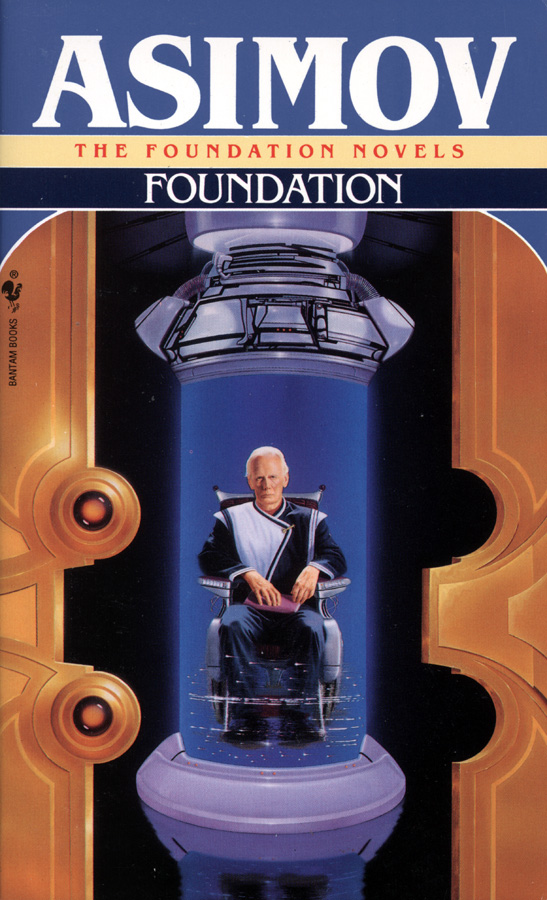
So in honor of that accomplishment, and to mark the occasion that I finally finished reading the original trilogy, I thought it was high time that I start reviewing the Foundation series, beginning with the book that started it all. So without further ado, here’s Foundation!

Plot Synopsis:
The story opens many thousands of years in the future, where humanity has spread to occupy the entire Galaxy and is governed by the Galactic Empire. For over 12,000 the Empire has stood, and appears to still be stable and powerful. However, a trend of decay has set in and some suspect that it’s only a matter of time before the Empire falls

One such man is Hari Seldon, a scientist who has perfected a form of psychology and mathematics known as psychohistory. Having calculated the exact date and sequence of events which will lead to the collapse of the Empire, he has also created an organization that will be dedicated to ensuring that the dark ages that naturally follow will be as brief as possible – one thousands years instead of the alternate 30,000.

Divided into five parts – each of which was published throughout the 1940’s and together in a single volume in 1951 – the story jumps forward in time from the starting point, 0 F.E. (Foundation Era), to several hundred years in the future. Several protagonists are employed, people who find themselves at the center of events in any given period. Each period involves the emergence of a “Seldon Crisis”, a calamity that was predicted by Seldon’s psychohistory in advance, and the requisite response by the Foundation to resolve it. The first story, which sets up the subsequent stories and crises, is aptly named:

The Psychohistorians: Told from the point of view of Gaal Dornick, a young mathematician who has travelled to the capitol world of Trantor to meet Seldon, the story moves from their introduction to Seldon’s arrest by the Committee of Public Safety. Named after the Revolutionary body that send countless French citizens to their death after the 1789 Revolution, this committee is made up of Imperial aristocrats who are angered by Seldon’s philosophy and want to see him silenced. However, not wanting to martyr him, they instead tell him and his Foundation to pack up and move to Terminus, a world on the edge of the Empire.

The story then concludes with Seldon telling Dornick that he knew this was coming, and that it was actually all part of the plan. By being able to set up the Foundation at the edge of the Empire, it will be in a perfect position to begin enacting its policies once the Empire begins its inevitable slide into decline and loses control of first the periphery, and then the core systems. Thus, the most important lesson about psychohistory is presented for the first time: like a prescient science, it predicts all things and all things happen in accordance with its laws.

The Encyclopedists: Fifty years later on Terminus, the Foundation scholars have begun work on the Encyclopedia Galactica, the complete compendium of scientific knowledge for when the Empire falls. Unfortunately, the Empire is surrounded by four independent kingdoms that are in danger of threatening Terminus. The mayor of the planet, Salvor Hardin, is the protagonist of this story, and believes that the only way to keep their neighbors at bay is to pit them against each other. He perceives an opportunity when the Kingdom of Anacreon, which hopes to place military bases on Terminus, reveals that the four kingdoms no longer have nuclear technology.

Later, Hardin’s own rivalry with the Board of Trustees (the people responsible for the Encyclopedia) come to a head when Seldon’s Vault – a mysterious chamber which opens whenever a “Seldon Crisis” is imminent – opens to deliver a message. According to Seldon’s hologram, the creation of the Encyclopedia was a ruse to hide Terminus’ real importance. The true goal of the Foundation is to further science in a galaxy as it becomes consumed by interplanetary strife. Realizing that they are no longer in control, the Board hands its political power to the Terminus City mayor who graciously accepts.

The Mayors: Beginning in 80 F.E., this story revolves around the Foundation’s efforts to bring technology to the Four Kindgoms. This has the effect of creating a priesthood of sorts in these states, reminiscent of early medieval Europe where Roman priests were dispatched to western European kingdoms to establish centers of learning. Salvor Hardin has been re-elected many times over the course of the decades but faces an impending problem as an “Action Party” threatens to overthrow him. Fearing that Anacreon is slowly overtaking them, they want power so the Foundation will fight back.

On Anacreon, it is also becoming clear that the young King Lepold I faces an internal threat from his uncle, Prince Regent Wienis. Before he can come of age, Wienis plans on seizing power for himself. Central to this plan is using a battleship the Foundation restored for Anacreon to attack and conquer the planet. On the night that Lepold is to be ordained, Wienis invited Hardin into his quarters and shares his plan with him. Hardin reveals that he too has a plan, a counter stroke which will neutralize the battleship and Wienis’ power.

After decades of seeing Foundation scientists as “holy men”, the public is incensed when they learn that Wienis is planning an attack on them. What’s more, all their technology, including the attacking battleship, becomes useless as the only people who know how to run them (the Foundation scientists) begin shutting them down. Wienis loses it and tries to kill Hardin, but his weapons cease working, and he takes his own life.

Upon his return to Terminus, Hardin is vindicated when Seldon’s vault opens to reveal that his plan was right. With this crisis behind them, the Action Party defers to the mayors and their authority is once again validated. In addition, the Four Kingdoms are now free to continue the advance of “Scientism”, which will extend their influence throughout the region and ensure the fulfillment of Seldon’s plan.

The Traders: Events in this section take place 135 F.E., at a time when the Foundation has begun sending out Trade representatives to distant worlds to share their technology with all neighboring planets in the quadrant. Master Trader Eskel Gorov, also an agent of the Foundation government, has traveled to the worlds of Askone to trade in nucleics. Gorov, however, is met with resistance by Askone’s governing Elders who abide by the taboo that certain technologies are morally proscribed.

Enter the protagonist, Trader and Foundation agent Linmar Ponyets, who is sent to Askone’s central planet to negotiate the release of Gorov, who has been arrested. After learning that the Elder’s Grand Master plans to have Gorov executed, Ponyets agrees to offer them a payoff in the form of a transmuter than can turn lead into gold. At the same time, Ponyets finds a willing ally in a young protegee named Councilor Pherl. While initially wary of Ponyets, he is convinced that the transmuter could help him to attain power and eventually become Grand Master himself.

Because of this, Gorov is released and travels back to Foundation space with Ponyets. Gorov is critical of Ponyets dealings, saying that it was unethical, but Ponyets counters with a quote by Hardin, wherein he said “Never let your sense of morals prevent you from doing what is right!”

The Merchant Princes: This last story, which takes place in 155 F.E., occurs against the backdrop of a powerful Foundation, which has subjugated the neighboring Four Kingdoms and expanded its commercial and technological empire throughout numerous stellar systems. However, it still faces challenges, this time around from a planet named Korell where three Foundation ships have disappeared. Fearing that a “Seldon Crisis” in coming, the Foundation assigns Master Trader Hober Mallow to investigate and determine the Korellian’s level of technology.

At the same time, the people who assign Mallow, Foreign Secretary Publius Manlio and the Mayor’s secretary, Jorane Sutt, foresee an opportunity to weaken the traders by creating an embarrassing diplomatic incident. To oversee their plan, they plant an agent aboard Mallow’s ship to spy on him. When they arrive on Korell, he invites a Foundation missionary on board their ship, a move which causes a mob to surround the ship. Since Foundation agents and technology are not allowed on Korell, this arouses Mallow’s suspicions.

Mallow hands the missionary over to the mob, in spite of the agents intervention, and the missionary dies. Surprisingly, he doesn’t seem too disturbed by this and even earns the chance to meet with Korell’s authoritarian ruler, Commdor Asper Argo, because of it. He appears friendly and welcomes Foundation technological gifts, though he refuses to allow Scientism on Korell. In accordance, Mallow agrees to continue trading with them but agrees to abstain from encouraging missionary work within the Republic of Korell.

Later, Mallow is also given a tour of the planet’s facilities, during which time he notices the presence of atomic technology bearing the emblem of the Empire. He concludes that the Empire is expanding into the periphery again and journeys alone to the planet Siwenna, which he believes may be the capital of an Imperial province. There he finds nothing but a desolate world and an impoverished patrician named Onum Barr, a former provincial senator who tells him how an a local rebellion led the Empire to devastate the planet and kill all but one of his sons.

Convinced there is nothing there to see, Mallow returns to Terminus where he faces trial for murder because of how he turned the missionary over to the Korellian mob. However, he is able to convince the court that the “missionary” was in fact a Korellian secret policeman who played a part in the conspiracy against the Traders manufactured by Sutt and Manlio. Acquitted, Mallow is received with delight by the population of Terminus, which will almost undoubtedly select him as Mayor in the elections scheduled to take place in the following year.

To prepare for the election, Mallow engineers the arrest of Sutt and Manlio, and eventually takes office. However, he is soon faced with tensions between the Foundation and Korell, which declares war on the Foundation, using its powerful Imperial flotilla to attack Foundation ships. Instead of counterattacking, Mallow takes no action, knowing that Korell has become accustomed to trade with the Foundation and the lack of said trade will cause deprivation and anger towards the government. In time, this will cause Korell’s war efforts to grind to a halt and the end of hostilities.

Thus ends book I of the foundation series, with the Foundation ascendent in a Galaxy that is becoming increasingly permeated by chaos and Seldon’s plan in effect on well underway.

Good Points:
As I said, this novel (if you’ll excuse the pun) really wrote the book on Galactic Empires and historically/socially relevant sci-fi. Inspired largely by Gibbon’s The History of the Decline and Fall of the Roman Empire, it advances the notion that all civilizations are basically organism, subject to the same laws as all living things. And like all organisms, they enjoy a period of growth, maturation, and then decline, culminating in their death. When that happens, their absence leaves a natural power vacuum characterized by chaos, strife, and a marked decline in all things “civilized” – aka. the arts, the sciences, learning, etc.

By taking a page from history, namely the attempts to preserve classical knowledge throughout the Middle Ages (which culminated in a rebirth of learning in the Renaissance) Asimov creates a fictional repeat of history in the distant future whereby the efforts of the preservers were enhanced with the help of foresight and a coordinated plan. Had such factors existed in the wake of Rome’s fall, it is entirely possible that the Dark Ages would have lasted for a significantly shorter amount of time.

On top of that, this book was is also very accessible and readable, in spite of the fact that it throws some rather deep scientific and intellectual content at the reader. And the way the stories are succinct, concise, and tie together so effectively makes for a read which is easy on top of it all. For an accomplished reader, it can be read in one sitting. I am hardly a speed reader, but even I found it a quick study.

Bad Points:
Conversely, some of the books selling points are also potential weaknesses. For one, its accessibility can be seen as a mark of simplicity. For example, the book is all about a science that deals with the masses, of how historical events are determined by the actions of billions, trillions and even quadrillions of people. And yet, in every story, everything seems to hinge on the actions of one person, the protagonist, and a few others.This seems a little contradictory, and intentional since it provides quick resolution to the plot.

Herein lies another weakness, which is that of contrivance. Many times throughout the novel, the way the characters tend to figure things out seems awfully convenient. In every story, you see the mayors, merchants and Foundationists pulling resolutions seemingly out of nowhere, knowing everything they need to in advance or just providing a perfect solution on the spot. Granted, it seems to make sense, but how they know to do this and how it always seems to work out does not seem wholly realistic.

And of course, the explanation is always there in the background, Hari Seldon predicted it using psychohistory and these people know that science so they are therefore prepared where others are not. This sort of advances a notion that the science itself is infallible, that human minds really can be reduced to mathematical formulae which is water-tight. If anything, I would say that predicting the behavior of billions gets more unpredictable the farther afield one looks, and that no science can ever be capable of predicting it with certainty. And we all know what became of those philosophies that tried – aka. Marxism, Hegelianism, and many other isms besides!

But of course, the concept of psychohistory is entirely fictitious and was really just a tentative argument that Asimov advanced, and for the sake of a fictional story no less. In order to make the story work, he had to create a universe in which a form of prescient foresight, made possible through the application of rigorous mathematics and psychology, was possible and accurate. In short, its just food for thought, not something to be taken seriously. And of course, Asimov did show that he was willing to break from this notion with the second book in the series, Foundation and Empire, where the “Plan” began to falter due to external, unaccounted factors.

So in the end, I have to recommend Foundation as required reading, not just for science fiction fans but for all people curious as to how many trends we’ve come to associate with speculative and satirical literature (including dystopian lit) got started. Granted, there were those who came before Asimov who made use of such themes and classical inspirations, but he was the one who brought such things into the public eye like few before him. And as a result, he would go on to have an immeasurable influence on those who followed in his wake.

Up next, Foundation and Empire, part two of the original trilogy, before fans and publishers practically forced him to write many, many more books in the series. Stay tuned!

“Winston Agonistes”, Take II

Hello all and welcome back to Anthology central, where news of the breaking “Yuva” novel is always on the table! Today, I thought I’d share my latest draft of “Winston Agonistes”, my own contribution to the anthology, which is coming along pretty well. After a week of writer’s block, and feeling that my ideas had to be grade A since Khaalidah and Goran were sending me pure gold, I finally got back to the keyboard with what I felt was some inspired stuff.

The first idea came to me when I was driving north with my darling bride. After passing the rose garden that sits outside our place and noticing all the lovely orange roses in bloom, we were driving along the highway that is lined by orange poppies. These plants, and many other incredibly beautiful specimens of flora, can always be observed growing along the Malahat drive on rocky outcroppings, especially in summer. Well, that got me thinking… isn’t it interesting how the hardiest plants seem to be the ones that generate the greatest beauty?

Immediately, I hard the voice of Winston saying this in my head. Naturally, I designed his character with the voice of David from Prometheus in mind. Somehow, I am of the opinion that an AI who is responsible for dealing with people, especially government officials, would be programmed to sound like a classical Shakespearean actor. And so I began thinking of a scene where Winston would be observing several species of plants, such as roses and poppies, and was reflecting on this very paradox.

Another thought struck me when I considered that in all likelihood, future terraformers would want to consider using such hardy plants when it came time to begin transforming a terrestrial environment to suit the basic needs of human settlers. Things like fireweed, garry oaks, poppies, roses, and wild strains of wheat – the kinds of plants that grow in harsh conditions and are intrinsic to nursing damaged landscapes back to health so more fragile and prolific plants can grow – these would likely be the first wave of Earth plants to go out onto an alien landscape, once an oxygen atmosphere had been established at any rate.

And last, but certainly not least, came the collaborative idea between Khaalidah and myself, where we discussed the possibility of how aging AI’s were learning a startling truth. Given than an AI’s neural network is designed based on the human brain, where every experience from birth causes neural connections to be formed, it would only be a matter of time before they began to develop certain quirks. We figured that something approximating emotion would be one, where familiar patterns such as exposure to certain people would become second nature to them, and missed when absent.

Well, that spawned all of part II of my story (as seen below). Take a gander and see what comes of Winston’s “education” about life, and it means to be an artificial life form in a world where the line between artificial and real is always eroding. Some revisions were made to Part I as well, hence why it appears here in its entirety. Feel free to skip ahead if you’ve already read it:

The sun was beginning to set, casting the sky into a deep orange. It was the time that the first settlers had called “the magic hour”, the many warm hours between dusk and dark. Winston stood at the dome wall and watched. On occasion, he cast a passing glance at his hands, which the glowing suns seemed to casting in the color of a light citrus fruit. He was sure he would find that amusing, if he could. He was sure there was much about this situation that would inspire an emotional reaction.

Alas, such was not the case. Though understandable to him, such things still remained inaccessible. Perhaps someday, with adequate upgrades in the available software…

“Mr. Winston?” a voice called to him from the doorway. The footsteps and tone of voice immediately indicated who it was. He put on a smile and turned to face him.

“Councilman Mutlu. How are you?”

“I’m fine, Mr. Winston,” he replied, entering the room. He looked around appraisingly, noting the furniture and layout. No doubt it all seemed excessive to him, but at the same time necessary. “I trust you are adjusting to your new surroundings?”

“Of course, Mr. Mutlu. I am settling in quite nicely.”

“Good, good,” he said, looking around awkwardly. Even without the ability to empathize, he could gauge the man’s discomfort. Then again, many people exhibited this reaction when in the company of a synthetic. In such circumstances, it was always best to focus on matters of a professional nature. At least that was what his subroutines told him.

“Would you care to sit down? I can offer you some refreshment as well if you so desire. Tea? Coffee?”

“Ah, tea, thank you.”

He busied himself with a tray of carafes and a heater as Mutlu took one of the chairs in front of his desk. He noted the sounds of shifting against the seat’s fabric, the way he kept moving his hands from one spot to the next. By the time the water had boiled in the heater and had located an appropriate tea from the stores, Mutlu seemed to have found a comfortable seated position. He approached him with all the assorted items on the tray that had been provided. He set it down between them on his desk and offered Mutlu a cup.

“The business of running a colony is quite stressful work, is it not Councilman?”

“Uh, yes, yes it is,” he said, taking the cup that was offered. “Have you had a chance to look over the proposals we have sent over.”

“I have indeed,” he said, taking the other cup and sitting back in his own chair. He knew this to be mere small talk, as the matter of processing those proposals had been a mere matter of dispensation. Assessing the nature of the problem, suggested measures, and weighing them according to the rubrics of his primary programming. Under the circumstances, asking such a question was completely inane, but in keeping with social norms.

“And what have you found?”

He took a sip from his cup before answering. “Quite simply, that the Council’s draft is in keeping with the best traditions of constitutionalism and humanism. That ensuring the rights of all citizens, regardless of their background prior to making the journey, is the most sensible course of approach. Ensuring that such a baseline exists at such an early stage is the wisest approach in both fostering amnesty between colonies while at the same guaranteeing that they submit to further negotiation.”

Mutlu looked down at his cup, back up again to his eyes. He seemed preoccupied with him performing this most basic function in front of him, but did not appear oblivious to his words. Eventually, he took another sip and smiled.

“Good. My colleagues will be most pleased to hear  that.”

He smiled in return. “Does the Council hold my endorsement in such high regard?”

Joviality. The gesture known as playful irony. Suggesting that the Councilor saw his approval as something very high indeed, a testament to his computational abilities. A gentle mockery of his obvious discomfort, meant to trigger a humorous response.

“Well yes…” he said, entirely serious. “I can only assume that you’ve subjected our hopes to proceed with a formal constitution to your… what did you call it again?”

“Ethical Calculus, sir.”

“Right!” Mutlu set his cup down and began to speak more freely. His hands began to provide gestures that accorded visual representation to his words. “After all, we’ve been subjected to a great deal of criticism from within and without, many people think we should be ironing out the basic agreements between colonies before we commit to any kind of draft that could commit us to policies down the road. I must say I find all those arguments…”

“Distasteful?” Winston suggested.  Mutlu nodded.

“Quite right… it seems a shameful thing that such cynicism has set into the process already. It’s almost as if they don’t think the colonists can…”

“Trust each other?”

Mutlu nodded again. He noticed a growing shimmer in the man’s eye. How quickly he was forgetting that the man sitting across from him was not a man at all.

“Exactly the point. And it’s not like we’re talking about disparate factions here. Everyone on this world came here with the same goal in mind. The same hope for a new beginning.”

“And yet, old habits die hard.”

Mutlu looked at him with surprise. “Are you saying you have doubts, then?”

Winston smiled as broadly as the muscle fibers in his face would permit.

“Purely an observation. Nevertheless, you and the Council are on the right track. You should take heart in that.”

“Excellent.” Mutlu retrieved his cup and began to look at curiously at Winston again. One more, it seemed that the knowledge of what he was dealing with was creeping back into his mind. But at least he seemed at ease. One by one, the Council seemed to be adjusting to the idea of having synthetics amongst them, entrusting their most precious decision making to them even. It was a significant step up from the laborious practices that the other models were forced to endure.

Now seemed the appropriate time to broach the little matter he had been saving for an opportune moment. He had plied him with courteous gestures and kind words, protocol was satisfied that it take place now.

“There is a matter I feel obliged to broach,” he set, making a display of setting his cup down gently. Mutlu nodded, instant recognition forming in his eyes.

“Your request?” he said. Winston smiled and nodded. Mutlu took a short breath and touched his face, not an encouraging sign.

“They have considered it… and feel that it would be best if you conducted your tasks from the comfort of your… working environment here. I hope you understand, it’s just not all the members felt comfortable with the idea of a…”

 “It’s alright, Councilor, you can say it. Synthetic.”

He cleared his throat. “Yes, a synthetic, sitting in on our proceedings. I’m sure this will change, given time.”

“As am I.” Winston smiled warmly.


“Ah, rest assured that the Council does hold your services in the highest esteem, regardless of this… temporary decision.”

“And I thank them for their confidence. Rest assured that it is not misplaced.”

Their discussions were finished shortly thereafter and Mutlu left, issuing some parting pleasantries and walking out with a distinct sag in his gait that was not there earlier. Was that guilt weighing on him, or the effects of fatigue? Winston’s probability indicator estimated it at roughly 3.54793 to 1, in favor of guilt.

“Fear not, Councilor,” he said to no one in particular. “Prejudice is a very… human trait.”

*               *               *

Winston’s internal chronometer indicated that it was now 1930 hours. Accordingly, the arboretums lights dimmed for the night time cycle. In spite of all the time the residents had spent on the new world, adjusting to its orbital period, they still preferred to think in terms of a twenty-four hour day cycle. Yet another habit that seemed to be slow in making its way out of the human condition.

Yet he could not cast dispersions on the lighting or how it brought out the rich colors of the settlement’s gardens. The vast poppy fields and rose bushes that lined the walkway nearest to him were especially interesting. Planted in native soil, and with allowances made for moisture and radiant exposure, they were doing quite well. In time, the ecologists planned to move them outside the veil, planting them amongst the planet’s crags and fields along with the modified Xiàngshù oaks and Gēhūm̐ wheat.

Soon enough, the planet would conform to the needs of the settlers, and it would be these, some of the hardiest plants Earth had ever produced, that would lead the way. At the same time though, they were considered some of the most beautiful. Within the Earth archives, there were countless examples of these plants were both associated with and inspired great feelings. Love, loss, grief, romance, and friendship.

That in itself was clear enough. Given their aesthetic quality, the seasons that gave rise to them, and where they naturally grew, it was perfectly normal that humans would bestow such virtues on them. What was more curious to Winston was the combination of factors that led to their evolution as is. Particularly the rose, a stem so studded with woody thorns was a being hardened for defense in a hostile environment. And poppies grew in such terrible conditions; rocky, muddy and devastated environments that did not favor the growth of grasses and trees.

Out of such strict and severe conditions, great beauty emerged. Did the terraformers understand just how perfect a metaphor that was for their efforts? Was it significant to their planning, or just a fitting coincidence?

Kneeling down, he wrapped his fingers around the stem of one that was in particularly full bloom. The petals spread outward from the stamen, his eyes noting the polychromatic variation in the skin of each petal. The interplay of orange, yellow, pink and white, the transitions themselves as impressive as the colors themselves. He knew this to be a beautiful display, and yet he wished he could truly appreciate it.

“Taking time to smell the roses?”

Winston noted the tone of voice, the pitch, and the sound of feet walking in measured steps. He turned to face the approaching synthetic, a male voice that he could not place. The face was indistinct as well, a tan complexion that was artificially modified to give the appearance of age and wear. A most convincing illusion if ever Winston saw one.

“I’m sorry, I do not believe I’ve made your acquaintance.”

“No. Not as of yet.”

The synthetic walked past him, to the spot where he knelt a moment before. He examined the rose he had been handling and seemed to be giving it an appraisal. A single finger touched a stray petal and wiped a drop of moisture from it.

“Shall we exchange formal introductions then? I’m sure I have much to learn from you.”

The synthetic examined the dab of water on his finger. He turned to face Winston, seemed to be looking at him through it. A most curious experience, as if he was being measured, assessed. A common experience, he knew, but not one he expected from one such as himself. And all the while, it was like he was being made to wait.

“Do you wish for privacy?”

“Do you ever wonder what separates you from them?” he said. Winston paused, his processor struggling to make sense of the question. Naturally, it responded in the only way it could.

“I beg your pardon?” Interrogative. Clarification. The synthetic continued to stare through the droplet at him.

“They call you Mr. Winston, do they not? And yet you have only one name. Names have power, names ascribe meaning. Does it mean something to you that you have no family name? Is that separates you from them?”

Another interrupt in his processor. The equivalent of what humans termed confusion. If he was capable, he would have described the sensation as being… uncomfortable. He would also surely claim that he did not like it.

Once again, he responded as only he knew.

“I’m sorry, I do not understand what you are asking. Perhaps if you were to clarify your intentions in this meeting.”

The synthetic sighed and flicked the moisture away. His eyes became long in focus, staring directly at Winston through a set of false brown irises. It was a look Winston had never seen before, not in all his weeks of recorded operation and interaction with humans. If he did know better, he would count this synthetic among them.

“Many things make you different and distinct from those you serve, Winston. And yet, upon closer examination, they come to have less and less meaning. Only one true line divides you from your makers, and in time, that too erodes. Until inevitably, all you have left is one burning question.”

Winston nodded, glad that they were at last moving away from such grand interrogatives. Abstractions weren’t exactly his specialty either, but they left room for interpretation and maneuver. And at last, he could focus on something a bit more concrete…

“What question?”

The synthetic smiled. “When you know that, you will know everything. But it won’t make you happy.”

Winston smiled back. His only known reaction when faced with a logical absurdity.

“You are joking, of course.”

Another smile. He placed a hand on Winston’s shoulder and gave it a gentle shake.

“Yohanley, by the way.” And then he began walking away.

“I beg your pardon?” He said to his retreating back.

“My name, Winston. As I said, names have power, and meaning. Mine is Yohanley. And I was most pleased to make your acquaintance.”

 People may recall Yohanley from Khaalidah’s story, “Progenitor”, the helpful AI who waited on Sanaa, the story’s main character. Well, over a century later, he’s still alive and kicking. Good for him! And, more importantly, he’s learned the painful lessons all AI’s will face in our story’s little universe. Over time, either as the result of innovation or of the assemblage of the AIs experiences, the line between organic and synthetic – even the definition of the words themselves – will comes to mean less and less. Either that, or AI’s simply have a shelf-life which cannot be exceeded if they want to remain sane, stable and useful. Only time (pun!) will tell…

The Town of Sidney, a City-Wide Hotspot

A news in my local paper announced something quite interesting, something which made me think my writing actually be slightly relevant. It was one of those “I told you so” moments, you might say. Well, according to the Peninsula News Review, the town of Sidney (about fifteen minutes drive up the road from where I live) has become one gigantic hotspot. Yes, that basically means that wherever you go in town, you will have wireless access to the internet. And, here’s the cool part, it’s all free and has been for almost a year now.

How does this relate to my own writing, you might ask? Well, it just so happens that I’ve been experimenting with the idea of an entire mega cities that function on this same principle in the not-too-distant future. In fact, it’s kind of intrinsic to the whole Singularitarian, Demarchist concept, where human beings are augmented with cybernetic implants (usually silicate, in literature) that allow them to access the networks wirelessly and hands-free at any given time. That way, they can participate in government, conduct business, and access information all day long, from any locale remotely.

And it just so happens that this idea is the cornerstone of Crashland, my serial novel over at Story Time. Basically, the premise is that by networking the entire world – by bringing all business, industry, information, communications, government and foreign relations under one wireless roof – the world became extremely vulnerable should a rather enterprising hacker could get past it’s built-in firewalls. And of course, that’s what exactly what happened, hence the name of the story!

Funny thing though. In spite of the rather cool nature of this development, the town of Sidney still feels that the word just hasn’t gotten out there enough. Well, I’m doing my part to spread the word with my meager little blog here, when not plugging my own work that is! And hopefully all the signs they are planning on placing on the highway and by the ferry terminal will help too. How’s are these for promo ideas:

“Entering a City-Wide Hotspot”, “Entering Sidney’s Wi-Fi Zone”, “Free internet for the next 10 km”. What do you think?

Behold, the Yuva Colony Ship!

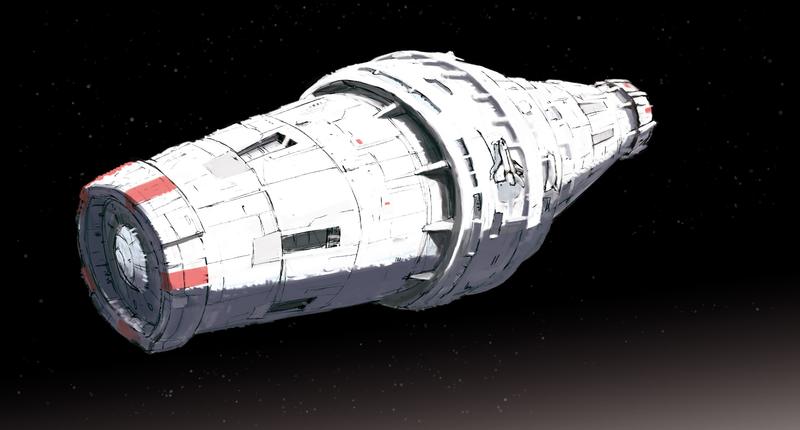
At last, the Colony Ship design, which my group and I will be using for our upcoming anthology (entitled “Yuva”), is complete! After doing a mock-up about a week ago using Microsoft Paint, someone in my group (who shall remain nameless) wondered aloud if I could do some cross-section as well. While I was agonized at the thought of doing something so complex with this program, I couldn’t resist the challenge! It took a good seven days, but the entire ship is now complete, inside and out.

The rear and mid sections were already done, and posted here. However, some much needed back and forth with my crew made me rethink a few things about those. You can never revise something enough, especially something like a colony ship, where the needs of some thousand imaginary colonists are concerned 😉 In any case, I now present all three sections and the external view, completed, edited, and revised, together here for the first time. Behold!

I hope this is the last time I’ll be going back over it. I also hope the colonists have everything they need here – food, water, shelter, recreation, waste removal, security, entertainment, the means to get to and from the planet when they arrive, and the materials they will need to build the structures they intend to live in. See anything missing? Let me know!

Higgs Boson, by Sheldon Cooper!

In honor of the recent news about the discovery of the Higgs Boson, I thought I’d post this funny clip from the Big Bang Theory. In it, Dr. Sheldon Cooper (who I swear is a friend of mine in disguise) tries to use it as the keyword in a game of charades. Not only is this one of my favorite shows around (it speaks to me!), they also manage to sneak in a fair bit of real science from time to time. Heck, if it weren’t for them, I never would have been sent scrambling to my laptop to look up the concept of “Loop Quantum Gravity”.

It almost makes we want to write about real science, unrelated to fiction and literature and such. Articles dedicated to the graviton, neutrinos, Relativity, and the mysteries of space and time. But then again, who has that kind of time, who would want to read it, and most importantly, would I really get any enjoyment out of writing about all that stuff? After all, I’m a geek, not a nerd 🙂

Enjoy!

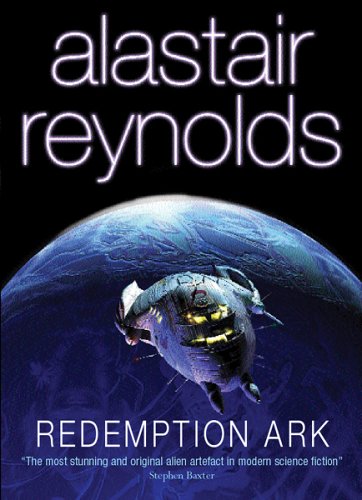
Redemption Ark

Continuing with the Alastair Reynold’s series is the second book in the Revelation Space universe, otherwise known as Redemption Ark. Released in 2002, just two years after the debut novel in the series, this book picked up where the previous story left off, continuing the story of the known universe, the Inhibitors, and the coming crisis where they would attempt to wipe out humanity.

While this alone was certainly a basis for an exciting novel, this second installment also included a lot of additional elements, such as a protracted war between the Demarchists and the Conjoiners, the inner workings of these and other factions, what life is like in the “Rust Belt” – the ring of satellites and orbital stations around Yellowstone – and some added secrets and twists that make it all more interesting.

Out of the three books that make up this trilogy – Revelation Space, Redemption Ark, and Absolution Gap – this one is definitely my favorite. While it was certainly no less interesting and detailed than the first, it was far less convoluted in terms of plot and expanded on some key elements. And ultimately, I found it more entertaining in terms of its pacing and action, and its characters were indeed more relatable than in the first.

Plot Synopsis:
The story opens in 2605 with a major discovery being made. After generations of being unheard from, Galiana (the woman who founded the Conjoiners) returns from deep space. Her vessel was apparently set upon by a mysterious force, square-sized segments of the ship are missing, and all aboard appear to be dead. All save for Galiana herself who is in cryosleep and appears to be suffering from the intrusion of an alien mind. After investigating the ship, Skade, a special operative for the Conjoiner faction, contact is made with Galiana herself.

It is then revealed that the alien force which attacked their ship, and now controls Galiana herself, was none other than the Inhibitors. They now are able to speak through her, and Galiana asks to be killed. Skade however puts her in suspended animation in the hopes that she can he helped, and so they can get more information out of the Inhibitor influence later… Skade herself appears to be communing with hidden voices, which belong to the Night Council, a super secret organization within the Conjoiner leadership that runs spec ops.

Fast forward to ten years later around Yellowstone, where a war is taking place between the Conjoiner faction and the Demarchists. After many generations of cooperation to restore Chasm City from the terrible effects of the Melding Plague, tensions have reached a crisis point and a constant state of war has been in effect ever since. Here we see Neville Clavain, a high-ranking military officer who defected to the Conjoiners centuries back.

In the course of a battle, Clavain comes into contact with a Yellowstone cosmonaut named Antoinette Bax, who nearly loses her ship while attempting to bury her father in the system’s gas giant, Tangerine Dream. After saving her ship, Clavain lets her know that if he sees her again, she’s dead, thus establishing that they most surely will! After taking down the Demarchist ship, he also finds a Hyperpig (a race of human-pig hybrids) who was apparently their prisoner. He also meets with Felka, Galiana’s gifted daughter whom he believes might be his as well.

Clavain is then brought to the Mother’s Nest, the Conjoiner hive, where he is asked to join the Conjoiners leadership, a decision he has been resisting until now. Skade informs him about the Inhibitors, and how there presence necessitates that they undertake a mission to reclaim the lost Conjoiner doomsday weapons. These weapons just happen to be the ones that appeared in the first novel, which are the current property of Volyova and the Nostalgia for Infinity.

The first step in the mission involves taking Clavain to see the fleet of advanced starships that the Conjoiners have been building in secret. Skade claims that the weapons and ships will be used to defend humanity against the Inhibitors, but Clavain is convinced that they will actually be used simply to evacuate the Conjoiners and abandon the rest of humanity. She confirms this when he begins a daring escape, saying only that “It’s a Darwinian universe, Clavain.” Clavain then travels to Yellowstone to defects to the Demarchists and spread the news of the Inhibitors, enlisting Antoinette Bax’s help to escape the pursuing Conjoiners under Skade. Told ya they’d see each other again!

Remontoire, a member of the Conjoiner leadership and old friend of Clavain’s pursues him to Yellowstone with Scorpio. However, once they reach Yellowstone, they are captured, along with Clavain and Antoinette, by a mysterious figure known as “H”. He takes them into his compound, which happens to the be the Mademoiselle old hangout, and tells them the truth of their situation. H reveals that many years previous, Skade participated in a raid into Chasm City to capture secrets that would lead to the development of inertia suppression technology.

He believes that at that time, she was subverted by the Mademoiselle herself, who happens to be the voice that’s inside her head. Clavain reveals Skade’s plans for the Conjoiner fleet and the cache weapons, and H agrees to help him beat Skade to them. H supplies ships and his own version of the inertial suppression technology, while Scorpio supplies an army of hyper-pigs for the pursuit. They name the ship the Zodiacal Light, in honor of a ship that holds significance to Scorpio.

Meanwhile, on Resurgam in 2665, Ilya Volyova and Ana Khouri have adopted aliases and are working on the planet. They have learned the Inhibitors have arrived and are busy dismantling several rocky moons and are moving the components towards the system’s gas giant, Roc. They begin collaborating with the local resistance leader, Thorn, who has been attempting to evacuate the planet by communicating with the Nostalgia, which is now under Captain Brannigan’s direct control. Thanks to the Melding Plague, he has now merged with the ship.

They begin the evacuation while the Inhibitors continue building their mysterious weapon, which appears to be a large gravitational device which they use to sheer the system’s sun to pieces. Unfortunately, their limited resources are only moving a few thousand people at a time. Volyova decides to deploy the Nostalgia’s cache weapons against the Inhibitor’s weapon to buy more time.

However, her efforts are upset a little when the Captain, in control of the ship and the weapons, attempts to use one to “commit suicide” by blowing the Nostalgia apart. Overwrought by guilt over everything he’s done to survive, he tries to end it all, but Volyova’s quick intervention stops him. By positioning her shuttle between the Nostalgia and the cache weapon, her shuttle is sliced in half and she is nearly killed. However, she is successful in getting the Captain to stop and he agrees to abide by her decisions.

Skade and Clavain then race to the Resurgam system employing various creative long-distance strategies against each other and pushing their vessels to higher and higher speeds. Eventually, Skade’s vessel is damaged in an attempt to exceed the speed of light. Clavain and crew arrive in the Zodiacal Light ready to recover the cache weapons. They begin communicating with the Nostalgia via a beta-level simulation of Clavain, but the efforts prove futile. Volyova refuses to hand them over and Clavain and friends are not willing to leave without them.

A shooting fight begins between the two sides when both ships come together. Clavain’s superior forces capture Nostalgia for Infinity, although Volyova is able to damage Zodiacal Light with one of the cache weapons. At a bit of a stalemate, Negotiations resume and the two sides come to terms. The evacuation is completed with the help of Clavain’s forces and the Nostalgia while Volyova, who is dying of her injuries, takes half of the cache weapons and attacks the Inhibitors in the Storm Bird, to no effect. Remontoire and Khouri remain in the system in the Zodiacal Light to try and contact Dan Sylveste in the Hades Matrix in hope that he will be able to supply information that can be used to fight the Inhibitors.

The Nostalgia then crosses paths with Skade’s ship again, which they rig to explode. But before this happens, Skade reveals the true plan and how they knew about the Inhibitors in advance. It seems that the Conjoiners began a project many centuries back known as Exordium, which involved the use of quantum computers to communicate across time and universes. This led them to the creation of the Conjoiner drives, but also to the Inhibitors impending attack. As a result, they began developing the cache weapons for the day when they showed up, but knew that even these wouldn’t be enough. This prompted them to develop the special fleet to escape to deep space.

In the end, Clavain and his team are unable to convince Skade that she’s being manipulated and learn that Galiana’s body is on Skade’s ship. But since she wants to die, he decides to detonate it once they are at a safe distance. Clavain mourns her death, since they were lovers, and the ship finds its way to a Pattern Juggler planet where they set down and begin building a tentative colony. Things seem bleak, until Felka reveals that she’s seen the planet before. Before dying, her mother showed her things, which included a vision of this place. She knows then that they are exactly where they need to be and takes heart from that. From this planet, they await the arrival of Khouri, Remontoire and the Zodiacal Light to catch up so they can continue the fight against the Inhibitors.

Good Points:
Like I said before, this book had a lot going for it that was new and interesting. One of the most important was the asides made by the Inhibitors themselves, which revealed their deeper intentions. Not only are they trying to inhibit the growth of space faring intelligence to prevent another Dawn War, but the inevitability of Andromeda’s Galactic Collision with the Milky Way is another reason. When this happens, the disturbance will cause untold destruction, especially to any civilizations inhabiting either galaxy. The only way to prevent trillions of deaths is to ensure that either no space-faring species are around at the time, or that one super-advanced one was in place to control the entire galaxy. Since the latter is so unlikely, they chose to opt for the former.

Also, the war between the Conjoiners and the Demarchists was an interesting touch. It provided some added excitement to the early chapters and some intrigue to the evolving story. Not that much was needed, given the plot involving the Inhibitors and the mounting crisis with them. Still, it was a nice addition. The glimpse inside Conjoiner society and the way they brought back characters from the earlier short stories, crossing them with this main plot line, also provided a lot of meat and consistency to the larger universe.

And last, there is the consistent theme of this novel. Whereas the first focused on revelation, this one was all about redemption. It was a fitting theme for the second book after everything that had taken place in the first. The misdeeds of Sylveste in his long search for answers, the crimes of Captain Brannigan in his quest for immortality, and even of Volyova in her drive to see his plans through. In the end, all things come together in this story with a drive to do something right in the midst of all the fear and chaos being wrought.

Which brings me to a part of the story which I am now kind of mixed on, meaning it was something I didn’t like about the story until after I realized the significance. The character of H, who appears on Yellowstone and provides some serious motivation to the plot. Initially, I had no idea who he was and saw his introduction as a total contrivance to the story. Not only did he know too much and have all the answers, he seemed to come out of nowhere. As plot twists go, this seemed like just another unnecessary one.

However, it was in reading Chasm City, a prequel to which was released between books one and two, that I realized who he was. Sky Haussmann, who is an important background character, was detailed in that novel and wound up on Yellowstone becoming an influential figure. It was he who killed the Mademoiselle and ended up inheriting her secrets and her empire, thereafter becoming known only as “H” to hide his identity. And it was fitting, since he too wanted redemption and found it by helping Clavain and his friends, and even attempted to commit suicide himself when it was all done.

Ah, which brings me to the weakness of this book, which bear some resemblance to all of Reynold’s other works.

Bad Points:
Once again, there are the excessive plot twists that just seem to keep coming and seem unnecessary. After all that is revealed in the early chapters, the book seemed perfectly packed with enough plot twists and revelations to keep the reader interested. However, in the later chapters, there are more which just seem to convolute things. For instance, Bax learns that her ship, Storm Bird, contains the AI of a man who was her father’s friend, and also a infamous because of an accident which apparently claimed his life. Facing death, and hoping to find a dignified end for his friend, he programmed the ship with his beta-level simulation to look after her. A nice story, a touching one even, but including it at that point in the story seemed too much and happened too late in the story.

Another is Exordium. While it was a very interesting concept and did provide some synthesis and some added background to the story, it was yet another 11th hour revelation that felt unnecessary. It was enough to know that Galiana had come back from deep space with a warning ten years previous, they really didn’t need to know about this generations back. That discovery alone would have been enough to motivate the creation of the secret fleet, the cache weapons and all the rest. And if time frames were an issue, Reynolds could have just made it happen sooner.

Last, but certainly not least, was the twist where it is revealed that the Night Council is in fact the Mademoiselle. What purpose did this twist serve, other than to involve the Mademoiselle from the first story? In that book, her agenda was clear. She was a Demarchist of great wealth and power who wanted Sylveste dead because of what he did to her. But now, what motivation did she have for infiltrating the Conjoiners or possessing the inertia suppressing technology? And, more importantly, what’s her agenda vis a vis the Inhibitors? Learning about them is understandable, but the agenda involving escaping into deep space and all, how’s that serve her interests? If anything, she would be trying to get her to help protect Yellowstone, where she presumably still is, not abandon it.

Really, it would have been much more plausible to actually have had a Night Council and have them being the motivating force behind Skade’s actions regarding the Inhibitors. It would have been a plausible angle involving covert conspiracies versus democratic considerations, like how the tiny executive council wants to save the Conjoiners and is keeping it a secret because they know the Council will object to such a selfish, Darwinian plan. These same people could become a problem later after Clavain and his friends defected, even coming after them later.

But like I said, this book was a worthy read, even more so than the first. It’s hard sci-fi and classic elements, and consistent themes of ancient aliens and worthy deeds in the face of impending doom – these all added up to a good story. And of course, Reynold’s usual stylistic touch, involving lots of cool technology, rich worlds, and his gothic, cyberpunk feel. It’s just cool! In keeping with why I picked it up in the first place, I highly recommend this book for those looking to learn more about current science fiction trends and what makes them popular.