Of Exoskeletons

Hey all. A few days ago, I read an interesting article from Io9 that spoke of historic examples of what might be termed exoskeletons. Naturally, it got me thinking about the emerging technology of powered exoskeletons. I’ve been beating around that bush for months now and figured it was high time I just jumped into it. But an interesting thing happened. In the course of researching fictionalized examples of this technology, like Iron Man and so forth, I found that there were real historical precedents. Not just the whole “Future Soldier” concept as we know it, but ones that go back at least a century and a half.

Though they are not quite what you’d expect – for example, most have no power systems or moving parts – they are nevertheless examples of armored exoskeletons that were designed with a modern application in mind… i.e. stopping bullets. Yes, unlike your more conventional suits of armor, these concepts were designed to keep a man alive in a shootout long enough to kill his enemies, reach his objectives, or bust criminals. Here’s the list that I have compiled, in chronological order of when they were debuted:

Ned Kelly’s Armor:
Our first example comes to us from Australia of the 1870’s, in the form of the body armor worn by notorious outlaw and (to some) folk hero Ned Kelly. Like all members of his gang, Kelly decked himself out with this head to groin suit in order to protect himself from gun fire during the commission of their many robberies. Always, the suit war worn under a dust jacket to hide it’s true nature.

The armor was made of iron a quarter of an inch thick, and consisted of a long breast-plate, shoulder-plates, back-guard, and helmet and. Kelly’s suit also had apron on the back and padding was applied inside to provide comfort underneath the armor’s heavy weight of 100 pounds. The suits’ separate parts were strapped together on the body while the helmet was separate and sat on the shoulders, allowing it to be removed easily.

Initially, police dismissed rumors of this armored suit as nonsense, but in the course of a firefight,they began to wonder if Ned Kelly was even human. It was not until he fell and his dust jacket came open that they realized he was wearing the suit, and not some kind of immortal demon!

Dr. Brewster’s Armor:

In the early 1900s, a man from Dover, New Jersey named Dr. Guy Otis Brewster was famous for his experiments with unusual body armors. Perhaps his most famous suit was the bulletproof suit shown at right, which bestowed the wearer with the mien of a warrior polygon. As was to be expected, his tests of this unusual costume garnered him some rather interesting press coverage.

During WWI, his popularity led the US military to take notice. Due to the sheer number of deaths overseas to machine gun fire, and America’s impending involvement in the war. Experiments were conducted at the Picatinny Arsenal in April, 1917, when Dr. Brewster stood in front of a Lewis machine gun and was shot several times. After receiving several hits, he indicated that he suffered no trauma or serious pain from the experience. In fact, he claimed declared that it was “only about one tenth the shock which he experienced when struck by a sledge-hammer.”

However, his designs were not picked up for use in the war, though it was part of a larger effort to equip soldiers with body armor to defend against the hail of bullets they were forced to walk into.

WWI Trench Armor:
The Great War was the most brutal war history had seen at date. And as such, some rather interesting – and in some cases, medieval – equipment was developed as a result. This included many designs of trench armor, which could be something as simple as a faceplate and helmet to a full metal body-suit. The purpose in each case was to provide the wearer with all the necessary protection to ensure that they would be resistant to snipers, machine guns and all other forms of enemy fire.

Naturally, these designs were never picked up en masse, mainly because the weight of the equipment made soldiers cumbersome. In addition, they did not protect against one other all-important killer in trench warfare, that being poisonous gas! Yes, it seemed that if a soldier had any kind of expectation of life in the trenches, their only hope was to cover themselves in sheets of metal, a helmet and a gas mask. In the end, engineers found it much easier to just develop tanks 😉

Police Wheeled Shield:
It seems that the concept for Robocop began long before 8 Man and cyborgs were ever conceived. At least, that appears to be the reasoning behind the Police Wheeled Shield. Developed in 1956 for use by Detroit policemen against rioters and gunmen, this bit of body armor came in both the wheeled and carried variety.

The shield itself is made of an impregnable layer of steel, whereas the man (or men) behind it fire through its portholes. The viewing panel is inlaid with bullet-proof glass, and the flattop carried version also comes with a head-mounted light. Those using the carried version were also equipped with bullet-proof leggings, to ensure the bad guys didn’t get wise and try to trip them up with a leg shot.

Though innovative and virtually indestructible, the wheeled shield never saw widespread use for a number of reasons. For one, it was too large and cumbersome and was eventually rendered obsolete thanks to the invention of lightweight riot shields and Kevlar vests. Still, the idea of an armored cop did play well in the movies. Go Robocop!

Future G.I.:
Developed in the late 50’s, this concept reminds us that during the Cold War, armies took the possibility of having to fight in radioactive environments very seriously. This particular bodysuit, known as the Future G.I., was developed in 1959, but was abandoned shortly thereafter in favor of more conventional concepts. Maybe they thought it was a little to dystopian or something…

In addition to a nylon armored vest that was resistant to radiation, the wearer also sported a transistor radio helmet, and a heat resistant mask. Naturally, the purpose here was to outfit soldiers so that they could defend territory that had been struck by nukes. Clearly, some people in the Pentagon thought that even after the bombs fell, soldiers would still need to fight and die for irradiated stretches of land.

All of the equipment featured in this design was state-of-the-art for the time, and you may notice the soldier posing for the photo is carrying carbine prototype which would eventually become the M16. Oddly, this is the only piece of the suit that would survive, going on to see service in Vietnam and every US conflict ever since.

“Future Soldier”:
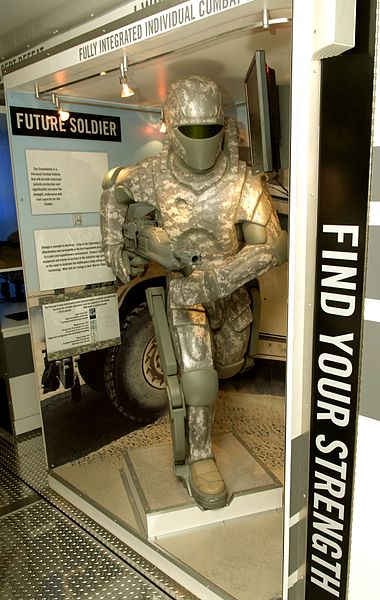
Last, we have by far the most comprehensive and in-depth program to date for the development of an exoskeleton. Falling under the general banner of “Future Soldier”, the US and other national armies are hard at work with contractors to try and come up with a workable powered suit for armed forces use. These consist mainly of powered limbs that attach to the soldiers own arms and legs and assisting in basic motions, such as walking, lifting, and carrying heavy loads.

Each variant of the powered exoskeleton is built around the same concept, consisting primarily of an exoskeleton-like framework worn by a person and a power supply that supplies at least part of the activation-energy for limb movement. These will enable soldiers and engineers to be able to bear more weight and survive in hostile environments. Some day, they might even be able to increase a wearer’s running speed and allow them to jump higher and farther as well.

So far, civilian and military concepts for powered suits include the Ekso Bionics/Lockheed Martin HULC (Human Universal Load Carrier), the Sarcos/Raytheon XOS, the Cyderdine (no joke) HAL (Hybrid Assistive Limb) and the Argo Medical Technologies ReWalk module for paraplegics.Each of these suits give the wearer the ability to lift several times their own weight and/or assist them in the use of their limbs, especially in those who are paralyzed or do not have full range of motion or use.

Because of their obvious merits, their exists a massive commercial market for these designs as well, mainly in the field of medicine for spine-injury or terminally ill patients. In fact, it would be no exaggeration to say that military development and civilian development are feeding off each other, with research and development on the one side providing impetus and advancement to the other. So in addition to powered construction suits and Iron Man-type units, we might also be seeing walking suits replacing wheelchairs real soon!

Thank you all for reading and feel free to stay tuned for my next installment in this lineup, featuring the concept of exoskeletons and powered suits in fiction. Really folks, Iron Man is just a drop in the bucket of this fertile concept, so stick around!


I Would Like to Thank the Academy…

Well, not so much the Academy, what have they done for me lately? Really, the person I need to thank is the one who nominated me for not one, but two awards: Maryam, aka. Caracaleo. Apparently, I’m doing something right in her eyes, otherwise I doubt she’d have given me the nod here. Or to be quote her words:

“This blogger is my hero. Amazing posts. Great keep up with publishing. Not to mention an amazing ability to write and talk about things I find fascinating.  Therefore it is my honor to present not one, but two awards.

Excuse me a moment… I can’t stand praise it makes me all… gushy! Okay, all better. And now, as is customary for these awards, I shall answer the five following questions as best I can:

  1. Why do you blog?
    I started blogging two years ago as part of my ongoing efforts to promote myself as a writer. However, I’ve found that having a site and being able to share your thoughts, not just on your own work but anything really, can be a very fun and rewarding experience. These days I blog mainly so I can keep up with people, share new and interesting ideas, and hear from others and what they think. It’s become more of a way to maintain relationships than promote anything, thought I still like to do that from time to time 😉
  2. What do you hope people get from your blog?
    Honestly, I just hope they come away feeling entertained, enlightened, or both if possible. Everybody’s got their share of loves and interests, but what’s really awesome is being able to share those things with other people and knowing that they enjoy them too. I always feel good about my site and my writing whenever someone says my passion is “infectious”. It lets me know that I’m making a positive impact.
  3. Are you happy?
    Yes I am, thank you for asking. Sure, I wish I had more money, I wish I got paid to write, I wish I could go on tour and talk to people face to face more often. But right now, I’ve got everything I could possibly want. My wife, my cat, our home, our community, we live in BC, one of the most beautiful places in the world, and I got plenty of people who tell me they think I’m a good guy and good writer. Who could ask for anything more?
  4. Chocolate , Vanilla, or Strawberry?
    Damn… I think I’ll have to go with Chocolate, though Vanilla is lovely with some melted chocolate or Nutella spread on top. But I can’t really discount Strawberry from the mix, it’s great with chocolate and hazelnut spread too. Oh, this is the hardest question yet!
  5. What are your two favorite bands?
    Now that is a tough one, but for the moment I would have to say Big Sugar and Peter Gabriel. The former are a Canadian Rock/Jazz/Blues ensemble that have been around years and are just plain kick-ass! I own most of their albums, have seen them numerous times in concert, and even got their farewell compilation CD autographed. As for Peter Gabriel, he’s an old favorite who’s classic rock and world beats have always been inspiring to me. While he can tough to classify sometimes, and a little weird and esoteric, no one can doubt that he’s an inspired artist who has plenty to say. And he always dressed classy!

Okay, that’s all I got for those questions. Hopefully those who read this will feel they know me a little better, which is always the point of these things isn’t it? In sharing with other people, we learn that we are never alone, that there are plenty of others out there just like us, and that we grow by the constant exchange of ideas, support, and experiences. This is why I blog, people. Thanks to Maryam for reminded me of this. Peace out :)!

New Trailers for Spider-Man

Columbia Pictures, in collaboration with Wal-Mart, has been making a major push to promote the soon-to-be-released Spider-Man reboot. I have to admit, I don’t really see the point in this movie. I mean, didn’t we just do a Spider-Man movie trilogy? Wasn’t it hailed as a prime example of movie making and a faithful adaptation? And I seem to remember the last one came out just a few years ago. So really, what’s to be gained with this reboot other than a whole lot of money?

But I can’t deny, the promos have got me kind of interested, especially the first one. Here, we have a scene from the movie where Parker, now amped up on Spidey-power, decides to take down a carjacker. The second video is an extended behind the scenes look at the new movie and what the new focus will be. Granted, there do appear to be some differences between this version and the last, and even from the source material. I might just see it after all!

Game of Thrones Romantic Comedy Mash-up!

Think Game of Thrones meets a bad romantic comedy! That’s what some rather enterprising fans managed to pull off with this mock trailer for GOT Season 2. Following the logic that all the relationships in the story could be broken down and pitched as a series of cliched love triangles, these fans took a series of clips from the show, added some cheesy pop music, and voila! Delicious satire was born.

Yes, it seems to work too, doesn’t it? It’s all funny and patronizingly heart-warming, until you remember that most characters in this story wind up losing their heads, being gelded or getting a golden crown 😉 Ah who cares, its fun stuff!

Generation Ships

systems___cryogenics_1Ever since my writing group and I got on the subject of space and colonization, some recurring themes have come up. For starters, there’s the concept of interstellar space travel, the kind that doesn’t involve fictitious Faster-Than-Light drive systems and cannot exceed the speed of light. In those situations, which are far more likely to happen in this and the next century, the question of how to keep crews alive until your arrival keeps popping up.

One way is to utilize some kind of cryogenic procedure, where passengers are put into “reefersleep” for the duration of the journey and awakened upon arrival. Though it might sound a bit crude, it’s actually a very practical solution to the problems of how to keep a crew preserved and provided for during the incredibly long voyages that space travel entails. This procedure has come up repeatedly in the realm of science fiction, particularly H.P. Lovecraft’s Cool Air, Robert A Heinlein’s The Door into Summer, Clarke’s 2001: A Space Odyssey, PKD’s Ubik, the Alien franchise, and the Revelation Space universe, just to name a few.

RAMAThe other solution, which is the subject of this post, is to construct generational ships. These are basically “interstellar arks” where people and even entire biospheres are transported from one location to another. Crews are kept in waking conditions, experience subjective time, and entertain themselves in interactive, simulated, or virtual environments in order to stay sane until they complete their voyage. Though much more expensive to build, these ships are an equally elegant solution for what to do about non-FTL space travel and settlement.

These two have made many appearances in science fiction, and I’ve compiled a list of all the Generation Ships, Space Arks, and O’Neil Cylinders I could find.

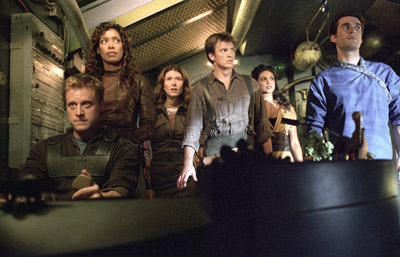
Firefly:
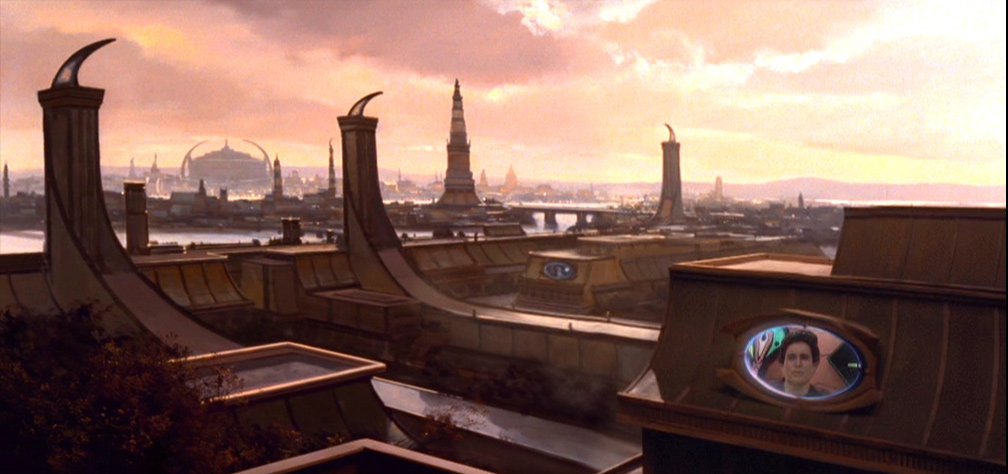
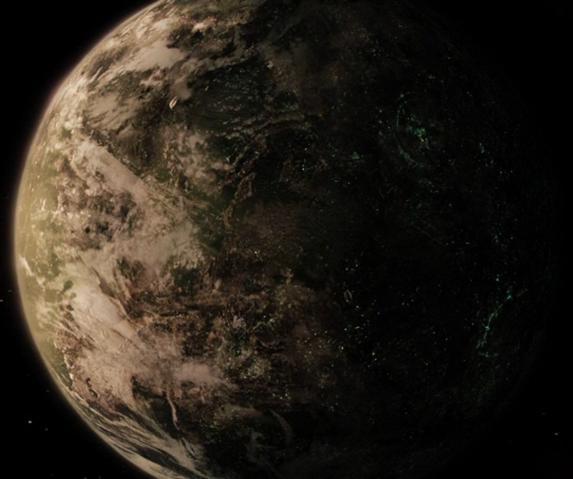
At the beginning of each episode, it was explained how Earth was used up, prompting humanity to seek out a new home. This is what eventually led them to 34 Tauri in the 22nd century, where they began the process of terraforming and settling the many worlds and moons. Though it was never explained in detail, mainly because the show was canceled before they could (screw you, Fox!), indications are given in the movie Serenity and the expanded universe that this migration involved Generation Ships.

In the movie, this was done mainly through visuals, where a large flotilla dusts off from Earth and eventually finds its way to the system of the White Sun. It was also said that the process of terraforming took decades, which would require that the crews had somewhere to stay while the terraformers did their work. Also, speculative point here, but it would stand to reason that the fleet would have to have some pretty large ships to accommodate both settlers and the kind of equipment they would need.

Chasm City:
This novel, set in Alastair Reynold’s Revelation Space universe, involves a large thread that follows the settlement of the world known as Sky’s Edge. This took place early in the universe’s backstory, before the development of “lighthuggers,” and therefore required that the ships be able to support crews for long periods of time.

From Reynold’s descriptions, these ships were large, cylindrical vessels that boasted vast bays to hold their many cryogenically frozen passengers. At the same time, the waking crew needed vast facilities to provide for their needs. These included mess halls, sleeping quarters, medical bays, and recreational facilities. Sky Haussmann, one of the children amongst the crew, had a nursery with a robotic clown and virtual backgrounds.

This divide, between a waking crew and frozen settlers, represents a sort of compromise between the cryo-ship design and the generation ship. On the one hand, you’ve got the majority of your crew at near-frozen temperatures and perfectly preserved for the voyage. On the other, you’ve got a crew walking about and looking for food, rest, and entertainment. However, it still qualifies and even inspired my group in our quest to design the perfect story for settlement!

Orphans of the Sky:
One of the earliest known examples of the use of generation ships in sci-fi, this two-novella set was also one of Heinlein’s first works. Like Clarke’s Rendezvous with Rama, it features a massive cylindrical ship that is drifting through space. But unlike Rama, Heinlein’s ship, known as the Vanguard, has become a derelict that is permanently adrift in space.

As the story goes on, we learn that this was due to a mutiny that killed all the piloting officers many generations back. Since that time, the descendants of the surviving loyal crew have forgotten the purpose and nature of their ship and lapsed into a pre-technological culture marked by superstition. In fact, they now view their ship as the cosmos itself and interpret its “voyage” as a metaphor.

The crew is also ruled by an oligarchy of “Officers” and “Scientists”, the head of which is the descendent of the original captain. Much like pre-industrial times, most crew members are dedicated to a simple life where they tend to agriculture and are illiterate. Seldom does anyone ever venture to the “upper decks” where the “muties” (aka. “mutants” or “mutineers”) are kept. These individuals, it is learned, know the truth of the ship’s purpose, another reason why they are ostracized from the rest of the crew.

As you can plainly see, this book not only featured a generation ship and some rather hard science when it came to colonization, but it also raised some valid and interesting questions about how space travel and confining environments could affect subsequent generations of people. Those who were born into an enclosed environment would come to know it as their whole world. And in the absence of external, verifiable facts (such as messages from Earth or historical records), they could even be led to believe there was nothing beyond their walls.

Paradises Lost:
Similar in tone and setting to Heinlein’s Orphans, this story by Ursula K. LeGuin focuses instead on the psychological impact that generational travel would have on a human crew. Adapted into a musical, this story explores the basic question of what happens when you spend your whole life (and entire generations) traveling toward a goal, only to find that the endpoint has become otherworldly and unattainable?

The story takes place aboard a generation ship known as the Discovery, where people are born and die on a trip to colonize a distant planet. Much like the Orphans, the ship becomes their entire universe and begins to seem more tangible to them than Earth or their mission to colonize a new world. The reason for this is quite simple; as the journey goes on, those who once lived on Earth are slowly dying off, and subsequent generations know about these things only through tales and lore.

As a result, a new religion is born that teaches that the ship is “spaceship heaven” and that it is bound for eternity. This religion is known as Bliss, and the younger generation is embracing it against the wishes of the older. The story is told through the eyes of two elder characters – Hsing and Luis. They know their lives will end on board the ship and that their mission lies in the hands of future generations. Naturally, they worry since said generations are convinced that they should never leave the ship they call heaven.

Rendezvous with Rama:
One of the best examples of a generational ship that is extra-terrestrial in origin! Known as Rama, this massive space cylinder was basically a self-contained world that was carrying the Raman civilization from one corner of the galaxy to another. When a crew from Earth arrives and begins to survey the interior, they begin to notice several tell-tale features.

For one, the interior contains several structures that appear to be arranged in “cities” – odd blocky shapes that look like buildings and streets with shallow trenches in them, looking like trolley car tracks. In addition, there is a sea that stretches in a band around Rama, dubbed the Cylindrical Sea, and trenches cut into the sides that appear to be windows.

In time, all the machinery comes to light, thanks in part to the admission of light through the ship’s long windows. Small creatures that appear to be biological machines (aka. “biots”) also begin to come out to conduct routine maintenance. In time, they come to the conclusion that the buildings constitute factories and the cylindrical sea contains trace elements and bio-matter, which they will begin to convert into “Ramans” as soon they get within range of their destination.

In the end, it seemed that the Ramans determined that the best way to spread their species was to break them down into their component parts, place them aboard ships that would float for generations through space, and begin recompiling them once they got to where they wanted to go. Ultimately, Sol was just a stopover on their long journey, and more ships were coming in subsequent novels. Still, this first exposure to the alien generation ship was an educational experience!

Ringworld:
Written by Larry Niven, the Ringworld series is considered one of the greatest examples of exploratory sci-fi. Set in the Known Space universe of the distant future, the story revolves around the discovery and exploration of the Ringworlds, an artificial habitation ring built by an extinct civilization. With the makers of these rings long dead, the rings themselves are adrift and their engineered inhabitants degenerated into a primitive state.

These artificial rings are roughly one million kilometers wide and one thousand kilometers across, approximately the diameter of Earth’s orbit. Each one encircles a Sol-type star which provides both life-sustaining energy and light. And, of course, they rotate, thus providing artificial gravity that is 99.2% as strong as Earth’s through the action of centrifugal force. Nighttime is provided by an inner ring of shadow squares which are connected to each other by thin, ultra-strong shadow square wire.

The ringworld has a habitable flat inner surface that is equivalent in area to approximately three million Earth-sized planets. Hence, it is able to sustain extensive ecosystems and all forms of life. This appears to be the purpose of the rings, in the end, the creation of habitable areas in space that were removed from terrestrial environments. An added bonus was the ability to transport said life and ecosystems over vast distances through space without having to stick them in an enclosed environment.

So really, these things were like a gigantic version of a generation ship, capable of moving an entire species or civilization through space.

Stargate Atlantis:

The series Stargate Atlantis contained a few mentions of vessels that fit the profile of generation ships. For starters, there was the Ancients City Ship, a self-contained city that was also a spaceship. Though it was capable of FTL travel, the vessel was capable of sustaining a city-sized population for extended periods of time as it traveled through space.

In addition, in the third season episode entitled “The Ark”, Colonel Sheppard’s team discovers a facility inside a hollowed-out moon that turns out to be an ark created by the people of the planet around which the moon is in orbit. The ark was built to preserve the existence of the people from the planet so that they could reemerge and rebuild their civilization. Generations prior, these people had fought a disastrous war with the Wraith in which they were almost exterminated.

Though not a vessel per se, the moon base served the same purpose as a generation ship. Though the moon orbited their original homeworld and the people really weren’t traveling through space (except in orbit around their planet), the principle was essentially the same. People were kept in stasis until the day came when they could awaken to transplant themselves on the intended world, thus ensuring the survival and expansion of their civilization.

Yes, the examples abound! In fact, the concept of the generation ship and related ideas are so fertile that I’m kind of surprised that it took me so long to really appreciate it. But then again, I came to a lot of the classics a little late in life. Ah well, it doesn’t really matter when you get to the destination, provided that you get there and enjoy the journey – which is kind of the concept behind a generation ship, isn’t it? If you can’t just warp your way across the Universe – if you have to take your time and drift slowly – you might as well travel in style!

Remembering 1812

Once in a while I like to break from sci-fi to honor major political developments or anniversaries. And since I missed out on honoring those who participated in D-Day on June 6th, I refuse to let this one pass without comment as well. As many are no doubt aware, it’s the 200th anniversary of the War of 1812, and in many countries, this occasion is being marked and commemorated. For many people in many nations, not just the historians among us, this war was extremely significant.

But what is most interesting is how it is remembered differently. For Canadians, 1812 was a decisive moment in which the country came together to repel a foreign invasion and declare its nationhood in the face of annexation. For Americans, it is remembered as a largely defensive affair in which a second British attempt at invasion was repulsed. For the the British, it was a largely colonial affair that was designed to distract them from the war on the Continent with Napoleon. And for the First Nations of Canada and the US, it was seen a loss which led to further annexation and loss of sovereignty.

And that’s just the Anglo-American perspective. If we were to set our sights a little farther abroad, we’d notice that people in Russia, Germany, and France also have thoughts of their own to share. For France, 1812 was a major setback in the larger affair known as the Napoleonic Wars. For this stout general/dictator from Sardinia, it was the beginning of the end for his rule and his empire. The Russians accordingly saw it as a great victory against a foreign invader, one which they would exploit in future wars to bolster morale. And for Germany, being forced to fight in Napoleon’s “Grand Armee” was a catalyzing event that helped to rouse national sentiment, ultimately leading to German unification in 1871.

Interesting how history can be relative, isn’t it, depending on who you ask and what their perspective is? But thanks to my own historical studies, I’ve learned much about this war, and can say that they all reflect a certain aspect of truth. In the end, all points of view and how we choose to remember the war tell us much of our national experience of it and confirm that the war was a very large affair that was experienced differently all around the world. I shall be brief, since the real historians are the ones you should be listening to. I just want to offer my humble two cents 😉

The American Perspective:
In the course of studying American history, I was interested to see just how the War of 1812 was treated. It was no secret to me that the popular American conception is that they won the war – here in Canada we say the exact same thing. But what I did find objectionable was the rather glaring ommissions that seemed to pervade the history textbooks on the subject.

For example, so many of the battles which took place on Canadian soil were not mentioned, the focus being on the battles America won and which happened for the most part on their own soil. These included the Battles of Plattsburgh, Chesapeake Bay, Washington DC, and especially New Orleans.

And yet, the best explanations I have heard for this come from American historians themselves. As one put it, “Americans, when they chose to remember the war at all, focus on the last year of the war when the battles were defensive in nature”. This, he claimed, is what gives rise to the illusion that America was fighting a defensive war which allowed them to think of it as a victory.

Another historian, who was also a General in the US Army, claimed that it is only in West Point Academy that a full and comprehensive treatment of 1812 is available in the US. Here, he claims, officers in training are taught that 1812 is a perfect example of what NOT to do in a war, namely go to war with overconfidence, an underfunded and staffed army, and a divided country.

And yet another claims that 1812 is America’s first “forgotten war”, beating Vietnam by over a century and a half. I especially liked this take on it since I’m a real proponent of how history repeats itself, just in different settings with different particulars. Seen in this context, 1812 was a less than stellar affair which quickly became overshadowed by the Revolutionary War and the Civil War, both of which were decisive for America and had a far greater impact on their history and development as a nation.

The First Nation Perspective:
Compared to the other perspectives, this one is by far the most sobering and real. In fact, one could characterize it by saying that this is a case where people were invited to a war, made a big difference, and then were shut out in the cold to be forgotten while the other combatants came to terms and all had their own victory parties. Disgusting really, but it teaches us something about how history frequently screws people over.

For the Cree Nation and the many nations that encompassed the Great Lakes Region, the war began long before 1812. Prior to this, American encroachment led many nations in the Ohio valley to begin to organize and militarize for the sake of defense. Seeing opportunity and common cause in this, the British began arming these nations and making alliances with them, knowing that any invasion northward would effect all. At the forefront of all this was a committed individual named Tecumseh, a Cree leader who was responsible for much of the cultural revival that was setting in and saw potential in an alliance with the British.

When war was declared, Tecumseh and his bands of fighters proved to be the decisive factor in several battles, not the least of which was at Fort Michigan, where they came upon the garrison by way of the river and took the fort with barely any casualties or shots being fired. In time, the collaboration between Brock (the British Commander) and Tecumseh led Brock to give him his overcoat as a personal gift. However, in keeping with his cultural traditions, Tecumseh conferred the honor onto a more senior warrior in his army. Brock was not offended.

During the American invasion of Upper Canada, the Mohawk nation also proved decisive. At the attack on Fitzgibbon, Mohawk warriors mounted a surprise attack on the unsuspecting American army and forced the surrender of over 500 troops. They had been tipped off by a young woman named Laura Secorde, a nurse who had been privy to the American plans while tending to wounded soldiers on Canadian soil.

In just about every subsequent battle on Canadian soil, Cree, Mohawk and Iroquois warriors were intrinsic to the fight. In fact, it would be no exaggeration to say that the presence of these seasoned warriors was often the difference between victory and defeat. Facing overwhelming numbers, the Angl0-Canadian forces were often bolstered by the fact that American troops were frightened of Native warriors, having been subjected to stories about their fearsome, bloodthirsty nature for so long.

Unfortunately, the war ended for the Cree Nation and Tecumseh during the Battle of Moraviantown (aka. the Battle of the Thames)i n southern Ontario. After the defeat of British naval forces on Lake Erie, British forces were ordered to pull back to where they could be reinforced and resupplied.

However, Tecumseh objected and voted instead to hold the line against the advancing American armies. Though he died and his forces were defeated at Moraviantown, this battle stalled the American forces long enough to give the British and Canadian forces time to regroup. As a result, the Americans were defeated at Lundy’s Lane six months later and the last invasion of Canadian soil was stopped.

The Canadian Perspective:
As I already stated, from the Canadian point of view, 1812 was a decisive war that saw the country come together to repel a foreign invader. This perspective does gloss over the fact that there were divisions between Upper and Lower Canada, that victory was owed in large part to its Native allies, and that Canada was still nominally a colonial possession of the British Empire. However, the perspective still holds true, as Canadian militia were the cornerstone of the small garrison of British regulars. In fact, Brock chose to dress all of his militia in the same red coats as his regulars in order to give the illusion that he had a larger force. This in turn would play a major role in ensuring the cohesion and organization of his forces in the battles to come.

And to top it off, Canadian forces did succeed in overcoming the odds against a much larger American invasion force. Whether it was the assaults on American border forts in Michigan and along the Great Lakes or defensive actions in Ontario and Quebec, Canadian forces managed to acheive an almost unbroken string of victories.

These included the Battles of Queenstown Heights, where the American forces that had crossed Lake Ontario and set fire to York (modern day Toronto) were defeated. The Battles of Chrysler’s Farm and Chateauguay were also decisive victories which forced the American forces to abandon their St. Lawrence campaign, the planned invasion of Quebec. And finally, Lundy’s Lane, though not a decisive victory, was seen as the final battle in which the invaders were stopped.

All of these experiences served to galvanize national sentiment and helped to inspired demands for reform which would culminate in the Rebellions of 1837. This is especially ironic seeing as how American planners believed that the Upper Canada Loyalists would welcome an American invasion and see it as a chance to throw off British rule. Instead, it inspired Canadians to reject union with the United States and demand a measure of independence on our own terms.

The British Perspective:
And last, but not least, we have what Merry Ol’ England thought of the whole affair. Far from seeing it as a mere diversion, the British were actually quite invested in what took place on North American soil, even if they did see it as a distraction from Napoleon’s invasion of Russia.

For many years, Britain had been locked in a state of cold war with the US, monitoring the frontier with wary anxiety and taking every opportunity to bolster its defenses, either by supplying Native allies or making sure their were garrisons in Upper and Lower Canada and fleets on the Great Lakes.

Though these were by no means comparable to American forces, they did indicate how seriously the British took the prospect of an American invasion. And in the end, Britain felt pretty good about it’s conduct during the war. Their vaunted General Brock, though he died in the line of duty, organized a stalwart defense of the colonies while the British Navy harassed and assaulted many American ports. Though eventually these invasion attempts were rebuffed, they did meet with some success.

While Brock and Tecumseh managed to seize a series of key forts in the Great Lakes region and burned Detroit to the ground – in retaliation for the burning of York – they managed to set upon Washington DC and burned it to the ground. This is something which is commemorated extensively on the American side, particularly how a portrait of George Washington was saved before the old White House was set ablaze.

But of course, the defeated attempts at invasion did not go unnoticed either. Whether it was at Plattsburgh, Baltimore or the disastrous assault on New Orleans, it was clear that the war would end with American territorial sovereignty more or less intact. As a result, Britain would walk away from the war undefeated, but without much to show for it.

But of course, that was ultimately the goal in North America, to repulse the American invasion while at the same time ensuring that Napoleon’s defeat on the continent was assured. With the signing of the Treaty of Ghent in 1814, and the war with France now over, Britain breathed a temporary sigh of relief. This would end with Napoleon’s return from Elba, but that too would be resolved with the Battle of Waterloo a year later. For the British, as well as the Americans, 1812 would fade into obscurity, something to be remembered mainly by historians and not popular consciousness.

Final Thoughts:
Well, that’s my limited appraisal of the war. For the full scoop, you really need to check in with the historical recreationists, especially those who maintain the border forts along the Great Lakes region. For example, if you’re in Kingston, best check out Fort Henry. I remember going there as a preteen and thinking just how awesome the whole affair was. Not only do they dress in period costume and tell you much about the history of the fort, they also conduct actual musket and cannon drills just to keep things interesting and authentic.

Also, be sure to do your own research on this and other “forgotten wars” of history. It’s often because they were so instructive that they are allowed to fade into obscurity, mainly because people would like to forget what happened. However, that is how lessons are avoided and convenient lies allowed to permeate. Those familiar with World War I and the legend of the “Stab in the back” will know what I mean by that! Had people not been in such a hurry to forget the carnage and pretend that the war was just a big misunderstanding, or that Germany had been betrayed and not defeated, World War II could very well have been avoided.

And for those veterans who fought in the Vietnam War, as well as those returning from Iraq and Afghanistan (two “forgotten wars” in the making), the lessons of a forgotten war cannot be allowed to go unlearned again. In fact, one could argue that if 1812 were taught in full in schools and academic institutions other than West Point throughout the country, wars like Vietnam and Iraq could have been avoided. When one reads of how men like Jefferson said taking Canada would be “a mere matter of marching”, slogans like “domino effect” and “we’ll be welcomed as liberators” suddenly ring very hollow!

In short, there’s a reason history is full of repeats. All too often, it seems that only a select few are able to discern the patterns and realize that this sort of thing has been done before, usually with disastrous consequences. And my father – who recently visited Europe as part of commemorative trip – would tell you, some people do remembrance right! In Belgium, especially in the town of Ypres, commemorative ceremonies are an almost everyday occurrence. Those who died in the defense of the country and the events which devastated it are solemnly remembered on a regular basis, not just once a year. One would get the impression that these things are important to them!

Okay, that’s enough out of me. Happy anniversary War of 1812. You accomplished much, remind us of much, and really deserve to be honored, regardless of the fact that you fell between the War of Independence and during the Napoleonic Wars. I tell ya, those wars are such attention hogs! In any case, I look forward to 2014 too, when the end of World War I will be commemorated the world over, but especially in Flanders where the people will holding all kinds of celebrations to mark the centennial of the end of the Great War. My wife and I plan to be in attendance. I know my folks will be front row center!

Good day and peace be with you, friends!

Millennium Falcon Found!

Okay, not exactly, but that was the subject of pretty much every news story when this undersea object was found. According to Blastr magazine, it all began a year ago when during a sonar survey of the coasts of Sweden and Finland, a large cylindrical object was found on the sea floor. Subsequent sweeps found an even stranger object nearby, which was this Millennium Falcon-shaped object. The find baffled scientists, with opinions ranging from a strange rock formation to a UFO, and just about everything in between.

And so a team from OceanX was finally sent down to investigate. After spending a week on an on-sight study, here’s just a few of the things that were said about it:

“First they thought it was just stone or a rock cliff, but after further observations the object appeared more as a huge mushroom, rising 3-4 meters/10-13 feet from the seabed, with rounded sides and rugged edges. The object had an egg shaped hole leading into it from the top, as an opening. On top of the object they also found strange stone circle formations, almost looking like small fireplaces. The stones were covered in something resembling soot… The path to the object itself can be described as a runway or a downhill path that is flattened at the seabed with the object at the end of it.”

This is a summery of the team’s findings, which was conveyed via OceanX’s website. Ocean X founder Peter Lindberg, who was the dive team leader, had some interesting things to add:

“First we thought this was only stone, but this is something else. And since no volcanic activity has ever been reported in the Baltic Sea the find becomes even stranger. As laymen we can only speculate how this is made by nature, but this is the strangest thing I have ever experienced as a professional diver.”

Weird stuff huh? It is too late to re-evaluate all those alien astronauts theories, the ones where aliens visited our planet and tampered with our evolution? I might be prejudiced, I DID just see Prometheus after all. In any case, some samples have been brought back for study. So whether this is a man-made object, a natural phenomena, or some kind of alien device, we will soon know… or not.

Worlds of Star Trek

In honor of the other sci-fi franchises I’ve covered in my “Worlds Of” series, which includes my own (shameless!), I’ve decided to throw some credit and attention Gene Rodenberry’s way. His Star Trek franchise is not only one of the most popular science fiction franchise of all time, it’s also hailed as one of the most detailed and in depth, owning to many years of existence and countless contributing minds. And so, here’s my list of the franchises hot spots, in alphabetical order:

Bajor:
The homeworld of the Bajoran people and situated near the Bajoran Wormhole, this planet and the system are the setting for the spinoff series DS9. Throughout the series, many details are given about the Bajoran’s culture, history and people, most of which revolve around the occupation of their planet by the Cardassian Empire and their worship of “The Prophets” (aka. the wormhole aliens).

At one time, Bajor was the home of one the oldest civilizations in the Alpha Quadrant, characterized by art, poetry, and a caste system where the priestly caste were at the top. During the occupation of Bajor, which last fifty years, the Cardassians murdered millions of inhabitants, destroyed much of their infrastructure and even poisoned large tracts of land. To mark the occupation, they built a large space station named Terok Nor in orbit.

In order to fight against the occupation, the Bajorans abandoned the caste system so that everyone could become fighters. After fifty years, the Cardassian government chose to cut its losses and abandoned the world. The Bajorans took control of Terok Nor shortly thereafter, the provisional government invited the federation to take control of it, and it was renamed Deep Space 9. After the discovery of the wormhole, Commander Sisko ordered the station to relocate to guard the entrance.

It was learned shortly thereafter that the wormhole was an artificial phenomena that connected the Alpha Quadrant to the other side of the Milky Way Galaxy (the Gamma Quadrant), and was inhabited by a race of super-evolved beings that had made contact with the Bajorans in the past. Because these beings were non-corporeal and had no concept of time, they were named “The Prophets”, mainly because of their ability to see into the future.

When the Dominion was discovered on the other side of the wormhole, Bajor would become the front lines in the Alpha Quadrant alliance’s war against them. During the course of this war, DS9 would become occupied by the Cardassian-Dominion alliance. Before abandoning the station, Sisko and the crew of DS9 made sure that the entrance to the wormhole was mined so as it ensure that the Dominion could not bring in reinforcements. Due to the articles of the Bajoran treaty with the Dominion, Cardassian forces were also forbidden from occupying the planet again. As a result, Bajor would remain free until the Federation and its allies retook the station a year later and once again controlled entrance to the wormhole.

Betazed:
Home to the telepathic race known as the Betazoids, this planet is a member of the Federation and a major contributor to its ranks, particularly in the field of diplomacy and counseling services. Deanna Troi and her mother, Lwaxana, both call this planet home, as do many other secondary characters in the TNG and spinoff series’.

In the course of the TNG series, many aspects of Betazoid culture are made clear. For one, the planet appears to have a semi-matriarchal culture, where the eldest woman of the family holds the title for the house and all its honors. This was particularly true of Lwaxana, who in addition to being a decorated diplomat, was named “daughter of the Fifth House, holder of the Sacred Chalice of Rixx, heir to the Holy Rings of Betazed”.

The planet was mentioned many times in the TNG series, usually in conjunction with the Enterprise’s many contacts with Lwaxana. During the Dominion War, Betazed was occupied for a brief time when Dominion forces caught the local fleet off guard. This development is what prompted Sisko to attempt a rapprochement with Romulan forces to bring them into the war.

Cardassia Prime:
Also known simply as Cardassia, this world is home to the Cardassian people and the seat of power for the Cardassian Union. Based on the many descriptions from DS9, Cardassia is apparently a warm, humid environment that favors reptilian creatures, which is apparently the basis of Cardassian biology.

Prior tot he militarization of their culture, Cardassia was home to thriving civilization that produced renowned works of art and architecture. However, the civilization soon fell into severe decline and decay, resulting in mass starvation. As a result, martial law was declared and the foundations for the Cardassian government were laid.

This consisted of the Central Command on the one hand, which controlled the military, and the Obsidian Order which acted as the secret police. Between the two was the relatively impotent civilian government which exercise little real power, but which occasionally was called upon to enact policy which Command knew would be unpopular. One such decision was the removal of Cardassian forces from Bajor after 50 years of unsuccessful occupation.

Cardassia was the first to ally themselves with the Dominion after their discovery in the Gamma Quadrant. This was after a disastrous war with the Klingon Empire, which the Dominion instigated through one of their shape-shifter replacement of General Martok. As a result, Cardassia Prime would remain occupied by Dominion forces for many years, until the arrival of Allied forces and the defection of the Cardassian military. In retaliation, the Dominion ordered the destruction of the Cardassian people, and over 800 million perished before the Founder officially surrendered.

Earth:
In the original series, TNG, DS9, and other spinoffs, much is made of how life has improved on Earth since the late 20th century. Though we don’t get to see much of it beyond San Francisco or Paris, it remains one of the most important planets in the Star Trek universe. As the seat of the Federation, it was the home of the Federation Council and of the office of the Federation President, and serving as the central headquarters of Starfleet.

In addition, Starfleet Academy is located in San Fransisco, just in view of the Golden Gate Bridge. It was here that all characters in the franchise received their education and commission as officers. Between Kirk, Picard, Sisko and Janeway, many stories are told of memorable and nostalgic incidents, and all allude to rather trying curriculum in which their abilities and aptitude were strenuously tested.

In the course of the original series, TNG and DS9, several major events are alluded to which had a drastic effect on Earth and the human race. These include the “Eugenics War” of the late 20th century, where genetically-modified human beings attempted to take over the planet. This ended when the last of the modified humans, under the leadership of Khan Noonien Soong, fled aboard the spaceship Botany Bay. During the early 22nd century, Earth was devastated in what was referred to as the “Atomic Horror”. This causes the destruction of most major cities, 600 million deaths, and the emergence of totalitarian regimes.

However, all that appeared to have changed with the development of the warp engine by doctor Zefram Cochrane and First Contact. Thereafter, Earth became united in the goal of reaching the stars and building a better future. Starfleet was created to acheive this goal, and the United Federation of Planets established between the Vulcans and humanity, and many subsequent races thereafter. Beyond that, not much is specified about Earth of the 23rd and 24th century, other than saying that it is a “paradise” where no crime, hunger, war, or poverty exist.

Ferenginar:
Wet, mucky, swampy, and perennially rainy, this moldy planet is home to the enterprising race known as the Ferengi. The seat of power for the Ferengi Alliance, it is also the home of the Tower of Commerce, the Sacred Marketplace, and the Ferengi Commerce Authority, the ruling body of their species.

Though it was never shown in TNG, Ferenginar makes a few appearances in the DS9 series. Here, it is depicted as a rainy, wet and extremely humid place where most people live in low-domed structures. In the capitol, the majority of architecture consists of these types of dwellings, expect of course for the central spire of the Tower of Commerce, where the Authority is centered.

The leader of the Ferengi people is known as the Grand Nagus, the head of all commerce for the Ferengi and the leader of the Authority. In addition to the sacred text, “The Rules of Acquisition”, the Ferengi are governed by the Bill of Opportunities, a quasi-constitution which sets out the rights of individual citizens. These revolve mainly around the right to own a business and make a profit, provided they don’t violate any of the sacred Rules or the regulations of the Commerce Authority.

Though women have traditionally had no rights under the law, amendments made by Grand Nagus Sek during the course of the DS9 series granted them the right to wear clothes and make profits. A ruling council was also established to pass several sweeping social reforms, which including the imposition of taxes, social programs, and laws banning monopolies and the mistreatment of workers. According to expanded universe sources, over 78 billion Ferengi live on their homeworld, and the civilization has been warp capable for some time.

Qon’oS:
The home of the Klingon people and seat of the Klingon High Council, the ruling body of their Empire. Though very little information was given about this planet in the original series, it appeared repeatedly in TNG and subsequent spinoffs, and was mentioned repeatedly in relation to the character of Worf and the Federation’s dealings with the High Council.

Due to the prolonged state of tension between the Klingon Empire and the Federation, very little was known about this world until the late 23rd century, when the destruction of its mining moon of Praxis forced the Klingons to sign the First Khitomer Accord with the Federation.

However, it was not until Khitomer Massacre, where Romulan forces commited a sneak attack on the Klingon delegation, that an alliance was formed between the Federation and Klingon Empire. This was apparently due to the fact that the Enterprise C responded to the Klingon’s distress signal and was destroyed while attempting to defend the colony against four warbirds. Thereafter, the Klingons became convinced of the Federation’s honorable nature and committed to a joint-defense pact.

It is often been suggested that the Qon’oS of the original series is not the same planet as that of the Next Generations. This is because of events in the movie The Undiscovered Country, where  the evacuation of Qon’oS became necessary because of the destruction of Praxis. Though it was never made clear if Qon’oS was simply established on another world or was somehow saved with the help of the Federation, the name of their homeworld remains the same even if the locations has changed.

Risa:
Originally a dismal, rain-soaked and geologically unstable environment, the native Risans have managed to transform their world into the pleasure capitol of the known universe. This was accomplished with weather control satellites, seismic regulators, and ecological engineering, all of which resulted in a planet wide paradise that is known throughout the quadrant.

Noted for its vast beach resorts and tropical climate, Risa’s greatest attraction lies in the open sexuality of its population. Identified by a decorative emblem between their eyes, Risians often initiate or respond to the desire for sexual relations through the use of a small statuette called a horga’hn, the Risian symbol of sexuality or fertility.

As was made clear to Captain Picard during his first visit, to own a horga’hn is to call forth its pleasures. To display one is to announce that the owner wishes to participate in jamaharon, a Risian sexual rite. Riker has apparently visited the planet many times, and often relates why its his favorite vacation spot in the galaxy.While Picard was on leave, he also discovered the local of the Tox Uthat, a 27th century weapon which had was hidden on Risa and passed into local legend.

The crew of DS9 also went to Risa during shore leave, during which time a group of extremists planned to sieze the planet to demonstrate how the Federation was not prepared to deal with the threats facing it. In the course of the visit, it was also revealed that Dax’s former host, Curzon, died there as a result of engaging in jamaharon. Death by pleasure. No wonder the place is so popular!

Romulus:
Along with its sister-planet Remus, Romulus is the home of the Romulan species and the seat of power for the Romulan Star Empire. Settlement of this planet took place in 4th century by Earth standards, when Vulcan colonists discovered it at the end of a long exodus. Shortly thereafter, the Vulcan society changed with the strict institution of logic and repression of emotion.

As a result, Romulans society bears little resemblance to their Vulcan forebears, though they are genetically related. Known for their arrogance and innate sense of superiority, the Romulans are one of the dominant powers in the galaxy, located in the Beta Quadrant adjoining Klingon and Cardassian Space. Because of this strategic location, they have been involved in skirmishes with virtually every civilization that borders there own.

The planet is the home of the Romulan Hall of State and the Imperial Romulan Senate. In the TNG series, Picard and Data also traveled here seeking Ambassador Spock. After finding him, they discovered that his presence was part of an effort known as “Reunification”, a movement between Romulans and Vulcans who wanted their worlds to come together again after centuries of being apart. During the Dominion War, the planet also hosted a Federation Alliance Conference to help them plan strategy and address wartime concerns.

Additional events took place in the franchise’s movies, particularly the TNG movie Nemesis and the JJ Abrams Star Trek relaunch. In the former, Romulus became the focal of a plot by Reman agents, led by a Picard clone, to take over the Romulan government and incite a war with the Federation. In the latter, Spock indicates that in 2387, a supernova destroyed Romulus before he could contain it using a “red matter” singularity device.

Vulcan:
The homeworld of the Vulcan race, the birthplace of their philosophy, and the center of their star-faring civilization. Noted for its higher than normal gravity and thinner atmosphere, the climate of this planet had much to do with fact that the Vulcan race, in their primordial form, are physically very strong, fast, and quite aggressive.

Much is mentioned of the history of Vulcan in the original series, TNG, and the various spinoff. After contact with Earth, it became one of the major worlds of the Federation and home to several key installations. In addition, many key events took here in the expanded franchise because of its importance in the Star Trek universe as the homeworld of Spock.

During the original series, Spock was summoned back to his homeworld to take part in the ritual of Pon farr, where he ended up Kirk to the death for the honor of his less-than-honorable betrothed. During the movie Search for Spock, the crew was forced to come to Vulcan aboard a captured Klingon vessel so that Spock’s regenerated body could be reunited with his consciousness.  This ritual, known as fal tor pan and conducted on Mount Seleya, was successful in restoring Spock’s mind, which had previously been sojourning in Dr. McCoy’s head.

In the TNG series, some details are given about Vulcan’s prehistory, before the adoption of logic and the repression of emotions. This period, known as the “Time of Awakening” was marked by civil war between several different factions, and even involved the use of nuclear and psionic weapons. One of these weapons, known as the Stone of Gol, survived the wars and was being sought by a Romulan agent posing as a Vulcan.

In the relaunch movie, Vulcan was a key setting, mainly in relation to Spock’s upbringing and his decision to join Starfleet rather than the Vulcan Science Academy. It is was later destroyed when Nero, the Romulan Captain of the Narada, used the red matter device to trigger an artificial singularity at the center of the planet. Because of these events, the Vulcan race has become an endangered species in this alternate timeline, though resettlement efforts did begin in earnest by the end.

Alright, that’s Star Trek done. Now that I’ve covered this franchise, Star Wars, Dune, and even my own, there’s only one or two left that I think deserve mention. The first is the Firely universe, which I’ve already talked about at length. And then there’s the Babylon 5 universe, which I’ve talked about WAY more! Like to the point of nausea, tedium, and even boring myself! But if people are even the slightest bit interested, I’d be happy to cover them. Just give me a week or two to decompress… all this writing about fictional planets has got me nerded out!

Back from seeing Prometheus!

As Stewie said when he learned that Child Services would be taking him away, “Finallllly!” Yes, that’s how I felt when we hopped in the car and were on our way to the theater. And though I am a week late in getting this review done, because last weekend we were diverted to see The Avengers, I think the wait was worth it!

And I should get some bonus points for doing it today. Because, as often proves the case with me, the cold has doubled back and reinfected me. You could say I was extra sympathetic to some of the characters in the this movie! But I don’t want to give anything away, I promised myself in advance that I would rate this movie without giving anything crucial away. So here goes…

First impressions:
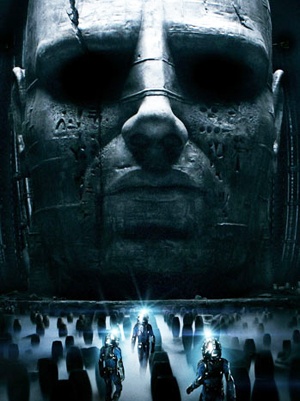
The movie was pretty damn cool! The premise of ancient astronauts, which I knew they were employing here, is one I think pretty highly of. And the fact that they were going back to the Alien universe in such a way that they really wanted to capture the feel of the original was also pretty pleasing. And just about everyone I’ve heard speak on the subject has said that the visuals and effects were state of the art. They weren’t wrong.

That being said, I think they could have done the whole “Engineers” thing a bit better. In fact, what they had to say about their coming to Earth and what they looked like (which I shan’t get into for fear of spoilers) kind of called to mind how Stargate and AVP tackled the whole “aliens tampered with our history”. Still, Scott is nothing if not a master of crafting worlds and believable settings, so it was by no means in the same category. While I felt it could be better, it was still pretty damn good!

The Big Questions:
What’s more, this movie also filled in a great deal of details from the Alien franchises back story. Questions like what are the Xenomorphs, where did they come from, do their hosts and environments influence their appearance, why were they found aboard the Space Jockeys (“Engineers”) ship, and just who are the Jockeys anyway? All of these questions were addressed in this film and answered in one way or another. And of course, they left just enough mystery to keep the option open for further explorations in the Alien universe.

And I was pretty pleased with how they went about answering them, mainly because I’ve been studying them for some time now and heard quite a few theories. And sure, covering all this stuff did generate a certain “prequel duty” feel here and there, but Scott’s handling of all that seemed far superior to most others efforts. For one, I never really felt like they were wrapping things up in a neat little package, which is an annoying tendency to be found in most prequels. Take the Star Wars prequels, did those not feel like they were simply trying to connect the threads irrespective of plot? Yeah, well that wasn’t the case here.

Overall:
And that, I think, is what is best about this movie. Though it is technically a prequel, Scott and the makers seemed determined that it feel like a standalone story. I recall him saying as much in the course of an interview, and I truly felt like they succeeded. Granted, there were some flaws and some holes here and there, but these were hardly fatal and didn’t leave me thinking, “holy crap, that movie made no sense and was totally pointless and stupid!” Expectations and hopes were certainly high for this film, leading some to come away disappointed. But what can be said about them?

Sure, this movie wasn’t Alien, but there’s a reason for that! Scott already made that movie thirty-three years ago, and several directors have since taken the franchise in many different (and some would say wrong) directions. Going back to the before the beginning was the only option left really, reopening the franchise at a point before the original to answer all the tough, enduring questions that have fans have raised over the years. And that was no easy task and I could see beforehand how it would be riddled with potential pitfalls.

But in the end, I came away pretty pleased. Not only was this movie pretty good viewing, it was also a faithful return to the Alien universe… Frankly, I’d like to see what they come up with next!

Off to see Prometheus!

Finaaaaally! Today the wife and I will finally be making our trip to see the latest installment in Ridley Scott’s Alien franchise. I say in his franchise because it is really is his baby. Sure, Cameron did a good job with the sequel, a really good job in fact. But those who’ve followed, especially those who filmed the fresh hell known as AVP and AVPR, pretty much pissed it away!

Mr. Scott pretty much said so, when interviewed he stated that part of his reasons for making this film was to ensure that he wanted his old franchise to be remembered for something other than all the abortive sequels other people made. I really don’t blame him! If I were Scott, I’d be looking for the bastards with blood lust in my heart and a shiv in my hand!

Despite my best efforts, I have heard some things about this movie. I’ve avoided reading the details wherever possible, but it’s hard not to notice when people rave or complain about something. Hell, they say so right in the title lines! But I’m still going in with a relatively open mind and so real expectations. I hope it’s good, naturally; but even if it’s only mediocre, it will be light years ahead of AVPR.

Review to follow, not to mention some themed posts that delve into various aspects of the movie. In fact, I think I’ll revisit the Ancient Aliens post I did awhile back, where the concept of ancient astronauts came up. I know it’s a thematic element of this film, can’t wait to see what they do with it! Did I mention it will be in Imax 3D? Woohoo!