
Awhile back I caught this amateur music video that a certain anime/heavy metal fan managed to make. Not only was it an awesome visual experience, but I found that it masterfully mixed two of the most awesome things ever! You had scenes from the landmark anime Akira with “No Leaf Clover” by Metallica. What’s not to like?
Nominated for a VBA!
 Well, this is awkward. It seems I’ve been nominated for a VBA for the third and fourth time… by two people… in the space of two days. I’m not sure what to do… I can’t imagine there’s a protocol for something like this, but I assume that the practical thing to do would be to roll them into one and acknowledge everyone who made it possible.
For starters, thanks to Dave W at theroadmarathon and Richard at Richard’s Ramblings for the nomination. You guys both rock!
And of course, seven things about myself… going to be hard to think up things I didn’t say the last two times.
- I have a notorious love for the color green. An inordinate amount of my clothes are this color. It’s embarrassing when they clash!
- I’m a historian and English teacher by training, for high school students. How I got into writing sci-fi and teaching elementary kids is kind of a long story.
- I am obsessive. When I want to learn about something, I kind of OD on it before moving on. It’s how I got into the history of WWII, Star Wars, cool-looking guns, and sci-fi literature.
- I don’t do organized sports. Though I’ve been doing Taekwon-Do for over two decades, I have no real love for organized sports outside of martial arts and MMA. Some people don’t get this, can’t say I blame them.
- I have more girl friends than guys. Though my oldest and best friends are all men, the one thing we all have in common is in being SNAG’s (Sensitive New Age Guys). We all tend to get along better with girls than guys. Probably because there’s no dick measuring involved.
- I’ve inherited a slew of health problems from my ancestors. These include baldness, high cholesterol and other heart problems. As such, and despite the recent advances in the field of medicine, I’m likely to die at the age 65, bald and as a result of a heart attack.
- I don’t tan well either!
And now for my nominees!
- Khaalidah – Indie author and fellow grim5Next contributor Khaalidah Muhammed-Ali. In addition to being a fantastic writer, and a faithful friend, she’s also a working wife and mother. I know eh?
- ramiungerthewrter – Rami Ungar, a college student who’s passion for anime, horror and science fiction are a constant source of inspiration for my own work.
- Sotet Angyal – The dark angel, or as she’s known to her friends, Nina D’Arcangela. I recently pledged my thanks for her constant follows, but today, I would like to acknowledged her hard work as writer, publisher and a social media anarchist!
- Kotev1000 – The dedicated soul who runs the site European Scientist and Journalist, a site dedicated to capturing history in words and photographs.
- hnsieverding – Esteemed (and published) fantasy writer Mrs. Sieverding, a relatively new acquintance of mine, but one who’s extensive credentials have not failed to impress me!
- VictorsMovieReviews – Film buff, movie reviewer and cinematic guru, definitely a man to be consulted on the latest releases, but not someone you want to cross while waiting for tickets on opening night!
- jazfagan – The website of catseyesk, a notorious lover of music, practitioner of Buddhism, and lover of all things existential. If its musical, life-affirming, and spiritual, chances are she’s posted about it.
- nicolahigginsfiction – The home of Nicola Higgins, fellow science fiction writer AND martial artist. She is also a working woman and a wife who somehow finds the time to also run two brownie packs. Though I can only nominate 7 people, I would be derelict if I didn’t acknowledge her too.
Well, that about does it for me. Thank you all for the ongoing support and recognition. Rest assured, I am not letting it go to my head… much. If I got paid to do this, then I might start going batty. So… we’ll see how that goes 😉
Zombie Weapons (addendum)
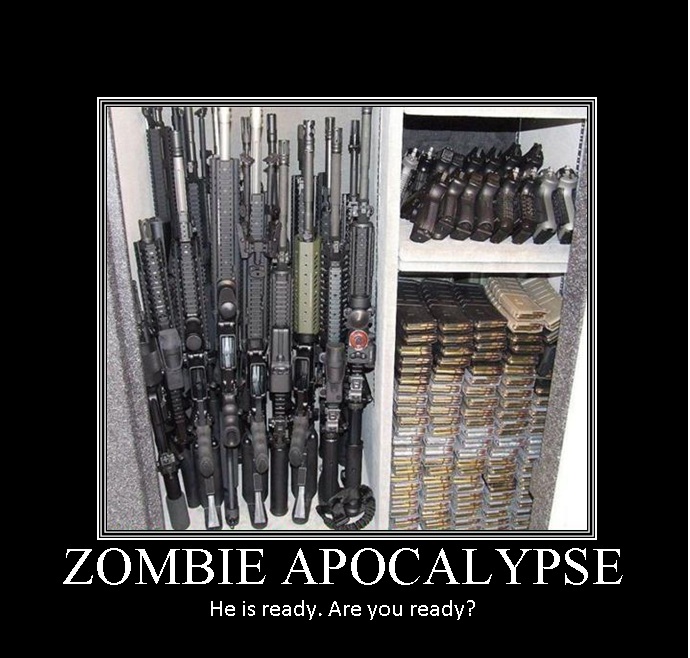 Can’t believe it but I seemed to have forgotten an all important aspect of zombie fighting with my last post (Zombie Guns). We all know there are certain kinds of firepower that excel at smashing zombie brains. But when it comes right down to it, there’s something to be said for a truly old fashioned weapon. The kind that relies on your swinging arm, or perhaps a little gasoline! I am of course referring to melee weapons, the kind that are designed for hand to hand.
So I am amending my last list to include some prime zombie smashing equipment. I also think I will amend the rules from the last post. Instead of four guns, I think we should get our pick of three plus one melee weapon. That seems fair, and works well with the whole balance of firepower and versatility thing. Bullets run out, but what you got in your hands can keep on killing until you break it or you get overrun! Dammit, all this talk of zombie smashing is making me
Melee Weapons:
The weapon on truly last resort, what you grab a hold of when all else fails or you just plain run out of ammo. In this case, what matters is either blunt force trauma, slicing power, or a combination thereof. Weight and balance are also important, as is compactness and portability. Since this is your last weapon, it should fit on your person without trouble and not be a hassle to get around.
Axe:
 Chopping wood is just one of many uses for this traditional tool turned zombie killer! On the one hand, you can use the blade to chop zombie skulls, then you can turn it around for a little blunt force trauma. This allows for swinging back and forth without having to worry about making sure the sharp end is pointed forward. And it can also be used with one hand, keeping the other free for other weapons!
However, as anyone who’s chopped wood for an extended period of time knows, swinging an axe can get pretty tiring! And even though it can be swung with one hand, its hard to do that and shoot or stab from the other, know what I mean?
Baseball Bat:
 Ah yes, the symbol of America’s pastime and the favored weapon of gangsters, gang-bangers and thugs everywhere! And in the event of a zombie apocalypse, its also pretty handy for smashing the heads of the infected/undead! In terms of blunt force trauma, it can’t be beat. Its tough wooden frame can take down a zombie with a single blow, and a few more will finish the job! It’s also quite wieldy and not heavy, making repeated use easy.
Downsides? Well it requires that you keep a hand free to carry it. Otherwise, you need a special carrying sleeve to hold it which can take up added room. Miniature ones can be snuck up your shirt sleeve, but that presents its own problems.
Chainsaw:
 What is it about chainsaws that are just so cool? Is it because they’re gruesome and ruthless, at least in the right hands? Perhaps. But in the right hands, they are also a very good zombie killer. A single slashing cut can take off a zombie head, and simple contact can hew off limbs and chew through their ugly flesh!
Naturally, the size and weight of this weapon can make it a bit unwieldy. And of course it requires two hands which can make cycling between weapons difficult. And last, it requires gasoline to function, which means it has a limited term of service. Lots of killing power, but you pay for it in other ways.
Chainsaw bayonet:
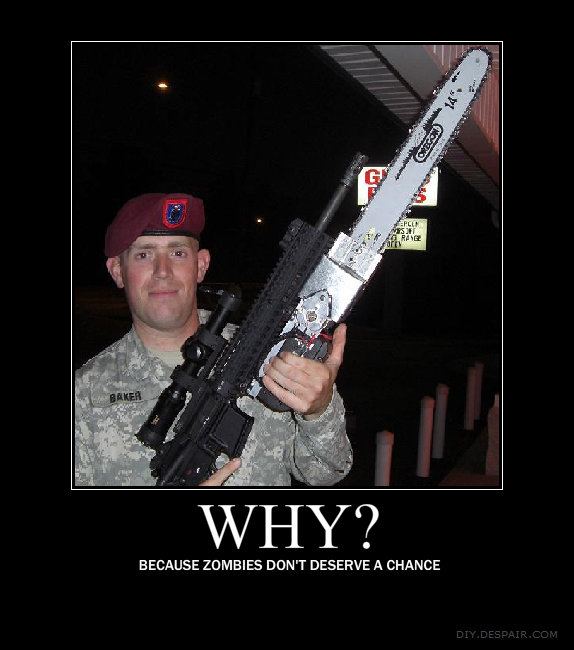 Now here is a pretty awesome combination! The raw killing power of a chainsaw with the added functionality of a bayonet. In addition to providing the user with the grinding power of a chainsaw, it also frees up their hands so they can tote their rifle. This combination gives them killing power at a distance and an effective melee attack if any zombies get in close.
The downside of this is obvious though. The added weight to the front of the rifle makes for depleted accuracy and portability. Basically, a soldier has to hold the front end constantly, forcing them to shoot from the hip instead of taking aim. And again, the weapon is only functional so long as it has a gas supply.
Claymore:
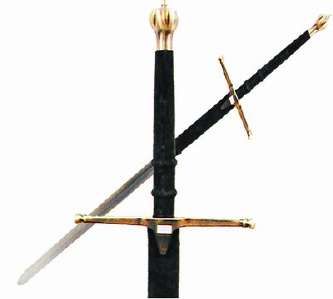 The sword that made Scotland proud and its warriors feared! Heavy, long, sharp and beautifully crafted, this sword is famous for knocking off heads and limbs with single strokes. Its long blade also makes for a good reach against flesh-hungry zombies!
Downsides? Well, its size and weight make it hard to wield. As long as you got two arms and big muscles, you can swing this around and take out any zombie in the vicinity. But anyone doing this can expect to get tired fast. And like the chainsaw, it requires two hands, making cycling difficult.
KA-BAR:
 The knife made famous by the Marine Corps, or was it the other way around? No, I’m pretty sure the Marines were doing fine before this knife came along. Still, its effectiveness as an infantry weapon make it a perfect addition to any zombie killing arsenal. A good 7 inches long, sharp as hell, and made of steel with a carbon tip point, a good thrust will render zombie brains inoperative.
As for downsides, can’t think of many. In close quarters, this is a good weapon to have, being lightweight and requiring only one hand to wield. Of course, the fact that it can’t take off zombie limbs means it can only kill when plunged into a zombie’s skull. And in its current form, it can’t be fixed as a bayonet, making it less versatile than some other blades here.
Pigsticker:
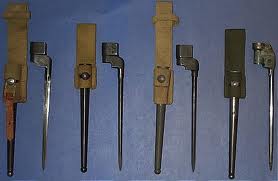 The little bayonet that could… F*@#! up the face of some zombies! Yes, this spike bayonet has undergone a revival of sorts thanks to the prospect of a zombie apocalypse. Small, adaptable to any rifle, and capable of taking out a zombie brain with a good poke in the eye, this weapon is both portable, versatile, and effective!
It’s small size and the fact that it can be mounted on top also doesn’t eliminate the possibility of a grenade launcher attached to your rifle either. However, the spike is somewhat limited in some respects. Being small and thin, it can’t really penetrate a skull with ease. Overuse can also break it, and its range is somewhat limited.
Samuria Sword:
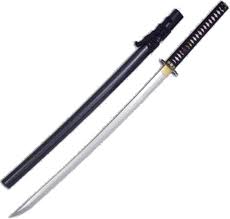 My thanks to Goran Zidar for suggesting this one. In the event of a zombie attack, this weapon is definitely one I would want on hand! Made of folded, tempered steel, good weight and wieldy, this sword can cut through bone, flesh, knock off heads, and limbs all at once. It can even chop into the brain pan of a zombie when used in an overhead attack.
But of course, the sword still takes two hands to wield effectively. What’s more, in the event of a head attack, it can get stuck in vertebrae and skull bone if not used properly. Always remember to snap the blade back at the end of the strike!
SKS folding bayonet:
 This Soviet-era bayonet is famous for being the only gun mounted blade that is retractable. This can be a time saver when it comes time to prepare for a zombie charge, or ensure some added safety should you want to leave the bayonet on full time.
Downsides are few, but the folding attachment means that a stiff blow can detach it from the fixed position. In a zombie fight, you don’t want to find your bayonet folded back on you, thus forcing you refix it between brain stabbings! Having this bayonet on also means you can’t have a rocket launcher fixed to your weapon.
Machete:
 Much like the baseball bat, the machete’s greatest features are its simplicity and brutal efficiency. And just for fun, I selected the Kukri machete, the Nepalese inspired variant which is the workhorse of modern machetes. Few weapons can out-cut this one, and a single blow is about as effective as that of samurai sword. But the Kukri manages to accomplish this with a much smaller frame, making it more compact and portable.
Potential downsides… Well it’s not the easiest thing to carry when not in use. Its curved blade means that you’d need a special holster since you can’t expect to just stick in your pocket, not unless you want to sever something vital! And since it’s smaller than a sword, you can’t really sling it over your back. So yes, portability might be a bit of an issue.
M9 Bayonet:
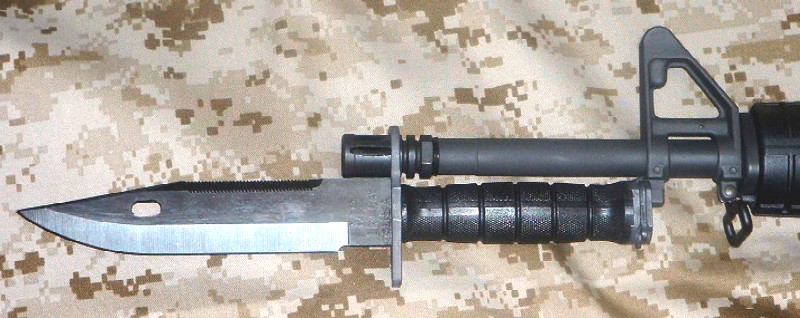 Last, but certainly not least, is the standard M9 infantry bayonet. A favorite amongst the US Army and USMC, the M9 is effective, reliable, and a quick kill option when fixed onto an assault rifle. Fixed at two points to a weapon, the odds of it coming off are also unlikely, making it a sturdy killer as well.
Drawbacks include diminished accuracy, which has been a problem since WWII. Soldiers usually resolve this by waiting until the enemy is close before fixing them. However, this presents the problem of having to take the time to slap it on while the zombie’s approach!
Are You Ready?
Okay, so the rules are clear right? One melee weapon, three guns. GO! My new picks are as follows:
Melee: Kukri Machete
Small Arm: Calico
Shotgun: USAS-12
Rifle: Stey AUG
I’m ready for some zombie smashing! Let me at em!
Zombie Guns, or How To Prepare for World War Z!
 I blame myself in part, but what with all the talk of face-eating and Bath Salts in the news, there’s been a lot of speculation about whether or not there’s a Zombie Apocalypse on the way. Personally, I’m not one to go in for rumors and speculation, but I figure it’s better to be prepared! Hence why I’ve decided to do a post dedicated to Zombie Guns, or more specifically, firearms that will come in handy when the flesh-eating zombies start roaming your neighbourhoods!
Having done some posts of late involving futuristic guns, I’m already pretty well versed when it comes to recent developments in the firearms industry. However, I wanted to be thorough, so I also did a looking around and included some ideas from people who’ve already put some work in on the subject. And of course, I would be lost were it not for the common sense rules that come to us from all of movie, television and even literacy sources on the subject.
Whether it’s tv’s The Walking Dead, movies like Zombieland or 28 Days Later, or Max Brooks’ Zombie Survival Guide, the basic rules for surviving zombies are the same. Go for the head, don’t be stingy with ammo, and sever all emotional attachments! And when it comes to weaponry that will be most effective in this regard, portability, capacitiy, firepower and versatility are all important.
Relying on all these basic criteria and what I know about modern weaponry, I now present a list of the top handguns, SMG’s, shotguns, and rifles, each entry with its own selling points and drawbacks. Have a look through them and see if any of them tickles your fancy! In the end, I figure we all get one from each category. Have fun picking your arsenal!
Small Arms:
The weapon of last resort. When you’re cornered and all other weapons have failed or run dry, your last option is to draw your sidearm and knock as many heads off as possible, preferably while falling back. And when this happens, you need a steady firearm that won’t run out of bullets fast. And when it does, it needs to be quick to reload. That way you can keep on knocking heads off without worrying about being bitten!
Beretta 92:
 Here’s one everyone should recognize. Also known as the M9 or Beretta 9mm, this gun is a favorite amongst police forces and militaries in many countries, especially the US. Combining a 9mm round, dual action and a 15 round magazine, it is one of the best all around sidearms in existence. In a firefight against zombies, its also a good last resort. The rounds are large enough to take out zombie brains, the pistol is accurate and doesn’t have significant recoil, and the shooter can go awhile without reloading.
The only real downside is the fact that this 9mm round doesn’t the same power as some its larger-caliber kin. If rounds are misplaced, like in zombie’s body, they won’t do much to slow it down. Basically, anyone using this will have to make their shots count by getting them right in the brain pan. But with 15 rounds (16 if they load the chamber), they will have plenty of opportunity.
Colt 45:
 Don’t ask me why, but when it comes to old school designs, big bullets seemed to be the norm. That is certainly true of the Colt M1911, aka. the Colt 45. Originally designed for shooting gangsters and trench warfare, this weapon is more than capable of splattering zombie brains all over the sidewalk.
An immediate downside of this weapon is its ammo capacity, a mere seven rounds. In addition, as a single action pistol, it can be less accurate than its peers. However, it can overcome the former with an extended (12 round) mag, and its simplicity and old-world durability can make up for any inaccuracy. Unlike other models, this sidearm can up to 6000 rounds without a single misfire or jam up.
Desert Eagle:
 What do you get when you cross a magnum with a semi-automatic pistol? The Desert Eagle, available in both the .357, .44 and .50 calibers. Each of these are capable of decorating a wall with zombie brains, but the bigger the bullet, the bigger the mess! As a hand gun, it packs a hell of a lot of firepower into a relatively small package. And at close range, nothing short of shot gun or an assault rifle can match its power.
However, its greatest strengths also prove to be its greatest weaknesses. Its powerful punch means powerful kickback, which can make accuracy a bit of a problem. What’s more, the large caliber make capacity problematic, even at the smallest caliber (9 bullets for .357, 8 for .44, 7 for .50). An extended 14 round clip helps this, but not the central problem of accuracy.
Glock 17:

This brand of handgun has been made famous by countless TV shows and movies, mainly because it sees so much use by police and military forces around the world. A variation on the Glock 9, the Glock 17 is also a compact 9mm pistol, but boasts a 17 round magazine. That kind of capacity is useful when facing off against a Zombie hoard!
In terms of drawbacks, the Glock has few. Much like the 9mm, its power is somewhat limited when used against zombie torsos. In the hands of an accurate shooter, this isn’t a problem. But for anyone else, that 17 mag will come in handy!
Submachineguns:
When zombies get close, its good to have something quick and small at the ready to take them down. Submachineguns, PDW’s and compact full-autos all fall into this category. In this case, rate of fire and ammo capacity count for something, but in the end, accuracy is important too, since head shots are the most effective.
Calico M960:
 Because of its unique, sleek design, the Calico is a mysterious gun that’s made many cinematic appearances, usually in connection to sci-fi franchises. However, when it comes to combating zombies, its chief benefits are firepower and ammo capacity. A 9mm weapon with a top-mounted, helical magazine, the Calico can hold up to 100 rounds. And because of the compact shape of the magazine, many can be kept on the gunner’s person without fear of being overlaiden.
Drawbacks? Can’t think of many. Given its two handles, 9mm caliber, ambidextrous option and the choice between semi-auto and full-auto firing modes, the Calico is well suited to taking down individual and crowds of zombies. One possible flaw is that the range is slightly limited, compared to that of an assault rifle.
Chang Feng SMG:
 Here we have another submachinegun that features a top-mounted helical magazine, a compact design and a relatively high ammo capacity. And like many other guns on this list, it is a 9mm design which makes it just right for splattering zombie brains! It’s ability to switch between semi-auto and full auto can also be useful when one needs to switch from accuracy to “kill em all” mode.
The drawbacks of this compact design are simple. Being so compact, it can be a bit unruly when fired in full auto mode. Though it has a forward handle as well as the trigger grip, the spacing makes recoil a bit of a problem.
MP5:
 A favorite amongst law enforcement and military personnel everywhere, and for good reason. It’s compact size, firepower, weight and range are all very well suited to close combat firefights, which are common in urban environments. This makes it well suited to zombie killing as well. As usual, the 9mm round is prime brain-bashing ammo, and the third round clip ensures plenty of ammo.
At full auto, the gun fires 800 rounds a minute, but given its stability and accuracy, those rounds will be well placed. Compared to all that, its only real downside is its size. Compared to other SMG’s, this gun is more akin to an assault rifle than a compact machine pistol. Combined with other large weapons, this can create a problem.
P90:
 Known as PDW (Personal Defense Weapon) this weapon is the living embodiment of compactness and automatic fire. Combining a 5.7mm round (the equivalent of .22 caliber) with a 50 bullet magazine, top-mounted, this weapon has enough punch to pulp zombie brains and can keep firing for some time. Its size and compact shape make it very portable as well.
However, there are some notable drawbacks. For starters, at full auto, its high rate of fire (900 rounds a minute) combined with its small size can produce some troublesome recoil. In addition, I hear tell that it has been known to jam up from time to time, which in a zombie fight can be truly fatal!
PP-2000:
 Built in Russia and a popular item amongst its armed forces, this 9mm machine pistol has a number of useful features when facing zombies. For starters, it combines an assault rifles rate of fire with the size and caliber of a pistol. This makes it highly compact and portable and a good weapon to have when in close quarters with a small group of zombies.
Alas, its magazine capacity is only 20-30 rounds, which at a 600 rpm rate of fire can go very fast! Its retractable stock can combat recoil, but also adds volume which reduces compactness. As a result, it is best when used in single fire mode like a mega-pistol.
TDI Kriss:
 Yet another example of portability meeting firepower, and then producing some weird looking offspring. Basically, a Kriss is an SMG that combines .45 caliber rounds with a rate of fire that lies between 800-1100 rounds per minute. Its handled design also makes it a steady shooter, which combined with its firepower, makes it good at chopping off zombie heads.
The downside you say? Well, its magazine is terrible small for a weapon that fires so quickly. As it stands, the weapon comes standard with a 13 round mag, which at 800 rounds per minute would go within a 1.33 seconds! Apparently, a 28 round mag is being developed, but that too would be gone in 2.1 seconds. This is fine if you’re happy shooting at semi-auto, but until they come up with a 50 round mag, this weapon is too quick for zombie fights.
“Close Encounters” – aka. Shotguns:
When it comes to zombie hunting, shotguns are mighty handy. Not only do they pack a lot of punch, a single shot can take a zombie’s head clean off. And even if you miss the head, a hewed arm or leg can also slow a zombie down considerably. Here, accuracy doesn’t count for a lot, but ammo capacity certainly does. When you’re blasting zombies, the last thing you want to hear is an empty click.
Franchi SPAS-12:
 Originally designed for sport shooting, this automatic shotgun has become a mainstay amongst police and military forces everywhere. Able to shoot in either the pump action or semi-automatic firing modes, it is renowned for versatility, reliability, and firepower. It’s eight round capacity is also highly respectable as ammo capacities go.
The only drawbacks, compared to other weapons in this category, is its limited ammo supply. Though accurate and not prone to mechanical problems, which can happen in automatic designs, the SPAS 12 can deplete its ammo quicker and then takes time to reload.
Kel Tec KSG:
 A cutting-edge design, boasting duel feed magazines and compact dimensions, this weapon is well suited for anti-zombie defense! In total, it holds 14 rounds, as is operated by pump action. It’s two handles also ensure a relative degree of accuracy, making head shots a real possibility.
Unfortunately, the weapon has two distinct drawbacks. Though it holds a highly respectable 14 shots between its two magazines, the pump action slows it down somewhat. In addition, it must be reloaded manually, and between its two tubes, that can take some time. This demands that the user find cover after exhausting their supply of ammo, or spend only part of it before taking time to reload.
Striker:
 Manufactured in South Africa, the Striker Protecta was specifically designed to be a counter-insurgency, high capacity weapon with a hell of a lot of punch. It’s size and shape make it compact and portable, and its 12 round magazine give it enough capacity for a prolonged firefight.
In terms of drawbacks, the Strikers has a few. Though it has a good capacity, it has to be reloaded manually, which can take some time. In addition, even though its compact, the drum magazine can make it bulky and awkward to carry. However, it can make up for this since it doesn’t require additional magazines, just a simple ammo belt, in order to be reloaded.
USAS-12:
 Here is a somewhat interesting design. Combining the familiar profile of an assault rifle with the concept of a shotgun, the USAS-12 also manages to combine a high capacity with a lot of firepower! The standard box magazine can hold 10 shots, but the drum magazine gives it a robust twenty. However, this is balanced by the fact that the ten can be reloaded by simply slamming a new box into place, whereas the twenty must be reloaded manually.
The only potential drawback of this weapon is its rate of fire. In addition to being semi-automatic, the gunner does not need to pull the trigger multiple times to get multiple shots off. This can cause have a saturation effect, but can also waist ammo. Remember, zombies hunt in packs, so saturation is only useful in real close quarters.
Rifles:
Last, but not least, is the category of rifles. Basically, these are the weapons that you want for long range encounters and sniping. In this case, what matters most are accuracy and ammo capacity. Even small caliber rifles have enough muzzle velocity to kill with a head shot, so in the end what matters is the ability to place that shot on target. Once you got that down, you want to make sure you can do it again, and again, and then again some more…
Barrett XM500:
 This .50 cal sniper rifle design, which is the most recent to come out of the US, is lighter and more compact that its peers. And its sheer firepower and range would make it a real Zombie killer. Just imagine, .50 cal slugs that are capable of taking a zombie’s head off, literally! A hit to the torso will limb will all dismember and tear them apart too. Even if that’s not fatal, its sure to slow them down a ton!
However, the weapon does come with its share of drawbacks. Though good for long-range encounters, it would be of little use up close since it can only be fired while in a prone position. It’s ammo capacity is also lacking, at ten rounds a magazine, and despite its more compact and light design, she’s still tough to get around in a hurry.In short, good for support fire, not the best to have on its own.
Daewoo K11:
 Here we have the Korean made dual caliber rifle that is part of the larger OICW (Objective Individual Combat Weapon) program. Combining a standard 5.56mm assault rifle with a built-in grenade launcher, this weapon is highly versatile, has good range and is very powerful. It’s regular ammo are more than capable of smashing zombie heads, and the grenades are good to disperse zombie crowds.
The drawbacks are clear. The K11 comes with a high-tech scope, but this is of little use when it comes to zombies. The added weight and bulkiness of it can also be a problem. In short, its delivers in all areas except portability, which in the end can mean the difference between life and death.
M16A2 Assault Rifle:
 This version of the M16 rifle is an upgraded model of the weapon that seen service with US armed forces since Vietnam. In addition to better ammo and less blowback, the A2 has the ability to carry the M203 40mm grenade launcher, which is a fine addition for zombie killing. Combined with the standard 5.56mm round, a good muzzle velocity and a 30 round magazine, the M16 is accurate, has good range, and a respectable capacity.
Compared to bullpup rifles, its not very compact, but this problem is pretty minor since it can be carried for its stock or slung without difficulty. The only other thing is the grenade launcher, which while powerful addition can take some time to reload. As a single shot, slide-loader, the gunner is going to be up against it to get ammo in between shots. Best when used sparingly and at long range between shots from the rifle.
FN SCAR:
 The name stands for Special Forces Combat Assault Rifle, which is precisely who this weapon was designed for. As a result, its accurate, powerful, compact, and very versatile. In addition to its 30 round 5.56mm rifle, it can be upgraded to carry a 40mm grenade launcher, red dot or holographic sites, tactical grips near the front, and probably some other things! All of this adds up to a very functional and versatile weapon.
Of course, all these modifications can be counterproductive. For instance, some modifications rules out others, such as tactical grips making a grenade launcher impossible. At the same time, too many attachments can make the gun bulky and cumbersome. The best configuration for fighting zombies would likely be a tactical grip for stability (ensuring better accuracy) or a 40mm grenade launcher for added punch. But as usual, that grenade launcher is a single shot weapon which takes time to load.
Steyr AUG:
 I knew I couldn’t complete this list without including at least one bullpup assault rifle. And when it comes to bullpups, the AUG is arguably the best. Light-weight, compact, accurate and powerful, the Steyr AUG is ideal for zombie hunting. With its magazine loaded at the rear, this gun cuts down on bulk while at the same time adding muzzle velocity. Combined with a 42 round magazine, the AUG can kill zombies longer than most.
One downside is a potential lack of versatility. The standard AUG comes with a tactical grip that ensures more stability and accuracy while firing. This can be taken out to enable a grenade launcher, but only at the cost of accuracy. The scope can also be upgraded, but red sights and holographics are no more effective than its standard 1.5x scope. In the end, this gun is best as it is.
Suit Up!:
Well, that about does it, doesn’t it? Now it comes time to pick which weapons we want on our persons when the zombies come knocking. God, I feel like I’m making a role playing game, but if that were true, I’d have to give every player an upper weight limit or capacity based on their size. That’d really make things interesting! Alas, I can only do a four category thing right now with the available choices. So.. here’s what I’m taking
Sidearm: Beretta 92 (I love the way it looks)
SMG: Calico (it had me at 100 rounds!)
Shotgun: USAS-12, 10 round box magazine (I figure these will be easier to carry and quicker to change. I shall try to be sparing with my shots)
Rifle: Steyr AUG (its accuracy and 42 round clip ought to be ideal for zombie hunting. I was thinking the K11 because of its grenade launcher, but its size and clumsiness would get in my way)
Well, that’s me done. Anyone else want to take a run?
“Bath Salts” and the Zombie Apocalypse
 I hear it more and more these days: “Is this the Zombie Apocalypse we were warned about?” Or is this just one of those rare occasions when pop culture and real news come together to create a sick, existential joke? In either case, I think we all know what I’m talking about. A little incident involving a naked man and some face eating? Yes, that one!
In that case, police indicated that drugs were involved, a strange new psychogenic named “Cloud Nine”. This drug is apparently a form of MDPV cocaine, also known by the street name “Bath Salts”. The “zombie man” Rudy Eugene was apparently loaded on the euphoric amphetamine when he attacked Ronald Poppo, bit half his face off, and then threatened to eat the police.
 According to numerous stories on the subject, this product is a perfectly legal form of bath salt that is meant to provide an invigorating bath experience. But given its recent link to this and other incidents , that’s likely to change! Shortly after the first “zombie attack” took place, police in Miami began reporting similar incidents where people ere either biting or threatening to bite other passerby’s. Here too, the behavior was attributed to Bath Salts.
And now it seems that a similar incident has happened here in the Great White North. For those not familiar with the Luke Magnotta story, allow me to elaborate. It began a few days ago when two political party headquarters in Montreal began receiving body parts in the mail. This was followed shortly thereafter by more body parts appearing on the doorstep of Vancouver Police Department, which appeared to belong to the same victim.

It took no time at all for authorities to identify the guilty party, a 29 year old man by the name of Luke Magnotta who was apparently a gay porn actor. After committing the grisly crime, he had fled to Germany where authorities found him and arrested him. According to the police reports, he was in an internet cafe reading about himself online. It also took them no time to identify the victim, a Chinese student named Lin Jun, a 33 year old man who was having a relationship with Magnotta.

Based on their initial investigation, police revealed that in addition to cutting his former lover up, Magnotta also engaged in some cannibalism with the body parts and video-taped the whole thing. He posted these and other gruesome tidbits on the web, hence why it was not hard to catch him! He is being extradited as we speak to Canada to stand trial. No indication has been given yet whether or not Bath Salts or some other drug was involved, or if he was just bat-shit crazy.
Granted, this is not the first time that drugs have been linked to cannibalistic behavior. In fact, cases have been reported where people high on PCP/”Angel Dust” have engaged in these and other totally messed-up behaviors. Still, the way this has coincided with the recent zombie craze is nothing short of sickening and frightening!
Just in case, I think it might be a good idea to start researching Zombie guns. I’m not condoning the whole “Zombie Apocalypse” theory, I’m just saying that it might not be a bad idea to have a contingency plan just in case this behavior starts to… you know, spread! In the meantime, I’m thinking it might not be too late to re-evaluate the “Just Say No” policy either, especially where Bath Salts are concerned. I know we all love a good, invigorating bath, but it aint worth becoming a zombie people! Stick to aromatherapy, lotions and luffa; or better yet, do what I do and just have a hot shower. Thanks for listening, and in the meantime, protect your exposed flesh!

Wired Tribute to Ray Bradbury
 Here we see Bradbury seated in the NASA control center back in the 1960’s. Apparently, it was his contention, prior to the Moon Landing, that the United States was headed for spiritual ruin unless “dumb politicians” got out of the way and let Americans reach for the stars. Well, he certainly got his wish, didn’t he?
Unfortunately, this science fiction great did not live long enough to see the colonization of Mars, which was a recurring theme of his writing. But given the current state of the world economy and the space race, I wonder if any of us will.
But I didn’t start this post to be gloomy. Mainly I want to share an article which I came across today from Wired magazine. It contains Bradbury’s thoughts on a multiplicity of subjects, as expressed in his most famous quotes. It was a lucky coincidence that I found it, since my wife shared one of his oft-quoted lines with me once I told her the sad news.
Riding home in the car together, she turned to me and said: “You must stay drunk on writing so reality cannot destroy you.” Since she’s always encouraged my writing, I couldn’t help but feel that she thought I could draw some inspiration from this. Mission accomplished.
These and other quotes can be found in the article, just click on the link below. And remember, you got any cool thoughts, be sure to write them down. You never know, someday, somebody could be quoting you!
http://www.wired.com/underwire/2012/06/ray-bradbury-big-ideas/
The Revelation Space Universe

Lighthuggers, Inhibitors, Ultras, Hyperpigs, Conjoiners Drives, Demarchists, Chasm City… Few science fiction authors have come up with as many weird and intriguing concepts as Alastair Reynolds. The author of the Revelation Space series, Pushing Ice, Blue Remembered Earth, Century Rain, House of Suns, Terminal World, and a slew of short stories and articles, Reynolds is not only a hard science fiction author but an actual scientist.
Yes, from 1991 to 2004, Reynolds worked as an astronomer for the European Space Research and Technology Center, which is part of the European Space Agency, in Noordwijk, Holland. So when it comes to matters of science and space – be it exploration, travel, or the physics thereof – this guy really knows what he’s talking about.
To start my review of his work off right, I’d like to cover his first full-length novel. Known as Revelation Space, this story became the basis for the universe of the same name and the setting of most of his books. It also advanced a lot of ideas and concepts which would inspire yours truly 😉

Revelation Space (2000):
The story opens with three separate but interrelated strands, though their connection is initially unclear. The first takes place on a planet known as Resurgam in 2551, where an archaeologist named Dr. Dan Sylveste is leading an expedition to uncover the remains of the Amarantin. This alien species, which were a winged-humanoid race, existed for over 900,000 years on the planet before some cataclysmic event wiped them out.
The most recent discovery of the excavation team proves that the Amarantin were far more technologically developed than previously thought. Retiring to his den, Dan begins to commune with the beta-level simulation of his deceased father, Calvin Sylveste. Often, he consults his father, who died on Yellowstone, for advice in scientific and political matters. However, Dan soon learns that a coup has taken place due to his obsession with uncovering the Amarantin, and a party shows up at the site to arrest him.

Cut to 2540 aboard the Nostalgia for Infinity, a “Lighthugger” vessel that is the mainstay of the universe in this time (the name refers to the fact that it can fly to within an inch of the speed of light.) Here, Triumvir Ilia Volyova is awake while the other crew members are in reefersleep (cryogenic suspension). They are en route to the Epsilon Eridani system and the planet of Yellowstone to find Dan Sylveste, not knowing that he departed for Resurgam some 15 years previously.
Its crew of Ultras (modified spacers) is desperate to find Sylveste since their Captain is a victim of the Melding Plague – a nanovirus that has infected all of Yellowstone. Basically, they are seeking his services yet again since his last treatment did not seem to take. Ilia also plans to pick up a new gunner since their last one apparently went insane and had to be spaced, the only clue he left behind was the name “Sun Stealer”, which he wrote on a wall in his own blood.

Last, the scene switches to 2524 and the surface of Yellowstone, where professional assassin Ana Khouri is hired by a wealthy recluse known as The Mademoiselle. Apparently, she wants Dan Sylveste found and killed, and she knows the Nostalgia for Infinity will go to the ends of the universe to find him. As such, she orders Khouri to go into stasis and meet up with the crew 20 years later when they arrive in orbit.
Meanwhile, we learn a few things of importance. For one, the Nostalgia appears to have been infected by virus other than the one that’s got their Captain in cryo-sleep. This virus appears to be what drove the last gunner insane and is threatening to kill Ilia now. During a training exercise where they test their landing suits, another glitch results in the death of another crewman, leaving only the Triumvirs – Ilia, Hegazi, Sajake – and the Captain.
We also learn that the cargo hold of the ship is holding a large supply of Cache Weapons, what are apparently referred to as Hell-class, all of which appear to be a bunch of Doomsday devices. Ilia secured these weapons from sources unknown, but in time it is suggested that they are of Conjoiner manufacture – the same advanced faction that built the Nostalgia’s engines (aka. Conjoiner Drives).

And finally, we learn why Sylveste is on Resurgam and why the Mademoiselle wants him dead. As it turns out, the Sylveste family maintained a research institute on Yellowstone dedicated to the study of alien civilizations. Many extinct cultures were discovered by humanity as it spread into space, no living ones aside from two exceptions. The first is the Pattern Jugglers, a planet-wide sentient species that comprised massive kelp nets that seemed to preserve the neural patterns of anyone who walked into them. The second is known as the Shrouders, aliens that were presumed to exist within a bunch of anomalous space-time bubbles.
Sylveste became interested in these when a colleague of his became the first to survive contact with a “Shroud” but was left insane. After years of doing nothing but scrawl images on the floor, he spoke and told Sylveste that he actually made contact with an alien intelligence inside the Shroud. This area of space-time, he said, was known as “Revelation Space”. He told him further that they held information about a great mystery that would explain the deaths of all alien civilizations in the quadrant and that he had to go to the Jugglers to get it. As preservers of memories, they held the secrets of many dead alien worlds in their massive neural nets.

Having completed all this, Sylveste finally flew into the Shroud and survived. However, his partner in the expedition, a female researcher, was lost and presumed dead. In truth, she survived, but just barely, and returned to Yellowstone where she became a recluse known as… wait for it… the Mademoiselle! Hence why she wants Sylveste dead, because she blames him for her accident and the fact that she is now forced to live in a containment apparatus.
Ah, but there’s more! After he made contact with “Revelation Space”, Sylveste was told to go to Resurgam, where he would find his answers. He did not know why, but it seemed the Amarantin were the final piece of the puzzle. Before that happened, though, he was brought aboard the Nostalgia to help the Captain for the first time. And years later, his work would be interrupted when the colony rose up against him.
Hints are also given as to what is going on vis a vis the extinction and the virus aboard the Nostalgia. Essentially, eons and eons ago, the first intelligent races of the Galaxy met up and began a prolonged conflict known as the Dawn War. After millions of years of fighting, the remaining civilizations, exhausted and cynical about sentient life, combined their intelligences with machinery to create a series of specialized weapons. Collectively, they came to be known as the Inhibitors, a race of machine-like intelligences that sought out sentient life and exterminated it once it achieved a high level of technical development.

Meanwhile, on Resurgam, Sylveste is given a reprieve from house arrest to see the latest results of the excavation, which has proceeded in his absence. It seems that the crews turned up a massive underground city containing many ruins and hints as to what happened. Featured over and over is an Amarantin idol which is reaching toward the sun. Hints are also given that Resurgam’s moon, Cerberus, was also particularly significant to the Amarantin people. After learning of all this, Sylveste proposes marriage to his new sweetheart, and they prepare to have their marriage in the city ruins.
By 2566, Khouri is brought aboard as the ship’s new gunner, and they arrive at Resurgam. However, before they make orbit, a nearly catastrophic situation occurs when one of the ship’s doomsday weapons suddenly becomes active and has to be released. It detonates off their bow and creates an artificial singularity that very nearly consumes their ship. Having just made it away, Ilia concludes that the virus is stepping up its game!
Once they make orbit, the crew establishes contact and demands Sylveste be turned over. To make their point, they stage a ruse where they pretend to level an outlying settlement, and the colony responds by handing Sylveste over. This they do by attacking him during his wedding and taking him and his wife prisoner. The crew fly down in their special suits to retrieve him and announce that they plan to bring him and his wife aboard. However, Sylveste turns the tables by saying his artificial eyes contain a pinhead antimatter device that will destroy their ship. He lists new terms, which include letting his wife go and taking him to Resurgam’s moon of Cerberus. In exchange, he promises to help their Captain any way he can.
As Sylveste and the crew of the Nostalgia for Infinity approach Cerberus, Sylveste realizes the massive celestial body isn’t a planet at all—but rather, a massive space station. They fly inside and begin to be set upon by the device’s defenses, but eventually make it down inside. Once in there, Sylveste realizes what it really is. Basically, the moon was built eons ago by the Inhibitors, which served as a beacon to alert them of the emergence of a star-faring intelligence. Once activated, it would signal the Inhibitors to launch their machines to the system so they could exterminate whichever species found them. Sylveste concludes that this is what happened to the Amarantin.
Aboard the Nostalgia, Ilia also is confronted by the truth when the virus threatens to finally take over the ship. Appearing on the ship’s main display, an Amarantin who identifies himself as “Sun Stealer” explains their purpose to her. Apparently, the Amarantin are the Shrouders! These bubbles in space-time have been their protection against the Inhibitors for hundreds of thousands of years and their means of drawing out new sentient races to find them and do their bidding. When Sylveste’s colleague passed into them, they realized their time had come, and as such, tried to manipulate him into discovering if the Inhibitors were still alive out there.
Unfortunately, this case of first contact went poorly. Not being able to recognize his neural patterns, the Amarantin nearly drove Sylveste’s friend completely mad with their message. Luckily for them, he was able to make sense of it in time and delivered it to Sylveste, who then came back to the Shroud, where they were able to imprint a series of clues in his mind as well as a virus that would monitor him. These, they hoped, would eventually lead him back to their homeworld and the moon of Cerberus. Their intent all along was to have someone else make contact with the Inhibitor machine. Thus they could see if it was safe to emerge from hiding. If so, they planned to retake their homeworld. If not, it would be a different race who was exterminated, and they would wait until the next came along.
However, that plan changed when Sylveste came aboard the Nostalgia for the first time and unknowingly planted the virus in the ship’s hardware. Hence why the gunner went mad and why its been threatening to take over the ship. Cut off from Sylveste, it was beginning to go mad. However, once he was aboard, it saw an opportunity to complete its mission. Having taken the helm, Sun Stealer now kept the ship in orbit around the moon and began reporting everything it saw back to the Amarantin Shroud.
Down on the station, Sylveste realizes that the beacon has become active and that he has been played. Rather than allow the Inhibitors to emerge, he detonates the bombs in his eyes to destroy the facility. Back on the ship, Ilia decides to unleash the Melding Plague that’s been consuming their Captain and let Sun Stealer do battle with it. Sun Stealer loses, and the ship begins transforming into a gothic nightmarish version of itself. But at least they’ve restored control of it to themselves. The story ends with the crew reuniting and setting course for Resurgam again.
Good Points and Bad:
Well, I don’t know if you could tell from my description, but the plot of this book was pretty damn complicated and mighty layered. And personally, I thought that was a good thing! It is not unusual for an author to have distinct points of view in a story that seem unrelated but inevitably come together, but Reynolds was really working overtime with this one. How and where the plots overlapped could produce headaches due to the sheer effort of keeping track of it all, but I, for one, felt it worked pretty well.
In addition, the inventions and futuristic concepts were a real mind-blower for me at the time. In fact, I specifically picked up this book in order to research modern sci-fi and get a dose of the latest hard science, and that’s exactly what I got. Beta-level simulations, Alpha constructs, nanotechnology, servitors, Lighthuggers, inertia, controlled singularities, and the like. It all called to mind numerous other classic sci-fi franchises, many of which Reynolds himself acknowledged a debt to.
For example, his Inhibitors sounded very much like the Firstborn of the Space Odyssey series. Here and there, you had aliens who were so advanced that they could download their consciousness into machinery that would preserve them for eternity, making for effective space travel in a universe that didn’t permit FTL. Reefersleep also called to mind cryogenic pods from Alien and other franchises. Cybernetic implants, augmentation, and nanobots are all concepts one can find elsewhere too. Still, the way Reynolds combined these things together was quite masterful and very much in keeping with the tradition of space opera.
And finally, I found the story downright intriguing. The concept of an ancient race that prevents the rise of space-faring sentient life because it knows from experience that such life will likely engage in a prolonged war with other sentients seemed quite believable. One need only look at the process of human history to know that conflict is a defining feature and that peace on a grand scale only seems to follow in the wake of terrible, exhausting wars. Consider Europe after two world wars, Japan after the Shogunate wars, or China after its Warring States period (and even after that!) Like it or not, peace and consensus are very often the result of war, war, and more war.
Okay, now for the weak stuff. As I said already, the plot can be convoluted. For the most part, this works in the story’s favor. However, something which comes up in other Reynold’s works as well is his tendency to throw in too many plot twists, especially toward the end. Already we have a very complicated and layered story that really didn’t need any more curve balls, but some are thrown even as the other plot threads are culminating. In this story, the unnecessary twists involve last-minute revelations.
In Sylveste’s case, this happens just before he is captured by his own people, and he takes the opportunity to unburden himself to his wife. He tells her that his father once had an alpha-level simulation of himself, as opposed to the beta that he frequently talks to. He gave this alpha to the Pattern Jugglers in exchange for the info they gave him. It is also revealed that Dan Sylveste is actually a clone of his father. Hence his vanity and obsessive nature, which were inherited from a father who wanted a duplicate of himself.
Last, there’s the revelation that the Captain of Nostalgia – John Brannigan – went into the Jugglers sea himself and used them to imprint his mind on Sajaki, one of the Triumvirs. His reasons had to do with the fact that he knew he needed to go into reefersleep until they found a cure for the Melding Plague. Unable to stand the idea of being out of it for so long, he decided to get the Jugglers to erase Sajaki’s mind and replace it with a copy of his own. That way, he could be aware of everything that was going on while he was under. This twist also seemed quite unnecessary, as it really didn’t advance the plot any, just added another complication.
But overall, I was very pleased with this book and was sure to pick up its sequel. In fact, Revelation Space was the second Reynold’s book I had read at this point (the first was Century Rain), and I consider his writing to be a highly educational experience. In fact, much of his ideas and hard scientific basis served to inspire my own writing, particularly when it came to Source. So when it comes to authors I owe a debt to, he’s right up there! Stay tuned for more reviews of Reynolds and the Revelation Space Universe!
Remembering Ray Bradbury (1920 – 2012)

Yesterday, one of the greatest sci-fi minds of the 20th center, Ray Bradbury, died at the age of 91 after a lengthy illness. His publisher, HarperCollins, were apparently the ones to break the news to the world. Best known for his seminal dystopian novel Fahrenheit 451, Bradbury quickly joined the ranks of authors like Orwell, Huxley, Clarke, and Asimov, in that he was a speculative author who’s predictions rapidly came true.
Amongst such things were the emergence of ATMs, wall-sized televisions, interactive entertainment, and live broadcasts of fugitive car chases. In addition to Fahrenheit 451, he also penned the Martian Chronicles, The Illustrated Man, and Something Wicked this Way Comes, and over 600 other works of fiction, articles and essays. As such, his influence and legacy are truly immeasurable.
So, in honor of this sci-fi great, whom I waited a very long time to read, I shall delve into his best known works and try to explain exactly why they were so enduring and influential. Let’s start with the book that earned him his reputation in the first place:
Fahrenheit 451 (1953):
 This dystopian piece of speculative fiction takes place in the late 20th century, when American culture has degenerated into a form of brutal escapism. Nuclear war looms on the horizon, books have been banned, and for the majority of people, cocooning in their homes in front of their wall-sized monitors seems like the perfect distraction.
The story takes place from the point of view of a Fireman named Guy Montag, who’s job consists of located offenders and burning their books. This is the role of firemen in the future, who instead of fighting fires are responsible for starting them. Montag is unhappy with his life and suffering from a deep sense of disquiet.
Until one night when a young woman named Clarisse shakes up his worldview. Whereas most people in Montag’s world seemed numbed and dead, she is vital and alive, and questions just about everything. Shortly thereafter, she dies in a tragic accident, which shakes Montag’s world up even more.
He too begins questioning the rules, he steals books from jobs he is meant to pull, and begins reading them. Realizing he is now in violation of the law, he seeks out other offenders for answers. This brings him into contact with Faber, a former English professor that Montag knows can help. In time, Faber is convinced to bring him into this confidence and reveals that he is part of a circle that is dedicated to the preservation of written knowledge.
Eventually, Montag is found out and must flee. His boss, it seems, has known for quite for some time what he is up to but extended him some courtesy because he knows what he’s going through. More enlightened than the average person, Montag’s boss explains to him why books have been banned and why they must destroy them. Rather than the result of forced censorship, the process was entirely voluntary. People chose mindless entertainment, distraction and fast cars over reading, reflection and learning.
Montag’s escape from his house and the police becomes the subject of the evening news. He manages to elude the authorities and meets up with the reading circle down by the river. Interestingly enough, he flees the city just in time to witness being destroyed from a nuclear attack. It seems the build-up to Armageddon has finally ended and nuclear war has come. Montag leaves with the group, who’s mission now has become one of preserving civilization as well as literature.
What was enduringly brilliant about this book was not so much the predictions about technology or the emergence of book banning, but the reasons for it. Capturing the zeitgeist of his age, Bradbury essentially felt that a shocked and fearful society would seek escape by the most convenient means available to them. And whereas most dystopian novels involve ignorance and illiteracy being forced by a brutal regime, Bradbury believed that the process would be entirely voluntary. In this respect, he captured the same essence as Huxley, another dystopian critic who believed man’s appetite for distraction would be it’s undoing.
The Martian Chronicles (1950):
 Though written before Fahrenheit 451, the MC gained notoriety more slowly, but eventually became recognized as one of the great works of science fiction. A collection of loosely based stories rather than a single novel, the book follows the future history of colonization on Mars, dealing with all kinds of speculative, existential and scientific questions.
The overall structure of the book comes in three parts, punctuated by two catastrophes. The first is the near-extinction of the Martians, while the second is the parallel near-extinction of the human race. In first part of the book takes place at the end of the 20th century and details mankind’s efforts to reach Mars, and the various ways in which the Martian natives keep them from returning. However, towards the end (in the story “—And the Moon be Still as Bright”) it is revealed the majority of the Martians have died as a result of a plague brought from Earth.
This opens Act II, taking place in the early 21st century, where humans begin colonizing the Red Planet. On occasion, they have the opportunity to make contact with the surviving Martians, but mainly are concerned with building a second Earth. However, many settlers begin to pack up and leave as looming nuclear war on Earth causes them to want to get back and be with their families. The outbreak of this war signals the end of Act II and the opening of the third act.
In the third and final act of the book, all contact has been lost with Earth when the nuclear war takes place. As the war passes, those humans who have survived on Mars have began building a distinct civilization and having children who have only known life on the Red Planet, effectively becoming Martian themselves. This prospect allows the book to return to its beginning, as it is suggested that new waves of colonists will soon be coming and conflicts are likely to emerge as a result.
This book was not only brilliant in that it addressed a great deal of scientific and existential questions that are sure to come when actual colonization begins (if ever). It also managed to capture a sense of timeless truth and lessons which come from real history, or the “Age of Discovery” as its known. These included the destruction of native inhabitants, the push-pull factors which lead to colonization, severance from the homeland, and eventual adaptation as new people begin to embrace the new environment as their home.
Much like KSR’s Mars Series, this book should be required reading if ever any Ares missions get underway!
The Illustrated Man (1951):
 Much like the Martian Chronicles, this book is a collection of short stories linked by a common theme. Through its exploration of humankind, the recurring theme is one of conflict between cold mechanics and technology and the basic nature of human beings. Many of these stories have been adapted into film over the years and been used in schools as educational tools. Some examples include:
“The Veldt” – in this story, we see a family who’s children have become terribly attached to the houses’ high tech nursery. Like a holodeck from Star Trek, the children use this to create virtual environments – in this case, the predatory environment of the African veldt. When the parents threaten to take it away, the children lock them inside and they are apparently consumed by the lions. thought it is not outright said, it is implied that the children have reprogrammed the unit to become real and have been “feeding” people to it for some time.
“The Other Foot” – in this exercise in turnabout, we learn that Mars has been colonized solely by people of African descent. When they learn that a rocket is coming from Earth with white travelers, they decide to institute a system of racial segregation similar to that of the Jim Crow Laws of the American South, in retaliation for the wrongs of history. However, when the rocket lands the traveler tells them that most of the Earth has been destroyed in a nuclear war and the people realize that discrimination is harmful in all its forms. They rescind their discriminatory laws and welcome the new crew as equals.
“The Man” – A group of space explorers land on a planet to find the population living in a healthy state of bliss. Upon investigation, they discover that an enigmatic visitor came to them, who they eventually conclude was Jesus (or some other religious persona since He was never named). Some decide to spend the rest of their days rejoicing with the natives, while another decides to continue on in his spaceship in the hopes of catching up with this person. While he spends the rest of his days in hot pursuit, always one step behind and never quite catching up to him, the other learn that “he” is still on the planet with them. Hello metaphor!
“The Exiles” – taking a page (no pun!) from Fahrenheit 451, this story revolves around the concept of burning books and the immeasurable nature of knowledge being lost forever. It begins with stating that numerous works of literature have been banned and burned on Earth. The fictional characters of these books are portrayed as real-life entities who live in a refuge on Mars. These characters are vulnerable however since once all the books on a character are destroyed, that character vanishes permanently. When the group of characters learn that some people are coming for them, they stage a counterattack, but are foiled by the astronauts who burn the last remaining books from Earth, unknowingly annihilating the entire colony.
“Marionettes, Inc.” – A man attempts to escape his marriage by replacing himself with a robot to fool his wife into thinking he hasn’t left and tells a friend about it. The man comes back and tells the robot to go back into the box, and the robot disobeys him saying he has fallen in love with the wife. The robot then proceeds to put the man in the box and replaces him for real. Sound familiar?
“The Illustrated Man” – The namesake of the book, this story involves an overweight carnival worker is given a second chance as a Tattooed Man, and visits a strange woman who applies skin illustrations over his entire body. She covers two special areas, claiming they will show the future. When the first is revealed, it’s an illustration of the man strangling his wife. Shortly after this comes to pass, the carnival workers run the man down, beat him, and look at the second area, which shows an illustration of the same beating they are doing. Can you say self-fulfilling prophecy?
Most of these stories would probably sound familiar in one way or anther, but that’s because they’ve been adapted, copied and referenced by countless pop culture sources. I myself recall watching “The Veldt” in school and being chilled by its eerie and dystopian tone. “Marionettes Inc.” has been adapted into comedy format numerous times, and the theme of prophecy and fulfillment in “The Illustrated Man” has inspired countless stories, not the least of which are The Butterfly Effect and perhaps even PKD’s Minority Report.
Something Wicked This Way Comes (1962):
 A somewhat off-beat work for Bradbury, who’s works consist mainly of speculative sci-fi, this fantasy/horror novel has nevertheless become a household name for fans of the dark and weird. Set in modern a day Midwestern town, the story revolves around a visiting carnival and its mysterious director, Mr. Black.
Enter into this the story’s protagonists, two 13 year old boys, Jim Nightshade and William Halloway, who witness the arrival of the carnival and become immediately enthralled with it. They quickly realize that everyone who works there has been lured into Mr. Dark’s service through the promise of being able to live out their fantasies. For most people, these involve become younger, a gift he confers on several characters through his “magic” carousel.
In time, they come to realize that Mr. Dark holds these people under his sway and has a tatoo of each of them on his body, a symbol of his control. Charles Holloway, William’s father, looks into Mr. Dark’s past and realizes he can be defeated through love. It is unclear what this entails, but after the boy’s are kidnapped, he comes to the carnival and begins destroying it’s structures and Dark’s protectors by expressing laughter and joy. He and his son use the same tactic to eventually bring down Mr. Dark and bring Jim back from death, who was stuck on the carousel and rapidly aging.
Though different from most of his other works in terms of genre, this story did contain many elements which were present in his other stories. For example, the concept of the carnival and the tattooed man was the basis of “The Illustrated Man”. The nostalgic feel of the story was also to be found in his novel Dandelion Wine, and is often paired with this novel as presenting both the lighter and darker sides of childhood. And of course, the novels resolution, where good prevails through purity of heart, is to be found in many of Bradbury’s works.
Because of its focus on good versus evil, childhood, and coming of age, this story was to have a profound effect on several authors, the most notable of which is Stephen King. Citing Something Wicked as his inspiration, King attributed a debt to Bradbury for helping to write It and Dreamcatcher.
Final Thoughts:
In the end, Bradbury was known for many things: originality, depth, vision and genius. But the thing that sticks with the most about him was his views on the preciousness of literature and knowledge. Basically, he expressed several times over how when something is lost, it’s lost forever. I can only assume then that he would take great comfort in knowing that he left the literary legacy that he did. Though he may no longer be with us, his works will live on and serve to inspire many generations to come.
I think this is a lesson we could all draw from. Though our time on this Earth may be short, we have the ability to leave our mark and ensure that some trace of us stays behind. So make those footprints people, write those manuscripts, and most importantly, tell the people you love how you feel. Do not leave things unsaid or undone, because someday, we will be gone…
So than you, Mr. Bradbury, for your many, many contributions. You did it right, and now you go on to join the other greats of your time. Rest In Peace.
More Prometheus Trailers: Quiet Eye and Space Travel Part I
So… here we find ourselves just two days shy of the official release date of the movie Prometheus. And wouldn’t you know it, these people still aren’t finished toying with us yet! Seems they got more trailers, which I just happened to snag! Let’s be honest, sci-fi and Aliens fans everywhere are hungry as hell at this point, and these are just more tiny snacks to tease us with! But what can we do? Any snippets that come out, we gotta gobble em up! So here they are… Bon appetit!
The first video is entitled “Quiet Eye”, where an interview camera takes archeologist Dr. Elizabeth Shaw’s statement to Mr. Weyland (head of Weyland Industies). Basically, she is stating why she should be allowed to lead the Prometheus mission and speaks about its potential benefits to the company. You know, Alien-type stuff!
Second, there is this clip I dug up over at Verizon’s Facebook page (they are apparently a big sponsor. This particular one is an interview with Prometheus’ conceptual artists who talk about the eponymously named ship, its design and layout, and how all of this was intrinsic to setting the tone and feel of the movie.
Jeez… When is this damn movie coming out?!
Once in a lifetime view of Venus
 There are stellar events which take place once in a lifetime. The arrival of Haley’s Comet, the alignment of three or more planets, and as of yesterday, the passage of Venus across the face of the Sun. According to astronomers, this event will not happen for another 105 years. So for those of us who lucky enough to see it, this really is a once in a lifetime event
News of this has junior astronomers scrambling to get a glimpse, and the web is already buzzing from the first photos to be uploaded. The one featured at top comes from the orbiting satellite known as the Solar Dynamics Observatory, courtesy of NASA, and is the first views of Venus passing in front of the Sun’s Corona. The second, featured below, is from the same satellite and is a close up of the planet as it begins to move across the face of the sun. 
But by far the most impressive images come from NASA live’s feed which captured Venus’ early passage from the depths of space into the Sun’s corona. Captured with a AIA 171 wavelength channel (that’s 171 angstrom, extreme ultraviolet) one thing which really stands out are the coronal loops. These are the extended arcs which reach up from the surface of the Sun, where plasma moves along magnetic field lines. The brightest visible spots are the locations where the magnetic field s exceptionally strong near the surface.
This second video comes from NASA’s ESA SOHO spacecraft, which tracked the planets approach before SDO took over and began tracking it across the Sun. Images and feeds are still coming in and can be expected to do for some time. For those people in Hawaii, Alaska and South Korea, the view of the passage is expected to be ideal since it will coincide with their daylight hours. Those of us on this side of the world will just have to be content with what we can catch! I recommend everyone get out back with some protective eyewear – don’t stare directly into the Sun! – and see what they can see. Once in a lifetime people!
 Stories by Williams