Episode 99 of Stories from Space is now Live!

Episode 99 of Stories from Space is now Live!

This week’s episode was an exciting one! I sat down with aerospace engineer, astrophysicist, and analog astronaut Dr. Rodrigo Schmitt. For years, he and other engineers have used the Kerbal Space Program (with the realism mods) to assist with spacecraft design and mission planning. KSP and other “sandbox games” have also been hailed as a vital educational tool for people studying to become aerospace engineers.

During our interview, we chatted about his recent paper, in which he proposes how KSP and other sandbox games could be integrated into the actual spaceship and mission design process. Based on NASA’s Program/Project Life Cycles, he explained how the software could become part of Pre-Phase A: Concept Studies, the initial design phase. Our interview also focused on how he and his team simulated the Artemis V mission and how orbital refueling will play an important role.

It was honestly one of the most fun interviews I’ve done in recent history. Check out the links below to hear more…

Where to Listen:

Episode 98 of Stories from Space – The Growing Problem of Space Junk – is now Live!

Episode 98 of Stories from Space – The Growing Problem of Space Junk – is now Live!

After a wee hiatus, Stories from Space is back! And this week’s episode is dedicated to something that is overdue: Space Junk! Otherwise known as orbital debris, this problem is the result of decades’ worth of launches (roughly 7000) that have placed 21,620 satellites into orbit. About 14,240 of these satellites are still there, and 11,400 are still operational. Similarly, every launch made before the advent of reusable rockets has left thousands of spent first and second stage rockets in orbit.

Over time, collisions between these objects have littered Low Earth Orbit (LEO) with literally millions of objects ranging from the massive to the incredibly small. Regardless, objects in orbit are accelerated to speeds of 7 to 8 km/s (4.35 to 5 mi/s), making them potentially lethal. And the worst part is, it’s only going to get worse. With more and more space companies conducting regular launches to deploy satellite “mega constellations,” CubeSats, and commercial space stations are deployed, the situation in orbit is projected to get worse.

But the greatest threat is what is known as Kessler Syndrome, where the saturation of LEO with debris will create a cascade effect – where more collisions will mean more debris objects, and so on. Hence why this episode also gets into mitigation strategies and proposals for active debris removal (ADR). But of course, the greatest challenge is changing the way we think!

Check out the links below to learn more.

Where to Listen:

My Interview with From Here to the Stars!

My Interview with From Here to the Stars!

Okay, now this was a surprise! Twice this month, interviews I previously did (months or even more than a year ago!) have aired. The first was the interview I had with Bharti Sharma of AADYA Geo Talks, which recently aired after a few months (and was the subject of my last post). The other was an interview with Stephen Euin Cobb, the host of the Interstellar Research Group‘s podcast From Here to the Stars, that aired in January. However, I only heard about it now because the Interstellar Research Group (IRG) featured me in a promo posted on LinkedIn!

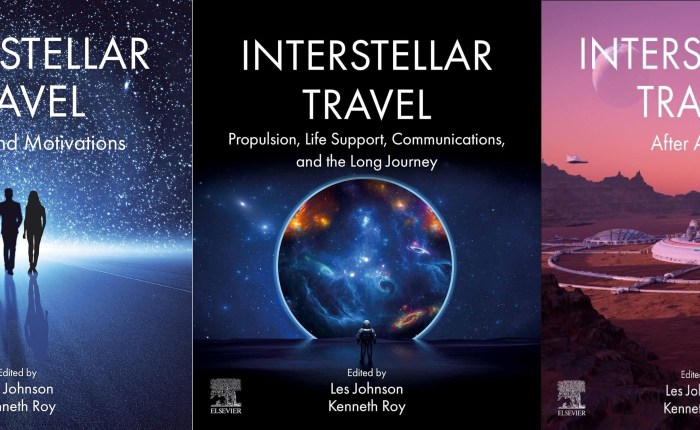
I was honored, to say the least. I imagine they do this all the time, but on this particular occasion, they put my face on their podcast series. Little ol’ me, how about that? Anyway, it was a lovely reminder of a very good interview I had with a distinguished science fiction author and award-winning podcaster and videographer. The subject of our chat was the chapter I wrote for the anthology The Ross 248 Project, a collection of SF shorts and science essays (edited by NASA scientists Les Johnson and Ken Roy) that explores the possibility of terraforming planets that orbit red dwarf suns.

This one is not so long, so please feel free to check it out:

My Interview with AADYA Geo Talks!

My Interview with AADYA Geo Talks!

A few months back, I had the honor of appearing on AADYA Geo Talks, the podcast series launched by Bharti Sharma and the organization she founded – AADYA, whose name means “origin” in Hindi. As a geologist and world-traveller, Sharma launched this organization to promote knowledge about planetary and geoscience and create opportunities for collaborative research to address critical global challenges. 

During the interview, we talked about how I got into science journalism, my podcast series, and my science fiction writing. The interview lasted for more than an hour because she asked great questions about a range of wonderful topics (and she let me talk for as long as I wanted!) Here’s how she described our conversation:

“In this episode of AADYA Geo Talks, we explore the mind of a space journalist who has spent years unraveling the wonders of the universe. From the allure of dark matter to the search for extraterrestrial life, Matthew takes us on a journey through the most fascinating corners of space science. But here’s where it gets even more intriguing—science fiction has always fueled real-world space missions. “

Check it out, and watch it in segments if you need to! Also, visit the AADYA website to learn more about their education, outreach, and collaborative efforts.

Public Service Announcement!

Public Service Announcement!

The following is an appeal to public mental health and reason. Have you or someone you love been accused of suffering from TDS? If so, you are entitled to clarification on this condition and what sufferers experience. Here is the proper definition of TDS and recommendations on how you or someone you love can prevent and (if necessary) treat this condition.

Trump Derangement Syndrome: (noun) A condition where subjects lose their capacity for rational thought, empathy, and civility upon endorsing Donald J. Trump (hereafter, DJT). Other symptoms include paranoid delusions, belief in conspiracy theories, and retrograde amnesia – most notably, the loss of all memory pertaining to previous opinions and statements made about Trump.

Cases of collective TDS have also been noted, in which subjects experience a notable decline in their ability to reason and think intelligently due to exposure to DJT. Long-term symptoms include the repetition of false statements (without thought or reflection) made by DJT and his supporters.

Multiple instances have been reported, including references to DEI, CRT, BLM, ACA, DREAM, LGBTQ+, NWO, and other abbreviations. In all cases, subjects display complete and total ignorance of these concepts but vehemently condemn them and blame them for all the problems facing society – as well as the delusional belief that only DJT and his policies can protect them.”

Some common examples of conspiracy theories associated with DJT include (but are not limited to), White Genocide, Flat-Earth Theory, Replacement Theory, Creationism, False Flag operations, and a belief in something called “The Deep State.” Other well-documented delusions include the belief that:

  • Vaccines contain microchips
  • The 26+ women he raped or assaulted are “liars”
  • Immigrants are eating your pets
  • Democrats abort babies after they’re born
  • Democrats are “grooming children”
  • Schools are performing gender transition surgery
  • Trump won the 2020 election
  • The election was “stolen” by left-wingers, some now deceased
  • There’s a vast media conspiracy to hurt DJT
  • Elites are out to get Trump because he “drained the swamp.”
  • Ukraine started the war with Russia
  • Ukraine is losing the war with Russia
  • Ukraine is run by Nazis
  • Nazis are a left-wing political movement
  • Tariffs will correct “economic injustice”
  • Trump is the most “persecuted” president in U.S. history

Warning signs that you or someone you love may be suffering from DJT include (but are not limited to) using the following terms unironically:

  • “Left-wing conspiracy”
  • “Drain the swamp”
  • “Rigged!”
  • “Let’s go Brandon!”
  • “FoxNews rules”
  • “Deep State”
  • “Third Term”
  • “Lamestream media”

Luckily, DJT is a treatable condition, except in extreme cases where the subject suffers from additional personality disorders and/or mental illnesses – especially when combined with extravagant wealth. Treatment options include:

  • Turning off FoxNews
  • Turning off Newsmax, OANN, Breitbart, and other alt-right “news”
  • Unsubscribing from Truth Social
  • Unsubscribing from X
  • Leaving FB chat groups
  • Limiting time on social media and internet forums
  • Stepping outside and interacting with people different than you
  • Reading a book, especially one that’s not a right-wing polemic
  • Exposure therapy to gay, trans people, and people of color
  • Empathy workshops
  • White and male privilege checks
  • Listening to family members you cut ties with over Trump

This has been a public service announcement. Good night, and good luck! Seriously, GOOD LUCK!

Episode 97 of Stories from Space is Now Live!

Episode 97 of Stories from Space is Now Live!

For this week’s episode, I had a very special guest: Dr. Moriba Jah, a man with more titles, credentials, and honors than I could possibly fit into a single paragraph. Check out his website if you doubt me or just want to know what they all are. But to give you the TL: DR version, Moriba Jah is a Professor of Aerospace Engineering and Engineering Mechanics at The University of Texas at Austin. He’s a major advocate for the “stewardship” of Earth and space and a promoter of sustainable living in both.

He has worked extensively with NASA, the Air Force Research Laboratory, and several premier academic institutions. He is also well-traveled and has earned a wide following for his advocacy for sustainability and humanity’s future in space. If we are to live beyond Earth, he states, humanity must either evolve by means of augmentation (homo machina), or we will need to take Earth’s systems with us – meaning bioregenerative life support systems and living, or Terraforming.

He’s been interviewed and featured by so many outlets and in so many forums that I consider myself the luckiest podcaster to actually secure an interview with him. Follow the links to learn more and hear some truly quotable quotes!

Where to Listen:

Episode 96 of Stories from Space is now Live!

Episode 96 of Stories from Space is now Live!

Forgive me for the late announcement, folks, but life has been rather busy lately. In any case, the latest episode of SfS is out, and the subject is, “What discoveries has the James Webb Space Telescope made so far?” This is a subject that I’m rather fond of, given the many scientific breakthroughs that have come from Webb’s three General Observations cycles. They are now into number four, which I am covering for Universe Today. And this has made me want to take stock of everything this next-generation observatory has revealed about the Universe until now.

The breakthroughs it has allowed for can be broken down into three categories: galaxies that existed in the very early Universe, the first supermassive black holes (SMBHs), and exoplanet characterization. Check the links below to hear more!

Where to Listen:

Episode 95 – WTF is Happening at NASA? (Part II) – is Now Live!

Episode 95 – WTF is Happening at NASA? (Part II) – is Now Live!

In this two-part episode, I interviewed former NASA scientist and astrobiologist Keith Cowing, the creator and editor of NASA Watch and Astrobiology.com. In part I, we discussed the current state of things at NASA amid the DOGE shakeup (somewhere between uncertainty and total chaos). In this installment, we followed this up with a look at how NASA’s long-term plans, which have changed many times in the past twenty years. Follow the links below to learn more.

Where to Listen:

Episode 94 – WTF is Happening at NASA? (Part I) – is Now Live!

Episode 94 – WTF is Happening at NASA? (Part I) – is Now Live!

This week’s episode was a special treat! I sat down with former NASA scientist and astrobiologist Keith Cowing, the creator and editor of NASA Watch and Astrobiology.com. Keith’s extensive experience as an industry insider and a scientist has made him a trusted news source for millions of people, including myself. In his time, he witnessed many developments and advancements and played a major part in advancing the fields of astrobiology and space exploration.

He is a trained biologist, a specialist in payloads and biospecimen containment, and was part of the -Space Station Freedom Program. He is also very well-traveled, having been to Nepal and the Arctic Circle and even participated in centrifuge training and zero-g flights. I only got to hear a bit about all those experiences during our chat, but we got deep into discussing the current state of things at NASA. Our talk went so long, I had to break it into two segments to do it justice.

Follow the links below to hear Part I of our interview.

Where to Listen:

Episode 93 of Stories from Space is now Live!

Episode 93 of Stories from Space is now Live!

This week, I sat down with Dr. Will Grundy, an astronomer and planetary scientist with the Lowell Observatory—the place where Dr. Tombaugh discovered Pluto in 1930! Who better to speak to about Pluto and the “Great Planet Debate”? The debate began in the early 2000s with the discovery of many new objects orbiting beyond Pluto. It was “resolved” with the IAU decision of 2006 that defined a planet as a celestial body that:

(a) is in orbit around the Sun, (b) has sufficient mass for its self-gravity to overcome rigid body forces so that it assumes a hydrostatic equilibrium (nearly round) shape, and (c) has cleared the neighbourhood around its orbit.”

As you’ll see in this episode, the debate is far from over and can get pretty contentious. Planetary scientists, astrogeologists, and people from other disciplines have criticized the IAU’s rather narrow definition and believe that planethood should be extended to all the major bodies of our Solar System. Follow the links below to learn why…

Where to Listen: