
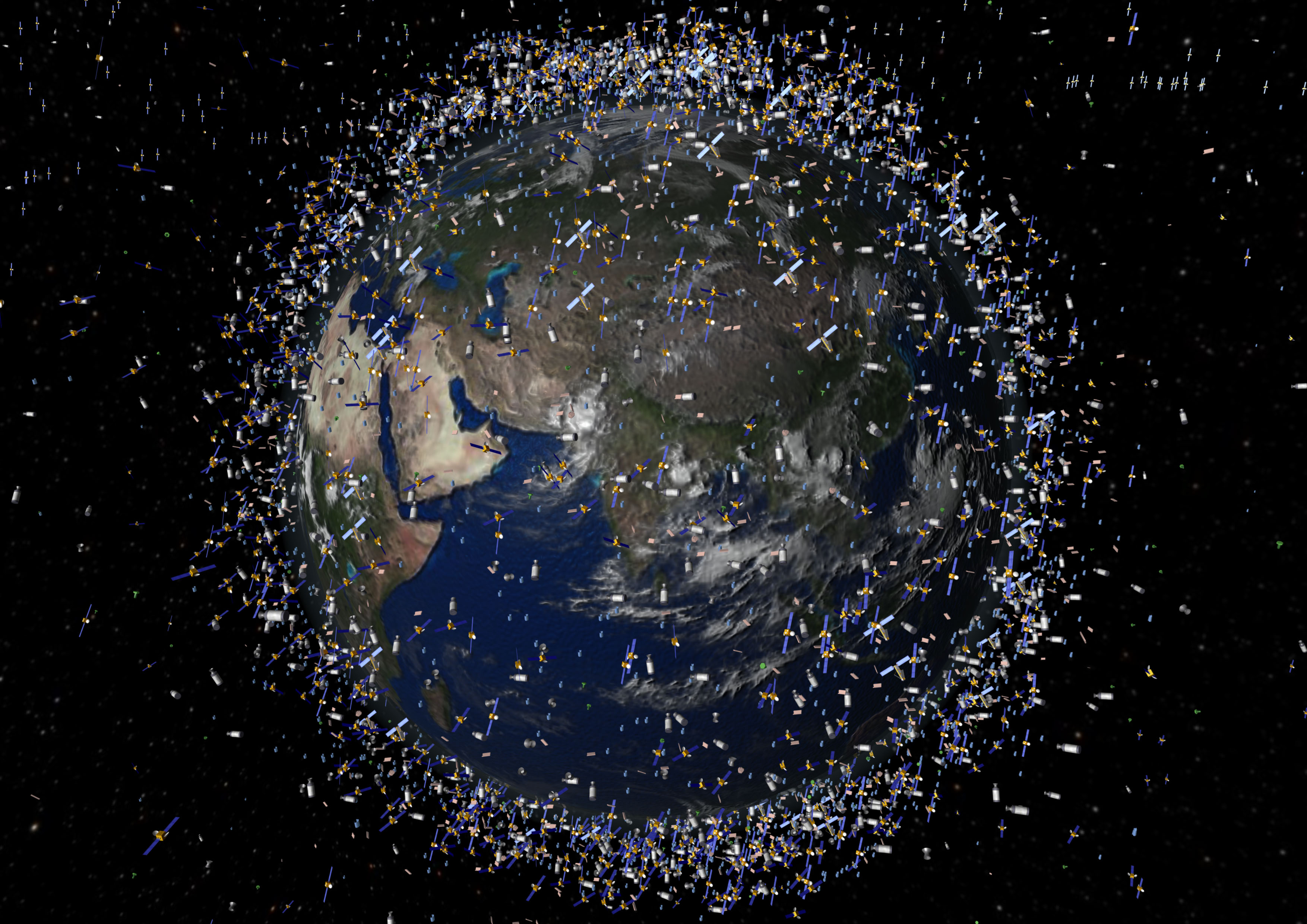
 It’s no secret that the orbital space lanes are clogged with debris. In fact, our upper atmosphere is so clogged with the remains of dead satellites, old rockets, and assorted space garbage, that initiatives are being planned to remedy the situation. The ESA, for example, has the Clean Space Initiative; and the e.DeOrbit mission that aims to send debris-hunting satellites into orbit to clean up the mess.
The aim of this mission is to clean up the important polar orbits between altitudes of 800 to 1,000 km (500 to 625 mil) that face the prospect of becoming unusable due to the increasing buildup of space debris. As part of the plan, the ESA is also investigating the possibility of using space harpoons to capture large items, such as derelict satellites and the upper stages of rockets.
 This is just the latest in a series of possible plans to capture debris. In the past, the ESA has revealed that it was looking at capturing space debris in a net, securing it with clamping mechanisms, or grabbing hold of it using robotic arms. However, the latest possibility calls for using capturing debris with a tethered harpoon, which would pierce the debris with a high-energy impact before reeling it in.
Such an approach would not be practical for smaller debris, but is aimed at reeling in uncontrolled multitonne objects that threaten to fragment when colliding with other objects. These sorts of collisions result in debris clouds that would steadily increase in density due to the Kessler syndrome – a scenario in which the density of orbital debris is high enough that collisions generates more debris, increasing the likelihood of further collisions.
 The ESA says the space harpoon concept has already undergone initial investigations by Airbus Defense and Space in Stevenage – two aerospace developers based in the UK. The preliminary design incorporates a penetrating tip, a crushable cartridge to help embed it in the target satellite structure, and barbs to keep it sticking in so the satellite can then be reeled in.
The initial tests involved shooting a prototype harpoon into a satellite-like material to assess its penetration, the strength of the harpoon and tether as the target is reeled in, and the potential for the target to fragment, which would result in more debris that could threaten the e.DeOrbit satellite. The ESA now plans to follow up these initial tests by building and testing a prototype version of the harpoon and its ejection system.
 The project will examine the harpoon impact, target piercing and the reeling in of objects using computer models and experiments, ultimately leading up to a full hardware demonstration. The space agency has put out the call for bidders to compete for the project contract, and hopes to be sending a working model into orbit by 2021 to conduct some much-needed housecleaning.
Naturally, there are other proposals being considered for debris-hunting. Between the ESA and NASA, there’s also the EPFL’s CleanSpace One debris hunter, and the Universities Space Research Association anti-collision laser concept. And while these remains still very much in the RandD phase, clearing the space lanes is likely to become a central issue once regular missions are mounted to Mars and the outer Solar System.
Sources: gizmag.com, esa.int

 Stories by Williams