
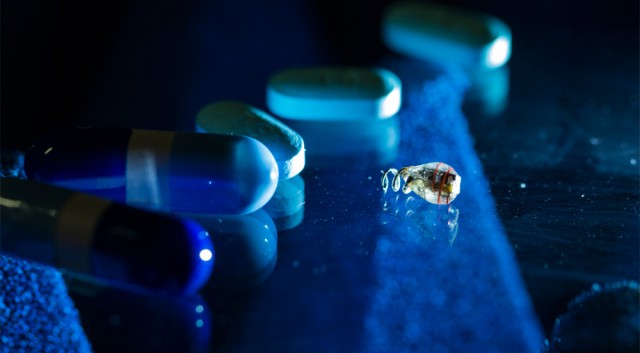
 Hard on the heels of their proposed BRAIN initiative – a collaborative research initiative to map the activity of every neuron in the human brain – DARPA has announced a bold new program to develop tiny electronic implants that will be able to interface directly with the human nervous system to control and regulate many different diseases and chronic conditions, such as arthritis, PTSD, Crohn’s disease, and depression.
The program, called ElectRx (pronounced ‘electrics’), ultimately aims to replace medication with “closed-loop” neural implants which monitor the state of your health and then provide the necessary nerve stimulation to keep your organs and biological systems functioning properly. The work is primarily being carried out with US soldiers and veterans in mind, but the technology will certainly percolate down to civilians as well.
 The ElectRx program will focus the relatively new area of medical therapies called neuromodulation, which seeks to modulate the nervous system to improve neurological problem. Notable examples of this are cochlear implants which restore hearing by modulating your brain’s auditory nerve system, and deep brain stimulation (DBS) which is apparently capable of curing/regulating conditions like depression and Parkinson’s by overriding erroneous neural spikes.
So far, these implants have been fairly large, which makes implantation fairly invasive and risky. Most state-of-the-art implants also lack precision, with most placing the stimulating electrodes in roughly the right area, but which are unable to target a specific bundles of nerves. With ElectRx, DARPA wants to miniaturize these neuromodulation implants so that they’re the same size as a nerve fiber.
 This way they can be implanted with a minimally invasive procedure (through a needle) and attached to specific nerve fibers, for very precise stimulation. While these implants can’t regulate every condition or replace every medication (yet), they could be very effective at mitigating a large number of conditions. A large number of conditions are caused by the nervous system misfiring, like inflammatory diseases, brain and mental health disorders.
Currently, a variety of drugs are used to try and cajole these awry neurons and nerves back in-line by manipulating various neurotransmitters. However, the science behind these drugs is not yet exact, relying heavily on a trial-and-error approach and often involving serious side-effects. Comparatively, an electronic implant that could “catch” the misfire, cleans up the signal, and then retransmits it would be much more effective.
 As DARPA’s Doug Weber explained:
The technology DARPA plans to develop through the ElectRx program could fundamentally change the manner in which doctors diagnose, monitor and treat injury and illness. Instead of relying only on medication — we envision a closed-loop system that would work in concept like a tiny, intelligent pacemaker. It would continually assess conditions and provide stimulus patterns tailored to help maintain healthy organ function, helping patients get healthy and stay healthy using their body’s own systems.
Despite requiring a lot of novel technological breakthroughs, DARPA is planning to perform human trials of ElectRx in about five years. The initial goal will be improving the quality of life for US soldiers and veterans. And while they have yet to announce which conditions they will be focusing on, it is expected that something basic like arthritis will be the candidate – though there are expectations that PTSD will become a source sooner other than later.
 And this is just the latest neurological technology being developed by DARPA. Earlier in the year, the agency announced a similar program to develop a brain implant that can restore lost memories and experiences. A joint fact sheet released by the Department of Defense and the Veteran’s Association revealed that DARPA also secured 78 million dollars to build the chips as part of the government’s Brain Research through Advancing Innovative Neurotechnologies (BRAIN) program.
While DARPA’s ElectRx announcement is purely focused on the medical applications of miniature neural implants, there are of course a variety of other uses that might arise from elective implantation – for soldiers as well as civilians. With a few well-placed implants in a person’s spine, they could flip a switch and ignore any pain reported by your limbs, allowing them to withstand greater physical stress or ignore injuries.
 Implants placed in muscle fibers could also provide added electrostimulation to provide extra boosts of raw muscle power. And With precision-placed implants around the right nerve fibers, people could gain manual control of their organs, allowing them to speed up or slow down their hearts, turbo-charge their livers, or tweak just about any other function of their bodies.
The age of the Transhuman looms, people!
Source: extremetech.com, motherboard.vice.com, darpa.mil

 The Optionally Piloted Black Hawk (OPBH) operates under Sikorsky’s Manned/Unmanned Resupply Aerial Lifter (MURAL) program, which couples the company’s advanced Matrix aviation software with its man-portable Ground Control Station (GCS) technology. Matrix, introduced a year ago, gives rotary and fixed-wing vertical take-off and landing (VTOL) aircraft a high level of system intelligence to complete missions with little human oversight.
 The Optionally Piloted Black Hawk fits into the larger trend of the military finding technological ways of reducing troop numbers. While it can be controlled from a ground control station, it can also make crucial flying decisions without any human input, relying solely on its ‘Matrix’ proprietary artificial intelligence technology. Under the guidance of these systems, it can fly a fully autonomous cargo mission and can operate both ways: unmanned or piloted by a human.
 Military aircraft have grown increasingly complex over the past few decades, and automated systems have also evolved to the point that some aircraft can’t be flown without them. However, the complex controls and interfaces require intensive training to master and can still overwhelm even experienced flight crews in emergency situations. In addition, many aircraft, especially older ones, require large crews to handle the workload.
 DARPA says that it wants ALIAS to not only be capable of executing a complete mission from takeoff to landing, but also handle emergencies. It would do this through the use of autonomous capabilities that can be programmed for particular missions, as well as constantly monitoring the aircraft’s systems. But according to DARPA, the development of the ALIAS system will require advances in three key areas.



 Stories by Williams