
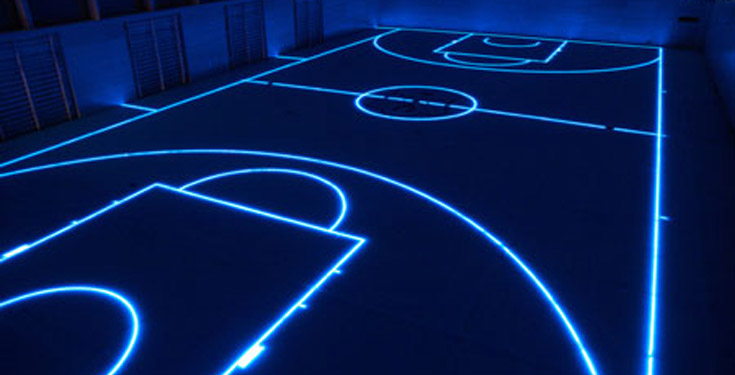
 It looks like something out of Tron, doesn’t it? In truth, its LED lights underneath a glass surface, but the end result is nothing short of awesome, not to mention convenient. It’s known as the ASB Glassfloor, the latest creation from German manufacturer Germany’s ASB Systembau. Using a system where an aluminum substructure supports the surface and LED’s provide light lines, a gymnasium or sports arena can be converted from a volleyball court, to a basketball court, to a series of tennis courts by simply pushing a button.
What’s more, ceramic dots on the glass re-create the feel of a wooden surface, while special etchings diffuse the LED light and prevent glare from bothering athletes. And for those who worry that the entire thing will shatter as soon as the home team takes the floor, know that this “glass” is actually a high-tech tempered security variety that is actually more durable and longer lasting than a conventional wood floor, meaning it can bear the weight of multiple teams, and is even available in different colors.
And finally, the company also indicated that since the floor’s are basically one large display device, that they can be programmed to broadcast ads in certain spaces, and that the entire floor itself can be turned into a single screen. Hence, while the player’s are playing, people can also enjoy small ads running in the end zone or sidelines, just in case they felt sports weren’t saturated by enough product placements! And at halftime, the floor can put on a show, either on its own or with the help of cheerleaders and a marching band.
My, with all the new display technologies and high-tech surfaces coming out, one would think the entire future is going to be made of “smart glass” and inundated with images and texts. Seems nobody can be satisfied with a simple, non-augmented window or floor anymore. Oh well, it looks cool and that’s what matters!
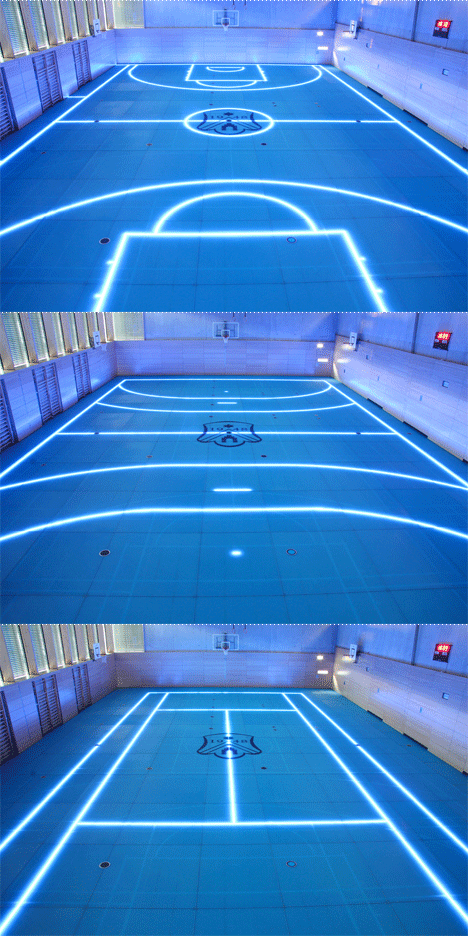 To see the Glassfloor in action, click on the gif image above, or watch the video below:

 Stories by Williams