 Look what you started, Nicolla 😉 After talking, at length, about the history of computing a few days ago, I got to thinking about the one aspect of the whole issue that I happened to leave out. Namely, the future of computing, with all the cool developments that we are likely to see in the next few decades or centuries.
Much of that came up in the course of my research, but unfortunately, after thirteen or so examples about the history of computing, I was far too tired and burnt to get into the future of it as well. And so, I carry on today, with a brief (I promise!) list of developments that we are likely to see before the century is out… give or take. Here they are:
Chemical Computer:
 Here we have a rather novel idea for the future of hardware. Otherwise known as a reaction-diffusion or “gooware” computer, this concept calls for the creation of a semi-solid chemical “soup” where data is represented by varying concentrations of chemicals and computations are performed by naturally occurring chemical reactions.
Based on the Belousov-Zhabotinsky reaction, a chemical experiment which demonstrated that wave phenomena can indeed take place in chemical reactions, contradicting the theory of thermodynamics which states that entropy will only increase in a closed system. By contrast, the BZ experiments showed that cyclic effects can take place without breaking the laws of nature.
Amongst theoretical models, it remains a top contender for future use for the simple reason that it is far less limiting that current microprocessors. Whereas the latter only allows the flow of data in one direction at a time, a chemical computer theoretically allows for the movement of data in all directions, all dimensions, both away and against each other.
For obvious reasons, the concept is still very much in the experimental stage and no working models have been proposed at this time.
DNA Computing:
 Yet another example of an unconventional computer design, one which uses biochemistry and molecular biology, rather than silicon-based hardware, in order to conduct computations. Originally proposed by Leonard Adleman of the University of Southern Calfornia in 1994, Adleman was able to demonstrate how DNA could be used to conduct multiple calculations at once.
Much like chemical computing, the potential here is to be able to build a machine that is not restricted as conventional machines are. In addition to being able to compute in multiple dimensions and directions, the DNA basis of the machine means it could be merged with other organic technology, possibly even a fully-organic AI (a la the 12 Cylon models).
While progress in this area remains modest thus far, Turing complete models have been constructed, the most notable of which is the model crated by the Weizmann Institute of Science in Rehovot, Israel in 2002. Here, researchers unveiled a programmable molecular computing machine composed of enzymes and DNA molecules instead of silicon microchips which would theoretically be capable of diagnosing cancer in a cell and releasing anti-cancer drugs.
Nanocomputers:
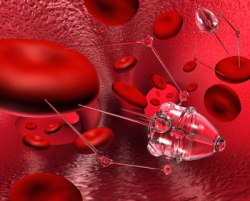 In keeping with the tradition of making computers smaller and smaller, scientists have proposed that the next generation of computers should measure only a few nanometers in size. That’s 1×10⁻⁹ meters for those who mathematically inclined. As part of the growing field of nanotechnology, the application is still largely theoretical and dependent on further advancements. Nevertheless, the process is a highly feasible one with many potential benefits.
Here, as with many of these other concepts, the plan is simple. By further miniaturizing the components, a computer could be shrunk to the size of a chip and implanted anywhere on a human body (i.e. “Wetware” or silicate implants). This will ensure maximum portability, and coupled with a wireless interface device (see Google Glasses or VR Contact Lenses) could be accessed at any time in any place.
Optical Computers:
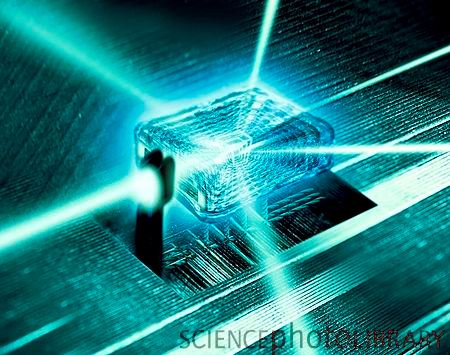
 Compared to the previous two examples, this proposed computer is quite straightforward, even if it radically advanced. While today’s computer rely on the movement of electrons in and out of transistors to do logic, an optical computer relies on the movement of photons.
The immediate advantage of this is clear; given that photons are much faster than electrons, computers equipped with optical components would be able to process information of significantly greater speeds. In addition, researchers contend that this can be done with less energy, making optical computing a potential green technology.
Currently, creating optical computers is just a matter of replacing electronic components with optical ones, which requires an optical transistor, which are composed of non-linear crystals. Such materials exist and experiments are already underway. However, there remains controversy as to whether the proposed benefits will pay off, or be comparable to other technologies (such as semiconductors). Only time will tell…
Quantum Computers:
 And last, and perhaps most revolutionary of all, is the concept of quantum computing – a device which will rely on the use of quantum mechanical phenomena to performs operations. Unlike digital computers, which require that data to be encoded into binary digits (aka. bits), quantum computation utilizes quantum properties to represent data and perform calculations.
The field of quantum computing was first introduced by Richard Feynman in 1982 and represented the latest advancements in field theory. Much like chemical and DNA-based computer designs, the theoretical quantum computer also has the ability to conduct multiple computations at the same time, mainly because it would have the ability to be in more than one state simultaneously.
The concept remains highly theoretical, but a number of experiments have been conducted in which quantum computational operations were executed on a very small number of qubits (quantum bits). Both practical and theoretical research continues, and many national government and military funding agencies support quantum computing research to develop quantum computers for both civilian and national security purposes, such as cryptanalysis.
Wearable Computers:
 Last, and most feasible, is the wearable computer, which has already been developed for commercial use. Essentially, these are a class of miniature electronic devices that are worn on the bearer’s person, either under or on top of clothing. A popular version of this concept is the wrist mounted option, where the computer is worn like a watch.
The purposes and advantages of this type of computer are obvious, especially where applications that require more complex computational support than hardware coded logics can provide. Another advantage is the constant interactions between user and computer, as it is augmented into all other functions of the user’s daily life. In many ways, it acts as a prosthesis, being an extension of the users mind and body.
Pretty cool, huh? And to think that these and possibly other concepts could be feasible within our own lifetimes. Given the current rate of progress in all thing’s high-tech, we could be looking at fully-integrated computer implants, biological computers and AI’s with biomechanical brains. Wouldn’t that be both amazing and potentially frightening!

 Computing has come so far in such a relatively short space of time. Beginning with comparatively basic models, which relied on arrangements of analogue circuits (such as capacitors and resistors), scientists were able to perform complex calculations, crack impenetrable cyphers, and even know how and where to deploy counter-measures against incoming missiles. And as we all know, sometimes you have to look back to the fundamentals if you want to move any farther ahead.
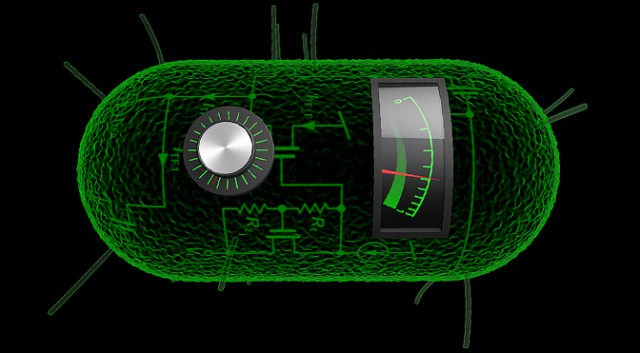 This news comes on the heels of researchers at Stanford who were able to create a biological transistor inside a cell. Relying on DNA and RNA to create a “transcriptors”, the Standford researchers were able to create a biological logic gate, and all on the microscopic scale. When combined the sorts of digital and analog circuits common to computing, this research could lead to powerful sensing and control platforms built on very small scales.
  What this means is that we could be very well seeing the beginning of biology that is enhanced and augmented by the addition of technology on the cellular level. And not in the sense of tiny machines or implants, things made of silicon and minerals that would regulate our blood flow, administer drugs or monitor or vitals. No, in this case, we would be talking about machines that are composed of self-regulating DNA and RNA and work in the same way our organic tissues do.
 And you know what that means, don’t you? The line between biological and artificial would truly begin to dissolve, Voight-Kampff and genetic tests might have to become mandatory, and we could all be looking at robots that look something like this…




 Stories by Williams