
 As part of their desire to once again conduct launches into space from US soil, NASA recently awarded commercial space contracts worth $6.8 billion to Boeing and SpaceX. But beyond restoring indigenous spaceflight capability, NASA’s long-term aim is clearly getting a manned mission to Mars by 2030. And in assigning the necessary money to the companies and visionaries willing to help make it happen, they just might succeed.
As per the agreement, Boeing will receive $4.2 billion to finance the completion of the CST-100 spacecraft, and for up to six launches. Meanwhile, SpaceX is receiving $2.6 billion for its manned Dragon V2 capsule, and for up to six launches. NASA expressed excitement its collaboration with both companies, as it frees the agency up for bigger projects — such the development of its own Space Launch System (SLS).
 One person who is sure to be excited about all this is Elon Musk, SpaceX founder, CEO, and private space visionary. With this big infusion of cash, he has apparently decided that it’s time to bring his plans for Mars forward. Ever since 2007, Musk has indicated a desire to see his company mount a manned mission to Mars, and now he may finally have the resources and clout to make it happen.
These plans include flying astronauts to Mars by 2026, almost a decade before NASA thinks it will. By late 2012, he even spoke about building a Mars Colony with a population in the tens of thousands, most likely established sometime during the 2020’s. As of this past year, he has also revealed details about a Mars Colonial Transporter (MCT), an interplanetary taxi that would be capable of ferrying 100 people at a time to the surface.

And then in February of this year, SpaceX began developing the MCT’s engines. Known as the Raptor, this new breed of large engine reportedly has six times the thrust of the Merlin engines that power the second stage of the Falcon 9 rocket. Now that the company has the financial resources to dream big, perhaps the MCT might move from the development stage to prototype creation.
And there is certainly no shortage of desire when it comes to sending people to the Red Planet. Together with Mars Society president Robert Zubrin, and Mars One co-founder Bas Lansdorp, crowdfunded organizations are also on board for a manned mission. The case for settling it, which Musk himself endorses, is a good one – namely, that planting the seed of humanity on other worlds is the best way to ensure its survival.
 And as Musk has stated many times now, a manned mission Mars is the reason there is a SpaceX. Back in 2001, while perusing NASA’s website, he was perturbed to find that the space agency had nothing in the way of plans for a mission to Mars. And the best time to go is probably in about 15 or 20 years, since Mars will be at its closes to Earth by then – some 58 million kilometers (36 million miles).
During this window of opportunity, the travel time between Earth and Mars will be measured in terms of months rather than years. This makes it the opportune time to send the first wave of manned spacecraft, be they two-way missions involving research crews, or one-way missions involving permanent settlers. Surprisingly, there’s no shortage of people willing to volunteer for the latter.
 When Mars One posted its signup list for their proposed mission (which is slated for 2025), they quickly drew over 200,000 applicants. And this was in spite of the fact that the most pertinent details, like how they are going to get them there, remained unresolved. Inspiration Mars, which seeks to send a couple on a round trip to Mars by 2021, is similarly receiving plenty of interest despite that they are still years away from figuring out all the angles.
In short, there is no shortage of people or companies eager to send a crewed spaceship to Mars, and federal agencies aren’t the only ones with the resources to dream big anymore. And it seems that the technology is keeping pace with interest and providing the means. With the necessary funding now secured, at least for the time being, it looks like the dream may finally be within our grasp.
Though it has yet to become a reality, it looks like the first Martians will actually come from Earth.
Sources: extremetech.com, (2), sploid.gizmodo.com, mars.nasa.gov


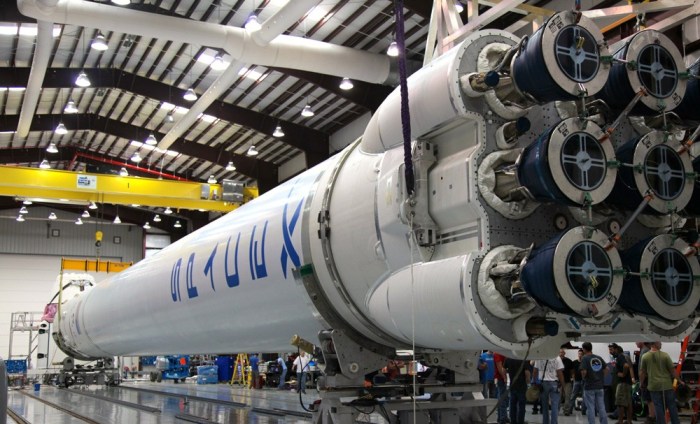
 Other notable features include the propellent, which is a pair of non-cryogenic liquids – monomethyl hydrazine for the fuel and nitrogen tetroxide for the oxidizer. These are hypergolic, meaning that they ignite on contact with one another, which helps the SuperDraco to restart multiple times. It’s also built to be deep throttled, and can go from ignition to full throttle in 100 ms. But what really sets the SuperDraco apart is that is has 200 times the power of the Draco engine, which works out to 7,440 kg (16,400 lbs) of thrust.
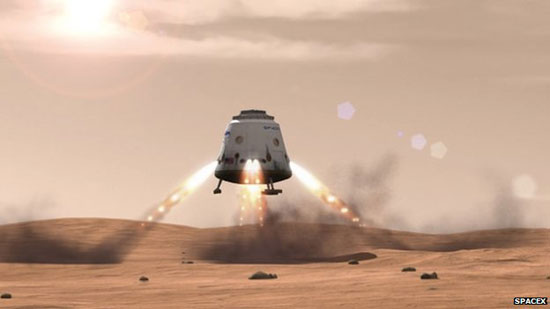
 Eight engines firing for five seconds are enough to carry the capsule safely away from the booster with 120,000 lb of axial thrust. In addition, the eight engines also provide a high degree of redundancy should one or more engines fail. But what’s really ambitious about the SuperDraco is that, like the Falcon 9 booster, the Dragon is designed to ultimately return to its spaceport under its own power and land with the precision of a helicopter, and it’s the power and control of the SuperDraco that makes this possible.
 But equally impressive was the unveiling of the Dragon V2 manned space capsule, which took place at a brief media event at SpaceX’s Hawthorne, California headquarters at the end of May. This larger, more powerful version of the reusable Dragon capsule will one day carry astronauts to the International Space Station (ISS) and return to Earth to land under its own power. This latest development brings the company one step closer towards its ultimate goal of a fully reusable manned capsule capable of making a powered landing.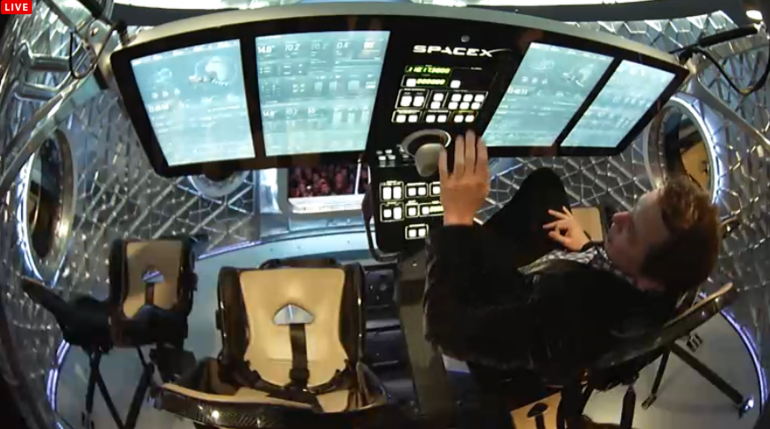
 Stories by Williams