
Hey all! I have more in the way of novel-writing news. For starters, The Cronian Incident is now just a few chapters short of completion. After over a year of writing, editing, and back and forth with my prospective-publisher, the novel is just about finished. All told, it is now 31 chapters long and just over 85,000 words in length. I anticipate it will be about 100,000 by the time its finished, though I have been known to exceed estimates in the past!
And as per my agreement with my publisher, I have begun working on its sequel. Apparently, publishers like to know the people they sign have more books in them. And they prefer to release sequels within a few months of the first book, to ensure that any buzz they generate with the first release can be capitalized on. Lucky for me I had plans for a second and third novel before my publisher and I started talking, not to mention some spin offs.
So here’s the commercial description for the proposed sequel (i.e. what you’d read on the back of the dust jacket), as well as a rundown on some other ideas I’m working on:
The Jovian Manifesto:
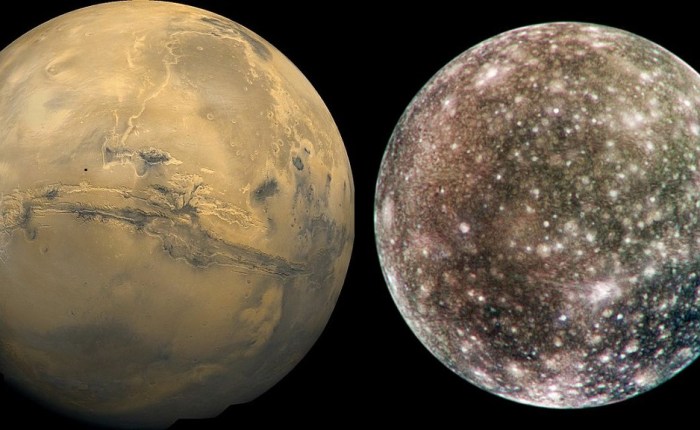
The Solar System is in the midst of a crisis. In the Jovian and Cronian systems, the populations are up in arms, thanks to an inflammatory document that has appeared on the local nets. Known as “The Jovian Manifesto”, this document details how a powerful faction in the Inner Solar System conspired to seize control over the moons of Callisto and Titan and forcibly alter them. Behind the leak is a mysterious personality known only as Clio, who is threatening to release all the details unless the guilty parties come forward.

Back on Venus, a former analyst named Valéria Gallego is called before the Solar Assembly to investigate the Manifesto and its author. In this, she is assisted by Kadera, an infiltration specialist who can get in and out of any location in the Solar System. If they can determine its authenticity, perhaps they can prevent open conflict. But if not, the Inner Worlds may have no choice but to send armed forces to the Outer Worlds to ensure peace and stability.
Meanwhile, a string of violent acts has threatened to bring things ever closer to the brink. For Gallego and all those who are seeking the truth, time is running out…
Luna Invictus:
Now this is a book that doesn’t come with a commercial description, just a general one. But it is set in the same universe as The Cronian Incident and The Jovian Manifesto. Here’s what I am thinking. Basically, I wanted to do a story set on the Moon, ca. the 22nd century, when the Moon is now effectively colonized,,,
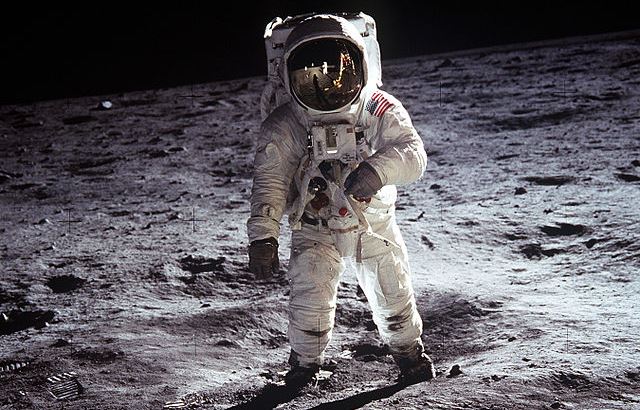
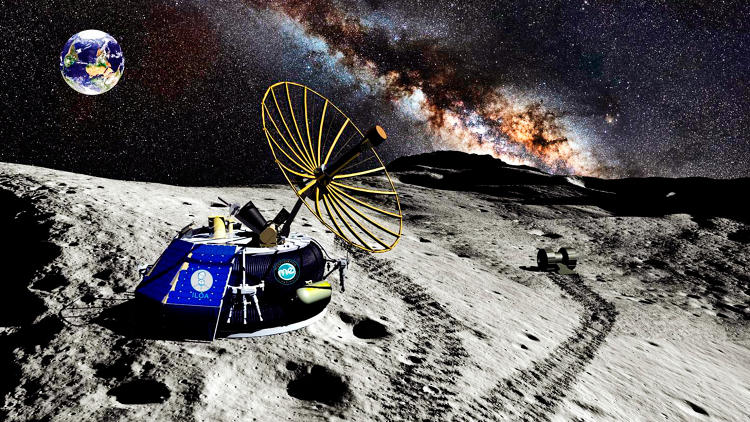
Between the European Space Agency (ESA), NASA, the Russians (Roscosmos), India (the ISRO), and China (CNSA), the lunar surface now has multiple permanent settlements. Whereas the ESA and NASA have established themselves at the southern polar region – in a domed settlement in the Shackleton Crater – and the Chinese have established a colony in the northern polar region, the Russians and Indians have claimed the mid-latitudes, where stable lava tubes have allowed for the creation of underground cities.

And on the “Dark Side” of the Moon – that is to say, the side looking away from Earth – are a series of installations known as the Unrestricted Zones. It is here that all kinds of weird research, development and experiments take place. Nanotechnology, biotechnology, quantum computing, and man-machine interface – anything goes in these places! Ever since the explosion in learning that took place during the previous century, places all over Earth and the Moon have become dedicated to pursuing technological progress and integration without restriction.
And it is here that a young man named Frankling Houte is seeking to go. Years ago, his sister – named Constant Houte – chose to undergo a procedure where her organic brain would be augmented by merging it with quantum components. But after all contact ceased, he is determined to find her and return her home. But whereas Franklin fancies himself a brave rescuer, it is his sister who will come to save him.
Transverse:
This story will take place entirely in a generation ship that is making its way towards the nearby star system. Within the confines of this self-contained world, thousands of humans have committed to waiting and working for generations as their massive ship – the Traverse Velocity, which in astronomical terms refers to the speed at which a star moves perpendicular to our line of sight – transports them to an Earth-like world outside of our Solar System.
The location of that world is up for grabs at the moment, mainly because new discoveries are being made all the time. Did you hear about the latest exoplanet discovery, located about 39 light years away and already said to be the “best place to look for signs of life beyond the Solar System”? Between that and new findings that claims how previous discoveries are not likely to be habitable after all, I’ve decided to leave the destination blank until I actually start writing it!
 But of course, no story would be complete without some intrigue and big ol’ inciting event! And the way I see it, things begin to go awry when the Captain and crew get notification that one of the passengers has awakened from cryosleep prematurely and disappeared into the ship. Shortly thereafter, one of the crew is found dead in what appears to be a sabotage attempt gone wrong. A ship-wide search begins to find the culprit while the atmosphere quickly devolves into one of paranoia and suspicion.
To make matter worse, the crew becomes aware of another ship that is threatening to catch up and overtake them. It seems that another faction from the Solar System, which was also intent on settling (insert exoplanet here) is now trying to get their ahead of them. What began as a journey to a new world, characterized by hopes and dreams, has become a race to lay claim to a planet. And it appears that the planet may have inhabitants of its own, ones which are not interested in welcoming the intruders.


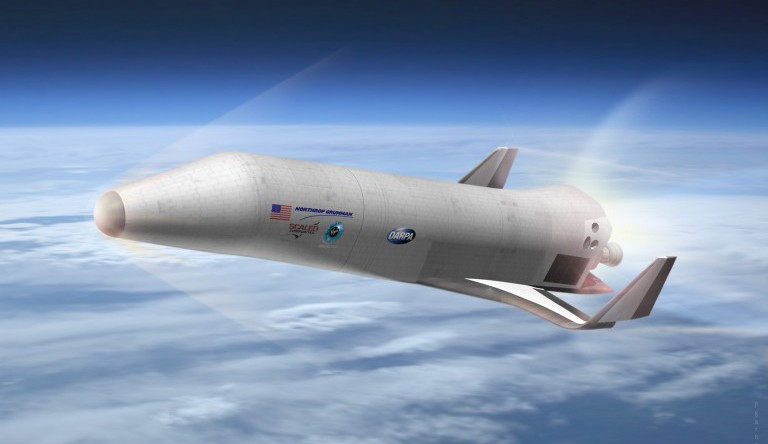


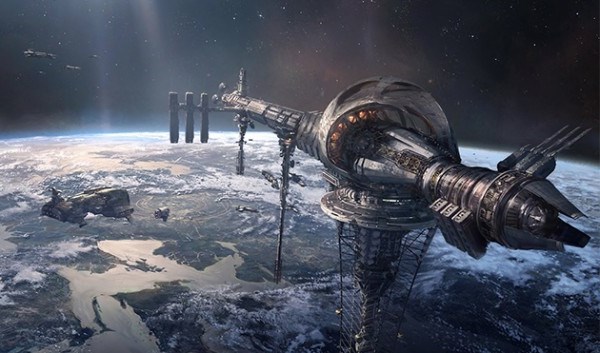





 Such ideas did inform Kim Stanley Robinson’s seminal novel Red Mars, where an international crew flew to the Red Planet and established the first human settlement that begins the terraforming process. But if international cooperation proves too difficult, perhaps a collaboration between commercial space agencies and federal ones could work. I can see it now: the Elon Musk Martian Dome; the Richard Branson Habitat; or the Gates colony…
 This is just the latest in a series of possible plans to capture debris. In the past, the ESA has revealed that it was looking at capturing space debris in a net, securing it with clamping mechanisms, or grabbing hold of it using robotic arms. However, the latest possibility calls for using capturing debris with a tethered harpoon, which would pierce the debris with a high-energy impact before reeling it in.
 The ESA says the space harpoon concept has already undergone initial investigations by Airbus Defense and Space in Stevenage – two aerospace developers based in the UK. The preliminary design incorporates a penetrating tip, a crushable cartridge to help embed it in the target satellite structure, and barbs to keep it sticking in so the satellite can then be reeled in.
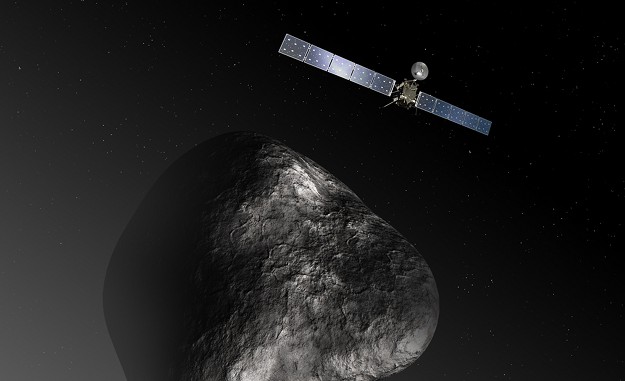 Space exploration is a booming industry these days. Between NASA, the ESA, Roscosmos, the CSA, and the federal space agencies of India and China, there’s just no shortage of exciting missions aimed at improving our understanding of our Solar System or the universe at large. In recent months, two such missions have been making the news; one of which (led by the ESA) is now underway, while the other (belonging to NASA) is fast-approaching.
 Named in honor of the Rosetta Stone – the a basalt slab that helped linguists crack ancient Egyptian – Rosetta is expected to provide the most detailed information about what comets look like up close (as well as inside and out). Similarly, the lander, Philae, is named after the island in the Nile where the stone was discovered. Together, they will help scientists shed light on the early history of our Solar System by examining one of its oldest inhabitants.
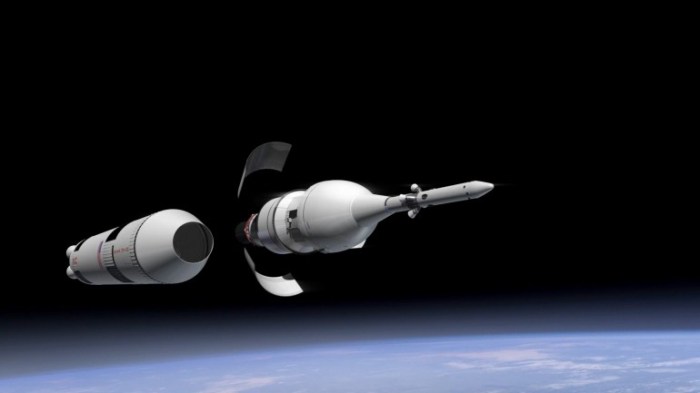
 EFT-1 will take the form of an unmanned test flight, with the Orion spacecraft being controlled entirely by a flight control team from NASA’s Kennedy Space Center located in Florida. One vital component to be tested is the Launch Abort System (LAS), which in essence is a fail-safe required to protect astronauts should anything go wrong during the initial launch phase. Designed to encapsulate the crew module in the event of a failure on the launch pad, the LAS thrusters will fire and carry the Orion away from danger.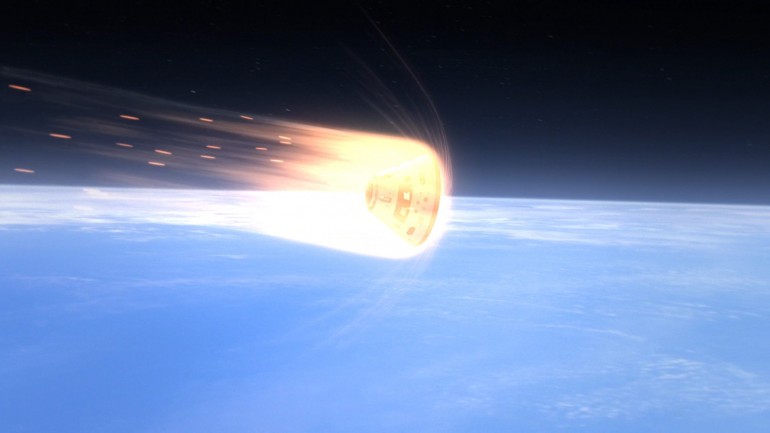
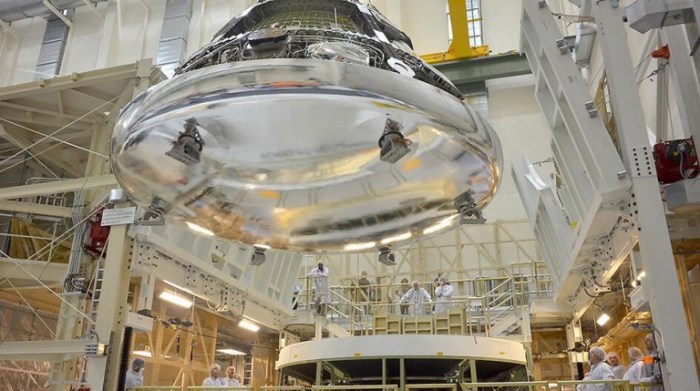 The final aspect of EFT-1 will be the observation of the parachute deployment system. Assuming the LAS has successfully jettisoned from the crew module following launch, the majority of Orion’s stopping power will be provided by the deploying of two drogue parachutes, followed shortly thereafter by three enormous primary parachutes, with the combined effect of slowing the spacecraft to 1/1000th of its initial re-entry speed.
 NASA staff on the ground will be nervously monitoring several key aspects of the proving mission, with the help of 1,200 additional sensors geared towards detecting vibration and temperature stress, while taking detailed measurements of event timing. Furthermore, cameras are set to be mounted aboard Orion to capture the action at key separation points, as well as views out of the windows of the capsule, and a live shot of the parachutes as they deploy (hopefully).

 The findings were presented at the Royal Astronomical Society’s National Astronomy Meeting in Portsmouth on Thursday, June 26. The work was funded by the UK’s Science and Technology Facilities Council (STFC) and the European Research Council. Professor Frenk, who received the Royal Astronomical Society’s top award, the Gold Medal for Astronomy, added:
 Ordinary neutrinos are very low-mass particles that interact only rarely with matter via the so-called weak nuclear force as well as via gravity. Sterile neutrinos are thought to interact with ordinary matter through gravity alone, making them a possible candidate as dark matter. As Dr Esra Bulbul – from the Harvard-Smithsonian Center for Astrophysics in Cambridge, Massachusetts, USA, and lead author of the paper discussing the results – put it:

 Stories by Williams