Should I Be Afraid of the Future?

should-i-be-afraid-of-the-futureNot that long ago, I discovered a site dedicated to taking speculations about the future, crunching data and trends, and producing visualizations about them. Already, they had me with their graph that shows when future technologies will emerge, and how they will be interrelated. But then came their future of education and health technology, both of which addressed the same issue – what can we can expect within the next few decades, leading up to the middle of this century?

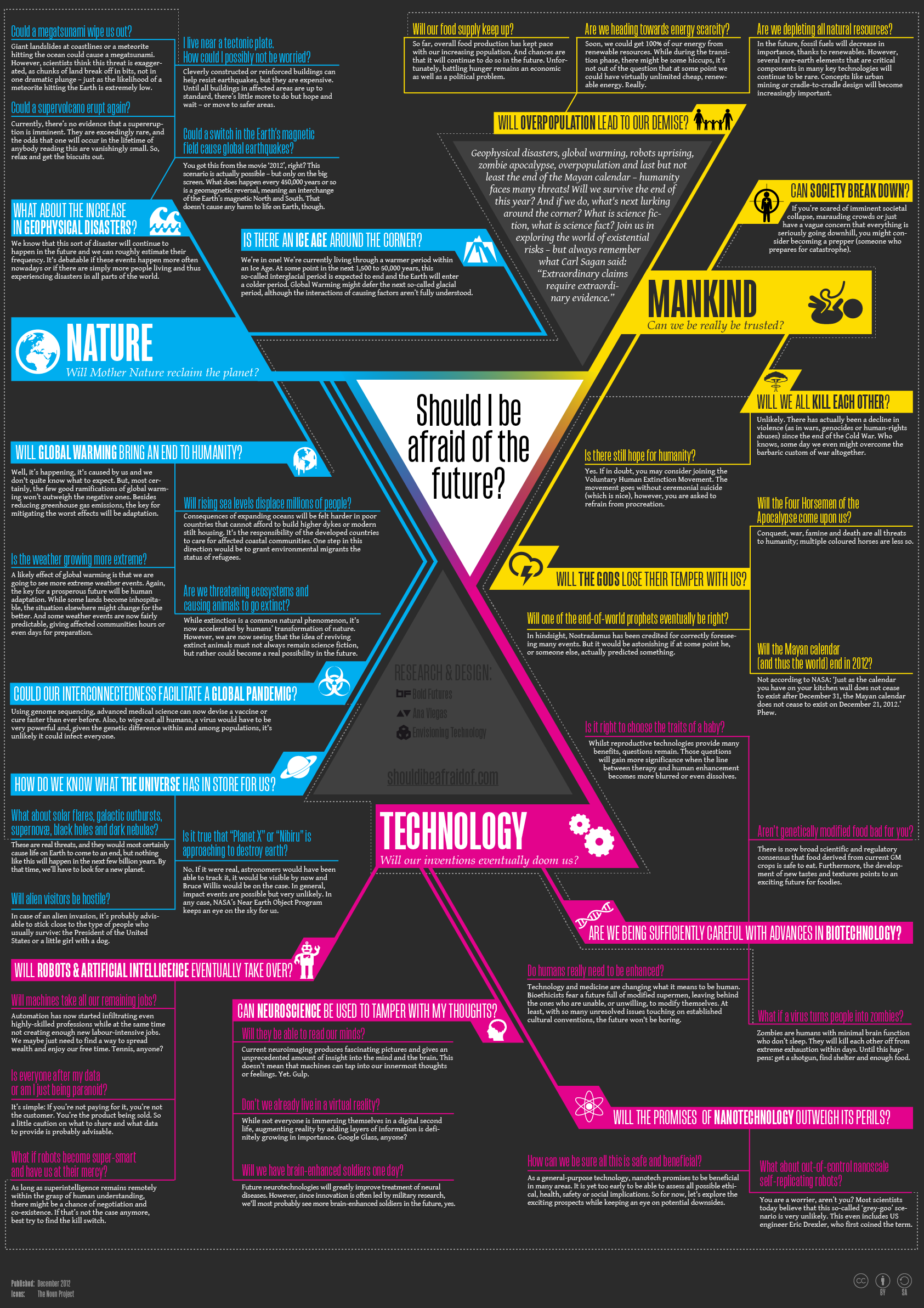
And now, the good folks at Envisioning Technology have created something truly informative and relevant. Entitled “Should I be afraid of the future?”, the infograph addresses all the big questions people might have when it comes to emerging technology, environmental perils, and the kind of technophobia that often result.

“Geophysical disasters, global warming, robot uprisings, zombie apocalypse, overpopulation, and last but not least the end of the Mayan calendar – humanity faces many threats! Will we survive the end of the year? And if we do, what’s next lurking around the corner? What is science fiction, what is science fact? Join in exploring the world of existential risks – but always remember what Carl Sagan said: ‘Extraordinary claims require extraordinary evidence.'”

The questions are broken down into three interrelating fields. First, there is Nature, covering such things as geological disasters, climate change, a possible ice age, and even astronomical events. Then comes Mankind, addressing possible factors such as war, apocalyptic scenarios, and overpopulation. And finally, there is technology, where questions about whether robots and AIs could turn hostile, and if advances in nanotech, biotech, and neuroscience could be potentially harmful.

And of course, each question is addressed in a rational, sensible fashion, even when the questions themselves are based on irrational, myth-peddling paranoia. The Mayan Calendar, bio-outbreaks, every possible technophobic impulse, and even a zombie apocalypse are covered. But then again, the infograph is all about addressing fears. Fear, by its very definition is irrational, and the only cure is information. A well-informed public is not only a safeguard against persecution and bigotry, but against a future full of existential risks.

Source: Envisioning Technology
Microsoft Concept Video: The Future of Smartphones and Computers

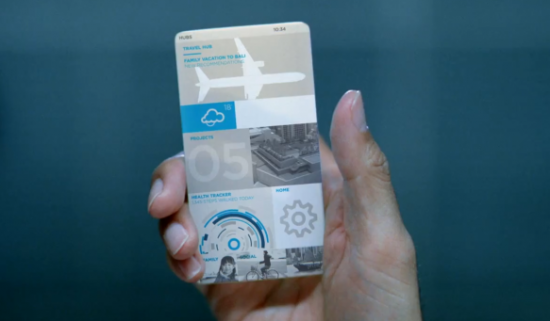
futurvision5-550x321Ah, I imagine people are getting tired of these. But permit just one more! In the midst of so many new products and developments in the fields of smartphones, tablets, augmented reality, and wireless technology, Microsoft was sure to add its two cents. Releasing this concept video back in 2011, shortly after the Consumer Electronics Show, amidst all the buzz over flexible screens and paper-thin displays, Microsoft produced this short entitled “Productivity Future Vision”.

In addition to showcasing their Window Phone (shameless!), the video also features display glasses, “smart” windows, self-driving cars, 3D display technology, virtual interfacing, paper-thin and flexible display tablets, touchscreens, teleconferencing, and a ton of internet browsing and wireless connectivity. All of the technologies featured are those that are currently under development, so the video is apt in addition to being visually appealing.

But of course, the real purpose of this video is to demonstrating to the world that Microsoft can bring these technologies and build the future of business, travel, education and play. Or at the very least, they seeks to lay their claim to a good portion of it. It’s Microsoft, people, they didn’t get to being a mega-corporation by writing checks or playing nice.

And based on this video, what can be said about the future? All in all, it looks a lot like today, only with a lot more bells and whistles!

The Milli-Motein: A “Real-Life Transfomer”?

DNA-molecule2It seems that the line which separates the biological world from the synthetic is growing fainter all the time. Just consider advancements made in the past year alone: In January, researchers at MIT created the world’s first medimachine. Then in September, researchers announced the development of an electronic implant that can dissolve completely inside your body, followed shortly thereafter by the creation of the first bionic hand. And then in November, amputee Zak Vawter climbed America’s tallest skyscraper with the world’s first neurally controlled prosthetic leg.

Now, researchers inspired by structural biochemistry are working to design shapeshifting robots that could, in theory, assume almost any form imaginable. That’s the idea behind MIT’s latest invention, the Milli-Motein: a highly adaptable, infinitely scalable machine that can assume almost any shape imaginable. MIT media labs describes the device as both the robotic equivalent of a Swiss Army Knife, and a “real-life transformer”.

milli-moteinBut, like many inventions these days, the inspiration comes from organic biology, specifically the protein structure. The building block of all life, proteins can assume an untold number of shapes to fulfill an organism’s various functions, and are the universal workforce to all of life. By combining that concept with the world of robotics, the MIT research team hopes to create a new breed of robot that can assume any shape to perform multiple functions, and the Milli-Motein is just the beginning.

According to research lead Neil Gershenfeld, this device represents the latest advance in what he describes as the “Digital Fabrication Revolution”. As he put it: “Digital fabrication will allow individuals to design and produce tangible objects on demand, wherever and whenever they need them.” Also known as “programmable matter” – or “smartmatter” – products made from this kind of material could not only change their shapes, but become new things altogether.

Naturally, this is a small step in that direction, but the eventual goal is nothing short of revolutionary. I can envision a future where people will actually line up to buy the new Acme “handy-dandy micro-helper”, a device which can convert from a screwdriver to a HDMI cord, a tablet, a fannypack, or a pair of shoes. Whatever you need, the micro-helper has you covered! Hey, that’d be a good slogan. I should start investigating patents now, don’t want Kurzweil and all those futurists making money off of this instead of me!

Check out the video below for footage of the Milli-Motein in action, and a brief description of the principles involved:


Source: IO9.com, MIT.edu

More Future Phones

Paper-Thin-Pamphlet-Smartphone-Concept-2The last decade has seen some real interesting developments in the field of digital technology and telecommunications. Perhaps too interesting! When one considers the kind of over-saturation  that has taken place with smartphones in recent years, not to mention the cavalcade of proposed concepts that are expected to take the field in the next few, one could get the impression that were moving too fast.

But that’s the nature of technological progress, it’s an iterative process that’s subject to acceleration. And of course, just because we’re being bombarded with countless proposals doesn’t mean they are all going to come true.  But what is clear is that the smartphones of the next generation are going to have a few things in common.

For example, flexible concepts are likely to be all the rage, as are touchscreens which have become the current mainstay. In addition, the phones are likely to be miniaturized even farther, some to the point of being paper thin and even collapsible. Transparencies are also a common concept, as are holographics and the ability to morph into other shapes.

In the end, its an open sea, and people will be free to pitch any and all combinations of these basic ideas. And there’s no telling which one’s will catch on and which one’s won’t. But one thing is clear. The end results are likely to be mighty cool and are sure to complicate our lives much, much more! And here are just some of the proposed concepts that are we likely to be seeing in the next few years…

Cobalto:
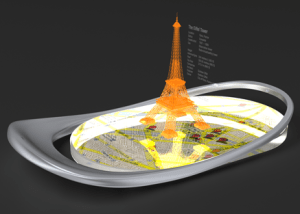
cobalto_phoneMac Funamizu’s “Cobalto” has taken the cell phone concept way into the future, with an almost all-glass design. The phone would feature 3D imaging that could make Google Maps even more useful, as demonstrated here.

Dial:
dial_phoneJung Dae Hoon’s “Dial” concept takes the rotary phone of the ‘good ol’ days’ and combines it with mobile technology and modern jewelry sensibilities.


Kambala:

kambalaA pop-up phone! Ilshat Garipov’s “Kambala” is a fascinating concept that features a center piece that can pop out to fit into your ear, making it an earphone. In theory, it will also have the ability to match your skin tone, rendering it almost invisible.

The Leaf:
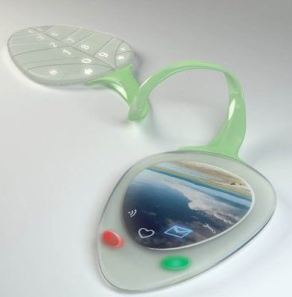
leaf_phoneAnastasia Zharkova’s organic “Leaf Phone” melds aesthetic creativity with functionality. The winding stem of the leaves could be wrapped around a user’s arm, wrist, neck, or other body part.

Mobile Script:
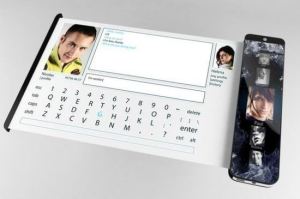
mobile_scriptAleksander Mukomelov’s “Mobile Script” phone starts with a stylish and sleek small screen, then reveals a larger touchscreen hidden within the phone’s body to meet all of your media device needs.

Morph:
morph_phoneNokia’s “Morph” phone uses nanotechnology to create a flexible body and transparent screen that can be molded to whatever shape is the most convenient for its user. The nanotech could even clean itself.

Packet:
packet_phoneEmir Rifat’s “Packet” phone won first place at the Istanbul Design Week 2007. The tiny phone starts off at 5 cm square, then folds out as needed for different functions.

Pebble:
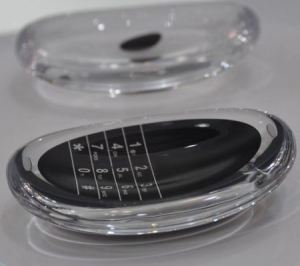
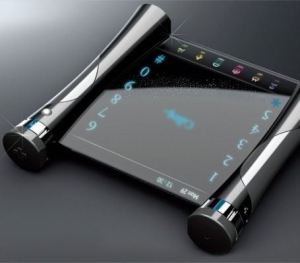
pebble_phoneAt first glance, this entrant into Fujitsu’s cell phone design contest looks like an ordinary paperweight. Actually, it’s a cleverly disguised phone. As the picture shows, the small black dot can be transformed into a keypad, media panel or web browser depending on what corner of the plastic handset you drag it to.

Sticker Phone:
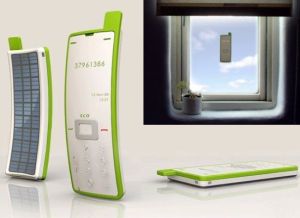
sticker_phoneLiu Hsiang-Ling’s “Sticker Phone” has a solar panel on the back of the phone and a curved surface that will allow it to stick to a window via suction to charge. Plus, you won’t lose your phone somewhere on your desk.

Visual Sound:
visual_soundSuhyun Kim’s stylish “Visual Sound” voice-to-text concept phone for deaf people is a huge step from current systems like teletypewriters.

Window Phone:
window_phoneDesigned by Seunghan Song, this “window phone” concept will reflect current weather conditions on the screen. To input text, you just blow on the screen to switch modes, then write with your finger as a stylus.

Source: Huffington Post.com

The Future is Here: The Microsoft 3D “Holodesk”!

holodeskHang onto your hats! Of all the future concept videos to be produced by high tech firms of late, this one has the potential of being the most badass! It is known as the Holodesk, a prototype system that allows users to interface with a computer by seemingly manipulating 3D objects with their hands. The result of ongoing research over at the Sensors and Devices group at Microsoft Research Cambridge, the Holodesk is one of several 3-D based concepts that are expected to take to the field in coming years.

According to Microsoft website, the group has “the goal of understanding how advances in technology will impact traditional computing and the ways in which people use and interact with computing devices.” Using technology adapted from their popular and award-winning Kinect gaming system, Microsoft has developed this new device which it believes will fill a niche market in computing.

holodesk1Amongs them are physics students, who will use this system as a possible “playground” to test hypothesis involving subatomic particles and atomic models. It is also believed it will be useful for people who conduct remote collaborative studies from long distances, and to test out 3-D models of various kinds. TechNet blog even had one suggestion on one of its comment boards where a user claimed it could be slowed down so that he or she could learn how to juggle.

Per the MicrosoftResearch Youtube channel, the Holodesk is described as follows:

HoloDesk is a novel interactive system combining an optical see through display and Kinect camera to create the illusion that users are directly interacting with 3D graphics. A virtual image of a 3D scene is rendered through a half silvered mirror and spatially aligned with the real-world for the viewer. Users easily reach into an interaction volume displaying the virtual image. This allows the user to literally get their hands into the virtual display. A novel real-time algorithm for representing hands and other physical objects, which are sensed by the Kinect inside this volume, allows physically realistic interaction between real and virtual 3D objects.”

Check out the video of the Holodesk in action:

The Future is Here: The Roll Out Laptop!

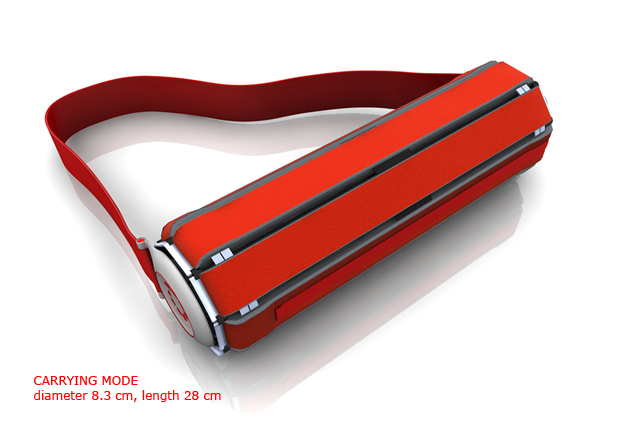
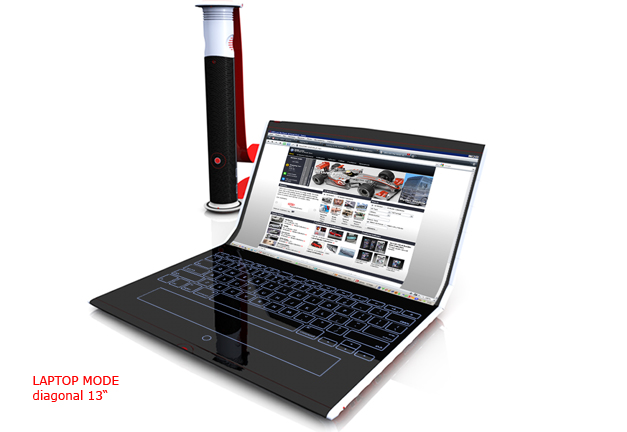
rolltop1 Presenting the Rolltop laptop, a proposed next-generation portable computer that is made to look and act like a scroll. As a concept, this idea was first started in 2009 by the people of Rolltop, a team of researchers, IT developers and business administrators. By combining recent advancements in the field of OLED-Display and multi-touchscreen technology, the plan was to create a flexible computer that would combine the utility of a laptop computer with the weight of a mini notebook.

In addition, it can be switched from a laptop with 13 inch diagonal screen to a 17 inch graphics tablet. Or, stand it up against its rear-mounted support arm and use it as a primary monitor. When rolled up, it measures a mere 8.3 in width and 28 centimeters in length, and has a carrying strap which allows it to be carried around like a small case. When unrolled, the laptop is separated from a central core which contains the battery, power plug-in, and loudspeaker.

rolltopInitially, the project was merely a proposal by the Rolltop team to demonstrate their vision and ideas. However, due to the overwhelming response from the technical and consumer community, they set to work on making it happen. As it stands, the device is still in the planning and development phase, but Rolltop has everything it needs to make it a reality. Well almost… The technology exists, the concept is feasible; all that’s needed is a little more time and investment capital.

In the meantime, check out this promotional video of the Rolltop at work. And if you’re really keen, click on this link to get to the company website to pledge a donation.

The Future Is Here: Oakley Airwave Goggles!

Remember Project Glass, the Google glasses that featured a heads-up-display and the option for augmented reality? Yeah, that was quite the big ticket news item for fans of cyberpunk and people who felt smartphones were becoming a little passe. Well, it seems that the world of sporting goods doesn’t want to be left out of the loop either!

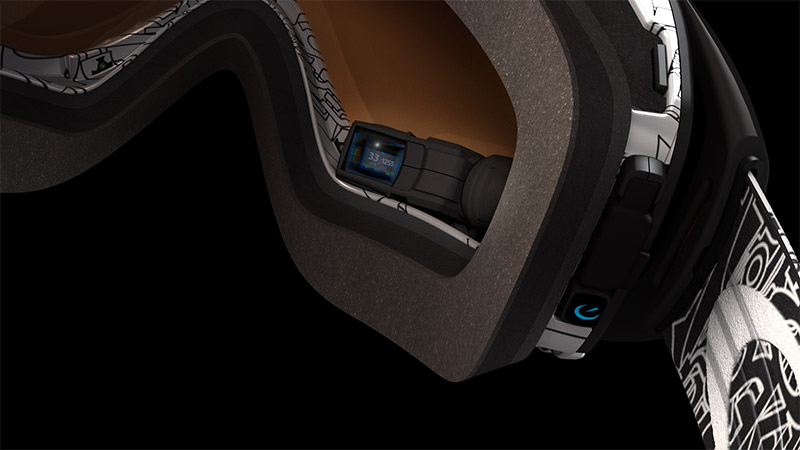
They are known as the Oakley Airwave goggles, a set of eye wear that allows skiers to to consult stats on a heads-up-display while they are on the sloped. Amongst the information that skiers can project into their field of view are such stats as distance, temperature, speed and altitude. In addition, the goggles have a wireless connection feature which will keep the user apprised of their incoming calls and text messages. No word yet if emails will be included, but one thing at a time I guess 😉

I can remember my father telling me that you could tell if a person was important based on whether or not they carried a cell phone. According to him, unimportant people carried cell phones to look important; whereas important people didn’t need them because people waited on them. Having one only meant that you were on call wherever you were. And I don’t know about you, but the slopes is one place I don’t want to be reached! That’s why I go there in the first place!

Still, it’s a cool concept as far as hands free communication and networking are concerned. Coupled with Project Glass and other such products, this new wave of devices is paving the way for a future in which cell phones are obsolete. I imagine Apple and Blackberry are going to have something to say about this, or possibly an even more revolutionary product in mind. Only time will tell…

Check out this video of the goggles in action:

Source: news.cnet.com

Robot Cars in Five Years?

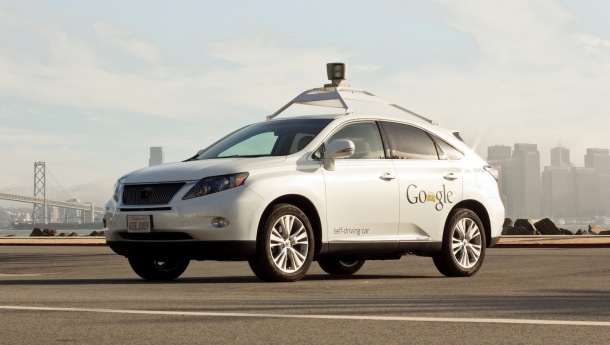
Could it be, that after decades of failed predictions, especially where flying cars were concerned, that science is finally making good on its promise of robot cars? Well, according to Google co-founder Sergey Brin, that’s what’s going to happen. Just two days ago, Brin was on hand for the signing of a bill in the California legislature which establishes safety and performance standards for cars operated by computers on California roads and highways. As the third state to pass this law – Nevada and Florida have already signed similar provisions – California will now allow licensed drivers to use automated vehicles, once they become commonplace.

Apparently, Google has been testing the concept quite extensively. Several prototypes have been developed, and over 300,000 miles worth of driving have been conducted for the sake of testing the software. Brin admits that their are bugs that still need to be worked out, such as improving the sensors and hardware failure supports for the technology. In addition, there are the big challenges of adapting the vehicles to “tricky situations”, such as weather conditions, temporary construction, and emergency vehicles. In any and all of these cases, the robots need to be able to interpret the situation and respond accordingly.

However, Sergey and Larry are confident, stating that “Our vehicles, of which about a dozen are on the road at any given time, have now completed more than 300,000 miles of testing. They’ve covered a wide range of traffic conditions, and there hasn’t been a single accident under computer control.” And, unless science fiction and futursist have been lying to me all this time, the robot cars are likely to come with manual control as well, just in case the driver feels the need to take the wheel and do a little hands-on driving! After all, the purpose of this technology is ensure our safety and comfort right? And what’s more comfortable than turning on the autopilot?

Source: CNET News

The Future Of Education

Hi all, and welcome to the third and final installment in the “Envisioning Technology” series. Today, it’s the “Future of Education Technology” that’s up for all to see. Much like their speculative work on Future Tech and the Future of Medicine, they present us here with an infographic that shows the interrelated fields of educational technology and how growth in one will inevitable lead to change in others.

On the one hand, we see a gradual transition from the Classroom (i.e. traditional educational environment) to the Studio environment, where a peer and group dynamic becomes the focus, rather than classic teacher-student transmission. In the final environment, learning becomes Virtual, divorced from any specific geographical context – i.e. it happens wherever you are, not just in a classroom or academic institution.

Also, through an incorporation of various education and education-related technologies, six steps are discerned within this process. As usual the entire process is traced from the present day to 2040, with many of the necessary technologies already in existence or in the process of development.

As a teacher, I was rather fascinated to see this, as it illustrates much of what was being espoused when I was still in teacher’s college. Back then, the concept of the post-modernist classroom was all the rage, even though there were many who insisted that this movement had passed.

Intrinsic to the concept was the deconstructing the traditional learning paradigm and even the classroom environment. Openness was the new rule, individuation the new philosophy and building on a student’s existing knowledge and experience, rather than simply handing them the curriculum and evaluated their assimilation thereof.

Naturally, many of us felt the same about all the concepts and ideas that were being thrown at us, in that they seemed highly idiosyncratic and theoretical. Missing from just about all the articles, studies and lectures we heard on the subject was mention of how this was to be done. Lectures on applied technology and new methods, on the other hand, seemed much more effective. Whereas the theory seemed to be commenting on trends that were happening, or still needed to happen, these lectures seemed to be showing us how.

Kind of makes you think… and in a way, I’m reminded of what men like George Orwell said. In 1984 (Goldstein’s Manifesto, to be specific), he claimed that the advent of modern industry and education had removed the basis of class distinction and elitism. By the 20th century, when totalitarian philosophies emerged, humanity was closer to the state of true equality that Marx predicted than ever before. Granted, that road has been fraught with bumps and attempts at subversion, but the general trend seems pretty clear.

Perhaps we’re seeing something of the same thing here with the emergence of IT and what people like Foucault, Derrida and Habermas predicted. The breakdown of singular standards, the opening of discourse, the plurality of perspective and opinions. Perhaps they weren’t just speaking off the cuff or stuck in an esoteric bubble. Maybe they were just picking up on trends which were yet to come to true fruition.

Makes me think, at any rate. But then again, that’s the point isn’t it?

“How Nanotech Could Reengineer Us.”

My personal thanks to kwolph, the unidentified fellow who was nice enough to stop by and forward me the link to this rather interesting infographic. Courtesy of the Keithley Center, which designs electronic systems for measurement and analysis, this infographic shows how advances in nanotechnology might aid us in reinventing and augmenting the human body.

These include augmenting our brain chemistry by either delivering drugs directly to our receptors (which can include anti-depressants, stimulants, or pain killers), or the more audacious approach of enhancing our thought pattens and memory by actively building and repairing neural tissue. As such, things like mental illness, brain injuries and trauma could be overcome at last.

In addition, there’s plenty of enhancing our hearts, lungs, reinforcing our bones, repairing muscle tissue, enhancing our eyes, reflexes, strength, endurance. And, as they point out, by virtue of the female model, the scourge of breast cancer, which effects one in eight women, could be be wiped out. No mother’s or young women dying before their time anymore!

And of course, other entirely too common ailments, heart disease, prostate cancer, ovarian cancer, lung cancer, and every form of degenerative disease, could be nipped in the bud either through regular maintenance of the bodily tissues, or by correcting the fault at the genetic level.

There’s really no limit to what programmable nanomachines could do, once the technology was realizable of course. And above all, proven to be safe and effective. And since it would mean that human beings no longer would be subject to disease or degenerative conditions (a la aging), lives could be extended indefinitely, which is part and parcel of the whole “transhuman”, “posthuman” and “postmortal” concept.

Naturally, they used the image of a very pretty young woman for the display. Had it been a man I’m guessing they would have gone with a six foot tall dude with washer board abs and only 1 percent body fat. Why can’t they ever use a porked out old dude with man boobs? That’s what I’d like to know? Well, for one, such regular individuals don’t exactly inspire confidence in the consumer market, do they?