Life-Giving Elements Found on Mars!

Curiosity_drillingsCuriosity has just finished analyzing the samples collected from its first drilling operation at the John Klein rock formation in Yellowknife Bay. And what it found confirms what scientists have suspected about the Red Planet for some time. Contained within grey the dust collected from the rock’s interior, the rover discovered some of the key chemical ingredients necessary for life to have thrived on early Mars billions of years ago.

After running the two aspirin-sized samples through its two analytical chemistry labs (SAM and CheMin), the Mars Science Laboratory was able to identify the presence of carbon, hydrogen, oxygen, nitrogen, sulfur and phosphorus in the sample – all of which are essential constituents for life as we know it based on organic molecules.

Curiosity_chemWhat’s more, according to David Blake – the principal investigator for the CheMin instrument – a large portion of the sample was made up of clay minerals, which in itself is telling. The combined presence of these basic elements and abundant phyllosilicate clay minerals indicate that the area was once home to a fresh water environment, one where Martian microbes could once have thrived in the distant past.

By confirming this, the Curiosity Rover has officially met one of its most important research goals – proving that all the elements necessary for life to flourish were once present on Mars. And when you consider that the Curiosity team was not expecting to find evidence of phyllosilicate minerals in the Gale Crater, the find was an especial delight. Based on spectral observations conducted from orbit, phyllosilicates were only expected to be found in the lower reaches of Mount Sharp, which is Curiosity’s ultimate destination.

Curiosity-Sol-169_5C1b_Ken-KremerSo what’s next for Curiosity? According to John Grotzinger, the Principal Investigator for the Mars Science Laboratory, Curiosity will remain in the Yellowknife Bay area for several additional weeks or months to fully characterize the area. The rover will also conduct at least one more drilling campaign to try and replicate the results, check for organic molecules and search for new discoveries.

Source: universetoday.com

More News from Mars… Lots More!

marsIt’s a good thing I’ve come down with a cold and have little to do but sit at my computer. Because in the last week, some very interesting news stories have been piling up that just scream for recognition. And wouldn’t you know it, more than a few have to do with our big red neighbor Mars, that world many human beings will one day think of as home.

The first story comes to us from the Siding Spring Observatory in New South Wales, where noted astronomer Robert McNaught recently sighted an new comet. From his observations, the icy interloper appeared to have originated in the Oort Cloud – a hypothetical cloud surrounding the solar system and containing billions of icy planetesimals that were cast out from our Solar System billions of years ago.

Mars_A1_Latest_2014After news of the discovery was released, the astronomers at the Catalina Sky Survey in Arizona looked back over their observations to find “prerecovery” images of the comet dating back to Dec. 8, 2012. These observations placed the orbital trajectory of the comet – now known as C/2013 A1 – through the orbit of Mars on Oct. 19, 2014. This means, in essence, that this comet could very well strike the Red Planet late next year.

Luckily, NASA’s Jet Propulsion Laboratory has run the calculations and indicated that their close approach data suggests the comet is most likely to make a close pass of the Martian surface. And by close, they mean at roughly 0.0007 AU, or approximately 100,000 kilometers (63,000 miles) from the Martian surface. So in all likelihood, Curiosity and Opportunity will be safe from a serious impact that could turn them into scrap metal!

But of course, predicting its exact trajectory at this time is subject to guess work, and ongoing observations will be needed. No doubt, the predictions will be refined a the next 20 months go by, and we’ll know for sure if this comet plans to miss Mars completely, or slam head-on into the surface at 200,000 km/h (126,000 mph).

Source: news.discover.com, astroblogger.blogspot.ca

Mars_curiosity_drillingThe second bit of news comes to us from the good-ole Curiosity Rover! Roughly four weeks after conducting the first drilling operation into the Martian surface, the Rover ate its first sample of the grey dust that resulted. The delivery of the two aspiring-sized tablets of dust took place on Feb. 22nd and 23rd respectively after the robotic arm delivered them into the rover’s Chemistry and Mineralogy (CheMin) and Sample Analysis at Mars (SAM) laboratories for analysis. Results expected in two weeks!

Among other things, the results from the analysis are expected to give clues as to what the color change between the red surface and the grey interior means. One theory is that it might be related to different oxidations states of iron that could potentially inform us about the habitability of Mars inside the rover’s Gale Crater landing site.

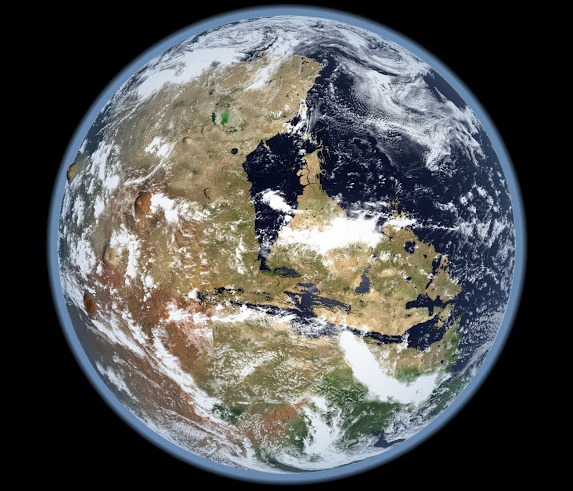
Living-Mars.2At the same time, the Mars Science Laboratory team expects to find further evidence of what life was like in previous geological eras. The Curiosity team believes that the area inside the Gale Crater, known as Yellowknife Bay, experienced repeated exposure to flowing liquid water long ago when Mars was warmer and wetter – and therefore was potentially more hospitable to the possible evolution of life.

The rover will likely remain in the John Klein area for a month or more to obtain a more complete scientific characterization of the area which has seen repeated episodes of flowing water. Eventually, the six-wheeled mega rover will set off on a year long trek to her main destination: the sedimentary layers at the lower reaches of the  5 km (3 mile) high mountain named Mount Sharp.

Source: universetoday.com
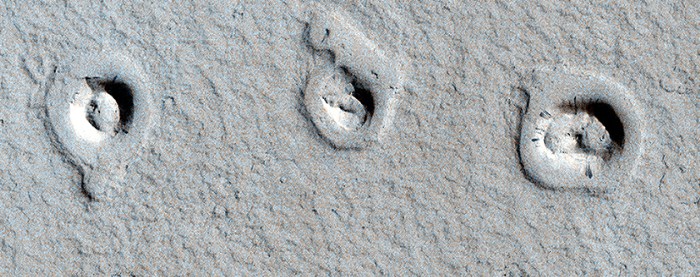
mars_hieroglyphsAnd last, but not least by any stretch of the imagination, is the discovery of “hieroglyphs” on the Martian surface. While they might appear like ancient glyphs to the untrained eye, they are in fact evidence of past subsurface water. The images were caught by the HiRISE camera on the Mars Reconnaissance Orbiter as it passed the surface area known as Amazonis Planitia.

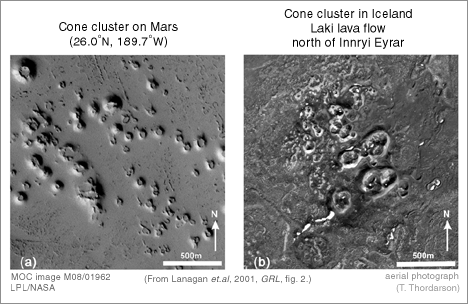
Known as ‘rootless cones,’ these geological features are the result of an explosive interaction of lava with ground ice or water contained within the regolith beneath the flow. Vaporization of the water or ice when the hot lava comes in contact causes an explosive expansion of the water vapor, causing the lava to shoot upward, creating what appears to be a button hole on the surface.

rootlessConesIn the past, Mars scientists have used geological patterns on Earth to make sense of similar ones found on Mars. For example, when the Curiosity Rover discovered veins of hydrated calcium in the rock surface in the Gale Crater, they compared them to similar patterns found in Egypt to determine that they were the result of long-term exposure to water flows. In this case, the rootless cones found in Amazonis Planitia are comparable to those found in Iceland’s Laki Lava Flow (as seen above).

According to Colin Dunas, from the US Geological Survey, the cones are rather large and most likely very old:

“The cones are on the order of a hundred meters across and ten meters high. The age of these specific cones isn’t known. They are on a mid- to late-Amazonian geologic unit, which means that they are young by Martian standards but could be as much as a few hundred million to over a billion years old.”

terraformingOnly time will tell if any subsurface water is still there, and hence usable by future teams of terraformers and settlers. According to Dundas, the odds are not so good of that being the case. Given the surface depth at which the ice was found, not to mention that at the low latitude at which it was found (22 degrees north), shallow ground ice is unstable. Dundas added that since ice stability varies as the obliquity changes, it’s even possible that ice has come and gone repeatedly since the lava erupted.

Too bad. That could have come in really handy for hydroponics, fuel cells, and even restoring surface water to the planet. Guess future generations of Martians will just have to look for their ground and irrigation water elsewhere, huh? Just another challenge of converting the Red Planet to a green one, I guess 😉

Stay tuned for more news Mars. As it stands, there’s plenty to be had! Stick around!

Source: hirise.lpl.arizona.edu, universetoday.com

Curiosity Drills!

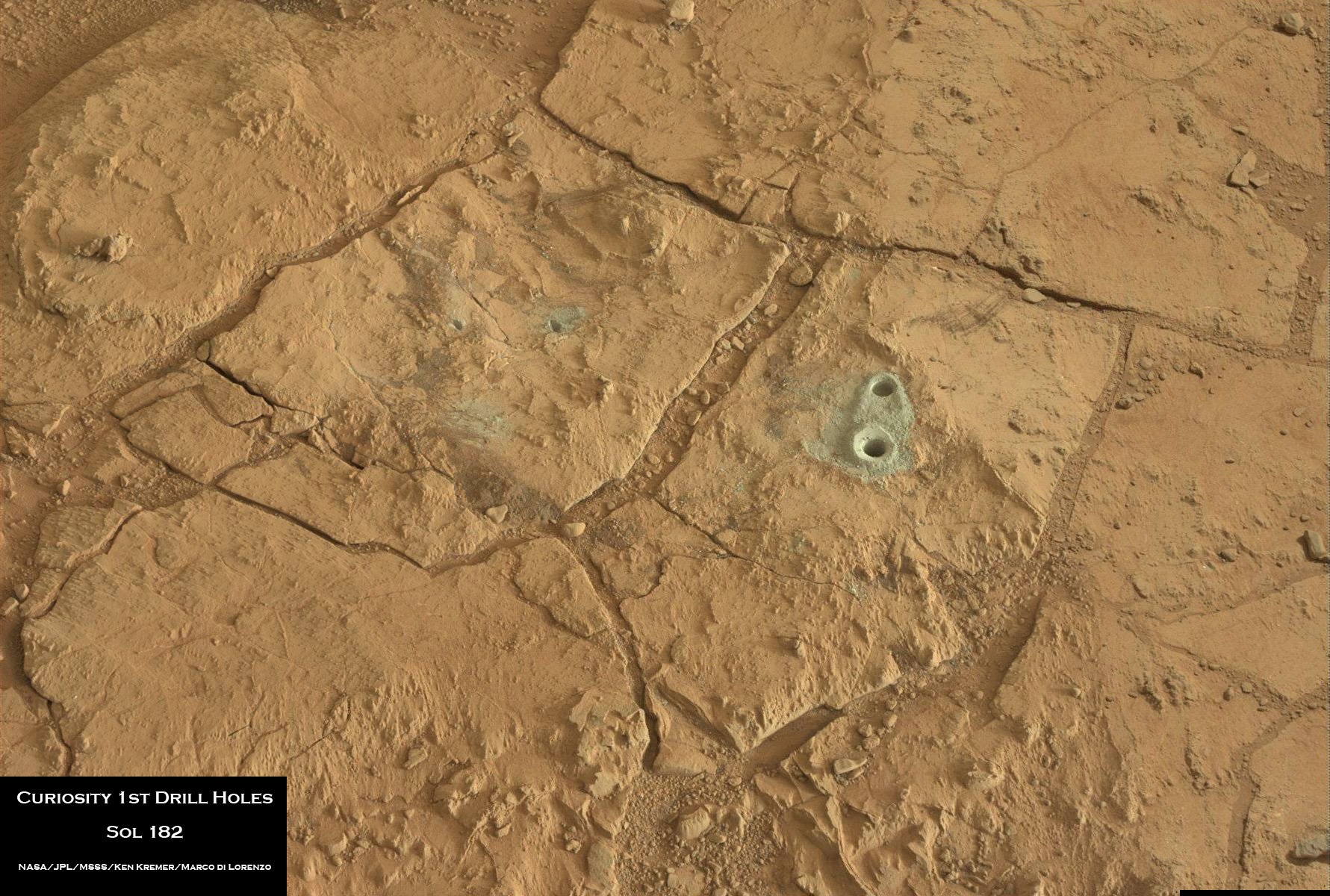
curiosity_drillsIn what is a first amongst cosmic first, the Curiosity Rover drilled into Martian rock and collected fresh samples from the resulting dust. The precision drilling took place this past Friday, Feb. 8, 2013 – during the 182nd day of the mission – after numerous tests and procedures were conducted. The images were beamed back to Earth on the following day (Saturday, Feb 9) amidst a great deal of fanfare and celebration.

Given the fact that it took them nearly a decade of painstaking work and effort to design, assemble, launch and land the Curiosity Mars Science Laboratory (MSL) rover, it’s obvious while the rover team is overjoyed with this latest development. What’s more, this was more than just a first in the history of space exploration, it also marked Curiosity’s 6 month anniversary on the Red Planet since touching down on Aug. 6, 2012 inside Gale Crater.

John Grunsfeld, NASA’s associate administrator for the agency’s Science Mission Directorate, had this to say about the drilling:

“The most advanced planetary robot ever designed now is a fully operating analytical laboratory on Mars. This is the biggest milestone accomplishment for the Curiosity team since the sky-crane landing last August, another proud day for America.”

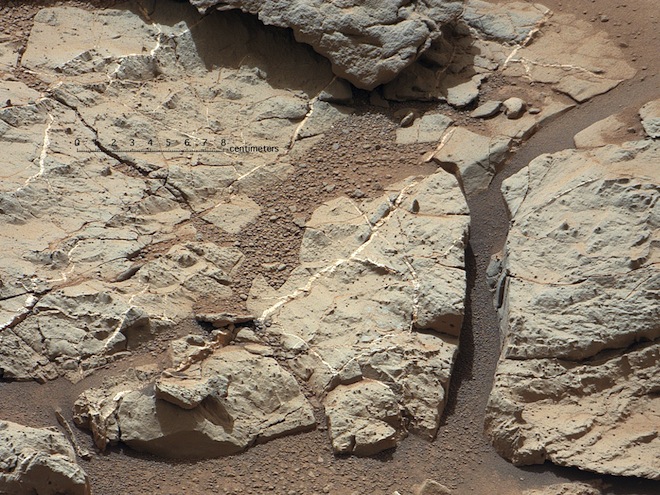
curiosity_drilling_sightCuriosity drilled a circular hole about  16 mm (0.63 inch) wide and 64mm (2.5 inches) deep into the red slab at the “John Klein” rock site. The  fine-grained sedimentary rock, which is rich with hydrated mineral veins of calcium sulfate, parted to produce a slurry of grey trailings surrounding the hole. These dust samples were then collected for examination using the rover’s on board laboratory.

The team believes the area known as Yellowknife Bay, where the drilling took place, repeatedly experienced percolation of flowing liquid water eons ago when Mars was warmer and wetter, and potentially more hospitable to the possible evolution of life. These latest samples, they hope, will offer additional compelling evidence to this effect, and also some traces of organic molecules.

curiosity_drillbitWhile this may sound like an ordinary day around NASA, it represents a quantum leap in terms of what remote landed craft are capable of doing. At no time in the past have astronauts been able to place mobile research platforms on a distant planet, collect samples of said planet, and conduct research on them, all the while beaming the results and images back to labs at Earth for analysis.

What’s next for the rover? Well, once the analysis is complete, the 1 ton robot will continue to investigate Yellowknife Bay and the Glenelg area. After that, it will set off on a nearly year long trek to her main destination – the sedimentary layers of the lower reaches of the  5 km (3 mile) high mountain named Mount Sharp – some 10 km (6 miles) away from its current position.

Source: universetoday.com

Curiosity Prepares to Drill

curiosity_rocksMore news from Mars! Or more specifically, from Yellowknife Bay, a place that shows extensive evidence of flowing water. After relocating to the region and performing a preliminary search, Curiosity has located the rock it will drill in order to gain an understanding of its composition and search for organics molecules. The rock has been dubbed “John Klein”, and this will be the first time engineers have drilled into the surface of another planet.

Already, Curiosity has determined that at one time, the Gale Crater was once the site of flowing water. But in its current location, they are able to assess the geological history and have stumbled upon a number of interesting features. In the course of descending from the plateau region where it landed into the relative depression that is Yellowknife Bay, Curiosity has observed many layers of rock that are increasingly older, effectively taking it backwards into the planet’s history.

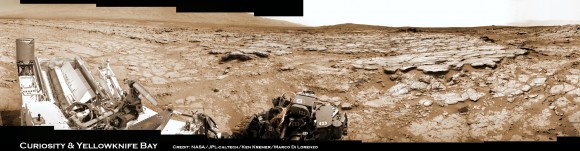
Curiosity-Yellowknife-Bay-Sol-125_2c_Ken-Kremer-580x151Geologists are finding a lot of different rock types, indicating that many different geologic processes took place here over time, all of which confirm that water passed through the region at one time. For example, some of the minerals are sedimentary, which suggests that flowing water moved small grains around and deposited them. Other samples are cracked and filled with veins of material such as calcium sulfate, which were formed when water percolated through the cracks and deposited the mineral.

terraformingAll these investigations suggest if you could go deep into Mars’ past and stand at the same spot as the rover, you’d probably see a river of flowing water with small underwater dunes along the riverbed. And since these rivers left traces behind, drilling into the rocks will reveal what else they carried, which could very well include the building blocks of life!

Already, Curiosity brushed some of these rocks to remove their dust covering and then examined them with its high-resolution Mars Hand Lens Imager (MAHLI) camera. The next step will be to drill 5 centimeter holes into some of these rocks and veins to definitively determine their composition. Geologist John Grotzinger of Caltech said that the team will search for aqueous minerals, isotope ratios that could indicate the composition of Mars’ atmosphere in the past, and possibly organic material.

curiosity_drillingThe drilling will probably take place within two weeks, though NASA engineers are still unsure of the exact date. But, says Richard Cook, Curiosity’s project manager, the procedure will be “the most significant engineering thing we’ve done since landing,” and will require several trial runs, equipment warm-ups, and drilling a couple test holes to make sure everything works. The team wants to take things as slowly as possible to correct for any problems that may arise, such as potential electrical shorts and excessive shaking of the rover.

And of course, this time around they are likely to be much more tight-lipped and reserved when it comes to announcing their findings. Should they uncover evidence of life at one time in Mars’ deep past, they will certainly need to be sure. Such a finding is likely to be… “Earthshaking”! I admit, that’s getting old. I’ll stop now…

Source: Wired.com

A Curiosity Christmas!

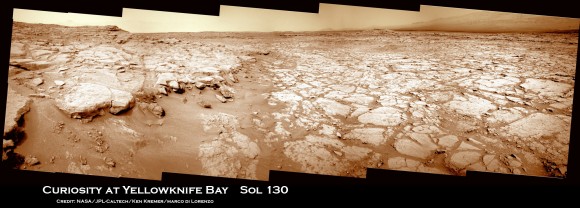
marsHey all! It’s a new year, a new day, but hopefully, there’s still some holiday cheer to go around! And in that spirit, I thought I’d share some news which came in over the holidays concerning Curiosity’s mission to Mars. For the rover, Christmas was celebrated at a location dubbed “Grandmas House”. Well, technically it spent it at Sol 130, a designated point in an area known as “Yellowknife Bay”. This area is a small depression located in the geographic region known as Glenelg, some 400 meters from “Bradbury Landing” where it first put down.

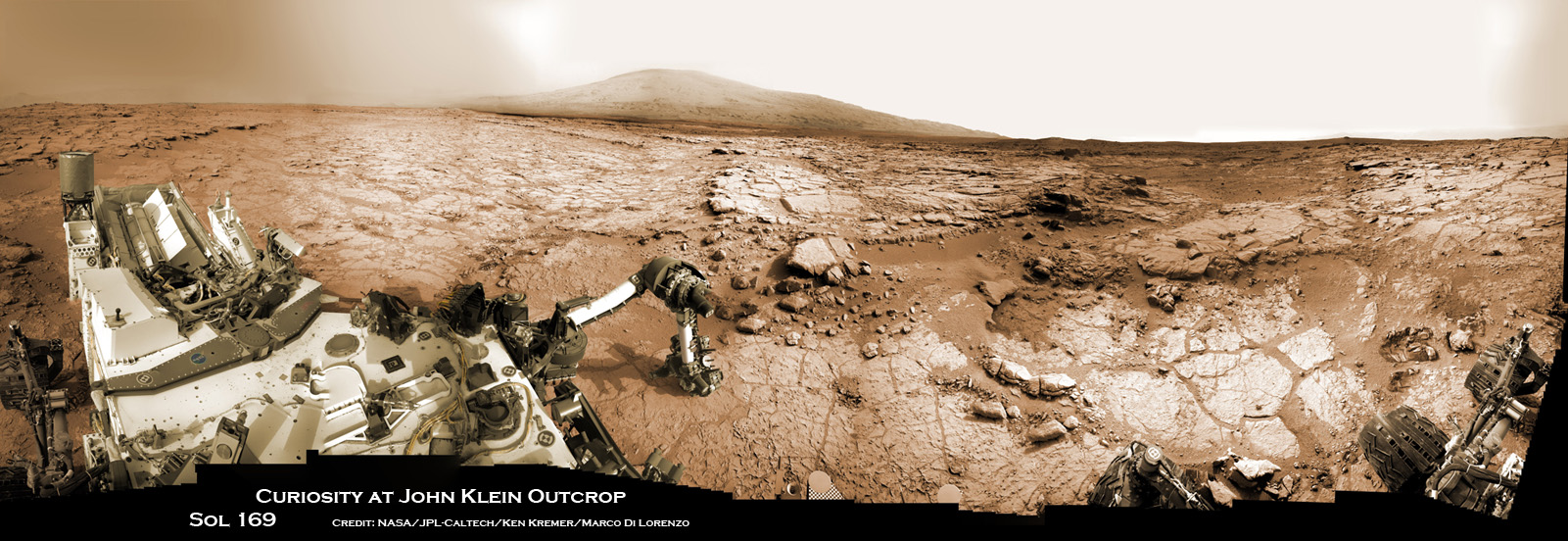
Curiosity-at-Yellowknife-Bay-Sol-130_3a_Ken-Kremer-580x208It is in Yellowknife Bay that Curiosity has been engaged in searching for its first target site to drill for a rock sample. The purpose of this to test out the rover’s high powered hammering drill, a test which has been put off because the Mars Science Team feared that the rock samples at other locations were not optimal. But the Glenelg area – which lies at the junction of three different types of geologic terrain – features a different type of geologic terrain compared to what Curiosity has driven on previously.

Curiosity-Yellowknife-Bay-Sol-125_2c_Ken-Kremer-580x151While there, Curiosity snapped a series of panoramic pictures of the area, which NASA compiled into the photos seen here and at the top. The rover also used its the APXS X-ray mineral spectrometer, ChemCam laser and MAHLI hand lens imager to gather initial science characterization data on the region and its rocky outcroppings. As you can plainly see, Yellowknife Bay was aptly named, being quite similar in appearance to its namesake here on Earth.

Hard to say what Curiosity will find once its begins drilling, but NASA is sure to be raving about it, either way. Everyone knows those Mars Science Laboratory people can’t keep anything a secret, even when they’re not sure they’ve got anything. Yes, MSL, that was a veiled reference to that “Earthshaking news” story you got us all excited about. And to answer you’re next question, no, I haven’t gotten over it yet. Can’t you tell?

Stay tuned for more news from the Red Planet! And while you’re at it, check out the video below where MSL team member Colette Lohr, the Tactical Uplink Lead, provides the latest video update on the Curiosity rover.

Source: Universetoday.com, (2)

Animation of Curiosity’s 1st “Touch and Go” Maneuver

In the days leading up to Thanksgiving in the US, Curiosity performed her first “touch and do” maneuver. This was the process whereby the rover drove up to and inspected an interesting looking rock using the Alpha Particle X-Ray Spectrometer (APXS) on its arm, then moved onto the next point of interest on the same day.

This latest maneuver now puts Curiosity inside the ‘Glenelg’ geologic formation. The NASA science team selected this as the first major science destination because it lies at the intersection of three diverse types of geological areas that will help unlock the secrets of Mars’ ancient watery history and evolution to modern times.

What makes this historic is that it is the first time the rover has conduct a touch and go maneuver on the same day. Ordinarily, the rover performs these duties separately. According to Curiosity Mission Manager Michael Watkins (of NASA’s Jet Propulsion Laboratory in Pasadena, Calif), “[this] is a good sign that the rover team is getting comfortable with more complex operational planning, which will serve us well in the weeks ahead.”

In honor of this event, NASA scientists created a animation of the maneuver using the same software they do to plan the rover’s movements. Beginning with the examination it made using its arm sensor, the animation then shows (with painful accuracy) the rover making the 25.3 meter (83 foot) transit to its next location.

News From Mars!

An interesting slew of news has been coming from NASA recently, courtesy of the Curiosity Rover and its mission to Mars. First, there was the announcement by John Grotzinger on NPR radio that Curiosity’s science team had discovered something potentially “earth-shattering” on the Red Planet, which came just two days ago. Since then, researchers over at NASA have been keeping a tight lip on what that might be, though it seems to be taking an extraodinary effort to do so. One can only imagine what they’re dying to tell us…

But it seems more stories are coming in the wake of this. First, there was the revelation by the Curiosity Rover that Mars radiation levels, once thought to be problematic for life, are actually safe for humans. According to Don Hassler, the principal investigator on Curiosity’s Radiation Assessment Detector instrument (RAD), Curiosity determined that “the Mars atmosphere is acting as a shield for the radiation on the surface and as the atmosphere gets thicker, that provides more of a shield and therefore we see a dip in our radiation dose.”

Apparently, the levels are equal to what astronauts deal with on the International Space Station, which means people in suits will be able to walk on the Red Planet safely once a manned mission is mounted. Knowing that they can conduct surveys on the surface without additional radiation shields should prove to be a boon for colonization as well. More settlers will certainly be drawn to Mars now that they know they can settle in without having to worry about little things like radiation sickness or mutations!

Third, there was the news that in the wake of making its “one for the history books” discovery, that Curiosity has finished collecting and analyzing soil samples and is preparing to move on. The final checks and preps were made amidst ethereal whirlwinds and twisters, which are characteristic of the region known as the “Gale Crater”, where it has been conducting its research for the past month. The rover is now being prepared to move on in search of suitable targets for a compact rock drill, the final major sample acquisition system to be tested.

Ashwin Vasavada, the deputy project scientist for the Mars Science Laboratory rover at the Jet Propulsion Laboratory in Pasadena, Calif, had this to say on the next phase of the mission: “We still would like to get a little further into this Glenelg region where we see this diversity of rocks and layered rocks and other really interesting terrain. And then we still have a goal in the next month or two of doing the big U-turn and heading up to Mount Sharp.”

Mount Sharp is a 3-mile-high mound of layered terrain that sits in the center of the Gale Crater, where Curiosity is expected to spend the bulk of its planned two-year mission. In the meantime, the research team needs to go over all the information Curiosity has sent back, including an ongoing analysis of the martian weather.

On top of all that, there’s still the matter of that “earth shaking news”. How about it NASA? You too, Grotzinger? We’re ready and waiting… how much more time do your researchers need before they’re sure and are free to break the news they are so clearly dying to share? I still say its organic molecules, but what do I know?

Source: news.cnet.com

Upcoming Mars Landing

I recently came across this story on CBC’s Quirks and Quarks, a science show dealing with all things science and tech related. Somehow, with the recent passing of Bradbury, Canada’s 145th birthday, and my obsession with colonization, this story just spoke to me on so many levels. For those who’ve been monitoring the news or NASA’s regular updates on their website, the Curiosity rover is on its way to Mars and is schedules to land on August 5th.This Martian rover is slated to roam the surface for years, looking for signs of life. And it just so happens that this vehicle carries a special Canadian instrument.

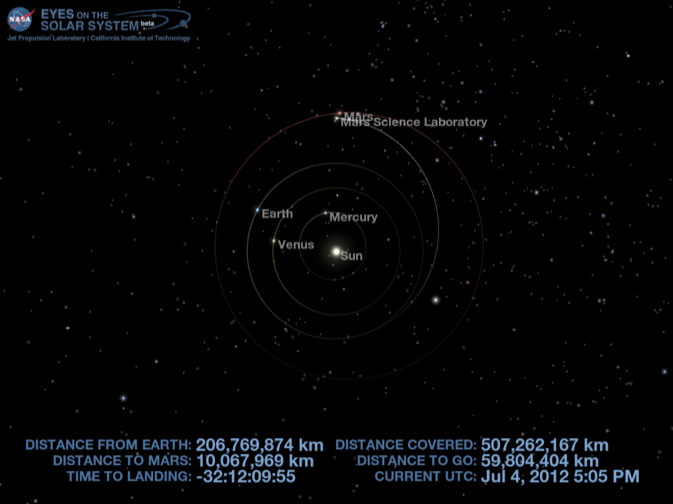
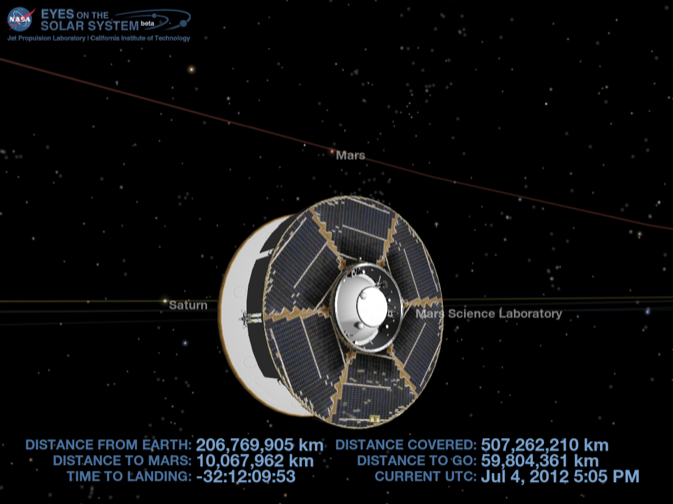
Curiosity’s position and distance to Mars as of July 4th, 2012 (NASA)

The Curiosity spacecraft, artists rendition (NASA)

Once it arrives, the Curiosity, the largest rover ever sent to Mars, will execute the most complicated powered landing, in the roughest area, that a robotic lander has ever attempted on Mars. The landing site is the Gale Crater, 155 kilometres across, with a mountain rising 5 km from its centre. Curiosity is aiming for a pinpoint landing on the crater floor, right at the base of the mountain. Once there, it will begin by exploring the lower slopes of the mountain (named Mt. Sharp after a NASA geologist) and spend the next two years looking for signs of ancient water activity and possible Martian life.

The Gale Crater, the landing point indicated with a black oval (NASA)

Here’s where the Canadian technology comes in. In the course of conducting its analyses of the surface, one of the instruments that it will use is a an Alpha Particle X-Ray Spectrometer. This device was built by a team of scientists at the University of Guelph, Ontario, with Dr.Ralf Gellert acting as the principle investigator. With the help of this an other instruments and on-board mini-laboratory, the Curiosity will analyze soil samples to look for chemical signatures of past or present life.

As many people know, this elusive search has been ongoing, ever since astronomers first looked at Mars through telescopes and thought they saw artificial canals. Those hopes were quickly dashed when more detailed analyses indicated that the planet was sterile and the atmosphere too thin to support life as we know it. But once rovers began to be sent and soil samples examined, the hope of finding life once again became a matter of hard science. Though there might not be little green men dwelling on the surface, or in underground facilities, life of a sort does appear to exist within the Red Planet’s oxidized soil.

On top of all that, this information will prove useful in helping scientists to determine whether or not Mars could be terraformed to suit human needs. If that should prove to be the case, then Mars may very well become our home away from home in the not too distant future. Bradbury certainly thought as much, and look how popular he became 😉

The landing, and results it produces over the next two years, are sure to be exciting! In the meantime, check out this computer-simulation of Curiosity’s landing, as produced by NASA: