3 – Vigilance

3 – Vigilance

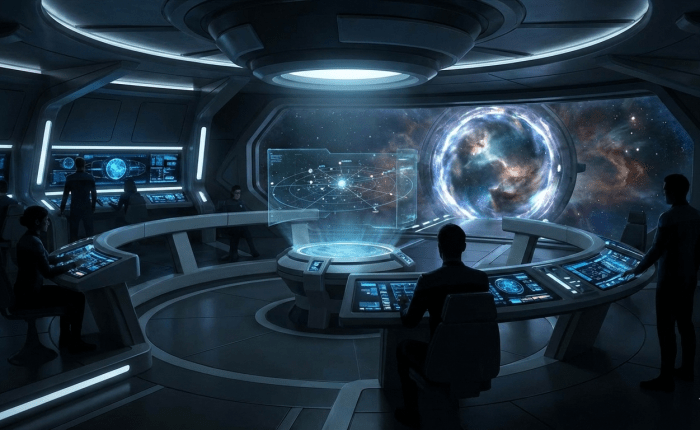
The central dais brightened as soon as Dube stepped into the room. As he approached, it rose slightly to greet him, rising further as his feet were firmly planted in the center. Other terminals and posts were already lit up and their attendants turned to greet Dube. And when he placed his hands out before him, an interface materialized in front of them.

He signalled to the ship’s AI that he was ready to assume his role as the Transverse’s temporary Custodian.

[Alright, Jonas. Show me the stars.]

The bulkhead directly in front of him, a concave feature that occupied much of the Bridge’s front section, went from opaque to transparent. Dube was immediately struck by the intense glow of the starfield, its countless pinpricks of light ranging from soft to piercing. In terms of color, they ranged from yellow and green to various shades of blue. This did not represent their true colors, but the way their light was being blueshifted.

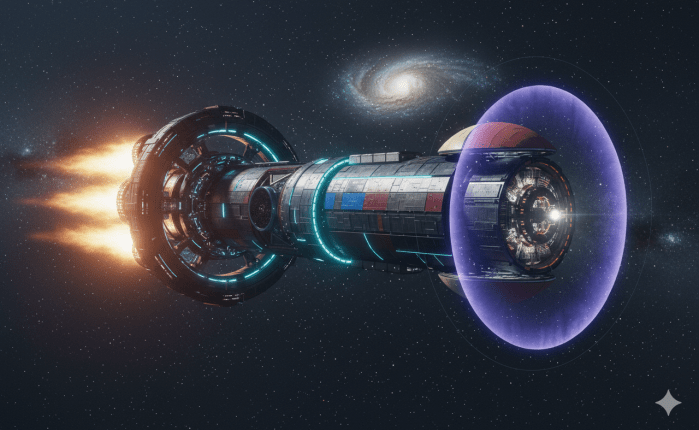
Such was the effect of moving at relativistic speed. Checking their velocity, Dube was informed that they were travelling at 15% the speed of light, a consistent 0.15 c. At this velocity, they were moving faster than any crewed vehicle in human history. As they flew, the light coming from distant stars continued to meet them at a constant rate of c. To accommodate this quirk of nature, the wavelength was shortened, to the point that all light was shifted towards the blue end of the spectrum.

Switching to the rear view, Dube saw the opposite effect with the stars that were receding from them. The light from these reached the ship at the same velocity and time as the oncoming light, but its wavelength was shifted towards the red end of the spectrum. The situation would remain unchanged until the Transverse ceased its acceleration burn and settled into its cruise phase. And in generations, when they commenced their deceleration burn, the situation would be reversed.

Just one of the consequences of living in a relativistic Universe. Another, as indicated by the nature of their vessel, was the immense amount of energy and vast stretches of time it took to travel from one star to the next.

The inspired thought led Dube to call up an overlay and request permission to access the ship’s systems. His Engineer status was immediately accepted, and a range of options appeared before him. He quickly navigated through the menus to select Power and Propulsion, then checked on three interconnected things simultaneously.

Singularity Drive
Reaction Chambers
Main Thrusters

As he hoped, all three systems were in the green. At the ship’s core, a tiny, controlled singularity – no larger than a micron in diameter – caused material periodically injected into its chamber to swirl around it, eventually reaching close to the speed of light. Eventually, the material would fall onto the face of the singularity and be stripped down into its subatomic constituents. Immense energy was released in the process, which the reactor’s receptors happily absorbed.

Meanwhile, the Transverse’ Chambers were cool and calm. The smashing of protons and anti-protons in a carefully controlled process known as matter-antimatter annihilations had ceased with their last acceleration. And the thrusters were quiet, as their were no subatomic particles to accelerate to relativistic speeds.

Dube tried, but a quick check on the other ship systems and subsystems showed no indication of any malfunctions or problems. There were a few issues that were bracketed to one side of the display window. These were those that emerged since last shift and been resolved. Dube noted the work signature of his peers, Engineers Ahika Chen and ShankarVorhees – both of whom had been up for a few minutes longer than he.

At last, he had confirmation. There were absolutely no issues on the ship that required the attention of an Engineer. No distractions and no means for stalling.

Sighing, Dube called out to the ship’s Custodian again.

[Okay, Jonas. I’m here. Let’s have those updates.]

Jonas obliged, sounding almost happy to be summoned.

[Excellent. There are many reports and status updates for your perusal. Shall I share them in chronological order?]

[No. Parse all for anything considered vital, and collate them, starting with the most-recent updates, then provide synthesis from all previous updates.]

Jonas complied. Within seconds, Dube’s mind was filled with new data on the status of the Transverse and all that had happened since he had gone to sleep. As always, Jonas considered some matters to vital that Dube did not, nor any sensible engineer for that matter. For safety’s sake, Jonas’ threshold of concern – ToC, as the Engineers knew it – was deliberately set to high to make sure no small things slipped through the net and became a big thing later. But that meant that seemingly trivial things might slip through in the meantime.

Dube was on the verge of concluding that everything on the list was trivial, until he came to one particular item.

[Stop. What’s this about a power drop in this subsection?]

Jonas summoned a schematic of the ship and enlarged it in his visual field. The image zoomed in on the section in question, highlighted in yellow. The drop was unsubstantial, but not so meagre as to have gone unnoticed.

[Cause?]

[Unknown at this time.]

[Speculate]

Jonas quickly ran through the various possibilities, based on probability and level of concern. It was good that the ship’s Custodian considered a malfunction with its internal sensors (or worse, itself) to be the least likely or worrisome. Dube, personally, would have thought those warranted the most concern.

His attention became fixated on one possibility the moment Jonas mentioned it.

[A siphon? Someone could be siphoning power in that section?]

[Initial assessment indicates a probability of twenty-to-one. Comparatively, the probability of this being the result of a fault in the conduit are one point seven-to-one.]

Dube sighed and felt like chastising Jonas for making him anxious. Jonas wasn’t finished, though. [However, the probability of a power siphon changes considerably when adjusted for axiomatic non-exclusivity.]

Dube huffed. [Meaning?]

[Meaning they may be related. If a structural fault in the conduit was the result of tampering, hypothetically for the sake of syphoning power, then the probability becomes point-zero-six-three to one.]

Dube paused to consider that. A sixty-three percent chance that someone was tampering with the power conduits? Those were hardly comforting odds. The only question was why they were seeing this now.

[What purpose would a siphon in this subsection have?]

[Unknown.]

Dube was on the verge of telling Jonas to speculate once more but stopped himself. Asking for theories at this point was a waste of time, especially when he had his own thoughts on the matter and didn’t want to hear them repeated back to him.

This was something that warranted more eyes and thoughts, he felt.

[Jonas, where are Engineers Chen and Vorhees?]  Jonas replied that both were taking their restoratives in the Arboretum. [Alert them, quietly. Tell them to meet me at Steering. I believe we may have a Sigma-class Contingency on our hands.]
2 – Worldship

2 – Worldship

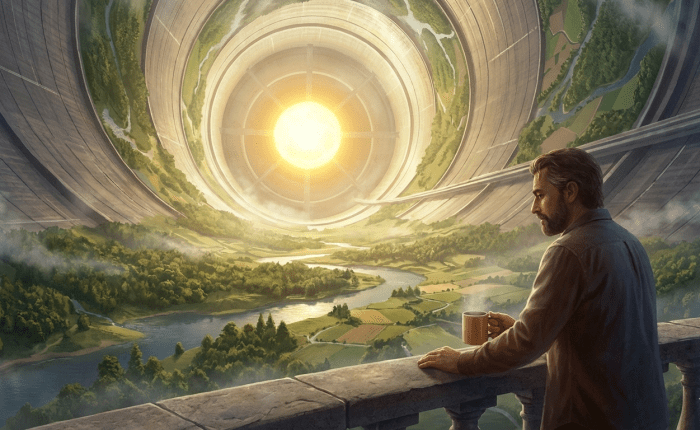
Light poured in through apertures in the hull. The many photons they admitted were focused by the ship’s interior lenses and directed towards the center. Where they met, a bright apparition hovered in midair, visible to everyone on the curved ground below. This “Sun,” which they had brought with them through the miracle of engineering, painted the landscape below in a warm light, drawing attention to every tree, structure, and ripple in the water.

It was appropriate and soothing for someone who had just arisen from cryosleep. Placing his cup down on the parapet, Dube took a deep breath and drew in the morning air. The landscape was quite accommodating, generating dew that formed on the grass and leaves. When the morning light came and turned it into water vapor, the result was fragrant ozone. Were it not for the vertically-sloping skyline, it would have looked, smelled, and felt like home.

Dube got a strange flash of recollection. He remembered standing somewhere, feeling the sights, sounds and smells of home. But he also recalled that there was a voice telling him that it wasn’t home, not anymore. The rest was darkness…

It was like something out of a bad dream that he could only remember in the vaguest sense. Dube knew that such recollections were natural after waking from cryosleep. The dreams one had, especially as they were coming out of dormancy, were known for being vivid. But as time went on, they became foggier and harder to retrieve.

If that were true, the indeterminate recollection was meaningless.

Then again, there was the extraction process that he and the other Engineers had undergone. So many memories from their training sessions had been removed afterward and put in storage, only to be reloaded when a specific Contingency occurred. A common side effect of the process, they had been forewarned, was vague recollections and moments of déjà vu.

If that were true, then Dube was sensing something from a training session, something that he elected to forget. He didn’t see how scenes from home and discussing where home was could possibly be related to contingency-specific training. But until he could retrieve something more of the memory, he had no way of knowing.

Dube huffed. Apparently, another symptom of cryosleep was endlessly poring over trivial matters. Vivid dreams were certainly to be expected during cryosleep, but not any particular obsession with them. Meanwhile, the ship’s artificial dawn was spreading in front of him and he had barely noticed.

There was much to notice too. The last time he had stared out onto the landscape of the ship, it was in the process of being spun up. The grass, trees, and foliage had just taken root, the deserts and transitional zones stood silent, and the waters reflecting the artificial dawn were not yet flowing. But in the years since their departure, the landscape must have blossomed and died many times over.

To look out onto the inner world that was the Transverse today was to look upon an environment that was at once familiar, yet alien. It was exacting in its biomimicry, every patch of the landscape adopted from the original example. But the biosphere had still evolved to become its own unique lifeform, with one generation of life dying and making way for the next. Even though the layout and distribution were as he remembered them, every organism that currently existed inside the ship was different than the ones that came before.

Like the human body, which swapped all its cells every seven to ten years, the landscape Dube beheld was the latest skin covering the same giant organism. That organism would continue to procreate and see its spawn mature and die. It would happen many more times as the ship made its way towards their destination. If necessary, it would continue to do so long after they reached it. The symmetry of that made Dube smile.

It also filled him with feelings of insignificance at the same time. From one end to the other, they had created a closed-loop system that mimicked (as closely as possible) the entire environment of Earth. Within a single structure, the entire biosphere of Earth was recreated.

In the center, there was the massive rainforest belt made up of the Amazon, Congo, and Borneo sections. Capping this section on either side was the patches of savannah and desert, gradually giving way to grasslands and temperature forests.  Stretching perpendicular to these were the three saltwater seas that ran the length of the interior – Atlantic, Pacific, and Indian – eventually emptying into the Arctic and Antarctic oceans.

Further down the ship’s spine, Dube could make out where the verdant hills and lakes of the Precambrian landscape gave way to the next geographical region of the interior. This was the Prairie-Steppe of the northern hemisphere, which distinguished them from the Pampas of the southern. While the view was somewhat hazy, thanks to all the moisture-laden air between Dube and that section, they were distinguishable based on their comparatively flat profile and large tracts of grasslands and shrubbery.

Light from the sunband painted the many structures distributed across this landscape, casting shadows beneath them. Down there, crewmembers were tilling the fields, planting the seeds of the previous harvest to grow the next.

A glance in the opposite direction revealed a different transition. The fields of the Borealis seemed to go on forever, until they thinned to make way for the Tundra. Beyond that, in the barely-perceptible distance, was the northern ice cap – a frozen field that wrapped the front section of the North Habitation module. Dube felt a chill just looking at it.

Picking up his cup, Dube took another sip of his coffee. The dose of restoratives Jonas had added was swarming through his insides now, meeting up with his dormant medimachines and giving them a blast of chemical energy. Once that was complete, they would come together to administer repairs to all of his bodily systems.

He could already feel the cobwebs in his brain being combed away.

Looking to his left, just above his eye level, Dube saw Lake Ontario, the central freshwater lake in the northern section of the vessel. The sunlight reflected from the surface a fine patchwork, indicating where wind and Coriolis forces caused ripples on the water. From his vantage point, the lake looked like something Dube would expect to see from Low Earth Orbit, and perhaps flying over Mars and Venus someday. The experience was known to trigger vertigo to the uninitiated, but Dube had seen it enough times to become comfortable with it.

His eyes came to rest on the small chain of islands that were grouped along Ontario’s narrowest point, the Engineers attempt to reproduce the Thousand Islands and the complex Frontenac Arch biosphere. Already, there were people in small boats out to the open water with their fishing implements. Perhaps they would even catch something. The pike, trout, steelhead, and bass had been awake longer than any of them, after all.

[Engineer Dube. Have you had adequate time to recuperate?]

Dube sighed. [Yes, Jonas. And just to save us both some time, I will be heading for the Bridge right now.]

[Thank you, Engineer Dube. I shall see you there.]

“Of course, you shall,” he sneered.

A Sneak Preview – Transverse

A Sneak Preview – Transverse

Boy, this has been a long time in the making! Years ago, as I was finishing work on the Formist series, I began working on my next project: Transverse. For years, I worked on it, but found that I was only moving the ball incrementally forward. And then life intervened when my wife had a stroke brought on by kidney disease. As you can imagine, this left little time or energy for creative writing.

However, as things got easier in our lives, I found myself returning to my Work-In-Progress (WIP). And a few months ago, I found the creative energy to finish chapter after chapter! As I write this post, I am nearing the completion of this project. In the spirit of this, I wanted to give you all a preview of my WIP by offering the first few chapters.

To recap, Transverse takes place aboard a Generation Ship en route to the not-so-distant system of Delta Pavonis. This Sun-like star is roughly 20 light-years from Earth and currently has no confirmed exoplanets, making it perfect for writing fiction. In my story, this star is named Tōnatiuh by the ship’s crew, which is Nahuatl for “Fifth Sun” (since it’s the fifth Sun-like star beyond the Solar System), and also the name of the Aztecs’ Sun god.

The world they are looking to settle is Delta Pavonis d, the third planet from the star, which they’ve named Çatalhöyük after the ancient neolithic settlement, one of the earliest known human settlements (dated to ca. 7500 BCE). The people aboard are highly advanced, led by a team of 9 Engineers and thousands of crew who tend to the ship on a rotational basis. While one-third of the Engineers and crew are awake, the others are kept in cryogenic preservation.

The rest, I hope, will become clear as the chapters go on…


The doors opened onto a vast theatre, dark, but with glowing patches where strategically placed lamps hovered next to the walls. Their light catches small surface spaces across the cavernous room: cream-colored walls, dark wood panels, russet seat cushions. The level of illumination is intentionally kept low; to the point that it makes the space and the few hundred people seated just discernible. On the stage, the focal point of the whole place, the lights are slightly brighter, drawing attention to a backdrop that not currently in operation.

Over ten thousand seats fill the room, arranged in a typical half-moon crescent on the ground floor. Dube knows there are just as many located in the gallery above, along with boxes along the walls that offer an elevated view of the stage. The place is familiar, though he knew somehow that he had never been here before.

Of the handful of patrons who’ve made themselves at home, a few looked at him when he entered. Of these people, Dube could make out some facial features, thanks to the brightened screens of their folios. A handful have no faces, just irises that beam light at him from the active display diodes embedded in them.

Dube felt inexplicably confused. The atmosphere that filled the theatre seemed very much calm. So many people, sprawled out in a room not ordinarily intended for self-directed tasks. No one appeared to be talking or calling in anyone else’s direction. Just the sound of their breathing the circulation of the ship’s air.

And yet, Dube felt that a strange tingle of unease.

He could think of nothing to justify that feeling. He recognized the room, the people were not behaving threateningly in any way, and there was sufficient light to see by.

Walking down the central walkway, he looked left and right for a familiar face. Strangely, everyone looked alien to him. That did not seem right, but he still couldn’t think of anything to contradict what he was seeing.

He smiled when he finally saw someone he recognized.

“Welcome home, Obuya,” she said.

“Home?”

She looked at him queerly.

“Of course. This has always been our home.”

She said the words in such a matter-of-fact way, as if it were somehow academic.

“I’m confused.”

“Can you remember a time before we were here?”

Dube sighed. He seemed to remember images of a distant place. He terrain was alpine, undulating in every direction. Where it ended, a cool valley stretched almost to the horizon, abutted by another mountainous outcropping. The ground before him was covered in shrubs and dotted with all manner of Acacia and Eucalypt trees. The sensations began to pile on: the warm Sun on his face, the cool shadow of the Blue Mountains on his back. And he could feel a gentle breeze coming up from the valley, the smell of wildflowers and eucalyptus oil.

His eyes snapped opened and he beheld the landscape with a new sense of disapproval.

“This is not my home.”

“Not anymore,” said Edennu, sternly. “We brought it all with us.”

These words made Dube feel a strange tingle. How did she know what he was thinking? He had not linked with her, nor had she reached out to him. He tried to do so now but couldn’t get a connection. Reaching out, he found no bandwidth with which to do so either.

He looked around again, harder this time. Somewhere in the sleepy room, there had to be some clue to what was going on. He couldn’t remember what he was looking for when he came in, but suspected it was here somewhere. And then there was the matter of where he had been before. He tried to call up the mental image again; perhaps what he sought was there.

“The trees…” he whispered. “I remember Baobabs, Umkwakwa, and Cinnamonum. Bushwillow blossoms, as many as the stars.”

Edennu quickly retorted, almost chiding him.

“Don’t worry about the trees, Obuya. We brought them all with us.”

He didn’t know why, but her words made perfect sense to him. He inquired further.

“And the oxen? And the aurochs?”

“We brought them too, Obuya.”

“And the Sun,” he said queerly. “What about that?”

She shook her head. “No, Obuya. We didn’t bring that with us. We just have to hope they have enough for all of us.”

“They? Who are you talking about?”

She didn’t reply. Her eyes remained fixed on her book. Dube tried again.

“What did you mean by that? Sandra?”

Edennu went dark. Her physical form was still there. But what was behind it was gone. In the space she occupied, it was as if an absence had formed. Dube looked around the room and noticed that the same thing was happening in other places too. He also noted the way it was spreading. In every seat, in every corner, the people were still there – and yet, not.

The room followed too. The stage, the auditorium, the lights – all of it became bathed in the same interminable darkness. And soon, an ill sound followed. The still quiet gave way to a terrible scurrying, as if something was crawling through the airways.

“What is that?” he asked. Edennu did not answer. She had gone dark and quiet, like everyone else. Nothing around him would answer. The only thing making any noise now was the one thing he couldn’t identify, and that was getting louder the closer the darkness came to envelop him. It was not in the airwaves. It was all around him now.

It only stopped once the darkness completely encompassed him.

He felt surrounded. Enveloped.

Yet strangely, he was unafraid.

He could still breathe, still feel, and was aware of an emptiness that surrounded him. The protective bubble, and his ignorance of what lay beyond it, staved off panic. He was alone, submersed in complete quiet and total darkness.

It felt like an eternity. But then again, it was. For the average mortal, centuries of sleep qualified as an eternity…

Some Updates On My Next Project – Transverse!

Some Updates On My Next Project – Transverse!

Hello fellow readers and purveyors of all things nerdy and cool! Today, I wanted to talk about my next literary moves once the trilogy I am currently working on is finished. There are a few ideas I have in mind, but right now, my main focus is on a standalone novel that will serve as a transition between the current trilogy and the one I hope to write next.

This story will take place inside a generation ship that is making its way towards a neighboring star system. Within the confines of this self-contained world, thousands of humans have committed to waiting and working for generations as their massive ship – the Traverse Velocity, which in astronomical terms refers to the speed at which a star moves perpendicular to our line of sight – transports them to an Earth-like world outside of our Solar System.

Continue reading “Some Updates On My Next Project – Transverse!”

Almost Done!

Almost Done!

Hey all! I have more in the way of novel-writing news. For starters, The Cronian Incident is now just a few chapters short of completion. After over a year of writing, editing, and back and forth with my prospective-publisher, the novel is just about finished. All told, it is now 31 chapters long and just over 85,000 words in length. I anticipate it will be about 100,000 by the time its finished, though I have been known to exceed estimates in the past!

And as per my agreement with my publisher, I have begun working on its sequel. Apparently, publishers like to know the people they sign have more books in them. And they prefer to release sequels within a few months of the first book, to ensure that any buzz they generate with the first release can be capitalized on. Lucky for me I had plans for a second and third novel before my publisher and I started talking, not to mention some spin offs.

So here’s the commercial description for the proposed sequel (i.e. what you’d read on the back of the dust jacket), as well as a rundown on some other ideas I’m working on:

The Jovian Manifesto:

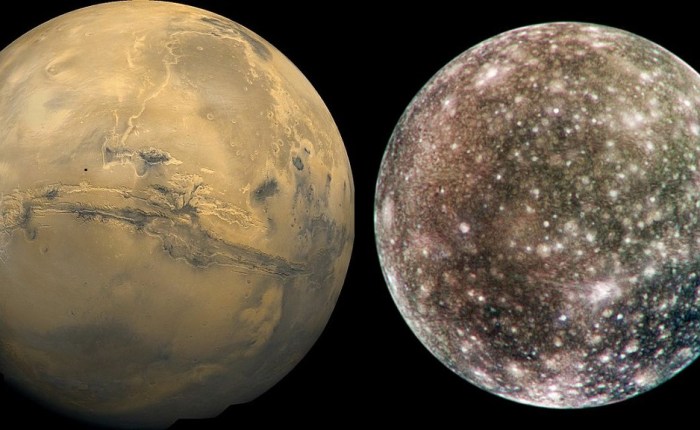
The Solar System is in the midst of a crisis. In the Jovian and Cronian systems, the populations are up in arms, thanks to an inflammatory document that has appeared on the local nets. Known as “The Jovian Manifesto”, this document details how a powerful faction in the Inner Solar System conspired to seize control over the moons of Callisto and Titan and forcibly alter them. Behind the leak is a mysterious personality known only as Clio, who is threatening to release all the details unless the guilty parties come forward.

Back on Venus, a former analyst named Valéria Gallego is called before the Solar Assembly to investigate the Manifesto and its author. In this, she is assisted by Kadera, an infiltration specialist who can get in and out of any location in the Solar System. If they can determine its authenticity, perhaps they can prevent open conflict. But if not, the Inner Worlds may have no choice but to send armed forces to the Outer Worlds to ensure peace and stability.

Meanwhile, a string of violent acts has threatened to bring things ever closer to the brink. For Gallego and all those who are seeking the truth, time is running out…

Luna Invictus:

Now this is a book that doesn’t come with a commercial description, just a general one. But it is set in the same universe as The Cronian Incident and The Jovian Manifesto. Here’s what I am thinking. Basically, I wanted to do a story set on the Moon, ca. the 22nd century, when the Moon is now effectively colonized,,,

Between the European Space Agency (ESA), NASA, the Russians (Roscosmos), India (the ISRO), and China (CNSA), the lunar surface now has multiple permanent settlements. Whereas the ESA and NASA have established themselves at the southern polar region – in a domed settlement in the Shackleton Crater – and the Chinese have established a colony in the northern polar region, the Russians and Indians have claimed the mid-latitudes, where stable lava tubes have allowed for the creation of underground cities.

And on the “Dark Side” of the Moon – that is to say, the side looking away from Earth – are a series of installations known as the Unrestricted Zones. It is here that all kinds of weird research, development and experiments take place. Nanotechnology, biotechnology, quantum computing, and man-machine interface – anything goes in these places! Ever since the explosion in learning that took place during the previous century, places all over Earth and the Moon have become dedicated to pursuing technological progress and integration without restriction.

And it is here that a young man named Frankling Houte is seeking to go. Years ago, his sister – named Constant Houte – chose to undergo a procedure where her organic brain would be augmented by merging it with quantum components. But after all contact ceased, he is determined to find her and return her home. But whereas Franklin fancies himself a brave rescuer, it is his sister who will come to save him.

Transverse:

This story will take place entirely in a generation ship that is making its way towards the nearby star system. Within the confines of this self-contained world, thousands of humans have committed to waiting and working for generations as their massive ship – the Traverse Velocity, which in astronomical terms refers to the speed at which a star moves perpendicular to our line of sight – transports them to an Earth-like world outside of our Solar System.

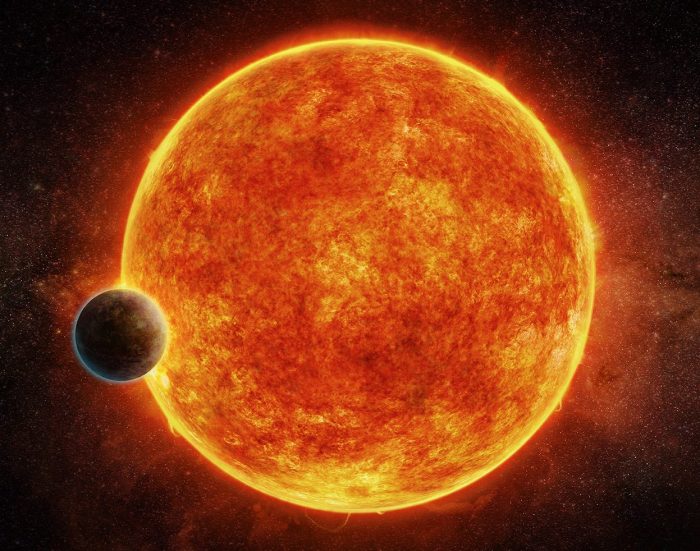
The location of that world is up for grabs at the moment, mainly because new discoveries are being made all the time. Did you hear about the latest exoplanet discovery, located about 39 light years away and already said to be the “best place to look for signs of life beyond the Solar System”? Between that and new findings that claims how previous discoveries are not likely to be habitable after all, I’ve decided to leave the destination blank until I actually start writing it!

But of course, no story would be complete without some intrigue and big ol’ inciting event! And the way I see it, things begin to go awry when the Captain and crew get notification that one of the passengers has awakened from cryosleep prematurely and disappeared into the ship. Shortly thereafter, one of the crew is found dead in what appears to be a sabotage attempt gone wrong. A ship-wide search begins to find the culprit while the atmosphere quickly devolves into one of paranoia and suspicion.

To make matter worse, the crew becomes aware of another ship that is threatening to catch up and overtake them. It seems that another faction from the Solar System, which was also intent on settling (insert exoplanet here) is now trying to get their ahead of them. What began as a journey to a new world, characterized by hopes and dreams, has become a race to lay claim to a planet. And it appears that the planet may have inhabitants of its own, ones which are not interested in welcoming the intruders.

An Interior Look at Yuva’s Spaceships

Rama16wikiI might have mentioned that things are coming together for my colleagues and I over at Grim5Next. After a few weeks, our story is really coming together. First drafts are coming in, ideas are germinating and being shared, and visuals are being made! Which brings me to the latest installments in the Anthology news cycle, after much time spent with my Windows Paint application, I have finally been able to prepare some cross sections of the ships in our story.

As already noted, we decided that for the purposes of our story, we wanted ships that could provide for crews during a long, sub-light journey through outer space. At the same time, they needed extensive cryo-facilities to ensure that thousands of colonists could be kept alive and preserved for the day when they would arrive at a new world. So basically, it would have to be a cross between a sleeper ship and a generation ship. This is what we came up with for a profile shot:

Note the segmented layout and extended middle section. This layout places the control module at the front with the bridge, navigation and whatnot, while the engine compartment, storage and shuttle bays are located at the rear. The middle section, which is an O’Neil Cylinder, is the habitation module, which rotates to provide artificial gravity. Here is where the crew sleep, eat, enjoy their leisure time, and ensure that they don’t suffer from the effects of muscular atrophy or osteoporosis.

And now, for the first time, here’s a peek at what it looks like inside. Each section was done separately to give it a maximum level of detail and ignite our collective imaginations. When complete, I hope to include them in the book to help our reader’s visualize what the interior layout of the ships would look like. Thus far, I’ve finished work on the aft and habitation sections, with the front end to follow soon. I was hoping to have them all done for today’s little unveiling, but man these things take time to generate!

CS_RearCS_Front

Space Anthology!

My apologies to all those expecting a post about zombies or post-apocalyptic stories. You see, my group and I are busy designing an entire world for our new anthology and we needed some mock-ups to help speed our imaginations to their goal. That’s been my obsession these last few days, that and visiting family. But alas, I have no idea how to post a PDF file to a Shaw Photo Share account, so I came here to do it instead. Behold… Our new Colony Ship!

The overall design is built around the concepts of a generation ship and a sleeper-ship, with the habitation module and the cryo-stasis bays in the center with the engine and shuttle bays at the rear and the command module at the front. And of course, for the people in the center area, the concept of an O’Neil Cylinder comes into play – a ship that utilizes a rotating section to generate gravity. And I think a long spine connecting it all together, which requires a cart since the gravity is at its lowest in the center, would also be cool.

Oh, and I should mention that we’ve selected a location for our story and done some additional mapping to give the setting a truly realistic feel. As already noted, the star system in question is Gliese 581, and the planet is 581 g, a real exoplanet that scientists believe could host life. And here is what it looks like, for our purposes anyway:

It’s called Yuva, a Turkish word which translates to “Home”. All the continents are named in honor of the scientists who helped discover Gliese 581’s planetary system. The rest, well, that’s all us baby! The polar continent, named New Gondwana, is named after the super-continent of Earth’s Precambrian period. And the vast stretches of sea are just tentative names that I thought seemed appropriate, given their position between the major landmasses. Note the color, which denotes levels of fertility, green being lush, grey being glacial, and yellow and light green being desert of savanna land.