
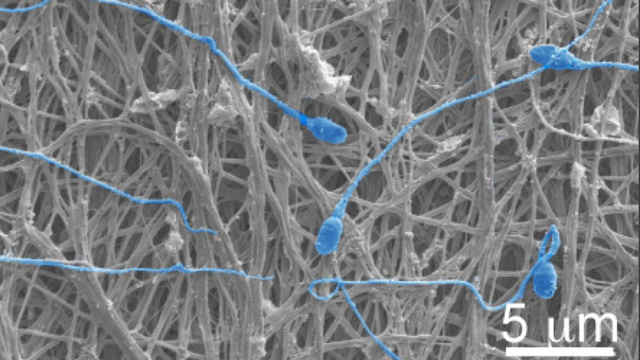
 Doesn’t that sound like a tall order? A nanofabricated condom that delivers an anti-HIV drug, prevents pregnancy, then disappears so as not to create waste. Did I say tall order, or something out of a dream? Hard to say. The point is, its could soon be reality thanks to researchers at the University of Washington who just published a paper in describing how they’ll use “electrospinning” to create next-generation female condoms made from specially customized nano-fibers.
For those unfamiliar with the terminology, electrospinning is a process where an electrical charge is used to draw very fine fibers (typically on the micro or nano scale) from a liquid. Using this method, the UofW researchers hope to weave an ultra-thin series of cloth-like fibers and medicine together to create female condoms that will boast all the necessary protection and contraceptives to make recreational sex perfectly safe. And the rate of disolution, which can be engineered to take place in a matter of minutes, hours or days, ensures that women don’t need to remove it after sex is had.
According to their abstract, the new condom is based in the field of “Multipurpose prevention technologies (MPTs)”, a relatively new concept that seeks to “simultaneously prevent sexually transmitted infections (STIs) and unintended pregnancy”. Given the current rate of population growth and the ongoing epidemic of HIV/AIDS and other STI’s, this new field is considered to be a possible answer to a growing global health concern. What’s more, they claim that “combining chemical and physical barriers offers the greatest potential to design effective MPTs, but integrating both functional modalities into a single device has been challenging.”
The abstract also goes on to describe the process that they will be relying on and the results:
“Using FDA-approved polymers, we fabricated nanofiber meshes with tunable fiber size and controlled degradation kinetics that facilitate simultaneous release of multiple agents against HIV-1, HSV-2, and sperm. We observed that drug-loaded meshes inhibited HIV-1 infection in vitro and physically obstructed sperm penetration. Furthermore, we report on a previously unknown activity of glycerol monolaurate (GML) to potently inhibit sperm motility and viability.”
Despite the challenges in the process, the results thus far have been encouraging, and even garnered the attention of Bill and Melinda Gates. Apparently, their Foundation has pledged a research grant of one million dollars to develop the technology which will make these condoms possible. I don’t know about you, but I feel safer!
Source: IO9.com

 Stories by Williams