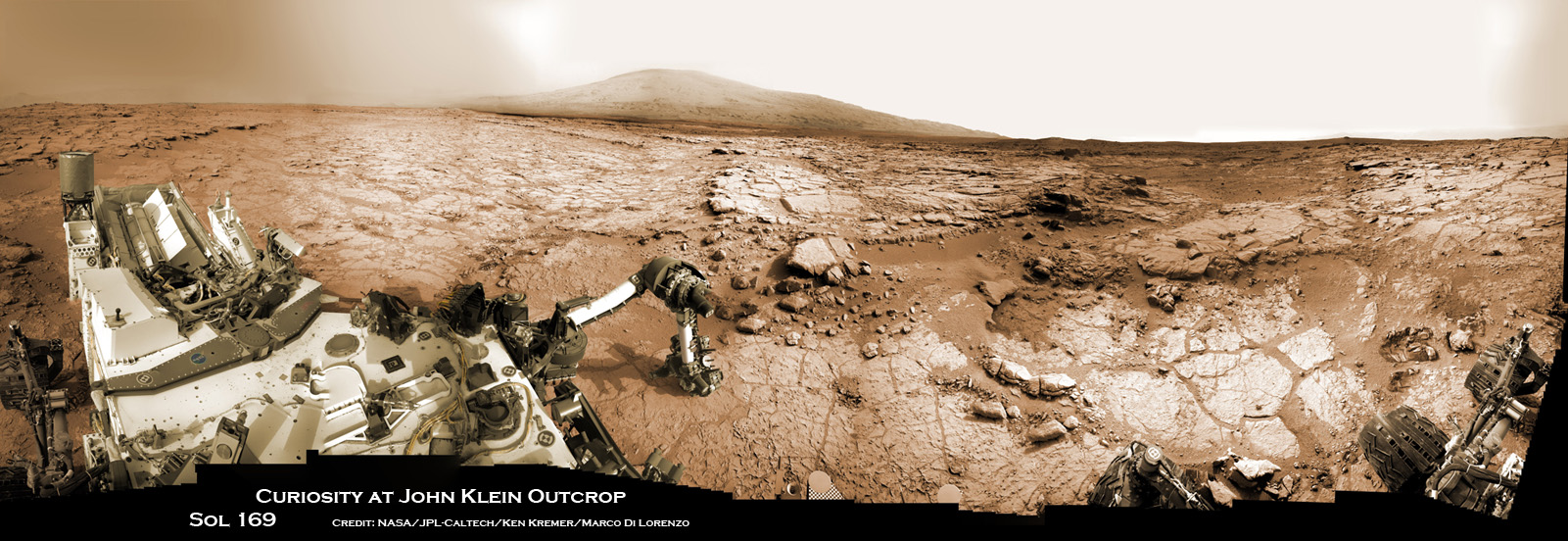
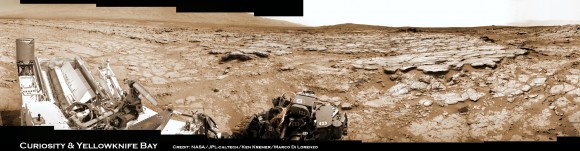
Curiosity has just finished analyzing the samples collected from its first drilling operation at the John Klein rock formation in Yellowknife Bay. And what it found confirms what scientists have suspected about the Red Planet for some time. Contained within grey the dust collected from the rock’s interior, the rover discovered some of the key chemical ingredients necessary for life to have thrived on early Mars billions of years ago.
After running the two aspirin-sized samples through its two analytical chemistry labs (SAM and CheMin), the Mars Science Laboratory was able to identify the presence of carbon, hydrogen, oxygen, nitrogen, sulfur and phosphorus in the sample – all of which are essential constituents for life as we know it based on organic molecules.
What’s more, according to David Blake – the principal investigator for the CheMin instrument – a large portion of the sample was made up of clay minerals, which in itself is telling. The combined presence of these basic elements and abundant phyllosilicate clay minerals indicate that the area was once home to a fresh water environment, one where Martian microbes could once have thrived in the distant past.
By confirming this, the Curiosity Rover has officially met one of its most important research goals – proving that all the elements necessary for life to flourish were once present on Mars. And when you consider that the Curiosity team was not expecting to find evidence of phyllosilicate minerals in the Gale Crater, the find was an especial delight. Based on spectral observations conducted from orbit, phyllosilicates were only expected to be found in the lower reaches of Mount Sharp, which is Curiosity’s ultimate destination.
So what’s next for Curiosity? According to John Grotzinger, the Principal Investigator for the Mars Science Laboratory, Curiosity will remain in the Yellowknife Bay area for several additional weeks or months to fully characterize the area. The rover will also conduct at least one more drilling campaign to try and replicate the results, check for organic molecules and search for new discoveries.
And we’re back from Mars with another slew of updates and breaking news! It seems that ever since the Curiosity Rover landed back in early August, the revelations and interesting facts have been pouring in non-stop. With each bit of news, we learn a little more about the Red Planet’s composition, its history, and how both are so similar to our own.
And in recent weeks, ever since Curiosity moved into Yellowknife Bay, there have been a number of interesting developments. One came back in January when the Rover found a series of calcium-rich deposits, similar to the kind observed here on Earth. These types of deposits are observed wherever and whenever water circulates through cracks and rock fractures. This is just the latest in a long string of discoveries which support the conclusion that Mars was once home to vast rivers.
The images above show the similarity between the sulfate-rich veins seen by Curiosity rover to sulfate-rich veins seen on Earth. The view on the left is a mosaic of two shots from the remote micro-imager on Curiosity’s Chemistry and Camera (ChemCam) instrument which were taken on Dec. 14, 2012, or the 126th sol (Martian day) of operations. The image on the right is from the Egyptian desert here on Earth, which a pocket knife included for scale.
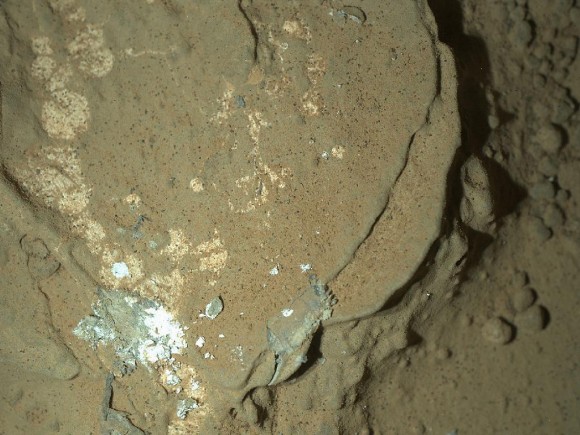
The next bit of news came on January 25th when Curiosity’s high resolution robotic arm camera – also known as the Mars Hand Lens Imager (MAHLI) – snapped its first set of nighttime images. The images were illuminated by both an ultraviolet and white light emitting LED’s (shown above and below). The rock outcropping – named “Sayunei”, located at the site of the “John Klein” outcrop – was just one of many to be found in Yellowknife Bay where Curiosity has been conducting ongoing surveys.
In this case, it was breaking the rock apart in an effort to try and expose fresh material, free of obscuring dust. Once exposed, the pictures were meant to determine the internal makeup of the rock. “The purpose of acquiring observations under ultraviolet illumination was to look for fluorescent minerals,” said MAHLI Principal Investigator Ken Edgett of Malin Space Science Systems, San Diego. “If something looked green, yellow, orange or red under the ultraviolet illumination, that’d be a more clear-cut indicator of fluorescence.”
In addition, certain classes of organic compounds are also fluorescent. Yes, that search continues!
And last, but not least, came the news at the end of January that indicated that Curiosity’s long-awaited test of its high-powered drill will finally be taking place. This first drilling operation entailed hammering a test hole into a flat rock at the John Klien formation for the purposes of making sure everything works as needed. If things pan out, then the team would conduct many more tests and collect the drillings for analysis by the Rover’s CheMin and SAM analytical labs in the coming days.
In anticipation of the planned drilling operation, the rover carried out a series of four ‘pre-load’ tests on Monday (Jan. 27), whereby the rover placed the drill bit onto Martian surface targets at the John Klein outcrop and pressed down on the drill with the robotic arm. Engineers then checked the data to see whether the force applied matched predictions. The next step was an overnight pre-load test, to gain assurance that the large temperature change from day to night at the rover’s location would not add excessively to stress on the arm while it is pressing on the drill.
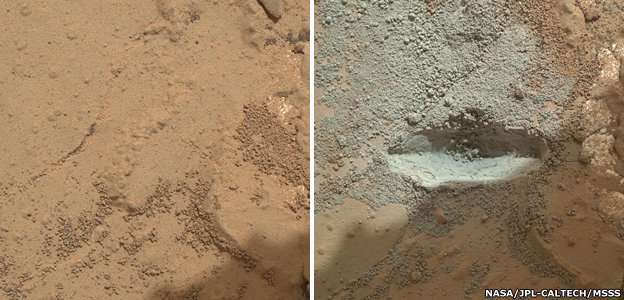
The photo above shows the before and after shots of the rock where the drill conducted its hammering. And as you can see, the rock powered and is of a different color inside – slate gray as opposed to rust red. If the MSL lab deems the slab suitable, a number of test holes are likely to be drilled – using the rotation as well the percussive action – before a powdered sample is picked up and delivered to Curiosity’s onboard laboratories.
And so far, according to Curiosity project scientist John Grotzinger, things are looking good:
“The drilling is going very well so far and we’re making great progress with the early steps. The rock is behaving well and it looks pretty soft, so that’s encouraging,” he told BBC News.”
Ultimately, the purpose of the rover’s mission is to try to determine whether Gale has ever had the environments in the past that were capable of supporting bacterial life. Detailing the composition of rocks is critical to this investigation as the deposits in the crater will retain a geochemical record of the conditions under which they formed. Drilling a few centimetres inside a rock provides a fresh sample that is free from weathering or radiation damage, both of which are common to the Martian surface.
There is more to follow, for sure. And in the meantime, check out this video of the Mars Science Labs providing the latest Curiosity Rover Report explaining their finds for the month of January and plans for February.
More news from Mars! Or more specifically, from Yellowknife Bay, a place that shows extensive evidence of flowing water. After relocating to the region and performing a preliminary search, Curiosity has located the rock it will drill in order to gain an understanding of its composition and search for organics molecules. The rock has been dubbed “John Klein”, and this will be the first time engineers have drilled into the surface of another planet.
Already, Curiosity has determined that at one time, the Gale Crater was once the site of flowing water. But in its current location, they are able to assess the geological history and have stumbled upon a number of interesting features. In the course of descending from the plateau region where it landed into the relative depression that is Yellowknife Bay, Curiosity has observed many layers of rock that are increasingly older, effectively taking it backwards into the planet’s history.
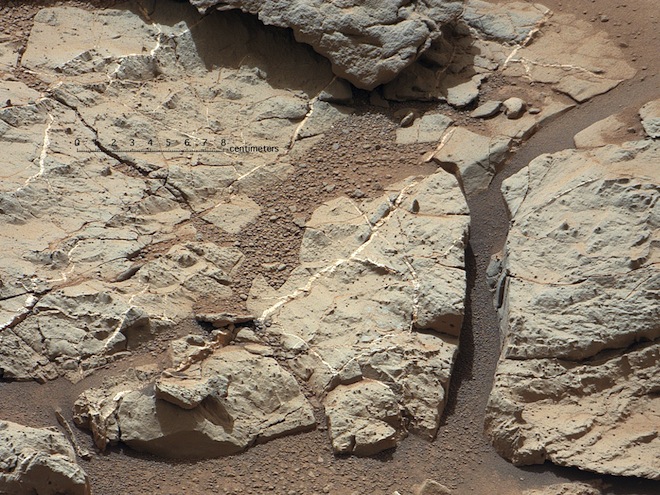
Geologists are finding a lot of different rock types, indicating that many different geologic processes took place here over time, all of which confirm that water passed through the region at one time. For example, some of the minerals are sedimentary, which suggests that flowing water moved small grains around and deposited them. Other samples are cracked and filled with veins of material such as calcium sulfate, which were formed when water percolated through the cracks and deposited the mineral.
All these investigations suggest if you could go deep into Mars’ past and stand at the same spot as the rover, you’d probably see a river of flowing water with small underwater dunes along the riverbed. And since these rivers left traces behind, drilling into the rocks will reveal what else they carried, which could very well include the building blocks of life!
Already, Curiosity brushed some of these rocks to remove their dust covering and then examined them with its high-resolution Mars Hand Lens Imager (MAHLI) camera. The next step will be to drill 5 centimeter holes into some of these rocks and veins to definitively determine their composition. Geologist John Grotzinger of Caltech said that the team will search for aqueous minerals, isotope ratios that could indicate the composition of Mars’ atmosphere in the past, and possibly organic material.
The drilling will probably take place within two weeks, though NASA engineers are still unsure of the exact date. But, says Richard Cook, Curiosity’s project manager, the procedure will be “the most significant engineering thing we’ve done since landing,” and will require several trial runs, equipment warm-ups, and drilling a couple test holes to make sure everything works. The team wants to take things as slowly as possible to correct for any problems that may arise, such as potential electrical shorts and excessive shaking of the rover.
And of course, this time around they are likely to be much more tight-lipped and reserved when it comes to announcing their findings. Should they uncover evidence of life at one time in Mars’ deep past, they will certainly need to be sure. Such a finding is likely to be… “Earthshaking”! I admit, that’s getting old. I’ll stop now…
An interesting slew of news has been coming from NASA recently, courtesy of the Curiosity Rover and its mission to Mars. First, there was the announcement by John Grotzinger on NPR radio that Curiosity’s science team had discovered something potentially “earth-shattering” on the Red Planet, which came just two days ago. Since then, researchers over at NASA have been keeping a tight lip on what that might be, though it seems to be taking an extraodinary effort to do so. One can only imagine what they’re dying to tell us…
But it seems more stories are coming in the wake of this. First, there was the revelation by the Curiosity Rover that Mars radiation levels, once thought to be problematic for life, are actually safe for humans. According to Don Hassler, the principal investigator on Curiosity’s Radiation Assessment Detector instrument (RAD), Curiosity determined that “the Mars atmosphere is acting as a shield for the radiation on the surface and as the atmosphere gets thicker, that provides more of a shield and therefore we see a dip in our radiation dose.”
Apparently, the levels are equal to what astronauts deal with on the International Space Station, which means people in suits will be able to walk on the Red Planet safely once a manned mission is mounted. Knowing that they can conduct surveys on the surface without additional radiation shields should prove to be a boon for colonization as well. More settlers will certainly be drawn to Mars now that they know they can settle in without having to worry about little things like radiation sickness or mutations!
Third, there was the news that in the wake of making its “one for the history books” discovery, that Curiosity has finished collecting and analyzing soil samples and is preparing to move on. The final checks and preps were made amidst ethereal whirlwinds and twisters, which are characteristic of the region known as the “Gale Crater”, where it has been conducting its research for the past month. The rover is now being prepared to move on in search of suitable targets for a compact rock drill, the final major sample acquisition system to be tested.
Ashwin Vasavada, the deputy project scientist for the Mars Science Laboratory rover at the Jet Propulsion Laboratory in Pasadena, Calif, had this to say on the next phase of the mission: “We still would like to get a little further into this Glenelg region where we see this diversity of rocks and layered rocks and other really interesting terrain. And then we still have a goal in the next month or two of doing the big U-turn and heading up to Mount Sharp.”
Mount Sharp is a 3-mile-high mound of layered terrain that sits in the center of the Gale Crater, where Curiosity is expected to spend the bulk of its planned two-year mission. In the meantime, the research team needs to go over all the information Curiosity has sent back, including an ongoing analysis of the martian weather.
On top of all that, there’s still the matter of that “earth shaking news”. How about it NASA? You too, Grotzinger? We’re ready and waiting… how much more time do your researchers need before they’re sure and are free to break the news they are so clearly dying to share? I still say its organic molecules, but what do I know?

 Curiosity has just finished analyzing the samples collected from its first drilling operation at the John Klein rock formation in Yellowknife Bay. And what it found confirms what scientists have suspected about the Red Planet for some time. Contained within grey the dust collected from the rock’s interior, the rover discovered some of the key chemical ingredients necessary for life to have thrived on early Mars billions of years ago.
 What’s more, according to David Blake – the principal investigator for the CheMin instrument – a large portion of the sample was made up of clay minerals, which in itself is telling. The combined presence of these basic elements and abundant phyllosilicate clay minerals indicate that the area was once home to a fresh water environment, one where Martian microbes could once have thrived in the distant past.
 So what’s next for Curiosity? According to John Grotzinger, the Principal Investigator for the Mars Science Laboratory, Curiosity will remain in the Yellowknife Bay area for several additional weeks or months to fully characterize the area. The rover will also conduct at least one more drilling campaign to try and replicate the results, check for organic molecules and search for new discoveries.





 Stories by Williams