The Latest From Mars: Water, Drilling, and Night Photos

curiosity_drilling2And we’re back from Mars with another slew of updates and breaking news! It seems that ever since the Curiosity Rover landed back in early August, the revelations and interesting facts have been pouring in non-stop. With each bit of news, we learn a little more about the Red Planet’s composition, its history, and how both are so similar to our own.

And in recent weeks, ever since Curiosity moved into Yellowknife Bay, there have been a number of interesting developments. One came back in January when the Rover found a series of calcium-rich deposits, similar to the kind observed here on Earth. These types of deposits are observed wherever and whenever water circulates through cracks and rock fractures. This is just the latest in a long string of discoveries which support the conclusion that Mars was once home to vast rivers.

curiosity_calciumThe images above show the similarity between the sulfate-rich veins seen by Curiosity rover to sulfate-rich veins seen on Earth. The view on the left is a mosaic of two shots from the remote micro-imager on Curiosity’s Chemistry and Camera (ChemCam) instrument which were taken on Dec. 14, 2012, or the 126th sol (Martian day) of operations. The image on the right is from the Egyptian desert here on Earth, which a pocket knife included for scale.
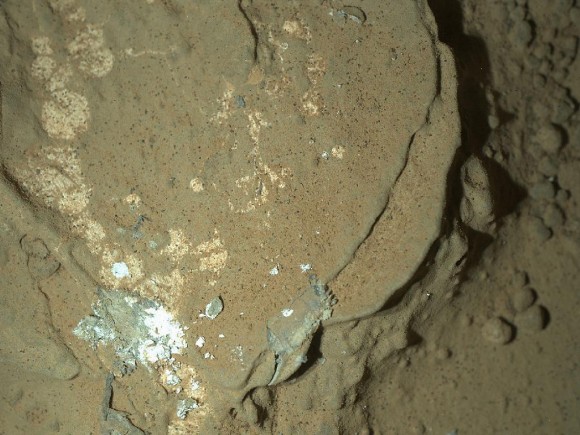
curiosity_night1The next bit of news came on January 25th when Curiosity’s high resolution robotic arm camera – also known as the Mars Hand Lens Imager (MAHLI) – snapped its first set of nighttime images. The images were illuminated by both an ultraviolet and white light emitting LED’s (shown above and below). The rock outcropping – named “Sayunei”, located at the site of the “John Klein” outcrop – was just one of many to be found in Yellowknife Bay where Curiosity has been conducting ongoing surveys.

curiosity_nightIn this case, it was breaking the rock apart in an effort to try and expose fresh material, free of obscuring dust. Once exposed, the pictures were meant to determine the internal makeup of the rock. “The purpose of acquiring observations under ultraviolet illumination was to look for fluorescent minerals,” said MAHLI Principal Investigator Ken Edgett of Malin Space Science Systems, San Diego. “If something looked green, yellow, orange or red under the ultraviolet illumination, that’d be a more clear-cut indicator of fluorescence.”

In addition, certain classes of organic compounds are also fluorescent. Yes, that search continues!

Curiosity_drillAnd last, but not least, came the news at the end of January that indicated that Curiosity’s long-awaited test of its high-powered drill will finally be taking place. This first drilling operation entailed hammering a test hole into a flat rock at the John Klien formation for the purposes of making sure everything works as needed. If things pan out, then the team would conduct many more tests and collect the drillings for analysis by the Rover’s CheMin and SAM analytical labs in the coming days.

In anticipation of the planned drilling operation, the rover carried out a series of four ‘pre-load’ tests on Monday (Jan. 27), whereby the rover placed the drill bit onto Martian surface targets at the John Klein outcrop and pressed down on the drill with the robotic arm. Engineers then checked the data to see whether the force applied matched predictions. The next step was an overnight pre-load test, to gain assurance that the large temperature change from day to night at the rover’s location would not add excessively to stress on the arm while it is pressing on the drill.
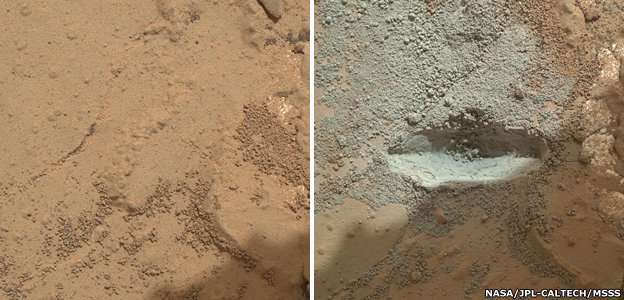
curiosity_drilling1The photo above shows the before and after shots of the rock where the drill conducted its hammering. And as you can see, the rock powered and is of a different color inside – slate gray as opposed to rust red. If the MSL lab deems the slab suitable, a number of test holes are likely to be drilled – using the rotation as well the percussive action – before a powdered sample is picked up and delivered to Curiosity’s onboard laboratories.

And so far, according to Curiosity project scientist John Grotzinger, things are looking good:

“The drilling is going very well so far and we’re making great progress with the early steps. The rock is behaving well and it looks pretty soft, so that’s encouraging,” he told BBC News.”

Ultimately, the purpose of the rover’s mission is to try to determine whether Gale has ever had the environments in the past that were capable of supporting bacterial life. Detailing the composition of rocks is critical to this investigation as the deposits in the crater will retain a geochemical record of the conditions under which they formed. Drilling a few centimetres inside a rock provides a fresh sample that is free from weathering or radiation damage, both of which are common to the Martian surface.

There is more to follow, for sure. And in the meantime, check out this video of the Mars Science Labs providing the latest Curiosity Rover Report explaining their finds for the month of January and plans for February.


Source:
universetoday.com, (2)
, (3), BBC.co.uk, nasa.gov

In Remembrance of Columbia

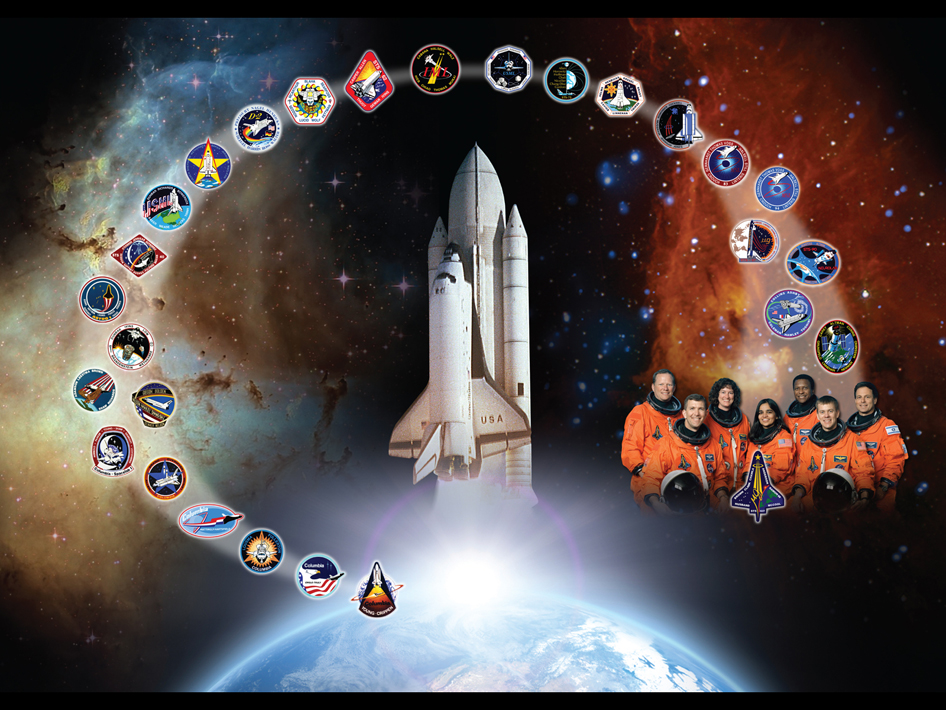
The STS-107 crew includes, from the left, Mission Specialist David Brown, Commander Rick Husband, Mission Specialists Laurel Clark, Kalpana Chawla and Michael Anderson, Pilot William McCool and Payload Specialist Ilan Ramon. (NASA photo)

Just two days ago, the tenth anniversary of the shuttle Columbia disaster came to pass. On that day, the pilots who lost their lives, as well as those who died on the Challenger and Apollo 1 missions, were commemorated at a special wreath-laying ceremony at the Arlington National Cemetery in Virginia. It is a somber day, when people all over the world come together to commemorate those brave souls who died in the name of advancing exploration.

The disaster took place on Feb. 1st 2003, roughly sixteen days after the shuttle departed from Earth to conduct microgravity experiments. During re-entry, contact was lost with the shuttle as the orbiter suffered a catastrophic failure due to a breach that had opened in one of the shuttle’s wings. This had occurred during launch when a piece of foam fell from the external tank during launch.

columbia_arlingtonThe seven person crew of the STS-107 Columbia, which included Rick D. Husband, William C. McCool, David Brown, Laurel Blair Salton Clark, Michael P. Anderson, Ilan Ramon, and Kalpana Chawla, died just 15 minutes before they were meant to touch down at Kennedy Space Center. Addressing the nation, then-President Bush said, “mankind is led into the darkness beyond our world by the inspiration of discovery and the longing to understand. Our journey into space will go on.”

On Feb. 1st, President Obama and Charles Bolden, Administrator for NASA, also marked the occasion with somber words of remembrance. The former emphasized the ongoing important of space exploration and its inherent risks:

“The exploration of space represents one of the most challenging endeavors we undertake as a Nation. Whether it’s landing a 1-ton rover on Mars, building a space telescope 100 times more powerful than the Hubble, or preparing to send humans beyond the Moon, it’s imperative America continues to lead the world in reaching for the stars while giving us a better understanding of our home planet.”

Bolden expressed similar sentiments, calling to mind other tragedies and drawing attention to the lessons learned from the disaster:

“After the tragedy of Columbia, we not only returned to flight, we established policies and procedures to make our human spaceflight program safer than ever. Exploration will never be without risk, but we continue to work to ensure that when humans travel to space, nothing has been left undone to make them as safe as possible.”

Naturally, I hope he’s right about that. As we embark on an era of renewed exploration – to the Moon, to Mars, and even beyond – there will plenty of risk incurred and only a few people bold and intrepid enough to risk their lives to see it done. Much like veterans who died in the name of peace, we should never forget those explorers who died in the name of advancing humanity’s knowledge, awareness, and understanding of the universe.

Rest In Peace you brave souls!

columbia_memorial

Sources: Universetoday.com, history.nasa.gov, nasa.gov

NASA Considers Catching Asteroids

CometNASA is apparently considering playing a little catch and release with some giant rocks. Basically, they want to capture an asteroid and deposit in orbit around the Moon by the early 2020s. The announcement of this new plan was made earlier this month, and left many wondering if this has anything to do with the Obama administration’s long term plans for establishing an outpost on the dark side of the moon or sending a manned mission to a near-Earth asteroid.

This makes sense, since if NASA were to place an asteroid in orbit around the Moon, a crewed space craft could practice engaging with it without needing to move beyond the range of a rescue mission. What’s more, such a body would come in handy as a potential stopover base for spaceships looking to refuel and resupply before setting off on deeper space missions – particularly to Mars.

NASA_moonWhat’s more, capturing a near Earth asteroid and bringing it in orbit of the Moon is a safer, cheaper way to perform manned landings on object in the asteroid belt. The nearest proposed target is a space rock named 1999 AO10, an asteroid which is roughly a year’s trip away. Traveling to this body would expose astronauts to long-term radiation since they would be beyond Earth’s protective magnetic field, and would also take them beyond the reach of any possible rescue.

Researchers with the Keck Institute for Space Studies in California have confirmed that NASA is mulling over the plan to build a robotic spacecraft for just such a purpose. They also confirmed that the project would take six to ten years and would involve the launching of a slow-moving spacecraft propelled by solar-heated ions on an Atlas V rocket. After locating and studying the target asteroid, the robot would catch it in a bag measuring about 10 by 15 meters and bring it back towards the moon.

Altogether, the mission would take 6 to 10 years, and cost about 2.6 billion. If successful, it may cut costs when it comes time to place a base in orbit at Lagrange Point 2 – on the dark side of the moon – or when missions to Mars start heating up by 2030. Yes, at this point, I’m thinking the people at NASA are thanking their lucky stars (no pun!) that Obama was reelected back in November. Always good to have powerful friends, especially when they can sign multi-billion dollar checks!

Source: Wired.com, newscientist.com

NASA’s Next-Gen Spacesuit

NASA_suitIt’s like something Buzz Lightyear would be seen in, minus the death ray laser. It’s called the Z-1 spacesuit, a prototype that NASA hopes to incorporate into their equipment lineup by 2015. Not only does this new design offer a wide range of advantages compared with the space agency’s previous suit – the Extravehicular Mobility Unit (EMU) spacesuit – it also represents the first major overhaul in spacesuit technology since 1998.

For example, it boasts a rear-entry hatch which lets an astronaut put on the suit from the back, as opposed to putting on the top, bottom and helmet separately. This hatch also coincides with a feature known as the suit port, which allows the suit to be attached to the outside of a vehicle (such as a rover), thus allowing the astronaut to simply enter the suit from inside the vehicle. This is a big step from the current space suits which must be stored and put on internally.

I don't see a resemblance, do you?
I don’t see a resemblance, do you?

On top of that, the Z-1 excels in the areas of mobility and visibility. The former arises from the fact that the suit comes as a single piece rather than being made up of multiple segments. The larger, bubble dome helmet is what ensures that the astronauts has a better field of view. And finally, NASA plans to address the issue of life support through the portable PLSS 2.0 which condenses all life support systems into one package and does not need external components.

The PLSS 2.0 design also incorporates a massive bonus in the form of the Spacesuit Water Membrane Evaporator temperature regulator, which would actually make it possible for future astronauts to comfortably walk on extraterrestrial planets. According to NASA’s PLSS engineer Carly Watts, the PLSS 2.0 “can be used in a Martian environment. It can be frozen without damaging the unit, and it’s not particularly sensitive to contamination.” Good news for the astronauts heading to Mars in 2030, assuming the budget environment remains friendly after President Obama is no longer in power.

Check out this video of NASA Public Affairs Officer Brandi Dean talking with Cristina Anchondo, Z1 spacesuit test director, about the Z1 spacesuit at the Johnson Space Center.


Source: news.cnet.com

NASA Makes Appearance at 2013 Inauguration

2013_inaugural_nasaThe 2013 Inaugural Parade on January 21st – my birthday, fyi – was quite the sight to see. In addition to the President and First Lady, many floats, and thousands of onlookers, the good folks at NASA also made an appearance. Specifically, two floats featuring the Orion deep space capsule and the Curiosity Rover were part of the parade, passing in front of the White House and the official reviewing stand while President Obama, VP Joe Biden, their families and numerous dignitaries smiling and waving.

The life-sized models were greeted with plenty of fanfare and fair weather as they floated near the front of the procession, and it is estimated that over a million people were on hand to witness the event. NASA was the only federal agency to be asked to take part in the inaugural parade, which goes to show you how important the administration considers their efforts. But given all that NASA has accomplished as of late, that should come as no small surprise.

In the few short months since it landed, Curiosity has uncovered very compelling evidence that water once flowed on Mars, and the Orion capsule is expect to take astronauts back to the moon and father into space than ever before. What’s more, the Obama administration has already granted the funding for NASA to go ahead with its plans to establish an outpost on the Moon in the next few years, as well as a manned mission to the Mars by 2030. In short, NASA and the Obama administration are pretty tight; and if you ask me, both are stronger for it!

Check out the video below of the procession, or go to NASA Flickr page for more photos of the inaugural parade.


Source:
Universe Today.com

More Plans to Colonize Mars!

mars_lifeFolks may recognize the name SpaceX, the private aerospace company that in May of last year launched a module into space to resupply  the International Space Station. An historic occasion, that was the first time a private spacecraft has has ever docked with the ISS, and signaled a growing trend in the development in commercial space travel. Well, it seems that the company’s founder has more ambitious plans now.

Yes, in a bid to make sure his company is not left behind in any future space endeavors, CEO and billionaire Elon Musk has announced plans to colonize the Red Planet with a population of 80,000. The announcement came back in November at the Royal Aeronautical Society in London, where Musk appeared to receive the Society’s gold medal for helping to advance the commercial space industry.

The first phase of the program, which is contingent on the development of reusable rocket that can take off and land vertically, would start off modestly with only a handful of explorers leaving Earth at a time. To make it happen, SpaceX has already started to work on their next-generation reusable Falcon 9 rocket, known as “Grasshopper”. This rocket has already made two short flights, including one in which it reached a height of 2 meters (6 feet), and another in which it leaped to a height of  5.4 meters (17.7 feet). Small beginnings, as they say!

The projected cost for each colonist looking to make the trip would be roughly $500,000. In short, those who are not rich or extremely adventurous need not apply! What’s more, he estimated that the entire program would cost about $36 billion, an inevitable expense to set up the initial infrastructure and transport. But once that is done, he believes enough people will be interested and find it within their means that the venture will pay for itself.

In an interview with Space.com, Musk’s vision for sending people to Mars was described as follows:

“Accompanying the founders of the new Mars colony would be large amounts of equipment, including machines to produce fertilizer, methane and oxygen from Mars’ atmospheric nitrogen and carbon dioxide and the planet’s subsurface water ice.

“The Red Planet pioneers would also take construction materials to build transparent domes, which when pressurized with Mars’ atmospheric CO2 could grow Earth crops in Martian soil. As the Mars colony became more self sufficient, the big rocket would start to transport more people and fewer supplies and equipment.”

So save your pennies and prepare for the day when tickets go on sale! Hard to say exactly when that will be, but chances are, it will be either feasible or abandoned by 2030. That’s when NASA plans to mount manned missions to the Red Planet. And like I said, men like Musk don’t want to be left behind!

Source: space.com

Wanted: People for Mars!

MarsOneThey’re called Mars One, a nonprofit organization based in the Netherlands that intends to establish a human settlement on the Red Planet by 2023. What began as a proposed Reality TV project that would hopefully recoup the costs of sending people to Mars has since matured into a project for actual, factual colonization. There’s just one thing missing at this point…

They need people to volunteer.

A little over a week ago, they released a document specifying their application criteria. Clearly, they can’t take just anyone. Among the five key categories for qualification are Resiliency, Adaptability, Curiosity (no pun!), Ability to Trust, Creativity and Resourcefulness. Oh, and you must be at least 18 years of age, kind of like getting in to an R-rated movie. No specific technical qualifications are necessary, but if you’ve got a go-getter attitude, a positive outlook and are willing to learn, I’m sure they can teach you.

terraforming-marsThe selection process will begin during the first half of 2013, and will still be based around a reality TV concept. Basically, it will take the form of Mars One experts and viewers of a “global, televised program” choosing who they want to see go. Those ultimately selected will be assembled into teams of four, with at least six teams hoped to be prepared to launch in September 2022. But only one team will make the first trip to the Red Planet, and that team will be decided democratically.

The training process will take eight years, and will include simulated missions, practice in a restricted mobility environment, and lessons in electronics, equipment repair, basic and critical medical care. In 2016, the company plans to begin rocketing supplies to Mars, including spare parts, two rovers, and living units that can be assembled into a base once humans arrive.

It’s a testament to an age where commercial space flight is fast becoming a reality, and internet-based voting, crowdsourcing and information sharing can take the place of space agencies and government sanctioned research. Sure, it still sounds like a pipe dream, but the effort alone is impressive isn’t it? And given all the advances that are made every day, who’s to say what will and won’t be possible within the next few decades?

To read the application in detail, click here. And check out the video of Mars One’s proposed mission:

Source: wired.com, blastr.com

Curiosity Prepares to Drill

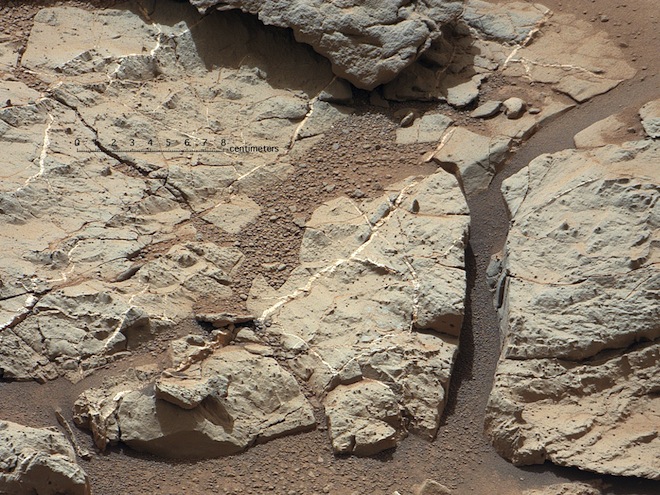
curiosity_rocksMore news from Mars! Or more specifically, from Yellowknife Bay, a place that shows extensive evidence of flowing water. After relocating to the region and performing a preliminary search, Curiosity has located the rock it will drill in order to gain an understanding of its composition and search for organics molecules. The rock has been dubbed “John Klein”, and this will be the first time engineers have drilled into the surface of another planet.

Already, Curiosity has determined that at one time, the Gale Crater was once the site of flowing water. But in its current location, they are able to assess the geological history and have stumbled upon a number of interesting features. In the course of descending from the plateau region where it landed into the relative depression that is Yellowknife Bay, Curiosity has observed many layers of rock that are increasingly older, effectively taking it backwards into the planet’s history.

Curiosity-Yellowknife-Bay-Sol-125_2c_Ken-Kremer-580x151Geologists are finding a lot of different rock types, indicating that many different geologic processes took place here over time, all of which confirm that water passed through the region at one time. For example, some of the minerals are sedimentary, which suggests that flowing water moved small grains around and deposited them. Other samples are cracked and filled with veins of material such as calcium sulfate, which were formed when water percolated through the cracks and deposited the mineral.

terraformingAll these investigations suggest if you could go deep into Mars’ past and stand at the same spot as the rover, you’d probably see a river of flowing water with small underwater dunes along the riverbed. And since these rivers left traces behind, drilling into the rocks will reveal what else they carried, which could very well include the building blocks of life!

Already, Curiosity brushed some of these rocks to remove their dust covering and then examined them with its high-resolution Mars Hand Lens Imager (MAHLI) camera. The next step will be to drill 5 centimeter holes into some of these rocks and veins to definitively determine their composition. Geologist John Grotzinger of Caltech said that the team will search for aqueous minerals, isotope ratios that could indicate the composition of Mars’ atmosphere in the past, and possibly organic material.

curiosity_drillingThe drilling will probably take place within two weeks, though NASA engineers are still unsure of the exact date. But, says Richard Cook, Curiosity’s project manager, the procedure will be “the most significant engineering thing we’ve done since landing,” and will require several trial runs, equipment warm-ups, and drilling a couple test holes to make sure everything works. The team wants to take things as slowly as possible to correct for any problems that may arise, such as potential electrical shorts and excessive shaking of the rover.

And of course, this time around they are likely to be much more tight-lipped and reserved when it comes to announcing their findings. Should they uncover evidence of life at one time in Mars’ deep past, they will certainly need to be sure. Such a finding is likely to be… “Earthshaking”! I admit, that’s getting old. I’ll stop now…

Source: Wired.com

A Look at “Living Mars”

Living-Mars With the confirmation that Mars with once home to oceans and rivers, and with speculation that a terraformed Mars will once again, there are many who wonder what a “Blue Mars” would look like. As it happens, a software engineer named Kevin Gill took it upon himself to create a series of images showing what a “living Mars” might look like.

Relying on his own imagination and a series of combined source material, the Red Planet gets a makeover, with aesthetically pleasing results! In an interview via email, Gill said the following of his process:

“This was something that I did both out of curiosity of what it would look like and to improve the software I was rendering this in. I am a software engineer by trade and certainly no planetary scientist, so with the exception of any parts derived from actual data, most of it is assumptions I made based on simply comparing the Mars terrain to similar features here on Earth (e.g. elevation, proximity to bodies of water, physical features, geographical position, etc) and then using the corresponding textures from the Blue Marble images to paint the flat image layer in a graphics program.”

Living-Mars.2For example, the view above is of the western hemisphere of Mars, with Olympus Mons on the horizon beyond the Tharsis Montes volcanoes and the Valles Marineris canyons near the center. The placement of clouds and the atmosphere was mainly to achieve a sense of scale and grandeur, but the rest is in keeping with information obtained by NASA over the years.

And these are just some of the images Gill has made over the years. His Flickr is awash in visualizations, many of which are of Mars, the Moon, and of course Earth, all of which are rendered from orbit. He also makes 3D models of geographic features, which comes in handy when its time to construct large-scale models.

A Curiosity Christmas!

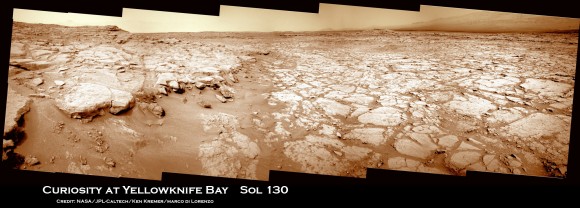
marsHey all! It’s a new year, a new day, but hopefully, there’s still some holiday cheer to go around! And in that spirit, I thought I’d share some news which came in over the holidays concerning Curiosity’s mission to Mars. For the rover, Christmas was celebrated at a location dubbed “Grandmas House”. Well, technically it spent it at Sol 130, a designated point in an area known as “Yellowknife Bay”. This area is a small depression located in the geographic region known as Glenelg, some 400 meters from “Bradbury Landing” where it first put down.

Curiosity-at-Yellowknife-Bay-Sol-130_3a_Ken-Kremer-580x208It is in Yellowknife Bay that Curiosity has been engaged in searching for its first target site to drill for a rock sample. The purpose of this to test out the rover’s high powered hammering drill, a test which has been put off because the Mars Science Team feared that the rock samples at other locations were not optimal. But the Glenelg area – which lies at the junction of three different types of geologic terrain – features a different type of geologic terrain compared to what Curiosity has driven on previously.

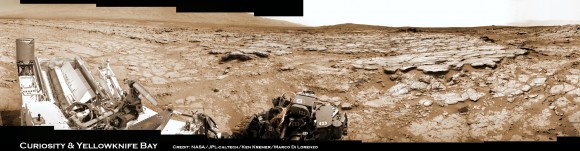
Curiosity-Yellowknife-Bay-Sol-125_2c_Ken-Kremer-580x151While there, Curiosity snapped a series of panoramic pictures of the area, which NASA compiled into the photos seen here and at the top. The rover also used its the APXS X-ray mineral spectrometer, ChemCam laser and MAHLI hand lens imager to gather initial science characterization data on the region and its rocky outcroppings. As you can plainly see, Yellowknife Bay was aptly named, being quite similar in appearance to its namesake here on Earth.

Hard to say what Curiosity will find once its begins drilling, but NASA is sure to be raving about it, either way. Everyone knows those Mars Science Laboratory people can’t keep anything a secret, even when they’re not sure they’ve got anything. Yes, MSL, that was a veiled reference to that “Earthshaking news” story you got us all excited about. And to answer you’re next question, no, I haven’t gotten over it yet. Can’t you tell?

Stay tuned for more news from the Red Planet! And while you’re at it, check out the video below where MSL team member Colette Lohr, the Tactical Uplink Lead, provides the latest video update on the Curiosity rover.

Source: Universetoday.com, (2)