News from Space: Rosetta Maps Comet Surface

Rosetta_and_Philae_at_cometLast month, the European Space Agency Rosetta’s space probe arrived at the comet known as 67P/Churyumov–Gerasimenko, thus becoming the first spacecraft to ever rendezvous with a comet. As it continues on its way to the Inner Solar System, Rosetta’s sensing instruments have been studying the surface in detail in advance of the attempted landing of it’s Philae probe.

Because of this, Rosetta has been able to render a map of the various areas on the surface of the comet, showing that it is composed of several different regions created by a range of forces acting upon the object. Images of the comet’s surface were captured by OSIRIS, the scientific imaging system aboard the Rosetta spacecraft, and scientists analyzing them have divided the comet into several distinct regions, each characterized by different classes of features.

rosettamap-1All told, areas containing cliffs, trenches, impact craters, rocks, boulders and parallel grooves have been identified and mapped by the probe. Some of the areas that have been mapped appear to be caused by aspects of the activity occurring in and around the nucleus of the comet, such as where particles from below the surface are carried up by escaping gas and vapor and strewn around the surface in the surrounding area.

So detailed are these images that many have been captured at a resolution of one pixel being equal to an area of 194 square centimeters (30 square inches) on the comet surface. Dr. Holger Sierks, OSIRIS’ Principal Investigator from the Max Planck Institute for Solar System Science, puts it into perspective:

Never before have we seen a cometary surface in such detail. It is a historic moment – we have an unprecedented resolution to map a comet… This first map is, of course, only the beginning of our work. At this point, nobody truly understands how the surface variations we are currently witnessing came to be.

Rosetta_and_Philae_at_comet_node_full_imageThe newly-generated comet maps and images captured by the instruments on Rosetta will now provide a range of detail on which to finalize possible landing sites for the Philae probe to be launched to the surface . As such, the Rosetta team will meet in Toulouse, France, on September 13 and 14 to allocate primary and backup landing sites (from a list of sites previously selected) with much greater confidence.

At the same time, Rosetta has revealed quite a bit about the outward appearance of the comet, and it aint pretty! More often than not, comets are described as “dirty snowballs” to describe their peculiar composition of ice and dust. But Rosetta’s Alice instrument, which was installed by NASA, has sent back preliminary scientific data that shows that the comet is more akin to a lump of coal.

Rosetta_Artist_Impression_Far_625x469Alice is one of eleven instruments carried aboard Rosetta and one of three instrument packages supplied by NASA for the unmanned orbiter. Essentially, it’s a miniature UV imaging spectrograph that looks for thermal markers in the far ultraviolet part of the spectrum in order to learn more about the comet’s composition and history. It does this by looking specifically for the markers associated with noble gases, such as helium, neon, argon, and krypton.

The upshot of all this high-tech imaging is the surprising discovery of what 67P/Churyumov-Gerasimenko looks like. According to NASA, the comet is darker than charcoal. And though Alice has detected oxygen and hydrogen in the comet’s coma, the patches of barren ice that NASA scientists had expected aren’t there. Apparently, this is because 67P/Churyumov-Gerasimenko is too far away from the warmth of the sun to turn the ice into water vapor.

rosetta-1Alan Stern, Alice principal investigator at the Southwest Research Institute in Boulder, Colorado, had this to say about the revelation:

We’re a bit surprised at just how unreflective the comet’s surface is and how little evidence of exposed water-ice it shows.

Launched in 2004, Rosetta reached 67P/Churyumov-Gerasimenko by a circuitous route involving three flybys of Earth, one of Mars, and a long detour out beyond Jupiter as it built up enough speed to catch up to the comet. Over the coming months, as the Rosetta spacecraft and comet 67P move further into the solar system and approach the sun, the OSIRIS team and other instruments on the payload will continue to observe the comet’s surface for any changes.

alice-first-findings-3Hence why this mission is of such historic importance. Not only does it involve a spacecraft getting closer to a comet than at time in our history, it also presents a chance to examine what happens to a comet as it approaches our sun. And if indeed it does begin to melt and breakdown, we will get a chance to peer inside, which will be nothing less than a chance to look back in time, to a point when our Solar System was still forming.

Sources: gizmag, (2), jpl.nasa.gov, nasa.gov

News from Mars: Curiosity Arrives at Mount Sharp

curiosity-mars-self-portrait-crop-640x353After two years exploring the Martian surface, the Curiosity Rover has finally reached its primary science destination – the foot of Mount Sharp, officially known as Aeolis Mons. Now that it’s there, it will begin its ascent of the rock formation, drill into rocks and analyze the different strata in the hopes of learning more about the history of the Red Planet. This is an event a long time in the making, and may prove to yield some of the greatest scientific discoveries ever made.

Located in the heart of the Gale Crater, Mount Sharp is like a layer cake, holding a chronology of past events reaching back billions of years. Because of this, it is an ideal place to find evidence that the Martian surface and atmosphere were once capable of supporting life. It took two years and one month for Curiosity reach the foot of this mountain, which lies some 5500 meters (18,000 feet) above the floor of Gale Crater.

MarsCuriosityTrek_20140911_AThe mountain is the central peak in a crater that measures 154 km/96 miles in diameter and which was formed when a meteor impacted the surface between 3.5 and 3.8 billion years ago. Beyond a certain size, and depending on the gravity of the planet, craters like this all have a central peak. But Mount Sharp represents something much more, otherwise NASA and the Jet Propulsion Laboratory wouldn’t be bothering with it.

Basically, Mars scientists believe that after its creation, the Gale crater was completely filled with sedimentary material from a series of huge floods, or by dust and ice deposits like those that happened at the Martian polar caps. The deposition over 2 billion years left a series sedimentary layers that filled the crater. Following the deposition of the layers, there was a long period of erosion which has finally led to the condition of the crater today.

mountsharp_galecraterThe erosion by some combination of aeolean (wind) forces and water (additional flooding), scooped out the huge crater, re-exposing most of the original depth. However, covering the original central peak are many sedimentary layers of debris. Gale crater’s original central peak actually remains completely hidden and covered by sedimentation. And it is this that attracted scientists with the Curiosity rover to the base of Mount Sharp.

Within the sedimentary layers is a sequential record of the environmental conditions on Mars going back over 2 billion years. While at the base, Curiosity will be able to examine the oldest sedimentary layers; but as it climbs the flanks of the mountain, it will be able to step forward in time. Each layer and its age will reveal information such as how much water was present, whether the water was alkaline or acidic, if there is any organic compounds.

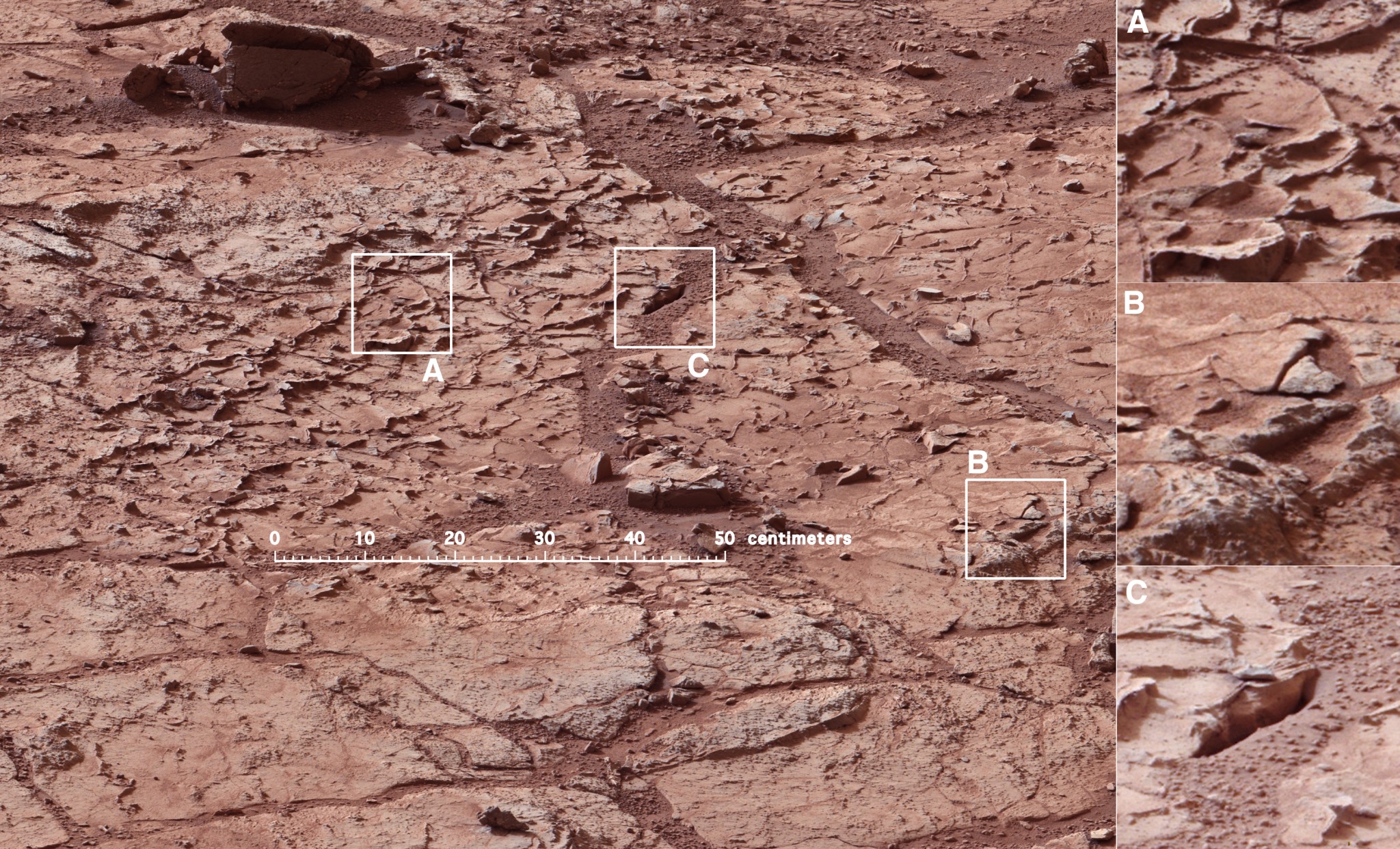
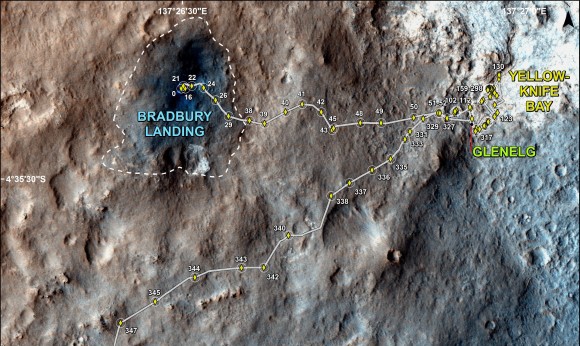
john_klein_curiosity-2The discovery of organic compounds on Mount Sharp could be “Earth shaking”, since the discovery of organics is of very high importance to this mission. Already, over the two year trek, Curiosity has seen numerous signs of the flow of water and sedimentation. Interestingly enough, evidence began to turn up way back in Yellowknife Bay — one of its first destinations, which it visited almost two years ago. But as of yet, signs of organic compounds have remained illusive.

What’s more, Curiosity sadly lacks the necessary equipment to look for evidence of microbial fossils or other signatures of life. Fortunately, the next rover – the Mars 2020 rover – will be equipped with the necessary tools to work out whether Mars ever harbored life. In any case, because of the lack of organic compounds in Yellowknife, NASA decided to continue to Mount Sharp, which is currently the best place to dig up scientific data about Mars’ past.

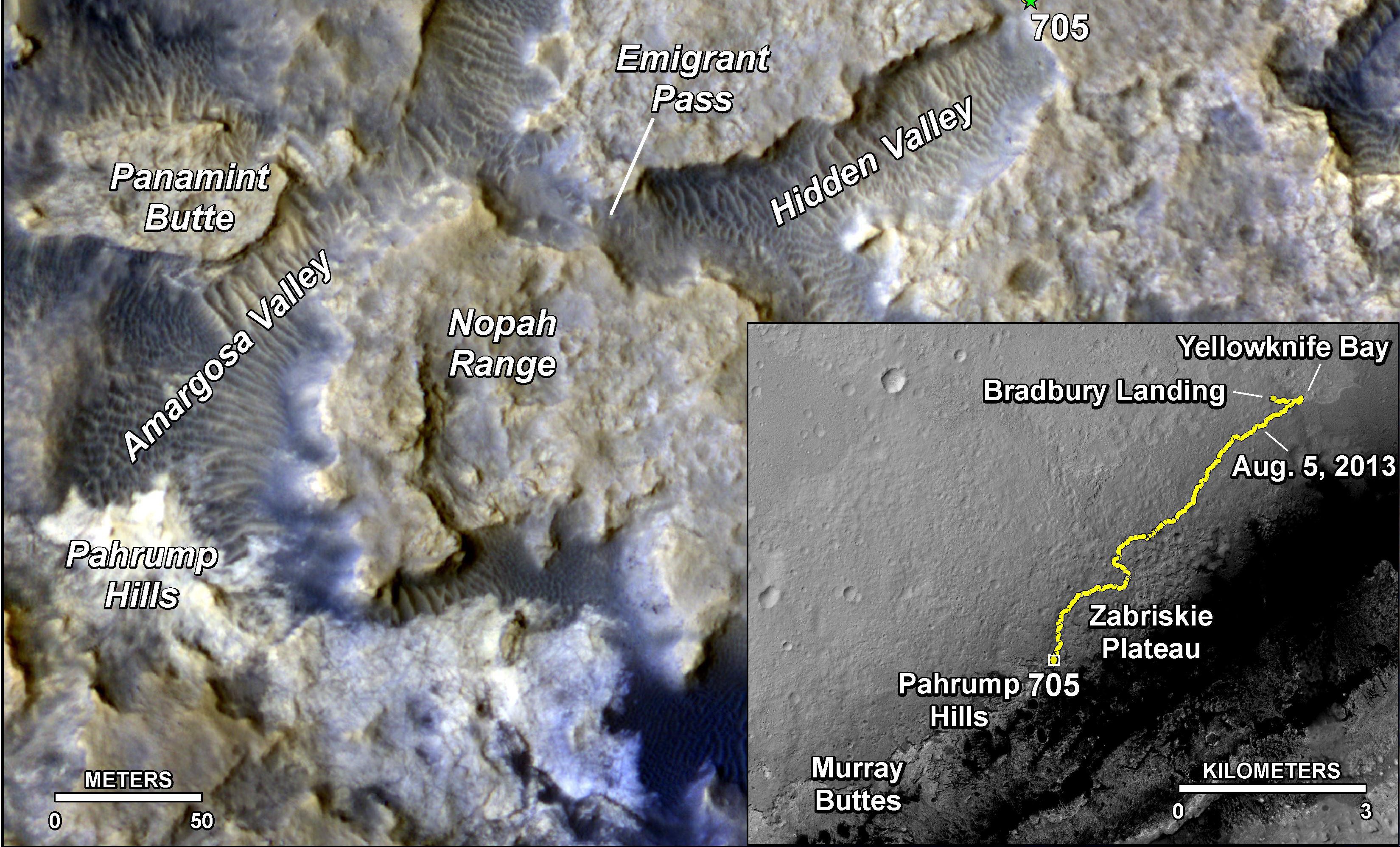
MSL_TraverseMap_Sol0743-2048Curiosity is currently at the base of Mount Sharp, in a region called the Pahrump Hills, where it will continue on to the Murray Formation. Once there, it will take a drill sample of some rock and then continue up Mount Sharp towards the Hematite Ridge where two drill sites await. This farthest site is about 8 km (5 mi) away from its present position, and Curiosity has driven only 9 km since it landed in 2012. So there’s plenty of trekking and work ahead!

One of the greatest challenges is finding a path that will reduce the stress on Curiosity’s wheels, which have been put through some serious wear and tear in the past two years. Because of this, the rover is being driven in reverse for the time being, and the team is looking the path with the least amount of sharp rocks. However, the Mars Curiosity remains confident that the mobility system will be capable of surviving the ten year life span of the rover’s power supply.

And be sure to check out this “Curiosity Rover Report” that talks about this historic accomplishment, courtesy of NASA’s Jet Propulsion Laboratory:

Sources: universetoday.com, extremetech.com, jpl.nasa.gov, space.com

News from Mars: ExoLance Project to Hunt for Life

exolance-2The search for life on Mars has been ongoing, and predates the deployment of the Curiosity rover by many years. However, it is becoming increasingly clear that if signs of life are to be truly found, they won’t turn up by scratching around on the surface. Beyond Curiosity’s own slated inspection of Mount Sharp (where it just arrived!) NASA has some long-range plans that reach deeper.

Outside of NASA’s InSight Lander, which is set to launch in the spring of 2016, there’s Explore Mars’ plan to look for signs of life beneath the surface. A private organization made up technologists and former NASA engineers, their plan is to drop supersonic lances onto the planet that will penetrate deep into the Martian soil to seek out protected, potentially wet strata where life might still exist.

exolanceKnown as ExoLance, the project is designed to take up where the Viking missions of the late 1970s left off. In these first successful Mars landers, there was an experiment on board that looked for signs of life in the Martian soil. This consisted of the Viking lander scooping up soil, depositing it inside the automatic laboratory in the lander, squirted a nutrient solution into the sample, and analyzing the gases given off that might indicate the presence of life.

The Viking experiment did give off gases that seemed like they were due to living organisms, but it later discovered that these were due to chemical reactions due to the extremely dry conditions and constant bombardment of UV radiation. Because of this, NASA has preferred to focus more on geology to gain a better understanding of the Martian environment rather than looking for life directly.

exolance-3But Explore Mars wants to go back to the direct approach by combining an experiment similar to the Viking lab with a delivery system based on the US Air Force’s bunker-buster weapons. They also hope to incorporate technology developed for the Curiosity rover, which includes reusing the aeroshell that protected the Curiosity rover as it made its descent to the Martian surface in 2012.

When the shell reaches Mars, it will open up to reveal a delivery vehicle similar to the Skycrane that delivered Curiosity to the surface by hovering under rocket power while it winched the lander down. In the case of the ExoLance, the vehicle – which is appropriately called a Quiver – will hover in place. But instead of lowering a rover, it will fire multiple penetrator probes at the ground.

exolance-1These perpetrators, called Arrows, are small, lightweight versions of the bunker-buster bombs that were developed by the US forces during the 1991 Gulf War. However, instead of exploding, the Arrows will strike the surface at supersonic speeds to bore deep into the ground and (similar to NASA’s Deep Space 2 probe) split in two to deploy a cache of scientific equipment packed into the nose.

While the tail section remains on the surface to act as a transmitter back to Earth, the nose bores about 5 m (16 ft) into the surface to find protected layers that may contain water, but which are shielded against the deadly surface radiation. Once in position, the Arrow activates its experiment, which is designed to not only detect signs of living organisms, but also to determine if the life signs are those of microbes similar to those found on Earth, or have a completely different origin.

exolance-4The mission is the subject of an Indiegogo crowdfunding campaign aimed at raising US$250,000. The group says that within a year of raising its Indiegogo funding, it would develop and build Arrow prototypes and test them in the Mojave Desert by dropping them from aircraft. The idea is not only to see if the experiments can survive the impact, but also to make sure that the penetrators don’t dig in too deep or too shallow.

In addition, the group expects the design to change as they deals with problems, such as the volume of the cylinder, batteries, deploying the tether linking the two segments, and making sure the components can withstand the impact. In the second year, the group plans to enact Phase II, which would concentrate on developing the microbial experiments. If this is successful, they plan to approach NASA or commercial companies to arrange delivering ExoLance to Mars.

The crowdfunding campaign will run until September 29th, and has raised a total of $15,680 of their projected goal. To check out this campaign, or to contribute, click here. And be sure to check out Explore Mars’ promotional video below:


Source:
gizmag.com, exploremars.org, indiegogo.com

News from Mars: Beam Me to Mars

marsIn the latest ambitious plan to make space exploration accessible to the general public, Uwingu has unveiled a new campaign where people can send messages and pictures to the Red Planet. It’s called “Beam Me to Mars”, and the company is inviting people to contribute, for a fee, to a “digital shout-out” that will send messages from Earth to Mars on Nov. 28 — the 50th anniversary of Mars exploration.

The first successful Mars mission, NASA’s Mariner 4 – launched on Nov. 28, 1964 – performed the first flyby of the Red Planet and returned the first pictures of the Martian surface. This was the first time that images were captured of another planet and returned from deep space. and their depiction of a cratered, seemingly dead world largely changed the view of the scientific community on life on Mars.

beam-me-to-mars-uwinguAccording to representative from Uwingu, “Beam Me to Mars” celebrates that landmark effort in a new and original way by inspiring people to get on board with Martian exploration. Other goals include raising lots of money to fund space science, exploration and education (Uwingu’s stated chief purpose) and letting policymakers know how important space exploration is to their constituents.

As CEO Alan Sterm, a planetary scientist and former NASA science chief, said in an interview with Space.com:

We want it to inspire people. There has never been an opportunity before for people of Earth to shout out across the solar system their hopes and wishes for space exploration, for the future of mankind — for any of that… We want to make an impression on leaders. The more messages, the bigger impression it makes. If this thing goes viral, and it becomes the thing to do, then it’ll make a huge impression.

ESO2For $4.95, people can beam their name (or someone else’s) to Mars, whereas $9.95 gets people a chance to beam a name and a 100-character message. $19.95 gets a 1,000-character note instead of the shorter one, and for those willing to spend $99 will be able to send their name, a long message and an image of their choosing. All messages submitted for “Beam Me to Mars” will also be hand-delivered to Congress, NASA and the United Nations.

Submissions must be made via uwingu.com by Nov. 5. And the company – whose name means “sky” in Swahili – and its transmission partner, communications provider Universal Space Network, will use radio telescopes to beam the messages at Mars on Nov. 28 at the rate of 1 million bits per second. The transmission, traveling at the speed of light, will reach the Red Planet on that day in just 15 minutes.

mariner-4-poster-art.enFor comparison, it took Mariner 4 more than seven months to get to Mars a half-century ago. The probe didn’t touch down, but its historic flyby in July 1965 provided the first up-close look at the surface of another planet from deep space. Mariner 4’s observations revealed that Mars is a dry and mostly desolate world, dashing the hopes of those who had viewed it as a world crisscrossed by canals and populated by little green men.

Already, several celebrities have signed on to the campaign, including actors Seth Green and wife Clare Grant, George (“Sulu”) Takei of Star Trek fame and his husband Brad, Bill Nye “The Science Guy”, astronaut and former ISS commander Chris Hadfield, commercial astronaut Richard Garriott, former NASA senior executive Lori Garver, Pulitzer winning author and playwright Dava Sobel, and Author and screenwriter Homer Hickam.

Uwingu-CelebritiesThis is not the first Mars effort for Uwingu, which was founded in 2012. In February, the company launched its “People’s Map of Mars,” asking the public to name Red Planet landmarks for a small fee. To date, people have named more than 12,000 Mars craters, and Uwingu has set aside more than $100,000 for grants. And when it comes to getting the general public involved with space science and travel, they are merely one amongst many. The age of public space exploration is near, people!

Sources: space.com, uwingu.com, (2)

Settling Mars: The Mars Base Challenge 2014

mars-colonyLife on Mars can’t become a reality without some serious design concepts and engineering. And that’s why Thingiverse, in cooperation with NASA’s Jet Propulsion Laboratory, conduct the Makerbot Mars Base Challenge every year. Taking Mars’ extreme conditions into consideration, people are tasked with designing a utilitarian Mars base that can withstand the elements and make settlers feel at home.

The competition opened on May 30th and received some 227 submissions. The challenge brief asked entrants to take into account the extreme weather, radiation levels, lack of oxygen and dust storms when designing their Martian shelters. And the winning entries will each be awarded a MakerBot Replicator 2 Desktop 3D Printer in order to help them fully explore their designs for Martian abodes.

And although the applicants did not always nail the science, their designs have a novelty that has not been seen in some time. This can especially be seen in with this years finalists, which included a design for a Martian pyramid, a modular beehive and a three-tiered Acropolis.

MarsChallengeResultsThe Thingiverse community appears to have been hugely supportive, printing out the designs themselves and offering handy hints in the comment section beneath each entry. Some were dismissed for being impractical; for example, those that would be immediately flattened or kill all of its inhabitants if it were installed on the Martian surface. But one designer, Noah Hornberger, points out:

A toy car does not need fuel because it runs on the imagination of the child who drives it around. So it seems to me that I’m driving my toy car at full speed and you are here telling me what kind of fuel and oil it needs to run. I would rather leave the physics to the right people.

Luckily, that’s what NASA is on hand for – to ensure that it’s not just the mathematicians and engineers that have an interest or a say in our Martian future, but to make sure those designs and dreams that come from the public meet the basic scientific and engineering requirements. Bringing together inspired ideas and realistic needs, here’s how this year’s finalists measured up.

MarsPryamid-4_Feature_preview_featured This Mars structure is designed with resource consumption and allocation in mind, and also takes into account that the majority of activity would be taking place inside the structure rather than outside. As its creator, Valcrow. explained:

High traffic rooms all have ample natural Martian light to help with the crews extended isolation and confinement… This design focuses on looping essential systems into as many multi-functional roles as possible to ensure that the very limited resources are used and reused as much as possible.

This includes food created through a sustainable aquaponics system which would sit at the top of the pyramid, where it can get some light. A mirror-based series of solar panels will be responsible for collecting energy, with a nuclear generator for backup, and water would be stored near the main power center so that it heats up. The whole thing is inspired by the Pyramid of Giza, but unlike that beauty it can be reconfigured for science or engineering tasks and experiments.

Mars_beehiveThis second design, known as the Queen B because of its modular beehive configuration, comes with all the mod cons and home comforts you might expect on Earth – a kitchen, two bathrooms, a garden, and a 3D print lab and decompression room. Its creator, Noah Hornberger, chose a flat-panelled, low-level design that would be cheap and easy to build and allow for less heat energy to be lost. The hexagon shape was chosen for its durability and ability to form modular designs.

Depleted uranium would be used to create laminated panels that would shield out the elements, but would need to be sandwiched between other materials to make it safe for the occupants. An exothermic chemical reactor would meanwhile be used to heat an underground water container, which will provide heat for the basecamp. Excess steam could also power generators to supplement solar power.

Speaking on behalf of his creation, Hornberger said:

I have extrapolated on the idea of a fully functional apartment on Mars with all the modern amenities fitted inside 16-foot-diameter hexagons. I think that to present Mars life to people and actually make it appealing to the public it needs to feel like home and reflect the lifestyle trends of Earth living.

Mars_acropolisAnd last, but not least, there’s the Mars Acropolis – a design that blends materials used here on Earth to create a classic futurist design that looks like it would be at home in the classic Fritz Lang film. Concrete, steel and Martian soil help form the outer wall that protects the population, while carbon fibre, stainless steel, aluminium and titanium would be used to build the main body.

Three greenhouses contain the vegetation and help filter the air and produce oxygen, and there are decompression chambers at the entrance. On level two, residents can park their shuttles before entering the living quarters and labs, while level three acts as the nerve center – with flight operators and observation posts. It’s joined by a huge water reservoir that flows to the first level for purification.

Designer Chris Starr describes the layout as follows:

The structure serves as a mass research facility, to explore and develop means for additional colonization of the planet. Due to the water vapour contained in the Martian atmosphere, that vapour can be harnessed into usable liquid water, where the condensation is collected from the water vapour, which is filtered back into the reservoir.

mars_one2In all cases, the designs draw attention to the fact that any structures intended for life on Mars will have to achieve a balance between resource management, comfort and entertainment, and security against the elements. At this point, there’s no telling exactly what a Martian settlement will look like; but as always, the truth will likely be stranger than fiction. To see more designs that made it to the Mars Base Challenge this year, check out Thingiverse’s website.

Sources: wired.co.uk, thingiverse.com

News From Mars: Curiosity Celebrates 2 Years!

curiosity_peakEarlier this month, Curiosity marked its second year on the Red Planet, and this anniversary comes amidst plenty of exciting news and developments. Ever since the rover touched down at the Bradbury Landing site inside the Gale Crater on August 5, 2012 at 10:31 pm PDT (August 6, 05:31 GMT), it has been busily searching for signs that life once existed on Earth’s neighbor. And as it enters into its third year of exploration, it is getting closer to accomplishing this lofty goal.

The nuclear-powered explorer is the largest, most advanced rover ever built. And since nothing like it had ever flown before and the maintenance facility was over 160 million kilometers (1oo million miles) away, the first months that Curiosity spent on Mars involved an array of system tests before it took it first tentative rolls across the Martian sands on its roundabout path to Mount Sharp.

curiosity_roadmap1Curiosity’s main mission was to find out if there are any places on Mars where life could have once existed – specifically, areas displaying minerals and geology that could have been produced by water. The Bradbury Landing site, where it touched down, turned out to be very close to an ancient dried lake bed in an area named Yellowknife Bay. According to NASA, this lake bed may have been able to sustain microbial life billions of years ago.

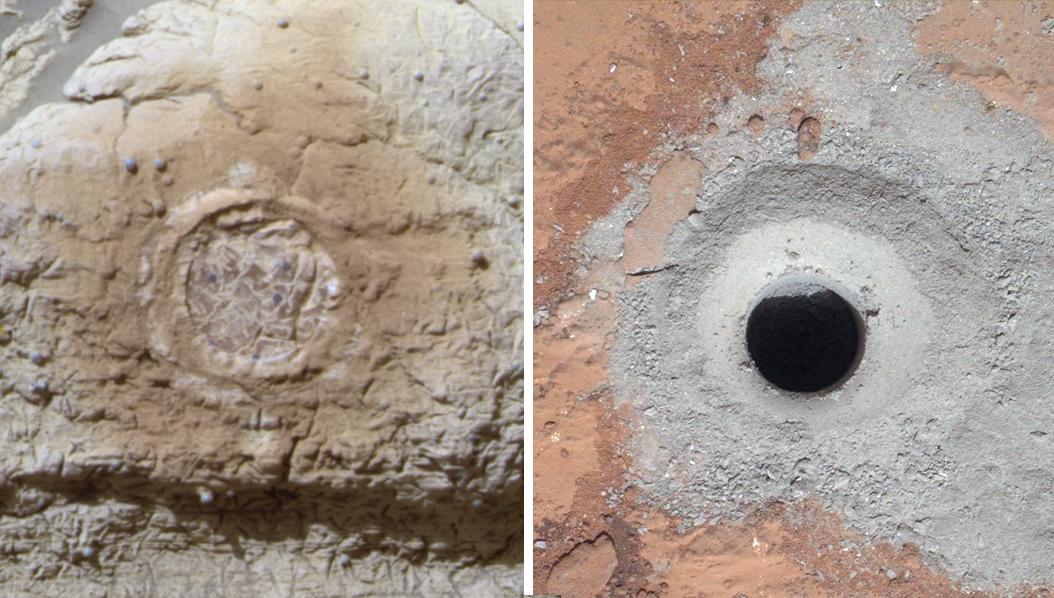
And then, barely six months after landing, the scientists struck gold when they drilled into a rock outcrop named “John Klein” at Yellowknife Bay and unexpectedly discovered the clay bearing minerals on the crater floor. This was the first instance of Curiosity finding clay-bearing minerals. or phyllosilicates, which are a key sign that organic molecules could exist on the planet.

Curiosity_drillingsAs Curiosity Project Scientist John Grotzinger of the Caltech said in a statement to mark the anniversary:

Before landing, we expected that we would need to drive much farther before answering that habitability question. We were able to take advantage of landing very close to an ancient streambed and lake. Now we want to learn more about how environmental conditions on Mars evolved, and we know where to go to do that.

Compared to its first year, which was marked by many firsts – such as the first drilling operation on Mars, the first laser firing, and first UV night scans – Curiosity’s second year on the Red Planet has been more routine. However, it hasn’t been without its share of excitement. In February, the rover cleared a dune that blocked its progress and in July it negotiated a detour around rocky terrain at Zabriskie Plateau.

curiosity-2nd-year-2However, by far, the majority of the rovers second Earth year on the Red Planet has been spent driving as fast as possible towards a safe entry point to the slopes of Mount Sharp. To date, Curiosity’s odometer totals over 9.0 kilometers (5.5 miles) since landing inside Gale Crater on Mars in August 2012, and her on board camera has snapped over 174,000 images – many of which have been transformed into panoramic shots of the surface.

The desired destination for the rover is now about 3 kms (2 miles) southwest of its current location. This consists of a bedrock unit that for the first time is actually part of the humongous mountain known as Mount Sharp. As the primary destination on her ongoing mission, this layered mountain in the Gale Crater towers 5.5 kilometers (3.4 miles) into the Martian sky, and is believed to hold the most compelling evidence of life yet.

mountsharp_galecraterThe sedimentary layers in the lower slopes of Mount Sharp are the principal reason why the science team specifically chose Gale Crater as the primary landing site. Using high resolution spectral observations collected by NASA’s powerful Mars Reconnaissance Orbiter (MRO), they were able to determine the presence of deposits of clay-bearing minerals. or phyllosilicates, a key sign that organic molecules could exist on the planet.

In late July of this year, the rover arrived in an area of sandy terrain called “Hidden Valley” which is on the planned route ahead leading to “Pahrump Hills”. Scientists anticipated that the outcrops here would offer a preview of a geological unit that is part of the base of Mount Sharp for the first time since landing. However, the sharp edged rocks caused significant damage to the rovers six aluminum wheels, forcing it to make a detour.

Mars_rovermapThis detour will take Curiosity to a similar site called “Bonanza King” to carry out its fourth drilling mission. According to NASA, this is no great loss because the two areas are geologically connected and the space agency is keen to look at a formation that is different from the crater floor formations encountered so far. Engineers are studying Bonanza King to see if its is suitable for drilling by assessing whether or not the plates seen on the surface are loose.

When drilling operations resume, NASA will study alternative routes to Mount Sharp and determine how well the rover’s wheels can handle sand ripples. However, as Dr. Jim Green, NASA’s Director of Planetary Sciences, said during an interview during the rover’s second anniversary in Washington, DC : “Getting to Mount Sharp is the next big step for Curiosity and we expect that in the Fall of this year.”

Godspeed, little rover! And I do hope that it finds the long-sought-after organic particles it has been looking for since the mission began. This discovery will not only show that life once existed on Mars (and still does in some capacity) it will also be one of the greatest scientific finds of all time, and maybe even serve as the starting point for ensuring that it can exist again.

terraforming

Sources: universetoday.com, gizmag.com, (2)

Total Recall (2012)

total_recall_farrellRemake season continues for me, this week with the 2012 remake of the 1990 original movie Total Recall. Back when it came out, I was seriously questioning what the hell was going on in Hollywood, as this was just another remake in a summer that was packed full of them. But as the saying goes, “put up or shut up” – i.e. if I’m going to complain about the tide of remade movies, I might as well know what I’m talking about.

And much like last time, I figure that a review of this movie should start by paying a little lipservice to the original (which this remake did in spades!)

Total Recall 1990:
total_recall1The film is set in the not-so-distant future, where a man named Douglas Quaid is haunted by dreams of Mars and a mysterious woman and seeks an escape from his humdrum life as a metal worker. He learns of a memory-implant service named Rekall which he believes might be the solution, since they can provide a simulated adventure that he has always wanted – to go to Mars and live a life of adventure.

He then goes to Rekall and selects a package that includes a simulation where he is a special agent on a top-secret mission. However, things go terribly wrong when he begins acting out his secret agent character before the company has even had a chance to implant it. They sedate him and put him in a car, hoping to wash their hands of the incident. But when he wakes up, his friends and wife try to kill him, claiming he is not who he says he is.

https://i0.wp.com/www.fmvmagazine.com/wp-content/uploads/2012/07/Total-Recall.jpgHe is given a briefcase by a former associate which contains a recording, in which he is telling himself that he’s really a man named Carl Hauser, and that the governor of Mars (Cohaagen) erased his memory because of a secret he carries. Quaid/Hauser then goes to Mars, retracing the path his old self has given him, and finds his way to Melina and the resistance. She then takes him to Kuato, leader of the resistance, to unlock his memories.

They help him recover the secret he’s been carrying – which involves the discovery of an alien artifact under the surface of Mars – but the base is then found and overrun. He and Melina are taken prisoner, and he learns that Hauser was never a double-agent, but a mole working with Cohaagen all along to lead them to the resistance. They strap him and Melina into chairs and try to force Hauser to recover his old self.

total-recall-originalHowever, Quaid and Melina escape and enter the alien artifact. Cohaagen tries to stop them, claiming its a doomsday device that will destroy the planet, but Quaid manages to activate it before the three of them are sucked out onto the surface. The reactor turns out to be an atmospheric generator that turns Mars’ icy core into breathable air, which then pours out onto the surface, saving Melina and Quaid and making the planet livable.

Quaid kisses Melina, still not sure if what he has experienced is real or a dream.

Total Recall 2012:

TotalRecall2012PosterAt the end of the 21st century, the world has been devastated by chemical warfare, rendering all but two regions unihabitable. Whereas the wealthy live in the northern hemisphere – in the United Federation of Britain (UFB) – and in the Colony (former Australia). Tensions between the two are high due to the latter demanding independence, and a series of terrorist bombings attributed to a man named Matthias.

Enter into this Douglas Quaid, a factory worker who makes the transit between the Colony and the UFB every day on a massive subterranean lift called “The Fall”. At night, he dreams of fleeing for his life with a woman, and then being taken captive. He attributes these dreams to feeling trapped in his dead end life, and then hears of the memory-implant service known as Rekall.

https://storiesbywilliams.com/wp-content/uploads/2014/08/0e021-total-recall-movie2b252882529.jpgAgainst his friend Harry’s recommendation, he goes to Rekall and requests a memory in which he is a intelligence service agent. The chief technician reveals that any duplication will cause problems, and then stops the process when he learns that Quaid really is a secret agent. Federal agents then break in and shoot everyone and try to take Quaid prisoner. However, he kills his captors and escapes.

Coming home to his wife Lori, he tells her of what happened and she tries to kill him as well. After escaping again, a pursuit begins, and Lori is told by UFB Chancellor Cohaagen to bring Quaid in alive. Meanwhile, Quaid is told by a former coworker to find the “key”, and a hidden message in the call leads him to a safety deposit box containing fake IDs, a holographic disguise, and a recording in which he explains what is happening.

https://i0.wp.com/www.fxguide.com/wp-content/uploads//2012/08/TotalRecall_TwoWeeks.jpgApparently, Quaid is actually a man named Hauser who worked for UFB intelligence. He was given the task of infiltrating the Colony’s resistance until he met Melina, who convinced him to change sides. He is instructed to go to the UFB and find it, but upon arrival, he is found out and forced to flee again. He is then rescued by the woman he keeps seeing in his dreams and escape Lori for the second time.

Together, they make it away and Quaid takes them to his old apartment to hide. Here, he finds the “key”, which is a recorded message on his piano that tells him that Cohaagen has been behind the bombings, and that he is planning an invasion of the Colony with an army of synthetics so he can level it and rebuild it as a new living space for the UFB. Luckily, Hauser discovered a kill code for the synthetics, which he must get to Matthias to stop the invasion.

https://i0.wp.com/www.thewallpapers.org/photo/59772/Total-Recall-013.jpgAs they attempt to leave his apartment, they are interrupted by Harry, who claims Quaid is still at Rekall and that he is an implant there to help him wake up to reality. Quaid chooses to shoot him and save Melina, and they are once again pursued by Lori and once again escape. They travel via the Fall to the Colony, where they meet with Matthias to hand over the memory that contains the kill code.

Unfortunately, the memory proves to be a recording of Cohaagen telling them they’ve been had. He then shows up with Lori and several security forces, kill Matthias, and take Melina away. Hauser is told he was given a false code to lead them to the resistance, and that a backup of his memories that predate his betrayal will be restored. Hauser realizes his old colleague is with them, has left his restrain undone, and escapes.

https://i0.wp.com/www.themaninthemoviehat.com/wp-content/uploads/2012/08/caps-total-recall.jpegA fight takes place aboard the Fall, and Hauser and Melina plant a series of bombs on the rails. The Fall arrives and the synthetics begin to deploy, and Hauser begins fighting it out with Cohaagen and his forces. Hauser and Melina defeat Cohaagen and then detonate the bombs, which causes the Fall to begin falling backwards towards the center of the Earth where it explodes.

Hauser loses consciousness and wakes up with Melina inside a medical vehicle. He realizes it is actually Lori wearing his holographic disguise and they fight again, and he finally kills her. He and Melina are reunited, and they stand together and hear how the Colony is now expecting full independence. He sees a Rekall signs and has a moment of doubt, but ignores it and kisses Melina.

Summary:
Once again, I am forced to give this one to the original. Whereas the remake had some signs of quality, which included decent enough performances from Farrel, Biel, Beckinsale, and Cranston. But unfortunately, some decent sets, a whole of lot of chase scenes and big budget special effects were not enough to save this movie from a relatively weak plot and a whole lot, too much CGI, and a whole lot of borrowing.

We-Can-Remember-It-for-You-Wholesale-Dick-Philip-K-9780806534459First of all, why did they do away with the whole Mars plot? The story which both the original and the remake are based on – “We Can Remember It For You Wholesale” by Philip K Dick – centered on Mars, though it did not take place there. Including it in the plot seems like a no-brainer. But for some reason, the writers of the remake wanted a story focused on Earth and the dangers of chemical warfare and rezoning.

Second, the story did away with a crucial element this time, which was the good old fashioned mind-fuck of the original. In that version, not only did we not know for certain whether or not Quaid/Hauser was dreaming the whole thing, we truly thought he was a good guy up until they showed otherwise. The plot involving replacing his memories was a ruse by Cohaagen in order to get Hauser past Kuato’s psychic detection.

https://i0.wp.com/filmesegames.com.br/wp-content/uploads/2012/08/total-recall-comparison-trailer-thumb-550x295-94147.jpgIn other words, in order to infiltrate the resistance, he had to believe he was an actual traitor. Thus began the convoluted process of making the resistance think he was genuine by erasing his memory and dumping him on Earth, then leading him to retrace his path and find his way to Kuato. Though the information he had about the Martian artifact was real, it was just the bait they dangled in front of the resistance’s nose to get them to give up their location.

Which brings me to item two in the weak plot front. The fact that Quaid/Hauser was actually a good guy in this version made me respect the plot way less. It was cool finding out the hero was a villain, and then seeing him chose to remain with his implanted identity rather than allow himself to be turned back into his old self. It was a big reveal, added a solid twist to the plot, and even raised an existential question or two.

https://i0.wp.com/img2-3.timeinc.net/ew/i/2012/08/02/TOTAL-RECALL-RED-PILL.jpgAnd then there was the key moment where Quaid/Hauser has to decide what is real. In both versions, this takes the form of someone telling him he’s still dreaming and has to do something he won’t like in order to wake up. In the original, it involved Quaid being handed a pill which the man from Rekall says is a symbol of his desire to wake up, but could just as easily be a sedative. He realizes the man is a fake by the way he’s sweating and shoots him.

In the remake, it takes the form of him being confronted by his friend Harry who tells him he’s dreaming and to shoot Melina, a figment of his imagination. He chooses to shoot his friend Harry and accept that what he is experiencing is real because Jessica Biel begins to cry. But isn’t that be exactly what a fantasy woman would do in that situation? Seemed like quite the gambit there.

https://i0.wp.com/img576.imageshack.us/img576/8643/totalrecallf.jpgAlso, the “secret” that Hauser had stumbled upon in this version was really quite lame. In the original, it involved an alien artifact, which is oodles more interesting than than Cohaagen planning to rezone Australia for more living space. Sure, the idea was laden with scientific inaccuracies – melting an ice core doesn’t instantly terraform a planet! – the ridiculousness of it could always be circumvented by arguing that it really was all a dream.

Last, but not least, there were the many parts of this remake that were obvious shout outs or references to the original. First, you had the three-breasted hooker, who was well cast and easy on the eyes. You also had key lines like – “If I’m not me, then who the hell am I?” “How would I know? I just work here.” And of course, the redheaded woman at the customs line. But these seemed a bit too many and obvious to be a simple wink and a nod.

https://i0.wp.com/iteenacgppesam.wikispaces.com/file/view/Total-Recall-Vilos-Cohaagen-Actors.jpg/493570572/Total-Recall-Vilos-Cohaagen-Actors.jpgAlso, Bill Knighy had barely any screen time at all, and only really comes on to paraphrase what Kuato said in the original film. And the bad guys? No comparison! While Kate Beckinsale was believable enough as a villainess, Brian Cranston simply did not hold a candle to the original’s Ronny Cox and Michael Ironside. Those two were perfectly cast as the evil, somewhat over-the-top bad guys, the perfect counter to Arnie’s over-the-top good guy.

But getting past that, there’s the matter of what the movie kinda-sorta did right. The settings were all quite artistic, with the world in the Colony being gritty, crowded, dirty looking, and consisting of a great deal of cultural influences. By contrast, the UFB looked cleaner, brighter, and the design seemed singular by comparison. And the emphasis of shortages of space was summed up nicely by the massive, overlapping layers of structures.

total_recall_setsAnd the “synthetics” were artfully done and kind of cool looking. As were the flying cars, the aerial traffic lanes, and the three-dimensional elevator pods that crisscrossed the sky. And “The Fall” was a pretty neat idea, especially with the whole “gravity reversal thing”. But in just about all cases, these things have been done before. The sets are reminiscent of Blade Runner, with it’s gritty, crowded streets, signs in Asian characters, and the synthetic humans wandering around.

The robots also looked like a cross between Storm Troopers and the machines from I, Robot, and the flying cars called to mind another Philip K Dick adaptation, namely Minority Report. What can be said about a movie who’s set designs and concept art are quite impressive, but which borrow heavily from several other franchises? It’s like this movie is subtly mocking itself for a lack of originality – which makes sense since it’s a remake.

https://i0.wp.com/futuredude.com//wp-content/uploads/2012/07/total-recall-2012-reboot-robot.jpgAnd with all the special effects, things looked entirely too fake. People today might find the Kuato puppet and the molded plastic suits of the mutants to be outdated, but those showed a lot of heart versus the extensive use of CGI in this one. In fact, seeing movies like these make me long for the days of old-style effects where costumes, real actors and real sets were built rather than generating everything digitally. George Lucas, I’m looking at you as I say this!

I’d say its blatantly obvious at this point, but this one definitely goes to the original. And much like the Robocop remake, it begs the question: why redo a movie when the original got it right? Sure, the 1990 version of Total Recall wasn’t perfect. It had a lot of cheesy elements and some massive scientific inaccuracies, but it managed to both entertain and impress with the way it played with perceptions, twisted things around and kept people guessing until the end.

In this remake, there really is no mystery, the plot is simplified, the most important element (i.e. Mars) is dropped, some of the best elements are missing, and it borrowed too heavily from multiple sources – not the least of which was the original. So really, why was it even made? In this season of remake review, I find myself asking that question quite a lot! Not a good way to start…

Okay, onto new things. Which may, at this point, include The Teenage Mutant Ninja Turtles relaunch. No promises though 🙂

News from Space: NASA Showcases New Rover Tools

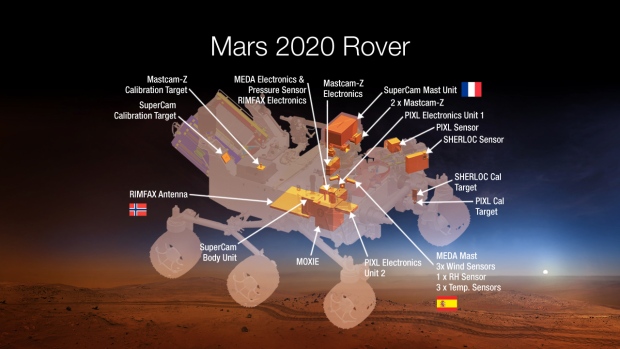
NASA_2020rover1Last Thursday at the agency’s headquarters in Washington, NASA unveiled more information about its Mars 2020 rover, which is scheduled to join Opportunity and Curiosity on the Red Planet by the end of the decade. The subject of this latest press release was the rover’s payload, which will consist of seven carefully-selected instruments that will conduct unprecedented science and exploratory investigations, and cost about $130 million to develop.

These instruments were selected from 58 proposals that were submitted back in January by researchers and engineers from all around the world. This is twice the usual number of proposals that NASA has received during instrument competitions in the recent past, and is a strong indicator of the extraordinary level of interest the scientific community is taking in the exploration of the Mars.

NASA_2020roverThese seven new instruments include:

  • Mars Oxygen ISRU Experiment (MOXIE): this technology package will process the Martian atmosphere into oxygen. ISRU stands for In Situ Resource Utilization.
  • Planetary Instrument for X-ray Lithochemistry (PIXL): this spectrometer will use a high-resolution imager and X-ray fluorescence for detailed elemental analysis to a finer degree than possible with any prior equipment.
  • Scanning Habitable Environments with Raman & Luminescence for Organics and Chemicals (SHERLOC): this sensor suite will use an ultraviolet laser for fine-scale mineralogy, detecting organic compounds, and high-resolution imaging.
  • Mastcam-Z: an advanced camera system that will send home panoramic and stereoscopic images and assist with rover operations and help determine surface mineralogy.
  • SuperCam: an imaging device with super capacities to perform chemical composition analysis and more mineralogy. This tool will allow the rover to peer around hunting for organic compounds within rocks or weathered soils from a distance, helping identify interesting locations to sample in greater detail.
  • Mars Environmental Dynamics Analyzer (MEDA): This sensor suite to measure temperature, wind speed and direction, pressure, and relative humidity. As dust is such a defining characteristic of weather on the red planet, it’s also going to measure dust size and shape, helping characterize how big of a hassle it will make housekeeping.
  • Radar Imager for Mars’ Subsurface Exploration (RIMFAX): a ground-penetrating radar to imagine the subsurface to centimeter-scale resolution.

These instruments will be used to determine how future human explorers could exploit natural resources to live on Mars, pinning down limits to how much we could rely on using local materials. In addition, demonstration technology will test out processing atmospheric carbon dioxide to produce oxygen, a key step towards using local resources for manufacturing oxidizers for rocket fuel and suitable for humans.

NASA_2020rover5This is perhaps the most exciting aspect of the proposed mission, which is looking ahead to the possibility of manned Martian exploration and even settlement. To quote William Gerstenmaier, the associate administrator for the Human Exploration and Operations Mission Directorate at NASA Headquarters in Washington:

Mars has resources needed to help sustain life, which can reduce the amount of supplies that human missions will need to carry. Better understanding the Martian dust and weather will be valuable data for planning human Mars missions. Testing ways to extract these resources and understand the environment will help make the pioneering of Mars feasible.

At the same time, and in keeping with plans for a manned mission, it will carry on in NASA’s long-term goal of unlocking Mars’ past and determining if life ever existed there. As John Grunsfeld, astronaut and associate administrator of NASA’s Science Mission Directorate in Washington, explained:

The Mars 2020 rover, with these new advanced scientific instruments, including those from our international partners, holds the promise to unlock more mysteries of Mars’ past as revealed in the geological record. This mission will further our search for life in the universe and also offer opportunities to advance new capabilities in exploration technology.

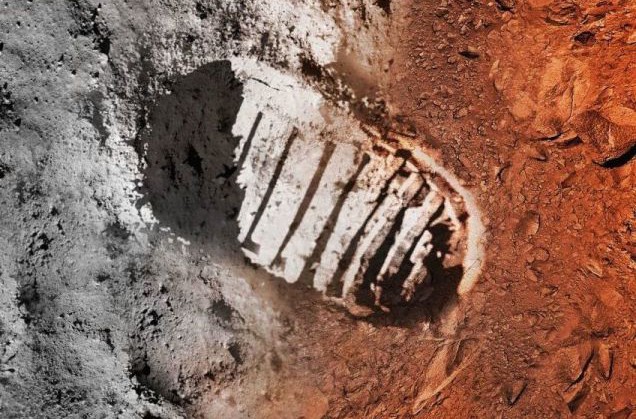
Mars_footprintNASA addressed these goals and more two weeks ago with their mission to Mars panel at the 2014 Comic-Con. This event, which featured retired astronaut and living legend Buzz Aldrin, spoke at length to a packed room about how Apollo 11 represented the “the first Giant Leap”. According to Aldrin, the Next Giant Leap could be “Apollo 45 landing humans on Mars.”

The panel discussion also included enthusiastic support of Orion and the Space Launch System which are currently under development and will be used when it finally comes time to send human explorers to join the rovers on Mars. The Mars 2020 mission will be based on the design of the highly successful Mars Science Laboratory rover, Curiosity, which landed almost two years ago.

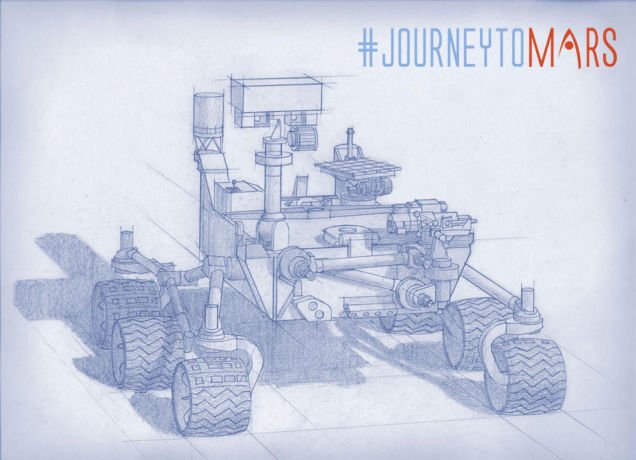
NASA_2020rover2Not only does it look virtually identical to Curiosity – from its six-wheeled chassis, on-board laboratory, and instrument-studded retractable arms – and will even be partly built using Curiosity’s spare parts.It will also land on Mars using the same lowered-to-the-surface-by-a-giant-sky-crane method. NASA als0 plans to use the rover to identify and select a collection of rock and soil samples that will be stored for potential return to Earth by a future mission.

These rock samples will likely have to wait until the proposed manned mission of 2030 to be picked up, but NASA seems hopeful that such a mission is in the cards. In the meantime, NASA is waiting for their MAVEN orbiter to reach Mars and begin exploring it’s atmosphere (it is expected to arrive by September), while the InSight Lander – which will examine Mars’ interior geology – is slated for launch by March 2016.

terraformingSo we can expect a lot more news and revelations about the Red Planet in the coming months and years. Who knows? Maybe we may finally find evidence of organic molecules or microbial life there soon, a find which will prove once and for all that life exists on other planets within our Solar System. And if we’re really lucky, we might just find that it could feasibly support life once again…

Sources: cbc.ca, fastcompany.com, nasa.gov, space.io9.com, (2), extremetech.com

News from Space: Coming Comet Flyby of Mars

Mars_comet_flybyEarth’s neighbor is once again making the news, but not for the usual reasons. Rather than groundbreaking discoveries or updates being provided by the small army of rovers or satellites, the NASA has now got its eyes firmly fixed on the Red Planet because of an incoming comet. And in the coming months, NASA is taking every precaution to make sure its orbiting spacecraft are out of the way.

Known as C/2013 A1 Siding Spring, the comet’s icy nucleus is predicted to flyby Mars on Oct. 19th, and will miss the planet by just 132,000 km (82,000 miles). That’s 17 times closer than the closest recorded Earth-approaching comet, Lexell’s Comet, which skittered by our world in 1770. And while this is certainly a record-breaking event, no one is concerned about it damaging anything on the Martian surface.

Mars_comet_sidingspringIn fact, it the dust particles embedded in the comet’s vaporizing ice that concerns NASA planners. As dust spreads into a broad tail that could potentially brush Mars’ upper atmosphere, it could also play havoc with or even strike an orbiter. While tiny particles are hardly a hazard on their own, when they are traveling at 56 km (35 miles) per second relative to a spacecraft, a single impact could spell disaster.

Rich Zurek, chief scientist for the Mars Exploration Program at NASA’s Jet Propulsion Laboratory in Pasadena, California, explains:

Three expert teams have modeled this comet for NASA and provided forecasts for its flyby of Mars. The hazard is not an impact of the comet nucleus, but the trail of debris coming from it. Using constraints provided by Earth-based observations, the modeling results indicate that the hazard is not as great as first anticipated. Mars will be right at the edge of the debris cloud, so it might encounter some of the particles — or it might not.

mars-comet-NASAHence why NASA is looking to get its hardware out of the way. The agency currently operates the Mars Reconnaissance Orbiter (MRO) and Mars Odyssey spacecraft with a third orbiter, MAVEN, currently on its way to the planet and expected to settle into orbit a month before the comet flyby. Teams operating the orbiters plan to have all spacecraft positioned on the opposite side of Mars when the comet is most likely to pass by.

Already, mission planners tweaked MRO’s orbit on July 2 to move it toward a safe position with a second maneuver to follow on August 27. A similar adjustment is planned for Mars Odyssey on August 5 and October 9 for the Mars Atmosphere and Volatile Evolution (MAVEN) probe. The time of greatest risk to the spacecraft is brief – about 20 minutes – when the widest part of the comet’s tail passes closest to the planet.

MARS-COMET-surfaceAs for the rovers on the surface, there really isn’t much to worry about there. Similar to what happens with meteor showers here on Earth, Mars’ atmosphere is thick enough that cometary dust particles will incinerate before they reach the surface. And its expected that rover cameras may be used to photograph the comet before the flyby and to capture meteors during the comet’s closest approach.

Despite concerns about dust, NASA knows a good opportunity when it sees one. In the days before and after the flyby, all three orbiters will conduct studies on the comet. According to a recent NASA press release, instruments on MRO and Odyssey will examine the nucleus, coma and tail and possible effects on the Martian atmosphere:

Odyssey will study thermal and spectral properties of the comet’s coma and tail. MRO will monitor Mars’ atmosphere for possible temperature increases and cloud formation, as well as changes in electron density at high altitudes and MAVEN will study gases coming off the comet’s nucleus as it’s warmed by the sun. The team anticipates this event will yield detailed views of the comet’s nucleus and potentially reveal its rotation rate and surface features.

This is Comet Siding Spring’s first trip to the inner solar system, so we can expect plenty of news and updates as it passes Mars. And the icy vapor and dust it leaves behind, which has been in a state of deep freeze since the time the planets were formed, will make for some pretty interest research as well! And be sure to check out this Solar System Scope simulation of the comet’s path as it makes it way through our Solar System past Mars.

Source: universetoday.com, solarsystemscope.com

Buzz Aldrin: Let’s Go to Mars!

Apollo11_Aldrin1This past weekend was the 45th anniversary of the Moon Landing. To mark that occasion, NASA mounted the @ReliveApollo11 twitter campaign, where it recreated every moment of the historic mission by broadcasting updates in “real-time”. In addition to commemorating the greatest moment in space exploration, and one of the greatest moments in history, it also served to draw attention to new efforts that are underway.

Perhaps the greatest of these is one being led by Buzz Aldrin, a living-legend and an ambassador for current and future space missions. For decades now, Aldrin has been acting as a sort of elder statesman lobbying for the exploration of the cosmos. And most recently, he has come out in favor of a mission that is even grander and bolder than the one that saw him set foot on the Moon: putting people on Mars.

mars_spaceXmissionIt’s no secret that NASA has a manned mission planned for 2030. But with space exploration once again garnering the spotlight – thanks in no small part to commercial space companies like SpaceX and Virgin Galactic – Aldrin is pushing for something even more ambitious. Echoing ideas like Mars One, his plan calls for the colonization of Mars by astronauts who would never return to Earth.

To be sure, the spry 84 year-old has been rather busy in the past few years. After going through a very public divorce with his wife 0f 23 years in January of last year, he spent the past few months conducting a publicity blitz on behalf of the 45th anniversary of Apollo 11. In between all that, he has also made several appearances and done interviews in which he stressed the importance of the Martian colonization project.

Mars_OneA few months ago, Aldrin wrote an op-ed piece for Fast Company about innovation and the need for cooperation to make a new generation of space exploration a reality. During a more recent interview, which took place amidst the ongoing crisis in the Ukraine, he once again stressed the importance of cooperation between the United States, Russia, China, and their respective space programs.

As he told Fast Company in the interview:

I think that any historical migration of human beings to establish a permanent presence on another planet requires cooperation from the world together. That can’t be done by America competing with China… Just getting our people back up there is really expensive! We don’t compete but we can do other things close by with robots, which have improved tremendously over the past 45 years (since Apollo 11). You and I haven’t improved all that much, but robots have. We can work together with other nations in design, construction, and making habitats on both the near side and far side of Mars. Then when we eventually have designs, we’ll have the capacity to actually build them.

SLS_launchSimilarly, Aldrin took part in live Google Hangout with Space.com’s managing editor Tariq Malik and executive producer Dave Brody. This took place just eight days before the 25th anniversary of the Landing. During the broadcast, he discussed his experiences as an astronaut, the future of lunar exploration, future missions to Mars and beyond, and even took questions via chatwindow on Google+’s webpage.

At this juncture, its not clear how a colonization mission to Mars would be mounted. While Mars One is certainly interested in the concept, they (much like Inspiration Mars) do not have the necessary funding or all the technical know-how to make things a reality just yet. A possible solution to this could be a partnership program between NASA, the ESA, China, Russia, and other space agencies.

terraformingSuch ideas did inform Kim Stanley Robinson’s seminal novel Red Mars, where an international crew flew to the Red Planet and established the first human settlement that begins the terraforming process. But if international cooperation proves too difficult, perhaps a collaboration between commercial space agencies and federal ones could work. I can see it now: the Elon Musk Martian Dome; the Richard Branson Habitat; or the Gates colony…

With that in mind, I think we should all issue a prayer for international peace and cooperation! And in the meantime, be sure to check out the video of the Google Hangout below. And if you’re interested in reading up on Aldrin’s ideas for a mission to Mars, check out his book, Mission to Mars: My Vision for Space Exploration, which is was published by National Geographic and is available at Amazon or through his website.


Sources:
fastcompany.com, buzzaldrin.com, space.com