Microsoft Concept Video: The Future of Smartphones and Computers

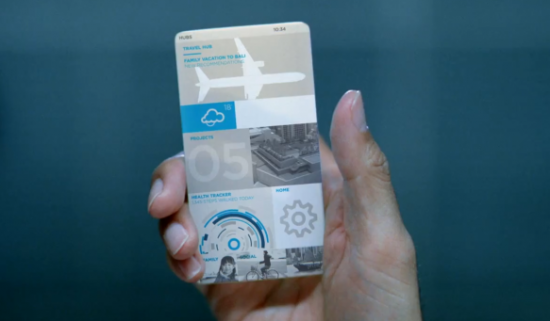
futurvision5-550x321Ah, I imagine people are getting tired of these. But permit just one more! In the midst of so many new products and developments in the fields of smartphones, tablets, augmented reality, and wireless technology, Microsoft was sure to add its two cents. Releasing this concept video back in 2011, shortly after the Consumer Electronics Show, amidst all the buzz over flexible screens and paper-thin displays, Microsoft produced this short entitled “Productivity Future Vision”.

In addition to showcasing their Window Phone (shameless!), the video also features display glasses, “smart” windows, self-driving cars, 3D display technology, virtual interfacing, paper-thin and flexible display tablets, touchscreens, teleconferencing, and a ton of internet browsing and wireless connectivity. All of the technologies featured are those that are currently under development, so the video is apt in addition to being visually appealing.

But of course, the real purpose of this video is to demonstrating to the world that Microsoft can bring these technologies and build the future of business, travel, education and play. Or at the very least, they seeks to lay their claim to a good portion of it. It’s Microsoft, people, they didn’t get to being a mega-corporation by writing checks or playing nice.

And based on this video, what can be said about the future? All in all, it looks a lot like today, only with a lot more bells and whistles!

The Future is Here: The Microsoft 3D “Holodesk”!

holodeskHang onto your hats! Of all the future concept videos to be produced by high tech firms of late, this one has the potential of being the most badass! It is known as the Holodesk, a prototype system that allows users to interface with a computer by seemingly manipulating 3D objects with their hands. The result of ongoing research over at the Sensors and Devices group at Microsoft Research Cambridge, the Holodesk is one of several 3-D based concepts that are expected to take to the field in coming years.

According to Microsoft website, the group has “the goal of understanding how advances in technology will impact traditional computing and the ways in which people use and interact with computing devices.” Using technology adapted from their popular and award-winning Kinect gaming system, Microsoft has developed this new device which it believes will fill a niche market in computing.

holodesk1Amongs them are physics students, who will use this system as a possible “playground” to test hypothesis involving subatomic particles and atomic models. It is also believed it will be useful for people who conduct remote collaborative studies from long distances, and to test out 3-D models of various kinds. TechNet blog even had one suggestion on one of its comment boards where a user claimed it could be slowed down so that he or she could learn how to juggle.

Per the MicrosoftResearch Youtube channel, the Holodesk is described as follows:

HoloDesk is a novel interactive system combining an optical see through display and Kinect camera to create the illusion that users are directly interacting with 3D graphics. A virtual image of a 3D scene is rendered through a half silvered mirror and spatially aligned with the real-world for the viewer. Users easily reach into an interaction volume displaying the virtual image. This allows the user to literally get their hands into the virtual display. A novel real-time algorithm for representing hands and other physical objects, which are sensed by the Kinect inside this volume, allows physically realistic interaction between real and virtual 3D objects.”

Check out the video of the Holodesk in action:

Omnitouch Projection Touch Screens

OmnitouchOne of the most interesting areas in which computing has been improving lately has been in the realm of interfacing. Concepts like the XBOX Kinect gaming console have not occurred in a vacuum; in fact, they are part of a larger research trend that wants to make projection and scanning the way of the future. After all, why rely on a monitor or a console when you can project images onto any surface and use them like a touchscreen?

That’s the idea behind the OmniTouch technology. Using the same technology from the Kinect gaming system, a research team made of developers from Microsoft and Carnegie-Mellon University revealed back in October that they’ve come up with a system that can turn virtually any surface into a touchscreen. By combining a miniature camera and a portable computer, the user can write documents, check email and carry out their daily computational tasks simply by finding a surface.

Chris Harrison, a postgraduate researcher at Carnegie Mellon’s Human-Computer Interaction Institute in Pittsburgh and a former intern at Microsoft Research and co-inventor of the device, describes the process as follows:

“OmniTouch works by bringing together a miniature projector and an infrared depth camera, similar to the kind used in Microsoft’s Kinect game console, to create a shoulder-worn system designed to interface with mobile devices such as smart phones. Instead of relying on screens, buttons, or keys, the system monitors the user’s environment for any available surfaces and projects an interactive display onto one or more of them.

“OmniTouch does this automatically, using the depth information provided by the camera to build a 3-D model of the environment. The camera acquires depth information about the scene by emitting a patterned beam of infrared light and using the reflections to calculate where surfaces are in the room. This eliminates the need for external calibration markers. The system rebuilds the model dynamically as the user or the surface moves—for example, the position of a hand or the angle or orientation of a book—so the size, shape, and position of these projections match those of the improvised display surfaces.”

Hrvoje Benko, another researcher who developed the device, admits that the current shoulder-mounted model is impractical. However, all the components involved in its creation are off-the-shelf electronics which are being miniaturized all the time. “But it’s not where you mount it that counts,” he says. “The core motivation was to push this idea of turning any available surface into an interactive surface… So I don’t think we’re so far from it being made into a pendant or attached to glasses.”

All of this calls to mind the SixthSense concept invented by Pranav Mistry many years ago. Presenting at TedTalks, he demonstrated how a wearable camera, finger mounted devices, and a portable computer, a person could use just about any surface to interface with their computer and even be able to transfer documents and programs to stationary computers.

While he may have beaten the IBM research team to the punch, this represents a step forward for portable computing and touch-technology since it shows that the results can be duplicated and made commercially viable.

Click on the video below to watch the OmniTouch device in action, and check out Pranav Mistry’s presentation to TedTalks at the bottom. Both enlightening and worthwhile video segments, trust me on that!

The Future is Here: Flexible Displays!

It’s like something out of a Neal Stephenson novel, or possibly movies like Minority Report or Red Planet. A display which you can not only morph and twist, but which is barely thicker than a piece of paper. Yes, some pretty impressive developments have been making the rounds in the world of displays of late, most of which are coming to an electronics store near you!

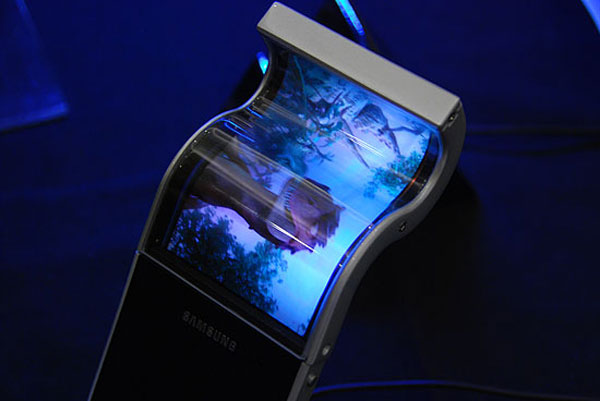
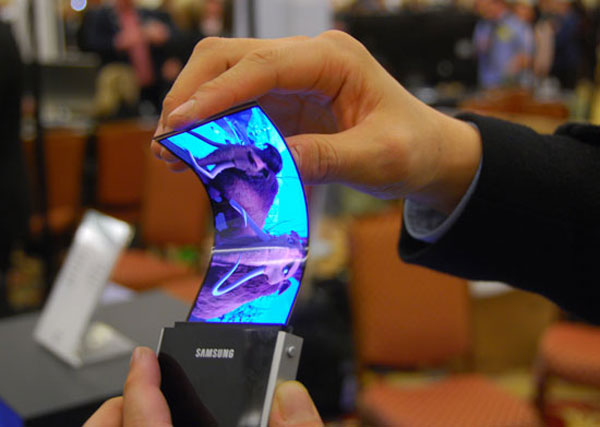
Many of these products were displayed last year at the 2011 Consumer Electronics Show in Las Vegas, where Samsung unveiled its revolutionary new AMOLED display on a number of items. AMOLED, which stands for active-matrix organic light-emitting diode, is a process where organic compounds are used to form the electroluminescent material while an active matrix takes care of pixelation and display.

The result is a display that can be twisted and shaped without fear of breaking the display, or ruining the picture quality. At CES, many of the displays came on hand-held devices, all of which boasted displays that were almost paper-thin and could be bent, hammered, and still maintain their picture. Check out the video below to see a few such items on display, which have since become commercially available, at least in some discerning sectors of the market.


But what is really exciting about this news is that it is not reserved to any one company. During 2011, virtually all technology firms with a hand in portable devices, laptops and tablets had their own ideas on new-age flexible displays that utilized AMOLED technology. Nokia has its own concept for the “Kinetic Device”, which it demonstrated at the Nokia World Conference in London this past September. This flexible phone is controlled not by touching the screen, but by manipulating the body itself. Check out this video of a demo of the Kinetic running Windows Phone OS.


Megagiants Sony, 3M and Microsoft are also on board, producing videos of products that are under development that utilize holographic technology, bendable displays, and all kinds of neat and futuristic concepts to produce the next great leap in gaming, personal computing, and communications. After viewing the majority of them, it seems clear that the future envisioned here will involve ultra-light, transparent devices that are extremely portable and merged with items we were on our person in the course of everyday life.

We can also expect things like windows and panes of glass to carry displays and interfaces as well, allowing people to get directions and access public databases just about anywhere. Consider the following video as an example of what’s in store. Not to left behind in the speculative department, Samsung produced this video of what they felt the future of tablets would look like:


You know the old saying, the truth is stranger than fiction? Well in this case, it seems the truth is catching up to the fiction. It’s nice when that happens, even if it comes a little bit later than expected. Now if someone would just invent a damn flying car already, we’d be in business!

Source: Huffington Post Tech

Of Faster-Than-Light Travel

It’s a popular concept, the fictional technology that could help us break that tricky light barrier. And it’s not hard to see why. The universe is a really, really, REALLY big place! And if we ever want to begin exploring and colonizing our tiny corner of it – and not have to deal with all the relativistic effects of time dilation and long, long waits – we better find a way to move faster.

And this is where various franchises come up with their more creative take on physics and the natural universe. Others, they just present it as a given and avoid any difficult, farfetched, or clumsy explanations. And in the end, we the viewers go along because we know that without it, space travel is going to be one long, tedious, and mind-bendingly complex journey!

Alcubierre Drive:
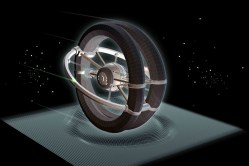
Proposed by Miguel Alcubierre as a way of resolving Einstein’s field equations, the Alcubierre Drive is an untested by possible way to achieve FTL travel. As opposed to Warp, Foldspace, or most other proposed means of FTL that involve some kind of internal propulsion of jump drive, the Alcubierre Drive is based on the idea of generating a wave that a ship would then “surf” in order to travel.

The creation of this wave would cause the fabric of space ahead of the spacecraft to contract and the space behind it to expand. The ship would then ride this wave inside a region of flat space known as a warp bubble and be carried along as the region itself moves through space. As a result, conventional relativistic effects such as time dilation would not apply in the same way as if the ship itself were moving.

The Alcubierre drive is featured in a few different science fiction genres, mainly those of the “hard” variety. This includes Stephen Baxter’s Ark, M. John Harrison’s novel Light, Warren Ellis and Colleen Doran’s Orbiter, and Ian Douglas’s Star Carrier where it is the primary means of transport.

FTL Drive:
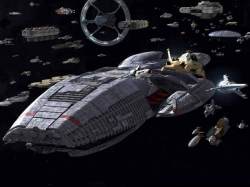
The primary means of interstellar travel in the Battlestar Galactica universe, where every ship larger than a in-system transport is equipped with an FTL drive. How it works is never really explained, but it is clear that the technology is complex and involves a great deal of calculation. This is not only to ensureolve n accurate relocation through space-time, but also to make sure they don’t up jumping too close to a planet, star, or worse, right in the middle of either.

Whereas Colonial ships use their own computers to calculate jumps, Cylon ships rely on the Hybrid. These “machines” are essentially semi-organic computers, and represent the first step in Cylon evolution from pure machines to organic beings. Apparently, the hybrids were more sophisticated than Colonial computers, especially the aging Galactica. Hence, they were able to calculate jumps more quickly and accurately.

Holtzman Drive:
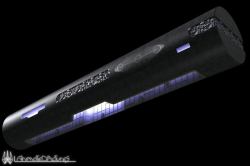
This FTL drive system comes to us from the Dune universe, and is otherwise known as a “Foldspace Engine”. Relying on principles that are not entirely clear to those in the Dune universe, the system involves depositing a ship from one point in space-time to another instantaneously. Though the workings of the drive are never really explained, it is intimated in Chapterhouse: Dune that tachyons are involved.

Another key component in the system is a Guild Navigator, a mutant who has been given natural prescient abilities thanks to constant exposure to spice. Using this prescience, the Navigator “sees” a path through space-time in order to guide the ship safely through. But in time, the Ixians invented a machine that was capable of doing this job as well, thus making the entire process automated and breaking the Guild’s monopoly on spacing.

Hyperspace:
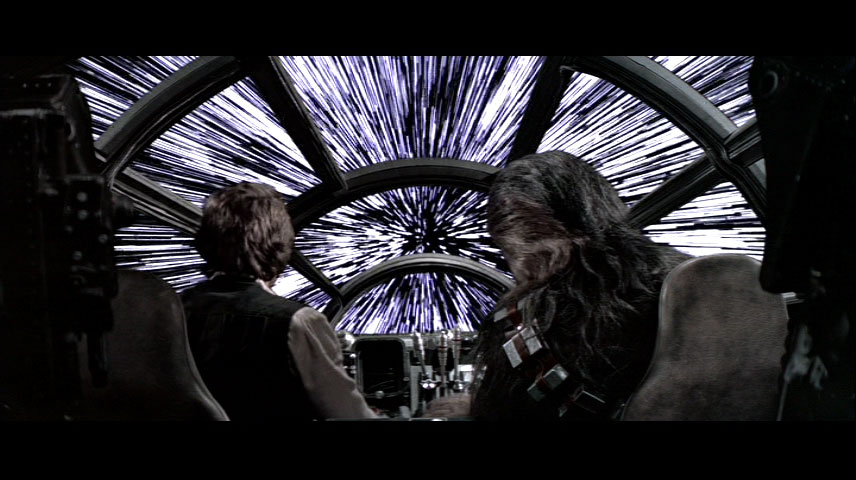
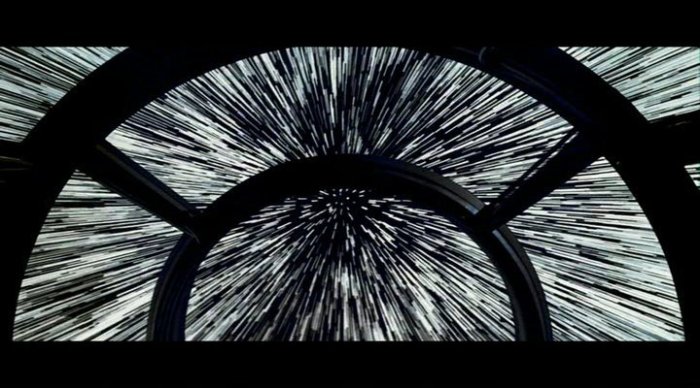
Like the Warp drive, the terms hyperspace and hyperdrive have become staples withing the science fiction community. It’s most popular usage comes from Star Wars where it is the principle means of interstellar travel. Though it is never explained how a hyperdrive works, it is made abundantly clear through a series of visuals in the first and subsequent movies that it involves speeds in excess of the speed of light.

In addition, Han Solo indicated in the original movie that the Falcon’s top speed was “point five past light-speed”, indicating that it can travel 1.5 c. All other references to hyperspace speed factors in the franchise are similar, with velocities given in terms of a decimal point value. As a fast ship, the Falcon can reach point five, whereas most of the larger Imperial and Rebel ships can make only point three or four at most.

Though Star Wars is the most popular example of hyperspace, it is by no means the earliest. The first recorded example was in John Campbell’s “Islands of Space,” which appeared in Amazing Stories in 1931. Arthur C. Clarke’s also mentioned hyperspace in his 1950 story Technical Error. However, the most enduring example comes from Asimov’s Foundation universe, where hyperspace is the principal means of travel in the Galactic Republic. In I, Robot, the invention of the “hyperspatial drive” is the basis of one of the short stories, and was meant to provide a sense of continuity with his earlier Foundation series.

Other franchises that feature the concept of hyperspace include Babylon 5, Homeworld, Macross/Robotech, and Stargate. Combined with Star Wars and the Foundation series, it is the most popular – albeit the most ill-defined -form of FTL in the realm of science fiction.

Infinite Probability Drive:
The perfect mixture of irreverence and science: the Infinite Probability Drive from The Hitchhikers Guide to the Galaxy. This FTL concept is based on a particular perception of quantum theory which states that a subatomic particle is most likely to be in a particular place, such as near the nucleus of an atom, but there is also a small probability of it being found very far from its point of origin.

Thus, a body could travel from place to place without passing through the intervening space if you had sufficient control of probability. According to the Guide, in this way the drive “passes through every conceivable point in every conceivable universe almost simultaneously,” meaning the traveller is “never sure where they’ll end up or even what species they’ll be when they get there” and therefore it’s important to dress accordingly!

Subspace Jump Drive:
Here we have an FTL concept which comes from one of my favorite games of all time, Descent Freespace. Subspace jumps, relying on the drive system of the same name, represent a very quick method of interstellar travel. By relying on subspace “corridors” that run from one point in space-time to another, a ship is able to move quickly from one star system to the next.

The only drawback to this concept is the fact that travel must occur along officially designated “nodes”. These nodes usually pass between large gravitational sources (i.e. between stars systems) but also can exist within a system itself. Virtually all nodes are unstable, existing for mere seconds or minutes at a time. However, nodes which will last for centuries or longer are designated as “stable” and used for transit.

Another favorite franchise which uses a similar concept is the Wing Commander universe. In all versions of the game, particularly Wing Commander: Privateer, interstellar travel comes down to plotting jumps from predesignated points in space. One cannot simply jump from one spot to another provided accurate calculations are made, they have to use the mapped out points or no jump is possible. This, as opposed to hyperspace travel, posits that subspace is a reality that exists only in certain areas of space-time and must be explored before it can be used.

TARDIS:
Officially, the Time and Relative Dimension in Space is a time machine and spacecraft that comes to us from British science fiction television program Doctor Who and its associated spin-offs. Produced by the advanced race known as the Time Lords, an extraterrestrial civilization to which the Doctor belongs, this device that makes his adventures possible.

Basically, a TARDIS gives its pilot the ability to travel to any point in time and any place in the universe. Based on a form of biotechnology which is grown, not assembled, they draw their power primarily from an artificial singularity (i.e. a black hole) known as the “Eye of Harmony”. Other sources of fuel include mercury, specialized crystals and a form of temporal energy.

Each TARDIS is primed with the biological imprint of a Time Lord so that only they can use it. Should anyone else try to commandeer one, it undergoes molecular disintegration and is lots. The interior of a TARDIS is much larger than its exterior, which can blend in with its surroundings using the ship’s “chameleon circuit”. Hence why it appears to outsiders as a phone booth in the series.

Warp Drive:
Possibly the best known form of FTL travel which comes to us from the original Star Trek and its many spinoffs. In addition to being a prime example of fictional FTL travel, it is also perhaps the best explained example.Though said explanation has evolved over time, with contributions being made in the original series, TNG, and the Star Trek technical manual, the basic concept remains the same.

By using a matter/antimatter reactor to create plasma, and by sending this plasma through warp coils, a ship is able to create a warp bubble that will move the craft into subspace and hence exceed the speed of light. Later explanations would go on to add that an anti-matter/matter reaction which powers the two separate nacelles of the ship are what create the displacement field (the aforementioned “bubble”) that allows for warp.

Apparently, Warp 10 is the threshold for warp speed, meaning that it is the point at which a ship reaches infinite speed. Though several mentions are made of ships exceeding this threshold, this was later explained as being the result of different scales. Officially, it is part of the Star Trek canon that no ship is capable of exceeding Warp 10 without outside help. When that occurs, extreme time dilation, such as anti-time, occurs, which can be disastrous for the crew!

In addition to Star Trek, several other franchises have made mention of the Warp Drive. This includes StarCraft, Mass Effect, Starship Troopers, and Doctor Who.

Final Thoughts:
Having looked through all these examples, several things become clear. In fact, it puts me in mind of a clip produced by the Space Network many years ago. Essentially, Space explored the differences between FTL in past and present franchises, connecting them to developments in real science. Whereas Warp and Hyperspace tended to be the earliest examples, based on the idea of simply exceeding the speed of light, thereby breaking the law of physics, later ideas focused on the idea of circumventing them. This required that writers come up with fictional ideas that either relied on astrophysics and quantum theory or exploited the holes within them.

One such way was to use the idea of “wormholes” in space-time, a hypothetical theory that suggests that space is permeated by topological holes that could act as “shortcuts” through space-time. A similar theory is that of subspace, a fictional universe where the normal rules of physics do not apply. Finally, and also in the same vein, is the concept of a controlled singularity, an artificial black hole that can open a rift through space-time and allow a ship to pass from one point in the universe to another.

Explanations as to how these systems would work remains entirely hypothetical and based on shaky science. As always, the purpose here is to allow for interstellar travel and communications that doesn’t take decades or even centuries. Whether or not the physics of it all works is besides the point. Which brings me to two tentative conclusions.

  1. Explanations Need Not Apply: Given the implausible (or at the very least, inexplicable) nature of most FTL concepts, the best sci-fi is likely to be the stuff that doesn’t seek to explain how its FTL system of choice works. I’st simply there and does the job. People hit a button, push a lever, do some calculations, or fly into a jump gate. Then boom! seconds later (or days and weeks) and they find themselves on the other side, light years away and ready to do their mission!
  2. That’s Hard: Given how any story that involves relativistic space travel, where both time dilation and confusing time jumps are necessarily incorporated into the story, only the hardest of hard sci-fi can ever expect to do without warp drives, hyperspace, jump or FTL drives. Any other kind of sci-fi that is looking to be accessible, and therefore commercially successful, will have to involve some kind of FTL or face extinction.

Well, that’s all I got for the time being. In the meantime, keep your eyes on the skies and don’t stop dreaming about how we’re one day going to get out there. For even if we start sending ships beyond our solar system in the near future, it’s going to be well into the distant future before they get anywhere and we start hearing back from them. At least until someone figures out how to get around Einstein’s Theory of Relativity, damn bloody genius! Until then, I’d like to sign off with a tagline:

This has been Matt Williams with another conceptual post. Good night, and happy spacing!

Count Zero


“On receiving an interrupt, decrement the counter to zero.”
-Programming The Z80 by Rodnay Zaks (1982).

The other night, I finally finished book II in the Sprawl series by William Gibson. Kindle for iPad, not paperback, which in itself was kind of a bummer. Somehow, I still haven’t made the transition for hard copies to ebooks. Probably never will. In any case, it was a rewarding experience which reminded me why I like Gibson in the first place. After getting through the Bigend Trilogy and the Bridge Trilogy and having somewhat mixed feelings, I got back to the trilogy that started it all, and was interested by what I found…

Count Zero is number two in the series that picks up after Neuromancer, the book which started it all for Gibson and which I read first. Set in the Sprawl – a.k.a. the Boston-Atlanta Metropolitan Axis (or BAMA) – this cyberpunk story deals with themes familiar to classic Gibson fans. Cyberpsace jockeys, freelance mercenaries, corporate monopolies, the street, and people so wealthy that they are able to cheat death and transcend humanity. In between, there’s all the familiar lexicon which Gibson invented himself: microsofts, biosofts, decks, trodes, jacking, jockying, ice, black ice, icebreaker, the matrix, Turing Police, cores, and all that good stuff.

However, there were also a few elements which put me in mind of his later work. Really, I could dedicate an entire post to the parallels between this book and his Bigend Trilogy. Again, there was the notion of the transformative power of wealth, how it means so much more than just having money and the freedom to use it. Given how much importance is placed on this in the book, how it serves as a sort of motivation in itself, one would get the impression that this is a serious preoccupation of Gibson’s. But then again, it was serious preoccupations of Fitzgerald’s, and for good reason! As he and Hemingway are rumored to have said to each other:

F: “The rich are different than you and me.”
H: “Yes, they have more money.”

Plot Synopsis:
The story takes place seven years after the events of Neuromancer and centers on the lives of three people: First, a mercenary named Turner who has just recovered from a near-death experience and is beginning to question what he does. However, while attempting to flee his life, he is picked up and told he must do one final job. A scientist named Mitchell, working the company of Maas, wants to defect from his job and join the rival company of Hosaka. It’s up to Turner to pick him up and transport him back to Japan where, presumably, he will be safe to pursue his work in biosofts – a revolutionary biological form of technology. However, the run goes terribly awry when they find that the evacuee is in fact his daughter, and the company destroys its own fortress and kills Mitchell rather than let him fall into their rivals hands.

Second, we have a disgraced Parisian art dealer named Marly Krushkova who has been hired by a fabulously wealthy man named Virek to track down the maker of some mysterious art boxes. One of these boxes, which are based on Joseph Cornell’s artwork, apparently contain indication of biosoft construction. Virek, who is currently alive in a vat somewhere in Scandinavia, wants the technology so he can ressurrect his body and live forever. Using his dime and his contacts, Marly begins to follow the clues which will lead her to the abandoned station of Freeside, the once proud holding of the Tessier-Ashpool clan, where she will learn the shocking truth of the boxes.

Third, a young New Jersey boy named Bobby Newmark, hacker alias “Count Zero”, who is new to the jockeying game and comes across some “black ice” that nearly kills him. He discovers that the friend who gave it to him, “Two-A-Day”, received it from a questionable source and pawned it off on him to test it. When looking into this, he finds that Two-A-Day’s backers are a group of Haitain hackers who are interested in investigating a bunch of apparitions in cyberspace that appear as Voodoo gods. One of these “gods”, it seems, was responsible for saving Bobby’s life when he jacked and encountered the black ice, which was apparently of Maas construction. Their group must now move quickly, because it becomes clear that anyone who knows about the ice is being murdered.

Sound familiar? Well it should. This is classic Sprawl Gibson at his best!  In time, all three threads, supposedly unrelated, weave together to the point where it becomes clear that Josef Virek, the wealthy mogul is pulling all their strings. For starters, we learn that Mitchell is not the genius he was rumored to be. Apparently, he was being fed all the information he needed to produce the biosoft technology. The person feeding him this info was apparently working from Freeside, and turns out to be one of the “apparitions” that is haunting cyberspace.

In addition, this same apparition instructed Mitchell to place biosoft technology in his daughter (Angie’s) head. Turner learns of these enhancements shortly after rescuing Angie and performing a routine scan on her. As a result, she is able to access the matrix anytime she wants without the need for a deck. Often, when she’s asleep, she is heard muttering things in Creole and having odd dreams which appear to coincide with events in cyberspace. For one, she remembers helping a boy named Bobby when he was being attacked by a malicious program. In short, she is the one who saved Bobby when he got into the black ice.

Last, Marly’s adventure to discover the box maker is related to the whole Maas/apparitions thing because Virek’s true agenda is to find the maker of the biosoft technology so he can use it to repair his dying body. As is made clear early on, he is alive only in the strictest sense, his remains being vet in a vat that keeps his vitals steady, and his brain wired to a Sim-Stim link that allows him to communicate with the outside world. It is also revealed that he intervened in Mitchell’s defection by paying off some of the mercenaries. However, his plans were upset somewhat when Mitchell chose to free his daughter instead of himself. So for the remainder of the novel, it becomes a race to capture her.

In time, she asks to be brought to the Sprawl where Bobby and his Voodoo friends are holding up inside a club. When they see Angie, Bobby recognizes her as the girl who saved his life. The Voodoo hackers also recognize her as one of the chief deities they have been observing in cyberspace. With some outside help, they make a stand against Virek and the mercenary Captain that was helping him and take them down. This they do by locating them both in cyberspace and arranging for their hiding places to be destroyed.

In the course of all this, it is revealed that these “apparitions” or Voodoo deities are in fact the splintered personality of the AI’s from book I that went by the names of Wintermute and Neuromancer. After coming together at the end of the story to form the first, fully-functional AI, the combined personality split itself up into several smaller constructs so that it would not be alone in the matrix. They adopted the form of Voodoo deities because they felt these suited them best, which is what attracted the interest of the Haitain hackers in the first place.

In addition, it was they who sent the Maas icebreak down from Freeside, as part of their wider plan to smoke out Virek. Knowing that he was trying to cheat death, they decided to intervene so that he wouldn’t be able to achieve the immortality and godlike power he had been seeking. A sort of “Tower of Babel” or Icarus-type scenario there, where a god or gods punish mortals for overreaching and trying to taste divinity.

Strength/Weaknesses:
As I said before, this book reminded me of why I turned to Gibson in the first place. His abilities at world-building, at submerging the reader in a world of megacities, megacorporations and cool and potentially frightening technologies is what established him as a master of cyberpunk in the first place. I was also happy to return to his world of familiar gadgets and tools, a la simstims, microsofts, decks, jockeys and mercenaries; not to mentions shadowy agendas and double-crosses. After having read through the Bigend Trilogy where the agendas were pretty benign and unclear, and the Bridge Trilogy where the settings were kind of inconsistent and really not that dark, it was a real treat to get back to the dirty, dystopian world of the Sprawl!

However, there were some bumps along the way as well. For one, Gibson’s penchant for portraying wealthy moguls as people who have ridiculous amounts of control and influence was something I was overly-familiar with at this point. In fact, substitute a desire to cheat death with immense curiosity and Virek easily becomes Bigend. However, I could see how this was the result of reading his later works first. Had I read the Sprawl Trilogy in its entirety before tackling the more recent Bigends, I might have seen this a bit less critically.

Ah, but there was another signature Gibson trait in this book. The anti-climactic ending! After quite a bit of action in getting Turner, Angie, Bobby and the Voodoo priests all in the same place, after all the growing tension as we are told that the club is surrounded by goons, not much happens.  Bobby contacts another jockier who lost her boyfriend in the raid on Maas, because of the Mercenary Captain’s betrayal, she kills both him and Virek, and the goons dissipate as they realize the people they are working for are gone. The word “abortive” seems appropriate here, for that’s what you call an ending that is building towards and explosive climax, then fizzles out!

Still, I loved the setting, the themes, and the feel of the story. It reminds me of why I love cyberpunk and was the perfect addition to a month that has been characterized by dark, dystopian and technologically-driven literature! Much of what I had to say about Gibson’s Sprawl in my Dystopian Literature post was taken from this very book. After Neuromancer, it helped to complete the picture of what Gibson was all about in his early writing career. In building the world of tomorrow, where corporate monopolies rule, people live in dirty, overcrowded environments, where the rich are barely human and the poor struggle just to live and retain some essence of their humanity, Gibson epitomized the cyberpunk ideal of “high tech and low life”!

more cool cyberpunk wallpaper!

RIP Steve Jobs, You Will Be Missed

What can you say about a man who’s life’s work has led him to be viewed as one of the foremost businessmen, inventors and innovators of the past century? I really don’t know, other than to repeat what everyone else has said already: that he was a titan of high-tech, busines acumen, and that he will be missed. Yes, it was only a few months ago that Jobs announced he’d be stepping down from his post because of an ongoing battle with cancer. And, much like Jack Layton, he departed this world shortly thereafter. And at the still-tender age of 56 no less.

Quite sad, but it reminds us just how precious life really is. The candle that burns half as long burns twice as bright.

I know very little about what he did in life, but I do know that, thanks to him, the world of personal computers and consumer electronics has forever been revolutionized. As one of the three founders, Jobs helped to invent the PC, which in and of itself changed the way the public and private sector does business. One can scarcely imagine an office environment without a personal computer, and today, one can scarcely imagine people going about their business without the help of an iPhone or PDA.

And in addition to bringing Apple to the world, he helped bring it back after years of being marginalized by their biggest competitor, Microsoft. Ultimately, he and his colleagues pushed back against the tide of monopolization that Gates unleashed with the policy that all hardware, software, and accessories should be designed by the same people and built to be compatible. And I don’t need to tell people how successful they were, do I? After a few years of being the underdogs, Apple turned things around and became the guys who’s stuff worked for a change! And with the Vista fiasco and the dominace of the iPod and iPhone (can anyone rememnber the name the Microsoft’s equivalent? Me neither!), it seems like the tables have turned.

Still, can’t help but wonder what Apple will do now. I guess I’m in the majority in that respect because every article and news story I’ve read on the subject so far seems to be tacitly asking this question. Sure, they’ll carry on, as always, but I think it will be many years before another person as innovative and brilliant as Jobs comes along.

P.S. I can recall a few years back when Steve Jobs and Rupert Murdoch were talking about creating an iPhone app for Newcorps, FoxNews’ flagship and Murdoch’s big weapon in his war on journalism. I’m hopeful that Murdoch’s current legal troubles torpedoed that, because, trust me Apple, you don’t want to get involved with that charlatan!