Should I Be Afraid of the Future?

should-i-be-afraid-of-the-futureNot that long ago, I discovered a site dedicated to taking speculations about the future, crunching data and trends, and producing visualizations about them. Already, they had me with their graph that shows when future technologies will emerge, and how they will be interrelated. But then came their future of education and health technology, both of which addressed the same issue – what can we can expect within the next few decades, leading up to the middle of this century?

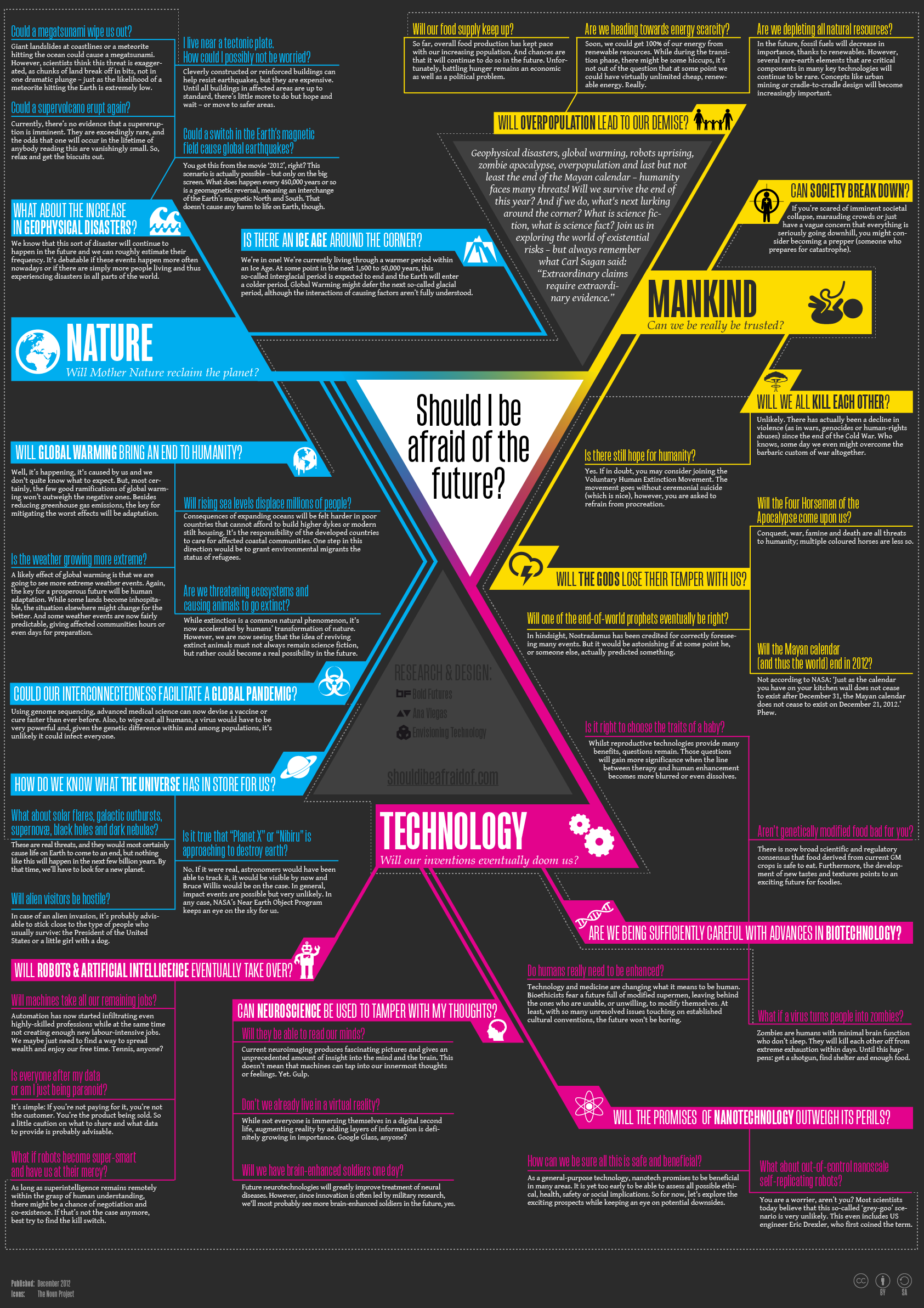
And now, the good folks at Envisioning Technology have created something truly informative and relevant. Entitled “Should I be afraid of the future?”, the infograph addresses all the big questions people might have when it comes to emerging technology, environmental perils, and the kind of technophobia that often result.

“Geophysical disasters, global warming, robot uprisings, zombie apocalypse, overpopulation, and last but not least the end of the Mayan calendar – humanity faces many threats! Will we survive the end of the year? And if we do, what’s next lurking around the corner? What is science fiction, what is science fact? Join in exploring the world of existential risks – but always remember what Carl Sagan said: ‘Extraordinary claims require extraordinary evidence.'”

The questions are broken down into three interrelating fields. First, there is Nature, covering such things as geological disasters, climate change, a possible ice age, and even astronomical events. Then comes Mankind, addressing possible factors such as war, apocalyptic scenarios, and overpopulation. And finally, there is technology, where questions about whether robots and AIs could turn hostile, and if advances in nanotech, biotech, and neuroscience could be potentially harmful.

And of course, each question is addressed in a rational, sensible fashion, even when the questions themselves are based on irrational, myth-peddling paranoia. The Mayan Calendar, bio-outbreaks, every possible technophobic impulse, and even a zombie apocalypse are covered. But then again, the infograph is all about addressing fears. Fear, by its very definition is irrational, and the only cure is information. A well-informed public is not only a safeguard against persecution and bigotry, but against a future full of existential risks.

Source: Envisioning Technology

3D Printer Uses Drag and Drop DNA for Cancer Drugs

brain-scan_530It seems that Parabon NanoLabs may have opened up a new front in the ongoing war against the terrible disease known as glioblastoma multiforme – aka. Brain Cancer. And the culprit in this new offensive is 3D printing technology, which is being used to print a new brand of medication, molecule for molecule, using a DNA self-assembly technique. But what is even more impressive is the fact that the DNA itself was custom designed with a drag-and-drop computer program.

The new technology, which was in part funded by the National Science Foundation, is called the Parabon Essemblix Drug Development Platform, and it combines computer-aided design (CAD) software with nanoscale fabrication technology. In an official release made by the National Science Foundation, lead investigator Steven Armentrout stated: “What differentiates our nanotechnology from others is our ability to rapidly, and precisely, specify the placement of every atom in a compound that we design.”

dna_selfassemblyIn essence, this breakthrough will not only drastically reduce the time it takes to both create and test medications, it will also open the door to completely new drug designs. The computer software used allowed the scientists to design molecular pieces with specific, functional components, and to optimize their designs using a cloud supercomputing platform called the Parabon Computation Grid that searches for sets of DNA sequences.

And to hasten the drug production process, the researches took their new sequences and chemically synthesized trillions of identical copies of the designed molecules. So, in a matter of weeks — and in some cases, days — the developers were able to produce their drugs. The technique is considerably faster than traditional drug discovery techniques, many of which simply utilize trial-and-error screening.

As for what lies ahead, Parabon is hoping to use the same technique to develop synthetic vaccines and gene therapies that can target a person’s genetic diseases. In addition, the technology could be used beyond the field of medicine, embracing nanotechnology, biotechnology and even computing. As always, exciting developments in one field are likely to trigger movements in others.

Source: NSF.com

The Milli-Motein: A “Real-Life Transfomer”?

DNA-molecule2It seems that the line which separates the biological world from the synthetic is growing fainter all the time. Just consider advancements made in the past year alone: In January, researchers at MIT created the world’s first medimachine. Then in September, researchers announced the development of an electronic implant that can dissolve completely inside your body, followed shortly thereafter by the creation of the first bionic hand. And then in November, amputee Zak Vawter climbed America’s tallest skyscraper with the world’s first neurally controlled prosthetic leg.

Now, researchers inspired by structural biochemistry are working to design shapeshifting robots that could, in theory, assume almost any form imaginable. That’s the idea behind MIT’s latest invention, the Milli-Motein: a highly adaptable, infinitely scalable machine that can assume almost any shape imaginable. MIT media labs describes the device as both the robotic equivalent of a Swiss Army Knife, and a “real-life transformer”.

milli-moteinBut, like many inventions these days, the inspiration comes from organic biology, specifically the protein structure. The building block of all life, proteins can assume an untold number of shapes to fulfill an organism’s various functions, and are the universal workforce to all of life. By combining that concept with the world of robotics, the MIT research team hopes to create a new breed of robot that can assume any shape to perform multiple functions, and the Milli-Motein is just the beginning.

According to research lead Neil Gershenfeld, this device represents the latest advance in what he describes as the “Digital Fabrication Revolution”. As he put it: “Digital fabrication will allow individuals to design and produce tangible objects on demand, wherever and whenever they need them.” Also known as “programmable matter” – or “smartmatter” – products made from this kind of material could not only change their shapes, but become new things altogether.

Naturally, this is a small step in that direction, but the eventual goal is nothing short of revolutionary. I can envision a future where people will actually line up to buy the new Acme “handy-dandy micro-helper”, a device which can convert from a screwdriver to a HDMI cord, a tablet, a fannypack, or a pair of shoes. Whatever you need, the micro-helper has you covered! Hey, that’d be a good slogan. I should start investigating patents now, don’t want Kurzweil and all those futurists making money off of this instead of me!

Check out the video below for footage of the Milli-Motein in action, and a brief description of the principles involved:


Source: IO9.com, MIT.edu

The Nokia Human Form

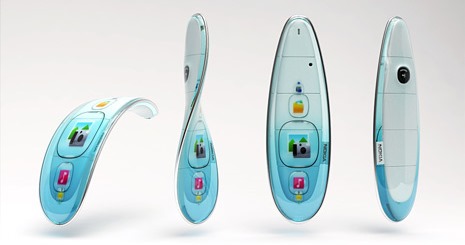
Nokia-HumanForm Hello all! As you may recall, Nokia made a rather interesting announcement back at the Consumer Electronics Show in 2011 with the promotional video for the Kinetic Device – a flexible smartphone which responds to user commands through twists and bends in the device’s frame. However, it seems that the telecommunications giant wasn’t satisfied with displaying their upcoming line of smartphones.

In addition, they saw fit to produce a future concept video for what they have named the Human Form. This is a futuristic smartphone which also boasts the new “bend and flex” method of use, touchscreen technology, and has a frame that is (in the words of the company) “humanized”. In essence, this means that the phone is extremely user friendly and intuitive, responding to the user’s own manipulations, touch and gestures, while the frame itself acts as a single display device.

Nokia-Human-FormBut the biggest surprise, for my money, is the tactile feature which allows users to “feel” images. What this means exactly is a bit unclear, but the promotional video seems to be suggesting that the phone will be able to simulate sensations, allowing a person to literally feel features of the image. This sort of technology not only requires a surface which is capable of adjusting its own properties down to the micro level, but an internal processor which is incredibly smart, perhaps even on the order of an AI.

No telling when Nokia plans to begin developing this phone for commercial use. Obviously, the promo video was designed to build upon their current project of building flexible smartphones and touchscreens. But given the current pace at which digital devices are developing, we could be seeing smartphones very much like this one before the decade is out. So save your pennies, because they aren’t going to come cheap!

Check out the promotional video in its entirety below:

Transhumans by 2030?

transhumanismThe issue of transhumanism, the rise of a new type of humanity characterized by man-machine interface and augmented intelligence, is being debated quite fervently in some circles right now. But it seems that groups other than Futurists and speculative fiction writers are joining the discussion. Recently, the National Intelligence Council, a US policy think-tank, released a 140 page report that outlined major trends and technological developments we should expect in the next 20 years.

The report, entitled “Global Trends 2030: Alternative Worlds”, predicted several trends which are likely to come true in the near future. Amongst them is the end of U.S. global dominance, the rising power of individuals against states, a growing middle class that will increasingly challenge governments, and ongoing shortages in water, food and energy. However, predictions were also made concerning a future where humans have been significantly modified by various technologies, what is often referred to as the dawn of the Transhuman Era.

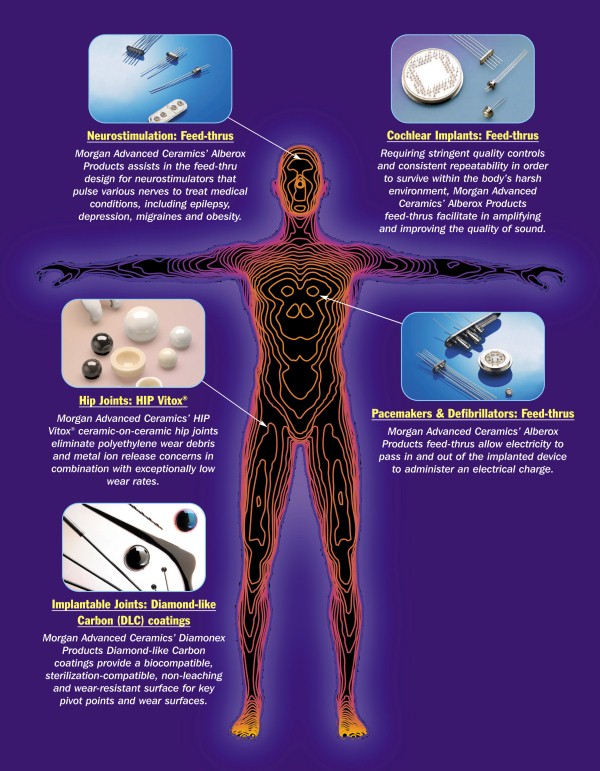
how-nanotechnology-could-reengineer-usIntrinsic to this new era is the invention of implants, prosthetics, and powered exoskeletons which will become regular fixtures of human life. These will go beyond merely correcting for physical disabilities or injury, to the point where average humans are enhanced and become more productive. 2030 is key year here, because it is by this point that the authors predict that prosthetics will exceed organics, and people will begin getting them installed in order to augment themselves.

In addition, life extension therapies and medical advances which will be used predominantly by the elderly will become a means for otherwise healthy people to prolong their lives and maintain health and vitality for longer periods of time. Brain implants are expected to become a reality as well, ostensibly to allow people to have brain-controlled prosthetics, but also for the sake of enhanced memory and augmented thinking.

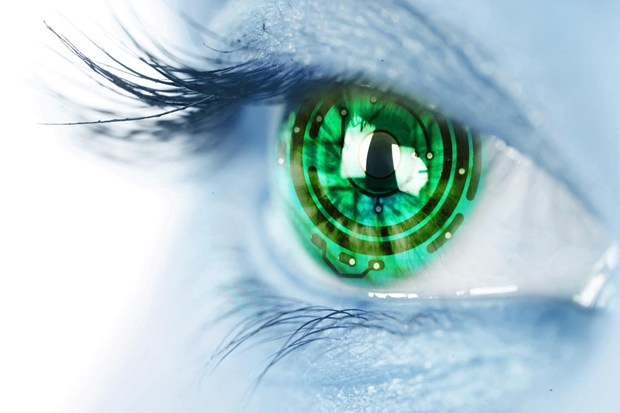
bionic_handAnd of course, bionics are an important factor in all this. Already, researchers have achieved breakthroughs with bionic limbs, but retinal attachments, artificial eyes, and even fully-functioning organs are expected before 2030. On top of that, improvements in drugs, such as neuropharmaceuticals – drugs that enhance memory, attention, speed of thought – and implants which assist in their delivery are expected to be making the rounds.

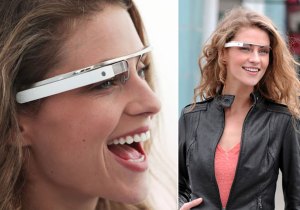
google_glassesFinally, there is the matter of virtual and augmented reality systems, which are already becoming a reality thanks to things like Project Glass and recent innovations in PDAs. As the report notes: “Augmented reality systems can provide enhanced experiences of real-world situations. Combined with advances in robotics, avatars could provide feedback in the form of sensors providing touch and smell as well as aural and visual information to the operator.”

However, the big issue, according to the report, is cost and security. Most of these technologies will be not affordable to all people, especially for the first few years of their existence. This could result in a two-tiered society where the well-to-do live longer, healthier and have a competitive advantage over “organics”, people of lesser means who are identifiable by their lack of enhancements. Also, developers will need to be on their guard against hackers who might attempt to subvert or infect these devices with tailor-made viruses.

Naturally, the importance of maintaining uniform scientific progress was stressed, and the need for a regulatory framework is certainly needed. What the CSER recently recommended is certainly worth keeping in mind here, which was to ensure that some kind of regulatory framework be put in place before all of this becomes a reality. What’s more, public education is certainly necessary, so that the current and next generation of human beings knows what to expect and how to go about making informed choices therein.

To see the full report and learn more about the NIC, follow the link below:

National Intelligence Council: Who We Are

Source: IO9.com

The Future is… Foggy!

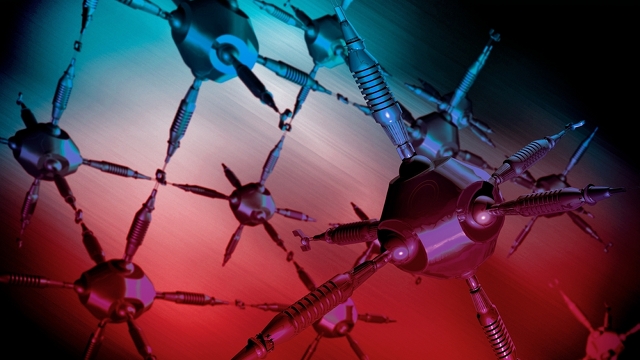
utility_fogIt’s called a Utility Fog, swarms of networked microscopic robots that can assume the shape and texture of virtually anything. Originally proposed by J. Storrs Hall, a speculative science writer back in 1993, the concept has gone on to inspired futurists and science fiction writers for years. These include Warren Ellis’s foglets in Transmetropolitan and Neal Stephenson’s personal nanodefense systems in The Diamond Age, among others.

As an extension of the nanotechnological principle – where microscopic machines are able to self-replicate and construct just about anything – the Utility Fog idea goes a step further by proposing that we have a series of robots linked, arm and arm, to form a solid mass that can assume the shape of anything we need. Another term that is often used is “Smart Matter”, because it entails the creation of materials that are capable of responding to input, storing info, and thereby predicting what a users desires.

And since they are composed by tiny robots that could be capable of computing and networking with larger machines, they could even form interfaces that allow us to store information, send emails, or take pictures. Each “foglet” would function as its own discreet computer network, in this model, making sure that separate clouds are discernible and perform different tasks. The possibilities are truly limitless, and though it may be a few decades away at this point (by liberal estimates), we can only imagine how it will alter our daily lives.

During a recent interview with IO9, Hall reminisced about how he first came up with the idea:

“I came up with this vision of form fitting foam — one that could take on the shape of anything inside it and on the fly, which got me to wondering if we could ever possibly build something like that.”

The answer, according to Hall, came to him by considering the nascent field of molecular nanotechnology. By designing and creating objects at the molecular scale, Hall envisioned a fog that could quickly morph along with the movements of anything around it — including the passengers of cars. However, the greatest potential, to Hall lies in the creation of virtual environments. In truth, there could come a day when utility fogs will blend seamlessly with the real and virtual worlds, creating a kind of hybrid reality in between.

“You could actually push this technology to the point of creating a virtual world around you. You’d essentially get Star Trek’s holodeck — one that could actually cut you and make you bleed. You could put yourself in a virtual environment where you’re interacting with something that leads to a real environment, and it’s this interface between what’s real and virtual that will prove to be the most important thing about it.”

However, the most radical possibility could be in the field of clinical immortality. Amongst science fiction writers such as William Gibson, the idea that human beings could upload their minds into constructs and interfaces has been toyed with for some time. However, why upload your mind into a box or some kind of portable hard drive when you could render it seamlessly into the form of a fog?

“You could very realistically imagine uploading into it, and then you’d be this sort of formless data amoeba controlling this formless physical amoeba and take any size or form you wanted.”

Of course, there are limitation to the whole concept, not the least of which is the fact that the constituent components of the technology are still any decades away. For starters, there’s the ability to construct robots on the scale required, then the need to fashion computers that are small enough to fit. Then there’s the software required to program such machines. Hall figures that it could take a team of experts as much as a half decade to come up with the first set of algorithms required for the most basic functions.

“To navigate that hairy interface between the continuous and the discreet — that’s more difficult, the foglets will have to link up hands, let go, walk, crawl, and so forth — it’ll be like a three dimensional square dance.”

But above all, the main issue is one of cost:

“The system will have to be capable of keeping track of any changes to the environment and to keep track of you — and this will require incredibly sophisticated simulation, sensing, and interfacing software and that’s going to be tremendously expensive.”

Not surprising really. At this juncture in time, the greatest leaps in technology that will forever alter the future and make it impossible to predict – to a point anyway – are still highly speculative. But then again, major breakthroughs are being made all the time, and are occurring at a greater and greater pace. Who’s to say when the future will arrive. It never seems to show up on schedule!

Microchips Made With DNA!

It seems IBM is deep at work developing a revolutionary new method for assembling microchips. This process will involve using self-assembled DNA nanostructures to create microchips and chip components. Or, to put it more dramatically, DNA would be used as a sort of “origami”, serving as a sort of scaffolding in the arrangement of nanotubes and allowing the company to develop microchips that are smaller and much less expensive to produce.

But of course, the long-term goal is much more ambitious. According to Greg Wallraff, a scientist working with IBM, the “goal is to use these structures to assemble carbon nanontubes, silicon nanowires, quantum dots. What we are really making are tiny DNA circuit boards that will be used to assemble other components.” In short, this could be not only a step towards bioassembly, nanotechnology, and even quantum computing.

For some time now, scientists have been experimenting with DNA as an assembler for microcircuits. One such individual is Paul W. K. Rothemund, a research associate at the California Institute of Technology, who developed DNA origami back in 2006. This involved taking a long strand of viral DNA, putting into a 2 or 3-D shape, and then holding it together with shorter strands of DNA. In this way, he was able to create shapes such as triangles, stars and smiley faces, according to his Caltech Web site.

Based on this process, complex DNA nanostructures are made in solution and then applied to surfaces which have designated “sticky spots” to ensure that they hold a specific configuration. Once the scaffold is in place, molecules of polymer, metal and other materials can then be guided into place, assembled from the cellular level outward. According to Rothemund, there are still some problems that need to be worked out and it is likely to be another 10 years before the process is entirely viable.

Still, for enthusiasts of bioware, biotech, and nanotechnology, this is exciting news. To know that we could be just ten years away from components assembled by nanostructures composed of living material, a stepping stone towards machinery composed entirely of DNA structures or nanomachines themselves… like I said, exciting!

Source: findingdulcinea.com

The Future is Here: Electronics that Dissolve

electronicsIt is no secret that research into nanotechnology is bearing fruit these days. Back in February, both Standford and MIT unveiled implantable devices which would be capable of delivering drugs directly into the human blood stream and detecting health problems. However, despite all the progress being made in terms of nano-miniaturization, there are still numerous barriers which need to be overcome.

For example, having microelectronics in the body, while initially beneficial, might prove problematic with time. What’s to happen when they are finished their jobs, become obsolete, or simply stop working after awhile? As anyone who’s ever owned a computer, PDA, mobile device or laptop can tell you, the stuff breaks! And if it does happen to live past its warranty, chances are it will be obsolete in six months… tops!

Such machines need a way to be removed, but given their size (o.oooooooo1 meters), that’s not exactly practical. And even if it were, there’s the question of disposal. Once commercially viable, there are likely to be billions of nanomachines in circulation. Even at their miniscule scale, such machinery could pose environmental hazards, especially if its likely to malfunction. Ever heard of Grey Goo? Well that’s a scenario that researchers have to consider.

Luckily, researchers at the University of Illinois have come up with a possible solution: electronics that dissolve! Composed of silicon, magnesium, magnesium oxide and contained within a protective layer of silk, these “transient electronics” are built to melt away just as soon as their tasks are complete.

In the process, they will reduce or remove the need to pass or surgically remove medical implants. Using rats as test subject, the researchers built their implants out of extremely thin sheets of silicon called nanomembranes to get the electronics to dissolve in hours or days instead of years.

Of course, the medical applications are clear. Already, electronics are being tailor made for the delivery of drugs, sensors implanted in internal organs to monitor of problems, and temperature monitors created to safeguard against infection and disease. Combined with external sensors, doctors would be able to do a full medical workup within seconds, and much of the guess work involving symptoms and patient history could be eliminated. Exploratory surgery could also become a thing of the past, since doctors would be able to use internal sensors to diagnose unexplained problems.

The researchers also used silk collected from silkworm cocoons to control the speed of disintegration. This is part of a growing field of electrical engineering that seeks to create biodegradable microchips and other electronics, in part for the sake of implantation but also to ensure the elimination of computer waste.

Such waste, which includes disposable cell phones, cameras, and computers, currently accounts for 50 million tons of waste a year. Sixty percent of that is produced in the US, but could rise by as much as 500 percent over the next decade in developing nations such as India and China. Designing these types of components now could ensure the aversion of a possible ecological disaster.

Source: news.cnet.com

Dealing With Rejection

As all successful writers will tell you, rejection is part of the process. From Ray Bradbury, to Frank Herbert, to George Orwell and James Joyce, every great has always admitted that before they were well known, they were a nobody. Publishing houses wouldn’t take risks on their manuscripts, editors told them it simply wasn’t what they were looking for, and friends and family told them to simply persevere. Sooner or later, their genius would be recognized for what it was.

That’s what I tell myself whenever I get the form rejection letter that I found in my Inbox this morning. For some months, I have been trying to get my short story “Domicile 4.5” published with a magazine. It’s a story of the not-too-distant future, of nanotechnology, avarice, and the dangers of constantly trying to “keep up”. And this is the third magazine to tell me, in essence, “thanks, but not what we’re looking for.”

Of course, I will try again. There are other magazines who have specified that they interested in speculative fiction and technologically based stories, so all hope is not lost yet. But it does get me down, right? One can’t help but feel personally rejected when a  form letter like this arrives. Whenever you express yourself creatively and someone says “no, thanks”, you can’t help but go through gambit of emotions. Self-doubt, sadness, and maybe even a little anger. What am I doing wrong? What was wrong with it? Surely, there must be a reason right?

Of course, I know that everyone out there knows precisely what I’m talking about. Whether it was a job application, a relationship, a petition to join a group – we’ve all been there. So I thought I might open the floor and ask my friends and colleagues out there, what kind’s of rejection stories do you have? More importantly, what did you do to soldier on when it happened? Is there a magical elixir to let yourself know that you are the problem, that this is just part of the process, or that you’re efforts are worth and just haven’t been recognized yet? Feel free to share because I’m interested to know 🙂

In the meantime, I thought I might post it here, just to see if people might actually find it worth reading. Stay tuned!

“How Nanotech Could Reengineer Us.”

My personal thanks to kwolph, the unidentified fellow who was nice enough to stop by and forward me the link to this rather interesting infographic. Courtesy of the Keithley Center, which designs electronic systems for measurement and analysis, this infographic shows how advances in nanotechnology might aid us in reinventing and augmenting the human body.

These include augmenting our brain chemistry by either delivering drugs directly to our receptors (which can include anti-depressants, stimulants, or pain killers), or the more audacious approach of enhancing our thought pattens and memory by actively building and repairing neural tissue. As such, things like mental illness, brain injuries and trauma could be overcome at last.

In addition, there’s plenty of enhancing our hearts, lungs, reinforcing our bones, repairing muscle tissue, enhancing our eyes, reflexes, strength, endurance. And, as they point out, by virtue of the female model, the scourge of breast cancer, which effects one in eight women, could be be wiped out. No mother’s or young women dying before their time anymore!

And of course, other entirely too common ailments, heart disease, prostate cancer, ovarian cancer, lung cancer, and every form of degenerative disease, could be nipped in the bud either through regular maintenance of the bodily tissues, or by correcting the fault at the genetic level.

There’s really no limit to what programmable nanomachines could do, once the technology was realizable of course. And above all, proven to be safe and effective. And since it would mean that human beings no longer would be subject to disease or degenerative conditions (a la aging), lives could be extended indefinitely, which is part and parcel of the whole “transhuman”, “posthuman” and “postmortal” concept.

Naturally, they used the image of a very pretty young woman for the display. Had it been a man I’m guessing they would have gone with a six foot tall dude with washer board abs and only 1 percent body fat. Why can’t they ever use a porked out old dude with man boobs? That’s what I’d like to know? Well, for one, such regular individuals don’t exactly inspire confidence in the consumer market, do they?