Happy Anniversary Curiosity!

curiosity_sol-177-1Two days ago, the Mars Rover known as Curiosity celebrated a full year of being on the Red Planet. And what better way for it to celebrate than to revel in the scientific discoveries the rover has made? In addition to providing NASA scientists with years worth of valuable data, these groundbreaking finds have also demonstrated that Mars could once have supported past life – thereby accomplishing her primary science goal.

And it appears that the best is yet come, with the rover speeding off towards Mount Sharp – the 5.5 km (3.4 mile) high mountain dominating the center of the Gale Crater – which is the rover’s primary destination of the mission. This mountain is believed to contain vast caches of minerals that could potentially support a habitable environment, thus making it a veritable gold mine of scientific data!
curiosity-anniversary-1To take stock of everything Curiosity has accomplished, some numbers need to be tallied. In the course of the past year, Curiosity has transmitted over 190 gigabits of data, captured more than 71,000 images, fired over 75,000 laser shots to investigate the composition of rocks and soil, and drilled into two rocks for sample analysis by the SAM & CheMin labs housed in her belly.

On top of all that, the rover passed the 1 mile (1.6 km) driving mark on August 1st. Granted, Mount Sharp (aka. Aeolis Mons) is still 8 km (5 miles) away and the trip is expected to take a full year. But the rover has had little problems negotiated the terrain at this point, and the potential for finding microbial life on the mountain is likely to make the extended trip worthwhile.
curiosity-anniversary-20But even that doesn’t do the rover’s year of accomplishments and firsts justice. To really take stock of them all, one must consult the long-form list of milestones Curiosity gave us. Here they are, in order of occurrence from landing to the the long trek to Mount Sharp that began last month:

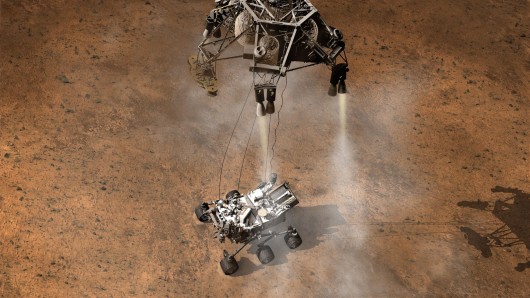
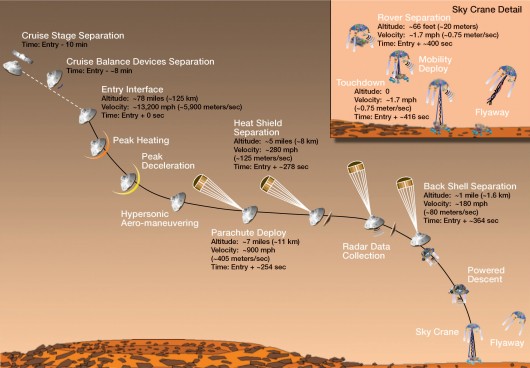
1. The Landing: Curiosity’s entrance to Mars was something truly new and revolutionary. For starters, the distance between Earth and Mars at the time of her arrival was so great that the spacecraft had to make an entirely autonomous landing with mission control acting as a bystander on a 13-minute delay. This led to quite a bit a tension at Mission Control! In addition, Curiosity was protected by a revolutionary heat shield that also acted as a lifting body that allowed the craft to steer itself as it slowed down in the atmosphere. After the aeroshell and heat shield were jettisoned, the rover was lowered by a skycrane, which is a rocket-propelled frame with a winch that dropped Curiosity to the surface.

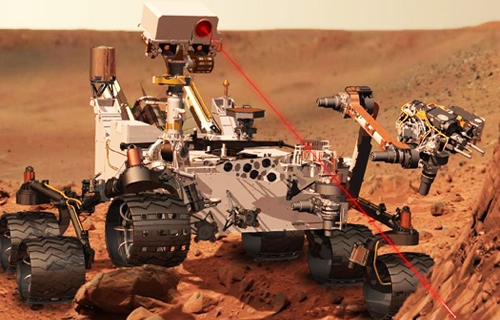
2. First Laser Test: Though Curiosity underwent many tests during the first three weeks after its landing, by far the most dramatic was the one involving its laser. This single megawatt laser, which was designed to vaporize solid rock and study the resultant plasma with its ChemCab system, is the first of its kind to be used on another planet. The first shot was just a test, but once Curiosity was on the move, it would be used for serious geological studies.Curiosity-Laser-Beam3. First Drive: Granted, Curiosity’s first drive test was more of a parking maneuver, where the rover moved a mere 4.57 m (15 ft), turned 120 degrees and then reversed about 2.4 m (8 feet). This brought it a total of about 6  m (20 ft) from its landing site – now named Bradbury Landing after the late author Ray Bradbury. Still, it was the first test of the rover’s drive system, which is essentially a scaled-up version of the one used by the Sojourn and Opportunity rovers. This consists of six 50 cm (20-in) titanium-spoked aluminum wheels, each with its own electric motor and traction cleats to deal with rough terrain.
4. Streams Human Voice: On August 28, 2012, Curiosity accomplished another historical first when it streamed a human voice from the planet Mars back to Earth across 267 million km (168 million miles). It was a 500 kilobyte audio file containing a prerecorded message of congratulations for the engineers behind Curiosity from NASA administrator Charles Bolden, and demonstrated the challenges of sending radio beams from Earth to distant machines using satellite relays.

curiosity-anniversary-45. Writes a Message: Demonstrating that it can send messages back to Earth through other means than its radio transmitter, the Curiosity’s treads leave indentations in the ground that spell out JPL (Jet Propulsion Lab) in Morse Code for all to see. Apparently, this is not so much a gimmick as a means of keeping track how many times the wheels make a full revolution, thus acting as an odometer rather than a message system.

6. Flexing the Arm: Curiosity’s robotic arm and the tools it wield are part of what make it so popular. But before it could be put to work, it had to tested extensively, which began on August 30th. The tools sported by this 1.88 m (6.2-ft) 33.11kg (73 lb) arm include a drill for boring into rocks and collecting powdered samples, an Alpha Particle X-ray Spectrometer (APXS), a scooping hand called the Collection and Handling for In-Situ Martian Rock Analysis (CHIMRA), the Mars Hand Lens Imager (MAHLI), and the Dust Removal Tool (DRT).
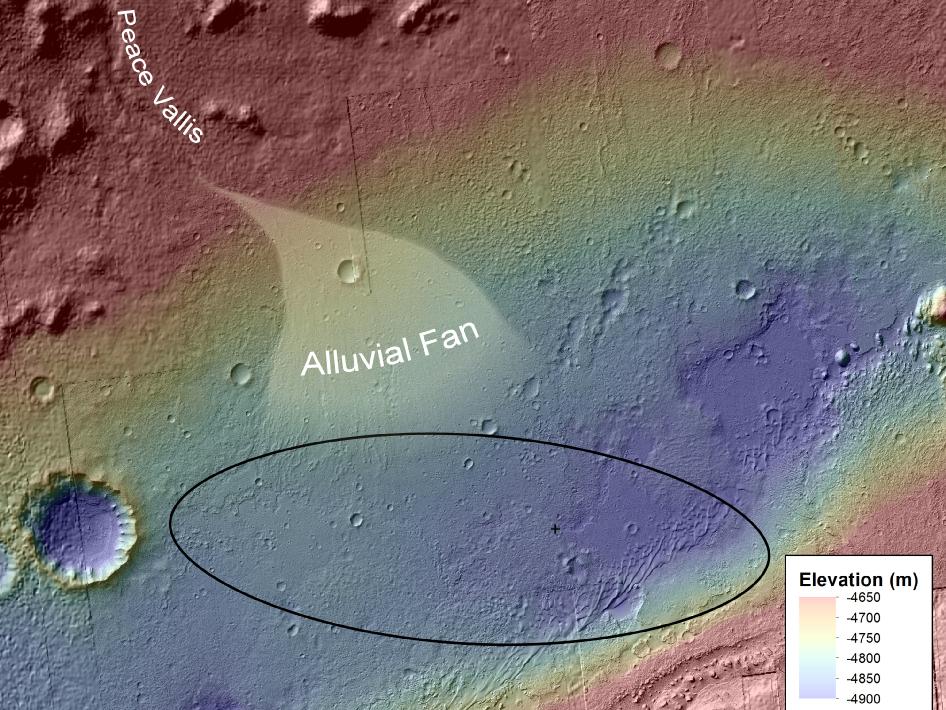
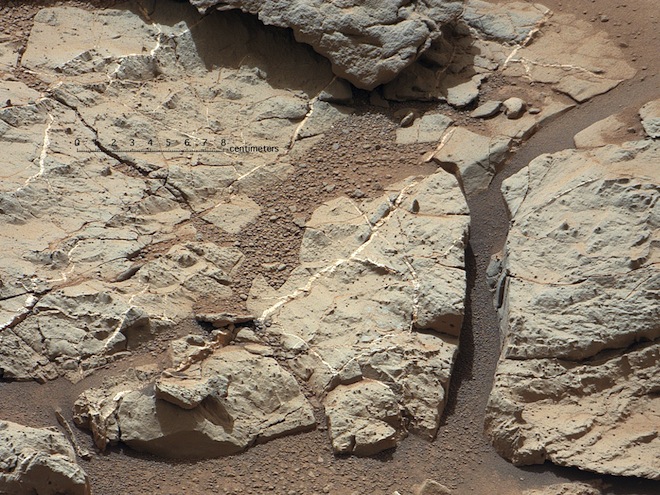
curiosity-alluvialplain7. Discovery of Ancient Stream Bed: Curiosity’s main mission is to seek out areas where life may have once or could still exist. Therefore, the discovery in September of rocky outcroppings that are the remains of an ancient stream bed consisting of water-worn gravel that was washed down from the rim of Gale Crater, was a major achievement. It meant that there was a time when Mars was once a much wetter place, and increases the chances that it once harbored life, and perhaps still does.

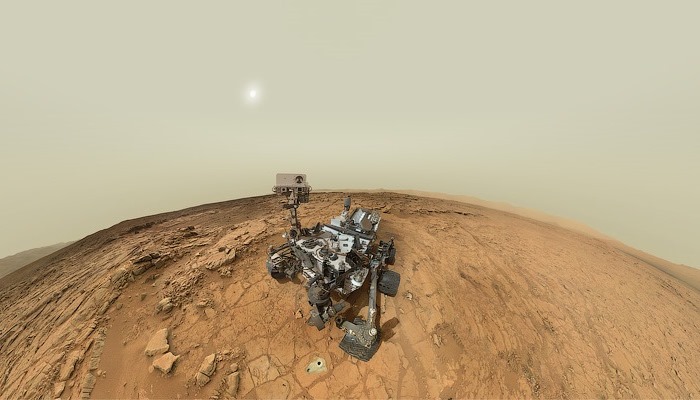
8. First Drilling: In February, Curiosity conducted the first robot drill on another planet. Whereas previous rovers have had to settle for samples obtained by scooping and scraping, Curiosity’s drill is capable of rotational and percussive drilling to get beneath the surface. This is good, considering that the intense UV radiation and highly reactive chemicals on the surface of Mars means that finding signs of life requires digging beneath the surface to the protected interior of rock formations.Curiosity_drillings9. Panoramic Self Portrait: If Curiosity has demonstrated one skill over and over, it is the ability to take pictures. This is due to the 17 cameras it has on board, ranging from the black and white navigation cameras to the high-resolution color imagers in the mast. In the first week of February, Curiosity used its Mars Hand Lens Imager to take 130 high-resolution images, which were assembled into a 360⁰ panorama that included a portrait of itself. This was just one of several panoramic shots that Curiosity sent back to Earth, which were not only breathtakingly beautiful, but also provided scientists with a degree of clarity and context that it often lacking from images from unmanned probes. In addition, these self-portraits allow engineers to keep an eye on Curiosity’s physical condition.

10. Long Trek: And last, but not least, on July 4th, Curiosity began a long journey that took it out of the sedimentary outcrop called “Shaler” at Glenelg and began the journey to Mount Sharp which will take up to a year. On July 17, Curiosity passed the one-kilometer mark from Bradbury Landing in its travels, and has now gone more than a mile. Granted, this is still a long way from the breaking the long-distance record, currently held by Opportunity, but it’s a very good start.

curiosity_roadmapSuch was Curiosity’s first 365 days on Mars, in a nutshell. As it enters into its second year, it is expected to make many more finds, ones which are potentially “Earthshaking”, no doubt! What’s more, the findings of the last year have had an emboldening effect on NASA, which recently announced that it would be going ahead with additional missions to Mars.

These include the InSight lander, a robotic craft which will conduct interior studies of the planet that is expected to launch by 2016, and a 2020 rover mission that has yet to be named. In addition, the MAVEN (Mars Atmosphere and Volatile Evolution) orbiter as just arrived intact at the Kennedy Space Center and will be blasting off to the Red Planet on Nov. 18 from the Florida Space Coast atop an Atlas V rocket.

maven_orbitThese missions constitute a major addition to NASA’s ongoing study of Mars and assessing its past, present and future habitability. Between rovers on the ground, interior studies of the surface, and atmospheric surveys conducted by MAVEN and other orbiters, scientists are likely to have a very clear picture as to what happened to Mars atmosphere and climate by the time manned missions begin in 2030.


Stay tuned for more discoveries as Curiosity begins its second year of deployment. Chances are, this year’s milestones and finds will make this past years look like an appetizer or a warm-up act. That’s my hope, at any rate. But considering what lies ahead of it, Curiosity is sure to deliver!

In the meantime, enjoy some of these videos provided by NASA. The first shows Curiosity’s SAM instrument singing “happy birthday” to the rover (though perhaps humming would be a more accurate word):


And check out this NASA video that sums up the rover’s first year in just two minutes:
News From Space: MAVEN’s “Time-Machine” for Mars

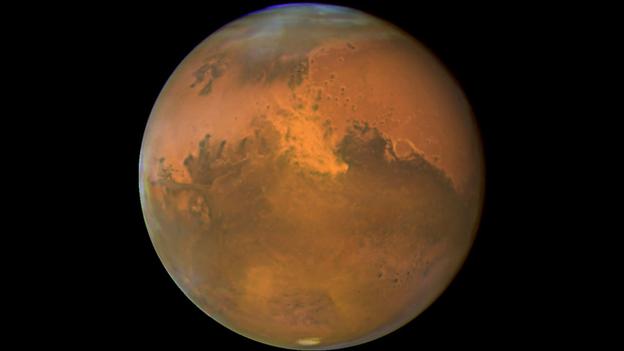
marsYes, the name is a bit of a attention-getter, but when you come to understand the purpose behind Lockheed Martin’s new spacecraft, the description does appear to be quite apt. It’s known as MAVEN, which stands for Mars Atmosphere and Volatile EvolutioN, and it is currently being produced in Lockheed Martin’s Martin Space Systems facility in Denver, Colorado.

People may recall how earlier this year, MAVEN was mentioned as part of the “Going to Mars” campaign. A project that is being organized by the University of Colorado at Boulder’s Laboratory for Atmospheric and Space Physics (CU/LASP), the Martian orbiter will be carrying a DVD featuring the names of everyone who applies, as well as three specially-selected haikus.

However, it is MAVEN’s larger mission which is now the focus of much interest. Later this year, NASA will be launching the orbiter to Mars for the sake of examine the atmosphere and answering some burning questions that remain about the planet. Thanks to evidence provided by Curiosity, Opportunity, and other missions, scientists now know that the Martian surface once boasted conditions suitable for life, including liquid water.

maven_orbitHence, Maven’s ultimate purpose, which will be will to orbit the planet and examine whether the atmosphere could also have provided life support. Scientists working on the Maven mission want to understand what this atmosphere was like, and the processes that led to its destruction. As Guy Beutelschies, Maven Programme Manager at Lockheed Martin, put it:

What we know from our missions looking at the surface of Mars is that there used to be water there. We can see the outlines of ancient rivers, the shorelines of ancient oceans. But water can’t exist there now – the atmosphere is too thin and too dry, any water would just evaporate or freeze. 

So the big question is what happened to Mars’ atmosphere? Short of being able to travel back in time into the Martian past, how would anyone go about tackling these questions with a mission today? Beutelshcies explained it as follows:

[The atmosphere] used to be thicker, warmer, wetter, now it’s thin and dry. How did we get there? In a sense we are building a little bit of a time machine. What we’re doing is understanding the processes.

maven_atmosphereJust last week, evidence provided by the Curiosity rover supports the theory that Mars may have lost most of its atmosphere billions of years ago. Still, scientists remain skeptical that Mars once had an atmosphere comparable to that of Earth. Today, that atmosphere is roughly one-hundredth the thickness of Earth’s, made up mostly of carbon dioxide and a tiny fraction of water vapor. What little remains is being stripped away by the solar wind.

And unlike Earth, Mars does not have a magnetosphere to protect its atmosphere from being blown away – at least not anymore. Such a fragile, thin band around is now unlikely to support any sort of life, as far as we know. But the atmosphere in the past must have been more substantial to allow the formation of rivers, lakes and oceans.

mars_sunsetBruce Jakosky, the Principal Investigator for Maven who is based at the University of Colorado’s CU/LASP lab in Boulder, claims:

We think that Mars used to have a magnetic field. We see places on the surface that retain some remnant magnetism, they were imprinted when they formed with whatever magnetism was there. We think that some four billion years ago, when the magnetic field turned off, that turn-off of the magnetic field allowed [for the] turn-on of the stripping by the solar wind.

To investigate the processes taking place today, Maven will dip into the Martian upper atmosphere with each orbit, measuring the particles, sampling gases, monitoring the magnetic field and solar wind. Whereas the rovers have looked at the atmosphere from the ground up, MAVEN will look at it from the top down. At this point, both are needed to put together a picture of what’s controlling the Mars environment.

maven_atmo1As well as filling in the blanks about Mars’ depleted atmosphere, Maven will also provide clues to the habitability of other planets beyond the solar system. As Jakosky said, the research conducted will have far-reaching implication for our understanding:

In trying to understand the distribution of life throughout the Universe, this is a really important indicator. Understanding the environmental conditions that allow [life] to exist, or don’t allow it to exist, is key to being able to extrapolate elsewhere.

What’s more, understanding what happened to Mars will provide some key insight into the history of our Solar System, and how it went from being a star with two planets that had oceans and atmospheres to just one. Knowing why things continued to operate on Earth, while on Mars they went horribly wrong, is likely to be quite the eye-opener, and make us all thankful we evolved here on Earth.

Source: bbc.com


News From Mars: Curiosity and Opportunity On the Move

marsMars has been quite the source of news in recent weeks. And perhaps its the fact that I got to witness some truly interesting astronomical phenomena yesterday – i.e. Sunspots through a telescope – but all of them seem to have caught my attention at once. And given their importance to the ongoing exploration of Mars and our Solar System, I would be remiss if I didn’t pass them on.

The first bit of news began late last month, when the High Resolution Imaging Science Experiment (HiRISE) camera on the Mars Reconnaissance Orbiter snapped this image of the Curiosity rover as it made its way through the “Glenelg” area of Gale Crater. The rover appeared as a little more than a blueish dot in the picture, but much more visible was the rover’s tracks.

curiosity_hirise_tracks This unique photo was made possible thanks to a little maneuvering and a some serious alignment. Basically, the folks working at the Mars Science Laboratory were able to bring the Mars Reconnaissance Orbiter (MRO) into position between the Sun and curiosity, bringing the Sun, MRO, and the rover on the surface were in a near-perfect alignment.

HiRISE principal investigator Alfred McEwen addressed the photos on the HiRISE website and explained how it was all made possible:

The rover tracks stand out clearly in this view, extending west to the landing site where two bright, relatively blue spots indicate where MSL’s landing jets cleared off the redder surface dust. When HiRISE captured this view, the Mars Reconnaissance Orbiter was rolled for an eastward-looking angle rather than straight downward. The afternoon sun illuminated the scene from the western sky, so the lighting was nearly behind the camera. Specifically, the angle from sun to orbiter to rover was just 5.47 degrees.

Curiosity has since moved on and is now heading towards the large mound in Gale Crater officially named Aeolis Mons (aka. Mount Sharp).

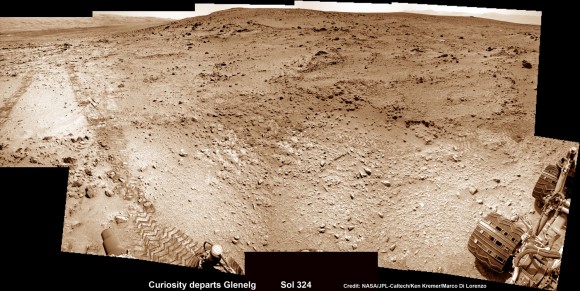
curiosity_roadmapWhich brings us to the second news item in this week’s Mars bulletin. It seems that since July 4th, after finishing up a seven months survey in Yellowknife Bay, Curiosity has achieved a long-distance driving record as it made its way to Mount Sharp. This took place on Saturday July 21st (Sol 340), when Curiosity drove a distance of 100.3 meters (109.7 yards) in a single day.

To give you some perspective, that’s the length of a football field (at least in the US), a distance that is without equal since she first landed inside the Gale Crater nearly a year ago. The previous record for a one-day drive was about half a football field – 49 meters (54 yards) – and was achieved on Sept. 26, 2012 (Sol 50), roughly seven weeks after Curiosity made its tense, nail-biting landing.

Curiosity-departs-Glenelg-Sol-324_2a_Ken-Kremer--580x291Paolo Bellutta, a rover planner at NASA’s Jet Propulsion Laboratory, Pasadena, Calif, explained what made the feat possible in a statement:

What enabled us to drive so far on Sol 340 was starting at a high point and also having Mastcam images giving us the size of rocks so we could be sure they were not hazards. We could see for quite a distance, but there was an area straight ahead that was not clearly visible, so we had to find a path around that area.

A combination of increased experience by the rover’s engineers and a series of intermediate software upgrades have also played a key role in getting Curiosity on its way to the 5.5 kilometer (3.4 mile) high Mount Sharp. This is expected to improve even more as soon as new driving software called autonomous navigation (or autonav) finishes development and is incorporated.

mountsharp_galecraterFollowing another lengthy drive of 62.4 meters (68.2 yards) on Wednesday, July 23 (Sol 342), the mission’s total driving distance  stands at 1.23 kilometers (0.81 mile) so far. But Mount Sharp still lies about another 8 km (5 miles) away at this point, so we can be expect to be hearing plenty from the rover between now and when it arrives.

For the record, it has already been discovered that the mountain contains vast caches of minerals that could potentially support a habitable environment. So when Curiosity arrives, we can expect another string of exciting finds!

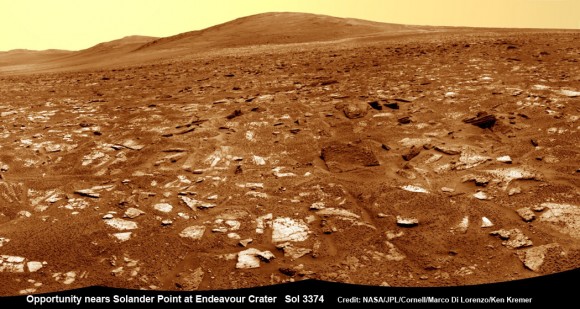
Opportunity-nears-Solander-Point-Sol-3374-N1-crop_Ken-Kremer-580x309And it is this subject of mountain goals which brings me to the last, but by no means least, of the Martian updates. While Curiosity has been making its way towards Mt. Sharp to conduct research on potentially habitable environments, Opportunity is just days away from reaching Solander Point, another Martian mountain which NASA seeks to learn more about.

This comes on the heels of the rover’s ten year, ongoing mission that was only ever expected to last ninety days. According to an update from Ray Arvidson earlier today, the mission’s deputy principal scientific investigator from Washington University in St. Louis, the rover is now just 180 meters away from the new mountain.

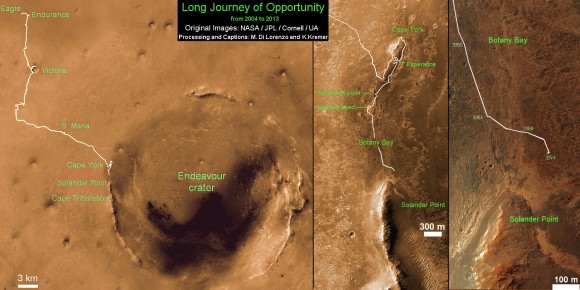
opportunity_roadmapAs NASA had previously stated, Solander Point represents ‘something completely different’ for the rover, being the first mountain it will ever climb. What’s more, the mountains mineral wealth may possess the key chemical ingredients necessary to sustain Martian life forms, and the area exhibits signatures related to water flow.

In many ways, you could say Solander Point represents a chance for the Mars Science Laboratory to find the elusive “organic molecules” they’ve been searching for since Curiosity first landed. And if it’s the veteran rover that finds the first hard evidence of their existence, it would be quite the feather in the Opportunity team’s cap.

opportunity_bdayBut before moving onto the first leg of ascent, Arvidson explained that the rover will be making a brief pause in its current location to conduce some exciting experiments. Thanks to observations made of the area by the Mars Reconnaissance Orbiter with its CRISM instrument (Compact Reconnaissance Imaging Spectrometers for Mars), the rover will be conducting some on-the-spot analysis to see if there is indeed evidence of water.

This past spring, Opportunity made the historic discovery of clay minerals and a habitable environment on a low hill called Cape York, the rover’s prior stop along the rim of Endeavour Crater. Solander was selected as the robot’s next destination because it also offers a goldmine of scientific data. Another reason was because its north facing slopes will be a boon to Opportunity’s solar wings, ensuring it more power before Martian winter sets in.

opportunity_missionmapBut since Opportunity is currently sitting on a healthy supply of power and has some time before the onset of her 6th Martian winter, the team decided to take a small detour to the southeast and spend several days exploring the area for more evidence of water-bearing minerals.

If successful, this will be yet another accomplishment for the rover during its long tenure of service to NASA. Today marks the 3380th day of continuous service for the rover – aka. Sol 3380 – a mission which has resulted in numerous scientific finds, over 182,000 images, and a driving distance of roughly 38 kilometers (23.6 miles). This, as already mentioned, puts Opportunity in the top spot for the longest distance traveled on another planet.

Yes, it seems that the Red Planet is certainly doing all it can to keep explorers and scientists intrigued. No telling what we might learn between now and the point when manned missions take place, and human astronauts are able to see the surface and study its mysteries close up. Personally, I’m hoping for signs of existing supplies of water, not to mention those tricky organic molecules. If settlement and terraforming are ever to take place, we need to know we’ve got something to work with!

Sources: universetoday.com, (2) , (3), nasa.gov, space.com

News From Space: Cassini Snaps Shots of Distant Earth

You are there
You are here

For those who follow my site, or just pay attention to a reliable news source, you may recall that NASA announced an opportunity to take part in a long-range photo op. REALLY long range. A few weeks ago, in an attempt to raise awareness about Jupiter and space exploration, NASA announced that the Cassini Space Probe would be rounding Saturn and snapping photos of a distant Earth.

The worldwide “Wave at Saturn” campaign encouraged people to look up at the skies as the probe took its shots. Junior astronomers were also encouraged to watch with their telescopes to see if they could spot the distant satellite performing its route around the massive, ringed planet. This marked the first time that NASA was able to give the people of Earth advanced warning about a space photo op, and the turnout was impressive.

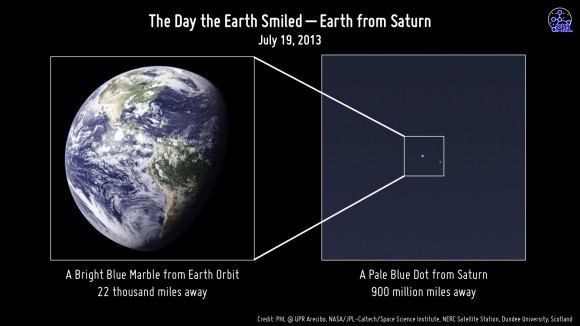
Earth_July_19_2013_Saturn-580x326Granted, North America and part of the Atlantic Ocean were the only illuminated parts of Earth at the time, but NASA claims that more than 20,000 people came out to wave at Saturn and post pictures of themselves online. Given the enormous distance involved, Earth itself appeared only 1.5 pixels wide in the photos. So congratulations if you got in the picture, but don’t expect to be able to see you face.

Not to be left out, members of NASA’s Jet Propulsion Laboratory in Pasadena gathered outside of the facility to wave at Cassini on July 19th as it rounded the Saturnalian system and snapped shots of North America. Camping out on the front lawn, researchers and scientists set up a pavilion for the afternoon and enjoyed some outdoor fun until the moment arrived to wave at the heavens.

cassini-wave20130After being beamed back to Earth from 1.5 billion km away (over a billion miles), NASA science teams got right to work processing the many photos shot by Cassini so they could create individual color composites and a panoramic view of the ‘pale blue dot’ of Earth as well as the entire Saturnalian system. And as you can see from the image posted at the beginning of this article, the first color composite was pretty damn spectacular!

Cassini took a total of 323 images using different spectral filters. The snapshots it took of Earth happened between 2:27 and 2:42 p.m. PDT on Friday, July 19 from a distance of about 1.44 billion kilometers (898 million miles). The images show the Earth and the Moon as dots barely about a pixel wide but do reveal the ‘pale blue dot’ that is home to all of humanity and our whitish colored neighbor.

saturn_cassini2006Distant views of the Earth from robotic space probes, especially from the outer reaches of our Solar System, are few and far between, and are therefore events for space and astronomy enthusiasts and everyone else to savor. The last time Cassini took mosaic pictures of Saturn and Earth was back in 2006, and those were pretty spectacular too. But on this occasion, the benefits went beyond stunning photographs.

Linda Spilker, Cassini project scientist of NASA’s Jet Propulsion Laboratory, explained:

One of the most exciting Cassini events in 2013 will be the unusual opportunity on July 19 to image the whole Saturn system as it is backlit by the sun. With Saturn covering the harsh light of the sun, we will be gathering unique ring science and also catching a glimpse of our very own home planet.

Coincidentally, the first humans (Neil Armstrong and Buzz Aldrin) set foot on the Moon 44 years ago nearly to the day of Cassini’s new images on July 20, 1969. In short, this occasion reminds us that not only do we live in a very vast universe, but that we are part of a very proud and ongoing tradition of exploration.

I Saw Sunspots Today!

solar1Today, I achieved a personal first and got to see an astronomical phenomena that few people will. While attending an open house event at my local Aviation Museum, I managed to meet up with a man who had set up a stargazing station and was showcasing some serious equipment. After waiting my turn, I got to peer through his special telescope with a sun filter. And what I saw, as the title would suggest, was something truly amazing – sunspots!

As some may know, sunspots have remained something of a mystery to astronomers and philosophers until the Scientific Revolution of the 16th century. It was at this time that Galileo observed them using his own telescope, which he did by projecting the image onto sheets of paper and recording the imperfections in the light.

sunspots1The discovery was important in helping to disprove the prevailing theory that the Earth was at the center of the universe – aka. the Geocentric theory. Up until this time, European philosophers were living under the impression that the Sun, like all celestial bodies that were believed to orbit the Earth, was a perfect sphere. By showing it to be riddled with imperfections, Galileo placed an additional nail in the philosophical basis of this idea.

This in turn helped pave the way for the acceptance of Copernicus’ theory of a Heliocentric universe. As with his observations that Jupiter had its own set of moons, that the Moon itself did not have a polished crystalline surface, and that Copernicus’ theory resolved numerous logical inconsistencies in the other model, Galileo helped to establish the field of truly scientific astronomy.

sunspot_activityToday, I learned that observing sunspots continues to be a difficult thing, since direct observation with a telescope is impossible without sun filter. Not only that, but many people mistake high-magnification for high-power, which in turn leads to images that are not of the best quality. And observing them can by difficult since they go through cycles.

As the kind host of the solar observation explained, and this NASA graph shows, sunspot activity goes through a cycle that repeats every eleven years. As we are currently at the edge of a peek in the cycle, its prime time to get a look at sunspots in the sky. The last time anyone could get a good look was in 2001, and the next opportunity won’t come until 2023.

So I feel pretty privileged, both as a geeky, space-enthusiast and a regular person. If you know someone who has access to a telescope with a solar filter, or just happen to live near an observatory that conducts tours, get out there and spot those surface imperfections. I’m not exaggerating when I say its a rare treat!

News from Space: The Orion MPCV gets a Manned Mission

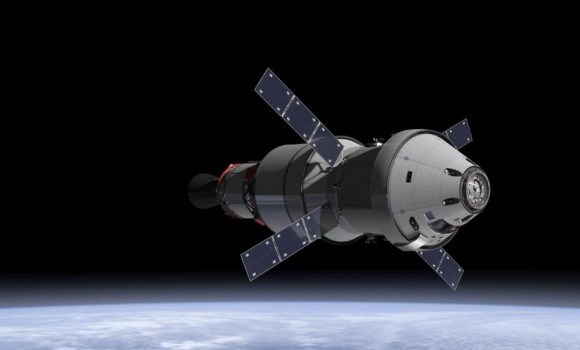
Orion_arraysIt’s known as the Orion Multi-Purpose Crew Vehicle (MPCV), and it represents NASA’s plans for a next-generation exploration craft. This plan calls for the Orion to be launched aboard the next-generation Space Launch System, a larger, souped-up version of the Saturn V’s that took the Apollo teams into space and men like Neil Armstrong to the Moon.

The first flight, called Exploration Mission 1 (EM-1), will be targeted to send an unpiloted Orion spacecraft to a point more than 70,000 km (40,000 miles) beyond the Moon. This mission will serve as a forerunner to NASA’s new Asteroid Redirect Initiative – a mission to capture an asteroid and tow it closer to Earth – which was recently approved by the Obama Administration.

orion_arrays1But in a recent decision to upgrade the future prospects of the Orion, the EM-1 flight will now serve as an elaborate harbinger to NASA’s likewise enhanced EM-2 mission. This flight would involve sending a crew of astronauts for up close investigation of the small Near Earth Asteroid that would be relocated to the Moon’s vicinity. Until recently, NASA’s plan had been to launch the first crewed Orion atop the 2nd SLS rocket to a high orbit around the moon on the EM-2 mission.

However, the enhanced EM-1 flight would involve launching an unmanned Orion, fully integrated with the SLS, to an orbit near the moon where an asteroid could be moved to as early as 2021. This upgrade would also allow for an exceptionally more vigorous test of all the flight systems for both the Orion and SLS before risking a flight with humans aboard.

orion_arrays2It would also be much more technically challenging, as a slew of additional thruster firings would be conducted to test the engines ability to change orbital parameters, and the Orion would also be outfitted with sensors to collect a wide variety of measurements to evaluate its operation in the harsh space environment. And lastly, the mission’s duration would also be extended from the original 10 to a full 25 days.

Brandi Dean, NASA Johnson Space Center spokeswoman, explained the mission package in a recent interview with Universe Today:

The EM-1 mission with include approximately nine days outbound, three to six days in deep retrograde orbit and nine days back. EM-1 will have a compliment of both operational flight instrumentation and development flight instrumentation. This instrumentation suite gives us the ability to measure many attributes of system functionality and performance, including thermal, stress, displacement, acceleration, pressure and radiation.

The EM-1 flight has many years of planning and development ahead and further revisions prior to the 2017 liftoff are likely. “Final flight test objectives and the exact set of instrumentation required to meet those objectives is currently under development,” explained Dean.

orion_spacecenterThe SLS launcher will be the most powerful and capable rocket ever built by humans – exceeding the liftoff thrust of even the Saturn V, the very rocket that sent the Apollo astronauts into space and put Neil Armstrong, Buzz Aldrin and Michael Collins on the Moon. Since NASA is in a hurry to reprise its role as a leader in space, both the Orion and the SLS are under active and accelerating development by NASA and its industrial partners.

As already stated by NASA spokespeople, the 1st Orion capsule is slated to blast off on the unpiloted EFT-1 test flight in September 2014 atop a Delta IV Heavy rocket. This mission will be what is known as a “two orbit” test flight that will take the unmanned Multi-Purpose Crew Vehicle to an altitude of 5800 km (3,600 miles) above the Earth’s surface.

After the 2021 missions to the Moon, NASA will be looking farther abroad, seeking to mount manned missions to Mars, and maybe beyond…

And in the meantime, enjoy this video of NASA testing out the parachutes on the Orion space vehicle. The event was captured live on Google+ on July 24th from the U.S. Army’s Yuma Proving Ground in Arizona, and the following is the highlight of the event – the Orion being dropped from a plane!:

News from Mars: Evidence of Falling Snow

Mars-snow-header-640x353Ever since astronomers first looked up at Mars, they discerned features that few could accurately identify. For many years, speculations about irrigation, canals, and a Martian civilization abounded, firing people’s imaginations and fiction. It was not until more recently, with the deployment of the Viking probe, that Mars’ surface features have come to be seen for what they are.

Thanks several more probes, and the tireless work of rover such as Opptorunity and Curiosity, scientists have been able to amass evidence and get a first hand look at the surface. Nevertheless, they are still hard-pressed to explain everything that they’ve seen. And while much evidence exists that rivers and lakes once dotted the landscape, other geological features exist which don’t fit that model.

curiosity_rocksHowever, a recent report from Brown University has presented evidence that snowfall may be one answer. It has long been known that ice exists at the polar caps, but actual snowfall is a very specific meteorological feature, one that has serious implications for early Martian conditions. This is just another indication that Mars hosted an environment that was very much like Earths.

And this is not the first time that snow on Mars has been suggested. In 2008, NASA announced having detected snow falling from Martian clouds, but it was entirely vaporized before reaching the ground. The Brown researchers claim that snowfall in the past, and buildup on the surface leading to melting and runoff, could have created many of the tributary networks observed near tall mountain-ranges.

mars_atmoTo back this claim up, the team used a computer simulation from the Laboratoire de Météorologie Dynamique called the Mars global circulation model (GCM). This model compiles evidence about the early composition of the red planet’s atmosphere to predict global circulation patterns. And since other models predict that Mars was quite cold, the program indicated the highest probability of snowfall over the densest valley systems.

Lead researcher Kat Scanlon also relied on her background in orographic studies (science for “studying mountains”) in Hawaii to arrive at this hypothesis. This includes how tall mountains lead to divergent weather patterns on either side, with warm, wet conditions one and cold, dry ones on the other. NASA’s Curiosity rover also was intrinsic, thanks to recent information that might explain why Mars no longer displays this kind of behavior.

Curiosity-Laser-BeamIn short, Curiosity determined that the planet is losing its atmosphere. It has taken detailed assays of the current atmosphere, which is almost entirely carbon dioxide and about 0.6% the pressure of Earth’s at sea-level. More notably, it has used its ability to laser-blast solid samples and analyze the resulting vapor to determine that Mars has an unusually high ratio of heavy to light isotopes — most importantly of deuterium to hydrogen.

The main explanation for this is atmospheric loss, since light isotopes will escape slightly more quickly than heavy. Over billions of years, this can lead to non-standard isotope levels the show a loss of atmosphere. One major theory that might explain this loss say that about 4.2 million years ago Mars collided with an object about the size of Pluto. An impact from this body would have caused a huge expulsion of atmosphere, followed by a slow, continued loss from then on.

All of this plays into the larger question of life on Mars. Is there, or was there, ever life? Most likely, there was, as all the elements – water, atmosphere, clay minerals – appear to have been there at one time. And while scientists might still stumble upon a Lake Vostok-like reserve of microbial life under the surface, it seems most likely that Mars most fertile days is behind it.

However, that doesn’t mean that it can’t once again host life-sustaining conditions. And with some tweaking, of the ecological engineering – aka. terraforming – variety, it could once again.

Living-Mars.2Source: extremetech.com
News from Space: Dream Chaser Begins Testing

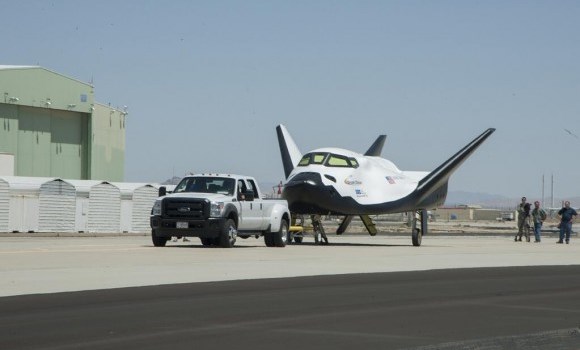
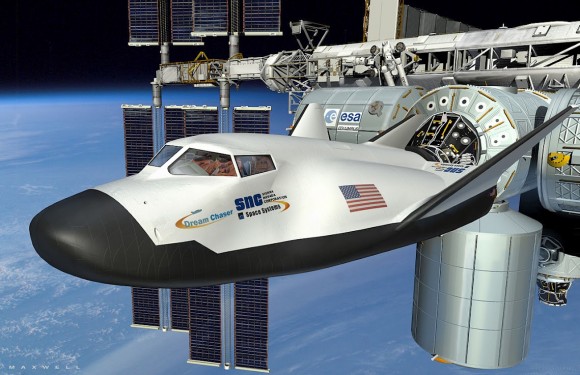
dream_chaserEver since their Space Shuttle program was forcibly shut down in 2011, NASA has been forced to look to the private sector to restore their ability to put human beings into orbit from American soil. This consists of providing the seed money needed for companies to develop a new race of “space taxis”.  One such program is the Dream Chaser, a reusable shuttle that will fly astronauts into low Earth orbit (LEO) and to the International Space Station (ISS).

Much like a standard Space Shuttle, the Dream Chaser is designed to launch atop a United Launch Alliance Atlas V rocket and land on a shuttle landing facility. And after lengthy periods of research and development, the Dream Chaser is now moving forward with a series of ground tests at NASA’s Dryden Flight Research Center in California that will soon lead to dramatic aerial flight tests throughout 2013.

dream-chaser-testThis consisted of putting the shuttle together and then conducting a series of what’s known as “Pathfinding tow tests” on Dryden’s concrete runway. The purpose here is to validate the performance of the vehicles’ nose skid, brakes, tires and other systems to prove that it can safely land an astronaut crew after surviving the searing re-entry from Earth orbit. For the initial ground tests, the ship was pulled by a tow truck at 16 and 32 km/h (10 to 20 mph).

Later this month, the next leg of the test will consist of towing it up to speeds of 64 to 95 km and hour (40 to 60 mph). The next phases of testing will take place later this year in the form of airborne captive carry tests, where an Erickson Skycrane helicopter will fly the fuselage around to see how it holds up. Approach and Landing Tests (ALT) will follow to check the aerodynamic handling, which will consist of atmospheric drop tests in autonomous free flight mode.

dream-chaser-test1In an interview with Universe Today, Marc Sirangelo – Sierra Nevada Corp. vice president and SNC Space Systems chairman – spoke on record about the shuttle and where it is in terms of development:

It’s not outfitted for orbital flight. It is outfitted for atmospheric flight tests. The best analogy is it’s very similar to what NASA did in the shuttle program with the Enterprise, creating a vehicle that would allow it to do significant flights whose design then would filter into the final vehicle for orbital flight.

In short, the Dream Chaser has a long way to go, but the program shows great promise. And as already noted, they are not the only ones benefiting from this public-private agreement that seeks to develop commercial vehicles for the sake of kick starting space travel.

dream-chaser-dockedOther companies include Boeing and SpaceX, companies that were also awarded contracts under NASA’s Commercial Crew Integrated Capability Initiative, or CCiCap. All three have their own commercial vehicles under development, such as the Boeing CST-100, SpaceX’s Dragon, which are similarly designed to bring a crew of up to 7 astronauts to the ISS and docking with it for up to 6 months.

Dream_Chaser_launchBut of course, everything depends on NASA’s approved budget, which seems headed for steep cuts in excess of a billion dollars if a Republican dominated US House has its way.This is the third contract in NASA’s Phase 1 CCiCap contracts, who’s combined value is about $1.1 Billion and runs through March 2014. Phase 2 contract awards will eventually lead to actual flight units after a down selection to one or more of the companies. The first orbital flight test of the Dream Chaser is not expected before 2016 and could be further delayed if NASA’s commercial crew budget is again slashed by the Congress – as was done in the past few years.

But as William Gerstenmaier – NASA’s associate administrator for human exploration and operations in Washington – indicated in a statement, the larger goal here is one of repatriation. As it stands, US astronauts are totally dependent on Russia’s Soyuz capsule for rides to the ISS, which costs upwards of $70 million a trip. NASA hopes to change that by rekindling the “good old days” of space travel:

NASA centers around the country paved the way for 50 years of American human spaceflight, and they’re actively working with our partners to test innovative commercial space systems that will continue to ensure American leadership in exploration and discovery.

And I for one wish NASA luck. Lord knows thirty-years of post-Cold War budget cutbacks hasn’t been easy on them. And hitching rides into space above Cold War era rockets is not the best way of getting your astronauts into space either!

In the meantime, check out this concept video of the Dream Chaser in action, courtesy of the Sierra Nevada Corporation:


Source:
universetoday.com

News from Space: The Canadarm2!

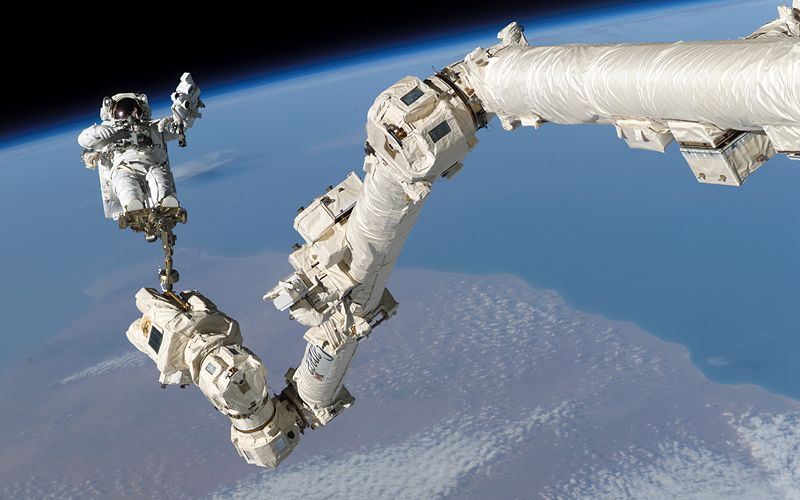
Astronaut Steve K. Robertson during STS-114

For decades, the Canadian Space Agency has been building the Shuttle Remote Manipulator System (SRMS) – also known as the Canadarm. Since 1981, aboard the shuttle STS-2 Columbia, this model of robotic arm has come standard on all NASA shuttles and was used as its main grasper. However, due to the progress made in the field of robotics over the past thirty years and the need for equipment to evolve to meet new challenges, the Canadarm was retired in 2011.

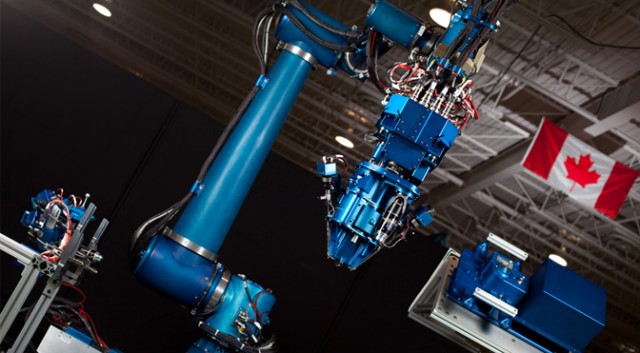
Luckily, the CSA is busy at work producing its successor, the Mobile Service System – aka. Canadarm2. The latest versions are in testing right now, and their main purpose, once deployed, will be to save satellites. Currently, an earlier version of this arm serves as the main grasper aboard the ISS, where it is used to move payloads around and guide objects to the docking port.

canadarm2However, the newest models – dubbed Next Generation Canadarm (NGC) – are somewhat different and come in two parts. First, there is the 15 meter arm that has six degrees of freedom, extreme flexibility, and handles grappling and heavy lifting. The second is a 2.58 meter arm that comes attached to the larger arm, is similarly free and flexible, and handles more intricate repair and replacement work.

This new model improves upon the old in several respects. In addition to being more intricate, mobile, and handle a wider array of tasks, it is also considerably lighter than than its predecessor. When not in use, it is also capable of telescoping down to 5 meters of cubic space, which is a huge upshot for transporting it aboard a shuttle craft. All of this is expected to come in handy once they start the lucrative business of protecting our many satellites.

canadarm2_missioncontrolIt’s no secret that there is abundance of space junk clogging the Earth’s upper atmosphere. This moving debris is a serious danger to both manned and unmanned missions and is only expected to get worse. Because of this, the ability to repair and retool satellites to keep them in operation longer is of prime importance to space agencies.

Naturally, every piece of equipment needs to undergo rigorous testing before its deployed into space. And the Canadarm2 is no exception, which is currently being put through countless simulations. This battery of tests allows operators to guide dummy satellites together for docking using the arms in both full manual and semi-autonomous mode.

canadarm2_chrishadfieldNo indication on when they will be ready for service, but it seems like a safe bet that any manned missions to Mars will likely feature a Canadarm2 or two. And as you can see, Chris Hadfield – another major Canadian contribution to space – is on hand to help out. Maybe he and the new arm can perform a duet together, provided it can handle a guitar!

And be sure to check out this video of the NGC Canadarm2 in action, courtesy of the Canadian Space Agency:


Source:
Wired.com

News From Space: First Blue Exoplanet Discovered!

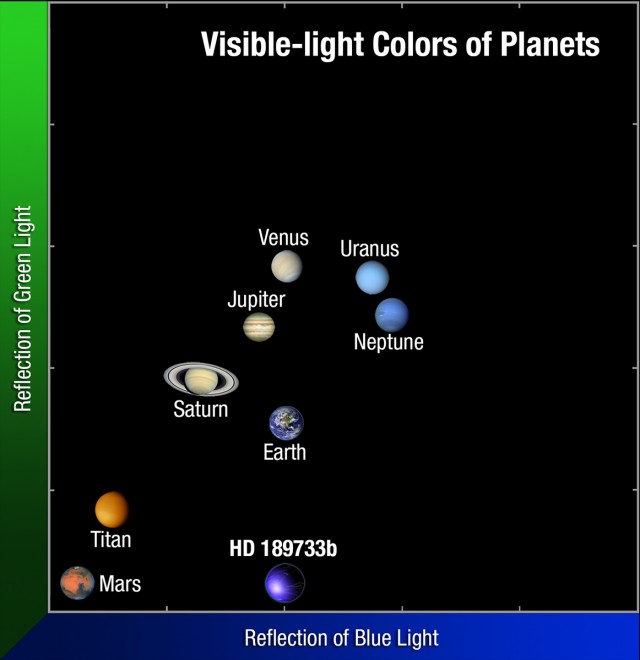
HD_189733_b_deep_blue_dotEver since our astronomers have gained the ability to see into deep space and discern what lies in distant solar systems, a total of 910 extra-solar planets have been discovered. Of those, only a handful have been confirmed as potentially habitable by Earth scientists. Despite these discovered, it was not until recently that a “blue planet” outside of the Solar System, thanks to NASAs Hubble telescope.

But here’s the kicker: as it turns out, the planet is not blue due to the presence of liquid water. The blue color likely comes from clouds in the atmosphere made of molten glass. The planet is known as HD 189733 b, located roughly 63 light years away from Earth in the constellation of Vulpecula (aka. the Fox). Initially discovered in 2005 by French astronomers who observed it passing in front of its star, HD 189733 b is one of the best-studied exoplanets.

Hd189733b_blue_planet_artPrior to this new finding, it was already known that the planet was a hot Jupiter — a massive gas giant that orbits very close to its parent star — and that, using polarimetry, it was most likely blue. Since that time, the blue color has been confirmed by a spectrograph aboard Hubble which scanned the planet during an eclipse. As it passed behind its parent star and out of our vision, Hubble recorded less blue light coming from the star, while the other colors remained the same.

This strongly indicates that the light reflected by HD 189733 b’s atmosphere is blue and thus, if we were close enough to directly observe the planet, it would appear blue. This is an apparent first for astrophysicists and astronomers, who wouldn’t normally be able to observe such a fluctuation from 63 light years away. But the size of the planet, plus the amount of light reflecting off it from its very-close-by star, mean that Hubble can do its thing.

blue_planet_image2-640x660As for the cause of the color itself, the current theory is that the planets atmosphere is full of clouds that contain tiny silicate particles, which absorb some light frequencies but reflect and scatter blue light. In the words of NASA, because the surface of the planet is around  815 Celsius (1,500 Fahrenheit), these particles are likely in a molten, liquid state that periodically turn into rain. Yes, you read that right, the planet experiences periods of molten glass rain!

In addition to that, it is also known that its orbital period (length of a year) is only 2.2 days. The planet is also tidally locked, meaning that one side is always facing towards the sun while the other experiences perpetual night. So basically, outside of its blue color, HD 189733 b is about as uninhabitable as it gets.

Ah well, the search for a truly Earth-like exoplanet continues I guess! And in the meantime, enjoy this short video from Hubble ESA – a computer graphic representation of the universe’s other “blue planet”:

Source: Extremetech.com